
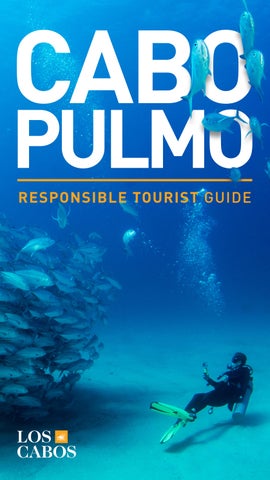
Los Cabos | Cabo Pulmo Guide (eng)

Page 1


THE HISTORY OF CABO PULMO

MORE THAN 30 YEARS AGO...

THIS AREA OF GREAT NATURAL BEAUTY WAS THREATENED BY OVERFISHING, UNTIL THE LOCAL COMMUNITY CAME TOGETHER TO CHANGE THIS SITUATION FOR THE BENEFIT OF THE PEOPLE AND THE ENVIRONMENT.

Thanks to this initiative, this marine protected area was created on June 6, 1995. Ten years later, UNESCO recognized it as a Natural World Heritage Site and in 2008 it was recognized as a RAMSAR site due to its global importance as a wetland.

Cabo Pulmo is a perfect example of ecotourism, ideal for those looking for the quieter, natural side of Los Cabos. Water activities in this area provide a closer look at its incredible underwater ecosystem.

THIS

IS A REMOTE, RUSTIC ECO-DESTINATION, PERFECT FOR THOSE LOOKING FOR EXTRAORDINARY ADVENTURES.

When at Cabo Pulmo, speak with locals and learn about the great conservation, training and commitment efforts that exist in this tourist destination located within a protected natural area.

HOW TO GET CABO PULMO?

POINT OF DEPARTURE

A. Todos Santos

B. Pacifico

C. Cabo San Lucas

D. Tourist Corridor

E. San Jose del Cabo

F. Los Cabos Airport

G. Cabo del Este

H. La Paz Airport

THE CABO PULMO NATIONAL

PARK REEF IS CONSIDERED A TREASURE OF

BAJA CALIFORNIA SUR

It is North America’s largest, most diverse coral reef.

It is around 20,000 years old.

Located within the ā€œAquarium of the World.ā€

Cabo Pulmo is home to 5 out of the 7 endangered sea turtle species in the world.

It provides a safe haven for more than 800 sealife species in the Gulf of California.

+300 fish species.

It has become a world-famous diving and snorkeling location, with top-level instructors.

As well as one of the largest shark aggregations, including the sand tiger shark, tiger shark, great hammerhead, blacktip reef shark, and great white shark.

10 RULES FOR RESPONSIBLE TOURISTS

LOS CABOS ENCOURAGES VISITORS TO MAKE AN EFFORT TO TAKE CARE OF THE ENVIRONMENT IN VARIOUS WAYS WHILE EXPERIMENTING AND EXPLORING CABO PULMO:

Take care of water, it is our most fragile resource.

Learn and follow the rules of Cabo Pulmo National Park.

Manage your solid waste responsibly.

Visit Cabo Pulmo National Park with an accredited, preferably local guide.

Do previous research on the destination you are going to visit and book your activities in advance.

Shop at local businesses and don’t encourage bargaining.

Learn and respect the community’s customs and its people.

Respect and learn about land and marine flora and fauna. Don’t take them as souvenirs, take photographs instead.

Respect other visitors.

For your safety, identify information desks, emergency contacts and health safety protocols.

ACTIVITIES AND RULES

The main tourist activities at Cabo Pulmo National Park are diving and snorkeling. Most stores that offer these services have rental equipment, but you can use yours if you prefer so.

Other activities include bike rides, camping, kayaking, etc.

DIVING (AUTONOMOUS DIVING)

• The activity requires an accredited guide.

• Maximum 6 tourists per guide.

• PADI, FMAS, NAUI, etc. certification required.

• Maximum 3 vessels per site (20 minutes between groups).

• Maximum 50 minute immersion per group.

• Minimum 2.5 m (8.2 ft.) distance from corals.

SNORKELING (FREE DIVING)

• Opening hours 6:00 a.m. to 6:59 p.m.

• The activity requires an accredited guide.

• Maximum two vessels per site.

• Mandatory use of life jacket.

• Maximum eight tourists per guide.

• Maximum 30 minutes per group per site.

SWIMMING

• This activity can be carried out at a maximum distance of 20 meters from the coast and in the sandy areas of the beaches: Miramar Norte, Cabo Pulmo, El Arbolito and Los Frailes.

• Swimming with sharks is prohibited, neither on tour nor from the shore.

MAIN RULES FOR SNORKELING AND DIVING

SPECIES CALENDAR

YOU ARE IN ONE OF THE MOST SUCCESSFUL PROTECTED AREAS OF MEXICO AND THE WORLD

In 1995, this community decided to trade its fishing nets for tourism and this commitment to conservation has paid off. Today, thanks to the authorities, researchers, civil society organizations and neighboring communities, this Park is one of the best preserved sites in the Gulf of California.

The Cabo Pulmo reef is 5,000 years old and is the only living coral reef in the Gulf of California. In many

ways, visiting Cabo Pulmo is like diving into the past. Here you can observe several species that belong to history in other sites.

Here you can see groupers, sea bass, sharks, turtles and many other species. If you are lucky, you can find groupers that are over 60 years old and 2 meters in length.

Cabo Pulmo National Park is recognized by UNESCO as World Heritage and Ramsar site. We invite you to enjoy the beauty of this place and respect the regulations.

The payment of your bracelet funds the proper management of this site. Patronizing local community businesses helps make conservation a viable livelihood option.

FREE DIVING

• At least level 1 certification guests.

• Maximum 6 tourists per instructor.

• Vessel with white and blue flag with park logo.

• Maximum 2 vessels per site.

• Maximum 50-minute immersion per site.

SWIM WITH SHARKS

DIVE SIGHTING

• Open-water certification.

• Minimum of 25 traceable dives.

• Diving in pairs and small groups.

• Diving in designated sandy areas.

• Diving silently, stealthily.

• Staying at the bottom most of the dive.

• Avoid touching or getting in the way of sharks.

• Avoid snorkeling or free diving in the presence of sharks.

• Avoid using flash.

CRANX

• For more information click here.

BEACH, CAMPING AND KAYAKING

For those who want to spend time on the beach, camping or taking a kayak tour, a recommended place for these activities is Playa El Arbolito. There, you can find a local store offering these services, where you can get to know another part of Cabo Pulmo National Park. Its access hours vary according to weather conditions. It also has limited capacity.

BEACHES

• Avoid leaving trash behind.

• Motor vehicle traffic on the beach is prohibited.

• Do not take or remove flora, fauna and elements of nature.

• Respect the established load capacity.

KAYAK, PADDLE BOARD, KITE and WINDSURF

• Life jacket is mandatory.

• An accredited guide is required for this activity.

• Maximum 5 tourists per guide.

CAMPING

Light campfires within designated areas and with materials that are external to the park.

Do not dig, level, cut or dismount vegetation from the camping land.

Extinguish the fire completely, without leaving ash or coal residue.

Do not leave any organic or inorganic waste

Do not put up permanent camping facilities.

Do not make noises that may disturb visitors or the natural behavior of wildlife.

Please note that there are certain restrictions during the sea turtle spawning and nesting season (june to february).

Do not light campfires.

Do not use any type of lights (flashlights, photo flash, video lighting, etc.).

Do not make excessive noises.

Do not swim in the nesting areas from 7:00 p.m. to 7:00 a.m.

Miramar Arbolito Los Frailes

CABO PULMO NATIONAL PARK VISITORS CENTER

CABO PULMO HAS A VISITOR CENTER FOR TOURISTS AND VISITORS, WHERE THEY CAN FIND INFORMATION ABOUT CABO PULMO, THE PROTECTED NATURAL AREA, AS WELL AS GENERAL INFORMATION TO HELP TOURISTS DURING THEIR STAY.

The Center has three modules where you will find information, a souvenir store, a representation of the coral reef and its representative species, as well as a representation of the terrestrial environment that surrounds this wonderful place.

The Visitor Center aims to be a space that promotes knowledge and dissemination of the natural characteristics of Cabo Pulmo and the East Cape region, it’s culture, inhabitants and the threats it faces, in a way that invites residents and visitors to reflect and learn that favors their participation in the region sustainability based on scientific information.

ADMISSION IS FREE

READY FOR YOUR TRIP

CLOTHING

In the Spring, Summer and Fall seasons, to protect yourself from the sun, we recommend wearing a long-sleeved t-shirt for the water, a cap and/or hat, and, preferably, not wearing sunscreen. Even if it is biodegradable, it damages the ecosystem. In the winter season, in addition to the above, we recommend a windbreaker or sweatshirt and wetsuit.

THE ROAD

To get here, you will have to go through a road of terraces of approximately 10 Km (6.2 mi.), which becomes dangerous during the rainy season (September). We recommend using a suitable vehicle, and carrying basic tools in case of any mishap. Being in a rural area near a mountain range, phone signal may be lost in some sections. The closest gas station to the community is 27 km (16.77 mi.) away, in La Ribera community, and has restricted opening hours.

MONEY

The community does not have ATMs, the nearest one is 27 km (16.77 mi.) away and several businesses do not accept electronic payments or do not have a terminal, so it is best to carry sufficient cash with you.

COMMUNICATION

Although the town has telephone signal, it can fail from time to time. Internet is slow and limited, so businesses do not provide this service. In bad weather, telephone signal is completely lost.

COMMUNITY STORE

In the community, the stores that offer groceries are very small and have limited products. If you need groceries for your trip, such as water, hygiene products, etc., make sure to bring them with you.

MEDICINE CABINET

The community has no health services or pharmacy, so we suggest traveling with a first-aid medication kit. In rainy seasons, there are often a lot of mosquitoes, so we recommend that you wear eco-repellent and some ointment to relieve the bites.

PETS

Pets, such as dogs and cats, are allowed in. However, it is ideal to avoid bringing them. There are several stray dogs in the community that do not respond well to the presence of other pets so, to prevent an unpleasant incident, we recommend you consider this.

PERMISSIONS FOR UNDERWATER CAMERAS, DRONES OR FILMS

The notice for the use of underwater cameras by tourists for personal purposes shall be made by means of a written letter. This applies to both autonomous diving and free diving tourists. You will need to provide the following details:

Ā» Location and date

Ā» Addressed to director

Ā» Camera and accessories data

Ā» Photographer’s name and photocopy of ID

Ā» Immersion dates

Ā» Activity sites

Ā» Vessel data (NAME OF CERTIFICATION, CAPTAIN AND GUIDES)

Send documents to abigail.reynoso@conanp.gob.mx

Permissions to carry out filming and photography activities in Natural Protected Areas (ANP, Ɓreas Naturales Protegidas) for commercial purposes, the procedure must be done in advance. More information can be found in this link.

EMERGENCIES

DAN

LOS CABOS CIVIL PROTECTION

LOS CABOS SEARCH AND RESCUE (SEMAR)

LOS CABOS HOSPITAL HYPERBARIC CHAMBER

CABO PULMO NATIONAL PARK OFFICE

STATE CIVIL PROTECTION

LA PAZ SEARCH AND RESCUE (SEMAR)

MARINE RADIO BAND

911

+1 (919) 684 9111

+1 (624) 160 1311

+1 (624) 105 1110

+1 (624) 143 3666

+1 (624) 130 0195 (Mon.-Fri.: 9 a.m. to 5 p.m.)

+1 (612) 105 1110

+1 (612) 122 6513

CANAL 16

Los Cabos Search and Rescue (SEMAR)
Sierra de La Laguna
Los Cabos Civil Protection
Los Cabos Hospital Hyperbaric Chamber
Cabo Pulmo National Park Office

We would like to thank the entire team of:

SUSTENTUR NIPARAJƁ CONANP

ACCP

Turn static files into dynamic content formats.
CreateĀ aĀ flipbook
Los Cabos | Cabo Pulmo Guide (eng) by FITURCA - Issuu