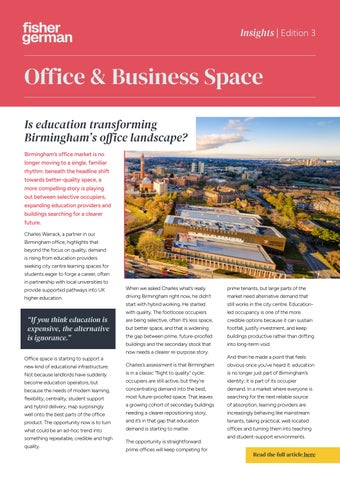
Is education transforming Birmingham’s office landscape?
Birmingham’s office market is no longer moving to a single, familiar rhythm: beneath the headline shift towards better-quality space, a more compelling story is playing out between selective occupiers, expanding education providers and buildings searching for a clearer future.
Charles Warrack, a partner in our Birmingham office, highlights that beyond the focus on quality, demand is rising from education providers seeking city centre learning spaces for students eager to forge a career, often in partnership with local universities to provide supported pathways into UK higher education.
“If you think education is expensive, the alternative is ignorance.”
Office space is starting to support a new kind of educational infrastructure. Not because landlords have suddenly become education operators, but because the needs of modern learning, flexibility, centrality, student support and hybrid delivery, map surprisingly well onto the best parts of the office product. The opportunity now is to turn what could be an ad-hoc trend into something repeatable, credible and high quality.
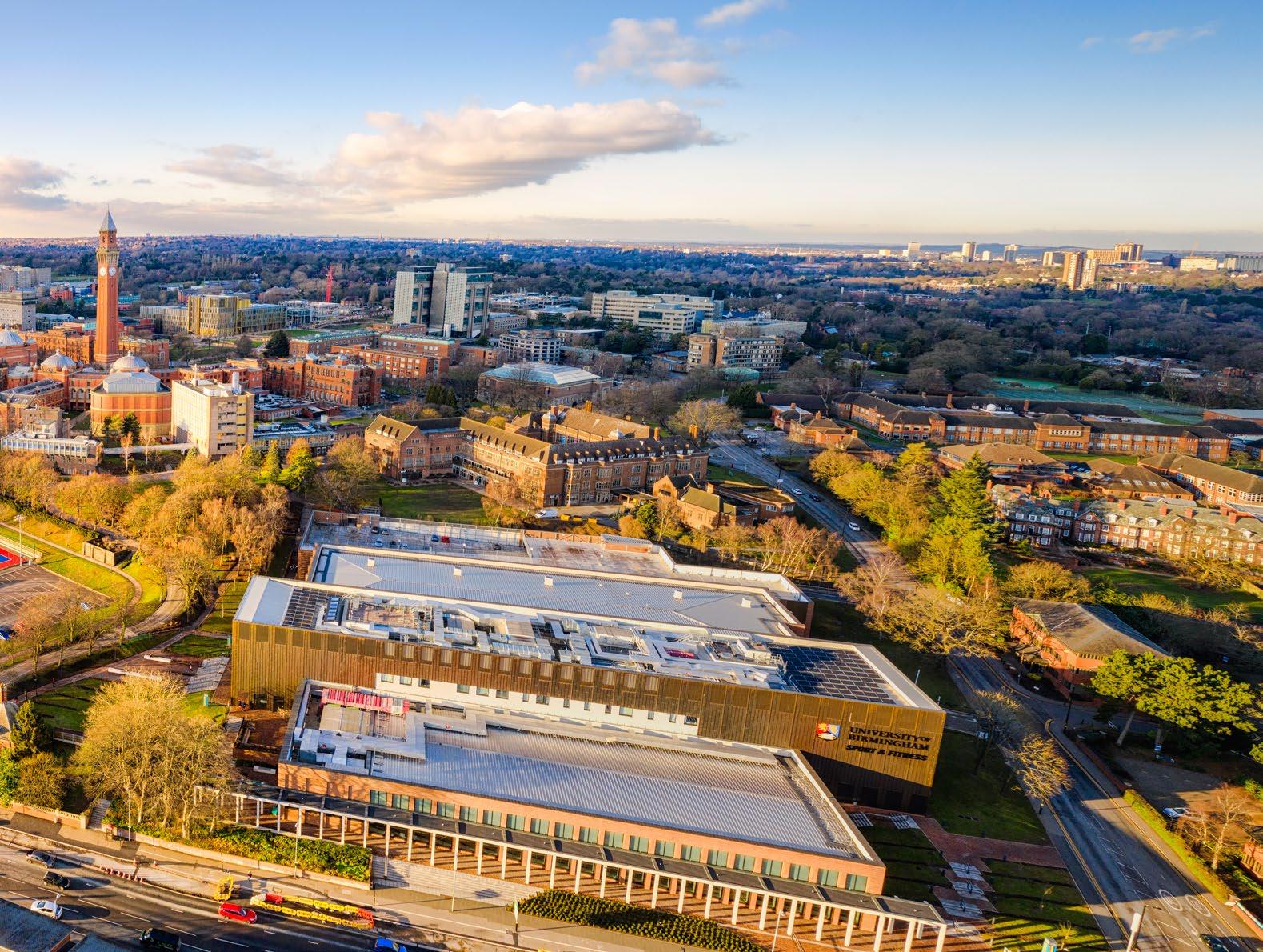
When we asked Charles what’s really driving Birmingham right now, he didn’t start with hybrid working. He started with quality. The footloose occupiers are being selective, often it’s less space, but better space, and that is widening the gap between prime, future-proofed buildings and the secondary stock that now needs a clearer re-purpose story.
Charles’s assessment is that Birmingham is in a classic “flight to quality” cycle: occupiers are still active, but they’re concentrating demand into the best, most future-proofed space. That leaves a growing cohort of secondary buildings needing a clearer repositioning story, and it’s in that gap that education demand is starting to matter.
The opportunity is straightforward: prime offices will keep competing for
prime tenants, but large parts of the market need alternative demand that still works in the city centre. Educationled occupancy is one of the more credible options because it can sustain footfall, justify investment, and keep buildings productive rather than drifting into long-term void.
And then he made a point that feels obvious once you’ve heard it: education is no longer just part of Birmingham’s identity; it is part of its occupier demand. In a market where everyone is searching for the next reliable source of absorption, learning providers are increasingly behaving like mainstream tenants, taking practical, well-located offices and turning them into teaching and student-support environments.
The evolving office: From place to performance
The office debate has moved beyond simplistic questions of attendance and square footage. What is now emerging is a more mature and evidence-based understanding of workplace space as a strategic tool: one that must support people, justify investment and create environments worth travelling for. The question is no longer whether the office still matters, but what it must deliver to justify its role in a hybrid world.
Over the past five years, the office sector has undergone a structural reset. What began as an emergency shift to remote working has evolved into a more nuanced understanding of how space supports organisational performance.
Early hybrid strategies were shaped by speed and necessity, with many organisations reducing headquarters space and expanding into suburban or lower-cost locations. While logical at the time, those approaches have exposed clear limitations: fragmented teams, duplicated costs, inconsistent experiences and increased estate complexity. We are now entering a more mature phase in which the focus is not on reducing space for its own sake, but on aligning space more precisely with organisational purpose.
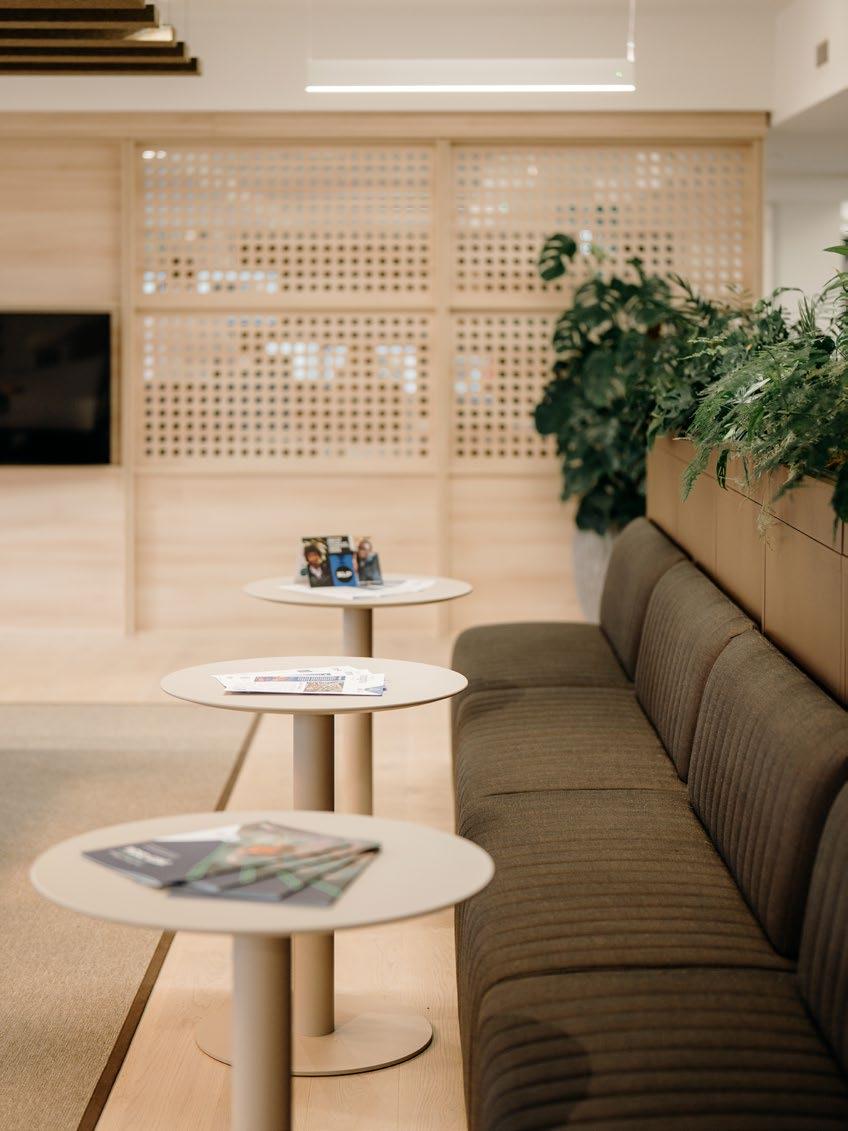

That reassessment is also changing how location is valued. City-centre demand has proven more resilient than many anticipated, underpinned by a simple but powerful dynamic: accessibility. Central locations remain the most practical meeting points for dispersed workforces, supported by transport connectivity, amenity and wider urban ecosystems.
In a hybrid environment, where every journey is weighed against the option of staying at home, convenience and surrounding experience matter more, not less. At the same time, the role of the office has shifted. It is no longer a default place for everyday tasks, but a strategic destination for collaboration, culture, connection and client engagement. In practical terms, the office must now excel where physical proximity adds distinctive value: building relationships, accelerating learning, strengthening culture and supporting innovation through proximity.
Perhaps the most important shift is conceptual. The workplace is no longer simply a real estate decision; it is a people and performance strategy expressed through place. A successful office is not defined by design features alone, but by the behaviours it enables.
The most effective workplaces encourage collaboration and informal
learning, support focused work and recovery, facilitate inclusion, trust and belonging, and strengthen the weak ties across teams that so often drive innovation. Critically, they act as a platform for social capital: the informal relationships, exchanges and moments of trust that underpin organisational effectiveness but are difficult to replicate remotely. As in-person contact becomes less frequent, these moments become more valuable, not less. The office must therefore answer a fundamental question: why would a talented individual choose to spend time here?
That people-first lens is also reshaping what the market rewards. Three forces are now converging to redefine value in the office sector: experience, performance and ESG.
Employees are making an implicit comparison every day between the experience of coming into the office and the experience of staying at home. Mandates may increase attendance in the short term, but sustained engagement depends on perceived value.
At the same time, sustainability has become a commercial reality rather than a compliance issue alone. A significant proportion of existing stock

is already functionally obsolete from an environmental perspective, with sub-B EPC ratings increasingly misaligned with occupier requirements, investor expectations and the direction of regulation in the UK. This now directly influences leasing velocity, tenant demand, financing conditions and long-term asset value, making building performance an increasingly useful proxy for income resilience. The result is an increasingly polarised market in which best-in-class, fully fitted, amenity-rich, tech-enabled workplaces command premium rents and stronger lease terms, while underinvested stock faces a widening risk of obsolescence. Standing still is no longer neutral; it is an active value risk.
This is prompting a more forensic, portfolio-level approach to decisionmaking. For occupiers, the direction of travel is towards fewer, better and smarter locations: consolidating into higher-quality space, aligning workplace settings with specific outcomes such as collaboration, learning and client engagement, creating more hospitalityled or “clubhouse” environments that blend work, social and cultural functions, and scrutinising operational performance, cost transparency and ESG credentials with far greater discipline.
For landlords and investors, a clearer segmentation strategy is essential. Assets increasingly fall into one of four pathways: optimisation, light retrofit, deep retrofit or redevelopment. The central challenge is diagnostic rather than cosmetic: deploying the right capital to the right asset in the right location. Partial upgrades without meaningful performance improvement risk becoming value traps rather than repositioning strategies.
“The office is not disappearing: it is becoming more deliberate.”
One of the clearest lessons of the past five years is that attendance cannot be forced sustainably; it must be earned.
The most successful organisations are shifting from mandate to magnetism, focusing on creating compelling reasons to come together, designing spaces people would genuinely miss if removed, supporting flexible and inclusive ways of working, and reducing friction through technology and operational excellence. This requires leadership clarity.
The starting point is not how many desks are needed, but what the office
is for, which interactions genuinely benefit from physical presence, and which behaviours the organisation wants to encourage. Space can then be designed around outcomes rather than assumptions.
The strategic implications for leaders are clear. Start with purpose, not space. Prioritise quality over quantity. Integrate ESG and economics rather than treating them as separate agendas. Design for behaviour, recognising that workplace effectiveness is determined by what people do, not just where they sit. And treat space as dynamic infrastructure that must remain flexible, adaptable and actively managed over time.
The office is not disappearing; it is becoming more deliberate. In a hybrid world where every commute is a choice, the office must deliver measurable value by enabling connection and collaboration, supporting culture and belonging, enhancing productivity and wellbeing, and reinforcing organisational identity.
The winners in this more selective market will be those who make informed, asset-specific and organisationally aligned decisions. The office of the future is not a place people have to go. It is a place that works hard enough that they want to.
Why I swapped the suburbs for Manchester city centre
After three years of commuting into Manchester, Marcus Baumber, a Senior Surveyor in our commercial agency team, moved from the suburbs into the city centre and quickly realised the biggest benefit wasn’t just time saved, but friction removed. What prompted your move to Manchester, and how has that changed your day-to-day life?
It was mainly lifestyle. I grew up in the suburbs, lived with my parents, and wanted my own routine. I’d worked in Manchester for three years, so I knew what I was missing while driving in and out. The practical change was immediate: my commute is now a 10-minute walk, not an hour’s drive.

That doesn’t just save time, it helps to change your work-life balance. I can train in the morning and start work feeling calmer. In the evenings I have real free time, not free time minus traffic. You don’t realise how draining commuting is until it’s gone.
Was the move driven more by lifestyle, career opportunities, or a mix of both?
A mix of both. Socially, it’s easier to see friends after work without planning your whole night around travel. Professionally, being in the city puts you closer to clients and opportunities, and it’s simpler to say yes to something last minute when you’re already nearby.
What do you enjoy most about living and working in Manchester city centre?
Everything is close. Manchester is thriving and there’s always something going on, new openings, events, popups, gigs. Living in the centre means you don’t have to “make a night of it” to enjoy the city, you can meet friends or clients after work without thinking about trains, parking, or the drive home.
How has being closer to work impacted your work-life balance?
Very positively. Less commuting means more flexibility before and after work, for
Our key office and business space specialists, providing expert advice are here to help:

Ben Stanley London and South East 020 7747 3141
ben.stanley@fishergerman.co.uk


exercise, seeing people, or switching off earlier. I’ve gained close to two hours a day back, and it makes the working week feel lighter.
Do you feel more connected to your colleagues, clients, or the business community by being based in the city?
Yes. Being based in the city makes it much easier to meet clients for a coffee or a drink after work, and regular face-to-face time feels more natural. In a relationship-driven industry, those informal catch-ups build trust. Proximity also matters for the bigger picture: this is a people business, and in agency work your network is everything. Being nearby is what makes the quick meeting happen, the event you actually attend, and the relationships you keep active over time.
What would you say to someone considering a similar move?
David Laws
North West 0161 214 4661
david.laws@fishergerman.co.uk
Charles Warrack Midlands 0121 561 7885
charles.warrack@fishergerman.co.uk
Go for it if you value convenience, social opportunities, and a faster pace of life. You’ll say yes to more and feel more connected. But it isn’t for everyone, city living can be busy and noisy, spaces are often smaller, and you pay a premium for the postcode. fishergerman.co.uk