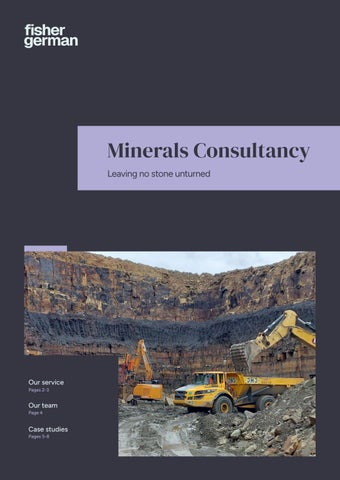
What lies beneath the surface can add significant value and our experienced professionals understand how this specialist sector works.
Over 100Mt of mineral reserves managed
Surveyors and geologists providing a full range of services
We have been active in this area for 30+ years
We represent 100’s of landowners across the UK
In depth market knowledge representing both landowners and quarry operators
We use cutting-edge quarry modelling technology
Our minerals department forms an integral part of our broader Property Management and Consultancy division. With a combined expertise spanning over 60 years, our specialists possess extensive knowledge across all facets of geology and mineral property matters.
Mineral extraction offers landowners a lucrative income stream, and the resulting voids may present opportunities for landfill or alternative development projects.
Our team is experienced across various extractive industries, including sand and gravel, hard rock, salt, coal, clay, and cementitious materials. Minerals and their products constitute the largest material flow in the economy, averaging approximately one million tonnes per day in a typical year. As a finite resource that can only be sold once, it is crucial to accurately assess their market value.
Quarrying operations are inherently temporary, making it important to consider future beneficial after uses. By collaborating with our rural estate management and natural capital team, we help maximise profitable outcomes following extraction.
Our services
Negotiation of options and leases
Rent reviews
Valuations
Land search
Quarry design and development
Geological site investigations
Sale and purchase negotiations
Compulsory purchase claims
Mineral Reserve Assessments
Planning and site promotion to mineral plan process
Mineral compensation and sterilisation claims
After use and restoration advice
Land contamination / land quality assessment
Materials management
Quarry audits and volumetric checks
To navigate the intricacies of minerals, consult our minerals team for expert guidance. Our team is committed to supporting you throughout each phase of mineral development, ensuring optimal value from initial discovery through to restoration and post-use management.
Our minerals team
Our team collectively brings more than 60 years of experience in minerals, providing extensive expertise across all areas of geology and mineral property matters.
William Gagie
William, Partner and Head of Minerals, specialises in mining and quarrying matters. He has been instrumental in establishing our minerals expertise, enabling the firm to assist existing and prospective clients, such as landowners, utility companies, and independent operators. He manages all facets of mineral property, including their management, valuation, sales, lettings, royalty reviews, and structuring agreements to maximise tax efficiency.
With three decades of experience in estate management and minerals, William previously worked for a prominent plc quarry company, overseeing its extensive property portfolio. His role encompassed acquisitions and disposals of both freehold and leasehold properties, and he played a key part in developing an innovative mineral sale and leaseback model.
Ross Smith
Ross is an Associate Partner within the minerals team and has a wealth of experience in land contamination assessment, mineral resource assessment and leveraging freehold and leasehold mineral deals.
As a Chartered Scientist with a robust geological background, Ross joined us after more than a decade in consulting, land contamination, materials management, earthworks and remediation.
Tom Giddings
Tom is a Partner and Head of Geological Services in our minerals team, bringing extensive expertise as a Chartered Geologist and Fellow of the Institute of Quarrying. His specialisms include quarry design modelling, reserve reporting, site identification, option and lease negotiation, as well as managing mineral assets for a varied portfolio of clients.
Tom’s experience covers all areas of geological support, from devising quarry working schemes and supervising site investigations and reporting, to conducting drone and topographic surveys, 3D quarry design, land search projects, and the ongoing management of mineral assets.
Maisy Moseley
Maisy is an Associate Partner within the minerals team having joined Fisher German as a graduate in 2019. Qualifying in 2021, achieving MRICS and FAAV status, Maisy has worked closely with William Gagie for the last 6 years.
With an established background in property and asset management, she brings experience in valuation, wideranging landlord and tenant matters, agency, CPO and compensation work to a more recent specialisation in minerals.
Case study
Asset management
Lathbury Quarry, Milton Keynes
Project summary
We were instructed to market and manage a uniquely placed quarry asset near Milton Keynes, from the greenfield inception stage, through to the full management of the mineral asset on behalf of the owners.
Solution
Key project data
Client: Private client
Location: Milton Keynes
Contract period: 2016 to date
Works: Quarry asset management
Using our expertise and combined 50 years of industry knowledge, we carried out the promotion and marketing of the site in order to secure a suitable operator. Following this, the successful negotiation of an option for mineral lease took place with the chosen operator.
After advising the client during the start-up of the operation, we began by collecting and remitting mineral and landfill royalties to the landowners. A highly complex land ownership, with four separate parties, each with different proportions of the minerals at different datums required analysis of topographic surveys and quarry design models to ensure that the correct mineral royalty was remitted to each owner. We also to carried out regular quarry site inspections and provided update reports for the landowners on the operation.
Our minerals team carried out assessments of mineral reserves and regular volumetric checks using an industry standard 3D modelling software called McCarthy Taylor LSS to ratify operator volumes. Throughout the contract delivery, we acted as minerals agent, providing the interface between operator and landowner.
Annual royalty rent reviews in accordance with the lease terms were implemented throughout the term. We also reviewed the Environment Agency Landfill permit, ensuring the operator adhered to the conditions.
Following the quarry operator’s application for planning permission to access additional mineral reserves, our team attended the local planning consultations and ensured that our client was well-informed and kept updated. Once the extension received committee approval, our team took all the necessary steps to seamlessly integrate this new area into our management.
Outcomes
• Client reassurance that the mineral and landfill royalties are accurate
• Regular updates for the landowners
• Ensuring lease terms are implemented
• Distributions of mineral royalties to owners ratified by the use of 3D modelling software
Case study
25 year quarry development plan
Project summary
We were instructed to carry out work for CEMEX on a major redesign of the company’s flagship Dove Holes Quarry. The redesign of excavation was to allow for the safe and efficient release of 5.5 million tonnes of limestone per annum over the next 25 years of the quarry’s life.
Solution
Key project data
Client: CEMEX UK
Location: Derbyshire
Contract period: Ongoing
Works: Creation of 25 year extraction programme to support ROMP submission and quarry asset management
Utilising their decades of experience working within the construction materials sector, our minerals team used the industry standard 3D terrain modelling software ‘LSS’ to create a phased sequence of excavation designs that update the quarry development plan (QDP).
Working closely with the CEMEX operational quarry team and mineral planners to ensure a workable and practical scheme was created, the excavation design needed to consider both a phased extraction of the carboniferous limestone but also the restoration of the rollover slopes as the depth of the quarry increased.
The excavation designs were subsequently used in a Derbyshire County Council and Peak Park review of mineral planning permissions or ‘ROMP’ process that affected Dove Holes Quarry in 2022.
Using LSS software also allowed for 3D visualisations and fly-throughs of the complex designs to be produced, an output which is more easily understood by non-technical stakeholders.
Outcomes
• We were able to understand to the requirements of the project due to their industry experience
• Design created in accordance with the Quarries Regulations 1999 and the sites excavation and tipping rules
• A safe and efficient working scheme for the next 25 years of Dove Holes Quarry was produced in a variety of different formats depending on the stakeholder
• The method of working scheme had to allow for an output of 5.5Mt per annum
• Our input and continuing support for one of the largest quarries in Europe
Dove Holes Quarry, Derbyshire
Restoration of ex-UK Coal mining portfolio Case study
Northumberland, Durham & the Midlands
Project summary
We were instructed by Harworth Group in June 2016 to provide advice and cost budgeting on the restoration process of eight former open cast sites, inherited from UK Coal across Northumberland, Durham and the Midlands.
Solution
Key project data
Client: Harworth Group
Location: Northumberland, Durham & the Midlands
Contract period: 2016 - present
Works: Advice & implementation of restoration schemes, cost management & budgeting and disposal programme
Initially the project involved assessing the outstanding restoration liabilities at the point of transfer from UK Coal and assisting with the commercial negotiations between the parties. A full planning appraisal of each site was carried out, including verifying compliance with existing conditions.
Upon transfer of the properties to Harworth, our role evolved into addressing the outstanding planning conditions and implementing the outstanding works, alongside a progressive sales programme.
Annual reports were prepared for planning authorities in line with the planning requirements, and revised cost assessments for budgeting as works were completed. Where possible costs were recovered from bonds held by local authorities and schemes varied to reduce costs.
Our team forged strong relationships with the individual planning authorities to ensure due diligence on sales could be successfully completed, thus ensuring swift completion of sales and maximising value.
Outcomes
• In three and a half years the majority of the assets have been sold above book prices
• Expenditure on works has been kept to a minimum
• No enforcement action has been taken by local authorities for non-compliance
• Restoration schemes have been varied in several cases to minimise expenditure
• Substantial sums have been recovered from bonds held by local authorities
• Successful completion of aftercare periods has now been achieved on some sites
Land contamination and remediation Case study
Project summary
We were instructed by Cadent Gas Limited to provide specialist contamination advice for the reconfiguration of a Pressure Reducing Station (PRS) in Tower Hamlets, London.
The site has a complex industrial history, having once formed part of a gas works. Underlying soils and groundwater are known to be contaminated with gas works contaminants including cyanide, hydrocarbons, asbestos and heavy metals. Cadent’s planned works included demolishing current buildings, constructing new buildings, undertaking drainage works and installing security fencing.
Solution
We liaised with the relevant authorities and produced a desk
Get in touch
Key project data
Client: Cadent Gas Limited
Location: London
Contract period: 2025
Works: Specialist land contamination advice, land quality assessment and outline remediation strategy
based geo-environmental assessment, aligning with Land Contamination Risk Management principles to recommend a practical redevelopment strategy. By leveraging existing information, the assessment demonstrated that further costly and time-consuming ground investigation (GI) was unnecessary, provided an outline Remediation Strategy was followed. After consulting with the project team, infiltration drainage was removed from the drainage proposals to prevent the inadvertent mobilisation of existing contamination. The outline Remediation Strategy offered clear guidance for managing residual gas works contamination during the construction phase.
Outcomes
• A thorough desk-based review was completed using available data, avoiding the need for extra ground investigations
• The client was able to stay on schedule and within budget thanks to this pragmatic approach
• The Environment Agency lifted its objection to the planning application, thereby enabling the project to proceed
We are a nationwide team of property professionals, including chartered surveyors, planners, estate agents, utility project managers and sustainable energy specialists, all dedicated to supporting your needs.
William Gagie
Head of Minerals 07551 152691 william.gagie@fishergerman.co.uk