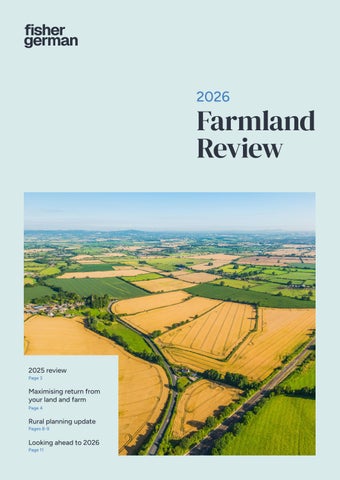
Farmland Review 2026

Page 1


Welcome

to the 2026 edition of Farmland Review

As we look back over a very busy 2025, we are reminded of the ongoing political and economic challenges that have shaped, and will continue to influence, the farmland market as we move into 2026.

The marketplace began steadily in 2025 amidst challenging weather conditions and reservations stemming from the Autumn 2024 Budget announcements. As supply increased by mid-year, buyer sentiment had declined compared to previous years, resulting in slower activity and more cautious engagement from fewer agricultural buyers. Overall, supply decreased last year relative to 2024, and although values varied by region, the national average softened slightly.

The profile of buyers continues to evolve, with an increasing number of non-agricultural buyers seeking land for diverse uses such as renewable energy, carbon offsetting, afforestation, conservation, and other natural capital initiatives.

As we look ahead into 2026, we remain cautiously optimistic. While profitability challenges persist, and operating costs for many rural estates continue to rise, the ever-widening pool of non-agricultural buyers supports a stable demand outlook. We anticipate that more land will be offered for sale in 2026 than last year.

The long anticipated 2026 SFI scheme detail will emerge, and this should provide more confidence to many. Additional reductions in interest rates will help ease debt serviceability. We also welcomed the APR and BR increased tax thresholds at the end of 2025.

Early engagement and thorough preparation remain crucial for those contemplating a sale or acquisition in 2026 and beyond. I hope you find this edition of Farmland Review informative. Please do get in touch to discuss any of the topics addressed or gain further insights into your local farmland market.

07966 481487

richard.gadd@fishergerman.co.uk

Looking back at 2025

Much of the news throughout 2025 centred on continued global, political, and economic uncertainty. The initial impacts of the US-imposed global tariffs gradually diminished as the year progressed, but this relief was offset by sustained upward pressure on commodity prices, stemming partly from the ongoing conflict in Ukraine and unrest in other regions. In the UK, anticipation around the Autumn Budget created a temporary period of caution among businesses. However, the outcome proved less disruptive than expected, with farms and landowners experiencing minimal direct consequences.

Supply

The availability of land and farms declined in 2025, yet values remained firm in many areas.

Buyer profiles shifted, with reforms to environmental schemes prompting some farming businesses to consider selling land to fund alternative investments or diversification.

While interest rates eased in 2025, some supply was prompted by debt-driven sales. The supply of lower-quality grassland rose as expected, influenced by environmentally driven buyers and persistently high input costs for livestock. As in previous years, much trading happened privately, making true transaction volumes hard to gauge.

Demand

Demand for land and farms was expected to remain strong in 2025, driven by a diverse range of buyers. Farmers and landowners with capital continued to seek larger commercial opportunities, often extending their immediate geographical areas, particularly where local supply was limited. Traditional farmer buyers were expected to focus on local and neighbouring properties that provided potential for expansion, despite cost pressures, and this materialised. Easing interest rates helped those looking to borrow.

Private, non-farming, and amenity buyers continued to fuel demand for smaller residential farmsteads, bare land, and diversified properties offering diversified income streams or where potential for value enhancement could be seen.

Conservation and corporate buyers pursued larger bare-land holdings, especially for carbon offset projects and woodland creation, a trend that had gained momentum in recent years.

Vendors

While changes to Agricultural Property Relief (APR) and

Business Relief (BR) were expected to prompt some additional sales, after considering capital gains tax, transaction costs, and potential future inheritance tax liabilities, only a small proportion of owners cited such reasons for sale. We saw more retirement sales in 2025 compared to previous years.

Additional supply was anticipated to come from farmers selling smaller plots to generate capital for diversification projects, such as converting agricultural buildings for alternative uses or investing in renewable energy schemes and this did materialise. Larger institutional landowners played a key role in the supply of land and farms to the market, as they sought to diversify away from low yielding assets especially where prospects for significant long-term gains were constrained.

Values

Land values were driven by land type, scale, quality, and location. Capital growth was subdued and averages values softened slightly, but the range of values achieved remained significant. Smaller parcels of amenity and equestrian land that were of the right scale and quality continued to command a premium in sought-after areas. Commercial farms with high-quality soils presented in excellent condition maintained strong values.

Pastureland values performed slightly better than arable values across the country, but regional and local variations were considerable. Some easing of prices in the eastern counties became clear by the year end, and conversely, we saw some exceptional prices recorded in the western and southern counties.

Maximising return from your land and farm

Gone are the days when farming businesses could simply depend on income from agriculture. With the Basic Payment Scheme (BPS) now a thing of the past and only limited access to agri-environmental schemes and capital grants, today’s farmers are presented with a new set of challenges to secure a profitable future. Now, more than ever, farmers need to spend time exploring national and local funding opportunities, all while unravelling the complexities of the planning system to open doors for new farming or diversification opportunities.

Crucially, location plays a key role in deciding which alternative income streams are worth pursuing. Farms on the urban fringe are especially well placed to tap into a larger customer base, making them prime candidates for ventures that thrive on footfall - such as farm shops, self-service fruit or milk vending machines, pick-your-own enterprises, or even adventure play areas for families.

Take, for example, one client, whose land sits on the edge of a major city. When HS2 sliced through their holding, it initially felt like an insurmountable disruption. Yet, out of this upheaval sprang opportunity and small, isolated parcels of land are being cleverly repurposed, with one farm tenant proposing a dog-walking field. The demand for such spaces has soared since the post-Covid boom in dog ownership. To embark on this kind of diversification, farmers need to weigh local demand, scope out the competition, consider land constraints and planning hurdles, calculate setup costs, and map out a sustainable management plan. These small plots, typically 1-3 acres, can generate attractive returns of £20,000-£40,000 per year, all for a relatively modest upfront investment.

Another avenue that is gaining traction is industrial open storage, particularly in areas with excellent transport links. This option boasts comparatively low setup costs and caters to end users needing robust surfaces, be it hardcore,

concrete, or tarmac and a secure boundary fence. Kitting out the site with lighting, electricity and water supply and security cameras can further boost its appeal and rental value. With the right conditions, open storage can generate returns of £20,000-£50,000 per acre depending on location and site condition. That said, the path to planning permission can be a little trickier to navigate.

For those nestled in the tranquillity of rural or scenic settings, tourism remains a tried-and-tested route for diversification. Glamping sites and holiday lets are popular, but with fierce competition, standing out from the crowd is key. One such success story saw us secure planning permission for a client to convert a traditional brick barn into a versatile venue for weddings and corporate events. Even though full project funding was out of reach at first, the Rural England Prosperity Fund, open to qualifying councils until March 2026, has since stepped in to offer capital support for projects that spark growth in areas with lower productivity, sparse connectivity, or limited access to essential services.

Ultimately, farmers looking to boost their bottom line through diversification must take a close look at which parts of their land are not vital for agriculture, pinpoint opportunities that align with their own interests and drive, and understand the opportunities afforded by their location. Teaming up with professional advisers for planning and funding guidance is vital to turning bright ideas into thriving new ventures.

07557 037902

tiffany.radford-hancock@fishergerman.co.uk

A selection of farms sold in 2025

A highly desirable, principally arable farm, set on the edge of Kineton village. In all about 240 acres.

accessible

About 79 acres of high-quality free draining Grade I and Grade II arable land capable of growing a wide range of combinable and root crops.

Equipped arable and grassland farm with principal farmhouse, secondary accommodation and farm buildings. In all about 110 acres.

A ring-fenced grassland holding with significant amenity appeal and potential for alternative uses (STP). In all about 58 acres. A highly productive arable farm with period farmhouse and farm buildings let under an AHA tenancy. In all about 229 acres.

Productive arable land and modern farm buildings in a ring-fence. In all about 238 acres.

Two fully equipped dairy farms with five residential properties and in-hand woodland all let under AHA tenancies. In all about 800 acres.

An
grassland holding in three distinct parcels with strategic potential (STP). In all about 133 acres.
A well-equipped equestrian property with stabling, farmhouse, menage and barns located in the rural surroundings of Clumber Park. In all about 73 acres.
Denbighshire
Warwickshire
Land at Barford St. Michael
Alston Estate
Middle Farm, Ashwell
Land at Brixworth
Charlton Farm
Land at Aberwheeler
Land at Great Bowden
Clumber Lane End Farm
Kineton Grange Farm

Preserving the family farm: navigating inheritance tax and succession planning

For many farming families, the farm is more than a business; it’s a home, a cherished legacy, and an asset passed down through generations that needs careful planning to protect. With land values rising, changing policies, and complex tax reliefs, careful planning tools like APR/BR, gifts, wills, and life insurance are necessary to protect this legacy for future generations.

Agricultural Property Relief and Business Relief

With changes to APR and BR coming in April 2026, these reliefs offer significant value to the agricultural community. They can significantly reduce or even eliminate Inheritance Tax (IHT) on qualifying agricultural assets, particularly for modest-sized farms. APR applies to agricultural land, pasture, and buildings used for farming if certain ownership, occupation, and use criteria are met, and its value is based on the agricultural value of the property, excluding any development or residential potential.

Eligibility for APR depends on what kind of property it is, how it is being used, the length of ownership, and the way ownership is arranged. Qualifying property often includes farmland, related farm buildings, cottages or farmhouses suitable for the land, and, sometimes, woodlands or land under approved long-term environmental schemes. Machinery, derelict buildings, or crops ready for harvest do not qualify, but some such assets may be eligible for Business Property Relief instead.

Recent legislative changes brought some welcome news for family farms. Starting in April 2026, the combination of APR and BR will now be capped at 100% on the first £2.5 million of qualifying property per individual, with any amount above that getting 50% relief. The pre-Christmas announcement also means that these reliefs, transferrable between spouses or civil partners, can now create a joint £5 million allowance for married couples. This applies retrospectively, so surviving spouses can benefit from the higher cap, even if their partner passed away before April 2026. This adjustment means more people could benefit from greater relief, even if they haven’t done detailed planning.

Another recent change means that IHT can now be paid in up to 10 interest-free annual instalments, making tax bills easier

to manage and potentially reducing costs as inflation takes effect.

Gifting and lifetime planning

Gifting assets remains an effective estate-planning strategy, especially for families wanting to pass the farm to the next generation gradually. Lifetime gifts can reduce the value of an estate for IHT if the giver survives seven years after giving. The £2.5 million allowance refreshes every seven years; so, a couple could give away up to £15 million of qualifying assets over a 21-year period, plus use the standard Nil Rate Band and Residence Nil Rate Band.

However, gifting land and farm assets is more complicated than transferring cash. It is vital to avoid “reservation of benefit” scenarios, where the donor continues using or benefitting from the gifted asset without paying market rent, as this would keep the asset in their estate for tax purposes. Every gift should balance succession goals with the operational needs of the farm. Building up other sources of income or capital such as pensions or investments, can help ensure agricultural assets are gifted fully.

Life cover and financial protection

Life insurance is sometimes overlooked but plays a crucial role in agricultural financial planning. It can provide funds to settle IHT liabilities, support family members, or maintain the business during a period of disruption. Putting policies in trust ensures proceeds fall outside the estate for IHT purposes and are available quickly if needed or can be saved to pay the tax in instalments. If a family’s farm has valuable assets but cash flow is tight, life cover could prevent the need to sell off property to pay taxes, for example, a married couple

aged 65, both non-smokers, buy a life insurance policy with a cover amount of £500,000 (covering the liability over their allowances), payable on second death, for a guaranteed monthly premium of £695 (£8,340 per year, assuming no health issues).

According to life-expectancy estimates, they would pay a total of about £191,820 into the plan over their lifetimes. When the policy pays out a lump sum of £500,000 upon the second death, this amounts to a 7.34% annualised return, an attractive figure comparable to investment market returns, effectively swapping investment risk for the certainty of mortality protection and affordability.

Barney Sears

Chartered Financial Planner, BRI Wealth Management

Rural planning update

Biodiversity Net Gain (BNG)

Since early 2024, Biodiversity Net Gain (BNG) has been a mandatory requirement for most developments, and by 2025 it became fully embedded in rural planning practices. Farmers and landowners are now central to delivering habitat improvements.

In 2025, DEFRA ran two major consultations: to enhance BNG for minor and brownfield developments, and to extend BNG to Nationally Significant Infrastructure Projects (NSIPs) from 2026. Both sought to rebalance obligations by easing requirements on smaller schemes while capturing the largest. In December 2025, the Government announced a forthcoming BNG exemption for small sites up to 0.2ha; until it takes effect, the April 2024 small-sites rules remain in force.

From a financial perspective, BNG can create additional revenue for rural businesses, particularly where opportunities are well sited, as developers may pay significant sums for off-site biodiversity units. Realising this potential entails longterm (typically 30 years) management commitments, upfront investment in habitat creation, ongoing monitoring, and potential future land-use constraints.

Housing delivery

Housing delivery has become a central focus, fuelled by significant planning reforms, which has prompted most local authorities to increase their annual housing targets, in addition to the recently published draft National Planning Policy Framework (NPPF), aimed at changing the way housing delivery is managed. Consequently, there are now even greater opportunities for residential development. If you have not previously explored the development potential of sites near existing settlements, or if past attempts have been unsuccessful, now is an ideal time to reassess these sites in light of emerging policy changes. Furthermore, opportunities to secure self-build or custom-build plots may

arise in locations where market residential development is not usually supported, particularly if the Council is not meeting its statutory duty.

Grey belt

The concept of ‘grey belt’ emerged as one of the most prominent planning topics in 2025. Introduced through the government’s broader planning reforms, the grey belt refers to areas within the green belt that are considered to have lower value and may be suitable for development under specific conditions.

The intention is to strike a balance between the need for housing and economic growth alongside preserving the most valuable green belt land.

Land within the green belt that is grey belt may now be appropriate for various types of development previously not achievable, where there is a demonstrable need for it, potentially leading to a significant increase in its value.

• Review ‘grey belt’ land: If your land within the green belt does not strongly contribute to its primary purposes, and there is a demonstrable need, development may now be possible. It is still worth reassessing the potential of such sites, especially those near existing settlements

• Environmental and financial return on investment: Establish habitat banks and sell biodiversity units to developers, including NSIPs from May 2026

• Self-build and custom-builds: Where your council’s self-build register indicates unmet demand, serviced plots may be feasible in locations not usually supported for market housing

• Natural burial grounds: Transform quiet, marginal land into a low-impact nature-positive cemetery. These are often acceptable in rural or green belt areas where openness is preserved and can provide steady income with modest infrastructure requirements such as access, parking and shelter, subject to planning approval

• Flexible use of agricultural buildings (Part 3, Class R): Convert larger agricultural buildings to flexible commercial uses, with the floorspace cap now increased to 1,000m2, subject to prior approval

• Expand agricultural floorspace: Construct new agricultural buildings up to 1,500m2 and extend existing ones up to 25% or 1,250m2;

• Deliver more homes under Class Q: The transitional arrangements for the previous version of Class Q have now ended. You can still secure up to 10 dwellings (1,000m2 total, 150m2 max per unit), and single-storey rear extensions on existing hardstanding are also possible, all subject to prior approval

• Removal of ag-ties: If an Agricultural Occupancy Condition has not been satisfied for 10 years or marketing is likely to demonstrate it is no longer meeting local needs consider pursuing removal

Planning process

Planning appraisal - typically 1-2 weeks to complete

• Helps inform decision-making early in the process

• Sets out expectations

• Generates a robust planning strategy

• Helpful for complex projects with difficult constraints

Pre-application (optional) - typically 6-8 weeks

• Early identification of any concerns

• Opportunity to build positive working relationships with LPA

• Confirm supporting information requirements

• De-risk the application stage

Prepare and submit application - typically 6-8 weeks

Work with technical consultants to prepare supporting information

• Prepare planning statements and forms

Validation check - typically 1-2 weeks

• Assessed against national and local lists

Valid - register and start determination timeline

Invalid - check information requested is a validation requirement and provide

Publicity and consultation - minimum 3 weeks

• Neighbour notification

• Site notices where relevant

• Statutory/internal consultees

Officer assessment and negotiation - typically 4-10 weeks post-validation

• Policy compliance (Local Plan/NPPF)

• Review consultation responses

• Material considerations

• Site visit

• Revisions if required

Decision (delegated or committee) - minor target 8 weeks, usually within 12 weeks. Major target 13 weeks, usually within 17 weeks from validation

• Under-resourcing main reason for delay

• Committee scheduling or amendments can typically add 3-6 weeks

Approve with conditions

• Refuse, setting out reasons

Post-permission actions

• Approved - discharge conditions (if required) and compliance

• Refused - resubmit/appeal

• Appeal duration varies but can typically add at least 6 months

07977 066072

ethan.glover@fishergerman.co.uk

07970 698729 tom.beeley@fishergerman.co.uk

Farm Machinery Auctions

Farm machinery auctions provide a swift, transparent, and reliable way for clients to sell surplus equipment, whether retiring, restructuring, or managing surplus assets, while achieving a fair market value. They are often the most effective option for a full farm dispersal sale, ensuring everything from workshop tools to combine harvesters are sold for the best possible return.

Our expert auction team is renowned for their knowledge and commitment at every stage of the auction process. Whether online, on site, or through our online timed auctions, we take pride in providing a personal, hands-on approach, especially during what can often be an emotional and important time for those involved. Our goal is to exceed our clients’ expectations before, during and after their farm machinery auction, ensuring the entire process is as smooth and straightforward as possible.

On site and online auctions

Combining the excitement of a traditional onsite auction with the far-reaching power of online bidding delivers fantastic results. On site, buyers can see first-hand the farm where the machinery was used, proving its authenticity. Meanwhile, our online platform enables those further afield or short on time to participate and bid from anywhere, broadening our clients’ pool of potential buyers.

Online timed auctions

The online timed auctions are an increasingly popular, hasslefree way to sell farm machinery and equipment, causing minimal disruption to clients.

Market trends

Despite ongoing challenges in the agricultural sector, the second-hand machinery market continues to perform well. With prices for new tractors and machinery remaining high, many farmers are seeking high-quality, well-maintained used

machinery. We have observed that demand is particularly strong for well-maintained, low-hour tractors, which have commanded premium prices at auction.

Auction preparations

To achieve the best results, early and thorough preparation is key. The condition and presentation of any machinery makes all the difference in securing premium sale prices. We create a comprehensive, illustrated catalogue showcasing the machinery and equipment, which is then sent to our extensive mailing list to ensure the auction reaches the widest possible audience. This is complemented by a targeted advertising campaign, carefully crafted to attract the right buyers and achieve maximum exposure of the farm machinery and equipment.

Why

should you choose us to conduct your farm machinery auction?

• Extensive expertise in farm machinery and equipment

• A dedicated team of professional, highly experienced auction staff

• Guaranteed total sale proceeds can be produced at the end of the auction

• A secure, real-time accounting system

• Rapid payment of proceeds after the auction

• Access to a large network of registered buyers across the UK and internationally

• Industry recognised auctioneers with proven track records

• Tailored marketing campaigns designed to reach the ideal audience, utilising our nationwide presence

Looking ahead to 2026

British agriculture stands at a crossroads in 2026, shaped by unpredictable commodity prices and significant policy changes on the horizon. The government’s recent announcement to raise the threshold for APR and BR from £1 million to £2.5 million per individual, effective in April 2026, is a welcome boost for family farms, smaller estates, and business owners. Couples can now transfer up to £5 million in qualifying assets, with the 50% inheritance tax relief still applying above these new limits.

While this change brings relief to many, some larger estates and businesses may still feel the impact. Across the farming community, there’s a sense of cautious resilience. Producers agree that the coming months will challenge farm businesses, demanding robust strategies and sound financial judgment. After a year marked by uncertainty and intense planning, these changes are a positive step, thanks in large part to the lobbying groups who championed them.

In this shifting landscape, thoughtful succession planning and prudent management are more important than ever to safeguard family farms for future generations. Yet, uncertainty often brings opportunity. With mounting income pressures and ongoing ambiguity around the Environmental Land Management scheme (ELM), Sustainable Farming Incentive (SFI) payments, and inheritance tax changes, landowners and investors are scanning the horizon for new prospects. A modest rise in land coming to market is expected, opening doors for those ready to act.

Buyers

The profile of farmland buyers is set to remain steady, with existing farm businesses leading the way. However, rural land continues to attract a wider pool of non-agricultural buyers, including corporations and individual investors interested in everything from afforestation and natural capital projects to lifestyle ownership. Whether motivated by environmental stewardship or the dream of countryside living, demand for farmland remains strong, supported by evolving interests and fresh investment strategies.

Vendors

On the selling side, the arable market faces turbulence as government policies reshape the sector. Most sellers will be farmers motivated by early retirement or a shift in business strategy, typically parting with smaller, less efficient parcels to streamline operations and raise capital for reinvestment.

Institutional and corporate sellers are also offloading land that lacks development potential, refocusing resources on assets primed for long-term growth. Larger estates may release land to ease financial pressures and support strategic reinvestment.

Volumes

As the year unfolds, individual blocks of land, especially those up to 150 acres, are expected to see increased activity. The rising value of grassland, driven by interest in natural capital, may prompt farm businesses to reconsider their holdings, increasing the turnover of such parcels. While it’s difficult to predict the market’s exact direction, forecasts suggest a 5% increase in the overall supply of farmland and farms for sale nationwide.

Values

Most arable and higher-grade grassland values are expected to remain stable, maintaining their reputation as reliable assets. Interestingly, land traditionally seen as ‘lower value,’ such as scrubland and woodland, may appreciate, fuelled by the surge in natural capital investments. Strategically located sites with long-term planning potential will continue to attract keen interest, highlighting the dynamic nature of the market.

07484 044171 edward.bostock@fishergerman.co.uk

Your key contacts

Richard Gadd MRICS FAAV

National Country Agency Team 07966 481487

richard.gadd@fishergerman.co.uk

Stuart Flint MRICS

National Country Agency Team 07501 720422

stuart.flint@fishergerman.co.uk

Alasdair Dunne

National Country Agency Team 07501 720412

alasdair.dunne@fishergerman.co.uk

Edward Bostock AssocRICS

National Country Agency Team 07484 044171

edward.bostock@fishergerman.co.uk

Molly Skinner MRICS FAAV East of England 07741 264143

molly.skinner@fishergerman.co.uk

Thomas Parker MRICS FAAV

North East, Yorkshire and the Humber 07738 981255

thomas.parker@fishergerman.co.uk

Joy Brankin-Frisby East Midlands 07918 677574

joy.brankin-frisby@fishergerman.co.uk

Will Kerton MRICS

West Midlands 07483 170611

will.kerton@fishergerman.co.uk

Matthew Allen MRICS FAAV

National Country Agency Team 07810 378190

matthew.allen@fishergerman.co.uk

Thomas Blake MRICS Midlands 07917 220967 thomas.blake@fishergerman.co.uk

Edward Clark MRICS FAAV North West 07718 524819

edward.clark@fishergerman.co.uk

Michael Harris North West 07870 961711

michael.harris@fishergerman.co.uk

Ben Charsley South East 07816 264582

ben.charsley@fishergerman.co.uk

Matthew Barker MRICS West Midlands 07788 412186

matthew.barker@fishergerman.co.uk fishergerman.co.uk

Turn static files into dynamic content formats.

Create a flipbook
Farmland Review 2026 by fishergermanllp - Issuu