WOMENPRENEUR MIDDLE EAST
1
2
WOMENPRENEUR MIDDLE EAST
SWISS CELLULAR SCIENCE WWW.SWISSKERN.COM
WOMENPRENEUR MIDDLE EAST
3
4
WOMENPRENEUR MIDDLE EAST
SS EE RR VVI C I CE EDDBBYYPPSSPPL LEEGGAAL L CCOONNSSUULLTTAANNCCYY
Empowering Empowering women women visionaries visionaries with with legal legal clarity, clarity, confidence confidence and and structure. structure. Guidedby byaadeep deepcommitment commitmentto tosupporting supportingand andempowering empowering Guided womenvisionaries visionarieswith withlegal legalservices, services,training training&&mentorship mentorshipdesigned designed women provideclarity, clarity,confidence, confidence,and andstructure structureacross acrossevery everystage stageof of totoprovide businessleadership leadershipand andgrowth. growth. business Expertiseforged forgedininproven provenlegal legaljudgment, judgment,credibility, credibility,and andpractical practical Expertise insightyou youcan cantrust. trust. insight
WOMENPRENEUR MIDDLE EAST
5
YOUR VISION. VISION. EXPERTISE. OUR LEGAL EXPERTISE. STARTUPS & & VENTURES VENTURES STARTUPS
Legal foundations foundationsfor forearly early Legal stage and and growing growingbusinesses. businesses. stage
HEALTH & & CLINICAL CLINICALPRACTICES PRACTICES HEALTH Compliant legal legal support supportfor for Compliant healthcare professionals. professionals. healthcare
FINANCIAL FINANCIAL & & REGULATORY REGULATORY Licensing, Licensing, compliance complianceand and regulatory regulatory guidance. guidance.
MENTORSHIP MENTORSHIP & & TRAINING TRAINING
One-to-one One-to-one mentorship mentorshipand and legal empowerment sessions. legal empowerment sessions.
Let’s build your your legacy legacy -legally and confidently. confidently.
womenpreneurlegal.com womenpreneurlegal.com legal@womenpreneurme.com legal@womenpreneurme.com +971 58 575 1048 +971 58 575 1048 UAE | Serving Women Entrepreneurs Globally UAE | Serving Women Entrepreneurs Globally
SCAN TO CONNECT SCAN TO CONNECT
6
WOMENPRENEUR MIDDLE EAST
Event AD
WOMENPRENEUR MIDDLE EAST
7
8
WOMENPRENEUR MIDDLE EAST
WOMENPRENEUR TEAM
FOUNDER & CEO (Chief Executive Officer) VIVEK MALIK
COO (Chief Operations Officer) DIVESH SINGH
CTO (Chief Technology Officer) UTKARSH SINGH
CLO (Chief Legal Officer) DEEPAK MALIK
CCO (Chief Creative Officer) NIDHI KUNDU
CEO, Womenpreneur Foundation FAHBIN ANWAR
Creative Director SUMAYRA FAROOKI
Partnering Agency BIG DATA MARKETERS
Design and Layout SURAJ YADAV, ROHAN NARWAL
Publisher
FIRSTREAD MEDIA LLC
CONTENTS
Page 28: There was a time when the story of women in business.
“Women’s empowerment is not a chapter in our journey - it is the foundation of our future.” INTERVIEWS
12 NOTE FROM CEO 11th Emirati Women’s Day Edition
13 THE BRIEF The UAE’s Womenpreneur Economy Is Moving From Participation to Influence
18 IN FOCUS The New Emirati Woman in Business: From Building a Business to Building Influence
22 TECH COLUMN AI Is Moving From the Experiment to the Enterprise 30 SARA AL ABDULLAH Purpose, Progress & the Power of Staying True 32 RASHA ALDANHANI Building With Courage, Creating With Purpose 34 CHEF MARIAM AL MANSOORI When Passion Becomes Purpose
10 WOMENPRENEUR MIDDLE EAST
W
Exclusive Interviews 36 DR. SHATHA AL ALLAY Building With Purpose, Leading Through Impact 61 DIJI SHUJAHI Building With Purpose, Leading With Kindness 38 ROWDHA ALSAYEGH Turning Culture, Emotion and Memory Into Stories That Stay 66 KARLITO HIGH JEWELLERY The Art of Being Unmistakable
40 LATIFA BIN HAIDER Making Access the New Definition of Empowerment
70 SHEFOUNDERHUB Supporting Women. Powering Businesses. Creating Opportunities.
44 DUBAI’S LONGEVITY VISION The City That Wants to Make Longer Lives Better
74 FROM EARNING TO BUILDING WEALTH Why Financial Power Is Becoming the Next Frontier for Women Entrepreneurs
48 DR. ROULA AL SHEHADAD Impact of Charishma Medical Clinic
55 ADA PANDEY Building With Courage, Creating With Purpose
We don’t just interview leaders to share their success - we do it to uncover the stories, lessons, and truths that inspire others to lead with authenticity and vision
59 LAURA OMURALIEVA Advancing Human Leadership for the Future
Finance is not just about numbers - it’s about building trust, shaping futures, and empowering growth with purpose
The future of women entrepreneurs is not about breaking into spaces - it’s about creating new ones where innovation, equity, and impact thrive.
Firstread Media LLC, headquartered in Dubai under the Sharjah Media Authority, is a global media house redefining how stories of leadership, innovation, and entrepreneurship are told. With a portfolio that spans Womenpreneur Middle East, CEO Weekly UAE, Entrepreneurial Arabia, Skyline Middle East, and Insider Al Seha, we create platforms that celebrate visionaries, empower changemakers, and spotlight industries shaping tomorrow. As publishers, our mission is simple: to inform, inspire, and influence. From exclusive interviews with global leaders to in-depth industry reports, our magazines and digital platforms bridge regions, industries, and ideas. We believe media is not just about reporting the present - it is about shaping the future. Firstread Media also curates high-impact events, summits, and awards that bring leaders and entrepreneurs together under one vision: growth with purpose.
WOMENPRENEUR MIDDLE EAST
11
WOMENPRENEUR MIDDLE EAST 12 NOTE FROM THE CEO
FOREWORD
11th Emirati Women’s Day Edition Let us celebrate Emirati Women not only as a reflection of how far we have come, but as a reminder of the future we are building with courage, ambition, creativity, and purpose.
Vivek Malik Founder & CEO, Womenpreneur Middle East
As we celebrate Emirati Women’s Day, I am honoured to present this 11th Emirati Women’s Day edition of Womenpreneur, dedicated to the strength, ambition, and excellence of the women who continue to shape the UAE’s identity and future. This day is a commemoration; it is a reflection of how Emirati women have become pillars of progress across every sector of society. When Womenpreneur was founded, our mission was clear: to build a platform that elevates women’s voices and celebrates their contributions with dignity and visibility. Today, as we celebrate the UAE, we are inspired by the womenleaders, entrepreneurs, educators, innovators, and visionaries whose work reflects both heritage and progress. The UAE has long been recognised for its forwardthinking approach to women’s empowerment. With investment in education, leadership, entrepreneurship, technology, and opportunity, the nation has created an environment where women can not only participate but lead with authenticity and purpose. The progress witnessed today is the result of a nation that believes in its women and women who believe in themselves.
This edition highlights the evolving journey of Emirati women across business, finance, technology, health, academia, media, culture, public service, and entrepreneurship. Their stories show that progress is not defined by grand gestures alone, but by everyday determination, by the women who build companies, inspire teams, influence decisions, and champion change within their communities. As we honour their journeys, we also celebrate the impact of SheFounderHub, our initiative launched on 28 August 2025 to remove barriers for women entrepreneurs. By connecting women with visibility, knowledge, networks, and opportunities, SheFounderHub reflects our belief that empowerment becomes stronger when access is created and opportunities are shared. This edition celebrates the impact of the initiative and the women who have been part of it. This year also marks another defining chapter as we launch the Womenpreneur App, taking our mission beyond the magazine and into a digital ecosystem. The app will help women discover opportunities, showcase their businesses, access knowledge, connect with
one another, and build meaningful professional relationships. It is our next step toward making opportunity more accessible and continuous. To our readers and supporters: thank you for being part of this narrative. Whether you are a young woman beginning your journey, an entrepreneur building your business, a leader shaping strategy, or an ally creating opportunities, your contribution matters. Together, we strengthen the fabric of opportunity. Womenpreneur remains committed to expanding its mission across the UAE, the Middle East, and beyond; building platforms, creating connections, and amplifying stories that deserve recognition. As we unveil this edition, let us celebrate not only the achievements of today but the promise of tomorrow. The women of the UAE stand as symbols of courage, creativity, leadership, and commitment, and through them, the future shines even brighter.
Happy 11th Emirati Women’s Day. Here’s to the women shaping today, inspiring tomorrow, and creating a legacy that will last for generations.
WOMENPRENEUR MIDDLE EAST
BUSINESS. DISTILLED.
FULL SPEED AHEAD Women entrepreneurs are reshaping industries, driving innovation, and expanding
The UAE’s Womenpreneur Economy Is Moving From Participation to Influence
13
14 WOMENPRENEUR MIDDLE EAST The story of women in the UAE’s economy is changing. For years, progress was measured through participation: how many women were entering the workforce, pursuing higher education, taking leadership positions or starting businesses. Those milestones remain important, but they no longer capture the scale of the transformation taking place. The more revealing question now is what women are building, how far those businesses can grow and how significantly they can shape the economy around them. The numbers offer a useful starting point. In the Global Entrepreneurship Monitor 2025/2026 report, the UAE retained its position as the world’s leading entrepreneurial economy for the fifth consecutive year. The country recorded a Total Early-Stage Entrepreneurial Activity rate of
19.2% while also ranking second globally for entrepreneurial finance and ease of access to entrepreneurial finance. The report reflects an ecosystem in which starting a business is increasingly supported by infrastructure, capital, policy and market access. Women are an increasingly visible part of that landscape. Data cited by the Emirates Businesswomen Council showed that women accounted for 18 percent of entrepreneurs in the UAE in
2024, while women’s share of the workforce stood at 34.6 percent. Perhaps more significant is the age profile:
while
80%
77.6%
planned to integrate technology into their operations.
of women-owned businesses were led by women under the age of 40.
These numbers suggest that internationalisation and digital adoption are becoming part of the normal growth strategy for UAE businesses rather than ambitions reserved for mature companies. For women entrepreneurs, this creates an interesting shift in ambition. A founder may begin with a fashion, wellness, education or food concept, but the long-term objective can be much broader: building a regional brand, developing intellectual property, creating a technology layer around the business or turning a locally successful model into an international one.
The figures point towards a young entrepreneurial population entering the market at a time when the UAE itself is undergoing rapid economic and technological change. A Different Kind of Founder The profile of the woman entrepreneur is changing alongside the ecosystem. The new generation is growing up in an economy where digital platforms, international markets and technology are accessible from the beginning of a business journey. For many founders, Dubai is not simply the place where a company is registered. It can be the headquarters from which a business reaches customers, partners and investors across the region and beyond. That international orientation is already visible in entrepreneurial behaviour. The UAE’s Global Entrepreneurship Monitor 2024/2025 findings showed that
The distinction between a small business and a scalable business is becoming increasingly important. Starting with a strong product and loyal customers is one challenge. Building systems that allow a company to grow without losing quality, culture or financial discipline is another. The entrepreneurs who master that transition will have a much greater influence on the economy than those who simply increase their number of outlets or customers.
55%
Beyond the Traditional Business Categories
of entrepreneurs served clients outside the country,
The sectors attracting women entrepreneurs are changing too. Fashion,
beauty, food, retail and lifestyle remain important areas of female entrepreneurship, but the conversation is increasingly expanding into technology, healthcare, financial services, sustainability, manufacturing and other future-oriented industries. That development fits directly into the UAE’s economic diversification agenda. The country’s National Employment Strategy 2031 identifies sectors including technology, communications, transport, financial services, healthcare, education, artificial intelligence, space and digital transactions as increasingly important to future employment and economic development. When women enter these sectors as founders rather than simply employees, the impact is different. A woman building a health technology company is not only creating a business; she is participating in the development of a future healthcare ecosystem. An entrepreneur developing an AI solution contributes to the country’s digital economy. A woman entering advanced manufacturing adds another dimension to the UAE’s industrial diversification. The change is particularly visible in the country’s efforts to encourage women into industries that have traditionally had lower female representation. The Make it in the Emirates initiative, for example, has highlighted Emirati women as makers, innovators and contributors to
WOMENPRENEUR MIDDLE EAST manufacturing, sustainability and national industrial development. This broadening of sectors matters because economic influence is rarely created by numbers alone. It comes from where businesses operate, what problems they solve, how many people they employ and whether they can create value beyond their immediate market. The Infrastructure Behind the Ambition Entrepreneurship is often presented as an individual pursuit, but successful companies are usually built within an ecosystem. Investors, banks, accelerators, government programmes, universities, professional advisers, suppliers and founder communities all play a role in determining whether an idea remains a small venture or becomes a sustainable company. The UAE has invested heavily in creating that ecosystem. Government programmes increasingly combine funding with mentorship, market access, investment readiness and business support. In April 2026, the Ministry of Economy and Tourism organised a roundtable focused on the UAE’s entrepreneurship ecosystem and opportunities to empower women entrepreneurs, with discussions around startup growth, financing, innovation and access to international markets. For women founders, networks can be particularly valuable. An introduction to
an investor can change the trajectory of a company. A conversation with another entrepreneur can help avoid an expensive mistake. A mentor can provide perspective at a point when a founder is making a difficult hiring, expansion or financing decision. The value of these relationships is difficult to capture in a statistic, but it is often one of the strongest advantages an entrepreneurial ecosystem can provide. Businesses may compete with one another, but founders also create a network through which knowledge, capital and opportunities circulate. Technology Changes the Equation Technology is adding another layer to this transformation. Artificial intelligence, cloud platforms, digital payments and e-commerce infrastructure are allowing smaller companies to operate with capabilities that were once available mainly to larger organisations. For a founder running a lean team, this can have a meaningful impact. AI can assist with research, customer communication, marketing and data analysis. Digital tools can automate administrative processes, while online commerce can make it possible to reach customers without building a large physical footprint. The UAE has made artificial intelligence a central part of its longterm economic strategy. Its National AI Strategy
2031 focuses not only on technology adoption but also on talent, investment, infrastructure and governance, with applications spanning healthcare, transport, energy, education and other strategic sectors. For women entrepreneurs, the opportunity lies in using these technologies strategically. The competitive advantage will not necessarily belong to the founder who uses the greatest number of AI tools, but to the one who understands where technology can improve margins, customer experience, productivity or decision-making. Technology also lowers some traditional barriers to entry. A small team with the right tools can test an idea quickly, reach an international audience and build a professional customer experience without the infrastructure that would once have been required. That does not eliminate the challenges of entrepreneurship, but it changes the economics of getting started. The Capital Question As women-led businesses become more ambitious, access to capital will become increasingly important. Starting a company can sometimes be financed through personal savings or family support. Scaling is different. Expansion requires working capital, technology investment, talent, inventory, infrastructure and often external financing. The UAE already has a strong financing
15
environment. The Global Entrepreneurship Monitor 2025/2026 ranked the country second globally for entrepreneurial finance and ease of access to entrepreneurial finance. Government-backed institutions, banks, venture capital firms, angel investors and accelerator programmes provide entrepreneurs with a wider range of financing options than many markets offer. But access to capital is only one part of the equation. Entrepreneurs also need to understand how different forms of capital affect ownership, control and risk. Venture capital may be appropriate for a highgrowth technology company, while a profitable retail business might be better served by debt or reinvested earnings. Financial sophistication therefore becomes part of leadership. Knowing cash flow, margins, valuation and funding structures can determine whether growth strengthens a business or simply makes it more expensive to operate. For women entrepreneurs, becoming financially confident is particularly important as businesses move into larger investment decisions. The goal should not simply be to raise the biggest possible amount. It should be to secure the right capital for the right stage of the business. From Businesses to Global Brands The UAE’s greatest entrepreneurial advantage
16 WOMENPRENEUR MIDDLE EAST may ultimately be its international connectivity. A company can be founded in Dubai, recruit talent from multiple countries, source products from several markets and sell to customers across the GCC and beyond. That model is becoming increasingly relevant for Emirati women entrepreneurs who want to take businesses beyond the domestic market. The General Women’s Union announced in 2025 the establishment of Emirati women entrepreneurs councils in friendly countries, aimed at strengthening cooperation in entrepreneurship, investment and women’s development. Such initiatives reflect a broader understanding of what entrepreneurship can contribute to the UAE. Women-led companies can become commercial bridges between markets, connecting Emirati businesses with international customers, investors and partners. For a country positioning itself as a global business hub, that role is significant. The successful founder of tomorrow may not think of herself as an entrepreneur serving a UAE market. She may think of herself as a global entrepreneur who happens to be headquartered in the UAE. Success Is Becoming More Institutional There is also a quieter shift taking place inside businesses themselves. As companies grow, founders have to move from doing
everything themselves to building organisations that can function without them being involved in every decision. That requires governance, professional management, defined responsibilities and reliable financial systems. Family businesses face a similar challenge when leadership passes from one generation to another. The ability to preserve values while introducing modern systems can determine whether a company remains relevant for decades. For women entrepreneurs, this transition can be particularly significant because it changes the definition of leadership. Being the person with the original idea is only the beginning. Building a team capable of executing that idea, creating a culture people want to work in and developing systems that survive periods of uncertainty are what turn a founder into a business leader. The strongest businesses are therefore likely to be those that become less dependent on the personality of the founder while retaining the clarity of her original vision. The Multiplier Effect The economic contribution of women entrepreneurs extends beyond the companies they own. A successful business employs people, purchases from suppliers, creates professional opportunities and contributes to the
communities in which it operates. The effect becomes even more powerful when successful entrepreneurs begin investing their experience back into the ecosystem. A founder can become a mentor, an angel investor, a board member or a connector for younger entrepreneurs. Her success then creates opportunities beyond her own balance sheet. This multiplier effect is particularly relevant to the UAE’s young entrepreneurial population. When younger women see other women building companies in technology, finance, industry or international markets, entrepreneurship becomes more tangible. It moves from something they admire to something they can imagine themselves doing. Visibility, in that sense, becomes economic infrastructure. The Next Measure of Progress The UAE has already created many of the conditions required for women to participate meaningfully in entrepreneurship. The country has strong infrastructure, international connectivity, government support, financing mechanisms and an increasingly sophisticated startup ecosystem. The next question is how much economic influence women can build within that environment. Progress will increasingly
be visible in the size and resilience of women-led companies, the sectors in which they operate, the markets they reach and the capital they control. It will be visible in the number of women moving from founder to investor, from entrepreneur to board member and from business owner to ecosystem builder. That is a more ambitious definition of women’s economic participation. It also reflects the reality of the UAE today. The country is building an economy shaped by technology, global trade, innovation and new forms of entrepreneurship. Women are not entering that economy at the margins. They are increasingly building businesses within its most important growth areas. The significance of this moment is therefore not simply that more women are becoming entrepreneurs. It is that entrepreneurship is giving women a larger role in determining where the economy goes next. The businesses being built today will shape employment, innovation, investment and consumer culture for years to come. Some will remain local success stories. Others will cross borders and become global brands. A few may grow into institutions that outlive their founders. That is when entrepreneurship becomes something larger than business ownership. It becomes economic influence.
WOMENPRENEUR MIDDLE EAST
LINA CAHILL www.linacahill.com
17
18 WOMENPRENEUR MIDDLE EAST The numbers reflect the shift. Women represented 18 percent of entrepreneurs in the UAE in 2024, according to data cited by the Emirates Businesswomen Council, while more than 2,000 new businesses established by Emirati businesswomen were registered during the first half of that year. Nearly 78 percent of womenowned businesses were led by women under the age of 40. The figures point to an entrepreneurial population that is not only growing, but also becoming younger and more willing to explore new sectors. A Generation Growing Up With Possibility
In Focus
The New Emirati Woman in Business: From Building a Business to Building Influence
The story of the Emirati businesswoman is changing. For decades, women have played important roles in family enterprises, professional organisations and established businesses across the UAE. Today, alongside that tradition, a younger generation is emerging with a different kind of ambition. They are founding companies, entering technology and future-focused industries, building digital brands and looking beyond the UAE from the very beginning.
For this generation, entrepreneurship is increasingly viewed as a first choice rather than an alternative career. They have grown up in an economy connected to international markets, digital platforms and global education, with access to infrastructure that allows a business to be launched and tested much faster than before. The UAE has reinforced this environment through policies designed to increase women’s economic participation and future readiness. The National Policy for Empowerment of Emirati Women 2023 to 2031 focuses on areas including economic participation, future skills and strengthening women’s contribution across emerging sectors. Entrepreneurship is increasingly being positioned not simply as business creation, but as part of the country’s wider economic development. That distinction matters. Helping someone start a company is only the first step. The larger opportunity lies in enabling that founder to build a company capable of employing people, attracting investment, entering new markets and creating lasting
WOMENPRENEUR MIDDLE EAST economic value. Entering New Industries One of the clearest signs of change is where women are choosing to build. Fashion, beauty, food, retail and wellness remain important areas of female entrepreneurship, but women are increasingly moving into technology, healthcare, financial services, sustainability and advanced industries. The shift mirrors the UAE’s own economic priorities. Artificial intelligence, healthcare, technology, financial services and other knowledgeintensive sectors are becoming increasingly important to the country’s diversification strategy. For women entering these fields as founders, the opportunity goes beyond establishing a business. They are participating directly in sectors that will shape the UAE’s economic future. Technology is particularly significant because it has changed what a small company can achieve. A founder can now reach customers internationally without opening offices in every market, use cloud infrastructure without building expensive systems and deploy AI tools across areas such as research, marketing and customer service. The UAE is actively encouraging this transition. Its national AI strategy places technology, investment, talent and infrastructure at the centre of long-term economic
development, while government programmes increasingly help startups and SMEs access international technology markets. From Founder-Led to Professionally Built As businesses grow, however, technology and ambition are only part of the equation. The founder who once handled every decision personally eventually needs systems that allow the organisation to function without depending on her involvement in every detail. That means stronger financial management, clearly defined responsibilities, professional teams and better governance. For family businesses, it can also mean finding the right balance between preserving a legacy and modernising the organisation. This transition is becoming increasingly relevant as more women-led companies move beyond the early stage. Building a successful business is one achievement. Building an organisation that can survive leadership changes, market disruptions and periods of rapid growth is another. The strongest entrepreneurs understand that the company eventually needs to become bigger than its founder. Her vision may start the business, but systems, people and culture determine whether it lasts. Capital Is Becoming Part of the Conversation Growth also changes the financial equation. A founder
may be able to launch a business with personal savings or family support, but expansion requires working capital, technology, talent, inventory and infrastructure. The UAE already has a strong entrepreneurial finance ecosystem. The Global Entrepreneurship Monitor 2025/2026 ranked the country second globally for entrepreneurial finance and ease of access to entrepreneurial finance. Government-backed institutions, banks, investors and accelerators provide businesses with a range of funding options. But access to money is only part of the challenge. Entrepreneurs also need to understand what type of capital is appropriate for their business. A technology company pursuing rapid international expansion may require venture capital, while a profitable retail company could be better served by debt or reinvested earnings.
19
Financial confidence is therefore becoming an essential part of entrepreneurial confidence. A founder who understands margins, cash flow, valuation and funding structures is better positioned to negotiate with investors and make informed decisions about growth. Networks Create Opportunity No business grows entirely alone. Investors, mentors, professional advisers, customers, government programmes and fellow entrepreneurs all form part of the ecosystem surrounding a company. For women founders, these networks can be especially valuable. An introduction to the right investor can accelerate growth. A conversation with another entrepreneur can prevent an expensive mistake. Access to an international business network can open a market that would otherwise take
20 WOMENPRENEUR MIDDLE EAST launchpad rather than simply a market. A founder can build a company in Dubai while serving customers across the GCC, Asia, Europe or Africa. The country’s connectivity, infrastructure and international business environment make that model increasingly practical. Government initiatives are also supporting this outward movement. The General Women’s Union announced Emirati women entrepreneurs councils in friendly countries in 2025 to strengthen cooperation in entrepreneurship, investment and women’s development. years to enter. Organisations such as the Sharjah Business Women Council have increasingly focused on international exhibitions, supply chains and global market access, giving women-led businesses opportunities to connect with customers and partners outside the UAE. The value of such networks is difficult to measure, but it can have a direct commercial impact. Entrepreneurship may begin with an individual idea, but scaling that idea requires relationships. From Founder to Influencer There is another dimension to the evolution of women entrepreneurs: their influence increasingly extends beyond their own companies. A successful founder can become a mentor, investor, board member or advisor.
Her experience can influence businesses she does not own and create opportunities for entrepreneurs who are still at the beginning of their journeys. The UAE is also seeing progress in women’s representation at the board level. According to the 2026 GCC Board Gender Index, the UAE ranked first in the GCC for women’s representation on the boards of publicly listed companies, with women holding 15 percent of board positions. The figure is still far from parity, but it highlights a broader movement. Women are increasingly moving from participating in organisations to influencing how those organisations are governed. A Global Outlook Perhaps the defining characteristic of the new generation is that the UAE is increasingly seen as a
For businesses built around Emirati identity, globalisation does not necessarily mean becoming less local. In many cases, cultural identity can become a competitive advantage. A distinctive product, heritage concept or regional perspective can stand out in markets where consumers increasingly value authenticity. Redefining Success There is no single definition of success for the new generation of Emirati women entrepreneurs. One founder may choose to build a global technology company, while another may grow a family enterprise, create a profitable consumer brand or establish a business focused on social
impact. What connects them is greater control over their economic future. That control is more significant than simply holding a business licence. It means being able to make strategic decisions, create employment, attract capital, enter new markets and eventually use personal experience to support others. The UAE has created many of the foundations required for that transition. The next challenge is ensuring that ambition is matched by financial knowledge, strong governance, technological capability and access to the right networks. Because the new Emirati woman in business is no longer asking whether she can build a company. She is deciding how large it can become, how far it can travel and how many other women can move forward because she built it.
WOMENPRENEUR MIDDLE EAST
21
22 WOMENPRENEUR MIDDLE EAST
Tech Column
AI Is Moving From the Experiment to the Enterprise
Artificial intelligence has spent the past few years being discussed as if it were a distant technological revolution. Then, almost overnight, it became part of everyday business. A founder can now use AI to analyse a market, draft a proposal, understand customer feedback, generate a first version of a campaign or build an internal knowledge system in minutes. For larger companies, the conversation has moved further, towards systems that can reason across information, coordinate tasks and increasingly act on behalf of employees. The speed of adoption is remarkable. Stanford University’s 2025 AI Index found that 78 percent of organisations surveyed reported using AI in 2024, up from 55 percent in 2023. Generative AI adoption moved even faster, with 71 percent reporting use in at least one business function, more than double the previous year. At the same time, private investment in generative AI reached
$33.9 billion in 2024.
For the UAE, this transformation carries particular significance. Artificial intelligence is not being treated simply as another emerging technology. It is part of a national economic strategy. The UAE Strategy for Artificial Intelligence aims to establish the country as a global leader in AI by 2031, with applications across sectors including healthcare, transport, renewable energy, education, technology and the environment. The strategy also places emphasis on talent, infrastructure, investment and responsible governance. That makes the AI conversation particularly relevant for entrepreneurs. The question is no longer whether a business should experiment with AI. It is becoming a more practical question: Where can AI fundamentally improve the way the business works? From Tool to Teammate The first wave of business AI largely behaved like a sophisticated assistant. Employees used chatbots to write, summarise, brainstorm, translate and search for information.
These applications remain useful, particularly for small companies where a founder may be responsible for several functions at once. But the technology is beginning to move beyond individual tasks. AI agents are designed to handle sequences of actions rather than simply respond to a single instruction. Instead of asking an AI system to draft an email, for example, an agent could potentially interpret a request, gather relevant information, prepare the communication, update a system and initiate the next step within a defined workflow. The distinction may sound technical, but its business implications are significant. A chatbot helps an employee complete a task. An agent can potentially help manage a process. McKinsey’s 2025 global survey found that 62 percent of respondents said their organisations were at least experimenting with AI agents, while 23 percent reported that they were already scaling an agentic AI system somewhere in
the enterprise. Yet adoption remains early, with fewer than 10 percent reporting scaled agent use in any individual business function. That gap between experimentation and implementation is likely to define the next stage of the AI economy. The Pilot Problem There is a paradox at the centre of corporate AI adoption. Almost everyone is interested in the technology, but relatively few organisations have successfully embedded it deeply enough to transform the economics of the business. McKinsey’s 2025 survey found that 88 percent of respondents said their organisations regularly used AI in at least one business function. Yet nearly two-thirds had not begun scaling AI across the enterprise. Only about one-third reported that their organisations had started scaling their AI programmes.
WOMENPRENEUR MIDDLE EAST
This matters because using AI and transforming a business with AI are not the same thing. An employee using an AI assistant to prepare a presentation may save an hour. That is useful, but it does not necessarily change the company. A business that redesigns its research, sales, customer service or product development workflows around AI can create a much larger advantage. The difference lies in integration. Companies that treat AI as another software subscription may achieve incremental productivity. Companies that rethink how work gets done have the possibility of achieving something considerably larger. The UAE Has Chosen Its Direction The UAE’s approach is unusually strategic. Its AI ambitions are connected to the broader goal of building a knowledgebased, technology-driven
economy rather than simply encouraging the use of consumer AI tools. The government’s AI strategy identifies investment, skills, infrastructure, governance and partnerships as important enablers. Abu Dhabi has also established the Artificial Intelligence and Advanced Technology Council to develop investment, research and partnership plans around AI and advanced technology. The implications extend into the private sector. The UAE’s National Employment Strategy 2031 identifies technology, financial services,
23
healthcare, education, artificial intelligence, space and digital transactions among value-added sectors important to future economic participation. The strategy also emphasises entrepreneurship, future skills and the development of a knowledge-based economy.
AI and the Smaller Company
For entrepreneurs, this creates an unusually fertile environment. AI is not developing in isolation from the economy around it. It is being supported by investment, infrastructure, research institutions, government initiatives and an increasingly sophisticated startup ecosystem.
A founder does not necessarily need a large technology department to begin experimenting with AI. She can introduce tools into marketing, customer service, research, recruitment, financial analysis or internal knowledge management without rebuilding the entire organisation. That flexibility can be particularly valuable for women entrepreneurs and founder-led businesses, where teams are often lean and senior leaders have to operate across several functions.
In February 2025, the Future100 initiative announced partnerships with organisations including Mohamed bin Zayed University of Artificial Intelligence, DIFC Innovation Hub, MEVP, Oraseya Capital and in5 to support startups in new and sustainable economy sectors. The ecosystem is therefore beginning to connect technology development with commercialisation.
Large corporations have the resources to build dedicated AI teams, purchase enterprise systems and hire specialised talent. Smaller businesses have a different advantage: they can move quickly.
AI can reduce some of the friction involved in running a small company. A founder can use it to analyse customer conversations, identify patterns in sales data, prepare research for a new market or create initial versions of marketing material. The technology can help extend the capacity of a small team without requiring the immediate cost of a much larger workforce. But efficiency should not become the only objective. The most interesting opportunities may come when entrepreneurs use AI to build things that were previously difficult to build at their scale.
24 WOMENPRENEUR MIDDLE EAST A small healthcare company could develop a specialised knowledge interface. A professional services firm could create an intelligent internal research system. A retailer could use AI to personalise customer journeys. A manufacturing company could combine AI with operational data to identify inefficiencies. The technology becomes valuable when it changes what the company is capable of doing.
about expansion. A creative team may spend less time generating first drafts and more time refining the idea that makes a brand distinctive. The competitive advantage may therefore belong to companies that understand where humans add the most
limit what AI is able to accomplish. This is why AI adoption increasingly becomes an organisational issue rather than simply a technology decision. Companies need to know what information they possess, where it is stored, who can access it and how
Intelligence Security Policy establishes minimum security requirements covering governance, infrastructure, algorithm protection, operational safety, threat monitoring and performance evaluation. For businesses, responsible AI is therefore becoming part of operational
it can be used. They need policies around confidential information, customer data and intellectual property. They also need people who understand how to evaluate AI outputs rather than accepting them automatically.
discipline.
The Human Advantage There is a temptation to describe AI as a replacement for human capability. The more useful way to understand it is as a shift in how human capability is deployed. Research increasingly suggests that AI can improve productivity, particularly when used to support workers rather than simply remove tasks from them. Stanford’s AI Index notes that studies have found productivity gains across a range of occupations, with AI often helping narrow performance gaps between less experienced and more experienced workers. That has implications for leadership. If routine work becomes easier, human attention can move towards judgement, relationships, creativity and strategy. A salesperson may spend less time preparing information and more time understanding a client. A founder may spend less time producing routine reports and more time thinking
value after AI takes over more of the repetitive work. The Data Behind the Intelligence There is, however, a less glamorous side to the AI revolution. AI systems are only as useful as the information and processes surrounding them. Poorly structured data, fragmented systems and unclear ownership can
The UAE is moving towards a more formal governance environment as adoption expands. Its National Artificial
The Trust Question The most sophisticated AI strategy can still fail if customers do not trust it. Businesses are increasingly using AI in areas that involve personal information, financial decisions, healthcare, customer interactions and professional advice. In these situations, accuracy is
WOMENPRENEUR MIDDLE EAST not the only consideration. Transparency and accountability matter too. A customer may accept an AI-generated recommendation for a product. She may be less comfortable if an opaque algorithm makes an important financial or healthcare decision without meaningful human oversight. This creates a role for leadership that technology cannot replace. Companies need to decide where AI should act independently, where humans must remain involved and where automation should not be used at all. Trust will become one of the important differentiators of the AI economy. The winners will not necessarily be the businesses using the most AI. They may be the businesses that use it most intelligently and responsibly. What Comes After Adoption The AI conversation is moving towards a more difficult phase. The novelty is disappearing. Employees are becoming familiar with generative tools. Businesses are beginning to understand what these systems can and cannot do. Investors are becoming more interested in evidence of commercial value than in demonstrations of technological possibility. That creates a higher standard for entrepreneurs.
An AI strategy can no longer be a line in a presentation saying that the company is “AIpowered”. It needs to answer practical questions. What problem does the technology solve? What becomes faster, cheaper or better? What data does the system require? Where does human oversight remain necessary? How will success be measured? McKinsey found that only 39 percent of respondents in its 2025 survey reported any enterprise-level EBIT impact from AI, while 64 percent said AI was enabling innovation. The strongest performers were more likely to pursue growth and innovation alongside efficiency. That distinction is important. AI may begin as a productivity tool, but its larger economic value could come from creating entirely new products, services and business models. Building the AI Economy For the UAE, the opportunity extends beyond adopting technology created elsewhere. The country is investing in the infrastructure, talent and institutions required to participate in AI development itself. Mohamed bin Zayed University of Artificial Intelligence, government AI initiatives, advanced technology programmes and the wider startup ecosystem are helping create the conditions for research and commercial innovation.
The National Programme to Transform Technology aims to develop 1,000 technological projects by 2031, invest AED 11 billion in advanced technology and enable AED 15 billion worth of advanced Emirati technology products to be exported annually. These ambitions point towards a larger question about the UAE’s role in the global AI economy. It is one thing to become a major consumer of artificial intelligence. It is another to become a place where AI companies are founded, technologies are developed, talent is trained and global products are commercialised. That is where the opportunity becomes much bigger than automation. AI is changing the economics of how businesses operate, but it is also changing the economics of who can build them. A small team can now access capabilities that would have required significant
25
resources only a few years ago. A founder with a strong idea can test, build and iterate faster. An established company can redesign processes that once seemed fixed. The technology is moving quickly, but the most important shift may not be happening inside the machines. It is happening inside organisations. The companies that emerge strongest from this transition will not simply be those that adopted AI early. They will be the ones that understood what to change, what to protect and where human judgement remains irreplaceable. For entrepreneurs, that is the real AI opportunity. Not to build businesses around the technology, but to use the technology to build businesses that could not have existed without it.
26 WOMENPRENEUR MIDDLE EAST
WOMENPRENEUR MIDDLE EAST
27
28 WOMENPRENEUR MIDDLE EAST
Rasha AlDanhani
Latifa Bin Haider
Dr. Shatha Al Allay
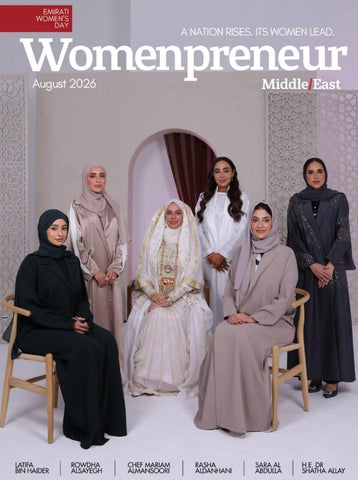
SHE IS WOMENPRENEUR COVER STORY There was a time when the story of women in business was largely told through the language of representation: how many women were in the room, how many had reached the top, how many had broken a barrier that once seemed impossible to cross. Today, the conversation is changing. Women are not simply entering spaces that already exist. They are building companies, creating industries, shaping culture, challenging assumptions and redefining what leadership can look like. This evolution is particularly visible in the UAE, a country whose rapid transformation has created an environment where ambition can move quickly from an idea into action. For Emirati women, the opportunity is no longer limited to
succeeding within established structures. Increasingly, it is about creating something of their own and deciding what comes next. That journey, however, is never only about achievement. Behind every successful venture are years of uncertainty, difficult decisions, personal sacrifices, reinvention and the quiet discipline of continuing when nobody else can see the destination. Our She Is Womenpreneur cover story brings together six women whose journeys capture that complexity. Rowdha Alsayegh has built her world around storytelling, using creativity and culture to connect people across different mediums and stages.
WOMENPRENEUR MIDDLE EAST
Rowdha Alsayegh
Sara Al Abdullah
Rasha AlDanhani transformed an entrepreneurial vision into an internationally recognised business while continuing to explore new creative worlds through film and music. Latifa Bin Haider is making access central to empowerment, creating spaces for conversations around mental health while helping people approach financial knowledge and investment with greater confidence. Dr. Shatha Al Allay demonstrates how public service and entrepreneurship can strengthen one another, carrying her experience across government, fashion, media, beauty and real estate. Chef Mariam Al Mansoori has turned her love for food and hospitality into a platform for Emirati culture, connecting heritage with contemporary experiences for audiences around the world. Sara Al Abdullah represents a generation of leaders thinking differently about sustainability, identity and global growth, taking an Emirati fashion brand onto international stages without losing its point of view. Their industries may be different, but their stories meet at a common point: purpose.
29
Chef Mariam Al Mansoori
They remind us that being a woman entrepreneur is not about fitting a particular mould. It can mean building boldly or starting quietly. It can mean leading a company, creating a cultural conversation, representing a country, opening a door for another woman or simply refusing to make your dream smaller. And perhaps that is what makes the word Womenpreneur so powerful today. It is not a title reserved for women who have already arrived. It belongs to every woman willing to build, learn, take risks, begin again and create something that did not exist before. She is Womenpreneur. And she is not waiting for the future to be built for her. She is building it herself.
30 WOMENPRENEUR MIDDLE EAST
WOMENPRENEUR MIDDLE EAST
31
Sara Al Abdullah
Purpose, Progress & the Power of Staying True
T
here is something powerful about women who understand that sustainability is not simply about what we produce, but about how we choose to live, lead and build. Sara Al Abdullah has built her journey around that belief, bringing together two seemingly different worlds: sustainable commercial strategy in aviation and the creative, ever evolving world of fashion. As the founder of Emirati fashion brand L’MANE, Sara has taken a homegrown idea to international fashion platforms across Milan, Paris, Seoul and London. Yet global expansion has never meant leaving her identity behind. For Sara, the challenge has always been to grow without losing the point of view that made the brand distinctive in the first place. “We always envisioned L’MANE as a brand that could have an international presence,” she says. But before thinking about global growth, the priority was building “a strong and distinctive identity.” That foundation has become increasingly important as L’MANE reaches new markets and audiences. The original dream was to create fashion that felt expressive and individual, pieces that went beyond clothing to become wearable art. Prints, colour, movement and silhouette have always been central to the brand’s language, balanced by a strong emphasis on wearability. That balance is also what Sara believes has helped L’MANE stand apart in an increasingly competitive fashion landscape. Its original prints are developed specifically for each collection, working with colour and movement to tell a story. Rather than chasing every trend, the brand has focused on developing its own visual language. “I believe that consistency is what helps build a recognisable identity,” she explains. Building that identity while maintaining a demanding leadership role in aviation requires another kind of discipline. For Sara, there is no complicated formula. Passion matters, but so does knowing how to manage time and priorities.
“I prioritise what needs my attention, plan my time and focus on what needs to be done at that moment. Of course, balancing two careers does not mean every day is easy. There have been moments when managing everything has felt overwhelming. Her response is not to try to solve everything at once, but to step back, assess the
situation and work through one issue at a time. Passion keeps her moving, but so does the excitement of seeing results and anticipating what the next opportunity might bring. That ability to remain focused has also shaped the way Sara approaches sustainability. For her, sustainability is much bigger than a product or a material. “It is really a way of life and a belief.” Quality and durability matter, but so do the choices made along the way, the communities involved, the collaborations created and the long term impact of those decisions. Ultimately, Sara sees sustainability as a commitment to contributing to a better tomorrow. Her corporate experience may have given her structure, but entrepreneurship taught her something entirely different: how to become comfortable with uncertainty. “In a corporate environment there are structures, processes and systems around you. When you’re building a business, sometimes you have to make decisions without having every answer.” There is patience in that lesson too. Meaningful businesses rarely grow as quickly as they appear to from the outside. Sometimes growth also means learning which opportunities to decline. As L’MANE evolved, Sara became more selective, asking whether an opportunity genuinely aligned with the brand, its audience and its creative and commercial direction. That clarity became especially important as L’MANE moved beyond the UAE. The biggest mindset shift was realising that international growth does not require changing the brand for every market. “Creatively we need to remain L’MANE.” For Sara, understanding the customer and market remains essential, but authenticity cannot be negotiated. Instead of asking, “What do they want us to be?”, the brand now asks, “How do we take who we already are to the right audience?” That confidence is deeply connected to where L’MANE comes from. Born in the UAE and designed in Dubai, the brand carries an Emirati identity that does not need to be expressed literally in every collection. The UAE’s diversity and international outlook have naturally shaped its creative perspective. As L’MANE enters its next chapter, Sara’s ambition is clear: thoughtful international growth without compromising the creative identity that has always defined the brand. Because for her, global success is not about becoming something else for the world. It is about becoming more fully what you already are, and finding the right world to share it with.
32 WOMENPRENEUR MIDDLE EAST
Rasha AlDanhani: Entrepreneur, Creative Producer & Philanthropist Building With Courage, Creating With Purpose
F
or Rasha AlDanhani, success has never been about the size of the headline. It is about who you remain when the awards, businesses and recognition are stripped away. “I hope they would say that I stayed grounded and real, regardless of the success or the pressure that came with it.” That groundedness has remained central to Rasha’s journey, from building PappaRoti into an internationally recognised brand to entering film and music production through AlRasha Production. Loyalty and hard work have remained equally important. The first employee she hired when she started PappaRoti in 2008 is still part of her team today.
“When people choose to stay and grow with you for that long, I think you must be doing something right.” One of the biggest turning points came in 2009, during the recession, when Rasha was preparing to launch the first PappaRoti café in the Middle East. Almost everyone around her advised against it. The timing was difficult and the risks were obvious, but she trusted the concept and, more importantly, trusted herself. “Had I chosen to be cautious and walked away, I probably wouldn’t be here giving this interview today.” That decision taught her something she still carries with her: fear is not always a warning to stop. Sometimes, it is simply a sign that you are stepping into something new. Entrepreneurship also came with sacrifices. In the early years, Rasha personally trained everyone, from the bun maker and barista to the manager, determined to understand every part of the business. That commitment sometimes meant giving her children less of her time than she would have liked. She does not look back with regret, but with perspective. Those years taught her discipline, resilience and the importance of understanding what truly matters. Eventually, another side of Rasha began asking for space. Her move into film and music production through AlRasha Production was not an escape from entrepreneurship, but an extension of it. “Business taught me how to build something from
nothing, and creativity requires much of the same courage.” She wanted to tell stories, not simply build businesses. For Rasha, creativity became another way of bringing an idea to life. Her definition of success has evolved with her journey. Earlier, it was about independence, building something of her own and proving that an idea could compete internationally. Today, she thinks more deeply about impact. “Business gave me a platform, but I don’t measure success only by the number of locations or awards anymore.” She asks different questions now: Who am I helping? What opportunities am I creating? What am I giving back? That perspective shapes how she views the next chapter for Emirati women. Rasha believes women are no longer simply being invited into rooms. They are building the rooms themselves, particularly across entrepreneurship, technology, AI, sustainability, culture and the creative industries. “I think we’re past the point of simply being included in the room. Emirati women are building the rooms now.” She also wants to challenge the misconception that success comes easily to Emirati women. “Our culture and heritage give us a strong foundation. They don’t limit how far we can go.” If she could speak to her younger self, her advice would be simple: trust yourself sooner, stop waiting for permission, do not fear mistakes and do not worry too much about being underestimated.
“Know your values, stay grounded, keep learning, and let your work speak for you.” Ultimately, Rasha hopes her legacy will be measured by the opportunities she created for others. She wants young women to know that ambition does not require sacrificing authenticity, and that global success can coexist with culture, values and identity. If her journey makes it even a little easier for the next woman to believe she can try, she says, that would mean more than any award or headline. That, to Rasha, is a legacy worth leaving.
33
WOMENPRENEUR MIDDLE EAST
33
34 WOMENPRENEUR MIDDLE EAST
WOMENPRENEUR MIDDLE EAST
35
Chef Mariam Al Mansoori When Passion Becomes Purpose
S
ome people cook to feed others. Others cook to preserve memories. For Chef Mariam Al Mansoori, food has become a way to do both while carrying a piece of Emirati identity into every room she enters. As Founder and CEO of Montauk Hospitality Group, Mariam has built a career that extends far beyond the kitchen. From her early connection with food and family gatherings to entrepreneurship, international judging, travel and representing the UAE abroad, her journey has evolved into something larger than cooking. It is about creating, leading and building a legacy that can outlast her own achievements. Her inspiration began at home. “My family is the foundation of everything I am,” she says, crediting them with teaching her generosity, resilience, humility and the importance of welcoming people with an open heart. Those values continue to shape the way she leads her team and the experiences she wants every guest to have. The transition from chef to entrepreneur and cultural ambassador happened gradually. There was no single defining moment. Instead, each new chapter expanded her understanding of what she could create. As her work grew, so did her sense of responsibility. “I realized I was carrying something much bigger than myself,” she reflects. “I wanted to build something that would last and create opportunities for the generation after me.” That ambition has required more than passion. It has demanded patience, resilience and the ability to keep moving through uncertainty. Like any entrepreneur, Mariam has experienced exhaustion, difficult decisions and moments when the outcome was far from certain. But she learned that strength is not about avoiding struggle. “It is about continuing with patience and believing in your purpose.” Her travels have added another dimension to that purpose. Experiencing different cultures around the world taught her that food can create connections even when people have little else in common. At the centre of every culture, she found different expressions of generosity, hospitality and community. Travel also reinforced something else she considers essential: curiosity. No matter how much experience a person gains, there is always more to learn. That philosophy has remained important even as Mariam has reached significant milestones, including international recognition. When an award or new achievement arrives, her first response is not celebration alone, but gratitude.
“I think about my family, my team, my country, and everyone who believed in me.” For Mariam, recognition is never the destination. Instead, it is a reminder of the responsibility that comes with representing where she comes from. That connection to Emirati identity is perhaps best captured in the dish she chooses to represent her journey: aseeda. Simple yet deeply rooted in Emirati heritage, it carries warmth, memory and identity. It also reflects Mariam herself. “No matter how far I travel or how much I evolve creatively, my roots will always be at the heart of what I do.” That balance between heritage and evolution is central to her vision for Montauk. As an Emirati woman working in hospitality, she understands that every experience she creates can become a cultural introduction. Her hope is that guests leave having experienced the warmth and generosity of Emirati hospitality, presented in a contemporary way that can connect with people from anywhere in the world. Over time, her definition of success has changed too. In the beginning, it was about proving that she could achieve her goals. Today, it is about impact: watching people around her grow, creating opportunities and building something meaningful that can continue beyond her. Perhaps that is why, when asked what she is most proud of, Mariam does not point to a title or award. She speaks about remaining true to herself and her values.
“Achievements and titles can change, but who you are when no one is watching matters more.” For the young Emirati woman with a dream that feels bigger than her circumstances, her advice comes from that same philosophy: do not make the dream smaller simply because the journey feels difficult today. Start with what you have. Keep learning. Do not fear mistakes. Stay connected to your values and identity. Because sometimes, the most meaningful legacy begins with something as simple as following what you love, and having the courage to turn that passion into purpose.
36 WOMENPRENEUR MIDDLE EAST
Dr. Shatha Al Allay: Entrepreneur, Former Federal National Council Member & Public Service Leader Building With Purpose, Leading Through Impact
F
or Dr. Shatha Al Allay, leadership has never been about a title. Whether in public service or entrepreneurship, it has always been about people, responsibility and the impact a decision can create. Her journey has moved across fashion, media, beauty and real estate, alongside years of service through the UAE Federal National Council and the Arab Parliament. Yet she sees these experiences not as separate chapters, but as parts of the same journey. Public service taught her to listen, consider different perspectives and think beyond immediate outcomes. Business taught her adaptability, speed and accountability. When her term at the Federal National Council ended in 2023, entrepreneurship was far from a new beginning. It was a return to a path she had been building for years, now shaped by a much broader perspective. “I began in fashion and abayas through Dar Al Shatha Design,” she explains, before expanding into media, events, beauty through Shatha Beauty & Spa and eventually real estate investment. Her philosophy has evolved with every venture. Today, she looks beyond profitability and asks a more important question: what value can this create, and can it endure? “Opportunity matters, and passion gives me the energy to continue, but purpose determines my direction.” That sense of purpose is closely connected to her belief in people. For Dr. Shatha, businesses may begin with capital, but they are sustained by the people who carry their vision forward. Training, developing capabilities and creating opportunities are therefore among the most important investments a leader can make. This is particularly meaningful to her when it comes to women. Economic opportunity, she believes, can create an impact that extends beyond an individual woman to her family and wider community. Her own journey has also taught her that leadership requires both patience and decisiveness. Parliament taught her the value of dialogue and examining different dimensions of an issue. Business taught her that waiting too long can mean missing an opportunity. “A good decision is not necessarily the fastest or the slowest. It is the decision made at the right time, with the right information.”
As an Emirati woman who has represented her country in public life and built businesses across different sectors, she is conscious of the responsibility that comes with visibility. But she believes the strongest representation comes through results rather than words.
“The best way to represent Emirati women is not simply to speak about what they can achieve, but to demonstrate it through work, results, and competence.” Her definition of success has also become more nuanced. Life, she says, taught her that not every success is visible and not everything that looks like a loss is truly a loss. Some of the most difficult experiences ultimately become the ones that reshape how we think. Looking towards the next generation, Dr. Shatha hopes Emirati women will continue moving beyond traditional definitions of what their careers should look like. She wants them to understand that reinvention is not a sign of uncertainty, but a form of strength. “A woman can begin in fashion, move into media, build a business in beauty, invest in real estate, serve her country through the Federal National Council and the Arab Parliament, and still continue learning.” For her, the greatest legacy is not a list of companies or positions. It is giving the next generation the confidence and tools to go further. “I hope the next generation of Emirati women will look at what the generation before them achieved and not simply repeat it, but build on it and surpass it.” Because ultimately, Dr. Shatha believes the most meaningful measure of leadership is not how many people follow your path, but how many people feel empowered to create their own.
WOMENPRENEUR MIDDLE EAST
37
38 WOMENPRENEUR MIDDLE EAST
WOMENPRENEUR MIDDLE EAST
39
Rowdha Alsayegh: Founder, Rowdha SAY
Turning Culture, Emotion and Memory Into Stories That Stay
S
ome people tell stories. Others spend their lives becoming them. For Rowdha Alsayegh, storytelling has never been simply a profession. It is a way of seeing the world. From creative writing and photography to film, live performance, brand narratives and cultural experiences, her work moves across mediums, but always returns to the same belief: the most powerful stories are not simply told, they are lived. As the founder of Rowdha SAY, she has built a creative space where stories can take different forms while remaining rooted in authenticity. Her work has brought together global luxury brands, national campaigns, live events and cultural experiences, alongside her role as an MC and moderator. At the heart of it all is a voice shaped long before there was a business or a stage. “My voice was shaped by a lifetime of dreams, stories and people.” She remembers a little girl who recorded family vlogs with her father before YouTube even existed, raised her hand whenever there was an opportunity to perform and remembered everyone’s birthday. She also remembers being told that she spoke too much. “Somehow, she found her way and looking back, I realise she was never ‘too much.’ She was simply becoming a storyteller.” That instinct to speak, create and connect stayed with her. Even an early experience of being underestimated could not silence it. As a young girl, a teacher once told her she was too short to be on stage. She cried herself to sleep that night. But when the next opportunity came, she raised her hand again.
“I discovered that even when something hurts, I will always find the courage to raise my hand again.” Today, that courage is visible in the rooms she commands and the stories she creates. Yet Rowdha is candid about what audiences do not see before she steps onto a stage. Preparation is where the worry happens. Once the story is
ready, she trusts it and trusts herself. “Confidence does not mean never making a mistake. What reveals a great speaker is not perfection, but how gracefully they carry themselves forward.” Her relationship with storytelling is also deeply personal. One of the experiences that changed her most was creating her TED Talk, “A Story Taught Me.” What began as a talk became a journey through the stories that had shaped her life. It even reconnected her with her school librarian, Miss Muna, who had kept a story Rowdha had written as a child. “I felt as though my story had found its way back to me when I needed it most.” That connection between past and present is also central to her relationship with Emirati identity. Rowdha does not remember one particular moment when she fell in love with her culture. She believes it was always within her, growing alongside her.
“What I cherish most is how quickly our country evolves without ever losing sight of its roots.” In many ways, she feels the UAE and she grew together. Her identity has remained an anchor even as her work has taken her onto increasingly larger stages. Success, she says, has changed the stages she stands on, but she hopes it never changes the person standing on them. She still carries a reminder she once wrote to herself after one of the biggest stages of her life: dream big, but keep the pure soul of the little girl who first loved standing on a school stage. Today, that little girl is still part of everything Rowdha creates. If this chapter of her life had a title, she already knows what it would be: “Her Dreams, My Story.” Because the dreams of the little Emirati girl she once was became the story of the woman she is still becoming, in a country that taught her that no dream was too big.
40 WOMENPRENEUR MIDDLE EAST
Latifa Bin Haider: Founder, Mental Health AE and Baytukum Making Access the New Definition of Empowerment
S
ome founders begin with a business idea. Latifa Bin Haider began by noticing something people were struggling to say out loud. In 2019, while still at university, Latifa and Ali Khawaja co-founded Mental Health AE to create awareness around mental health and wellness and challenge the stigma surrounding it. What began as a simple idea grew into a community of thousands, with more than a hundred events and over forty podcast episodes. For Latifa, the experience changed her understanding of leadership. “I don’t think it was courage, at least not in the way people imagine it. I kept noticing something and couldn’t look away from it.” That instinct to pay attention has remained central to everything she builds. Today, her work extends into financial literacy and property investment through Baytukum, where she is focused on making access to real estate and financial knowledge more accessible. Latifa believes genuine financial empowerment begins when ordinary people feel they are allowed to participate. “Genuine empowerment, to me, is when someone on an ordinary salary can start.” For her, the problem is not always a lack of money or intelligence. Often, it is the fear of entering a world that feels complicated, exclusive or designed for someone else. Whether it is mental health or investing, people can hesitate because they are afraid of being judged, asking the wrong question or making an irreversible mistake. The answer, she believes, is to make the first step easier. Her entrepreneurial journey spans social impact, property investment, technology, marketing and strategic growth, but Latifa does not see these as separate worlds. She sees them as interconnected parts of everyday life. “Someone’s finances affect their health, their health affects their work, and their work affects the time and energy they have left to learn or pursue something new.” That perspective also shapes her approach to building sustainable businesses. Latifa does not believe purpose and commercial discipline have to compete. A venture needs strong revenue, governance and systems if it wants to continue serving people over time. At Baytukum, that means taking regulation and accountability seriously. Building within the DFSA framework may require more time and investment, but for Latifa, those structures are part of earning trust, particularly
when people may be investing for the first time. Her own leadership has evolved along the way. One of her most important lessons has been learning to listen before trying to solve. “I would hear a problem and immediately start trying to solve it. What I eventually understood is that what people first tell you isn’t always the real issue.” That shift has made her more patient, more curious and more intentional about understanding the people she hopes to serve. Recognition has followed her journey, including the Young Arab Pioneer Award and national recognition for innovation and impact. Yet Latifa does not measure success by awards alone. “An award tells you that people noticed the work. It doesn’t necessarily tell you whether the work made a real difference.” For her, success is knowing that someone is genuinely better off because of something she has built. As a young Emirati woman working across traditionally complex sectors, Latifa hopes the next generation will inherit a world where women building in finance, property or technology is no longer considered unusual. But she wants to offer more than representation. She wants to make the path easier.
“I’d rather help make the path easier than simply be an example to admire.” Perhaps that is the most consistent thread in Latifa’s journey. From creating spaces where people could speak openly about mental health to making financial participation feel less intimidating, her work is ultimately about access. Her enduring legacy, she says, would be helping people see their lives as connected rather than divided into separate boxes of money, health, work and learning. And, perhaps most importantly, helping them question the belief that when something feels inaccessible, the problem must be with them. Sometimes, the system simply was not designed with them in mind. Latifa’s work is about changing that, one conversation, one opportunity and one open door at a time.
WOMENPRENEUR MIDDLE EAST
41
42 WOMENPRENEUR MIDDLE EAST
The The Womenpreneur Womenpreneur App App
WOMENPRENEUR MIDDLE EAST
43
44 WOMENPRENEUR MIDDLE EAST
DUBAI’S LONGEVITY VISION
The City That Wants to Make Longer Lives Better
For years, the conversation around longevity was largely about one question: How long can we live? That question is beginning to feel outdated. The more interesting question now is what those additional years will look like. Will people remain healthy, mobile and mentally active for longer? Will they be able to work, travel, create, raise families and contribute well into later life? And can cities be designed in a way that makes healthier ageing part of everyday life rather than something we begin thinking about at 60? Dubai appears to be betting that the answer is yes. In June 2026, Dubai took a significant step in turning its longevity ambitions into an institutional framework with the establishment of the Dubai Longevity Authority under Law No. 17 of 2026. The authority has been created with a remarkably broad mandate: to position Dubai as a global hub for regulated longevity, wellness and advanced healthcare, while bringing together scientific research, innovation, investment and
international partnerships. It is an important distinction. Dubai is not simply trying to attract another category of luxury clinics or wellness tourists. It is attempting to build an ecosystem around the science, regulation and business of helping people live healthier lives for longer. And that ambition fits into a much larger idea already taking shape across the emirate. Beyond the obsession with age Longevity has become a fashionable word, sometimes accompanied by promises that sound more like science fiction than medicine. Dubai’s approach, however, is increasingly being framed around something more practical: healthspan, or the number of years a person can live in good health and with functional independence. The World Health Organization makes a similar distinction. Healthy ageing is not simply the absence of disease. It is about maintaining the functional ability that allows people to do the things they value, including
moving independently, making decisions, building relationships and contributing to society. That changes the conversation considerably. A longer life is not necessarily a better life. Adding years while spending a significant portion of them dealing with preventable illness, physical limitations or isolation is a very different proposition from extending the years in which a person feels capable and engaged. The demographic reality makes this conversation increasingly urgent. Globally, the number of people aged 60 and above is projected to rise from one billion in 2019 to 1.4 billion by 2030 and 2.1 billion by 2050. Longevity, therefore, is not simply a healthcare issue. It is becoming an urban planning issue, an economic issue, a workplace issue and, perhaps most importantly, a quality of life issue. Dubai is building the environment around the person This is where Dubai’s wider vision becomes particularly interesting. The Dubai Quality of Life Strategy 2033,
approved in 2024, already established a broad framework built around the wellbeing of individuals, communities and the city itself. Its ten pillars include health, mobility, the natural and urban environment, education, employment, society and family, safety, culture and entertainment. Look closely and many of these priorities are also longevity priorities. A city where people can walk safely is a longevity city. A city with accessible parks is a longevity city. A city that makes movement easier, encourages social connection and gives people access to healthcare before illness becomes serious is a longevity city. Dubai’s strategy includes plans to expand cycling lanes from 544 kilometres to 1,150 kilometres, increase green public park areas from 23 to 64 square kilometres, develop more than 200 parks and squares, and create neighbourhoods where 80 percent of essential services can be reached within a 20 minute journey using soft and sustainable mobility options. These may not sound like longevity interventions in the conventional sense.
WOMENPRENEUR MIDDLE EAST There is no futuristic laboratory involved. But perhaps that is precisely the point. The foundations of a long, healthy life are often remarkably ordinary: movement, good food, sleep, social connection, mental wellbeing, preventive healthcare and an environment that makes healthier choices easier. From healthcare to health creation The establishment of the Dubai Longevity Authority adds another layer to this existing infrastructure. The authority is expected to oversee longevity related activities across the value chain, from research and clinical trials to manufacturing, delivery and patient clinics. It is also tasked with creating a science driven and risk proportionate regulatory framework for longevity therapies and innovations. That regulatory role could prove particularly important. Longevity sits at an unusual intersection. It attracts serious scientific research and medical innovation, but it also attracts an enormous amount of marketing. The global market is filled with supplements, treatments, diagnostics and wellness interventions that make very different claims about ageing. If Dubai wants to become a credible global destination for longevity, credibility will matter as much as capital. That means separating evidence from enthusiasm, establishing clear standards and creating an environment where innovation
can happen without compromising patient safety. The authority’s coordination with Dubai Health Authority, Dubai Health, Dubai Municipality and Dubai Future Foundation suggests that Dubai is approaching longevity as a cross sector issue rather than something confined to hospitals. The economics of living longer There is another reason Dubai is paying attention. Longevity is becoming an economic sector in its own right. As people live longer, economies have to rethink healthcare, retirement, employment, housing, financial planning and caregiving. The World Economic Forum has described this emerging landscape as the “longevity economy”, arguing that longer lives require societies to rethink how people remain financially resilient, productive and engaged across extended lifespans. For Dubai, this creates an opportunity that goes well beyond attracting wealthy visitors seeking personalised health programmes. It opens possibilities in biotechnology, precision medicine, diagnostics, medical research, preventive healthcare, digital health, nutrition, fitness, age friendly urban development, insurance, finance and education. The Dubai Longevity Authority has explicitly connected its mandate to attracting investment, specialised talent and industrial capability into the
emirate. In other words, Dubai is not only asking how to help people live longer. It is asking what kind of economy needs to exist around longer lives. The real test will be accessibility There is, however, a more human question beneath the strategy. Who gets to benefit? Longevity can easily become associated with expensive diagnostics, private clinics and highly personalised programmes available only to those who can afford them. But a genuinely successful longevity vision cannot be built exclusively around the wealthiest population. The World Health Organization’s approach is instructive here. Healthy ageing is shaped not only by an individual’s biology but also by their physical, social and policy environment. It also emphasises that inequalities accumulate across the life course. That means the success of Dubai’s longevity vision will ultimately be measured not by how many premium longevity centres open their doors, but by whether healthier ageing becomes increasingly normal for the wider population. Can an older resident walk comfortably through their neighbourhood? Can they access preventive care before a problem becomes a crisis? Can they remain socially connected? Can they continue learning, working or contributing if they choose to? Can the city support them without
45
making ageing feel like a limitation? Those questions are every bit as important as what happens inside a laboratory. A different definition of the future Dubai has always been comfortable with ambitious targets. Its story has been built around imagining what a city could become and then constructing the systems to support that vision. Longevity may be one of its most human ambitions yet. The emirate’s stated goal is to become a global leader in longevity, wellness and advanced healthcare, while supporting the broader objective of becoming a leading city for healthy life expectancy and quality of life. The significance of that ambition is not that Dubai wants people to live forever. It is that the definition of progress is beginning to change. Perhaps the future of healthcare will be less about waiting until something goes wrong and more about protecting health before it does. Perhaps the future of cities will be judged not only by their skylines, airports or economic output, but by how well they help people live. And perhaps the most meaningful measure of longevity will never be the number of candles on a birthday cake. It will be how many of those years we are still able to enjoy blowing them out.
46 WOMENPRENEUR MIDDLE EAST
WOMENPRENEUR MIDDLE EAST
47
48 WOMENPRENEUR MIDDLE EAST As a dermatologist, this is a change I welcome. For me, good aesthetic medicine has never been about creating a completely different face. It is about understanding what makes someone look healthy, rested and confident, and finding the right way to enhance those qualities while preserving individuality. My journey in dermatology has given me the opportunity to work with patients with very different concerns, expectations and ideas of beauty. I have also seen how quickly the aesthetic landscape can change. New technologies appear, social media creates new trends and treatments that were once considered highly specialised become part of everyday conversations. Through all of this, one principle remains constant: the patient should always come before the procedure. Skin Is Where It All Begins When someone comes into the clinic asking for an aesthetic treatment, the conversation should not immediately begin with a syringe, laser or machine. It should begin with the skin.
The Future of Aesthetic Medicine Is Personal By Dr. Roula Al Shehadat, Specialist Dermatologist
There was a time when aesthetic medicine was largely associated with changing the way we looked. Today, the conversation has become much more interesting. Patients are asking better questions. They want to understand their skin, their options and what is genuinely right for them, rather than simply following the latest beauty trend.
What is happening beneath the surface? Is there pigmentation, dehydration, sensitivity, acne, inflammation or a change in texture? What is the patient’s lifestyle like? What products are they using? What are they hoping to achieve? These questions may seem simple, but they can completely change the approach. Aesthetic medicine works best when it is personalised. There is no universal treatment plan because there is no universal face. Two people may have similar concerns but completely different skin, facial structures, lifestyles and expectations.
WOMENPRENEUR MIDDLE EAST This is why consultation is so important. It gives us the opportunity to understand not only what a patient wants to change, but also why they want to change it.
For me, that is a much healthier definition of beauty.
Sometimes the answer is a treatment. Sometimes it is a better skincare routine. And sometimes the most responsible medical advice is to wait. That last part is important. Knowing when not to treat is just as much a part of being a good aesthetic doctor as knowing how to treat.
Dermatology and aesthetic medicine have changed enormously through technology. Today, we have access to advanced lasers, injectables, skin treatments and other technologies that can address a wide range of concerns.
Beyond the Pressure of Perfection We live in a visual world. Social media has made beauty more accessible, but it has also made comparison almost unavoidable. People see filtered photographs, carefully edited videos and constantly changing beauty ideals. Over time, it can become difficult to distinguish between what is real and what has been digitally created. I often remind patients that real skin has texture. Real faces move. Real expressions create lines. These are not necessarily imperfections that need to be corrected. The goal should not be to remove every sign of individuality. The goal should be to help a person feel confident in themselves. This is where I believe modern aesthetics is moving. We are seeing greater appreciation for subtlety, balance and natural-looking results. Patients increasingly want to look refreshed rather than altered.
Technology Is a Tool, Not the Solution
But technology alone does not create a good result. The important question is not, “What is the newest treatment?” It is, “Is this the right treatment for this person?” Every technology has a purpose, limitations and appropriate indications. Understanding anatomy, skin biology and the individual patient is what allows a doctor to use these tools responsibly. This is also why continuing education matters so much to me. Medicine does not stand still. Techniques evolve, products develop and our understanding of anatomy and treatment continues to improve. I believe doctors have a responsibility to keep learning. I have personally valued opportunities to deepen my knowledge through advanced education and hands-on training, particularly in areas such as facial anatomy and injectable treatments. Participating in international medical training and learning alongside experienced
practitioners is not simply about adding another certificate to a career. It is about returning to practice with greater knowledge, greater precision and a deeper understanding of what we do. The Art of Knowing When Less Is More One of the biggest lessons aesthetic medicine has taught me is that more is
49
not necessarily better. A treatment should have a reason. When someone comes to me wanting a particular feature changed, I want to understand what they see and what they hope the treatment will achieve. Sometimes there is a genuine concern that can be addressed. Other times, what the patient is asking
50 WOMENPRENEUR MIDDLE EAST for has been influenced by a trend or comparison with someone else’s appearance. This is where communication becomes part of treatment. Patients deserve honesty. They deserve to understand what a procedure can achieve, what it cannot achieve, what the potential risks are and what kind of maintenance may be required. There should never be a promise of perfection. Instead, there should be a realistic conversation about improvement. That approach builds something much more valuable than a short-term result: trust. Healthy Skin Is the Best Foundation Aesthetic treatments can be incredibly valuable, but
they should not replace the fundamentals of skin health. Daily skincare, sun protection, appropriate hydration, sleep, nutrition and addressing underlying dermatological concerns all have an important role to play. In Dubai, this becomes particularly relevant. We live in a climate where heat, strong sun exposure and environmental conditions can affect the skin throughout the year. Pigmentation, dehydration and sensitivity are concerns I encounter regularly, and prevention is always preferable to trying to correct a problem later. I encourage patients to think of skincare as an investment rather than a collection of products.
More products do not necessarily mean better skin. The right products, used consistently and appropriately, are much more important.
Our faces change because our lives change. We smile, laugh, worry, sleep, work, travel and experience things. These experiences become part of us.
And when there is a persistent concern, professional assessment matters. Skin conditions should not always be treated based on something seen on social media or recommended by a friend. What looks like one condition may have several possible causes, and the right diagnosis is the starting point for the right treatment.
Aesthetic medicine should not be about fighting every year that passes. It can instead be about helping people feel comfortable as they evolve.
Beauty Should Evolve With You Another change I find encouraging is the way people are beginning to think about ageing. Ageing is not a medical failure. It is part of being human.
For some patients, that may mean improving skin quality. For others, it may mean addressing pigmentation, restoring subtle volume or improving a particular concern. The approach should always depend on the individual. I believe the best aesthetic result is often the one that does not announce itself. Someone may simply look healthier, more rested or
WOMENPRENEUR MIDDLE EAST more confident, without anyone being able to identify exactly why. That is the kind of result I value. The Doctor’s Responsibility Is Bigger Than the Treatment Being an aesthetic doctor comes with a responsibility that goes beyond technical skill. Patients often come to us at moments when they feel vulnerable. Sometimes they are unhappy with something they have carried for years. Sometimes they are preparing for an important moment in their
51
life. Sometimes they simply want to feel better about themselves.
their treatment options, they can make better decisions for themselves.
aesthetics, it is this: you do not need to become someone else to feel beautiful.
We need to recognise that emotional dimension.
That is ultimately what I want to encourage: informed beauty rather than pressured beauty.
Your face is yours. Your skin is yours. Your ageing journey is yours. Our role as doctors is to help you care for these things, understand them and, when appropriate, enhance them in a way that respects who you already are.
This does not mean saying yes to everything a patient requests. In fact, responsible medicine sometimes means saying no. It means listening carefully, managing expectations and ensuring that the decision is informed. I believe education is one of the most powerful parts of my work. When patients understand their skin and
Dubai’s Changing Beauty Conversation Dubai is a fascinating place to practise dermatology and aesthetic medicine because it is home to people from so many cultures and backgrounds. Beauty is understood differently by different communities, yet there is a growing common interest in looking healthy, natural and confident. The city has also become an important destination for aesthetic medicine, with patients increasingly aware of advanced treatments and international standards. This creates an exciting environment for doctors, but it also raises the standard of responsibility. As the industry grows, patients should not only ask about the treatment itself. They should ask who is performing it, what their qualifications are, whether the treatment is appropriate for them and what aftercare is involved. A beautiful clinic and advanced technology are valuable, but ultimately, healthcare is about expertise, ethics and patient care. A More Meaningful Definition of Beauty If there is one message I would like people to take away from the modern conversation around
The future of aesthetic medicine, in my view, is not about bigger transformations. It is about smarter decisions, better science, personalised treatment and results that feel authentic. Beauty will continue to evolve. Technology will continue to advance. New treatments will continue to emerge. But the fundamentals will remain. Healthy skin. Informed choices. Individualised care. And a doctor who understands that behind every treatment is a person. That is where meaningful aesthetic medicine begins. Dr. Roula Al Shehadat is a Specialist Dermatologist practising in the UAE. Public professional records list her as a Specialist Dermatology physician with an active UAE licence, and public medical profiles associate her with Charisma Medical Centre/ Charisma Plus Medical Centre. Her publicly listed areas of practice include dermatology and aesthetic treatments.
52 WOMENPRENEUR MIDDLE EAST
EXCLUSIVE INTERVIEW
WOMENPRENEUR MIDDLE EAST
53
ASHIA THOMPSON, CPA, MST Where Tax Strategy Meets Global Ambition
F
or many entrepreneurs, taxes are something to think about when a deadline approaches. For Ashia Thompson, they are part of a much bigger conversation: how a business is structured, how wealth is protected, and ultimately, what a founder is able to build with the resources they have created. A Certified Public Accountant, international tax strategist, entrepreneur and Founder & CEO of Top Tier Accounting, Ashia has built her career around helping high-income entrepreneurs, healthcare professionals and high-net-worth individuals make more informed financial decisions. Her approach goes beyond compliance, focusing instead on proactive tax planning, financial structure and long-term wealth creation. Her own path began in the world of Big Four accounting. Ashia worked with PwC before moving to Deloitte Tax, where she served as a Senior Tax Consultant in Business Tax Services. Those years gave her exposure to complex tax structures and high-value clients, but they also helped her recognise something important: the financial knowledge used by large organisations could be equally transformative for entrepreneurs building businesses of their own. That realisation eventually led her to entrepreneurship. Top Tier Accounting was founded with a focus on strategic tax planning, accounting and advisory rather than simply preparing returns. Today, the firm works primarily with high-earning business owners and individuals who require more sophisticated financial guidance as their businesses and wealth grow. Its services span tax strategy, accounting, CFO advisory, entity structuring, wealth planning and international expansion. Ashia’s international perspective has become an increasingly important part of her work. Having established a presence in Dubai while continuing to serve clients in the United States, she operates at the intersection of two major business environments. Her work includes helping entrepreneurs consider UAE business setup, international expansion and the financial implications of operating across borders. For Ashia, one of the biggest misunderstandings entrepreneurs have about tax is treating it as a once-a-year exercise. Effective planning, she argues, has to happen while the business is growing, not after the financial decisions
have already been made. Her firm describes its model as year-round advisory, with regular reviews designed to adjust strategy as income, investments and business circumstances change. Her philosophy has also been shaped by personal experience. Ashia has spoken openly about growing up with financial limitations and how that experience sparked her desire to understand money and financial systems. Education eventually became a pathway to greater financial independence, leading her into accounting and, ultimately, entrepreneurship. That background gives her work a dimension beyond numbers. Financial literacy, in her view, is closely connected to freedom. Entrepreneurs need to understand not only how much their businesses earn, but how their structures, decisions and investments influence what they can keep, reinvest and build over time. Her growing connection to Dubai reflects that wider vision. The city has become an important base for Ashia as she works with entrepreneurs navigating global expansion and increasingly international lives. Her experience gives her a distinctive perspective on the opportunities and complexities that arise when business crosses borders.
“Financial success should be intentional. Your business should not only generate income, but create the structure and opportunity to build lasting wealth.” Ultimately, Ashia Thompson’s message is straightforward: financial success should be intentional. A business should not simply generate income; it should become a vehicle for opportunity, investment and lasting wealth. And for the entrepreneur thinking beyond the next tax return, that shift in perspective can make all the difference.
54 WOMENPRENEUR MIDDLE EAST
EXCLUSIVE INTERVIEW
WOMENPRENEUR MIDDLE EAST
55
ADA PANDAY Building Luxury With Purpose
A
da Panday’s journey into jewellery was anything but conventional. Before becoming a name in Dubai’s luxury retail landscape, she trained in medicine, pursued further studies, and later moved into business, proving that a career does not have to follow a straight line to become successful. If anything, her story is about reinvention, curiosity and the confidence to build something new when the opportunity feels right. Today, Panday is the entrepreneur and creative force behind Kiara Jewellery, a Dubai-born brand that has grown into a six-location presence across the emirate. Built around the meeting point of traditional craftsmanship and contemporary design, Kiara has developed a distinct proposition in a market where luxury can often feel distant or intimidating. For Panday, jewellery is not simply about adornment. Increasingly, she sees it as part of a woman’s financial and personal independence. She has spoken about encouraging women to look at gold not only as something beautiful to wear, but also as an asset that can offer long-term value and a sense of financial security. That philosophy is reflected in the way Kiara positions itself. The brand describes its jewellery as pieces created with intention, designed to be worn, remembered and kept for years. Its aesthetic brings together influences from Arabic, Egyptian and Indian craftsmanship with a contemporary Dubai sensibility. The growth has been significant. What began as a homegrown jewellery venture has expanded to six locations in Dubai, with Panday playing a central role in shaping the brand’s retail strategy and creative direction. Entrepreneur Middle East reported that the expansion was driven by an ambition to combine timeless design with a more approachable idea of luxury. That approach has also earned recognition. In 2025, Panday was named Breakthrough Founder of the Year at the India International Influencer Awards in Dubai, with the recognition highlighting her approach to luxury, women’s empowerment and self-expression. Kiara was subsequently named Best Luxury Jewellery Brand 2025 at the Khatoon Entrepreneur Summit and Luxury Awards.
Yet jewellery is only one chapter of Panday’s entrepreneurial story. Her professional journey has crossed healthcare, shipping, luxury and fragrance. She has also ventured into Kanishque, a jewellery concept built around symbolism and the idea of celebrating a woman’s evolving identity, as well as Ataratma, a fragrance house combining Ayurvedic traditions with European perfumery. There is a common thread running through these ventures: the belief that women should be encouraged to create, own and make choices for themselves. Her own career offers a compelling example of that philosophy. Moving from medicine into entrepreneurship could easily have been seen as an unconventional detour. Instead, Panday turned the diversity of her experiences into an advantage, bringing curiosity from one field into another and allowing each chapter to inform the next. At Kiara, that mindset translates into a different idea of luxury. It is less about excess and more about meaning, craftsmanship and confidence. The brand’s philosophy is that jewellery should become part of a woman’s story rather than simply accompany a particular occasion.
“Jewellery is not just something a woman wears; it can be a symbol of her identity, her confidence and her independence.” For Panday, the future of luxury may therefore be less about owning something simply because it is expensive, and more about understanding why it matters. In a city built on ambition, her journey reflects a distinctly modern form of entrepreneurship: build boldly, stay curious, create value, and make sure the women around you have the confidence to own a piece of the future too.
56 WOMENPRENEUR MIDDLE EAST
EXCLUSIVE INTERVIEW
WOMENPRENEUR MIDDLE EAST
57
DAHLIA MAHMOOD Designing With Vision, Building With Heart
A
t 17, when most people are still trying to figure out what they want to become, Dahlia Mahmood was already building it. She founded Dahlia Design in Washington, D.C., in 1995, beginning with residential design and gradually transforming the company into a full-service design and construction firm spanning interiors, architecture, landscaping, commercial projects, product design and largescale events. More than 25 years later, Dahlia’s work has travelled far beyond the United States. An Iraqi-American entrepreneur, designer, developer and builder, she has created spaces for high-profile clients including international royalty and elite athletes. Her firm’s ability to bring design and construction together under one roof has become an important part of its identity, allowing her team to remain closely involved from concept through execution. But the story behind the business is perhaps more interesting than the finished interiors. Dahlia started young, inspired by the extraordinary environments she encountered at Disneyland. She has recalled being fascinated by the way design could create an emotional response and transport people into another world. That early fascination eventually became a career built around a simple idea: beautiful spaces should make people feel something.
“I work to bring beauty into people’s lives, and there is nothing more personal than a home,” she says. That philosophy explains why her approach goes beyond decoration. Before beginning a project, Dahlia pays close attention to what clients say, how they live and even the details of their body language and emotional responses. Her goal is to create a space that reflects the person living in it rather than simply imposing a recognisable designer aesthetic.
Her signature style is equally considered: simple, elegant and timeless, with a touch of glamour. She favours classic architecture softened by transitional elements, handcrafted details and statement pieces that can remain relevant long after a trend has disappeared. That attention to the personal has produced projects ranging from luxurious residences to highly imaginative children’s rooms. Her aviation-themed children’s bedroom, for example, transforms a young boy’s room into an entire world of exploration, complete with an airplane bed, map murals and travel-inspired details. Her ballerina-inspired designs bring the same sense of imagination into a distinctly different setting. Yet Dahlia’s portfolio also includes projects of extraordinary scale and responsibility. One of the projects she has described as particularly meaningful was a cultural hall and museum for King Abdullah of Saudi Arabia. She called it one of her most challenging experiences, but also one of her most rewarding, because the project allowed her team to help tell the story of a person and his legacy through design. Recognition has followed. Her work has appeared in The Wall Street Journal, The Washington Post, HGTV and other leading publications, while her firm has received industry awards including an NKBA Award of Distinction for a large kitchen. Still, Dahlia does not seem particularly interested in design as a vehicle for status alone. In a 2023 profile, she spoke about bringing beauty into clients’ lives as something that goes beyond aesthetics, creating spaces that reflect personality, support wellbeing and contribute to a more meaningful life. She also credits patience and perseverance for helping turn her early dreams into reality. That may be the most enduring lesson in her journey. Dahlia did not wait for permission, perfect circumstances or years of experience before beginning. She started at 17 and grew into the scale of her vision one project, one challenge and one decision at a time. Today, she is not simply designing interiors. She is demonstrating what can happen when a woman trusts her instincts early, protects her standards fiercely and remembers that behind every beautiful space is something far more important: a human story waiting to be lived.
58 WOMENPRENEUR MIDDLE EAST
EXCLUSIVE INTERVIEW
WOMENPRENEUR MIDDLE EAST
59
LAURA OMURALIEVA: FOUNDER, EARTH FUTURE FOUNDATION & RISE&THRIVE | CREATOR, BEYOND BUSINESS Advancing Human Leadership for the Future
or Laura Omuralieva, that question sits at the heart of her work. As the founder of Earth Future Foundation and Rise&Thrive, and the creator of Beyond Business, Laura is exploring a different kind of leadership, one that places people, purpose and the planet at the centre of progress.
F
Rather than viewing people simply as employees, consumers or resources, her work invites leaders to recognise the human being behind every role. It is an approach that asks more difficult questions: What kind of culture are we creating? What does meaningful growth look like? What happens when ambition is disconnected from purpose? And how can leaders build organisations that are capable of thriving without losing their humanity? The answer, for Laura, lies in moving beyond business as usual.
Her work reflects a growing understanding that the challenges facing businesses and societies cannot be solved through traditional leadership models alone. The future demands leaders who can think beyond immediate results, understand the human impact of their decisions and create meaningful change that extends beyond the boardroom.
Her work also reflects an important shift in the way leadership itself is being understood. The strongest leaders of the future may not necessarily be those with the loudest voices or the most conventional credentials. They may be the ones capable of listening deeply, adapting thoughtfully and creating environments where other people can thrive.
Through Earth Future Foundation, Laura’s work connects leadership with a broader responsibility towards the world we are building. Through Rise&Thrive, she focuses on growth and development, helping individuals and organisations navigate change while remaining connected to what truly matters. And through Beyond Business, she challenges the idea that business and human wellbeing exist in separate worlds.
That philosophy sits naturally within Beyond Business, a platform that looks at what exists beyond conventional measures of achievement. It is about recognising that leadership is ultimately a human practice, and that the decisions made today shape not only organisations, but the people and communities connected to them.
What if the future of leadership is not about doing more, moving faster, or building bigger, but about becoming more human?
For Laura, they are deeply interconnected. The way we lead influences the way people work. The choices organisations make influence communities. And the values businesses prioritise ultimately shape the kind of future society creates. This perspective is particularly relevant at a time when leaders are navigating unprecedented shifts in technology, sustainability, workplace culture and human expectations. Success can no longer be measured solely through financial performance. Increasingly, people want to know what a company stands for, how it treats its people and whether its growth contributes to something larger than itself. Laura’s approach to leadership begins with that bigger picture.
Laura’s vision is therefore both ambitious and deeply grounded. She is not simply asking leaders to prepare for the future. She is asking them to take responsibility for creating it. And perhaps that is where the real transformation begins: not with another strategy, framework or corporate target, but with a more fundamental question.
What kind of future are we willing to lead people towards?
60 WOMENPRENEUR MIDDLE EAST
EXCLUSIVE INTERVIEW
WOMENPRENEUR MIDDLE EAST
61
DIJI SHUJAHI Building With Purpose, Leading With Kindness
S
ome careers follow a straight line. Diji Shujahi’s has moved across media, marketing, geospatial engineering and entrepreneurship, but there is a clear thread running through it all: a passion for people, ideas and communication. With more than 30 years of experience in the media industry, Diji has become a familiar presence on stages across the UAE, Middle East and India. From television shows and radio programmes to festivals, cultural celebrations and prestigious government events, she has built a career as a multilingual Master of Ceremonies and presenter, becoming a preferred choice for high-ranking government authorities. Yet the stage was only one part of the story. Her professional journey began in marketing, working with multinational companies including Sky Electronics, AMD and Intel in Dubai. She later moved into the geospatial industry with Genesys, where she played a key role in executing projects for the UAE Military Headquarters in Abu Dhabi. After more than 15 years in corporate life across marketing and geospatial engineering, Diji decided it was time to bet on herself. In 2018, she entered entrepreneurship through a partnership with Pinnaclemena Group in Dubai. What followed was steady expansion, with operations established in Abu Dhabi, the Philippines, Nigeria and India, alongside the launch of a healthcare consultancy in Dubai. Then came one of the most difficult chapters of her journey: the COVID-19 pandemic. Her business faced bankruptcy, forcing her to confront uncertainty head-on. Instead of giving up, Diji embraced personal responsibility and resilience, rebuilding her businesses with renewed purpose. The experience also inspired her first book, Leveling Up: During a Pandemic, where she shared her journey while offering practical guidance to women facing life’s challenges. For Diji, difficult periods have not simply been obstacles. They have become opportunities to rethink, rebuild and create something meaningful. That philosophy is visible in the work she has created since. Through Women of Arabia, the digital interview
series she created and hosted, she highlighted accomplished women from across the Arab world and their personal and professional journeys. More recently, she launched Business Best Friends, a podcast and community where business owners can openly discuss the highs and lows of their careers and share insights. Today, Diji serves as Founder and CEO of Urban A2Z and Managing Partner of Pinnaclemena Group, leading strategy, operations, investments, partnerships and the development of original brands and intellectual properties. But her ambitions go beyond building businesses. Through Urban A2Z, she is focused on creating ethical media, ethical entertainment and positive role models for future generations. With offices across the UAE, India, the Philippines and Nigeria, and strategic partner offices in Zambia and Jordan, the organisation develops original intellectual properties in Dubai and takes them into regions with large youth populations and growing media industries. Its current portfolio includes eGameUnity, Urban A2Z Lifestyle, FPSC, My Ride Expo, YxO TV show and 180 – The Movie. Each reflects Diji’s broader belief in using creativity, entrepreneurship and innovation to create meaningful opportunities for young people across Africa, Asia and the Arab world. At the heart of her leadership are three values: accountability, initiative and kindness. She believes empowerment begins with ownership and responsibility, supported by a culture of excellence. After decades of standing in front of audiences and behind businesses, Diji’s vision is ultimately simple: build work that matters, create opportunities that last, and leave future generations with something better than what they inherited. As she puts it, the goal is to build ethical media, ethical entertainment and ethical role models that empower future generations to create meaningful businesses, careers and positive social impact.
62 WOMENPRENEUR MIDDLE EAST
EXCLUSIVE INTERVIEW
WOMENPRENEUR MIDDLE EAST
63
ELLEN MANNAERT: THE ARCHITECTURE OF WHO YOU ARE What if the problem is not that you are broken, but that you are simply out of alignment with who you are?
F
or Ellen Mannaert, that question sits at the heart of her work. A Dutch-Ghanaian entrepreneur, speaker and founder, Ellen has spent 25 years building and selling companies across Europe, the Gulf and the Caribbean. Yet after years of operating in high-performance environments, she began asking a more personal question: what does it really mean to succeed without losing yourself in the process? Born in Amsterdam to Ghanaian immigrant parents, Ellen grew up between cultures. That experience shaped her lifelong curiosity about identity, belonging and the invisible forces that influence how people see themselves and show up in the world. Her professional journey gave those questions another dimension. She built businesses, mentored leaders and worked in environments where performance and pressure were constant. From the outside, success could look straightforward. Internally, however, she began to recognise the disconnect that can exist between achievement and fulfilment. That realisation eventually became the foundation for The Architecture of Who You Are, her body of work focused on identity, alignment and leadership from the inside out. Ellen’s central belief is both simple and confronting: most people are not broken. They are misaligned. Through her 90-day programme, she works with entrepreneurs, executives and founders to explore the internal patterns shaping their decisions, relationships and businesses. Rather than beginning with productivity hacks or performance metrics, her approach goes deeper, examining how people are wired to think, feel, decide and connect. The question is not simply, How can I perform better? It is, Does the life and business I have built actually fit who I am? That distinction matters, particularly for high-achieving individuals who appear confident and successful while privately feeling disconnected. Ellen explores the identities people develop to survive, the expectations inherited from culture and family, the relationship between faith and
leadership, and what happens when the success someone worked so hard to achieve no longer feels like success. Her own experience of growing up between cultures gives the conversation around identity particular depth. Belonging, after all, is not always about choosing one side. Sometimes it is about understanding the different parts of yourself and learning how they can coexist. Today, Ellen’s work extends across keynote talks, panels, podcasts and private programmes. She has spoken at Davos, Harvard, Oxford, Cambridge and Westminster Palace, bringing conversations about identity and leadership into some of the world’s most influential spaces. Her growing presence in Dubai and the wider Middle East feels like a natural extension of that work. As the region continues to redefine modern leadership and success, conversations around identity, faith, ambition and belonging are becoming increasingly important. For Ellen, leadership begins much earlier than the moment someone takes charge of a team or builds a company. It begins with understanding the person doing the leading. That is why her work challenges leaders to stop performing and start aligning. Because the external structures of success can only be as healthy as the person building them. And if the individual at the centre is disconnected, eventually that disconnect finds its way into the business, relationships and decisions surrounding them. At the heart of Ellen’s philosophy is a line that captures her work with striking simplicity:
“You cannot build a healthy ‘we’ on a disconnected ‘I’.” For a generation increasingly interested not only in what success looks like, but in how it feels, Ellen Mannaert offers a different kind of leadership conversation. One that begins not with becoming more, but with understanding who you already are.
64 WOMENPRENEUR MIDDLE EAST
EXCLUSIVE INTERVIEW
WOMENPRENEUR MIDDLE EAST
65
SAMARA IQBAL: WHERE LAW MEETS COMPASSION
F
or Samara Iqbal, law has never been simply about statutes, procedures or legal arguments. It is about people, particularly those navigating some of the most difficult and uncertain moments of their lives. With a strong sense of fairness, a passion for problemsolving and a commitment to advocacy, she has built a career around making complex legal challenges more manageable for individuals and families.
That realisation became the foundation for Aramas.
In 2018, Samara founded Aramas International Lawyers with a clear vision: to provide specialist legal support to expatriate families facing complex, cross-border family law matters across the UAE, the wider Middle East and the UK.
Yet professional recognition is only one part of the bigger picture for Samara. At the heart of her work remains a commitment to fairness, integrity and practical solutions. Her philosophy is particularly relevant in family law, where legal decisions can have consequences that extend far beyond the immediate dispute. Whether the issue involves children, financial security, international assets or future planning, clients need advice that considers not only what is legally possible, but what will work in the realities of their lives.
Today, Aramas International Lawyers focuses on international divorce, child custody, child arrangements, financial settlements and other multi-jurisdictional family law issues. The firm also provides dedicated wills, guardianship and probate services, helping UAE expatriates protect their families, assets and futures. What distinguishes Samara’s approach is her understanding that family law is rarely confined to a courtroom or a single legal system. For expatriates, cultural expectations, different jurisdictions, religious considerations and international assets can all become part of an already emotionally challenging situation. Her academic background reflects that understanding. Alongside her Graduate Diploma in Law and Legal Practice Course from BPP Law School, Samara holds a Master’s degree in Islamic Education from the University of Winchester and studied classical Arabic in Damascus, Syria. This combination has helped shape her culturally informed approach to international family law. Her journey into the profession began with a broader ambition to make a meaningful difference in people’s lives. After gaining experience across different areas of law and working alongside respected practitioners, she discovered international family law and recognised a significant need. Families dealing with cross-border disputes often require more than technical legal advice. They need someone who understands the complexities surrounding their circumstances and can help them navigate them with clarity and sensitivity.
Since establishing the firm, Samara has advised and represented clients across the Middle East and the UK, including international and high-net-worth individuals. Her work has earned recognition for both herself and the firm in leading legal directories, including Chambers UK and SPEARS 500.
That client-focused approach is central to Aramas International Lawyers. The firm combines specialist international family law expertise with what it describes as a compassionate and culturally sensitive approach, supporting expatriate individuals and families through complicated legal situations. For Samara, however, building a successful law firm is not the only form of impact she wants to create. She remains committed to expanding access to expert and compassionate legal support while championing independent businesses, women’s empowerment and female-founded enterprises. Her journey reflects a broader understanding of what leadership in law can look like today. Technical expertise matters, but so does empathy. Strategy matters, but so does listening. And achieving a successful outcome is not simply about winning an argument; it is about helping people move forward with greater clarity and confidence. Through Aramas International Lawyers, Samara Iqbal has created more than a specialist legal practice. She has built a platform rooted in expertise, cultural understanding and human connection, proving that even in one of life’s most challenging chapters, the right legal guidance can help people find a way forward.
66 WOMENPRENEUR MIDDLE EAST
KARLITO HIGH JEWELLERY: THE ART OF BEING UNMISTAKABLE An interview with Karl-Alexandre Chiniara, Founder & Creative Director
L
uxury is changing. For a new generation of collectors, a famous name or a century-old heritage is no longer enough. They want something more personal. They want to know who created the piece, what inspired it, how it was made and, most importantly, whether it says something about them. That is the space Karl-Alexandre Chiniara saw when he founded Karlito High Jewellery. The independent house is built around a simple but ambitious idea: high jewellery can be as expressive as contemporary art while retaining the craftsmanship, precision and permanence expected from the world’s finest jewellery. Chiniara’s pieces are not designed simply to showcase exceptional gemstones. They begin with an idea, an emotion or a form, and the stones become part of bringing that vision to life. “I wanted to build something that spoke to a new generation of collectors,” he explains, “people who see jewellery not as a status symbol handed down by tradition, but as a personal expression of identity, emotion, and art.”
quality of the work, one relationship and one commission at a time. Financing exceptional gemstones and working with master craftsmen without a financial safety net added another layer of pressure. But Chiniara found an advantage in that independence. “If I could not control the money or the legacy, I could at least control the quality,” he says. That became the foundation of the brand. He stayed closely involved with artisans and stone dealers, maintained control over the creative process and allowed each finished piece to become its own introduction to the next client. There was no inherited rulebook to follow, and that gave Karlito permission to take risks.
Building Without a Shortcut
When Jewellery Becomes Art
Building an independent luxury house comes with an obvious disadvantage: there is no inherited credibility. Chiniara had neither a century-old name nor outside investment behind him. Every relationship had to be built from scratch, and every piece had to prove that a young independent house could stand alongside names that had existed for generations. “In high jewellery, where a single piece can represent an extraordinary investment for a client, trust is everything,” he says. The early years were therefore about proving the
Ask Chiniara what makes Karlito different and the answer comes back to the starting point. Traditional jewellery, he says, often begins with the gemstone and develops a setting around it. At Karlito, the process can work in the opposite direction. “I frequently begin with an idea, an emotion, or a form, and then find the stones and the structure that can give that idea a physical life.” It is this approach that gives Karlito its sculptural quality. Chiniara wants a piece to have enough presence to stand on its own as an object, but the experience changes when it is worn. It has to move with the body, catch the light and become part of the person wearing it. That balance is not easy. “Uncompromising artistic intent” has to exist alongside “uncompromising wearability,” he says. For him, neither can succeed at the expense of the other.
Inspiration Beyond Jewellery Chiniara does not look primarily to jewellery for inspiration. Architecture, art, nature, music and human experiences all find their way into his creative process. Sometimes it begins with something as simple as the way light moves through a structure or the tension within a
WOMENPRENEUR MIDDLE EAST
67
sculpture. Sometimes it comes from a conversation with a client or a memory attached to a particular moment. “I collect impressions constantly,” he says. Those impressions eventually become a narrative. Then comes the less romantic, far more demanding part: turning the idea into reality. Chiniara can work through dozens, sometimes hundreds, of sketches before a design feels right. From there, he works alongside master craftsmen, refining the form, selecting stones and resolving technical details. The story remains the filter throughout the process. “If a detail does not serve the narrative, it is removed.”
what makes it different. “They are buying meaning as much as material,” he says. That shift plays naturally into Karlito’s philosophy. There is a visible author behind the work, a story behind the collection and a deliberately limited production process. The relationship between the brand and its collectors is intended to be personal rather than transactional. In an increasingly saturated luxury market, being human and distinctive can become a competitive advantage.
A Different Way to Build Luxury
Chiniara’s ambition extends beyond establishing Karlito as a successful jewellery house. He wants to challenge an old assumption within luxury: that credibility necessarily requires a century of history. “I hope Karlito proves that a new house, built independently and driven purely by creative vision, can rise to stand beside the great names of high jewellery within a single generation.” But ultimately, he wants the jewellery itself to become the legacy. He imagines a Karlito creation being passed down decades from now, studied and treasured as an object that captured something meaningful about its time. That is perhaps the most appropriate ambition for a high jewellery house: not simply to create something beautiful today, but to create something that remains relevant long after today’s trends have disappeared. The next chapter is already taking shape, with new collections, increasingly ambitious artistic expressions and more one-of-a-kind commissions created in close conversation with collectors. The direction is clear: more sculptural, more distinctive and more uncompromising. But expansion will remain deliberate. Karlito is not interested in becoming larger simply for the sake of scale. The ambition is to become more significant while protecting what made the house distinctive in the first place. And perhaps that is the most consistent thread running through Chiniara’s journey. From building an independent brand without inherited credibility to creating jewellery without following conventional formulas, the philosophy has remained the same: know what you want to say, make it exceptionally well, and have the patience to let people recognise it.
There is a temptation for young luxury brands to measure themselves against established houses. Chiniara chose not to. “That is a battle no young brand can win,” he says. “They will always have more history than you.” Instead, Karlito competes on something heritage cannot easily manufacture: a singular creative voice. The ambition is for someone to see a Karlito piece and immediately know that another house could not have made it. That distinctiveness, combined with an obsessive focus on craftsmanship, became the foundation of the brand’s credibility. Chiniara also believes reputation is built through consistency: never releasing something that is not fully resolved, never overproducing and never chasing every trend. In high jewellery, patience can be a competitive advantage.
Dubai and the Global Luxury Conversation Karlito’s journey is also closely connected to the UAE. For Chiniara, Dubai represents a meeting point between East and West, established wealth and new ambition, tradition and futurism. More importantly, it is a market that is open to new names. “There is an appetite here for the exceptional,” he says. The UAE also provided something particularly valuable to an independent luxury house: momentum. Dubai is a city where ambition is expected and where businesses are encouraged to think internationally from the beginning. For Karlito, that meant connecting with an international clientele while remaining rooted in a market that appreciates craftsmanship and rarity. Chiniara sees a certain similarity between the city and his brand: “Both are young, unafraid, and determined to stand beside the most established names in the world.”
The Luxury Consumer Has Changed Perhaps the biggest change Chiniara has witnessed is in the consumer. Today’s luxury collector is less impressed by a logo and more interested in a story. They want to know who made the piece, why it exists, how it was crafted and
A Legacy Still Being Written
68 WOMENPRENEUR MIDDLE EAST
WOMENPRENEUR MIDDLE EAST
69
70 WOMENPRENEUR MIDDLE EAST
SheFounderHub
Supporting Women. Powering Businesses. Creating Opportunities.
There is no shortage of women with ideas. What is often missing is access. Access to the right person at the right moment. Access to visibility, knowledge, mentorship, funding, opportunities and a community that understands what it takes to build a business. For many women entrepreneurs, the challenge is not a lack of ambition or ability. It is navigating a system where the doors are not always easy to find, let alone open. SheFounderHub, an initiative by Womenpreneur Middle East, was created to change that. Launched on 28 August 2025, on the occasion of the 10th Emirati Women’s Day, SheFounderHub began with a straightforward idea: no woman entrepreneur should be held back simply because she lacks access. The initiative brings together the visibility, connections, knowledge and opportunities women need to start, strengthen and grow their businesses. At its heart is a belief that supporting women entrepreneurs is not only about celebrating successful
founders. It is about creating the conditions that allow more women to become successful founders in the first place.
across the Womenpreneur Network, giving their businesses and stories a platform in front of new audiences.
Where Women Find Their Next Opportunity
For small and growing businesses, visibility can make a meaningful difference. More than 200 SMEs have received free marketing, PR and media visibility through the Womenpreneur network, helping businesses gain exposure without requiring founders to carry the full cost of traditional brand building.
The SheFounderHub ecosystem is designed to connect women at different stages of their entrepreneurial journeys. Some may be building their first business and looking for visibility. Others may be ready to scale and need strategic guidance, funding or introductions. Some may simply need a community where they can ask questions, meet people and discover possibilities they did not know existed. Through the wider Womenpreneur network, more than
1,000
women and business leaders have accessed the annual Summit ecosystem, including free guest access to Womenpreneur Summits and community events. More than 500 women founders have been featured
The ecosystem has also brought together more than
100
speakers, mentors and industry leaders, creating opportunities for women founders to learn directly from people with experience across different industries and markets. But SheFounderHub’s impact extends beyond entrepreneurship itself. Ten Afghan women have been given opportunities to work part time with Womenpreneur, creating access to income,
professional experience and new opportunities. Twenty students have also been given internship opportunities, offering early career exposure and a chance to enter professional environments. These numbers represent different stories, but together they point to the same philosophy: opportunity becomes meaningful when it can be accessed. From Visibility to Opportunity For women founders, one of the most immediate ways SheFounderHub creates access is through visibility. Women can submit their stories and businesses for consideration for free press releases and media visibility through the Womenpreneur network. Depending on the opportunity, this can include a press release, social media feature, podcast feature, magazine interview or magazine advertising space. The idea is not simply to put more businesses online. It is to help women tell their stories in a way that creates visibility, credibility and new conversations. Because sometimes the
WOMENPRENEUR MIDDLE EAST next opportunity begins with someone discovering your story. For women looking for professional opportunities within the ecosystem, SheFounderHub also provides a channel to submit a CV or resume for consideration for internships, freelance opportunities, part time work and other career opportunities. This creates another important bridge: connecting women not only with businesses, but with work, experience and income. Helping Women Build, Not Just Be Seen Visibility is important, but it is only one part of the journey. For women led startups, SheFounderHub is developing pathways towards mentorship, strategic support, investor introductions and funding opportunities. Women entrepreneurs can submit their businesses for consideration and potentially gain access to support that can help them move from an idea or early stage venture towards sustainable growth. The initiative has already taken a significant step in this direction with the creation of a USD 500,000 startup grant funding initiative for women led startups in India, established through the Womenpreneur India and Jain Community partnership. The initiative was announced on 6 December 2025 at the Womenpreneur Leadership Summit in
Mumbai, marking an important expansion of the broader vision of creating access to capital for women entrepreneurs. For a founder, funding can be transformative. But so can the right introduction, mentor, strategic conversation or piece of advice at the right time. SheFounderHub looks at these elements as interconnected rather than isolated forms of support. Support When It Matters Most Entrepreneurship is rarely a perfectly planned journey. Businesses experience unexpected challenges, and for some women, those challenges can become serious enough to threaten the survival of a venture. SheFounderHub therefore also creates a pathway for women entrepreneurs facing urgent business challenges to apply for consideration for small emergency grants and financial support, subject to eligibility and available funding. It is a reminder that entrepreneurship is not only about celebrating the big wins. Sometimes supporting a founder means helping her through the difficult moment that allows her to keep going.
meet one another, learn from experienced leaders, access media and visibility, discover professional opportunities and potentially connect with mentors, investors and partners. “I believe the biggest barrier for many women entrepreneurs is not ambition, talent or ideas; it is access,” says Vivek Malik, Founder & CEO, Womenpreneur Middle East. “SheFounderHub was created to change that. We want every woman with the courage to build something to know that there is a community, a network and an opportunity waiting for her.” The statement captures the philosophy behind the initiative. SheFounderHub is not positioned as a destination that women have to reach after they have already achieved success. It is intended to be part of the journey itself. The Next Chapter The first year has established a foundation, but the ambition is considerably larger. By 28 August 2027, the 12th Emirati Women’s Day, SheFounderHub aims to impact more than
5,000
Building a Community Around Access
women led businesses.
The larger ambition of SheFounderHub is to create an ecosystem where women do not have to build alone. That means creating spaces where founders can
Reaching that goal will require more than numbers. It will mean expanding the network, creating more opportunities, strengthening partnerships and continuing
71
to connect women with the resources that can move their businesses forward. Because the real measure of an initiative like SheFounderHub is not simply how many women it reaches. It is what happens after they enter the ecosystem. Does a founder find her first major client? Does a small business finally receive the visibility it needs? Does a young woman secure her first professional opportunity? Does a startup gain access to a mentor or investor? Does a woman who was considering giving up find the support to continue? Those moments are where access becomes impact. And that is ultimately what SheFounderHub is trying to build: not just a platform for women entrepreneurs, but a network where opportunity is easier to find, support is easier to access and ambition has somewhere to go. Supporting women. Powering businesses. Creating opportunities. That is the promise of SheFounderHub. And its next chapter is about making that promise available to many more women.
72 WOMENPRENEUR MIDDLE EAST
38% OF YOUR PATIENTS MESSAGE WHEN NOBODY IS LISTENING. What one Jumeirah clinic found when it audited 18,754 of its own leads - and the AI consultant that stopped the leak. THE BRUTAL TRUTH ABOUT CLINIC LEADS · FEATURING CLINIC ROBO THE TRUTH NOBODY MEASURES
You are paying for leads you never answer.
A
leading aesthetic and dermatology clinic in Jumeirah did something most clinics never dare to: it audited its own leads. All 18,754 of them. The finding was uncomfortable. More than one in three - 38% arrived between 10 PM and 10AM, when not a single salesperson was online. This is the silent killer of clinic marketing. You pay for the ad. The patient messages at midnight. And by the time someone reads it at 10 AM, they have already booked somewhere that answered. A basic chatbot does not save these leads -it repels them. Canned “we’ll get back to you” replies, wrong prices, dead ends. It answers, technically, and loses the patient anyway A CHATBOT ANSWERS AND LOSES.
CLINIC ROBO ANSWERS AND KEEPS. WHERE THE MONEY HIDES
79% of booked patients said yes only after the third follow-up.
Here is the truth every tired sales team proves daily: people do not book on the first message. Of the clinic’s leads that booked through a follow-up sequence, 79% converted only after the third or later follow-up. No human chases a cold lead four, five, six times. Clinic Robo does automatically, on schedule, and it stops the instant the patient books or declines. It has fired 43,096 follow-up messages doing exactly The bookings live in the persistence a person never has time for. And every send is logged - done or pending - so a single missed follow-up is flagged, not forgotten.
Dead leads are not dead, either. The clinic revived 1,830 archived leads a normal practice would have written off - turning AED 69,498 of recovered revenue out of a list that was simply sitting in a database. ACCOUNTABILITY YOU CAN SEE
You stop chasing the team. You just look. At day’s end a manager no longer interrogates anyone. They open one screen. A real day for one of the clinic’s reps reads like this computed automatically, no spreadsheet touched:
WOMENPRENEUR MIDDLE EAST
THE END OF THE BLAME GAME
Now the report tells you whose fault it is.
the full AI Brain — each agent with exactly one job, catching a wrong price or a wrong tone before the patient ever sees it.
Clinics and agencies blame each other endlessly. The clinic says the leads are junk. The agency says the clinic never works them. Nobody could ever prove it agencies never handed over a real report. Now there is one report neither side can argue with. For every campaign it shows spend, leads, booked, converted, not interested and true ROAS - and whether each of those leads was actually called and followed up. That second half changes everything. A good campaign with poor operations - strong leads the team never called - is a fix inside the clinic, not a new agency. Great operations with a weak campaign everything chased, nothing converts - is a fix to the ad spend, not the reps. For the first time, accountability lands on the right person. Bad campaigns get cut. Weak reps get coached. Good agencies get kept. Every dirham of spend and every hour of effort is finally traceable to a result NOT A CHATBOT - A TEAM OF 13 MINDS
Thirteen specialists read every single message. Every one of 487,138 messages passes through
EVERY LOOP, CLOSED
The problems every clinic lives with — solved, with proof.
73
74 WOMENPRENEUR MIDDLE EAST WHAT HAPPENED NEXT
The payoff showed up on the P&L. Not by buying more leads - by finally answering, chasing and converting the ones the clinic was already paying for. The same demand, worked properly, is worth far more than fresh demand poured into a leaky funnel. And management got its time back: no more days spent asking “did we call these? did anyone follow up?” - one screen answers it, live.
WOMENPRENEUR MIDDLE EAST
75
THE WHOLE PICTURE
Before Clinic Robo, and after.
A clinic used to run on judgement. Now it runs on the truth
Finally, a consultant that tells you what’s really happening — measured in data, not opinion. Where every lead went, who worked it, which ad paid for it, and where the money was truly made or lost.
Your 24/7 AI consultant — from first message to booked chair
76 WOMENPRENEUR MIDDLE EAST
FROM EARNING TO BUILDING WEALTH: WHY FINANCIAL POWER IS BECOMING THE NEXT FRONTIER FOR WOMEN ENTREPRENEURS
F
or a new generation of women entrepreneurs in the UAE, financial success is beginning to mean something different. It is no longer enough to build a profitable business, generate a strong income or secure an impressive valuation. Increasingly, the conversation is moving towards what happens after the money is earned. How is it protected? Where is it invested? How much of the business does the founder actually own? Is the company generating sustainable cash flow? And can today’s success create financial security for the founder, her family and the generations that follow? These questions are becoming more important as women take a larger role in the UAE economy. Women accounted for
18% of entrepreneurs in the UAE in 2024
while
77.6% of women-owned businesses were led by women under the age of 40. More than
2,000 businesses established by Emirati businesswomen were registered during the first half of that year alone. The growth of womenled businesses creates a larger financial question. As more women become owners of companies, they are also becoming owners of assets, decision-makers around capital and potential investors in their own right. The next stage of economic empowerment may therefore have less to do with participation and more to do with ownership.
The Shift From Income to Wealth There is a fundamental difference between earning money and building wealth. Income is what a person receives. Wealth is what she owns. A successful founder may
generate millions of dirhams in annual revenue, but that does not automatically mean she has created personal wealth. The business may have high operating costs, significant debt, expensive inventory or cash tied up in expansion. A company can look successful from the outside while its founder
WOMENPRENEUR MIDDLE EAST remains financially exposed. This distinction becomes particularly important as women-led businesses grow. The early entrepreneurial years are usually dominated by survival and growth. Founders think about customers, salaries, suppliers, rent, marketing and expansion. Personal financial planning can easily be pushed into the background because every available dirham appears to have a better use inside the business. But eventually, the founder has to separate the company from herself. The business needs its own balance sheet, its own reserves and its own investment strategy. The founder needs personal savings, insurance where appropriate, diversified assets and a financial plan that does not depend entirely on the continued success of one company. That separation is not a sign of reduced ambition. It is a sign of maturity. The UAE’s Financial Advantage The UAE provides a particularly interesting environment for this transition because entrepreneurship and financial services are developing alongside one another. Dubai and Abu Dhabi have established themselves as major regional financial centres, while the country’s banking and fintech sectors continue to expand. The Central Bank of the UAE has also been strengthening financial inclusion and digital financial
infrastructure. In June 2026, the Central Bank announced a strategic partnership with the World Bank Group to strengthen financial inclusion. The move reflects a broader effort to improve access to appropriate financial products and services across the economy. Digital payments are also becoming increasingly embedded in everyday commerce. The Central Bank reported that Aani, the UAE’s instant payment platform, had reached 12.5 million users by April 2026, with transfers completed in seconds. For entrepreneurs, these developments matter because financial infrastructure increasingly operates in real time. A business can receive payments faster, manage transactions digitally and access financial information with greater ease. This can improve cash flow management and reduce some of the friction traditionally associated with running a growing company. But better infrastructure only creates opportunity. It does not replace financial discipline. The Cash Flow Reality One of the most common mistakes founders make is confusing revenue with financial strength. A company can generate impressive sales and still struggle to pay its bills. This happens when customers pay slowly, inventory absorbs cash, expansion happens too quickly or expenses grow faster than revenue.
Cash flow is therefore one of the most important financial indicators for an entrepreneur. A founder who understands her monthly cash position can make better decisions about hiring, inventory, expansion and investment. She can identify periods when the business may need additional working capital and avoid being forced into expensive financing at the worst possible moment. This becomes particularly important during periods of uncertainty. The IMF’s July 2026 assessment of the UAE economy noted that the country’s financial system remained resilient, with banks adequately capitalised and liquidity still ample, although private sector credit growth was expected to moderate as nonhydrocarbon activity slowed. The IMF also highlighted geopolitical uncertainty and the need for continued policy agility. For entrepreneurs, the lesson is straightforward. Strong businesses should prepare for difficult periods while conditions are favourable, rather than waiting for a downturn to force the issue. Cash reserves are not idle money. They are strategic protection. The Cost of Capital Matters Capital can accelerate a business, but not all capital has the same cost. A founder raising equity gives away part of the ownership of her
77
company. A founder taking debt retains ownership but takes on repayment obligations and interest costs. Reinvesting profits avoids external financing but can slow expansion if the business has large capital requirements. Understanding these trade-offs is becoming increasingly important as women-led companies move from small ventures into growth businesses. The UAE has a broad entrepreneurial finance ecosystem. The Emirates Development Bank, for example, reported AED15.7 billion in cumulative financing since the launch of its transformational strategy in 2021, supporting sectors linked to economic diversification and industrial development. The availability of financing creates opportunity, but it also creates responsibility. The right question is not simply, “How much money can I raise?” It is, “What will this money allow my business to achieve, and what will it cost me?” A founder who raises capital without a clear use for it can create unnecessary dilution or debt. A founder who refuses all external capital may also miss an opportunity to build something significantly larger. Financial strategy sits between those two extremes. Women and the Funding Conversation Access to finance remains an important issue for women entrepreneurs
78 WOMENPRENEUR MIDDLE EAST globally, and the UAE is no exception. A 2024 roundtable organised by the Sharjah Business Women Council and American University of Sharjah specifically examined funding challenges faced by female entrepreneurs. Participants identified limited awareness of available financial
networks through which capital is often introduced. This is why financial literacy and networking need to develop together. A founder who understands valuation but has no investor network may struggle to raise capital. Another may have access to investors but lack the financial knowledge required
resources, insufficient networking opportunities with investors and potential biases in traditional funding structures as some of the barriers women encounter. They also highlighted the need for financial products designed around the needs of women-led businesses. The issue is not simply whether money exists. It is whether entrepreneurs know where to find it, understand how different financing structures work and have access to the
to negotiate effectively. The strongest position comes from having both. Valuation Is Not the Same as Wealth The startup economy has popularised another financial misunderstanding: the idea that a high valuation automatically means a founder is wealthy. It does not. A company can be valued at a significant figure while its founders own only a
portion of it. The valuation may also depend on future expectations rather than current profits. Until shares are sold or the company generates distributions, much of that value remains theoretical. For entrepreneurs, this distinction is essential. A founder should know not only what her company is worth, but also what percentage she owns, what rights investors have, what obligations exist and what happens to her ownership after future fundraising rounds. The goal is not to avoid dilution at all costs. Dilution can be perfectly rational if the capital creates substantially greater value. The goal is to understand the exchange. Giving up 10 percent of a company to fund a major expansion can be sensible if that expansion significantly increases the value of the remaining 90 percent. Giving away equity without understanding the economics is another matter entirely. Financial confidence means knowing the difference. The Rise of the Financially Sophisticated Founder The modern entrepreneur increasingly needs to understand areas that were
once left almost entirely to accountants and financial advisers. Tax planning, corporate structures, cash management, debt, investment, valuation, insurance and succession are becoming part of the founder’s broader leadership responsibilities. This does not mean every entrepreneur needs to become a financial expert. It means she needs to become financially literate enough to ask the right questions. The UAE’s business environment is also becoming more sophisticated from a regulatory perspective. As the economy evolves, entrepreneurs have to consider corporate structures, accounting standards, tax obligations and compliance as part of the cost of doing business. Financial administration can sometimes feel like a distraction from growth. In reality, good financial systems often make growth possible. A founder who knows exactly where money is going can identify waste. A company with reliable financial reporting can make better investment decisions. A business with clean records is easier to finance, sell or pass to the next generation. Good numbers create options. Investing Beyond the Business There is another important transition that successful entrepreneurs eventually face. What happens when the
WOMENPRENEUR MIDDLE EAST business begins generating more wealth than the founder needs to reinvest? The instinct to put everything back into the company is understandable. Founders know their own businesses better than any outside investment. But concentration also creates risk. If most of a person’s wealth is tied to one company, one sector and one market, her financial future becomes dependent on a single economic outcome. Diversification can reduce that exposure. The objective is not necessarily to move money away from entrepreneurship. It is to build a financial structure where the entrepreneur can continue taking calculated business risks without putting her entire personal financial future at stake. For some, that may involve financial investments. For others, it may mean property, retirement planning, ownership in other businesses or building a family investment structure. The exact strategy depends on circumstances, risk tolerance and professional advice. The principle is universal.
When women who have built companies begin investing in other businesses, they bring more than capital. They bring experience. They understand the realities of hiring, product development, customer acquisition, cash flow and scaling. They can recognise problems in business plans that may not be obvious to someone who has never operated a company. This creates a multiplier effect. A successful woman entrepreneur can build her own company, invest in another founder and mentor a third. Her financial success can therefore generate opportunities beyond the original business. The UAE’s expanding venture capital ecosystem is creating more space for this transition. In 2024, then Minister of State for Entrepreneurship Alia Al Mazrouei met CEOs of 20 venture capital funds to discuss startup growth, investment opportunities and access to domestic and foreign investors. As the ecosystem matures, founders themselves can become an increasingly important source of smart capital.
Do not confuse your business with your entire financial life.
Building Financial Resilience
From Founder to Investor One of the most powerful developments in the womenpreneur economy could be the movement of successful founders into investing.
Wealth creation is often discussed in terms of returns. Resilience is less glamorous, but just as important. A financially resilient entrepreneur can survive a weak quarter, a delayed payment, an unexpected expense or a change in
market conditions without putting the entire company at risk. That resilience begins with basics. The business needs accurate accounts, realistic budgets, appropriate reserves and a clear understanding of fixed and variable costs. Personal finances need separation from business finances. Debt needs to be managed deliberately rather than accumulated casually. Expansion needs to be based on evidence rather than ego. These are not exciting ideas. They are the foundations on which exciting businesses are built. The IMF’s latest assessment of the UAE highlights precisely why resilience matters. Despite significant regional uncertainty, the country’s strong financial buffers, healthy banking sector and policy response have helped contain economic disruption. The IMF expects the UAE’s economy to remain resilient while also emphasising the importance of diversification and continued structural reform. Businesses need the same mindset. Build during good times so that the company has options during difficult ones. The Next Generation of Wealth The UAE’s womenpreneur economy is entering an interesting phase. The first ambition was participation. Then came business ownership. Now the opportunity is to create lasting financial power. That means women
79
owning more companies, holding meaningful equity, understanding capital and becoming investors themselves. It means moving from generating income to building assets, from managing cash to allocating capital and from creating successful businesses to creating financial structures that can survive beyond one business cycle. The scale of the opportunity is already visible. Women make up 18 percent of entrepreneurs in the UAE, and womenowned businesses are increasingly appearing in technology, sustainability, healthcare, digital commerce and other growth sectors. The next chapter will be measured differently. It will not only ask how many women founded companies. It will ask how many built companies with durable value. How many retained meaningful ownership. How many became investors. How many created family wealth. How many used their financial success to fund the next generation of women entrepreneurs. That is the deeper meaning of financial empowerment. Because the ultimate goal of entrepreneurship is not simply to earn more. It is to build something you own, something that grows, and something that gives you the financial freedom to decide what comes next.
80 WOMENPRENEUR MIDDLE EAST SERVICED BY PSP LEGAL CONSULTANCY SERVICED BY PSP LEGAL CONSULTANCY
Empowering Empowering women womenvisionaries visionaries with withlegal legalclarity, clarity, confidence confidenceand and structure. structure. Guided a deep commitment supporting and empowering Guided by by a deep commitment to to supporting and empowering women visionaries with legal services, training mentorshipdesigned designed women visionaries with legal services, training && mentorship to provide clarity, confidence, and structure across every stageofof to provide clarity, confidence, and structure across every stage business leadership and growth. business leadership and growth. Expertise forged in proven legal judgment, credibility, and practical Expertise forged in proven legal judgment, credibility, and practical insight can trust. insight youyou can trust.
WOMENPRENEUR MIDDLE EAST
81
YOUR VISION. VISION. YOUR OUR LEGAL LEGAL EXPERTISE. EXPERTISE. OUR STARTUPS&&VENTURES VENTURES STARTUPS Legalfoundations foundationsfor forearly early Legal stage and growing businesses. stage and growing businesses. HEALTH&&CLINICAL CLINICALPRACTICES PRACTICES HEALTH Compliantlegal legalsupport supportfor for Compliant healthcareprofessionals. professionals. healthcare FINANCIAL FINANCIAL&®ULATORY REGULATORY Licensing, Licensing,compliance complianceand and regulatory regulatoryguidance. guidance. MENTORSHIP MENTORSHIP&&TRAINING TRAINING One-to-one One-to-onementorship mentorshipand and legal empowerment sessions. legal empowerment sessions.
Let’s Let’s build buildyour yourlegacy legacy-legally legally and andconfidently. confidently.
womenpreneurlegal.com womenpreneurlegal.com legal@womenpreneurme.com legal@womenpreneurme.com +971 58 575 1048 +971 58 575Women 1048 Entrepreneurs Globally UAE | Serving
UAE | Serving Women Entrepreneurs Globally
SCAN TO CONNECT SCAN TO CONNECT
82 WOMENPRENEUR MIDDLE EAST
AD Cosmique Aesthetics
WOMENPRENEUR MIDDLE EAST
Baithak AD
83
www.womenpreneurapp.com
Your Community. Your Opportunities. Your Next Move.
84 WOMENPRENEUR MIDDLE EAST
The All-in-One App for Women EXCHANGE
Discover. Collaborate. Grow. Opportunities that move your business forward.
CONNECT
Build meaningful relationships & partnerships.
EXPLORE
Find businesses, services & solutions you need.
LEARN
Know What’s Happening in the Business World.
Join. Connect. Grow. With Womenpreneur. DOWNLOAD NOW
Local Community
International Connections
Explore, Plan and Grow