STREETZine
SEPTEMBER 2026 EDITION
The Homeless Vote
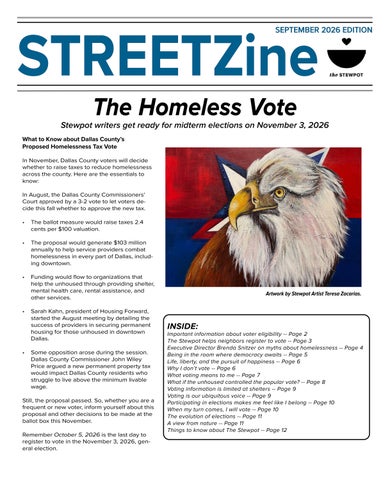
Stewpot writers get ready for midterm elections on November 3, 2026 What to Know about Dallas County’s Proposed Homelessness Tax Vote In November, Dallas County voters will decide whether to raise taxes to reduce homelessness across the county. Here are the essentials to know: In August, the Dallas County Commissioners’ Court approved by a 3-2 vote to let voters decide this fall whether to approve the new tax. •
The ballot measure would raise taxes 2.4 cents per $100 valuation.
•
The proposal would generate $103 million annually to help service providers combat homelessness in every part of Dallas, including downtown.
•
Funding would flow to organizations that help the unhoused through providing shelter, mental health care, rental assistance, and other services.
•
•
Sarah Kahn, president of Housing Forward, started the August meeting by detailing the success of providers in securing permanent housing for those unhoused in downtown Dallas. Some opposition arose during the session. Dallas County Commissioner John Wiley Price argued a new permanent property tax would impact Dallas County residents who struggle to live above the minimum livable wage.
Still, the proposal passed. So, whether you are a frequent or new voter, inform yourself about this proposal and other decisions to be made at the ballot box this November. Remember October 5, 2026 is the last day to register to vote in the November 3, 2026, general election.
Artwork by Stewpot Artist Teresa Zacarias.
INSIDE:
Important information about voter eligibility -- Page 2 The Stewpot helps neighbors register to vote -- Page 3 Executive Director Brenda Snitzer on myths about homelessness -- Page 4 Being in the room where democracy awaits -- Page 5 Life, liberty, and the pursuit of happiness -- Page 6 Why I don’t vote -- Page 6 What voting means to me -- Page 7 What if the unhoused controlled the popular vote? -- Page 8 Voting information is limited at shelters -- Page 9 Voting is our ubiquitous voice -- Page 9 Participating in elections makes me feel like I belong -- Page 10 When my turn comes, I will vote -- Page 10 The evolution of elections -- Page 11 A view from nature -- Page 11 Things to know about The Stewpot -- Page 12
2
STREETZine
SEPTEMBER 2026 EDITION
STREETZine
STREETZine is an enrichment program of the Stewpot.
The STREETZine is a monthly newspaper published by The Stewpot, a ministry of the First Presbyterian Church of Dallas. The Stewpot provides services and resources for people experiencing homelessness or who are at risk of being homeless. The organization also offers opportunities for a new life. As part of this ministry, the STREETZine seeks to raise awareness about the issues surrounding homelessness and poverty. The monthly publication also offers financial opportunity for Stewpot clients who sell the paper to Dallas residents. Vendors are able to move towards economic self-sufficiency by using the money they receive from selling copies to purchase bus passes, food, and necessary living expenses. Clients also receive stipends for contributing articles to STREETZine. The content in STREETZine does not necessarily reflect the views or endorsement of its publisher, editors, contributors, sponsors, or advertisers. To learn more about this publication, contact Betty Heckman, Director of Enrichment, 1610 S Malcolm X Blvd Dallas, TX 75226 or BettyH@thestewpot.org. To read more about STREETZine, a member of the International Network of Street Papers, go to www.thestewpot.org/streetzine. Managing Editor: Wendy Rojo Editorial Advisory Board: The Rev. Amos Disasa Brenda Snitzer Poppy Sundeen Sarah Disasa William McKenzie Betty Heckman Dee Leone Ryan Sanders Tim Smith
How to Register to Vote in Dallas County
• Request an application by phone by calling (469) 627-8683 • Visit the Dallas County Elections Department Monday-Friday, 8:30 a.m. to 4:30 p.m. at Round Table Drive Dallas, TX 75247 • Pick up an application at your nearest library or local tax office Source: Dallas County Elections Department
You are eligible to vote if you are: • A United States citizen;
• A resident of Dallas County; • At least 17 years and 10 months of age (to vote, must be 18) • Have not been declared totally mentally incapacitated or partially mentally incapacitated without the right to vote by a final judgment of a court exercising probate jurisdiction; and • Not finally convicted of a felony, or, if so convicted must have (1) fully discharged the sentence, including any term of incarceration, parole, or supervision, or completed a period of probation ordered by any court; or (2) been pardoned or otherwise released from the resulting disability to vote. Source: Dallas County Elections Department
SEPTEMBER 2026 EDITION
Getting Carded: The Stewpot Helps Neighbors Replace Lost ID By Poppy Sundeen If you don’t have identification, you face a variety of obstacles. Voting, finding a job, applying for housing, getting medical care, accessing benefits — all those things require ID. So, what happens when your ID is lost or stolen? Charisse Walker has the answers. She’s part of The Stewpot team that helps neighbors restore the documents and cards so important to the business of living.
STREETZine
3
a documents bank. “Clients can leave their vital documents here in a folder and check them in and out when they need to. It’s a safe, secure place.” Your ID and your right to vote Losing your place to live shouldn’t mean losing your voice as a citizen in our democracy. By helping neighbors replace the ID required at polling places, The Stewpot facilitates participation in local, state, and national elections.
The Stewpot’s Charisse Walker helps neighbors secure documents needed to vote. Of course, before you can vote, you need you end up helping yourself. Such was to register. And to register, you need a the case in 2022, when Charisse happermanent address. That can be a chalpened upon The Stewpot. “I was working lenge when you’re unhoused or are for Metrocare Services and had a client moving from shelter to shelter. The Stew- who was being kicked out of his boardpot can solve that problem. “We offer ing house because he didn’t have valid our mailing address,” says Charisse. “We ID.” She asked around and learned that Stolen, lost, and irretrievable documents have hundreds of voter registration cards The Stewpot could help. “I called, got my here.” questions answered and was able to help The scenarios for losing ID vary. “Say you my client.” During the course of her conwere living with someone or there was The voter registration cards are cataversation, she learned that The Stewpot a domestic violence situation,” Charisse loged in alphabetical order and kept in had an opening for someone with her explains — a situation that could make it The Stewpot mailroom. “Once a person background. “She walked me through the dangerous or just plain impossible to get uses our address, the voter cards are just application process, and a month or two to vital documents. “Or the documents re-sent here every year. This becomes later, I was working at The Stewpot.” were burned in a fire. Or someone stole their stable address.” your bag, and all the documents were in Continuing the tradition of helping oththere.” A fortuitous change of plans ers Charisse meets with up to 24 neighbors a day. “We started taking appointments by referral, because the demand is so great.” Referrals can be made by area shelters or mental health providers, such as Metrocare. By meeting’s end, next steps are outlined, and solutions are at hand.
Regardless of the circumstances, the loss is devastating. Everything you need to regain your place in society and start a new chapter is gone. That’s why the work Charisse and her teammates do is so important. Priority documents and a safe place to keep them Texas ID cards, birth certificates and Social Security cards top the list of essential documents. “For a job you have to have a Texas ID and a Social Security card for sure. For housing you have to have a Texas ID and a birth certificates.” Once vital ID is in hand, what’s to keep them from getting lost again? If you’re unhoused or living in a temporary situation, it may be hard to keep track of belongings. That’s why The Stewpot provides
Charisse didn’t start out to do the work she does now. She was on the path to becoming a teacher. “There’s a long history in my family of teaching. We have seven or eight teachers in my family.” Her student teaching experience ended up leading her to a different path. “I was more concerned with why children came to school hungry and couldn’t focus or why their clothes were too small and how that led to bullying than I was with the curriculum.” Her college advisor suggested she’d be better suited to becoming a social worker than to teaching. She changed her major and earned a bachelor’s degree in sociology with a concentration on social services. Finding her way to The Stewpot Sometimes when you’re helping others,
When Charisse isn’t with Stewpot clients, she’s home with her family, including a nine-year-old daughter who shares Charisse’s compassion for others. “My daughter donates toys she no longer wants, so I can bring them to work. When I have clients who have children, the toys keep them occupied while the parent and I get things done.” Maybe she’ll follow in her mother’s footsteps. Poppy Sundeen is a Dallas writer and a member of The STREETZine editorial board.
4
STREETZine
SEPTEMBER 2026 EDITION
Talking with Brenda Snitzer By Brenda Snitzer Editor’s Note: For this new feature, STREETZine presented a handful of questions to Brenda Snitzer, executive director of The Stewpot. Below are her responses, which only have been edited for length and clarity. What do you hear from foundations and philanthropists about homelessness in Dallas? Foundations and philanthropists are like the rest of the population in Dallas County. Residents want action to be taken on homelessness. A countywide poll that Housing Forward commissioned this year shows 63% of individuals surveyed say homelessness is a concern, and 60% believe investing more support in solutions will lead to better results. The public and philanthropists are asking for the solution. What one thing do you want the community to know about recent progress being made at The Stewpot in providing homeless services in Dallas County? In our community, the All Neighbors Coalition, an organization of 150-plus members that Housing Forward leads, has proven what works. Since 2021, there has been a 25% reduction in street homelessness. Five years ago, we were searching for solutions. Today we know what works. Now, we must scale the solutions to every corner of Dallas County. Coordinated outreach. Immediate shelter. Treatment and housing connections. Specialized response for severe mental health needs. These will enable Dallas to have a system where no one is forced to sleep outside. Faster exits from homelessness keeps us from having bottlenecks on the street or in shelters. The Stewpot is a key player and supporter of the Homeless Response System, which Housing Forward coordinates and is addressing homelessness. The coalition of providers and leaders I mentioned is working to scale the solutions. What myths about homelessness do you run across in the larger Dallas community?
Tim Smith, our communications director, wrote a great piece about myths on our Stewpot blog. Here is a summary of his explainer, “Myths About Homelessness (And What We Actually See in Dallas).” Myth 1: People choose to be homeless Reality: Homelessness is rarely a deliberate choice. It often results from chain reactions — job loss, medical emergencies, domestic violence, disability, or family breakdown — combined with rising housing costs outpacing wages. The data show homelessness rises when rents grow faster than paychecks.
systems. Understanding the truth is the first step toward meaningful solutions. In short, homeless is complex and often the result of structural and economic factors. Effective responses require housing stability, regional coordination, and systemic change rather than blaming individuals.
North Texas Giving Day is this month. How does that event help The Stewpot Myth 2: If you work, you won’t be home- live out its mission? less North Texas Giving Day helps not only Reality: Many people experiencing home- The Stewpot but all providers in the lessness are employed. However, wages Homeless Response System tell the story often don’t cover housing, utilities, food, to the general public of what’s working. transportation, and healthcare. A single Dallas County is a leader across the naunexpected expense can collapse a tion in moving people out of homelessfragile budget, making work alone insufness. Every year, about 11,000 houseficient. holds need help. Sixty percent of those are currently reached but 40% go without Myth 3: Homelessness is just a downhelp. town problem Reality: Homelessness is a regional crisis. The plan for all of us is to fund pathways In Dallas and Collin counties, people out of homelessness for everyone. North experiencing homelessness come from Texas Giving Day helps every organizaall areas — urban, suburban, and rural — tion live out its mission to help folks move and are found in diverse settings. That out of homelessness and become stable, includes under bridges, in cars, on couch- housed members of our community. es, and in shelters. Our goal is to continue decreasing the Myth 4: Shelters solve homelessness issue of homelessness in our commuReality: Emergency shelters save lives by nity. We do this by: 1) helping folks avoid providing a bed for the night, but they are unnecessary jail and hospitalization; 2) not a long-term solution. Housing stability preventing street homelessness and is the key to ending homelessness. Shel- responding quickly when it happens; 3) ters are a necessary short-term measure, connecting people to treatment, shelnot a permanent fix. ter, and housing; and 4) restoring public spaces and supporting economic growth. Myth 5: Homelessness is a personal failure Reality: Public conversation often frames homelessness as a moral failing, but it’s usually a systems issue — a failure of affordable housing, wages, and support
SEPTEMBER 2026 EDITION
STREETZine
5
Writers’ Workshop Essays Editor’s Note: Each Friday morning at 10 a.m., The Stewpot hosts a Writers’ Workshop. During the sessions, participants address selected topics through prose. In this edition of STREETZine, we feature the essays of writers that discuss their experiences with voting.
Being in the Room Where Democracy Awaits By Jamuna Krishnan
The crisp autumn air bit Evelyn’s cheeks as she stood outside the Oak Creek school library, her fingers tightly gripping her grandmother’s silver-plated compact mirror. It was the first Tuesday in November, and at 18 years old, she was finally standing in line to vote. For Evelyn, the wait was a novelty. But for her 80-year-old grandmother, Clara, it was a monument to a long, hard journey. Tall and thin, with silver hair gleaming under the sun, Clara leaned lightly on her cane, her eyes fixed on the double doors of the polling room. Evelyn opened her compact to check her hair. Clara caught her reflection and smiled softly, her eyes distant. “You know, Evie,” Clara whispered, “when I was your age, standing in a line like this was not just a matter of waiting your turn to vote. It was an act of defiance.” Evelyn closed the compact and listened. She knew most of her family’s history, but she still loved hearing the stories.
“In the early 1960s, back in our hometown in Alabama, your grandfather and I tried to register to vote,” Clara said. “The law said we had the right, but the people at the registration office had other ideas. They didn’t just ask for IDs. They handed us a literacy test meant to make us fail. We had to recite parts of the Constitution from memory.” Clara shook her head, a bittersweet smile playing on her lips.
chine pulled the paper in, a small screen flashed, “Ballot cast. Thank you.” Clara stepped out and adjusted her coat while she waited for Evelyn. Together, they walked outside into the bright sunlight, where a volunteer handed each of them a small circular sticker. Clara took hers and pressed it firmly over her heart. Evelyn looked down at her own sticker. It was bold and simple: “I VOTED.”
“They wanted us to feel small, to turn around, and to walk away. But we stayed in that office until they forced us out. Then we came back. We marched, organized, and held rallies. We watched the world slowly change. Finally, the Voting Rights Act passed.”
The fictional story of Evelyn and Clara illustrates the powerful meaning behind the act of voting. The right to vote was peacefully fought for, and Evelyn’s first vote was not only a personal milestone, but a continuation of Clara’s courage and hope.
The doors opened, and the line moved forward into the room where democracy waited. Volunteers stood ready to help and pointed people toward the privacy booths. There were no hurdles, just neighbors helping neighbors.
In the voting booth, every person stands as an equal, carrying the hopes, struggles, and dreams that brought them there. With each ballot, we honor those who fought before us and help shape the future for future generations.
As Evelyn entered an empty booth, she saw her grandmother in the booth next to her, already sliding her ballot into the electronic tabulator. As the ma-
That is the promise of democracy. Jamuna Krishnan is a writer in The Stewpot Writers’ Workshop.
6
STREETZine
SEPTEMBER 2026 EDITION
Life, Liberty, and the Pursuit of Happiness By Savita Vega
When I was young, my mother never voted. She was a Jehovah’s Witness, and she believed that becoming entangled in “worldly concerns,” including politics, was a sin. The idea was that one’s only allegiance should be to God, not to one’s country or to a particular politician. So, I did not grow up in a house where the culture of voting was strong.
support the view that the economic disparity I witnessed was systemic. Furthermore, I realized that the system which underlies it runs deeper than the two-party system in which we cast our votes. In other words, both the Democrats and the Republicans turn a blind eye to the ever-growing economic disparity in this country where we have enough resources to guarantee sufficiency for everyone.
As a result, although I did not adopt my mother’s religious beliefs, I did retain the view that governments — and even democratic systems of voting — were fundamentally flawed. Therefore, even without having taken a class in economics or politics at the time, I began to question economic distribution and wonder why our voting system seemed to offer no alternatives to the dire inequality that I saw. Consequently, I was not inclined to vote even when I came of age.
For example, according to an article written by Andrew Lisa in Yahoo Finance, if all wealth in the United States were divided equally among all adults and children, each individual would have roughly $471,465. However, according to the Federal Reserve’s recent quarterly datasets, the top 1% as well as the bottom 90% of all U.S. households each hold roughly 31.7% of the total wealth. In other words, the top 1% of Americans (2.6 million adults) holds as much wealth as the bottom 90% (240 million people).
Only a few years later, in the early ‘90s, I moved to Seattle and discovered the many alternative bookstores that existed there. That’s when I began to read the likes of Peter Kropotkin and Mikhail Bakunin. Although I did not adopt all their beliefs or agree with all their ideas, I did
And yet, I am called on at every election cycle to vote for politicians on whom these facts appear to be lost, politicians who do not even acknowledge this data in their campaigns, much less propose a solution to it. As a result, most of my adult life, I have declined to vote. In my view,
Why I Don’t Vote
By Nicolas Williams The first time I got my voter registration card and voted was when I turned 19. I voted for a candidate because I didn’t like the president we had at the time. My candidate didn’t win and that wasn’t the last time my choice lost. After a while, it felt like my vote didn’t count, so I stopped voting. It also seems like there aren’t a lot of options to choose from. Some candidates seem like they are not for the people, but for who has given them the most campaign money. And it feels like some aren’t really trying to address the issues at hand. I don’t like that votes cast in presidential elections get sent off to the Electoral College. Its electors cast the final vote for us and, while their names are public, I doubt many of us know them. To me, my vote seems more of a suggestion, even if the electors are to reflect the outcome in their states.
The Electoral College is not a physical place, either. It consists of 538 electors who reflect the number of representatives and senators from each state. Texas, for example, has 40 electors since it has 38 representatives and two senators. But it seems to me the college is undemocratic. Small state electors may have more of a proportional voice because their states have two senators, just like big states. To me, that gives more power to some voters depending on where they live.
any vote, on either side of the political divide, equates to a vote for the system upholding and even promoting that disparity. Unfortunately, there are very few exceptions to this norm of politicians who ignore economic disparity. When I have encountered these exceptions on the ballot, I have voted. In my view, when democracy becomes the mere semblance of choice without actually offering alternatives, it is not democracy at all. When the system of voting becomes wholly controlled by the wealthy such that any vote is a vote to keep the uber-rich in power, we are left with an oligarchy. Every election cycle, the rich get richer, while more and more people at the bottom of the economic spectrum are stripped of the resources fundamental to “life, liberty, and the pursuit of happiness.” So, my refusal to vote is not a lack of faith in democracy or rejection of the core principles upon which this country was founded. It is rather a rejection of what I see as the demise of those principles and the death of democracy. Savita Vega is a writer in The Stewpot Writers’ Workshop. believe in direct democracy or that the common people would make the best decisions. It took a very long time before our laws allowed anyone other than white males to cast votes. These are some of the reasons I don’t vote. Nicolas Williams is a writer in The Stewpot Writers’ Workshop.
The Electoral College also makes it where a handful of swing states determine the election. Presidential candidates can ignore almost the entire country. The Electoral College is such a bad system that people have been trying to abolish it for a long time. But it’s hard to do. The Founding Fathers didn’t
Photograph by Unseen Histories courtesy through Unsplash.
SEPTEMBER 2026 EDITION
STREETZine
7
What Voting Means to Me
so many different races and propositions.
people to vote.
Voting can be meaningful to me, or it can mean nothing depending on the kind of election, my current situation, and whether I have the right information about the candidates or the issues. I am not a person that follows all the political news.
I also find that not living in a permanent area affects my voting habits. It is hard to care about things when you are not fully invested in your community. I live in a project-based housing unit but want to move to a regular apartment. By living where you want to live, a person can get invested in their community leaders.
Finding the right precinct can be a problem also. I either went online or looked in the newspaper to find the right precinct for my current address. I also think you have to live for a certain amount of time at that address to vote, which is another obstacle for homeless people.
By Kenneth Henry
The problem is all of the different news stations and different points of view. It seems like each news station is geared to promote Republican or Democratic candidates. That makes it hard to know what is the truth or a lie. Social media is another example of fake news. It is very hard for me to distinguish between what is real and what is not. I have read some outlandish stories on my newsfeed that seem so unbelievable. Artificial intelligence is a big contributor to outlandish news stories. Once you read them or see a video, it is hard to put them out of your mind. I have a hard time deciding what is real or fake. Like most people, I don’t vote in every election. It is hard to know about every election and every candidate. There are
I personally never had a problem getting registered to vote. Getting a card in the mail or registering at the library was usually how I did it. Not having a permanent address is a more complex situation. When I became homeless due to my circumstances, voting was still not a problem for me. Going directly to a shelter provided me with a stable address, although voting was the last thing on my list of duties to perform. Homeless people have their own set of problems, and each person is different. Transportation can be another problem that makes voting difficult. Some people don’t drive or have access to a bus route to get to their precinct. On voting day, there should be a community bus to take
Apathy is another obstacle to voting, myself included. Many people think that voting doesn’t matter. It is hard to make changes in people’s voting habits. As far as voting goes for me, I have to admit that the presidential election is the most important thing to me. I rarely vote in mid-term elections, again due to apathy. Propositions can be important for local races, and I will vote if it is relevant to me. Having the right to vote is a great honor that some people don’t have, such as felons. I try not to take it for granted. Kenneth Henry is a writer in The Stewpot Writers’ Workshop.
Where to Call for Municipal Government Housing Assistance:
• City of Balch Springs (972) 286-4477 • City of Dallas (214) 670-5988
• Dallas Housing Authority (214) 951-8300 • Garland Housing Agency (972) 205-3393 • City of Grand Prairie (972) 237-8176 • City of Irving (972) 721-2667 • City of Mesquite (972) 216-6424 Source: Housing Forward
Artwork by Stewpot Artist Jose Palacios.
8
STREETZine
SEPTEMBER 2026 EDITION
There’s No Place Like Home(less): What if the Unhoused Population Controlled the Popular Vote? By Ahavah Daweed
Imagine Election Day in America. Before sunrise, voters form lines outside schools, libraries, churches, and community centers. Television networks illuminate enormous maps in red, blue, and undecided shades. Commentators calculate percentages while candidates wait beneath bright lights for America to speak. Now imagine another map. On this map, families sleeping in cars, shelters, tents, motels, abandoned buildings, and beneath overpasses possess enough votes to determine the popular vote. Their communities also command enough electoral power to decide who enters the White House. What would the voice of America sound like then? I invite you to imagine this possibility with me — not as a partisan argument, but as an examination of power, citizenship, compassion, and human dignity. For me, homelessness does not exist as an abstract political issue. I lived inside its uncertainty as a homeless widow and mother. I know what it means to grieve a husband while my children still need their mother. Widowhood already creates an empty space no one else can fill. Yet, homelessness adds another dimension of emptiness: no permanent place to close the door, exhale, and mourn. Grief does not wait for housing stability. Neither does motherhood.
Scripture gives me language for this tension. Psalms 68:5 describes The most high as a father to the fatherless and a Judge of widows. Isaiah 1:17 calls people to seek judgment, relieve the oppressed, defend the fatherless, and plead for the widow. Deuteronomy 10:18 reveals The most high’s concern for the fatherless, the widow, and the stranger. Those passages felt different for me when I became a widow. They feel different when your children know loss personally. They feel different when “the poor” no longer describes strangers somewhere across town. Homelessness changes where a person sleeps. It does not erase citizenship, motherhood, intelligence, faith, dignity, or political voice. Yet political conversations often discuss unhoused people as problems for communities to solve instead of citizens for communities to hear. Words such as encampment, shelter capacity, housing shortage, and public safety can reduce human lives to categories. Behind every statistic stands someone with a name, history, family, gifts, convictions, and dreams. What if those people politicians and society seek to silence decided elections?
Imagine presidential candidates entering shelters because every conversation could shift the Electoral College. Imagine campaign strategists studying motel corridors with the same intensity reserved for suburban swing counties. Imagine debate moderators asking candidates: “How will a widowed mother without permanent housing register to vote, receive election information, reach a polling place, protect My children still need meals when my heart aches. They still need clean clothes, her children, and rebuild a stable life?” reassurance, protection, laughter, instrucPolitical priorities might change if political tion, and hope. They still need me to power moved from the privileged few to answer questions about tomorrow even the misplaced masses. when I cannot see tomorrow clearly myself. Perhaps this possibility reveals an uncomfortable feature of democracy: people Some nights, a homeless mother may lie awake wondering where her children will often listen differently when overlooked communities gain leverage. sleep next while everyone around her rests behind locked doors. She carries grief in one hand and responsibility in the Proverbs 31:8-9 calls us to open our mouths for those appointed to destrucother, refusing to drop either one.
tion, defend the poor and needy, and judge righteously. Yet I wonder what might happen if the poor opened their own mouths together — and millions of ballots amplified their voices. Picture election night. A reporter stands before an electoral map and announces how the unhoused vote will determine the presidency. Cameras suddenly turn toward people society usually passes without seeing. A widowed mother emerged from her temporary housing wearing an “I Voted” sticker. A veteran casts a ballot. A young adult who slept inside a car walks into a polling place. An elderly man who carries his possessions in a backpack while carrying enough political power to help determine his nation’s future. For one evening, America cannot look away. But why should political power become the price of visibility? As a homeless widow and mother, I do not ask anyone to view me only through sorrow. My children and I represent more than what we lost. We still possess faith. We still possess purpose. We still possess a future. We still possess voices, and we revoke our “right to remain silent.” Matthew 25:35-40 reminds believers to recognize the Messiah through his encounters with people experiencing hunger, thirst, displacement, need, sickness, and imprisonment. Scripture invites more than sympathy. It invites recognition and calls us to action. So, I return to the electoral map. What if the unhoused population controlled the popular vote and the Electoral College? Perhaps candidates would finally enter places politicians rarely visit. Perhaps America would discover wisdom hidden beneath bridges, leadership inside shelters, courage inside motel rooms, and mothers fighting fiercely for their children while carrying grief few strangers ever see. Perhaps our nation would finally hear millions of voices it should never have needed an election to notice. Ahavah Daweed is a writer in The Stewpot Writers’ Workshop.
SEPTEMBER 2026 EDITION
Voting: Information is Limited at Shelters By Sandra Robinson
I remember my grandfather stating that everyone made money when “tricky Dick Nixon was in office.” Voting and getting involved in political campaigns were not promoted at home. I never felt I was missing out on anything. I keep an eye on world events. I took a course in social science that taught me to look at patterns in society. My casual reading of history and my basic understanding of social science allowed me to view the world differently. I like looking at the world view, what the economics profession calls the “bird’seye view” — looking at the big picture instead of the worm’s-eye view or seeing the small things in front of you.
The first homeless shelter I went to did not allow pay-as-you-go guests to use computers. Those that were members of the program were allowed to use the computers when they were in the third or fourth stage of the Homeless No More program. Military veterans were the only guests that were allowed TVs in their rooms. Those that had government-issued phones had limited minutes of data usage. Limited internet and TV access to political candidates and their topics limited the voters’ knowledge.
My second homeless shelter had a computer room that was used by the job assistant agent. The agent used the computer Monday through Friday. The only time we were allowed to use a computer was when a volunteer came and was willThe main problem about being homeless ing to allow usage of the computer. There was one large TV in the pavilion. Surfing is the limitation placed on following your the internet at the shelter for information TV news interest and internet surfing. Knowing the candidates and their political on the different political parties and their candidates was not available. views is what makes an informed citizen.
Voting is Our Ubiquitous Voice By James Varas
I am 48 years old, and I have a story to tell you: I have never voted in my life for a president. For many years, I have rightfully registered to vote, yet I have never actually made it to the voting center. It was not because I could not decide who to vote for or because I did not know which candidates supported my views. Instead, I simply allowed my daily life and my busy schedule to become my valid excuses. I focused my time and energy on my college studies, my future aspirations, and my prayer life, convincing myself that I was just too busy to make it to the polls. I used to feel deeply ashamed of this track record, realizing I had made the simple act of voting seem much harder than it actually was. That mindset changed completely once I decided to research the actual voting procedures online. I was surprised to discover that the process is incredibly straightforward. In Texas, you do not even need to bring your actual voter registration card with you to the polls; all you need is a valid Texas ID or driver’s license. After checking my own license to ensure everything was up to date, I realized that my old excuses no longer could be accepted. While I understand the importance of
STREETZine
9
My third homeless shelter had scheduled times a person could use computers and two TVs, one for the men’s section and the other for the women’s section. The men’s TV stayed tuned to western TV shows. The females were always tuned into Family Feud. The Dallas Cowboys games took over both TVs on a game day. The computer lab offered no privacy for internet surfing of topics. My home life never promoted joining political parties, and homeless shelters limit computer surfing and TV viewing of political issues and debates. But my interest in social science influenced me to watch and observe society. I started seeing patterns in society with the understanding of history. Sandra Robinson is a writer in The Stewpot Writers’ Workshop.
voting, I have never personally experienced standing at a ballot box. Breaking this lifelong failure is a challenge I am finally ready to accomplish in this next election. Because I want to focus on the reasons that guide my choices rather than political talk, I have chosen to look at what principles in my mind would create a perfect president. My ideal leader is someone who reflects my deepest personal and holy spiritual aspirations in this life. Most importantly, I want a president who believes in and follows the doctrine of Jesus Christ. I believe our country needs a leader who will stand up for our nation by maintaining strong military funding and defense. Lastly, I want a chief executive who stands firmly against evil and wickedness on this earth. I realize, my vote is a reflection of my personal stand for life and freedoms of what I believe in. I regularly pray for our nation and this world to walk closely with God Almighty, and I want my actions at the polls to align with that prayer. By turning my past inactivity into future effort, I am looking forward to finally casting my ballot.
Artwork by Stewpot Artist Fernando Segovia. No matter how busy life gets, I am committed to making my voice heard and doing my part as a citizen. I shall stand with God at the finish line knowing that I did all I could to stand for the light of His holy word. I am hoping that our voice becomes ubiquitous in the world we live in. James Varas is a writer in The Stewpot Writers’ Workshop.
10
STREETZine
SEPTEMBER 2026 EDITION
Participating in Elections Makes Me Feel Like a Functioning Member of Society
It’s been a few years since I got to canvass for a political campaign. Going around making sure people By Jason Turner know where to go and when to go and having them make a promise to I don’t get the chance to vote like I used vote is a dream job for me. The job to. I really don’t have a reason why. I just put voting on the back burner for too long pays a lot of money and it’s relatively easy, let alone interesting to and never get around to it. I do believe hear how people feel about differvoting is extremely important. You get to participate in political affairs. We have the ent topics. opportunity in America to help pick who I’m constantly searching for more represents us in office. It’s important that opportunities to canvass elecwe choose the right candidates. tions, but there just haven’t been too many major elections that are The outcome of elections makes me close enough to need ground-game question my judgment because I don’t resources. In the next presidential often side with the winning team. And election, I’ll be sure to get a voter’s sometimes it’s hard to accept that my registration form and make an apvote really does count with the Electoral pearance at the voting booth. College in presidential elections. The college works strangely, and I believe the Voting makes me feel better, like electors have the final say. a functional member of society. I hope by the next major campaign I For any run-of-the-mill election, it is hard can get a job canvassing and be an for me to maintain a current address on influential part of the special event. my ID because I change places so often. Even when I do have a current address, Jason Turner is a writer in The Stewit’s tough to find the voting place and pot Writers’ Workshop. make it there in a timely manner.
When My Turn Comes, I Will Vote By Darin Thomas
I have always wanted to vote. My time in prison made it where I wasn’t able to do so. But I’d like to after I complete parole and am fully discharged. My vote might count for something, just like it does for the rest of the people able to vote. Putting the right people in positions could make things better. I will be 54 in September and have never voted. Voting would make me feel like I’m a part of the rest of the world. I feel like my vote, and that of other people who can’t vote now because of their prison records, would give everyone a chance. In prison, some want to change their lives and make a difference. Being imprisoned makes you realize we need compassionate leaders. They Artwork by Stewpot Artist Roger Blais. could come up with policies that help those who want to change. Some inmates are learning trades, working jobs, and getting their diplomas. They are not getting into trouble or fighting. Some may
Artwork by Stewpot Artist Jennifer Grace.
have been in for years, not improving and causing trouble. But not everyone. A lot want to get ahead. I am not the only person with a record. Some in high office even do. And some good people do as well. People make mistakes and some learn from them. In the past, I used to get voting papers to fill out. But I was turned down when they found out I’d been incarcerated previously. My brother votes. My baby sister votes. One day I’d like to vote with them as well as with my son and daughter. In the meantime, I try to make things better for this world. I’m working on getting a job and restarting a cleaning business that would give me income. I also speak to young guys about avoiding trouble. Making things better, though, starts with praying to my heavenly Father. That strengthens my walk with God. Praying helps you get through the day and through your challenges. That, in turn, helps the world. Churches around the world can change things. Darin Thomas is a writer in The Stewpot Writers’ Workshop.
SEPTEMBER 2026 EDITION
The Evolution of Elections in an Unfolding Democracy By Paul Ranjan Watson
I consider elections as a collective learning process; it’s my realization after voting in elections over the years and as a journalist covering elections as events. My perspective evolved. I quit considering elections as a mere contest to assert one’s stand and now I see it as an ongoing learning process. The shift in my perspective over the decades has helped me protect myself from post-election disappointments. Immediately after elections, the results would have significant impact on my
A View from Nature: The Big Game Experience By Vicki Gies
This past summer, I had the opportunity to learn about the FIFA World Cup and its fans. I was skeptical at first. I wasn’t sure how it would play out. What I mean by that is I thought there would be a lot of trouble in Dallas, considering the crime and problems with the homeless people. But I was wrong; it turned out much better than expected. I even watched several games! I’m not a soccer fan. I don’t even know anything about soccer. But the fans from other countries really got my attention. I met so many people from various countries who were very friendly and wanted to take the time to talk to me. The fans were all very interesting. I enjoyed hearing their different accents and listening to their excitement about being here in a different country. The fans from Japan were so helpful to everyone. They even stayed after the game at Dallas Stadium and cleaned the stands. Wow! I found out that it’s their culture to leave everything the way they found it when they got there. Next, I met and talked with fans from Norway, Africa, and Argentina. I learned the “Row” of the Norwegian Vikings, which turned out to be very good exercise; the culture and dress of the African people; and what turned out to be my favorite team, Argentina! Go Messi!
emotions, and after the election it was no different. However, a common thread that runs through the years was that elections, knowingly or unknowingly, became a learning system. It has become personal. I don’t see elections as an unattached, distanced democratic function. Also, the very mechanics of elections evolved. For instance, I wrote my master’s thesis on how a candidate for the 2004 Democratic presidential nomination, Howard Dean, ran his campaign. The Vermont governor used blogs to organize people and raise funds. It was a novelty.
STREETZine
11
Joe Trippi, his campaign manager, famously said, “This revolution will not be televised.” But that was 22 years ago. However, what became mainstream since 2004 election is the emergence of electronic spaces as “dialogic spaces.” British scholar Anthony Giddens theorized the significance of electronic spaces as venues for democratic functions. I applied the so-called novel thought to the 2004 elections. But just as then and now, I’ve come to realize that elections are nothing but a collective learning experience. Paul Ranjan Watson is a writer in The Stewpot Writers’ Workshop.
Some of their fans, who didn’t get to go to the actual games, went to the Fan Festival at Fair Park. I talked with an Argentinean church group who gave me a prayer bracelet. They were so cool and friendly. I’m only sorry that Argentina didn’t win the championship. I was really behind them all the way! Even though I knew nothing about soccer and its regulations before FIFA came to Dallas, I became interested in the games through the fans I met. I’d heard so much about “Magical Messi,” and after talking with several of their fans, I wanted to learn more about him and his team. I started watching the Photo of Argentina fan attending a match at Dallas Stadium. games They were exciting, Courtesy of Wendy Rojo. even if I didn’t understand the commentators who spoke in Spanish. TV. I’ll always remember the summer of I began to see why he was called “Magi2026 when I learned that I really do enjoy cal”. All his maneuvers to get the goal soccer after all. were fascinating! Now that the games are over, I really miss all the fans that came to Dallas. I wished I had gone to the Fan Festival at Fair Park, but my health wasn’t allowing me to walk that far, and I had no transportation. There’s always another chance to see the FIFA World Cup games four years from now, although I’ll have to watch it all on
Vicki Gies is a writer in The Stewpot Writers’ Workshop.
12
STREETZine
SEPTEMBER 2026 EDITION
Street Newspapers - A Voice for the Unhoused & Economically Disadvantaged What is STREETZine? STREETZine is a nonprofit newspaper published by The Stewpot of First Presbyterian Church for the benefit of people living in poverty. It includes news, particularly about issues important to those experiencing homelessness. STREETZine creates direct connection between our communities.
Distributing STREETZine is protected by the First Amendment. CHAPTER 31, SECTION 31-35 of the Dallas City Code PANHANDLING OFFENSES Solicitation by coercion; solicitation near designated locations and facilities; solicitation anywhere in the city after sunset and before sunrise any day of the week. Exception can be made on private property with advance written permission of the owner, manager, or other person in control of the property. A person commits an offense if he conducts a solicitation to any person placing or preparing to place money in a parking meter. The ordinance specifically applies to solicitations at anytime within 25 feet of: Automatic teller machines, exterior public payphones, public transportation stops, self-service car washes, self-service gas pumps, an entrance or exit of a bank, credit union, or similar financial institution, outdoor dining areas of fixed food establishments.
Offering a financial opportunity to those currently experiencing homelessness.
DIAL 211
STREETZine is a program of The Stewpot and a member of International Network of Street Papers
2-1-1 Texas helps connect people with state and local health and human services programs.
Want to be a writer?
Come visit us at The Stewpot!
1610 S Malcolm X Blvd, Dallas TX 75226 Fridays at 10AM-11AM Call 214-382-5902 for more information
Order your copy today with a suggested donation of $30. Learn what it means to be a neighbor in our community.
For help finding food or housing, child care, crisis counseling or substance abuse treatment.
ANONYMOUS AVAILABLE 24/7, 365 DAYS A YEAR
Support our book, Thy Neighbor. Written by the Writers’ Workshop participants, it celebrates The Stewpot’s 50th anniversary.
www.thestewpot.org/thy-neighbor
Advertise in
STREETZine Support STREETZine and its vendors with your business or personal advertisements and announcements.
Want to help? Make a donation! Donations directly support our STREETZine and Writers’ Workshop. thestewpot.org/streetzine Contact us at streetzine@thestewpot.org
Any other ideas? Take our survey:
https://bit.ly/2WbMRsg Thank You For Your Support!