Finding Hope and Resilience
Broadway performer Hailee Kaleem Wright spoke at The Stewpot’s annual Soup’s On luncheon on February 2. Before the event began, the Houston native spoke with STREETZine writers and editors about her experiences in theater and being homeless, which sometimes occurred simultaneously. The following has been edited for length and clarity.
How did you get interested in theater?
I got started back in 2011. I was in high school, and my theater teacher said, “I think you should join this program.” I was like, “Ok, I don’t know.” Everybody went to theater class in my high school to be cool. They didn’t go to actually learn theater. But while I was there, I thought this is kind of interesting. I like to sing and dance. I had not been exposed to many live productions except movie musicals. “Chicago” is my favorite, but I didn’t realize there was a Broadway show of it.
I auditioned for “Hairspray” at my school and didn’t get the part. I was a junior and my teachers said I was not ready yet. I thought, “Well, I don’t know how to get ready.”
Going into my senior year, I started taking it more seriously. I still didn’t get a part, but I got to be in the choir and the dance team. I got stage time.
As I was about to graduate, my mom sent off my high school videos to a company she was about to work for in “Hairspray.” I got that professional gig and started as a swing at the El Dorado Casino in Reno, Nevada. I didn’t even have a mic, but I got bit totally by the theater bug.
I told my parents that I wanted to do this for real. My dad was very much against it (laughter), but it worked out.
Had you already started in the arts when you found yourself homeless?
It was right after Reno that I went to New York with my mom. It was so much more expensive than in the South. And I didn’t know how things work, even getting an apartment. It was a calamity of errors.
Rent caught up with us quickly, so we found ourselves in the New York shelter system. My mom and I were both pursuing our dreams of being in theater. We were like, “Now, what do we do?” We had sold all our stuff and were stuck. Our big dream deflated quickly.
It was a constant battle working with the Homeless Services Department in New York and their strict rules while also trying to be an artist. They don’t look at that as valuable employment. You felt like this dream was not possible. It was a constant battle to figure out how to make something exist that I didn’t how to make exist.
That kind of battle is dark and dreary, but you and your mom were together. That’s beautiful. I saw a lot of momdaughter relationships at the shelter that were not so beautiful. So, good for you.
Yeah, we only had each other.
What was it like living in both a shelter and trying to get auditions?
That is like a double life. When I walked out of the shelter, I was acting already. I was acting like I had a normal life like everyone else. But when I went home, my experience was not like everyone else’s. You had to show up at the shelter by a certain time, ask for your keys back, and other differences.
I was trying to free up my daytime to audition between 9 and 5. I had to get a job that let me do that, so I would have to work past the hours the shelter was open.
It was always this constant juggling and figuring out how to get momentum going. It was about making good decisions consistently to have stability. If I could get an acting job, maybe I could get housing.
It didn’t happen fast. It took three years of bouncing from shelter to shelter in New York City. I had two jobs, went from audition to audition, had a record deal that went kerplunk, and I had so many different experiences during that three-anda-half years before I got a modicum of success.
Did you have a Plan B while you were struggling?
No. Plan Bs do give certain folks the
logistics of knowing how to get out of Plan A. But if you want Plan A, you have to commit to it. Along the way, you might get shifted and moved along. But if you really love your main goal, you will find resilience. That’s my favorite word, my superpower.
You are very poised. You speak with insight without thinking. How do you do that?
Oh, thank you. Well, my mom was a nerd, and she raised a nerd. She used to read the dictionary for fun, and I did that with encyclopedias. I learned a lot from those. I’m also a writer, a songwriter. I started off journaling and I still do that today. That is another way I kept my wits about me. Writing lets you get out all your fears. I could realize what was false and plan my way out.
My mom and dad are big book and text people. So, I got a lot of that from them.
I also watch a lot of Oprah (laughter). I’m a big Oprah girl.
And you perform in front of a lot of peo ple.
Being in any show requires a lot of rehearsing and work that no one knows. Before I started my last show, I was doing two weeks of pre-production work with my vocal and acting coaches before I went into rehearsal. That is paid out of my pocket, free labor.
I did that because I love my craft and want to honor the moment. And that was my third Broadway role, and this was a big lead, so I wanted to show up ready.
How did you navigate the shelter system and networking in the arts community? You can’t tell someone you’re homeless when you are applying for positions.
What a great question. Going into these audition spaces, I was changing in the bathroom of a restaurant or audition space and put on makeup so I could pretend I was someone ready for the gig.
It just takes time and effort to learn your community and who is in it. You might find, oh, this person has been through the same experience and been public about
Continued on page 6
Caring for the Largest Organ in Your Body
By Poppy Sundeen
Weighing in at six to 10 pounds and covering roughly 21 square feet in the average person, your skin is the largest organ in your body. It’s also one of the most important.
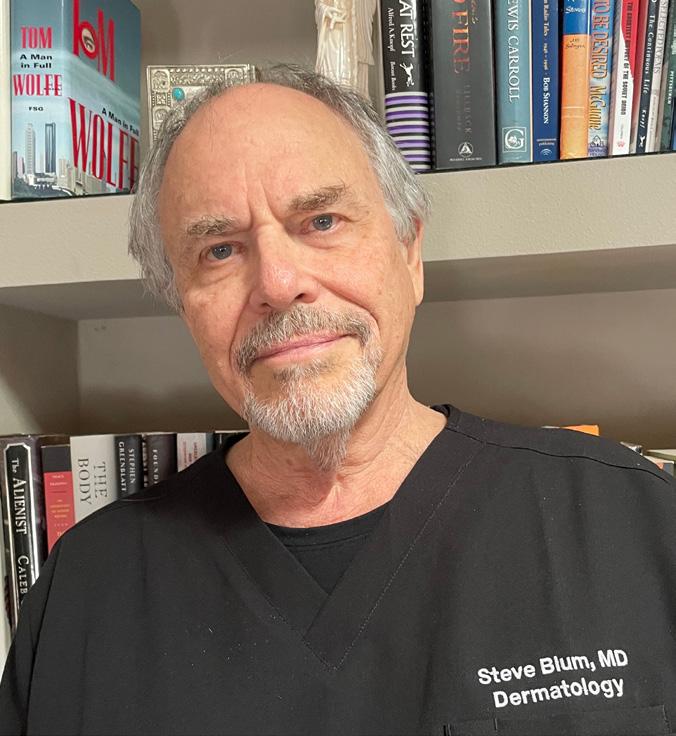
“A lot of people think it’s like a sheet,” says Dr. Steve Blum, a North Texas dermatologist. But skin does much more than separate the body inside from the world outside. “It’s actually a living organ,” he points out, and it serves several vital functions.
Your body’s first line of defense
Your skin helps keep germs out of your body. “It makes anti-microbial substances to fight germs that might otherwise invade.”
It also keeps needed moisture in. “The body labors hard to make a layer of lipids or oil-like substances that coat the outer layer and make it look better, feel better, and function better.” If the barrier function of the skin is diminished by drying it out and removing those lipids, the outer layer of the skin becomes cracked and loses its effectiveness.
Are you your skin’s worst enemy?
Many of us were taught to keep our skin squeaky clean using harsh soaps. Dr. Blum cautions against that conventional wisdom. “The skin recycles itself. Dead cells slough off naturally and take out some of the oily stuff, and new oily stuff comes up from below, so the skin is constantly renewing. Using harsh soaps interferes with that process.”
The same applies to scrubbing. It removes the surface cells that protect the layer below instead of letting them slough off naturally. “People who have an occupation that gets them grimy or greasy are exceptions, but most for the most part, scrubbing with strong soap causes more harm than good.”
Skincare on a budget
There are plenty of very expensive soaps out there. The good news is that you don’t need them. “An inexpensive, gentle
soap will do.” The example he gives is Dove soap, but there are lots of other options.
Dr. Blum recommends using your hands when you wash your skin, as opposed to washcloths. And the parts you can’t reach? “Just letting water rinse over the skin on your back is fine.”
He also points out that it’s not necessary to bathe every single day. That’s good to know, if you have limited access to showers. “A sponge bath for your underarms and groin area may be all you need.”
Treating cuts and scrapes
Even a minor skin tear can be problematic without proper care. When you cut or scrape your skin, Dr. Blum recommends washing the area right away with soap and water to prevent infection and then patting it dry.
He also cautions against leaving the wound uncovered. “When I grew up, I was under the impression that if you had some kind of sore, it would heal better open to the air. Turns out, that’s not true. It’ll actually heal better if it’s moistened and covered by a Band-Aid.”
So, what do you moisten it with? It may surprise you to learn that the answer is not antibacterial ointment. “Early in my practice antibacterial ointment was the go-to, but the fact is that most of the time it’s better to use Vaseline,” says Dr. Blum, “and never use rubbing alcohol.”
The wound should be covered with a bandage to protect the skin as it heals and keep it from rubbing against clothing or bed sheets.
When to get medical help
Most skin injuries can be treated at home, but some require the help of a health care provider. “If it’s a serious or dirty cut, get medical care. And if you’re not up to date on tetanus shots, you should get one.”
Cuts, scrapes, and burns aren’t the only skin problems that might need professional attention. Seemingly innocent bumps and skin discolorations sometimes turn out to be skin cancers. That’s why it’s important to go to the doctor or clinic if you have a lesion or a bump that doesn’t go away on its own and grows.
“A red or abnormally scaly growth or a smooth shiny patch may be a squamouscell or basal cell cancer. They’re usually not life-threatening if treated early.”
Melanoma is a more dangerous type of skin cancer. You can recognize a potential melanoma from its pigmentation. “It may be blackish, bluish, or dark brown with an odd shape that may change as it grows and spreads out.” It’s important to have any suspicious spot checked out. “If you have melanoma removed early, there’s often a good prognosis.”
Protecting your birthday suit
You can buy new clothes, but you can’t replace your birthday suit. It has to last you a lifetime. Remember to take care of it!
Poppy Sundeen, a Dallas writer, is a member of the STREETZine editorial board.
Photograph of Dr. Blum courtesy of Poppy Sundeen.
it. They might have a soft spot, and I can let them know why I don’t have an address on my resume. There are people who are caring.
But I kept putting my head down. And I would ask questions of people who were doing it well and pick their brain. I’d learn about programs and have a goal for how I’d save money from some horrid job I was working at.
You keep knocking at doors to get to the next goal.
How did you navigate financial barriers?
I came in with no education beyond high school, and everyone knew all these shows. I knew none except “Chicago” and “Hairspray.” It was constant catchup. You have to constantly ask questions. People who had a lot of privilege and education would throw questions at me like, “How did you not know that?”
I’d go to the library. Lincoln Center Library has this amazing place where you can rent laptops and watch videotapes of Broadway shows. I’d find ones that people would say I should watch or be in because I couldn’t afford to see them in person.
It’s always that curiosity about your craft. I created my own college and courses. I kept finding ways to get into programs that were not Juilliard, but I was having a Juilliard experience at the library.
You were homeless in Texas, as I have been. How did you handle that?
It was unfortunate. I went to live with a family member but that did not work out after a week of moving to Texas for a better life. It was whiplash of the worst kind. Even though we were in a shelter in New York, we had gotten to the place where we had our own keys and did not have a curfew. We didn’t have a lot of strict rules, although strict rules are fine. It’s just that they can become dehumanizing and unnecessary.
It was not like that in Texas. It was extremely dehumanizing. We went to a shelter in Houston and stayed on mats. My mom and I got jobs that allowed us to get an apartment and buy a car, which we lived in after we lost our jobs.
Hope was the only thing I had during my time of being unhoused. Hope is the only thing we have any time. You can have many things come and go out of Continued from page 4
Ultimately, I found that I got picked from my last audition in New York for a job. So, I flew out and sent money back to get my family stable. After that job, I came back to Houston, and my mom was facing eviction. So, we ended up living in our car again.
That’s a complicated answer to your question, but the details are tedious. This was my third iteration of being homeless. This time we were working with the Salvation Army and the VA because my mom is a veteran. We got into a hotel program where they would place us in a room for a week or two.
I really don’t remember how we made it through all of that. It was like constant hot potato. What do we do now? Where do we go?
Man, we needed a program like The Stewpot, just having a regular place to eat. I also like that you have an art program here where you can release what’s inside of you.
How did you find hope amidst all this?
your life, including money. But hope and community keep you lifted up and going.
One of my biggest belief systems is that asking and knowing that you will get what you need. But you have to ask. That may be asking God, the universe, or a friend. Hope is knowing you may be told yes, or you may be told no. But you go and ask anyway.
My mom and I still laughed. We had a lot of joy and fun. It’s always sounds sad when we talk about being unhoused. But it was not always gloom and doom. We were not depressed. We were happy people with challenging circumstances. You can still laugh and smile and be in need. You can be hopeful and joyful in the midst of being homeless. That is my drum that I will keep beating.
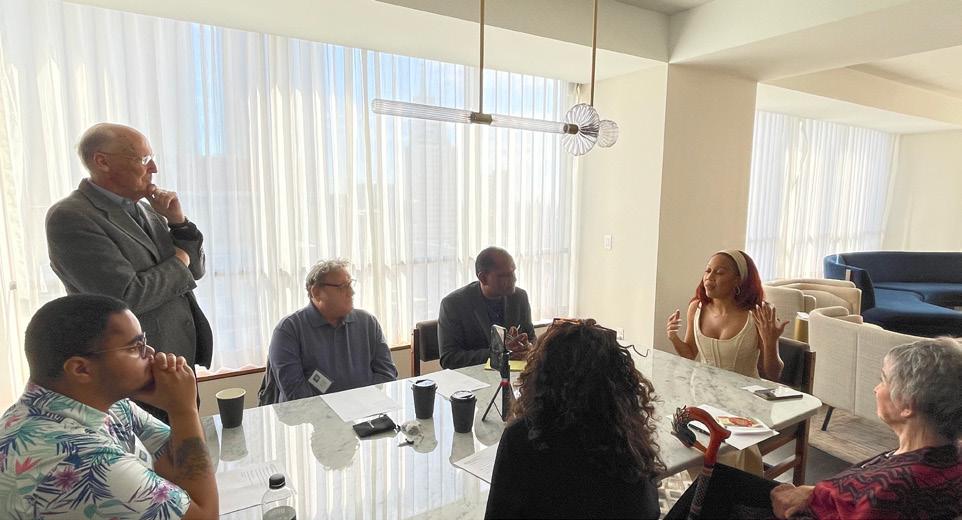
Photograph of Writers’ Workshop participants and volunteers interviewing Hailee Kaleem Wright.
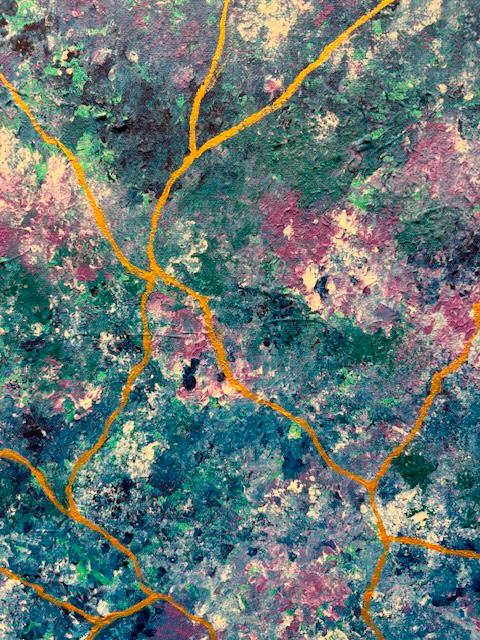
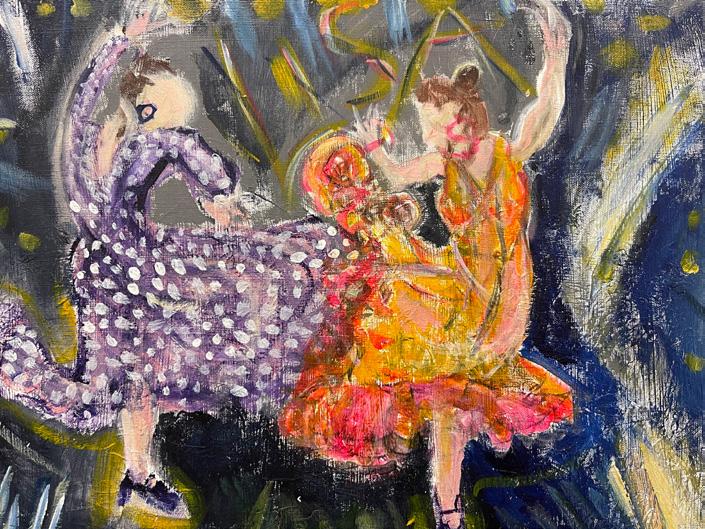
Artwork by Stewpot Artist Lisa López.
Writers’ Workshop Essays
Editor’s Note: Each Friday morning at 10 a.m., The Stewpot hosts a Writers’ Workshop. During the sessions, participants address selected topics through prose or poetry. In this edition of STREETZine, we feature the essays of writers that discuss the topic of health.
A Brush with Insanity
By Savita Vega
It’s always important, of course, to stay healthy. However, the importance of that becomes magnified when one is homeless or experiencing housing instability. In both cases, one doesn’t have the luxury of lying in bed to recover.
Fortunately, Dallas County has provided Parkland Health and Hospital System, which helps those of low or no income access medical care of every kind. The Parkland Financial Assistance Program (PFA) will cover a percentage, sometimes up to 100% of one’s medical care if they qualify.
It was only recently when I realized just how valuable this assistance is. I had already been on the program for several years, but somehow, by some oversight, I failed to renew my PFA. As a result, I ran out of my medication, which I couldn’t af-
Steps to Getting and Staying Healthy
By James Varas
Before I tell you about anything to keep you healthy, I must tell you about the power of prayer. I pray each day before I start my morning. I used to go straight from my mattress to my knees. One of my friends told me his first step each day was to his knees, and I thought that was quite amazing.
The only thing is my prayers are quite long. I feel that by sitting with God and drinking coffee and talking about the day to come is quite special to me. He is honored by me on my knees but really He wants me to listen as we talk and not pass out on my knees.
However I pray, communing with God is best for my health. I pray for supernatural healing, protection, life, and for God’s guidance and help to keep me on paths of righteousness. Prayer is a powerful instrument for believers in Jesus Christ. Please understand that I needed supernatural help from God before I could start any other steps to a healthy way of life.
I needed to quit a lifestyle of drugs and
ford on my own.
Not very long after that, I woke up one day and I just couldn’t think properly. I have schizoaffective disorder for which I take medications, and I assumed what I was experiencing had something to do with suddenly ceasing the medication without tapering off. However, I still had no idea what was wrong with me, and the symptoms I was experiencing were both very uncomfortable and frightening.
It was as though I were outside of myself observing myself in everything that I did and thought (something that I now know to be depersonalization). Also, I was both deeply depressed and extremely anxious. The symptoms were severe enough that they were impeding even my most basic daily routine. Eventually, I couldn’t function at all. I was literally out of my mind.
Luckily, I had already started the process of renewing my PFA, and the financial
alcohol, and did so over three years ago. This has been good for my health. In fact, it has been a miracle.
I had to stop doing the bad things that damaged my body. No more smoking reefer, no more smoking cigarettes or using any harmful substance that could hurt me. I also quit drinking alcohol on a daily basis. That was the first step I took to getting better.
Rest is very important and I use rest as my new drug to keep me going. I really didn’t sleep much when I was on drugs. Sometimes you have to learn the hard way that when the body sleeps, it is rebuilding and refueling with life. There are many verses in the Bible about David receiving rest even though he was on the battleground.
My next step has been going back to school. I worked hard labor for about 20 years, and I knew it was time to make a change. I started college classes about three years ago to become an executive chef or director in management in the culinary and hospitality industry. Sharpening my mind has made me feel great again about my future.
office needed only one more piece of paperwork from me, which I provided. The renewal of my PFA was approved that day, and I called the Behavioral Health Clinic at Parkland to make an appointment with my psychiatrist. She was able to squeeze me in the very next day, and I was able to get my meds. Rapidly, I got better and now feel normal again.
Perhaps a county hospital system like Parkland’s seems like a given to most people who live in Dallas County. However, having moved here from a rural area in Southeast Texas, I can attest to the fact that public healthcare systems like Parkland’s don’t exist everywhere. In some places in Texas, there simply is no access to medical care for those with low or no income.
The last step has been eating healthily. I have eaten some of the healthiest and most wonderful foods during my culinary studies. Keep in mind that I have prepared many types of fish, birds, and different livestock in my culinary journey.
The hardest part is being blessed with salmon, duck, veal and more, and having the control to eat smaller portions. My instructors and co-chefs have sent me home with pounds of prepared food that were left over from our service. I have been flooded with blessings.
Now I am on my journey of 2000 calories a day to lose weight. Good thing, I have taken a nutrition class as part of my degree in the culinary industry.
This is all the advice I have for staying healthy. But don’t forget to drink lots of water and stay hydrated. This is a must in losing weight and staying healthy.
James Varas is a writer in The Stewpot Writers’ Workshop.
Savita Vega is a writer in The Stewpot Writers’ Workshop.
Seizures On Concrete
By Ezra Gatlin
On August 28, 2025, I arrived in Dallas via Greyhound, barely sleeping on the 20-hour journey from Denver. I ended up outside a church near a train station in Irving that night. I was eaten alive by mosquitoes and woke up every hour. The next night, I went to a homeless shelter for help. They told me to wait, that intake was at 6 a.m., no exceptions.
Having no choice but to sleep outside, I was awakened by the police at 1 a.m. with nearly a dozen new mosquito bites. When it started raining at 2 a.m., I huddled under a gazebo for nearly five hours in order to complete the shelter intake. I didn’t sleep, but I was given emergency shelter over Labor Day weekend. For the next four days of downpour, I was lucky to be inside, but I didn’t have a blanket. I was freezing. And I didn’t sleep.
I was diagnosed with epilepsy when I was 10 years old. The pediatrician called them absence seizures or petit mal epilepsy. At that time, I didn’t have convulsions. I had five- to 30-second staring spells that almost looked like daydreaming and were accompanied by lip smacking and eye fluttering. According to MedLink Neurology, about 65% of children with absence seizures outgrow them. I didn’t. Instead, in 2023, I was diagnosed with nonepileptic seizures (convulsive, NES) and Tourette’s syndrome.
My triggers are primarily physiological. This means that stress, lack of food, lack of sleep, lack of adequate shelter, intense
Boxing Kept Me Fit
By Darin Thomas
I am now 53, but my my younger years as a boxer kept me healthy. Those were great years. I did exercises every day. I ran, jumped rope, did pushups and situps, and sparred with a heavyweight speed bag.
I was good with my hands and footwork. It felt good when I used my power and my hands. And it was hard for the guys I was fighting to hit me. I bobbed and weaved really well. And I was in great shape because I exercised every day.
But I started getting into trouble as a young man and being incarcerated. So, I stopped boxing and started fighting. Be-
emotions, or strobing lights (such as ambulance or police sirens) can all cause me to have massive seizures at any time or place. The convulsions start off as tic attacks: a quick neck jerk, snapping fingers, or repeating words to soothe building anxieties. For me, the tics are normal, but they escalate quickly.
I could sense the seizure coming on. I had about 10 minutes before I would be on the concrete, losing control of my limbs. I asked shelter security if they had a safe place for me to lie down. They said no. They told me to sit on a bench and wait for Emergency Medical Services (EMS). They were understandably confused, but all I needed was a quiet, dark space to lie down. I got angry, I lost control and dropped right in front of them. I came to with paramedics in my face, explaining that it was up to the shelter to decide if I could stay.
Being disabled in a shelter requires you to be able to take care of your own needs, but what does that mean exactly? I tried to explain what my needs were but was shot down every time.
I was told I couldn’t control my own body and was being removed from care. If I had not had other options, I could have died outside. A week later, I had another seizure in a different shelter. I hadn’t told them I was epileptic at all. I couldn’t afford to be kicked out again. I was placed on a watchlist by the shelter for security to keep an eye on, in case anything else happened. I was once again removed from care, less than two weeks later.
ing a boxer helped me win a lot of fights in prison. I wasn’t the best, but I loved to use my hands. Guys realized they didn’t want to face my boxing game. Being incarcerated didn’t stop me from working out every other day. And I played a lot of basketball and ran every day.
Later, I got diabetes. I had to get insulin shots twice daily since I had too much blood glucose or blood sugar. Insulin acts as a key to unlock a cell when it needs energy. It opens the cell so sugar can enter and be used for energy.
The risk factors for diabetes include being overweight or obese. Carbohydrate counting, or “carb counting,” is a meal planning technique for managing my
A seizure puts me in the unique position of vulnerability, both to the public and to the elements of my surroundings. The risk of hitting my head or biting my tongue during frenzied, uncontrollable thrashing is always high. The shelters’ stances were seemingly cruel, but they are not uncommon. Realistically, a shelter is not equipped to deal with an epileptic guest.
The obvious solution is to seek medical care and treat the condition, but I was told the Parkland Neurology Clinic had a waitlist over six months long, and I didn’t have health insurance to receive care elsewhere. Medication was inaccessible. What I needed was stability and kindness. I was afforded neither.
I feel as though I lose a piece of myself with every episode. I have lost jobs because I repeatedly had seizures due to the stress. I was always sent home early after convulsing in a manager’s upstairs office. When I am in public, at a coffee shop or on the train, there is nothing I can do. I do not have a safe place. My tics get worse and my heart rate starts to drop — the warning signs. I lose my dignity among throngs of concerned onlookers, unsure how to help and only making the situation worse.
I dread the body I live in. I often feel like it has betrayed me. With every tic, every convulsion, every staring spell, there is one thought that crosses my mind: What will I lose this time?
Ezra Gatlin is a writer in The Stewpot Writers’ Workshop.
blood glucose levels.
A good example of a modified diet for breakfast is oatmeal with no sugar added; one or two pancakes with peanut butter; or bran flakes and milk. Limit the grits and fruit and avoid biscuits and French toast. And for lunch, eat the meat and vegetables first. Then, choose one of the following: a half slice of bread; a half serving of potatoes; or a half serving of rice. The same goes for dinner.
Now I try to do healthy exercise and eat healthy food and take my medicine. This is how I stay fit.
Darin Thomas is a writer in The Stewpot Writers’ Workshop.
First Things First
By Lisa López
I remember the last day of my previous identity and iteration in this lifetime. The anesthesiologist had big blue eyes and was very kind and comforting. She was asking me to count backwards from ten. I remember reaching zero and then I woke up on a whole new timeline.
The date was November 18, 2018. The doctors were about to remove a tennis ball-sized tumor from the right side of my frontal lobe.
The most memorable aspect of waking up was the vast, sacred, and profound silence in my mind. It had been emptied and was brand new.
I was not able to speak and was forbidden any food or drink. And they performed physical and cognitive tests 72 hours after surgery. The first test required me to subtract in threes beginning from 100. I slowly yet steadily made it to zero. But I could not complete drawing a clock pointing to three o’clock. The tests concluded I needed physical and cognitive therapy.
Life Without Health Insurance is Hard
By Jason Turner
Not having health care is a terrible way to live. Unfortunately, I’ve been doing it off and on for years. Without any at the moment, I face huge emergency room visit costs and am on the brink of medical bankruptcy.
When I was homeless, people used to drive up and offer gift cards to sign me up for any random marketplace health care. I would do it because they had a bunch of great sounding deals, and it was free.
Inevitably, the offers turned out to be far from free. Worst case scenario, I would be turned away from the emergency room and forced to pay high prescription drug prices.
Before, without insurance, I had free prescriptions. Although I had huge medical bills for emergencies, at least I would be treated and not turned away.
The marketplace insurance made me find a limited choice of pre-determined doctors that were usually hard to find. And they charged me a pretty large
I disliked every single minute of cognitive therapy. All the doctor wanted to do was reinsert me back into my “normal life.” For some reason, I resented that. Still, I agreed to all of her tests and assignments until she finally delivered me to the next level of the healing spiral.
She said there was a dark emotional cloud surrounding me, so maybe I should see a neuropsychologist. It was three months post-surgery and I was starting to regain my strength. The physical therapists dismissed me quickly from their program. At home, I was beginning to understand the importance and practice of putting myself first and foremost in my god-given life.
It was beginning to make sense to me. The neurosurgeon sat my spouse and me down the day I was discharged. He told us sternly that the psychological effects of the tumor removal were yet unknown and undetermined. In addition, he added, most people undergo a personality change.
The doctor essentially was telling me I was no longer hiding my innermost child-
down-payment cost that I couldn’t afford. So I was off my medicine for about two months trying to scramble around and cancel the marketplace insurance.
Even my cherished mental health medications suddenly had fees whereas, with no insurance, they were free. I’m still not sure if I have cancer or any life-threatening tumors because I don’t have the insurance to get tested for any of those. Even if I figured out that I need chemotherapy or something, the fees would reach into the hundreds of thousands of dollars, and I would most likely be denied.
If I ever graduate college and actually get hired, I will gladly accept company-packaged insurance. And I would change my publicly funded mental health doctors to private practice.
All this is riding on me graduating college and getting hired despite a hideous background of criminal offenses that revolve around a felony. Doesn’t look too good but I have very high hopes that since I haven’t gotten a charge in over five years, I can plead recovery and good behavior. It’s a drastic long shot but you’d be surprised how many of my goals have
hood traumas. Therefore, I decided to create a self-healing protocol.
For the next three years, I spent my days cleaning my subconscious, doing shadow work and extensive inner-child psychological work. Plus, I did rigorous physical training.
By the end of 2021 I was certain that I needed to change my marriage status and family habits. My healing journey was making me speak up against oppression in my family for the first time. It was not well received.
I eventually became homeless in Dallas in 2023. My family could not and would not accept the new version of me who put herself first and before anyone else.
This journey started almost eight years ago with an unexpected surgery. Our interaction with our health can have a surprising and long impact. Putting ourselves first is a non-negotiable.
Lisa López is a writer in The Stewpot Writers’ Workshop.
been realized under similar circumstances.
This is my battle with health care, although I don’t have monthly payments, and I get most of my prescriptions free. My phone blows up from credit unions, and my mailbox is packed with medical bills demanding payment. I’m pretty sure I have a mental health diagnosis that isn’t recognized by general publicly provided doctors. And every time I need medical care that isn’t an emergency, I have to come as a walk-in to The Stewpot clinic services for routine checkups. They are free and amazing and sometimes easier than private practices.
I miss being a kid under my father’s insurance plan. I had better medicine and low up-front fees at renowned practices and elite treatment facilities.
I really can’t complain about anything. But if I ever win the lottery, I’ll give it all to emergency room and mental health crisis centers!
Jason Turner is a writer in The Stewpot Writers’ Workshop.
Staying Healthy While Homeless or in Transitional Housing
By Kenneth Henry
I was never one to worry about being healthy in my early years. During my childhood I was pretty healthy except for colds, flu, chicken pox, measles — the usual illnesses you will expect to get by going to school and playing with friends.
During my early work years, I did get health insurance but rarely used the coverage. My dilemma was trying to decide if it was worth it for me to have health insurance and pay for it. I hated that money coming out of my check and not really getting the full benefit of using it for my health issues.
In my middle years, I did have a health issue pertaining to my back. I found out that my spine is curved. It isn’t straight like a regular spine. I found that out the hard way. All of a sudden, my back went out. I could hardly drive or get dressed, because it hurt so much to even move. It was the worst pain of my life, and I didn’t know the cause of it. I finally had to see a doctor for a major reason.
Chiropractic care is what I needed to fix me. It took about three to four weeks of
Health Comes First
By Teresa Zacarias
treatment to get back on my feet. Health insurance was a godsend at that time of my life. That was the only time I really used my health insurance for a major reason.
After I left my longtime hospital job, health insurance was no longer an option. I stayed relatively healthy during my period of transitioning from job to job.
I got sick with Covid-19 when I started working at Amazon in 2020. Luckily, during that time the company paid for my time off, which was about two weeks. It was the worst sickness of my life. I had no sense of taste or smell. Food tasted awful. I was very tired and could barely get out of bed. There was really no medicine I could take for Covid — just wait it out.
Eventually, I got so depressed during my later years that I could not take care of myself properly. Depression really set in, and that led me to becoming homeless. I made it to a shelter, and that is where my recovery began.
I got into the Bridge Homeless Recovery Center, where I spent about a year and a half. It was there that I got the mental and physical help I needed. The shelter had access to health care through Parkland
Most of the time, our health resolutions are the last ones we take into consideration. As I heard a pastor say in a seminar: We don’t respect health. We kind of deal with it instead of thinking about it thoroughly.
We may think about losing weight but do so without sacrificing goodies like desserts. Or we think about how to get a better job without, say, working weekends or holidays.
As an example, I do want to lose weight, but I do not like walking. I do want to get healthy, but I do not like to take medicine. I am one of those people who believes that overloading oneself with any type of medicine isn’t good. But it could be better if you really follow your doctor’s instructions to “take it as needed.” Not as wanted.
We should respect not only healing but health as part of getting better and living longer. What good is it to have a lot of money if we are not healthy? Or if we are unable to enjoy life with our loved ones? Or perform those big things that make our lives complete?
Thinking about those makes one realize how lucky we are being healthy. Health comes before love and wealth. Seriously.
Teresa Zacarias is a writer in The Stewpot Writers’ Workshop.
and also psychiatric care through Metrocare Services.
At Metrocare I received the appropriate medication to treat my depression and anxiety issues. Counseling was also offered to me on a weekly basis to talk through my issues.
I have transitioned to rapid rehousing and now have my own place. I can still use the free coverage through Parkland and Metrocare. Eventually I will need regular insurance or Medicaid.
Now that I am older, I must pay attention to my health more than ever. I have an ongoing urinary tract infection that I am taking medication for and hope to resolve. Having a regular doctor who really knows you is a very good idea. I am lucky that I haven’t had a major illness, but it could happen any time.
Health care is now at the top of my priorities, next to permanent housing. I can’t take my health for granted any more, nor should you. Staying active and engaged will lead a person to a better mind and body.
Kenneth Henry is a writer in The Stewpot Writers’ Workshop.
Health Tips
By Jeanine Robinson
Health is your wealth, so I look at health as a big money-making machine. Industries make money off our health, so I’m not compromising mine to any pharmacy company.
Staying healthy means eating right, exercising, and drinking plenty of water. Whole fruits and vegetables are what make your body the healthiest. Drugs and an unhealthy lifestyle can make you sick.
Health is so important because all we have is our health. Being healthy makes you think about making the right choices. When you realize that these hospitals and doctors make money off your bad health, it is best, in my opinion, to go a natural route. That is why I try natural remedies and juices.
Jeanine Robinson is a writer in The Stewpot Writers’ Workshop.
My Health Journey Over the Years
By Vicki Gies
This story is about my lifelong health. As a child, I had the usual problems like the measles, chicken pox, mumps, and whooping cough, along with my share of colds and tonsillitis (I still have mine at 74!). And I had to have three operations by the time I turned eight years old.
Of course, my mother was always there to handle it all, along with other family members and some of their “home remedies.” This is where it gets a little strange for a child.
I was four years old when I got the mumps, and I remember I was miserable. I had a high fever, my throat was swollen, and I couldn’t keep food down. We were visiting my oldest aunt and family, and she gave me one of her “home remedies.” It was a half of an orange juice glass with Falstaff beer (my mother was shocked!). I drank it, and it made my throat feel better, plus it made me sleep. They covered me with two blankets, and I slept through the night. The next morning my fever was gone and I could eat. So, in some cases, beer is a good medicinal!
Sometimes as an older child I would get bronchitis. My grandfather would give me another “remedy” for my coughing: a teaspoon of sugar in a half jigger of
My Struggle to Lose Weight
By Sandra Robinson
I have Stage Three arthritis in both knees, and my right kneecap has slid down out of place. The doctors told me I need to lose 75 pounds to be eligible for knee surgery.
The only way I know how to lose weight is by working in the kitchen. I learned that once through working in a restaurant with my mother. I lost weight that summer.
But the kitchen worker at a shelter where I stay would not allow me to work in the kitchen because I was using a cane. I had to find another method to lose weight. That’s when I started mopping the female dorms every Saturday. I even volunteered to clean the mold and mildew in the women’s shower.
Once I stopped using my cane, I volunteered to mop the kitchen floor. I used the floor scrub brush to clean the floor’s
peach brandy. He would mix it up and make kind of a paste. I didn’t understand how it worked, but it helped break up the congestion.
I’ve had five surgeries during my lifetime. Two of those surgeries were removals of tumors which turned out to be benign. My first surgery was when I was 21 months old. I fell on my glass milk bottle (plastic milk bottles weren’t invented back then). I was walking up to our apartment and tripped on the top porch step. The bottle broke and cut my right thumb almost completely off! It cut through the ligament and tendons in my right hand. The doctor told my mother that he would do his best to save my thumb, but he also said he had done this type of surgery only on one other person, and that person was an adult male, never on a baby.
He saved my thumb and repaired my hand, but still to this day, I cannot bend my thumb. But I’m thankful that my hand works great.
My next surgery was a tumor in my lower colon when I was four years old. As I said, it was benign. But it just hurt to sit down for a while.
When I was eight years old, I had my third surgery. It was removal of my appendix, which had ruptured. I still remember that thick blue surgical thread for stitches.
stains. After that, I started working in the kitchen on a regular basis. I cleaned the grills, ovens, the large fryer, I mopped the floors, the kitchen’s walk-in, the pantry, and the deep freezer. I thought it would be easy to clean the deep freezer floor. I used the mop.
At first the mop’s hot water melted the ice build-up. Then, the mop started to stick to the floor. I realized I had never cleaned a deep freezer before. I looked up on YouTube how to do that because I was determined to keep working and losing weight.
One day the shelter’s employee asked me to clean 10 dirty mops. I poured the dirty water out, removed the mop handles from the mop heads, placed the heads in the washing machine, and then placed them in the dryer. That wasn’t enough for me. I had to do more, so I cleaned the mop buckets.
After all that cleaning, I felt pain in my right thigh and lower leg. The doctors
Next came the tumor in my jaw. When I was 19 years old, one of my baby teeth that never came through developed a tumor. My jaw had to be broken to remove it, so naturally my jaw was wired for a while. This meant I was on a liquid diet while I healed (yuck!). When I got completely well and could eat real food again, I ordered the biggest hamburger, and it took me over an hour to eat it. My jaw was still very sore, but that hamburger was so good.
My last surgery was a day surgery (a laparoscopy) to aid in finding a cure for my severe migraine headaches. I was 50 then.
I’ve been blessed not to have had any more surgeries since then, which was 24 years ago. Just recently I was diagnosed with Stage 3A kidney disease. Nothing can really be done for that until Stage 5, which would be dialysis or find another compatible kidney.
So nowadays, I have regular doctor visits and take my medicines as directed. I just wonder if there’s an old “home remedy” for old age?
Vicki Gies is a writer in The Stewpot Writers’ Workshop.
told me I was doing too much. They gave me a rollator walker and scheduled a nerve block surgery.
That hasn’t stopped me from working to lose weight. I now sit in my rollator wiping the walls to continue burning off my food intake. So far, I’ve only lost 25 pounds. But I will keep trying, including decreasing my consumption of cookies, rice, and fruit from my lunch and dinner meals.
Sandra Robinson is a writer in The Stewpot Writers’ Workshop.
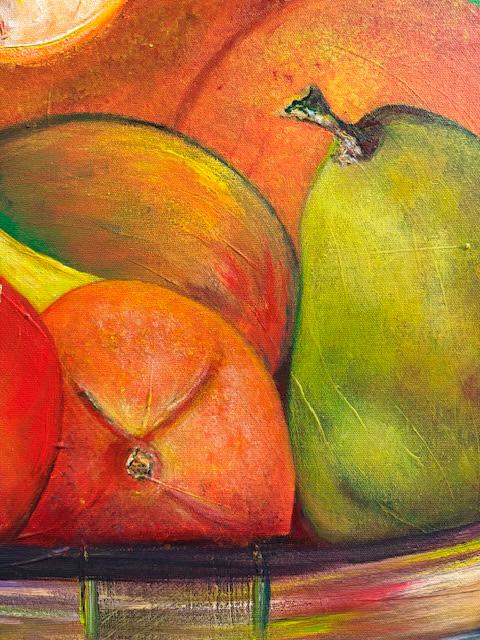
Artwork by Stewpot Artist Jose Palacios.
Street Newspapers - A Voice for the Homeless & Impoverished
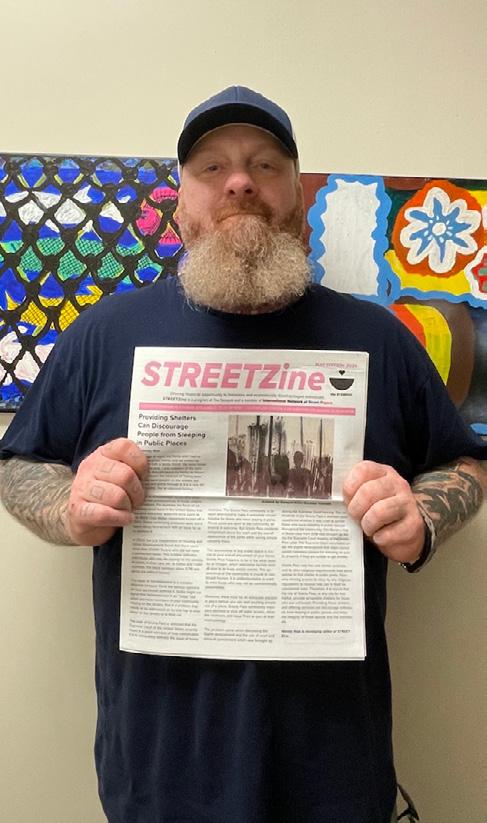
What is STREETZine? STREETZine is a nonprofit newspaper published by The Stewpot of First Presbyterian Church for the benefit of people living in poverty. It includes news, particularly about issues important to those experiencing homelessness. STREETZine creates direct economic opportunity. Vendors receive papers to be distributed for a donation of one dollar or more.
For help finding food or housing, child care, crisis counseling or substance abuse treatment.
AVAILABLE 24/7, 365 DAYS A YEAR
2-1-1 Texas helps connect people with state and local health and human services programs.
Want to be a vendor?
Come visit us at The Stewpot! 1610 S Malcolm X Blvd, Dallas TX 75226 Mondays at 1 p.m. or Friday mornings Call 214-382-5902 for more information
Distributing STREETZine is protected by the First Amendment.
STREETZine vendors are self-employed and set their own hours. They are required to wear a vendor badge at all times when distributing the paper. In order to distribute STREETZine, vendors agree to comply with Dallas City Ordinances.
If at any time you feel a vendor is in violation of any Dallas City Ordinance please contact us immediately with the vendor name or number at streetzine@thestewpot.org
CHAPTER 31, SECTION 31-35 of the Dallas City Code
PANHANDLING OFFENSES
Solicitation by coercion; solicitation near designated locations and facilities; solicitation anywhere in the city after sunset and before sunrise any day of the week. Exception can be made on private property with advance written permission of the owner, manager, or other person in control of the property.
A person commits an offense if he conducts a solicitation to any person placing or preparing to place money in a parking meter.
The ordinance specifically applies to solicitations at anytime within 25 feet of:
Automatic teller machines, exterior public payphones, public transportation stops, self-service car washes, self-service gas pumps, an entrance or exit of a bank, credit union, or similar financial institution, outdoor dining areas of fixed food establishments.
Want to help?
Buy a paper from a vendor!
Buying a paper is the best way to support STREETZine and our vendors.
Make a donation!
thestewpot.org/streetzine
Contact us at streetzine@thestewpot.org