STREETZine

Offering financial opportunity to homeless and economically disadvantaged individuals. STREETZine is a program of The Stewpot and a member of International Network of Street Papers
Offering financial opportunity to homeless and economically disadvantaged individuals. STREETZine is a program of The Stewpot and a member of International Network of Street Papers
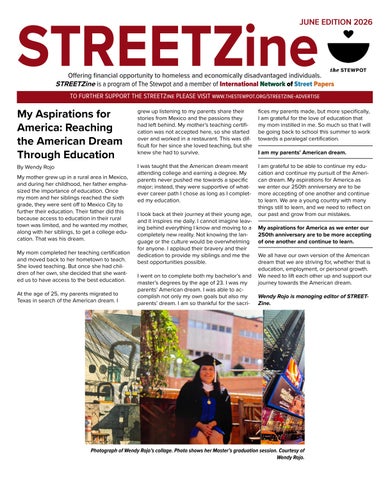
By Wendy Rojo
My mother grew up in a rural area in Mexico, and during her childhood, her father emphasized the importance of education. Once my mom and her siblings reached the sixth grade, they were sent off to Mexico City to further their education. Their father did this because access to education in their rural town was limited, and he wanted my mother, along with her siblings, to get a college education. That was his dream.
My mom completed her teaching certification and moved back to her hometown to teach. She loved teaching. But once she had children of her own, she decided that she wanted us to have access to the best education.
At the age of 25, my parents migrated to Texas in search of the American dream. I
grew up listening to my parents share their stories from Mexico and the passions they had left behind. My mother’s teaching certification was not accepted here, so she started over and worked in a restaurant. This was difficult for her since she loved teaching, but she knew she had to survive.
I was taught that the American dream meant attending college and earning a degree. My parents never pushed me towards a specific major; instead, they were supportive of whatever career path I chose as long as I completed my education.
I look back at their journey at their young age, and it inspires me daily. I cannot imagine leaving behind everything I know and moving to a completely new reality. Not knowing the language or the culture would be overwhelming for anyone. I applaud their bravery and their dedication to provide my siblings and me the best opportunities possible.
I went on to complete both my bachelor’s and master’s degrees by the age of 23. I was my parents’ American dream. I was able to accomplish not only my own goals but also my parents’ dream. I am so thankful for the sacri-
fices my parents made, but more specifically, I am grateful for the love of education that my mom instilled in me. So much so that I will be going back to school this summer to work towards a paralegal certification.
I am my parents’ American dream.
I am grateful to be able to continue my education and continue my pursuit of the American dream. My aspirations for America as we enter our 250th anniversary are to be more accepting of one another and continue to learn. We are a young country with many things still to learn, and we need to reflect on our past and grow from our mistakes.
My aspirations for America as we enter our 250th anniversary are to be more accepting of one another and continue to learn.
We all have our own version of the American dream that we are striving for, whether that is education, employment, or personal growth. We need to lift each other up and support our journey towards the American dream.
Wendy Rojo is managing editor of STREETZine.

By Reverend Amos Jerman Disasa
Editor’s Note: This essay is excerpted from a sermon that Rev. Disasa delivered to the First Presbyterian Church of Dallas on April 19, 2026.
1 Peter 1: 17-23
17 If you invoke as Father the one who judges all people impartially according to their deeds, live in reverent fear during the time of your exile.
18 You know that you were ransomed from the futile ways inherited from your ancestors, not with perishable things like silver or gold,
19 but with the precious blood of Christ, like that of a lamb without defect or blemish.
20 He was destined before the foundation of the world but was revealed at the end of the ages for your sake.
21 Through him you have come to trust in God, who raised him from the dead and gave him glory, so that your faith and hope are set on God.
22 Now that you have purified your souls by your obedience to the truth so that you have genuine mutual love, love one another deeply from the heart.
23 You have been born anew, not of perishable but of imperishable seed, through the living and enduring word of God.
The Texas Legislature passed a law in 2025 mandating that a 16-by-20 poster displaying the Ten Commandments be hung in every public-school classroom. The law is being challenged in court, but the Jesus followers Peter addressed in this passage never imagined a world in which Christians had enough political and cultural influence to dictate the legislative priorities of the ruling class two thousand years in the future.
This unimaginable empire to come would unironically call itself a Christian nation. Christian theologians and preachers would bless the domination and displacement of indigenous people as America’s manifest destiny, a divinely ordained mission from God to spread the gospel,
Prominent Presbyterian theologians and preachers would bless the enslavement of Africans as a biblically sanctioned ordering of master and slave. And this unimaginable empire elected a president who, in 1899, defended the conquest of the Philippines by noting that God had directed him to take the islands in order to “uplift and civilize and Christianize” the Filipino people, who were already Catholic.
All these events would have been unimaginable to the tiny movement that Peter wrote to in his first letter. That movement started with secret house churches of exiled and dispersed people. Their survival was so threatened by the ruling empire, and the vulnerability of their bodies so present, that they had to make a sacrament of physical suffering. The only way to endure their subjugation was to understand it as a sign that Jesus was near.
Two thousand years later, the president of that unimaginable nation would share an icon of himself as Jesus. And his secretary of defense, during a Bible study at the Pentagon, would make this prayer for our troops deployed to Iran:
“Preserve their lives, sharpen their resolve, and let justice be executed swiftly and without remorse that evil may be driven back and wicked souls delivered to the eternal damnation prepared for them…. We ask these things with bold confidence in the mighty and powerful name of Jesus Christ, King over all kings and amen.”
The question is, how did we go from secret Bible studies in house churches to prayers in the Pentagon?
To answer that question, we must retreat a bit from the headlines.
Peter’s readers
Peter’s readers did not live in a world of Bible studies in buildings filled with people that controlled geopolitical outcomes. They lived in houses. And if you asked them what love looked like — the daily, muscular, unromantic kind — they would not have described a feeling. They would have described a posture.
A rower pulling on the oar, his whole
torso exposed committed, the back of the boat straining forward against water that does not want to part. A nursing mother in the dark, leaning over a child, her body stretched out in the one direction the child is calling from. A farmer in harvest season, reaching up into an olive tree, standing on tiptoe, fingers closing on fruit that does not come to him.
These are not metaphors for Peter’s readers. This is what bodies did in the first century, all day, every day. Reached. Bent. Extended. Held.
So, when Peter tells them what to do with each other, he reaches for a word that would have made them feel the posture before they understood the idea.
The word Peter uses in verse 22 for how we are to love one another is ektenōs. Stretched out. It is the adverb for a body extended. A hand reaching. A rower at the oar.
Luke uses the same word to describe how Jesus prayed in the garden of Gethsemane the night his sweat began to look like blood. That is the intensity Peter is reaching for. Stretched-out love. Love at the edge of what the body can bear.
And the thing the stretch reaches toward is a word Peter uses on purpose: Philadelphia. Sibling-love.
Philadelphia is the love between brothers and sisters. But when it’s spoken in the church, philadelphia names something stranger. Family love without family instinct. The obligations of sibling hood without the biology that makes those obligations feel natural.
In a blood family, you extend the benefit of the doubt because you have to see this person at Thanksgiving for the next 40 years. The generosity is structurally required. You’re stuck with each other, so you figure it out.
Philadelphia has none of that. Church members can leave. The bonds are voluntary. Every act of love is unsecured. There is no future obligation forcing present kindness. There is no shared DNA making forgiveness feel inevitable. There is no blood underneath the commitment.
Continued on page 5
STREETZine is an enrichment program of the Stewpot.


The STREETZine is a monthly newspaper published by The Stewpot, a ministry of the First Presbyterian Church of Dallas. The Stewpot provides services and resources for people experiencing homelessness or who are at risk of being homeless. The organization also offers opportunities for a new life.
As part of this ministry, the STREETZine seeks to raise awareness about the issues surrounding homelessness and poverty. The monthly publication also offers financial opportunity for Stewpot clients who sell the paper to Dallas residents. Vendors are able to move towards economic self-sufficiency by using the money they receive from selling copies to purchase bus passes, food, and necessary living expenses. Clients also receive stipends for contributing articles to STREETZine
The content in STREETZine does not necessarily reflect the views or endorsement of its publisher, editors, contributors, sponsors, or advertisers. To learn more about this publication, contact Betty Heckman, Director of Enrichment, 1610 S Malcolm X Blvd Dallas, TX 75226 or BettyH@thestewpot.org. To read more about STREETZine, a member of the International Network of Street Papers, go to www.thestewpot.org/streetzine
Managing Editor: Wendy Rojo
Editorial Advisory Board: The Rev. Amos Disasa
Brenda Snitzer
Suzanne Erickson
Russell Coleman
Poppy Sundeen
Sarah Disasa
William McKenzie
Betty Heckman
Dee Leone
By Brenda Snitzer
This July 4th is a huge celebration: Our country’s 250th birthday! A celebration of democracy — of the founding principles of our nation and the freedoms our Constitution provides.
For me, and maybe others, I have mixed feelings of nostalgia, pride, and sadness about our country’s history. I am an American through and through and love the United States and our democracy. I believe in our Constitution and the principles this country was founded upon, even though I do not believe our history has always reflected the principles that we hold to be true.
Growing up as a fifth-generation Texan, my family hails from the South. We came from Virginia and then by way of Tennessee before settling in Waco. Many of my relatives had farms in Waco - particularly cotton.
As an adult, I know the conflicted history of cotton farms throughout the South. My family were poor farmers of cotton and didn’t have a plantation. And I cannot trace our family history to the horrific use of slavery. Still, I feel immense pain over those facts of our nation’s past.
During the bicentennial of this country, in 1976, I was just becoming a teenager. I have memories of moving from Houston to Dallas two years before and being hyper-aware of the bicentennial festivities - celebrating 200 years!
Gerald Ford was president and there were many festivities, just as there are now. I was old enough to stay up until after midnight while my parents were out at a celebration. I remember watching the fireworks and all the hoopla on television - it was exciting. I especially loved it because I didn’t then understand the complexity around the ideals of our founding beliefs and the reality of those ideals.
Concepts like “all men are created equal” and the pursuit of liberty were groundbreaking. In
truth, there were great injustices fueled by racial slavery and the displacement of indigenous populations.
Even today, we feel the tensions of what we say we believe about equality and welcome in this country and the way we treat folks who are different from ourselves. While my hope is that we achieve this ideal, I realize we must all confront the injustices we see.
Progress from 1776 to now has been made even if in recent years it may seem we have taken some steps back. The collective “we” must continue to work toward justice for all in the ways and places each of us can. I believe that with God all things are possible.
So, while I know we have much to overcome, I will continue to believe our country is worth fighting for and that it is a wonderful place to live. And I will celebrate the incredible birthday we have before us - 250 years of the United States of America. A country of diverse people and a land of opportunity for most. I will continue to pray that God helps our country achieve love, unity, and equality for all men...AND women.
My prayer is that it happens before our next big birthday in 50 years. Or sooner! I won’t likely be around to see that next big birthday, but I’m hopeful my children and grandchildren will. Happy Birthday America.

By Poppy Sundeen
Patrick Tiwthong was in junior high school when the 9/11 attacks took place. That’s when he decided to join the military. “I signed up after high school,” he says. “I knew I wanted to serve.” Over the next eight years, he was deployed three times — once to Iraq and twice to Afghanistan.
It was during the tour in Iraq that Patrick got wounded, sustaining a permanent back injury. Still, he completed two more combat tours before receiving an honorable discharge from the army. “I developed arthritis and degenerative spine disease, and mental health played a role in me getting out early as well,” he explains. “I used not to talk about it but now I’m a little more open.”
Patrick’s last post was Fort Hood near Waco, Texas. It’s one of the biggest army bases in the U.S., so he was far from the only veteran looking for work in the area. “Living near Fort Hood, jobs were hard to find.” He decided to enroll in HVAC courses and became a technician. While Patrick was up to the task, his spine was not. Crawling around in small spaces to fix furnaces and AC systems took a serious toll on his back. Meanwhile, depression and post-traumatic stress disorder (PTSD) weighed on him.
That’s when Patrick decided to go to college. “Because I was wounded, I qualified for vocational rehab.” With funds from the program, he was able to enroll at Abilene Christian where he earned a bachelor’s degree in communications. From there, he went on to begin work on a master’s degree in social work at Baylor University. He attends classes online. “Vocational rehab covered my bachelor’s degree, and the G.I. Bill is paying for my master’s.”
Three months ago, Patrick began an internship at The Stewpot. “Baylor knew about The Stewpot, and they led me to this program.” He met with Suzanne Erickson, senior director of Stewpot pro-
grams. “Talking with her, we really clicked,” says Patrick.
“I didn’t know I had a passion for the unhoused community when I first came here. Now I’ve come to realize that everyone has a different circumstance in life, and sometimes it takes just that one little thing to happen for everything to fall apart.”
Patrick helps Stewpot neighbors put their lives back together. “I connect people with the resources they need. The work we do here has given me a lot of motivation to want to help others.” It’s the kind of help he hopes to provide others when he completes his degree and takes a permanent position in social work.

Giving back to his fellow vets
Patrick’s dream is to work for the (VA) Veterans Administration, where he could apply his personal experiences as well as his education to helping other vets. “When I was getting out of the military, I didn’t use the VA. I didn’t know where to go to seek help or resources.” It wasn’t until years later that a social worker guided Patrick to the benefits available to him. “Meeting with her changed my life. If you don’t ask questions, they don’t come to you.”
He’s particularly concerned about the toll PTSD can take on vets, having experienced it himself. “My depression plays a role sometimes, even though I’m on my medication. There are days when you wonder if you can help others — or even help yourself.”
He learned, firsthand, the importance of recognizing the signs. “At first, I really didn’t know what PTSD was. The symptoms started to come on — nightmares, depression. I wasn’t aware of what was happening to me. The guys in the unit realized. They saw I was struggling and got me together with mental health.”
Despite his injuries, Patrick would sign up for duty all over again. “I didn’t want to just sit behind a desk, which led me to do infantry. I wanted to be out there on the front, get my hands dirty. I wanted to know that I could serve.”
Today he’s as dedicated to serving the nation as he was when he enlisted at age 18. “I feel we have quite a way to go for veterans. There’s a vision where all vets get help, but I think it’s still going to take some work.”
He’s ready to do his share.
Poppy Sundeen, a Dallas writer, is a member of the STREETZine editorial board.
Continued from page 2
Stretched-out sibling-love. Family love without family instinct. Reaching toward a brother or sister you did not choose, with no biological reason to keep reaching, and no structural reason that will make you reach tomorrow if you stop reaching today.
That’s what Peter is asking for.
That posture costs. When you stretch the way a rower stretches, the way a nursing mother stretches, the way ektenōs stretches, your body does several things at once, none of them safe.
First, your torso opens. Every defensive posture ever invented closes the torso. Arms in. Chin down. Weight centered. Stretching reverses all of it. Stretching is the body saying, I am not protecting my vital organs right now.
Second, your center of gravity moves outside your base of support. You cannot be stretched and stable at the same time. One foot forward, weight leaning, body committed past the point where you could easily pull back.
Third, your muscles begin to fatigue. Prolonged extension is metabolically expensive. You cannot hold a stretch indefinitely. A body held in sustained extension, past what it was built for, begins to suffer.
Peter’s readers knew this. They lived in a world full of bodies that had stretched until they could no longer stretch.
Peter’s readers had seen these bodies. Some of them were these bodies, or would be, within a generation. The first century did not romanticize stretched-out labor.
These bodies can’t mend themselves. To keep stretching requires God’s help, which comes in verse 23: You have been born anew, not of perishable but of imperishable seed, through the living and enduring word of God.
Peter’s readers could be stretched without collapsing because something within them was feeding them between the stretches. That something was an imperishable seed. A word that was living and would not stop living. Something planted
in them before the stretch began, growing inside them while the stretch was happening, still there when the stretch was finished.
Peter says to his readers: You can stretch toward each other, even when it costs you, even when it is not returned, even when your siblings do not deserve it and will not reciprocate. That’s because something imperishable has already been planted in you.
Your bodies can be hurt. What you actually are cannot be touched. If what we are is tied up in what can be hurt, then ektenōs love becomes impossible.
Ektenōs philadelphia is the ethic of people whose identity is not located in what can be conquered, controlled, bought, voted out, lost, or won. Stretched-outlove is the ethic of people who have been born of imperishable seed. People whose center of gravity is not anchored by their social standing, or their circles of influence, or their most recent disappointment, or perennial story of victimization.
Beloved, your seed is imperishable. Victimhood is not the destiny of vulnerability. For I am convinced that neither death, nor life, nor angels, nor rulers, nor things present, nor things to come, nor powers, nor height, nor depth, nor anything else in all creation, will separate us from the stretched-out love of God in Christ Jesus our Lord.
No, in all these things we are more than conquerors through him who loved us ektenōs, deeply, stretched out. That seed is imperishable.
So, when preachers preached slavery, enslaved Christians were meeting in hush arbors, stretching toward a God who they refused to believe had ordained their chains.
And when some blessed manifest destiny, Cherokee Christians were reading the Bible in their own language and arguing, in Christian terms, against the government that would march them west.
While our president in 1899 prayed over the Philippines, Filipino Christians were stretching toward a freedom he could not see.
The seed is imperishable. The word is living. It has been feeding faithful stretch-

ers in every generation, including those generations when the official Christianity of the empire had forgotten what the word said.
Torso open. Arms extended past the base of support.
Weight committed past retraction.
The stretched-out body on the cross is what ektenōs looks like when the stretch goes all the way.
Stretched-out love is our participation in the shape of the cross. Philadelphia — sibling-love without biology, without backstop, without guarantee — is the church’s small, daily, household-sized version of what Christ did with his whole body, in public, for the world, once for all.
Stretch toward the sibling who has not earned it. Stretch toward the one who hurt you. Stretch toward the one whose politics you cannot stand. Stretch with an open torso and an off-balance body and muscles that will, some days, feel like they cannot hold the position one more minute.
Editor’s Note: Each Friday morning at 10 a.m., The Stewpot hosts a Writers’ Workshop. During the sessions, participants address selected topics through prose. In this edition of STREETZine, we feature the essays of writers that discuss their aspirations for America, as this July 4th marks the 250th anniversary of America.
By Ezra Gatlin
In the summer of 2025, I was passing through Needles, California. It lies directly in Death Valley on the border of Arizona and California. I was carrying two bags and a half-empty bottle of juice and sobbing wordlessly in 114-degree heat. A kind stranger handed me an unopened water bottle and slipped me $5 alongside it. She drove away, and I found myself in a state of intense anguish.
I didn’t have it all together anymore. I had become someone who needed help, and other people could see it. I couldn’t say no, though. That $5 was the only reason I ate that day. I bought Pop-Tarts, soup, and flavored electrolyte powder that gets mixed into water. Generosity saved my life, but I realized I viewed other people’s kindness as my own personal failing.
A few days later, I found a nearby food bank. I didn’t have the required California ID, but they once again saw something I didn’t. The volunteers gave me four slices of cold pizza and a pound of sweet cherries. I felt obligated to leave an offering for the pigeons and crows, too — the birds who often watched over me during my times of need.
I was only homeless for five months, but I have so many stories like this one. Like the “Church by the Sea” in Santa Monica that gave us two cups of coffee, pastries, and Hawaiian-style beef stew over rice, simmered for 16 hours. I ate some of the best meals I’ve ever had, overlooking the ocean with a ragtag crew of the unhoused.
Being homeless taught me that our communities can’t survive without kindness. Homelessness required me to unpack the beliefs and trauma that told me I was weak for needing or even wanting help. I spent so much time preaching about the mutual aid networks we needed to save our communities, yet I wasn’t putting those ideals into practice. Faced with my own hyper-independence and crippling self-esteem issues, those networks became little more than empty words, convincing me I wasn’t worthy of help.

To paraphrase Wikipedia, mutual aid is a voluntary, collaborative exchange of resources and services, often taking place during times of crisis or for community members suffering from extenuating circumstances. Mutual aid runs on a grassroots organizational model, building solidarity amid sociopolitical relief efforts.
Basically, life happens to all of us, and the only way we can get through it is by supporting each other in times of hardship or otherwise. Ultimately, for me, having trouble accepting help comes from a fear of rejection or getting screwed over. Getting out of that mindset requires work, trust, and the realization that assuming everyone will hurt me will only push away the ones who want to help.
For America’s 250th birthday, I think of a crumbling empire. My hopes do not lie with a government that has failed us, time and time again. Contrary to our president’s belief that we can “Make America Great Again” between racial injustice, bureaucratic colonization, and modernday attacks on the unhoused, this country was never great.
Despite this, I find serenity within its communities, even those that I feel I do not fit into. During Hurricane Helene in North Carolina, a friend of mine described scenes of overwhelming mutual aid amid mass destruction and the wildfires that followed. In Los Angeles, residents came together en masse in January 2025, when hundreds of thousands of people were displaced by the Altadena and Pasadena wildfires. Kindness, structure, empathy, and even the checks and balances of bureaucratic red tape lie within the simple premise of people helping one another.
There is so much grief hidden in the longheld American Dream, but the people who make up this country deserve to be protected, even if just from the trials and tribulations of everyday life.
Ezra Gatlin is a writer in The Stewpot Writers’ Workshop.
America! America! God Has Shed His Grace on Thee
By Sandra Robinson
When I was a student at El Centro Community College, I was assigned to give a speech on the environment. At that time Cedar Valley Community College started offering an environmental degree. Researching my topic of plankton bloom, I came across the problem global warming was causing by melting permafrost and raising the sea level.
While surfing the internet for my essay, I found that plankton blooms remove 30 to 50 billion metric tons of oxygen from the earth’s atmosphere each year. Global warming is causing a decrease in the number of plankton blooms. United States colleges and universities are researching the issue to find solutions to the problem of too much carbon dioxide in the world air. Artificial trees that remove carbon dioxide from the air have been a solution that some colleges and companies are working on.
Researching my topic, I found out that global warming is causing permafrost (ground that typically remains frozen) in northern nations and states to melt. The nation of Russia states that the melting of permafrost is causing buildings to sink. Many buildings had to be destroyed for safety. The state of Alaska is reporting that the melting of permafrost is causing mudslides. Other states are reporting that once-normal rainfall has turned into massive flooding because the land is already soaked with water. When I was taking a real estate course, informing buyers of possible flooding in a flood area became important.
Melting ice at the North and South poles is causing a rise in the sea levels. Many U.S. states are expected to eventually be under sea level with the continued melting of polar ice. The Rockefeller Foundation established the 100 Resilient Cities campaign to help cities over their challenges. The City of Dallas established bike lanes, and grocery stores placed local product labels on items that were produced locally.
All the massive natural disasters are what led me to join USDA’s People’s Garden. I joined to help people get the message of what they need to do to decrease the carbon dioxide in Earth’s atmosphere. The City of Dallas is promoting community gardens. The city wants community gardens to capture rainwater for their gardens. People’s Garden stresses that members’ gardens should plant crops that grow naturally in the area. It is what President John F. Kennedy stated, urging that we should not ask what our nation can do for us; we should ask what we can do for our nation. The United States has a lot of natural beauty, and it takes lots of work to maintain it. I am going to do my best working with People’s Gardens to maintain life and liberty in the United States.

By Savita Vega
During America’s bicentennial celebration, in 1976 when I was 10, we went on a family vacation. My mother, her parents, my cousin, and I all piled into my mother’s truck, which had a camper mounted on the back, and headed out.
Over the next six weeks, we traversed seven states: Texas, Colorado, Utah, Nevada, California, Arizona, and New Mexico, camping at state and national parks along the way. Just a few of the parks we visited included: Palo Duro Canyon in Texas; Canyonlands National Park in Utah; Great Basin in Nevada; Yosemite, Sequoia, and Death Valley in California; and the Grand Canyon and the Petrified Forest National Parks in Arizona.
When I think back on that summer now, I believe it was highly formative in my appreciation of the outdoors and nature. That trip illustrated for me the immensity and diversity of natural wonders that the United States has to offer.
The 250th: A Different Celebration
By Jamuna Krishnan
In the small town of Willow Falls, the morning of July 4, 2026 arrived not with the blast of fireworks but with the sound of shovels, hammers, and laughter.
On America’s 250th birthday, Willow Falls chose a different celebration: not a parade, concerts, or drones, but a townwide day of service.
Maria stood at the edge of the town square, holding a blueprint for the new community center. At 22, she represented a generation that had inherited a weary nation.
There was Mr. Davis, 70, a retired army veteran, showing teenagers how to properly frame a porch for the community center. It would house after-school tutoring, job training, and a food pantry.
His voice gruff but patient as he said, “Measure twice, cut once. We are building for another two hundred and fifty years.”
A few yards away, a group was transforming an old alleyway into a community garden.
Although I didn’t realize it at the time, I know now that this is not something to be taken for granted. Even countries with natural beauty that can rival that of the U.S. don’t have our extensive public parks system.
When I was 10, exploring that parks system made me feel proud to be American, and that level of pride is something that I retain today. I still feel fortunate to live in a country where stunning natural wonders are preserved for the enjoyment of all.

hope that we, as a generation, will see the greater value in preserving these wonders for the use of all.
This year, as we celebrate America’s birthday again, my hope is that we will continue this tradition moving forward. As valuable as America’s public lands may be in the eyes of private corporations, I
Maria’s neighbor Anita was planting native wildflowers and vegetables. Laughing, she was planting tomatoes and explaining a recipe from her home country.
Across the street, children painted a mural on the library wall. At its center stood a giant oak tree, its tangled roots surrounding the words Justice, Empathy, and Tolerance. Nearby, two adults who had fiercely disagreed at a school board meeting just weeks earlier stood together on a ladder, painting the sky above the tree a bright blue.
As the sun set, the work came to a stop.
Everyone gathered in the new community garden, where acoustic guitars filled the air and the scent of a potluck dinner drifted through the crowd.
The town mayor looked at all the tired but smiling faces. “Two hundred and fifty years ago,’” he said, “people
Savita Vega is a writer in The Stewpot Writers’ Workshop.
came to this land with hopes and dreams of a better life. They did not create a perfect new world. It is not perfect today.”
The mayor added, “America is not always defined by grand gestures. Sometimes, it is found in helping your neighbor and planting seeds for a tree you may never live to see. Happy Birthday, America! Let’s keep planting.”
Jamuna Krishnan is a writer in The Stewpot Writers’ Workshop.

By Kenneth Henry
I find it hard to imagine what the future holds for our country due to the fact that I don’t know the future for myself. As I am getting older, my future is narrowing. As I am getting older, worrying about my dayto-day living is more important at this time in my life.
My housing situation is more stable now. I transferred from rapid rehousing to a permanent project-based voucher which renews every year as long as I wanted to live there, but it is tied to the apartment and not a voucher I can use elsewhere.
I am filling out my Parkland insurance, so it will be good for another year. So, for now, I think that I am in a good place, although I would like to eventually get a car to have more freedom in my transportation challenges.
As for the next 250 years, there are changes I personally would like to see. They would be coming from my point of view, not necessarily from other people’s perspectives.
The first change I would like is getting back to real people rather than AI when dealing with different companies. I hate having to hear automated choices when I am trying to get help with something. Half of the time the choices cut off, and I have to call again. Of course, that would cost more money. But in the long run, companies would benefit from personal attention.
The next thing is better transportation. Not all cities have access to trains and buses. It would be nice to not have to worry about getting from point A to point B if you do not have a car.
It seems we stigmatize people who ride buses and trains while we should celebrate them. The overall environment would benefit from fewer cars on the road, and it would lead to less road rage. I think that all of the suburbs within a city should be connected to the main bus and rail lines.
Health care is another main issue for people in our country. I don’t think what job you have should dictate the quality of your health coverage. The premium alone is a big chunk of your paycheck.
The answer might be universal health care. This is a hot topic in our country. Other countries have done it successfully, and our country could if only our politicians could get into a meaningful discussion about the health care crisis with open minds.
Gun control is another issue our country faces. A reasonable course of action could easily be enacted, such as stricter background checks and a ban on automatic weapons. A reasonable waiting period could also be applied from the time you purchase a weapon until the time you actually receive it. That would give people a chance to change their minds about attaining a gun and still getting a full refund. Also, mandatory licenses should be required for first-time gun owners to learn how to operate and store a gun properly.
The last thing I would like to see is combatting homelessness due to the fact that I was once homeless. It is a very humbling experience to not have a place to call your own. A person is on the fringe of society and frowned upon, vulnerable to different scams and theft, which I have experienced firsthand while sleeping on a mat in a shelter. My bag full of my personal items and electronic tablets was stolen, and the guard was no help. I had no locker at the time and was exposed.
Fixing homelessness is a complicated problem. You are dealing with different types of people with different needs. There should be more shelters so no one is turned away because of a lack of vacancy.
I also believe workers should be retrained on how to treat people who are most vulnerable while at a shelter. I have experienced some workers who put down and make fun of people who are homeless when they really need sympathy and encouragement at this time. The situation could make or break a person depending on what care they receive at a shelter. Always having
enough money and resources to combat homelessness would improve that aspect of society.
Lastly, I would like to see a more open America where everybody can enjoy the different parks and nature preserves without having to worry about how much it would cost for a family. Getting outside is very important for mental health. With the internet, kids are glued to their screens and phones. I remember when I was a kid playing with my friends from morning to evening without having to worry about crime. Of course, this was back in the 60s and 70s.
In 2026 it seems all we hear about is kids killing kids and dark crimes involving predators and unstable parents. Good and bad information just flows through the internet. My hope is that somehow the internet could be used for good intentions and not bad intentions. Maybe in the future the internet could be filtered for adults and kids.
I could go on, but these are a few of my wishes for the next 250 years. I am optimistic that America and the rest of the world will become better with the right leaders at the helm.
Kenneth Henry is a writer in The Stewpot Writers’ Workshop.

By James Varas
My hope for the future of America is an old tale reborn. I have always been old school. I enjoy the past generations and their stories.
I hope the next 250 years brings a beautiful future for our country. Rather than looking at the bad things in the world, though, I want to look at the good.
I recently went to a college contest in Texas called SkillsUSA. I competed in the category of Dining Room Service. I had 20 minutes to set a table with many wine glasses, tablecloths, and polished silverware. I also had to fold eight different types of napkins. Then, I acted as a host and a server. I did my best and won third place in the state of Texas.
But my story is not just about winning. It is about something that happened at the event. I left my bag on a chair while I went to help my team. The bag was clear, so everyone could have seen all my belongings inside. Thousands of people walked by as I was gone for a whole hour.
When I came back, everything was still there. No one had touched it. I told someone nearby that I was surprised no one took my things. It made me feel good to know that there still are honest people we can trust. It reminded me of the good old days when people could leave their front doors unlocked and feel safe.
I wanted to share this to show there is still hope. Good people exist everywhere. I hope these good people stand up and keep doing what is right for our world.
James Varas is a writer in The Stewpot Writers’ Workshop.


By Gershon Trunnell
America. Land of the free, home of the brave. “Land of the thieves, home of the slaves” used to be a saying of mine back in the day before I came to forgive the things that happened to my forefathers and ancestors. “Give me your tired and poor” is what the creed says. Give us the people who want to “live.” When I say live, I mean people who want to contribute good qualities and work ethics as well as moral values.
I would love to see the people who are at war repent and give up their worldly ways and start living the way the creator intended. I would love to see them live in harmony with one another, loving our neighbors as we love ourselves, sharing care for one another.
If people can put pride aside and be themselves, we would not be as confused as we are today. For instance, the ICE situation could be regulated to where there is less brutality and excessive force as well as police respecting the people’s human rights.
When I was growing up, I witnessed prejudice and brutality as well as experienced it. Now in 2026, I still witness and experience wrongdoings, but not as much as before, because it is not as obvious and is more normalized. Today, people say that color doesn’t matter anymore yet show you something different. I do my part by being the example I would love to see. I can love you, and you can love me. We can coexist without being enemies.
Gershon Trunnell is a writer in The Stewpot Writers’ Workshop.
By Paul Watson
In a dimly lit room on the seventh floor of the J. Erik Jonsson Library in downtown Dallas, a scruffy document sits in silence. However, on close reading it comes alive.
As one of the few original copies of the Declaration of Independence — printed on the night of July 4, 1776, following the Continental Congress’ Declaration of Independence from British rule — the silent document still stirs with life.
For instance, among several tyrannies cited for declaring independence, eerily, two stand out: First, the king declared war, ignoring Congress; second, the king raised hurdles to naturalization.
Shockingly, similar cries pierce the air when citizens gather to voice their concerns in the courtyards of the City Council, a stone’s throw away from the library.
Even a casual visitor to downtown Dallas might run into streets regulated with yellow ribbons and police cars during protest marches, little knowing that an old document nestled in the tall library building — hovering over their protests — resulted from similar cries.
By Darin Thomas
However, drafting the Declaration of Independence was not easy.
The years preceding the declaration were marred by conflict. Clashes broke out at Lexington, Concord, and Bunker Hill in 1775, creating a climate of revolt.
After declaring independence in the General Congress that met in Philadelphia on the night of July 4, 1776, congressmen rushed to the printing press of John Dunlap. He pulled an all-nighter, setting the type, printing the copies, and dispatching them to the rest of the colonies by daybreak.

The Philadelphia Declaration ushered in a new phase of the war, changing the goal to a permanent break with Britain. As a result, years of bloody conflict flared. General Washington’s army was severely hurt.
However, all that ended in October 1781 when the British surrendered to the persistent patriots at Yorktown.
I admit my dream for America going forward is like hoping for heaven on earth. There is some value in dreaming, though. And we probably all have the same dream.
I would love an America that is free of drugs, without abusive relationships, and with less crime. Prayer and fasting can help make that happen. If anyone can make it happen, God can do so.
I know there will be peace on earth when Jesus comes back. Until then, I would like more peacemakers to start making peace worldwide. We as individuals can help, too.
Spreading the word of God, for example, can bring peace on earth. I like sharing the word with believers and nonbelievers. And that’s what I want to do in America in the future.
My dream includes people making America a better place for our children. That includes for my own family. I want my janitorial business to succeed so my kids and their kids can have some money to share. I would love to see more paying jobs so people will be able to help themselves and their children and families.
This is part of my dream for America. May God continue with his blessings.
Darin Thomas is a writer in The Stewpot Writers’ Workshop.
Called the noblest of the documents printed in the country, it was the first time the name “United States of America” appeared in print.
Meanwhile, 250 years later, the aspirations of independence continue.
Paul Watson is a writer in The Stewpot Writers’ Workshop.

By Jason Turner
My aspirations for America start with things like affordable housing, better-paying jobs, lower healthcare costs, and less personal debt. I care most about those.
After being homeless for a while, and incurring student loans and other debts, I make it a point to seek affordable housing options. Housing costs are not likely to go down in the near future, but I would love to see that happen.
My best-paying jobs are usually with political groups for a go-out-and-vote campaign or mayoral elections. My emphasis is on better-paying jobs because I have done a lot of temporary labor. People often will hire a bunch of workers temporarily and only a few at great pay. I wish blue-collar jobs would pay more. Hopefully, we will see a minimum wage increase in Texas.
From what I hear about healthcare costs in some countries, we have a long way to go. America would be a much better place with lower healthcare costs.
By Sheila Charles
This country needs to face reality. Aspirations start with sobriety. It’s hard to do, but we have to do it.
In Dallas and across America, we need to build beautiful things again; ugliness is despair in concrete and steel.
We need to become a nation of family again. Our parents supported us, and we should support our parents and our children. We should stop outsourcing kids to screens and aging parents to facilities.
Words like honor, grace, and duty are not just meant to control people; they’re shared standards. And without shared standards, we can’t stay free. Liberty without virtue is like a parking lot for appetites.
We live in the nation the world still runs to. The people, tired and poor, huddled in crowds, still look to us. They come for opportunity — not handouts — and an open door.
As far as technical advancements, I look around and see those cars that drive themselves and robots that deliver food and do karate. Technology is on the way. We can see that America is focused on space exploration, artificial intelligence, and clean energy. With better technologies and new regulations, we can move forward with clean energy.
I can’t speak about the war in Iran. I’m not up to date with all the politics and policies. I can’t say whether the situation is good or bad. But I don’t want war at all.
As for America moving forward, I have confidence that the great USA will prevail and turn bad situations into tolerable ones without falling into a great depression or World War III. I feel that way because I just have strong faith. We can never know for sure nothing will overwhelm us. Still, I have high hopes for where our aspirations will take us.

Jason Turner is a writer in The Stewpot Writers’ Workshop.
We can use technology to make humans more human, not less. We’ve put men on the moon. The problem was never ability. It was finding the will and uniting to work together.
Renewal demands sacrifice from people alive right now. In the Gettysburg Address, Abraham Lincoln referred to our nation’s unfinished work. Instead of asking what we’re owed, we need to ask what we can give, and the great task is still ahead.
Nations don’t get aspirations from speech. They get it from family. Kids need to see adults as they are and then decide what they want to do and be.
Aspiration is contagious. When one person aspires to a better life, others are affected. Nations with-
out aspirations don’t simply collapse, they get bought piece by piece by the nations that still aspire to something. From this I learned we have responsibility to our family to make things better, not worse. Aspiration is good for the life and soul.

By Vicki Gies
My aspirations for America are peace, love, and more prayer. That may sound corny, but that’s what I hope for.
There are a lot of people who feel the same way that I do. But there are some people who only live for today and do not think about the generations that follow. They need to stop and take a breath. By that I mean that they should step out of their box and look to see what is really important in their lives.
As for me, I’d like to have been around (or have been a fly on the wall) when the Constitution was written. I’d like to begin the same way: “We the people of The United States of America...” And I’d live by the Bill of Rights. When I was in high school, I took American history. We had to memorize the Constitution. It took several weeks to take it all in, but I truly loved the history, and I made an A in that class. The hippies of the 60s and 70s had the
A Hopeful Heart at 250: Reflections on July 4, 2026
By Miechelle Waltraud Michaelis
I was six years old in 1976, but I wasn’t in America. I was in Jeddah, Saudi Arabia, watching the Bicentennial on Betamax tapes my parents had smuggled into the kingdom. Fireworks, parades, red white and blue bunting — all of it came to me through a grainy screen, recorded weeks earlier and shipped in a cardboard box. I didn’t know it then, but I was seeing America through a borrowed lens.
Later, I would hold a Life magazine that covered the entire 1970s decade — a time capsule of an era I witnessed from afar. That’s the America the world saw — one I still believe in.
My uncle Billie Joe Lewis was born on July 4. He embodies the holiday — grilling burgers in the backyard, laughing, telling me that freedom means you can be anything. Even a little girl with a wild imagination and a grandmother who read her “The Little Engine That Could.” Uncle Billie Joe is still here, still smiling. And the hope he planted in me never faded.
Half a century later, I’ve learned that life
right idea, although their ideas were out of context. But the principles are still the same: peace and love. I hope that America gets to get back to those principles.
As for faith, well, that covers a bigger field. I do hope and pray that all Americans will go back to faith and to God. After all, God created everything. I intently listened to what Charlie Kirk had to say before he was assassinated. He was asked what was most important to him. He answered, “God, family, and country!” Words to live by, and that’s how I feel too.

God in this beautiful America.
I’m not inclined to write about America’s problems, politics, or war. I want what I believe to be best for this country. Everyone is entitled to their own opinions and beliefs. I just hope for more peace, more love and understanding, and a lot more
bends but doesn’t break. Don McLean’s “American Pie” has followed me across the ocean. In the early 1990s, I found myself in a sing along bar in Lübeck, Germany — the city where my mother’s family comes from. The room was full of locals and travelers, voices rising together: “Bye, bye, Miss American Pie.” But the meaning was completely different there. It wasn’t about American loss anymore. It was about coming home — to music, to memory, to a moment where borders disappeared. That night, the song taught me that hope can be sung in any language.
Now, back in the United States, I hear “American Pie” and I think of both worlds — the one I watched on tape as a child, and the one I sang of in a German bar as a young woman. The song is still about loss, yes. But it’s also about connection.
My hope for America is simple. It’s the hope that we unlock our storage rooms — the ones filled with help we’ve been holding back. That we trade endless paperwork for a hand up. That we remember every person matters, no matter their address or circumstance.
My grandmother gave me three gifts: eyes to see, ears to hear, a mouth to
It reminds me of the words of Lee Greenwood’s song from several years ago: “And I’m proud to be an American. God bless the USA!”
Vicki Gies is a writer in The Stewpot Writers’ Workshop.
speak. She taught me that the little engine makes it over the mountain not because it’s the strongest, but because it refuses to stop. I think I can. That’s my prayer for America at 250.
We’ve gone backwards in some ways. But backwards isn’t lost. It’s a chance to reroute. To love our neighbor, not as a slogan, but as a key to the door.
This Fourth of July, I’ll remember those Betamax tapes. I’ll hold my Life magazine from the 1970s — not as propaganda, but as a reminder of what we hoped we could become. I’ll hum “American Pie” and smile. And I’ll whisper thanks that I’m still here to say: I still believe.
That’s my aspiration for America: a nation that bends but never breaks, and keeps chugging up the mountain — on faith, on hope, and on love.
Happy 250th Birthday, America.
Miechelle Waltraud Michaelis is a writer in The Stewpot Writers’ Workshop.
What is STREETZine? STREETZine is
per
by The Stewpot of First Presbyterian Church for the benefit of people living in poverty. It includes news, particularly about issues important to those experiencing homelessness. STREETZine creates direct economic opportunity. Vendors receive papers to be distributed for a donation

Distributing STREETZine is protected by the First Amendment.
STREETZine vendors are self-employed and set their own hours. They are required to wear a vendor badge at all times when distributing the paper. In order to distribute STREETZine, vendors agree to comply with Dallas City Ordinances.
If at any time you feel a vendor is in violation of any Dallas City Ordinance please contact us immediately with the vendor name or number at streetzine@thestewpot.org
CHAPTER 31, SECTION 31-35 of the Dallas City Code PANHANDLING OFFENSES
Solicitation by coercion; solicitation near designated locations and facilities; solicitation anywhere in the city after sunset and before sunrise any day of the week. Exception can be made on private property with advance written permission of the owner, manager, or other person in control of the property.
A person commits an offense if he conducts a solicitation to any person placing or preparing to place money in a parking meter.
The ordinance specifically applies to solicitations at anytime within 25 feet of:
Automatic teller machines, exterior public payphones, public transportation stops, self-service car washes, self-service gas pumps, an entrance or exit of a bank, credit union, or similar financial institution, outdoor dining areas of fixed food establishments.
