STREETZine
DECEMBER EDITION 2025
Offering financial opportunity to homeless and economically disadvantaged individuals. STREETZine is a program of The Stewpot and a member of International Network of Street Papers
Suggested donation to a vendor with a badge: $2.00 or more - La donación sugerida a un vendedor con insignia: $2.00 or more
SNAP Benefits and Food Pantries are Crucial By Wendy Rojo
During the 2024 fiscal year, the U.S. Department of Agriculture (USDA), reported that the Supplemental Nutrition Assistance Program (SNAP) served about 41.7 million people per month. The USDA also argued that the number of people receiving SNAP benefits has been steadily on the rise since 2020. This increase could be related to various factors such as the long-lasting effects of COVID-19 or the increase cost of living, just to name a few. During the 2024 fiscal year, the U.S. Department of Agriculture (USDA), reported that the Supplemental Nutrition Assistance Program (SNAP) served about 41.7 million people per month. Regardless of why someone may need SNAP benefits, let’s understand why these benefits are crucial. SNAP benefits serve as a way to help supplement a family’s grocery budget. According to the Texas Health and Human Services, benefits are available to eligible low-income households, adults ages 1854 with no children in their household, and households where all members are 60 years or older. There are income caps that apply when it comes to deciding how much a person may receive through SNAP. A person must fill out the SNAP application and provide proof of identity, proof of residency, citizenship/immigration status, and household’s income/expenses proof. The Stewpot offers assistance for those who are wanting to apply for SNAP benefits.
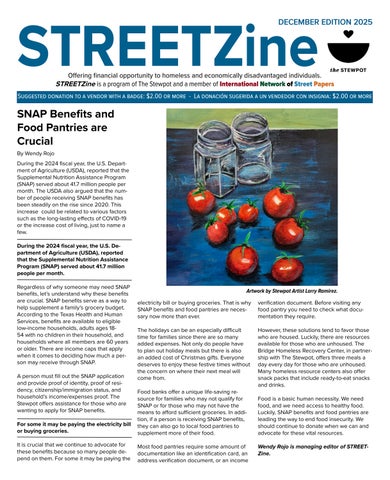
Artwork by Stewpot Artist Larry Ramirez. electricity bill or buying groceries. That is why SNAP benefits and food pantries are necessary now more than ever.
verification document. Before visiting any food pantry you need to check what documentation they require.
The holidays can be an especially difficult time for families since there are so many added expenses. Not only do people have to plan out holiday meals but there is also an added cost of Christmas gifts. Everyone deserves to enjoy these festive times without the concern on where their next meal will come from.
However, these solutions tend to favor those who are housed. Luckily, there are resources available for those who are unhoused. The Bridge Homeless Recovery Center, in partnership with The Stewpot, offers three meals a day every day for those who are unhoused. Many homeless resource centers also offer snack packs that include ready-to-eat snacks and drinks.
For some it may be paying the electricity bill or buying groceries.
Food banks offer a unique life-saving resource for families who may not qualify for SNAP or for those who may not have the means to afford sufficient groceries. In addition, if a person is receiving SNAP benefits, they can also go to local food pantries to supplement more of their food.
It is crucial that we continue to advocate for these benefits because so many people depend on them. For some it may be paying the
Most food pantries require some amount of documentation like an identification card, an address verification document, or an income
Food is a basic human necessity. We need food, and we need access to healthy food. Luckily, SNAP benefits and food pantries are leading the way to end food insecurity. We should continue to donate when we can and advocate for these vital resources. Wendy Rojo is managing editor of STREETZine.
2
STREETZine
DECEMBER EDITION 2025
STREETZine
STREETZine is an enrichment program of the Stewpot.
The STREETZine is a monthly newspaper published by The Stewpot, a ministry of the First Presbyterian Church of Dallas. The Stewpot provides services and resources for people experiencing homelessness or who are at risk of being homeless. The organization also offers opportunities for a new life. As part of this ministry, the STREETZine seeks to raise awareness about the issues surrounding homelessness and poverty. The monthly publication also offers financial opportunity for Stewpot clients who sell the paper to Dallas residents. Vendors are able to move towards economic self-sufficiency by using the money they receive from selling copies to purchase bus passes, food, and necessary living expenses. Clients also receive stipends for contributing articles to STREETZine. The content in STREETZine does not necessarily reflect the views or endorsement of its publisher, editors, contributors, sponsors, or advertisers. To learn more about this publication, contact Betty Heckman, Director of Enrichment, 1610 S Malcolm X Blvd Dallas, TX 75226 or BettyH@thestewpot.org. To read more about STREETZine, a member of the International Network of Street Papers, go to www. thestewpot.org/streetzine. Managing Editor: Wendy Rojo Editorial Advisory Board: The Rev. Amos Disasa Brenda Snitzer Suzanne Erickson Russell Coleman Poppy Sundeen Sarah Disasa William McKenzie Betty Heckman Dee Leone
Advent Hope: Can You Hear It? By Reverend Dr. Charlene Jin Lee The Nobel laureate Irish poet, Seamus Heany, just before he died sent this final text to his wife, Marie. It read noli timere: “don’t be afraid.” If there is one line that repeats again and again in the Bible, in both Hebrew and Christian scriptures, it is: do not be afraid. Spoken by God or by an angel sent with a message from God. Spoken by Jesus. Whispered by the Holy Spirit. Do not be afraid. Do not be afraid. It may be the word we most long to hear — need to hear. But we don’t know we long for it or need it until it is spoken. Then we remember. It is like the sound of a train in a distance. Like a wind that carries a song to our ears, muted but not completely, distant yet true. Everybody loves the sound of a train in a distance. You can’t see it — you can’t see the caravan of the train where a chorus sings the song for the wind to carry your way, but if you can hear the music — the sound of a train in a distance, the promise of arrival of ancestors and loves, of friends yet unmet traveling together, stewarding stories of hope — your belief awakens, even from deep slumber. You wait. And lean your ears toward the fields or stay very still, eyes fixed on empty air in the quiet, holding your breath, straining to catch the notes humming in the winter wind, distant yet true. Advent is listening. This is the practice of Advent faith. Loving the sound of a train in a distance, leaning your ears to hear its music, waiting, listening for something you had forgotten you were longing to hear — the consoling good news: Do not be afraid. You are not alone. I once received a request for prayer from a friend, for a friend. The request came by way of two degrees because it was an unlikely request made by someone who regarded religion as simply something that people have so that they can have it, like any other possession, to own. Choosing its rituals and beliefs for consumption to ease the hard truths of life: death is
inevitable and unfair and real. She was raised by erudite scholars who loosely viewed believing in Santa Claus and its upkeep (like leaving cookies out and then taking bites out of them in the middle of the night so that in the morning everyone can ask with gleeful wonder, how Santa got into a house without a chimney). In their household all of this ritual and belief wasn’t much different from all the ways Christians work to upkeep God or the notion of god alive. I regarded with affection her irreverence and with admiration her truth-telling spirit. So when the request came, asking if I would come to her house to pray for her, I spent some time in preparation. How should I show up to this moment? It felt like an official duty, summoned by a friend who silently and, at times forthrightly, expressed ambivalence toward the kind of devotional faith I professed. The aggressive cancer had returned and now spread like insult to the power and beauty of life within her, about her. Would I pray a prayer that would protect God, a measured kind of prayer that would leave a way out for God’s goodness and mercy to be saved even if the prayer didn’t work? Would I try to imagine the words she would pray, and align my prayer to the conversation she would have with God with a god that may or may not be listening? She was a powerful literary mind, a respected writer of public note, sophisticated in cultural discourse and modest in her assessment of her influence. I felt like a small preacher, coming with a medicine bag that was empty, to enact this ritual people who are sick by the favor of grace ask for. I then remembered the story of Micah, the country prophet who spoke of the Shepherd who would feed the flock with good food to strengthen their frame and the one of peace who would restore their weary body and spirit from having to learn to walk in the dark for so long. And I remembered that I know how the story ends. The promised Shepherd, the Savior for all people came to say: Do not be afraid. You are not alone. Love divine, all loves excelling came to dwell with us in our disheveled, unprepared lives. I know how the story will end, that the final word is not death. The final
Continued on page 5
DECEMBER EDITION 2025
STREETZine
3
Executive Director’s Report By Brenda Snitzer EdItor’s Note: STREETZine posed these questions to Brenda Snitzer. What is the food pantry operation like at The Stewpot? When do you operate? Where do you get the food? Who volunteers? The Stewpot food pantry operates Monday through Friday from 9 am - 3 pm. Individuals or families can get food every two weeks. A first-time client can walk in and get assisted. They have to do an intake, which is very easy. They just answer questions. After that, the staff will schedule their next appointment. We are not zip-code specific, like some pantries. Anyone from around the DFW area or even outside of the region can utilize the pantry. We are a client-choice pantry, which means this is a shopping experience. Folks can use the grocery cart to pick up produce, canned food, and other items like milk, meat, or desserts. Some items are unlimited amounts within reason, and some have a limit. We primarily receive our food from the North Texas Food Bank, but we also have a robust food recovery program. We pick up regularly from other partners like HEB/ Central Market, Costco and Sam’s, as well as bakeries, schools, and restaurants. This food goes in our pantry, or we utilize it at the Meal Service program we operate at The Bridge Homeless Recovery Center. Our volunteers are amazing! Some volunteer every day, some a few times a week, and others monthly. They are able to go online at www.thestewpot.org and sign up for a shift or multiple shifts. We also have corporate groups, schools, and churches that regularly sign up as a group. We have a number of high schools that come regularly. During the summer, families come because students 12-andup can volunteer with a parent. Those 16-and-up can volunteer on their own. We normally have about 20 volunteers in the morning and 20 in the afternoon.
Photo of volunteers in The Stewpot food pantry. Photo courtesy of Wendy Rojo. They help restock food, help the neighbors shop, bag groceries, and assist them with taking the groceries out to their cars and returning our carts to the pantry. We could not do our pantry work without the volunteers. What trends are you seeing among families and clients? The pantry has been keeping up with demand even though the demand has continued to grow. Since last December when we took over the pantry, we have seen our numbers increasing to over 200 households shopping a day. A household could be one individual or five, six, seven, or more. During the government shutdown and when SNAP benefits stopped, we started seeing over 300 households. Many of these were first-time shoppers. Since the government shutdown ended, we are still seeing almost 300 households. SNAP benefits have started again but every person that had been on SNAP had to reapply. This has slowed people down in getting SNAP again. While the government shut down happened, we did a special food distribution on a Saturday to help more folks. We served about 200 people. What impact do the holidays have on the pantry? During the holidays, we still see a lot of need. Particularly with the rising cost of food, individuals and families are more dependent than ever on the pantry. Unfortunately, our staff need some time off, so the pantry is closed a few days at
Christmas and for New Year’s Day. How does this pantry differ from The Stewpot’s food distribution at its former location on Young Street? During COVID, The Stewpot went from doing a food distribution one time a month to three times a month. We also saw a huge increase in the number of people served. That was primarily a drive-through, where folks received several food boxes and other items like milk and meat. Everyone received the same amount. Now, that we have the pantry, we are able to have a shoppers’ experience client choice. They can select the items they want. Brenda Snitzer is the executive director of The Stewpot.
DIAL 211
For help finding food or housing, child care, crisis counseling or substance abuse treatment.
ANONYMOUS AVAILABLE 24/7, 365 DAYS A YEAR
2-1-1 Texas helps connect people with state and local health and human services programs.
4
STREETZine
DECEMBER EDITION 2025
Feeling Her Way Into SNAP Suddenly blind, Nicole learned to navigate her benefits By Poppy Sundeen Imagine losing your vision in the course of a single day. Once routine activities would instantly turn into insurmountable obstacles. How would you get from here to there? How would you handle the financial challenges? How would you buy and prepare food? When Nicole Massey lost her sight in July 2003, she faced all those questions and more. A student at University of Texas in Arlington at the time, she remembers quickly realizing that her life plans needed to be reevaluated. “When I got out of the hospital I didn’t weep, wail, and rend my garments. I just told myself I needed to manage this.” And manage she did, although it wasn’t without frustrations and a lot of trial and error. “I didn’t know all the things that other blind people did.” So, she set about the task of learning. Peeling away layers of red tape Nicole calls it “the red tape that binds,” referring to the bureaucracy involved with getting appropriate help. At what was then the Texas Division of Blind Services (now part of Texas Workforce), she waited for more than three hours to turn in the required paperwork which she’d completed with the help of a friend. But even with help, there were more delays before all the i’s were dotted and the t’s were crossed. Eventually, her Social Security Disability benefits were approved, and her SNAP card was in hand. A new approach to grocery shopping SNAP benefits don’t leave room for extravagance. Nicole quickly realized she needed a well-thought-out approach to make the most of her allocation. I’ve observed Nicole’s methods firsthand, because for a year or so, I served as what Nicole calls her “seeing-eye Poppy” for periodic grocery shopping trips.
Before I picked her up at her house, she would use her voice-to-text device to create an email shopping list for me to print out. The list was organized based on the staples she needed as well as the recipes she planned to cook for herself that week. We’d start at Aldi, sometimes adding a second stop for items they didn’t have. She always checked the prices to make sure she was staying within her budget. If some item was too costly that week, she’d rethink her plan. A pantry organized by feel Without eyesight, how would you distinguish between a 15-ounce can of tomato sauce and a 15-ounce can of corn? How could you tell the bag of frozen peas from the bag of frozen blueberries? In Nicole’s kitchen, the answer is organization. Items in her pantry are arranged by rows and refrigerated food by shelves and compartments, so Nicole can easily find what she’s looking for. Newer items are placed behind the older ones to make sure nothing sits around aging beyond its freshness date. Helping Nicole put groceries away made me wince at the chaos that abounds in my own kitchen! How does a blind person cook? Carefully! For many sighted people (like me), wielding a knife is fraught with danger. Not a problem for Nicole. “I had worked in restaurants for years before I went blind, and I had good knife skills.” She has a number of go-to recipes that are both economical and nutritious. One favorite is something she calls yuppie stew. She starts by cooking whatever meat she chooses, and then she adds three cans of diced tomatoes and one can each of green chiles, hominy, kidney beans, and diced potatoes before mixing in an envelope of taco seasoning and ranch dressing mix. “I use cookware with high sides to prevent spills and other mishaps.” The ebb and flow of food assistance Nicole doesn’t currently have SNAP benefits because cost-of-living adjustments
Photograph of Nicole Massey. pushed her Social Security Disability benefits over the threshold. “It’s kind of a little dance,” she says. “I get a notice that says they’re giving me more SNAP, then one that says I’m getting a Social Security increase, and then one that says they’re giving me less SNAP.” During the discharge evaluation from a recent hospitalization, she learned that she once again qualifies for SNAP. “I sent all the forms in, so we’ll see. It takes a while.” In the meantime, she budgets carefully, doing her grocery shopping online. “Everything shows up on the doorstep. My roommate helps me identify what’s what and put it away.” She’s not sure whether SNAP allows online shopping with home delivery. If not, she may need her “seeing-eye Poppy” to take her shopping again. I’d welcome that. Poppy Sundeen, a Dallas writer, is a member of the STREETZine editorial board.
DECEMBER EDITION 2025
Continued from page 2 word is life, not fear. It is love, not darkness. It is light. I stood up and placed my hand upon the strength of her small shoulders, and I prayed a prayer I only pray silently by myself. I prayed aloud speaking the name of Jesus, asking for healing. There were no theological negotiations or measured hope in sight of this prayer. It was the urgent prayer of those who have no options but to tell God exactly what we need and want — and hope God would grant. My Pentecostal Presbyterian spirituality was prepared for this moment. There was no time to be shy about it. It wasn’t my faith: the cultivated faith, the faith developed with theological training and study that stirred the hope that led us to this prayer. It was my friend’s faith. So vast and wild it couldn’t be understood. It was the faith of the one who was listening for the music, who had been straining to hear the humming of notes here and there, holding her breath to catch the rustling sound of the holy, perhaps gracious enough to be near even her reach, even if it is only the sound of a passing train across a field, the sound of words spoken in a prayer by someone across the table, she loved listening and so hoping.
So hope for a great sea-change On the far side of revenge. Believe that a further shore Is reachable from here. Believe in miracles and healing wells. She continued, “It was because of those lines that I started ignoring the oncologists who insisted that I would never be cured.” Bold and daring words of faith penned in a poem, spoken in a prayer, daring hope of the one who strains to listen for the sound of the train in a distance, listening for the wind carrying the songs of the chorus, the grounds of all of this listening and hoping is not optimism or a thing likened to a feather perched on the soul. The grounds for Advent faith are a force far greater and more powerful. It is hope in this truth, not conditioned by my belief in it: Light is lord over darkness, truth is lord over falsehood, life is lord over death. If I am asked what are my grounds for hope, this is my answer: If I have two rooms, one dark, the other light, and I open the door between them, the dark room becomes lighter without the light one becoming darker.
STREETZine
The people who walked in darkness have seen a great light; those who lived in a land of deep darkness — on them light has shined. From a little town of Bethlehem a Savior will be born to you and the government will be on his shoulders. And he will be called, Wonderful Counselor, Mighty God, Everlasting Father, and the Prince of Peace. Of the greatness of his government and peace there will be no end. —Isa 9:1-2, 6-7 If we know how the story ends, we would dare to speak the name of Jesus in praying for peace in a world where peace seems improbable. We would take the first move in loving the not so lovable and lay our hands upon one another when we are sick or when our hearts are broken. We would listen together for the Word we have forgotten how much we long to hear. Do not be afraid. —Matthew 1:23 Luke 1:30, Luke 2:10, John 14:27, Deuteronomy 31:8, Isaiah 41:10… The Reverend Dr. Charlene Jin Lee is executive pastor at the First Presbyterian Church of Dallas.
That morning, I learned what faith is. It isn’t about knowing exactly what one must believe or believing everything written in the Bible. It isn’t found in neatly written statements of faith that expound words like Incarnation and Immaculate birth. The grounds for faith and its practice and formation are not on doctrinal statements that assign who is in and who is out in God’s plan of salvation or our version of orthodoxy (correct beliefs). Somewhere in her listening, even if only faintly or by grace in the voice of a timid friend who dared to proclaim the strong name of Jesus, she would remember what she longed to hear: Do not be afraid. You are not alone. I learned this week, that my irreverent, valiant friend, relied on many fellow truth tellers and chorus singers distant and near her path. She wrote: “After I first got sick, and in the years since, I have returned often to these lines in Seamus Haney’s poem, which argues for faith in an unseen future.
5
Artwork by Stewpot Artist Teresa Zacarias.
6
STREETZine
DECEMBER EDITION 2025
Writers’ Workshop Essays Editor’s Note: Each Friday morning at 10 a.m., The Stewpot hosts a Writers’ Workshop. During the sessions, participants address selected topics through prose or poetry. In this edition of STREETZine, we feature the essays of writers that discuss their take on SNAP benefits. 5 Tips for Food Bank First-Timers By Ezra Gatlin Food is a basic human right. No one should go hungry. Unfortunately, some still do. There’s no shame in needing help. If your family struggled during the SNAP or WIC delay and/or is struggling to put food on the table, you aren’t alone. Findhelp.org is a great way to locate your local resources, but no one tells you how you’re supposed to utilize them. Let’s start by asking: What is a food bank? According to the Oxford Language Dictionary definition, it is a place where stocks of food, typically basic provisions and nonperishable items are supplied free of charge to people in need. In Dallas, food banks are separated by zip code and you may need to provide proof of address, but no proof of income, disability, or need is required.
Photo of neighbor shopping in The Stewpot food pantry. Photo courtesy of Wendy Rojo.
If it is your first time accessing food from a community pantry, here are a few more great tips to get started.
trunk is completely empty. This allows staff to simply drop your groceries into your car and send you on your way.
1. Arrive early.
2. Ask for needed nonfood items.
The lines for food pantries often start long before the time listed on the website. It is always a good idea to call ahead and confirm the hours, but many line up 30 minutes to an hour before the pantry actually opens. There are many benefits to arriving early, such as a better food selection and small goodies that may run out long before the last attendees can receive them. Items such as frozen meats and fresh eggs are in short supply and high demand. Pantries are only open for a few hours on one or two days each week, so it is important to be punctual.
Food banks often carry many essentials besides food. This includes hygiene items, diapers, formula, clothing, can openers, pet food, cat litter, and blankets. These items are usually not advertised because they are reserved for families who need them most. If you have a specific nonfood need, be sure to request it from staff.
There is no definitive day that is the slowest or has the shortest lines. It all depends on your community and your pantry’s staffing levels, but weekends will always be busier. Larger pantries with more regular hours will usually let you make appointments so you do not have to wait in line. Mobile pantries in Dallas are drive-thruonly pantry lines distributed out of a truck. At a mobile pantry, make sure your
3. Be respectful. Remember, you are not the only person who needs food. Everyone in line is impatient, tired, and hungry. If the lines become intolerable, consider talking to staff about the days and times when the lines are shortest. Cutting, skipping others in line, or being disrespectful to other patrons or staff is liable to get you banned. People working at food banks are usually unpaid volunteers taking time out of their day to serve their community. Be patient. 4. Trade with your neighbor. What if you receive an item you don’t like
or can’t use? Trade with your neighbor! I frequent a pantry that gives out large bags of raw nuts such as walnuts and pistachios. I do not like nuts, and there is not much I can do with these items, but my neighbors love them for cooking or snacking. In return, my neighbors give me their canned fruit, such as apricots and pears. This is a great way to connect and build relationships. There is more than enough to go around. Why not share it? 5. Volunteer! My last tip is a little-known one, but probably the most crucial. If you need food, volunteer at your local food pantry! Volunteering even once a month builds relationships with your local community, shortens the lines, and you may even get free food out of it. Banks and pantries that deliver meat and produce to the community inevitably receive items that will soon be out of date. I have heard of many programs that allow volunteers to take home up to 10 lbs. of food and surplus items simply for helping them deliver to the community. If you want shorter lines at your local food pantry, volunteer! Ezra Gatlin is a writer in The Stewpot Writers’ Workshop.
DECEMBER EDITION 2025
SNAP Card Fuels My Career Move By Paul Watson I am an entrepreneur currently between the founding phase and the funding phase. My days are spent in study of the private equity market, analyzing problems that require capital and systems to solve. This work requires focus. To maintain that focus, I rely on the Supplementary Nutritional Assistance Program (SNAP). For me, the EBT card is not a symbol of distress. It is a tool for efficiency. My daily operation is regimented. I commute via the DART train to Akard Station to reach my workspace: the J. Erik Jonsson Central Library, where I conduct my research. But before I sit down to work, I must address my nutritional needs. This is where the system functions as a stabilizer. On the walk from the train to the library, I stop at the 7-Eleven downtown. My food purchases are consistent and calculated. A packet of almonds, peanuts or pistachios with a banana or an apple, are my typical combos of “fast food.” The transaction is fast. I use the Lone Star Card. I do not have to count loose Food Stamps and Food Insecurities By Kenneth Henry I didn’t really think about food stamps or food banks until I became homeless. Luckily, I never stayed on the street since I got into a shelter. We were fed three meals a day — breakfast, lunch, and dinner. The drawback was if you missed mealtimes, you didn’t get to eat and you got only one portion. One of my first tasks was to access food stamps. At the shelter, we had a food stamp representative once a week to help us with our applications. It was a consuming process filling out the application and answering all the questions truthfully, but the representative helped me through it. Acknowledging that I was homeless really hit home; it was real, not a dream. It took a while for the food stamp agency to get back to me with an answer. They kept requesting more information to make a decision. After about a month, I finally got approval for the food stamps
STREETZine
7
change or worry about the price changes of breakfast. The transaction is handled, and my food need is met. This assistance allows me to bypass the concerns of food insecurity, resulting from my job loss. If I were worried about my next meal, I could not focus on the complexities of asset valuation or the integration of technology to private equity portfolios. For me hunger is a distraction that affects my performance. By ensuring my nutrition is covered, the safety net allows me to operate at a higher capacity. I treat the public library as my office and the EBT program as my seed funding. Although it is a temporary subsidy, it allows me to remain in the market, observing, learning, and preparing.
Artwork by Unknown Artist. problems and create value. For me the card keeps my work going, creating value, until my next phase.
The goal of any entrepreneur is to solve
Paul Watson is a writer in The Stewpot Writers’ Workshop.
at $291.00 a month for the year. Even though we got three meals at the shelter, I could eat something different for a change of pace.
shutdown, they were delayed or stopped. I personally did not need them to survive. My Social Security income allowed me to maintain my diet, but they are still important to help me subsidize my expenses.
The biggest benefit was that I could save the food stamps every month and use them when I got my own place again to save on groceries. It was a great comfort to know that I wouldn’t have to worry about not being able to afford to eat in my own place. Before I became homeless and still had a car, I would go to the food bank when I was getting low on money. Each food bank had its own rules about how often a person could go in a week or a month. It was usually every two weeks. The two programs saved me during my homeless situation. I can’t imagine how my life would have turned out if I hadn’t had access to them. In the last few months, these programs have come under fire due to the economy and politics. During the government
I do have my own place for now, and I pay 30 percent of the rent. I am in the rapid-rehousing program which means I get one year, and then I need to get a new place to live. My expenses may significantly increase at that time. I can’t imagine depending on food stamps and food banks as my only source of food. Many people depend on them to be able to live on their own. We are now in an uncertain time to maintain these programs for people who need them to survive. My hope is that food-assistance programs continue and even expand to people who need them. This should be automatic and should not be a burden to people. Kenneth Henry is a writer in The Stewpot Writers’ Workshop.
8
DECEMBER EDITION 2025 STREETZine with his male cousin that stopped the My SNAP Experience family from continuing to fit into the limiBy Sandra Robinson tations of the food stamps system. They It was in the early 70s that my parents purchased their first brick home in ’76 and no longer sought the approval of the started paying for food stamps from the federal post office. My father was a food stamp system. disabled veteran and my mother was a low-wage cook in restaurants. Our family Years later, when I injured my knee and included four children. My father used my was on worker compensation, I called grandfather’s car to drive my mother to and inquired about food stamps. I was the post office to pick up the food stamp told I could only receive food stamps for booklets. My parents had to pay some a limited time, and I would have to wait money for their stamps. They purchased three years to apply. I decided not to get food from the local Safeway and a meat any food stamps until I had a more dire market in South Dallas. life situation. It was when I became homeless that I was reintroduced to the food I remember a time when my parents had stamp system. The Human Resources to purchase additional items to get close (food stamp) office was next door to the to the dollar amount. At that time grohomeless shelter. Since the homeless shelter fed us, I had no need for addicery stores did not give back change, tional food. I only received food stamps nor were they giving plastic coins to be for one month. The Human Service office redeemed at the issued company store. told me I was making too much in unemOnce the Safeway store closed in South ployment to receive food stamps. Dallas, my parents went to the Safeway in southeast Dallas. My father’s cousin, Once my unemployment and market Joe Frank, lived in a red brick house in health insurance ran out, I was again reinthe area. Each time we passed the red troduced to food stamps and introduced brick house, my father would tell us how to Parkland’s prime system. It was Parkhe loved that house and that one day he was going to have a house just like it. land that finally x-rayed my right knee and told me I had level three arthritis in both The food stamps system placed limitaknees and that my right knee cap had tions on the amount of money and the slid down. I was told I had osteoarthritis items you could purchase. I remember and that I have to keep moving and need my parents getting the house ready for to lose weight. They wanted me to lose a social worker to inspect. My parents weight so I could get knee surgery. would read from the list of items they could have. It was my father’s desire to I started working in the kitchen to lose own a red brick house and to keep up weight. One summer when I was in high
school, I worked in the kitchen where my mother worked. I lost a lot of weight. If Parkland needed me to lose weight, working in the kitchen would surely do it. I lost 25 pounds of the 75 pounds they wanted me to lose. Then I started feeling pain in my thigh, calf and hip. The doctors told me I was doing too much and had to decrease working. During the recent food stamp crisis, I was not able to walk to get any food. I still have to lose weight without using the kitchen and doing too many chores. The food stamps system is continuing to change. If you go to a human resources (food stamp) office, they will give you food stamps for the month before they make a settlement on your case. There are those that violate the food stamp policies by purchasing rides to the grocery store and selling food stamps for cash. I am working with a friend to start growing food on his family land. He plans on getting the seeds from the human resources (food stamp) office. When I get my housing, I will be able to get food delivered to my house. Presently, I do not have the physical ability to purchase food or have food delivered because there is no area in the shelter for me to sit to eat my food. Sandra Robinson is a writer in The Stewpot Writers’ Workshop.
DECEMBER EDITION 2025
STREETZine
9
People Need Food Stamps and Food Banks By Darin Thomas People really need food stamps and food banks to survive in this crazy world. Some people aren’t able to feed their families without them. And without food stamps and food banks, this world would be full of crime. People have to eat and feed their families, you know. Some people think food stamps are not needed because they have money. But people really need this help so they can provide food for their loved ones. Food stamps and food banks help people until their able to buy food for themselves and find a job to provide meals for their families. Food banks assist those who are not eligible for food stamps so they can provide for their families. When people get out from being incarcerated, they will need help with food. Food stamps and food banks help put food in whatever home they move into. Food stamps and food banks are very important. God wants the “poor” to eat like the rich. That’s real talk. Darin Thomas is a writer in The Stewpot Writers’ Workshop.
Artwork by Stewpot Artist Jennifer Moore.
Everyone’s Story is Different By James Varas When I was a child, my entire family attended a huge San Antonio church until my grandmother was very offended by one of the pastor’s sermons. He said if people would go to work and stop living off food stamps our country would greatly improve. I know he wasn’t talking about her, but she took it like he directly said it to her because she was retired and living off Social Security and food stamps. She stopped attending that church. Years later, I ended up on food stamps myself. I was living at The Bridge Homeless Recovery Center in downtown Dallas. It was the first time I was in a homeless shelter. During my first three months at The Bridge, a woman companion from Ukraine suggested I go to the food stamp office. I did so, which also was the first time I had sought out food stamps. I walked into the office, and a security guard handed me a booklet. After about 45 minutes, I saw a man at the front desk. I turned in my application with The Bridge as my new home address. After about another 20 minutes, a counselor spoke with me and went over all the details. I was given over one hundred dollars on a SNAP card and could now go
Artwork by Stewpot Artist Luis Arispe. to a store and buy groceries. I ended up buying some boiled shrimp from Kroger’s. I know that sounds awful, but it is the truth. I missed my mother, and I would buy shrimp for her and think of her while I ate them in my car. After spending a year at The Bridge, I am now housed and a sophomore in culinary school at Dallas College. I no longer am on food stamps but instead am learning to cook for myself and others.
My pastor doesn’t tell people to get off food stamps anymore. Nor does he tell people to get off the couch and get a job. I’m glad about that. Everyone’s story is different and sometimes people need a helping hand. James Varas is a writer in The Stewpot Writers’ Workshop.
10
STREETZine My Favorite Foods By Jason Turner
DECEMBER EDITION 2025
Food isn’t tough to get but the kind of food you can get your hands on is a challenge. Even with food pantries and food stamps, there always seems to be a shortage of my favorite foods. Whether it’s just bread or a snack cake, it seems like there’s only one left when I shop for groceries. I guess it depends on the time of day that I go. It was crunch time when the government shut down and I only had received half my benefits. Food pantries were running low due to the holidays arriving and lines were very long. I got a few basic items like whole bread, noodles, and beans with canned food, but nothing special. I usually go to the pantry once every other month. I use benefits the rest of the time. If the line at the pantry isn’t bad, I can get through fairly quickly. Other times, the wait can last half a day. I like to eat spaghetti, burgers, cereal, and drink juice. I also like sandwiches, noodles, and rice and beans. That is pretty much my weekly menu. I have a small problem with soda and snacks, so I try to do the less sugary snacks when possible.
My new goals are to eat more whole wheat bread, although I do like cheese on everything. I can give up the snacks but never the sweet drinks. Losing weight is within my grasp, but choices at the food pantry are out of my control. I’m surprised that one time I got two giant steaks there. They were very delicious. Trail mix recently became my favorite food. There are so many different kinds besides regular trail mix. One of the best has peanut butter cups and milk chocolate. There’s s’mores trail mix, and the traditional Chex Mix. They are good for when you are on the go and need quick snacks. As long as humans need to eat, people will love food, I’m just glad I’m not a fastfood lover like I used to be. That comes with a heavy price.
Artwork by Stewpot Artist Jennifer Moore. Stay healthy and enjoy your Christmas meals. Jason Turner is a writer in The Stewpot Writers’ Workshop.
Nutrition is Key By Evan Williams As homeless people, we need food every day in order to survive. SNAP can help. You can spend the benefits at the store for the month to feed yourself or your family. The state requires nutritious food items to be purchased with the card. This can also help with education about healthy foods while we seek housing. My SNAP reloads on the 14th of each month. When I use my SNAP card, I try to use it to seek self-improvement. In my life right now, my SNAP benefits are a means to stay healthy and head off trouble in my lackluster lifestyle as a homeless person. My SNAP card allows me to eat, so seeking shelter can be my main focus, and I can take care of myself more. I’m now writing in this newspaper to help better my life, using it as an outlet of self-expression that could make my relationships better, because people can see my actions as a homeless person and make sense of them as they read the publication. My food stamp card has saved my life and it’s like my friend Eddie said on Wednesday, “the only way you can eat.” The active status of my food stamps actually grants me privileges and access to foods I wouldn’t be able to afford. Evan Williams is a writer in The Stewpot Writers’ Workshop.
Photo of the Supporting Wellness at Pantries (SWAP) guide in The Stewpot pantry. Photo courtesy of Wendy Rojo.
DECEMBER EDITION 2025
Ship, Shop, I was Taken Back By Lisa López I was born and raised in Mexico City, Mexico. My mother was a divorced expat living in Mexico. She was a high school English teacher at The American School Foundation. This historic institution housed students of diplomats, American businessmen, and affluent Mexicans who wanted their children to be bicultural and bilingual. In such an environment, food stamps were only part of a history lesson or a fictional story we read in class. The socioeconomic reality of poverty in the United States did not affect me directly, nor did it pique my interest or anyone else around me. Fast forward to October 2025, when I voluntarily checked myself into The Bridge Homeless Recovery Center, on the south side of St. Paul in Dallas, and was offered SNAP benefits. At first, I was filled with dread. “Food stamps?” “Me?” “No, thank you!” The shelter provided all the meals, and we were not allowed to bring in any outside food or beverages, which did not make sense to me.
A New View from Nature: Pets’ Transition from Homelessness to a New Life By Vicki Gies This story is about my pets coming out of homelessness and getting a new and permanent place to live. My husband and I have lived the past eight years in a tent with our three dogs and three cats. We survived the best we could with what we had, which was a 10’ X 20’ tent, two cots, sleeping bags, and a few pillows. We also had a few seasonal items, such as a couple of battery-operated fans for summer and a propane Buddy Heater with lots of blankets for winter. Our cats had crates and our dogs had floor coverings. In addition to our tent, we had a used 2003 SUV that we had gotten cheap from a friend. Unfortunately, it was stolen last July. We managed living like this for eight
By November, I had changed my mind. Primarily because I had found a place to stash my belongings and had a little more freedom and courage to leave campus. In addition, I learned Whole Foods and Sprouts accepted food stamps and decided to give it a go. The first time I went to the Whole Foods Market with my EBT card was bittersweet. I felt like a kid in a candy store reunited with all my favorite treats. A fellow guest offered to show me the way to the market. I volunteered to buy him a treat at the store. Ernesto had never been to or heard of the Whole Foods Market and was curious about it. It didn’t take long to arrive at McKinney Avenue. We agreed to meet again in 15 minutes, and off we went to shop! I excitedly filled my basket with essential oils, fluoride-free toothpaste, aluminum-free deodorant, castor oil, and coconut oil soap. In my mind, I was being frugal and only getting the necessary. Ernesto circled back around with a chocolate chip scone in his hand. He eyed my basket, and by the look on his face, I now realize he knew exactly what was about to go down. The cashier rings me up for all the items. The total is a whopping $130! I am always taken aback by how quickly the bill ascends at Whole Foods. Either way, I had years. During that time, we applied for various housing options, but, unfortunately, we had never heard back about any of them. Last May, my former NA sponsor who was with a ministry in Irving called Many Helping Hands put us in touch with a now very good friend who was with an apartment complex in Irving that helped people with housing needs. They also helped with other needs while people got back on their feet after experiencing homelessness. From mid-June to August 5th, we were placed in a hotel along with our pets. They adapted instantly, and so did we! Coming from the heat of the summer to a very comfortable and air-conditioned room with a lot of amenities, our pets adjusted quickly and slept with us on the big bed. We had prayed for so long to have a place to live, and suddenly it was here.
STREETZine
11
$268 that I could blow, or so I thought. After my initial swipe, the artificial intelligence machine only computes the scone and the coconut oil as eligible items for purchase with the SNAP! The cashier never had an EBT customer before and is just as confused as I am. Consequently, we are attracting the attention of most clientele and managerial staff. Ernesto sheepishly makes a move to pay for the surplus of non-perishable, non-eligible goods. Meanwhile, the manager has stepped in to take over the situation, and in a loud booming voice announces that food stamps can only be used for perishable items, not toiletries. Filled with fear and dread, I snip out all excess items, deny Ernesto’s financial assistance gesture, and simply purchase the scone and coconut oil. Humbled by my impulsivity and the true nature of the SNAP. By December, having learned how the SNAP program worked I started having my Sunday and holiday meals at the Whole Food Cafe and purchasing zinc along with elderberry orange juice to fortify my immune system during the winter. Happily, I also recovered my spring water habit. Lisa López is a writer in The Stewpot Writers’ Workshop.
Finally, on August 5th, we all got to move into our new apartment. We’ve already made a lot of new friends, and everyone has been so helpful in making our new life great. Our dogs have made new friends too. After a long eight years, we finally have a great and blessed life. Although we and our pets miss the nature part of it, we will go back to visit every now and then. It will be just a visit, and then we will come back home. Like Dorothy said in the end of the Wizard of Oz, “There’s no place like home.” We are finally home! Vicki Gies is a writer in The Stewpot Writers’ Workshop.
DECEMBER EDITION 2025
STREETZine
12
Street Newspapers - A Voice for the Homeless & Impoverished What is STREETZine? STREETZine is a nonprofit newspaper published by The Stewpot of First Presbyterian Church for the benefit of people living in poverty. It includes news, particularly about issues important to those experiencing homelessness. STREETZine creates direct economic opportunity. Vendors receive papers to be distributed for a donation of one dollar or more.
Distributing STREETZine is protected by the First Amendment. STREETZine vendors are self-employed and set their own hours. They are required to wear a vendor badge at all times when distributing the paper. In order to distribute STREETZine, vendors agree to comply with Dallas City Ordinances. If at any time you feel a vendor is in violation of any Dallas City Ordinance please contact us immediately with the vendor name or number at streetzine@thestewpot.org
CHAPTER 31, SECTION 31-35 of the Dallas City Code PANHANDLING OFFENSES Solicitation by coercion; solicitation near designated locations and facilities; solicitation anywhere in the city after sunset and before sunrise any day of the week. Exception can be made on private property with advance written permission of the owner, manager, or other person in control of the property. A person commits an offense if he conducts a solicitation to any person placing or preparing to place money in a parking meter. The ordinance specifically applies to solicitations at anytime within 25 feet of: Automatic teller machines, exterior public payphones, public transportation stops, self-service car washes, self-service gas pumps, an entrance or exit of a bank, credit union, or similar financial institution, outdoor dining areas of fixed food establishments.
Want to be a vendor?
Come visit us at The Stewpot!
1610 S Malcolm X Blvd, Dallas TX 75226 Mondays at 1 p.m. or Friday mornings Call 214-382-5902 for more information
Want to help?
Buy a paper from a vendor!
Advertise in
STREETZine Support STREETZine and its vendors with your business or personal advertisements and announcements.
Email:
streetzine@thestewpot.org
Buying a paper is the best way to support STREETZine and our vendors.
Make a donation! thestewpot.org/streetzine
Write for us!
Contact us at streetzine@thestewpot.org
Any other ideas? Take our survey:
https://bit.ly/2WbMRsg
VENDOR #