STREETZine

Offering financial opportunity to homeless and economically disadvantaged individuals. STREETZine is a program of The Stewpot and a member of International Network of Street Papers
Suggested donation to a vendor with a badge: $1.00 or more - La donación sugerida a un vendedor con insignia: $1.00 or more
Facing Change
By Wendy Rojo
Change is inevitable. Yet, we talk about change only after it has occurred. We start discussions of transformation only after we have changed or after we have been pushed to change.
Most of us may not be the best at handling upheaval especially since there is not a manual on how to handle various obstacles we face in our lives. For example, if you are laid off from your job, you have to deal with the effects that come from leaving your job and finding another one.
Most of us may not be the best at handling upheaval especially since there is not a manual on how to handle various changes we face in our lives.
What about the change that we do not choose yet occurs? How do we deal with change that can inevitably lead to a worse situation?
Change that we are pushed to face can be more difficult to deal with versus changes we agree to. According to the California Budget and Policy Center, the trauma an individual experiences while facing housing insecurities can lead to mental health problems or worsen existing mental health issues. The transition from having a secure home and stable living environment to the uncertainty of being unhoused can lead to various effects on a person’s mental health as well as their general wellbeing.
The National Health Care for the Homeless Council contends those who are homeless have a higher rate of illnesses and a person’s life expectancy can decrease if they are homeless for a long period.
The Bautista Project, a non-profit organization based in Tampa, provides resources to those who are unhoused as well as integration resources. It found that the disorders a person has developed from experiencing homeless-

ness can persist even after they have secured housing and are no longer homeless.
These changes can have long-lasting effects on a person, The Bautista Project reports. They include post-traumatic stress disorder, anxiety disorder, panic attacks, etc. The side effects of “change” are always present.
The change from having a secure home and stable living environment to the uncertainty of being unhoused can lead to various effects on a person’s mental health as well as their general wellbeing.
The effects of any change may not be obvious, but every single one we go through can cause any amount of uncertainty, anxiety, or stress. Regardless of whether that change is positive or negative, there is always a level of fear that comes with change.
The best kind of alterations lead to growth and force you to challenge yourself. A transformation we can all say we have experienced is the transition into adulthood. No matter how many courses or how much
advice people give you, entering adulthood is hard.
Everyone’s path to adulthood is different, and depending on the opportunities you get and the relationships you have can impact how you navigate adulthood. Even if you have navigated adulthood well until now, all it takes is one event or situation for a person to become unhoused. For example, some become unhoused due to expensive medical bills.
Regardless of the reason that one may become unhoused, it is important to acknowledge the short-term and long-term effects on a person. We as a society need to recognize that change affects everyone, but change can hit harder when you already live with uncertainty and stress about where you will sleep or where you will get your next meal.
APRIL EDITION 2024
Wendy Rojo is managing editor of STREETZine.
Artwork by Stewpot Artist Jennifer Moore.
STREETZine
STREETZine is a program of The Stewpot.


The STREETZine is a monthly newspaper published by The Stewpot, a ministry of the First Presbyterian Church of Dallas. The Stewpot provides services and resources for people experiencing homelessness or who are at risk of being homeless. The organization also offers opportunities for a new life.
As part of this ministry, the STREETZine seeks to raise awareness about the issues surrounding homelessness and poverty. The monthly publication also offers financial opportunity for Stewpot clients who sell the paper to Dallas residents. Vendors are able to move towards economic self-sufficiency by using the money they receive from selling copies to purchase bus passes, food, and necessary living expenses. Clients also receive stipends for contributing articles to STREETZine.
The content in STREETZine does not necessarily reflect the views or endorsement of its publisher, editors, contributors, sponsors or advertisers. To learn more about this publication, contact Betty Heckman, Director of Enrichment, 1835 Young Street, Dallas, Texas 75201 or BettyH@thestewpot. org. To read more about STREETZine, a member of the International Network of Street Papers, go to www. thestewpot.org/streetzine.
Pastor’s Letter: On Spiritual Practice
By Reverend Dr. Charlene Jin Lee
I used to teach a course called “Psychology, Spirituality, and Human Transformation.” The title itself drew popular interest from college students, especially seniors looking to fulfill their religion course requirement for graduation. Over the years of teaching this course to students whose actual level of interest in religion ranged from -10 to maybe 3 (out of a possible 10), I learned that talking about spirituality is a better bet to get students engaged. Mention religion, and students tune out.
I distilled a description of spirituality this way: It is how one breathes this life. Of course, students always want a concrete, bullet-point kind of definition they can copy down from the board, so I came up with: an intentional living and daily practice of one’s beliefs about human nature (and the divine).
Satisfied with the more explicit yet roomy enough latter description, students are willing to consider my invitation for them to observe their lives in order to decipher their spirituality, even if they didn’t realize they had one or like the idea of having such a thing.
Answering the question: What is my spirituality? is an elusive, blurry task. So, we ask a different question: What do I do?
Observing one’s activities is an accessible path to discovering one’s spirituality. One spiritual teacher phrases this practice this way: let your life speak. You may not call it spirituality or recognize what you observe as anything remotely religious. Yet, under all of our energies are roots bearing traces of motivations, desires, and commitments.
What emerges from an attentive observation of what we do, what we have done, and what we plan to do, is a representation of our beliefs about our self and the world (for some: self, world, and the divine).
My students and I emerge from this observation exercise with stark clarity about our disconnections. And we are generally dissatisfied by what each of us deciphers.
We think we hold a generative value to
certain worthy ideals and honorable purposes — at the very least, a philosophy persuaded by desires more noble than, “I just want to make a lot of money and be happy” (which, as you may surmise, is a commonly deciphered spirituality). However, the reality of how much we give our energies to activities other than what we think we value, awakens us to see who we really are and what we are really about. The honest mirror reflection can be harsh.
Lest you get discouraged, I share here the same counsel I give my students and myself: begin anywhere.
If you regard compassion as an essential value or endeavor to be a compassionate human, do a small act for another’s benefit, write a poem for the world. If you believe in fairness, get involved in an expression of societal justice, read about all kinds of inequities hurting people everywhere. If love is a vital necessity to uphold, then love with deeds, by thoughts, in a note. If you believe in God, see the hues of the dusk sky and say thank you out loud, sit still long enough to feel your need for grace, love someone not so lovable.
Begin somewhere, anywhere. Begin not knowing where you will end. Begin without a plan for transformation outlined and organized.
Do one intentional action that bears a subtle trace or a glaring, bold reflection of what you believe, what you desire to believe, what you had believed you believed. Your life will begin to breathe an intentional breath, and then another. This is spirituality — spiritu, Latin for breath.
Your belief — for some: your faith, your convictions, your theology and hermeneutics — will be transformed by what you do and by the wisdom you acquire from all that doing. In turn, the next practice you begin will be guided by your growing and intensifying belief. This is spiritual practice.
My cliff notes for the spiritual journey? Observe. Decipher. Begin. Do. Observe again.
Extra credit: be still in between, for grace.
Reverend Dr. Charlene Jin Lee is associate pastor for practice and formation at the First Presbyterian Church of Dallas.
2 STREETZine APRIL EDITION 2024
Managing Editor: Wendy Rojo Editorial Advisory Board: The Rev. Amos Disasa Brenda Snitzer Suzanne Erickson Russell Coleman
Sundeen Sarah Disasa William McKenzie Betty
Dee
Jesse
Poppy
Heckman
Leone Photo Editor:
Hornbuckle
Executive Director’s Report
By Brenda Snitzer
STREETZine posed five questions about change and transformation to Brenda Snitzer, The Stewpot’s executive director. Below are her responses, which only have been edited for length and clarity.
What is the biggest change The Stewpot has faced during your time as executive director?
In my past six years at The Stewpot, the biggest change we have gone through is incredible growth and change in services in response to the pandemic. Every business and organization had to quickly change in response to the closing down of the country in 2020. For us, that was affected by the enormous growth in needs of the middle class and those in poverty, as well as the limitations on how we normally did business.
I credit a resilient staff and strong leadership of First Presbyterian Church (FPC) and The Stewpot. The Stewpot is a ministry of FPC, yet we have a lot of autonomy to run as a social service organization.
The church, like most businesses that had to change their operations, stopped having in-person worship and programming. But we all recognized that The Stewpot was an essential service for so many people. We had to continue providing meals at The Bridge Homeless Recovery Center. We needed to continue serving three meals a day there, seven days a week, and we had to do it without volunteers. We also needed staff from other programs to fill in at meal services and food distribution to compensate for the lack of volunteers. This shift in our approach happened overnight.
Similarly, we had to help housed families in our Children, Youth and Family Program. Families had started losing their jobs and had no income. So, we converted much of our budget to help with rent assistance for our families. Our homeless services needed to continue, the unsheltered were counting on us. This meant a total reorientation of how we did services.
How did The Stewpot prepare for that change?
The changes were made overnight. And then we had to continue making changes like the rest of the world in response to the information we were receiving.
The way we responded to that change involved both the leadership at FPC and at The Stewpot. At the church, the senior leadership team, led by the senior pastor and the elders of the church, made policy decisions based on the information that we all had about Covid and the best way to protect staff, congregants, and all those The Stewpot worked with.
Then the FPC staff and The Stewpot staff would meet to figure out how to carry out the work based on the policy decisions. At first, FPC and Stewpot leadership met daily to discuss how things were going with our implementation plan, make necessary shifts, and communicate to our workforce any needed adjustments.
We interfaced with everyone not only on how to do what we were doing but to do mental health checks and gain feedback on how folks were feeling about the implemented changes. After the first few months, we stopped meeting daily and started meeting only a few times a week, and then gradually less often than that.
How hard was this shift in The Stewpot’s work?
The change was immediate and unprecedented. It was hard but all pulled together to make things happen in the best interest of staff, clients, and volunteers.
Our primary goal was to keep everyone safe while meeting the increasing needs of the community. Our objective was to keep doing our essential services and to increase support (rent and utilities as well as food distribution and meal service) to anyone in the community that needed it.
There was an all-for-one and one-for-all attitude. When some area needed more support, those who could assist would step in and solve the problem at hand. Because of the success of us addressing all that was needed during this time, and because our fund development kept pace, we tripled in size both in programming and our budget/staffing.
What changes have the homeless provider community made over, say, the last five or 10 years to improve care for people experiencing homelessness?
In the last six years, I have seen an enormous change in the homeless provider community that has made a difference in improving care for people experiencing homelessness. The provider community is connected by the lead organization in Dallas and Collin County. The federal government requires that for a region to receive federal funding.
Six years ago, the lead organization for our counties (Dallas and Collin) was Metro Dallas Homeless Alliance (MDHA). Now its name is Housing Forward. This organization manages the collaborative structure for the provider community.
Six years ago, it was weak, not effective in facilitating a collaborative approach to addressing homelessness. The provider community attended meetings, but little collaborative or targeted work occured.
The funding community actually brought in a consultant organization that had helped Houston reduce its homeless population through changing the framework of its homeless collaborative. Through the consultant group’s work with the provider community and Housing Forward, it helped transform the system to what it is today, which has seen the homeless count continue to decrease the last few years.
What was that change like? Hard to achieve?
The transformation of the system has been challenging but it has made significant advancements, and we are seeing the results. Unsheltered homelessness is decreasing, veteran homelessness is almost at functional zero (which is the number who become homeless and get housed fairly quickly), and the collaborative nature and results of Dallas and Collin County homeless system has brought in millions of new federal dollars that benefits the work we all are doing.
We are achieving changes, and the system is much more collaborative. We believe this trend will continue as we become more efficient and effective in housing folks and diverting them from entering the homeless response system through collaborative strategies.
Brenda Snitzer is executive director of The Stewpot.
APRIL EDITION 2024 STREETZine 3
Turning Darkness into Light
Leslie Johnson’s Journey
By Poppy Sundeen
The November 2021 death of Demetrius Johnson, known as D.J. to family and friends, shattered her sister Leslie’s world. “I practically raised her. She’d tell me I was like a mama.”
D.J. was just 33 when she suffered a lifeending heart attack. “I prayed her back,” says Leslie, describing a cardiac emergency that took place earlier that year, but then came the one that proved fatal. “I was sitting there looking at my baby sister lying dead on the floor. That’s when all the marbles came out of the jar.”
Things had already begun to come apart. As D.J.’s health deteriorated, Leslie had taken more and more time off to be with her sister. “My boss wasn’t understanding about that.” Ultimately, she lost her job as a security concierge in a Dallas apartment complex.
In the months that followed, Leslie’s money dried up, and she found herself unable to pay the rent. In August of 2023, she lost her apartment and sought shelter at The Bridge. “My anxiety and depression were so bad by the time I got there, they connected me with mental health resources.”
In addition to getting professional help, Leslie sought comfort in painting.
Taking solace in art
Leslie’s love of art started long before she became homeless. “I earned my degree in graphic design.” Then during the pandemic, she stocked up on art supplies. “I painted a lot of pieces for my sister. The day before she died, I finished a painting of D.J. and a friend in Jamaica.”
After D.J.’s death, the friend sent Leslie a crate of canvases. “She told me not to lose my light,” says Leslie. “D.J.’s gone but she would want you to continue to paint.”
When she moved into The Bridge, Leslie discovered new sources of encouragement in fellow artists Cubby and Larry. She also learned about The Stewpot Art Program and met with program director

Since then, Leslie has been a regular fixture in the studio. She thinks of it as more than a place to paint; it’s a community. “Betty explained that this is a safe space with no judgment. She said as long as you’re doing what you’re supposed to do, you’re welcome, and I took advantage of that. It’s helped me through the dark spots.”
Finding joy through acts of kindness
Leslie has an additional strategy for easing her anxiety and depression: She seeks out opportunities to help others. “When I do something for someone else, it’s like the whole world changes. It makes me appreciate what I’m capable of.”
She discovered that even small good deeds can have a big impact. She tells of an encounter with a woman who came to The Bridge after spending time on the street. “Her hair was all tangled, and people were talking about her. I know how to braid, so I offered. I told her I wasn’t asking for money. It’s just that having a new hairstyle makes a person feel good.” After Leslie finished braiding, the woman smiled and thanked her. “I felt like I had nothing to offer the world at that point in time, and this one act made this woman’s whole day.”
Leslie sees a connection between art and
kindness. “When you share your art, that is an act of kindness. You share how you view the world. And you never know who will appreciate that view.”
Changes ahead
Things are looking up for Leslie. She was recently awarded five-year housing and is currently looking for a place to rent. She plans to work from home as a graphic designer, but even as she anticipates a more comfortable living situation, she doesn’t regret her time at The Bridge. “Being at the shelter helped me appreciate my life.”
Leslie plans to continue painting at The Stewpot. “I used to paint alone,” she says. “Since I’ve been here, I’ve expanded my repertoire by learning from the other artists, and they learn from me. It’s like a family held together with art, prayer, and wisdom — the wisdom of life. This space is the most beautiful and creative space I’ve been in my entire life.”
She also looks forward to continuing her habit of doing good deeds, both to be a positive force in other people’s lives and as a way to keep herself stable. “It helps you regulate your emotions. It connects you with a special place inside yourself that most people don’t even think they have.”
Leslie intends to stay connected with that special place.
Poppy Sundeen, a Dallas writer, is a member of the STREETZine editorial board.

4 STREETZine APRIL EDITION 2024
Betty Heckman. “Betty liked my work.”
Photograph of Leslie Johnson.
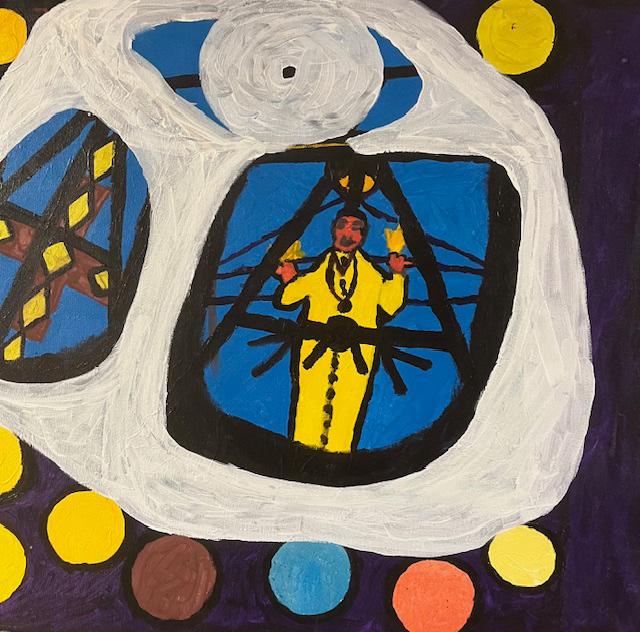
Artwork by Leslie Johnson at The Stewpot.
April Fooling Around
By Vicki Gies
April is a time for spring and for new beginnings. All the trees are coming alive again with new buds; bushes with their beautiful flowers; new little vine people, with their ever present and sharp thorns! All the songbirds have returned, and yes, it’s mating season.
I love to watch the male birds do their little dances, fluffing up their feathers. The male mallard ducks and geese compete for the females.
But let’s start with an old tradition called April Fool’s Day! I remembered some brain teasers to make my readers smile. You may even be fooled! See how many you can guess correctly. (Answers on page 11)
1. If you take two apples from three apples, how many apples would you have?
2. A rooster sitting on a pointed roof and facing north lays an egg. Which direction will the egg roll down the roof?
3. A farmer had 17 sheep. All but nine died. How many sheep did he end up with?
4. I have two coins that total 55 cents. One is not a nickel. What are the coins?
5. A lesson in grammar. Which is correct: 8 and 8 are 15 or 8 and 8 is 15?
6. An archeologist claimed he found a coin dated 50 B.C. Was he telling the truth or was he lying?
7. A monkey is at the bottom of a 30-foot well. Someone drops him a rope to get out of the well. Each day the monkey climbs up three feet, but slides back down two feet. How many days will it take for the monkey to get out of the well?
8. Pretend you’re living back in the old west days. You walk into a dark cabin at night. In this cabin is a candle, a lantern and a wood burning stove. What are you going to light first?
9. There’s a diesel train traveling southwest at 80 mph. The wind is blowing north at 40 mph. Which direction will the smoke go?
10. Peter Piper picked a peck of pickled peppers. How many pickled peppers did Peter Piper pick?
I dedicate this story to all the comedians, relative or not, who have brought joy and happiness to my life and hopefully to my readers as well!
APRIL EDITION 2024 STREETZine 5
Vicki Gies is a STREETZine vendor and frequent STREETZine contributor.
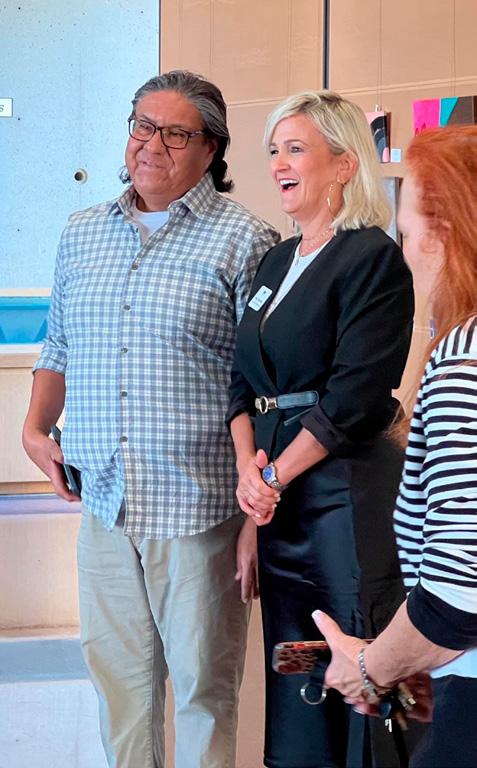
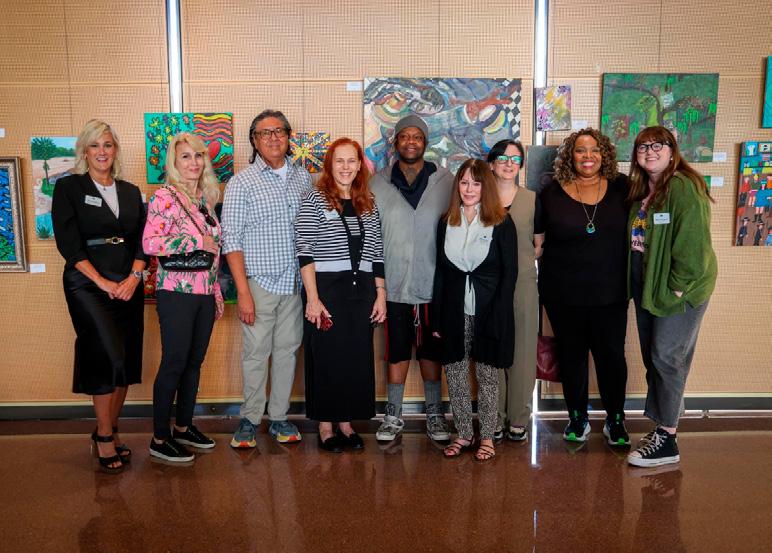
Stewpot artists showcased their work at the Dallas Museum of Art. Photographs by Tim Smith.
Writers’ Workshop Essays
Editor’s Note: Each Friday morning at 10 a.m., The Stewpot hosts a Writers’ Workshop. During the sessions, participants address selected topics through prose or poetry. In this edition of STREETZine, we feature the essays of writers that explore the concept of change.
Housing Update: One Year Later
By Michael McCall
What a difference a year can make. I’m coming up on my one-year anniversary from moving out of the shelter and into my own apartment and the move has been life changing.
Looking back at all I’ve accomplished still fills me with joy and amazement. I struggled for years on my own trying to get it right, but it never did stick. It took the structure of the shelter and the helping hands of many people to put me in this chair, typing on my own laptop, sitting by the open window in my own apartment.
I don’t allow a single day to go by without acknowledging how grateful I am for all the changes that have occurred in my life recently. From getting sober, finishing probation, becoming a full-time student and most of all for maintaining housing for a full year.
While some individuals think the hard part is getting the voucher and housing, I think it is more difficult to keep it once you are moved in. Allow me to elaborate on the difficulties that occur after you proudly change your status from “unhoused” to “housed.”
To begin with, shelter life is hard on a person. It drains you physically and mentally even to the point of leaving for some. So, when you are granted the opportunity to escape the chaos and find some peace in your own apartment, well, you can only imagine the overwhelming joy that can bring.
This joy is accompanied by a new sense of freedom and that is where the danger lies. For a recovering addict like me, this could be just enough to send you back down a path you don’t need to go. Getting sucked back into that lifestyle could be all it takes to have your voucher revoked and send you back to the shelter from which you had recently left.
Another problem I have seen is what happens to a person once they leave the structure of the shelter and lose all their resources. The amazing new apartment
you just moved into with your voucher comes with some non-negotiable new responsibilities. Meals are no longer served to you at the appropriate hours, laundry is no longer free, and there is no form of entertainment that comes with the apartment.
This becomes your first introduction or reminder of what it’s like to take care of yourself. It may seem like a simple thing to do, but if you have little experience doing it or being on your own it is a daunting task. Which unfortunately for some is enough to leave the roof over their head in search of some place less challenging.
The last challenging part of maintaining your new apartment is the fact that most of us just receive a voucher for six months to a year. This isn’t a long time to transform a shelter life into a self-sustaining one. So, the truth is our housing situation returns to being unhoused the day our voucher ends. The cost of living is so high it is hard to pay the rent for the apartment after the voucher runs out.
The place I moved into was bought out, and knowing how much the Dallas Housing Authority would pay for this zip code, the new owners raised the rent by $900.
This means if I don’t get approved for the mainstream voucher, I would be required to pay $1,800 for a studio as an unemployed full-time student waiting on disability.
As you can see, the struggle is real and it only changes with your circumstances. I truly feel grateful for my life and everything in it. Although things might not be perfect, they are so much better than they were. Knowing that I have improved myself mentally and physically to make it on my own without drugs or alcohol is quite an accomplishment. I have also done what it takes to maintain my housing for a year without any problems.
I’m not sure what the future is going to look like for me, but I believe I have developed the skills needed to take on the challenge and continue my path to graduating college. This past year only strengthened my story and will help me when I become a counselor after graduating. It makes the journey seem achievable when you can look a person in the eye and honestly tell them you have walked the path, so it is possible.
Michael McCall is a writer in The Stewpot’s Writers’ Workshop.
6 STREETZine APRIL EDITION 2024
Artwork by Stewpot Artist Fernando Segovia.
The Blessing of Homelessness
By Cici Guerre
I certainly did not feel blessed as I descended into homelessness. Everything I thought important was being stripped away from me. That money was gone forever and my possessions couldn’t be replaced. The worst thing was that it seemed that even my family was gone, and that loss left me without any sense of security or safety.
I was trapped in a nightmare that seemed without end. And I was helpless, overwhelmed by traumatic memories and grief, and every person I met took whatever they wanted from me. Everything that had once been simple, had now become incredibly hard. I was bewildered, and absolutely alone. I cried out to God, “But my name is not Job!” Everything was so unfair.
I wasn’t alone, though. A thought, like a whisper, crossed my mind. “Help someone else.” That seemed like a crazy idea. I didn’t think that I had much help to offer anyone. I did like the idea, though. Something about it was comforting. “Okay, I will help when I am able.” Had I just decided that I was not about to give up?
Trying Times of Losing Housing
By Darin Thomas
I started to listen. And that was all it took for the direction of my life to change forever. Meaning and purpose slipped into my life when I quietly agreed that if I had an opportunity to help someone else, I would do so. I eventually realized that the secret to happiness had been revealed to me. Help someone else! It really is that simple!
People continued to steal from me, however, and it seemed like everything I tried to do led to disaster. I could feel a dark and endless sea of hatred growing inside me, so much that I could see myself drowning in it. I didn’t want that. So, I decided that I would forgive everyone who had done me wrong, whether they really had or I only thought they had.
I felt a tremendous weight lift off me right then. I didn’t know I could do that. In fact, I knew I could not have let go of that burden without help. It wasn’t possible, but I had felt that weight lift! I started healing rapidly once I was able to put down the burden of resentment. I had unexpectedly received another wonderful gift.
Almost overnight, I was transformed from someone rather sad and resentful of all the things that had never gone right for me into the happiest person I could ever
have imagined anyone being. I was born to be this happy person and I believe that the same is true for every one of us.
I am an amazing person whom I admire and respect. I never had the opportunity to know that about myself before. After losing everything that I thought was important, I recognized that I had received a wonderful gift. It was a fair trade, despite the horrible price I paid. I would never be so foolish as to try to renegotiate this good fortune. I don’t want a single thing back that was lost, not if getting it back meant I would lose me.
I am grateful that today I am able to enjoy simply being alive. I am excited about my life. And I know now that I have been blessed. I thought that so many horrible things had happened to me over past years. I finally realized that God saw all those things in a different manner, and He had gracefully removed all those things that kept me from feeling the joy I feel today.
Everyone deserves to feel this joy! I now say that I am Job if you want me to be, God. Thank you. Thank you for everything.
Cici Guerre is a writer in The Stewpot’s Writers’ Workshop.
Losing housing last fall was very difficult. I had a housing voucher for a year in Dallas, and when it ran out in September, I couldn’t find an affordable place to live.
At first, I went to live with my cousin and her husband. I had my own room. But I decided to move on and found a place at The Bridge in a large room with others.
The hardest part in losing my apartment was not having a place to go every night. I had grown used to that after being at The Bridge and other places before getting my apartment. You get used to cooking your own meals. You get used to shutting the door and having privacy. My daughter could come visit. I liked all those comforts.
I put my name on the waiting lists for permanent supportive housing and for disability insurance.
Meanwhile, I look back on my past to give me strength. Living a sober life is one of the hardest things I have ever done. I deal with it day-to-day. Some days are easier than others.
Outpatient classes at The Bridge talk about triggers that cause relapses. When I relapse, I want to get out of it. The feeling is dark.
I lost some of my steadiness after I lost my apartment. I am doing everything to get that steadiness back.
Darin Thomas is a writer in The Stewpot’s Writers’ Workshop.

APRIL EDITION 2024 STREETZine 7
Artwork by Stewpot Artist Michael Norwood.
By Savita Harris
We tend to classify change as “good” or “bad,” but sometimes change is just hard. Like when people finally get housed, often after a wait of months or even years, that transition can be difficult.
No one talks about this. Not a lot of people say, “Hey! I’m having a hard time adapting to living in this home that’s been provided for me,” because it sounds ungrateful. And our society demands gratitude above all.
Secondly, it demands a positive, can-do attitude in the face of change. “I’ve got this!” “I can do it!” “No sweat!” But this reality of the transition from living on the streets to being housed is a bit more complicated than that, or at least it has been for me.
I can’t remember what month it was in my year and a half on the streets — and I can’t even recall now precisely what disappointment among many precipitated it — but something in me snapped, and I suddenly let go of even thinking that I belonged among the people who lived in houses.
Change
By David Arnaz
Change is something that we all have to go through at some point of our life. Change comes from one wanting to better himself or herself. When we are born, we are infants. We change into a toddler, teenager, then an adult.
In the last 15 years, I have been in a complete mode of changing and of bettering myself. I started off to try to figure out who I was at the time. After years and years, I realized that I was going about change all wrong, because I knew who I was, and who I was was someone who I no longer wanted to be. See, I was always the kind of guy who everyone wanted to be around because I kept them laughing and feeling good. I was too generous with my money. Whatever I had I was too quick to give it away to someone who wanted it.
Then there was the other me, the other me that was using drugs. I was still nice and generous, but while using drugs I didn’t want anyone around me. The rea-
I felt like I was somehow fundamentally different from them, like a once-domesticated animal gone wild again. I no longer belonged in those high-rises reaching for the blue skies. I no longer belonged on the other side of the windows in homes that glowed golden and warm at night as I passed by. I didn’t belong there any more than would a wolf or a bobcat or a panther. Those homes were for the domesticated, and I was feral.
I’ve been homeless more than once in my life — that’s just the nature of untreated schizoaffective disorder. It’s like a shark that can swim up on a sunny day and drag you under again. At any rate, one habit that I’ve noticed in the past when I got housed — and one that I’m experiencing again this time — is something that I refer to as “scouting.”
When you’re homeless living on the streets or in your car, you always have to be scouting to survive: scouting out a place to stay dry in case it rains, scouting out a place to stay cool or get warm, scouting out a place to find water, use the restroom, charge your phone, park your car without getting towed. The list goes on and on. I imagine it’s a lot like our distant ancestors who lived in the wild before there were such things as cities and
son why I didn’t want anyone around was because “they” were a trigger to the drug. I tended to get mad and want to fight when people were around.
So, I wanted to change. I didn’t know how to change at first but after talking to several people and listening, I learned that I must first decide who I wanted to be, but the person I wanted to be couldn’t be around the same people.
So, the last time I was incarcerated I promised myself that I have to distance myself from the exact people who helped keep me down for so many years. I had to get out of the old environment that I was used to.
Last, just say no. No to people, no to drugs, and no to the things that I no longer had the desire to take part in any longer.
Although I have come a long way in my journey of change, I still have a long way to go. I was listening to Steve Harvey one day, and he said that one of the things we (meaning I) have to do to better myself is
high-rises. The thing is, whatever it is that enables us to do that — cortisol, some switch in our brains — it’s hard to turn off.
Although I now have over a dozen electrical outlets in my apartment, I can’t help but look for any uncovered electrical sockets when I enter a room. When I’m out walking my dog, my mind still takes note if I happen to see a hydrant that might be accessible to passersby. I’m tempted to test it to see if water comes out. Even if I have a little money, I still don’t buy drinks when I’m out. I keep a jug of sun tea in my car and my insulated mug. I know that convenience stores offer free ice. I take care of myself. There’s a tendency not to rely on luxuries that might not be there tomorrow.
The first week in my new apartment, I spent two nights sleeping in my car. It’s so quiet inside, deafeningly quiet, and disorienting. Something in me still feels like it’s connected to the rumble of the streets, like a tamed animal might still be connected to the rustle of the forest, dangerous but somehow comforting. Something in me still isn’t sure that I belong in a high-rise reaching for the sky.
to demand more from myself. That part I’m still working on, because I haven’t yet figured it out.
But the person I have changed into I am loving more every day. Sometimes I wish I could have done this years ago. It was Sam Cooke who said, “A change is gonna come,” and my change is underway.
David Arnaz is a writer in The Stewpot’s Writers’ Workshop.
8 STREETZine APRIL EDITION 2024
Feral
Savita Harris is a writer in The Stewpot’s Writers’ Workshop.
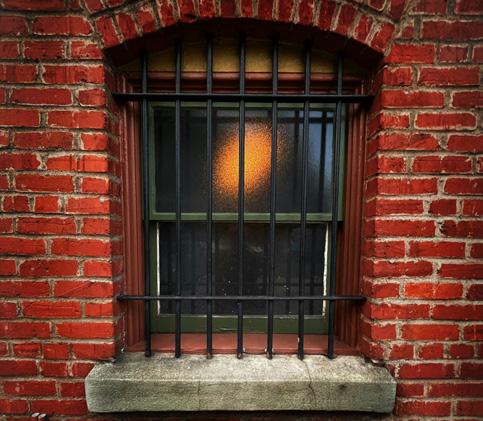
Photograph Courtesy of Jan Canty through Unsplash.
Transformation
By Aneshia Owens
When life has been in the dead of winter for longer than you want, you are eager for the season to pass and be done. The temperature has sent chills down your spine and the landscape has no bloom or blossom — what do you do in this space of sterile stillness?
You let the season evolve. It will not remain forever. It will run its course, giving way to a vibrant season: a season of employment, of home, of creativity and expression while embracing family and community. My journey has now been released from the dead of winter (homelessness) to the vibrant spring (housed, employed, creative and happy).
This amazing transformation took change, hope, perseverance and push. Some three years ago, I journeyed from
Change is Coming
By Jason Turner
When I think of change, the first thing that comes to mind is exactly how bittersweet it is. Change can be exciting or tough, surprising and anticipated. Another thing that comes to mind are my goals. I learned through an Intensive. Outpatient Program to always have short-, mid-, and long-term goals.
The goal that fits all the ranges is my weight. I gotta watch my weight by first managing a better diet. I’m switching my meat intake to chicken and cutting out rice. I don’t want to give up Kool Aid, however, so the process is slower than it should be. I’m making progress, though, and I should be where I want to be by the summer.
Another long-term goal is life-changing, and that’s acquiring a new front tooth. My choir director jokingly calls me Michael Strahan, and all I ever wanted for Christmas is a new front tooth. Change happened with the support of my family — I recently found the finances to get a dental implant. The goal is long term because it takes several appointments, and those visits are all spread out. Social standing and job interviews will go more smoothly, and my confidence will be boosted when my front tooth is replaced.
A mid-term goal is not to struggle with the change of structure for everyday life
Texas to Indiana with a “single” mindset: myself against the world. I felt I could rely only on myself and that I had to change my environment to leave my frustration behind — only to discover the critical reality that moving back to Texas and reuniting with my immediate family was the real solution to a self-inflicted frustration. That realization has given way to a most productive path.
With that, I also had to change how I interact with others. I had to acknowledge people were my best asset — no one person can figure out everything without partnership. I am not self-made, I’m God-made. He placed people in my life to partner with me, so my winter has turned to blooming spring.
Aneshia Owens is a writer in The Stewpot’s Writers’ Workshop.

in my apartment. It took me six months to get settled and my routine isn’t all it should be. I want to get into walking more, which will come with warmer weather and playing more Frisbee golf. I want to purchase some household goods next time I come across some money and make my place more like home. That’s always exciting to do, and early this spring I’ll be able to shop for those home products.
There you have it. Change is upon me constantly with my long-, short-, and midterm goals. Changing goes hand in hand with that as the weather gets nicer and I find myself with more energy. Brighter, warmer climate means no excuses not to exercise.
I feel the hard press of time going by quickly. It seems only yesterday that Christmas and New Year’s were arriving. All the holiday spectacles have dissipated, and the flowers are blooming. Spring is a great time for change, and change is coming in my life as fast as the seasons turn.
Goals, change, more goals and more change. But now is crunch time. Writing this down really helps get things moving.
Jason Turner is a STREETZine vendor and writer in The Stewpot’s Writers’ Workshop.

APRIL EDITION 2024 STREETZine 9
Artwork by Stewpot Artist Cornelious Brackens, Jr.
Artwork by Stewpot Artist Gershon Trunnell.
Change
By Gershon Trunnell
As I stand here, I stand here still and slacked. Motivated to move as I stand still. The changes on the inside and outside should match.
As I stand still, awaiting instruction from dispatch.
As I let go of the old for the new I hope to catch.
As I stand here, I move faster and farther Than where I was at.
Change.
I Learned Love Again
By James Varas
Change is a subject that comes deep with intense feeling. I have spent 40 years of my life trying to live in a way that is acceptable to my God.
Gershon Trunnell is a STREETZine vendor and a writer in The Stewpot’s Writers’ Workshop. DIAL
The hard truth is that I had to change from my evil ways. I had learned how to survive at a young age in military school. I learned how to be a machine who could keep going and going. You give the order, and we were taught to obey the order. We were taught to cover all emotion and almost be like a person without any emotion, almost like our hearts had been taken from us.
I spent about 20 years repairing myself. I had a life-saving God to pull me through into the light. I learned love again and Jesus filled me with more love than I could ever imagine.
All those tears that I shut off like a valve began pouring out like Niagara Falls. My heart would be cleansed and almost like it would come alive and be resurrected with each tear.
I learned it takes a real man to open up to God. I surrendered my life to Jesus and

He remade me into something beautiful. I was like a cracked vessel and Jesus shined His light within me.
I know now that all that pain I went through was so I could save others. I would not give up on the hopeless. I was hopeless and Jesus said that’s enough, and He came running and picked me up and carried me.
I will never be the same now that I know the truth. Jesus is the truth, the life, and the way. I give my life to Him because I would not be here today without him.
I quit doing drugs, and other bad things that were killing me. I have tried erasing anything trying to hurt my life. I even quit smoking and limit my drinking alcohol to a bare minimum or on special occasions. I am not perfect, but I am willing to change because of my love for Jesus Christ.
James
211
For help finding food or housing, child care, crisis counseling or substance abuse treatment.
ANONYMOUS AVAILABLE 24/7, 365 DAYS A YEAR
2-1-1 Texas helps connect people with state and local health and human services programs.
10 STREETZine APRIL EDITION 2024
Varas is a STREETZine vendor and writer in The Stewpot’s Writers’ Workshop.
Photograph Courtesy of Priscilla Du Preez through Unsplash.
Change to Me is Being Reborn
By Kimberly Parker
Spring is finally here, meaning a new beginning is upon us. Flowers are growing, birds are singing, and the sun is shining. Everything is being reborn and bringing beauty into the world.
To see all the things that have died but are being reborn is amazing. That is my outlook on things that have occurred in my life, like being homeless, coming up in an abusive home, being molested, raped, neglected, ignored, abandoned, and forgotten.
All of those things have been in the life that I choose to be a part of. Now I am a happy mother of five beautiful children, and I am living life on a positive note. No more crying or stressing would have, could have, or should have. I will walk this positive, loving path God chose for me.
Every day is a new day to do something different. Use the tools God gave you and the resources that are provided, whether through The Stewpot or calling 211. Help is out there, and it is time for a change.
Changes in My Life
By Gershon Trunnell
As the weather changes, we adapt from season to season. I use the analogy of growth in the life around me and the growth within myself.
I use communication to encourage and comfort others in need of advice, support, and companionship.
I use the growth in my art of music to express myself to the world through recording — positive music brings the elements of joy, peace, and motivation through the sense of sound, reaching people with the gifts God gave me.
In jewelry making, I use birthstones, gemstones, and other material to make necklaces, earrings, bracelets, and rings. When people inquire about my items that I may be wearing or are on display, I tell them about God giving me the gifts and talent to make the things that I make.
Painting on canvas or sketching in my book illustrates the expressions of my life’s experiences. Through this, I am able also to give testimony and deliver the messages God sent me to deliver.
The Stewpot has caseworkers who help with anything you need. There is also Metrocare Services that assists with doctor’s appointments, dentist appointments, medication, housing, clothing, and so much more. The Stewpot’s gardening, writing, and artistry activities develop your talents, too. There is even a choir, if you enjoy singing.
I moved to Texas in May 2022, and The Stewpot has always helped me. Even if I call 211, The Stewpot will help provide resources. No matter what it is, God’s angels are out there. The day might look dark, and nothing may be going right. But there is help all over.
Just remember to pray about your situation and put God first. He has great plans for you. It might not look like it, but the things we go through aren’t to punish us. They are to help us and teach others. Share your testimony.
Kimberly Parker is a writer in The Stewpot’s Writers’ Workshop.
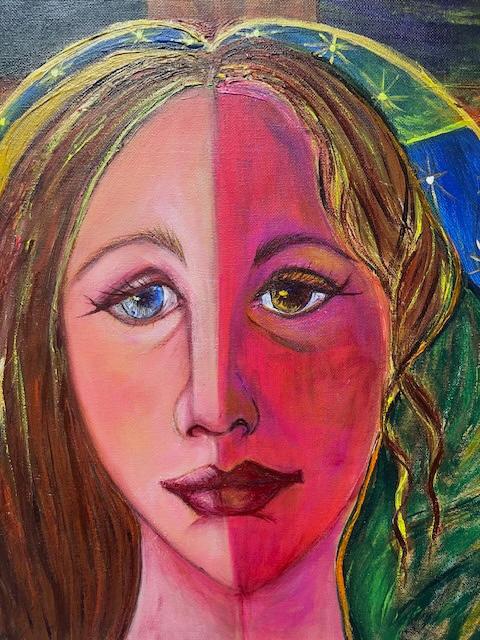
I also have the talent of making or manufacturing colognes, mostly because I don’t like to wear already-made fragrances or smell like other people. So, I make my own from essential oils, not mixing manufactured colognes. When people comment on my scent, I again give God the glory for the talent and gift to be able to do so, giving all honor and praise to my Father in Heaven for blessing me in such a way.
I also have a clothing line. I’m a designer, seamster, tailor. I sew clothes together to make my own clothes, and I also paint on clothing items. When people ask me about my clothing, I again give all credit to God for this extraordinary talent to be able to have my own style.
So, combining all of that together when I go out to entertain, all of it is utilized at one time, bringing people together for the purpose of getting closer to God. In my own personal life, willpower has become an instrument in my overcoming obstacles, not just for me but for others who want to change or quit things in their lives for the betterment of themselves.
Gershon Trunnell is a STREETZine vendor and a writer in The Stewpot’s Writers’ Workshop.
Now here are the answers to the teasers; they are never the obvious answers!
1. Two apples (The key word is “you.”)
2. Roosters don’t lay eggs because they are males!
3. Nine (simple subtraction)
4. A half dollar and a nickel (One isn’t but the other one is!)
5. Neither: 8 plus 8 is 16!
6. He’s lying. B.C. means Before Christ. (No one knew when Christ was going to be born.)
7. 27 days. On the last day when he jumps up, he’ll be out of the well.
8. A match (Cigarette lighters hadn’t been made yet.)
9. Diesel trains don’t have a smokestack.
10. A peck
APRIL EDITION 2024 STREETZine 11
Artwork by Stewpot Artist Teresa Zacarias.
Street Newspapers - A Voice for the Homeless & Impoverished
What is STREETZine?
STREETZine is a nonprofit newspaper published by The Stewpot of First Presbyterian Church for the benefit of people living in poverty. It includes news, particularly about issues important to those experiencing homelessness. STREETZine creates direct economic opportunity. Vendors receive papers to be distributed for a one-dollar or more donation.

Distributing STREETZine is protected by the First Amendment.
STREETZine vendors are self employed and set their own hours. They are required to wear a vendor badge at all times when distributing the paper. In order to distribute STREETZine, vendors agree to comply with Dallas City Ordinances.
If at any time you feel a vendor is in violation of any Dallas City Ordinance please contact us immediately with the vendor name or number at streetzine@thestewpot.org
CHAPTER 31, SECTION 31-35 of the Dallas City Code PANHANDLING OFFENSES
Solicitation by coercion; solicitation near designated locations and facilities; solicitation anywhere in the city after sunset and before sunrise any day of the week. Exception can be made on private property with advance written permission of the owner, manager, or other person in control of the property.
A person commits an offense if he conducts a solicitation to any person placing or preparing to place money in a parking meter.
The ordinance specifically applies to solicitations at anytime within 25 feet of:
Automatic teller machines; Exterior public pay phones; Public transportation stops; Self service car washes; Self service gas pumps; An entrance or exit of a bank, credit union or similar financial institution; Outdoor dining areas of fixed food establishments. Any
other ideas? Take our survey: https://bit.ly/2WbMRsg Advertise in STREETZine
STREETZine and its vendors with your
personal
and announcements.
Support
business or
advertisements
Email: streetzine@thestewpot.org
VENDOR #
to be a vendor? Come visit us at The Stewpot! 1835 Young Street, Dallas, TX 75201 Mondays at 1 PM or Friday mornings, or call 214-746-2785
to help?
a vendor!
a
is the best way to support STREETZine and our vendors. Make a donation! thestewpot.org/streetzine Write for us! Contact us at streetzine@thestewpot.org APRIL EDITION 2024 STREETZine 12
Want
Want
Buy a paper from
Buying
paper
