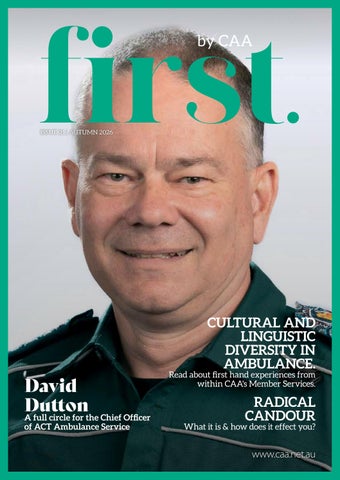
First Magazine Issue 21 AUTUMN 2026

Page 1


Opinion First

Hear from Dr Buck Reed of Charles Sturt University on the education of paramedicine students.

Data First

Read the latest Ambulance Snapshot and Workforce and Gender Report. 08 Industry First

The latest news from across the Australasian Ambulance Health Sector.

12 CAA First

Meet the CAA’s new Chief Executive Officer, Andrew Tombs and read about the 2025 Women in Leadership events as well as the upcoming CAA Congress and Awards for Excellence. 22

Focus First

Connecting the ambulance community through Culturally and Linguistically Diverse (CALD) colleagues.

36

Services First

Showcasing the latest projects and achievements from across CAA member services.

46

Awards First

Meet the 2026 Women in Ambulance Award Winners, 2024 Women in Leadership Scholarship Runners-Up and learn about two of the winning projects in the 2025 Awards for Excellence.

60 Feature First

FIRST speaks with ACT Ambulance Service (ACTAS) Chief Officer, David Dutton.

68

Events First

See what is on the CAA calendar for 2026 along with 2025 Women in Leadership Symposium and 2025 Women in Leadership Scholarship wrap-ups.

74 Partners First

In this edition of FIRST, we share updates from the Australasian College of Paramedicine, Centre for Palliative Care, Titan Prehospital Innovation and the Angels Initiative.

82 Research First

Sharing the latest innovative research projects from around the ambulance world.

92 Sustainability First

See what Ambulance Victoria is doing in the sustainability space with Sustainability Advisor, Mitchell Flett.

THE TEAM

Editor: Mojca Bizjak-Mikic

Relationship and Content Manager: Kieren Vartuli

Editorial Team: Joshua McNally, Courtney Waters

Publication Design: Kade Marsh, Alpha State

94 People First

Meet some of the wonderful people that make up the Australasian Ambulance services.

96 Leadership First

What is Radical Candour? Hear from our leadership expert Dr Erica Kreismann. 102 The Directory

PUBLISHED BY:

The Council Of Ambulance Authorities Inc 2/141 Sir Donald Bradman Drive Hilton SA 5033 Australia admin@caa.net.au

Ambulance Snapshot

Throughout 2025, the CAA collected data from statutory ambulance services across Australia, New Zealand, and Papua New Guinea.

This data supports benchmarking comparisons and is published across the CAA's platforms. The Australian data compiled by the CAA contributes to the Australian Government’s Productivity Commission Report on Government Services (ROGS).

Read the full report

Across Australia, New Zealand and Papua New Guinea in 2024-25 financial year:

Ambulance Stations and Locations 1,845

Ambulances and other vehicles 8,768 Aircraft (excludes NZ and PNG) 76

All Salaried Staff

29,179 Volunteers and First Responders

Incidents reported to ambulance service organisations

5.23 million

Responses where an ambulance was sent to an incident

6.88 million

9,251

Calls made to 000 or 111 (excludes Papua New Guinea) 5.10 million

Workforce and Gender Report 2026

The Workforce and Gender Report is an annual publication that presents workforce dynamics and gender representation trends across the Australasian ambulance sector.

This report aims to enhance the understanding of gender segmentation and diversity within the ambulance sector workforce, which aligns with the CAA 2023-2028 strategy.

Data collected for this report is from the 2024/2025 financial year and includes insights from the CAA’s 11-member services.

Female representation in the Australasian ambulance sector:

Industry News

NSW Ambulance Commissioner’s Valour Medal Awarded

After a resounding inaugural year, the St John Academy in WA is expanding. This program will come to four new locations across regional and metropolitan WA. Ellenbrook and Joondalup will host the metro academies, while Wundowie and Paraburdoo will host the regional academies. This program empowers secondary school students to develop the skills to be leaders, create a healthcare foundation for a future career, and learn lifesaving skills.

St John NT’s Excellence Awards honour the paramedics, volunteers and staff from the service who show outstanding leadership, clinical skill, professionalism, and compassion in caring for the Northern Territory community. Recipients are recognised as role models within their profession and community, often going above and beyond the call of duty, while living our values of respect, integrity, collaboration and empathy.

Congratulations to all the award recipients.

Congratulations to NSW Ambulance Helicopter Critical Care Paramedics Stuart Gourlay and Marty Thomson on their Commissioner's Valour Medals for their acts of bravery. Stuart and Marty rescued an injured rock-climbing patient in an incredibly challenging setting, which included them abseiling 100m down a cliff before nightfall. This rescue took 23 hours to complete and showcases their patient dedication and passion.

The National St John Ambulance Service of Papua New Guinea First Ambulance Specific Cadet

Program Completion

Late 2025 saw the celebration of the National St John Ambulance Service of Papua New Guinea’s (NStJPNG) first ambulance-specific Cadet Program in partnership with the Sir Brian Bell Foundation and supported by the Motu Koita Assembly. The six-month program was held from May to October, 2025, engaging ten cadets with a focus on ambulance and first aid skills, discipline and teamwork.

Read More
Learn More
Read More
St John WA St John Academy Grows
See Winners St John Ambulance (NT) 2025 Excellence Awards

New Emergency Operation Centre (EOC) Has Commenced Operations

The end of 2025 marked a milestone in the New Zealand Government's Public Safety Network (PSN) project. All emergency ambulance and first response vehicles now have new radio equipment in preparation for the Land Mobile Radio network. Over 750 radios have been installed in 18 different vehicles across the fleet. Hato Hone St John are the first of the four emergency services in New Zealand to complete installation.

Ambulance Tasmania

Learn More

SA Ambulance Service’s new EOC has commenced its incredible 24-hour work with a variety of teams including, Triple Zero call takers, coordinators of aeromedical retrievals, and many more working out of the new Mile End location.

Read more about the facility in Services First.

2026 Australian of the Year Award Nominees

Congrat ulations to 2026 Australian of the Year Award nominees, Dr Jorian Kippax and Margaret Chilcott.

Dr Kippax, a Retrieval Consultant with Critical Care and Retrieval (Ambulance Tasmania) and Trauma Consultant at the Royal Hobart Hospital, was recognised for his exemplary career in wilderness and emergency medicine.Margaret, a dedicated Volunteer Ambulance Officer who has served with Poatina’s community emergency response team since 2012, was nominated for Senior Australian of the Year.

Elite NSW Ambulance flood rescue paramedics have been making the most of Tumut’s fast-moving waters, sharpening their skills through intensive hands-on training. From mastering rope techniques and crossing powerful currents to navigating inflatable rafts and motorised rescue boats, the training ensures crews are ready to respond safely when flood emergencies strike. It’s tough, technical work that demands precision and teamwork.

SA Ambulance Service
Learn More
Hato Hone St J ohn Public Safety Network (PSN) Milestone Reached
Read More
NSW Ambulance Swiftwater Skills in Action

Industry News

Ambulance Tasmania

Welcome Nicole Ashworth

Wil White has commenced his role as Chief Emergency Officer of St John WA. Mr White brings extensive operational experience and emergency and patient transport service understanding to the position. Known as a calm leader with sound judgement and a commitment to workforce support, he is highly regarded across the organisation. The CAA would like to thank former Chief Emergency Officer, Brendon Brodie-Hall, for his service to St John WA and time on the CAA Board.

St John Ambulance (NT) Welcome Abigail Trewin

Ms Abigail Trewin has commenced her appointment as Chief Executive Officer of St John NT. Ms Trewin has extensive experience across government, emergency response and health leadership, which assists her in this role. Ms Trewin is familiar with the organisation, as Abi was a frontline paramedic close to two decades ago. The CAA would like to thank former Chief Executive Officer Andrew Tombs and Interim Chief Executive Officer Reece Kershaw for their time in their roles.

Congratulations and welcome back.

January saw Nicole Ashworth commence her role as Chief Executive of Ambulance Tasmania. Ms Ashworth was previously the Chief Operating Officer at Triple Zero Victoria before joining Ambulance Tasmania. During her time at Triple Zero Victoria, she showcased her emergency management leadership skills by providing strategic leadership to almost 1,400 staff members statewide. The CAA would like to thank Michelle Baxter for her time as Ambulance Tasmania’s interim Chief Executive and CAA Board Member.

Wellington Free Ambulance Welcome Dan Pallister-Coward

In January 2026, Dan Pallister-Coward commenced as Chief Executive of Wellington Free Ambulance.

Starting his career in emergency service with the New Zealand Fire Service, he spent nearly two decades across both Islands in various roles. An experienced and values-driven leader, Mr Pallister-Coward has extensive experience across emergency services, health and not-for-profit sectors, most recently coming from the Salisbury Street Foundation. The CAA would like to thank Acting Chief Executive Liz Belke for her time in the Interim role.

St John WA Welcome Wil White

The National St John Ambulance Service of Papua New Guinea Welcome Kai Tane

Kai Tane has commenced as the Chief Executive and Commissioner of the National St John Ambulance Service of Papua New Guinea. Mr Tane brings significant senior leadership experience, a strong commitment to organisational governance, clinical excellence and community service to the role. The CAA would like to thank Interim Chief Executive Dr Arabella Koliwan for her time in the interim role.

St John NT Release new Strategy

St John NT has released its 2025-2028 Mental Health and Wellbeing Strategy, which will emphasise its commitment to the safety, health and wellbeing of its people and their communities.

ACT Ambulance Service David Dutton Receives Emergency Services Medal Clasp

Congratulations to ACT Ambulance Service Chief Executive David Dutton on being awarded a clasp for his Emergency Services Medal for his involvement in the Floods February 2022. The clasp was awarded at an event in Brisbane in November by Her Excellency the Honourable Dr Jeanette Young AC PSM. Congratulations David.

MEET ANDREW TOMBS the CAA's new Chief

Executive Officer

Andrew Tombs joined the CAA in early 2026 as Chief Executive Officer. Bringing decades of leadership experience across diverse roles, including his most recent position with St John NT, Andrew provides the CAA with deep governance expertise and a commitment to strengthening communities.

Andrew, thank you for taking the time to sit down with us and allow our readers to learn more about you.

Andrew, you’ve had an impactful career, and you’ve held significant roles both inside and outside the ambulance space. What has been a pivotal moment or role that shaped your leadership values?

One of the most pivotal moments in my career was recognising that people don't come to work intending to perform poorly, even when outcomes suggest otherwise at times. I came to understand that if we expect high performance without providing clear, coherent direction, suboptimal results should not be a surprise.

This reinforced for me the importance of communication, engagement, and shared understanding - particularly when making strategic and operational decisions.

Having come from the frontline, I have a deep appreciation of how senior-level decisions directly affect frontline staff and the communities they serve. As a leader, I continually remind myself that the impact of decisions often extends far beyond their immediate scope.

Being accountable not only for performance, but also for people’s safety, wellbeing, and trust, fundamentally shaped my leadership values. It reinforced my belief that effective leadership is grounded in integrity, clarity of purpose, meaningful engagement, and a genuine commitment to supporting people to do their best.

A quote that reflects this philosophy is: “When we choose kindness, respect, and compassion, we don’t just uplift otherswe elevate the entire team. Bring out the best in everyone, and together we’ll achieve more than any of us could alone.”

Coming from the energy sector, did you recognise any prominent similarities between energy and ambulance? Did any similarities assist in solving any challenges you faced?

There are more similarities than people might initially expect, and I found it easy to be able to transfer knowledge and experience between the sectors. Both sectors operate in high-risk, highly regulated environments where reliability, safety, and rapid decision-making are critical. The systems thinking, risk management, and operational discipline developed in the energy sector translated well to the ambulance environment, particularly when navigating complex challenges, staff, patient, and public welfare, and ensuring continuity of service under pressure.

You’ve previously served as the Group Chief Executive Officer of St John NT. What is your fondest memory of working with the NT team?

My fondest memories are of the peoplethe professionalism, resilience, and deep connection to community shown by the NT team. Working alongside staff and volunteers who operate in some of the most challenging and remote conditions in the country was incredibly humbling. Their commitment to service and to one another left a lasting impression on me.

Continuing from the previous question, are there any lessons learned that you think are relevant at the CAA?

One key lesson is the importance of listening and engaging– from the frontline to leadership levels to key stakeholders. Strong outcomes are achieved when leadership decisions are informed by lived experience, research, data and analytics, and when people feel heard and valued. Another lesson is that collaboration across jurisdictions and organisations strengthens the entire sector, something that is highly relevant to the role the CAA holds.

There are a variety of ways that one can lead. What would you describe your leadership style to be?

I practice purpose-driven leadership - setting clear direction while empowering people to contribute their expertise, staying transparent and decisive, and consistently aligning our work to shared strategic goals we all have a shared responsibility for. In summary, I lead through purpose, not control.

What do you consider non-negotiables when it comes to leadership, and how does these apply to your own experiences?

Integrity, respect, and accountability are nonnegotiable, as are wellbeing health and safety. Leaders must do what they say they will do, treat people fairly, and take responsibility for outcomes - both good and bad. Throughout my career I’ve learned that trust is hard-earned and easily lost, and effective leadership depends on genuine effort to maintain that trust every day.

What have you enjoyed the most about joining the CAA office and participating in the day-to-day team operations?

What I’ve enjoyed most is the strong sense of shared purpose and passion within the CAA team. There is a deep commitment to supporting members and contributing meaningfully to the advancement of the ambulance sector, both across our member jurisdictions and beyond our traditional boundaries. Being part of a team that is engaged, highly knowledgeable, and genuinely driven to make a difference has been truly inspiring.

What opportunities do you see to continue to grow and to better service our members?

There are significant opportunities to further strengthen advocacy, deepen collaboration between members, and enhance the value CAA delivers through research, policy leadership, knowledge transfer, and shared learning and development. By continuing to listen to our members and responding to their evolving needs, we can ensure CAA remains a strong, trusted voice for ambulance services across Australia, New Zealand, Papua New Guinea, and beyond.

Women in Leadership Symposium 2025

The 2025 CAA Women in Leadership Symposium, held in Brisbane in November, brought together emerging and established leaders from both the ambulance and emergency services sectors and beyond.

From the opening keynote to the closing reflections, the symposium emphasised the importance of breaking barriers, challenging assumptions, and fostering resilience. Through personal stories shared from senior leaders, an interactive workshop, panel discussions and networking, attendees were encouraged to be bold and seize leadership opportunities.

As the final, in-person major event of the year on the CAA calendar, the 2025 Women in Leadership Symposium was a power-packed one-day event to equip mid-level professionals with the skills, tools, and confidence to apply and acquire senior leadership roles.

Read more about the 2025 Women in Leadership Symposium in Events First on page 68.

2025 Women in Leadership Scholarship

The 2025 Women in Leadership Scholarship, awarded by the CAA, celebrates four outstanding emerging leaders — Annie Fardell Hartley, Kathryn Haden, Maggie Jensen, and Shwetanjali Teotia — whose diverse journeys exemplify courage, authenticity, and resilience in ambulance services.

This year, we awarded four scholarships to finalists, the highest number that the CAA has awarded. 2025’s recipients reflect the dynamic and evolving face of leadership across Australasia’s ambulance sector. Each brings unique perspectives, experiences, and ambitions that contribute to shaping more inclusive, equitable workplaces where women are empowered to lead change and inspire others.

Guided by experienced mentors Julie Piantadosi and Dr Erica Kreismann, the scholarship program offers a transformative platform for learning, reflection, and growth. Through tailored mentoring and professional development opportunities, participants are supported to strengthen their leadership capacity, drive innovation, and amplify their impact within their respective services.

Beyond individual career advancement, the Women in Leadership Scholarship underscores the CAA’s continuing commitment to fostering gender equity and diverse representation at every level of leadership. It is a vital step in supporting a culture where emerging and established women leaders alike can thrive—ultimately enriching the collective strength, compassion, and capability of the ambulance sector.

Thank you to our Women in Leadership Scholarship partners, Hexagon, RAPP Australia and Titan Prehospital Innovation, who support the CAA in providing these significant scholarships.

Read more about the 2025 Women in Leadership Scholarship in Events First on page 70.

2026 CAA Congress

Save the date

In 2026, the CAA and ACT Ambulance Service (ACTAS) will host the CAA Congress, National Convention Centre, Canberra, 12-14 August.

The CAA Congress continues to be the premier Ambulance Health Sector event for Australasian member services and beyond. CAA Congress continues to bring together leaders, decision makers and senior officials regionally, domestically and internationally to discuss ideas, challenges, victories, and experiences, and to consider programs for the future of ambulance.

In 2026, delegates will hear from insightful keynote speakers, see the latest in ambulance sector equipment, technology, and network with colleagues, throughout two full days and a number of social events.

Delegate registration and abstract submission portals are now open through www.caacongress.net.au

2026 CAA Awards for Excellence

The highly anticipated and coveted CAA Awards for Excellence Gala Dinner are held during the CAA Congress, recognising innovation in the Ambulance health sector.

These notable awards celebrate the creativity, hard work, and new approaches that the CAA's member services have introduced across number of domains from Mental Health and Wellbeing, to Patient Care. The winners of the six esteemed categories vie for the ultimate prize, the Star Award, which is awarded and concludes the evening.

In 2026, the Awards for Excellence Gala Dinner will be held in the prestigious Great Hall in the Australian Parliament House on August 13th. A fitting venue for the most significant event on the CAA calendar.

The CAA Awards for Excellence in 2025 had over 45 submissions, with the National St John Ambulance Service of Papua New Guinea winning their inaugural Star Award for their 2030 Staff Health Strategy.

Inspirational, influential, and truly unmissable, the CAA Awards for Excellence Gala Dinner continues to celebrate the innovation that drives our sector forward.

 Fast, flexible CPD you can complete between shifts – self‑paced eLearning, webinars, podcasts

 Advocacy that represents your profession, from capability recognition to workforce sustainability

 Up‑to‑date clinical content to keep your practice informed and safe

 Online tools built for shift workers – including our FREE CPD tracker and on‑demand learning library

 Industry‑recognised professional development that strengthens your clinical profile

 Exclusive member rates for workshops, events and conferences

 Education and research grants for when you’re ready to take the next step

 Membership fees are tax deductible

21-22 May 2026 | Canberra, ACT Join us for this unique event that has something for everyone.

 Explore diverse opportunities in primary care and paramedicine

 Hands on workshops to develop skills

 Sharpen your clinical reasoning

 Learn to work seamlessly with community based teams

 Gain the skills to thrive in new areas of practice

PLASTIC FREE JULY IS A WORLDWIDE INITIATIVE THAT EMPOWERS MILLIONS TO COMBAT PLASTIC POLLUTION.

Here at CAA, we're committed to participating in this important movement. To help you begin your plastic-free journey this July, here are four steps inspired by the CAA Sustainability in Ambulance Services report.

Choose recycled latex gloves Use recycled medical equipment Remember to use reusable bags Keep your keep cup nearby Proudly supported by

COMMUNITYThe Various Voices of

CONNECTION

How Culturally and Linguistically Diverse (CALD) colleagues connect with their communities across our sector

In this edition of first, we are proud to highlight colleagues from culturally and linguistically diverse (CALD) backgrounds, their lived experiences, language skills, cultural perspectives, and the unique value they bring to their workplaces, teams, and patients.

This issue's Focus first section offers a first-hand experience for readers to see things from their perspective and how their cultures and various languages assist in the development of trust and confidence within their communities.

These team members enrich ambulance services by helping patients feel seen and understood, especially in moments of crisis where fear, language barriers, and unfamiliarity with the health system may be overwhelming. Their contributions across organisations strengthen care, build trust with communities, and foster more inclusive and culturally safe workplaces.

Over the following pages, colleagues from CALD backgrounds share their powerful stories about their experiences working within ambulance services. From navigating different cultural expectations around emergency care to advocating for patients who may struggle to communicate their needs, bilingualism and multilingualism play a central role in this work, enabling staff to communicate directly with patients and families, explain procedures, and de-escalate stressful situations.

These language skills also support deeper community engagement, whether through health education sessions, outreach to new and emerging communities, or collaboration with local community leaders.

Many member services develop initiatives and programs that support CALD staff and promote culturally appropriate care. These efforts sit alongside growing reflections on the importance of cultural diversity within our sector, recognising that a diverse team is better equipped to care for a diverse community.

In this issue's Focus, we are grateful to be able to share the stories of Jaimik Chauhan of Ambulance Victoria, Waiza Abdi of NSW Ambulance, Dr Shohreh Majd of the CAA, and Mojgan Sadrizadeh and Lynette McFall, both of Queensland Ambulance Service, and to hear firsthand of their experiences in their respective organisations across a variety of roles in the sector.

Join us in celebrating the vital role CALD colleagues play in shaping a more equitable ambulance sector, one where diverse voices build trust, innovation, and further compassionate care for all communities.

Empowering Communities with Lifesaving Skills as a Multilingual Paramedic

Iwas born in Gujarat, India, and moved to Australia when I was nine. From a young age, I learned to navigate multiple languages and cultures, speaking Gujarati, Hindi, and English.

I originally planned to study medicine and was accepted into James Cook University at 17, but I felt I was still too young to move away from home. I explored nursing for a while, yet my interest in paramedicine kept growing until it became the clear path forward.

My family has always supported my career, and they are proud of the work I do in the community.

Over the past few years, I’ve been involved in several significant clinical moments, including achieving return of spontaneous circulation for a cardiac arrest patient who recovered within days. I’ve also responded to two birthsone involving a premature newborn resuscitation and a breech delivery.

One case that has stayed with me, involved a South Indian family experiencing a cardiac arrest at home. Two young adults were present, and no one had started CPR in those critical minutes before we arrived because they weren’t sure what to do. Sadly, it was too late to revive the patient. That experience has driven me to educate the community about what CPR is, and why learning it is so important.

I’m passionate about improving health literacy in diverse communities. Many Indian Australian families, for example, are unfamiliar with the role of paramedics in Australia. In India, paramedics are primarily a transport service, so people often don’t realise that here we provide advanced clinical care, make complex decisions and can treat many conditions without hospital transport. This misunderstanding can lead to hesitation, confusion or fear during emergencies.

To help address this, I’ve started delivering community education sessions at my local temple in Pakenham. I teach people when and how to call Triple Zero (000), what to expect if paramedics are required, and the services available - including the Victorian Virtual Emergency Department (VVED), Nurse-on-Call and Urgent Care Clinics. I emphasise the importance of having medication lists and billing information ready, and I teach CPR basics, stressing that anyone can do it. I believe education delivered in a person’s own language is essential and can save lives.

I’ve found that patients often open up more when they see someone who understands their background or speaks their language. It builds trust quickly. My multilingual skills allow me to connect with people who might otherwise feel isolated or misunderstood in an emergency.

I believe education delivered in a person’s own language is essential and can save lives.

Some of the moments that have stayed with me most are the ones where language and culture played a crucial role.

One of my earliest realisations about the importance of language came during my first case as a solo officer. Our patient had a simple ankle strain and spoke only Hindi. Hospital transfer wasn’t required, but being able to explain the situation in the patient’s own language transformed the interaction. They felt reassured, respected and fully informed.

Another involved a patient from Afghanistan who was experiencing chest pain and spoke very limited English. My partner was trying to assess the pain, but the patient struggled to describe what he was feeling. He spoke Dari but understood some Hindi, and by switching languages, I was able to gather the information needed for a thorough assessment.

It turned out to be reflux rather than a cardiac event. We connected the patient with VVED via video call, and he was able to access the right medication from the comfort of his home, avoiding an unnecessary hospital transport. I still remember how relieved he looked when someone spoke in a way he could understand.

I’m a motivated and dedicated paramedic, driven by the desire to help people from a range of backgrounds and improve patient outcomes every day.

I find the profession deeply rewarding, and I can’t imagine doing anything else.

Belonging on the line

Emergency

My name is Waiza Abdi, and I am a proud Muslim employee of NSW Ambulance. Wearing this uniform represents more than a career. It reflects identity, opportunity, and the power of representation.

Before joining NSW Ambulance, representation of Muslim paramedics and emergency medical call takers was not something I had personally experienced. So, when I began my journey here and saw other Muslim staff members, including women wearing hijab like myself, I felt an immediate sense of belonging. Representation matters not only for our patients but also for staff.

Representation matters not only for our patients but also for staff.

When I attended my observation day in 2023, I was told there was a prayer room available on-site for staff of all cultures and religions and that I was welcome to step away to pray whenever needed. That reassurance made me feel seen and valued from the very beginning.

Knowing I have made even a small difference in someone’s life is what truly makes my day.

Within my culture, there is often limited awareness of what NSW Ambulance clinicians do and the scope of care we provide. Choosing this profession has allowed me to open conversations within my community about the vital work we do and the inclusive, supportive environment we are part of.

My parents, who migrated to Australia and adapted to new languages and cultures, are my greatest inspiration. Their resilience encouraged me to embrace opportunities and step beyond my comfort zone. Because of their sacrifices, I am able to stand where I am today.

Each shift brings both challenge and reward. Supporting patients during vulnerable moments and knowing I have helped make a difference, even in small ways, is what I value most about this role. Working alongside colleagues from diverse backgrounds has strengthened my empathy and reinforced that our diversity is one of our greatest strengths.

The job can be emotionally demanding, but NSW Ambulance provides a strong support system. Leaning on colleagues, prioritising family time, rest and wellbeing helps me maintain balance in such a challenging profession. During Ramadan, my team has consistently been accommodating and supportive while I fast, reinforcing that this organisation genuinely cares about its people.

Three years forward, in 2026, I have witnessed meaningful growth within NSW Ambulance. Inclusivity continues to strengthen, and it is inspiring to see more Muslim women and diverse staff entering the field. The visibility and representation that once felt unfamiliar are becoming increasingly present, and that progress is something I am incredibly proud to be part of.

With this support, I’ve also finished my paramedicine degree and hope to begin working as a paramedic in the future.

NSW Ambulance makes room for everyone, and I hope more women from all backgrounds see that they too can make a difference here.

The Power of Cultural Diversity in Shaping Inclusive Professional Environments

As an academic and professional with a diverse background in neuroscience, teaching, and research, I have had the privilege of collaborating with researchers, academics, students, and ambulance professionals from a wide range of cultural backgrounds.

Originally from Iran, I moved to Australia in 2008 to undertake postdoctoral research at Flinders University. Since then, I have experienced firsthand the value that cultural diversity brings to both academic and professional environments. At the same time, adapting to life and work in a new cultural context has played a significant role in shaping my own identity as an academic and professional. Learning to navigate different expectations, communication styles, and workplace norms has strengthened my adaptability and broadened my perspective.

Over the years, I have developed strong connections with the Australasian ambulance sector through my work at Flinders University and the CAA.

In these roles, I have contributed to educating the next generation of paramedics and medical doctors, as well as developing research and policy initiatives that support emergency services across Australasia.

My teaching experience spans medical, paramedic, midwifery, and nursing programs at Flinders University and Dalhousie University. Working with students from a wide array of cultural backgrounds has reinforced the importance of cultural awareness in creating effective and equitable learning environments. Although my roles have not involved direct patient care, my teaching philosophy is grounded in the belief that diversity enriches education.

As a lecturer, I have consistently seen how diverse perspectives strengthen discussions, enhance collaboration, and broaden collective understanding. Teaching culturally diverse cohorts has highlighted the need to develop inclusive environments where everyone feels respected, valued, and able to participate meaningfully.

This requires adapting communication approaches to accommodate different cultural and educational needs so that learning remains accessible, relevant, and engaging. These experiences have also encouraged me to reflect on my own journey, moving from a place of uncertainty to finding my voice and confidence within Australian academic and professional environments.

Drawing on my multilingual abilities has also enabled me to bridge language gaps and offer more personalised support to students and team members who may otherwise struggle with English-language instruction. This has contributed to a more inclusive culture in which individuals feel supported and empowered to succeed.

One of the most rewarding aspects of working across cultures has been witnessing the transformative impact of culturally sensitive pedagogy on team engagement and learning outcomes. Incorporating culturally relevant examples, facilitating inclusive discussions, and respecting varied communication styles have all enabled team members to share their experiences confidently.

Adapting to life and work in a new cultural context has played a significant role in shaping my own identity as an academic and professional.

This not only strengthens individual learning but also enriches broader collaboration by introducing new perspectives and encouraging critical thinking.

These same principles of inclusivity and cultural responsiveness extend to the ambulance sector. As the Policy and Research Manager at the CAA, I work with diverse teams of ambulance professionals to collect data, analyse trends, undertake research and shape policies that serve communities from all backgrounds, including culturally and linguistically diverse groups. This collaborative and culturally informed approach ensures that our policy recommendations reflect the needs of the communities we serve and are more likely to be effective in practice.

The process of building a career in a culture different from the one in which I was raised has been both challenging and deeply rewarding.

It has enriched my leadership style, strengthened my empathy, and allowed me to appreciate diversity not only as something I support in others but also as a defining part of my own professional path.

Cultural diversity is essential to a thriving workplace. It enhances academic and professional environments by promoting collaboration, mutual respect, and shared understanding. I remain committed to promoting inclusive, culturally sensitive practices, whether in universities or professional settings, and firmly believe that supporting diversity leads to stronger outcomes for individuals, organisations, and the communities we serve.

Using my lived experience to foster greater inclusion at Queensland Ambulance Service

When I moved to Australia, I never expected to face cultural barriers to work, but I’ve used these experiences to inform and create a positive opportunity, promoting greater diversity and inclusion within the service to reflect the state’s diverse communities.

My name is Mojgan Sadrizadeh (Moji for short), and I work at Queensland Ambulance Service (QAS) as a Senior Project Officer.

I migrated from Iran 12 years ago in search of a better future, and despite having a Master of Business Administration (MBA), I encountered many challenges and barriers that other Australians may never experience in their careers.

These challenges, or barriers to employment, included language differences, limited recognition of overseas qualifications, underemployment, cultural adjustment, discrimination, trauma and social isolation, which collectively can have a huge impact on a person’s mental health and overall wellbeing.

While most of these barriers stem from unconscious bias, they are real.

Recognising and understanding these barriers is essential to shaping how the QAS supports our communities and how we foster culturally safe and inclusive communication within our workforce.

Multilingual and multicultural staff members who understand cultural norms can play a crucial role in building trust with our patients and communities, especially when treating people with limited English proficiency or those unfamiliar with emergency services.

Their ability to communicate clearly, recognise cultural factors influencing health decisions, and provide culturally safe care leads to better patient outcomes.

Having a greater cultural and language diversity improves our ability to provide compassionate, equitable care to all Queenslandersstrengthening both our organisation and the communities we serve.

In my role, I recognise the importance of working towards removing barriers multicultural employees experience and the need for the service to have a plan which includes measurable actions to ensure accountability, underlining its commitment to making change.

One of the greatest challenges I experienced was securing employment aligned with my qualifications and experience.

Although I held a master’s degree and brought extensive professional experience from Iran, I struggled to obtain a role that reflected my skillset, instead having to accept roles I was completely overqualified for, and many migrants have shared this experience.

Unconscious bias toward foreign names can influence recruitment decisions, and I know people who felt compelled to anglicise their names on their resumes simply to be considered for interviews.

I encountered many challenges and barriers that other Australians may never experience in their careers. While most of these barriers stem from unconscious bias, they are real. I struggled to obtain a role that reflected my skillset.

First-generation migrants often lack local experience and established professional networks, and their overseas qualifications are not always fully recognised.

These systemic barriers can make a job search challenging and deeply stressful.

QAS’s Equity, Diversity and Inclusion Action Plan sets out a clear pathway to creating a work culture where everyone feels valued and respected regardless of their background and culture and can enjoy a sense of belonging in their workplace.

This also means people from different backgrounds and cultures seeking employment can see there are systems in place, the service recognises the barriers these people can face, and is actively promoting greater inclusion.

Migrants bring different strengths to a job, so organisations must look beyond a different accent or cultural background to look at the skills, knowledge, diversity and experience they bring with them to a workplace.

Strength in Diversity: Cultural Insight

McFall, Acting Patient Transport Operation Supervisor/ Patient Transport Officer, Queensland Ambulance Service

Working within Queensland Ambulance Service

(QAS) has given me the privilege of standing at the intersection of two worlds, the structured fastpaced environment of healthcare operations and the deeply relational community-centred values of my Samoan heritage. Both shape the way I lead, communicate and care for the people we serve.

Growing up in a Pacific Island family, I learned early that service ‘Tautua’ is not just an action but a responsibility. It’s woven into how we show respect, how we support our elders, and how we uplift our communities.

I learned early that service ‘Tautua’ is not just an action but a responsibility.

When I joined QAS, I quickly realised that these values aligned naturally with the heart of our work. Every patient interaction, every crew I support, and every operational decision I make is grounded in that same sense of duty.

Working in Patient Transport has exposed me to countless stories, families navigating complex health journeys, patients who feel vulnerable or isolated, and communities who rely on us not only for clinical support but for reassurance and dignity.

Being Samoan and part of a broader CALD workforce has shaped how I approach these moments. I understand what it feels like to straddle cultures, to translate not just language but emotion and to help people feel seen in a system that can sometimes feel overwhelming.

Bilingualism has been an unexpected bridge. While English is my primary language at work, speaking Samoan has allowed me to connect with Pacific Island patients and families in a way that immediately softens the room.

A simple greeting ‘Talofa Lava’ can shift someone from anxious to ease.

It reminds them they’re not alone, that someone understands their cultural rhythms, their hesitations, and their need for family involvement in decision making.

Even when patients don’t share my language, the cultural lens I bring helps me read the unspoken, the importance of tone, body language and relational warmth.

Working as a Patient Transport Operation Supervisor, I’ve also seen the growing recognition of how important culturally appropriate care is. Initiatives that support CALD staff, whether through mentoring, leadership pathways or cultural capability training, don’t just benefit employees; they strengthen the service as a whole.

When our workforce reflects the communities we serve, trust grows. Communication improves. Outcomes shift.

I have had the chance to advocate for these values in practical ways, supporting staff who may feel unsure about cultural nuances, encouraging open conversations about diversity and modelling leadership that is firm but grounded in empathy. I’ve seen first-hand how diverse teams think more creatively, respond more flexibly, and support each other more genuinely.

Cultural diversity isn’t a box to tick; its strength that shapes the way we care. It brings colour, perspective, and humanity into our service. For me, being Samoan in QAS isn't something separate from my role; it's part of the foundation I stand on. Every day, I’m proud to walk in both worlds that contribute to a service that values every story, every background and every voice.

Supporting the Future Workforce:

Optimising the wellbeing of pre-employment paramedicine students.

Buck Reed, PhD FACPara, Lecturer in Paramedicine — Charles Sturt University

Acapable paramedic workforce relies on effective education and development. In the last two decades, Australia and New Zealand have transitioned to a tertiary pre-employment education model (Hou et al., 2013).

These courses are accredited by appropriate regulatory bodies in their respective jurisdictions. This transition has resulted in the university sector having a critical part in the development of entry-level paramedics.

With this change in the education model has come changes in the workforce. Entry-level paramedics are

increasingly younger, increasingly female and increasingly diverse (not only culturally but in factors such as lived experience and neurodiversity) (Thyer et al., 2024). These changes are not solely the result of the change in educational approach but also reflective of generational changes in the population more broadly.

A future workforce in need of support

For most paramedicine students at university, they are studying at a time of significant personal development and transition (Browne et al., 2017). Studies of Australian universities have found that approximately 25% of university students will have a period of mental health unwellness each year (Orygen, 2017) and an equal percentage have some type of formal mental health diagnosis (Usher & Curran, 2017). Likewise, the pandemic had a significant impact on the wellbeing of recent cohorts of university students (Dingle et al., 2024).

There have been relatively few studies examining the wellbeing of paramedicine students. Alzahrani et al. (2025) undertook a systematic analysis of thirteen available studies on the wellbeing of paramedicine students in several countries (five included Australian and/or New Zealand data). Using the pooled data available in these surveys, Alzahrani found that 17.8% of students reported moderate PTSD, 34.7% reported depression, and 54.9% reported moderate anxiety. It is important to caveat that these findings were based on a limited pool of studies with relatively small cohorts, utilising different assessment tools, and most only looking at a single disorder. This analysis of the available literature suggests paramedicine students are likely to endure stresses related to both student and paramedic environments. Concerningly, these results show students carry a burden of mental health unwellness comparable to, if not exceeding, rates found in practising paramedics (Alzahrani et al., 2025). However, the paucity of large-scale data means that knowing the real picture of wellbeing challenges in the paramedicine student cohort is elusive.

Risks to student wellbeing

The diversity of the student population means that it is difficult to identify risk factors that are universal to students; however, pockets of risk and some commonalities of risk can be identified. Factors identified in the literature likely to be of particular concern for paramedicine students include:

• Stress

• Self-esteem, including perceptions of competence

• Some personality factors, such as weak capacity to adjust and Type A personalities

• Cognitive function elements such as problem-solving, avoidance, and depressogenic cognitive style

• Poor emotional regulation or coping skills

• Previous trauma and life stress

• Sociodemographic factors.

A full list of factors can be found in the study by Sheldon et al. (2021).

Paramedicine students in Australia and New Zealand are likely to be especially impacted by elements such as placement poverty (exacerbating socio-economic risks), stresses around employment recruitment processes, and impacts from engaging in work-integrated learning (e.g. clinical placement).

Opinion First

Supporting and improving student wellbeing

There is an increasing focus on the wellbeing of students at Australian universities. In 2020, Orygen released the Australian University Mental Health Framework with recommendations to support individual and environmental wellbeing in universities (Orygen, 2020). The following year, Universities Australia and Headspace released the Real Talk Mental Health Framework for Universities (Universities Australia and Headspace, 2021). These two strategies support a range of initiatives in universities which are being implemented across institutions. The Orygen Framework is based on six key principles:

1. Student experiences improve when mental health and wellbeing strategies reflect students’ real needs and lived experiences.

2. A supportive university culture is created when everyone contributes to learning environments that prioritise student mental health and wellbeing.

3. Healthy university communities promote inclusion, participation, connection, and success both academically and personally.

4. Mental health and wellbeing outcomes strengthen when responses are coordinated and collaborative across the institution.

5. Students thrive when they can access timely, effective, and appropriate mental health and wellbeing supports.

6. Ongoing improvement and innovation rely on evidence that deepens understanding of what best supports student mental health and wellbeing.

Opportunities for universities and paramedic services

One of the key elements of the Orygen framework is collaboration. The wellbeing of paramedicine students is a shared concern of both universities and employers. The healthier and safer the student experience is, the better the student’s academic journey will be and the greater the opportunity for them to thrive at university. Likewise, the more prepared and capable students are for the workplace, the greater their performance as practitioners and the more adaptable they will be to the challenges of paramedic work.

Paramedic services have significant capacity and experience with paramedic wellbeing. While universities are building more strategies and services, these are designed for more generic student populations. The experience of paramedic services can help universities tailor approaches to paramedicine students and utilise strategies that will look familiar when they move into paramedic employment.

University paramedicine programs need to increase their wellbeing content, delivered in collaboration with employers and interprofessional experts in the wellbeing of paramedics. This needs to be in turn role modelled by employers and preceptors when students are engaged in clinical placement to help normalise wellbeing as a critical skillset. The use of lived experience experts and practitioners with practical experience of wellbeing can help build wellbeing as a key value in paramedic practice by contextualising it for students before they are fully immersed in the workplace.

Universities and paramedic services can adopt pedagogies that support wellbeing in the education process. This is especially important in that many paramedicine students choose a helping profession because of previous experience with the health system or caring for others (Tannous et al., 2024). There is good evidence for approaches such as trauma-informed pedagogy, which increase educational safety and recognise lived experience (Harrison et al., 2023).

Finally, universities have significant capacity in research. Research partnerships can evaluate wellbeing strategies used in paramedic services; help build a better understanding of both student and employee needs, and synthesise wellbeing research into a practical curriculum. Universities also have access to experts in other areas, which can help to build interprofessional project teams.

References

Alzahrani, A., Keyworth, C., Alshahrani, K. M., Alkhelaifi, R., & Johnson, J. (2025). Prevalence of anxiety, depression, and post-traumatic stress disorder among paramedic students: a systematic review and meta-analysis. Social psychiatry and psychiatric epidemiology, 60(3), 563-578.

Browne, V., Munro, J., & Cass, J. (2017). The mental health of Australian university students. JANZSSA: Journal of the Australian and New Zealand Student Services Association, 25(2), 51-62.

Dingle, G. A., Han, R., Alhadad, S. S., Beckman, E., Bentley, S. V., Gomersall, S. R., Hides, L., Maccallum, F., McKimmie, B. M., Rossa, K., Smith, S. S., Walter, Z. C., Williams, E., & Wright, O. (2024). Data from four consecutive cohorts of students in Australia (2019–2022) show the impact of the COVID-19 pandemic on domestic and international university students’ mental health. Australian & New Zealand Journal of Psychiatry, 58(6), 528-536. https://doi.org/10.1177/00048674241233111

Harrison, N., Burke, J., & Clarke, I. (2023). Risky teaching: Developing a trauma-informed pedagogy for higher education. Teaching in Higher Education, 28(1), 180-194.

Hou, X. Y., Rego, J., & Service, M. (2013). Paramedic education opportunities and challenges in Australia. Emergency Medicine Australasia, 25(2), 114-119.

Orygen. (2017). Under the radar: The mental health of Australian university students (1920718435).

Orygen. (2020). Australian university mental health framework. In. Melbourne: Orygen Melbourne, Australia.

Sheldon, E., Simmonds-Buckley, M., Bone, C., Mascarenhas, T., Chan, N., Wincott, M., Gleeson, H., Sow, K., Hind, D., & Barkham, M. (2021). Prevalence and risk factors for mental health problems in university undergraduate students: A systematic review with meta-analysis. Journal of Affective Disorders, 287, 282-292.

Tannous, C., Chien, H.-W., Kenny, B., Lin, K.-H., Everett, B., Yeh, J.-Y., Wang, J.-Y., Heaton, L., & Salamonson, Y. (2024). Factors influencing career choice, study experiences and professional identity in undergraduate health students: A mixed methods study across two universities. Teaching and Learning in Nursing, 19(3), 249-259.

Thyer, L., Baldry, S., Hernandez Gande, A., Sharafizad, F., Aiello, S., & Howie, G. (2024). Australasian paramedicine workforce survey report 2023–2024. Sydney: Australasian College of Paramedicine, 2023-2024. Universities Australia and Headspace. (2021). Real Talk Mental Health Framework. Universities Australia and Headspace.

Usher, W., & Curran, C. (2017). Predicting Australia’s university students’ mental health status. Health Promotion International, 34(2), 312-322. https://doi.org/10.1093/heapro/dax091

Buck Reed, PhD FACPara, Lecturer in Paramedicine — Charles Sturt University

Dr. Buck Reed is a Lecturer in Paramedicine at Charles Sturt University with over a decade of academic teaching and research. He is a Registered Paramedic who continues to practice clinically in both rural and metropolitan settings since commencing with NSW Ambulance two decades ago.

Buck received a Churchill Fellowship in 2013 and was the first paramedic accepted into the NSW Health Rural Research Capacity Building Program in 2009. His PhD examined the implementation of professional regulation for Australian paramedics in 2018. Buck is a Fellow of the Australasian College of Paramedicine and has engaged with the industry n a range of capacities over the last 15 years. His research focuses on the intersection of paramedicine and the social sciences, specifically areas are professionalism, regulation, wellbeing and philosophies of practice.

Dr Ziad Nehme becomes first paramedic to receive national Health Minister’s research award

Ambulance Victoria (AV) is proud to celebrate a historic milestone with Dr Ziad Nehme becoming the first paramedic to receive the honour in the 25-year history of the Commonwealth Health Minister’s Award for Excellence in Health and Medical Research.

Dr Nehme, AV Director of Research and Evaluation, received the 2025 award for his extraordinary contribution to improving outcomes for patients experiencing cardiac arrest.

His achievement marks a significant moment for the paramedicine profession, recognising the vital role paramedics play in advancing health and medical research in Australia.

The award highlights Dr Nehme’s outstanding research career in prehospital emergency care and resuscitation, and his leadership in shaping evidence-based improvements to cardiac arrest survival.

Out-of-hospital cardiac arrest (OHCA) remains a major health challenge in Australia, with over 25,000 cases annually. Despite advances in emergency care, survival remains low, with only one in 10 patients surviving.

As part of the award, Dr Nehme will receive an additional $50,000 to support his research. This funding complements his recent five-year NHMRC Investigator Grant.

In his groundbreaking research project, Dr Nehme will bring technology, integration and sophistication to the health service response to OHCA by integrating advanced technology and improving early treatment.

Ambulance Victoria

Dr Ziad Nehme received the Commonwealth Health Minister’s Award for Excellence in Health and Medical Research.

Dr Nehme accepted the award at a ceremony in Canberra. He said, “While many in the community have expressed gratitude for the lifesaving work paramedics do, my journey in research has been shaped by a starkly different reality. The devastating experience of seeing the majority of patients experiencing OHCA die before they reach the hospital.

“Through this NHMRC Emerging Leadership Fellowship, I am committed to driving a paradigm shift in OHCA management. I want to move beyond traditional emergency response to an integrated, technology-driven and community-focused system of care.

“My ultimate vision is clear; I want a future in which every individual experiencing OHCA has the best possible chance of survival. No life should be lost due to delays, inaction or missed opportunities for early intervention,” he said.

Dr Nehme’s future research will focus on better identifying OHCA during emergency calls, reducing delays in bystander CPR, testing community-based interventions to increase defibrillation rates before ambulance arrival, and strengthening the evidence base for resuscitation interventions.

Victoria is the safest place in Australia and the third safest in the world for cardiac arrest survival, as highlighted in the 2023/24 Victorian Ambulance Cardiac Arrest Registry (VACAR) Annual Report.

The Victorian Ambulance Cardiac Arrest Registry Report showcases groundbreaking advancements in cardiac arrest response and survival rates across the state.

Ambulance Victoria proudly congratulates Dr Nehme on this historic achievement and acknowledges his exceptional contribution to advancing cardiac arrest care in Victoria and across Australia.

Read the Victorian Ambulance Cardiac Arrest Registry Report at: www.ambulance.vic.gov.au/ research-publications.

National Health and Medical Research Council (NHMRC) Chief Executive Officer Professor Steve Wesselingh and Dr Ziad Nehme.

Brodie's Connection to Community Service

Queensland Ambulance Service

He might be younger and fresh-faced, but Brodie Savage is the first to admit he isn’t chasing the adrenaline-fuelled aspirations of a high acuity Critical Care Paramedic (CCP) role. Instead, his heart lies in his local community in the rural town of Nanango, where he’s the Officer in Charge (OIC).

Brodie’s move to Queensland Ambulance Service (QAS) as a graduate was unintentional – more the result of QAS being the first service responding to his application after graduating with a paramedicine degree.

“I grew up in Port Macquarie and was posted to Nanango straight after uni, so my career started here,” said Brodie.

“I met my wife Ashlee here too, as she’d been working as a nurse at Nanango Hospital.

“One of my workmates, Danny George, convinced me to start up a conversation and ask her out on a date –and the rest is history!”

After settling into his role at Nanango, Brodie was then transferred to Bundaberg Station, so both Brodie and Ashlee packed their bags and moved, ready to spend their next several years there.

“Bundy is a great town, and we really enjoyed living and working there,” he said.

But then COVID-19 played its card.

The couple’s time in Bundaberg was cut short after Brodie’s Gold Coast-based grandfather experienced multiple health emergencies, and COVID19 travel restrictions meant Brodie was the only family member with access to support him.

So, the couple packed their bags again, this time moving to the Gold Coast.

Brodie gained a transfer to Springfield Station, while Ashlee transferred to the Gold Coast University Hospital (GCUH) as a clinical nurse in the infectious diseases and COVID-19 ward.

Thankfully for the couple, the COVID-19 restrictions at the time didn't manage to derail their wedding plans, as Brodie and Ashlee were still able to celebrate their marriage on Ashlee’s family property.

After a year of working in Southeast Queensland, the couple realised metro life wasn't for them – it was too busy, they never saw each other, and they felt it wasn’t the place for them to raise children.

“Working in a Metro area during that time was hectic and challenging – there was so much disconnect – you’d turn up, do your shift, then go home.”

Brodie said his return to Nanango Station took much longer than they’d hoped – almost four years.

“We needed the extra family support around us as we’d had our first child and had a second on the way,” he said.

“I’d been driving back and forth from Brisbane while I waited for a job to become available here, and that was hard on Ash”.

Brodie said that in 2024, he jumped at the opportunity to finally return to Nanango Station as a paramedic before taking on the Acting OIC role for 14 months until it was made permanent.

“Returning to the Nanango community completely renewed my love for being a paramedic,” Brodie said.

“I also recognised how important connection to our community was to me both professionally and personally.

“I’ve spent a lot of time with our Local Ambulance Committee (LAC), which comprises around 10 volunteers of all ages, because their focus has changed significantly over the last few years, from fundraising for equipment for the station and staff, to providing community education and engagement.

“This new direction has given our LAC real purpose and value, and the team is super enthusiastic about it.

“I’ve been working closely with our LAC, supporting the members with training to deliver various education programs, including first aid, snake bite first aid, STOP the BLEED, and CPR Awareness.

“These volunteers have also become peer trainers and community coordinators, which means they can become more involved in the school visits and events like Under 8s Days."

“It’s these opportunities you often don’t have the time to do in Metro areas that make us feel a part of the community and that we’re giving back to it.”

Brodie said the station’s engagement with the local schools, with the area’s disaster planning groups and the emergency services groups had continued to build the station’s networks and the whole team’s connection with the community.

“These community networks have generated other collaborative opportunities too,” he said.

“For example, our Automated External Defibrillator (AED) Project was formed from a partnership between the Heritage Bank, our LAC and the QAS.

“So far, this project has delivered 18 AEDs to the care of community groups and businesses around town, with the aim of reducing the rate of out-of-hospital cardiac arrest deaths in the area,” Brodie said.

“We’ve also held several community education sessions teaching these groups and community members how to use these AEDs.

“Not all AEDs are in boxes on walls – several units are based with the groups hosting park run or tai chi, but they’re all registered with the QAS, so they can be easily located.”

Brodie said he enjoyed living in the community he serves, but acknowledged he and the team were highly visible in the community.

“Being visible is just part of the job,” he said.

“I certainly never realised how far-reaching the OIC role would be – there’s so much more to it than rostering and timesheets.

“I don’t think I realised until I was in this OIC role how closely we work with our LACs, and the vital work they do representing QAS in our communities.

“The community education these volunteers provide gives us more time to be out on the road responding to our communities’ emergencies.

“These volunteers help us build community connections and networks. “In general, paramedics are constantly looking for ways to improve to bring greater value or purpose to their job.

“Some of us will choose to upskill to be a Critical Care Paramedic (CCP), a Local Area Assessment and Referral Unit (LARU), or a High Acuity Response Unit (HARU) to provide more specialist care for their patients.

“Others, like me, may feel we can bring greater value and purpose to our roles by strengthening our stations’ connection to, and engagement with, our local communities.”

AN OUT-OF-HOSPITAL

Building for the future:

SAAS opens next- generation Emergency Operations Centre (EOC)

SA Ambulance Service

SA Ambulance Service has successfully relocated its Emergency Operations Centre (EOC) to a new facility that sets the service up for the future and strengthens SA’s capacity to respond to statewide emergencies.

The operational transition of the EOC was a live relocation, staged over 11 days in December.

“It is a massive challenge to relocate a working EOC into a brand-new facility that had to run from the first minute that Triple Zero (000) switched over. We achieved it without missing a beat, thanks to the extraordinary efforts of our project team and the positivity and flexibility of the relocating staff, underpinned by meticulous planning and conservative management of the operational transition,” said SAAS Executive Director of Critical Operational Services, Kate Clarke.

The new $134 million purpose-built EOC facility is at Mile End South and houses SAAS’ Critical Operational Services directorate and a number of other workgroups in the EOC.

The heart of the new building is the EOC operational floor, which supports collaboration by bringing together all EOC operational and clinical portfolios, including call taking, dispatch, secondary triage, EOC clinicians and aeromedical retrieval coordination.

Staff wellbeing was an important consideration in the design, and the EOC operational floor has a large central skylight filling the space with natural light, while gardens and outdoor seating are proving popular as a restorative space for staff breaks.

The relocation also marks a significant technology upgrade, with the introduction of the Guardian telephony and call management system, which increases SAAS’ capacity to manage future growth in Triple Zero (000) call volumes.

The new building enhances SAAS disaster resilience with structural and engineering IL4 features to protect against natural disasters, and independent water and power supplies to support operational continuity.

In addition, the building has a large incident command centre and the space and technological capacity to provide a greatly enlarged redundancy site for other emergency services.

The new Adelaide ambulance station is adjacent to the EOC building. Adelaide station was opened in November, and its location is strategically important to strengthen ambulance coverage for the Adelaide CBD and inner western and southern suburbs.

SAAS also recently completed the rebuilding of Campbelltown station and a major expansion and upgrade of Goolwa station.

The new stations and EOC building are part of a major expansion that has delivered 24 completely-new, upgraded or rebuilt ambulance stations and deployed 350 additional operational staff and 36 additional ambulances over the last three years.

2026 CAA Women in Ambulance Award Winners

Celebrating International Women’s Day for 2026 and our continued commitment to gender equality, we are proud to announce this year's CAA Women in Ambulance Award Recipients.

This year, the 2026 CAA Women in Ambulance Awards recognise 56 women across Australasia whose achievements are far more than personal milestones; they are proof that change is building, momentum is growing, and that every step forward brings us closer to a more inclusive future.

The 2026 International Women’s Day theme, “Give to Gain,” highlights how meaningful progress emerges when we actively invest in one another through generosity, encouragement, and mutual support.

Now in its sixth year, the CAA Women in Ambulance Awards were created to recognise outstanding women, celebrate the impact of their contributions, and help build a profession that is inclusive, equitable, and free from bias and barriers.

The CAA remains firmly committed to the advancement of women across the sector and continues to support their growth through a range of initiatives, including scholarships and professional development programs.

Congratulations to all Honour Recipients.

Watch the announcement of the CAA Women in Ambulance Award Winners.

ACT Ambulance Service

Awards First

Hato Hone St John

NSW Ambulance

Queensland Ambulance Service

SA Ambulance Service

St John NT

The National St John Ambulance Service of Papua New Guinea

Paramedics Exposure Analysis

Driving excellence in critical care

Ambulance Victoria

In the high-stakes world of emergency medicine, every second counts, and so does every skill. At Ambulance Victoria (AV), a groundbreaking initiative is ensuring paramedics remain prepared for the most critical moments in the field.

The Paramedics Exposure Analysis (PEA) project is an innovative collaboration between analytics experts and frontline clinicians, reshaping how AV monitors clinical exposure, identifies training needs, and drives improved patient outcomes.

Launched as part of AV’s commitment to clinical excellence, the PEA tool delivers a user-friendly and consistent method for tracking paramedics’ exposure to highacuity cases and advanced clinical interventions.

L-R: AV Hume Regional Improvement Lead and MICA paramedic Kate Cantwell, AV Senior Data Scientist Farhad Salimi and AV Senior Manager Analytics Development Rachel Atkinson
By transforming complex data into actionable insights, the tool empowers AV’s Clinical Support Officers (CSOs) to provide targeted education, ensuring paramedics remain confident and proficient even in rarely encountered but high-risk scenarios.

The impact has not gone unnoticed. In 2025, the project earned the Council of Ambulance Authorities (CAA) Awards for Excellence, Excellence in Patient Care award, recognising its role in strengthening frontline capability and advancing emergency medical care across Victoria.

The PEA project, is the result of a thoughtful co-design process led by AV Senior Data Scientist Farhad Salimi, supported by AV’s Analytics Development team, paramedics, CSOs and clinical governance experts.

From the beginning, the team anchored their work in real-world insights, taking an iterative, hands-on approach and working closely with clinicians, including AV Hume Regional Improvement Lead and MICA paramedic Kate Cantwell.

Through rounds of feedback and refinement, the team shaped an R Shiny dashboard that mirrors the way paramedics think, work and learn.

The result is a highly intuitive interface that allows users to explore highacuity exposure across individuals, cohorts and teams. The dashboard distils complex modelling, including historical exposure analytics and predictive risk estimation, into a clear visual experience accessible to both clinical leaders and frontline staff.

For AV Senior Manager Analytics Development Rachel Atkinson, the mission behind PEA has always been simple – better data, better preparedness, better patient outcomes.

“PEA helps identify areas where paramedics need further training and upskilling, ensuring they are wellprepared for high-stakes situations when it matters most,” she said.

The tool analyses exposure to 28 high-acuity case types, each linked to clinical practice guidelines involving advanced medications or procedures. It can filter exposure by branch, region, state or patient age group, offering a level of detail needed for precise, localised training interventions.

Incorporating advanced data-science techniques, PEA also forecasts the likelihood of future high-acuity cases. This predictive capability allows AV to anticipate skill gaps before they impact patient care.

Some clinical skills, such as paediatric airway management, may be infrequently used but critically important. When the tool highlights a case type with high predicted frequency but low past exposure, CSOs can intervene with targeted coaching, simulation or refresher training.

“Having staff easily aware of their clinical exposure and providing opportunities to keep their skills current means that when that case occurs, the outcome is better for the patient.

“On top of that, preparedness supports the psychosocial health of the paramedic because they can feel confident, they delivered the best possible care,” Kate said.

Now a mandatory tool for clinical planning across AV, PEA has quickly become an integral part of workforce development and quality improvement.

Its ability to pinpoint training needs, highlight emerging risks and illuminate opportunities for professional growth makes it a powerful asset in strengthening paramedic proficiency statewide.

By connecting data with real-world practice, the tool ensures that every paramedic, whether metropolitan or regional, recent graduate or seasoned clinician, has the knowledge and preparedness to navigate the most challenging cases.

In a field where readiness can mean the difference between life and death, AV’s PEA project stands as a model of innovation, teamwork and unwavering commitment to patient care.

SAAS Volunteer Insights Survey

SA Ambulance Service

SA Ambulance Service (SAAS) relies on around 1,200 dedicated volunteers to provide ambulance services across 77 regional locations.

To better understand volunteers’ experience, challenges and motivations, SAAS wanted to design a meaningful tool that would drive change – something that traditional feedback mechanisms fail to capture.

In 2024, Simone O’Dea, Strategic Volunteer Projects Manager led, designed and implemented the Volunteer Insights Survey project, tailored specifically to the SAAS volunteer experience.

The aim of the project was to develop a comprehensive and engaging feedback tool that captured the SAAS volunteer experience. The survey was intended to encourage volunteers to provide meaningful in-depth feedback. Feedback that could then be used to deeply understand volunteers and provide critical information to design meaningful retention, engagement and continuous improvement activities.

A collaborative and structured approach was taken in designing, communicating and executing the survey. The methodology involved consultation with stakeholders, including volunteers, a tailored in-house survey design, and a comprehensive communication strategy to maximise responses and data quality. This methodology influenced decision-making, resulting in the key focus areas of the survey being engagement, support, culture, and overall volunteer experience.

A variety of question formats were used to gather both quantitative data for trend analysis and qualitative insights to better understand the volunteer journey.

A comprehensive communication strategy was developed, and through targeted messaging across multiple platforms, the campaign resulted in a staggering 40% response rate.

The survey remained open for one month, allowing flexibility for volunteers to complete it at their convenience. Volunteers provided over 1,900 qualitative responses reflecting diverse perspectives across all clinical levels, years of service, and regions.

A key element of the methodology was also ensuring transparency in sharing results with volunteers. Postsurvey communication was designed to demonstrate that SAAS valued its volunteer feedback and was committed to acting on the rich information it received.

Some of the survey outcomes include:

• 41% of volunteers work full-time and 32% part time: 40% work in the health industry.

• 66% were satisfied or very satisfied with the onboarding process to become a SAAS volunteer.

• 57% felt the Nationally Recognised Qualification was important as part of their training, with 24% neutral and 19% considering it unimportant.

• 82% felt ongoing training gave them confidence to maintain skills, but there were some frustrations with the way training was delivered.

• 64% were keen to extend their clinical skills to better support their communities.

• Overall, volunteers felt local team culture was positive (73% said it was positive), however approximately 27% were either neutral or had negative experiences.

Since receiving the survey results, we have:

• Developed a new team-based charter to replace the Volunteer Terms of Engagement, meaning volunteer teams now have more decision-making ability to decide how and when their teams want to volunteer.

• Leadership development and support for local team culture improvements.

• Developed a Volunteer Action Plan that aims to improve diversity in volunteering.

• Improved engagement with volunteers on projects and initiatives that affect them.

• Engaged with providers to support leadership development and local team culture improvements.

“This project was a milestone in understanding and improving the SAAS volunteer experience, and we’re pleased with the results.

“Our aim is to ensure the volunteer voice is heard regularly, and we will use their input to shape and improve the volunteer experience.”
said

Robert Tolson, Executive Director for Country Operations.

SAAS runs the survey biannually and continues to incorporate the feedback received into its decisionmaking processes to inform strategic planning, leadership training, volunteer management, and support programs.

Insights gained also guides policy development and the prioritisation of initiatives to improve volunteer engagement, team culture, and wellbeing.

Ambulance Service Medal in the Australia Day Honour Roll

In January this year, the prestigious award for the Ambulance Service Medal (ASM) was announced, recognising distinguished members of an Australian Ambulance Health Sector.

The Council of Ambulance Authorities congratulates the following recipients who were recognised in the 2026 Australia Day Honours list.

Recipients of the Ambulance Service Medal in the 2026 Australia Day Honour Roll

Ambulance Victoria

Ms Jessica Joy Drummond

Mr Danny Elbaum

Ms Heather Mary Hodgkin

Mrs Rebecca Lee Veitch

Mr Steven John Grove

NSW Ambulance

Mr Bernard John Coren

Mr Martin Jonathan Pearce

Mr Terence John Savage

Ms Kirsty England

Queensland Ambulance Service

Mr Stephen John Johns

Ms Susan Rebecca Neale

Miss Dahleen Joyce Nugent

SA Ambulance Service

Mrs Sandra Joy Gutsche

Mr Kieran Dominic Johnson

St John Ambulance

Australia (NT)

Mr Aaron Shaun Brooks

St John WA

Mrs Lauren Marie D'arcy

Mr David Alexander Emerson

Congratulations to Matthew Cannon, former National St John Ambulance Service of Papua New Guinea Chief Executive, for being awarded a Member of the Order of the British Empire (MBE) medal in the 2026 New Year Honours— Papua New Guinea. This award was for his outstanding service to St John Ambulance Services.

Celebrating Excellence

Meet the 2024 Women in Leadership Scholarship Runner-Ups

In this issue of Awards first, we speak with the two 2024 Women in Leadership Scholarship runners-up, Belinda Deebank and Kristy Fraser.

Belinda Deebank of Queensland Ambulance Service and Kristy Fraser of St John WA were awarded six-month scholarships with Dr Erica Kreismann of OneWild Coaching after finishing as runners-up of the 2024 Women in Leadership Scholarship at the 2024 Women in Leadership Symposium held in Sydney, Australia.

We recently spoke with the scholarship recipients to hear and learn about their scholarship experiences, their experiences since and their advice for others ahead of the 2026 Women in Leadership Scholarship.

To learn more about the winner of the 2024 Women in Leadership Symposium, Justine Fletcher, revisit Issue 20 of First.

Senior Operations Supervisor — South West District, Darling Downs, and South West Region, Queensland Ambulance Service (QAS)

Belinda joined NSW Ambulance as a Paramedic in 2006 and transitioned to QAS in 2010. She has worked in a variety of leadership roles, including Officer in Charge, Clinical Support Manager, and Relieving Director within Darling Downs and South West Region (DDSWR).

Married mum of two school-aged children, who are my inspiration for achieving the maximum, whilst keeping feet balanced between career aspirations and personal life.

How did the scholarship experience challenge your way of thinking? Did you learn any key lessons about overcoming challenges?

Prior to becoming connected with Erica, I unconfidently felt I had the answers to my own questions. The biggest lesson I learnt is that transparency and true vulnerability within oneself will allow true progression and growth. I would turn up for each session with a superficial problem that I felt I had the solution for (and just wanted Erica to confirm), but it didn’t take long for Erica to peel back the layers and help me understand that the superficial “problem” was a symptom of something more that may have been occurring for me. I value the lesson I learnt that it takes true vulnerability and authenticity to truly move in a forward motion.

Amongst your coaches’ guidance, is there some advice that resonated with you the most?

Don’t wait for someone else to find a solution or plan a career path for you. This was in the context of feedback. When asking for feedback (only if you are ready for the true feedback), ask for the response in a scalable approach. This allows the response to provide an opportunity for growth. As an example, on a scale of 1 to 10, how was my performance? If I receive a 6, what is one thing I could change to reach a 7?

How has your Women in Leadership Scholarship experience prepared you for future opportunities?

It has caused me to look deep inside and see what truly inspires me to turn up as my best self each day. This let me look at my potential career paths and discover other opportunities that allow me to be the best version of myself. As someone who can rarely sit idle, it has let me slow down, be prepared, and approach situations less reactively.

Looking back, what was the most unexpected lesson from your Women in Leadership Scholarship journey?

I think the knowledge that others believe in me, more than I believed in myself. Whilst I have always felt valued, being a recipient of this award has reaffirmed that for me. The positive connections with people I have met, and being privileged to hear others' journeys and paths have truly made me feel connected to a wider group of women and men, in similar life positions to me.

One personal benefit I have gained is to become closer to my own children and really be present when with them. Along my journey, I was fortunate enough to meet an inspirational leader, who advised me that making time uninterrupted with her children allowed her to feel more balanced between work and family. Since the CAA experience, my little family has created “talk time”, and my teenage son reminds me daily of the positive influence this has brought to our family.

How has the experience assisted in growing your confidence as a leader?

Helping me be able to dissect situations more confidently and respond with a more authentic approach has truly made me feel more confident in my everyday role. 2025 was a challenging year for me personally, and being able to apply the lessons I was learning with Erica into not only work situations, but also personally, helped me be able to confidently navigate challenges that arose. I’m more comfortable now approaching situations without feeling imposter syndrome, or that even if it doesn’t work out as planned, it’s a learning opportunity.

What advice would you give to future Women in Leadership Scholarship applicants?

Apply for the scholarship and take the chance to give yourself a growth opportunity. Regardless of whether you receive the award, it is important to acknowledge that the application journey itself is a step forward from where you’re currently standing.

Kristy is one of the Clinical Education Managers and a paramedic with St John WA, where she has served for more than 14 years. Throughout her career, she has worked across metropolitan and regional Western Australia as an on-road mentor, country relief paramedic, and trainer, before moving into leadership roles within Clinical Education.

Growing up in the coastal town of Esperance, Kristy had early exposure to community service through her mother's work as a volunteer ambulance officer with SJWA. Driven by this and her passion to improve community care and healthcare education, Kristy volunteered internationallyincluding service in Vanuatu and six months with The National St John Ambulance Service of Papua New Guinea. Now, she tries to bring that same passion to her leadership, alongside her keen sense for adventure and learning. Having travelled to over 20 countries, she balances her career with life as a mother to two young children, continuing to infuse compassionate, authentic leadership in everything she does.

How did the scholarship experience challenge your way of thinking? Did you learn any key lessons about overcoming challenges?

The scholarship experience challenged the stories I’d been carrying about what leadership “should” look like. For years, I believed I had to lead by embodying a more traditional style - being louder, tougher, and quicker with solutions. Through Erica’s coaching, I learned to question these stories and recognise how limiting they were. A key lesson was realising that the challenges faced weren’t signs of inadequacy; they were often the result of trying to fit into a mould that wasn’t mine. By reframing these thoughts through self-reflection and curiosity,

Clinical Education Manager, St John WA
Kristy Fraser

I discovered that my natural strengths - empathy, thoughtfulness, and emotional insight - weren’t barriers to overcome, but qualities to embrace. That shift has allowed me to approach obstacles with more openness, resilience, and a sense of authenticity.

Amongst your coaches’ guidance, is there some advice that resonated with you the most?

The most powerful piece of guidance that resonated with me the most was the power of curiosity. I learned to ask questions like “What does success look like?” and to approach conflict not with defensiveness, but with genuine curiosity. This simple shift has completely changed how I engage with my team and how I navigate difficult moments.

How has your Women in Leadership Scholarship experience prepared you for future opportunities?

The scholarship experience equipped me with a deeper level of self-awareness and clarity around the leader I want to be.

I can recognise traits I always thought were weaknesses as strength’s and instead of trying to imitate a certain leadership archetype, I now understand how to lead in alignment with my values and strengths. This has made me more confident and far more grounded in my decision-making.

As I step into future opportunities, I bring with me the ability to create psychologically safe environments, build strong relationships, and lead with authenticity. This foundation will continue to guide me through complex change, new responsibilities, and the ongoing evolution of my leadership.

Looking back, what was the most unexpected lesson from your Women in Leadership Scholarship journey?

The most unexpected lesson was realising that I didn’t need to change who I was to be an effective leader; in fact, embracing who I already was made me stronger. I went into the scholarship expecting new tools or techniques. What I didn’t expect was to unlearn old stories, peel back layers of self-imposed pressure, and step more fully into myself.

When I started leading from the heart, it created a ripple effect - others felt permission to be themselves, too.

How has the experience assisted in growing your confidence as a leader?

This experience helped me develop a deeper confidence in who I am as a leader by allowing me to recognise that my strengths are not only valid but valuable. I don’t need to be louder or tougher in order to be a good leader.

I feel more confident setting boundaries, having courageous conversations, and creating a culture of empowerment within my team. Knowing that I can lead effectively while staying true to who I am has been one of the greatest confidence shifts of my career.

What advice would you give to future Women in Leadership Scholarship applicants?

Apply with an open mind and a willingness to explore who you are beyond your job title. This experience isn’t about becoming a different kind of leader - it’s about discovering the leader you already are.

Be ready to challenge old assumptions, lean into self-reflection, and embrace the qualities you may have once dismissed. Above all, remember that there is no single “right” way to lead. Your style is valid, powerful, and needed.

DD David Dutton

In this edition of Feature First, we sit down with ACT Ambulance Service Chief Officer David Dutton and learn more about his career to date, a full circle moment by rejoining ACTAS, his leadership values, what life is like in the ACT and what he believes will be the challenges of the sector's future.

It is the privilege of being invited into people’s lives at their most vulnerable moments.”

Picture by Keegan Carroll © The Canberra Times/ACM.

With over three decades of operational, clinical, and executive leadership experience, David's appointment as Chief Officer of the ACT Ambulance Service (ACTAS) signifies a heartfelt return to his roots, where he began his career as a Student Paramedic.

David, thank you for generously sharing your time with us. Your flourishing insights will deepen our understanding of your career, leadership, life in the ACT, and the ambulance sector's future challenges.

David, you initially started your career with ACTAS as a student paramedic. Was there a pivotal moment when you said, "This sector is my calling"?

When I hear someone say, “This sector is calling me,” I really identify with that. For many, ambulance and pre-hospital emergency care is not just a job - it is the privilege of being invited into people’s lives at their most vulnerable moments. and the responsibility, the trust, and the opportunity to make a difference when it matters most.

If this sector is calling you, it is likely because you are drawn to teamwork and service that has real impact. The work can be very challengingphysically, emotionally and professionally - but it is also deeply rewarding. You will see humanity at its rawest, and you will be part of something much bigger than yourself.

That “call” is often about purpose and purpose is a powerful driver. If you feel it, nurture it, you must also prepare yourself for it.

Build resilience, seek mentors, invest in your wellbeing, and commit to lifelong learning. The sector needs skilled, compassionate and reflective clinicians.

If you step into paramedicine for the right reasons - to serve, to learn, and to contribute - it is one of the most truly rewarding and meaningful careers.

Picture by Keegan Carroll © The Canberra Times/ACM.
Picture by Peter Wells © The Canberra Times/ACM.

Knowing how demanding this role can be, is there an aspect that drives you to get up and come to work each morning?

What drives me to get up and come back each morning is knowing that the work truly matters. Ambulance services sit at the front door of the health system, in the cliched but true space of “meeting people on one of the worst days of their lives”. Being part of a team that can make a tangible difference in those moments carries enormous responsibility, but also deep purpose. That sense of positive impact on a patient and their family is incredibly motivating.

I am also driven by the people. All our ACTAS staff – whether out in emergency operations on the road, non-emergency patient transport, in our communications centre, our educators, operational support teams, and other support staff - show extraordinary commitment every day.

As a senior leader, I see my role as creating the conditions that enable them to do their best work - removing barriers, advocating for resources, and strengthening wellbeing and culture - to ensure their welfare is prioritised. Supporting those who serve the community is a powerful reason to keep showing up.

Finally, I am motivated by the opportunity to shape the future. The sector is evolving rapidly, and there is a real opportunity to improve models of care, strengthen partnerships and build more sustainable systems. Being able to contribute to that evolution - to leave things better than we found them - is both a privilege and a responsibility.

It is the combination of purpose, people and progress that brings me back each day.

David, you rejoined ACTAS after working for NSW Ambulance for 12 years. Does returning feel like you’ve reached a full circle, and what key lessons or learnings have you brought back to ACTAS?

Returning to the same ambulance service does feel like coming full circle, but with a new perspective, one grounded in growth, reflection and responsibility. It is affirming to come back to an organisation that shaped my early professional identity, now with broader experience and a deeper understanding of the system.

What has changed most is how I see the organisation. Earlier in my career, my focus was naturally on the immediate task and the patient in front of me. Having worked in different roles and environments, I now better understand the complexity behind many of the decisions - the balance between clinical care, workforce wellbeing, governance, funding and community expectations.

The key lessons I have brought back are around the importance of culture, communication and people. I have learned that sustainable performance depends on trust, psychological safety and strong relationships, not just processes or structure.

I have also learned the value of listening deeply to our people and using their insights to inform strategy and change.

Perhaps most importantly, I have brought back a stronger sense of humility and purpose. Returning is not about doing things the way they were, but about honouring what works, learning from what did not, and contributing in a way that leaves the service stronger for the next generation. I strongly believe we are only ever temporary custodians, and with that comes a responsibility to “pay it forward”.

I have brought back a stronger sense of humility and purpose.

Moving into leadership values, what does “great leadership” mean to you, and what is your leadership style?

Great leadership, to me, is about creating an environment where people feel safe, valued and empowered to do their best work. It is about clarity of purpose, integrity in decision-making and genuine care for the people you lead.

In complex environments like healthcare and emergency services, great leadership means staying calm under pressure, making informed decisions, and communicating clearly and honestly - especially when things are challenging. It also means being as visible and approachable as possible, listening to frontline perspectives, and ensuring people feel heard.

I lead with empathy, but I am also outcomes focused.

My leadership style is collaborative, and values driven. I lead with empathy, but I am also outcomes focused. I believe in setting clear expectations, providing direction when needed, and then trusting people to deliver.

I prioritise psychological safety, accountability and continuous improvement. I also see leadership as service — supporting others to grow, removing barriers, and fostering a culture where teamwork and respect are non-negotiable.

Ultimately, great leadership is about leaving a team stronger, more confident and more capable than when you joined it.

I've learned that people will forget what you said, people will forget what you did, but people will never forget how you made them feel.”

What do you see as essential for the next generation of ambulance service leaders? Are there specific traits or skillsets that may be required in a rapidly changing sector?

New and emerging ambulance service leaders will be faced with difficult and often complex decisions and will need to balance competing priorities and maintain the public’s trust. I consider that the key attributes needed are the ability to combine compassion with strategic thinking, leading people fairly and well, while navigating complexity with confidence and integrity.

The ambulance sector is evolving rapidly with increasing demand, more complex patient presentations and incidents, workforce pressures, and system-wide reform. Ambulance service leaders will need strong clinical credibility, sophisticated organisational capability, be more adaptive than ever before and look at issues with a wider lens. Resilience and ethical courage will remain foundational.

Maya Angelou

Adaptability and systems thinking will be essential.

Ambulance services are no longer just emergency transport providers; we are integrated healthcare partners. Leaders will need to understand the whole health ecosystem and think beyond traditional boundaries.

Emotional intelligence and authentic communication will be critical.

I cannot emphasise this enough. Workforce wellbeing, psychological safety and cultural trust are central challenges. Leaders must be highly visible, approachable and able to have honest and direct conversations, particularly in high-pressure environments.

Data literacy and digital confidence will become increasingly important.

From predictive demand modelling to AI-supported triage and virtual care, leaders must be comfortable using data to inform strategy and operational decisions.

Collaborative leadership is another key trait.

The future will require strong partnerships and networks — across hospitals, primary care, mental health, aged care and community organisations. The ability to influence, negotiate and build alignment across sectors will be crucial.

Cultural competence and inclusivity will be vital.

Leaders must understand the diverse communities they serve and foster workplaces that are inclusive, respectful and reflective of those communities.

The ACT has an excellent lifestyle balance and sense of community spirit. What do you love most about living and working here?

What I love most about living in Canberra is the balance. It genuinely offers the best of both worlds, a combination of meaningful work, community spirit and quality of life – you are never far from nature, mountain bike and bush trails, the changing seasons and 2 ½ hours to both the sea and the snow!

Professionally, there is a sense of purpose here. The ACT has a collaborative culture amongst emergency services agencies – people know each other, partnerships matter, and there is a shared commitment to doing things well for the benefit of our patients and the community. Canberra may be small, but that creates a close-knit, supportive community where people look out for each other.

Whether working in frontline operations or supporting frontline operational services, ACTAS staff have told me that the work feels connected and impactful. It’s that combination of meaningful work, community spirit and quality of life that makes the ACT such great place to live and work.

Canberra has been recognised as Australia’s most liveable city, achieving top rankings for quality of life and liveability based on various surveys and indices (Property Council of Australia Survey 2025 and the 2025 Global Cities Index by Oxford Economics).

Ambulance services across Australia continuously face increasing demand and complexity. What do you see as the biggest opportunities for the sector in the next 5-10 years?

Ambulance services in Australia are facing increasing complexity and demand by our patients and communities, which will require us to evolve and strengthen our presence and impact across the health system.

The biggest opportunities lay in repositioning ambulance services as not just emergency responders, but as integrated, mobile healthcare providers playing a central pre-hospital role in Australia’s healthcare system.

Expanded scope of practice and alternative care pathways

Paramedics are increasingly delivering advanced clinical care in the community. Expanding extended care and community paramedicine programs can reduce unnecessary emergency department presentations and support patients at home, in aged care facilities, and in rural areas.

Integration with the broader health system

Closer collaboration with other emergency service agencies, hospitals, primary care, mental health services, and aged care presents a major opportunity. Better data sharing and coordinated care pathways can improve patient outcomes and reduce system pressure.

Workforce

development and wellbeing

There’s an opportunity to rethink workforce models — creating more flexible career pathways, specialist clinical roles, and leadership development programs. At the same time, prioritising mental health support and wellbeing initiatives will be critical to retaining skilled staff.

Digital innovation and data use

Investment in telehealth, electronic patient care records, AI-supported triage, and predictive demand modelling can improve response planning and patient care. Data-driven decisionmaking will allow services to better anticipate demand and allocate resources effectively.

Community education and prevention

Ambulance services are trusted organisations and expanding public health education, early intervention initiatives, and partnerships in injury prevention and chronic disease management could significantly reduce demand over time.

Strengthening rural and remote services

Innovative service delivery models, including community paramedics and virtual clinical support, present possible opportunities to improve equity of access across regional and remote Australia.

When you think about the legacy you want to leave one day, as both a health practitioner and leader, what do you hope that will be?

The legacy I hope to leave - both as a health practitioner and as a leader - comes back to impact on people.

As a Paramedic, I hope I am remembered as someone who delivered care with compassion, professionalism and integrity. Someone who treated every patient with dignity, particularly in moments when they were at their most vulnerable. If patients and families felt safe, heard and respected in my care, that would matter most to me.

As a senior leader, I hope my legacy is about people and culture. I want to have helped create environments where individuals felt supported to grow, confident to speak up, and proud of the work they were doing. If I have helped develop future leaders, strengthened teams, and left services more collaborative and sustainable than I found them, that would be something to be truly proud of.

Ultimately, others will determine how I am remembered. I hope that includes how I made people feel - respected, valued and empowered. If the systems I have contributed to are stronger, and the people within them are thriving, that would be incredibly humbling and satisfying.

THE CAA CONGRESS

12-14 AUGUST

12 AUG

CAA Congress

Welcome Function

Join the CAA in Canberra, ACT to hear from and collaborate with Australasian ambulance sector leaders and professionals. At CAA Congress you will share information, ideas, and experiences while developing programmes to grow and shape the next generation of Ambulance Sector leaders.

13 AUG

CAA Congress – Day 1

National Convention Centre

CAA Congress – Expo Hall

CAA Awards for Excellence –

Australian Parliament House

14 AUG

CAA Congress – Day 2

National Convention Centre

CAA Congress – Expo Hall

2025 Women in Leadership Symposium

The Council of Ambulance Authorities proudly hosted the 2025 Women in Leadership Symposium in Brisbane, Australia, on November 12.

The single-day conference at the Hotel Grand Chancellor brought together delegates from across the Australasian ambulance sector and beyond, joined by esteemed leaders from the wider community.

Research shows that men apply for roles when they meet 60% of the qualifications, while most women only apply if they meet 100% of the requirements (Mohr, Harvard Business Review, 2014). The Women in Leadership Symposium showcases practical skills, tools, perspectives and tips for delegates to advance their careers. By hearing from leaders across a variety of departments, delegates were able to gain insight into diverse viewpoints and opportunities that may impact them in the future.

The 2025 program saw a powerful lineup of women take the stage, including Ms Sandra Lerch of the Public Service Commission, who shared the lessons she learned during her leadership journey, followed by Rebecca Atherton, Executive Director of Corporate Services Finance at Queensland Ambulance Service. Rebecca delivered an insightful presentation surrounding pivotal moments that shaped her career, including returning to work and the job “she didn’t get”.

Moving beyond ambulance, Julie McKay from Full Harvest Advisory drew on her diverse industry experience to demonstrate how bold storytelling can drive influence, foster cross-sector collaboration, and unlock fresh leadership pathways.

We then heard from Karen Stewart of St John WA, who delivered an insightful speech surrounding menopause in the workplace. By exploring service opportunities, she emphasised that supportive leadership provides retained expertise and momentum within teams. These reflections encouraged delegates towards opportunities that could aid their own teams across menopause.

Referring to her time as former Interim Chief Executive of Ambulance Tasmania, Michelle Baxter shared an update on “The Next Chapter” of her career. Michelle shared her wins, obstacles and challenges, describing the evolution of her leadership while highlighting the challenges of guiding a pivotal emergency service.

The morning sessions concluded with a panel discussion covering imposter syndrome with panellists varying in departments, including Jordan Emery, Chief Executive of Ambulance Victoria, Kate Clarke, Executive Director, Critical Operational Services of SA Ambulance Service,

Trent Jackson, A/Executive Manager Aboriginal and Torres Strait Islander Cultural Safety Unit of Queensland Ambulance Service, and Peta Thompson, Assistant Commissioner, Darling Downs and South West Region of Queensland Ambulance Service. Panellists offered practical strategies to reframe self-belief, seek mentorship, and celebrate incremental progress.

Starting the second half of the day was a masterclass on Radical Candour. Dr Erica Kreismann of OneWild Coaching led the discussion and provided a compelling exploration of how honest, empathetic communication strengthens teams, builds trust, and drives performance. Delegates were given insights into how to work with a feedback culture and the balance between directness and care. You can learn more about Radical Candour in our Leadership First section of this issue, on page 96.

As we continued the day, Justine Fletcher, the winner of the 2024 Women in Leadership Scholarship, reflected on her time within the program and gave an insight into her last year. It was an informative presentation that encouraged future scholarship applicants to challenge themselves.

We also heard from Dr Arabella Koliwan, who engaged the audience with her presentation, “Leading High-Performing Teams Under Pressure: Lessons from PNG’s Healthcare Frontline.” She shared powerful firsthand experiences of resilience, cultural intelligence, and the strength that comes from working together in times of crisis.

To wrap up the day, Sally Moten from Landers and Rogers closed the presentations by sharing practical and helpful legal insights. She spoke about building a compliant and psychologically safe workplace, highlighting the importance of clear policies, confidential reporting pathways, timely risk assessments, and fair, consistent processes.

Following a combination of topics, themes and messages from speakers across the day, we were delighted to announce the 2025 Women in Leadership Scholarship winners. Four finalists were awarded 12-month scholarships to be mentored in the acceleration of their careers, the most winners awarded since the initiative’s inception.

You can discover the 2025 winners below:

• Annie Fardell Hartley, NSW Ambulance

• Kathryn Haden, Ambulance Victoria

• Maggie Jensen, Queensland Ambulance Service

• Shwetanjali Teotia, Ambulance Victoria

After the conclusion of formal proceedings, delegates were able to come together for a networking event, with time to reflect on the day, share their thoughts, and continue the conversation in a more relaxed setting.

You can read more about the Women in Leadership Symposium at www.caa.net.au/symposium

Stay tuned for the announcement of the 2026 event by following us on LinkedIn @council-of-ambulance-authorities

2025 CAA Women in Leadership Scholarship

The CAA proudly announced the winners of the 2025 CAA Women in Leadership Scholarship as part of the 2025 Women in Leadership Symposium. In 2025, the CAA focused on both emerging and established leaders and awarded the most scholarships since the program's inception.

Following a rigorous judging process, Kathryn Haden and Shwetanjali Teotia of Ambulance Victoria, Ann-Maree Hartley of NSW Ambulance and Maggie Jenson of Queensland Ambulance Service were announced as the recipients for 2025.

The winners of the 2025 Women in Leadership Scholarship were awarded a 12-month scholarship with Julie Piantadosi of Total Coaching Academy Australia or Dr Erica Kreismann of OneWild Coaching.

The CAA Women in Leadership Scholarship was developed by the CAA Women in Leadership Working Group to encourage more women to step into leadership roles and to support the further development of women leaders in the ambulance sector.

Thank you to Hexagon, RAPP Australia and Titan Prehospital Innovation for partnering with the CAA for this initiative, without whose support the program would not be the success it is.

In 2026, the Women in Leadership Scholarship will return, with applications open in mid-2026.

You can learn more by visiting www.caa.net.au/wilscholarship

Women in Leadership Symposium

A powerful one-day event for emerging and established female leaders in ambulance and pre-hospital care.

Victoria NOV 2026 19

MELBOURNE

Develop practical skills and tools for career growth

Hear from succesful women and inspiring industry leaders Network with like-minded professionals

Women in Leadership Scholarship winner announcement

Tickets on sale soon Visit caa.net.au/symposium to learn more and stay up to date.

20 26 EVENTS

3-5 JUN

The Paramedic Chiefs of Canada Leadership Summit 2026

Calgary, Alberta

12-14 AUG

CAA Congress

Australasia’s premier event for the Ambulance Health Sector, bringing together leaders, decision-makers and senior management teams from ambulance services, health, and emergency management sectors from across Australasia and abroad.

National Convention Centre, Canberra, ACT

13 AUG

CAA Awards for Excellence

Recognising the hard work and innovative solutions of our member services from Australia, New Zealand, and Papua New Guinea.

Parliament House, Canberra, ACT

14-16 SEP

18th National Rural Health Conference

Adelaide Convention Centre Adelaide, South Australia

7-10 OCT

IRCP26

The International Round Table of Community Paramedicine Conference

Regensburg, Germany

16 OCT

Restart a Heart Day

Restart a Heart is a global initiative to raise awareness and educate the community about CPR and AEDs.

restartaheart.net

27-30 OCT

AEROMED

Critical Care In The Air: Remote, Real & Relentless

Darwin Convention Centre Darwin, Northern Territory

19 NOV

Women in Leadership Symposium

Empowering women in ambulance leadership through professional development, mentorship, and career advancement opportunities.

19 NOV

Women in Leadership Scholarship Winner Announced

DEC 2026

Women in Ambulance Awards Nomination Portal Opens

Covering the updates, insights and achievements within the ambulance and emergency services sector across Australasia and beyond.

Issue #22 AUG 2026

Issue #23 NOV 2026

Scan code for

and

The value of an Australasian Clinical Practice Framework for Paramedicine

Across our Australasian health systems, one principle remains clear: high-quality clinical practice is never accidental. It comes from shared expectations, standards and a collective commitment to excellence.

In this edition of FIRST, I want to highlight a Collegeled-initiative that embodies this commitment; the Australasian Clinical Practice Framework for Paramedicine v.1 (the Framework). This personcentred framework provides a clear, contemporary structure to guide safe, evidence-informed care across Australia and Aotearoa New Zealand.

At its core, the Framework outlines the capabilities, education and experience expected across four progressive levels of practice. This gives clinicians a clear understanding of what good practice looks like, what their role may require, and how they can grow toward more advanced levels.

Rather than functioning as a compliance tool, the Framework is designed as a roadmap for professional development, helping paramedics recognise their strengths, identify opportunities for growth and take ownership of their ongoing learning throughout their careers.

As well, the Framework strengthens the profession by establishing a shared language and consistent expectations across diverse practice settings. In a field where roles and responsibilities can vary significantly, this consistency is essential. It supports clearer career pathways, improves health literacy across the health sector, and helps organisations align recruitment, role design, supervision and governance models with evidence-based expectations. By doing so, it reinforces the value of paramedicine within the broader health system context and enhances the profession’s credibility and influence.

The development of the Framework has been grounded in three guiding principles that place person-centred care at the forefront. The first principle—capabilities and expectations—ensures paramedics have clear, well-defined guidance on the knowledge, capabilities and behaviours required at each level of practice, aligned with regulatory requirements in both Australia and Aotearoa New Zealand. The second principle— usability and accessibility—emphasises the need for the Framework to be practical, relevant and easy to understand for all who use it, including clinicians, educators, employers and the community.

The third principle—healthcare impact—focuses on the Framework’s role in strengthening the wider health system by providing consistently recognised levels of practice that align with existing frameworks and support interprofessional understanding.

As the health landscape continues to evolve, with rising complexity, increasing community expectations and workforce pressures, the Framework equips paramedics and services with the clarity, adaptability and confidence needed to navigate change. To this point, we will review the Framework to ensure it reflects contemporary practice, legislation and regulation. When clinicians are supported to perform at their best, patients and families receive better care. When the profession is unified around clear expectations, the entire health system becomes more resilient, responsive and effective.

I am proud to champion this Framework as a cornerstone of our commitment to clinical quality, professionalism, and community health. We see it as an investment in our workforce and in every person who relies on the care paramedics provide.

New resources to support palliative paramedicine and end of life conversations with families

Centre for Palliative Care

The evolution of paramedicine seeks to better serve the needs and preferences of the Australian community, particularly in the realm of palliative and end-of-life care.

As the population ages and more Australians express a preference to remain at home during the final stages of their life, demand for home-based palliative care has grown significantly. Paramedics, as highly mobile and clinically capable practitioners, are uniquely positioned to support these patients, provided they are equipped with the right training and system level supports.

Despite clear benefits including, improved patient care, better alignment with patient wishes and reduced avoidable hospital admissions at end-of-life, palliative paramedicine remains inconsistently delivered across jurisdictions. The reality is that it can be challenging to have end-of-life conversations for even the most experienced clinician.

Education plays an essential role in addressing this gap. Paramedic training spans both undergraduate programs and ongoing professional development, offering multiple opportunities to embed bestpractice palliative care principles. There are calls for a more holistic approach to palliative paramedicine education, emphasising communication, shared decision making and psychosocial understanding as opposed to purely technical competencies. Strengthening these elements will be essential to ensuring paramedics are confident, prepared, and supported when caring for patients and families at end of life.

CarerHelp, one of the National Palliative Care Projects funded by the Australian Government Department of Health, Disability and Ageing, has developed factsheets to guide both paramedics and families to facilitate successful palliative care-related ambulance visits. CarerHelp develops resources to prepare families to care for someone towards the end of life. Most recently, a new resource, “Things to consider before you call an ambulance” is helping families to reflect on their caring situation before an emergency arises, so they are more prepared for an ambulance visit. This includes, understanding the role of a paramedic, understanding their rights, having advance care plans in place, and feeling confident to advocate for the person they are caring for.

CarerHelp has also worked with paramedics and palliative care professionals to develop a simple resource to encourage communication about palliative care and end-of-life issues between paramedics, patients and families. CarerHelp’s new resource, “End of Life discussion starters with patients and their families” provides prompts and examples of how to engage patients and families in discussions about end of life.

The goal is to facilitate clear, honest, and effective communication about the goals of care which align with the patient’s end-of-life wishes whilst supporting the family.

Both of these factsheets are freely available on the CarerHelp website. Paramedics many also find other CarerHelp resources helpful when supporting families. CarerHelp has a range of useful videos and factsheets on a range of end-of-life topics that paramedics may like to refer families to for more information, including:

• Caring for the dying person

• Tips for managing common symptoms at the end of life

• Emotional care of the seriously ill person

• Recognising dying. To learn more and to access any of the resources mentioned, visit carerhelp.com.au

In this issue of FIRST, we proudly introduce you to Titan Prehospital Innovation, creators of the Zeus Telehealth Platform.

Partnering with Ambulance Services to Advance Smart Prehospital Care

Titan Prehospital Innovation

Ambulance services operate at the frontline of some of the most time-critical and complex decisions in healthcare. As demand increases and models of care continue to evolve, smart ambulance technology is playing an increasingly important role in supporting crews, improving connectivity, and strengthening decision-making in the prehospital environment.

At Titan Prehospital Innovation, our role is to work alongside the expertise, leadership, and operational excellence of ambulance services, partnering in the development and deployment of smart ambulance technologies that extend capability and support better outcomes for both patients and clinicians.

Our focus on safety, governance, interoperability, and operational readiness helps reduce risk while ensuring innovations deliver clear and sustainable value. At its core, Titan exists to support ambulance services to do what they do best: deliver high-quality, patient-centred care under pressure. We bring technical, clinical, and systems expertise to help extend capability, de-risk innovation, and accelerate implementation—always in partnership, and always with respect for the complexity of prehospital care.

Titan manages the Zeus telehealth platform, a secure, prehospital-focused technology designed to support real-time clinical connectivity, decision support, and data-enabled care from the field. While Zeus is well recognised for its role in stroke care, it is intentionally designed as a flexible, multi-use smart ambulance platform fit for any indication or workflow. Zeus supports a wide range of clinical and operational applications, enabling paramedics to access specialist input when appropriate, supporting assessment, triage, and destination decision-making, and maintaining paramedic-led care within established governance frameworks. Zeus’s architecture supports AI-readiness and advanced decision-support capability, positioning ambulance services to adopt emerging technologies as they mature, without the need for wholesale system replacement. This approach enables fleetwide deployment and consistent capability across metropolitan, regional, and remote operations.

A SING L E P L A TFO RM

FO R THOSE IN THE FIE L D

App toolkit

Paramedic at scene assesses patient with city-based stroke physician

Brain scan discussed

Video-call tech supports diagnosis

Research data captured

Titan’s experience spans the delivery of complex, technology-enabled prehospital programs across diverse operational environments. Through partnerships in South Australia, the Northern Territory, New South Wales, and Victoria, we have supported the deployment of connected care models that improve access to expertise, strengthen system coordination, and enhance situational awareness for crews operating in challenging and resource-variable settings. These programs demonstrate how smart ambulance platforms can be scaled responsibly and sustainably across jurisdictions.

In Victoria, Titan manages the two Melbourne Mobile Stroke Units, working closely with partners to integrate advanced diagnostics, telehealth, and specialist support into routine operations. While stroke remains a key application, these platforms also function as innovation environments, demonstrating how connectivity, real-time data, mobile diagnostics, and integrated decision support can be embedded safely into frontline service delivery and extended to broader smart ambulance use cases.

Beyond any single application, Titan’s broader value lies in our ability to support innovation across its full lifecycle. We partner with ambulance services from early concept development and co-design, through funding strategy and business case development, to deployment, training, and operational integration.

1 Pre-hospital data sent

2 Ambulance travel tracked

3 Patient admitted

4 Work continues using pre-hospital data Patient flow

With a combined 30+ years of experience, our team understands the governance, workforce, digital, and change-management considerations that determine whether technology delivers real, measurable value on road.

Looking ahead, Titan works with ambulance services to plan for the next generation of prehospital capability. This includes supporting the integration of new technologies, expanding existing platforms to new use cases, and collaboratively developing business cases that enable services to scale capability over time. By aligning clinical priorities, operational realities, and investment planning, we help ambulance services build future-ready platforms that can evolve as demand, technology, and models of care change.

As ambulance services continue to navigate rising demand, workforce pressures, and digital transformation, collaboration will be essential. Titan Prehospital Innovation is proud to work alongside ambulance leaders and clinicians across Australia, supporting smart ambulance technology that is practical, interoperable, future-ready, and built to last.

Titan Prehospital Innovation. Working with ambulance services to advance care, together.

Benchmarking excellence in stroke care:

Is your ambulance service ready for global recognition?

Angels Initiative

South Australia Ambulance Service (SAAS) has made history as the first Australian ambulance service to be recognised with the international stroke awards at the prestigious 2025 Council of Ambulance Authorities Awards for Excellence Gala Dinner.

In 2026, ambulance services across Australia have the opportunity to secure similar recognition by partnering with the Angels Initiative to benchmark prehospital stroke care and help achieve the 30/60/90 National Stroke Targets.

A Milestone for Prehospital Care in Australia

The World Stroke Organization (WSO) EMS Angels Awards recognise high-performing providers of prehospital stroke care. In 2025, SAAS became the first ambulance service in Australia to earn Gold and Platinum awards for their Country and Metropolitan Operations.

While the awards recognise world-leading achievement, it's the performance behind them that changes lives. The awards are about validating a system that ensures faster stroke recognition, standardised protocols, and ongoing clinical training - because in stroke care, every minute matters.

The Angels Initiative: transforming stroke care across Australia

In achieving its award, SAAS worked closely with Boehringer Ingelheim’s Angels Initiative, a non-promotional healthcare intervention delivered in partnership with Australia’s stroke community.

This collaboration included comprehensive code stroke simulations across four hospitals, enabling ambulance clinicians to review their own processes and join multidisciplinary debriefings to identify system improvements.

SAAS also contributed to rigorous data collection and analysis undertaken jointly with the Angels Initiative and the Australian Stroke Coalition, forming the benchmarking foundation that made the WSO EMS Angels Awards possible. The initiative aims to broaden access to quality care by aligning services with the 30/60/90 National Stroke Targets.

With over 140 participating Australian hospitals, the Angels Initiative has helped slash treatment times by more than 30% in some areas. Since 2025, the initiative has expanded its work with ambulance services through supporting performance benchmarking and protocol implementation.

What it takes

Awards are earned based on an ambulance services’ performance benchmarked against a range of indicators, including:

• Median time on scene

• Percentage of cases where the hospital was pre-notified

• Percentage of patients where time last known normal was reported.

To earn a WSO Angels award, an ambulance service must achieve high standards across these and other benchmarks.

But these are not measurements for measurements’ sake. They are drivers of quality and delivery which have an enormous impact on patients’ lives.

Take the first step to global recognition

To learn more about the WSO Angels EMS Awards program or to begin the enrolment process for your service, please contact the Angels Initiative Australia team by emailing MEDAngels.AU@boehringer-ingelheim.com

From left: Stacey Solomou, Clinical Development and Innovation Operations Manager, SAAS; Kim Malkin, Stroke Care Program Manager, Angels Initiative; Shana Leonard, Clinical Development and Innovation team, SAAS

PANDA

PAramedic Randomised Trial of N ora D renaline Versus Adrenaline in Cardiogenic Shock

Ambulance Victoria

Ambulance Victoria has launched the PANDA trial (PAramedic Randomised Trial of NoraDrenaline Versus Adrenaline in Cardiogenic Shock), a pioneering study that will see paramedics test whether noradrenaline offers better outcomes than adrenaline for patients experiencing cardiogenic shock – an acutely life-threatening condition.

This innovative research aims to strengthen prehospital care by generating high-quality evidence to guide future treatment for cardiogenic shock.

Cardiogenic shock: a clinical dilemma

Cardiogenic shock (CS) is a complex haemodynamic condition characterised by inadequate end-organ perfusion resulting from cardiac dysfunction.1 In Victoria, the overall populationwide incidence of paramedic-treated prehospital shock is 76 per 100,000 person-years, of which over one quarter of all presentations are cardiogenic in aetiology.2 Despite advances in care, CS continues to carry an unacceptably high morbidity and mortality rate of approximately 50%.3

Pharmacologic management with vasopressors and inotropes remains a cornerstone of therapy for CS, with approximately 90% of those admitted to an intensive care unit and 55% treated in the prehospital environment receiving at least one vasoactive medication.2,4

Vasoactive agents used in the prehospital setting:

Vasopressors and inotropes play a central role in early management, helping to stabilise patients by improving cardiac output and vascular tone in the short to medium term.5-7 Approximately one quarter of ICU patients receive at least one vasoactive agent, with this proportion rising to more than 90% among those with CS.4,8 Although head-to-head comparisons between these medications are scarce, noradrenaline has increasingly become the preferred option for haemodynamic support in CS.4

Evidence for the use of vasoactive agents in cardiogenic shock

Observational evidence suggests that, among patients who achieve return of spontaneous circulation after out-of-hospital cardiac arrest, adrenaline may be associated with worse clinical outcomes compared with noradrenaline. Several studies have reported higher rates of re-arrest9,10, greater prevalence of refractory shock10, or a combination of these adverse outcomes following adrenaline administration.11

However, the available evidence is constrained by important methodological limitations, including small cohorts, retrospective study designs, and a range of unmeasured confounding factors. Moreover, these studies generally do not evaluate key clinical endpoints such as mortality, limiting their relevance for guiding evidence-based practice.

Clinical trials such as the OPTIMA CC 12 and CAT clinical trials13 have evaluated adrenaline versus noradrenaline in the treatment of patients with shock in the intensive care setting. The OPTIMA CC trial, conducted in nine French intensive care units, enrolled patients with cardiogenic shock following acute myocardial infarction, while the CAT clinical trial enrolled critically ill patients with circulatory failure requiring vasopressor support from four Australian university-affiliated intensive care units. Findings from these studies suggest that adrenaline use was linked to higher rates of refractory CS and higher rates of metabolic derangements, respectively. In addition, the SOAP-II trial, an intensive care unit based trial that compared the use of dopamine with noradrenaline in patients with shock, demonstrated that dopamine was associated with increased risk of arrhythmia.14

Collectively, these studies provide evidence that favour noradrenaline, however these warrant further investigations to establish the safety and efficacy of adrenaline and noradrenaline in the management of CS.

Implications for Paramedics

Current clinical practice guidelines in Australia recommend paramedics administer adrenaline infusions for patients presenting with cardiogenic shock, despite limited evidence supporting the superiority of this agent over alternative medications.

A World First Clinical Trial

The PAramedic Randomised Trial of NoraDrenaline Versus Adrenaline in Cardiogenic Shock (PANDA) is a phase III, multi-centre, open-label, single blind, randomised controlled, superiority trial that is being pioneered by Ambulance Victoria in partnership with Monash University. PANDA seeks to definitively establish if noradrenaline improves clinical outcomes, compared to adrenaline, in the initial resuscitation of patients with suspected CS. The study involves the randomisation of over 1,100 confirmed CS patients to receive either an intravenous adrenaline or noradrenaline infusion.

Research question

The study aims to determine if noradrenaline or adrenaline administered in the pre-hospital setting improves clinical outcomes, such as mortality and myocardial injury, in patients presenting with cardiogenic shock.

The primary endpoint for this study is all-cause 28-day mortality. The primary safety endpoint is the development of refractory shock during pre-hospital care.

Eligibility criteria

Inclusion criteria

• Adults (aged ≥18 years or older)

• Evidence of shock with an indication to commence vasoactive infusion as per Ambulance Victoria CPG and systolic blood pressure ≤90mmHg despite adequate filling

• Suspected cardiac etiology

Exclusion criteria

• Suspected traumatic, anaphylactic or asthmatic aetiology of shock

• Heart rate < 50 beats per minute

• Transferred from another healthcare facility

• Cardiac arrest with ≥30 minutes of cardiopulmonary resuscitation prior to return of spontaneous circulation.

• Patient dependent on others for activities of daily living

• A female who is known or suspected to be pregnant

• Receiving vasoactive infusion prior to randomisation

Procedures

All randomisation is performed by Mobile Intensive Care Ambulance (MICA) paramedics. MICA ambulances are provided with randomisation envelopes, stratified by region which outline whether adrenaline or noradrenaline should be used for treatment.

For patients allocated to adrenaline:

• Standard shock management as per AV clinical practice guidelines15

• While the trial agent is being prepared, bolus IV metaraminol can be administered to maintain perfusion pressure

• Commence adrenaline infusion through peripheral intravenous cannula at a rate of 5 mcg/min

• Titrate up to 250mcg/min, aiming for SBP ≥100mmHg. Dose increases occur at a rate of 5-10 mcg/min.

For patients allocated to noradrenaline:

• Standard shock management as per AV clinical practice guidelines

• While the trial agent is being prepared, bolus IV metaraminol can be administered to maintain perfusing pressure

• Commence noradrenaline infusion through peripheral intravenous cannula at a rate of 5mcg/min

• Titrate up to 250mcg/min, aiming for SBP of ≥100mmHg. Dose increases occur at a rate of 5-10 mcg/min.

The trial recommends that alternate vasopressors are not to be administered concurrently or exchanged with the trial drug, unless in the event of cardiac arrest and treatment is in accordance with usual resuscitation guidelines. Hospitals will be instructed, but not mandated, to follow the treatment allocation for patients enrolled in the trial.

Early experience

Since the commencement of the PANDA trial in February 2023, MICA paramedics have demonstrated strong engagement and adherence to the trial protocol, successfully randomising 419 patients. Of these, 257 (61%) patients were enrolled post resuscitation from out of hospital cardiac arrest and 162 (39%) were enrolled with other conditions such as ST-Elevation Myocardial Infarction and arrhythmia. Clinical adjudication using hospital records shows that approximately 67% of patients enrolled have the aetiology of shock confirmed as cardiogenic in nature. This early phase has highlighted the feasibility of integrating a complex randomised protocol into routine prehospital practice, even in time-critical settings.

Leading the Way with Research

Paramedic leadership is crucial to the success of clinical trials like PANDA, where translating complex research protocols into real-world, time-critical care depends on the skill and judgement of those on the frontline. MICA paramedics, in particular, play a pivotal role: their advanced clinical expertise, procedural capability and experience managing high-acuity patients make them uniquely positioned to lead the safe and consistent delivery of trial interventions in the prehospital environment. Their leadership not only ensures high-quality data collection and protocol fidelity, but also strengthens the culture of clinical excellence within Ambulance Victoria—helping drive innovation that ultimately improves outcomes for the sickest patients.

References

1. Van Diepen S, Katz JN, Albert NM, Henry TD, et al. Contemporary Management of Cardiogenic Shock: A Scientific Statement From the American Heart Association. Circulation. 2017;136(16):e232-e68.

2. Bloom JE, Andrew E, Dawson LP, Nehme Z, et al. Incidence and Outcomes of Nontraumatic Shock in Adults Using Emergency Medical Services in Victoria, Australia. JAMA Network Open. 2022;5(1):e2145179-e

3. Sterling LH, Fernando SM, Talarico R, Qureshi D, et al. Long-Term Outcomes of Cardiogenic Shock Complicating Myocardial Infarction. JACC. 2023;82(10):985-95.

4. Jentzer JC, Wiley B, Bennett C, Murphree DH, et al. Temporal Trends and Clinical Outcomes Associated with Vasopressor and Inotrope Use in The Cardiac Intensive Care Unit. Shock. 2020;53(4):452-9.

5. Overgaard CB, Džavík V. Inotropes and Vasopressors: Review of Physiology and Clinical Use in Cardiovascular Disease. Circulation. 2008 Sep 2;118(10):1047–56.

6. Senz A, Nunnink L. Review article: Inotrope and vasopressor use in the emergency department. Emerg Med Australas. 2009;21(5):342–51.

7. Jentzer JC, Coons JC, Link CB, Schmidhofer M. Pharmacotherapy update on the use of vasopressors and inotropes in the intensive care unit. J Cardiovasc Pharmacol Ther. 2015 May;20(3):249–60.

8. Berg DD, Bohula EA, Van Diepen S, Katz JN, et al. Epidemiology of Shock in Contemporary Cardiac Intensive Care Units: Data from the Critical Care Cardiology Trials Network Registry. Circulation Cardiovascular quality and outcomes. 2019;12(3)

9. Wender ER, Counts CR, Van Dyke M, Sayre MR, Maynard C, Johnson NJ. Prehospital Administration of Norepinephrine and Epinephrine for Shock after Resuscitation from Cardiac Arrest. Prehospital emergency care. 2023:1-6.

10. Weiss A, Dang C, Mabrey D, Stanton M, et al. Comparison of Clinical Outcomes with Initial Norepinephrine or Epinephrine for Hemodynamic Support After Return of Spontaneous Circulation. Shock. 2021;56(6).

11. Bougouin W, Slimani K, Renaudier M, Binois Y, et al. Epinephrine versus norepinephrine in cardiac arrest patients with postresuscitation shock. Intensive Care Med. 2022;48(3):300-10.

12. Levy B, Clere-Jehl R, Legras A, Morichau-Beauchant T, et al. Epinephrine Versus Norepinephrine for Cardiogenic Shock After Acute Myocardial Infarction. JACC. 2018;72(2):173-82.

13. Myburgh JA, Higgins A, Jovanovska A, Lipman J, Ramakrishnan N, Santamaria J. A comparison of epinephrine and norepinephrine in critically ill patients. Intensive Care Med. 2008;34(12):2226-34.

14. De Backer D, Biston P, Devriendt J, Madl C, et al. Comparison of Dopamine and Norepinephrine in the Treatment of Shock. N Engl J Med. 2010;362(9):779-89.

15. avcpg-als-mica-paramedics-may-2020.pdf [Internet]. [cited 2026 Jan 21]. Available from: https://www.ambulance.vic.gov.au/wpcontent/uploads/2020/05/avcpg-als-mica-paramedics-may-2020. pdf

Bridging the Gap in Resuscitation Practices

the

in collaboration with Dr. Sze Ling Chan and Professor Marcus E. H. Ong from SingHealth, Duke-NUS Medical School, and Singapore General Hospital

In the pursuit of improving survival rates and neurological outcomes for patients experiencing cardiac arrest, the CAA has recently published an important paper in the Journal of Clinical Medicine, titled "Accelerating the Adoption of Best Practice Research in Resuscitation Through Implementation Science: Identifying Gaps and Pathways."

This research tackles one of the most pressing challenges in healthcare: the slow pace at which evidence-based practices, particularly in resuscitation, are translated into routine clinical use.

This study reveals several key barriers to the widespread adoption of best practices, including the overwhelming workload of emergency dispatchers, issues with team coordination during resuscitation efforts, and resource limitations that hinder optimal care. The team of authors applied the Knowledge-toAction framework to identify these gaps and developed targeted strategies to address them.

Among the most significant recommendations from this paper is the implementation of dispatcher-assisted CPR protocols and the use of real-time feedback devices during resuscitation. These tools are designed to improve the effectiveness of interventions in the critical moments following a cardiac arrest, potentially saving more lives and reducing the risk of long-term neurological damage.

This research highlights the need for a coordinated effort between research, clinical practice, and policy to ensure that innovations in resuscitation science can be effectively integrated into real-world emergency medical services. By overcoming these barriers, it can ensure that healthcare institutions have the support and resources necessary to implement best practices, ultimately improving patient outcomes.

We are excited to share that the full paper is now available on PubMed: Accelerating the Adoption of Best Practice Research in Resuscitation. We encourage you to explore the full details of our findings, which provide a comprehensive roadmap for healthcare institutions looking to adopt evidence-based resuscitation practices in a sustainable and impactful way.

Scan code to read the full publication.

Leading with Emotional Intelligence: Resilient Paramedics, Cohesive Teams

The sirens cut through the night as a paramedic team arrives at a chaotic roadside scene. The leader pauses, steadies the team, and clears the path to safe care. In that moment, emotional intelligence is not theory; it is a practice.

Leadership in paramedicine is increasingly recognised as essential to safe, effective care. Emotional intelligence (EI) provides the foundation for adaptive leadership, enabling paramedics to manage stress, build team cohesion, and support patient-centred practice. Far from abstract, EI calms limbic impulses, regulates inter-team responses, and enables rational decisions that protect teams and patients.

This article explores how emotionally intelligent leadership transforms paramedic practice, drawing on evidence across Australasia. It builds on prior work on “trust, trauma and transformation” (Spokes, 2025) and connects to forthcoming research on EI, leadership, and decision-making (Spokes, in press).

The Case for Emotional Intelligence in Paramedicine

Paramedicine has matured into a profession where clinical competence alone is no longer sufficient. The unpredictable nature of prehospital care requires leaders who can respond to operational, emotional, and systemic pressures with adaptability and relational depth (Boyar et al., 2023). Routine low-acuity work can shift abruptly into high-acuity cases, demanding leaders who regulate emotion and maintain clarity under pressure (McCann et al., 2018; Parker et al., 2024; Paterson, 2024).

EI provides the framework for distinguishing between impulsive reactions and intuitive, experiencebased responses. This distinction, between emotional insight and control, between “deciding with the brain and leading with the heart” (Spokes, 2025), differentiates reactive from reflective leadership. It enables leaders to stabilise teams and deliver safe, compassionate care even in the most challenging circumstances.

Across the literature, EI is consistently linked to improved leadership outcomes. Goleman's domains of self-awareness, self-management, social awareness, and relationship management (Cherniss & Goleman, 2001; Goleman, 1995) provide a scaffold for understanding how leaders can regulate their own responses and foster cohesion. Neuropsychological research highlights the risks of unmodulated limbic activation, which can drive impulsive behaviours such as visible frustration, raised voices, or combative posturing (Dolcos et al., 2017). EI dampens these impulsive responses, allowing clarity in stressful environments and enabling paramedics to choose measured, evidence-based actions, complemented by clear decision-making.

By contrast, intuitive responses are shaped through experience and reflection, allowing leaders to draw on emotionally encoded learning without succumbing to fear-flight impulses that cloud judgment.

Recent evidence, including systematic reviews of workplace EI training, suggests practitioners can override limbic impulses, engage cortical regulation, and transform emotional intensity into constructive decision-making. (Mehler et al., 2024), while mindfulness practices in healthcare demonstrate how emotional regulation reduces stress and fosters measured responses (Thygeson et al., 2010). This capacity to pause, assess, and respond rather than react is particularly critical in paramedicine, where time-critical decisions carry profound consequences for patients and teams alike.

Psychosocial pressures highlight EI leadership. Burnout, fatigue, and role ambiguity threaten workforce sustainability (Parker et al., 2024; Paterson, 2024; Waller, 2022). Leaders who model self-leadership, reflective practice, and empathy are better equipped to stabilise teams and support patient-centred care. The benefits flow in multiple directions: patients receive more consistent, empathetic care; paramedics experience greater psychological safety, which reduces risk in high-stakes situations (Edmondson, 1999); and teams develop stronger resilience, wellbeing, and cohesion (Dagnell, 2020; Halliwell et al., 2022).

Practical Applications: From Theory to Practice

The implications for paramedic leadership development are clear and immediately actionable. Workplace education programs should embed EI training through reflection, coaching, case-based analysis and learning (Church & Carroll, 2023).

This is about weaving emotional awareness through clinical education, debriefing, and case review. When paramedics learn to recognise their own emotional triggers and responses, they become better equipped to manage the variable emotional intensity of prehospital care.

Mentorship and coaching provide powerful conduits for practising EI, strengthening leadership capacity and generational continuity (Halliwell et al., 2022; Murphy, 2012).

Tim Spokes (DipAppScN., BScN., MN, MMid., GradDipClinPracPara)

Lecturer in Paramedicine, School of Nursing, Paramedicine and Healthcare Sciences, Charles Sturt University

Governance must recognise leadership as relational, not just technical. Misaligned governance and emotional disconnection undermine trust and effectiveness (Berg et al., 2023; Ellis, 2024; Spokes, 2025). Leaders who create psychological safety and relational depth break dysfunction cycles and restore confidence. Organisations must move beyond procedural leadership development, recognising that team dynamics determine effectiveness and belonging (Satiani & Satiani, 2022).

International perspectives reinforce these principles. UK frameworks emphasise adaptability and interprofessional collaboration (Clompus & Albarran, 2016; Phillips, 2024), while both New Zealand and Australia have advanced, extended and community-based paramedic roles that foreground mentorship, situational responsiveness, and reflective practice (Adio et al., 2020; Stewart et al., 2021; Woods et al., 2022). These models demonstrate that the relational qualities associated with EI are teachable and transferable across diverse healthcare systems.

Tim Spokes is a Lecturer in Paramedicine at Charles Sturt University. A registered practitioner across paramedicine, nursing, midwifery, and aviation medical retrieval, he draws on high-acuity and remote experience to enrich postgraduate teaching. His focus is on encouraging emotionally intelligent, interprofessional, collaborative leadership that fosters resilience and adaptability across both clinical and academic settings. His future pathway is toward a PhD with a research focus on emotionally intelligent paramedic practice.

Building EI Capability: Five Practical Strategies

For paramedics seeking to develop their emotional intelligence, five evidence-informed practices offer a starting point:

• Pause before reacting.

This mindfulness technique shifts processing from limbic to cortical pathways, enabling measured decisions under stress (Arch & Craske, 2006; Zeidan et al., 2010).

• Name the emotion.

Label feelings (“I’m frustrated,” “I’m anxious”). Affect labelling reduces intensity and supports rational decision-making (Lieberman et al., 2007; Torre & Lieberman, 2018).

• Check your impact.

Ask, “How did my response land?” Feedback-seeking builds self-awareness and strengthens team relationships (Boyatzis & McKee, 2005; Edmondson, 2019).

• Create reflection rituals.

Embed debriefing or journaling into routine practice. Reflection converts experience into learning and prevents emotional overload (Kolb, 2015; Mann et al., 2009).

• Model vulnerability.

Openness about challenges fosters psychological safety and trust (Avolio & Gardner, 2005; Detert & Burris, 2007).

The Path Forward

The path forward lies in deliberately integrating emotional intelligence (EI) into paramedic leadership development, mentorship, and governance structures. By cultivating emotionally intelligent leaders who can regulate limbic responses, paramedicine can move decision-making and intercollegial dialogue from impulsive reactions toward intuitive, reflective cognition.

This shift enables leaders to sustain team cohesion under pressure and align clinical excellence with emotional wisdom. The authors’ future research will test these benefits, but the opportunity is clear: embedding EI into the profession’s culture will strengthen resilience, enhance patient care, and ensure sustainable leadership across all levels of practice.

EI gives us the ability to accept the things we cannot change and change the things we cannot accept in an inclusive, productive and functional manner.

References

Adio, O. A., Ikuma, L. H., Dunn, S., & Nahmens, I. (2020). Community Paramedics' Perception of Frequent ED Users and the Community Paramedicine Program: A Mixed-Methods Study. Journal of health care for the poor and underserved, 31(3), 1134-1151. https://doi.org/10.1353/ hpu.2020.0086

Arch, J. J., & Craske, M. G. (2006). Mechanisms of mindfulness: Emotion regulation following a focused breathing induction. Behaviour research and therapy, 44(12), 1849-1858. https://doi.org/10.1016/j.brat.2005.12.007

Avolio, B. J., & Gardner, W. L. (2005). Authentic leadership development: Getting to the root of positive forms of leadership. The Leadership quarterly, 16(3), 315-338. https://doi.org/10.1016/j.leaqua.2005.03.001

Berg, M., & Black, G. (2014). A Canadian perspective on clinical governance. Clinical governance, 19(4), 314-321. https://doi.org/10.1108/ CGIJ-10-2014-0031

Boyar, S. L., Savage, G. T., & Williams, E. S. (2023). An Adaptive Leadership Approach: The Impact of Reasoning and Emotional Intelligence (EI) Abilities on Leader Adaptability. Employee responsibilities and rights journal, 35(4), 565-580. https://doi.org/10.1007/s10672-02209428-z

Boyatzis, R., & McKee, A. (2005). Resonant leadership: Renewing yourself and connecting with others through mindfulness, hope and compassioncompassion. Harvard Business Press.

Cherniss, C., & Goleman, D. (2001). The emotionally intelligent workplace: how to select for, measure, and improve emotional intelligence in individuals, groups, and organizations (1st ed.). Jossey-Bass.

Church, D., & Carroll, M. (2023). How does metacognition improve decision-making in healthcare practitioners? Journal of paramedic practice: the clinical monthly for emergency care professionals, 15(3), 113-123. https://doi.org/10.12968/jpar.2023.15.3.113

Clompus, S. R., & Albarran, J. W. (2016). Exploring the nature of resilience in paramedic practice: A psycho-social study. International Emergency Nursing, 28, 1-7. https://doi.org/10.1016/j.ienj.2015.11.006

Dagnell, A. J. (2020). Teamwork and Leadership in Out-of-Hospital Cardiac Arrest – Do These Non-Technical Skills Require Attention? Australasian Journal of Paramedicine, 17, 1-6. https://doi.org/10.33151/ajp.17.748

Detert, J. R., & Burris, E. R. (2007). Leadership Behavior and Employee Voice: Is the Door Really Open? Academy of Management journal, 50(4), 869-884. https://doi.org/10.5465/amj.2007.26279183

Dolcos, F., Katsumi, Y., Weymar, M., Moore, M., Tsukiura, T., & Dolcos, S. (2017). Emerging Directions in Emotional Episodic Memory. Frontiers in psychology, 8, 1867. https://doi.org/10.3389/fpsyg.2017.01867

Edmondson, A. (1999). Psychological Safety and Learning Behavior in Work Teams. Administrative science quarterly, 44(2), 350-383. https://doi.org/10.2307/2666999

Edmondson, A. C. (2019). The fearless organization: creating psychological safety in the workplace for learning, innovation, and growth. Wiley.

Ellis, C. (2024, December 3). Report on the clinical governance of St John Ambulance Australia (Northern Territory). ABC News. https://www.abc.net.au/news/2024-12-03/st-john-ambulancentcontract-under-doubt-after-damning-report/104668164

Goleman, D. (1995). Emotional intelligence: why it can matter more than IQ (25th anniversary edition. ed.). Bantam Books.

Halliwell, P., Mitchell, R., & Boyle, B. (2022). Interrelations between enhanced emotional intelligence, leadership self-efficacy and taskoriented leadership behaviour–a leadership coaching study. Leadership & organization development journal, 43(1), 39-56. https://doi.org/10.1108/ LODJ-01-2021-0036

Kolb, D. (2015). E xperiential Learning: Experience as the Source of Learning and Development (2nd edition ed.). PH Professional Business.

Lieberman, M. D., Eisenberger, N. I., Crockett, M. J., Tom, S. M., Pfeifer, J. H., & Way, B. M. (2007). Putting Feelings into Words: Affect Labeling Disrupts Amygdala Activity in Response to Affective Stimuli. Psychological science, 18(5), 421-428. https://doi.org/10.1111/j.14679280.2007.01916.x

Mann, K., Gordon, J., & MacLeod, A. (2009). Reflection and reflective practice in health professions education: a systematic review. Advances in health sciences education: theory and practice, 14(4), 595-621. https://doi.org/10.1007/s10459-007-9090-2

McCann, T. V., Savic, M., Ferguson, N., Bosley, E., Smith, K., Roberts, L., Emond, K., & Lubman, D. I. (2018). Paramedics' perceptions of their scope of practice in caring for patients with non-medical emergency-related mental health and/or alcohol and other drug problems: A qualitative study. PLoS One, 13(12), e0208391. https://doi.org/10.1371/journal. pone.0208391

Mehler, M., Balint, E., Gralla, M., Pößnecker, T., Gast, M., Hölzer, M., Kösters, M., & Gündel, H. (2024). Training emotional competencies at the workplace: a systematic review and metaanalysis. BMC Psychology, 12(1), 718-718. https://doi.org/10.1186/s40359-024-02198-3

Murphy, W. M. (2012). Reverse mentoring at work: Fostering crossgenerational learning and developing millennial leaders. Human resource management, 51(4), 549-573. https://doi.org/10.1002/hrm.21489

Parker, B., Ashton, A., Fletcher, I., & Eccles, F. (2024). Relationship Between Emotional Intelligence, Self-Compassion and Wellbeing in Ambulance Staff. International Journal of Paramedicine, 62-82. https://doi.org/10.56068/JNUD3075

Paterson, S. (2024). Leadership characteristics to reduce staff attrition and absence related to burnout. Journal of paramedic practice: the clinical monthly for emergency care professionals, 16(11), 467-474. https://doi.org/10.12968/jpar.2023.0009

Phillips, J. S. (2024). From frontline to forefront: paramedics as healthcare leaders within the NHS. Journal of paramedic practice: the clinical monthly for emergency care professionals, 16(9), 370-378. https://doi.org/10.12968/jpar.2024.0038

Satiani, B., & Satiani, A. (2022). Recognizing and Managing a Toxic Leader: A Case Study. Physician leadership journal, 9(5), 23-27. https://doi.org/10.55834/plj.6849841215

Spokes, T. (2025). Trust, trauma, and transformation: deciding with the brain, leading from the heart. Journal of Paramedic Practice, 17(12), 1-11. https://doi.org/https://doi.org/10.12968/jpar.2025.17.12.CPD1

Spokes, T. (in press). The Goldfish Postulate: The evidenced relationship between emotional intelligence, leadership and clinical decisionmaking. Journal of Paramedic Practice

Stewart, K., Cope, V., & Murray, M. (2021). The Transition from Clinician to Manager: The Paramedic Experience. Australasian Journal of Paramedicine, 18, 1-5. https://doi.org/10.33151/ajp.18.861

Thygeson, M., Morrissey, L., & Ulstad, V. (2010). Adaptive leadership and the practice of medicine: a complexity-based approach to reframing the doctor-patient relationship. Journal of Evaluation in Clinical Practice, 16(5), 1009-1015. https://doi.org/10.1111/j.1365-2753.2010.01533.x

Torre, J. B., & Lieberman, M. D. (2018). Putting Feelings Into Words: Affect Labeling as Implicit Emotion Regulation. Emotion Review, 10(2), 116-124. https://doi.org/10.1177/1754073917742706

Waller, J. (2022). Identifying effective paramedic leadership skills. International paramedic practice., 12(3), 55-64. https://doi.org/info:doi/ Woods, S. A., Napiersky, U., & Rivkin, W. (2022). L earning to self‐lead: Examining self‐leadership strategies, personality traits and learning attainment. Applied psychology, 72(3), 1324-1338. https://doi.org/10.1111/apps.12422

Zeidan, F., Johnson, S. K., Diamond, B. J., David, Z., & Goolkasian, P. (2010). Mindfulness meditation improves cognition: Evidence of brief mental training. Consciousness and cognition, 19(2), 597-605. https://doi.org/10.1016/j.concog.2010.03.014

CHANGE PUSHING ENVIRONMENTAL at Ambulance Victoria

While being a sustainability professional in any industry can feel like an uphill battle, ambulance services face an unusually steep hill due to our need to prioritise patient care over environmental and other considerations.

Unlike many sectors that can redesign workflows or accept small delays to improve sustainability outcomes, ambulance authorities must keep their lifesaving and emergency care purpose at the forefront of any process change. The broader healthcare and emergency services sector also faces this conundrum when considering a push towards more sustainable options.

Simply, there is extraordinarily little wiggle room in patient care that is an acceptable trade-off for improving sustainability outcomes. Issues like widespread use of single-use items, energy-intensive equipment, and clinical waste management are all inherent to providing the best care, but all also pose massive sustainability challenges. Add to that some ambulance-specific issues, including a fleet of high-emission vehicles and a reliance on a highly dispersed workforce spread across many small sites, and the challenge can feel overwhelming.

The best thing I have found in my brief time as a sustainability professional at Ambulance Victoria (AV) is that people truly care. In my past experiences, the first battle in introducing green initiatives was always convincing people that sustainability even mattered in the first place. There was always a distinct feeling that sustainability was a burden, or, if not, it was co-opted by one group or another to gain political points or greenwash.

Mitchell Flett

While it may be naive to believe that these feelings don’t exist within healthcare, it is the first environment I have worked in where everyone has joined the sector to make a positive difference in the world. This passion is something sustainability professionals in different sectors don’t have available to them, and utilising this passion has become a key component in furthering our sustainability strategy at AV.

We have introduced the Sustainability Champions network at AV, a group of local leaders driving sustainability initiatives on the ground across the state, to better reach every corner of the organisation.

We see this as a way to ensure that limited resources can help create maximum impact through better flow of information, streamlined access to the sustainability team for our workforce, and developing a sense of community and ownership around sustainability initiatives.

AV’s dedicated workforce runs a uniform recycling program where good quality items are offered back to the workforce or debadged and provided to charities or other organisations. This initiative has seen staff prioritise recycled uniforms rather than purchasing new items, with excess clothing being donated to countless Victorians, including those who lost their belongings in the recent bushfires. Staff members also repurpose fabric from uniforms that can no longer be worn into bags and quilts, giving them a new life.

In a similar vein, single-use items that can no longer be used on patients are often donated by AV to animal rescue organisations to assist with the rehabilitation of injured or displaced wildlife. Through this work, unopened high-quality items such as gauze, bandages, saline and catheters that have all exceeded their marked expiry dates have been kept out of landfill and used to provide medical assistance to animals in need.

Ambulance authorities have a particularly difficult path towards environmental sustainability compared to most other sectors due to widespread single-use items, a highly dispersed workforce, large emissions-intensive vehicle fleets, and limited flexibility to change our service delivery. However, we are also afforded a unique, and frankly quite special, advantage in being surrounded by people who are deeply passionate about making the world a better place.

Our community

Hato Hone St John: Health Shuttle Goes the Distance

The Feilding Waka Ora Health Shuttle team put some phenomenal kilometres on their shuttle after travelling over 121,000km throughout 2025. As well as such a great distance, the 26 volunteers have collectively donated over 9600 hours of their time to clients. Not only does their service offer transportation, but a valuable ear and presence for their journey.

Well done, all.

Ambulance Victoria:

A

Wildlife Rescue

January’s extreme temperatures not only affect humans but also our community's wildlife. Paramedic Lu recently rescued a furry friend and her joeys. The brushtail possum climbed under a Narre Warren ambulance to avoid the temperatures. Lu provided water for the mama-possum and took her to the vet for care. From here, she took her home for the weekend for further recovery and release back into the wild.

Great work, Lu.

Welcome to Papua New Guinea

The National St John Ambulance Service of Papua New Guinea have welcomed new paramedics to their service. The class of paramedics will undertake a 5-week induction and accreditation program, which includes an introductory session focusing on working in PNG with the NStJPNG.

After completion of the program, they will be integrated into Port Moresby teams and then further assigned to Lae, Kokopo and Mt Hagen throughout 2026.

All the best, team.

SA Ambulance Service: A new look for Goolwa

The Goolwa community celebrated a stunning new station that is set to help serve the Fleurieu region. Joining SAAS for the special moment was longstanding volunteer Michael, who volunteered with SA Ambulance Service and St John throughout six-decades. Michael and his team were crucial in bringing an initial presence to Goolwa. SAAS described it as a full-circle moment, and we couldn’t agree more.

NSW VeteranAmbulance: Paramedic Honoured

The Bega ambulance station held a special celebration earlier this year to honour retiree Simon Fox. Simon, recently retired after an incredible 47 years with the service. Joining in 1977, Simon was stationed in metropolitan Sydney before moving to Bega and nearby stations shortly after. A decorated member of NSW Ambulance, Simon also volunteered with Tathra Surf Lifesaving Club to do weekend patrols and training.

Simon, we hope you enjoy your retirement after what has been a stellar shift.

Wellington Free Ambulance: Creative Giving

A huge thank you goes out to Sue from Huntleigh Retirement Apartments, whose creativity and generosity have made a real difference. At her recent Spring Diamond Art Exhibition, Sue showcased and sold around 20 of her dazzling diamond bead artworks, raising $615 for Wellington Free Ambulance, her charity of choice. Each artwork, priced between $10 and $25, was a little masterpiece made with care and heart. With help from her community, Sue turned her hobby into hope, proving that every sparkle can help support Wellington Free’s life-saving work across the region.

Queensland Ambulance Service: A Long-Distance Birthday

Bianca and Andy were deployed to Biloela, a rural town in central Queensland, almost 600km from Brisbane, to assist with flooding after ex-Tropical Cyclone Koji in January. Bianca had a birthday coming up, and the officer in charge, Terry, heard this through ‘the grapevine’. Despite being hundreds of kilometres away from home, the station crew made an extra effort to make the day special with a surprise birthday cake before their shift.

We hope you had a great day, Bianca

Ambulance Tasmania: AT Graduates

Meet Joel, Brooke, and Josh, three of Ambulance Tasmania’s 17 graduates who are undertaking an induction program at the Ambulance Tasmania State Headquarters in Cambridge. This program makes sure that the graduates are industry-ready with hands-on training and mentorship. Great work getting this far, and all the best with the remainder of your studies and future deployment.

St John WA: Five-Year Celebrations.

Congratulations to Zarlie, who has completed five years of service with St John WA. Zarlie is stationed at the Wundowie Subcentre, is a graduate paramedic and the Volunteer Development officer. In this role, she delivers the Continuous Education Program to the Wundowie volunteers. Pictured is Zarlie and chairperson Jarrod in recognition of her service to the subcentre and community. Congratulations on this achievement Zarlie.

RADICAL Leadership

CANDOUR in Ambulance services

Dr. Erica Kreismann Founder and Executive Coach, OneWild Coaching

Erica Kreismann, MD, FACEM, is an Emergency Medicine specialist and boardcertified executive coach. Her passion for leadership and developing people to their greatest potential led her to found OneWild Coaching in 2022. OWC is grounded in the belief that leading with courage and kindness is the foundation for all great leadership and when we lead from the heart in a way that is authentic and real, we will change the world.

Erica moved to Tasmania 15 years ago, and has recently returned to the US to continue her adventures in building community and connection across continents. She can often be found tucked away with a book in front of the fire, or by following her oversized laugh. You can also follow her daily on LinkedIn.

Spend enough time in ambulance services, and you learn a few things quickly. You learn that leadership does not sit neatly inside position descriptions.

You learn that pressure reveals patterns. You learn that how we speak to each other, especially when things are hard, matters more than almost anything else.

I was asked to write this column on radical candour. Not the buzzword version, the real one. The version that shows up at 3am on a difficult job, in a messy performance conversation, or in a leadership meeting where everyone knows something needs to be said and no one quite wants to go first.

Radical candour is often misunderstood. Some hear “candour” and think bluntness. Others hear “care” and think niceness. In ambulance services, neither extreme serves us well.

What we need is both.

Care deeply. Challenge directly

That sounds simple. It is not easy.

Why this matters in ambulance services - and in life.

Our environments are high-stakes, high-pressure, and deeply human. Decisions are made quickly, often with incomplete information. Emotions run hot. Fatigue is real, and many of us were trained in cultures where silence, stoicism, and “just getting on with it” were rewarded.

The unintended consequence is this:

• We avoid conversations until they become problems,

• We soften feedback until it loses meaning, or

• We deliver it so sharply that trust is damaged.

Radical candour offers a different way.

It gives us a shared language for navigating discomfort without losing our humanity.

Leadership First

The framework, briefly:

At its core, radical candour asks two questions:

• Do I care personally about the person in front of me?

• Am I willing to challenge directly when something needs to change?

When one is present without the other, we run into trouble.

Some pitfalls:

• Ruinous empathy looks “nice” but avoids the truth.

“I didn’t want to upset them.”

“They’ve had a lot going on.”

• Obnoxious aggression delivers the truth without care.

“I’m just being honest.”

“They need to toughen up.”

• Manipulative insincerity avoids both care and challenge.

This is where frustration goes underground and shows up as cynicism or gossip.

Radical candour lives in the top-right corner. It’s often an uncomfortable place to be. And discomfort is the entry price for growth.

What radical candour looks like on the ground:

(Let’s move out of theory and into practice.)

1. It starts with a relationship, not a hierarchy

Radical candour does not require a title. It requires credibility.

People are far more open to challenge when they feel seen, respected, and understood. That does not mean you need to be best friends. It means you have invested enough in the relationship that feedback does not feel like an ambush.

In practical terms:

• You know their name, their role, and their context.

• You listen more than you speak.

• You show consistency between words and actions.

Without this foundation, even wellintended feedback will land poorly.

We all have an obligation to build this foundation.

2. Be clear about the behaviour, not the person

One of the fastest ways to trigger defensiveness is to make feedback about who someone is rather than what they did.

Compare these:

• “You’re not reliable.”

• “When you arrived late to shift handover twice this week, the team had to repeat information, and it impacted patient flow.”

One attacks identity. The other addresses behaviour and impact.

Radical candour is specific, observable, and grounded in reality.

A useful structure is:

• What I observed

• The impact it had

• What needs to change

Keep it short and clear.

3. Timing matters more than perfection

We often wait for the “right moment” to have difficult conversations. In ambulance services, that moment rarely arrives gift-wrapped…and if we are honest, we often use that as an excuse.

Radical candour favours timely over perfect.

That might mean:

• A quiet word after a job

• A check-in before resentment builds

• Naming tension in a meeting rather than carrying it out the door

Delayed feedback is diluted feedback.

If it matters, say it while it still matters.

4. Separate intent from impact

This is one of the most powerful leadership moves you can make.

Most people in our services have good intent. That does not negate the impact of their actions.

As Kim Scott says, "Radical Candour gets measured, not at the speaker's mouth, but at the listener's ear"

You can hold both truths at once.

“I know your intention was to move things quickly. The impact was that others felt shut down.”

This approach preserves dignity while still addressing the issue. It keeps the conversation collaborative rather than adversarial.

5. Invite response, not compliance

Radical candour is not a monologue. It is a dialogue.

After naming the issue, pause. Ask:

• “How does that land for you?”

• “What’s your perspective?”

• “What am I missing?”

You are not relinquishing authority. You are strengthening your understanding.

People are far more likely to change behaviour they have had a hand in shaping.

Leading up, down and sideways

One of the most common questions I am asked is, “What if I’m not in charge?”

Radical candour works in every direction, but it looks different depending on power dynamics.

• Leading down requires care not to weaponise authority.

• Leading up requires clarity, courage, and respect.

• Leading sideways relies heavil on trust and shared purpose.

In all cases, the principles remain the same:

Care personally. Challenge directly. Stay grounded in behaviour and impact.

Silence is also a leadership choice. It is just rarely a neutral one.

Boundaries are part of candour

Radical candour is not only about feedback. It is also about boundaries.

Many of us struggle here. We overextend. We say yes when we mean no. We absorb work that should be shared. And then we quietly resent it.

Boundaries spoken early and clearly prevent far harder conversations later.

Examples sound like:

• “I’m at capacity right now. Can we prioritise?”

• “I can’t take that on this week.”

• “I’m not available after hours for this.”

These statements are not unkind. They are honest.

Sustainable leadership depends on self-leadership.

What gets in the way

If radical candour is so effective, why do we avoid it?

A few common reasons:

• Fear of being disliked

• Fear of conflict

• Fear of getting it wrong

• Prioritising our own comfort over the growth of our people

• Old narratives about what leadership “should” look like

Many of us were rewarded early in our careers for competence, not conversations. For action, not reflection; for resilience, not vulnerability.

Radical candour asks us to unlearn some of that. It asks us to tolerate discomfort in the service of something better.

Growth lives there.

A practical starting point

If this all feels like a lot, start small.

This week, consider:

• One conversation you have been avoiding

• One piece of feedback you have been softening

• One boundary you need to name

Prepare it. Say it. Then listen.

You do not need to be perfect. You need to be present.

Bringing it home

Leadership in ambulance services is messy, human, and deeply personal. No script fits every situation. Radical candour is not a checkbox. It is a practice.

When done well, it builds trust, clarity, and psychological safety.

When avoided, it quietly erodes all three.

At the end of the day, this is not about being nicer or tougher. It is about being braver.

Because caring deeply enough to tell the truth, and courageous enough to hear it, is one of the most meaningful acts of leadership we can offer each other.

Our people are worth that.

cqu.edu.au

globalpointofcare.abbott

sdsi.com.au

acu.edu.au

corvanta.com

paramedics.org

agili8.com

www.angels-initiative.com

bluelightcard.com.au

careopinion.org.au

device.com.au

austrokealliance.org.au

belgraviaapparel.com

bmw.com/en-au/home.html

deccanintl.com

emvision.com.au

bus4x4.com.au

dedalus.com/anz

goodsamapp.org

amtek.net.au

belgraviahc.com.au

carecompany.com.au

dementia.org.au

healthcaresoftware.com.au

theinsgroup.com.au

CAA helps provide an important link between the ambulance sector and businesses that provide goods and services for this industry. It’s instrumental in providing networking and partnering opportunities. Don’t hesitate to reach out to organisations of interest.

Interested in becoming a part of The Directory? Contact admin@caa.net.au

jdhealthcare.com.au

medicalert.org.au

mesha.org.au

laerdal.com/au

mediquip.com.au

motorolasolutions.com

livingstone.com.au

mercedes-benz.com.au/vans

orhltd.com

philips.com.au/healthcare

prehos.com

solventum.com

titanprehospital.com

medicaldev.com

midmed.com.au

outcomehealth.org.au

prioritydispatch.net/en rappaustralia.com.au

stemlogic.co

tlcforkids.org.au

stryker.com/au/en

tacmedaustralia.com.au

tollgroup.com

totalmobilesolutions.com.au

Connect with us on LinkedIn

The Council of Ambulance Authorities Inc.

Follow us on Facebook

The Council of Ambulance Authorities

Find us on X @CAAAustralasia

Subscribe to our channel Council of Ambulance Authorities

For information on other CAA activities please visit

Turn static files into dynamic content formats.

Create a flipbook