ANCESTRAL, HISTORICAL & LIVING ARTS by INDIGENOUS PEOPLES of the AMERICAS
FırstAmericanArt MAGAZINE
NO. 29, WINTER 2021
DOLLS OF THE NORTH INUIT WORKS ON PAPER
TERI GREEVES
SKAWENNATI’S FUTURISMS
JOEL ISAAK
ZUNI FETISH CARVING DISPLAY UNTIL APRIL 6, 2021
JOANNA BLACKBURN
G. PETER JEMISON
IDYLLWILD ARTS ACADEMY & SUMMER PROGRAM INDIGENOUS ARTISTIC & EDUCATIONAL EXCELLENCE. SINCE 1950.
VISUAL ARTS
MUSIC
CREATIVE WRITING
FASHION
DANCE
INTERARTS
THEATRE
FILM & DIGITAL MEDIA
Join the long list of renowned Native artists and be a part of the creative journey at Idyllwild Arts. Learn more about our arts programs, and reserve your space today for a virtual informational gathering. UPCOMING ONLINE INFORMATION SESSIONS: Thursday, January 21 – 4 p.m. Thursday, February 25 – 4 p.m. Thursday, March 25 – 4 p.m. TO REGISTER, CONTACT: jranchia@idyllwildarts.org | (951) 659-2171, Ext. 2347
@idyllwildarts KEVIN COOCHWYTEWA DESIGN
@lightning.kev . lightningkev.com
idyllwildarts.org
The Indian Arts and Crafts Board offers a Source Directory of American Indian and Alaska Native Owned and Operated Arts and Crafts Businesses that sell authentic Indian art and craftwork, which is available at doi.gov/iacb. Under the Indian Arts and Crafts Act (Act), it is unlawful to offer or display for sale, or sell, any art or craft product in a manner that falsely suggests it is Indian produced, an Indian product, or the product of a particular Indian or Indian tribe or Indian arts and crafts organization. For a free brochure on the Act, including how to file a complaint, please contact: U.S. Department of the Interior Indian Arts and Crafts Board Toll Free: 1-888-ART-FAKE or 1-888-278-3253 Email: iacb@ios.doi.gov Web: doi.gov/iacb
Kathy Dickerson, Kiowa, Kiowa Women’s Boots, ©2005
wildcareoklahoma.org WildCare provides people a place to bring native, wild animals struggling to survive with the goal of releasing healthy individuals back into the wild.
@WildCareOklahoma @WildCareOklahoma
7601 84th St., Noble, OK (405) 872-9338
Open to the public 9 a.m. to 7 p.m. daily and for the April Baby Show and November Open House.
Iowa Tribe of Oklahoma
Citizen Potawatomi Nation
GREY SNOW EAGLE HOUSE
CPN EAGLE AVIARY
Perkins, OK (405) 334-7471
Shawnee, OK (405) 275-3121
eagles.iowanation.org @GreySnowEagleHouse @grey_snow_eagle_house
@hownikan @CPNeagleaviary potawatomiheritage.com/aviary
Our programs—rehabilitation, long-term care, education, and research—ensure that we are actively involved in eagle conservation.
The CPN Eagle Aviary offers a permanent home to eagles rescued from the wild that have been injured and cannot be rehabilitated and released.
Book a presentation for your organization or take a tour! Outreach requests should be booked three to six months in advance.
Tours of the aviary are available Thursday through Saturday by appointment only. Book at least three months in advance.
issue no. 29, winter 2021
FEATURES
DEPARTMENTS
Dolls of the North: 16 Depicting a Way of Life, Part I By Michole Eldred (Catawba/Eastern Band Cherokee)
Recent Developments
8
Seven Directions: Daniel McCoy Jr. (Muscogee/ Citizen Potawatomi)
12
Metamorphoses in Zuni Fetish Carving: Three Artists Expand an Indigenous Art Form By America Meredith (Cherokee Nation)
24
Collections: The National Museum of Wildlife Art By Andrea L. Ferber, PhD
72
76
Commodity and Heritage: Works on Paper by Myra Kukiiyaut By Katharine W. Fernstrom, PhD
32
Spotlight: Hopi Polychrome Jar By Nampeyo By Michelle J. Lanteri
Other Places, Outer Spaces: Skawennati’s Virtual Futurism By Matthew Ryan Smith, PhD
38
48
REVIEWS
ARTIST PROFILES Joanna Underwood Blackburn: Chickasaw Ceramic Artist and Sculptor By Laura Marshall Clark (Muscogee Creek)
48
Teri Greeves: Kiowa Beadwork Artist By Staci Golar
54
Joel Isaak: Dena'ina Interdisciplinary Artist By Nadia Jackinsky-Sethi, PhD (Alutiiq)
60
G. Peter Jemison: Seneca Painter By Matthew Ryan Smith, PhD
66
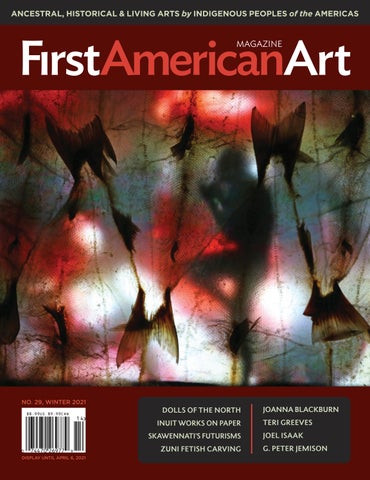
cover Joel Isaak (Kahtnuht'ana Dena'ina), Łuqa'ch'k'ezdelghayi Visions of Summer, 2016, fiveminute video loop projected through a salmon-skin screen, 24 × 38 × 3 in. Image courtesy of the artist.
Art+Lit 78 LeAnne Howe: Choctaw Nation Author, Playwright, and Educator By Matthew Ryan Smith, PhD Artwork by Kristin Gentry (Choctaw Nation)
54
Book Reviews
83
Exhibition Reviews
86
Report
92
IN MEMORIAM Anthony Gauthier 94 (Menominee/Ho-Chunk, 1942–2020) By America Meredith (Cherokee Nation)
60
Irving Toddy (Navajo, 1951–2020) By America Meredith (Cherokee Nation)
95
Kathy Wallace 96 (Hupa/Karuk/Yurok, 1946–2020) By Nanette Kelley (Osage/Cherokee Nation)
66
WINTER 2021 | 3
issue no. 29, winter 2021 ISSN 2333-5548 (Print) • ISSN 2333-5556 (Online) Publishing Editor: America Meredith (Cherokee Nation) Literary Editor: Matthew Ryan Smith, PhD (Euro-Canadian) Marketing Director: Barbara Harjo (Cherokee descent) Copy Editors: Jo Ann Reece, Rosa Cays (Chicana), and Staci Golar Proofreaders: Travis D. Day, Staci Golar, Jo Ann Reece, and Angela C. Villa (Chicana) Layout & Design: America Meredith (Cherokee Nation) Social Media: Staci Golar, Michelle J. Lanteri, America Meredith (Cherokee Nation), Jackie Sevier (Northern Arapaho), and Neebinnaukzhik Southall (Rama Chippewa)
Regional Representatives
Coe Center Art inspires, energizes, and challenges. Find hope in the creativity that surrounds us. Experience the Coe
Great Basin: Melissa Melero-Moose (Northern Paiute/Modoc) Great Plains: Jackie Sevier (Northern Arapaho) Northeast: Kelly Church (Odawa/Ojibwe/Potawatomi) Northwest: Miranda Belarde-Lewis, PhD (Zuni/Tlingit) Southeast: Michole Eldred (Catawba/Eastern Band Cherokee) Southwest: Holly Coonsis (Zuni) and RoseMary Diaz (Santa Clara Pueblo)
Editorial Advisory Board heather ahtone, PhD (Choctaw/Chickasaw) Roy Boney Jr. (Cherokee Nation) James T. Bialac, JD Cliff Fragua (Jemez Pueblo) Teri Greeves (Kiowa) Emily Haozous, PhD, RN (Chiricahua Fort Sill Apache) Linda Lomahaftewa, Hon. DHum (Hopi/Choctaw) Anya Montiel, PhD (Mestiza/Tohono O'odham descent) Jami Powell, PhD (Osage Nation) Mary Jo Watson, PhD (Seminole) India Rael Young, PhD
Advertising Representative Barbara Harjo (Cherokee descent), barbara@firstamericanartmagazine.com
Visit us virtually… Being together while being apart. coeartscenter.org
International distribution is by Disticor Magazine Distribution Services. First American Art Magazine, LLC, is not responsible for the content of any article or for the statements of any advertiser. First American Art Magazine welcomes queries about editorial submissions. The magazine is not responsible for unsolicited manuscripts, photographs, or artwork. Copyright ©2021 by First American Art Magazine, LLC. Cover and contents are fully protected by copyright and may not be reproduced in whole or part by any method without written permission, except those specific images listed with Creative Commons licenses. Any errors or omissions will be corrected in subsequent editions. First American Art Magazine® is registered with the US Patent and Trademark Office.
Questions About Subscriptions? For subscription services, changes of address, and wholesale inquiries: email circulation@firstamericanartmagazine.com or visit www.firstamericanartmagazine.com/subscriptions
Artist Unknown (Ojibwe), Child’s Leggings, c. 1880. NA1028.
Ralph T. Coe Center for the Arts
Coe Center 1590 B Pacheco Street, Santa Fe, NM 87505 info@coeartscenter.org • 505.983.6372
4 | WWW.FIRSTAMERICANARTMAGAZINE.COM
Letters Policy Letters to the editor are welcome and may be emailed to us at info@firstamericanartmagazine.com or mailed to: First American Art Magazine, Attention: Editor 3334 W. Main St. #442, Norman, OK 73072
www.firstamericanartmagazine.com Facebook: FirstAmericanArt info@firstamericanartmagazine.com Instagram: FirstAmArt ads@firstamericanartmagazine.com Twitter: FirstAmArt circulation@firstamericanartmagazine.com First American Art Magazine has been Papyrus font–free since 2013.
he’s not from around here, 2020, gouache on Arches watercolor paper, 6½ × 13 inches
benjamin harjo jr.
american indian artist | benjaminharjojr.
an ancestor visits, 2020, gouache on Arches watercolor paper, 7½ × 9 inches WINTER 2021 | 5
EDITOR'S GREETING In Defense of Land Acknowledgments
Y
OU ARE AT A CONFERENCE, and the welcoming speech includes a formal land acknowledgment. The speaker lists the Indigenous peoples who currently or once lived in the local city or perhaps entire state. You may wonder why one group was left out or why on earth another group was mentioned, pull out your smartphone, and begin scrolling through NAGPRA Notices of Intent to Repatriate of local sites to understand the connection. Then the first session begins, and the moderator reiterates the land acknowledgment. Then every single speaker begins their talk with that same statement. The next session follows suit, and this is repeated the second and third day. My initial encounters with land acknowledgments like this left me thinking they were bombastic, overblown, and insincere. Long-winded land acknowledgments are too often issued as if they were royal decrees. But at an Association of Tribal Libraries, Museums, and Archives conference, the (almost all Native) speakers briefly thanked the tribe whose lands we met on that day. Their sincere expressions of gratitude changed my mind, and I began incorporating brief acknowledgments into my own public speaking events. This morning I write to you from within the historical lands of the Wichita and Affiliated Tribes. This magazine is printed, trimmed, and bound within historical lands of the Arapaho, Cheyenne, and Ute. The acknowledgments or “welcomes to country” have been commonplace in Australia and New Zealand among Indigenous communities for centuries. The practice spread to Canada and is making its way south. In Spanish, the statement is known as reconocimiento de tierras. As the practice spreads, however, so do the backlashes and critiques. A CBC article with the dramatic headline, “‘I regret it’: Hayden King on writing Ryerson University's territorial acknowledgement” made the rounds last summer and is still circulating online. Hidden within the article was a statement by King (Beausoleil Ojibwe/Potawatomi): “Now, in other circumstances, where you’re in less privileged spaces and maybe the acknowledgment is just evolving for the first time, then it does have the power to compel a conversation. And that’s helpful.”1 Museums, colleges, and cultural nonprofits generate land acknowledgments, but outside of these, the statements remain rare throughout most of the Americas. I have assisted a few institutions with their land acknowledgments and feel it is important to consider the statement a working document. Community feedback is important, as is information about early tribes, which is not always easy to research. Some might want land acknowledgments to be a
feel-good activity, but the reality—particularly for the Caribbean and Eastern Woodlands—is that many tribal communities perished from disease, warfare, slavery, and displacement wrought by European colonists before being written about, and we simply do not know their names today. We may never know what they called themselves, but we can hold space for these peoples. Also, Native peoples traveled. The European or Asian model of peasants tied to the land, never to venture beyond their villages, does not carry over in the Americas. What time period do you trace? Do you try to trace them all? Is that even possible? A good place to start is native-land.ca, a volunteer project created by Victor G. Temprano, but you must follow up with your own research. The website clearly states: “This map is not perfect—it is a work in progress with tons of contributions from the community.” They will update their map if you furnish citations for your corrections; I’ve been able to do so. They tend to err on the side of making the territories much larger than they were, and that is difficult to correct.
1. Rosanna Deerchild, “‘I regret it’: Hayden King on writing Ryerson University’s territorial acknowledgment,” CBC Radio, January 18, 2019, web.
6 | WWW.FIRSTAMERICANARTMAGAZINE.COM
below America Meredith (Cherokee Nation), ᏧᏴᏢ ᎠᎹᏰᎵ, Tsuyvtlv Amayeli, 2008, watercolor, pen and ink on paper, 7 × 5 in., private collection. opposite America Meredith (Cherokee Nation), ᏧᎦᎾᏮ ᎠᎹᏰᎵ, Tsuganawv Amayeli, 2008, watercolor, pen and ink on paper, 7 × 5 in.
The maps in the Smithsonian’s series, The Handbook of South American Indians and The Handbook of North American Indians, are helpful; however, many of the maps are outdated, especially of South America, and should be viewed as starting points for further research. In Brazil, the Socio-Environmental Institute’s website, Povos Indígenas no Brasil (pib.socioambiental.org), is an invaluable tool available in Portuguese, Spanish, and English. Treaties can be good resources, particularly in Canada, but also come with caveats. In California, many treaties with tribes remain unratified. Lands ceded in treaties were not always the homelands of a particular tribe. For instance, in two 18th-century treaties with the British, the Cherokee ceded lands in Kentucky, although we never historically lived in Kentucky, which was Shawnee territory at the time. In the Prairies and Great Plains, access to horses dramatically changed lifeways and territories. Displaced by Europeans’ encroachment, disease, and warfare, several tribes entered
other tribes’ territories. For example, Osage people clashed with Wichita people in Eastern Oklahoma, then Cherokees encroached on Osage land and fought with them. Native people are aware of historical skirmishes, but this can be upsetting to non-Native people who might want to believe Indigenous peoples were historical pacifists. Any hint of violence destroys a picture of moral purity they have painted in their minds (though some tribes, such as the Hopi, are indeed people of peace). We understand that we are human beings, and being forced to clash for resources is different than unilaterally committing genocide for profit. Indian Removal must be addressed in the United States. The tribe whose homeland you might be on could now be in Kansas, Oklahoma, Texas, or elsewhere; it behooves you to research and not just name tribes currently nearby. People tend to gravitate toward familiar names of large tribes, but smaller tribes need to be acknowledged as well. Some people might want to use historical names for tribes that might sound more poetic to non-Native audiences, but sovereignty is better supported by using the current, official name of the tribe. The current year’s federal registrar that lists the federally recognized tribes is easily searchable online, and almost every tribe has its own website sharing a basic overview of its history. Institutions may phrase their land acknowledgment loosely and vaguely, when their locations sit squarely on current tribal lands (for instance, in Tulsa). In this case, that tribe should be acknowledged first by its current, official name. Google Maps has become a handy resource for reservation boundaries. While it is good to consult Native people in researching your land acknowledgment, particularly if you live in a region that forcibly removed local tribes, it is important to reach out to the tribes and First Nations themselves, rather than just individuals. Many Elders are busy and do not live to answer strangers’ emails. Tribal historic preservation officers and cultural centers are better equipped to educate the non-Native public. These histories are often complex and contested, but dialogue about Indigenous lands and history is valuable. Native people should feel empowered to respond to any errors and omissions in your land acknowledgment, and institutions need to listen. Educational and marketing departments of tribes could proactively reach out to organizations within their current, historical, and ancestral homelands to get their voices heard and forge alliances. While it is easy to bash land acknowledgments, they serve as educational tools, especially as they reach new audiences. Of course, the statements do not replace action; however, erasure is one of the fundamental challenges facing Indigenous peoples of the Americas today. By convincing non-Native people to think about Native people even briefly, land acknowledgments help push back against erasure and encourage place-based knowledge. As the Native Governance Center in Minneapolis states, “Starting somewhere is better than not trying at all.”2 —America Meredith (Cherokee Nation)
2. “A guide to Indigenous land acknowledgment,” Native Governance Center, web.
WINTER 2021 | 7