FırstAmericanArt MAGAZINE
A r t o f In dige n ou s Pe op l e s of t h e Am e r i c a s
No. 4, Fall 2014
Pilar Agoyo Cahuilla Basketry Troy Jackson Jagua Body Art Melissa Melero James Luna’s Archive Kevin Pourier The Challenges of Judging
Shan Goshorn www.shangoshorn.com
SWAIA Booth 511-SF Whitewashed, Arches watercolor paper splints, first printed with archival inks Collection of the Nordamerika Native Museum (NONAM), Zurich, Switzerland
Online Certificate Programs Now Available Business & Entrepreneurship Museum Studies Native American Art History On Campus Academic Programs: • • • • • •
Studio Arts Creative Writing Cinematic Arts and Technology Museum Studies Indigenous Liberal Studies Business and Entrepreneurship
About Us: • • • • •
15:1 Student/Teacher Ratio No out of state tuition fee 70+ Tribes Represented Over 60% Native American Faculty Accredited by the Higher Learning Commission and the National Association of Schools of Art and Design
“Empowering creativity and leadership in Native arts and cultures through higher education, lifelong learning, and outreach.” www.iaia.edu
83 Avan Nu Po Road, Santa Fe, NM 87508
800-804-6422
First American Art Magazine, LLC
KESHi
Issue No. 4, Fall 2014 ISSN 2333-5548 (Print) • ISSN 2333-5556 (Online)
thezuniconnection
Publisher Editor: America Meredith (Cherokee Nation) Marketing Director: Barbara Harjo (Cherokee descent) Circulation Manager: Robert Garcia (Mestizo) Copy Editor: Meghan Cunningham Proofreaders: Rebecca Hammer, Samonia Byford (Cherokee Nation), William Ferguson, Mary Ellen Meredith (Cherokee Nation) Layout and Design: America Meredith Editorial Consultants: Samonia Byford, Jean Merz-Edwards Editorial Advisory Board: Emily Haozous, PhD, RN (Chiricahua Fort Sill Apache) Maggie Ohnesorgen (Mestiza) Paula Rivera (Taos Pueblo) Mary Jo Watson, PhD (Seminole) Ken Williams Jr. (Northern Arapaho-Seneca) Advertising Representative: Barbara Harjo (Cherokee descent), Nancy Fields (Lumbee) Social Media: Jacquie Archambeau (Cherokee Nation), Staci Golar (Cornish-Welsh-American), America Meredith
227 don gaspar
Thanks to: Mark Bahti (Sami-American); Bruce Bernstein; Heidi Bigknife (Shawnee); Jeff Binion; Sean Campbell, Buffalo Bill Center 505.989.8728 of the West; Alan Camou; Leticia Chambers (Cherokee descent); keshi.com Kelly Church (Odawa-Ojibwe); Holly Coonsis (Zuni); Jon Davis, IAIA; Keesic Douglas (Mnjikaning Ojibwe); Chase Kawinhut Earles (Caddo Nation); Rosalie Favell (Métis); Susan Feller (Choctaw Nation), Ryan Flahive, IAIA; Reid Gómez (Navajo); Heather Gross; Franci King Hart; Boulder Opal Bear & Coral Fish: Gibbs Othole Benjamin Harjo Jr. (Shawnee-Seminole); William Johnson (Saginaw since 1981 fetishes jewelry pottery Chippewa), Ziibiwing Center; Stephen Lang; Tara Lasiloo (Zuni); Linda Lomahaftewa (Hopi-Choctaw); James Luna (Puyukitchum [Luiseño]); Tom May; Jessica Metcalfe (Turtle Mountain Chippewa), Beyond Summer ad Othole Opal Bear v2.indd 1 6/10/14 4:30 PM Buckskin; Linda Muzzy, Heard Museum; Denise Neil-Binion (DelawareCherokee); Jaq Nigg, Eiteljorg Museum; Sasha Noche (Zuni); Victor rctic and ndian arts Pascual (Navajo-Maya); Mike Patten (Cree); Valerie Pourier (Oglala st for the 21 century Lakota); Jenna Faye Powell, Forest City Gallery; Jaune Quick-to-See Smith (Sqelix’u-Métis-Shoshone); Tatiana Lomahaftewa Singer (Hopi26 Maine Street Choctaw); Michael Smith, Michael Smith Gallery; Michael Stoklos; Kelly Kennebunkport, Maine 207 967-2122 Waller; Marilyn Van Wrinkle, Autry National Center.
santa fe nm
A
I
Subscription services, changes of address, and wholesale inquiries: Email: circulation@firstamericanartmagazine.com Mail: First American Art Magazine, 1000 Cordova Place #843, Santa Fe, NM 87505. First American Art Magazine, LLC, is not responsible for the content of any article or for the statements of any advertiser. First American Art Magazine welcomes queries about editorial submissions. The magazine is not responsible for unsolicited manuscripts, photographs, or artwork. First American Art Magazine 1000 Cordova Pl. #843 Santa Fe, NM 87505 www.firstamericanartmagazine.com info@firstamericanartmagazine.com ads@firstamericanartmagazine.com circulation@firstamericanartmagazine.com
Floral inlay buffalo horn Kevin Pourier
Sculpture | Prints | Jewelry |Beadwork |Baskets shop online: www.homeandawaygallery.com
2 | W W W.F I R S TAM E R IC AN ARTMAG A ZI N E.C OM
Copyright © 2014 by First American Art Magazine, LLC. Cover and contents are fully protected by copyright and may not be reproduced in whole or part by any method without written permission, except those specific images listed with Creative Commons licenses. All reasonable efforts have been made to identify and contact copyright holders but in some cases these could not be traced. If you hold or administer rights for materials published here, please contact us. Any errors or omissions will be corrected in subsequent editions. First American Art Magazine is a Papyrus font-free publication.
EXPERIENCE
LIVING
CULTURE
WWW.C H I C KASAWCU LT U RALCE NT E R.CO M SULPHUR, OK • 580.622.7130
FAL L 2 0 1 4
| 3
JackieChessney Sevier andSevier w
2014 Show Schedule for Jackie Sevier A Gathering of People, Wind, and Water Rapid City, SD July 19th
Santa Fe Indian Market Booth 715LIN_W Northern Plains Indian Art Market Sioux Falls, SD Sept. 20-21
w
Cherokee Indian Art Market Tulsa, OK Oct. 11-12
Nathalie’s of Santa Fe Canyon Road, Aug. 22
2014 Show Schedule for Chessney Sevier Santa Fe Indian Market, Booth 236PAL_S Nathalie’s of Santa Fe, Canyon Road, Aug. 22
4 | W W W.F I R S TAM E R IC AN ARTMAG A ZI N E.C OM
BABE & CARLA HEMLOCK Mohawks of the Eastern Woodlands
“Continuing the Legacy,” Best Of Class Diverse Arts SWAIA 2013
SWAIA Booth #744 LIN-W Stop by to see our new work to be presented at Santa Fe Indian Market FAL L 2 0 1 4
| 5
6 | W W W.F I R S TAM E R IC AN ARTMAG A ZI N E.C OM
The Ralph T. Coe Foundation Presents: Plain and Fancy:
Native American Splint Baskets and Beyond... originally exhibited at the Fenimore Art Museum, Cooperstown, NY Curated by Bruce Bernstein and Eva Fognell Opens at the Ralph T. Coe Foundation for the Arts, August 19, 2-6 pm with a panel discussion at 3 pm—Kelly Church, Grand Traverse Band of Ottawa and Ojibwe; Theresa Secord, Penobscot; and Ronnie-Leigh Goeman, Onondaga Nation/Eel Clan
Ralph T. Coe Foundation for the Arts Aspen Plaza 1590 B Pacheco Street Santa Fe, New Mexico 87505 Tel. (505) 983-6372 www.ralphtcoefoundation.org
N AT H A N HART
mapel burl 16.00” h x 20.25” dia
Santa Fe Indian Market Lincoln Avenue, Booth 785 LIN-W
nathanhartstudio.com t: 405.820.4267
FAL L 2 0 1 4
| 7
8 | W W W.F I R S TAM E R IC AN ARTMAG A ZI N E.C OM
FAL L 2 0 1 4
| 9
10 | W W W.F IR S TAM E RI C AN ARTMAG A ZI N E.C OM
Carla Hemlock Mohawk of the Eastern Woodlands
SWAIA Booth #744 LIN-W New Series of Quilts to be showcased at the Santa Fe Indian Market carlahemlock@hotmail.com “Survivors,” Despite Everything We Have Been Through We Are Still Here, 76” x 76”
Sheridan MacKnight
Chippewa/Lakota
paintings & jewelry In Santa Fe: new paintings at the historic Morning Star Gallery at 513 Canyon Road and jewelry at studio by appointment: www.sheridanmacknight.com • 310.488.1796
A HOLIDAY TRADITION Enjoy a Weekend of Fun, Food and Culture During the 62nd Annual Cherokee National Holiday
DILIGWA 1710 CHEROKEE VILLAGE Discover a place where authentic Cherokee fashion never goes out of style at Diligwa – a Cherokee village depicting life during the early 18th Century.
$2 DILIGWA ENTRANCE FEE
62nd CHEROKEE NATIONAL HOLIDAY Food trucks, live entertainment and a wide variety of arts and crafts await all visitors to the Cherokee Heritage Center this year over Labor Day Weekend. Enjoy and celebrate Cherokee National Holiday with the Heritage Center.
CHEROKEE HOMECOMING ART SHOW & SALE Beat the heat during the Cherokee National Holiday inside the Cherokee Heritage Center where you will discover nearly 150 pieces of traditional and contemporary Cherokee artworks, all available for purchase. 2013 Grand Prize Winner “Trading Post Days” by Virginia Stroud
21192 S KEELER DR, PARK HILL , OK 74451 (888) 999-60 07 • CHEROKEEHERITAGE.ORG
ISSUE NO. 4, FALL 2014 FEATURES
26
Cahuilla Basketry: An Enduring Legacy Bryn Barabas Potter
50
Let It Sink In: The Art of Jagua Vanessa Elmore (Colombian-American)
64
Sharing His Legacy: James Luna Donates His Archives to IAIA Kim Baca (Diné-Santa Clara Pueblo)
70
Recent Developments
20
Seven Directions 22 Tania Willard (Secwepemc Nation)
32
OPINION The Challenges of Judging Native Art America Meredith (Cherokee Nation)
DEPARTMENTS
60
ARTIST PROFILES Pilar Agoyo (Ohkay Owingeh-CochitiKewa Pueblos) RoseMary Diaz (Tewa)
26
Troy Jackson (Cherokee Nation) Roy Boney Jr. (Cherokee Nation)
32
Melissa Melero (Northern Paiute-Modoc) Jean Merz-Edwards
38
Exploring Native Graphic Design The Making of a Designer: Mark Rutledge (Little Grand Rapids Ojibwe) Neebinnaukzhik Southall (Rama Chippewa)
24
Art + Lit Laura Da’ (Eastern Shawnee) Heidi Bigknife (Shawnee Tribe)
76
In Memoriam Alex Seowtewa (Zuni) America Meredith (Cherokee Nation)
78
Frank Sheridan (Southern Cheyenne) Teri Greeves (Kiowa)
79
REVIEWS 38
Art Exhibition Reviews
74
Book Reviews
84
Video Art Review Kevin
87
Kevin Pourier (Oglala Lakota) 44 Mary Bordeaux (Sicangu-Oglala Lakota)
44
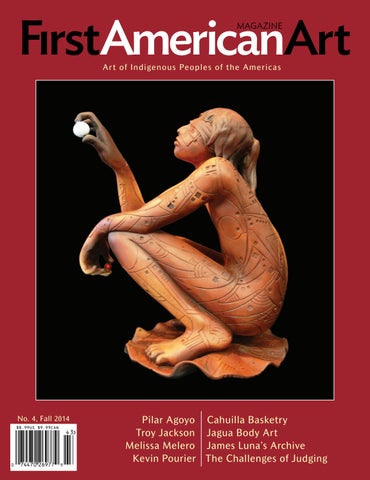
COVER: Troy Jackson (Cherokee Nation), Halfbreed: Am I Red and White or Am I White and Red, 2011, clay, 22 x 10 x 14 in. Image courtesy of the artist. Besides the overt racial symbolism in the art, red and white marbles were historically used by Southeastern tribes to divine the future—red typically denoted warfare, while white denoted peace.
FALL 2 0 1 4
| 15
Editor’s Greetings …The true artist: draws out all from his heart works with delight, makes things with calm, with sagacity, works like a true Toltec, composes his objects, works dexterously, invents arranges material, adorns them, makes them adjust. The carrion artist: works at random, sneers at the people, makes things opaque, brushes across the surface of the face of things works without care, defrauds people, is a thief. —Nahuatl poem from the Florentine Codex, fol. 115, v. (208)1
T
HIS SNIPPET of a 16thcentury Nahuatl poem reminds us that Indigenous peoples have been studying our art and artists for a long time. First American Art Magazine is honored to contribute to this legacy. The Native American art world and its many supporters deserve serious art writing, willing to go below the surface and explore. I read coverage of Native art on a daily basis and am astounded by how formulaic the articles can be. Writers frequently state the assumption that the audience is utterly unfamiliar with Indigenous art. Many articles begin with the trope, “Most people think Native American art is just beads and feathers [or fill in the stereotypes], but these artists are different...” Personally,
I’m tired of writing that always begins at Square One and never move beyond it. Here at First American Art Magazine, we believe that you, our reader, are knowledgeable about Native art, and if not—if you are new to the subject—we have every confidence that you possess a lively curiosity and are a quick study. It’s been fascinating following Native art scholars articulating Indigenous art theory. We hope First American Art Magazine provides primary research from which to draw. I believe one of the key components of approaching art from an Indigenous viewpoint is acknowledging art as a living entity. At a recent School of Advanced Research panel, every single artist—even though they worked in different media and came from different tribes—separately described her or his art as alive. I find the sentiment echoed across national boundaries by different Native artists. What does this mean? The art has intrinsic qualities and meanings independent of the audience, and sometimes even of the artist. Simply by its existence, art has agency to shift reality. In reception theory, the audience activates meaning within the artwork. However, if the art is alive, it creates its own meaning. Many Native artists describe themselves as conduits rather than creators of art. Seeing the art in this light, the audience might glean meaning from the work beyond what the artist consciously intended. Often the cultural context illuminates meaning between the artists and the audience; however, due to historic forces, the cultural context surrounding a tribe’s art is often not be widely known. The art can be seen as a living seed that grows the cultural context.
America Meredith (Cherokee Nation), Walela, 2014, acrylic on hardboard panel, 12 x 12 in.
First American Art Magazine wishes the best for the Native artists and art lovers this season and hopes these living seeds provide fruitful and plentiful nourishment to enhance all of our lives. —America Meredith
1. Miguel León Portilla, editor, Native Mesoamerican Spirituality: Ancient Myths, Discourses, Stories, Doctrines, Hymns, Poems from the Aztec, Yucatec, Quiche-Maya and Other Sacred Traditions (Mahwah, NJ: Paulist Press, 1980), 208.
16 | W W W.F IR S TAM E RI C AN ARTMAG A ZI N E.C OM
Letters to FAAM Art and Tribal Languages
Ꭳ
ᏏᏲ HELLO. I just want to say an ᎡᏆ ᏩᏙ a BIG THANK YOU for sending my four editions of the First American Art Magazines. Wow! It is super-sensational. I love it; every issue is spectacular! I love America Meredith’s work. The summer 2014 edition, page 5, Point and Shoot: Julia Tuell and Company is brilliant. What a painting! Thank God that I am on your mailing list because I am so getting your next edition. Also I want to thank America for her artwork that has Cherokee letters; it has been so beneficial to me. All the very best to everyone at First American Art Magazine. Sandra Beasley Cleveland, OH ᎰᏩ, ᎩᎾᎵᎢ. Thank you for the kind praise. We encourage the use of our tribal languages throughout the magazine. Julia Tuell (1886– 1960) was a European-American schoolteacher who taught on several reservations, notably the northern Cheyenne. She photographed Native Americans, and her work is characterized by its intimacy and casual style. For instance, her portrait of the mighty Oglala Lakota warrior and chief American Horse shows him holding a baby and grinning.
Wixáritari Yarn Painting
W
E HAVE ADMIRED THE ARTWORK in Kevin Simpson’s galleries in Puerto Vallarta, Jalisco, for many years. We have collected many things we treasure, and we have become good friends with Kevin and his family. But even after all the years, I must admit that in his article in First American Art Magazine I learned things about these Huichol arts and the people who practice them that I had never heard before from Kevin. The article was a wonderful and educational work. Kevin was able to put so much of what he has learned from the people themselves over the years into print. First American Art Magazine gave him that opportunity, and it gave us the opportunity to learn from him. Thank you so much for so many wonderful educational articles like this one. Keep up the good work! Beth and Peter Shumway Santa Fe, NM We welcome letters to the editor! Please email info@firstamericanartmagazine.com ormail letters to: First American Art Magazine, Attention: Editor 1000 Cordova Place, #843, Santa Fe, NM 87505
FALL 2 0 1 4
| 17
Contributing Writers ROSEMARY DIAZ KIM BACA (Diné-Santa Clara Pueblo) is a marketing and
(Tewa) is a freelance feature writer based in Santa Fe, New Mexico. She is the author of an original online series, Native Foodways: New Seasons, for Indian Country Today Media Network, and is still engaged in the writing of her study/memoir on historic trauma, entitled The Diaries of Sunshine YellowStar: Entries from Zarzamine. RoseMary studied literature and its respective arts at the Institute of American Indian Arts, Naropa University, and University of California, Santa Cruz.
GLORIA BELL (Métis) is a writer and researcher based in
VANESSA ELMORE (Colombian-American) is a
communications consultant and a former newspaper and wire service reporter for regional and national news organizations, including the Santa Fe New Mexican and the Associated Press. Vancouver, British Columbia. She earned her master’s degree in art history from Carleton University. She has served most recently as the web editor for the Aboriginal Curatorial Collective and also as an intern at the School of Advanced Research. Her research interests include First Nations and Aboriginal histories and art practices, as well as debates surrounding the term “indigeneity” within the global art world. Bell has heritage ties to the Métis at Red River Settlement and Cree in James Bay.
ROY BONEY JR. (Cherokee Nation) is an award-winning
artist and writer. He holds a bachelor’s degree in graphic design and a master’s degree in studio art. Working in a variety of forms including comic books, paintings, drawings, and digital media, Boney focuses heavily on Cherokee culture and language in his art. He is currently the manager of the Cherokee Language Program at Cherokee Nation.
MARY BORDEAUX (Sicangu Lakota/Oglala Lakota) is the
museum curator and cultural coordinator for the Crazy Horse Memorial Foundation in Custer, South Dakota. She served as interim director, curator, and collections manager at the Heritage Center at Red Cloud Indian School in Pine Ridge. In 2009, she earned her MFA in museum exhibition planning and design from the University of the Arts in Philadelphia, Pennsylvania. She earned both her associate’s and bachelor’s degrees in museology/ museum studies from the Institute of American Indian Arts.
KELLY CHURCH (Grand Traverse Odawa-Ojibwe) is a
fifth-generation black ash basket weaver from Michigan. Her cousin John Pigeon and her father Bill Church taught her how to harvest, process, and weave black ash. She collaborates with her daughter Cherish Parrish in basket weaving and birch bark biting. Church earned her bachelor of fine arts degree from the University of Michigan in Ann Arbor. She is an outspoken activist and educator focused saving the black ash tree from the emerald art borer.
LAUREN DA’ (Eastern Shawnee) is a poet and a public
school teacher. A lifetime resident of the Pacific Northwest, Da’ studied creative writing at the University of Washington and the Institute of American Indian Arts. Da’ has published poems in Prairie Schooner, Hanging Loose, The Iowa Review, and elsewhere. Her first chapbook, The Tecumseh Motel, will soon be published in Effigies II. In 2013, she was nominated for a Pushcart Prize and selected as one of Sherman Alexie’s top ten Native American poets. Da’ lives near Seattle with her husband and son. 18 | W W W.F IR S TAM E RI C AN ARTMAG A ZI N E.C OM
professional freelance writer/researcher, art consultant, and fine art appraiser specializing in the arts of the Americas. She holds a master of arts degree in art history from the University of New Mexico and is a current member of the International Society of Appraisers. For the last 16 years, Elmore has handled both antique and contemporary Native American arts at the finest art galleries in Santa Fe, first at Morning Star Gallery and now at Blue Rain Gallery.
SUZANNE NEWMAN FRICKE, PhD (Ashkenazic-
American), completed her doctorate in art history, with an emphasis on 20th-century Native American pottery, at the University of New Mexico in 2003. For the past 20 years, she has taught art history at the University of New Mexico, IAIA, Santa Fe University of Art and Design, and Central New Mexico Community College. In 2012, she curated the exhibit Octopus Dreams, which traveled throughout Russia and to 516 Arts Gallery in Albuquerque. As We See It: Photography by Contemporary Native American Artists, curated by Fricke, opens at the Yekaterinburg Museum of Fine Arts in August then travels to the Novosibirsk State Museum of Art in October.
TERI GREEVES (Kiowa) is a beadwork artist who grew up
on the Wind River Reservation in Wyoming. Greeves graduated from the University of California, Santa Cruz, with a degree in American studies. Her work‚ which is in the National Museum of the American Indian, the British Museum, the Museum of Art and Design, and other major collections, combines Kiowa oral history with her personal and family experiences.
THOLLEM MCDONAS is a peripatetic pianist/
keyboardist/vocalist, serial collaborator, activist, educator, and author. He has released over 35 albums of his own and in collaboration with others on 16 different vanguard labels. As an author he has contributed articles to Anthology of Essays on Deep Listening, Entasis, and Full Moon Magazine.
RHONDA MEIER is an independent curator, writer, and educator based in Montreal. Beginning with her MA work at Concordia University, she has largely devoted her practice to understanding racism and achieving decolonization. She is an active board member at Articule, an artist-run center.
JEAN MERZ-EDWARDS has been studying and teaching art history since 2000 when she attended her first art history classes at Hunter College in New York. Recently, her studies include earning a master’s degree in art history from the University of Oklahoma where Jean was awarded a certificate in women’s and gender studies and the Alice Mary Robertson
KERI ATAUMBI WEARABLE METALS
Photo by Eric Swanson
SWAIA Indian Market Booth #125POG WWW.ATAUMBI.COM
Award for her scholarship on the life and art of Hopi-Choctaw Linda Lomahaftewa. This fall, Jean looks forward to returning to the classroom where she will be teaching art history and English at Kansas Wesleyan University in Salina, Kansas.
ALEX J. PEÑA (Comanche/San Ildefonso/Pawnee) is a professional artist who has exhibited throughout the United States and in group shows in Europe and Asia. He received his MFA in studio arts and printmaking from the University of Wisconsin, Madison. Peña currently resides in Santa Fe and teaches at the Institute of American Indian Arts.
BRYN BARABAS POTTER (Hungarian-Irish-GermanAmerican) is the adjunct curator of anthropology at the Riverside Metropolitan Museum, where she is working with many Native consultants on the exhibition Cahuilla Continuum: Tuku, Ivax, Tuleka. As curator of basketry of the Southwest Museum of the American Indian/Autry National Center, she exhibited the Juana Apapas baskets, and, working with Carrie Garcia on a loan, drove them home for a visit. As BBP Museum Consulting, Potter collaborates with tribes and institutions primarily on basketry projects. She has a BA and MA from California State University, Northridge, and is a resident fellow at the Buffalo Bill Center of the West, Cody, Wyoming, from 2013 to 2015.
NEEBINNAUKZHIK SOUTHALL (Chippewas of
Rama First Nation) is a graphic designer and an artist, working in a variety of media such as photography, body painting, and threedimensional art, at Neebin Studios. At Oregon State University, she graduated magna cum laude in 2011, earning an honors BFA through the University Honors College and OSU’s competitive graphic design program, with a minor in fine arts. Southall now works at the Wheelwright Museum of the American Indian, where she photographs, designs, and manages media.
MATTHEW RYAN SMITH, PhD, is a freelance writer,
independent curator, and sessional professor at the OCAD University. Currently based in Toronto, Smith’s writings have appeared in several Canadian and international art publications including Canadian Art Magazine, C Magazine, FUSE Magazine, and Afterimage, in addition to academic journals and exhibition catalogues. His current research focuses on unorthodox autobiographies in visual art practice. Somewhere between her Alaskan home, her New York college education, and peace riots in La Paz, Bolivia, INDIA YOUNG decided art best expresses activism. She returned to school to learn the practice of sharing her passions. Today she is a doctoral candidate in art history at the University of New Mexico and an independent curator. Young researches print media, contemporary Indigenous arts, and activist art. Her curatorial pursuits focus on the spaces of interconnection between Indigenous arts and the larger world. FALL 2 0 1 4
| 19
Recent Developments MUSEUMS The Inuit Art Foundation (IAF) is raising funds to build the Cape Dorset Arts and Cultural Centre in Canada. The proposed center will include print studios and an exhibition space. The IAF hopes to begin construction in the summer of 2015 and have the center open by 2016. The Minneapolis Institute of Arts in Minnesota hired Jill Ahlberg Yohe, PhD, as assistant curator of Native American art. Yohe earned her doctorate in cultural anthropology from the University of New Mexico in 2008 and was assistant curator and the Mellon Fellow in Native American Art at Saint Louis Art Museum. Candace Hopkins (Tagish) is the new interim curator of the Museum of Contemporary Native Arts (MoCNA). Hopkins is an independent curator and writer, who has curated at the National Gallery of Canada, the Western Front, and the Walter Phillips Gallery, and the Banff Centre. Hopkins earned her MA from the Center for Curatorial Studies, Bard College in Annandale-on-Hudson, New York.
ART FAIRS The Grand Award winner of the 2014 Red Earth Festival in Oklahoma City, Oklahoma, was Chase Kahwinhut Earles (Caddo Nation). Nelda Schrupp (Pheasant Rump Nakota) won the President’s Award, and Karin Walkingstick (Cherokee Nation) won the Kathleen Everett Upshaw Award. The division winners were Mary Aitson, basketry; Connie Hart Yellowman, beadwork; Tahnee Ahtone Harjo Growing Thunder, textiles; Jim Van Deman, utilitarian cultural items; Anita Caldwell Jackson, diversified cultural items; Linda Kukuk, drawings and graphics; Nelson Garcia, contemporary jewelry; Ray O. Garcia, traditional jewelry; Matt
Bearden, oil/acrylic painting; Gilmore Scott, water-based painting; Lester Harragarra, photography; Jeri Redcorn, traditional pottery; Mel Cornshucker, contemporary pottery; and Troy Anderson, sculpture. The Best of Show winners of the 2014 Eiteljorg Indian Market & Festival in Indianapolis, Indiana, were Ronni Leigh Goeman (Onondaga) and Stonehorse Goeman (Seneca). The Goemans and Antonio Grant (Eastern Band Cherokee-Navajo) won Harrison Eiteljorg Purchase Awards. Division winners were Jodi M. Webster (HoChunk Nation-Potawatomi) for twodimensional arts; Ryan Gashweseoma (Hopi) for sculpture; Gerry Quotskuyva (Hopi) for carvings/dolls; Brian Szabo (Sicangu Lakota); Delmar Polacca (Hopi-Tewa) for pottery; Ronnie Leigh and Stonehorse Goeman for basketry; Florence Manygoats (Navajo) for textiles; Antonio Grant for cultural items; Sho Sho Esquiro (Kaska Dena) for beadwork; and Ronni Leigh and Stonehorse Goeman for collaboration. Juniper Anderson (Navajo-Ho-Chunk) won the Margot L. Eccles Youth Award.
ART SHOWS Grand Prize winner at the 43rd annual Trail of Tears Art Show was Troy Jackson (Cherokee Nation). Division winners were Kenny Henson, painting; Jane Osti, sculpture; Vivian GarnerCottrell, basketry; Kristie Vann, Trail of Tears theme; Joseph Erb, jewelry; Hillary Glass, graphics; and Merlin Little Thunder, miniatures. Jane Osti won the Bill Rabbit Legacy Award, and Karin Walkingstick won the emerging artist award. The Trail of Tears Art Show is hosted by the Cherokee Heritage Center in Park Hill, Oklahoma.
PROJECTS An interactive site-specific installation, The Tipi Project, was established in Havemeyer Park, Brooklyn, New York.
20 | W W W.F IR S TAM E RI C AN ARTMAG A ZI N E.C OM
A collaboration between Native and non-Native organizers, The Tipi Project features a 30-foot-tall tipi, around which events and youth workshops are organized throughout the summer.
AWARDS AND SCHOLARSHIPS Christi Belcourt (Métis) received the 2014 Ontario Arts Council Aboriginal Arts Award. The council created the $10,000 annual award in 2012 to recognize contributions made by local Aboriginal artists and arts leaders. Belcourt is both an accomplished painter and the lead organizer of Walking with Our Sisters, a commemorative art installation for the missing and murdered Indigenous women that is scheduled to travel throughout Canada and the United States through 2018. The OAC asked Belcourt to select a recipient for its emerging artists award. She chose Jaime Koebel (Cree-Métis), a dancer and visual artist working in a variety of media, including fish scales. The 2014 Rasmuson Foundation Fellows include David Galanin (Tlingit) from Sitka; Nicholas Galanin (Tlingit-Aleut) from Sitka; and George Demientieff Holly (Deg Hit’an Athabascan) from Soldotna. The Fellowship includes a $50,000 honorarium. Everett Athorp of Klawock, Jerrod Galanin of Sitka, and Kristina Cranston of Haines received 2014 Project Awards. Based in Anchorage, Alaska, the Rasmuson Foundation is a private foundation established to promote Alaskan artists. Nadia Myre (Kitigan Zibi Algonquian), an interdisciplinary artist from Montreal, Quebec, is one of five artists chosen for the 2014 Sobey Art Award shortlist. One of the five will win the $50,000 award, to be announced November 19th, with the four runners-up winning $10,000. The Sobey Award, funded by the Sobey Art Foundation and administered by the Art Gallery of Nova Scotia, is awarded to exhibiting contemporary Canadian artists.
legal challenges by both tribes, the US Embassy, and Survival International. The French Conseil des Ventes (Board of Sales) ruled that American Indian tribes do not have legal standing in France. The Hopi Tribe believes the items to be stolen, while the French courts maintain a French collector legally acquired them. The Holocaust Art Restitution Project denounced the French government’s decision to allow the auction and said this contradicts France’s signing of the 2007 United Nations Declaration on the Rights of Indigenous Peoples (UNDRIP). Only nine of the 29 items sold.
Red Earth 2014 Grand Award winner: Chase Kawinhut Earles (Caddo Nation), Kahwis Bahateno (Red River Bowl), 2013, pit-fired Red River clay with mussel-shell temper, 13 x 24 in. Image courtesy of the artist.
The Colombian Ministry of Culture is offering a grant of 46,455,000 Colombian pesos (US$25,000) for cultural programs serving Indigenous youth, from babies to three years. The ministry wants to encourage childcare that teaches Indigenous language and ethnic identity.
SCHOOLS Dartmouth College is partnering with IAIA to offer Native American studies courses in Santa Fe, New Mexico. This off-campus program, which will include Native American art classes, will begin in 2015. The Native American art collection of the late Lois Nelson Miller was donated to Bacone College in Muskogee, Oklahoma, by her family. The 88-piece collection spans much of the 20th century and will be housed in Ataloa Lodge, Bacone College’s art museum. Founded in 1932, Ataloa Lodge is undergoing a major renovation and conservation effort. Ryan Rice (Mohawk) has been hired as the Chair of the Indigenous Visual Cultural Program at the Ontario College of Art & Design, in Toronto.
REPATRIATION After 16 years of legal battles and protests, Kueka, the sacred stone of the Pemon people, will be returned to them. The 30-ton rose and grey sandstone boulder is known as “Grandmother” to the Pemon of the Great Savanna region of southeastern Venezuela. In 1998 German artist Wolfgang von Schwarzenfeld removed the monolith from Canaima National Park, with permission, the artist claims, from the former Venezuelan president Rafael Caldera. The Pemon and their representatives maintain that their cultural patrimony cannot be legally removed by outsiders. Kueka was installed in Berlin as part of the Global Stone Project, which features stones from five continents. The German attorney general’s office received petitions with over 13,000 signatures calling for Kueka’s return to Venezuela.
LEGAL ISSUES June 27th marked the fourth sale of American Indian religious items by Parisian auction houses in the last year and a half. Twenty-nine Hopi and Navajo sacred items were put up for auction by Auction House Eve, despite
The Bureau of Land Management reports an increase in vandalism of Native American rock art in the Grand Slope of western Colorado. On May 10th, San Juan County Commissioner Phil Lyman and Ryan Bundy, son of controversial rancher Cliven Bundy, led a protest ride of ATVs through Recapture Canyon in southeastern Utah. The National Congress of American Indians and the Hopi Cultural Preservation Office both condemned this unlawful ride. The US Bureau of Land Management outlawed motorized vehicles in the canyon in 2007 when an illegal trail damaged Ancestral Pueblo sites. The canyon contains Ancestral Pueblo cliff dwellings dating between 750 and 1150 CE and is legally accessible by foot or horseback.
PRECONTACT SITES Poverty Point, an archaic settlement dating back to 1650 BCE in West Carroll Parish, Louisiana, was declared a UNESCO World Heritage Site on June 22nd. Of the 1,001 sites designated by UNESCO, only 22 are in the United States, and Poverty Point is the first in Louisiana. The settlement consists of six concentric semi-circular earthen ridges surrounding a central plaza, and platform, conical, and effigy mounds. A sixth mound, dating from 1280 BCE, was recently discovered by archaeologist Diana Greenlee. FALL 2 0 1 4
| 21