SizeUp
©
Summer/Fall 2026
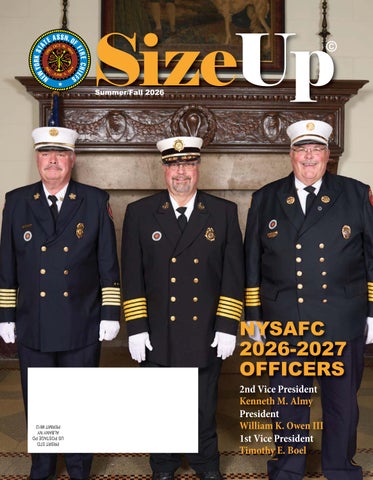
NYSAFC 2026-2027 OFFICERS 2nd Vice President Kenneth M. Almy President William K. Owen III 1st Vice President Timothy E. Boel
PRSRT STD US POSTAGE PD ALBANY NY PERMIT #812
2
SizeUp SUMMER/FALL 2026
SizeUp
© Size Up is an official publication of the New York State Association of Fire Chiefs.
Summer/Fall 2026
Contents Departments 5 Index of Advertisers 6 The President’s View 7 From the Chief Executive Officer 8 From the Chaplains’ Study 10 NYSAFC News 14 The View From the Hill 22 NYSAFC 120th Annual Conference & FIRE 2026 Expo Highlights
32 NYSAFC Hands-On Training at the FDNY Training Academy
34 The Roster 38 Leading From the Front Seat
Features 16
The First Five Minutes Tell the Story
20
Charting the Course: Why Self-Analysis is Critical for the Future Fire Service
30
The Moment It Clicked
NEW YORK STATE ASSOCIATION OF FIRE CHIEFS 1670 Columbia Turnpike P.O. Box 328 East Schodack, NY 12063-0328 Phone: (518) 477-2631 • (800) 676-FIRE Fax: (518) 477-4430 www.nysfirechiefs.com
ASSOCIATION STAFF Bruce E. Heberer – Chief Executive Officer Oksana Franklin – Treasurer Mary K. Hanlon – Communications Coordinator Catherine E. Hannigan – Administrative Assistant Paul C. Melfi – Hands-On Training Coordinator Susan R. Revoir – Conferences/Education Coordinator Jeremy S. Rodd – New York Fire Book Store Manager ASSOCIATION OFFICERS Chief William K. Owen III – President Chief Timothy E. Boel – 1st Vice President Chief Kenneth M. Almy – 2nd Vice President Chief Richard L. Lyman – Past President ASSOCIATION DIRECTORS Chief Brad W. Davies Deputy Fire Coordinator Anthony D. Faso Chief Wayne C. Friedman Chief George P. June Chief Kevin O. Kalk Chief Charles Kostyk Chief Dale G. Lingenfelter Chief Nicholas Luparella III Chief Stefano Napolitano Chief Richard M. Nemier Chief Anthony J. Tripp EDITORIAL SUBMISSIONS Contact: Size Up Editor Mary Hanlon Email: editorial@nysfirechiefs.com PUBLISHED BY
Frank C. Trotta - Publisher Tim Edwards - Executive Editor Barbara Connolly - Vice President National Sales Patti Niebling - Special Projects Coordinator Gregory Jones - Art Director To advertise in Size Up contact Barbara Connolly at (631) 776-1853 COVER PHOTO Wainwright Photo
SizeUp SUMMER/FALL 2026
© 2026 all rights reserved. The contents of this publication may not be reproduced by any means, in whole or in part, without the prior written consent of NYSAFC and Fire News.
3
YOUR SUPPORT MAKES A DIFFERENCE!
RESERVE YOUR SPACE
9/11
Anniv ersary
EDITION
This commemorative issue is being produced to honor the lives lost on September 11, 2001 and will include events and tributes taking place this year. It is expected to be released by October 31, 2026. Your advertisement can make a difference.
REME MBRA NC E REFLAND ECTIO NS 200 1-202
1
PROFITS FROM THIS ISSUE WILL BENEFIT: ◆ Lt. Joseph P. DiBernardo Foundation ◆ Terry Farrell Firefighters Fund ◆ FealGood Foundation ◆ The Billy Moon Foundation ◆ Johnny Mac Foundation
◆ Kidneys for First Responders ◆ National Fallen Firefighters Foundation ◆ Firefighter Cancer Support Network ◆ Nassau County 9/11 Fire Service Memorial
◆ Phoenix Society for Burn Survivors ◆ Firefighter Cancer Awareness & Mentoring Program of NYS ◆ Lt. Michael P. Murphy Navy Seal Museum
Contact Barbara Connolly (631) 776-1853 • Email:Barbara@FireNews.com
Profits From This Issue Will Benefit the Above Charities 4
SizeUp SUMMER/FALL 2026
INDEX OF ADVERTISERS Access Compliance .......................31 www.accesscompliance.net
Fire News ..........................................4 www.firenews.com
AT&T FirstNet ...................................9 www.firstnet.com
Frank G. Relf Architect PC ............21 www.fgrelf.com
Auctions International, Inc. ...........36 www.auctionsinternational.com
H2M Group ........................................9 www.h2m.com
Bauer Compressors, Inc................40 www.bauercomp.com
Husky Portable Containment ..........4 www.huskyportable.com
Certified Ambulance Group...........29 www.certambgroup.com
IAFC ...................................................5 www.iafc.org
Draper Asset Management ............37 www.draperasset.com
Liberty Art Works .............................2 www.libertyartworks.com
Fire Hooks Unlimited, Inc. .............29 www.firehookssunlimited.net
National Foam.................................36 www.nationalfoam.com
Fire Innovations..............................19 www.fireinnovations.com
Paul Congelosi Sales, Inc..............19 www.congelositrailersales.com
SizeUp SUMMER/FALL 2026
RBC Wealth Management The LOSAP Group..........................21 www.rbcwealthmanagement.com Signal 5 Fire Apparatus .................29 www.signal5fireapparatus.com Specialty Ambulance .....................11 www.specialtyambulance.com Tele-Lite, Inc....................................36 https://tele-lite.com Traffic Systems Incorporated........39 www.trafficsystemsinc.com VFIS-Glatfelter Insurance Group...11 www.vfis.com W & E Phillips Locksmith ..............29 www.phillipslock.com Wendel/Five Bugles Design ............2 www.wendelcompanies.com
5
THE PRESIDENT’S VIEW
Honoring the Past, Shaping the Future Chief William K. Owen III, NYSAFC President
A
s I begin my journey as president of the New York State Association of Fire Chiefs, I’d like to thank you, our members, for your confidence in me. It is a great honor to serve. This association has been a significant part of my life ever since I joined the fire service in 1976 as a junior member of the Stittville Fire Department. As I’m sure is the case with many of you, the fire service has been a family tradition. My father, Bill, also led my home department as chief, was president of the Oneida County Fire Chiefs Association, and served as president of NYSAFC. He instilled in me the importance of serving my community, my county, and the fire/EMS providers in New York state, and I am committed to upholding the mission of our association. My father was also a leader of our Conference Committee, and I remember attending our event back when it was held at the famous Concord Hotel. Times have changed since the conference moved from the Catskills in the late 1990s, and so has the fire service. While the conference remains a cornerstone of our association, it too has evolved over the past three decades. With our responsibility to provide education to the leaders and future leaders of our EMS and fire service, we’ve grown our conference to include a variety of high-quality, practical classes and hands-on courses. This is all made possible by the support of our vendors, who educate our members about new technologies and equipment to increase safety and efficiency. You can learn more about this year’s event in this issue of Size Up. I thank our dedicated instructors, volunteers, and staff, as well as our exhibitors and attendees. By participating in the conference, you are supporting our year-round activities. The conference will return to Syracuse through 2029. Other sites were reviewed; however, our partners in Syracuse, including The Oncenter, Visit Syracuse, the city of Syracuse and Syracuse Fire Department, as well as the local business community, continue to provide the best option for the association to deliver an affordable and centrally located event to you. With plenty of space for both exhibits and classes, as well as a top-notch fire training center and hotels and restaurants nearby the exhibit hall, Syracuse meets the needs of all aspects of the conference. We hope you’ll join us next year.
6
To carry on the traditions of our association and ensure the continued growth of events like our conference, we’re always looking for volunteers to join and strengthen our committees. If you are interested in serving and learning from our seasoned members, please contact our office and let us know. Equally important to preserving the legacy of our organization is expanding our membership. We always say there is strength in numbers. By supporting NYSAFC with your membership dues, you’re helping us fulfill our educational mission, as well as allowing us to focus on legislative issues concerning all emergency responders. Please, talk to the newer members of your department, let them know what we at the State Chiefs do, tell them why you got involved, and encourage them to join us. Firefighter health and safety will remain a top priority for the association. To that end, I’m pleased to announce that NYSAFC is partnering with PERMA to host a series of seminars presented by Managing Director Frank Leeb of the First Responder Center for Excellence (FRCE). Chief Leeb previously served with the FDNY for more than 30 years and has authored numerous books, including In the Mouth of the Dragon – Toxic Fires in the Age of Plastics, which you can purchase through our New York Fire Book Store. There will be no fee to attend the important program, “In the Mouth of the Dragon: Fire Dynamics and the Cancer Risk on Today’s Fireground,” which will help participants develop a clearer understanding of the relationship between modern fire behavior, toxic smoke, and occupational illness – and how informed tactics, disciplined decision-making, and fireground awareness can meaningfully reduce risk. Dates and locations will be available on our website this fall. Thank you to PERMA for their support. Our legislative focus remains on the joint Issues of United Concern legislative agenda, including continuing the effort to secure nominal compensation for volunteer firefighters, to designate EMS as an essential service, and to expand peer support programs for first responders. We will also work to keep you up to speed on changes to the OSHA Fire Brigade Standard (1910.156), which will be published next year. I look forward to a productive year as we carry on the tradition of “Providing Service to Those Who Serve.”◆
SizeUp SUMMER/FALL 2026
FROM THE CHIEF EXECUTIVE OFFICER
Moving Forward with Resolve Chief Bruce E. Heberer, NYSAFC Chief Executive Officer
I
feel like I just welcomed you to 2026, and now we have passed the halfway point and are heading into the fall, leaving me wondering, where has the time gone? Since our last issue, we had another outstanding conference and expo, providing education, Hands-On-Training, and exhibits at the highest level for our members. With 145 vendors, more than 4,900 attendees, and 500-plus HOT trainees attending the conference, we consider this a huge success. However, we want our event to be bigger and better next year! We continually reevaluate our programs to keep them fresh, relevant, and exciting. Our educational staff, for both lectures and HOT, is the best in the country, our loyal vendors are outstanding, and we strive to provide the best experience possible for our attendees. We will continue to maintain affordability, as seen this year with our reduced Full Term Registration cost. At the same time, this event remains a vital funding source for our association to provide our statewide programs each year. To that end, we are open to your ideas on how to improve the event. Reach out to me, a board member, or a regional rep to share those ideas. Obliviously, there are limits to consider, but we look at every option to continue to provide a great program. At our annual business meeting, we introduced our revised Constitution & By-Laws for membership approval, and I am happy to say the resolution passed by a 54-1 margin. Our revised governing documents will guide us into the future and keep the association moving forward. The updated documents are available on our website at www.nysfirechiefs.com. We also conducted our annual elections, which were uncontested. Our Regional HOT programs have been keeping us busy most every weekend, as we provided courses across New York this past spring. Training will ramp up again in September, running through November. We also had the opportunity to return to the FDNY Training Academy, “The Rock,” in July for three fantastic days of training. This great partnership allows us to provide another level of training at the premier training facility in the country. Attendees had time to tour this outstanding facility with FDNY staff so they could see firsthand the capabilities of the acad-
SizeUp SUMMER/FALL 2026
emy. We hosted approximately 145 students representing six different states, coming from as far away as Texas! The students participated, along with a combination of our instructors and members of the FDNY, in either engine or truck company operations and concluded each day with live fire evolutions. We hope to continue this partnership with the FDNY to continue delivering events in 2027. Stay tuned! Our advocacy, along with the New York State Fire Service Alliance, continues to focus on our Issues of United Concern legislative agenda, which contains initiatives that allow for more tangible incentives for our members. There is no individual solution or magic wand to wave to quickly fix our current issues, but these initiatives are a great beginning. We have had our setbacks; because of the late state budget, much of our legislation did not make it to the floor. That doesn’t mean we are giving up. Just the opposite – it has strengthened our resolve, and we will get our agenda passed – that I am sure of. We are moving forward. Our service demands action from its leaders, and as leaders, that’s what we intend to do. The leadership of the fire service will work together to give you the tools you need to be successful. We cannot do this alone; we are asking for your help to move these efforts forward. There is much more to be done, so please get involved. Bring forward ideas. Engage in the process. We are in this together, and progress depends on all of us. Our commitment to the betterment of the emergency services and its members is unwavering! We are an inclusive organization open to chief officers, company officers, firefighters, commissioners, and coordinators, as well as EMS leaders and all emergency service providers. If you’re reading this and are not already a member, please consider joining! If you’re already a member, you can support us further by inviting colleagues from your agency to participate through membership or by attending events. Our outstanding staff – Sue, Mary, and Jeremy, along with me – are always here to assist you wherever we can. Just reach out! Let’s continue moving forward together. Stay focused, stay positive, stay educated, stay safe, and stay healthy!◆
7
FROM THE CHAPLAINS’ STUDY
The Bislett Effect Rev. Leon I. VanWie, Past Chief Chaplain, New York State Association of Fire Chaplains
The following is the address delivered at the 120th Annual Conference Memorial Service, held in Syracuse on June 11, 2026.
I
t was Mexico City, 1968. John Steven Akhwari of Tanzania had been sent to the Olympics to represent Tanzania in the marathon. He, along with 75 others, started the race. Of the 75 that started, 18 dropped out, but not John. John Akhwari did not win the race, but what he is known for is simply that he finished the race. And to say he “simply” finished the race would not be a fair statement at all. Akhwari finished the marathon a little over an hour after the awards for the race had been presented. When he finished there were only a few spectators remaining in the stands. Several racers had tripped over each other and fallen with significant injuries. Akhwari was one of them. In the process of falling and hitting the ground, John Akhwari tore open his knee and dislocated his shoulder. The medical team advised him to quit, but he refused. As he finished the marathon, it was starting to get dark; his right leg was bandaged. The photo of John finishing shows him hobbling across the finish line with the bandages waving in the breeze, his knee heavily bleeding. He was obviously in great pain, and he crossed the finish line suffering from fatigue, leg cramps, dehydration, and disorientation. A reporter asked him why he didn’t just quit. He thought for a moment and said, “My country did not send me here to start the race; my country sent me here to finish it.” Today we gather to honor 34 members of our association who have finished their race. For each of them, it was a different race, as it was personal. Typically, when I visit an individual who is nearing the end of life’s journey, I mention the fact that if we were betting people, we would bet that their earthly life would end before mine. But we know that life can be fragile and uncertain, as I could tragically have been killed in a car accident on my way home from our visit. Of the 34 we are remembering today, some are younger than many of us, and I know that there are some who are much older. But they have all finished their races. So, today we gather to honor and remember them. The New Testament book of Hebrews, 11th Chapter, has a list of many of the characters from the Old Testament who shaped the faith of the early Christian church. It talks about Noah building the ark, Abraham heading off to where the Lord sent him, as well as Isaac, Jacob, Moses, Rahab, Gideon, Samson, David, Samuel, and the prophets. Of course, if that chapter had been written a century or half century later, it would have included Peter, Barnabas, Paul, Mary Magdalene, Mary the mother of Jesus, and others. Chapter 12 begins with these words: “We are surrounded by a great cloud of witnesses. It means we’d better get on with it and never quit!” Or as the more traditional versions have it, “Therefore, since we are surrounded by such a great cloud of witnesses, let us
8
run with perseverance the race marked out for us.” The picture that the author is describing is a stadium, with all the faithful ancestors of our faith who have finished their races; they are in the stands, there they are encouraging us in our life’s race, in our life’s journey. They are rooting us on! It might just be an occupational hazard, but as a retired preacher who attends other churches periodically, I typically will pick up the program to see what the title of the message is and try to figure out how the preacher will lay it all out. I’ll admit there have been times when I have been so impressed with how everything fits together – the title, the scripture, the stories in the sermon – just everything. But there have also been times when I wondered how they ever came up with the title, because it didn’t make any sense to me. So, this morning, I want to be clear, as I think that the Bislett Effect, the title of my memorial address, is most fitting. In Oslo, Norway, there is a sports arena known as the Bislett Stadium. It has hosted such grand events including the Bislett Games, the European Championships, and the 1952 Olympics. This stadium is where 65 world records have been set in sports, including for speed skating and track and field. That number is quite astonishing. For one stadium to be able to boast having 65 world records is really quite special. The stadium seats 15,400 people, which is twice the seating capacity of the Lake Placid arena, to give you a perspective. The construction of this stadium is such that the seating is designed to permit the spectator the opportunity to be very close to the contestants. The seating then is very steep, as compared to more gradual sloped seating. The competitors on the six-lane track are literally next to the seated and enthusiastic spectators. The noise of 15,400 cheering and adoring fans resonated with the athletes in ways that enhanced their performance through encouragement. The crowd actually makes the athletes perform better, as sports psychologists and kinesiologists have discovered. Runners will say that it is “electrifying.” This has become known as the Bislett Effect. Runner’s World has interviewed runners, and they have found that it is “up close and personal” and helps them preform much better. I love the notion that all of those who have gone before us, these 34 and hundreds of others who have touched our lives and helped to make us who we are today, are right there, up close and personal, encouraging us in our life’s journeys – the Bislett Effect. Today we are humbled as we remember these 34 members of our association. Four members took on a leadership role. Jeffrey Harloff was active in the Ionia Fire Company, following in the footsteps of his father, grandfather, and uncles. He served in the Ontario County Emergency Management Office and was a past
SizeUp SUMMER/FALL 2026
NYSAFC regional representative. Jeff earned his national and international arson investigators credentials, being one of only 52 in New York state. He was 61 years old. Safety Officer Ronald Johnson from the Kiantone Fire Department in Chautauqua County was a past regional rep of our association and served as fire chief for several years. He was 82. We remember Past Assistant Chief William Sweatman from the Oneida Castle Fire Department. Bill was a past committee member for our association, typically found seated at the registration table. He always greeted me with a big smile. Chief Samuel Usborne from the Cazenovia Volunteer Fire Department was active for over 47 years and served two terms as chief. Sam served as our Hands-On Training instructor for both the Conference & FIRE Expo program and regional programs. He was a past instructor for the Office of Fire Prevention & Control for more than 20 years. Sam was honored as the 2022 recipient of our association’s Chief Fred Singer Fire Educator of the Year Award in recognition of his outstanding effort in fire service training.
SizeUp SUMMER/FALL 2026
Of the 34 we are honoring and remembering today, the one I knew the best was Past Chief Bill Lennon from the Glen Park Fire Department in Jefferson County. Bill was like many of us; he loved his family and served his community. He never held a leadership role in our chiefs’ association, but was active in FASNY, as well as the fire service in Jefferson County. He was a 68-year member of the fire department and died at the age of 94. He has passed the love of the fire service down to his children, grandchildren, and undoubtedly, his great-grandchildren, and that is something very special in today’s world. Consider the great cloud of witnesses who have gone before us in the fire service. They are surrounding us, encouraging us on our journey. They are rooting for us and pulling for us. Today we gather in appreciation of all those who have gone before us. We pause to lift up their qualities, their quirks, and yes, their shortcomings, but especially their dedication to our NYSAFC and the emergency medical services and fire service of New York state.
On May 6, 1954, Roger Bannister became the first person to ever run a mile in less than four minutes. In July of 1954, John Landy, an Australian, beat Bannister’s record by 1.4 seconds. On August 7, 1954, the two met to have what was considered a runoff race to determine if Landy truly was the faster runner. It was a historic race. As they moved into the last lap, Landy held the lead, and it looked as if he would succeed and win. But as they neared the finished line, Landy was haunted by the question, “Where is Roger?” Landy looked over his left shoulder to see where Bannister was, and as he was looking, Bannister passed him on his right side and beat him in the race. The Australian made the mistake of taking his eyes off the goal. Each of us gathered here today is on our own life’s journey and we never know when that journey will come to an end, or when we have reached our goal. But know this: we are surrounded by a great cloud of witnesses – those who have gone before us. We can look to them for encouragement, for guidance, and to help us, as they are cheering us on. Listen closely. Can you hear them?◆
9
NYSAFC NEWS
Meet Your New Director
C
hief Nicholas Luparella III of the Riverhead Fire Department (Suffolk County) was sworn in as a new member of the NYSAFC board of directors at the association’s 120th Annual Conference & FIRE 2026 Expo in Syracuse. He will serve a three-year term as a volunteer director. Luparella started his EMS/fire service in 1978 with the Springs Fire Department as an EMT/firefighter and the Montauk Fire Department as an EMT. In 1980, he moved to Riverhead, where he joined the Riverhead Volunteer Ambulance and Riverhead Fire
Department. At the RFD, Luparella rose through the ranks and was chief of department from 2012-2014. He is a past president of the Southampton Town Fire Chiefs Council and the Fire Chiefs’ Council of Suffolk County. Luparella currently serves as corresponding secretary for the Suffolk County Chiefs and as secretary/treasurer of the Riverhead Town Chiefs Council. A member of NYSAFC since 2006, he served on the Volunteer Chiefs Committee before joining the board of directors.◆
Wainwright Photo
2026 Fire & Life Safety Educators’ Training Series Concludes
T
his year’s Fire & Life Safety Educators Training Series, hosted by the New York State Division of Homeland Security & Emergency Services Office of Fire Prevention & Control and NYSAFC, wrapped up in the spring. Full-day conferences were held on April 18 at the Esopus Fire Department (Ulster County) and on May 2 at the Camillus Fire Department (Onondaga County). This annual series brings together educators from across the Northeast and Canada for training and networking. Lectures included “Beyond Forests: Understanding Wildfire in Our Neighborhoods,” “Using Data to Identify and Reduce Local Risks,” and “Firework and Sparkler Safety for Fire Departments.” Kalliopi Lang and Laurie Schwenzer of the Gates Fire District, this year’s recipient of NYSAFC’s James Wright Public Education Award, presented “One District’s Journey into Community Risk Reduction.” Thanks to our host agencies and participants. Special thanks to our partners at OFPC and to the members of our Public Education Committee for helping to coordinate this important event. Planning is already underway for the 2027 event!◆
Joe Nemier
Burn Injury Prevention & Education Outreach Coordinator Kelly Reed, RN, CHRN of Upstate University Hospital Clark Burn Center addressed attendees at the program in Camillus.
Updated Website to Debut in the Fall
N
YSAFC is excited to announce that a new association website will be rolled out this fall! The new website will be mobile optimized, providing a more user-friendly experience for members viewing the site while on a mobile device. In addition to a fresh look, key new features include a “Career Center,” where fire and EMS agencies can list job openings and announce bunk-in program openings for students at no cost. If your organization would like to take advantage of this opportunity, contact Communications Coordinator Mary Hanlon at mhanlon@nysfirechiefs.com for more details.
10
The website will remain the hub for association news and activities. Members will continue to find schedules and registration details for our conferences and expos, as well as seminars and training events. The website will seamlessly connect to our online portal, where members can pay dues electronically and register for most events, as well as to our New York Fire Book Store site. Be on the lookout for the new www.nysfirechiefs.com in early October! ◆
SizeUp SUMMER/FALL 2026
SizeUp SUMMER/FALL 2026
11
NYSAFC NEWS
NYSAFC Announces 2026 Award Recipients
T
he New York State Association of Fire Chiefs 2026 award recipients were recognized during the General Session of the 120th Annual Conference & FIRE 2026 Expo on June 11, 2026, in Syracuse, N.Y. The New York State Career Fire Chief of the Year Award was presented to Chief Wayne C. Friedman of the City of Cortland Fire Department (Cortland County). Friedman, a 39-year veteran of the fire service, was appointed chief of the combination department in 2019 and recently retired after 23 years of dedicated service to the city of Cortland. He is also a past chief of the Cortlandville Fire Department, where continues to volunteer, and is a past member of the Cuyler Fire Department and Tully Fire District. Friedman previously served as an EMT/paramedic with two commercial ambulance services, as well as a Cortland County 911 dispatcher and deputy fire coordinator. He has been a New York state fire instructor since 2008, is actively involved with the Cortland County Fire Advisory Board, and is a past president of the Cortland County Fire Chiefs Association. A member of NYSAFC since 1991, Friedman served on the association’s Fire Education Committee before being appointed to the board of directors in 2021. He is a graduate of the National Fire Academy’s Executive Fire Officer (EFO) Program. Unfortunately, this year no nominations were submitted for the Volunteer Chief of the Year Award. Chief of the Year honorees are association members who have demonstrated exemplary leadership, innovation, professional development, integrity, service to the public, contributions to the fire service, and support of NYSAFC’s objectives. Captain Michael Deyneka of the City of Auburn Fire Department (Cayuga County) was honored with the Chief Fred W. Singer Fire Educator of the Year Award, which recognizes an association member for outstanding effort in fire service training and education. Deyneka recently retired from the AFD after a 31-year career. He has been a certified New York state fire instructor for
12
20 years, teaching at the New York State Academy of Fire Science and in his home county. Deyneka is described as one of the most influential instructors in the Recruit Firefighter Training (RFFT) program and a cornerstone of the train-the-trainer staff at the academy, where he has educated, inspired, and mentored students and instructors alike. A member of NYSAFC since 2020, he has served the association as a Hands-On Training instructor at both the Annual Conference & FIRE Expo and Regional HOT programs.
tended to advance firefighter training by funding the registration of deserving students in the Hands-On Training program at the NYSAFC Annual Conference & FIRE Expo. The awardees receive training, registration for the conference, hotel accommodations, and a meal stipend. This year, both students completed Advanced Vehicle Extrication HOT held at the Syracuse Fire Department Training Center.
The Gates Fire District (Monroe County) was named this year’s recipient of the James W. Wright Public Education Award for its Community Risk Reduction program. This award recognizes innovation and exceptional effort in fire/injury prevention and fire/life safety public education. After implementing a public education program several decades ago, in 2018, the district transitioned from a fire prevention program to a robust CRR program to expand outreach to its citizens. A notable initiative in 2025 was the installation of over 600 smoke detectors and 660 carbon monoxide detectors in residents’ homes, provided at no charge. Targeting all segments of the community’s population, the district offers a variety of programs including a weeklong Junior Fire Academy, school presentations, a Citizens Fire Academy Seminar, a New Homeowner Safety Inspection Program, fire safety education for senior facilities and fall prevention assessments, as well as safety training for local businesses. Through its diverse CRR program, the district demonstrates a yearround commitment to educating the community it serves.
Five scholarships were awarded this year through the association’s Scholarship Program, which supports NYSAFC Individual Members or the spouses and children of these members who are pursuing academic advancement. The inaugural President Emeritus Chief James E. Hare Scholarship Award, presented by the Chautauqua County & Monroe County Fire Chiefs Hospitality Committee, was bestowed to Explorer Graden Kimmel of the Hilton Fire Department Explorer Post. This award, presented in memory of Jim Hare of the Hilton Fire Department, will be granted each year to a student working toward an emergency services degree who is a current or past fire/EMS junior/explorer/RAM. Three Anthony J. Messina Scholarship Awards were presented to students pursuing a degree in the fire, EMS, or healthcare field: Firefighter Brody Chapman (Eaton Fire Department), Firefighter Lauren Parada (Central Islip Fire Department), and Firefighter Dennis Dougherty (Cazenovia Fire Department). Jack Miller (sponsoring agency Johnstown Fire Department) received a Ward A. & Janice R. Bohner Scholarship Award, which is granted to students pursuing a general course of study.
Firefighter Emmalee Kadle of the Berkshire Fire District (Fulton County) and Firefighter Shawn Waters of the Trenton Joint Fire District – Barneveld Fire Company (Oneida County) received this year’s Chief Neil McNeight Hands-On Training Award. Presented by the Chautauqua County & Monroe County Fire Chiefs Hospitality Committee, this program is in-
Thanks to the Fire Chiefs Council of Nassau County and Fire Chiefs’ Council of Suffolk County for their contributions to the Bohner and Messina Scholarship Award fund. Thank you to the Chautauqua County & Monroe County Fire Chiefs Hospitality Committee for sponsorship of both the Hare Scholarship Award and the McNeight Hands-On Training Award.◆
SizeUp SUMMER/FALL 2026
Wainwright Photo
Wainwright Photo
NYSAFC CEO Bruce Heberer, Career Chief of the Year Wayne Friedman, and President (2025-2026) Richard Lyman.
Fire Educator of the Year Michael Deyneka.
Wainwright Photo
Wainwright Photo
Members of the Gates Fire District, recipient of the Public Education Award, from left: Commissioner James Werth, Community Risk Management Specialist Kalliopi Lang, Assistant Risk Management Specialist Laurie Schwenzer, and Chief Timothy Goole.
Wainwright Photo
James Hare Scholarship Award recipient Graden Kimmel, flanked by his parents Matt and Jennifer, alongside (from left): NYSAFC Past President Norman Knapp and Past Director James Harrington (Chautauqua & Monroe Hospitality Committee), Mrs. Barbara Hare, Hilton F.D. Assistant Chief Brian Lissow, and NYSAFC Regional Rep Laurence Vaughan (Chautauqua & Monroe Hospitality Committee).
Wainwright Photo
Scholarship recipients Brody Chapman and Lauren Parada with CEO Bruce Heberer and President Richard Lyman.
Nicole Wright
Nicole Wright
Hands-On Training Award winners Emmalee Kadle and Shawn Waters with NYSAFC Instructor Paul Haynes.
SizeUp SUMMER/FALL 2026
13
THE VIEW FROM THE HILL
Gearing Up for a Challenging Fall Director of Government Relations & Policy Ken LaSala, International Association of Fire Chiefs
I
n terms of the Congressional calendar, it is a scant few weeks until the November election. In fairness, we have seen some progress on our legislative issues: the National Fire Academy is back open. However, there is a lot of work to do. Fiscal Year (FY) 2027 Appropriations The good news is that the Republicans and Democrats came to an agreement on funding for the Federal Emergency Management Agency (FEMA); U.S. Fire Administration (USFA); and other agencies of the U.S. Department of Homeland Security (DHS) not related to border and immigration enforcement. On April 30, Congress finally passed funding for these programs. The National Fire Academy (NFA) opened shortly afterwards, and FEMA opened the application period for the Fiscal Year (FY) 2025 Assistance to Firefighters Grant (AFG) program, including the Fire Prevention and Safety (FP&S) grants and the Staffing for Adequate Fire and Emergency Response (SAFER) grants, from May 19 to June 22. Also, President Donald Trump ap-
14
pointed Paul Matheis to be the U.S. fire administrator. Matheis previously was a division chief with the Newport Beach (CA) Fire Department. He also received his Executive Fire Officer certification and served as an adjunct instructor at the NFA. President Trump also nominated Cameron Hamilton to be the FEMA administrator. Hamilton briefly served as the acting FEMA administrator in the first half of 2025. He was confirmed by the Senate on August 7. The House Appropriations Committee also voted to pass the FY 2027 DHS Appropriations bill (H.R. 9310) on June 12. The table above shows how funding for the fire service programs at DHS looks. Unfortunately, the appropriations process is looking stalled at this point. The Senate Appropriations Committee was unable to begin work on any of the FY 2027 appropriations bills before the August recess. To prevent a federal government shutdown in October, the House voted on July 21 to pass a continuing resolution (H.R. 9770) to fund the federal government through December 4. The Senate voted on August 8 to
keep the government open through December 11. FirstNet Update On April 20, the House passed legislation (H.R. 7386) to preserve the federal FirstNet Authority. The legislation would: • Extend the life of the program to September 30, 2037. • Increase the representation of active public safety officers on the FirstNet board. • Reinforce the FirstNet Authority’s ability to deploy emergency response capabilities and resources to emergencies and disasters; set strategic priorities for the network; develop an annual budget and outline reinvestment decisions; and manage the device and application ecosystem within the FirstNet network in a timely manner without bureaucratic interference. Unfortunately, FirstNet legislation is stalled in the Senate. The IAFC and its allies are asking Senator Ted Cruz (R-TX), the chairman of the Senate Committee on Commerce, Science, and Transportation, and Senator Maria Cantwell (D-WA), the
SizeUp SUMMER/FALL 2026
ranking member, to consider FirstNet legislation based on the House-passed bill. The federal FirstNet Authority faces a statutory sunset date in February 2027. Also, there were some other recent developments regarding the federal FirstNet Authority. Two years ago, the Federal Communications Commission (FCC) proposed making changes to the use of the 4.9 GHz band. The 4.9 GHz band was set aside for public safety, but the FCC thought it was underutilized due to the geographical licensing system that the agency used for the band. The FCC proposed setting up a national band manager to oversee the 4.9 GHz band and then allow the federal FirstNet Authority to have access to the band. Verizon, T-Mobile, and their allied groups asked the U.S. Court of Appeals to overturn the FCC’s order. On July 21, the U.S. Court of Appeals released a decision rejecting their petition. So, it looks like the FCC can move forward with their order to set up a national band manager for the 4.9 GHz band.
ment (HUD) to issue guidelines within 18 months to provide states, territories, and localities “with model code language, best practices, and technical guidelines” to permit “point-access block residential buildings.” These buildings are Group R–2 occupancy residential structures, as defined by the International Building Code, in which a single internal stairway provides access and egress in a building that is not more than six stories. In developing the guidelines, HUD is supposed to consider fire safety concerns. However, the IAFC and other national fire service organizations are concerned about the fire safety of single-stairway buildings. We also are concerned about Congress trying to subvert the code development process of the National Fire Protection Association and International Code Council. We will continue to advocate for the need for more than one stairway for egress in residential buildings as is consistent with the NFPA and ICC codes.
Single-Stair Buildings and the New Federal Housing Legislation We did face a setback in the early summer. Congress passed the Housing for the 21st Century Act and it became law on July 11 (P.L. 119-101). The new law directs the secretary for Housing and Urban Develop-
Safety Standards for Lithium-Ion Batteries in Micromobility Devices For the past few Congresses, the IAFC and the NYSAFC have supported legislation (H.R. 973/S. 389) by Representative Ritchie Torres (D-NY) and Senator Kirsten Gillibrand (D-NY) to allow the Consumer Prod-
SizeUp SUMMER/FALL 2026
uct Safety Commission (CPSC) to set fire safety standards for lithium-ion batteries in e-bikes and other micromobility devices. H.R. 973 passed the House on April 28, 2025, but it has been stalled in the Senate. On June 24, the CPSC released draft regulations to set these fire safety standards. The draft regulations would set safety standards for both lithium-ion batteries and their charging units in micromobility devices and user replaceable battery packs and e-bike electrical system conversion kits. Comments on these standards are due on August 24. The regulatory process has a long way to go, but it is good to see some action to promote fire safety for e-bikes. In Conclusion As the November election arrives, it is important to prioritize what bills Congress can actually pass this year. It is imperative that Congress pass legislation to fund the USFA and the AFG, FP&S, and SAFER grants. Also, we must make sure that Congress does not let the federal FirstNet Authority expire in February. The IAFC continues to publish a weekly Washington Update on our webpage. You also can use the IAFC Legislative Action Center to contact your members of Congress and federal agencies about timely legislation and regulations. It will be a stressful fall.◆
15
The First Five Minutes Tell the Story John Lewis and Robert Moran
T
he strategy selected, tactics employed, and command decisions made in the first five minutes on the fireground will determine the success of the operation. This short window of opportunity is when first-arriving companies and chief officers need to be at the top of their game, setting the table for all that will follow. This is when the actions of trained, competent, and disciplined firefighters – managed by an incident commander who makes sound, decisive choices in a fast-moving and challenging environment – make all the dif-
16
ference. Winning these first five minutes will be determined by the first-arriving units’ ability to read the fireground, determine needs, develop strategies, and execute proven tactics in a coordinated and operationally effective order. Let’s take a closer look at these first five minutes and the fireground actions that will establish the foundation for a successful outcome. Size Up Winning the fireground starts with completing an initial size up that provides com-
panies with the essential information required to begin the fire suppression operation. While there are several size up acronyms and processes that will provide this critical information, many do not fit into the challenging environment of the first five minutes. It is well understood that a 360-degree size up is the goal; however, due to the operational priorities, units may find on arrival at an incident that an initial size up only includes a three-sided view of the fire building. Regardless of the type of initial size up units complete, there are six critical
SizeUp SUMMER/FALL 2026
pieces of information that must be identified prior to initiating any fire suppression operation: 1. Extent and location of the fire: where it is and where it is going. This information is critical to identifying fire movement, extension probabilities, occupiable spaces, and deployment of attack lines. 2. Life safety of the building’s occupants is the primary objective of first-arriving units. Time of day, occupant indicators, and witness reports will all impact the number of victims and where they may be found. 3. Construction and appearance of the fire building provide details of the construction type (fire-resistive, noncombustible, ordinary, heavy timber, wood frame), access and egress points, materials involved, internal layout, modern versus legacy, and the potential for added challenges such as vacant versus occupied, collapse, illegal occupancies, hoarding, or other unexpected building deficiencies. 4. Occupancy is the next critical factor that must be determined in the initial size up. Each type (residential, commercial, mixed occupancy) will present unique risks and specific threats to firefighters, and all will require a separate set of operational rules. 5. Water is the lifeblood of first-arriving units. Establishing a supply source and fire flow that supports the delivery of the correct rate of gallons per minute (gpm) required to defeat today’s high heat release rates and protect firefighters is an absolute necessity. The correct size line flowing the correct amount of water placed in the right location by first-due units will make all the difference. 6. Smoke is a key component of the initial size up. Conditions found by first-arriving units can present multiple clues as to the extent and location of the fire, materials burning, stage of fire, flow path, and the potential for flashover and backdraft. These signs paint a formidable picture of what is going on inside the fire building and should not be overlooked. Completing a 360-degree view of the building is an absolute at every incident. However, it is important to remember the fire, the building, and the occupants do not care how many sides you were able to see on arrival. It is these six critical fireground factors that will form the foundation of the information you will need to begin to operate
SizeUp SUMMER/FALL 2026
in these demanding conditions. Command Strict command and control of the fireground during the first five minutes is essential to a positive outcome. Based on the foundational information provided in the size up, the incident commander must act quickly forming strategy (plan), developing tactics (how), and assigning companies (who) as they work with purpose and competence to secure a coordinated, unified, and disciplined fire attack that meets the
must also visualize the incident in a more sizable perspective, developing alternate incident action plans, evaluating progress, requesting and assigning additional resources, ensuring RIC assignment, maintaining accountability and safety, and monitoring radio transmissions. Completing these tasks while managing the fireground is an extremely difficult and challenging task. Effective incident commanders understand this and will use additional arriving chief officers to decentralize the fireground and reduce their span of control. Assigning these offi-
adopted incident action plan. To complete this task, communication between the IC and operating companies must be effectual and decisive. Weak, delayed, or failed decision-making results in a disorganized and lawless operation and will have a negative and potentially dangerous effect on the entire incident. To ensure this does not occur and control of the fireground is maintained, the IC must give clear, strong, and purposeful orders that must be capably executed in a coordinated manner by firstdue units. Focused exterior visualization of the incident from a stationary command post and reliable conditions/actions/needs (CAN) reports from interior companies will support sound command decisions. The opportunity to adjust a failed decision is rarely available, so the IC must make every one count. During these first five minutes, the IC
cers to key positions, such as safety, operations, interior and exterior divisions and sectors, accountability, RIC supervisor, water supply, and staging, strongly enhances management and coordination of the units operating on the fireground. Utilizing a tactical worksheet is another method that enhances operational efficiency on the fireground and supports the incident commander’s ability to manage and control the incident. Whether paper or tablet-based, these documents are structured to directly assist in tracking units, aligning strategic and tactical priorities, maintaining situational awareness, documenting completed tasks, identifying benchmarks, and developing operational plans. Tracking this information and managing the fireground in real time puts the first-arriving chief officer in a vulnerable position and creates an environment in which valuable intelligence can eas-
17
ily be missed. Do not let this happen to you. Utilizing a tactical worksheet reduces the potential for missed information and ensures a more coordinated and controlled fireground. Use it to your advantage. Truck Company Operations The truck company (or company assigned as the truck company) is responsible for multiple fireground assignments. The acronym LOVERS U (ladders, overhaul, ventilation, entry, rescue/search, salvage, utilities) is an excellent reminder of these duties.
However, do not be fooled by the placement of rescue in this abbreviation, as the search for and rescue of trapped occupants remains the primary mission of first-arriving truck companies. On arrival, members must conduct a size up of the building and quickly assess all occupiable spaces as they initiate an aggressive primary search of the identified areas. Once this primary objective is met, a priority-based approach to fulfilling other essential fireground tasks can be initiated by the incident commander. The decision-making process that will be used to prioritize these functions will heavily rely on several critical factors, including available staffing, fire conditions, and firefighter safety. Key operational tasks to be completed include placing ground ladders, conducting coordinated ventilation, creating access and egress points, and per-
18
forming pre- and post-control overhaul. Truck company members must complete these assignments with competence, efficiency, and in strict coordination with the incident action plan, incident commander, and other first-arriving companies. Engine Company Operations First-arriving engine companies have one purpose on the fireground. That is, to stretch and advance the proper size attack line (length and diameter) flowing the correct amount of gpm to the seat of the fire. Simply put, a properly positioned attack line
will protect the life safety of the occupants and firefighters, extinguish the fire, and reduce property loss. This coincides with the three basic fireground principles of life safety, incident stabilization, and property conservation that every incident is evaluated on. Time and time again, experience has proven the single action of applying water to the seat of the fire will decide whether the incident will end in success or failure. Mastering this may sound simple, but it is not. To reach this objective, first-arriving engine companies must complete a quick size up of the structure, identifying the location of the fire, locating access points and the path of least resistance, determining the size and type of the structure and water supply needs, and verifying the presence of auxiliary suppression systems. Once this infor-
mation has been obtained and line length and type have been determined, companies must deploy and stretch with a purpose, removing kinks and setting hoselines in a pattern that supports a rapid and efficient advance to the seat of the fire. In departments with minimal staffing or when conditions on arrival require it, the incident commander may have to collectively merge first- and second-due engine companies to ensure the advancement of this first line. Once this line is in place and additional resources become available, the incident commander can then look to assign backup and exposure lines as necessary. Like their truck company counterparts, engine company members must complete these assignments with competence, efficiency, and in strict coordination with the incident action plan, incident commander, and other first-arriving companies. In Closing If we are going to win the first five minutes on the fireground, disciplined, competent, and well-trained companies and incident commanders must execute their assigned tasks in a coordinated and purposeful manner. To achieve this objective, we must dedicate ourselves to a standard of training and preparation that will ensure absolute readiness and proficiency. The second we step off the rig or open the back of the command vehicle in these challenging moments, we will be expected to perform our job with a level of confidence and focus that will control the environment and deliver a successful outcome. Our customers and brother firefighters demand perfection from us. We should give them nothing less.◆ About the Authors: John Lewis joined the volunteer fire service in 1978 and began his career as a firefighter/EMT in 1985. He retired as a lieutenant with the City of Passaic (NJ) Fire Department, where he was assigned as officer in charge of the Training and Safety Division. Robert Moran retired as chief of the Brewster (MA) Fire Department. He previously served for 27 years with the City of Englewood (NJ) Fire Department, where he was chief of department, and he is a former chief of the Leonia (NJ) Volunteer Fire Department. Lewis and Moran operate Jersey Guys Firefighter Training (www.jerseyfireguys.com).
SizeUp SUMMER/FALL 2026
SizeUp SUMMER/FALL 2026
19
Charting the Course: Why Self-Analysis is Critical for the Future Fire Service Jeff Dygert
O
ver the last few months there has been a tremendous amount of discussion regarding the future of the fire service throughout New York state. These discussions, both formal and informal, have brought together (for the most part) the primary fire service organizations from across the state. While there are numerous important topics being explored, recruitment and retention have been at the forefront as both career and volunteer departments are increasingly struggling to adequately and safely respond to growing call volumes with limited personnel resources. Simultaneously, the cost of providing our services is rapidly increasing. While not every department or district is experiencing the same level of stress, most are tackling similar challenges. Unfortunately, the challenges our organizations face are sometimes downplayed, ignored, or at worst, hidden from those we are sworn to protect. We must keep in mind that we, as fire service leaders, and our fire service organizations exist to provide service to our communities. We owe it to our communities to be honest and open about what level of service we can provide and the areas where we are struggling. We cannot let personal and organizational pride influence us to downplay our current or predictable shortfalls. As leaders, we may feel like these shortfalls or challenges are personal failures; most likely they are not, as there are clearly
20
industry and cultural trends that are impacting all of us. True leadership is identifying weaknesses and threats to our service model and working to address those areas. Leadership is identifying opportunities to utilize our strengths to improve our service or organization. Wait, that sounds a lot like a SWOT analysis. Whether formal or informal, we should apply the principles of a SWOT analysis to ourselves and our organizations. The prospect of opening ourselves up to some level of evaluation can be stressful. However, when handled properly and without prejudice regarding the outcome, a thoughtfully conducted organizational assessment can be extremely helpful in setting and prioritizing goals for improving our operations. There are any number of studies that can be performed on our organizations, and they are all useless unless they are conducted with the true goal of service level improvement – not politics, power trips, or personal agendas. For any evaluation of service to be properly conducted, we must look to data that helps us identify trends and illustrate our story to the communities we serve. We should strive to communicate our efforts and hurdles in terms the public can relate to. An increasing number of communities, fire districts, and departments across New York state are undertaking some form of
study to evaluate current service levels, trends, strengths, weaknesses, opportunities, threats, finances, training, and more, hoping to head off operational crisis and continue providing their essential services. This is good leadership and takes courage. When considering conducting an evaluation of your operation, first and foremost keep an open mind and do not approach the process with a specific outcome in mind. Allow the data and the process to guide your organization to a reasonable number of options for system improvement. Our communities and our departments are all unique in several respects and one size does not fit all. If you choose to undertake an evaluation as an internal exercise with your own people and resources, stay vigilant and avoid or at least be aware of internal and external biases that might hinder an honest, accurate outcome. A full-blown operational study can require significant time and effort; if conducted internally, it may be best tackled incrementally so participants don’t become overwhelmed. If you engage an external resource to conduct your evaluation, allow them to create their report based on the data; do not expect a consultant to compromise their integrity by steering an outcome based on a personal or organizational agenda. We need to be committed to acting. Some fire service leaders will be tempted to
SizeUp SUMMER/FALL 2026
Local fire departments are the go-to for our communities’ problems. They call us when they don’t know who else to call. We find a solution to their issue on nearly every call for service. It’s time we practice a little self-care. Our communities overwhelmingly support their local fire departments. We owe them quality service and the respect to honestly communicate when that service is in jeopardy. There is no single remedy to what ails the fire service. To survive and continue to respond – or better yet, to thrive and provide better, more efficient response – we likely need to work together. Always keep in mind who we pledged to protect.◆ About the Author:
undertake some sort of study or evaluation with the intent of appeasing a critic or appearing to be progressive. They either lack the desire, initiative, or courage to implement change. We should fully expect that a need for some sort of change will be identi-
SizeUp SUMMER/FALL 2026
fied. These changes should be prioritized and pursued. Some modifications to your organization may be easily applied, while others could take significant time and effort. Find the strength to tackle necessary change despite inevitable resistance.
Jeff Dygert is the former city manager of the city of Auburn, as well as the former fire chief, with over 30 years of combined service. He also served many years as a union official. Dygert is currently a New York state fire instructor, NYSAFC Hands-On Training instructor, and Cayuga County Emergency Management deputy fire coordinator. He is also currently providing consulting services with Chiefsade Emergency Response Consulting Partners.
21
Highlights NYSAFC 120th Annual Conference & FIRE 2026 Expo
T
The NYSAFC 120th Annual Conference & FIRE 2026 Expo was held June 10-13 in Syracuse, N.Y. Thanks to our attendees, exhibitors, sponsors, instructors, volunteers, and our partners in Syracuse for your participation and support! Special thanks to Vice President Mark Dries of Great Lakes Events, NYSAFC’s longtime show contractor,
upon his retirement. Mark has worked our event since 1998, overseeing set up of the exhibit area and tirelessly serving our vendors throughout the expo. We thank Mark for his support of our association and our staff. Look for more photo highlights on our Flickr photostream at https://bit.ly/3KgF8lb. See you at FIRE 2027 – June 9-12 in Syracuse!◆
Kristina Moon of the Billy Moon Foundation, an inspiring advocate for organ donation, FDNY Chief of Training Michael Meyers, and NYSAFC CEO Bruce Heberer.
NYSAFC CEO Bruce Heberer and President 20252026 Richard Lyman with Syracuse Fire Chief Michael Monds and Mayor Sharon Owens at the General Session.
Wainwright Photo
Sidewinder Photography 500+ students completed Hands-On Training at FIRE 2026. Wainwright Photo
The Memorial Service honored 34 association members lost during the past year.
FDNY Chief of Training Michael Meyers delivered this year’s Keynote Address.
22
Wainwright Photo
Sidewinder Photography A highlight of the conference was the Roundtable with the Last Lions featuring FDNY Chiefs Frank Leeb, John Norman, Thomas Richardson, Vincent Dunn, and Lt. Michael Scotto.
County Fire Coordinators’ Association President William Streicher and NYSAFC President Richard Lyman.
SizeUp SUMMER/FALL 2026
Wainwright Photo
Sidewinder Photography
Sidewinder Photography
Sidewinder Photography
Wainwright Photo Sidewinder Photography Conference Committee Vice Chair Rick Akey on the exhibit floor.
SizeUp SUMMER/FALL 2026
23
Wainwright Photo Past Chief Mike Healy (Central Nyack F.D.) and Firefighter Jeff Daniels (FDNY), both of the Rockland County Fire Training Center, packed the house for the class “Short-Handed Firefighting.” This program was developed by Lt. Andrew Fredericks (FDNY) more than 25 years ago; its impact resonates powerfully today.
Instructor Tim Klett led the Hoarder Fires HOT course.
Sidewinder Photography
24
Wainwright Photo Firefighter Josh Miller (New Haven F.D./Signal 73 Fire Training).
Firefighter Al Benjamin (FDNY) lectured on the “Rescue Business.” Special thanks to Al, whose organization Family Tradition Respect, LLC donated $500 to support NYSAFC’s educational mission.
Sidewinder Photography
Sidewinder Photography
SizeUp SUMMER/FALL 2026
Wainwright Photo
Bill Tashjian, president of Hawill’s, Ltd., has been exhibiting at the NYSAFC Conference for several decades. We appreciate his continued support.
EMS Coordinator Mike McEvoy (Saratoga Co.) presented two of our six EMS CME classes.
Nicole Wright
Wainwright Photo President Richard Lyman with lecturer Captain John Ceriello (FDNY).
Nicole Wright
Pat Daglio (VFIS) visiting with NYSAFC Conferences & Education Coordinator Sue Revoir.
John Lewis with lecturers Deputy Chief Walt Lewis (Orlando International Airport F.D.), Battalion Chief (Ret.) Paul Kearns (Teaneck F.D.), Lt. John Lewis (Passaic F.D.), and Lt. Tim Klett (FDNY).
SizeUp SUMMER/FALL 2026
Longtime Hands-on Training Instructor Joe DeFrancisco.
25
Sidewinder Photography
Randy Jensen (Chautauqua & Monroe County Fire Chiefs Hospitality Committee) visiting with our exhibitors.
Wainwright Photo
Chief (Ret.) Tony Perez (Tampa F.D./Pasco Fire Rescue).
Fire Service Attorneys Mark Butler and Terry Hannigan presented Fire District Administrators’ Training.
26
NYSAFC’s Book Store Manager Jeremy Rodd with lecturer Captain Doug Mitchell (FDNY).
SizeUp SUMMER/FALL 2026
Sidewinder Photography
Chief Robert Reardon (Duxbury F.D.).
Instructor Brian McGorman checking out the technologies on display.
Wainwright Photo
SizeUp SUMMER/FALL 2026
Past President Anthony LaFerrera touring the exhibit hall.
27
Sidewinder Photography
Sidewinder Photography As we mark 25 years since 9/11, we will never forget the 343 FDNY members lost on that day. The NYSAFC FIRE 2026 9/11 Memorial Stair Climb & Walk was held at The Oncenter War Memorial. This is the 10th climb held in conjunction with our conference to benefit the FDNY CSU and NFFF. Thank you to all who supported the event.
Sidewinder Photography Chief of Department (Ret.) Tom Richardson and Chief (Ret.) Frank Leeb (FDNY) with NYSAFC Past President Jim Comstock, President Rich Lyman, and Past President Norm Knapp at the climb.
Sidewinder Photography
28
Wainwright Photo
A great crowd turned out to enjoy the camaraderie at the Block Party held at the Marriott Syracuse Downtown.
Past Chief William K. Owen III (Stittville Fire Department) was installed as NYSAFC president on June 14, accompanied by his family.
SizeUp SUMMER/FALL 2026
SizeUp SUMMER/FALL 2026
29
The Moment It Clicked A 9/11 Stair Climb, 145 flights, and the day a 12-year-old found his calling. Myles Baker Jr.
R
ecently, I had the opportunity to spend time in Syracuse, N.Y., attending the New York State Association of Fire Chiefs Conference. I have been a member of State Chiefs since 2021 and have attended the conference for the past few years. The conference provides great educational opportunities, a chance to reconnect with colleagues and friends from across the state, and the opportunity to meet new people who share the same passion for the fire service. For the past few years, I have also made it a point to bring my son on the last day of the conference. Like many kids, he enjoys
30
seeing the fire trucks, checking out the equipment, buying a few trinkets, and taking in all the “cool stuff ” that comes with an event of this size. But this year was different. This year, my son joined me for the 9/11 Memorial Stair Climb. The event honors the FDNY members who lost their lives on September 11, 2001, and raises funds for the National Fallen Firefighters Foundation and the FDNY Counseling Services Unit. Over the past year, he trained for this climb. He worked out, climbed stairs, and prepared himself for what he knew would be a difficult challenge. At just 12 years old, he was the first per-
son in line to climb. He led the entire group up the equivalent of 110 flights of stairs, approximately 2,200 steps, while wearing full turnout gear. Watching him push forward with determination, discipline, and respect for the purpose behind the climb was nothing short of inspirational. When we finished, we noticed another firefighter still climbing alone. Without hesitation, my son and I doubled back, caught up to them, and helped them finish. By the end, we had climbed 145 flights of stairs together. As proud as I was of the number of flights he climbed, what meant the most was his character in that moment. His determi-
SizeUp SUMMER/FALL 2026
nation to keep going. His willingness to support someone he did not know. His understanding that the fire service is not just about gear, trucks, or tradition, but about showing up for others when they need you. At the end of the climb, he told me he wanted to be a firefighter. That is a decision he has avoided for a long time, and I have always made it clear that he can choose whatever path he wants in life. But in that moment, through that experience, something clicked. He realized that this is where he wants to be. The conference gave me education, networking, and professional growth, as it always does. But this year, it gave me something much more meaningful. It gave me the chance to watch my son understand the heart of the fire service.◆
About the Climbers: Myles Baker Jr. is the Chemung County fire coordinator with Chemung County Fire & Emergency Management and serves as assistant fire chief with the Southport Volunteer Fire Department. He has spent 21 years in the fire service and has progressed through the volunteer ranks to company officer and is also a New York state certified code enforcement. Myles’ work focuses on firefighter training, emergency management, response coordination, recruitment and retention, and fire service leadership. Owen Baker is a 12-year-old middle school student who is full of energy, personality, and determination. An honor roll student, Owen enjoys playing basketball and lacrosse, going to the gym, and spending time at the firehouse. He looks forward to becoming a junior firefighter and is already counting down the days until he turns 16 and can join as a member. Owen was diagnosed with Tourette’s syndrome at 4 years old, but he has never let that define or limit him. Instead, he uses it as an opportunity to educate his classmates and friends, helping others better understand Tourette’s and what it means to live with it.
SizeUp SUMMER/FALL 2026
ADVERTISE IN THE NEXT EDITION OF SIZE UP! Contact Barbara Connolly P: 631-776-1853 C: 631-921-0391 Barbara@FireNews.com
31
NYSAFC HOT at the FDNY Training Academy N YSAFC held its third weekend training program at the “The Rock” – the FDNY Training Academy on Randall’s Island – from July 10-12. Training was expanded to three days this year to allow more firefighters to participate. Students completed an engine or truck company course where they rotated through stations, honing their skills with NYSAFC and FDNY instructors, then joined together at the end of the day for live fire evo-
lutions. Firefighters from throughout New York state, as well as Connecticut, New Jersey, North Carolina, Pennsylvania, and Texas took part in the program. Thank you to our outstanding instructors, and special thanks to FDNY Chief of Training Michael Meyers, Chiefs of the Fire Academy Timothy Keenan and Michele Fitzsimmons, Fire Academy Operations Officer Keith Jackson, and the entire academy staff for a great weekend of learning and networking.◆
Benjamin Dicker
Benjamin Dicker
36
Benjamin Dicker
Benjamin Dicker
SizeUp FALL 2025
SizeUp FALL 2025
37
THE ROSTER
NYSAFC Members – In Memoriam Assistant Chief Richard J. Barber Rye Fire Department Ex-Chief John Barrett Wantagh Fire Department Past Assistant Chief Joseph H. During Jr. Mattydale Fire Department Past Chief Robert M. Herget Lancaster Fire Department Firefighter Anthony J. Holdampf Fire Department City of New York (FDNY)/West Haverstraw Fire Department Vol. Hose Co. 2 Past NYSAFC Instructor Past Chief Mahlon W. Irish Jr. Homer Fire Department
Ex-Chief Robert D. Jacoby Oceanside Fire Department Safety Officer Ronald V. Johnson Kiantone Fire Department Past NYSAFC Regional Representative Fire Coordinator (Ret.) Malcolm F. Jones Franklin County Bureau of Fire/Malone Callfiremen Fire Department Ex-Chief Richard Kroebel West Babylon Fire Department Past Chief William A. Lennon Glen Park Fire Department Fire Police Captain Robert McGinnis Mumford Fire Department
Chief Thomas A. Nappi Niskayuna Fire District No. 1 Past Chief Leonard Ranous Caledonia Fire Department Firefighter Jerome C. Smith Elsmere Fire District Chief Kenneth Volkmar Ridge Road Fire District District Secretary Robert A. Walsh Midway Fire Department Chief Stephen E. Woehrle Piseco Fire Department
In Memory of Our Members – September 11, 2001 Donald J. Burns
Ronald T. Kerwin
Glen K. Pettit
Assistant Chief – Fire Department City of New York – Citywide Tour Commander
Lieutenant – Fire Department City of New York – Squad 288 Chief – Levittown Fire Department
Police Officer – New York City Police Department – Police Academy Video Production Unit Firefighter – West Sayville Fire Department
Terrence P. Farrell
Thomas M. Langone
Gerard P. Schrang
Firefighter – Fire Department City of New York – Rescue 4 Ex-Chief – Hicksville Fire Department Chief – Dix Hills Fire Department
Police Officer – New York City Police Department – Emergency Service Squad No. 10 2nd Assistant Chief – Roslyn Rescue Fire Company
Firefighter – Fire Department City of New York – Rescue 3 Ex-Chief – Holbrook Fire Department
Andrew A. Fredericks
Peter A. Nelson
Lawrence T. Stack
Lieutenant – Fire Department City of New York – Squad 18 NYSAFC Instructor
Firefighter – Fire Department City of New York –Rescue 4 3rd Assistant Chief – Huntington Manor Fire Department
Battalion Chief – Fire Department City of New York – Safety Battalion 1
Orio J. Palmer
Joseph V. Vigiano
Deputy Chief – Fire Department City of New York – Battalion 7
Detective – New York City Police Department – Emergency Service Squad No. 2 Past Commissioner – Deer Park Fire Department
Ronnie E. Gies Lieutenant – Fire Department City of New York – Squad 288 Ex-Chief – Merrick Fire Department
Jonathan L. Ielpi Firefighter – Fire Department City of New York – Squad 288 Chief – Great Neck Vigilant Fire Department PHOTO SOURCES: 9/11 Living Memorial, Voices Center for Resilience National Fallen Firefighters Foundation
Signal 5-5-5-5 Manhattan Box 5-5-8087 e honor the 343 members of the FDNY and all the first responders who made the ultimate sacrifice on September 11, 2001. We honor all who have been lost to illnesses related to the 9/11 World Trade Center rescue and recovery effort. We will never forget all who were lost on 9/11.
W
Joseph Agnello Brian Ahearn Eric Allen Richard Allen James Amato Calixto Anaya Jr. Joseph Angelini Sr. Joseph Angelini Jr. Faustino Apostol Jr. David Arce Louis Arena Carl Asaro Gregg Atlas Gerald Atwood Gerard Baptiste Gerard Barbara Matthew Barnes Arthur Barry Steven Bates Carl Bedigian Stephen Belson John Bergin Paul Beyer Peter Bielfeld Brian Bilcher Carl Bini Christopher Blackwell Michael Bocchino Frank Bonomo Gary Box Michael Boyle Kevin Bracken Michael Brennan Peter Brennan Daniel Brethel Patrick Brown Andrew Brunn Vincent Brunton Ronald Bucca Greg Buck William Burke Jr. Donald Burns John Burnside Thomas Butler Patrick Byrne George Cain Salvatore Calabro Frank Callahan Michael Cammarata Brian Cannizzaro Dennis Carey Michael Carlo Michael Carroll Peter Carroll Thomas Casoria Michael Cawley Vernon Cherry Nicholas Chiofalo John Chipura Michael Clarke
Steven Coakley Tarel Coleman John Collins Robert Cordice Ruben Correa James Coyle Robert Crawford John Crisci Dennis Cross Thomas Cullen III Robert Curatolo Edward D’Atri Michael D’Auria Scott Davidson Edward Day Thomas DeAngelis Manuel Del Valle Martin DeMeo David DeRubbio Andrew Desperito Dennis Devlin Gerard Dewan George DiPasquale Kevin Donnelly Kevin Dowdell Raymond Downey Gerard Duffy Martin Egan Jr. Michael Elferis Francis Esposito Michael Esposito Robert Evans John Fanning Thomas Farino Terrence Farrell Joseph Farrelly William Feehan Lee Fehling Alan Feinberg Michael Fiore John Fischer Andre Fletcher John Florio Michael Fodor Thomas Foley David Fontana Robert Foti Andrew Fredericks Peter Freund Thomas Gambino Jr. Peter Ganci Jr. Charles Garbarini Thomas Gardner Matthew Garvey Bruce Gary Gary Geidel Edward Geraghty Denis Germain Vincent Giammona James Giberson
SizeUp SUMMER/FALL 2026
Ronnie Gies Paul Gill John Ginley Jeffrey Giordano John Giordano Keith Glascoe James Gray Joseph Grzelak Jose Guadalupe Geoffrey Guja Joseph Gullickson David Halderman Vincent Halloran Robert Hamilton Sean Hanley Thomas Hannafin Dana Hannon Daniel Harlin Harvey Harrell Stephen Harrell Thomas Haskell Jr. Timothy Haskell Terence Hatton Michael Haub Michael Healey John Heffernan Ronnie Henderson Joseph Henry William Henry Thomas Hetzel Brian Hickey Timothy Higgins Jonathan Hohmann Thomas Holohan Joseph Hunter Walter Hynes Jonathan Ielpi Frederick Ill Jr. William Johnston Andrew Jordan Karl Joseph Anthony Jovic Angel Juarbe Jr. Mychal Judge Vincent Kane Charles Kasper Paul Keating Richard Kelly Jr. Thomas R. Kelly Thomas W. Kelly Thomas Kennedy Ronald Kerwin Michael Kiefer Robert King Jr. Scott Kopytko William Krukowski Kenneth Kumpel Thomas Kuveikis David LaForge William Lake
WE WILL NEVER FORGET Robert Lane Peter Langone Scott Larsen Joseph Leavey Neil Leavy Daniel Libretti Carlos Lillo Robert Linnane Michael Lynch Michael Lynch Michael Lyons Patrick Lyons Joseph Maffeo William Mahoney Joseph Maloney Joseph Marchbanks Jr. Charles Margiotta Kenneth Marino John Marshall Peter Martin Paul Martini Joseph Mascali Keithroy Maynard Brian McAleese John McAvoy Thomas McCann William McGinn William McGovern Dennis McHugh Robert McMahon Robert McPadden Terence McShane Timothy McSweeney Martin McWilliams Raymond Meisenheimer Charles Mendez Steve Mercado Douglas Miller Henry Miller Jr. Robert Minara Thomas Mingione Paul Mitchell Louis Modafferi Dennis Mojica Manuel Mojica Carl Molinaro Michael Montesi Thomas Moody John Moran Vincent Morello Christopher Mozzillo Richard Muldowney Jr. Michael Mullan Dennis Mulligan Raymond Murphy
Robert Nagel John Napolitano Peter Nelson Gerard Nevins Dennis O’Berg Daniel O’Callaghan Thomas O’Hagan Patrick O’Keefe William O’Keefe Kevin O’Rourke Douglas Oelschlager Joseph Ogren Samuel Oitice Eric Olsen Jeffrey Olsen Steven Olson Michael Otten Jeffrey Palazzo Orio Palmer Frank Palombo Paul Pansini John Paolillo James Pappageorge Robert Parro Durrell Pearsall Glenn Perry Philip Petti Kevin Pfeifer Kenneth Phelan Christopher Pickford Shawn Powell Vincent Princiotta Kevin Prior Richard Prunty Lincoln Quappe Michael Quilty Ricardo Quinn Leonard Ragaglia Michael Ragusa Edward Rall Adam Rand Donald Regan Robert Regan Christian Regenhard Kevin Reilly Vernon Richard James Riches Joseph Rivelli Jr. Michael Roberts Michael Roberts Anthony Rodriguez Matthew Rogan Nicholas Rossomando Paul Ruback Stephen Russell
Michael Russo Matthew Ryan Thomas Sabella Christopher Santora John Santore Gregory Saucedo Dennis Scauso John Schardt Fred Scheffold Thomas Schoales Gerard Schrang Gregory Sikorsky Stephen Siller Stanley Smagala Jr. Kevin Smith Leon Smith Jr. Robert Spear Jr. Joseph Spor Lawrence Stack Timothy Stackpole Gregory Stajk Jeffrey Stark Benjamin Suarez Daniel Suhr Christopher Sullivan Brian Sweeney Sean Tallon Allan Tarasiewicz Paul Tegtmeier John Tierney John Tipping II Hector Tirado Jr. Richard Van Hine Peter Vega Lawrence Veling John Vigiano II Sergio Villanueva Lawrence Virgilio Robert Wallace Jeffrey Walz Michael Warchola Patrick Waters Kenneth Watson Michael Weinberg David Weiss Timothy Welty Eugene Whelan Edward White Mark Whitford Glenn Wilkinson John Williamson David Wooley Raymond York
35
Mark Your Calendar 121st Annual Conference & FIRE 2027 Expo June 9-12, 2027 The Oncenter Syracuse, NY 36
SizeUp SUMMER/FALL 2026
SAVE THE DATE! February 5-7, 2027 Nassau Coliseum
NYSAFC REGIONAL HANDS-ON TRAINING ■ Beyond the Basics ■ Fire Behavior From the Outside ■ Fire Behavior On the Inside ■ Flashover
REGISTER NOW!
www.nysfirechiefs.com SizeUp SUMMER/FALL 2026
37
LEADING FROM THE FRONT SEAT
Emergency Communications (Part 3) – Operations/Putting It All Together John Lewis and Robert Moran
I
n the second part of this series of articles, we discussed the importance of mayday training and the actions required of the distressed firefighter and incident commander during a mayday event. In this third part, we examine the role and functions of the incident commander (IC), rapid intervention crew (RIC), and rapid intervention supervisor (RICSUP), as they jointly work toward the successful removal of the distressed firefighter. Incident Commander (IC) In the “Managing the Mayday” article, we identified the operational tasks expected of the IC during a mayday event. As we move through the last part of this series, we are going to assume the IC has made the decision to maintain control of the fireground and assign the position of RICSUP. With that said, let’s take a closer look at the individuals involved and the responsibilities they share. Rapid Intervention Supervisor (RICSUP) The RICSUP position serves as the bond between the RIC and the IC. Their mission is to provide supervision, support, and resources to the RIC. It is a key position on the command staff that should be filled prior to or in combination with the assignment of the RIC. Doing so sets clear direction as to who will supervise the rescue operation, prevents the confusion that occurs after a mayday message, and expedites the removal of the distressed firefighter. On appointment, the RICSUP needs to conduct a review of interior company assignments and locations and complete a 360 of the building, examining concerns such as fire extent and location, smoke conditions, access and egress points, RIC staging site, construction type, and any unforeseen challenges that may arise, ultimately communicating these findings to the IC and the RIC.
38
Initial supervision of the RIC includes verifying adequate staffing levels (four minimum/six maximum), confirming RIC assignments (team leader, navigation, air, and extrication/packaging), verifying tool readiness (TIC, rope, forcible entry tools, saws, webbing, RIC pack/SCBA), ensuring PPE use, validating radio communication, identifying the RIC staging location, and acquiring an engine company for RIC use only. Upon transmission of a mayday, the RICSUP is responsible for analyzing the information in the message and utilizing the mayday checklist to secure control of the RIC operation. This oversight includes coordinating the tactical actions of the RIC; maintaining communication with the distressed firefighter (guiding them through GRAB LIVES), the RIC, interior companies, the safety officer, and the IC; providing resources to the RIC; identifying suitable egress paths; monitoring RIC accountability and air consumption; maintaining situational awareness of the fire conditions; and ensuring availability of emergency medical services. Strict management of the operation in coordination with the strategic and tactical actions of the IC is mandatory. Rapid Intervention Crew (RIC) On arrival, the RIC reports to the command post, engages the IC and RICSUP, and obtains critical operational information, including current strategy and tactics, location of interior companies, radio frequency in use, time on scene, known hazards, and the location of the RIC staging area. The RIC officer then conducts a concentrated 360 of the building noting the extent and location of fire, access and egress points, construction type, smoke conditions, structural stability, obstructions, laddering objectives, stairwells, and any other exterior or interior hazard that may affect the ability to successfully reach a downed firefighter. After shar-
ing this information, the group initiates the task of “softening the building” by removing obstructions, such as gates/window bars/security devices, clearing access and egress points, and laddering upper floors. Upon completion, the RIC reports to the staging area ready to go to work, maintaining constant situational awareness of the fire conditions, ongoing radio traffic, and air consumption of operating members. Benchmarks While in the standby mode, there are a number of what we term “benchmarks” or indicators that expose potential mayday events. These include PASS alarm activations, rapid changes in conditions, operational time, water failure, low air alarm activations, failed radio communications, structural instability, and building evacuation. Strong situational awareness during these conditions is essential. Mayday Upon transmission of a mayday message, the RIC officer establishes communication with the RICSUP and moves the team into rescue mode, following a focused tactical plan that includes confirming the mayday information, moving to the last known location of the distressed member (targeted searching), locating the firefighter (disentanglement), packaging the firefighter (providing air, prepping for removal), and removing the member to the exterior of the structure. Putting It All Together As this series has pointed out, successful mayday rescues are achieved through proactive, realistic training, strong SOGs, sound event management, and the disciplined and coordinated actions of every member on the fireground. Failing to prepare is preparing to fail. Do not let this happen to you.◆
SizeUp SUMMER/FALL 2026
VISIT NYSAFC’S NEW YORK FIRE BOOK STORE FOR ALL YOUR TRAINING NEEDS! Operated by the New York State Association of Fire Chiefs, the New York Fire Book Store is your source for fire, EMS, and rescue books and training materials from Fire Engineering Books, IFSTA, and Jones & Bartlett Learning.
www.nysfirechiefs.com/bookstore bookstore@nysfirechiefs.com
SizeUp SUMMER/FALL 2026
39