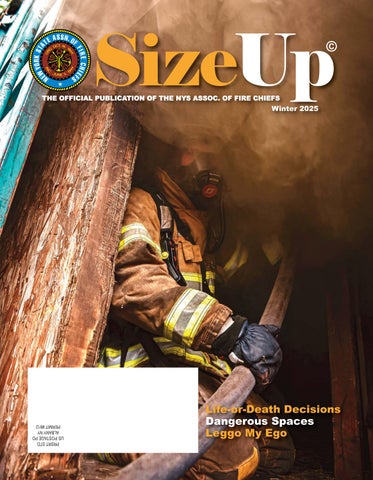
SizeUp
©
THE OFFICIAL PUBLICATION OF THE NYS ASSOC. OF FIRE CHIEFS
Winter 2025
Life-or-Death Decisions Dangerous Spaces Leggo My Ego
PRSRT STD US POSTAGE PD ALBANY NY PERMIT #812
SizeUp
©
Contents
Winter 2025
Departments 5 Index of Advertisers 6 The President’s View 8 From the Chaplains’ Study 10 NYSAFC News 12 Around the State 14 Committee Report - EMS 16 View From the Hill 30 Long Island Metro Fire/EMS Expo Preview 33 The Roster 35 NYSAFC Sustaining Members Directory 38 Leading From the Front Seat
Features 18 20
22 24 26
28
Firefighters Make Life-or-Death Decisions Dangerous Spaces – Challenges and Tactics When Dealing with Garage and Basement Fires Surviving a Flashover Leggo My Ego FirstNet: Reshaping the Fire Service and EMS in New York State New York’s Fallen Firefighters Honored
SizeUp WINTER 2025
Size Up is an official publication of the New York State Association of Fire Chiefs. NEW YORK STATE ASSOCIATION OF FIRE CHIEFS 1670 Columbia Turnpike P.O. Box 328 East Schodack, NY 12063-0328 Phone: (518) 477-2631 • (800) 676-FIRE Fax: (518) 477-4430 www.nysfirechiefs.com
ASSOCIATION STAFF Bruce E. Heberer – Chief Executive Officer Faith M. Alheim – Administrative Assistant Oksana Franklin – Treasurer Mary K. Hanlon – Communications Coordinator Catherine E. Hannigan – Administrative Assistant Paul C. Melfi – Hands-On Training Coordinator Susan R. Revoir – Conferences/Education Coordinator Jeremy S. Rodd – New York Fire Book Store Manager ASSOCIATION OFFICERS Chief Richard L. Lyman – President Chief William K. Owen III – 1st Vice President Chief Timothy E. Boel – 2nd Vice President Chief Anthony V. LaFerrera – Past President ASSOCIATION DIRECTORS Chief Kenneth M. Almy Chief Brad W. Davies Deputy Fire Coordinator Anthony D. Faso Chief Wayne C. Friedman Chief George P. June Chief Kevin O. Kalk Chief Charles Kostyk Chief Dale G. Lingenfelter Chief Stefano Napolitano Chief Richard M. Nemier Chief Anthony J. Tripp EDITORIAL SUBMISSIONS Contact: Size Up Editor Mary Hanlon Email: editorial@nysfirechiefs.com PUBLISHED BY
Frank C. Trotta - Publisher Tim Edwards - Executive Editor Barbara Connolly - Vice President National Sales Patti Niebling - Special Projects Coordinator Gregory Jones - Art Director To advertise in Size Up contact Barbara Connolly at (631) 776-1853 COVER PHOTO Sidewinder Photography © 2025 all rights reserved. The contents of this publication may not be reproduced by any means, in whole or in part, without the prior written consent of NYSAFC and Fire News.
3
Serving Fire, Rescue & EMS Heroes Since 1973 For advertising opportunities contact Patti 631•286•0058 ext.108 • patti@firenews.com 4
SizeUp WINTER 2025
INDEX OF ADVERTISERS Access Compliance.........................................36 Liberty Art Works.............................................13 www.accesscompliance.net www.libertyartworks.com Auctions International, Inc. ............................15 Paul Congelosi Sales, Inc ...............................39 www.auctionsinternational.com www.congelositrailersales.com Bauer Compressors, Inc. ................................40 RBC Wealth Management – www.bauercomp.com The LOSAP Group ...........................................32 Certified Ambulance Group ............................14 www.rbcwealthmanagement.com www.certambgroup.com
Signal 5 Fire Apparatus...................................15 Draper Asset Management .............................32 www.signal5fireapparatus.com www.draperasset.com Specialty Ambulance.........................................7 Fire Hooks Unlimited, Inc ...............................19 www.specialtyambulance.com www.firehooksunlimited.net
Tele-Lite, Inc .....................................................19 https://tele-lite.com
Fire Innovations ...............................................13 VFIS-Glatfelter Insurance Group ......................4 www.fireinnovations.com www.vfis.com Frank G. Relf Architect PC..............................34 W & E Phillips Locksmith ...............................14 www.fgrelf.com www.phillipslock.com Husky Portable Containment ...........................9 Wendel/Five Bugles Design..............................9 www.huskyportable.com www.wendelcompanies.com
SizeUp WINTER 2025
5
THE PRESIDENT’S VIEW
Mental Health Peer Support for First Responders Chief Richard L. Lyman, NYSAFC President
T
he work of first responders – whether firefighters, EMS personnel, law enforcement officers, or 911 dispatchers – is both mentally and physically demanding. These pressures can take a serious toll, leading to stress, burnout, behavioral health challenges, and, in too many cases, thoughts of suicide. Despite the critical role first responders play in keeping our communities safe, their mental health needs are often overlooked or stigmatized. Being a first responder is more than just a job; it’s a way of life. And the mental and emotional toll it takes is real. If we are going to truly care for those who put themselves in harm’s way for us, we must confront the stigma, build systems of support, and treat mental health as the critical part of overall well-being that it is. Recently, the New York State Division of Homeland Security & Emergency Services collaborated with the Benjamin Center at SUNY New Paltz to undertake the New York State First Responder Mental Health Needs Assessment (MHNA). The report (https://bit.ly/4nOXhHP), completed in 2025, found that stress, burnout, anxiety, depression, PTSD, and thoughts of suicide place first responders at greater risk for developing mental health issues. These issues can negatively impact their family relationships, friendships, social lives, and overall health. It is interesting to note that over 6,000 responders took the time to answer the survey. This indicates a real need for addressing the mental health challenges facing first responders in New York state. The MHNA brought forward some great suggestions, including “Development of a statewide or regional peer support network, trained to address first responder issues and available 24/7. This team would be the first line of support for struggling first responders and would, when appropriate, refer clients to a professional who had already been vetted for experience, availability, and insurance (including tele-mental health). Confidentiality of this peer support network (and other peer support programs) is an important issue that needs to be attended to in this model.” The Ruderman Family Foundation’s 2018 white paper reported that in 2017, suicide rates were 18 per 100,000 for firefighters and 17 per 100,000 for police officers. By comparison, the national suicide rate in 2023 reported by the CDC was 14.1 per 100,000. An updated Ruderman report in 2022
6
Change begins when we treat mental health like any other health condition – without shame, without judgment, and with the collective resolve to ensure no responder stands alone. found no meaningful decrease in first responder suicides, despite increased awareness efforts, and noted that the mental health needs of retired responders remain largely unaddressed. The report also highlighted a sobering reality: more firefighters, EMS personnel, and police officers die by suicide than in the line of duty. Each year, the fire service loses about 100 firefighters on duty – but tragically, suicides take even more lives. The Fall 2025 issue of Size Up contains an article titled “Beyond the Flames Part 2: Peer-to-Peer Support – Changing Culture” by Deputy Chief (Ret.) Butch Cobb and Deputy Chief (Ret.) Paul Drennan. It describes the establishment of the peer support program in the Jersey City (NJ) Fire Department and strategies beyond peer-to-peer support. If you missed this article, I encourage you to seek it out on our website. Here in New York, this year, state Senator Pete Harckham and Assemblyman Chris Burdick sponsored the First Responder Peer Support Act (S.5407A/A.7285-A) that would establish a statewide mental health and peer support training program. The legislation was recently amended to define a broader range of emergency responders that are covered. This year, the peer support legislation passed in the Senate, but did not pass in the Assembly. This is an important piece of legislation that would help develop peer support programs across New York state. The New York State Fire Service Alliance, including NYSAFC, identified this legislation as one of the priorities for 2025 to be advocated for through mutual effort (https://bit.ly/42bQ23k). Governor Kathy Hochul’s office has enacted sev-
SizeUp WINTER 2025
eral first responder behavioral health, mental wellness, suicide prevention, training, and support programs and legislation. These include the First Responder Mental Health Needs Assessment, First Responder Counseling Scholarship Program (SUNY), legislation for first responder mental health/addiction training, and the CARES UP initiative (https://nycaresup.com) to strengthen resiliency and wellness for uniformed personnel. The governor’s initiatives are a good start to addressing behavioral health issues for first responders. However, we can do more by getting involved and supporting Senator Harkham’s and Assemblyman Burdick’s legislation. There are no standardized criteria for reporting behavioral health issues for first responders, making data from various studies less precise and fragmented, creating more uncertainty in the data. According to the Ruderman white paper, “Shame and stigma, which are often associated with first responder suicides, leads to secrecy and silence surrounding the event, preventing appropriate processing of it by colleagues of the deceased.” This is causing underreporting of the data. However, based on multiple re-
porting agencies, even with different criteria we can conclude there is a higher risk of behavioral health issues and suicide rates for first responders than the general population. A peer support program will not succeed if the public safety administration does not embrace a culture that supports the program. Enacting first responder peer support legislation in New York state would be a key step in mitigating mental health issues for first responders. Every one of us has a role in breaking the silence around mental health. By challenging stigma, advocating for legislation that strengthens peer support, and speaking openly about the real struggles first responders face, we can help build a culture of care instead of secrecy. Change begins when we treat mental health like any other health condition – without shame, without judgment, and with the collective resolve to ensure no responder stands alone. In his book Taking the Cape Off, Chief Patrick Kenny reminds us, “Mental illness is a proven physical illness, not a character weakness, and indeed it is not a choice any more than one chooses cancer.” ◆
QUALITY EMER RGENCY V VE EHICLES SINCE E 19 29
THE PRE EMIER AMBULANCE E, EMS, FIR RE, AND FIRST RESPONDER R VEHICLE E DEALERSHIP
S Specialty ty yA Ambulance.com Call us today! (516) 349-7700 0 | 60 Engineerrs s Lane, East Fa Farmingdale, NY 1173 73 35 5 @Special ty yA Ambulan nce
SizeUp WINTER 2025
7
FROM THE CHAPLAINS’ STUDY
Lord, Keep Them Safe Rev. Leon I. VanWie, Past Chief Chaplain, New York State Association of Fire Chaplains
M
any of you who are reading this article attended the annual New York State Fallen Firefighters Memorial that was held on October 7 at the Empire State Plaza Convention Center. I always find the ceremonies to be solemn and very meaningful. After I left the ceremony there were two numbers that haunted me. Maybe “haunted” is not the appropriate word, but on my drive home, I kept hearing “126” and “112.” Those numbers were shared by Jackie Bray, the commissioner of the Division of Homeland Security & Emergency Services for New York state. We honored and remembered 126 of our colleagues whose names were added to the memorial wall this year. Of the 126, 112 died because of 9/11-related illnesses. I think about those numbers every day – each representing a colleague who has answered their last alarm. Whenever the pager goes off and the alarm sounds, we know that it COULD be our last call, as it comes with our job. The EMS and fire service is dangerous work. As the trucks initially pulled up to the towers, before they collapsed on 9/11, I would think that many of the 343 were very aware of the dangers that awaited them. They still did their job, because that is just what we do. Over the years, the fire service has made great progress to minimize the dangers we face, but we know that we can never eliminate them. I’ve thought of the 112 who were added to the wall this year because of 9/11-related illnesses, as well as the several hundred who have died in previous years from 9/11 illnesses. When a firefighter enters a burning building, they are very aware of the danger, as were the 343. But after the towers fell on September 11, firefighters took precautions in their rescue and recovery efforts. They tried to protect themselves, yet 112 still paid the ultimate price and their names were added to our memorial wall this year. 112 names were added this year, and as Commissioner Bray indicated, more names, unfortunately, will be added in the years to come due to 9/11-related illnesses. Two stories from our scriptures come to mind. First, Abram was called by God to leave his home and to go where the Lord would send him. The story is found in Genesis 12. There were plenty of uncertainties for Abram, but Abram knew that God would be with him and secondly, that the Lord would bless him. That was enough for Abram, so he went.
8
The second story is from Luke 1:26, where God sent the angel Gabriel to Nazareth to notify Mary that she was going to have a baby, the baby Jesus. Mary, of course, had many questions, but the Lord assured Mary to “be not afraid” because the Lord would be with her. For both Abram and Mary there were many uncertainties as to what they would be facing. But both knew that they were not alone, because God would be with them. Throughout my years as a firefighter and EMT, when the pager went off, before I headed out the door to respond, my simple prayer was, “God, be with me, and keep me safe.” As a chaplain, each day my prayer for my local departments is simply, “God, be with them, and keep them safe.” When I hear sirens, my prayer is the same, whether it’s fire, EMS, or law enforcement. “God, be with them, and keep them safe.” Abram and Mary, as well as many of our ancestors in the faith, moved into the future not knowing what they were facing, but they knew that the Lord would be with them. I hope, as the trucks pulled up to the towers the morning of September 11, that our colleagues knew that even though they were facing many uncertainties and dangers, that they were not alone, that the Lord was with them. That is also my prayer for you. As we go into our uncertain futures, we face danger every day, and we never know what day will be our last. But I hope that my prayer is your prayer… “God, be with me, and keep me safe.” ◆ About the Author: Leon VanWie served as chief chaplain of the New York State Association of Fire Chaplains from 2020 - 2022. He began in the fire service in 1976 and became a chaplain within a year. VanWie was an EMT for over 15 years and currently serves as the chaplain and president for the Town of Watertown Volunteer Fire Department, chaplain for the City of Watertown Fire Department, and a deputy fire coordinator for Jefferson County in the role of chaplain. He belongs to numerous county and state fire organizations and has been a pastor since 1973. VanWie can be contacted at leonvanwie@gmail.com or (315) 7719142 (voice and text).
SizeUp WINTER 2025
SizeUp WINTER 2025
9
NYSAFC NEWS
2025 Training in Review
N
YSAFC’s classroom and Hands-On Training programs wrapped up for the year in November. Past Chief/Coordinator of Education Mike Healy (Central Nyack Fire Department) and Firefighter/Instructor Jeff Daniels (FDNY), both of the Rockland County Fire Training Center, presented the association’s 2025 Seminar Series “Short-Handed Firefighting” in 18 counties. The class was developed 34 years ago by the late Lieutenant Andrew A. Fredericks (FDNY/Rockland County), and it is timelier than ever, as volunteer and career departments across New York state face staffing challenges. 17 Regional Hands-On Training programs were delivered this year, including the association’s newest course, Fire Behavior From the Outside. This course was developed by Instructors Sam Usborne and Matt Kowaleski, and has been presented at 12 sites since being introduced in the fall of 2024. Unlike NYSAFC’s other two-day Regional HOT courses, which are delivered on weekends, this course can be scheduled for any day of the week all year round, making it ideal for a department drill. Available for a flat fee, the two-hour session includes a lecture and demo featuring a dollhouse prop, which provides a safe, inexpensive way to discuss fireground strategies and tactics to improve firefighter safety and victim survivability. Instructor Usborne passed away this fall, but this course will continue to be presented by association instructors and is part of Sam’s lasting legacy of sharing knowledge to strengthen the fire service. Thanks to everyone who participated in NYSAFC training this year! Regional HOT programs are now being booked for 2026. Refer to the Host Request Forms available on our website for each course. Details on the 2026 Seminar Series and Company Officers Leadership Training (COLT), plus training at the Long Island Metro Fire/EMS Expo and 120th Annual Conference & FIRE 2026 Expo, are available at www.nysfirechiefs.com. ◆
NYSAFC CEO Bruce Heberer, Instructor Mike Healy, President Rich Lyman, and Instructor Jeff Daniels at the Westchester County Seminar.
10
East Glenville Fire District #3 hosted Fire Behavior On the Inside Regional HOT in October.
Instructor Sam Usborne presented Fire Behavior From the Outside Regional HOT course earlier this year for the Perth Fire Company.
SizeUp WINTER 2025
NYSAFC NEWS
Committee Member Edward DiMonda Recognized
I
n the spring, the New York State Division of Homeland Security & Emergency Services Office of Fire Prevention & Control and NYSAFC commemorated 50 years of the Fire & Life Safety Educators’ Conference. At this year’s Suffolk County program held on May 3 at the Suffolk County Fire Academy, DHSES presented Edward DiMonda of the NYSAFC Public Education Committee with a certificate of appreciation recognizing his many years of dedication to fire and life safety public education and his ongoing support of the conference. The association’s Pub Ed Committee was established in 1983. DiMonda, an ex-chief and commissioner with the North Sea Fire District (Suffolk County), was appointed to the committee in 1984, and later served as its chairman for several years. He continues to actively assist in the planning of the Fire & Life Safety Educators’ Conference and supports the association in all of its endeavors, including as a volunteer at the Annual Conference & FIRE Expo and Long Island Metro Fire/EMS Expo. DiMonda is currently the longest-serving active member of an association committee. To commemorate this milestone of service, the board of directors recognized him at the Combined Board & Committee Meeting held on November 8 in Schodack, N.Y. Thank you, Ed!◆
NYS DHSES OFPC Deputy Chief Mike Stevens, Ed DiMonda, NYSAFC President 2024-2025 Anthony LaFerrera, and OFPC Chief Ben Keller.
President Rich Lyman and CEO Bruce Heberer honored Ed DiMonda at the NYSAFC Fall Meeting.
Mark Your Calendar for the 2026 Fire & Life Safety Educators’ Training Series Single-day conferences will be hosted by the New York State Division of Homeland Security & Emergency Services Office of Fire Prevention & Control and the New York State Association of Fire Chiefs. Join us in these locations: Ulster County Esopus Fire Department April 18, 2026 Onondaga County Camillus Fire Department May 2, 2026 More details are coming soon!
SizeUp WINTER 2025
11
AROUND THE STATE
Fireboat Edward M. Cotter Celebrated for 125 Years of Service
O
n September 21, 2025, the annual Cotterfest was held in Buffalo, N.Y. to mark the 125th anniversary of the Fireboat Edward M. Cotter. The Cotter, operated by the Buffalo Fire Department, is the oldest working fireboat in the world. Throughout its storied career, the Cotter has played a vital role in firefighting and rescue operations, and it also serves as an icebreaker. It was des-
ignated a National Historic Landmark in 1996. NYSAFC HandsOn Training Coordinator Paul Melfi and Instructor William Hanrahan attended Cotterfest to join in commemorating the fireboat’s rich history. Learn more about the vessel from the E.M. Cotter Conservancy at www.emcotterconservancy.org.◆
Photos: Shari Hanrahan
Buffalo Fire Commissioner William Renaldo, Paul Melfi, and Buffalo Fire 1st Deputy Commissioner Paul Eason.
Members of the Buffalo Fire Department Honor Guard. Paul Melfi, Michael Kick, captain of the Cotter, and William Hanrahan.
NYSAFC Training and Events Calendar View the association event calendar to find a conference, class, or hands-on training program in your area! 12
SizeUp WINTER 2025
SizeUp WINTER 2025
13
COMMITTEE REPORT - EMS
Firemedically Speaking EMS Coordinator Mike McEvoy, NYSAFC EMS Committee
T
his column will keep you up to date on significant developments in EMS policy, regulations, and legislation.
EMT-CC Sunset Delayed In 2017, the State EMS Council and State Medical Advisory Council made an extensive review and solicited input from across the state on the EMT-Critical Care certification level, which no longer aligns with national standards. A 10-year plan was effected (https://bit.ly/4nufzxy), creating a special bridge program to allow EMT-CCs to bridge to Paramedic level. After extensive discussion and review of data by SEMAC and SEMSCO, a decision was made in 2024 to transition away from the Critical Care level effective July 2027. At the December 2024 SEMSCO and SEMAC meetings, the health commissioner asked to open dialogue and collaboration with his office to better understand the process. This led to agreement that the original 2027 timeline will be adjusted. SEMSCO is committed to finding an equitable solution that supports all current Critical Care technicians and offers care to the public consistent with national standards. This includes ensuring a smooth pathway for them to transition to the Paramedic or Advanced EMT level, a
14
process already underway for many. Continued collaboration with the commissioner’s office will bring a new implementation plan to the SEMAC and SEMSCO membership. AHA Rolls Out New Guidelines On October 22, the American Heart Association rolled out new guidelines for CPR, advanced adult and pediatric life support and first aid. The full guidelines were published in the journal Circulation (https://bit.ly/4hEBCjY). Summaries are available (https://bit.ly/4oKl0JJ). For the first time, all the new materials (textbooks, instructor manuals, references) were released at the same time (https://shopcpr.heart.org). Instructors will be required to complete an update on the new guidelines and begin using the new course materials by February 2026.◆ About the Author: Mike McEvoy, Ph.D., NRP, RN, CCRN is a member of SEMSCO, EMS coordinator for Saratoga County, paramedic supervisor and CME coordinator for Clifton Park-Halfmoon Ambulance Corps, and firefighter and chief medical officer for West Crescent Fire Department.
SizeUp WINTER 2025
SizeUp WINTER 2025
15
VIEW FROM THE HILL
Federal Government Shutdown Impacts Fire and EMS Programs Director of Government Relations & Policy Ken LaSala, International Association of Fire Chiefs
A
fter a 43-day shutdown, President Donald Trump signed legislation (P.L. 119-37) on November 12 to reopen the federal government through January 30, 2026. While the federal government is getting back to work, it is important to note that many federal programs that support fire and EMS departments were closed, including the National Fire Academy. However, Congress continued to work on fire and EMS legislation during the shutdown.
The Federal Government Shutdown The federal government shutdown had serious effects on federal fire service programs. For example, the National Fire Academy closed, and the U.S. Fire Administrator’s Summit was postponed. The World Trade Center Health Program was supposed to remain open. The portal for the National Cancer Registry for Firefighters remained open, but there were few staff to support it. The Federal Fire Fighter Fatality Investigation and Prevention Program also was shut down. Staff at the Department of Justice’s Public Safety Officers’ Benefits program also were furloughed. The U.S. Forest Service (USFS) and Department of Interior (DOI) retained staffing to respond to wildland fires, but fire prevention activities were curtailed in some instances.
16
The Pipeline and Hazardous Materials Safety Administration also continued to inspect shippers of hazardous materials and investigate haz-mat accidents. The situation regarding FEMA’s grant programs was messy, because the FEMA GO platform was shut down. At the end of September, FEMA announced the Fiscal Year (FY) 2024 awards for the Assistance to Firefighters Grant (AFG) program; Fire Prevention and Safety (FP&S) grant program, and the Staffing for Adequate Fire and Emergency Response (SAFER) programs. However, if a fire department did not accept the award before October 1, it was unable to accept the grant through the subsequently closed FEMA GO platform. FEMA extended the deadline for accepting AFG and SAFER grants to November 24. The FEMA GO platform came back online on November 17, which gave fire departments about a week to accept the grants. In addition, the Trump administration unilaterally changed its funding levels under the State Homeland Security Grant Program (SHSGP) and Urban Areas Security Initiative (UASI) for states and localities. These allocations were challenged in federal court resulting in multiple rulings, a temporary restraining order, and delays in the actual distribution of SHSGP and UASI funds. It remains to be seen how these complications
with federal grants will affect homeland security preparedness. Also, the Centers for Medicare and Medicaid Services (CMS) suspended the add-on payments for ambulance transport during the shutdown. For EMS transports before October 1, CMS was paying an additional 2% for urban; 3% for rural; and 22.6% for super rural areas. P.L. 119-37 restored these ambulance add-on payments retroactively, but only extended them through January 30. Congress must pass the Protecting Access to Ground Ambulance Medical Services Act (H.R. 2232/S. 1643) to extend these payments through 2028. On October 20, Chief Trisha Wolford, the IAFC’s president and board chair, joined the IAFF General President Edward Kelly in calling for Congress to negotiate a reopening of the federal government. They highlighted the plight of federal firefighters that must work without pay or be furloughed without pay. In addition, they highlighted the problems that local fire and EMS departments are having in accessing grant funds through programs like the AFG, SAFER, and FP&S programs and the need to reinstate the (CMS) ambulance add-on payments. We will continue to urge Congress to pass the annual appropriations bills and keep the federal government open past January 30.
SizeUp WINTER 2025
Executive Branch Actions Despite the federal government shutdown, the Trump administration continues to reform the federal government. The federal FEMA Review Council is expected to produce a report by mid-December. Chief Jim Schwartz, the chair of the IAFC’s DHS/FEMA Review Task Force, testified at a listening session held by the federal council on September 22. He advocated for the Trump administration to keep programs like the Urban Search and Rescue System, as well as the AFG, FP&S, SAFER, SHSGP, and UASI programs. Schwartz also discussed the importance of the National Incident Management System in managing emergency incidents and emphasized the need to improve the national mutual aid system and improve reimbursements to local fire departments for sending resources to major disasters. He also discussed the importance of the USFA and NFA in producing future fire and EMS leaders. Also, he emphasized the role that FEMA plays in helping local jurisdictions prepare for and effectively respond to national emergencies, which is important due to the Trump administration’s focus on putting greater responsibility for disaster response on state, local, tribal, and territorial communities. The Trump administration also began to consolidate its wildland fire response capabilities. It announced the creation of a U.S. Wildland Fire Service (USWFS) in January 2026 that will be located at the Department of Interior. Under the current proposal, all of the DOI’s wildland firefighter capabilities under agencies like the Bureau of Land Management and National Park Service will
SizeUp WINTER 2025
be consolidated under the USWFS. The DOI even opened an application period to hire a director for the USWFS. There are other proposals to consolidate the wildland firefighting capabilities of the USFS into the USWFS, but that would require Congressional action. Legislative Update There have been some accomplishments on Capitol Hill despite the federal government shutdown. Most notable, the Honoring Our Fallen Heroes Act (S. 237/H.R.1269) was included in the Senatepassed version of the Fiscal Year (FY) 2026 National Defense Authorization Act (NDAA; S. 2296). This bill would extend the eligibility for the Public Safety Officers’ Benefits program to the families of fire, EMS, and law enforcement personnel who die from cancers caused by job-related exposures. The House and Senate must reconcile their different passed versions of the NDAA. The IAFC is working with other national fire, EMS, and law enforcement organizations to ensure that the final version of the NDAA includes the Honoring Our Fallen Heroes Act. Also, we are working on some bills to help improve fire departments’ abilities to provide EMS to their communities. Representative Mike Carey (R-OH) introduced the CARE Act of 2025 (H.R. 2538) to create a pilot program within the Center for Medicare and Medicaid Innovation to test a nationwide reimbursement model for EMS treatment in place. The bill is co-sponsored by New York Representatives Patrick Ryan, Claudia Tenney, and Paul Tonko. Also, Rep-
resentatives Emmanuel Cleaver (D-MO) and Diana Harshbarger (R-TN) introduced the Community Paramedicine Act of 2025 (H.R. 4011). This legislation would allow existing rural health development grants to fund community paramedicine and mobile integrated health programs. This bill does not have any New York co-sponsors. The NYSAFC and IAFC are working to recruit more co-sponsors for these bills. We also continue to work to ask the Senate to pass the Setting Consumer Standards for Lithium-Ion Batteries Act (H.R. 973/S. 389). The legislation, sponsored by New York Senator Kirsten Gillibrand and Representative Ritchie Torres, would allow the Consumer Product Safety Commission to regulate lithium-ion batteries and their charging components on e-bikes and other electric mobility devices. The bill passed the House in April, but it awaits Senate passage. In Conclusion As members of Congress focus on passing legislation before the December holidays, the NYSAFC and IAFC will continue to push them to pass legislation like the Honoring Our Fallen Heroes Act. We also will continue to advocate for funding for programs like the U.S. Fire Administration and AFG and SAFER grant programs as part of the Fiscal Year 2026 appropriations bills. We have a weekly Washington Update that lets fire chiefs know what happens each week here in Washington. We ask that you stay engaged and ask your senators and representatives to pass legislation to help local fire departments.◆
17
Firefighters Make Lifeor-Death Decisions Vincent Dunn
D
o you know there are life-or-death principles that influence us when we act at fires and emergencies? We may not acknowledge them or speak of these principles of life or death, but when we stretch hose, raise ladders, search for trapped victims in a collapse, or establish a rapid intervention team, we act according to these principles of life or death or “acceptable/unacceptable life loss.” Theologians and philosophers, for centuries, have debated and established these life-or-death principles that we use every day when rescuing people at fires. For example, the one we are most familiar with and use at a multi-life loss emergency is “triage.” When we triage, we treat only those that have a chance to live with our help. When we ignore injured people in the lobby of a high rise to get upstairs and advance a hose, we are complying with the life-ordeath principle of saving the greater number; when we rescue surface and half-buried victims before digging for buried victims, we are working according to the life-ordeath principle of saving the closest ones first; and when we establish a rapid intervention team, we are acting according to a life-or-death principle of saving our own. Our firefighting strategies and tactics have evolved according to these life-ordeath principles of acceptable and unacceptable life loss. We may not realize it, but
18
firefighters are practitioners of what priests and philosophers have debated and thought about, who lives and who dies. When you ask firefighters “What do you do?” they say, “I stretch hose, raise ladders, and search for trapped people,” but they should say, “I make life-or-death decisions.” “Acceptable/unacceptable life loss” is an upsetting term. And we would rather not use these terms, but making acceptable/unacceptable life-or-death decisions is part of a firefighter’s daily work, whether we admit it or not. Firefighters must decide what is acceptable and unacceptable life loss when they raise ladders, stretch hose, do collapse search, assign rapid intervention companies, or respond to hazardous material incidents. We may not think about it in terms of lifeor-death decision-making, but it is. It’s what we do, and it requires knowledge of acceptable/unacceptable life loss decision-making. The Six Principles of Life-or-Death Decisions Made at Fires 1. (Beyond Saving) Mass Casualty Decisions: This determination must be made when there are “scarce resources.” When there are multiple casualties, injured people must be placed in three groups: 1. Those not seriously injured, 2. Those beyond saving, and 3. Those seriously injured who can be saved. This last group of victims gets first attention. Those identified in group 2 are ac-
ceptable life losses. 2. (Save the Most) Raising Ladders: When placing ladders at windows of a burning building, people may be trapped at several windows in equal danger from fire and calling for help. If one window has two or more trapped victims pleading for rescue and another window has one person calling for help, the first ladder is placed to save the most people who are threatened. This is determining acceptable/unacceptable life loss. 3. (Doing Greater Good) Stretching Hose: When arriving at a high rise fire where many people in a lobby are requesting assistance and the incident commander ignores these pleas for help and orders available firefighters to stretch the hose and extinguish the fire to stop smoke, flame, heat, and toxic gases from extending upstairs, this action protects the greater amount of people. This is an example of the life-or-death principle of doing the greater good. 4. (Rescue Closest First) Collapse Rescue Procedures: When a building collapses from a tornado, explosion, or hurricane and victims are trapped, the search and rescue procedure is to first rescue surface victims and half-buried victims who can be seen and heard before you start digging for buried victims. This is complying with the life-or-death principle of rescuing the closest victims first.
SizeUp WINTER 2025
5. (Saving Our Own) Rapid Intervention Team: The principle of “saving our own” is demonstrated when we establish a rapid intervention rescue team to stand by at the command post with one purpose only – to rescue trapped firefighters. This is the saving our own life-or-death principle. 6. (Limiting Life Loss) Establishing a Haz-Mat Hot Zone: The principle of “limiting losses” is achieved when responding to a hazardous material incident and we divide the area into hot, warm, and cool zones. Firefighters do not enter the hot zone. Entry is restricted to limit contamination of firefighters and the public. This is an example of the life-or-death principle of limiting life loss. Debate Versus Action Theologians and philosophers may have debated and discussed life-or-death decision-making and determining acceptable/unacceptable life loss for centuries; however, firefighters and EMTs do not debate, they put life-or-death principles into practice every day in America at fires and emergencies.◆
About the Author: Vincent Dunn served 42 years with the New York City Fire Department, including 26 years as a chief officer. He retired in 1999 as the division commander of Division 3 in midtown Manhattan. Dunn is the author of 11 books, including Safety and Survival on the Fireground, Building Construction: The Firefighter’s Battlespace, and My War Years – A Fire Chief ’s Memoir. He co-wrote the U.S. National Fire Academy course “Command and Control of Major Fires and Emergencies” and developed seminars on high rise firefighting, terrorism tactics, and collapse rescue operations throughout his career. Dunn has served as an instructor at the New York City Fire Department Division of Training, adjunct professor at Manhattan College, adjunct professor at John Jay College, and instructor at the National Fire Academy. He is the recipient of numerous awards, including the Fire Engineering, New York City Fire Department, and Friends of Firefighters Lifetime Achievement Awards and the FDNY Honor Legion Society Award.
Learn More from Vincent Dunn Books, including Battlespace Life-orDeath Decisions, articles, and educational resources are available at vincentdunn.com
Save the Date for the EDIAFC 99th Annual Conference April 17-18, 2026 Lancaster, PA “The Art of Leadership: Inspire Action” www.ediafc.org
SizeUp WINTER 2025
19
Dangerous Spaces – Challenges and Tactics When Dealing with Garage and Basement Fires Michael Lombardo “Attention Engine 3, Engine 2, Truck 6, Battalion 1 – respond to 61 Cheshire Way for the report of smoke coming from the attached garage. Battalion 1, lady said that there was gray smoke coming from the garage. We held up on the auto-aid.” “Engine 3, on location 61 Cheshire Way with a two-story wood frame dwelling, with heavy fire involving the attached garage and fire extending into both floors of the house.” “Battalion 1, on location establishing command. Dispatch the autoaid units.”
S
ome of the most dangerous fires we deal with are often looked at as routine: the basement fire and the garage fire. Basement fires are probably the most overlooked killer of firefighters engaged in combat firefighting in much of the United States. The construction, layout, fuel load, and access present difficult and dangerous challenges at below grade fires, as well as fires involving garages. From the incident commander to the firefighter on the nozzle, we must all recognize and be able to deal with these challenges. Huge migration to the suburbs starting with the arrival of the post-World War II Baby Boomer generation saw the proliferation of the attached garage. Many older cities never had the available space for homes to feature an attached garage or any garage at all. The tremendous fuel load that is constantly evolving in our garages presents danger for occupants and firefighters alike. This article will focus on the garage fire. Size Up Issue 1 • 2022 included my article dealing with basement fires, “Basement Fires Are a Bitch,” which you can read at www.nysfirechiefs.com/sizeup. When we look at residential fires in suburbia, the most common point of origin often involves the attached garage, as well as “outside-in” fires. You know, outside-in fires, the grill too close to a wall, the light fixture in the gazebo, etc. These same causes are prevalent in garage fires, also along with the common fireplace ashes disposed of in the garage. Construction The garage is most commonly Type V wood frame construction in residential occupancies. Detached garages are also found to have masonry walls. The most common construction method in modern suburban attached garages uses lightweight components, trusses, laminated beams, and I-joists to span the garage opening and roof. These members may fail rapidly when exposed to fire, particularly in an unfinished garage. Fire separation between the garage and living area is often provided by fire-rated drywall, as well as fire-rated
20
Jack Lombardo
doors coupled with self-closure devices. Firestopping and sealed penetrations are critical. Any holes in fire-rated assemblies for wiring, plumbing, and HVAC are potential paths for fire extension. The same goes for a fire door with an inoperable closure device or a non-rated door. These separations are only effective if intact and not compromised by renovations. Another common danger in garages is overhead storage that is often overweight and very much subject to collapse early in an operation. Layout Garages come in all shapes, sizes, and designs, everything from a one-car detached to a below grade 100-plus car parking ramp with a high rise residential occupancy above. Some departments send a smaller response to garage
SizeUp WINTER 2025
How much fuel could be in this garage?
fires. Don’t fall for this trap, because the fuel load in even a simple two-car attached garage is well above the “fuel” that is in the rest of the dwelling. Detached garages are often very close to adjacent garages, as well as other structures, including houses. Fuel Load Let’s talk about fuel load. The common two-car garage with just one car and average storage is a challenge. Vehicles today – gasoline, EV, hydrogen – all add to our fuel load. We worry about the new types of vehicles, but don’t get lulled into complacency by a gasoline-powered vehicle because of familiarity. 10 gallons of gas in a car, as well as the vehicle itself, along with a lawnmower, snowblower, gas “can” (probably plastic), two old tires we haven’t thrown out yet, jet ski, four bicycles hung from the ceiling for winter, and the list could go on and on. Now think of the fuel load in a two, four, six, or eight-car garage… get the deck gun ready! Operations The five-point incident action plan (IAP) has served me well for many years – attack, backup, exposures, search, and vent – not in a specific order, but rather, as close to happening at once as staffing and conditions permit. When we look at garage fires, particularly at attached garages in suburban dwellings, we see that a lot is going on. Attack really involves a two-pronged approach. A line, most often a 1¾-inch through the front door, heads for the interior door to the garage. This line may remain in a holding pattern protecting the interior for search crews, as well as lines that may go above. At the same time, a line – think 2½-inch or deck gun depending on the fire condition – attacks the main body of fire in the garage. Again, depending on the conditions, a line to the second floor will be needed quickly to stop extension on the upper floor and attic space. The search crews that are on the upper floors also need to be searching and opening up for the line
SizeUp WINTER 2025
Lightweight metal easily fails.
that has gone above. A check has to be made early on below grade in the house to make sure fire hasn’t extended into the basement. Often, well-involved attached garages will be self-venting on or shortly after arrival. Vent operations will be confined to the house dictated by conditions in the attic and first and second floors. In cases of garage fires that are not wellinvolved, we still face serious hazards. Due to construction methods using lightweight components, trusses, laminated beams, and I-joists to span the garage opening and roof, rapid failure of these components should be anticipated. Another serious concern is the garage door. For multiple reasons a garage door may come down and close during fire operations. A post or hook may be used in a pinch to prop up the door, as well as a tool, like a Vise-Grip, to lock onto the rail. That is not the only danger from the door. The rails may come down, as they are held up by a rather lightweight piece of stamped metal. With any serious fire conditions, collapsing the door is the safest option for operating crews. Commercial Commercial garages, parking ramps, auto repair facilities, and storage units all present their own unique challenges and hazards. Parking ramps with hundreds of cars can be a maze in zero visibility. Sprinklers, if equipped, will most likely confine the fire, but you will need to extinguish it. The car roof is there to keep rain out, so the fire may grow. This is a time to give serious consideration to deploying a rope to help with orientation. The pit at an auto repair facility, as well as vehicles on lifts eight feet in the air, cause us problems and dangers as we operate. Storage units, of course, may contain any type of item imaginable. Forcible
Dozens of golf carts in a massive basement present a horrendous challenge for fire crews.
entry will often involve saws. Make sure you have some extra blades. Although storage units are compartmentalized, the “attic” space is often open with chain-link fencing the only barrier. A storage unit fire recently involved a homeless person setting up living quarters in a unit adjacent to the fire. Meth lab operations have also been found in storage units. Conclusion Garage fires are deceptively dangerous. Though they may appear simple initially, they combine heavy fuel load, proximity to living spaces, and vulnerable structural systems. Fire behavior in garages can escalate rapidly. The presence of flammable materials, vehicles, and structural hazards requires a well-coordinated firefighting effort. Proper size up and tactical planning are essential for protecting both firefighters and civilians.◆ About the Author: Mike Lombardo is a 47-year veteran of the fire service and was the commissioner/chief of department of the Buffalo Fire Department from 2006-2010. He currently operates with the Christiana (DE) and East Amherst Fire Departments. Lombardo was a member of the development team for the New York State Firefighter Survival and Rapid Intervention programs and serves on the board of directors of the Fire Department Training Network, where he presents and developed the Fire Command program. He was a contributor for the NFFF documentary “Giving Courage: LODD Chiefs Speak,” is a two-time Firehouse Magazine Heroism Award recipient, and was the recipient of the FDIC 1999 Tom Brennan Training Achievement Award.
21
Surviving a Flashover James Sabol
This article was first published in the Fall 2021 issue of WNYF Magazine, the official training publication of the New York City Fire Department (FDNY). Thank you to the FDNY for permission to reprint these important lessons learned and shared by Lieutenant James Sabol.
J
uly 10, 2014, started out like any other day for me in the firehouse. After arriving at Ladder 155 for the day tour, I gathered my equipment and headed to Ladder 158, where I was detailed for the day. At Ladder 158, I was assigned the roof position and checked with the outside vent (OV) firefighter regarding procedures and equipment usage.
At approximately 1200 hours, Box 5998 at 259-46 145 Avenue in Queens came in for a reported privatedwelling fire. We were assigned as the first-due truck. Engine 314 arrived shortly thereafter, transmitting the 1075 for fire on the second floor of a peaked-roof private dwelling. Upon our arrival, I observed fire venting out of multiple second-floor windows along
22
Exposure 4 and Exposure 1. I proceeded with my tools to Exposure 2/3, where I used my ladder to vent, enter, and search (VES) the bedroom. Two things immediately came to mind upon entering the room. First was how hot the room was with no visible fire and a medium smoke condition (I was able to see the hallway door). Second was how high the window was from the bedroom floor. I stand at 6 feet 2 inches, and the windowsill came to just under chest height for me. As I searched the room, I heard the radio transmission “Water on the fire” and heard the line operating. I exited the room into the hallway and toward Exposure 4. Approximately 10-15 feet down the hallway, I met up with the officer of Ladder 158 and gave a verbal report. He informed me that there were reports of a missing occupant and instructed me to return to the bedrooms and conduct a more thorough search. I met up with the OV from Ladder 158 and gave him an update. We split up and continued our searches. Upon my return to the bedroom I had originally entered, I noticed a small area of fire on the wall; it looked to be a picture frame on fire. The smoke condition was unchanged, but the heat was increasing. I radioed Ladder 158 and told him I needed a line down the hall. At this point, I was thinking, “No big deal.” As I waited, a member from Ladder 165 entered the room via portable from Exposure 2, and an additional firefighter entered off my ladder. Everything happened so fast. There were now three firefighters – including me – in the bedroom. I heard a saw running. As I had been operating for almost 10 minutes, I really started to feel the heat through my gear. I thought to myself, “I’m in trouble; my gear is saturated with heat now. Where is this line?” I radioed again, “It is getting hot down the hallway here. Where
The initial conditions when it flashed. Fire visible in the Exposure 3 window.
A few seconds later. I am inside the Exposure 3 window with the fire.
Exposure 2 window.
The two other firefighters in the room with me exited the Exposure 2 window.
is the line?” I decided to head to the hallway door and get out of the bedroom, but the door and hallway were blocked by additional firefighters. The fire in my room was getting bigger. It was getting hot. I bent over and headed back to my window (the Exposure 3 window) to get out. The third firefighter was standing there because there was no place to go. I said to him, “Dude, you need to move.
SizeUp WINTER 2025
I am burning here.” He responded, “There is no place for me to go.” The fire was growing, and the heat was increasing. Fire began to drop down from the wall. My leg and shoulders were burning. I yelled at him, “Get out of the way; I am on fire!” I remember seeing fire all around me. It was, as I have heard guys mention before, like a freight train. The pain was unbearable and excruciating; it felt like thousands of needles poking me all over at the same time. I knew I was going to die. I needed to get out. I went headfirst out the window I came in (the Exposure 3 window). I knew my ladder was there. We had trained in the firehouse about bailing headfirst on a ladder and then turning ourselves around on the portable. I was able to lock myself onto the windowsill with my feet. The pain was unbearable, though, and my feet came loose. You can see my leg as I fall to the ground. I felt myself falling; it happened fast, but it felt so slow. I thought, “I need to turn my head, or it will hit the concrete first.” I consciously remember trying to turn my whole body. I remember hitting hard, and I thought I landed on my side. I don’t recall hitting my head and helmet at all. After I recovered from my initial shock, I slowly rolled over onto my back and saw a fireball blowtorching out of the window above me. The pain was excruciating. I remember turning my head and seeing my gear still smoldering. As I lay there, I thought, “I should transmit a mayday.” I made a feeble attempt at transmitting a mayday (I said the wrong position for myself and didn’t activate my EAB) and noticed the chauffeur of my assigned company (Ladder 155 was the FAST Truck) coming toward me. He attempted to get my gear off, but I stopped him and asked him to grab the garden hose behind him and put me out. I was still burning. I was fortunate. I escaped with only minor to moderate injuries. Could you have transmitted a mayday or used your PSS? When I tell my story, people often ask whether I could have transmitted a mayday
SizeUp WINTER 2025
My helmet cracked and splintered along the rear. My eye shields were deformed, and the rubber edge guard melted in several places. I had heavy signs of thermal loading along my chinstrap consistent with where I was burned.
I was told by Morning Pride that I was exposed to temperatures of 1,500 to 2,000 degrees Fahrenheit during the flashover.
– and I tell myself every day that I didn’t panic – but I know it started to set in. I was burning; all I wanted was to be out of that room. I had always heard the term “freight train” used to describe a flashover – that term doesn’t do it justice. My takeaways: • Wearing my chinstrap and waist strap saved me from serious injury or death. I always try to wear my chinstrap and my SCBA waist strap as a matter of routine. When I went out headfirst, I was hanging upside down, and my SCBA was held in place and kept from sliding up my back and knocking my helmet off. My chinstrap kept my helmet firmly in place and did not allow it to fall off. • I monitored the conditions around me and was able to get information out in a clear and concise manner. • I had a backup plan in place once I couldn’t get out via the hallway, and I retreated to the window where I had entered and positioned a ladder. • Being near a way out was key. We have only seconds to survive in a flashover condition. • Having all my gear on – and donned properly – saved my life. I would like to thank the members of Engine 302 and Ladder 155 for their assistance that day. I would also like to thank the FDNY Safety Command for the gracious assistance with this article.◆
or used my personal safety system (PSS). I believe I would have died in that room if I didn’t get out. I cannot overemphasize how fast things happened. I honestly do not believe, under those circumstances, that I would have been able to do either. A few seconds earlier would have afforded me time to deploy my PSS. I would like to believe that I didn’t panic
About the Author: James Sabol began his career with the FDNY in 1999 as an EMT and transitioned to firefighting in 2003, serving with Ladder 155. Promoted to lieutenant in 2021, he continued his service in Division 11 until retiring in 2023. A life member of the Melville Fire Department, Sabol remains active in the fire service and works as a fire department preplanning specialist. He holds an Associate of Science degree from SUNY Farmingdale.
23
Leggo My Ego Joe DiFabio and Paul Haynes
O
ver the last year, we have had the pleasure of touring various parts of the state, sharing our thoughts and views on one simple topic: training! While this broad topic lends itself to multiple different facets of our craft, our focus was on how to maximize training program potential utilizing the melting pot of individuals within our own organizations. Simply put, each individual within our organizations has something to offer toward the overall success of the department. Should we fail to collectively stay ahead of the curve, together we shall fall. The Old Timers The first demographic we took aim at was those within the service that have accumulated 15 years of service or more. In today’s technological age of continuous advancement, these primitive neanderthals of our craft cannot be pushed aside and lost due to their potential lack of informational technology skills. Instead, we dove into the vast wealth of information these hard-nosed giants possess. Focusing on life experience, district and apparatus familiarity, and “street cred,” there were emphatic and enthusiastic reminders to every attendee that the information carried within these dinosaurs could not only prove critically important on an emergency scene, but also save lives when we associate building construction and renovation histories to firefighter survival. Dubbed as “old school” and a “safety third” mentality, the thought processes undergone by these folks rely on very few factors of influence. These decisions are made simply because “This is the way we have always done it” and ultimately the implementation of the KISS method (keep it simple, stupid). From farmhand adaptations of ingenuity to an innate ability to apply the laws of physics, these prehistoric creatures of our craft have the mechanical aptitude to solve nearly any problem placed in front of them. We all know the steps taken in an effort to accomplish the task at hand will be about as fancy as a bulldog with its face pressed in a jar of mayonnaise, but in the end, the task is accomplished with hardly a bead of sweat being broken. Despite the rugged exterior of this demographic, we must be careful not to imply there is no longer a need for what they have to offer. These hardened, callused souls are just as human as the rest of us and want to be active participants toward our common cause. Challenge these members with mentoring positions and developmental programs. From driver training to leadership and supervision, some of these individuals are the past leaders of your organization that helped shape where you are today. They can provide invaluable information regarding command and control considerations, dealing with difficult personalities, and understanding why fire department directives read as they do. Most days, the easiest way to learn the most from these folks is to just sit with a cup of coffee at the kitchen table, close your mouth, open your ears, and just listen.
24 www
Sidewinder Photography
The Mid-Levels Running in the middle of the pack are these individuals accumulating from six to 14 years of service. This demographic has the absolute hardest position within the entire organization. These able mind and body folks must bridge the gap between the cavemen and the space cadets. The enormous importance of this group is unparalleled. The harshest reality in today’s fire service is knowing so many of our organizations lack this group of people. After settling in with five years of service, these men and women are nearing mastery of our craft. They are at the top of their game donning PPE and wearing SCBA. They have memorized tool and equipment locations on the apparatus and have begun to remember specific premise history information for repeat addresses. Perhaps going as far as mastering entry-level chauffeur skills, these individuals are committing the response district to memory. Absorbing fire department connection locations, water supply considerations, and feeling the desire to know more, these sponges of all things fire service are your “make it or break it” bunch. Let’s think about this for a quick second. Is there anyone more
SizeUp WINTER 2025
suited to help the probationary members get adjusted to all of these new requisite skills and abilities than the one who has mastered them in their prime? While there will be an exception to every rule, the answer is likely no. These folks have a vested interest in sharing what they have learned with these probationary firefighters, as they are the next in line to be riding in the seats beside them when every little second and decision matters. Likely to teach the trade rather than the tricks of the trade, these mid-level influencers can adapt what they have learned from the grizzled salts of the world and translate it into a meaningful and understandable message the younger generation can understand. The stark reality for so many of us, though, is that this demographic is either absent or woefully understaffed. In today’s societal climate, when our members reach this benchmark of service, the personal lives they have built for themselves take over as their primary responsibility. New houses and job or career changes, coupled with any number of diaper-filling feces machines, life as they knew it has come to an end. Reprioritizing life’s challenges and curveballs leaves the fire service alone and crying on prom night after your date leaves you for the king or queen. New Guys (Firefighters) The probies. The new guys. These juvenile blank slates require the utmost attention and direction. Nowadays, so many fire departments are accepting young members from the ages of 14 to 16 in an effort to see if the fire service “bug” truly is contagious. Inherently, at these ages, there are additional rules and regulations in place; however, departmental organizations are making these adjustments in membership categories to boost enrollment. Based on age alone, these younger members lack life experience and exposure to the cruelties this world has to offer. This naivety, if not handled and mentored properly, could cause irreversible psychological damage to these impressionable minds. Both the fire station atmosphere and the emergency scene can wreak havoc on the underdeveloped, malleable mind of a teenager. The maturation process is one that we take for granted most of the time, even though it is arguable at best if anyone within the fire service has ever truly fully matured. Younger, immature probationary members are not the only applicants the fire service is seeing. We are seeing new member applicants from every age range and every societal background. While older, more mature applicants are less likely to be affected by the daily traumas and rigors of our craft, they pose a slew of other obstacles to overcome as probationary members. Most notably is their resistance to change due to years of doing things their way. Trying to sway someone’s past practice to a new regimen of skills and procedures can prove futile unless approached methodically and with purpose. These folks do bring a new “shiny side of the coin” to the fire service, though. Most people entering our craft in this era are tech savvy and can bring any organization stuck in the Cretaceous period to this century. Today, social media is being used in our daily fire service lives, from training to promoting fundraising events. Embrace the new era and the new additions to your organization. Reflection The summation of our presentation focused on how our organ-
SizeUp WINTER 2025
izations have gotten to where they are today because of the people who came before us. The roots of our organizations come from our predecessors and their relentless devotion to our craft and the future of it. Recently, NYSAFC felt an immeasurable loss with the untimely passing of Instructor and Chief Sam Usborne. Sam embodied every ounce of what it means to properly train the next generation of firefighters.
Be like Sam! Sam was a constant student of our craft and felt no shame in asking question after question. He also felt great pride in sharing what he had spent so many years amassing as his vault of knowledge and information. Sam’s seemingly evangelical proclamations were not always appreciated by all, but he made it his life’s work to share old school and new school ideas and techniques, no matter if you agreed with him or not. His innate ability to take all things fire service and deliver them to quite literally “anyone” in a manner and words that people from all walks of life could understand was truly a gift. We would be remiss if we did not take this opportunity to remind everyone who has the genuine love of our craft to “Be like Sam.” All of you! Be like Sam! Embrace every member of your organization and identify how they can contribute to its continued success. Be creative in how your organization adapts and tailors the training program to ensure departmental success.◆ About the Authors: Joey DiFabio is a captain assigned to the Training Division of the City of Syracuse Fire Department, where he has 20 years of service. He has also been an active volunteer of over 28 years, presently serving as an assistant chief with the Camillus Fire Department. DiFabio is the lead instructor for NYSAFC’s Fire Behavior Hands-On Training program and is also a fire instructor for NYS OFPC and Onondaga Community College. Paul Haynes is a 30-year fire service veteran. He retired from the City of Syracuse Fire Department as lieutenant after 23 years of service. Haynes is also a 30-year member and current chief of the East Syracuse Volunteer Fire Department, and was a U.S. Army firefighter for four years. He is the lead instructor for NYSAFC’s Advanced Vehicle Extrication Hands-On Training program and is a New York state fire instructor. Both DiFabio and Haynes are instructors for NYSAFC’s Regional HOT program and were lecturers for the 2025 COLT series.
25
FirstNet: Reshaping the Fire Service and EMS in New York State Brad Davies and Mark Ryckman
N
ew York state presents one of the most complex operating environments for fire services and EMS in the nation. First responders must be prepared to operate in high rise buildings in New York City, the remote wilderness of the Adirondacks, along the international border with Canada, and within the maritime areas of the Great Lakes, the St. Lawrence Seaway, and the Atlantic Ocean. Across these terrains, public safety leaders are responsible for providing voice and data exchange among and between responders in the field, command centers, and healthcare facilities. These missions require high speed broadband wireless coverage that is secure, interoperable, and reliable. It is critical that these communications take priority over normal commercial wireless traffic.
26 www
The First Responder Network Authority (FirstNet), the nationwide public safety broadband network, was built to meet these challenges. Operated through a public-private partnership with AT&T, FirstNet provides a dedicated, resilient core with priority and preemption for public safety traffic. These capabilities allow first responders to maintain connectivity for voice, video, and data during both daily operations and largescale emergencies when commercial networks are overwhelmed. Expanding Coverage Where New York Needs It Most Coverage continues to expand in the areas New York’s responders identified as critical: urban corridors and subway systems, rural and mountainous regions, bor-
der areas, and along the Atlantic and Great Lakes coastlines. FirstNet has co-located public safety infrastructure on commercial towers while adding purpose-built sites in locations where coverage gaps previously limited operations. Beyond its fixed tower network, FirstNet maintains a dedicated response operations group (ROG) that provides on-demand deployable assets to ensure reliable connectivity when and where it’s needed most. These resources, such as cells on wheels (COWs), satellite cells on light trucks (SatCOLTs), and compact rapid deployables (CRDs), can be requested at no cost to subscriber agencies. ROG assets are used not only during wildfires, severe storms, or large-scale emergencies, but also to support preplanned events such as marathons, festivals, and out-
SizeUp WINTER 2025
door concerts where network congestion is anticipated or rural coverage gaps exist. The group’s public safety specialists work directly with emergency managers to assess coverage needs and deploy the appropriate solution. Many agencies are also augmenting these capabilities by investing in their own CRDs and mini-CRDs that they can activate within minutes to extend FirstNet coverage. Examples from Across the State Several departments across New York state are using FirstNet to solve real operational challenges. These examples demonstrate that broadband solutions are not limited to large cities but are practical, scalable, and immediately implementable in communities of any size. City of Corning Fire Department (Steuben County) The city of Corning has been integrating FirstNet into its public-safety communications strategy since 2018. In a small-city environment with mutual aid partners spread across rural terrain, Corning uses FirstNet to support computer-aided dispatch (CAD), mapping, and field data exchange. The network provides a dedicated broadband path that complements land mobile radio (LMR). By extending connectivity to tablets and field devices, Corning firefighters can access preplans, hydrant data, and incident maps in real time, even when commercial networks are congested or unreliable. The city has also begun leveraging high-power user equipment (HPUE) to strengthen coverage in neighboring rural communities when providing mutual aid. Bangs Ambulance (Tompkins County) Serving the city of Ithaca and a wide rural service area, Bangs Ambulance has adopted FirstNet’s high-power user equipment (HPUE), branded as MegaRange, to maintain uninterrupted data communications during rural patient transports. HPUE technology boosts the uplink signal to six times the power of standard mobile devices when operating at the edge of a cell tower’s coverage. With this additional power, agencies can sustain reliable connectivity in areas that previously had little or no service. This allows Bangs to transmit patient data, maintain real-time navigation, and coordinate with receiving hospitals without interruption.
SizeUp WINTER 2025
City of Oswego Fire Department (Oswego County) The city of Oswego has emerged as one of New York’s most innovative departments in integrating FirstNet into both emergency response and public event management. Oswego’s drone program exemplifies how broadband-enabled situational awareness tools can dramatically improve operational outcomes. Using drones connected through FirstNet, the City of Oswego Fire Department has transformed how it manages structure fires, water rescues, search operations, and large public events. The department’s drone program provides real-time thermal imaging and aerial situational awareness that enhance safety and accelerate response times. In recent years, Oswego’s drones have helped locate victims during nighttime water rescues, identify missing individuals in large crowds, and support multi-agency ice rescue operations. Practical Adoption Notes for Fire Chiefs and EMS Directors As broadband becomes a core part of incident management, the key is to adopt it in a way that compliments, not disrupts, existing communications systems. FirstNet should be viewed as the data backbone of your department, enhancing operational intelligence, field coordination, and safety. Below are practical considerations for agencies at any stage of adoption: • Compliment LMR. Use FirstNet to extend the reach of your existing land mobile radio systems by supporting mapping, preplans, and hydrant data on tablets; streaming data from the field to hospitals; and maintaining connectivity when radio coverage or commercial networks are limited. • Start with high impact but achievable goals. Identify use cases that address immediate needs – such as improving mutual aid connectivity, accessing building or site data to enhance situational awareness, and strengthening EMS communication with receiving hospitals. Equip a few key assets, evaluate performance, and expand as benefits and funding allow. • Know how to request deployables. Train your command staff on the process for requesting FirstNet deployables during planned events and emergencies. Familiarity with the request process saves valuable time when coverage is most needed.
• Plan for a degree of self-sufficiency. Departments operating in more rural and remote locations should evaluate the purchase of compact rapid deployables (CRDs) or mini-CRDs. These self-contained systems allow incident commanders to establish or enhance coverage more quickly than relying solely on response operations group (ROG) assets. • Integrate broadband into standard operating procedures. Treat FirstNet access as a standard utility, embedded into response plans, event preplans, and after-action reviews, so that broadband becomes a routine part of operational planning rather than a secondary consideration. The Bottom Line Across New York, FirstNet is proving to be a cost-effective solution to the communication challenges faced by fire and EMS agencies. Its dedicated public safety core, priority and preemption capabilities, and expanding coverage footprint give first responders dependable connectivity not only during large-scale incidents, but also throughout routine operations. For departments working to modernize without overspending, adopting FirstNet does not require sweeping change. Integrating broadband as a compliment to existing land mobile radio systems enhances daily coordination, improves data access, and supports mission-critical decision-making. Embracing this technology positions departments to adapt to evolving service demands, expand interoperability, and strengthen operational resilience. As broadband becomes as essential as firefighting equipment and apparatus, agencies that integrate FirstNet into their communications strategies will be better equipped to protect their communities. The fire departments and EMS agencies in New York are well on their way.◆ About the Authors: Brad Davies is fire chief for the city of Corning and is a member of the New York State Association of Fire Chiefs board of directors. Mark L. Ryckman is the city manager and director of public safety for the city of Corning. He is also a member of the FirstNet Public Safety Advisory Committee.
27
Photos: Faith Alheim
New York’s
T
▲
FALLEN FIREFIGHTERS he 28th Annual New York State Fallen Firefighters Memorial Ceremony was held on October 7, 2025, at the Empire State Plaza in Albany, N.Y. 126 firefighters who made the ultimate sacrifice in the line of duty were honored. Several firefighters recognized this year succumbed to illnesses related to rescue and recovery efforts in the aftermath of 9/11. The names of NYSAFC Committee Member Walter W. Eck Jr. and Charter Member Patrick Byron, who passed away in 1918, were added to the wall this year. The memorial was dedicated in 1998, and as of October 2025, the names of 2,818 firefighters have been inscribed on the wall. NYSAFC joins in paying tribute to all who have made the supreme sacrifice while serving their communities and protecting the citizens of the Empire State. A tribute video in honor of the fallen and a recording of the event are available via the New York State Division of Homeland Security & Emergency Services website (https://on.ny.gov/3SmWqlz).◆
28
SizeUp WINTER 2025
Regina Wilson (FDNY) performed the national anthem.
State Fire Administrator James Cable and DHSES Commissioner Jackie Bray. NYSAFC officers in attendance.
SizeUp WINTER 2025
29
PREVIEW January 30 – February 1, 2026 • Nassau Coliseum Join NYSAFC and Islip Town Fire/EMS Museum Educational Center for our fifth annual emergency services exposition and educational event on Long Island! In addition to 150+ vendors displaying apparatus, tools, equipment, and services, the event includes seminars for responders of all ranks presented by prominent leaders in the fire/EMS field, Hands-On Training, accredited codes and EMS programs, and activities for junior firefighters.
Exhibit Hours
Attendee Registration
• Friday, January 30: 12:00 – 5:00 p.m. NEW • Saturday, January 31: 9:00 a.m. – 5:00 p.m. • Sunday, February 1: 9:00 a.m. – 3:00 p.m.
$25 per person, per day (includes entry to the expo and seminars on Saturday and Sunday). Free parking! Tickets can be purchased at the door only. Save time if paying by voucher! Provide NYSAFC with the voucher and a registrant roster by January 23 or submit the voucher and use a sign-in sheet on-site. Agencies will be billed after the expo.
Education Hours • Friday, January 30: 9:00 a.m. – 4:00 p.m. NEW – Codes Training Only • Saturday, January 31: 9:00 a.m. – 5:00 p.m. • Sunday, February 1: 9:30 a.m. – 2:00 p.m.
Codes Training Friday, January 30: 9:00 – 4:00 p.m. $125 per person (includes lunch and expo ticket). Special pre-registration required by January 23. Earn seven hours through these code enforcement in-service approved courses: “Wood Construction and the Fire Investigator” (2 Hours), “2025 Fire Code of New York State – Lithium-Ion Battery Storage and Handling” (2 Hours), and “Changes to the 2025 Carbon Monoxide Laws of New York State” (3 Hours).
30
SizeUp WINTER 2025
Live Fire Hands-On Training: Suffolk County Fire Academy Thermal Imaging Camera Class - “The TIC” Presented in partnership with the Suffolk County Fire Academy Saturday, January 31 and Sunday, February 1 Session A: 9:00 – 11:00 a.m. Session B: 12:00 – 2:00 p.m. $175 per person (includes expo ticket). Special pre-registration by January 23 and PPE required. This course will provide students with a basic understanding of thermal imaging and the TIC’s usefulness as a fire service tool. Thermal imaging theory and camera tactics will be reviewed and demonstrated. The benefits of using a TIC on the fireground will be addressed, along with the detriments of over reliance. Following a lecture, students will be given the opportunity to use a TIC in a live fire environment to reinforce lessons learned. NYSAFC’s mobile training unit will be utilized outside of Nassau Coliseum for training. Note – this class is the same program delivered at the academy.
Seminar Schedule and Lecturers Saturday, January 31 9:00 – 10:30 a.m. “Practical Leadership Behaviors: Lessons Learned On the Line” Deputy Fire Administrator (Ret.) Dr. Denis Onieal (U.S. Fire Administration)
10:45 a.m. – 12:15 p.m. “Leggo My Ego” Chief Paul Haynes (East Syracuse F.D.)
12:30 – 2:00 p.m. “In Harm’s Way” Lt. Michael Scotto (FDNY)
2:15 – 3:45 p.m. “The Dangers Lurking Below: An In-Depth Look at Basement Fire Operations” Lt. John Lewis (Passaic F.D.) & Chief Robert Moran (Brewster F.D.)
4:00 – 5:00 p.m. Roundtable Discussion featuring Chiefs Vincent Dunn, Frank Leeb, John Norman, & John Salka (FDNY)
Sunday, February 1 9:30 – 11:00 a.m. “Covering Your ASSets in EMS” Deputy Chief Paul Cousins (Syracuse F.D.) Students will earn 1.5 EMS CMEs
11:00 a.m. – 12:45 p.m. “The Internal Code: The Power of Choice, Purpose, and Identifying Failures that Lead to Self-Sabotage” Captain/Publisher & Editor-in-Chief Kory Pearn (CRACKYL Media)
SizeUp WINTER 2025
31
Follow NYSAFC on Social Media ➡ Follow us on Facebook and Instagram for announcements and updates on association programs and events. ➡ Look for us on X for the latest fire/EMS news from across the state. ➡ Check out our Flickr photostream for pictures from our expos and training.
NYSAFC SCHOLARSHIPS AND AWARDS NYSAFC Scholarship Program Tuition assistance for academic advancement. Chief Neil McNeight Hands-On Training Award Scholarship for NYSAFC HOT in Syracuse. Chief Fred W. Singer Fire Educator of the Year Award Recognizes a New York state fire service instructor. James W. Wright Public Education Award Recognizes a fire/life safety educator or agency. Fire Chief of the Year Awards Honors a career chief and a volunteer chief.
Forms and full eligibility criteria available at
www.nysfirechiefs.com/awards 32
SizeUp WINTER 2025
THE ROSTER
NYSAFC Members – In Memoriam Safety Officer John J. Apicello Jamesport Fire Department Treasurer Edwin Brooks Mastic Fire Department Chief (Ret.) Robert M. Czerwinski Pittsfield (MA) Fire Department Ex-Chief Thomas Dinkler Croton-on-Hudson Fire Department Commissioner Michael Dolan New Hyde Park Fire Department Past Assistant Chief Joseph H. Durling Jr.
Mattydale Fire Department Ex-Coordinator Gerald J. Firth Babylon Fire Department Past Chief Gordon Frost Jr. Grahamsville Fire Department Chief Jason K. Halm Webbs Mills Fire Department Commissioner David Hancock Gates Fire District Chief Fire Marshal Gilbert W. Hanse Babylon Fire Department
Director/Fire Coordinator (Ret.) Jeffrey Harloff Ontario County Emergency Management Office Past NYSAFC Regional Representative Ex-Chief Neil Hicks Manhasset-Lakeville Fire Department Commissioner/EMT John M. Horan Jr. Circleville Fire Department Past Chief James Hunt West Hoosick Fire Department Past Chief Tom Indiano West Webster Fire Department
Past Commissioner William J. Murray Chester Fire Department Commissioner Ken Phesay Copake Fire District Chief (Ret.) William J. Raftery Hartsdale Fire Department Firefighter Steven Robart Peru Fire Department Past Chief Charles L. Smith Lakewood Fire Department Ex-Chief Robert F. Smith Patchogue Fire Department
Fire Coordinator Brian S. Langdon, RN Franklin County Past NYSAFC Committee Member
Past Assistant Chief William F. Sweatman Oneida Castle Fire Department Past NYSAFC Committee Member
Past President Richard A. Martinkovic Liberty Fire Department Past NYSAFC Regional Representative
Chief Samuel D. Usborne Cazenovia Volunteer Fire Department NYSAFC Hands-On Training Instructor
Chief Peter J. Maycott Putnam Lake Fire Department
Coordinator Michael S. Waters Onondaga County
Past Chief Frank Mucci Harrison Fire Department
Ex-Captain Dean C. Westcott Brockport Fire Department
Samuel D. Usborne NYSAFC Hands-On Training Instructor Sam Usborne passed away on October 6, 2025. He was a member of the Cazenovia Volunteer Fire Department for over 47 years and served two terms as chief. Usborne was also a Madison County deputy fire coordinator and past instructor for NYS OFPC. A member of NYSAFC since 1998, Usborne served as a HOT instructor for both the Annual Conference & FIRE Expo HOT program and Regional HOT program. In 2024, he co-developed the association’s newest Regional HOT course, Fire Behavior From the Outside, which he presented through the summer. With a great passion for educating and mentoring other firefighters, Usborne contributed articles to Size Up and was honored as the 2022 recipient of NYSAFC’s Chief Fred W. Singer Fire Educator of the Year Award in recognition of outstanding effort in fire service training. We honor Sam and strive to live by his motto to “Be a solution, not a problem.”◆
NYSAFC Memorial Service Please forward the name of deceased members to NYSAFC at members@nysfirechiefs.com or call (800) 676-3473. If names are received by May 1, 2026, members will be recognized during the 120th Annual Conference Memorial Service scheduled for June 11, 2026, in Syracuse, N.Y.
SizeUp WINTER 2025
33
VISIT NYSAFC’S NEW YORK FIRE BOOK STORE FOR ALL YOUR TRAINING NEEDS! Operated by the New York State Association of Fire Chiefs, the New York Fire Book Store is your source for fire, EMS, and rescue books and training materials from Fire Engineering Books, IFSTA, and Jones & Bartlett Learning.
www.nysfirechiefs.com/bookstore bookstore@nysfirechiefs.com
34
SizeUp WINTER 2025
NYSAFC SUSTAINING MEMBERS DIRECTORY
2025-2026 Sustaining Members
N
YSAFC gratefully acknowledges our 2025-2026 Sustaining Members. The generous support of these businesses and organizations assists our association in delivering training and providing service to fire and EMS personnel across New York state throughout the year. Please view our online Sustaining Members Directory at www.nysfirechiefs.com/sustainingmembers.◆
Aerial Testing Co., LLC Affordable Drill Towers Air Cleaning Systems, Inc./Plymovent Air Vacuum Corp. Alpine Software Corp. American Trade Mark Co. ASI Fire/Rescue Apparel C.A. Reed Epoxy Floors Craig, Fitzsimmons & Meyer, LLP Eagle Engraving, Inc. Fire Districts of New York Mutual Insurance Co., Inc. Fire Facilities, Inc. Fire Hooks Unlimited Fire News, Inc. Fire Rescue Systems
SizeUp WINTER 2025
Fire Service Safety Testing, Inc. Firematic Supply Co., Inc. Garrison Fire & Rescue Corp. H2M Architects + Engineers Hawill’s, Ltd. High Street/Ovia Insurance Agencies Hometown Firefighter Insurance Hoseline, Inc. Hudson Valley Fire Equipment, LLC IFSTA/Fire Protection Publications Jerome Fire Equipment KB Emblem Co., LLC Law Offices of Mark Butler MedEx Billing, Inc. NFPA Nite Beam Products
NYS Public Entities Safety Group 497 Offsite Accounting Paul Congelosi Sales, Inc. Performance Advantage Co. PERMA RBC Wealth Management – The LOSAP Group Safeware, Inc. Strategic Safety Dynamics, LLC Sutphen Corp. Tele-Lite, Inc. Ultra Bright Lightz United Radio Varsity Health & Training Solutions VFIS/Hubbinette-Cowell Associates, Inc. Wendel/Five Bugles Design
35
JOIN NYSAFC AT THE 120TH ANNUAL CONFERENCE & FIRE 2026 EXPO JUNE 10-13 • SYRACUSE, NY
Exhibits Hands-On Training Seminars • Networking FREE One Day Tickets for the expo available from vendors and FREE parking available in The Oncenter Garage! www.nysfirechiefs.com/fire2026
ADVERTISE IN THE NEXT EDITION OF SIZE UP! Contact Barbara Connolly P: 631-776-1853 C: 631-921-0391 Barbara@FireNews.com
36
SizeUp WINTER 2025
NYSAFC 2026 SEMINAR SERIES “Dangerous Spaces: Challenges and Tactics When Dealing with Garage and Basement Fires” With Chief Michael Lombardo (Buffalo Fire Department)
COMING TO THESE COUNTIES: Broome ◆ Chautauqua ◆ Chemung ◆ Clinton ◆ Cortland ◆ Dutchess ◆ Erie ◆ Fulton Greene ◆ Herkimer ◆ Monroe ◆ Nassau ◆ Niagara ◆ Oneida ◆ Onondaga ◆ Orleans Oswego ◆ Otsego ◆ Rensselaer ◆ Rockland ◆ St. Lawrence ◆ Saratoga ◆ Schenectady Steuben ◆ Suffolk ◆ Westchester ◆ Wyoming
www.nysfirechiefs.com/2026seminarseries
NYSAFC REGIONAL HANDS-ON TRAINING ■ Beyond the Basics ■ Fire Behavior From the Outside ■ Fire Behavior On the Inside ■ Flashover
REGISTER NOW!
www.nysfirechiefs.com SizeUp WINTER 2025
37
LEADING FROM THE FRONT SEAT
Emergency Communications (Part 1) – What To Say When It Matters Most John Lewis and Robert Moran
T
he fireground is a dangerous and risky environment, especially during the first 20 minutes of an incident. This operational phase is known to be a turbulent, fast-paced period during which effective radio communication is critical to firefighter survival. This was verified during Don Abbott’s Project Mayday study, where it was found that 54% of first mayday messages were missed by the incident commander or dispatch, and during 87 percent of maydays, there was a major breakdown in communications. Further confirmation of this truth can be found in multiple NIOSH firefighter fatality reports, where inadequate communications have been identified as one of the five major contributing factors of fireground fatalities (NIOSH 5). Urgent/Mayday Understanding the differences between urgent and mayday messages is the first step in knowing what to say when it matters most. Urgent messages can be used by any member on the fireground to report a hazardous condition or other situation that requires the incident commander’s immediate attention. Issues such as structural instability, found victims, water supply concerns, change in fire and smoke conditions, fire extension, loss of water, firefighter injuries, collapse, or any other circumstance that may have a negative impact on firefighter safety or the ongoing fire suppression operation deserve an urgent message. Failure to report these situations can lead to catastrophic fireground events. As you have heard multiple times before, “If you see something, say something.” You won’t be wrong. Mayday messages are used to report lifethreatening situations that require immediate intervention by the incident commander, rapid intervention supervisor, rapid intervention crew, and the safety officer. This is an emergency communication that can be transmitted by any member on the fireground who becomes or has knowledge of a member in distress. Common rea-
38
sons for communicating a mayday message include SCBA failure, low air alarm activation, trapped or distressed, entanglement, disorientation, missing firefighter, cut off by fire, collapse, or any other event regarded as perilous by the member making the report. In these stressful and challenging situations, firefighters must be able to act immediately in an intuitive and decisive manner. Issuing the mayday message with clarity and composure will afford them the best opportunity to survive the situation. The Mayday Message There is much debate about the ingredients of a mayday message. Firefighters have been taught to use acronyms, such as LUNAR (location, unit, name, assignment/air, resources), LIPCAN (location, identification, problem, conditions, actions, needs), UCAN (unit, conditions, actions/air, needs), or WWW (who, what, where), to report this critical information. The National Fire Protection Association (NFPA), along with many states and individual fire departments, have adopted LUNAR as their standard mayday message. However, mayday audio, fireground studies, and experience tell us that most mayday messages do not follow these acronyms. In these life-threatening situations, distressed members may have only one chance to “get their message out,” and trying to remember these abbreviations could be problematic. There have been many instances during which mayday firefighters simply use the word “help” to signify a problem. In these situations, the incident commander must exhibit strong command and control of the fireground, thorough knowledge of company locations and assignments, and adept management of the ongoing emergency communications. It is also imperative to maintain interior fire suppression operations. Continuing to operate in this manner will give the distressed firefighter the best chance of being located and surviving the mayday.
Communication Loop Like a fire, no two mayday messages will be the same. Each event will have its own distinctive factors based on why the message is being transmitted. However, the one critical factor that is unfortunately common during every incident is the life-threatening breakdown of the emergency communication process. With multiple individuals both on and off the fireground involved in the mayday, the potential for missed messages, stepped-on transmissions, and substandard radio discipline is extreme. It is at this moment when training, standard operating procedures, and clear, concise, and disciplined communications will make the difference. The most critical point is to ensure the mayday message is received, acknowledged, and relayed. This process is identified as the “communication loop” in which all those involved in the transmitted message, including the local communication center, fully understand and acknowledge the mayday firefighter’s message. Dispatchers play a key role in this process, benefiting from a work environment in which they can clearly understand and relay emergent messages, implement applicable standard operating procedures, and assist in keeping the operating channels clear from excessive radio transmissions. Look for part 2, “Managing the Mayday,” in the next issue of Size Up.◆ About the Authors: John Lewis joined the volunteer fire service in 1978 and began his career as a firefighter/EMT in 1985. He retired as a lieutenant with the City of Passaic (NJ) Fire Department, where he was assigned as officer in charge of the Training and Safety Division. Robert Moran recently retired as chief of the Brewster (MA) Fire Department. He previously served for 27 years with the City of Englewood (NJ) Fire Department, where he was chief of department, and he is a former chief of the Leonia (NJ) Volunteer Fire Department. Lewis and Moran operate Jersey Guys Firefighter Training (www.jerseyfireguys.com).
SizeUp WINTER 2025
The 2026 two-day leadership development program for current and aspiring company officers will feature: “Leadership Perspective – How to Be Successful On the Fireground and Off” Chief of Training Michael Meyers (FDNY)
NYSAFC Company Officers Leadership Training (COLT) 2026
“The Value of Procedures” Lieutenant Michael Scotto (FDNY) “Leadership Challenges of Small Fire Departments” Assistant Chief Scott DeNinno & Captain James McCredie (Johnstown F.D.) Coming to These Locations: Fulton County – January 9-10 Monroe County – February 27-28 Erie County – March 27-28 www.nysfirechiefs.com/colt
SizeUp WINTER 2025
39