like a farmer, the psychological effect of farm shop
I’ll leave it to our most dedicated readers to play ‘spot the di erence’, but please be kind – my previous photo was taken in 2014.
By MichaelLane, editor
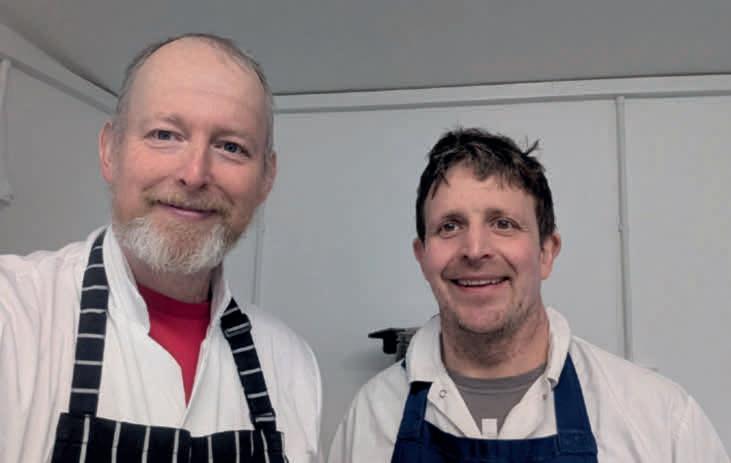
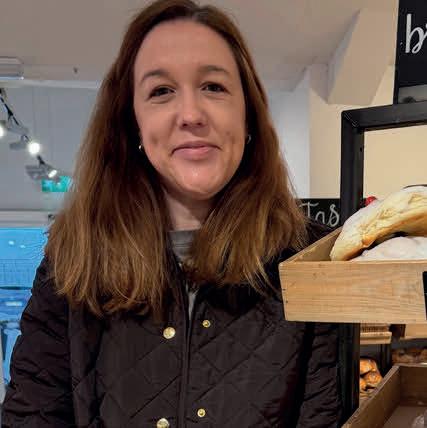
Notice anything di erent? There’s still a bloke in a navy shirt in the top right corner of this page – but he looks a little older, his beard is a bit greyer and he’s possibly smiling a little bit less. Yes, I’ve nally updated my photo in the magazine.
I’ll leave it to our most dedicated readers to play ‘spot the di erence’, but please be kind – the previous one was taken in 2014 (well, that’s a conservative estimate anyway).
Don’t think me vain for bringing it up. The only way I could force myself to actually achieve this momentous task – a er it being a running joke amongst colleagues for at least the last ve years – was to commit to writing this very leader.
There are certainly some parallels between my own struggle to update my image and the trials and tribulations faced by retailers and other small businesses.
Well, either way. I suppose I owe you an explanation. What’s taken me so long?
This is a prime example of human beings’ capacity for stagnation –something that retailers can su er from too. You don’t update your signage, adjust your pricing, review the range. Even though you should.
Change is not easy. You have to force yourself into it, as I did by making promises to colleagues.
Next thing to consider is the movement of time. Have you ever recommended a lm to someone –and then been hit by the shock of it being a full decade old?
Time creeps up on you. That’s exactly what’s happened in this case. Have a look around your premises and focus on one thing: a menu, a poster, a shelving unit. Ask yourself how long it’s been in that very spot. Brace yourself for a fright. If you leave something unattended for long enough, it just becomes part of the background. Unless someone points it out to you (I owe one particular colleague a big thank you for giving me the
push). It might not be so easy in a retail context but I’ll paraphrase some advice I’ve heard from top consultants. Next time you open up your shop, go in through the front door and walk the route from the front door to the till. You’ll see the shop through your customers’ eyes and hopefully spot something that they always notice but wouldn’t dare tell you about.
The last thing to factor in is that I hate having my photo taken. There are always things in life we put o because we don’t like them. Whatever your line of work, don’t dawdle as long as I did.
Truthfully, I feel better for deciding to show the world what I actually look like now (I would be smiling in the new portrait but it makes my aging forehead concertina). And I dare say any updating you can do, no matter how small or overdue, will bring a little bit of joy to your working week too.
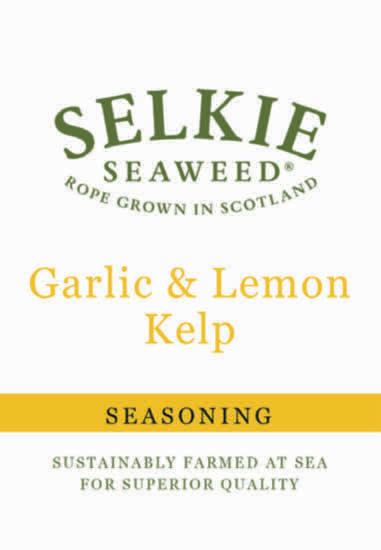
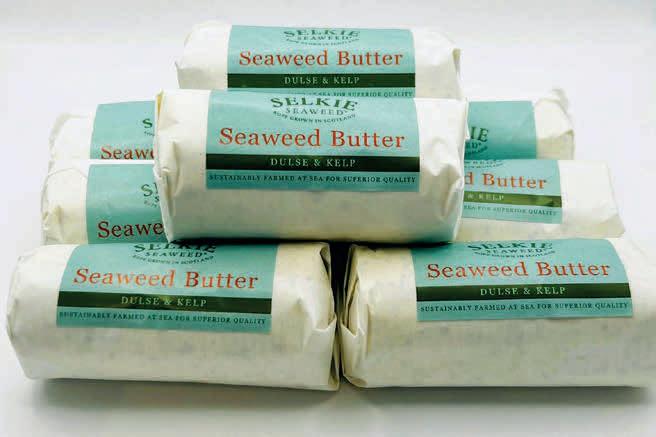
I’m rarely one for having things prepared for me. Unless I’m at a restaurant, I value my independence when making dinner. I’m not a ready meal (or God forbid, a meal kit) kind of girl. But sometimes, a seasoning blend like this comes along and earns my trust. The kelp on its own is delicious, all briny depth and the essence of the sea, lifted by bright citrus and earthy, funky garlic. Sprinkle over fish, salads or rice, and join me in gratitude for Selkie Seaweed’s helpful hand. More on p.46
editorial@gff.co.uk
Editor: Michael Lane
Deputy editor: Tanwen Dawn-Hiscox
Art director: Mark Windsor
Contributors: Nick Baines, Claire Bullen, Patrick McGuigan, Greg Pitcher, Phil Taylor, Lynda Searby
opportunities@gff.co.uk
Sales and publishing director: Sally Coley
Senior sales account manager: Becky Haskett
Sales executive: Henry Coley
Sales support: Tamsin Bullock
Accounts assistant: Julie Coates
Finance director: Ashley Warden support@gff.co.uk
Managing director: John Farrand
Associate managing director: Christabel Cairns
Partner relations director: Tortie Farrand Chairman: Bob Farrand
Warehouse lead & operations support: James McCall Published by The Guild of Fine Food Ltd Fine Food Digest is published 11 times a year and is available on subscription for £50 p.a. inc P&P.
Indies bracing for the impact of April business rates hikes
By Greg Pitcher
Fine food retailers are preparing for another juddering cost rise as a major subsidy that has been in place for six years – the Retail, Hospitality and Leisure Business Rates Relief Scheme– comes to an end in March.
Put in place at the start of the Covid-19 pandemic, the subsidy has kept bills down for many a er several extensions. Its demise comes at the same time as the National Living Wage rises by 50p to £12.71 an hour alongside increases to the pay oors for younger workers.
Sangita Tryner, owner of Delilah Fine Foods, said the Nottingham business had cut its headcount due to
ballooning costs.
“We’ve gone down from a team of 14 at Christmas to 12 now,” she said. “We will look for people on parttime hours to ll in during busy periods.”
Tryner added that all her costs were rising at the same time, and passing the entirety of these increases on to customers was impossible.
In January, Chancellor Rachel Reeves announced a package of support for pubs losing the bene t of the relief scheme.
Boozers will get 15% o their business rates alongside a review of how their buildings are valued and a combined £10 million to boost footfall.
Tryner said she was “disappointed” to see food
shops le out.
“High streets are struggling, and it would have been nice to see some support.”
Nick Sin eld, chief executive of Teals Farm Shop in Somerset, said there was an “underlying sense of unfairness” from retailers at being le out of the measures o ered to pubs.
He added: “It is frustrating that the Government seems to enjoy making life di cult for businesses. But on the other hand, there has been generosity since Covid. They have to make a policy decision, and there isn’t much we can do about it.”
Sin eld said Teals was working out budgets and giving upcoming cost rises
WHAT THEY ARE SAYING ABOUT... ...HOW ARE YOU PLANNING FOR APRIL’S COST HIKES?
“We are buying cleverer, negotiating and squeezing where we can. We’ve put foodservice prices up by changing dishes so it isn’t as noticeable. In March we will probably be looking at the £4 coffee, which is something I have been fighting. But I can’t compromise on retail margins, if you erode those you’re stuffed.”
“We look at how we can achieve next year’s growth without compromising cost to the consumer or local employment. We try to strike a balance that is fair to suppliers, customers and employees. We look to find efficiencies and if that isn’t possible we try to find the best balance between prices and costs. The good thing is that process forces you to become a better business.”
“a lot of thought”.
For some food retailers, the loss of support could be a tough pill to swallow, he warned.
“If you’re on a at trajectory, you are in a tricky position. Your costs
“We’re not making any immediate blanket price increases; simply reacting to price rises between 2-4% on the retail side of things, and we have little choice but to pass on. We are highly likely to have to make some adjustments to menu pricing, but it’s a fine balance with retaining consumers and finding a price point that makes the hard work worth it.”
£1bn investment into local areas to boost high street business
Ministers have outlined almost £1 billion of spending on local neighbourhoods – and independent retailers have demanded a say on how it is spent.
On 31st January, the Government announced £150 million to regenerate rundown high streets.
Four days later, Prime Minister Keir Starmer revealed that 40 areas would share up to £800 million through the ‘Pride in Place’ initiative to transform their communities.
He said: “We must reverse the devastating decline in our communities and give power, agency and control to the very people who want to improve their community – those who have skin in the game.”
Andrew Goodacre, chief executive at the British Independent Retailers Association, welcomed both pots of cash.
But he called for local businesses to have a voice in how the money was spent.
He said: “Investment in public realm,
are going up, so your pro t and cash generation will go down.
“In a growth scenario, it is easier to accommodate.”
The picture on business rates is complicated as many premises have been revalued this year, and the Government has also changed the ‘multipliers’ used to convert those valuations into annual bills. Meanwhile other support schemes are available for small businesses. The Government has described the change in the landscape as “a permanent tax cut” o ering “much-needed certainty and support”.
But three case studies given on an o cial explainer updated in January showed indies’ annual rates bill rising in 2026/27.
facilities, accessibility and property will all be crucial. We’d also like to see historic independent retail businesses, often operating in historic buildings, receive support to share their stories with the wider community.”
Goodacre also repeated a call for businessrate reform “to create a level playing field for independent retailers”.
“Without this, we risk having beautifully restored high streets with no businesses to occupy them,” he warned.
TOM NEWEY, COBBS FARM SHOP
SANGITA TRYNER, DELILAH FINE FOODS
NICK SINFIELD, TEALS FARM SHOP
IN BRIEF
New nutrient pro ling model will level playing eld for healthy food producers
By Greg Pitcher
Health campaigners have urged independent retailers to act “in the spirit of” longawaited changes to a key food classi cation system.
In late January, the Government published the outcome of a consultation held eight years ago over the UK Nutrient Pro ling Model (UKNPM).
The latest document updated the core guidance used in classifying food products for various purposes, including de ning the scope of advertising and placement laws.
Although the changes revealed in January will still go out to further consultation before coming into force, experts say they represent a key milestone for the sector.
“This is a technical tweak to the engine room that shapes UK policy on advertising and promotions [of certain foods],” said Beth Bradshaw, policy lead at the Obesity Health Alliance.
“We believe it is
fundamental as it underpins important legislation we would like to see strengthened and improved.”
Bradshaw said the updated model, if put into policy, would turn the spotlight on “more ultraprocessed foods that people are concerned about and more products containing lots of sugar”.
But she described the ongoing delay translating the landmark 2015 SACN
The new UKNPM model explained
A trigger to update the UKNPM model came in 2015 when the Scientific Advisory Committee on Nutrition published its Carbohydrates and Health report suggesting changes to the recommended diet.
It called for free sugars –monosaccharides and disaccharides added to food & drink, as well as those naturally present in honey, syrups, fruit juices and concentrates - to account for no more than 5% of daily energy intake.
This recommendation was implemented in the updated 2018 UKNPM, representing a major
change from a 21% limit for all sugars under the existing system.
Bradshaw said certain yoghurt and cereal products would be classified as “less healthy” if the revised model was brought into policy. This could see a raft of new items caught under laws such as those governing advertising of targeted food and drink.
The Government said the UKNPM 2018 reflects the recommendations, and that no further significant changes to dietary recommendations have been made since 2018.
review (see box-out) into rm policy as “very frustrating” and added that there has been “a lot of lobbying from the food and drink industry”.
New laws came into force in January banning advertisement of “less healthy” food and drink on TV before 9pm and, when paid for, at any time online. Meanwhile, separate legislation restricts the promotion of such products by price or positioning.
Bradshaw noted the exemptions available to many small producers and retailers under these rules.
But she added, “We all have a role to play. We are facing a huge issue in the rise in obesity at primary age that will be carried into adulthood.
“Independent retailers can think about ways they can support customers to access healthier options.
“They know their customers and there is clear
demand for healthier food. It is important to be aware of the shi in consumer demand and health consciousness.”
She added: “Just because policies don’t apply to a small business doesn’t mean it can’t act in the spirit of them by making small changes to recipes or stores.”
Guild of Fine Food managing director John Farrand backed the Government’s announcement on the UKNPM.
But he added: “It is deeply disappointing to see the glacial pace with which things have progressed thus far.
“For too long, the juggernauts of the food industry have been able to get away with clever marketing to cover up their lack of meaningful action, while small producers and independent retailers have had to pour precious resources into defending what is fundamentally good food.”
Booths hints at geographic expansion a er refreshing its executive team
Premium food retailer Booths has set its sights on reaching markets with “untapped potential” with a new strategy and senior management structure.
The regional supermarket – which has 26 stores, mainly in the North West of England – in February announced the creation of a five-strong executive team and a new vision not constrained by geography.
Nigel Murray, who has been at Booths for more than a decade, moved from managing director to chief executive.
Reporting into
him are chief brand officer Emma Booth, chief operating officer Rebecca Hardman, chief commercial officer Nicola Karran and chief financial officer Damien McDonald, who is also company secretary.
Murray said: “The creation of this team is a critical enabler in the delivery of a new broader business strategy.
“We have untapped potential within our brand-reach and also our manufacturing base. There are significant opportunities in new markets and with new customers for what we make and develop,
be that through other businesses or direct to consumers.”
He added that he had “huge confidence” in his new executive team.
“There is a bright future for the business, in Booths Country and beyond, and this team will enable us to deliver positive change with pace and impact,” he added.
Chairman Edwin Booth will continue to lead the family grocer.
He said: “We are keen to realise the potential for the Booths brand and the love it evokes across the country.”
The changes could help tackle childhood obesity by highlightling “less healthy” foods to consumers
Taste of the West hosts rst awards ceremony since rescue deal
By Tanwen Dawn-Hiscox
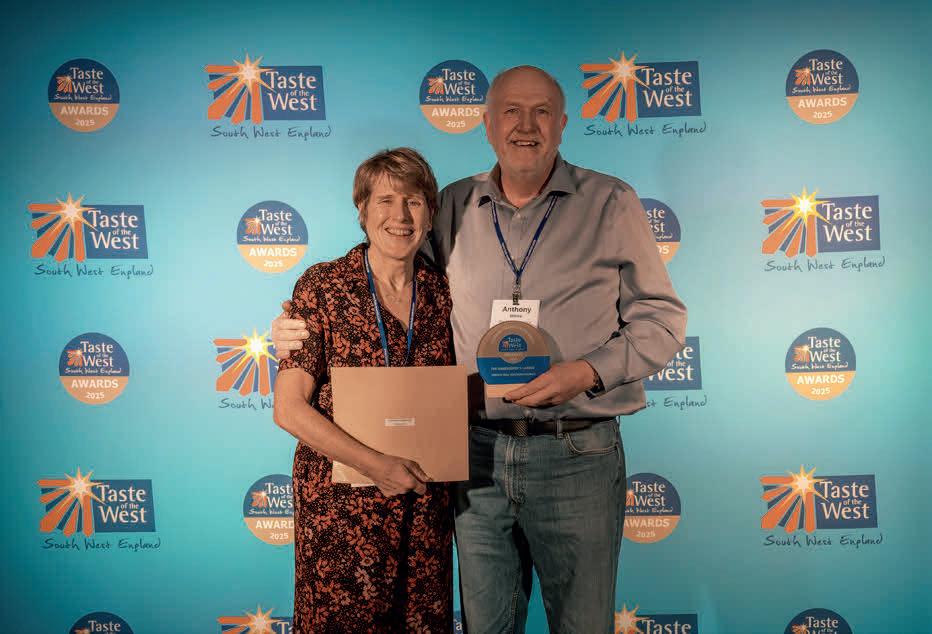
Last month, Taste of the West celebrated its 2025 award winners at the rst ceremony since it was rescued from administration and relaunched as a community interest company last year. The event took place at The Source trade show at Westpoint in Exeter, welcoming 200 guests from across the food & drink industry.
Established in 1991, Taste of the West was one of the rst regional food and drink trade organisations, founded when Regional Development Agencies and EU rural development funding were proli c. It supports producers, retailers and hospitality providers across Cornwall, Devon, Somerset, Dorset, Gloucestershire, Bristol and Wiltshire, with a membership of around 1,000 businesses. Services include marketing and development support,
WALES TO INCLUDE GLASS IN DRS SCHEME
Many drinks suppliers have warned they are likely to stop selling into Wales after Westminster cleared the inclusion of glass in Wales’ Deposit Return Scheme, due to be introduced in England and Wales in October 2027. Bottles will need to be labelled for sale, or not for sale, in Wales, and trade bodies claim the additional compliance burden will be too high for some businesses to remain in the market.
alongside preferential access to the Taste of the West Awards.
However, as grants dwindled and the economic landscape grew more precarious, the organisation collapsed in May last year and administrators were appointed. A month later, a group of self-described “people who care”, including Charles Baughan, founder of Westaway Sausages and a Taste of the West director, and managing director of Hale Events,
Mike Anderson, relaunched the trade body as a CIC, meaning pro ts are reinvested into the South West food and drink industry.
Five founding businesses, Leino, FSC Group, Stephens Scown, Wyke Farms and Yeo Valley, subsidised the relaunch. Director Chris Milton, formerly of Thatchers Cider, described it as “an exciting and daunting challenge”, adding: “We created the Founders Club to enable
DOWN ON THE FARM
interested businesses to invest in the future of our organisation. Our sincere thanks to the rst ve founders for believing in our vision and helping us safeguard this precious regional asset.”
This year’s awards recognised 27 producers, 13 hospitality and retail businesses, and two sustainable businesses, alongside a Supreme Champion. Winners included Anton’s Butchers in Devon for its Steak and Devon Blue Cheese Pie; Hollychocs in Wiltshire for its Caramel Collection; Cornish Cheese Co for Cornish Blue; and the Gamekeeper’s Larder, whose whole sika venison haunch was named Supreme Champion Product.
Otterton Mill South West Farm Shop in Devon was named Best South West Farm Shop, while All Things Cornwall took Best South West Specialist Retailer/Deli. tasteofthewest.co.uk
The latest from farm shops across the country
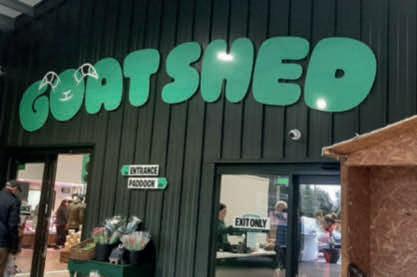
On the last Saturday of every month, starting on March 28th, a market will be held in the Maize Maze field adjoining the Goat Shed Farm Shop and Kitchen in Honingham, Norfolk. This monthly market was launched partnership with The Best of Norfolk, bringing together independent, local producers and retailers, creating what they hope will become a regular destination for foodloving shoppers. goat-shed.co.uk
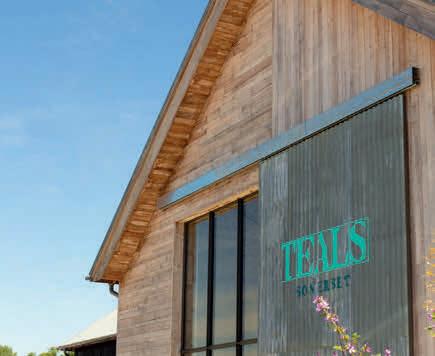
Plans to extend Teals Farm Shop in Somerset by an additional 164 square metres of floorspace and 189 square metres of ‘community’ space outdoors have been approved. They will see the addition of new, non-food retail space; revamped toilets; 59 parking spaces, including electric vehicle charging points; and space for local events to be held away from the current takeaway area. teals.co.uk
IN BRIEF
In a victory for the Real Bread Campaign, after it raised complaints to Trading Standards, M&S has renamed several of its ‘Only…Ingredients’ products to reflect the true number of ingredients they contain.
Wholesaler
Cotswold Fayre has named Gary Jordaan as its new operations director. Jordaan comes from largerscale businesses Euro Food Brands, BOSH! Media, Mars and Friesland Campania.
Labour’s promise to ban imports of foie gras could be scuppered by the new Sanitary and Phytosanitary Agreement with the EU, Animal Equality UK has warned. Foie gras production has been banned in the UK since 2006.
Successful “pick your own” farm Kislingbury Sunnies & Spooks of Northampton has submitted plans to convert an existing agricultural building into a farm shop and café. Four years of sunflower, pumpkin and wildflower picking with additional seasonal events has created a following for the farm, and the addition of a farm shop will diversify the offerings further. A decision is due mid-March. kislingburysunnies andspooks.co.uk
Westlands Farm Shop in Winchester recently hosted a group of French delegates and local government representatives set out to learn about farm diversification. Specifically, they set out to learn how farm-tocity models can unlock new revenue streams by bringing local products to urban consumers, something Westlands does with great success. westlandsfarmshop. co.uk
In association with Fabulous Farm Shops fabulousfarmshops.co.uk
Supreme Product Champion Gamekeeper’s Larder
CHAMPAGNE IS NOT JUST ANY OLD TIPPLE and Miller’s aren’t just any old biscuits and crackers. extraordinary
IF I’D KNOWN THEN WHAT I KNOW NOW...
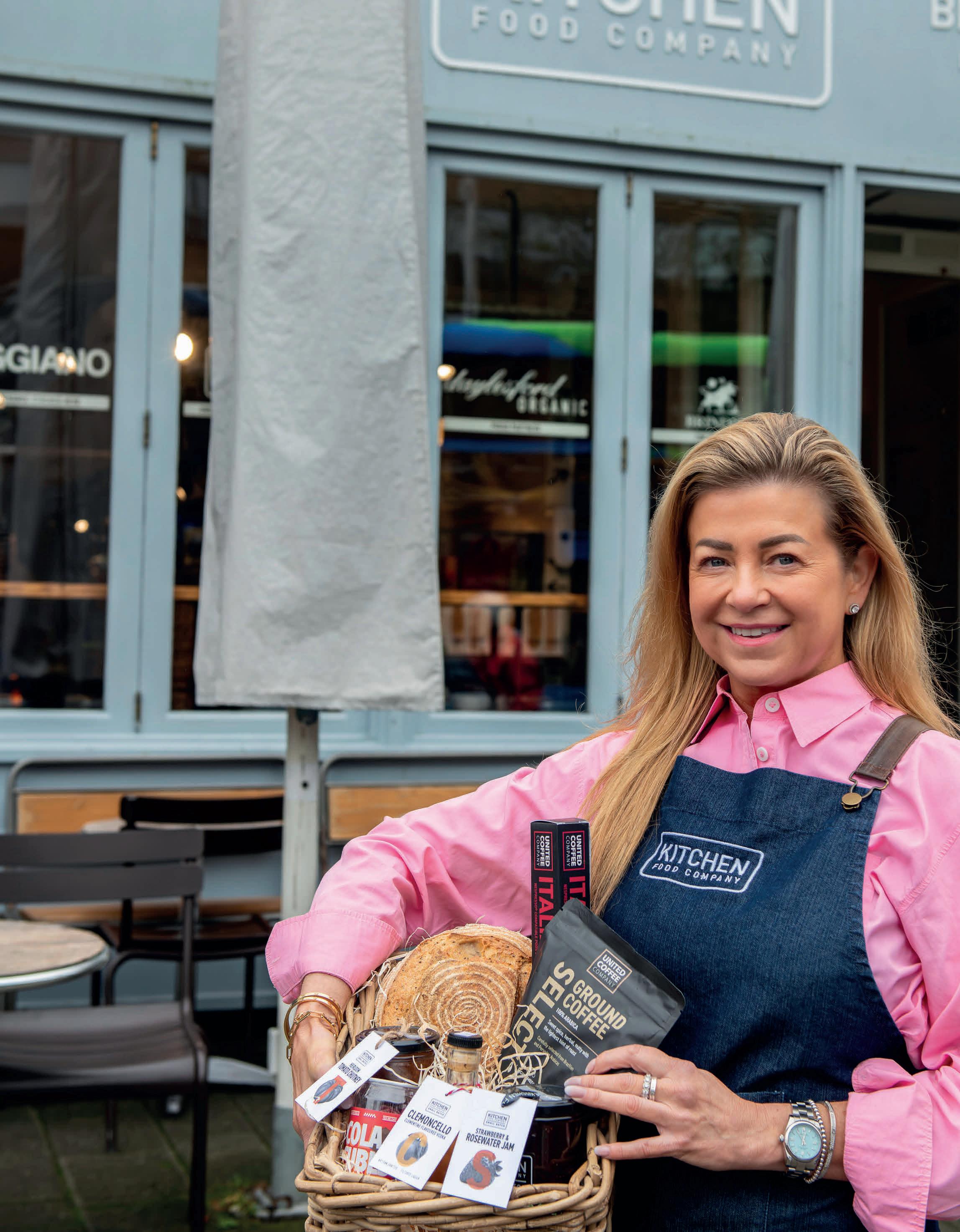
SAM WILSON, co-owner, The Kitchen Food Company, Summertown, Oxford
My partner Steve and I have been together for almost 20 years, and for most of that time we’ve worked side by side. We’re both trained chefs, but while Steve followed the hotel route in France, I began my career with Sodexo.
I moved from the kitchen to front of house, working on large-scale events at venues including Wimbledon, Ascot and Henley, before progressing into food and menu development for pubs and restaurants.
Our paths crossed in 2003 when we were both working for Compass. Two years later, Steve founded Cucina, a school food business that grew to serve 100 schools. During this time, we settled in Oxford. Seeing an opportunity to create something special locally, we opened The Oxford Kitchen. We had always dreamed of earning a Michelin star, and after four years, we did.
We adapted quickly during Covid, evolving the restaurant into a more relaxed bistro concept. After the sale of Cucina, I began thinking about creating a business that would offer both creativity and balance. Meanwhile, Steve was busy founding MPP, a procurement business, and alongside that established Big Drinks and United Coffee. After living in New York, I had long held a dream of opening a deli inspired by Dean & DeLuca, a vibrant food destination combining quality produce with a sense of theatre. In 2022, we brought that vision to life, transforming the site into The Kitchen Food Company, with a deli downstairs and a daytime bistro upstairs.
We have gradually shifted away from stocking larger brands to focus on more locally sourced products and our own small-batch range of jams, chutneys, pickles and gins.
We have had to remain nimble, refining the model as we go. Increased costs meant we streamlined the team and focused the menu around a simple but strong brunch offer. In the deli, lunchtime trade drives the business, supported by a carefully curated retail selection centred on treats, entertaining and gifting. The bistro now thrives at weekends, and event catering has become an exciting and fastgrowing part of the company. I’ve developed a range of beautifully presented boxes and grazing boards for parties and local businesses, delivered and styled in eco-packaging. The creative side of this work particularly inspires me.
I’ve always said that if you’re not happy to get up and go to work, you need to get another job. This was meant to be my retirement, and while I don’t think I have ever worked as hard, I’m happier than ever to go to work. kitchenfoodco.co.uk
Interview Lynda Searby
Photography Isabelle Plasschaert
View from HQ
FFD’s publisher and Guild of Fine Food managing director John Farrand has his say
TFor a relatively insular bunch, farmers do a pretty good job of collective whingeing and making themselves heard in Westminster
he only thing more boring than the incessant rain is talking about it. And so, I should have known better when I signed up for a late January romp across the wilds of Wiltshire, with good friends, most of whom were farmers. It was the subject du jour.
For a relatively insular bunch, they do a pretty good job of collective whingeing and making themselves heard in Westminster. I admire that. It might be tractors in Parliament Square, Minette Batters on another soapbox or the more subtle, lucrative approach by the Game and Conservancy Conservation Trust’s (GCCT) Allerton Project.
My headline of the year so far, attributed to right-leaning The Telegraph, is ‘‘Clueless’ civil servants sent to farms to learn how they work’. I read the article with a mix of respect and resentment. Respect because it appears that the GCCT has landed a £650,000 contract to ‘upskill’ Defra
JOIN THE GUILD OF FINE FOOD
Our members are a tight-knit community of businesses with a shared passion for good food &drink.
Representing independent retailers and the producers who supply them, the Guild of Fine Food is a source of advice and support and a place to share your views.
There is a whole host of benefits that come with membership, including reduced rates for training, venue hire and advertising, access to the Deli Retailing Code of Practice, free webinars and helpdesk, opportunities to have your say on issues facing our sector in the Town Hall, and more.
To learn more about becoming a member of the Guild, visit gff.co.uk/join-us
employees with a foundation in farming know-how in an attempt, I assume, to bridge the gap in their knowledge, but also to strengthen urban and rural relations.
Victoria Atkins, the shadow Defra secretary, pointed out that there may be a lack of understanding and therefore empathy from Whitehall, for those who work in wellies. “It will not surprise any farmer to learn that many civil servants, like the current crop of ministers they serve, have no clue about farming or the countryside,” she said.
It’s laudable that this initiative is happening, but my resentment cuts in when I think about how I would love to land a deal like this to extend that awareness to the production of quality food.
Good news everyone, according to Sainsbury’s, quality food is on the up. In the same way that Whitehall is piling into the countryside, the supermarkets continue to plough our eld. Their
‘Taste the Di erence’ range has surpassed £2bn in sales, they proudly PR. In fact, most of the multiples seem to put emphasis on premium rather than basic lines helping to restore margins. I’m not sure about the quality of raw ingredients or the production methods in these lines, but most of the food & drink producers I know seem to be having their margins squeezed rather than extended. We’re into March, so surely the rain will relent soon. It will then be summer and presumably be too dry for farmers. I’m looking forward to the next Defra Agri-Food group meeting. We won’t bore on about the weather anymore, we’ll be able to chat about crop rotation, PTO sha s on John Deere tractors and rotary parlours. At least the civil servants will understand why the crops have failed and they will marvel at how dairy farmers sell ‘Taste the Margin’ milk to the supermarkets for less than it costs to produce.
The Word on Westminster
By Edward Woodall Association of Convenience Stores
LAST MONTH, AN influential committee of MPs released a report looking at the Government’s Small Business Strategy, with over 60 recommendations aimed at supporting SMEs. The report covers a huge range of topics, looking at everything from energy costs and late payments, through to crime and business rates. I’ve highlighted three recommendations that we believe would make a big difference.
Firstly, a recommendation that straddles the line between two of the biggest issues facing local shops – business rates and crime. We’ve long called for CCTV to be removed from the list of things that affect the value of a business for the purpose of calculating business rates, and we’re pleased that the committee has listened to those calls. At a time when safety is a huge focus of investment for stores, there’s no good reason why we should pay twice to keep people safe.
Next is the level of protection that local shops get from regulator Ofgem when dealing with energy companies. We’ve made the case that independent food retailers are not energy
experts, and essentially have the same level of insight into the market as domestic consumers. The Committee has recognised this and recommended that more businesses be given the same protections as consumers.
Finally, the upcoming Crime and Policing Bill will aim to reset the narrative on retail crime, but with additional proposals on merging local forces and scrapping Police and Crime Commissioners, the concerns of our sector mustn’t get lost in the shuffle. The Committee has recommended that every police force has an Assistant Chief Constable who has an explicit responsibility for tackling business crime. We know that relationships between retailers and the police have improved over the last year, and this recommendation takes a further step to ensure that the progress made so far isn’t lost. There is far more in the report than what’s been mentioned, much of it extremely positive for our sector if implemented, so I would recommend taking a look and browsing through the whole thing if you can - it’s certainly a great way to start a conversation with your local MP if nothing else.
Edward Woodall is government relations director at the ACS edward.woodall@acs.org.uk
CONFESSIONS OF A DELI OWNER
Anonymous tales from behind the counter
MOST PEOPLE LIVE with a sanitised, low-level anxiety about crime. They worry about a stray pickpocket in a crowded place, or their house being burgled while they are clinking glasses on a beach. But for those of us running rural businesses, the fear is far more visceral, and expensive. While the urban imagination views the countryside as a sleepy paradise of rolling hills, we are essentially sitting ducks waiting for anyone with a getaway car to take a shot. When we rst took over our site, the security was practically a written invitation for predators. A sturdy crowbar to the front door was all it took to gain entry. No
alarms, no CCTV, just easy access and a naive hope in human nature. It was a criminal’s dream, and it didn’t take long for us to become victims.
Our rst two encounters with the local underworld were embarrassing for all involved. A group of local teenagers broke in one night, but these criminal masterminds had not done their homework. A er failing to crack the till, they made o with what they thought was a haul of pick and mix in green and white stripy bags near the counter. In reality, they had stolen bags of chopped vegetables intended for customers to feed to our pigs. The second time, they upgraded to ice cream. While these
Rural shops are o en perched near major roads, o ering a fast exit for anyone looking for a low security target
Expert eye
TVHARI
RUSSELL, FOUNDER OF THE FOOD MARKETING EXPERTS, ON WHY MARKETING DOESN’T WIND DOWN AFTER EASTER.
he next eight months a er Easter o er overlooked opportunities that savvy brands are already planning for.
May through to June is the forgotten season. While competitors go quiet, smart brands own summer. Bank holidays, Father’s Day, and picnic season create natural PR hooks. Pitch “al fresco dining” features now for June coverage. Create recipe content around outdoor eating, BBQs, and no-cook meals that actually help timepressed shoppers.
In July and August, editors need you. Summer is traditionally slow for food news, which means journalists are actively looking for stories. Your new product launch gets more attention in July than it would in January. Festival season, staycations, and “feed a crowd” content all perform brilliantly.
September is the the Second New Year.
incidents make for great stories, the reality of living on site and knowing someone has been nosing around at 2am does wonders for your sanity. Then the professionals arrived. These were not bored kids looking for a sugar rush; these were career criminals who viewed my business as an easy target. They did not bother with the pig food. They ripped the entire safe out of the wall. It was a brutal, calculated wake-up call. Rural shops are o en perched near major roads, o ering a lightning-fast exit for anyone looking for a low security target with high value stock. Since then, we have spent a small fortune on alarms, reinforced steel doors, and CCTV cameras. It is a rural crime tax that nobody tells you about when you’re writing a business plan. Even though our last major hit was years ago, the ghost of it still dictates my morning routine. My day starts with a shot of adrenaline as I stare at the shop entrance, checking for the telltale signs of a forced door. There is a speci c kind of violation that comes with walking into your workplace and seeing it trashed. We are told we are the backbone of the rural economy, but most days it feels like we are just a conveniently located, unmonitored ATM.
Back-to-school isn’t just for kids. September shoppers are resetting routines, making it prime time for launches targeting busy parents, batch cooking, and weeknight solutions. Pitch lifestyle features in July for September publication.
If you haven’t started preparing for the October-December period, start now. Create gi guides, entertaining tips, and seasonal recipes that establish your brand before the December rush.
Map every seasonal moment from now through year-end. Assign PR pitches (remembering the three-month lead time), social content themes, and retailer conversations to each. The brands that plan their whole year outperform those who only show up for Christmas.
The rest of 2026 isn’t le over time; it’s your competitive advantage. If you need further inspiration, download our free social media calendar for key events, dates and ideas. thefoodmarketingexperts.co.uk
The brands that plan their whole year outperform those who only show up for Christmas
The rate at which the UK’s organic food & drink market grew in the year up to October 2025. 2.5% The rate
at which volume sales of organic food & drink grew over the same period in the UK.
Source: The Soil Association
ARE YOU LOOKING FOR MORE?
Whether it’s staff training, business advice, event space, making industry connections or opportunities to meet trade buyers and food lovers, the Guild of Fine Food does far more than publish FFD The Guild has been championing independent food & drink for over 30 years. Join us today and find out what we can do for your business.
Support & ideas: support@gff.co.uk
Training & venue hire: bookings@gff.co.uk Exhibition stands: opportunities@gff.co.uk
Share the taste of Wales with your customers this St David’s Day.
The Fine Cheese Co. set to open ‘Cathedral to cheese’ shop and café
By Patrick McGuigan
The Fine Cheese Co. is set to open a major new farm shop and café at its HQ near Bath, billed as a “cathedral to cheese”.
The 200-square-metre shop, branded The Fine Cheese Co. Cotswold Way, will open next month and includes a four-metre-long “wall of cheese,” a marble-top counter, and a café with 38 covers. A new bakery and production kitchen are also part of the new construction.
“Cheese is central to what we do, so we wanted to create a cathedral to cheese with high ceilings and an oak-framed glass-fronted extension,” explained retail operations manager Oliver Sutton. “We carry around 190 cheeses in our range and will o er around 90-100 in the shop, with the selection rotating seasonally. There will also be a broader representation of what we do with all our other products, plus partner brands and other local and seasonal foods.”
The shop, which has 70 parking spaces, is located at the former Marsh eld Bakery opposite Fine Cheese’s maturing rooms and headquarters on Tolldown Farm, on the A46 close to junction 18 of the M4.
“It’s a busy main road with a lot of passing clientèle, and we’re on the Cotswold Way, which is popular with walkers and cyclists, so footfall is really good,” said Sutton. “Places such as Gloucester Services have shown that there is a market for good food and drink on busy roads. But the new shop will also be a great place for us to host trade customers from across the UK and abroad. Our door has always been open, but this gives us the space to really showcase what we are about. We see it as a multifaceted space for the public and the trade.”
The Fine Cheese Co. has
Caws Cenarth has launched four of its artisan cheeses in Tesco stores across Wales, including Thelma’s Original Caerffili, Perl Wen, Perl Las and Cenarth Brie.
Sales of cottage cheese continue to rocket, driven by TikTok posts highlighting its high protein content. Tesco has reported a 200% increase in sales in two years.
Andy Swinscoe, owner of The Courtyard Dairy in Yorkshire, has written and published a ‘definitive guide’ to Wensleydale. ‘Wensleydale Cheese and Other Dales’ Cheeses’ details the history of the famous crumbly cheese, recipes and cheesemaker case studies. The 59-page book costs £13.
a shop in Bath, which has been open for around 30 years. “[We] began as a retail shop, so it has always been important to us, and there are opportunities out there for good shops in the right locations,” said Sutton. “We don’t have grand plans to open more bricks-and-mortar sites a er Cotswold Way, but never say never.
According to Fine Cheese’s annual report on Companies’ House, pre-tax pro ts increased to £667,000 in the year to 31 March 2025, while turnover increased 21% to £25m. Exports accounted for 44% of revenue.
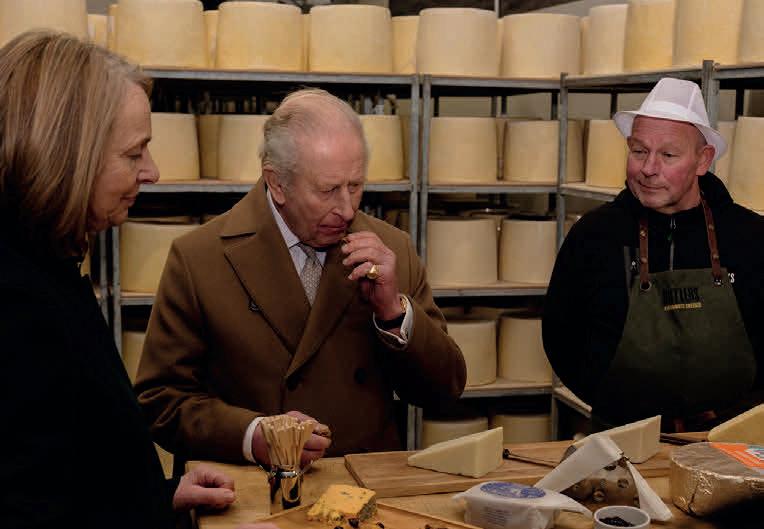
His Majesty King Charles III officially opened Butlers Farmhouse Cheeses’ new cheese campus in Lancashire last month. The new facility was built after a devastating fire at the site just over two years ago, which saw hundreds of tonnes of cheese stock lost just before Christmas. The King met three generations of the Butler family, along with long-standing employees, before touring the campus to discover the full production process. He also tasted Blacksticks Blue with blackcurrant jam on a ginger biscuit.
THREE WAYS WITH...
Rædwald
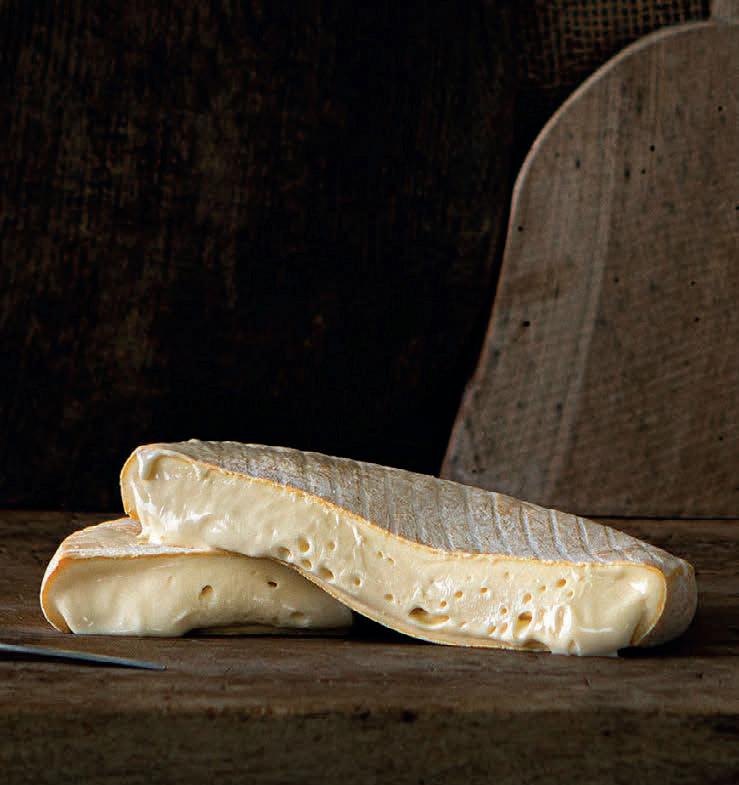
Fen Farm Dairy’s Reblochon-style washed rind cheese Rædwald is back after launching last year. The 1.2kg pasteurised cheese is only available at the end of winter for a few months. It is washed in brine to create a bronze rind and gooey texture. The flavour is savoury, malty and earthy.
Bungayflette
Fen Farm has worked with chef James Jay to create a British version of the French melted cheese dish Tartiflette. Nicknamed ‘Bungayflette’ (in honour of where the dairy is located), the dish is baked with roasted garlic, shallots and fried pancetta mixed with thin slices of potato and cream, topped with sliced Rædwald.
Palo Cortado
Washed rind cheeses are notoriously tricky to pair with wine. Their funky flavour can trample on the delicate flavours of white wines and clash with the tannins in reds. But sherry matches the intensity of the cheese, while bringing its own unique flavours. Try Palo Cortado, which is initially aged under a veil of yeast (flor) before being barrel aged. The result is a dry wine that balances freshness with rich, nutty, dried fruit flavours.
Tarallini
The oozy nature of ripe Rædwald calls for a cracker with crunch. Sourdough crackers or toasts both work well, but try spreading the cheese into the gap of a fennel seed Tarallini for something a bit different. The knot-shaped Italian baked bites from Puglia have a biscuity texture that contrasts with the soft cheese, while the fragrant fennel seeds dovetail nicely with the aromatic rind.
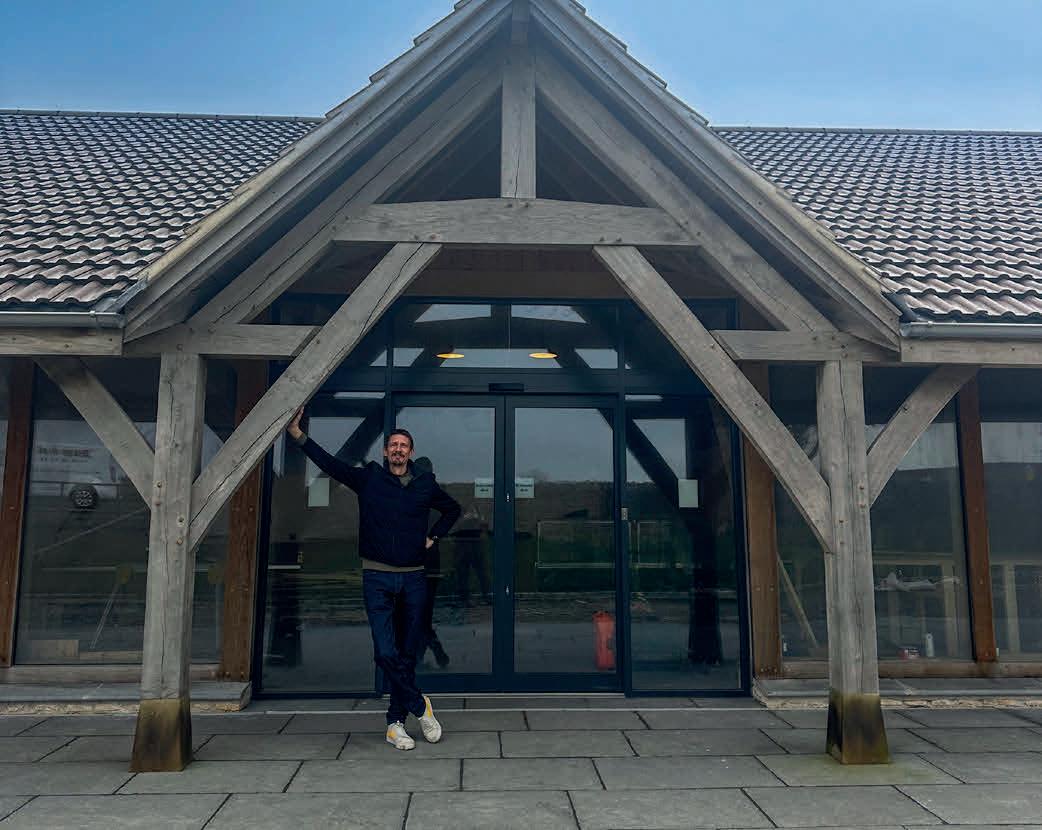
The Fine Food Co. retail operations manager Oliver Sutton standing outside the new shop and café, which was still being built at the time of writing
CHEESE
Scottish Cheese Academy to improve local knowledge of local cheese
By Patrick McGuigan
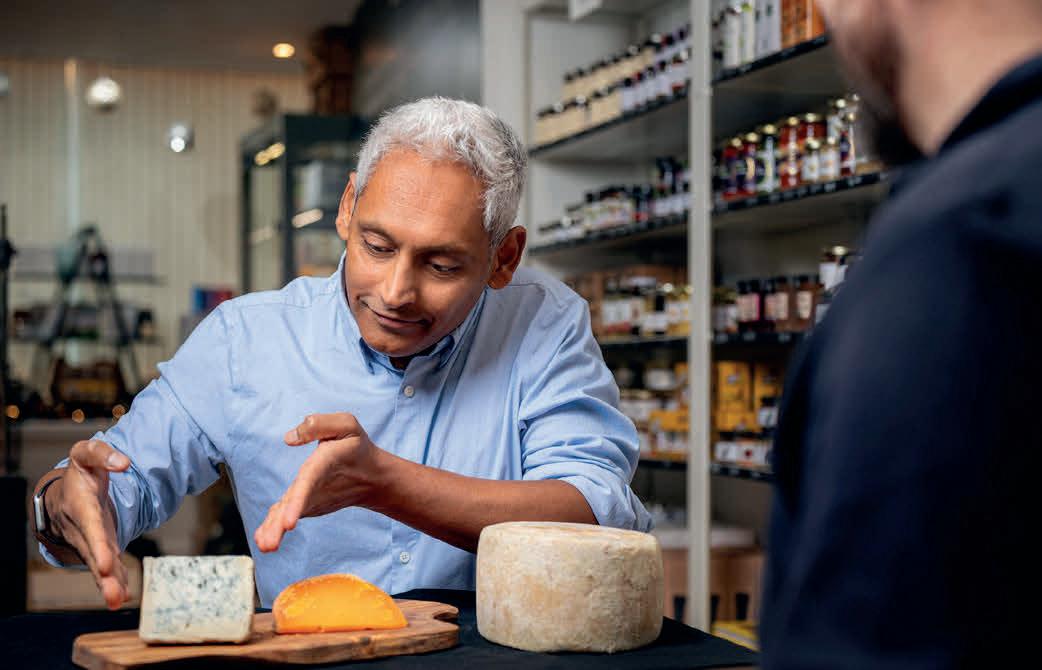
Cheese expert Tanny Gill has launched Scotland’s rst ever cheese training organisation, which aims to raise understanding of Scottish cheese with professionals and the public.
The Scottish Cheese Academy, which launched last month, o ers Academy of Cheese courses and bespoke training courses, as well as tastings and cultural events for the public. Gill has more than 20 years’ experience, having previously worked for Isle of Mull, La Fromagerie and wholesaler Clarks Speciality Foods. He is also a longstanding judge at the World Cheese Awards.
He told FFD there was “a missing link” when it came to championing Scottish cheese, so set up the Academy to “ ll the gap”.
“When I worked at Clarks I trained hospitality and retail business for many years and it was clear that while sta would understand wine and whisky,
CHEESE IN PROFILE with
when it came to cheese they o en le it to the wholesaler to decide or there might be a chef that had worked in France and wanted only French cheese.”
He added: “My goal is to raise the standard of service across the hospitality sector and champion our heritage with the same rigour applied to the world’s nest wines and whiskies. Hospitality teams need the con dence to sell and describe artisan cheese with the same uency they use for
hay. Life in the mountains was demanding and largely run by women, who tended the cattle, made the cheese and managed daily life in the jasseries.
What’s the story?
wine. But equally, the academy delivers the high-end sensory experiences food lovers need to truly understand the history and avour pro les of our amazing cheeses.”
The new company is backed by a Strategic Advisory Board, which includes Patricia Michelson, owner of La Fromagerie; the former chair of Highland Fine Cheese Andrew Baker; and cheese educator and judge Sue Sturman.
scottishcheeseacademy.com
BEHIND THE COUNTER TIPS OF THE TRADE
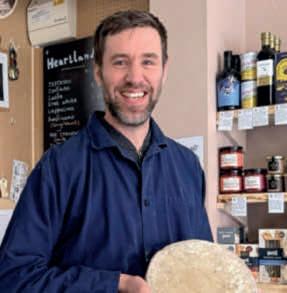
Ed Billins, owner, & Caws, Menai Bridge, Wales
After 10 years working at La Fromagerie, Ed Billins swapped the bright lights of London for Anglesey in North Wales in 2021.
“There is slower footfall but lots of tourists between Easter and October,” he says. “At La Fromagerie, customers often knew what they wanted, but here people are more interested in listening and learning.”
The counter stocks 30-40 cheeses from Wales, England and Europe. Hafod and the locally made Môn Las, Yr Afr and Brefu Bach are particularly popular. “Price is an issue. I was conscious not to be seen as a fancy London boy bringing fancy London ways, and pricing ourselves out of the market,” he says. “We buy direct from local cheesemakers, so I can price competitively. Being in a rural area means we have more direct links with cheesemakers.”
A foray into natural wines was less successful. “The market wasn’t there, so we went more mainstream, although still from small producers.”
The biggest change was setting up the café a year after opening, which accounts for around half the business. “It keeps us busy during the week when the shop is quieter.” andcaws.co.uk
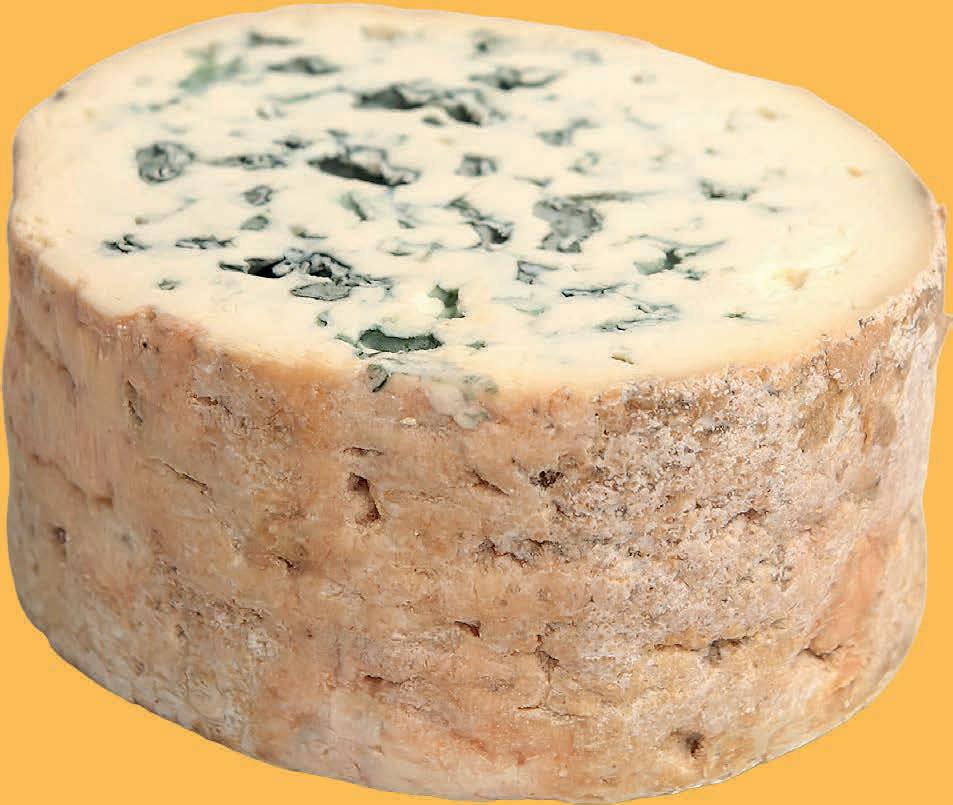
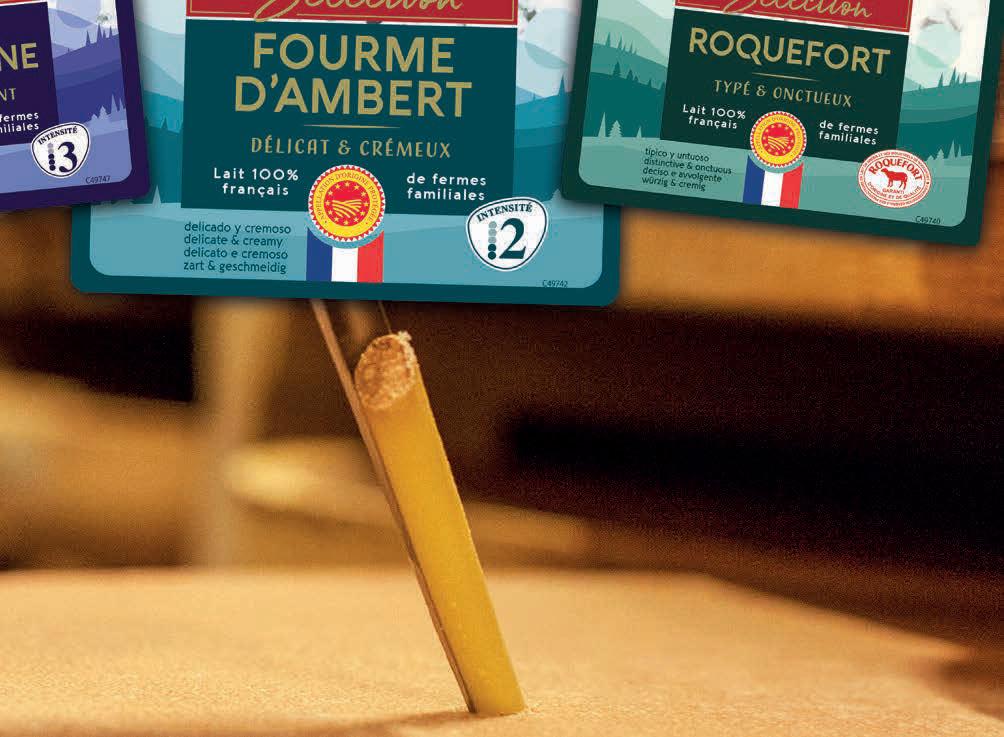
d’Ambert before being transferred to cool, humid cellars to mature. Fourme d’Ambert is aged for several weeks, slowly developing its distinctive character, and cannot be sold under its name until at least four weeks after the milk is first set.
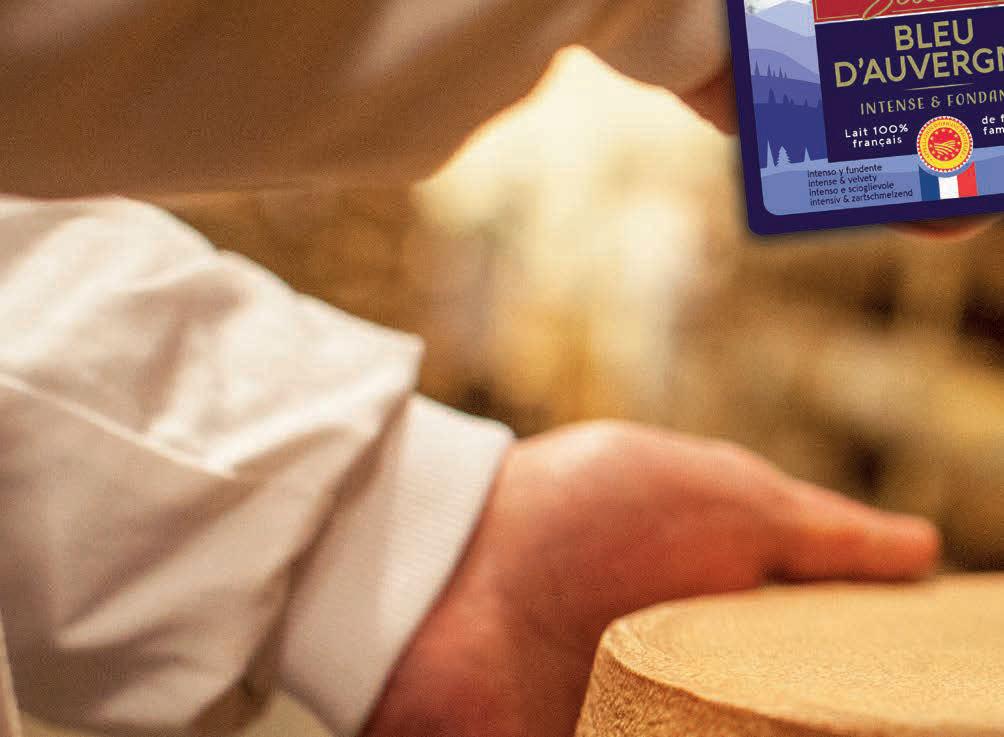
Fourme d’Ambert is one of France’s oldest PDO cheeses from the Auvergne region, with roots stretching back to the ninth century and possibly as far back as Roman times. Traditionally, it was made high in the mountains of the Haut-Forez in seasonal farm huts known as jasseries. Each spring, small herds were taken up to the summer pastures, allowing the village fields below to rest and be cut for winter
How is it Made?
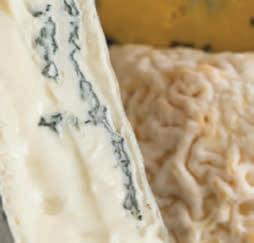
The cheesemaking process begins with gently warming the milk before adding rennet to coagulate it. Once the curd forms, it is cut into small pieces and left to rest, allowing excess moisture to drain away. The curd is then partially drained before being placed into moulds, where it sits without pressing and is turned regularly. After one or two days, the cheeses are pierced to encourage blue mould development,
develops a pale grey natural rind, often mottled with touches of white, yellow or red mould. The paste ranges from white to soft cream in colour, with evenly scattered veins of blue-green mould throughout. The texture is smooth and supple, while the flavour is milky and fruity, finishing with a subtle saltiness.
Variations: None
Cheesemonger tip: Pairs perfectly with sweet wines, such as Sauternes, but also Vouvray and light reds, such as Côtes d’Auvergne.
Chef’s recommendation: The gentle flavour of this cheese makes it a versatile and rewarding ingredient in the kitchen. It works beautifully in a Hautes-Chaumes cake, where a classic cake batter is folded with crumbled Fourme d’Ambert and fresh blueberries. The cheese brings a subtle tang and savoury saltiness that cuts through the fruit’s sweetness, creating a perfectly balanced combination
Fourme d’Ambert is one of the 75 cheeses studied as part of the Academy of Cheese Level Two Certification. For more information on this and all of their courses, head to: www.academyofcheese.org
Gill’s career has spanned cheese production, retail and affinage since he moved to the UK more than 15 years ago
Fourme
THE TASTE OF TRADITION.
Keep your cows warm
Farmer and vet Matt Gue founded Adur Valley Creamery to add value to his herd, farming year-round under cover in a system he says delivers consistency, sustainability and high welfare for his 400 pedigree Holsteins.
Rattling along a muddy lane in West Sussex, our farm buggy rounds a corner and a giant lake appears on the horizon. Except there isn’t meant to be a lake in this part of West Sussex. Torrential rain since Christmas has led the River Adur to burst its banks, turning green elds into a glassy lagoon.
“Flooding has become the norm and it’s only going to become more common,” says dairy farmer-turned-cheesemaker Matt Gue, who is avoiding puddles as we hurtle down another track. Not that he’s bothered. His cows are safe and dry in dry sheds as you would expect in February. Perhaps less expected is that they will still be there in six months when the summer sun is out and the waters have receded.
That’s because Huddlestone Farm, near Steyning, takes a di erent approach to farming to most other artisan cheesemakers. Its 400-strong milking herd of pedigree Holstein cows is housed year-round and fed a controlled diet of homegrown grass, silage and wheat, plus citrus pulp from a nearby juice factory. They are free to wander round the airy barns and eat as they please, choosing when they are milked and how o en using robotic miking machines.
“What we do is a bit di erent to what people expect, but no farming system is better than any other,” says Gue, who is also a vet. “As long as the cows are healthy, the business is pro table and you’re happy, that’s the right one for you.”
There’s no denying the cows seem calm and quiet in the sheds, and sickness and lameness has decreased since they switched over to robotic milking in 2023, says Gue. Huddlestone’s cows are the number one herd of Holsteins in the country in terms of genetics, based on pro tability data that tracks everything from yield and longevity to health
and calving. “They’re the genetic elite,” says Gue proudly.
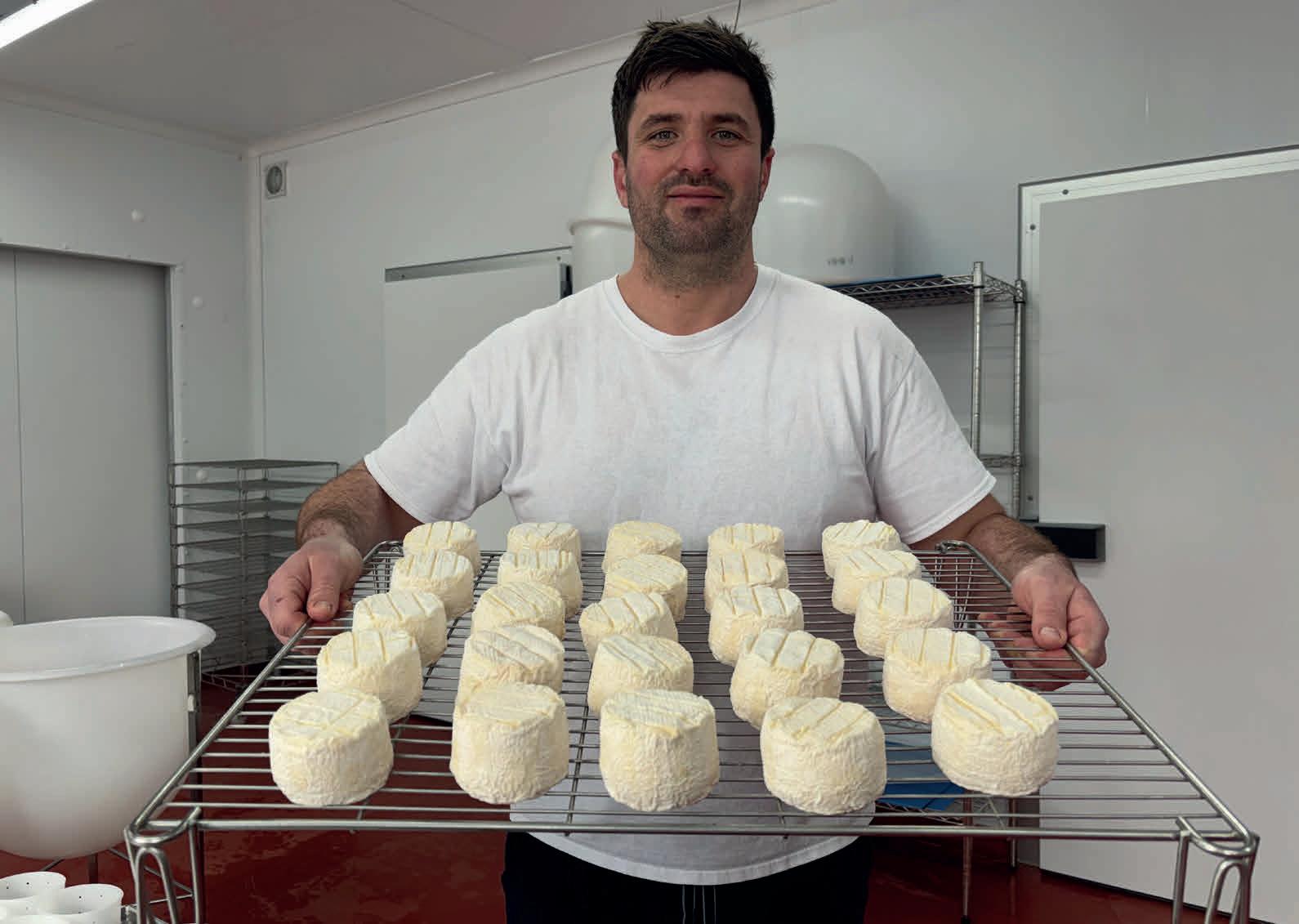
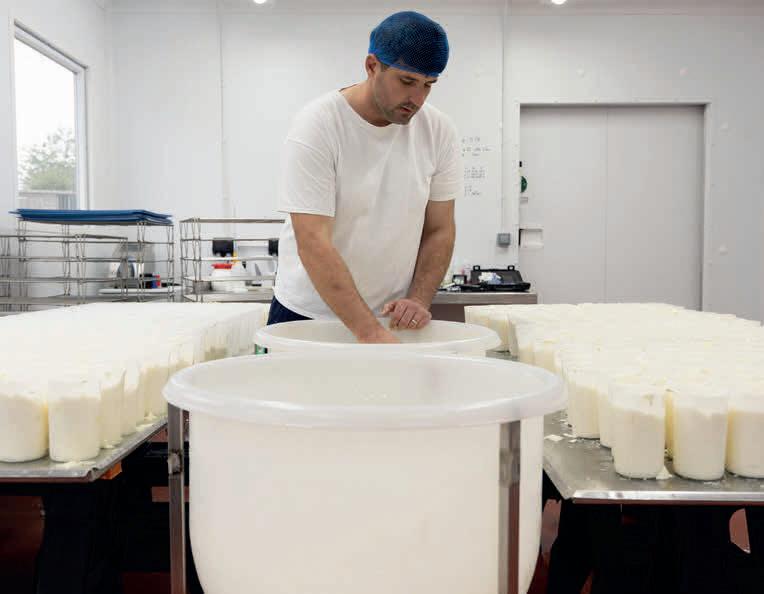
Huddlestone’s approach results in rich milk with butterfat and protein levels of 4.8% and 3.8%, respectively, which is where the move into cheesemaking came in. One of three brothers on the farm, Gue set up Adur Valley Creamery last year to add value to the milk, making a so Chaource-style cheese called Cuthman, a er taking a cheese course at the School of Artisan Food and building his own dairy. He currently sells his cheese at markets and to local retailers, making about 200 a week. But there is capacity for 10 times that amount. “We’re feeling our way into it, but the plan is to start supplying wholesalers,” he says. “We’re aiming for 5-10 tonnes a year. It doesn’t sound a lot until you start trying to sell that much.”
Thankfully, Cuthman ticks a lot of boxes for buyers. The success of Rollright, St Jude and Baron Bigod shows there is huge demand for British so cheeses made on farm, especially with the continued ban on imports of so raw milk cheeses from Europe.
“They are ddly cheeses compared to cheddar, but they are popular with the public and ready to sell in two weeks, which is good for cash ow. And we can develop other products relatively easily, like butter, washed rind and larger cutting versions, as well as avoured cheeses with tru e or dried fruit. They are all on the to-do list.”
Cuthman’ adaptability goes back to Huddlestone’s farming system and rich milk, which is well suited to creamy so cheeses. “People want cows out grazing all the time, but if they are happy and you make a great product it shouldn’t matter,” says Gue.
Come rain or shine, there’s more than one way to milk a cow.
instagram.com/adur.valley
So cheeses are ddly compared to cheddar, but they are popular and ready to sell in two weeks
CROSS SECTION
Cuthman
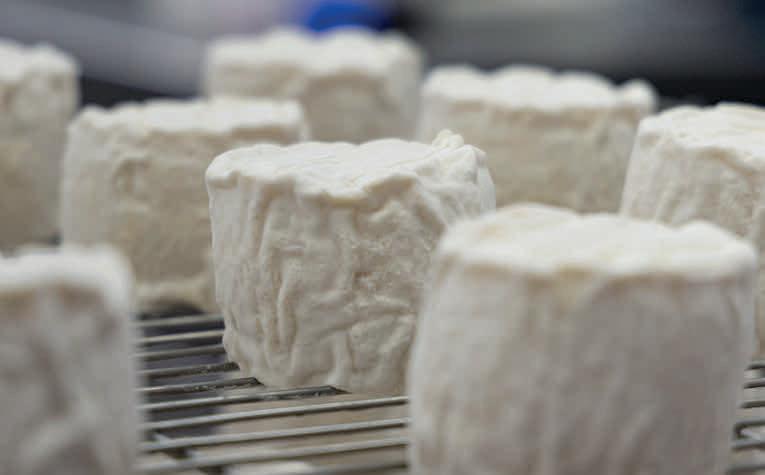
Cuthman is a lactic cheese, made by acidifying pasteurised milk overnight using French starter cultures. The curd is moulded in the morning, demoulded the day after, and the young cheeses hastened in a warm room for two days. They are then salted and hastened for another 24 hours. In total, the cheese takes seven days to make, before being matured for a further two weeks.
2
The tissue thin rind has a fruity, yeasty flavour, while the paste beneath breaks down into a glossy, savoury layer over time. The core of the cheese has a dense texture like clotted cream with notes of Greek yoghurt and cut grass.
Cuthman is named after St Cuthman, a shepherd who founded the nearby village of Steyning in the 7th Century. He is said to have travelled by foot transporting his paralysed mother in a wheelbarrow. When the contraption broke, Cuthman decided it was a sign from God to end his travels and build a church, still standing in the village. 1
Matt Austin
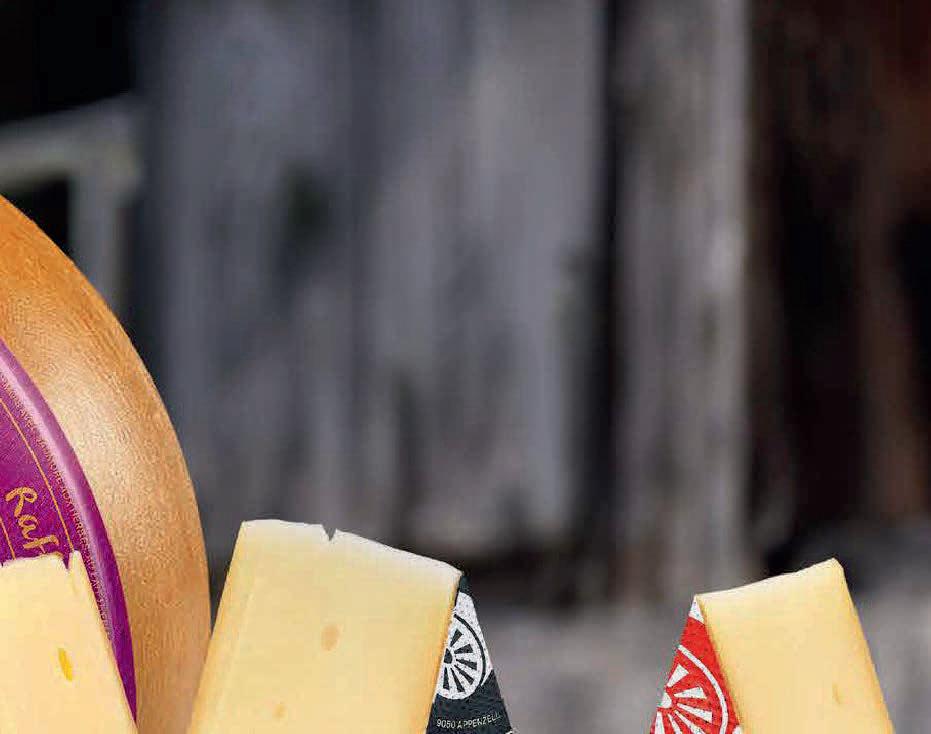
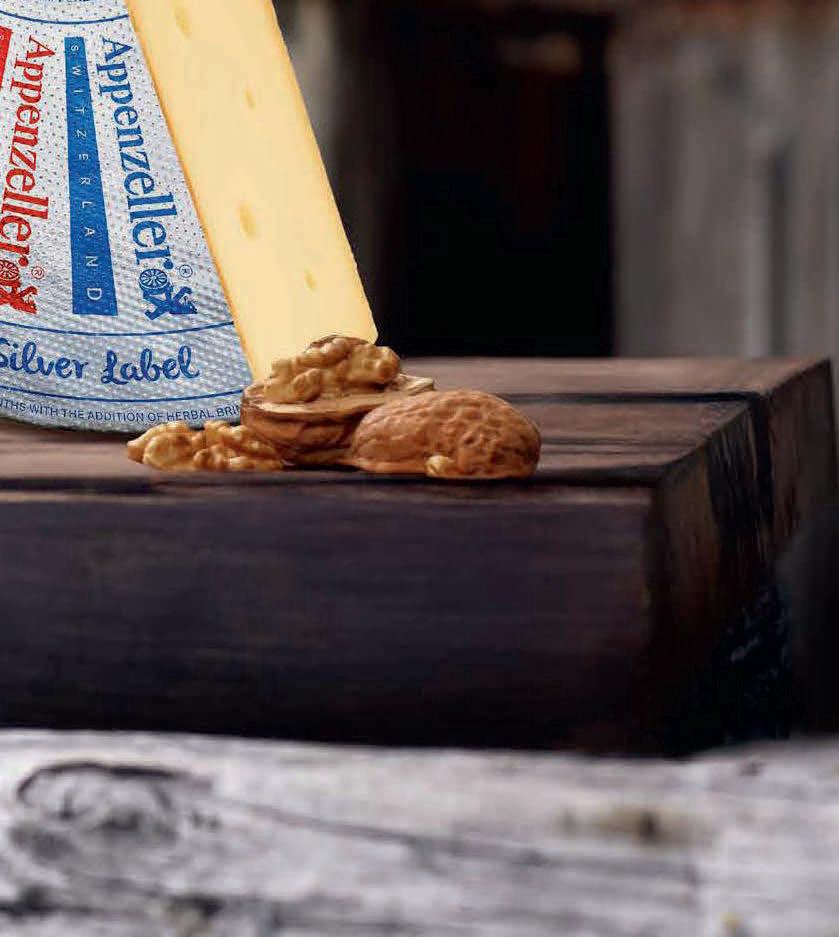
Purple Label
Aged for 9–12 months
Complex and lingering
Black Label
Aged for 6-8 months
Sharp and robust
Silver Label
Aged for 3 months
Mild and creamy
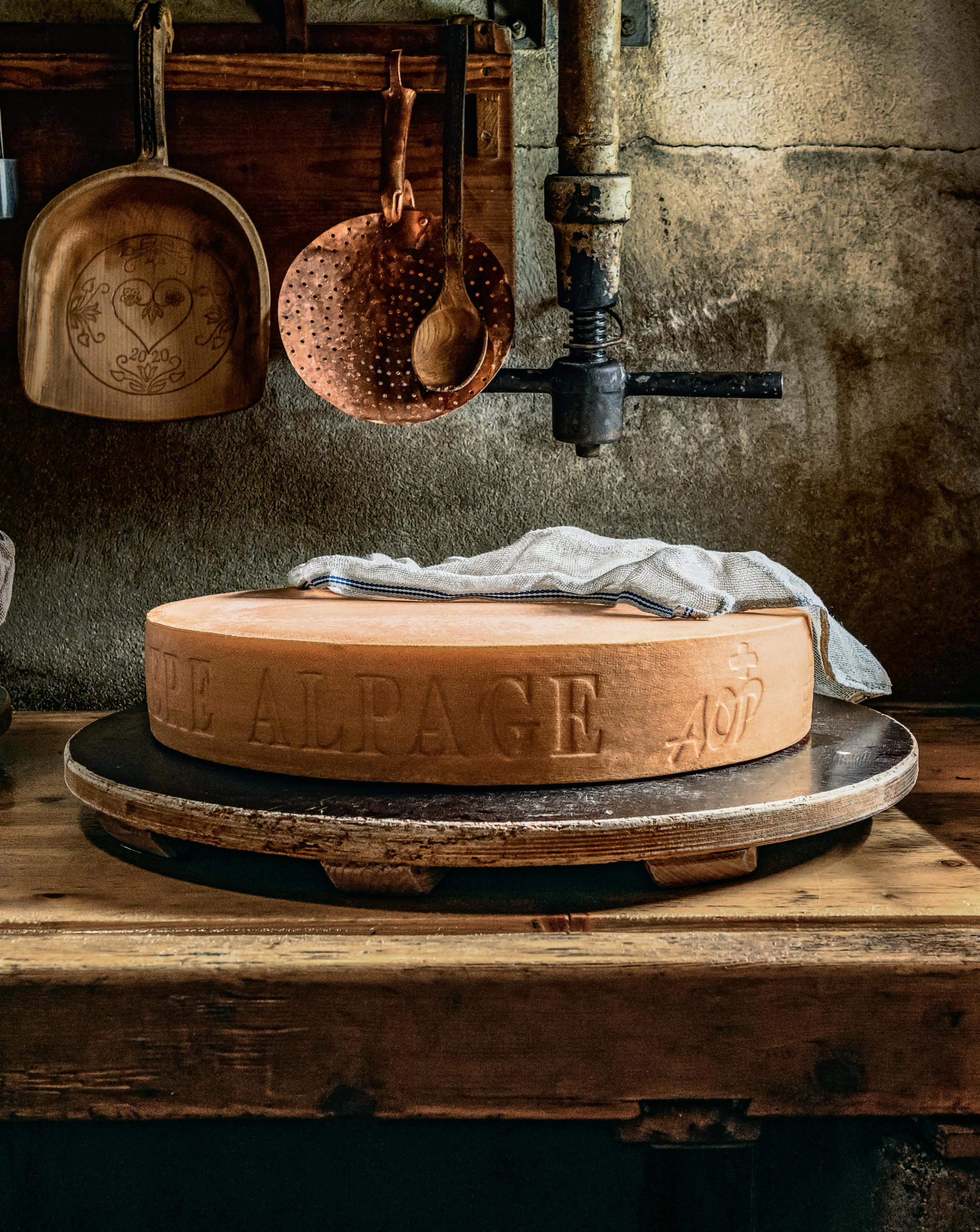
tastiest cheese comes to life in the known as Twice a
Switzerland’s idyllic Alpine region Appenzellerland. day, farmers bring their fresh and still warm cow’s milk to one of the 40 authorized cheese dairies where master cheese makers use their years of expertise and more than 700 years of artisanal tradition to transform it into delicious Appenzeller ® cheese.
Bringing Northern Ireland to the table
SHOW
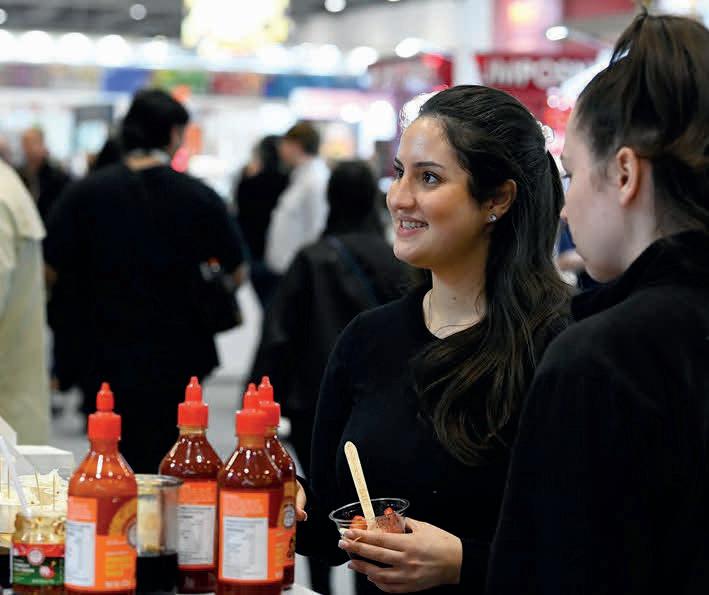
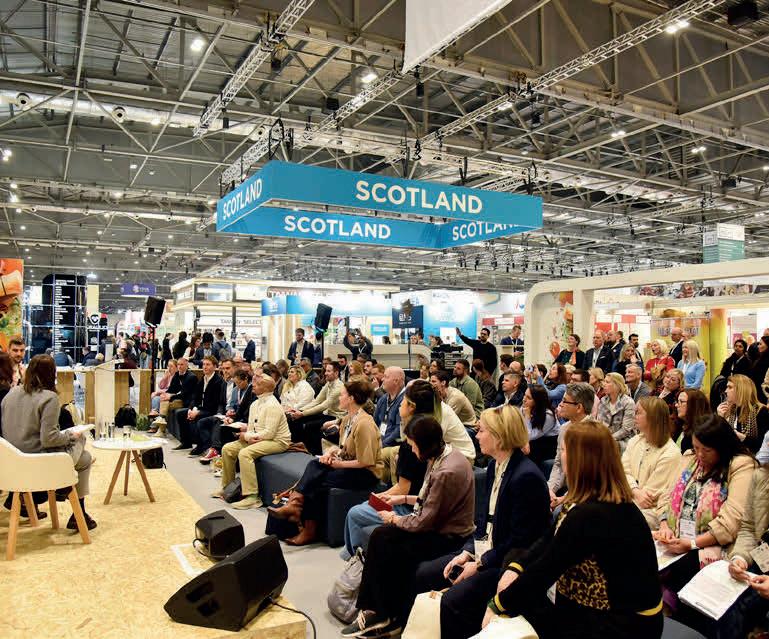
IFE returns to ExCeL London from 30th March to 1st April as the UK’s leading food and drink sourcing platform, connecting UK and international producers with buyers across retail, wholesale, travel and hospitality.
Six reasons to visit… ...IFE
Breakout food & drink
IFE’s Startup Market brings emerging food and drink brands into sharp focus, with this year’s line-up including DelicDay, Mr. Sprinkle, SheReal, Dragon Mama’s Kitchen and Yogoody. With live pitches on the New Producers Discovery Theatre, it o ers ne food buyers a concentrated view of early-stage brands with growth potential.
Get ahead of the trends
The Future Food Stage explores the forces shaping food and drink’s next phase, from mood-boosting nutrition and AI-led waste reduction to 2026 trend forecasting. Sessions also cover travel buying, frozen food and legumes, giving buyers context on which categories are gaining momentum and why.
High-value connections
Part of Food, Drink & Hospitality Week, IFE brings together around 25,000 trade visitors from retail, wholesale and foodservice, o ering exhibitors a focused platform to reconnect with contacts, build new relationships and pitch directly to buyers through curated sessions and showcases.
Driving growth
Source standout products
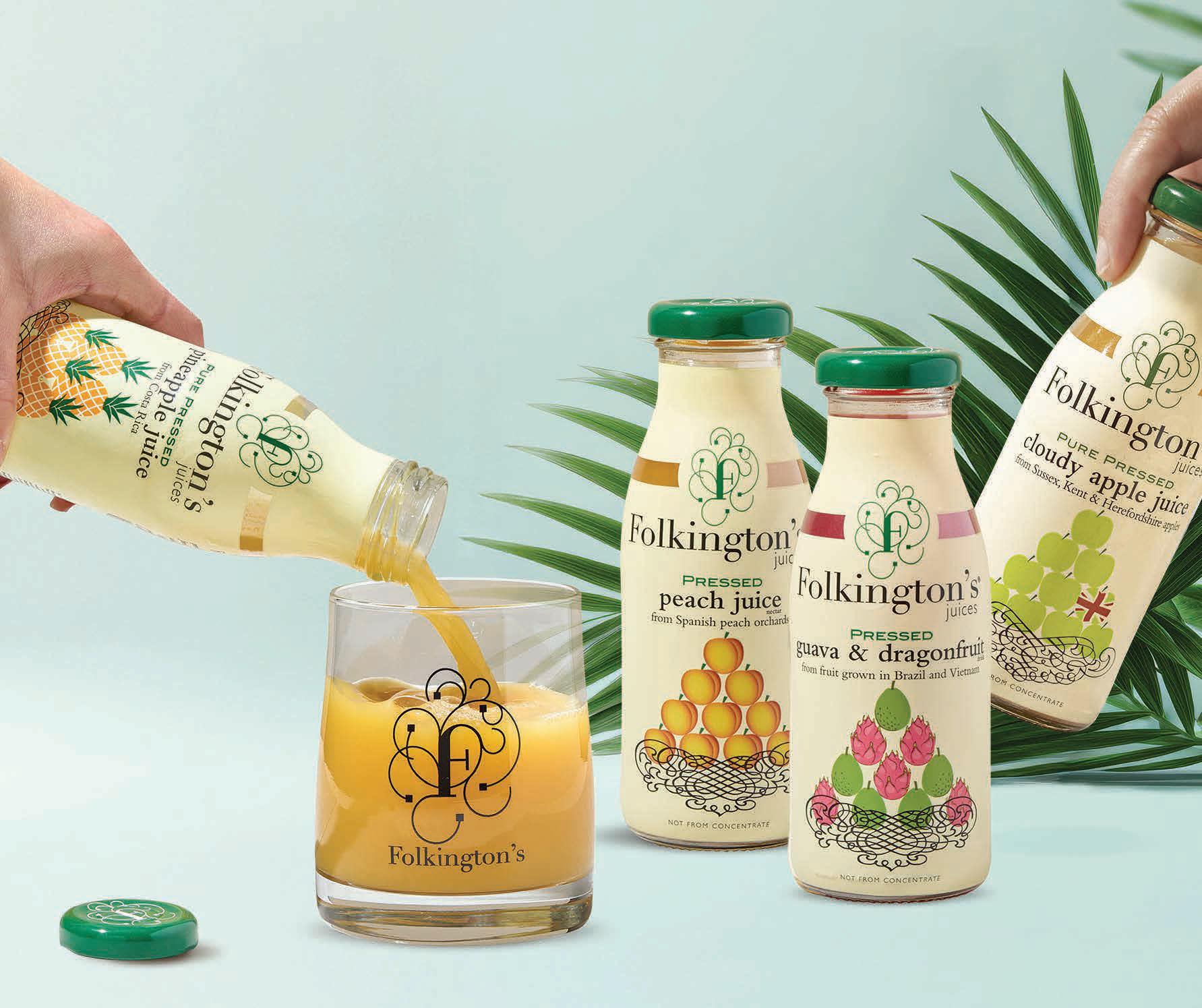
IFE brings together hundreds of UK and international exhibitors across core food and drink categories, with the Speciality Food section a key draw for ne food buyers. Exhibitors include Folkington’s, Naturli’, Smokin’ Brothers, vanillabazaar and The Farmer’s Son, alongside launches from coconut water to Dubai-style chocolate and plant-based burgers.
IFE Manufacturing’s Trends and Innovation platform explores future product development, with sessions on ingredient innovation, sustainable sourcing and AI, alongside market insight from Mintel and returning highlights including FDReviews’ food failures session.
Celebrate the brands raising the bar for food & drink
Two awards ceremonies take place on day one, celebrating innovation across ingredients, development, sustainability and technology. IFE runs as part of Food, Drink & Hospitality Week alongside IFE Manufacturing, HRC and other co-located shows. Register at ife.co.uk. 1 4 2 5 3 6
Photo Jean FondacciRéalisation Audrey Paradisi
The House always wins
Interviews by Tanwen Dawn-Hiscox
Three decades in, The House of Bruar has become a Scottish institution. While managing director Patrick Birkbeck shies away from the ‘Harrods of the North’ label, he tells FFD why he remains ercely proud of the Cairngorms department store’s ethos, and how he is steering the business through its challenges and ambitions.
By Tanwen Dawn-Hiscox
Here at Fine Food Digest, we’ve been known to be a touch superstitious. Regularly enough to arouse deliberations about the scope of our own in uence, we pro le a business which, through individual circumstances, ends up closing within the following twelve months. But we would eat our hats if this were to happen to The House of Bruar, the three-decade-old department store in Scotland’s Cairngorms – hats that may well have been bought from an extensive selection of felt, sheepskin or cashmere chapeaux, in tweed or plaid patterns, or with fox-fur pom-poms on top.
The House of Bruar, founded by Patrick Birkbeck’s parents, Mark and Linda Birkbeck, rst opened its doors in 1995. It was established as a clothes shop, but has since expanded its o er to ne food & drink, homeware & gi s, and also has a restaurant, an art gallery and a garden centre. It welcomes more than two million visitors a year and employs more than 350 people.
Back when it started, Birkbeck did not picture himself at the helm of the family business, but he willingly fell into it. He worked on the building site and on the shop oor while at university, where he was studying to become an accountant. As the business gathered momentum, he realised he couldn’t just walk away.
His title was attributed to him informally, on a whim. “In November ’98, I was sitting in a meeting with my father,” he explains, “and a
supplier of ours said, ‘So Patrick, what’s your role in the business?’ And my father said, ‘Well, he’s the managing director.’”
Since then, whether driven by the needs of the business or a desire to prove himself worthy of that title, Birkbeck has done every job going. “Everything that anyone else had to do, I did,” he says. Even now, he nds it hard to step away completely. Ahead of a recent Black Friday sale, he sat down with the warehouse team to ask how he could help. “Right, so Saturday, picking in the warehouse?” he asked, only to be met with a polite but rmly negative response.
Perhaps here lies some of his reasoning for always mucking in: this expectation extends to everyone who works at The House of Bruar, and is likely why it still feels like a family business, despite its scale. “The people who’ve been at The House of Bruar for a long time will not walk across the car park without picking up a cigarette end,” says Birkbeck. “If there’s a mess, if someone’s dropped an ice cream outside, you get a mop and you deal with it. I don’t care whether you’re a senior manager or somebody who’s just come in and you’re a student, you do the job.”
For the most part, Birkbeck leans into his strengths, overseeing nance, human resources, systems, strategy and operations. His brother Tom, meanwhile, is the creative director at The House of Bruar, responsible for product selection and design. Their parents
still hold ceremonial roles in the business, but no longer contribute to day-to-day operations.
Given Scotland’s widely celebrated culture, the outlet’s location lends itself naturally to a local slant. Much of what can be found on the shop floor is Scottish, or from elsewhere in the UK. But even here, Birkbeck is frank about the need for discipline, particularly where food & drink are concerned.
“The proportion of non-Scottishproduced food has increased and is a bit out of balance,” he says.
“So we’re making a very conscious decision to get that back in line.”
That said, it is not a case of cynically selling tartan scarves and white-label tablet. Scottish provenance alone isn’t enough to make a brand. Birkbeck says significant time and money are invested in sourcing and developing products that create an emotional attachment and encourage repeat custom, even with the store’s premium price points.
Although he baulks at the idea of being called the ‘Harrods of the North’, as it was in The Times, because, as he says, “that’s very flattering, but if we were to say that it would be a bit arrogant”, the desire to be an iconic destination retailer is there. “We’d love it if anyone coming to Scotland was told, ‘You’ve got to go to The House of Bruar’,” he says. “We’re a long way from that, but we’ve got to keep pushing.”
Part of that push is creating a sense of theatre across all departments, something the business is actively pursuing. As it stands, Birkbeck admits, “we don’t achieve it. We’ve got to keep striving for that”.
The experience also justifies the department store’s pricing strategy, where competing to be the cheapest is not the aim. “We want you to look at things and think, ‘actually, that’s very good value. If I were in London, that would cost me £150.
Here it’s costing me £110.’”
Physical experience aside, the realities of modern retail mean that The House of Bruar also keeps its doors open thanks to a substantial online operation, with a roughly 60–40 split between online sales and in-store shoppers. Even so, Birkbeck is adamant that online sales must still be rooted in the physical shop. “We feel it is absolutely essential for the success of our business,” he says, adding that this is often literally the case. “We are in the shop picking stuff off the shelves. Customers aren’t buying from a warehouse, an empty Internet business with no back.”
That need for a clear, traditional identity also shapes who The House of Bruar is, and is not, trying to attract. While there is an openness to modernity, chasing trends has burned the business before. “In 2018, we styled our catalogue for a much younger lady,” says Birkbeck, describing the outcome as an “absolute disaster”. While it succeeded in attracting a younger customer, the core audience did not respond. “We have got a hell of a lot more older ladies than we do younger ones,” he says. “We don’t want to try and be all things to everyone, because we’ll be nothing to everyone.”
Over the past three decades, The House of Bruar has also had to contend with challenges beyond merchandising, weathering several financial crises, Brexit and Covid-19. “When a crisis comes, you can’t bury your head in the sand; you have to keep working,” says Birkbeck. That approach has paid off. By the end of 2020, “we employed as many people as before we
explains. “We are now investing more in automation.”
If someone’s dropped an ice cream outside, you get a mop and you deal with it. I don’t care whether you’re a senior manager or a student.
went into lockdown. That’s actually one of our proudest achievements”. More recently, cost pressures have continued to mount. Birkbeck is forthright about the impact of Government policy, whether from Westminster or Holyrood. “Everything they did in that budget cost me a million pounds,” he says, referring to changes in employer national insurance and minimum wage increases. The business’ response has been to strive for more efficiency. “We invested quite a lot of money in processes, machinery, conveyor belts,” he
Budgets aside, staffing is a further challenge in the department store’s rural location. The House of Bruar drives three daily minibuses from Perth, carrying more than 50 employees, and also offers onsite accommodation. “We have 19 bedrooms,” says Birkbeck, intended to provide temporary housing for new recruits while they establish themselves locally. To that end, the business is also working with local authorities, aiming to create longer-term housing solutions. “It’s another investment,” he says. “But if it allows us to increase our pool of people who live locally, that’s what we need to do.”
Whatever the future holds, Birkbeck remains focused on the here and now and broadly optimistic. “I think we’ve got enough to be positive about this year,” he says. Tight-lipped on specifics, he confirms there are no front-of-house expansions planned, “but we are aligning our ducks on various things,” he says, a process which he believes will create opportunities further down the line. “That’s all I’m going to say.” houseofbruar.com
What’s for pudding?
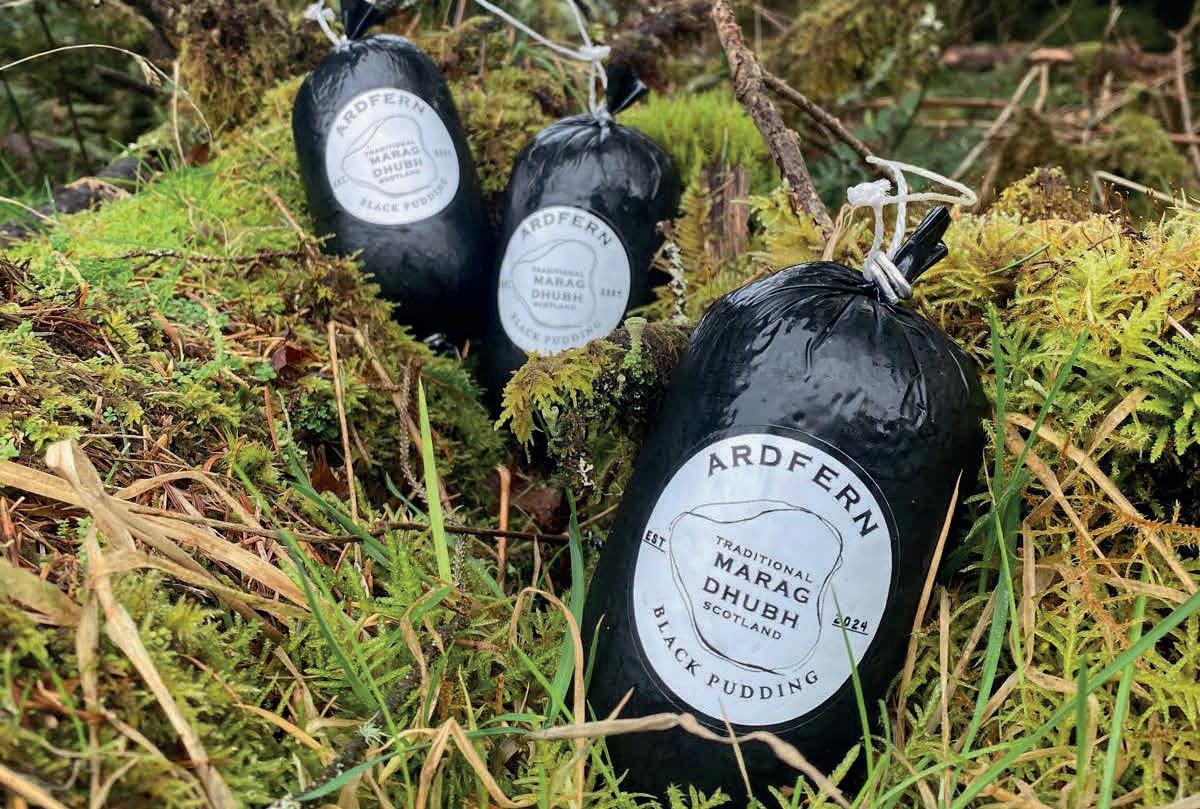
Once a regional staple, Marag Dhubh production has all but disappeared from Scotland’s west coast. Ardfern Black Pudding founders Rob FitzPatrick and Derek Muircro are bringing it back.
By Tanwen Dawn-Hiscox
NOT ALL BLACK pudding is created equal. There are many recipes for it around the world, mixing the core components – blood and fat, usually pigs’ – with di erent ingredients. French Boudin Noir typically contains onions and sometimes apples; Spanish Morcilla is made with rice. Boudin Créole from the Caribbean is heavily seasoned, sometimes infused with rum.
When Ardfern Black Pudding founders Rob FitzPatrick and Derek Muircro , out shing mackerel together in the summer of 2024, were discussing how a friend of theirs had set up production on the Isle of Skye, they were set on making a traditional Marag Dhubh.
“We looked at other Scotch area recipes,” FitzPatrick tells FFD, “some of which were a bit surprising. The Glasgow one traditionally had milk and mint in it” – not a combination they wanted to pursue.
They opted for what they describe as a “pepper-dominant” sausage. Whereas allspice is common in Irish recipes, “you wouldn’t nd it in a West Coast black pudding”, FitzPatrick says, where the preference is for a simple, clean taste. “And it’s not just about the medium you use,” he adds, meaning oats, “but actually how coarse that is”.
They wanted theirs to hold and fry well and to have a pleasing texture, neither
crumbly nor too smooth.
“My family would not like a pasty black pudding,” FitzPatrick says. “They would have told me that was rubbish, no matter what it tasted like.”
They buy the fat from Scottish suppliers and the all-important fresh blood from a butcher in East Kilbride, and believe they have the capacity to ramp up production. When we spoke in early February, they were in the kitchen making 80kg for the week, down from 100kg in the summer, when more of the local hotels and restaurants are open.
“Our maximum would be about 400kg a week,” Muircro tells FFD, “but we did well last year, and if we double that, we’re going in the right direction.”
Although foodservice is a strong channel for them, the pair have accidentally stumbled on the ideal weight for their product, which has a orded them signi cant traction in retail.
Muircro says: “A lot of other black pudding producers either make one that is 650g, which is a bit daunting, or 350g, and these seem a bit mean. We’ve slid into almost a perfect size.”
Presently, FitzPatrick and Muircro supply customers directly, handling both deliveries and postal orders themselves. Both are keen to spend less time ferrying pudding around the country and more time making it, so they are in early conversations about working with their butcher as a potential distribution partner.
The pair launched Ardfern partly because their long careers in kitchens – and in Fitzpatrick’s case, current occupations including being a musician and an artist –meant they wanted to do something that would only take up limited time, which it does: they only make two days a week.
We wanted to prove it could be done in a rural place like this
They couldn’t have done it, however, without local support. They were granted use of the village hall for their rst six months of production. “Without that opportunity,” FitzPatrick says, “the idea would have remained with us, bobbing on a boat shing mackerel”.
But it wasn’t all smooth sailing when it came to obtaining the environmental health approval to set up Ardfern.
They argue that part of what deters artisan producers from making animal products such as cheese or charcuterie is the lack of small-scale sites that meet the strict health regulations required.
FitzPatrick tells the story of an acquaintance who tried to set up a charcuterie business in Argyll: “Apparently, the EHO turned up, and their rst sentence was, ‘I’m here to stop you doing this’,” he says. “They tried to insist it needed ve separate units to go through the process –and he gave up in the attempt to educate the regulators.”
FitzPatrick and Muircro encountered a similarly discouraging EHO, but thankfully, their backgrounds helped them navigate and challenge some of the regulators’ assumptions.
“We wanted to prove it could be done in a rural place like this,” Muircro says. “I’ve seen it in England, like in Su olk and Guernsey, places where networks are established, and innovation breeds innovation. That kind of food culture works incredibly well. To an extent, Mull and Arran have got a little bit of it. But if you try and nd products in Argyll, there’s not a lot.”
At the end of the day, all vibrant food scenes have to start somewhere – and what better way than to start with pudding? ardfernblackpudding.com
Ardfern Black Pudding founders Rob FitzPatrick (L) and Derek Muircroft (R)
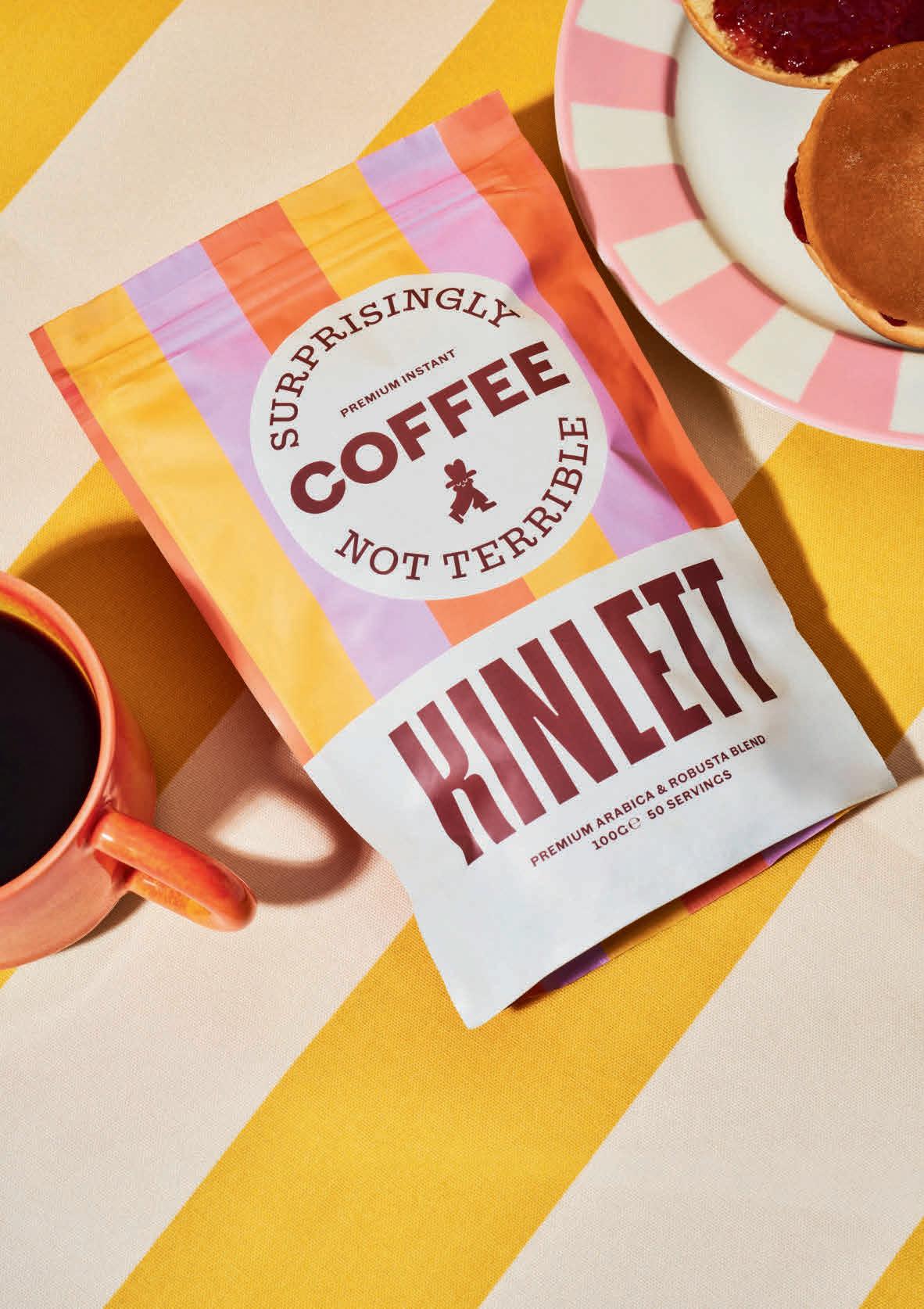
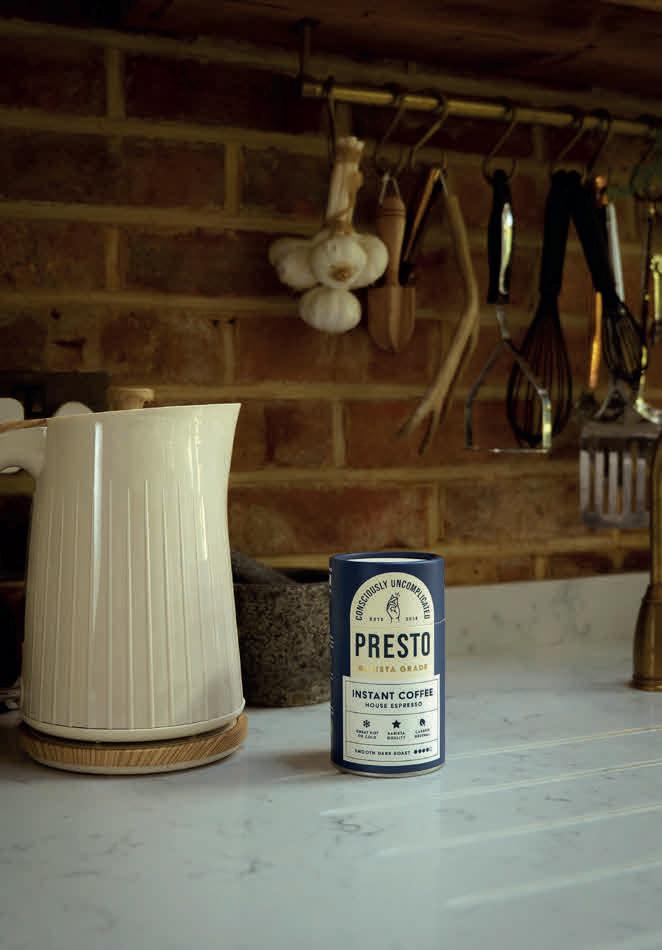
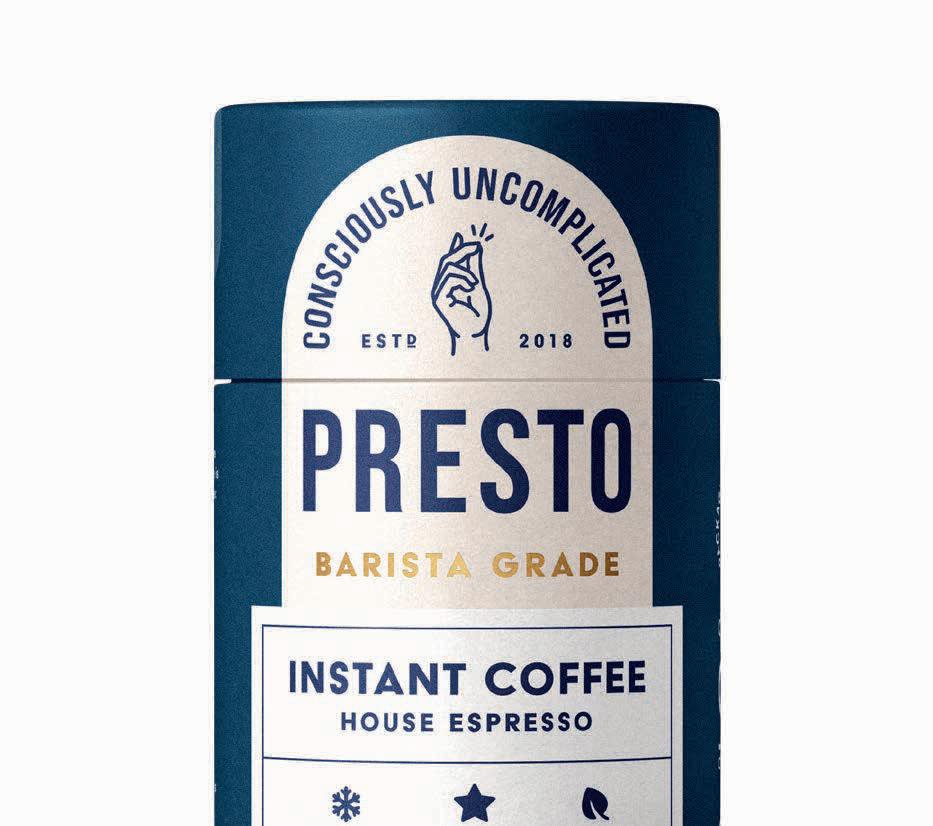
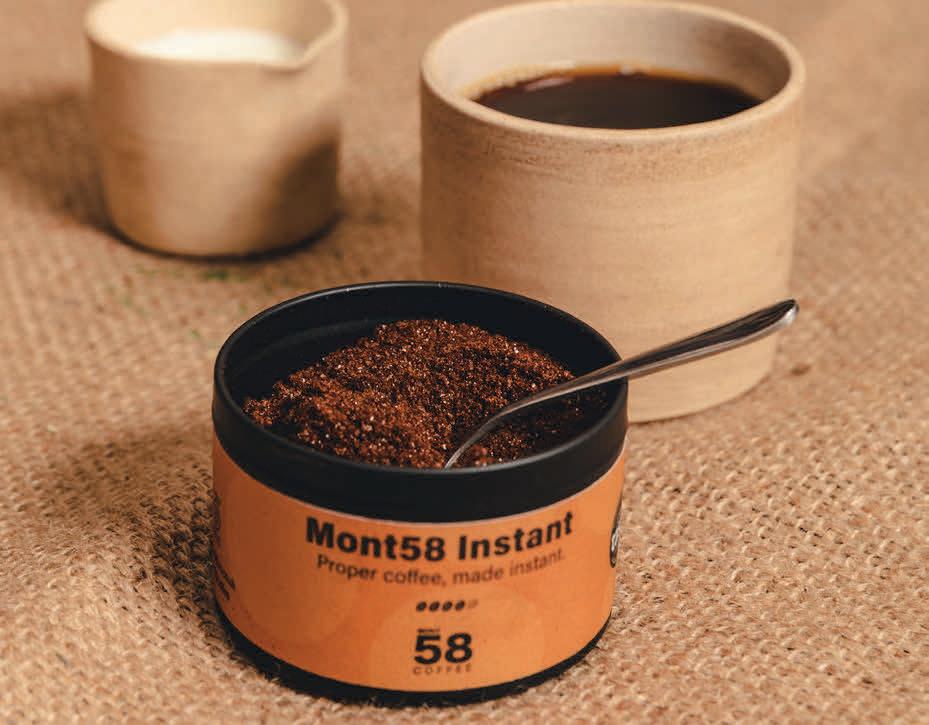
Voted Best Instant Co ee in the UK
Great days start with great co ee. Whether you prefer a quick cup of instant or have time to grind our
Meet
our new range
House Espresso Instant Co ee
Our flagship. Smooth, balanced, espresso style, with proper body and a clean finish.
Intenso Espresso Instant Co ee
The bigger, bolder option. More intensity and depth for people who like their co ee strong.
Decaf Instant Co ee
Full flavour, no compromise decaf for customers who still want a great co ee ritual without the ca eine.
Half Ca eine Instant Co ee
Lower ca eine but not fully decaf. It gives you the best of both worlds: flavour and a bit of a li without going full send on ca eine.
Time for a cuppa and some cake?
Whether you are a retail-only business or also have a deli-café, we’re here to help you stand out with an original o er of cakes and puddings, chocolate and confectionery, co ee and tea.
Compiled by Lynda Searby
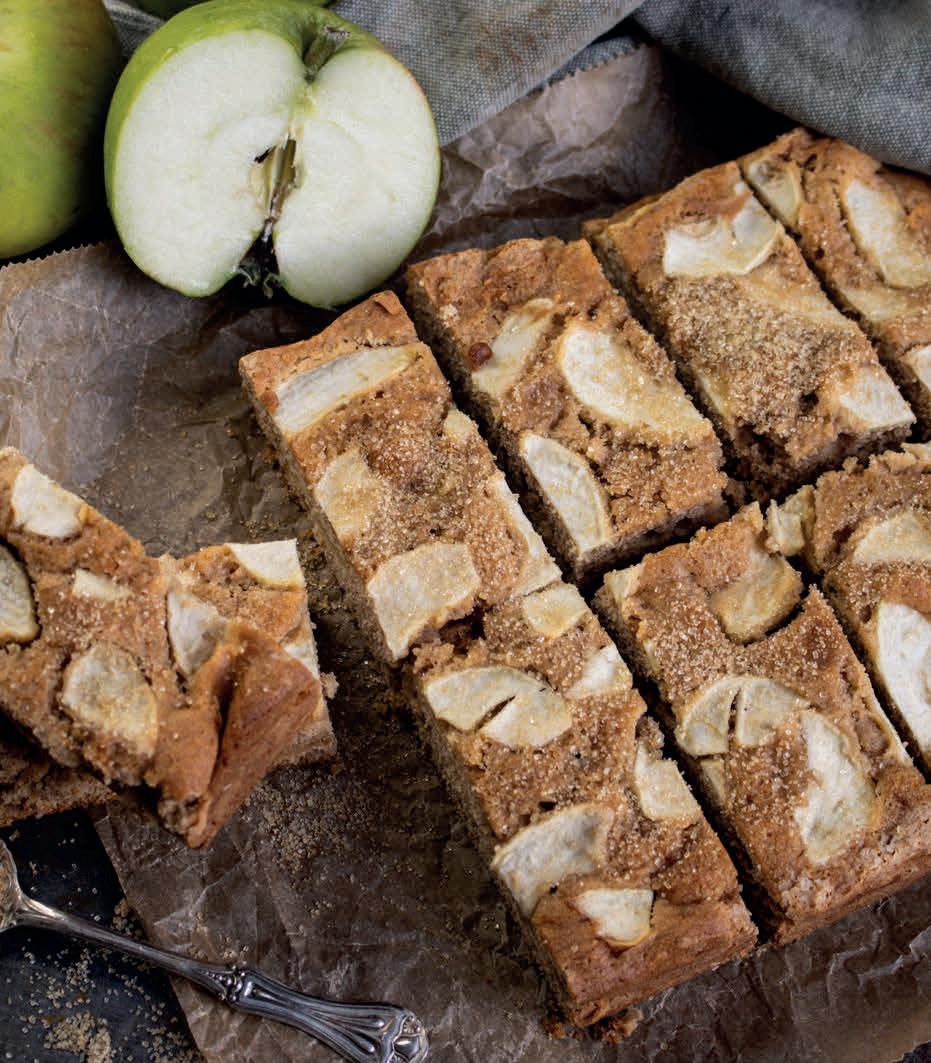
Hot out of the oven at Willow & Finch’s Devon bakery are two homely traybakes designed with busy deli cafés and counters in mind. The Spiced Apple Tray Cake is said to be soft, moist, and generously filled with Bramley apples and cinnamon, while the Sticky Ginger Cake features golden syrup, treacle, and stem ginger that bring warmth and spice, and a lemon glaze to cut through the sweetness. WSP £14.99 for 14 portions; RRP £2.50. willow-finch.co.uk
A classic traybake done properly
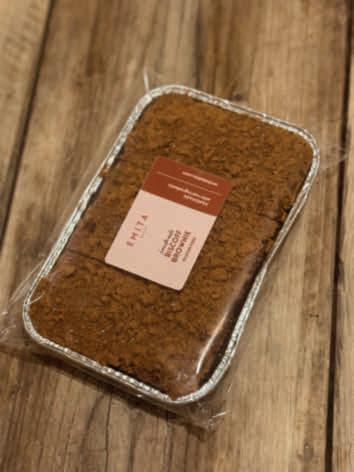
Emita Bakes is a newcomer to the brownie and blondie scene, started by Emma Boers, out of a passion for baking and because she couldn’t find a brownie that hit the spot. Her signature product is the Classic Triple Chocolate Brownie, and other top sellers include Biscoff Blondie, Biscoff Brownie and Gluten-Free Choc Orange Brownie. WSP £4.80 for a 6 portion traybake; RRP £7.50. emitabakes.com
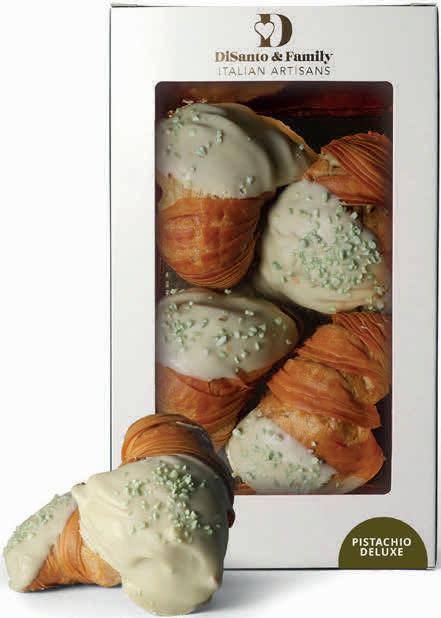
DiSanto & Family has ramped the Southern Italian pastry known as aragostine up to the next level of luxury with the launch of its Elite range. These multi-layered horn-shaped treats boast the same light buttery puff pastry crunch and creamy fillings as the original version, but with the added indulgence of a rich cream coating. They are available in Pistachio Deluxe, Rocher and Amalfi Coast (lemon) flavours. RRP £6.50/200g pack. disantoandfamily.com
Peterborough-based Ozola Macarons has drawn on familiar references such as Raspberry and Rum & Raisin as well as unexpected combinations like Parmesan with Blackcurrant for its latest round of NPD. Built around a chocolatebased whipped ganache to keep the texture light, sweetness restrained and flavours defined, each batch-made macaron is conceived as a complete dessert. RRP £2.70-3.20 per macaron. diozola.com
IN BRIEF
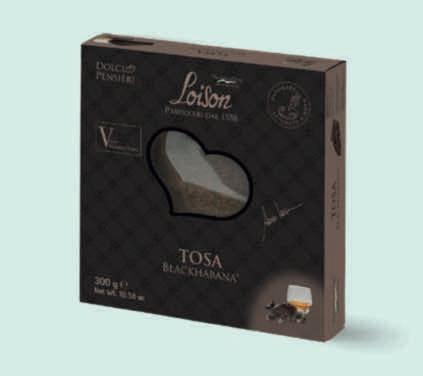
Italian fine bakery Loison has set out to put a contemporary slant on Venetian patisserie with the launch of Tosa BlackHabana. This torta marries a cocoa shortcrust pastry base with fillings such as dark chocolate frangipane cream and salted caramel. RRP €13.50/300g. loison.com
Wokingham-based Unholy Donuts has unveiled a new freeze-thaw doughnut range designed for counter display and takeaway, prioritising visual impact and high-quality ingredients. The handcrafted donuts feature fillings and flavours inspired by classic desserts, including Lotus Biscoff, Birthday Cake, Cookie Dough, Lemon Crunch and Millionaire Shortbread. WSP £1.85; RRP £4.25. MOQ 50. unholydonut.com
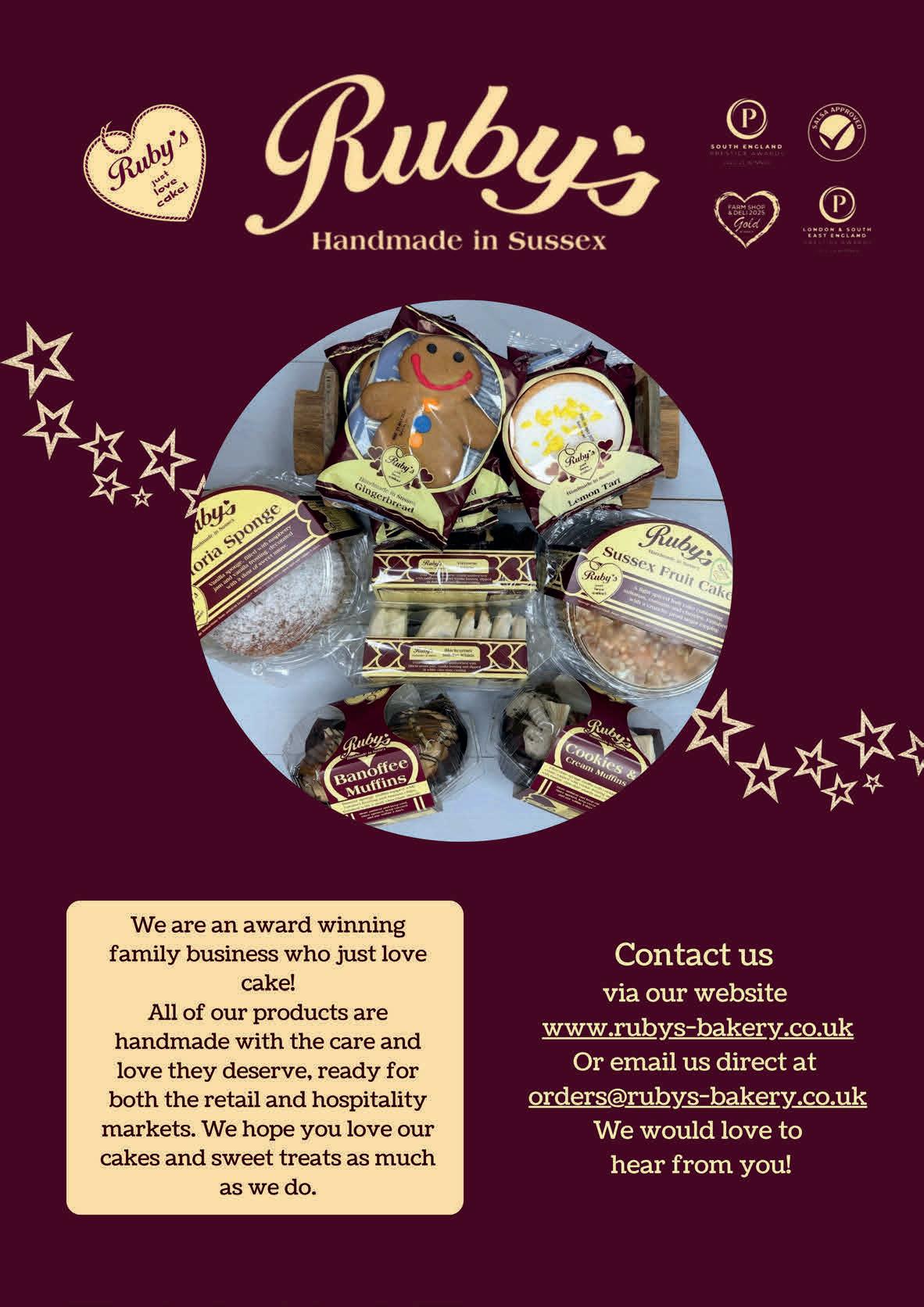
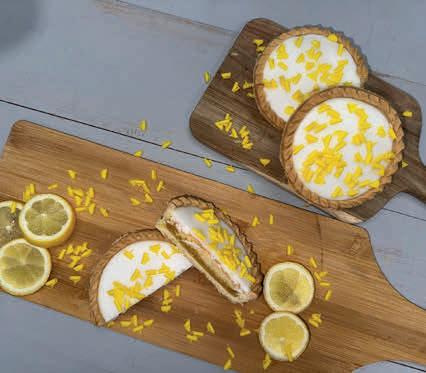
Ruby’s Bakery in West Sussex has adapted the Bakewell tart for citrus lovers, with a zesty creation that encases lemon curd and lemon sponge in a rich pastry crust, finished with fondant icing and lemonflavoured white chocolate curls. WSP for a box of 24 is £24.48; RRP £1.99 per tart. rubys-bakery.co.uk
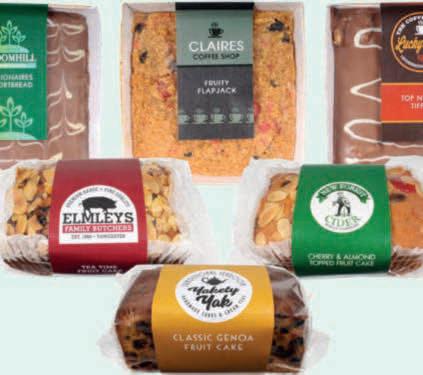
The Bay Tree has expanded its ‘own label’ collection, giving farm shops and delis greater choice to build their own brands. Bespoke labelling is now available for six traybake recipes and 13 cake and sponge varieties. WSPs range from £2.24/275g traybake to £5.99/500g cake. thebaytree.co.uk
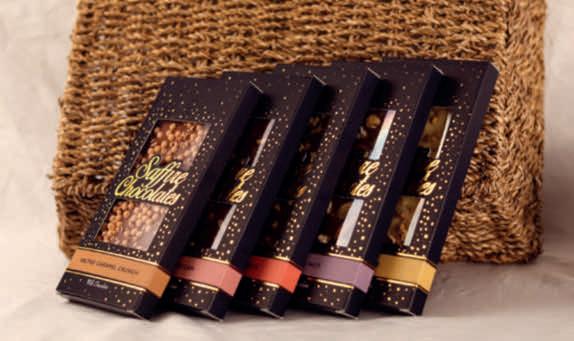
Saffire Chocolates stockists include Bakers & Larners and Jarrolds, and the producer is keen to expand its base. Flavoured bars include Eton Mess, Espresso and Orange Crunch, in 45g and 120g sizes (RRPs £3 and £6.50 respectively. saffire.co.uk
Organic Fine Dark
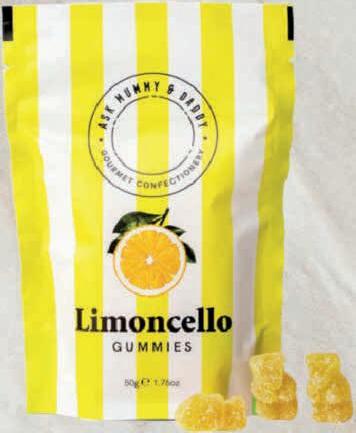
Ask Mummy & Daddy has expanded its alcohol-free Cocktail Gummies range to capitalise on growing demand for grownup giftable sweets.
The two new SKUs – Limoncello and Sex On The Beach – join Prosecco, Italian Spritz, Passion Fruit Martini and Piña Colada variants, and are positioned as playful sweet treats for adult consumers. RRP £3.49/50g. askmummyanddaddy. com
Sweet treats: honest indulgence never goes out of fashion
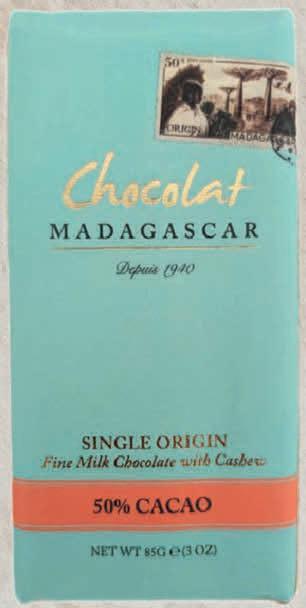
Chocolate 85% Cacao (RRP £8.95/85g) and Fine Milk Chocolate 50% Cacao with Malagasy Cashew Nuts (RRP £7.99/85g) are the two latest introductions from African bean-tobar producer Chocolat Madagascar. The brand’s chocolate is grown, crafted and packaged at origin, so that, like wine or cheese, it expresses its terroir. chocolatmadagascar.com
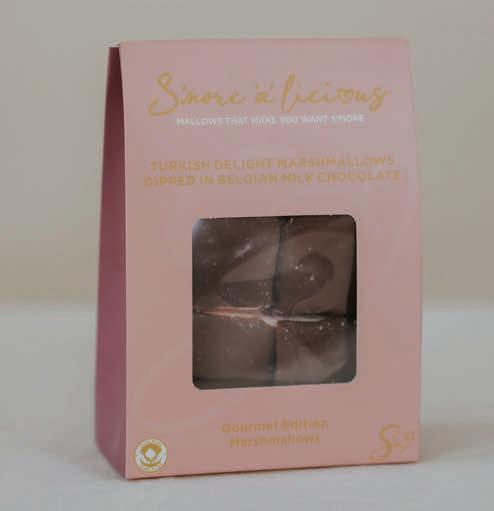
S’more’a’licious has added three new flavours to its jumbo marshmallow collection: Turkish Delight, Lemon Dipped in Belgian White Chocolate and Coconut Dipped in Belgian Milk Chocolate. The producer claims a six-month shelf life with no artificial additives or preservatives. RRP £6.99 for a pack of four. 50% wholesale discount. smorealicious.com
Juthan is furthering its mission of crafting extraordinary chocolate that inspires slow, mindful indulgence with the launch of two 60% cocoa bars. In Vanilla 60, real vanilla pods bring a warm, aromatic sweetness that enhances the natural depth of the cacao, while Ginger 60 relies on ginger root for citrus, earth and soft spice notes that complement the cacao. WSP £5.22/75g; RRP £8.95. juthanchocolate.com
Hungarian confectionery maker Flore has upgraded to a single plantation dark chocolate for its dragées. These include BangBang! –raspberry jelly cubes with Damask rose and Espelette pepper, coated in 67% Madagascan dark chocolate and raspberry powder; and King of the Mango: mango and passion fruit jelly cubes, panned in 70% Tanzanian dark chocolate. WSP £5.60/50g; RRP £11.30. floreconfectionery.hu
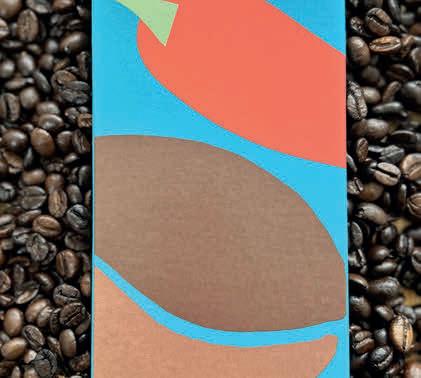
South Devon Chilli Farm has combined locally roasted and ground espresso coffee beans with its own Devon-grown chillies to create a grown-up treat for coffee, chocolate and chilli lovers. The 80g Chocolate Mocha Crunch bar has an RRP of £6.15; WSP £21.17 per case of six.
southdevonchillifarm.co.uk
Anna Barton, co-owner of Canalside Farm Shop in Great Haywood, Staffordshire, on navigating seasonality and consumer trends – and making the most of the perennial popularity of doughnuts.
Homemade is perceived as best Customers definitely prefer the items made in our in-house bakery over pre-packaged goodies because they perceive them as fresher and containing fewer ingredients –something that is on people’s minds at the moment. 90% of what we sell in the bakery is made from scratch on the premises. This includes cakes, pain au raisin, Belgian buns and doughnuts. Bakery is one of our top-performing departments, growing by 20-30% a year. In contrast, sales of bought-in cakes and packets of biscuits have dropped off by 10% in the past year. Doughnuts are the biggest seller in our bakery, a hundred times over. I think there is a mindset that if you’re going to have a treat, you might as well go all out and have a proper one.
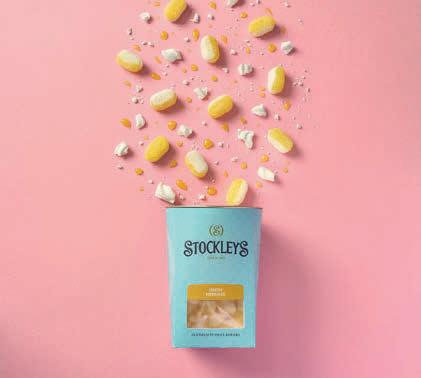
Following the success of Jam Roly Poly & Custard last year, Stockley’s has added another dessert trolley-inspired flavour to its confectionery portfolio. Its modern take on the retro classic lemon meringue pie pairs a lemon and vanilla shell with a citrus centre. RRP £5.99/250g. stockleys-sweets.co.uk
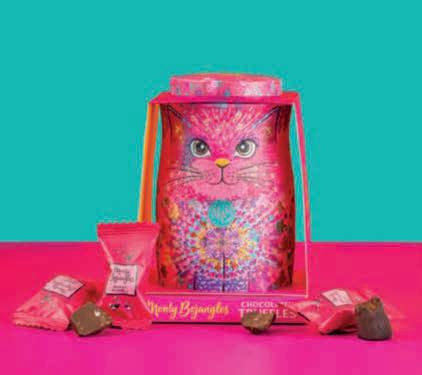
Monty Bojangles’ Shimmering Starlet joins the brand’s Cat Tin family of collectable tins in three sizes (36g, 135g and 200g). This tin is filled with individually wrapped Berry Bubbly truffles, which combine raspberry with popping candy in a chocolatey treat. RRP £15.50/135g. montybojangles.com
Margins flex with volumes
We try to stick to set margins, but it doesn’t always work, as on some of our most popular lines, we reduce margins because we can produce them in larger quantities. We also have to factor in costs like staff wages and VAT when calculating margins. We make more on our in-house bakery lines than on products sourced from third-party producers.
Chocolate & confectionery: stay local
When it comes to chocolate and confectionery, our ethos is to source local and British where possible. People want to champion local, and ‘proper’ ingredients. We are also noticing that chocolates made with ‘mylks’ such as oat mylk chocolate are becoming more popular, as are low sugar options.
Ride out peaks and troughs
Sales of chocolate & confectionery lines spike in the run-up to Valentine’s Day, Mother’s Day, Easter and Christmas, then plummet in January because everyone is on a health kick. We try to move with the seasons, and at the times of the year when people aren’t interested in chocolate, we shift the focus to other departments. Interestingly, we’ve noticed that sales of confectionery and ice cream go through the roof when strawberry and pumpkin picking are open.
Monsooned Malabar Brazil Santos
Steenbergs has treated its organic loose-leaf teas to a new look that reflects its progression from a spiceled offering to also selling herbal and blended teas. Featuring Britain’s fauna and wildlife to convey values of sustainability, purity and a connection to nature, the new packaging has been rolled out across 20 SKUs. These include Organic Happy Hippy - a blend of chamomile, mint and rose petals; Organic English Breakfast; and Dream Time - a relaxing tea designed to encourage sleep and featuring St John’s wort, valerian, skullcap, lemon balm, oat straw, peppermint, elderflower, hop and marigold.
All the blends are created and blended at Steenberg’s factory in North Yorkshire, and WSPs begin from £2.02 per unit.
steenbergs.co.uk
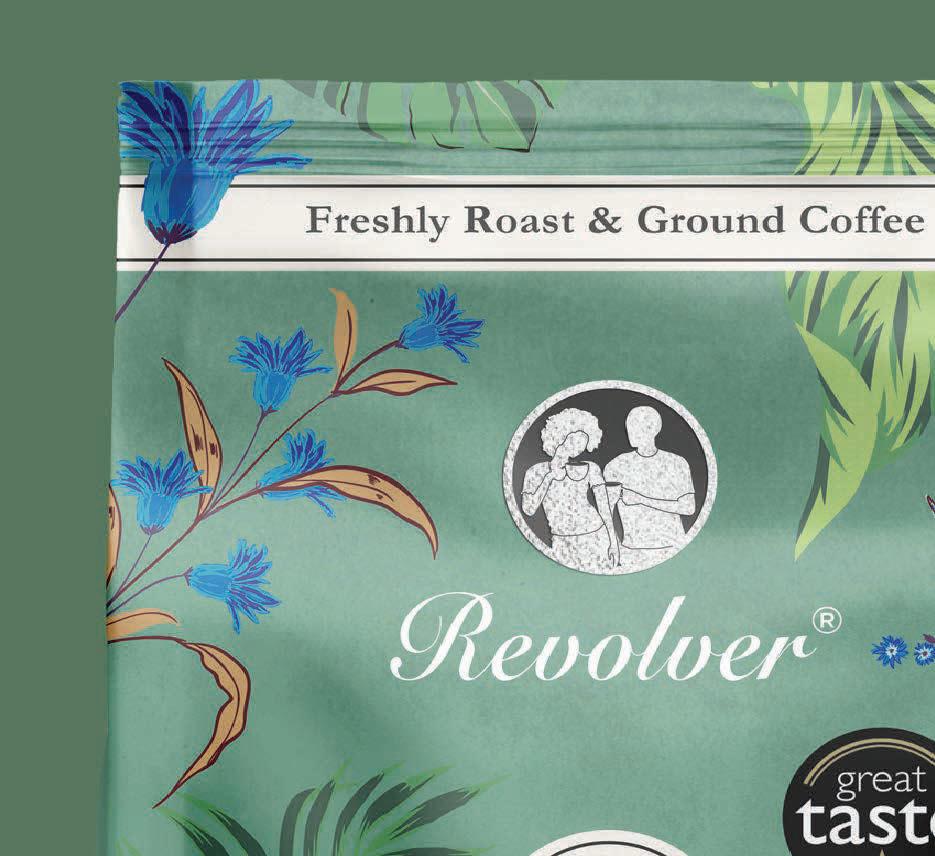
Revolver Co-operative’s Malawian teas will appeal to retailers with ethicallyminded customers who value provenance, female empowerment and sustainable production. Malawi Gold Tea (RRP £3.99/80 bags) is a breakfast blend that combines Mtendere cooperative tea with assam. It is said to offer a bold, full-bodied cup while showcasing how cooperative collaboration at origin can bring benefits for both flavour quality and farmers. revolverworld.com
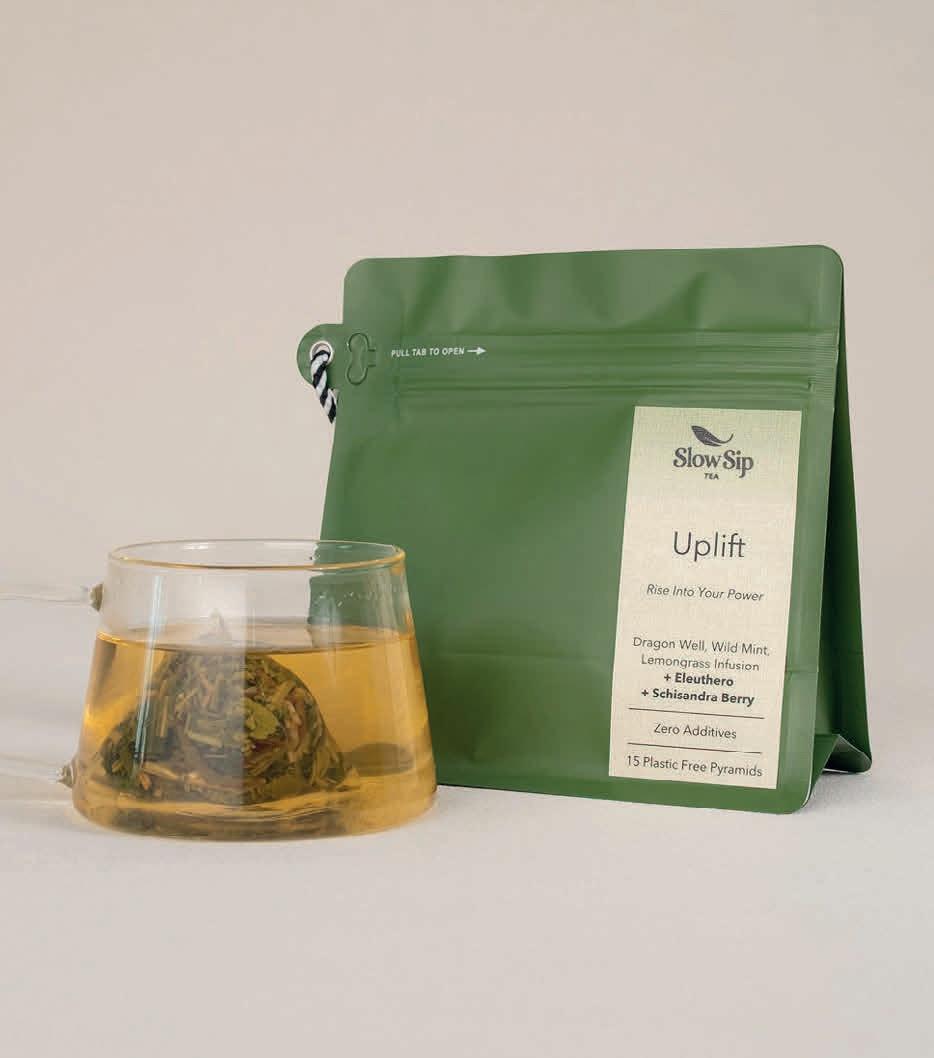
Having built a following for its functional tea blends via pop-ups, D2C online sales and markets around London, Slow Sip Tea is gearing up to expand into indie retail.
The brand is all about slowing down, reconnecting with oneself and others, and living life more fully and intentionally. It uses adaptogens, nootropics, nervines and other functional herbs to achieve outcomes based on traditional herbal medicine and modern scientific research.
The brand’s inaugural range takes in five blends: Uplift, for boosting energy levels; Rhythm, for supporting caffeine-free mental clarity; Earth, a relaxation aid; Ember, for digestion and immunity support; and Lunar, for period and reproductive health.
RRP £12 for a pack of 15 or £19 for a pack of 25. slowsiptea.com
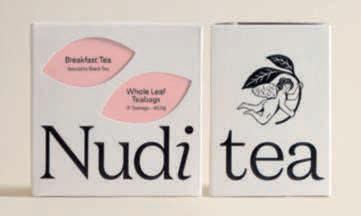
Nuditea credits new, plastic-free packaging and a drive in delis and farm shops, with securing a listing with Diverse Fine Foods. Now stocked in Teals, Hartley Farm Shop and Panzer’s, its range includes Breakfast Tea (WSP £4.65/100g; RRP £6.95), available as loose leaf or in plastic-free tea bags, and Matcha Powder in both ceremonial and barista grade (WSP £16.95/30g; RRP £24.95). nuditea.com
IN BRIEF
Three Legends Chai is seeking to establish a more visible retail presence through pop-ups across London. The startup was founded to make the ritual of authentic chai at home simple, mess-free and consistent, without compromising on flavour. It offers three blends: Original Spiced Black Tea, Spiced Coffee and Spiced Rooibos. WSP £11/15 bags; RRP £14. threelegendschai.co.uk
Haru is a new matcha brand on a mission to promote a matcha appreciation culture in the UK by showcasing varieties from the different terroirs of Japan. So far, it has launched three first-harvest, stone-milled matchas: Hana Blend from Uji, Kyoto, Kasumi Single Cultivar Matcha from Yame, Fukuoka, and Hokkari Hojicha Roasted Green Tea from Yame, Fukuoka, RRPs from £20/30g. harumatcha.co.uk
Noticing a growing demand for flavoured brews on the UK market, freshly rebranded Hilltree Tea has developed a Masala Chai blend of premium Assam Second Flush tea with real spices and no artificial flavourings. Developed over a year of tastings and customer feedback, the blend reflects the brand’s grounding in quality selection and ethical sourcing. RRP £3.99. hilltree.in
Hampstead Tea is hoping to capitalise on growth in wellness blends with a new trio of benefitled infusions. Each leads with a star ingredient: tulsi vana in She’s Well; shatavari in Relax Well; and ginger in Cleanse Well, and their organic and microplastic free credentials are given front-of-pack prominence. They launch this month [March] with an RRP of £3.99 for 20 sachets. hampsteadtea.com
Tea from Scottish Tea House’s Lanarkshire garden is blended with a Chinese tea in this classic black tea fusion. Honey sweetness, nutty notes and floral aromas work together to create a complex flavour journey that is said to be ideal for afternoon tea. WSP £7.86/35g; RRP £10.49. scottishteahouse.com
Responding to demand for comforting, indulgent black teas with a natural flavour profile, Iva Tea’s Vanilla & Cacao is now available in both loose leaf and teabag formats. Ceylon black tea is scented with vanilla through slow ageing and blended with cacao husk for warmth and depth. RRP £7/30g. ivaplants.co.uk
Ausha has launched its Moringa Masala Chai product in tea bag format, with a WSP of £2.45 for 20 bags; RRP £4.95. The company claims this is a “first of its kind chai” as it infuses the plant-derived ‘superfood’ moringa with aromatic spices to pack more new nutrition than a regular chai. ausha.co.uk
Fuss free brew bag
Roar Gill says it has created its new home compostable coffee bags to give consumers a convenient, no-fuss way to enjoy quality coffee on the go. The bags are fully compostable and require nothing more than hot water, making them ideal for travel, office use, or anywhere a coffee machine isn’t available. Each brew bag is individually wrapped to lock in freshness and preserve the flavour of the ground coffee. There are three varieties - Bold, Exotic and Rare - available in retail boxes of 10 bags. WSPs £3.223.54; RRPs £4.95£5.45 roargill.com
Hampshire-based River Coffee has unveiled a new design inspired by life at origin that it says balances “simplicity and storytelling”. It sources mainly from producers in Central and South America, where the founder worked on farms before starting River Coffee in 2018. WSP from £5.05/250g; RRP from £8.50. rivercoffeeroasters.com
MOGU has given coffee a “focus and energy” boost by incorporating adaptogens like lion’s mane, cordyceps and chaga into coffee. The low-acid arabica is said to make you feel “switched on but not wired”. The brand also offers adaptogenic ceremonial matcha and cacao. RRP £50 for 30 servings. wearemogu.com
Kinlett Coffee is a new British brand intent on challenging perceptions of instant coffee. Focused on flavour and balance, it offers a Swiss-made coffee chip format using arabica and robusta blends, lifted with Ethiopian Sidamo for a smooth, low-acidity finish. Sold in 100g resealable pouches. WSP £5.95; RRP £11.95. kinlett.com
Leeds’ Leodis Coffee is celebrating its tenth year in business with new packaging inspired by the wildlife of its sourcing regions. The Deli blend – a mix of arabica beans from Indonesia, India, and Ethiopia –features a Javan kingfisher, while the character of the Colombian blend, a full-bodied all-rounder, is depicted by a jaguar. WSP £6.99/227g; RRP £11.95. leodiscoffee.co.uk
Presto has just launched four new premium instant coffees into Waitrose and says the range is a strong fit for delis, food halls and farm shops looking to offer quality with convenience. Designed to give coffee drinkers clear choices around flavour and caffeine intake, the line-up spans House Espresso, Intenso Espresso, Decaf and Half Caffeine. Presto Coffee positions its range for so-called “Queenagers” aged 35 to 60, consumers who want a proper espresso-style experience without the faff. The 90g jars are said to offer smooth, balanced cups through to bolder, more intense profiles, as well as thoughtful lower-caffeine options that do not compromise on taste. Already live in Waitrose, the launch marks the start of a busy period for the brand, with further UK grocery listings and a major US rollout planned later this year. prestocoffee.com
CupsFull’s coffee bags are designed for anyone who wants to be able to access decent coffee, anytime, anywhere. There are three varieties – Pace, Powder and Peace – which tap into different origins, beans and taste profiles. WSP £7.89/105g pouch; RRP £11.95. They have just won a listing with Selfridges and are carried by Cotswold Fayre. cupsfull.co.uk
York Emporium has launched two new SKUs to showcase one of its favourite origins.
Cobbles House Colombia (RRP £7.15/200g) and Decaf (RRP £8.50/200g) both begin with beans grown in the highlands of Cauca, which are said to deliver silky milk chocolate, juicy red fruits and honeyed sweetness. yorkemporium.co.uk
Cupper’s Journey has launched a single-estate Rwamatamu Rwanda coffee. The brand champions the slow coffee movement, focusing on provenance and storytelling. Roasted medium-light, the new release offers citrus, berry and nectarine notes with floral undertones. RRP £15.85/250g. cuppersjourney.com
Mont58 Premium Instant launched in October 2025 as a speciality-focused take on instant coffee, crafted from real espresso shots derived from Mont58’s signature Espresso blend.
Designed for professionals and coffee lovers who value both quality and convenience, Premium Instant is said to bridge the gap between barista-style flavour and on-thego accessibility.
It uses 100% beans, which are medium-dark roasted to deliver a rich, aromatic cup with tasting notes of hazelnut, caramel and cacao. WSP £13.50/80g; RRP £18. Mont58 Coffee is an independent roastery founded by husband-and-wife team Shai Eilon and Maya HaimanEilon. What began as a passion project roasting beans in a garden shed has evolved into a B Corp, operating from a large roastery in Ashford, Kent, with two further locations in South East London. mont58coffee.com
TRAINING RETAIL CHEESE
Smoked Haddock
Smoked Salmon Cold Smoked Trout Smoked Eel Fillet
BARISTA QUALITY LATTE
‘Grette times
‘Grette founders Juno Jablon and Angus Hunter spotted a gap in the market for delicious, clean-label, premium dressings, and seized on the opportunity.
Interview by Tanwen Dawn-Hiscox
MEET THE PRODUCER
What were you doing before founding ’Grette, and how did it come about?
Juno Jablon: Part of our origin story is that we got married, and suddenly, after the wedding we had more free time. We’d always bounced ideas off each other about starting a small business, and we both love food.
Angus Hunter: I’m in the wine trade. I work in restaurants in London.
JJ: I work in tech marketing, so no food background, but I’d always make dressings myself, and friends would comment, ‘oh this is such a nice dressing’. We started going to independent shops and realised the category was pretty untouched. Most options are American imports, made by fast-food chains, or mayonnaise-based. We saw an opportunity for something fresher and punchier. From a branding point of view, everything also looked the same: similar bottles, a bit twee. We started at home and went from there.
Can you talk us through the recipes?
JJ: The first is Dijon, which we call ’Grette, our original. It’s a classic French vinaigrette, our take on it. The recipe was inspired by Via Carota in New York and their green salad piled high with herbs. It’s acidic and punchy but sweet, so it complements any green. It’s Dijon mustard, red wine vinegar, sherry vinegar, olive oil and honey. The second is Miso ’Grette: miso, soy and sesame, very umami-rich but also sweet. That’s been the overwhelming success.
We didn’t want to look like a food product or use the same bottle as everyone else. It looks more like a beauty product.
reason – it makes people stop and look – but we wanted it to feel cool and urban.
How did you find suppliers and then move to outsource production?
JJ: We started with Amazon. Our first batch was of about 60 bottles. As we scaled, deliveries became a problem. That’s when we decided to move to wholesalers.
We dropped off our order and flew to Japan two days later. It sold out within days. Then we were contacted by independent retailers like Superette and by Selfridges; through that we connected with Marcus at Artisan Food Club, which opened doors like Panzer’s. We also used Faire. Until this year we hadn’t worked with a major wholesaler – we’ve only just started working with Diverse.
And what’s your plan in terms of scaling up?
JJ: For ’Grette, we want to stay premium and independent. Major grocery isn’t the goal.
AH: We did launch in Booths, which for us sits closer to a regional premium model. But Waitrose, Tesco and the big national chains aren’t the focus.
Aren’t other producers likely to copy you?
AH: Yes. It’s already happened.
From the beginning, we designed the branding to allow for more flavours, but we deliberately started with two. When we were making from home, it made everything much easier; it also meant most retailers bought both.
Tell us about the branding.
AH: We launched in June ’24 and continued making at home until September ’25. We bottled more than 10,000 units ourselves, so there’s a real emotional connection to the product. Finding a co-packer, and then a fulfilment centre that could match the quality took a long time, partly because there aren’t many available in the
AH: We didn’t want to look like a food product or use the same bottle as everyone else. It looks more like a beauty product. There’s a commercial
JJ: But when you look at categories like nut butter, honey, hot sauce or chilli oil, there are loads of small independent brands reinventing things. We’re actually quite lucky that there still aren’t that many people entering salad dressing.
Was DELLI your route to market?
AH: When we started seeing other brands appear, it was almost a relief because it validated the category. A bit of competition is healthy.
And creatively, what’s next?
Our first stockist was Salt.Deli. Iain [Hemming] is a longtime family friend and gave us advice early on. We launched on DELLI around the same
AH: Tahini ’Grette is coming next. We’re finalising the recipe shortly.
JJ: And then there’s something different. Still a condiment, but a different category.
AH: We’re launching ’Naise. There are three mayonnaise flavours to start with: Pickle ’Naise, Harissa ’Naise and an OG classic mayonnaise.
JJ: The thinking is the same. Mayonnaise is delicious, but a lot of brands use poor ingredients, and they all look the same: glass jars, blue and yellow branding, nothing that feels cult or exciting. Ours will be smaller batch, punchy flavours, and branding that makes mayonnaise feel fun. grette.co
PRODUCTS & MERCHANDISING
Potts departs from tradition with new world cuisine sauces in cans
By Lynda Searby
The Potts Partnership has moved its cooking sauces into aluminium cans and taken them in a world cuisine direction, adding Mexican, Indian, Mediterranean and South East Asian inspired recipes to its line-up.
The Wiltshire producer’s stocks and gravies have been in cans since 2020, but historically, its chef-prepped sauces have been presented in pouches and built around more traditional British and European cuisine. While these SKUs are still available, The Potts Partnership has taken the opportunity of the switch to cans to get creative with both aesthetics and recipes.
Potts told FFD: “Moving our sauces into cans has given us a licence to go into the fabulous avours of Asia, the Mediterranean and Central America. It’s a fantastic opportunity to go in that direction without detracting from our core semitraditional products and values - we still use the same production methods and recognisable pantry ingredients.”
a pretty staid appearance - lots of red sauces in jars. Breaking that mould has become a bit of a mission for us.”
Agency This Way Up created the visual identity for the new canned sauce collection, using di erent designers to make the artwork on each “couture” can unique.
“Food is fun and should be fun. I think that should be re ected in packaging and branding,” said Potts.
But there’s a serious side to the company’s decision. Aluminium cans are 100% recyclable (and in nitely recyclable) via kerbside collections, making them one of the most sustainable packaging choices.
The rst sauces to launch in cans were Puttanesca Pasta Sauce, Ragu alla Calabrese Pasta Sauce, Enchilada Mole Sauce, Fajita Pibil Sauce, Tikka Masala with Roasted Cumin Curry Sauce, Keralan Curry Sauce, Sweet & Sour Sauce, Katsu Curry Sauce and Thai Red Curry Sauce.
WHAT’S NEW
GSN has added two plantbased meals to its Pots of Gold range of clean deck, proteinrich frozen ready meals. Vegan Four Bean Chilli and Vegetarian Tempeh Tikka launched in February with an RRP of £3.99/ 350g pot. The formerly gym-focused brand is now looking to build its independent retail presence with distribution through Eden Farm Hulleys. mygsn.co.uk
Biona has introduced a trio of clean, spelt breakfast cereals that offer a UPF-free start to the day. Naturally high in fibre and wholegrain, Organic Crispy Spelt Flakes (RRP £3.29/200g) and Organic Spelt Puffs (RRP £2.69/200g) are made from 100% spelt with nothing added. Organic Honey Spelt Puffs (RRP £3.49/200g) are a highfibre sweeter option, with no added sugar. biona.co.uk
He said the move was inspired by the cra beer category, where the shelves used to be a sea of brown bottles until the likes of BrewDog and Beavertown disrupted the status quo.
“It’s similar in cooking sauces, where there’s
Olives Et Al has kickstarted 2026 with the launch of three Italian pestos that it says will bring “bold regional character” to its pesto range. Pesto alla Calabrese is a southern Italian classic that blends red peppers, sun-dried tomatoes, ricotta, EVOO, Pecorino and chilli; Salsa di Porcini is a rich and unctuous sauce that is made in Liguria from porcini mushrooms, EVOO and garlic; and Salsa di Noci is a smooth, northern Italian-style walnut sauce. The three new pestos join Olives Et Al’s established pestos – Proper Genovese Basil & Pine Nut Pesto, Pesto di Pomodoro and Spaghetti Mezzanotte – giving customers an expanded range that spans Italy from north to south. WSP £3.29/135g jar; RRP £5.50. shopolives.co.uk
Following the success of these, the company has added a second tranche of Italian and Indian sauces.
The RRP is said to be around £3.30/330ml. pottspartnership.co.uk
Protein water brand Vievé has branched out beyond hydration into snacks, with the launch of three bars that combine a nutrient-dense profile with foodie flavours. Available in Pistachio Punch, Strawberry Blondie and Coconut Crunch varieties, the are high in protein and fibre and contain no added sugar. RRP £2.49/45g. drink-vieve.co.uk
Fancy dates o er nutritious candy alternative
Date-based confectionery is emerging as a leading ‘healthy indulgence’ trend, bridging the gap between whole foods and luxurious sweet treats.
Date confectionery has long featured in Middle Eastern diets, in the form of iconic treats such as ma’amoul and tamr mahshi, and now a new generation of British artisans is reinventing them as a modern, self-care treat.
Two of the companies at the forefront of this trend are Final Dates and Messydate.
Final Dates is specifically targeting mums to be with its chocolate date truffles, which are handcrafted from medjool dates, organic and vegan dark chocolate and Maldon sea salt.
“It’s functional chocolate that’s naturally fibre-rich and free from additives, preservatives and palm oil,” said founder Amanda Eidelstein.
WSP £3.46 for a 2-truffle box; RRP £4.95.
MessyDate was started last November by two best friends, Saskia Van Der Vlugt and Hannah Moore, who met at university in Bristol. The brand’s narrative centres on ushering in a new era of indulgence. Its products are chocolate covered, nut butter filled medjool dates dipped in Peruvian cacao and finished Punch, Coconut Crunch
with crushed nuts and sea salt.
“MessyDate replaces ultra-processed confectionery with real food you genuinely crave. Ingredients are chosen for both flavour and function, supporting gut health while still tasting unapologetically indulgent,” said Van Der Vlugt. Three variants - Peanut, Almond and Pistachiolaunched in February in individually wrapped pouches. WSP from £1.50; RRP £2.99+. finaldates.co.uk messydate.co
PRODUCTS & MERCHANDISING
WHAT’S NEW
Following the success of its Solice home ice cream ready mixes, Ingredients Bar has introduced two sugar-free options. The No Added Sugar Chocolate and Vanilla flavour mixes are designed to make it easy for those avoiding sugar to create ice cream at home. . WSP £3.48; RRP £6.99 for 250g. ingredientsbar.com
The Saucerer has joined forces with Pizzarova – the so-called ‘kings of crust’ – to conjure up a sauce for slathering on pizza dough. This deep, rich tomato base is crafted in small batches in The Saucerer’s London kitchen, with no nasties. RRP £5.39. thesaucerer.co.uk
Oatco has extended its Super Bites energy ball range with a Peanut Butter Crisp flavour. Designed for grab-and-go and premium retail environments and powered by oats for slow-release fuel, this latest introduction aligns with the company’s mission to provide natural energy through functional, greattasting snacks. RRP £2.30/68g (2-ball pack).
oatco.co.uk
My magic ingredient
Lyburn Farm Old Winchester
JAKE FISCHER, Cheesy Living Co.
Produced by Mike and Judie Smales at Lyburn Farm, Wiltshire, Old Winchester is a hard cow’s milk cheese that I would liken to a cheddar-parmesan hybrid.
Each of our three sites gets through a 4kg wheel of this cheese every week and I think that’s down to its versatility.
When micro-shaved it puffs up into a fluffy pillow so we take every opportunity to grate it on the top of dishes such as arancini, croquettes, and cheesy garlic focaccia.
We also use it in fondues where people want a vegetarian switch up; it has that Alpine flavour profile and, being hard, melts down well whilst holding its flavour integrity.
With its powerful taste and crystalline texture, it’s also great on a cheeseboard - it’s one of those cheeses you just keep going back and picking at.
lyburnfarm.co.uk
Selkie makes seaweed easy to eat with everyday, avour-led NPD
By Lynda Searby
Seaweed Farming Scotland is taking a vertically integrated approach to making seaweed accessible to consumers, launching a range of speciality food products under the Selkie Seaweed label.
In recent years, there has been lots of hype about seaweed’s potential as a nutritious, sustainable foodstuff, but this hasn’t materialised into products.
The consumer arm of Seaweed Farming Scotland is hoping to succeed where others have failed by translating native seaweed into formats that are familiar, tasty and easy to use, and leading with seaweed’s flavour-enhancing attributes.
waters off the west coast of Scotland, harvesting them at peak nutrition. It then converts the wet crop into dried seaweed and mills it into flakes and powders for adding to food products.
“Seaweed is a pretty loaded health food – it contains vitamins, minerals, iodine, antioxidants and fibre, but we’re more about showing how seaweed can make food enjoyable,” founder Lawrie Stove told FFD
The company grows three seaweed varieties (kombu, dulse and wakame) on ropes in pristine
Stove explained:“If you add the seaweed to a casserole or a soup, the glutamate will really enhance and enrich the flavours of the other ingredients.” Selkie Seaweed has built a range of ‘gourmet’ food products around this quality: two trail mixes – one a mix of five omega-3 seeds, cranberries and goji berries, and the other a blend of almonds, pecans, pistachios, sour cherries, cranberries and 70% cocoa drops. The line-up also includes two seasonings; a seaweed & salt that is a collaboration with Blackthorn Scottish Sea Salt, and a seaweed & cracked black pepper. Lastly, Selkie Seaweed has teamed up with Glasgow’s Wee Knob of Butter to produce a seaweed butter. The range is currently stocked through a mix of farm shops, food halls and chefled outlets, alongside D2C sales. Independent retail is a key focus.
seaweedfarmingscotland.com
Each of our three sites gets through a 4kg wheel of this cheese every week
Lunar Bakes, a new London-based bakery, says it has brought a beloved Taiwanese treat to the UK market in the form of Pineapple Cakes.
The cakes, which are handcrafted and batchbaked weekly, combine buttery pastry with a pineapple jam filling. The jam is made in-house from Taiwanese pineapples to a specific recipe without artificial flavours or additives, whilst the shortbread-like pastry is made from British ingredients.
The company says these cakes are one of Taiwan’s most popular and meaningful treats, often shared as gifts, but that in the UK, they’re still relatively unknown, which creates an exciting opportunity.
RRP £8 for a 4-pack; WSP £42 for a case of 8.
lunarbakes.com
lunch! NORTH takes place on 10–11 March at Manchester Central. Across two packed days, the show brings together networking, seminars and food & drink exhibitors supplying the Northern café, co ee shop and food-to-go sector.
Six reasons to visit… ...lunch! NORTH
The
North’s largest café and food-to-go trade event
The biggest Northern-focused hospitality trade show for cafés, co ee shops and food-to-go. With more than 400 exhibitors, it’s the place to discover new products and meet the makers behind the brands you already stock and trust.
Industry networking at scale
Connect with over 12,000 hospitality professionals, from café and co ee shop owners to operators and retailers. A chance to meet peers, share ideas and build new commercial relationships.
Free to attend
Visitor entry is free when you preregister. Sign up in advance to avoid the £20 on-the-day fee at lunchnorth.co.uk
Explore thousands of new products and services shaping the future of the sector, from emerging food and drink trends to the latest equipment and technology, all designed to help your business grow. 1 4 2 5
3
Access to Northern Restaurant & Bar
One ticket gives you entry to both lunch! NORTH and Northern Restaurant & Bar, making it one of the most comprehensive hospitality events in the region.
Four seminar theatres
Your ticket includes access to four seminar theatres across both shows. Hear practical advice, real-world case studies and fresh thinking from more than 80 live speakers.
6
Innovative products and ideas
Since arriving in Newcastle in 2012 without so much as a roof over their heads, Olga Fernandez and Angel Romero have built one of the
city’s most beloved delis and wine shops.
By Tom Vaughan
La casa de todos
“Iconsider mine an immigrant story,” explains Olga Fernandez, owner of La Casa in Newcastle’s city centre. Originally from a small town in the La Mancha area of central Spain, over the last ten years, Fernandez has turned a derelict unit at Grainger Market into the city’s go-to destination for hard-tocome-by Spanish produce. As late January’s cold gushes through the historic covered market, her 300-square-foot unit radiates an illusion of warmth; a tiny summery enclave stocked with olives, chorizo and Ibérico
hams, tucked between clusters of butcher shops and discount-clothes stores. With shoppers’ breath visible in the chill air and the drizzle lacquering the dirty sandstone of Newcastle’s Grey Street outside, you might well wonder how Fernandez ended up so far from home. The answer is a remarkable success story.
Back in 2012, Fernandez was a recently divorced mum of two, struggling to find work in a Spanish job market decimated by the financial crash. A friend who had recently moved to the UK to work as a nurse gave her a much-needed glimmer of hope, recommending that she join her in Newcastle. “She said it was full of nice people, with jobs everywhere. So my partner and I decided to come here and find out.”
However, with no connections, no permanent address, no employment references, barely any English and two young children still being cared for by her parents in Spain, life in England was hardly any easier. To top it all off, they arrived in July, and it rained all summer. “Many times, we thought about giving up and going back. But something told me that we needed to keep going.”
her own, selling Spanish produce. She sent it in, hoped for the best and was stunned when a £1000 grant was approved. “That included money to buy tables, a gazebo, produce, everything. We owe Crisis so much – we are still very, very grateful.”
They secured a stall at Morpeth market, borrowed a car from a friend, loaded it up with a tiny amount of produce sourced from Oxfordshire-based Spanish wholesaler Delicioso, and in April 2015 did their first day’s trading. “We had two bottles of olive
VITAL STATISICS
Turnover: £145,000
Average spend: £32
Retail space: 300 square foot
Average margin: 30%
Staff: 4
Fernandez and her partner, Angel Romero (co-founder of La Casa), eventually found jobs at a bakery, with Fernandez selling the bread from a stall at Quayside Market. It was just enough for them to afford to rent a room in a house and bring their children over, but with their low, unreliable income, the family routinely found themselves on the verge of homelessness.
Then came the moment that changed everything: a friend helped them apply for assistance from homeless charity Crisis. Fernandez spent weeks writing a “basic” business plan (with the little English she had learned), proposing to set up a market stall of
We had two bottles of olive oil, some olives, some cheese – we couldn’t afford much. We made about £80 that day. But it was enough to keep going oil, some olives, some cheese – we couldn’t afford much. We made about £80 that day. But it was enough to keep going.”
Further stalls at Tynemouth and Quayside markets followed. Within a year, Fernandez and Romero had built a loyal customer base and enough savings that they could consider a move into bricks and mortar. After spotting a derelict unit while passing through Grainger Market, Fernandez approached the manager, wrote another business plan and
triumphed out of 35 applicants.
La Casa was born. Initially squeezed into a single unit – 50 feet by 30 – it was stocked almost entirely by UK wholesalers. However, the couple’s true success has been in expanding the business and giving themselves a unique point of di erence by importing 80% of their stock themselves –a task that involves 30-hour drives to central Spain and mountains of post-Brexit import paperwork.
From the beginning, La Casa’s o ering was built around wine – its shelves stocked with bottles from La Mancha, the world’s largest wine-producing area relative to its size, where high sun-drenched plateau, low rainfall and cold winters make for fresh and straightforward whites and reds de ned by plum, blackberry and dried herb. To this day, wine is the shop’s biggest seller, with customers coming to explore the unique pro le of La Mancha and sample the shop’s tasting ights.
The couple import from 12 vineyards in La Mancha, and among the wines on o er are bottles of Verdejo and Cabernet Sauvignon from Puente de Rus in San Clemente, and an un ltered selection from Malano, outside of Socuéllamos, whose red – made from with minimal intervention with a blend of Tempranillo, Merlot and Cabernet Sauvignon grapes and aged for seven months in American and French oak – is a real standout.
Sherries and vermouths are also big sellers. With 30 Spanish vermouths and 20
sherries on o er – and routinely selling out – La Casa has pro ted from the resurgence in popularity of both drinks, and even has its own vermouth produced by Malano winery. Of course, it wouldn’t be a Spanish deli without a selection of meats and cheese – the latter particularly important seeing as La Mancha is the home of Manchego. Fernandez and Romaro have worked hard to nd producers close to their hometown,
and now import whole wheels of Manchego from producer Queso de Oveja, including cheeses made with black beer, and earthy black tru es: “An unbelievable cheese!”, says Fernandez.
Meanwhile, whole Serrano hams hang from the ceiling, coupled with pre-sliced meats in the fridge, such as ham from the Protected Designation of Origin of Teruel, and translucent slivers of cured pork loin from supplier Aire Sano.
Tins and dry goods expand the range –including tinned sardines, dried beans and olives imported directly from Spain. Not everything has worked. Romero returned from one visit to La Mancha laden with Spanish-grown almonds and pistachios that just wouldn’t sell. But when an item is stuck on the shelf, the answer is to make it part of the sharing plates alongside the wine ights that the shop o ers, with stools and tables set up in the market alley for customers to linger over a few glasses.
Despite 10 years of unfavourable trading conditions (the Brexit vote took place two weeks a er La Casa opened in Grainger Market), Fernandez and Romero haven’t restrained their ambitions, but continued to expand their operations. In 2019, they took on a second, neighbouring unit and knocked through to create a kitchen and small tapas menu, which they were forced to abandon a er Covid. However, such was the clamour for their home-cooked food, in 2022, they
DELI OF THE MONTH
MUST-STOCKS
Antonio de Mendoza extra virgin olive oil
Puente de Rus wines
Malaño Minimal Intervention wines
Verum wines
Jamivi Iberian charcuterie Embuastur game meats
Hermanos Pintor Artisan crisps
Quesos Campollano Manchego cheese
Olivarera Socuéllamos extra virgin olive oil
La Chinata Spanish Gourmet productos
Campos de Alarcon preserved meats
Legumbres Caballero Spanish pulses
Alvear Sherries
La Gamba Vermut
Verano ceramics
bid for and won another neighbouring unit, and opened La Gamba, a tapas restaurant and vermouth bar. Even though it is run as a separate business from the deli, it serves as an excellent shopfront. With over a dozen vermouths on o er by the glass, Fernandez nds that customers are o en surprised by how much they like vermouth, and round o a meal by picking up a bottle from La Casa on their way out.
This year promises an even bolder expansion, with La Casa nally granted the permits to become an alcohol wholesaler. It’s been a long process to get approved: “It is a real headache with the council. It takes a long time. There are not many businesses they allow to be wholesalers for alcohol. They want to see you have customers, but we won’t until we start. So it has been hard.” However, success late last year means the couple have since bought a van and started selling their range of wines to hospitality
businesses. It’s early days, but the goal for 2026 is to continue growing that business with personal visits to hotels and restaurants around the northeast.
With only four sta and no heating to pay for (or at all), Fernandez is able to keep overheads as low as possible. But the added costs of Brexit and other rises have eaten into margins over the years, which now average at 30%. And while the threat of further cost rises in 2026 – including a National Living Wage rise and associated National Insurance – mean that the coming year will bring further challenges, Fernandez admits that she needs to step back and appreciate what she has achieved over the last 14 years. “Sometimes I have to stop worrying and look at what we have built and how we started, and remind myself what we have managed to do since we came to this city.”
@lacasadelicatessen
Expert View
NICOLA WOODS, EVENT MANAGER AT SPECIALITY & FINE FOOD FAIR ON HOW TO MAKE SMALL CHANGES FOR A BIG IMPACT IN YOUR RETAIL OUTLET
As we progress into the new year, many independent retailers will be planning for the months ahead. The rst quarter of the year is a perfect opportunity for a store refresh and some quick, low-e ort wins that help elevate spend and improve the shopping experience. Here are ve suggestions to help maximise dwell time and boost pro ts for the start of 2026.
Moments of connection
Consumers visit delis, farm shops and speciality retailers not only to discover new products but to enjoy human connection and curated choice. With many supermarkets moving away from deli counters, this point of di erence matters more than ever. Ask sta to write short notes championing their favourite products and empower teams to speak con dently about what’s on your shelves. These personal touches help customers feel welcomed and engaged.
Introduce decision anchors
Too much choice can overwhelm shoppers, especially in categories like chocolate, condiments or alcohol-free drinks. A simple
MODEL RETAILING
“Top 3 products this week” can reduce decision fatigue and quietly guide customers towards pro table lines. Rotate it frequently and vary the price points so it feels like discovery rather than an upsell.
Make use of natural pauses
Observe how customers move around your store: where do they slow down or linger? Position high-margin products at these pause points rather than just at the entrance. A slightly narrower aisle, a subtle ooring change or even a small rug near premium items naturally changes walking pace and increases dwell time where it matters most.
Experiment with sensory contrast
We o en consider scent and lighting, but contrast is what truly captures attention. A darker, moodier corner for speciality wines or a so ly lit “calm zone” for wellbeing items creates visual punctuation and encourages customers to explore. Areas that feel distinct from the rest of the shop hold attention for longer.
Make cross-merchandising hyper-specific Move beyond generic pairings and create “moment bundles”: Friday night in, dinnerparty gi s under £20 or three-ingredient weeknight recipes. These speak to real-life needs and reduce cognitive load, naturally encouraging customers to add an extra item. Lean on supplier suggestions to build combinations that feel useful and relevant. Retail thrives when it feels human and intentional. These small but clever shi s can help independent shops remain vibrant parts of their communities.
montgomerygroup.com
Preventing pests
Setting up shop for good hygiene
Retail premises must be adequately proofed against pests and where problems are noted, action should be taken to rectify them in a timely manner.
• Ensure there are no holes (mice can enter via holes the size of a ballpoint pen (as small as 5mm) or access points to the premises from spaces e.g. roof spaces.
• External doors must be close fitting or be fitted with a stiff bristle strip to prevent rodents or other pests gaining access.
Mice can enter via holes the size of a ballpoint pen
• If window and doors in food preparation/ storage areas are to be open for ventilation they should be fitted with fly screens.
• Grills and filters should be fitted over any ventilation openings.
• Drainage must in good repair, including any traps e.g. grease filters/water traps.
This advice is an excerpt from the Guild of Fine Food’s Assured Code of Practice for Deli Retailing. The guide is available in PDF format (free for Guild Members, £250+VAT for nonmembers). To request a copy of the Code, email support@gff.co.uk Fine Food’s Assured Code of Practice for Deli Retailing The guide is available in PDF format (free for Guild members, £250+VAT for non-members). To request a copy of the Code,
SOLVING EVERYDAY SHOPKEEPING DILEMMAS. IN MINIATURE.
Kombucha, water kefir, dragon fruit soda with activated mushrooms. This new drinks selection is going to fly out
Alright, mate? Got any cola?
FFD says: Following and adopting trends (especially the health-related ones at this time of year) is smart retailing – but not every single one is going to work for you. Don’t over-commit until you know that these new lines are something your customers actually want and make sure you don’t ditch products that do sell just to free up shelf space. The best experiments are controlled ones.