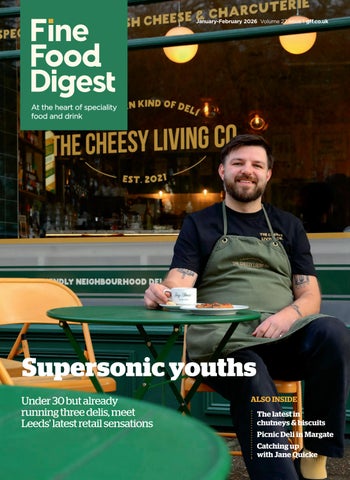
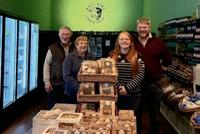
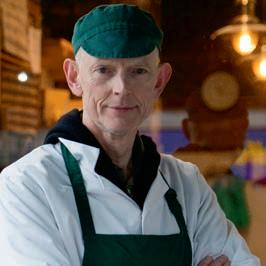
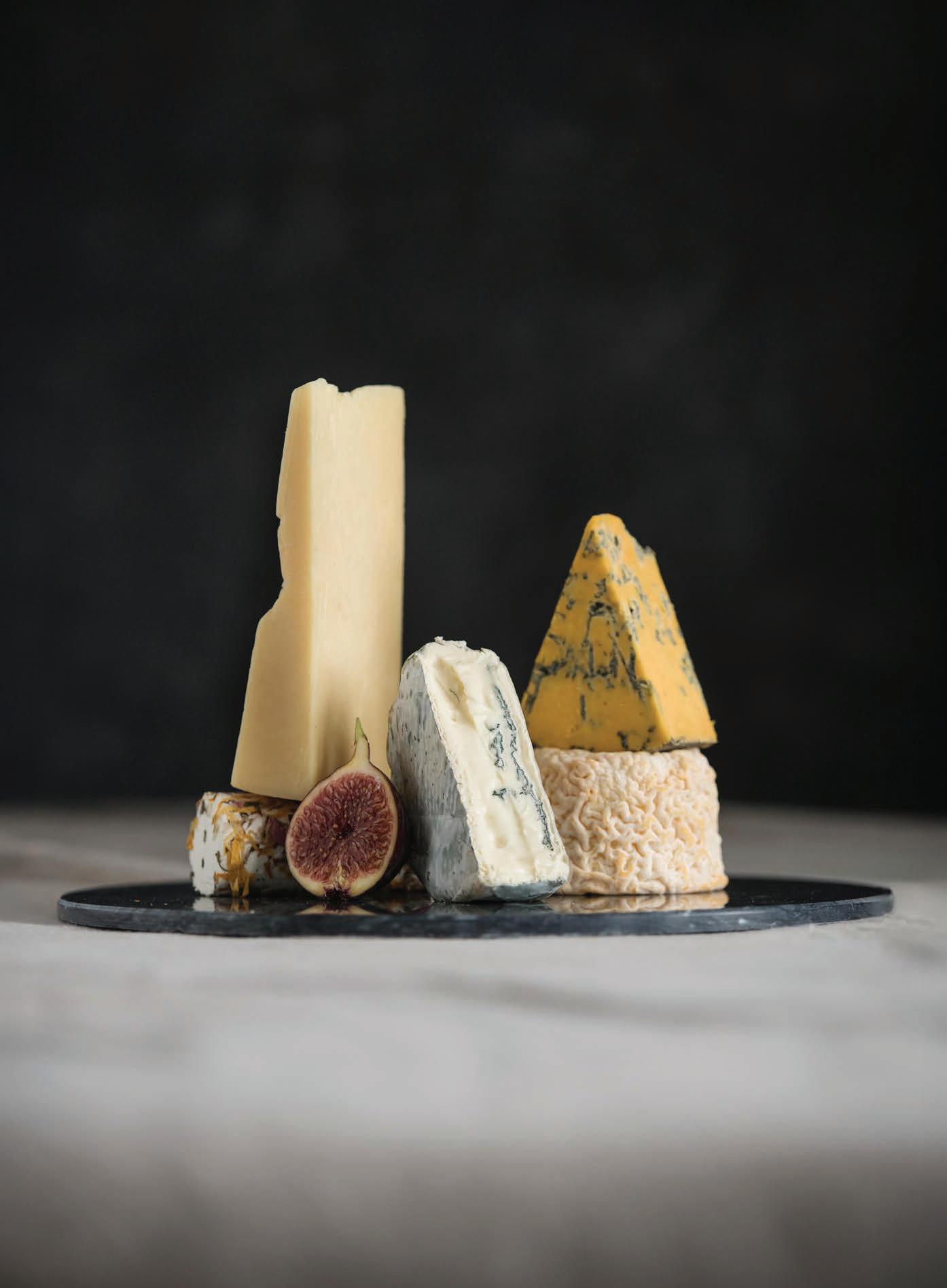
Under 30 but already running three delis, meet Leeds’ latest retail sensations
ALSO INSIDE
The latest in chutneys & biscuits Picnic Deli in Margate Catching up with Jane Quicke
www.sodiaal.co.uk
info@sodiaal.co.uk
CONTENTS
How
editorial@gff.co.uk
Editor: Michael Lane
Deputy editor: Tanwen Dawn-Hiscox
Art director: Mark Windsor
Contributors: Nick Baines, Claire Bullen, Patrick McGuigan, Greg Pitcher, Phil Taylor, Lynda Searby
opportunities@gff.co.uk
Sales and publishing director: Sally Coley
Senior sales account manager: Becky Haskett
Sales executive: Henry Coley
Sales support: Tamsin Bullock
Don’t start the year guilt-tripping, pressurising and whipping yourself too hard. You need to conserve your energy.
By Michael Lane, editor
We’re already a month into the year. So, rather than wish you a happy new one, it feels more appropriate to ask you about how those resolutions are going.
Well, how have you got on, then?
My guess is that most people’s resolve has broken already. Gym membership cards have retreated into wallets, pints and glasses of wine are back on the menu, and that ‘Teach yourself Spanish’ book already has a thin layer of dust on it.
I’ve all but abandoned the pledges I made to myself, relatively sober, on New Year’s Eve. I hoped this year they were too modest to fail.
The plan to definitely definitely exercise three times a week fizzled out within a fortnight. And my intention to read more? Still haven’t picked up a book in 2026.
I never tell anyone what I think I might give up, because I never ever
manage it.
This is the first time in a few years I’ve tried to con myself and I thought that opting for improvements, rather than all-out denial and punishment would be achievable. But, no.
Thankfully for me (and unluckily for long-time readers), the one thing I didn’t say I’d do is give up reinventing the wheel. Because that’s what this first column of the year has to do. Different lesson, same moral. And it does bear repeating.
Don’t start the year guilttripping, pressurising and whipping yourself too hard. You need to conserve your energy. This time of year is as close to hibernation as you’re going to get in this line of work.
Yes, it’s easy to freak yourself out with the grim potential of whatever cost pressure, import ban or governmental policy is coming in the next 11 months. But you
What then about the latest trends and tech coming to destroy our small and relatively traditional shopkeeping models?
The funny thing is, as much as I hear about Artificial Intelligence and Augmented Reality, I still read plenty about how customers still want storytelling and to feel a sense of belonging when they buy goods.
The UK’s delis and farm shops are in exactly the right position to be able to give them that. You are doing it already!
If I was writing this in 1926, retailing would still have been the timeless art of selling people what they want and introducing them to things they didn’t realise they wanted.
So, let’s bin all the guilt and doom.
If you want to show resolve, keep doing what you’re good at – easing everyone else’s New Year blues.
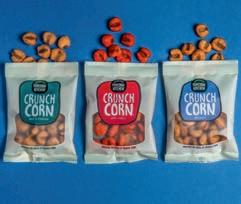
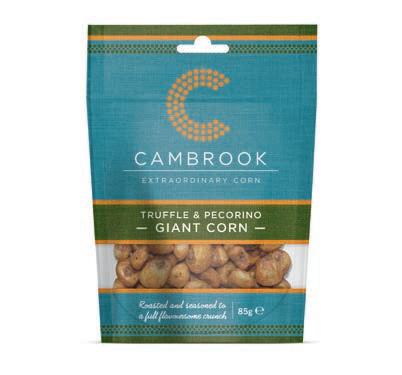
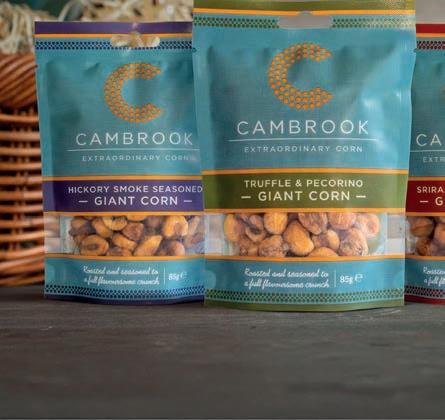
Sometimes you don’t know you want something until you’ve tried it. Would I have willed this sheep’s cheese and mushroom-flavoured giant corn into existence? Possibly not. Am I glad it does exist, and am I looking forward to crunching on those airy, deeply savoury kernels over a glass of white wine (perhaps even a Pecorino, made from the aromatic Italian grape variety of the same name, whose racing acidity, rich peachy notes and minerality complement the flavour and the name)? Yes, yes I am. More on p.45
Data strategy & insight manager: Lindsay Farrar
Operations & logistics lead: Chris Farrand
Operations & judges lead: Sepi Rowshanaei
Operations & membership lead: Chloë Warren-Wood
Operations & events lead: Zara Williams
Operations assistants: Thomas Jackson, Jos Holmes
Published by The Guild of Fine Food Ltd Fine Food Digest is published 11 times a year and is available on subscription for £50 p.a. inc P&P.
Printed by Blackmore, Dorset gff.co.uk +44 (0)1747
Retailers report a strong end to 2025 a er festive boost
By Greg Pitcher
Fine food retailers have celebrated a strong Christmas trading period a er a di cult year.
Delis and farm shops told FFD of a strong climax to 2025 with customers turning out in their droves both online and in person.
Last year saw shops battle with rising employment costs, soaring business rates and a subdued economy that constrained consumer spending.
But Sangita Tryner, owner at Delilah Fine Foods in Nottingham, expressed her relief at the positive end to 2025.
“We were holding our breath with all the doom and gloom around,” she
admitted. “But we had a really good Christmas.”
Delilah’s in-store takings were up 2% on the previous year but the deli’s online sales rocketed by 50% and its corporate hampers did 60 % better than in 2024.
“We had lots of preordered collections,” says Tryner. “Two days in a row we were here for four or ve hours a er closing cutting cheese for pick-ups.”
Selling online also meant the East Midlands shop sold produce to customers from Scotland to London.
Tryner added: “We had a diabolical summer. We were on the back foot, but the buoyancy of Christmas has pulled it back and I feel a lot better.”
Ian Evans, co-owner at Broad Bean Deli in Ludlow,
WHAT THEY ARE SAYING ABOUT... ...WHAT SOLD WELL AT CHRISTMAS
“We did build-your-own hampers, which really worked for us and we had companies buying from all over the place. Cheese and meats were mental, also miso and Japanese-style hampers. I was holding off buying stock and ended up panic buying. We had an eclectic range of wine, including Georgian, and sold a lot, especially to London.”
Waitrose to open new
said the nal two months of 2025 were the best end to a year since he bought the Shropshire shop a decade ago.
“We are 17% up on the previous December and 14 % up on the prior November,” he said.
“Across the nal quarter of 2025 we were probably about 13% up year-on-year.
The rm reduced its pro t on individual items as costs rose last year.
“Where we would aim for 32% gross pro t margin on ambient products it is now about 27%. But with increased turnover, there is more money in the bank going into January than previously.”
Nick Sin eld, cofounder at Teals, said the Somerset farm shop enjoyed
“We don’t buy Christmas-themed produce, we have winter stock.
This year I spent 30% more than previously and still had to do lastminute top-ups in the week before Christmas. Italian classic winter fare sold well, as did French nougat. We find people buy a lot of our normal shelf products as presents as they realise they are worth gifting.”
a strong festive period –eventually.
“Christmas came very late, we were very busy the last 10 days, and we are on a main road so we stayed busy until New Year because people were traveling.
“All the areas you would expect to come through, came through –butchery, special event bits. Our price points are quite giftorientated in December, that was the fastest moving element, items around £20. So books connected to what we do, such as on sustainability or food systems, and biscuits, crackers, cider. Things that go in stockings or under the tree.”
“There was a moment when we thought the period might be so er than expected but we pulled it back. In the end we were up on the prior year.”
Rob Copley, owner at Farmer Copleys, said the Yorkshire business took 6% more than during the previous Christmas run-in but had spent more to achieve the sales.
“Prices are 10% up, wages are up, so we made a bit less pro t but it was still a very good e ort.”
Premium chain grocer Booths also posted bumper results over Christmas. The family-owned retailer said like-for-like retail sales were up almost 5% on last December.
Booths, which has 28 stores across the North of England, said turkey sales were up 12%, cheese sales 4% and mince pies 5%.
Bristol distribution centre as £1bn investment continues
Waitrose has announced plans to begin filling 560 jobs in the South West this spring as it gears up to open a 360,000 sq ft distribution centre in Bristol next year.
The upmarket grocer said the Avonmouth hub would be run by logistics giant DHL, which will recruit 480 warehouse workers and 80 drivers.
Waitrose is spending £1 billion, including investment in all 317 stores, as part of its stated aim to become “number one choice for food lovers”.
The firm said its new distribution centre would be its most sustainable; improve delivery efficiency for 50 outlets in the South West; and “support future expansion”.
Waitrose opened a shop in The Arches in Bristol last autumn, and plans to create a supermarket in the Brabazon development. Supply chain director Alison Maffin said: “As we grow, it’s essential that our supply chain grows with us.
“This new site strengthens our network, ensuring consistent service for our customers
and creating over 550 jobs in a state-of-theart facility. DHL shares our commitment to sustainable logistics, making it the perfect partner for this next phase of our expansion.”
Waitrose has made clear its intentions recently, opening a concept store in Berkshire before Christmas with a cheese island featuring more than 100 speciality products.
The Newbury shop also includes a “meal maker” service that sees fishmongers and butchers preparing cuts, as well as an “expanded” bakery and deli counter.
IAN EVANS, BROAD BEAN DELI
NICK SINFIELD, TEALS
SANGITA TRYNER, DELILAH FINE FOODS
IN BRIEF North East shopli er scheme has indies hoping for better across the UK
By Greg Pitcher
Independent retailers have backed a crime- ghting scheme trialled in the North East allowing shopli ers to be sent to court without being arrested.
Now others in the sector are hoping that this kind of process will be applied nationwide.
Northumbria Police is running Operation Canvas in Newcastle city centre in partnership with the NE1 Business Improvement District.
More than 30 retailers have signed up to the initiative, which allows them to le a crime report with CCTV evidence to o cers, who can summon suspects straight to court.
The force said in January that 63 convictions had been secured since November 2023.
Courts have also handed out over 200 hours of unpaid work, in excess of £2,500 in nes and beyond £7,500 in compensation.
Chief inspector Rob
Bosson said: “Many repeat shopli ers o en commit such o ences because they believe the risk is low.
“But criminals who are known to Operation Canvas and continue to o end should expect to be put in front of a judge more o en.”
The British Independent Retailers Association (BIRA) said its latest research showed a sharp rise in crime, with 83% of members saying the had worsened over the past year.
However, almost half of incidents were not reported to police, according to the survey, with less than one in ve leading to prosecution.
BIRA chief executive Andrew Goodacre backed the Newcastle trial.
“It is great to see the police being so proactive in addressing the growing problem of retail crime,” he said.
“We know forces around the country are keen to support retailers and I urge all retailers to submit relevant CCTV coverage of criminals so that these
Former NFU head calls for new farming plan
Former National Farmers’ Union president Baroness Batters has demanded a “national plan for farming” to boost domestic food supply.
The cross-bench peer made the call in a Governmentcommissioned review published shortly before Christmas.
Her report said the UK produced under two-thirds of the food it consumed in 2024, down from almost four-fifths 40 years earlier.
“Farmers and growers are feeling firsthand the impacts of volatility, extreme weather and rising input costs,” said the review.
people can be charged.”
However, many ne food purveyors have lost faith in the police tackling crime in their stores.
Frankie Dyer, managing director at Barbakan Delicatessen, said independent retailers in the Chorlton district of Manchester had “no support” despite “proli c shopli ing, frequent burglaries and high business rates”.
“It’s appalling,” she added. “Just like everything else at the moment: we’re on our own.”
The deli made headlines
four years ago when it posted an incident on social media involving a would-be burglar attempting to break into its store during the early hours while sta were working inside.
Although this was captured on CCTV, Dyer said “nothing came of” attempts to catch the perpetrator.
“We don’t bother sending anything in [to police] anymore,” she told FFD this month.
“It’s more useful that we have a Chorlton Traders WhatsApp group to alert each other.”
IN BRIEF
UK Spanish food importer and wholesaler Basco has launched a campaign called Beat the Budget, offering a 12% discount across 40 of its product lines throughout January and February.
Richard Clothier, MD of Somerset cheddar maker Wyke Farms, was appointed an MBE in January for his contributions to sustainable agriculture and food production.
Daylesford Organic recorded a profit of £2.8m in the year up to March 24th 2025, up from a £2m loss the year before. The Bamfordowned business said this was thanks to increased wholesale and retail sales, and the first full year of operations at its dedicated events space.
Delli is done selling online but site lives on
Online fine food market
“Many are currently facing huge economic challenges to produce high quality, affordable food and meet environmental demands. Lack of clarity on finances and policy is leaving many farmers questioning the viability of their business.”
Among a raft of recommendations, Batters called for establishment of an organisation called Food and Drink England.
This should forge “closer relations with farmers and local government” and “champion English food producers and our national food culture” she urged.
Delli has stopped selling products directly in a change of tack some experts see as a sign of the importance of retailers having a physical presence.
The platform, which offers a range of items from apple cider vinegar soda to brown-rice noodles, now directs customers to manufacturers’ websites.
While retailers can continue to checkout on the Delli website, orders will be fulfilled by suppliers.
The Delli app will be phased out and consumers will have to buy produce directly. An email sent by the
company on 1 January said: “We need to step away from central fulfilment and invest more deeply in discovery, infrastructure and long-term growth for the independent food economy.
“We know that one of the things many of you loved about Delli was the simplicity of a single checkout and combined delivery. But this shift allows us to do far more for makers and in turn to bring you more of them in more places.”
Guild of Fine Food managing director John Farrand said the concept of selling fine food online had proved difficult to “crack” over the years.
“It’s normally the fulfilment side that doesn’t stack up,” he said. “Aggregating multiple small producers proves to be difficult.”
Farrand added that Delli’s switch showed there “continues to be a place for bricks and mortar”.
“The majority of shoppers are looking for an experience in real life with theatre and advice when shopping for deli food and drink,” he said.
The British Independent Retail Association said 83% of its members reported thefts worsening in the past year
The e ect of ASF on imports of Spanish pork is limited, but ongoing
By Tanwen Dawn-Hiscox
UK importers of Spanish pork products have assured retail customers that the African Swine Fever (ASF) outbreak declared last year has not resulted in any sustained shortages, as supply has been allowed to continue from outside the a ected zone – and that food safety is not a concern. Reports are instead of short-term disruption, additional checks and administrative burden.
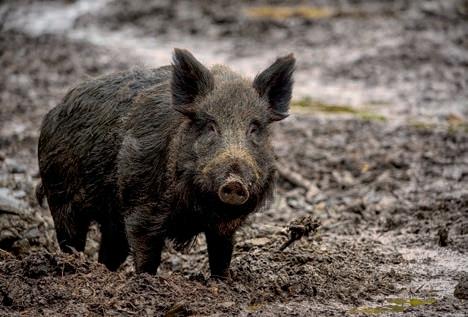
The disease, which is harmless to humans but highly contagious among pigs and wild boar, was rst detected in the outskirts of Barcelona in late November, in wild boar. It has not been identi ed in any farm animals.
Defra initially imposed a total ban on Spanish pork product imports to the UK– meaning that some consignments were held at the border. Shortly therea er, it agreed to a regionalisation deal whereby
imports could resume from outside the restricted zones.
Germán Arroyo, meat category buyer at Spanish importer, wholesaler, retailer and foodservice provider Brindisa, told FFD that the timing of the outbreak made the initial disruption particularly di cult. “For us, 30%, 40% of sales are in the last quarter of the year,” he said. “So the impact could have been massive.” Arroyo added that
ED WOODALL TAKES HELM AT ACS
From March 1st, Ed Woodall will take on the role of CEO at the Association of Convenience Stores (ACS), replacing James Lowman, who has held the position for the past 19 years. Woodall joined the ACS in 2009 as a public affairs assistant, and
was subsequently promoted to the role of head of Government relations in 2014, and Government relations director in 2024. James Lowman applauded the appointment, calling Woodall “an outstanding leader” and “a key part of ACS’ work for the past 16 years”.
being BRC A++ accredited, Brindisa’s suppliers already keep thorough records, meaning traceability isn’t an issue. He said the outbreak nonetheless served as a reminder of the potential scale of risk facing the sector.
He added, however, that the response by authorities had been swi and proportionate once the scale and location of the outbreak were understood.
Kate Shirley-Quirke,
owner of Spanish importer Delicioso, said that when news of the outbreak rst emerged, concern among larger customers led to some short-term availability issues. Some suppliers have introduced price increases, driven both by reduced availability and the additional burden of compliance.
Shirley-Quirke added that while supply had largely stabilised, the administrative impact remained signi cant, particularly in terms of lead times. “It already took ve or so days for them to get the paperwork done already. This is making it take another week in addition.”
She was also critical of o cial communication, saying she had relied more on customs agents than Government updates to understand the practical implications for her business. “It would be nice if they really thought about what they needed to communicate to people.”
DOWN ON THE FARM
IN BRIEF
Unesco has awarded Italian cooking special cultural heritage status. The Egyptian lentil dish Koshary, Cuban Son music and Icelandic bathing practices were also added to the list of “intangible cultural heritage”.
Paramount Retail Group has bought Keystone Brewing and combined its portfolio of craft breweries – which include Brick Brewery, Magic Rock Brewing and Fourpure Brewing Co – under a new brand, The Great British Drinks Company.
Retailers looking to ramp up their summer offer are invited to sign up for a one-day gelato masterclass at Caliendo’s Gelato, provided by head chef Michelina Caliendo-Sear.
The latest from farm shops across the country
After strong local support, planning permission has been granted for a change of use at The Castle Inn on London Road near Haywards Heath. The proposals include extending the building to add a combined café and farm shop, with a separate new toilet block. The ground floor will remain in use as a pub and restaurant, while the upper floors will be renovated to create a bed and breakfast. facebook.com/ CastleInnHotelBramber
The Hog & Hen Farm Shop in Stonham Aspall closed for the first two weeks of January to complete building works.
It is reopening with a new on-site bakery, and will produce all the cakes, bread and pies sold in the shop in-house once the work is finished. facebook.com/ hogandhenfarmshop
A Grade II-listed building in Ludlow town centre has a new tenant. Bull Ring
Farm Shop opened on 10th January, bringing together local farm produce and groceries. The business is run by James Evans of Evans Family Grocers and Ruth Powell of Lizzie’s Layers, a free-range egg producer, alongside her husband David, a farmer. bullringfarmshop.co.uk
While the source of the outbreak remains unconfirmed, one theory is that wild boar ate contaminated food waste imported from Eastern Europe, where ASF cases errupt more frequently.
IF I’D KNOWN THEN WHAT I KNOW NOW...
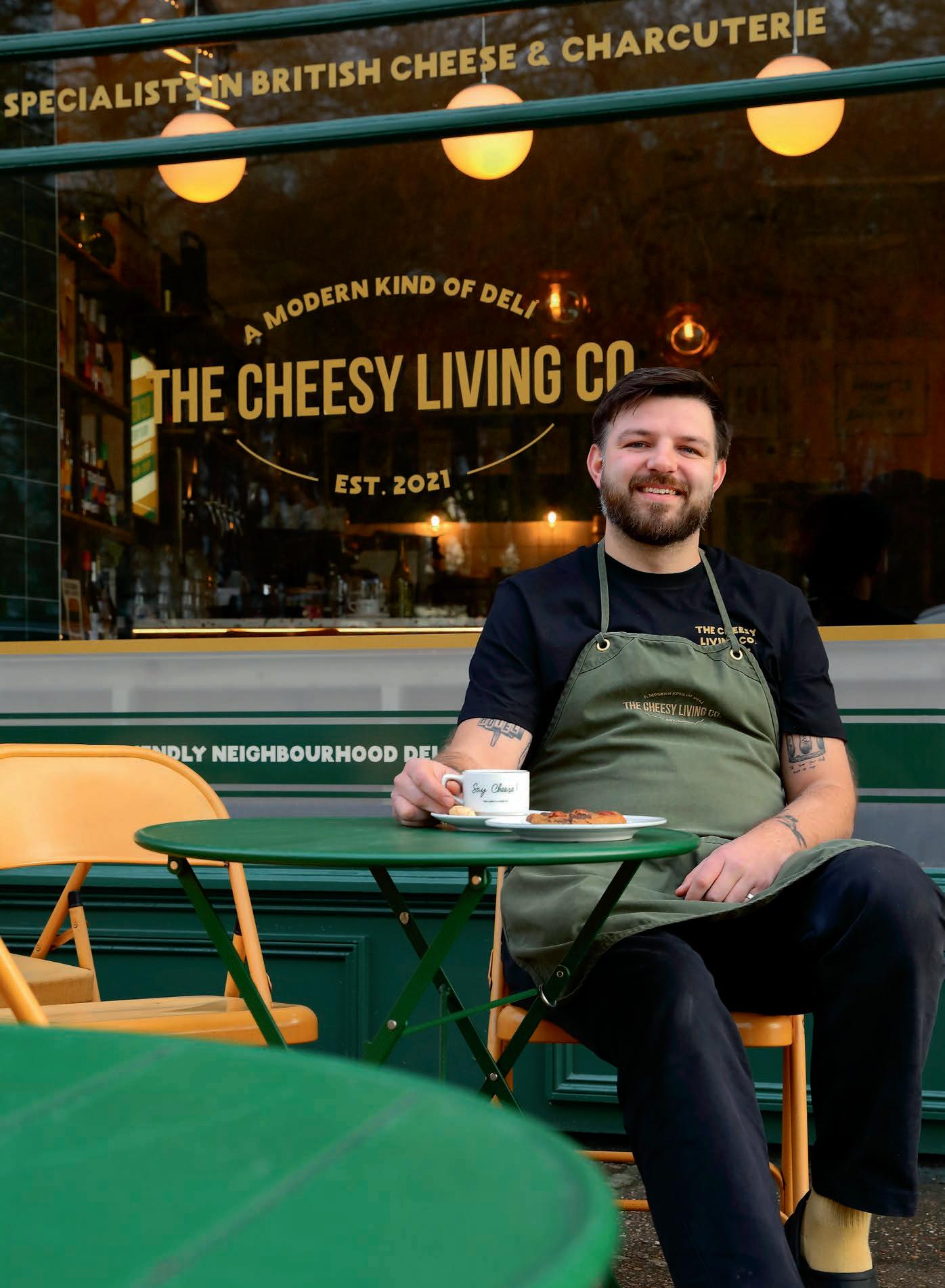
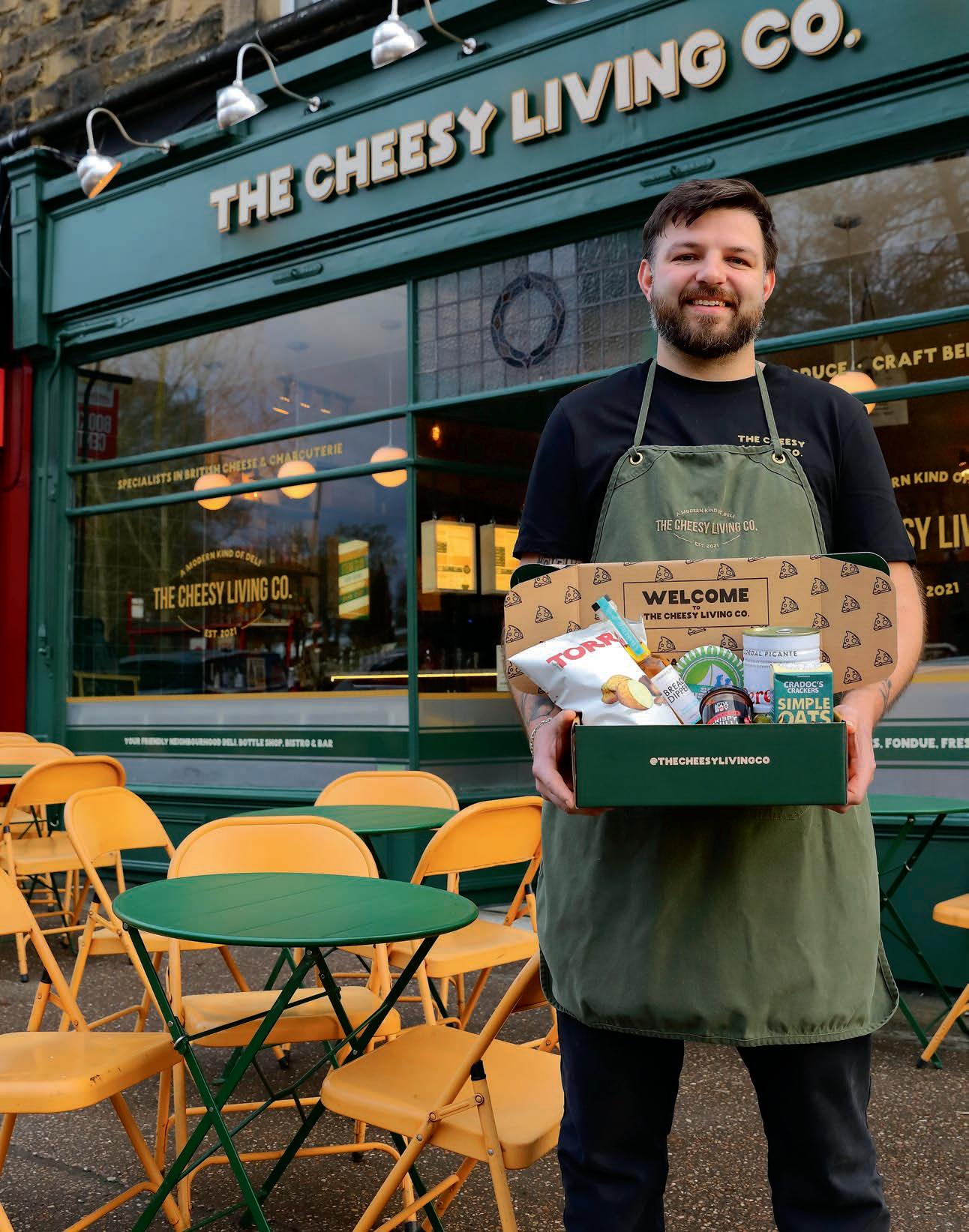
JAKE FISCHER, director, The Cheesy Living Co, Leeds
During the pandemic, when I was furloughed from my job in hospitality, my partner Sophie and I came up with the idea of delivering at-home cheeseboard experiences in a box.
By the time we had the branding right and the sourcing in place, lockdown was over, so we pivoted and started doing pop-ups at farmers’ markets and events. A Christmas fair at the Corn Exchange in Leeds triggered a conversation about taking a permanent unit and we opened our first site there in 2022.
We set out to modernise the cheese shop format by making it bright, fun and approachable. Our experience of traditional cheesemongers is that they can be intimidating and a bit stuffy. We wanted to create a welcoming space where people could ask questions and get stuck into British cheese.
These values are reflected in our branding, and our policy of selling all our cheese at the same price per kilo (£4/100g). Cheese counters can be overwhelming, especially when the cheeses are individually signposted with prices. We’ve tried to simplify the buying process so people can choose what looks interesting to them. One of our most popular lines is our ‘Pick and Mix Cheese Box’, which works like an introductory offer, allowing people to try 100g portions of different cheeses rather than being stuck with one big lump.
We’ve since opened in two further locations – Pudsey and Oakwood. These are ‘neighbourhood’ spots, where the emphasis is on eating in rather than retail. Our Corn Exchange site is 75% retail and has just five tables.
When we opened our Oakwood site, we weren’t prepared for how different it would be to running a city centre shop. We laid it out as a retail store, installing a massive cheese counter at the centre of the room. But people wanted to sit down to eat, so we expanded our kitchen team and menus. We put in a smaller cheese counter and bar seats, giving it a more social, American diner feel. You don’t always know how a space will work until you start working in it.
As the business has grown, our biggest challenge has been evolving as owners. We employ 30 staff, which is one of our proudest achievements, but also a huge responsibility.
From the outside, it might look like we are smashing it, but what people don’t see is that we are both working 80 hours a week before we’ve even started the admin. We are busy; we are on top of our numbers and we prioritise guest experience – and that is probably why it works. thecheesylivingco.co.uk
Interview Lynda Searby
Phil Taylor
Photography
Sensory notes
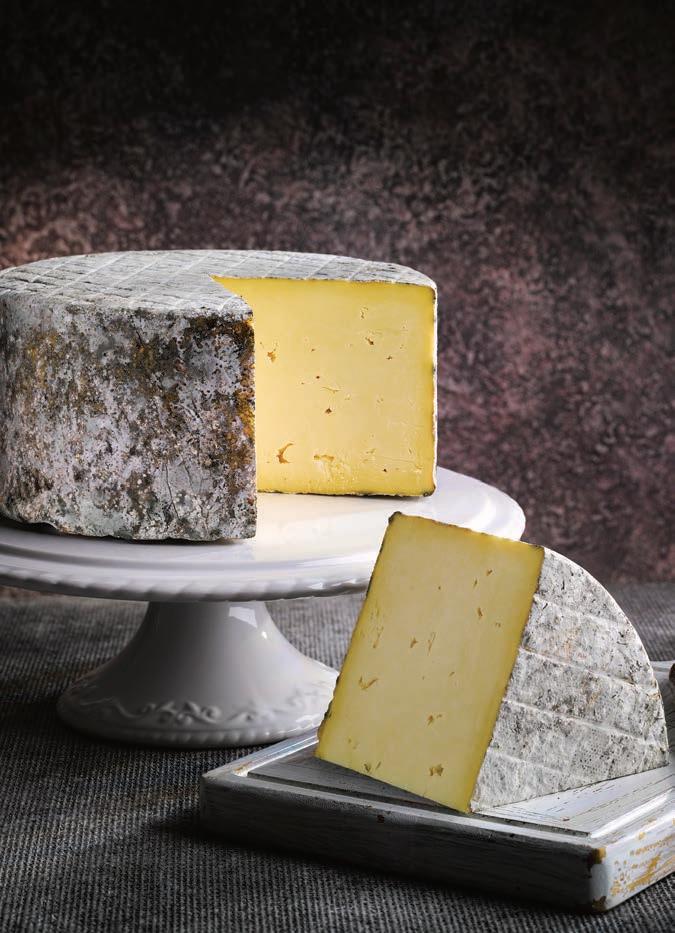
The organoleptic characteristics of the cheese are:
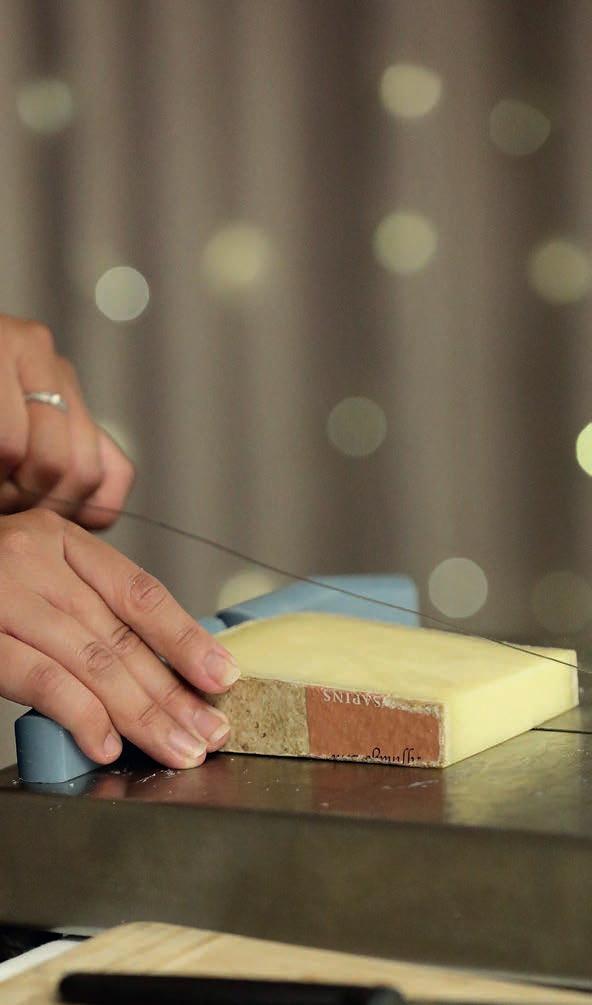
Pressed cheese made from the milk of ewes of the ‘Manchega’ breed, aged for a minimum of 30 days for cheeses weighing up to 1.5 kg, and from 60 days to a maximum of 2 years for larger formats.
‘Queso Manchego’ may be produced using either pasteurized or raw milk. In the latter case, the label may include the designation ‘Artesano’
RIND
Color
A pale yellow or greenish-black coloration may occur when the mold-covered surface formed during maturation is not properly cleaned.
Appearance
The cheese exhibits a characteristic shape, with braided ‘pleitas’ impressions on the sides and a floral pattern on the flat faces.
How to identify Manchego cheese
CHEESE PASTE
Consistency
Firm and compact.
Color
From white to ivory-yellow.
Smell
Characterized by lactic and intense acidic notes with a persistent profile, which evolves into spicy nuances and extended flavor persistence in well-aged cheeses.
Flavor
Exhibits a slightly acidic, intense, and flavorful profile that evolves into spicier notes in well-aged cheeses. The milk from Manchega ewes contributes to a characteristic and pleasant aftertaste.
Appearance
Characterized by small, evenly distributed eyes, which may occasionally be absent.
Texture
The texture is low in elasticity, buttery, and slightly crumbly, becoming granular in well-aged cheeses.
@QuesoManchegod
Queso Manchego DOP
@quesomanchegodop
Web: https://www.quesomanchego.es/
View from HQ
FFD’s publisher and Guild of Fine Food managing director John Farrand has his say
WTrade agreements with far- ung places might please politicians, but back in the real world, we want to trade with our neighbours
e decamped to foreign parts for the rst time in my life at Christmas. I was overseas not only for the ‘big day’ itself but avoided the traditional last-trading-days-chaos of our local high street. Cheese… wine…bread sauce…shopped at high speed, negotiating car parking charges and folk who can’t drive.
Our time there was in many ways a metaphor for the Defra SME Agri-food group that I have just sat in. There was discussion concerning Q4 trading numbers and how the high street had performed. Local independent shops are the backbone of towns in Kenya. It was enlightening to see healthy, enthusiastic retail without signi cant supermarket in uence. There was evidence of trade and produce from neighbouring Tanzania, hinting at how much we need a Sanitary and Phytosanitary (SPS) Agreement. The new look Food & Drink Exporters Association (FDEA) has set punchy
WEDGE ISSUE 02 OUT NOW
The second issue of the Guild’s new consumer magazine about cheese, Wedge, is available now.
The perfect complement to your cheese offering, Wedge is available to stock in your shop –and we have an introductory offer for all FFD subscribers:
5 copies for £6 each - 50% margin (total for order £30) 10 copies for £5 each - 58% margin (total for order £50)
Order your copies today from wedge@gff.co.uk or call us on +44 (0)1747 825200. wedgemag.com
but laudable targets around export trade – they want an additional £1bn every year. If we could start trading easily with Ireland alone, we’d hit that number. Trade agreements with far- ung places might please politicians, but back in the real world, we want to trade with our neighbours.
The last item on the agenda was pEPR (Extended Producer Responsibility for Packaging). I’ve been cynical here and concerned about drinks producers who use glass bottles because they seem to be getting a raw deal. But I dig deeper and with a degree of relief, I nd out that smaller retailers (less than 100sqm) will be exempt from installing collection points. I dri back to the holiday in Kenya. They have a bigger problem with discarded plastics than we do in the UK, but they run a simple monetary incentive to collect that refuse – and the same is true across much of Europe. Will I see fewer KFC buckets on the verges
if we instigate a more responsible approach to our packaging?
But what of Q4? Our critical quarter. The most recent data from the Independent Retail Confederation (IRC) showed that Christmas sales were, on average, 9.3% up on 2024. In allied research, the Booksellers Association revealed that the average transaction value was up across 32.66% of respondents. At our own Town Hall meeting mid-January, one retail member assured us his festive season was 20% up on the year before. Crude analysis by me perhaps, but it all sounds pretty positive. Perhaps that time of year always is. There was a neat little idea on the bottom of head of the Booksellers’ Meryl Hall’s email to me as we bantered about trade. Her sign o included the book she was currently reading. Got me thinking; should the GFF team indicate what cheese they are currently enjoying? It should be seasonal and mine could well be African.
The Word on Westminster
By Edward Woodall Association of Convenience Stores
THE DEBATE OVER business rates has resurfaced in recent weeks, prompted in part by calls from the pub sector for additional support. However, it’s essential to acknowledge that the pressures facing small retailers will remain significant in the years to come.
Although the November 2025 Budget introduced permanently lower multipliers for retail, hospitality and leisure and extended transitional relief, these measures fall short of addressing the scale of change in rates bills. As we outlined in our recent letter to Treasury Ministers, the combination of the 2026 revaluation and the withdrawal of temporary reliefs means that many independent shops will still see increases in their bills worth several thousand pounds, even with transitional relief. For local shops, delis and fine food retailers, these increases will have a material impact on their business. Rising fixed costs limit the ability to invest in stores, to maintain staffing levels and to keep up with other regulatory and operational demands. This inevitably filters
through to the customer experience and impact the services communities rely on.
Local shops play an essential role in villages, on neighbourhood parades and city high streets. A sustainable business rates system should reflect that.
Our position is straightforward: the measures announced in 2025 are only a starting point. Further action is required to ensure retailers are not disproportionately affected by the revaluation and the loss of previous reliefs. This includes protecting small businesses that may lose Small Business Rate Relief as rateable values rise, and reducing the new retail, hospitality and leisure multiplier further to prevent undercutting essential investment.
As the Government considers its next steps on business rates, it cannot limit additional support to one part of the high street. Retailers face the same structural pressures and deserve the same level of attention. We’ll continue to make the case that any further support must extend to retailers to ensure local shops can continue serving their communities.
Edward Woodall is government relations director at the ACS. edward.woodall@acs.org.uk
CONFESSIONS OF A DELI OWNER
Anonymous
tales from behind the counter
EVERY SATURDAY MORNING , without fail, my favourite customer breezes through our door. They don’t have a basket, and they certainly don’t have a shopping list. What they do have is a passionate, ve minute monologue about how vital we are to the fabric of the village. They tell me how much they love the smell of the shop and how they simply couldn’t imagine the local town without our window display. Usually, they deliver this sermon while clutching a heavy, rustling bag from one of the big budget supermarkets, lled with the very items, such as butter, eggs, and our, that actually pay my
electricity bill.
There is a peculiar British cognitive dissonance at play here. This customer wants to live in a postcard. They want their property value propped up by the presence of a charming independent deli, but they want their actual pantry stocked by a multi-national that views a penny of pro t as a failure. To them, we are a museum or a public service: a quaint backdrop for their weekend stroll, rather than a business that needs cold, hard cash to exist. They treat our shop like a stage set, assuming that the lights stay on through some sort of community magic rather than the sale of actual
We’re told the high street is dying, yet the people mourning it are the ones holding the shovel
Expert eye
IARTISAN FOOD CLUB FOUNDER MARCUS CARTER ON HOW NLP EXPLAINS WHAT CUSTOMERS NOTICE ON SHELVES
am a true believer in clear product names with recognisable descriptions, front and centre. Yet many artisan brands still do the opposite, hiding what the product is behind small fonts, oversized logos and layers of messaging. The reason sits squarely in Natural Language Processing (NLP) and how the brain protects itself from overload. Shoppers don’t stand in front of a shelf carefully analysing every product. They scan. In seconds, the brain lters out anything that feels unfamiliar, confusing or e ortful. In NLP, this process is known as deletion. It happens before conscious thought. Products that can’t be instantly identi ed, categories that feel ambiguous, and labels that require interpretation are o en removed from attention altogether. Most shoppers don’t reject artisan food; they never properly notice it.
products.
The most painful part is when they ask, with genuine concern, why the greengrocer in town had to close his doors. I want to point at the plastic-wrapped, sweatbeaded broccoli peeking out of their supermarket bag and say, “That. That is why.” But instead, I smile and shrug my shoulders, playing the part of the grateful merchant. In the current UK economic climate, being a small retailer feels like being a character in a heritage theme park where the visitors have forgotten to pay for their tickets.
We are constantly told that the high street is dying, yet the very people mourning it are o en the ones holding the shovel. They want the variety, the expertise, and the “experience”, but they expect us to compete with the buying power of a corporation that owns its own shipping eet. If you want the village to stay a village and not just a collection of charity shops and boarded-up windows, you eventually have to buy a loaf of bread that costs more than a rst-class stamp. Otherwise, one day soon, the only thing le of our “vital” community hub will be the memory of a nice smell and a very expensive empty unit.
One of the biggest mistakes artisan brands make is assuming originality earns attention. It doesn’t. The brain isn’t hunting for novelty; it’s hunting for recognition. Humans are patternmatching machines. When something ts an existing mental framework, the brain relaxes and allows attention. When it doesn’t, it moves on. This is why so many labels struggle. They lead with poetic descriptions, invented category names, clever wordplay or brand story before product function. From the producer’s point of view, this feels premium and distinctive. From the shopper’s point of view, it feels like work.
The solution isn’t to make everything bland or generic. It’s to give the brain a familiar anchor. When something new is linked to something known, the brain feels safe enough to explore. Great artisan labels do this exceptionally well. They o er a clear reference point, an obvious use case and a recognisable category cue. Once the brain understands where a product ts, curiosity is unlocked. Story, provenance and personality can follow. This is where many artisan brands need to be honest with themselves. The shelf is not a discovery platform, a learning environment or a storytelling space. It is a fast, practical, problemsolving environment. Shoppers are in a “what do I need?” mindset, not a “tell me something interesting” mindset. artisanfoodclub.online
3.66% The rate at which alcohol duty rates rose on February 1st, in line with Retail Price Index (RPI) inflation. That’s 11p on a bottle of Prosecco, 13p on a bottle of red wine, and 38p on a bottle of gin.
Source: gov.uk
ARE YOU LOOKING FOR MORE?
Whether it’s staff training, business advice, event space, making industry connections or opportunities to meet trade buyers and food lovers, the Guild of Fine Food does far more than publish FFD The Guild has been championing independent food & drink for over 30 years. Join us today and find out what we can do for your business.
Rowcli e set to ramp up artisan Irish cheese imports into the UK
By Patrick McGuigan
Imports of Irish artisan cheese to the UK are set to grow thanks to a new supply chain being set up by dairy industry veteran Tim Rowcli e.
Paperwork requirements following Brexit have made it more di cult for small producers in Ireland to export to the UK, but Rowcli e is working with Cork-based groupage company AOR International Transport on a scheme that will enable mixed pallets of cheese from multiple producers to be shipped to England.
Kent-based distributor Rowcli e, which was previously owned by Tim Rowcli e, will receive initial shipments with the rst expected in time for the British & Irish Cheese Awards in March. At the same time, Irish cheesemakers are working towards SALSA+ - a food safety accreditation required by many British retailers, which has only recently launched in Ireland. Cheeses including Coolea, Cooleeney, Cashel Blue, Milleens, Gubbeen and Knockanore are expected to be included in initial shipments with more cheeses added in time.
Rowcli e, who has a house in Ireland and spends much of his time there, has been helped
in the scheme by the Specialist Cheesemakers’ Association (SCA), Cais (the Association of Irish Farmhouse Cheesemakers) and Irish food board Bord Bia. As part of the project, the largest showcase of Irish cheeses in 40 years was held in London last October at an event supported by Bord Bia and attended by 17 cheesemakers.
“The enthusiasm from buyers and suppliers at that event was palpable,” said Rowcli e. “We used to sell a hell of a lot of Irish cheese when I owned Rowcli e, but there was so much paperwork a er Brexit that it was hard to nd companies willing to to bring small amounts of cheese from 10-15 producers.”
Rowcli e lobbied for the
Cheesemonger Heritage Cheese Kitchen has been fined £150,000 after food hygiene inspectors uncovered a “widespread infestation” of mice at two premises in Dulwich and Tower Bridge, South London. The Dulwich shop has since closed.
Entries are now open for the British & Irish Cheese Awards. Judging will take place at the Bath & West Showground on 20th March. Applications close on 17th February.
Pasture for Life, the Raw Milk Producers’ Association and Neal’s Yard Dairy have won funding from Farming the Future to organise 12 events on dairy farms. The events will explore issues such as reducing costs, biodiversity and new product development.
British Cheese Awards to be renamed The British and Irish Cheese Awards last year in his role as vice chairman of the competition. He aims to “relaunch” Irish cheese at this year’s contest with the highest number of entries from Irish producers in the awards’ 30year history. A reciprocal trip is also being planned for British cheesemakers to visit Ireland. Trade between Ireland and the UK is also likely to bene t from plans by the British Government to ‘dynamically align’ with EU agricultural production rules on sanitary and phytosanitary standards and food safety regulations. “Anything that helps reduce paperwork is to be welcomed,” said Rowcli e.
A collaboration between Ayrshire farm Mossgiel Organic and Cumbria cheesemaker Torpenhow saw 300 limited edition truckles of cheddar pre-ordered in the run-up to Christmas. The 2kg cheeses are currently being matured, with delivery expected in the summer. The initiative was launched to raise funds for both farms and allow customers to be part of “the story of the cheese”, from the cows, which are kept with their calves, and their milk to the artisan skills used to make the cheddar.
THREE WAYS WITH...
Graviera Kritis PDO
Legend has it that Greek Graviera was inspired by Gruyère, but it’s a very different beast. PDO Graviera Kritis from Greece is often made with sheep’s milk (although up to 20% goat’s milk is permitted). Aged for from 3-24 months, mature cheeses have a crumbly texture and a sweet, herbaceous and buttery flavour.
White wine
The sweet, buttery flavour of Graviera Kritis makes it a flexible friend to various wines. Light reds with freshness and low tannins, such as Pinot Noir and Gamay, work well, but the cheese is most at home with richer whites. Think lightly oaked Chardonnay or Viognier. The Greek grape Malagousia is used in full-bodied whites with fruity and floral notes that wrap around the sweetness of the cheese.
Dried figs
Figs work with most cheese, but there’s a pleasing Mediterranean symmetry to Graviera served with PDOprotected Kimi figs. These unique figs from the island of Evia in central Greece are split open and carefully dried in the Greek sun. They are sweet, aromatic and chewy, contrasting with the saltiness of more mature Gravieras.
Saganaki
Greece’s famous fried cheese snack Saganaki is sometimes made with Feta or Halloumi, but more commonly with young hard cheeses, such as Graviera or Kefalotyri, which melt while holding their shape. Graviera Kritis aged for 3-6 months is perfect for the job. Serve with a drizzle of honey or a squeeze of lemon juice.
A meeting of Irish makers in October, staged to showcase their cheeses
CHEESE
UK makers to re ne technical skills thanks to new French cheese school
By Patrick McGuigan
British cheesemakers are learning the secrets of French fromage at a new cheese school and dairy run by one of France’s leading cheese equipment companies.
France Process, founded by Julia Chistova, has long sold equipment in France and has recently opened a school and Research & Development dairy at a converted château in Burgundy.
The company has also expanded its operation in the UK, recently appointing former Hampshire Cheeses owner Stacey Hedges as UK business development director to build equipment sales across the Channel and encourage British cheesemakers to learn at the school and dairy in France.
France Process’ two-week residential courses cover various cheese styles and are led by Nadège Bel, who was previously head of cheese technology at Actalia – one of France’s largest food technology institutes. Students learn about cheese
CHEESE IN PROFILE with
What’s the story?
Cheesemaker Emily Tydeman began making cheese at Broughton Hall during the pandemic, but what began as an exploration soon became a vocation, rooted on the century-old Tydeman family farm.
Under the stewardship of Emily’s husband Sam and his father David, the farm has evolved into a mixed enterprise built around regenerative and sustainable land use. Emily’s first cheese, Pyghtle, is a delicate lactic cheese made with raw sheep’s milk, which
science, which is implemented in hands-on sessions in the commercial dairy, run by Patrick Heathcoat-Amory, formerly head cheesemaker at Nettlebed Creamery in Oxfordshire.
Carron Lodge, Nettlebed, Fen Farm and White Lake have already sent sta on courses, while several British cheesemakers, including Fen Farm and Shepherd’s Purse, have signed up for this year.
“There’s a lack of technical knowledge in the UK, especially
comes from neighbouring Salter’s Farm, which shares this regenerative ethos. Animal welfare is paramount; lambs remain with their mothers for five to six weeks until naturally weaned. The flock includes a mix of Lleyn, Friesland and Lacaune breeds, striking a balance between hardiness and milk quality.
now that [respected cheese tutors] Val Bines and Chris Ashby are no longer with us,” said Hedges. “But there’s a huge amount of expertise in France, where there are universities devoted to cheese courses and training. The equipment and courses that France Process o ers help cheesemakers better understand Continentalstyle cheeses, how to scale up without losing quality, and how to improve consistency.”
franceprocess.fr
Academy of Cheese.
BEHIND THE COUNTER TIPS OF THE TRADE
Finn Dunlop, owner, Finnian’s, Bishopsbourne, Kent
Finn Dunlop opened his deli at Court Lodge Farm last year, and after a busy first Christmas is navigating the inevitable lull in January and February. Thankfully, he has plenty of experience after more than a decade as part of the management team at Kent food hall, Macknade.
“The first week of January was our quietest since we opened, but I was expecting it,” said Dunlop. “January is the time for planning and reviewing, making the business more lean and efficient.” To this end, he has honed his range, reducing the number of small soft cheeses in favour of larger harder cheeses, which fill the counter, have longer shelf lives and are easier to care for. At the same time, he has also closed his stall at Folkestone Harbour Arm for January and February and reduced orders to just a couple of key suppliers. Staff hours have also been scaled back.
“The shop is small enough that one person can run it alone,” he said. “We’re looking at doing markets and events to help keep stock moving and give staff more hours in the coming weeks.”
finnians.co.uk
Emily’s dedication to craft and learning has been central to the development of her cheese. She was among the first cohort of cheesemakers to receive the Chiswick Cheese Market Cheesemakers’ Grant and has since achieved Level Two Certification with the
Pyghtle - pronounced “pie-tull” - is an old Suffolk word meaning an enclosed piece of land, of which there are many surrounding the farm.
Milk: Raw ewes’ milk.
How is it made?
Fresh milk arrives early each morning and is warmed to approximately 22 °C before a small
amount of culture is added. After several hours, a drop of rennet is introduced to speed coagulation. The following day, the curds are ladled by hand into moulds and left for a further 24 hours, being turned regularly. They are then unmoulded, handsalted, and transferred to the maturation rooms, where they are turned daily for around two weeks.
Appearance & flavour:
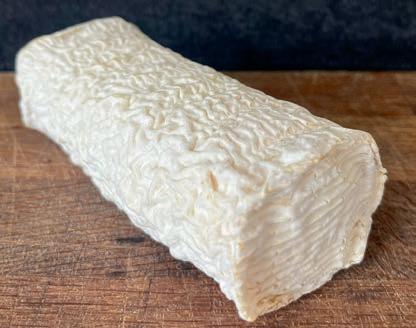
Log-shaped, the ivorycoloured, wrinkled rind covers a soft, fluffy white
paste. Older cheeses often have a slight liquid breakdown immediately beneath the rind. When young, they can be lemony, grassy and yoghurty, gaining savoury depth as they age.
Variations: None.
Cheesemonger tip: Pyghtle is a seasonal cheese, available from April, and is best eaten at three to five weeks. Pair it with an English sparkling wine or Crémant.
Chef’s recommendation: For simplicity, let it stand resplendent on a cheeseboard with a side drizzle of English honey.
Pyghtle is one of the 200 cheeses studied towards Academy of Cheese Level Three Certification. For more information on this and all of their courses, head to www.academyofcheese.org
Students attending a France Process course at the school in Burgundy in 2025
Pyghtle
PIE-ONEER IN TASTE.
Agility Jane
With her background in business and biology, Jane Quicke has taken the helm at her family’s cheddar business.
By Patrick McGuigan
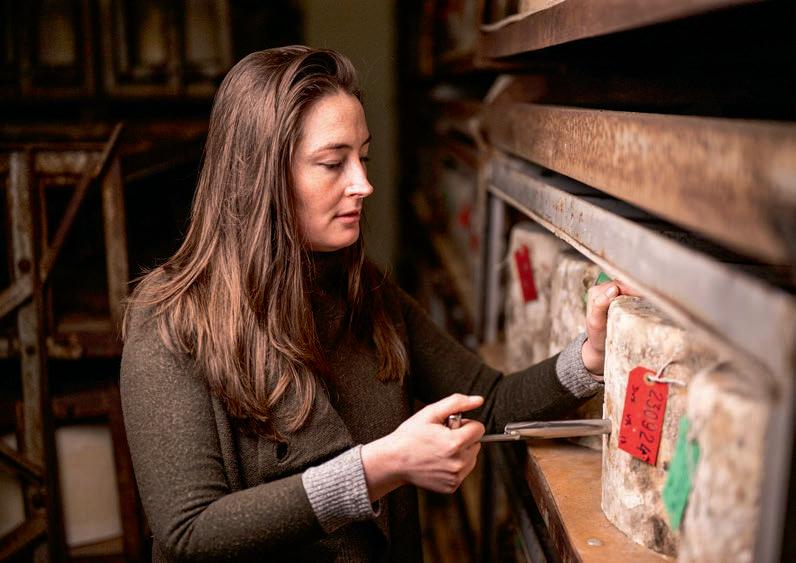
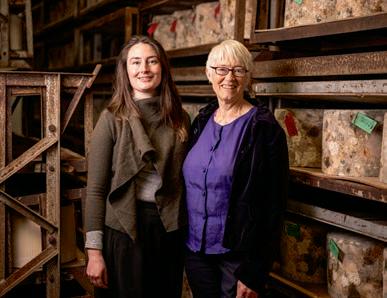
With her purple glasses and penchant for stylish hats, Mary Quicke has been the unmistakable face of Devon cheddar maker Quicke’s for nearly 40 years. The fourteenth generation to tend the family’s 3,000-acre estate in Newton St Cyres, she was awarded an MBE for her e orts in 2005 and is a driving force behind the Academy of Cheese.
But even the great Mary Quicke has started to slow down. She celebrated her 70th birthday last year, and has taken more of a back seat since her daughter, Jane Quicke, became MD in 2024. “It takes a ridiculous amount of energy to run Quicke’s,” says Jane. “It’s a people-focused business that makes cheese meticulously by hand. There comes a point where, naturally, you want to ease up.”
Not that Mary has hung up her cheese iron entirely. She is still a director and ambassador, providing a valuable sounding board, while keeping an eye on the 600 cows and 200 tonnes of traditional cheddar made annually.
“She sends me photos on WhatsApp showing me which hedges need trimming, and she’s in the stores checking temperature, humidity and cloth binding,” says Jane. “It’s so useful having someone with her experience to discuss new ideas.”
Jane grew up on the farm “tugging at mum’s trouser leg and tasting curd from the vat”, but a er studying science at university and working as a teacher, she took a di erent path as a management consultant for PWC in London and then Canada. She was based there when Covid hit, and she decided to rejoin the cheese world, initially looking a er sales in America, before returning to Devon in 2023.
“It was a fantastic career opportunity,” she says. “I studied biology and love it. I also
studied business. Farming and cheesemaking are applied biology with business. I nd it fun working with family, doing a job where I enjoy and care about the thing the company is producing and the way we produce it.”
A er two years in the hot seat, she’s clearly put her mark on the business. “We’ve trained people so everyone can do everything, whether that’s cutting cheese, making butter or working in the stores or dairy,” she says. “We can direct people to where the work is and are more agile as an organisation. We’re also better at assessing how big a job is going to be.”
This is done with quick stand-up meetings around a whiteboard, with tasks measured using T-shirt sizes, from small to extra-large, each given corresponding points based on the mathematical pattern known as the Fibonacci sequence to represent the scale of the task. On the farm, the business has invested in new housing and two slurry lagoons.
“If you’d told me three years ago I would have been excited about digging holes for slurry, I’d have said you were mad,” she says.
Historically, 40% of Quicke’s turnover came from exports, but Brexit and tari s have taken their toll, and that has now dropped to 20-25%, while Covid and in ation were huge challenges. A er a lull in 2024, sales increased 15% last year, helped by a deal to supply grated cheddar to the Gail’s bakery chain.
“We’re also working more closely with wholesalers and distributors, who are getting better at explaining to shops and restaurants about our cheese. We only need a crumb of the wedge that industrial cheese producers make to be successful beyond our wildest dreams.”
That’s plenty to keep the eenth generation busy. quickes.co.uk
We only need a crumb of the wedge that industrial cheese producers make to be successful beyond our wildest dreams
CROSS SECTION
Smoked Double Devonshire
1
Quicke’s is best known for cloth-bound cheddars, from three-month-old Buttery to two-year-old Vintage. But it also makes a Goat’s Milk Cheddar, Devonshire Red (similar to Red Leicester) and Whey Butter. In 2022, it launched a smoked version of its Double Devonshire, which is similar to Double Gloucester.
2
Made with pasteurised milk, heritage ‘pint’ starter cultures and coloured with annatto, the 25kg cheese is cloth-bound and aged for 4-6 months before being cut into wedges and smoked over oak chippings from the Quicke’s Estate. The flavour is buttery with a caramel sweetness overlaid with aromatic smoky notes.
Quicke’s herd mixes different breeds to create the perfect cheese cow, producing milk that is rich in protein and fat, but also hardy enough to graze outside for 11 months of the year.
Matt Austin
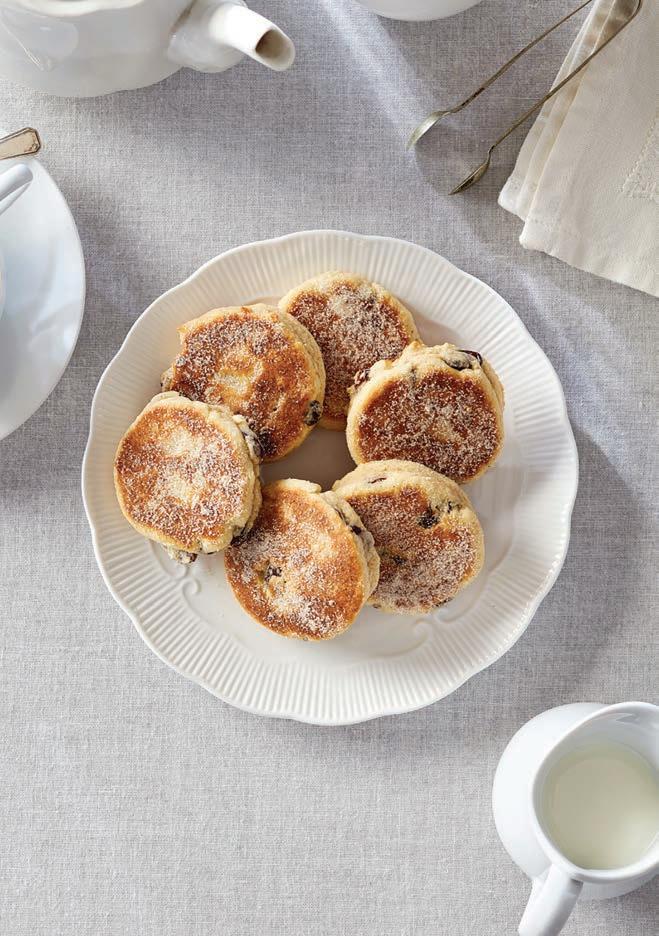
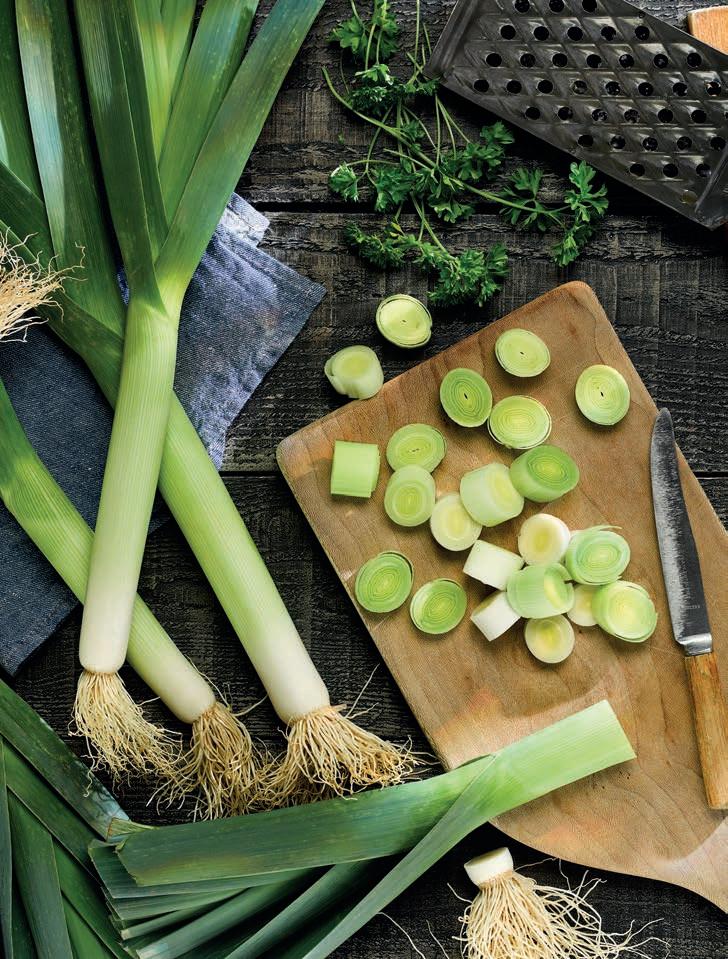
Discover the taste of Wales as we celebrate St David’s Day (1 March), showcasing food and drink shaped by tradition and passion.
Northern Ireland’s premier industry showcase, for food, drink, hospitality and retail returns on 24th-26th February at its new home - the Eikon Exhibition Centre, Lisburn. There are also a number of new exhibitors and features.
Six reasons to visit… ...IFEX 2026
All under one roof
Whether you’re looking for high-quality ingredients, fresh produce, drinks suppliers, foodservice solutions, kitchen equipment, furniture or technology innovations, the show’s high-calibre mix of exhibitors makes it easy to nd the right suppliers for your business.
Kitchen Live
New for 2026, IFEX Kitchen Live shines a spotlight on public sector catering, with animated demonstrations and talks from leading voices across education and healthcare. The stage will also showcase top chefs’ cooking skills, insights, ideas and experience through engaging interviews hosted by chef Suzi Lee.
Making its debut at IFEX, the Liquid Minds Stage brings drinks innovation to the fore, celebrating tea, co ee and alcohol. From barista cra to emerging mixology trends, visitors can enjoy a packed programme of talks, tastings and demonstrations across all three days. Register for your free trade ticket at ifexexhibition.co.uk. 1 4 2 5 3 6
Chefs take centre stage
Showcasing culinary talent, Salon Culinaire Belfast supports skills development with world-class competition heats and expert demonstrations. The 250 chefs present will ensure the Chef Skills Live Theatre comes alive throughout the show, with back-to-back live competitions, including the prestigious NI Chef of the Year.
Great Taste Market
In partnership with The Guild of Fine Food, the much-loved Great Taste Market returns with a unique opportunity to see and taste award-winning products from across Ireland. Meet the producers, sample outstanding food & drink, and discover the stories, provenance and quality behind leading artisan brands.
World Skills and Wild Food Arena
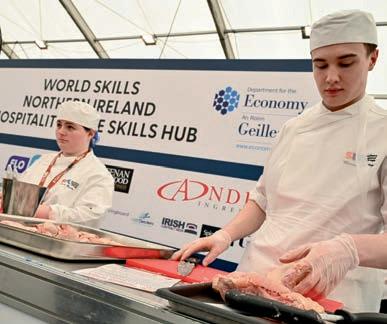
This hands-on arena puts practical skills and real-world experience rmly in the spotlight. World Skills challenges will take place every morning, testing knife skills –from shmongery to vegetable cuts. In the a ernoons, the arena will turn into a wild food experience, exploring foraging and innovative cooking techniques.
Liquid Minds Stage
Raising spirits
Over the last decade, our drinks sector has become one of the region’s most dynamic and innovative industries with growing international appeal.
From premium spirits to artisanal craft brews and cocktails, our producers are winning awards across the globe. Make sure to call by Stand ND101 at Northern Restaurant & Bar, Manchester, where you will find some of our innovative and exciting producers - McConnell’s, Titanic Distillers, Cocktail Keg Company, Bullhouse Brew and Get’er’Brewed.
For more information on Northern Ireland’s wide range of quality and innovative food and drink products, contact: Alex Taggart E: alex.taggart@investni.com
Photograph courtesy of Titanic Distillers, Belfast.
Do you drink from a land down under?
Tanwen Dawn-Hiscox
Retail and hospitality at the value end of the market may have shaped perceptions of Australian wine as ‘cheap and cheerful’, but producers and importers argue that this is a nation of serious winemakers, home to some of the world’s oldest vines and o ering quality that remains widely underestimated.
By Tanwen Dawn-Hiscox
As an independent selling wine, you know better than to compete with supermarkets on price. And following the implementation of UK ABVindexed duty on wine in 2023, alongside EPR fees and the cost of importing wine into the UK, not to mention further duty rises from February 1st, customers get less value for money than ever from budget wine.
Yet many still know Australia for its bulk wines, mainly produced in arid regions, which rely heavily on irrigation, allowing mass grape-growing rather than a focus on quality.
But there is so much more to Australian wine than this, according to Marcus Parry, portfolio manager at Fells, a UK wine importer and distributor supplying premium wines to independent retailers, restaurants and hotels. (Despite the premise of this article), he argues that Australia shouldn’t be treated as a single wine region, in the same way that Europe, or even individual European countries, aren’t.
“There’s so much variation from one place to another,” he
tells FFD, citing Barossa reds, Eden Valley Riesling, McLaren Vale Shiraz and Tasmanian sparkling wines as evidence of Australia’s regional diversity.
When promoting Fells’ Australian portfolio, he likes to highlight the fact that many Australian vines remain planted on their original rootstock, having escaped the phylloxera devastation that reshaped European vineyards. “Most of the old vineyards that were planted in the 1840s, 1850s and 1860s are o en still in place and still on their own roots,” he says. Australia shouldn’t be perceived as “new world”, he argues, but as a custodian of old vine heritage. “In a way, these vineyards in Australia are now a more authentic, longer-standing source of this great genetic vine material than the vineyards that they’ve got in France and Italy and Spain.”
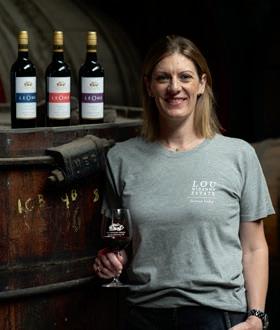
The Lou Miranda Estate is one such example. Based in the Barossa Valley, the familyrun winery is overseen by three sisters, Victoria, Lisa and Amanda Miranda, who jointly run the business. Lisa oversees sales, Victoria focuses on
brand, marketing and direct-toconsumer sales, while Amanda oversees production. They are the third generation of their family to make wine, having taken over
This is not a mysterious beverage you need credentials to enjoy. Everybody’s welcome.
Mary Hamilton, Hugh Hamilton Wines
from their father, Lou, a er the sale of the original family winery in the early 2000s.
Today, the sisters work exclusively with their own vineyards, tending more than a century of plantings, including Mourvèdre dating back to 1897 and Shiraz from 1907, alongside later Cabernet Sauvignon, Merlot, Chardonnay and Pinot Grigio.
If bulk wine has attened perceptions of Australian wine abroad, the task of correcting that picture increasingly falls to those deciding what makes it onto shelves. Independent retailers, argues Victoria Miranda, play a pivotal role. “They are the handholders of the little guys and the di erent wines. We wouldn’t have the diversi cation we have within the wine industry without them.”
Producers like Lou Miranda Estate are increasingly helping that story along themselves. Lou Miranda’s Fierce III range, designed to make premium wines feel contemporary and accessible by borrowing cues from spirits branding, has found traction in the UK. Particularly
DRINKS
its Sagrantino, one of Australia’s few plantings of the Umbrian grape, which retails at around £30. The estate is also preparing to introduce its Leone range, pitched closer to £15, aimed at a more approachable entry price point without compromising on provenance or quality.
For Lisa Miranda, pricing is guided by how wines are actually consumed. “At the end of the day we want people to drink our wines and enjoy them. If we put [our old vine Shiraz] at AU$140, we’ll just store wine. There’s no point. We want people to drink it, not treat it like a museum piece.”
With global wine consumption declining and market conditions tough for producers worldwide, the UK stands out by comparison, proving more open to Australian wine at both entry and premium levels.
“In the late 80s and 90s, when there was this initial boom of Australian wine, it delivered an amazing value proposition for people in this country and introduced a huge amount of people to the wine category,” Parry says.
Western Australia is known for Margaret River ‘Bordeaux Blends’ and crisp, fresh Chardonnays.
In the Great Southern area, cooler climate Shiraz, Riesling, Pinot Noir and Chardonnay abound.
South Australia is famous for fullbodied Barossa reds, high altitude Eden Valley Rieslings, Mediterranean climate wines from McLaren Vale, Sauvignon Blanc from Adelaide Hills, and more.
In Victoria, celebrated specialities include Yarra Valley and Mornington Peninsula’s coolclimate Pinot Noir, Chardonnay and sparkling wines; and world-class Shiraz from Heathcote.
The price di erential is actually surprisingly low for the di erence in what you’re getting
Lisa Miranda, Lou Miranda Estate
And while “brand Australia”, which Mary Hamilton, owner and sixth-generation winemaker
Australian wine regions
at Hugh Hamilton Wines in McLaren Vale, describes as “not compatible with the premium end in terms of a consumer’s understanding”, can work against small producers, it also creates opportunity. “There’s a huge amount of growth at the premium end still possible, and so much discovery for consumers,” she says.
For Hamilton, that opportunity lies in being playful and modern, without sacri cing rigour. “Our approach is to be deliberately small, terroir-driven, take the wine very seriously but not ourselves,” she says. “This is not a mysterious beverage you need credentials to enjoy. Everybody’s welcome.”
Deliberately downsized from previous generations, Hugh Hamilton now works with just three vineyards but around 35 grape varieties, a scale Hamilton concedes is “ ddly and expensive” but vital for discovery. Prized bottles include a 100% Saperavi, a Sangiovese–Grenache frizzante described as a modern take on Lambrusco, Aroma Pagoda, a white blend of Gewürztraminer, Frontenac and Fiano, and Black Ops, a
Shiraz–Saperavi blend created by Hamilton’s father as a secretive experiment (hence the name).
Regional literacy, Hamilton argues, remains the missing link between Australia’s high-end wines and the UK audience. “If I just look at South Australia, there are 17 di erent wine regions,” she says. “Most consumers here can rattle o the di erences, but that understanding hasn’t translated overseas.”
Speaking in the context of changing consumption habits, Hamilton believes the future is smaller rather than bigger.
“If that means that half of the Australian grapes go away, I have no problem with that,” she says. “Leave it to the people who put some passion into it.”
The gap between industrial and premium wine, Lisa Miranda agrees, is less about price than value. “The price di erential is actually surprisingly low for the di erence in what you’re getting.”
So next time you’re considering adding some new bottles on your shelves, why not go Aussie?
loumirandaestate.com.au fells.co.uk
hughhamiltonwines.com.au
Queensland’s South Burnett is known for potent reds and aromatic whites; its signature variety is Verdelho. The higher altitude Granite Belt offers more complex, European styles.
New South Wales is home to Australia’s oldest wine region, the Hunter Valley, with its unique take on Sémillon. Riverina is where many mass-market wines are made, as well as more premium plantings.
Tasmania is known for cool climate varieties like Pinot Noir, Chardonnay, Riesling, used in stills. Sparklings come from Tamar Valley, the Pipers River area and the Derwent Valley, among others.
Ripe Wines presents
LEARN | TAS TE | UNDERSTAND | COMMUNICAT E
TRAINING RETAIL CHEESE
Our one-day course for anyone sourcing or selling cheese, delivered by industry and retail experts. Understand how cheese is made, how it should be stored and sold, gain skills to help communicate with customers and sell more cheese from a position of knowledge.
Amarena Cherries & Cream Gelato
A bright NEW LOOK for
business improvement
Working on your core
People, pricing, stock management and environmental performance are four areas that, together, form the foundation of a successful ne food retail business. We interviewed four top retailers, who are strong in these elds, to nd out what their strategies will be in 2026.
Interviews by Lynda Searby
STOCK MANAGEMENT
PAUL CASTLE, managing director, Flourish Foodhall & Kitchen
I think of us as being in the people business, because if we get that part right, the rest will follow. We employ 140 people and my job is to serve them – to be there for the team and help them do the best job they can.
We’ve taken advantage of some free training courses in areas such as marketing and leadership, provided by Business West, and this year the focus will shift to one-to-one development and cultural rather than task training. We’ve noticed that young people in particular have become more insular and are more connected to their devices than they are to one another. This means we have to work quite hard to create that team mentality – that you can achieve more together than alone. Another aim is to get our supervisors and full-time staff to step up so that our
managers can spend more time training and developing others. We have a saying that we ‘train people to do the job above them’ rather than the one we employed them for.
Recruitment has got harder in recent years, and we have to employ various recruitment methods, from table talkers and banners to Indeed.
Our package makes us attractive to prospective employees. We are a living wage employer and offer a 30% staff discount, 4% pension contributions, medical and death-in-service cover, 36 days holiday after five years’ employment, and the option of taking a sabbatical after seven years.
Yes, this package comes at a price to us, but the cost of not offering these benefits is far greater. We’ve worked out that it costs on average £8,000 to recruit a fulltime head at a reasonable level of seniority. It doesn’t cost that much to retain someone by providing the right benefits.
Our biggest problem at present is having a Government that doesn’t understand what the challenges are in hospitality and retail. Our headcount is lower than it was 18 months ago, and if it hadn’t been for National Insurance increases and other growth-constricting policies, we would have expanded our team by seven heads this year. flourish-group.co.uk
We train people to do the job above them rather than the one we employed them for.
CHRIS HALLAM, manager, Chorlton Cheesemongers
After five-and-a-half years of trading, I’ve come to rely on instinct rather than deliberate planning when it comes to stocking decisions.
We tried kanban stock control, but found that it didn’t always make sense. The idea is that when a product falls below a certain level, you automatically reorder, so it takes the thinking out of stock management. We did that for while and then decided we didn’t need to be replenishing chutney when we
still had 23 jars in the store room.
Now we restock based on what we need. In summer, for instance, we don’t sell much chutney so we don’t carry much stock.
I’d say I’m quite a tight stocker, particularly when it comes to soft cheese, which is only at its best for a couple of weeks. To keep our counter looking full, we put out just a few soft cheeses and surround them with bigger hard and semi-hard cheeses that aren’t age dependent.
I order once a week on a Monday, and if I can get it done by 11 o’clock, that’s a result.
We have just bought a new display fridge that will enable us to introduce a plant-based range of smorgasbord / buffet type products like pâtés and pastes. I definitely won’t be stocking any vegan cheeses, as, in my experience, they don’t look or taste anything like cheese.
chorltoncheesemongers.co.uk
To keep our counter looking full we put out just a few so cheeses and surround them with bigger hard and semi-hard cheeses that aren’t age dependent.
MATT HOMFRAY, partner, Forage Farm Shop and Kitchen, Cowbridge
We’ve been going six years now and we certainly approach pricing in a more professional way than we used to. We try to maintain a 70% gross margin on restaurant products, whereas in the shop, margins vary across different product lines and every pricing decision is tested against one key question: ‘will the customer realistically pay this once the margin is applied?’.
Where possible, we offer alternative price points on retail products so that more pricesensitive customers are catered for.
Cost prices are updated via our EPOS system as goods come in, which means our margins are monitored in real time. If the price of a product gets too high,
There is an argument for cherry-picking the best deals from multiple suppliers, but that is a full-time job
ENVIRONMENTAL PERFORMANCE
We’ve calculated that the solar panel project will give us payback within four years, which is a great return on investment
ALLISTER NIXON, CEO, Yorkshire Agricultural Society, owner of Fodder food hall
From a monetary perspective, we’ve managed to keep our energy costs down by being on a fixed rate tariff for the last few years. But our approach to energy savings goes deeper than trying to negotiate the best deal. We have a ‘green team’, which looks at waste management, energy and water usage, and recently did a baseline environmental impact survey. This gave us a good idea of our footprint, showing that in terms of Scope 1 and Scope 2 we
we either increase our price or discontinue the product.
For core kitchen ingredients, we tend to stick with one large wholesale supplier. There is an argument for cherry-picking the best deals from multiple suppliers, but that is a full time job in itself and the salary of that person still has to be paid. That is what we did when we first started - we were so obsessed with trying to reduce the cost of goods, but we’ve learned that it is better to look at overall basket value and compare suppliers in that way.
In recent months, butchery and kitchen ingredients are two of the areas where we have really noticed prices rising, mainly owing to increased production costs.
We can’t just implement blanket price increases, as customers are cost sensitive, so instead we have to be rigorous about labour efficiency, waste reduction and making smarter buying decisions.
We are obsessive about
are in a pretty good place, and giving us a baseline for Scope 3 so that we can improve the situation.
All of the energy we use comes from green sources. We currently have 960 solar panels and a ground source heating system, and are about to install another 1,500 solar panels across the site, which should reduce our energy consumption by between 30% and 40%. We’ve calculated that the solar panel project will give us payback within four years, which is a great return on investment.
Within the business, fridges were identified as our biggest energy users. Therefore one of our drivers for refurbishing last year was to replace outdated, inefficient fridges with more energy efficient ones. We’ve also installed LED lighting throughout the site.
To reduce water usage, we’ve got rainwater harvesting systems, reduced flush load toilets and taps that automatically turn off.
When Fodder was first built in 2009, the building was designed with environmental impact top
measuring labour ratio against sales, as it can very quickly get out of hand, and then you become a busy fool. In our shop, we operate off a labour ratio of 18 or 19%, while in the restaurant, we target 38%. Government policies are making it harder to maintain healthy labour-sales ratios, but by looking at footfall patterns very carefully, we can scale down to skeleton staffing at times when the shop is quietest. We can no longer afford to have any slack in the rope. foragefarmshop.co.uk
of mind. It has a sedum roof, the walls are insulated with sheep wool and the toilet doors are made from recycled plastic, for example. There have been lots of incremental improvements since then and this focus continues into the present day as we work towards the aim of becoming carbon neutral by 2030. fodder.co.uk
CATEGORY FOCUS
Risk it for a biscuit
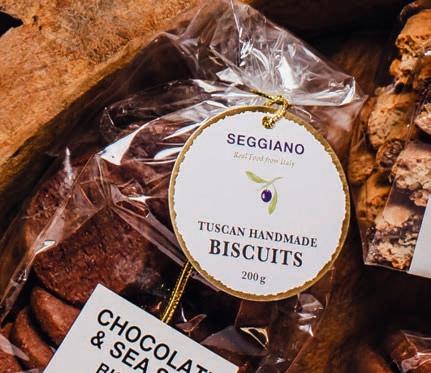
This month’s round-up of new launches is a very British one. It starts with biscuits, sweet and savoury, and ends with pickles and chutneys. These are the staples that, if well selected, could set you apart and keep your customers coming back week in, week out.
Compiled by Lynda Searby
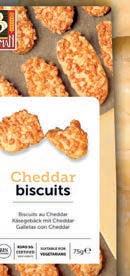
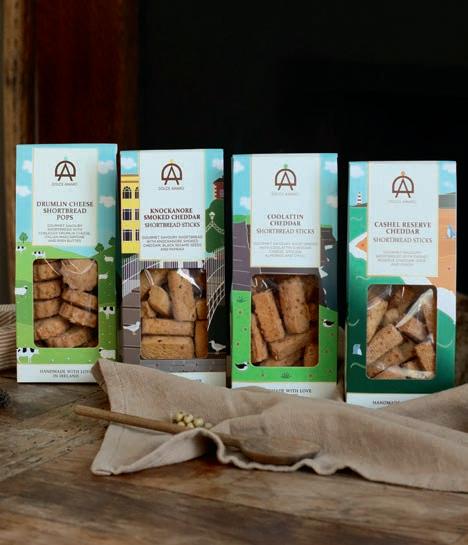
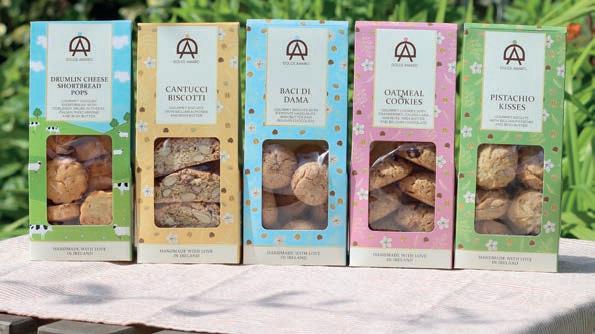
Amaro has developed a trio of savoury biscuits in collaboration with Irish cheesemakers Corleggy, Collattin and Cashel. Fusing Irish and Italian culinary traditions, the biscuits are baked with ingredients like Irish butter and cheese, and Sicilian almonds.
This is the second wave of NPD from the Irish startup, which was founded in 2004 by Cashel Café owner Antonietta Cinelli and pastry chef Greta Gastaldi, and now has distribution across Ireland and Northern Ireland through Lilliput Trading Company. WSP €4.30/150g; RRP €7.50. dolceamaro.ie
Combining Irish and Italian culinary traditions
Hot out of the oven from Original Biscuit Bakers are Koala and Panda sugar cookies. The brand introduced the biscuits to bring variety to its yearround collections, which include gingerbread farmyard favourites, dinosaurs and unicorns. They are vanilla flavoured, promising a firm yet delicate bite and melt-in-the-mouth icing. WSP from £1.59; RRP £2.30. originalbiscuitbakers.co.uk
North Wales bakery Shepherd’s has secured a listing with Cress Co, making its biscuits available via a UK distributor for the first time. Flagship ranges include Aberffraw Biscuits - traditional Welsh shortbread, stamped with a scallop shell and based on one of Britain’s oldest biscuit recipes; and Biscuits for Cheese – hand-baked grain biscuits for cheeseboards. RRPs are £4.75/260g and £3.75/144g respectively. thecressco.co.uk
The Fine Cheese Co. has made its first foray into sweet biscuits with a dessert-themed range made in Derbyshire using fresh cheese. Ricotta from the Panizzi family in Italy brings milky sweetness to the shortbread-style Fresh Ricotta & Lemon Mousse Biscuits, while Fresh Brillat-Savarin & Apricot Cheesecake Biscuits incorporate a double-cream Brillat-Savarin from Fromagerie Delin in Burgundy. WSP £2.40/120g; RRP £3.70. finecheese.co.uk
IN BRIEF
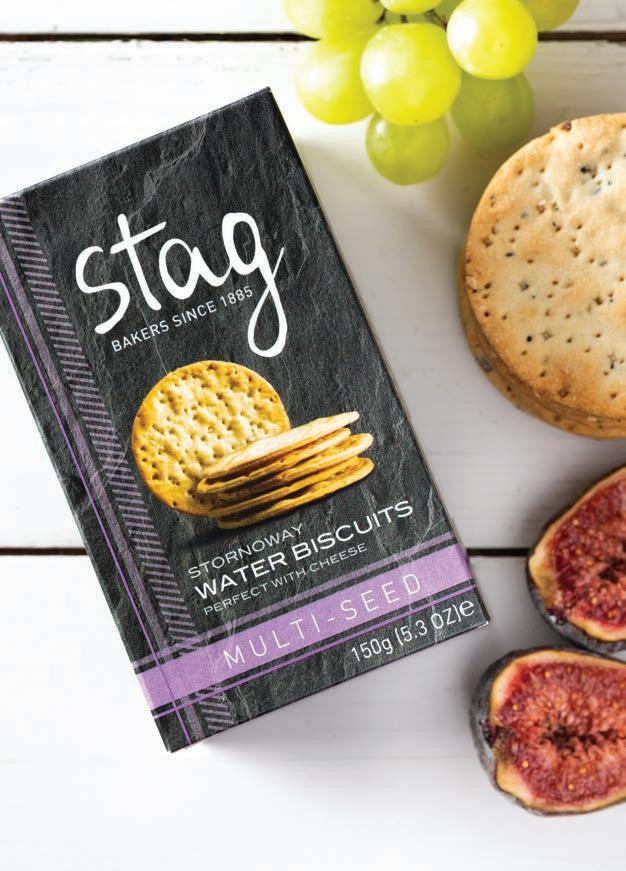
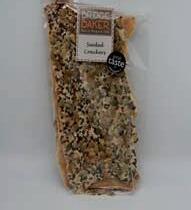
Bridge Baker’s premium, Seeded Crackers are handmade with flour, butter and a seed blend including linseeds, sunflower seeds, sesame seeds, pumpkin seeds and chia seeds. RRP £5.20/160g. Pair with cheese and wine. bridgebaker.co.uk
Cotswold Fayre is carrying The Half Nuts Company’s 50% nut cookies, giving retailers a biscuit option that taps into the protein, fibre and clean label trends. Its mission is to make food healthier and more sustainable by adding nuts and legumes, without compromising on taste. Cashew Shortbread, Chocolate Chip and Peanut Butter have a WSP of £2.80/100g; RRP £3.99. halfcookies.co.uk
Mountain Honey Delights are bite sized gingerbread biscuits made with Hungarian mountain honey, sunflower oil, lemon oil and Csudaíz’s signature blend of nine spices. WSP £1.60/125g; RRP £2.80+. biscottiz.hu
Good Guys Bakehouse has launched Cocoa and Ginger Crispy Biscuits for evening grazing on the sofa. They contain just six calories per melt, making them a light alternative to many existing choices. RRP £1.75. goodguysbakehouse.co.uk
Dolce
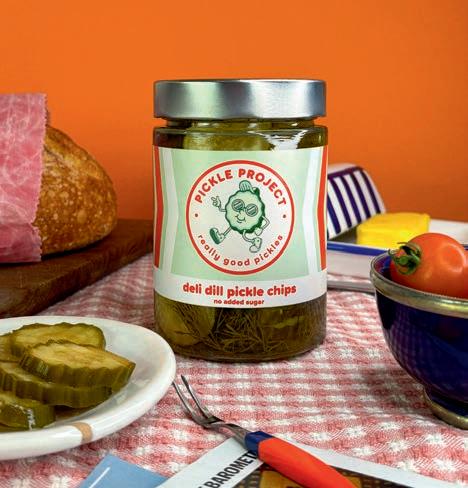
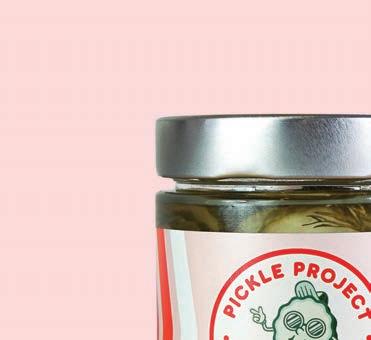
Pickle Project says it is harnessing ultrasonics to produce pickles with a greater depth of flavour.
Restaurateur Matt Harris, who launched the business in 2024, said the inspiration for using ultrasonics came from cocktail bars, where bartenders use them to rapidly infuse spirits.
“Ultrasound creates microscopic bubbles that release bursts of energy, breaking down herbs and spices. It’s a complicated process, but it extracts complex layered flavours in a way that traditional pickling can’t.”
Pickle Project says its combination of natural ingredients, craft and science yields pickles that taste brighter, fresher and more “pickly” than anything else on the shelves.
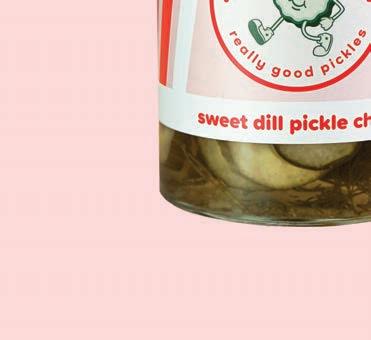
Deli Dill Pickle Chips is the latest ultrasonic creation to come out of the producer’s North London kitchen. A riff on the classic American style garlic and dill pickle, the pickles are crinkle sliced in brine with no added sugar. RRP £6.99/500g; WSP £36 for a case of 8 jars. pickleproject.co.uk
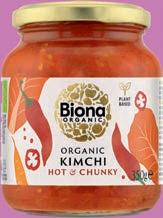
Biona says it is building on the success of its existing kimchi lines and the growing popularity of gut-friendly food with the launch of Hot and Chunky Organic Kimchi. Made with organic napa cabbage – the original authentic kimchi base – this ferment features hearty chunks of veg and a bold blend of spices for a warming kick. RRP £5.39. biona.co.uk
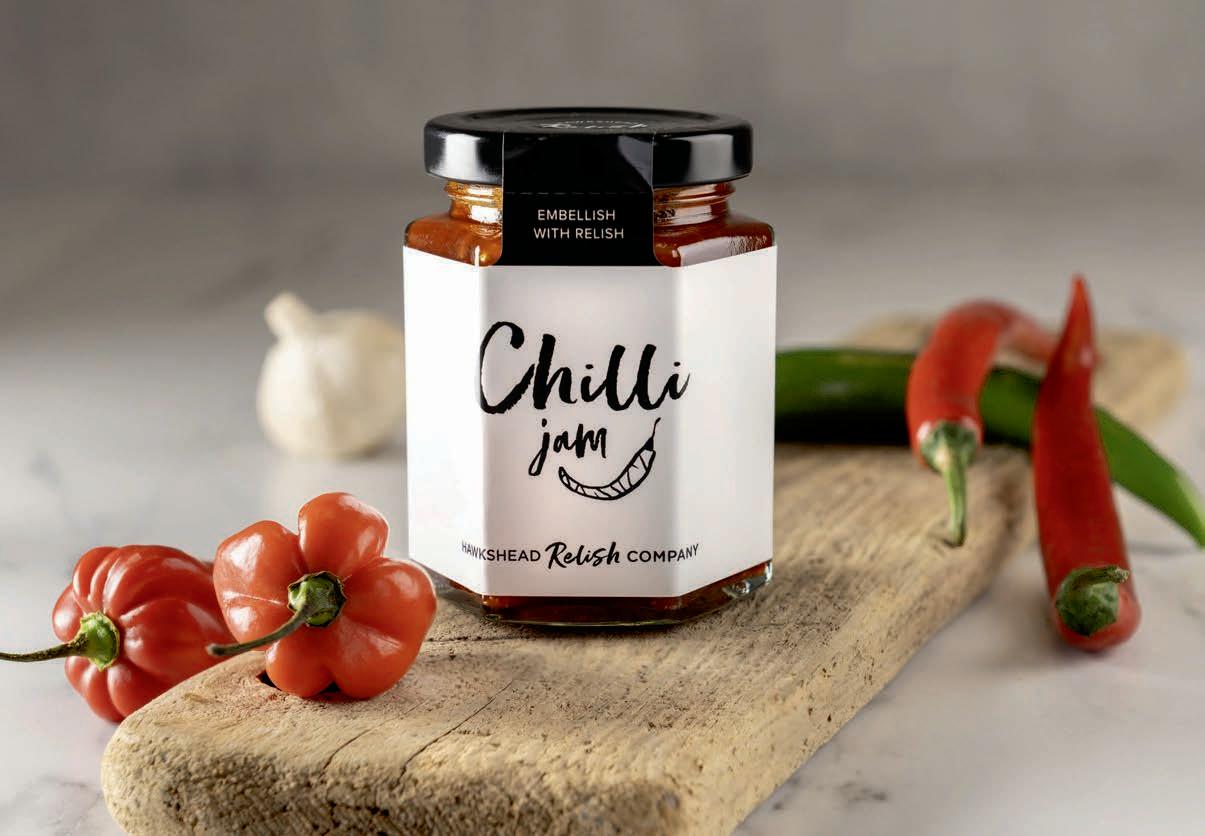
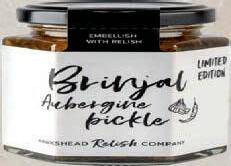
Created after many trips to India, this brinjal (aubergine) pickle started off as a limited edition, but sold so well that Hawkshead Relish added it to its core range. Described as “rich, beautifully spiced and irresistibly sticky”, the pickle is a match for curried sausage rolls, oily fish, lamb curry and cheese on toast. RRP £4.95. hawksheadrelish.com
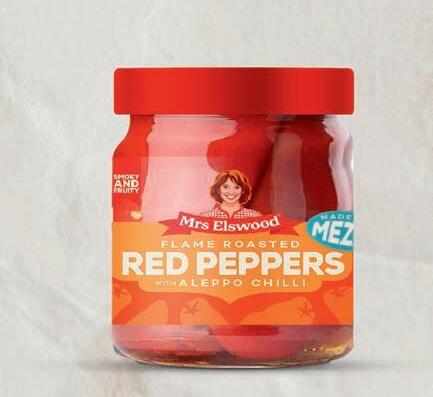
Empire Bespoke Foods says its new trio of mezze products has been launched in response to the growing popularity of Turkish, Greek and Middle Eastern cuisines. Marketed under the Mrs Elswood label and available from 1st February, the Made for Mezze range comprises Soft & Juicy Tomatoes (RRP £2.50/215g), Turkish Kebab Peppers (RRP £2/300g) and Flame Roasted Red Peppers (RRP £2.50/330g). empirebespokefoods.com
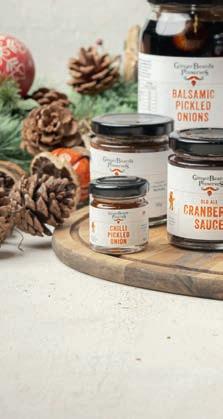
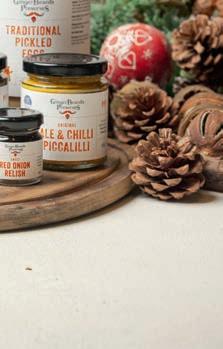
GingerBeard’s Preserves has reimagined a classic cheese and charcuterie board accompaniment with the launch of Sweet Cider Pickled Shallots. The Bristol producer says it has chosen shallots as they are lighter than onions, making for a more balanced match with delicate cheeses, while the cider vinegar is a nod to the West Country where it is based. WSP £2.60/190g; RRP £4.30. gingerbeardspreserves.co.uk
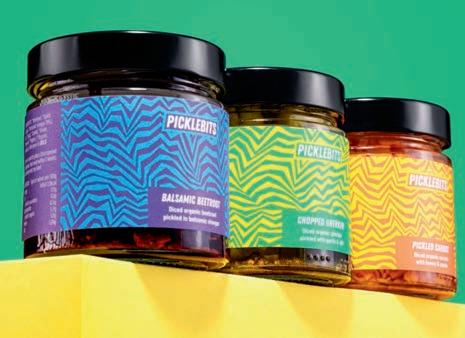
September 2005 saw newcomer Picklebits make its debut with a range that is designed to bring fun to the category while appealing to environmentally conscious consumers.
Bright, eye-catching packaging and organic ingredients are the hallmarks of the brand, which is already on shelf in a number of delis, farm shops and zero waste stores across South Wales.
The inaugural line-up takes in three organic vegetable pickles: Chopped Cucumber (organic cucumber pickled with garlic, dill & mustard seeds); Balsamic Beetroot (organic beetroot pickled in balsamic vinegar with cumin) and Pickled Carrot (organic carrot diced and pickled with cumin and coriander).
All are chopped for convenience, making them easy to spoon onto sandwiches, wraps, salads, burgers and more. WSP £3.58/210g; RRP £5.95. picklebits.co.uk
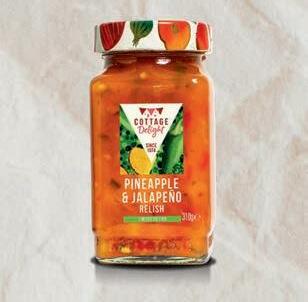
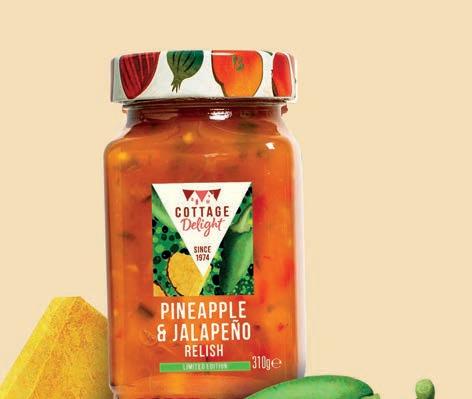
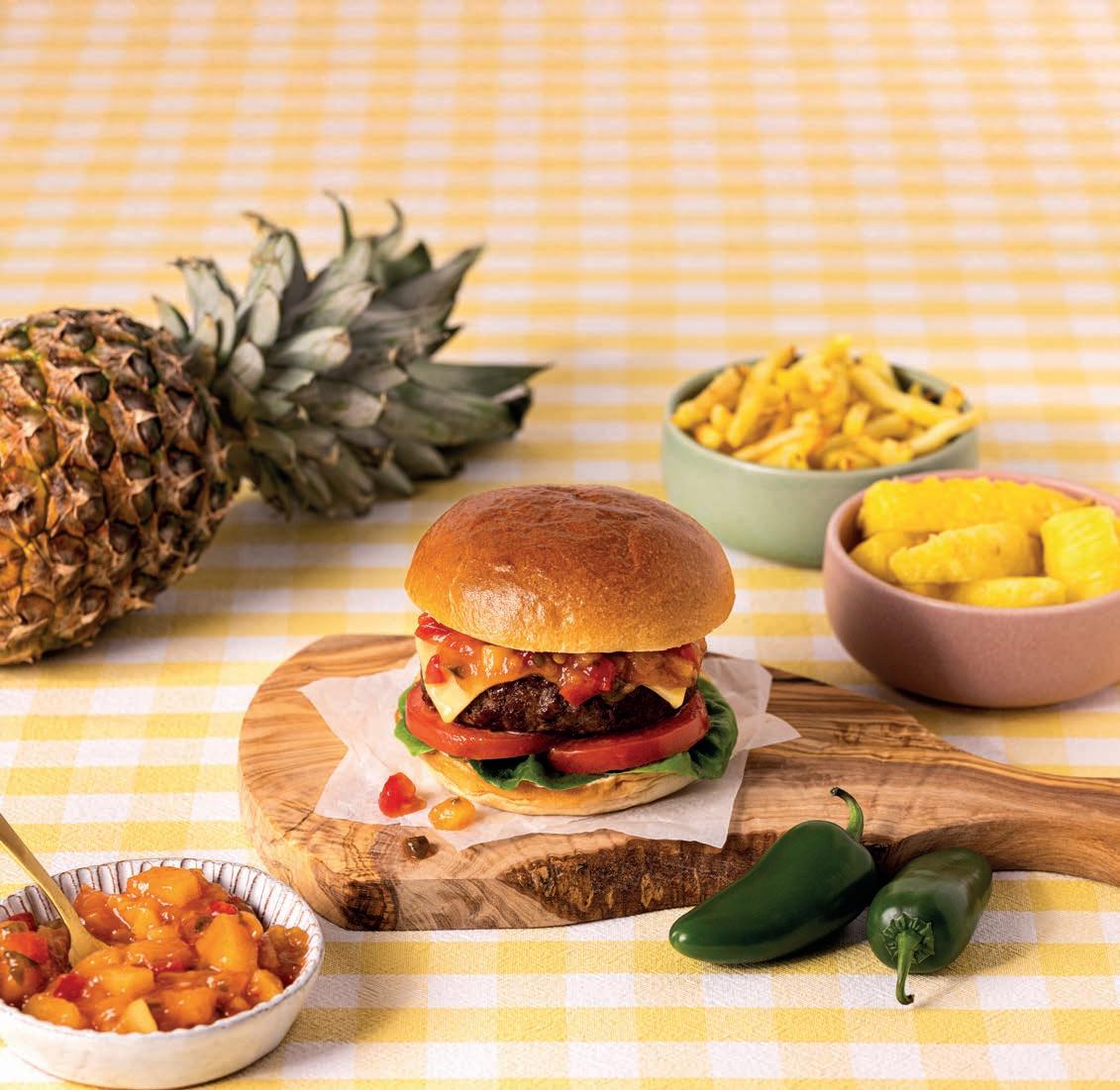
It might still be winter, but Cottage Delight is already thinking ahead to the barbecue season, with the release of Pineapple & Jalapeno Relish. Tapping into the ‘swavoury’ (sweet and savoury) flavour trend, this tropical chutney delivers a spicy-sweet punch to grilled meats, burgers and veggie skewers. RRP £4.59/310g; WSP £18.54 per case of 6 jars. cottagedelight.co.uk
IN BRIEF
This vegetable-packed piccalilli was developed in response to customer requests and, according to its maker, Jam Packed, has rapidly become a firm favourite even with people who don’t like piccalilli. The Surrey producer recommends serving it with gammon, charcuterie and cheeses –especially Stilton. RRP £5.25£5.45/230g; WSP £3.38. jampackedpreserves.co.uk
Stay Saucy founder Andy Barnett says this mango chutney was inspired by 25 years of exploring the curry houses of Rusholme, Manchester. Cooked in small batches in Nottinghamshire, the condiment offers up mango sweetness, aromatic spicing and a warming chilli finish. WSP £4; RRP £5. repleat.uk/stay-saucy
North Wales coastal restaurant chain Dylan’s has added Spiced Fruit Chutney to its retail collection. Made on Anglesey and listed with M&S, the lightly spiced fruity chutney has a tangy but sweet flavour that is said to be perfect for pairing with Welsh cheese and crackers. RRP £5.50/180g; WSP £3.71. dylansrestaurant.co.uk
Leeds-based Mickles Pickles has fused dill pickle and sauerkraut in one crunchy ferment. The main target audience is pickle lovers and gut food enthusiasts, who are using it as an ingredient in fritters and pairing it with deli meats, cheeses and all things smoked. WSP £4.80/500g; RRP £8. micklespickles.co
Producer of gourmet handmade in Ireland sweet biscuits and savoury shortbread
At Dolce Amaro, we use the finest Irish ingredients to create authentic flvours, naturally - with no preservatives, artificial flavours or additives.
We support Irish farmers by using locally sourced butter and cheeses. “Irish Country Living” magazine nominated us as one of the producers to watch out for 2026.
Currently distributing in Ireland and Northen Ireland. We offer private label service, creating personalised recipes.
dolceamaro.ie@gmail.com
Antonietta +353 873872861 | Greta +353 852654275 www.dolceamaro.ie
To view all our products, please visit: www.grandma-wilds.co.uk
Easy as pie
British food doesn’t get much more traditional than pie. Once a xture of East London shops now largely lost, the humble staple is enjoying a quiet renaissance.
By Nick Baines
THERE USED TO be a pie and mash shop up on Exmouth Market in Clerkenwell called Clarke’s. It was an iconic old institution, knocking out pie, mash and liquor all day every day – a bustling place serving up fortitude on cheap white crockery, a haven to nd shelter from the cold streets of London.
As you’ll no doubt be aware, this kind of old-school, traditional pie and mash shop is a rarity in the capital today. Clarke’s is no more, but thankfully the time-honoured Manze’s lives on, having adapted for chilled and hot deliveries.
Bristol’s Pieminister revitalised pastryclad llings in the early 2000s, securing a strong foothold in in retail. Arguably, Pieminister paved the way for brands like Chunk, and Higgidy. But the pie never needed anyone to allow it to retain its place in the hearts of the hungry British public, not least in the depths of winter.
Calum Franklin, the renowned chef hailed as the ‘King of Pies’, rose to fame by establishing the Pie Room at Holborn Dining Room, and has since gone on to open the British bistro, Public House, in Paris. But in the early days of Franklin’s success, Josh Whitehead, a 23-year-old chef from Leeds, keen to delve deeper into the dark arts of pastry, contacted the hotel Franklin was working at, claiming to be from the Michelin
Guide. Whitehead came clean about his identity when reaching out to Franklin, who found the move amusing, and invited him down to learn more.
“We spent the day making stu ,” says Whitehead. “We made pâté en croute, and he gave me beef wellington for my tea. That was back in 2016 and I’ve been addicted ever since.” Whitehead now runs Finer Pleasure, a successful pop-up in Leeds, serving pristine pies with llings like oxtail, snails and Newcastle Brown Ale, and chicken and mushroom pie that features Champagne and morels.
Yet the cost of a pie is somewhat skewed. “Supermarket perception has given people a warped sense of what a pie should cost,” continues Whitehead. “Some of these pies take a minimum of two days, and there’s a lot of work that goes into them.” However, customers continue to ock to his pop-ups, and a bricks and mortar premises is in the pipeline.
The interest in pies is growing across the board. Yorkshire’s The Original Baker, a producer of ready-to-bake pastry products, has seen an upturn in demand too. “We’re seeing really healthy momentum in premium pies and pastries,” says managing director Mike Walker, who believes double-digit growth has been driven by customers trading up for better ingredients and bolder avours.
It’s undeniable that the humble pie is a mainstay of British food & drink which has seen waves of renewed enthusiasm. As this staple is continuously refreshed and revitalised everywhere from trendy east London bakeries to butchery pop-ups in the North, it remains an area worth every retailer’s attention.
THREE WAYS TO... ...upgrade your pies
The rule of three
When pondering seasonal specials, it’s worth sticking to the rule of three ingredients to marry together. Think ‘chicken, mushroom and tarragon’, or, ‘cauliflower, leek and cheddar’. The rule of three not only works as a framework to create balance in a pie filling, but also works better in marketing and menus.
Be adventurous with liquids
When introducing the liquid component to your fillings, make it count. Explore specific beers when making a steak and ale pie. Does the obscure Italian apéritif add an extra flavour dimension, or could the locally pressed apple juice be a judicious choice for braising that pork jowl?
Experiment with the lid
Without a lid, pies are technically a tart, but at the risk of them all looking the same, some producers are working to give pies some kind of individuality in the display cabinet. Consider mash potato, à la cottage pie, or mixing other ingredients like herbs or spices into the pastry. Or if you’re feeling adventurous, you could attempt some decorative lattice work.
OUR PICK OF THE PIES
Tuscan sausage, Scamorza & Friarelli
Willy’s Pies
The London-based producer consistently turns out quality, premium pies. This seasonal special is filled with coarse aromatic sausage, stretched cheese from southern Italy, and bitter Friarelli greens.
Beef
mince pie
M. Manze
The utilitarian benchmark has been dishing out pies daily since 1902. Each one is filled with beef mince and gravy. Order it with mash, with or without liquor – either way, you won’t leave hungry or disappointed.
Vacherin, confit potatoes, salt pork
Finer Pleasures
The fillings from this pop-up pie shop rotate, but when in season, the Vacherin Mont d’Or topped with confit potatoes, cornichons and salt pork, then dowsed in Champagne and sealed under a rosemaryadorned crust are worth tracking down.
Claire McClean
Sambalicious
Makan Malaysia founders and best friends Susanna Encarnacion and Katerina Perry – known to their followers as Su and Kat – have set out to bring Malaysian cuisine into the British mainstream, with an o er ranging from ready meals and snacks to marinades and sauces.
Interview by Tanwen Dawn-Hiscox
What were you doing before starting Makan Malaysia, and how did it come about?
I used to work for an energy company – I’m a chemist by background. I was unfairly dismissed from there and even though I loved my job it just didn’t work out, and I decided that no one would ever have that kind of power over me ever again. I called my best friend Kat and I was like, ‘hey let’s start a food business’. We knew it had to be something to do with Malaysian food because it was so hard to nd in the UK. We started in 2018. We survived the pandemic but it was really hard because we’d only been going about a year and a half and were just starting to build our brand and get some recognition. We didn’t have furlough or any safety net, it had to work for us to live, so it really pushed us to grow the business.
What was your first product?
When we rst started it was our vegan sambal. From there we realised not many people knew about Malaysian food, so we started hosting supper clubs to share the dishes and talk about culture and heritage. During lockdown we started doing frozen meal kits that we sent around the country. We still do them today, but last year we realised we needed something scalable, so we launched the sauce range.
Pringles has a ‘Malaysian avour’, but what does that actually mean? What does Malaysia taste like?
Jam fest in 2023 and that opened our eyes. From there, we researched branding, rebranded, looked at jars and safety, and re ned the range.
Where is your distribution focused at the moment?
We are with a distributor, so we don’t know all the precise locations. Our biggest retailers are Selfridges and Panzer’s in London; we’re also in Borough Market under Raya, and we’re soon launching in Ocado – so nationwide retail, which is incredible.
What makes up your full range?
provenance. We don’t substitute ingredients – for example our coconut sugar comes from a speci c type of tree in Malaysia, which is expensive to import. Manufacturing there would improve cost, authenticity and ethics. That’s our goal for 2026.
Why is authenticity so important to you? It’s really frustrating seeing big companies jump on trending words without respecting what they mean. For example, Pringles launched a ‘Malaysian avour’, but what does that actually mean? What does Malaysia taste like?
Consumers deserve to know what real avours are. That’s why sharing our story, culture and running supper clubs still matters to us.
What flavours and techniques define Malaysian cuisine?
Malaysia is made up of three ethnic groups with di erent avour pro les that, because of geography, trade and colonialism, have merged into one cuisine. Malay food brings chillies, stir fries and deep, rich dishes. Indian in uence brings cloves, cardamom and cinnamon. Chinese in uence brings ash frying, ginger and garlic.
How did you make the move from markets into retail?
Very gradually. At markets people kept asking how to cook the food and whether they could buy it, so it felt natural to put it in a jar, but there was a lot of research around doing that legally and safely. The question was how to be retail-ready and appeal on shelf when we couldn’t explain ourselves. We went to Bread &
We have three chilli sauces and ve cooking sauces – Rendang, Wok Sauce, Ginger and Garlic Paste, Peanut Sauce and Satay Marinade. We also do snacks: Sambal Cookies, crispy anchovies and peanuts –Ikan Bilis & Kacang – and sweet and spicy Sambal Almonds.
Are you producing everything in-house, or is some of it outsourced?
We work with manufacturers in the UK for compliance and to supply places like Ocado, but our goal is to make in Malaysia and import here. We want to work closely with farms and strengthen
Rendang is a Malay dish but uses Indian spices. Nasi goreng uses Chinese stir-frying techniques with Malay sambal. It means there’s something for everyone, and not everything is spicy, but everything is full of avour.
And pandan?
Pandan is incredibly versatile – savoury and sweet – we put it in everything. We love it.
What’s next for the business?
In the short to medium term we want to be in more farm shops, delis and premium supermarkets, and to grow into foodservice. Long term, we want to be the number one Malaysian food provider in the UK, starting at the top end and eventually o ering more a ordable ranges so everyone can access it.
makanmalaysia.co.uk
flour is ancient which from the finest
Our award-winning flour is produced from the finest ancient grains which are sustainably grown in the beautiful British countryside. Our entire range carry the highly sought after Great Taste 2 and 3 star awards, in recognition of outstanding quality and flavour.
Available in 1kg and 20kg bags. Minimum order 2 boxes of 10 × 1 kg bags. No delivery charges. Call or email today for a trade price list
PRODUCTS & MERCHANDISING
Divine re-enters hot chocolate and reveals farmer-focused redesign
By Lynda Searby
Fairtrade chocolate brand Divine has re-entered the hot chocolate category a er a short absence and unveiled a new look that reinforces its unique status as the only chocolate company that is co-owned by cocoa farmers.
Divine has been Fairtrade certi ed since its inception in 1998, when it became the second chocolate brand to join the movement. While its commitment to Fairtrade hasn’t waned, the company recognises that in today’s landscape, it would be di cult to di erentiate itself through Fairtrade alone
“We’re not just a Fairtrade brand; we are a B Corp, and we are co-owned by cocoa farmers. That’s not something anyone else can claim. And that is why we have brought the farmers to the fore through the redesign,” Lydia Stubbins, group marketing director at Divine, told FFD.
to working with VisionSpring to make sure that farmers who need corrective eyeglasses have them,” said Stubbins.
As well as celebrating the farmers, the new design promotes the brand’s premium and avour credentials in a way that the old packaging didn’t, she added.
And while Divine’s multi-layer relationship with the Kuapa Kokoo cooperative that can’t be communicated through design alone, its backof-pack QR codes will help.
“It’s more than ‘we pay Fairtrade prices and we’re owned by them’. We also fund projects that can make meaningful change to their lives, from adult literacy and numeracy programmes
Somerset-based Hejgro crafts condiments from what it calls “the true local superfoods” – wild-foraged and organic ingredients – with no refined sugar or additives. This ethos has yielded some original creations, such as Dandy Root Chutney, which is made with dandelion root and nettles; Wild Garlic Pesto – a raw blend of foraged garlic, Somerset rapeseed oil and nuts; and Pontack Sauce – a traditional slow-cooked elderberry sauce. So far the brand is only stocked in a handful of outlets. WSPs £3-4; RRPs £4.50–£6. Minimum order: £74 (mix and match). hejgro.co.uk
Divine has also been busy developing a new hot chocolate range. Its previous hot chocolate was discontinued in 2024 when the supplier went bust, and now the brand is back with a new, improved product.
“Our old hot chocolate was good, but we knew it could be even better. By working on mouthfeel and the boldness of our avours, we stepped it up a notch. We’ve chosen two of the most popular avours in the hot chocolate category – Salted Caramel and Hazelnut Praline – and done them in a premium, ethical way,” said Stubbins.
“We’ve always known there has been an appetite for Divine hot chocolate – it is the most requested product on our website – and it makes sense that, having built a solid business in chocolate and chocolate bars, we expand into adjacent categories that use cocoa.” divinechocolate.com
WHAT’S NEW
Golden Hooves has grown its regeneratively farmed range with the launch of Dorset Clotted Cream. It is produced using milk from dairy farms across Britain – part of farmer-owned dairy co-operative First Milk, who have committed to maintaining healthy soils, grazing cows and promoting biodiversity. RRP £3/200g. goldenhooves.co.uk
The Almond Lover Granola is
The Edinburgh Granola Company’s debut product. It is handmade in Scotland using only whole ingredients – organic jumbo oats, whole almonds, organic seeds, extra virgin olive oil and honey – by founder Karen Pratt, after she concluded that nothing on the supermarket shelves matched the taste, crunch or quality of her recipe. WSP £4.50/325g; RRP £7+. edinburghgranola.com
Pack’d has designed a range of frozen, pre-chopped cooking ingredients to take the hassle out of prepping. Packaged in recyclable paper bags, the inaugural lineup comprises: Organic Chopped Onions, Organic Chopped Garlic and Organic Soffrito Base - a shortcut to creating sauces, curries, stews and more. RRP £2.85/450g (100g for the garlic). packd.co.uk
Giant Peruvian corn snacks hit UK shelves
TikTok influencers Costco Twins have been raving about the retailer’s latest snack – crunchy corn made from Peruvian kernels that are “bigger and crunchier than your average corn nuts”. But the membership-only retailer isn’t the only one that has recognised the market potential of these giant corn kernels.
When visiting the bars and eateries of Seville in 2023, Popcorn Kitchen’s Louise
Monk discovered the joy of roasted giant corn kernels. Delving deeper, she found that Choclo giant corn, which dwarfs its common, sweet corn cousin, is a great base for allowing simple yet bold flavours to shine, as well as being high in fibre. After two years of flavour development and searching for the right supplier, Popcorn Kitchen has launched Crunchy Corn in three “crispy” flavours: Sea Salt, Salt Vinegar and Spicy Chilli. RRP £3.49/100g.
Cambrook Foods has also come up with its own twist on the Spanish bar snack. Giant corn grown in the Sacred Valley of the Incas, high in the Peruvian Andes, is roasted and then tumbled in the company’s signature
seasonings. Available in three “gourmet” flavours - Hickory Smoked, Sriracha Chilli & Lime and Truffle & Pecorino – Giant Corn has an RRP of £2/85g. cambrookfoods.co.uk popcornkitchen.co.uk
PRODUCTS & MERCHANDISING
WHAT’S NEW
Biddenden has refreshed its juice range, adding three new flavours. New labels and bottle shapes reflect its heritage and the Sparkling Apple, Strawberry & Mint, Sparkling Apple & Grape and Apple & Pear juices showcase the winemaker’s sophisticated flavour profiles. biddendenvineyards.com
In Two Farmers Crisps’ new flavour, Herefordshire Sauce combines the county’s own condiment with potatoes that are grown, cooked, and packed in compostable film on the farm. The result is an umami-rich, piquant crisp said to offer a true taste of the region.
RRP £1.20/40g and £3.50/150g. twofarmers.co.uk
Messy Face is pitched as a fresh, modern take on tahin pekmez, a two-ingredient blend of cooked grape molasses and roasted sesame seed tahini. Translating the traditional Mediterranean spread into a smoother, more spoonable format, it is free from refined sugar and has a caramel-like texture. RRP £4.50/300ml. messy-face.com
Good Phats is bringing fats back into kitchens via indies and mults
By Lynda Searby
Challenger fats and oils brand Good Phats has reaffirmed its commitment to the independent sector while announcing national listings with Sainsbury’s and Waitrose.
“Indies are where we started and still spend the majority of our time nurturing; we’re currently in around 500 nationally, and we have ambitions to be in over 1,000 by the end of the year. We are seeing fantastic pick up in butchers, bottle shops, farm shops and delis,” Tom Redwood, the chef-turned-entrepreneur behind Good Phats, told FFD.
Redwood is on a mission to reframe fats and oils as essential cooking tools that should be “revered not feared”.
“For years, fats have been misunderstood and unfairly lumped together, with people taught to avoid them rather than understand them. The
result was confusion in the kitchen and the rise of highly processed alternatives.
Tracklements marks chilli jam milestone with promotions, collaborations and competitions
“Good Phats exists to challenge that, by selecting fats based on quality, transparency and function, with no seed oils, appropriate processing, and a clear role in how people actually cook,” said Redwood.
To this end, the company’s range includes Italian and Spanish extra virgin olive oils and Spanish avocado oil in glass bottles, squeezy bottles and sprays, as well as spoonable organic British grass-fed ghee and beef tallow.
“We’ve seen a significant rise in interest in animal fats over the past year, particularly beef tallow, as people rethink ultra-processed cooking oils and seed oils. Our Squeezies are also performing extremely well. They tap into a simple truth: chefs have been decanting their favourite oils into squeezy bottles for years for control and precision.” goodphats.com
In a world of ever-shorter product life cycles, Tracklements’ Fresh Chilli Jam is one of a rare breed. The sticky-sweet condiment, which, according to its maker, was the UK’s first chilli jam, celebrates 25 years on the market in
The Wiltshire producer says it has a whole host of activity planned for the year, kicking off with a promotion for speciality retailers. Come February, when retailers place an order for Fresh Chilli Jam, they will receive bunting and point-of-sale materials to create
Additionally, any order over eight cases will be accompanied by a giant 3kg Fresh Chilli Jam jar display centrepiece.
To ensure that Fresh Chilli Jam shines from retail shelves in its birthday year, Tracklements has created special anniversary labels with gold highlights. Selected jars will also feature an on-pack promotion with prizes such as Ooni Pizza Ovens, tickets to Bestival, Oak & Rope Cheeseboards and
a sales-boosting display. more.
RRP £4.10/210g; £5.50/345g; heart
shaped jars £7.25. trade.tracklements.co.uk
Hand-cooked crisp maker Salty Dog says it is “back with a vengeance” after revamping its flavours and packaging.
Dave and Judy Willis launched the brand in the early noughties, but some setbacks in the interim years saw it fall off the radar. Then, in 2025, a change in production set-up and interest from potential new stockists prompted the company to “get back on the front foot” and introduce itself to “a new generation of fine crisp enthusiasts”.
The refreshed range comprises Prawn Cocktail, Sweet Chilli, Ham & Mustard, Roast Beef, Salt & Vinegar, Sea Salt and the new addition, Jalapeno & Paprika. RRP £1.40/40g.
saltydog-grrr.com
health wealth
LittlePod’s guide to natural wellbeing. is
Our work with farming communities on the Equatorial Belt has proved that vanilla is good for the health of the planet, but did you know this precious ingredient also has wellbeing benefits for you?
Vanilla is packed with complex compounds and high antioxidants, with tests showing our delicious natural paste improves with age. Each tube lasts for two years after opening, which means your creations in the kitchen will keep getting better and better!
The familiar scent of vanilla is linked to oxytocin –the happiness hormone – helping to bring a sense of ease, calm and comfort to everyday life. No wonder some people say, ‘Eat vanilla yoghurt and be happy!’
Did you know? The Aztecs used vanilla as a natural aphrodisiac.
Seasonality may put the fear of God into many a seaside business owner, but not at Picnic Deli. On a bustling street in sunny Margate, founders Rose Exall and Magnus Alanko have built a favourite neighbourhood spot for locals, and a destination for neighbouring townspeople.
By Claire Bullen
Come rain or shine
It is deep January in Margate, and the seaside town is hunkered down against the cold and driving rain. Along the Cli onville neighbourhood’s main thoroughfare, Northdown Road, each junction reveals views of lashing waves in the distance. Many of the street’s small businesses are in hibernation, with notes in the windows promising reopenings later in the spring.
Then there is the striking contrast o ered by Picnic Deli. It is painted a vibrant shade
of teal that even the prevailing grey cannot dampen, while a sandwich board advertising its o erings, written in bright red and matching teal, jauntily beckons passersby. Inside, it is wonderfully warm – not just because the heating is on full blast, but because the sense of welcome is so immediate.
Learning to adapt to the seasonal rhythms of coastal life has been one of the main challenges that founder Rose Exall – who runs the business with help from her partner, Magnus Alanko – has confronted since opening Picnic Deli nearly three years ago. “It’s a completely di erent operation in winter – we just do obvious things, like loads more toasted sandwiches, hot soups… A bigger red wine selection,” she says. “It’s just adapting to a di erent rhythm.”
A er spending some 15 years in London, the couple relocated to Margate prior to the pandemic. They were drawn by the promise of a di erent pace of life, as well as the town’s burgeoning creative community. “Actually, Margate high streets are thriving in comparison to a lot of other seaside towns –even towns in a similar area,” Exall says. “So there was the start of a scene happening, where we felt that we would be able to come here and try something, and have a go at doing our own business.”
VITAL STATISICS
Location: 3 Northdown Parade, Prices Ave,
Average
Average
Floor
Although she’d spent a signi cant portion of her career working in nonpro t communications, Exall had long nurtured a parallel passion for food, which encompassed everything from recipe developing and food styling work to hosting pop-ups. The opportunity to make it her principal calling and open a business of her own arrived serendipitously, when a local greasy spoon came up for sale.
Its location, right o Northdown Road, was part of the site’s appeal. Recently, Time
Out selected the road as one of its “31 coolest streets in the world,” noting that “the area fell on hard times in the 1980s and has been making a slow-and-steady comeback ever since.” It’s become a hub for independent businesses, artists, and other makers, as Exall describes it, though it hasn’t lost its neighbourhood feel or sense of community in the process.
“We always had in the back of our mind that we would like to do something that wasn’t necessarily crystallised, and then we found this
Our chicken Caesar sandwich has taken on a life of its own – someone got it tattooed on them!
place and it took shape, and it’s really evolved,” she says.
But the business didn’t actually begin life as a deli. In 2021, when it rst opened, it was called Stingray, and functioned as a bottle shop and bar focused on cra beer and natural wine. However, a er the couple had a baby in 2022, Exall found that her priorities had shi ed away from an exclusive focus on alcohol.
“My mum one day – we were in a deli –and she was like, ‘You just want a deli.’ And I was like, ‘I do just want a deli!’” Exall laughs.
Driven by that revelation, Stingray was o cially reborn as Picnic Deli in 2023. Although it still sells a selection of local cra beers and low-intervention wines, as well as
hot drinks, its primary focus is now rmly on food.
As part of that transformation, two beer fridges were replaced with a larger fridge unit, which is currently dedicated to cured meats and cheeses. The shelves are now stocked with a rotating array of speciality grocery items –including everything from high-end tinned sh to locally made chutneys and chilli oils – and there is a new glass deli case where homemade sausage rolls and pastries, and bought-in cannoli, are displayed. Soon, Exall says, the range will be supplemented with additional breakfast items, plus grab-and-go soups and salads designed to cater to the area’s freelance workers in need of a quick, high-quality lunch.
But the heart of Picnic’s prepared food o erings will likely always be its sandwich menu—and speci cally, its breakout star: the chicken Caesar sandwich. “People go wild for it,” says Exall. “It’s taken on a life of its own –somebody got it tattooed on them!”
Exall was not attempting to create a cult favourite when she rst dreamed up the recipe. “It was a complete surprise,” she says. “I had no idea it was going to take o in the way that it did, and it’s just based on my own personal love of chicken Caesar—I was in Australia for a bit in my 20s, and they have it everywhere.”
A er one bite, it’s not hard to see why the sandwich has attracted such diehard fans. In many ways, it seems to exemplify the care that de nes Picnic’s approach. A er failing to nd the right bread locally, Exall’s team began baking their own focaccia every day – a major initiative given their limited kitchen space. The
focaccia is then spread with Exall’s anchovypacked Caesar dressing, which positively hums with umami. Then, there are the irresistible textural contrasts: the juicy roast chicken, the cool and crisp lettuce, and the crunchy toasted breadcrumbs.
It is a phenomenally delicious piece of sandwich engineering. Exall says that customers regularly travel in from out of town just to order the chicken Caesar sandwich for lunch, although that loyalty isn’t an outlier –Picnic Deli has been roundly embraced by the community, to the point that some customers drop by twice a day.
“People tell us that part of the reason they moved here is because they came in here and were like, ‘Oh wow, we’re going to be living next to this lovely little café-shop,” she says. Others come from surrounding towns, such as Broadstairs and Ramsgate, to stock up on essentials. “We get lots of love, and lots of repeat customers.”
Following the completion of Picnic Deli’s renovation, and the upheaval of the past few years, Exall says she’s looking forward to the deli settling into a more predictable rhythm –as much as it can in such a seasonal town, at least. But then there’s its new half-sibling to attend to: The Last Light, a freehold, wet-led pub that opened further up Northdown Road in July of last year.
As was the case with Picnic, the pub arose from the serendipitous discovery of a newly vacant, promising piece of real estate. But Exall
MUST-STOCKS
Homemade chicken Caesar sandwich
d'Addezio Cannoli
Torres crisps
Perelló olives
Comté
Rallo Ciello Rosso Sicilian wine
Homemade margarita cocktails
Floc Brewery beers
Grignotons saucisson pots
Carmelo smoked sardines in olive oil
and Alanko were too stretched to run it alone, so they brought in two Margate friends: Tim and Sienna O’Rourke, who also previously made the move down from London, and who both work for leading British cra breweries (Floc Brewery and Pressure Drop, respectively). Exall describes running the pub as a “side hustle” for all four owners.
“It’s a real community pub, and it’s thriving,” Exall says. “We’re just in a sweet spot, in a neighbourhood that didn’t have that kind of venue yet.”
It’s easy to envision The Last Light’s conviviality, particularly as the summer high season approaches. Picnic, too, comes into its own once warm weather arrives. “All summer, we’re heaving out there,” Exall says, gesturing to the tables and chairs poised on the pavement outside. “We have 20-odd covers. It’s packed; we’ll have a queue out of the door.”
In response to the summer demand, Exall says Picnic extends its opening hours, and hosts events like apéro hour, complete with plates of snacks and £5 spritzes. “We get
people saying it feels like a little European [holiday],” she says wistfully, as the rain continues to hammer down outside.
From the dark depths of January, those sun-drenched days couldn’t feel farther away. But there is still plenty of charm to be found in the quieter, peaceful pace of winter. One event that Exall’s looking forward to, for instance, is O Season Margate. Hundreds take part in this DIY art festival organised by Cli onville’s Quench Gallery. Picnic Deli will be decorated with custom window artworks for the occasion.
As lunchtime approaches, the deli’s indoor tables start to ll up with groups of locals, many in search of that chicken Caesar sandwich. The sta working behind the counter seem to greet every person walking in by name, and conversation soon lls the space with a happy hum.
It may not be sun and spritzes – but the scene is evidence of Picnic Deli’s enduring, year-round charm.
@ picnicdeli_margate
Expert View
experience where context is remembered, and channel switching is frictionless.
INSIGHT6’S RICHARD KNIGHT ON THE NEWEST TRENDS IN CUSTOMER EXPERIENCE
As we enter a new year, the pace of change in customer expectations and technology shows no sign of slowing. Businesses face accelerating technology and, with that, comes a steep rise in expectation.
So what are Insight6’s top emerging customer experience trends to look out for in 2026?
• Hyper-personalisation and Predictive AI Brands are using AI-driven personalisation to deliver tailored recommendations, predictive outreach and proactive support to their customers across channels. Intelligent routing ensures queries reach the right team immediately. That means AI agents can handle repetitive or transactional tasks, freeing up human teams to focus on complex interactions. Predictive analytics are now allowing businesses to anticipate customer needs before they arise, providing guidance and promotions that feel e ortless and relevant.
• The Evolution of Omnichannel and Immersive Experiences
“Omnichannel” has evolved far beyond meaning a business is present both online and in bricks & mortar. Today, customers expect a seamless
MODEL RETAILING
Happy 2026, Mr Deli! Any New Year’s resolutions?
Whether they are switching from mobile to in-store, or from instant chat to telephone, customers are expecting “one continuous journey”, not markedly separate channels.
Meanwhile, immersive customer experiences – driven by Arti cial Reality, smart devices and experience-layered retail – bring products to life. These technologies enable richer storytelling, personalised recommendations and interactive touchpoints blending the digital and physical worlds.
• Loyalty, Community and Customer Education
Loyalty programmes will shi from simple discounts to delivering genuine value, recognition and a sense of belonging. Customers respond to personalised rewards, exclusive experiences, and initiatives that acknowledge their engagement with you. Brand communities are also emerging. These are spaces for customers to share experiences, access insights, and feel part of something. Customers will increasingly expect brands to do more than just sell products. Providing clear information and expert advice enhances the overall experience, strengthening engagement and driving long-term brand loyalty.
While understanding these trends is useful for all retailers, not all of them will apply to your own business. Success comes from prioritising initiatives, testing new ideas in controlled ways, and measuring results against clear metrics.
Focus on what you think will make the biggest positive change and please do get in touch if you think Insight6 might be able to help. insight6.com
How long have you got?
Reduce wastage in the café, eat less chocolate, update my HR documents, do more regular stock reviews, start running, replace the mop every month, file my accounts on time…
Setting up shop for good hygiene
Cheese and meat at ambient temperatures
Can I display and store some hard cheeses and cured meats at ambient temperatures?
Yes. Some hard cheeses (e.g. Parmesan) and cured meat varieties (e.g. Parma ham) and also some varieties of fermented sausages (e.g. salami) are safe to display and store ambient as they do not support the growth of food poisoning bacteria.
How will I know which cheeses and cured meats are safe to display and store at ambient?
Normally this information should be supplied by either the producer or the supplier. This could be provided either by information on a label or via verbal instructions.
Some
hard cheeses
and cured meats are safe to display ambient
This advice is an excerpt from the Guild of Fine Food’s Assured Code of Practice for Deli Retailing. The guide is available in PDF format (free for Guild Members, £250+VAT for nonmembers). To request a copy of the Code, email support@gff.co.uk Fine Food’s Assured Code of Practice for Deli Retailing The guide is available in PDF format (free for Guild members, £250+VAT for non-members). To request a copy of the Code,
SOLVING EVERYDAY SHOPKEEPING DILEMMAS. IN MINIATURE.
Only joking. None. None whatsoever.
FFD says: The New Year always starts with a mixture of good intentions and massive ‘to do’ lists. Try not to overwhelm yourself with ambition or punishments. It’s always best to reflect on Christmas, do your sums for the next few months and focus on what will keep your customers spending with you. Why not ask them about their resolutions and the things they want in 2026?