SunStorm Fine Art Magazine Jubilee Edition 1975-2025
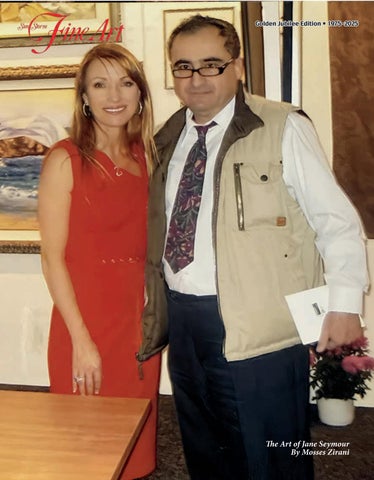
The Art of Jane Seymour By Mosses Zirani Golden Jubilee
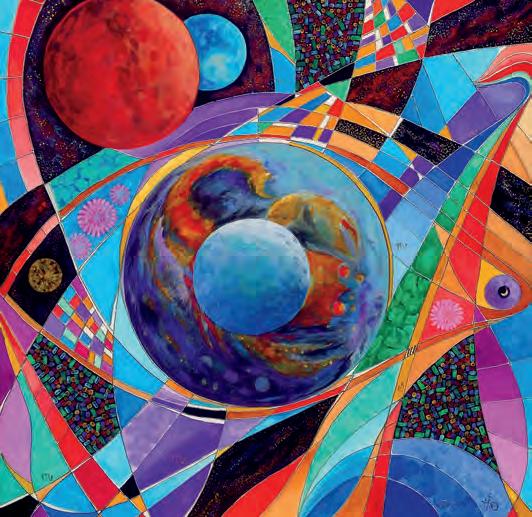
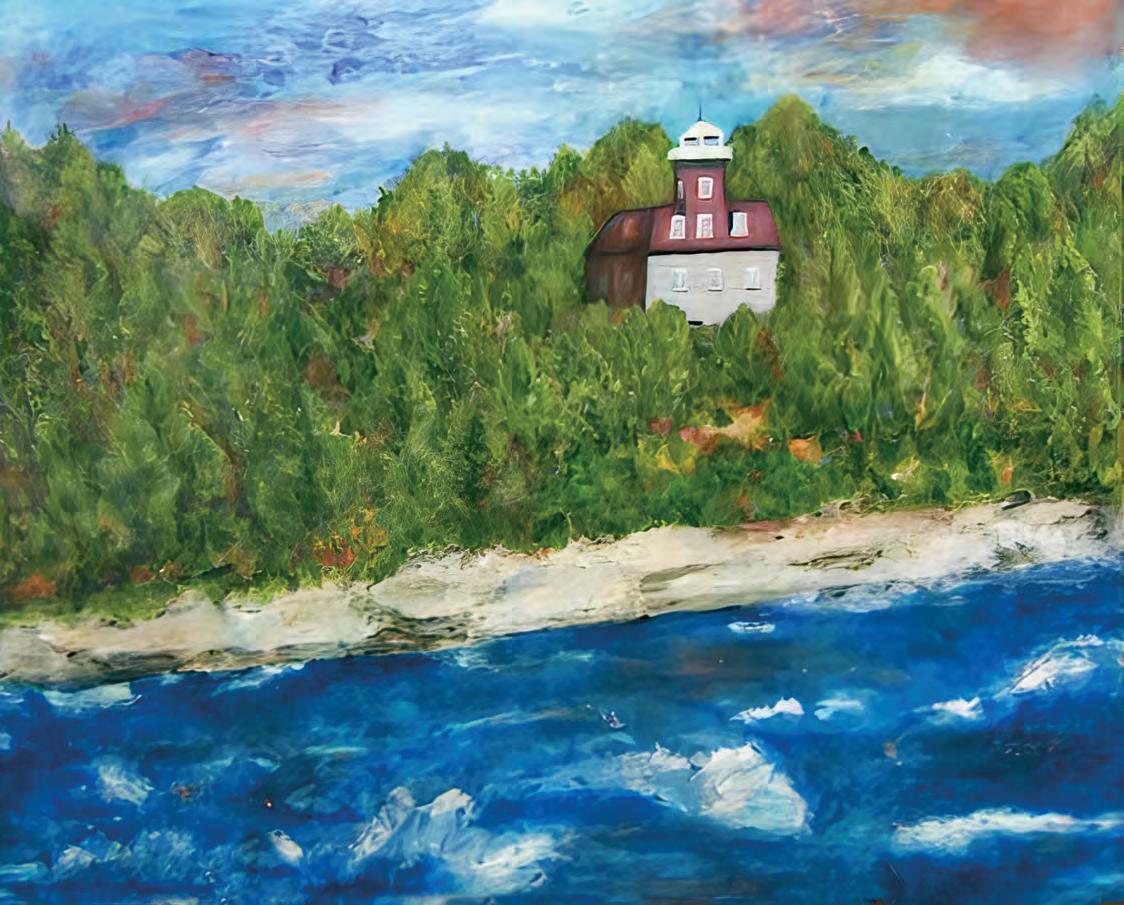
Cover Artist Jeff Vermeeren
JAMIE: Hi Jane, I want to thank you for joining me.
JANE: You’re welcome.
JAMIE: I’m admiring your new work.
JANE: Thank you.
JAMIE: This is a slightly different palette for you.
JANE: Yes, I’ve been doing a bit more slight abstractions. And, again, the theme of the water and the koi and the fish, the leaves from my garden. Stunning. And the waves. And we’ve got a lot of new pieces here.
JAMIE: Very stunning.
JANE: Thank you.
JAMIE: The motion in the work is a little different. It captures the motion in the jewelry pieces and the love in the hearts. But this is just absolutely stunning.
JAMIE: What moved you to investigate a new area?
JANE: I’ve just come back from Hong Kong. And I was painting with a very famous artist out there. And he was
–Jamie Forbes
Jeff Vermeeren is a delight to have known over the last decade as we have watched him develop and create art for collectors, making impressive wall works available to the public. Until now, wall space for the most part was reserved for canvas, paper, reliefs and/or wall-hangings in traditional mediums. Jeff’s technique has advanced to encompass both figurative and abstract spaces with instilled vitality and sensation. This new mode of expression Jeff has created dominates the visual presentation of each piece with color, fire and excitement. Displayed in Jeff’s artistic process is an inventiveness — the ray of light issued from the artist’s heart intended to inspire and enlighten. Capturing energy and movement, the possibilities of dimensionality offered by his galvanizing work has resulted in broad-spectrum appeal of his paintings and sculptures to collectors. Maybe the reader can tell I am a big fan of Jeff Vermeeren — as an artist and as a person.
showing me Chinese brush stroke and he gave me some beautiful brushes. I was doing some work on rice paper with him. When I came back I thought it would be kind of fun to take watercolor and sort of abstract it, thinking about the Chinese brush strokes a little bit.
JAMIE: Well, it’s so difficult to do. And you really captured the essence of it. I really admire this body of work. As long as I’ve known you and I’ve watched you for a few years doing your art, I’ve never seen a harder worker. Nobody works harder than you do.
JANE: Well, you know what? I love what I do and I see no reason to just keep repeating one thing. Each painting is a separate experience for me and I’m always trying to grow and come up with something new and challenging.
JAMIE: Not only are you a great physical beauty, but that beauty comes across because I see you’re having a tremendous renaissance now within every medium you’re touching.
JANE: You know something? I think that when you are genuine and you have something genuine to say, and it’s real and it’s not fake, I think it comes across. And I think that’s what people see in my paintings. They read something into it that’s meaningful to them, and then they take it home and it continues to be meaningful. That’s exciting for me because I really don’t need to do this to earn a living particularly. But I love to paint. I love to express myself. In art, I can do that.
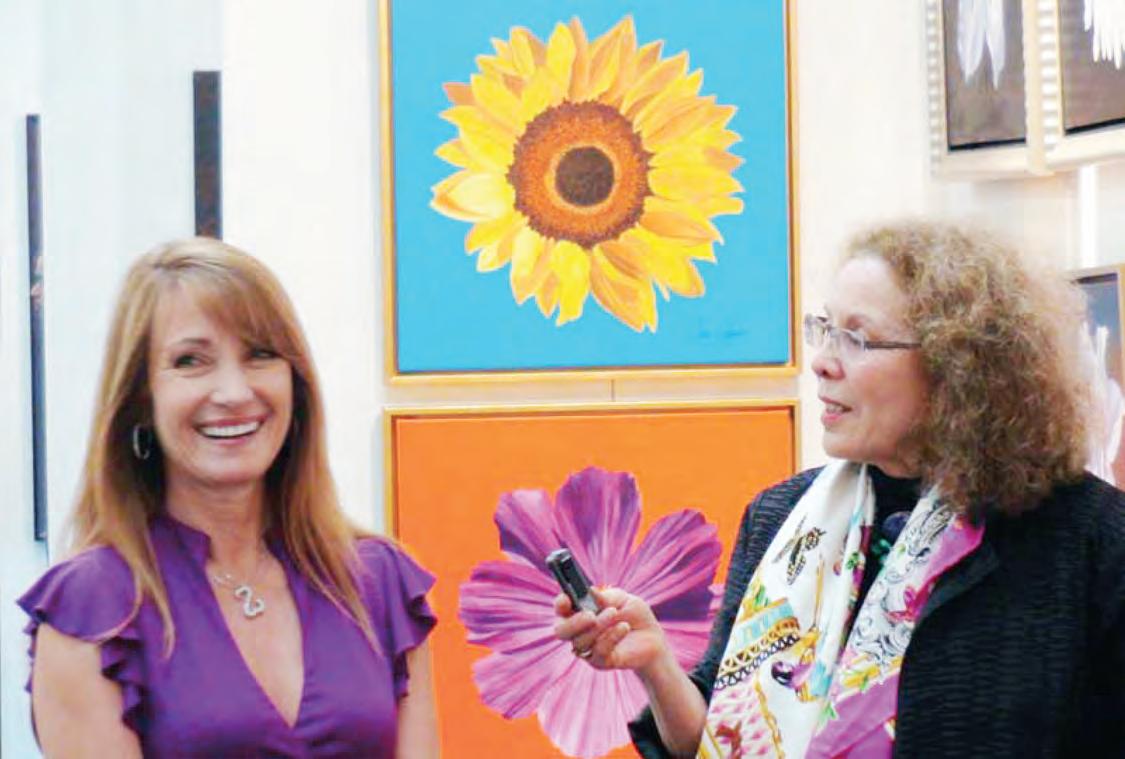
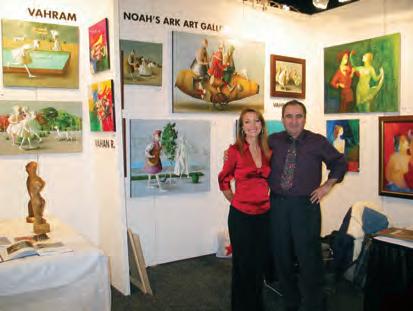
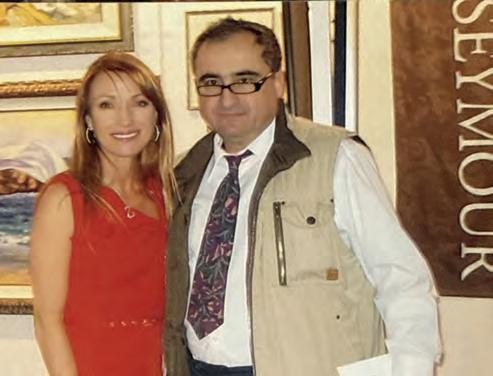
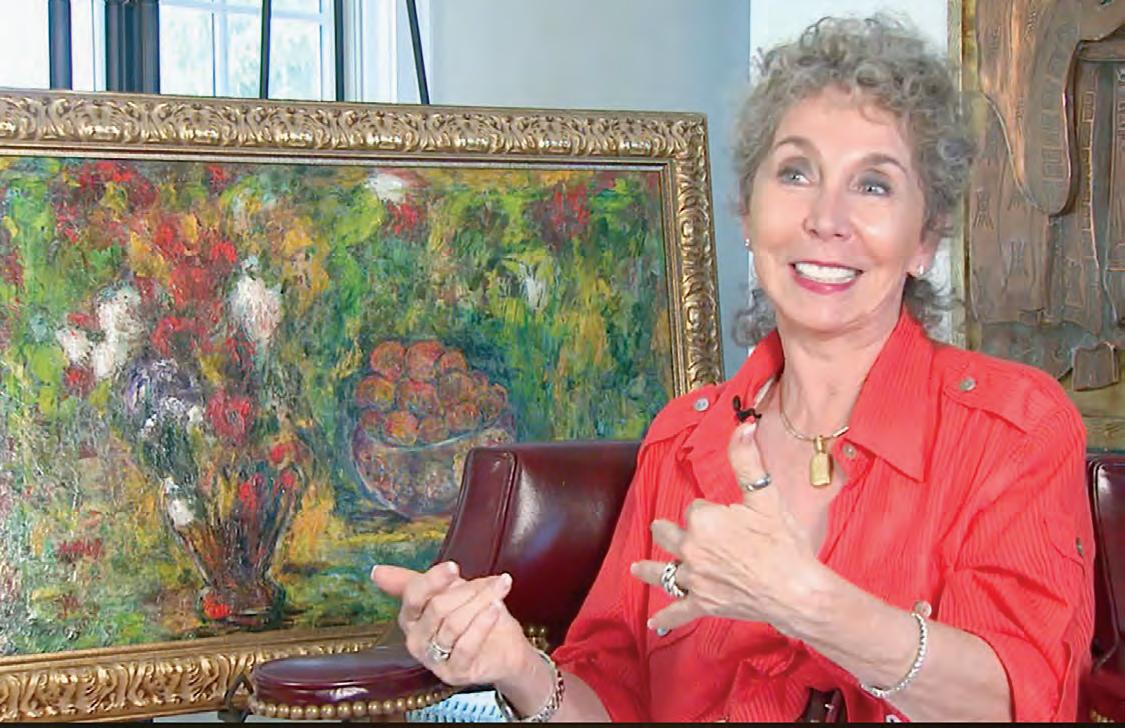
Jane Seymour interviewed by Jamie Ellin Forbes, Publisher of Fine Art Magazine at Artexpo, NY 2011
Jane Seymour’S FlowerS aS PaSSionate SelF-PortraitS
By DR. MOVSES ZIRANI
If man, with the ability to reason has in animal life with an untouchable and undeniable worth, then the flower has a fixed worth in the entire scope of nature as a super-sensitive and the most beautiful of creatures.
It is not in vain that both the woman and the flower are symbols of beauty and sources of life. In nature, the role of the
flower is to bear and nurture the seed into fruition, whereas the role of the woman is one of fertilization and reproduction. Since the dawn of human civilizations, and in the heathen eras, all the known cultures have presented the flower as the symbol of fertility and of immortality. In the Christian era, especially during the Renaissance and on, many of the painters have included the lily in their portraying
of the Annunciation scene, like Leonardo da Vinci, Giovanni Bellini, Filippo Lippi , and others. In ancient Rome, the goddess of fertility, youth and renaissance was called Flora, flower; she was worshipped in springtime.
Most of the Renaissance masters, like Tiziano, Rembrandt and Poussin, have given us beautiful representations of Flora, which usually symbolized the awakening of
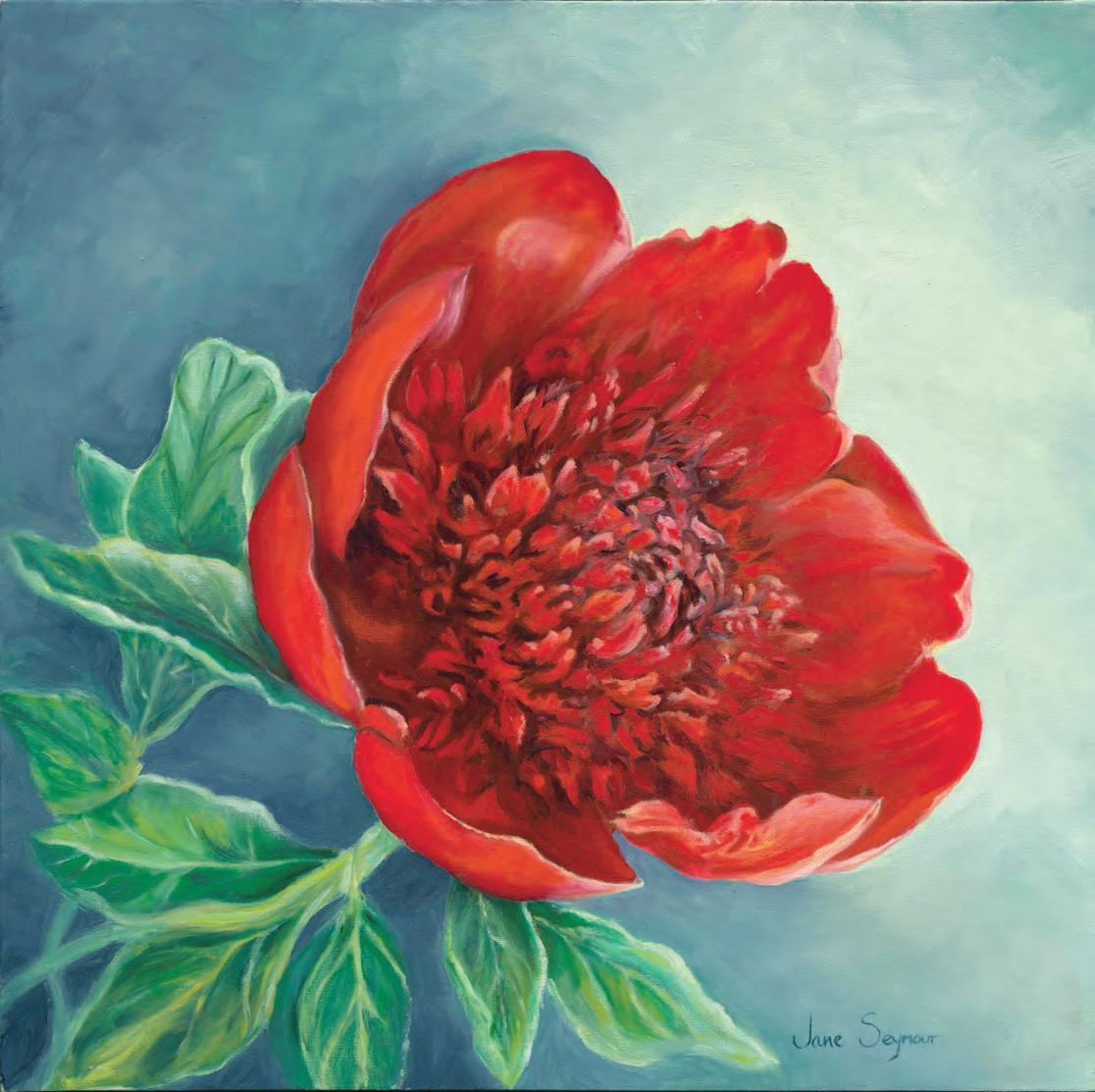
Portrait of a Chinese Peony, Oil on canvas, 24” x 24”
“She is a beautiful flower herself, with much depth and content…”
spring and fertilization of life. During the celebrations of the advent of spring in Rome, as well as in Armenia, Babylon, Phoenicia, Egypt, and most of the ancient world, there were hysterical games of love and sex. Those games were performed so that the mother earth would be fertilized and the year would be bountiful.
Flora personified both the flower and the woman as one entity. Toward the end of the 18th century and in the 19th century, the flower ceased being a symbol and artists started to use it for decorative purposes. Blooming fields, vases and flower bouquets inundated the European paintings. This was a demand, especially to decorate the royal palaces. Later on, the Impressionists and post-Impressionists consigned the flowers a great worth. They not only tried to bring them away from the decorative status, but also to assign them personalities.
Van Gogh is different. Some of his paintings (The Sunflowers) are so powerful and personal that we consider them self-portraits. An example is the Sunflower With Two Faces. Here, the passionate and power-saturated male is presented, where the inner turmoil is expressed through the wrinkled and curly leaves. There is the flame of a burning suffering; a fire which seems to be the expression of a wounded ego, of shattered dreams and of watered-down emotions. van Gogh’s inner fire engulfs his entire being in flames and we see the smoke in the sunflowers. Their expression is so powerful and insightful that it is transferred to us, burns our conscience and forces us to face our human duties.
The first is the American painter Georgia O’Keeffe. She has painted many flowers, like the red tulip, the iris, the violet, etc. that are erotic in nature and somehow call to mind either male or female sex organs and other sensitive parts of the human body. With Georgia O’Keeffe, the sexual passion is mixed with the pleasure of love and the flower, through its beauty, expresses erotic emotions.
The second woman is Jane Seymour. She too has painted many flowers, which are very different from others. Delicate and feminine, those flowers have the charm of life and give us the good news of enjoyment, transporting us to different worlds. The awakening of spring and renaissance of life are characterized with flowers, which as a theme occupy an important space in Jane Seymour’s paintings.
Acting is a mediated art. That is, somehow the actor or actress depends on other artists. So, Jane Seymour goes to painting where she feels completely free to express herself. That is why many writers, architects and actors (as well as scientists, diplomats and others) paint alongside their various professions. The language of color is universal; and the artists feel free and uninhibited in this world.
This is what secures van Gogh’s greatness and the standard to value his art. Having said all this, van Gogh had no problem in portraying the flower and its charms. He worked in a natural way; in him everything was born instinctively. After van Gogh and his contemporaries, presenting flowers continued. However, very few appreciated the flowers by painting them to express their beauty and wonder.
Two of those painters known to us (it is no surprise that both are women) have successfully painted flowers with special care and in great numbers. Those paintings have the value of self-portraits.
They are freer than with rhythms, or with words. There are many examples in the history of international art: William Blake and Gebran Khalil Gibran are gifted as painters, as well as writers. Leonardo da Vinci was a scientist, Rubens was a diplomat. Both, however, were some of the titans of painting of the Renaissance.
For Seymour, painting is not a secondary profession. It is an inner calm, which comes forth from an uncontrolled motive to express herself artistically. This is confirmed by her biographical details, and by her serious attitude toward art. As a highly successful actress, she does not need to go into the depths of another form of art if that does not spring from within her being and does not force her to dive into a world where the colors become meaningful, according to the suggestions of one’s inner self.
Seymour has successfully enacted dozens of important roles and
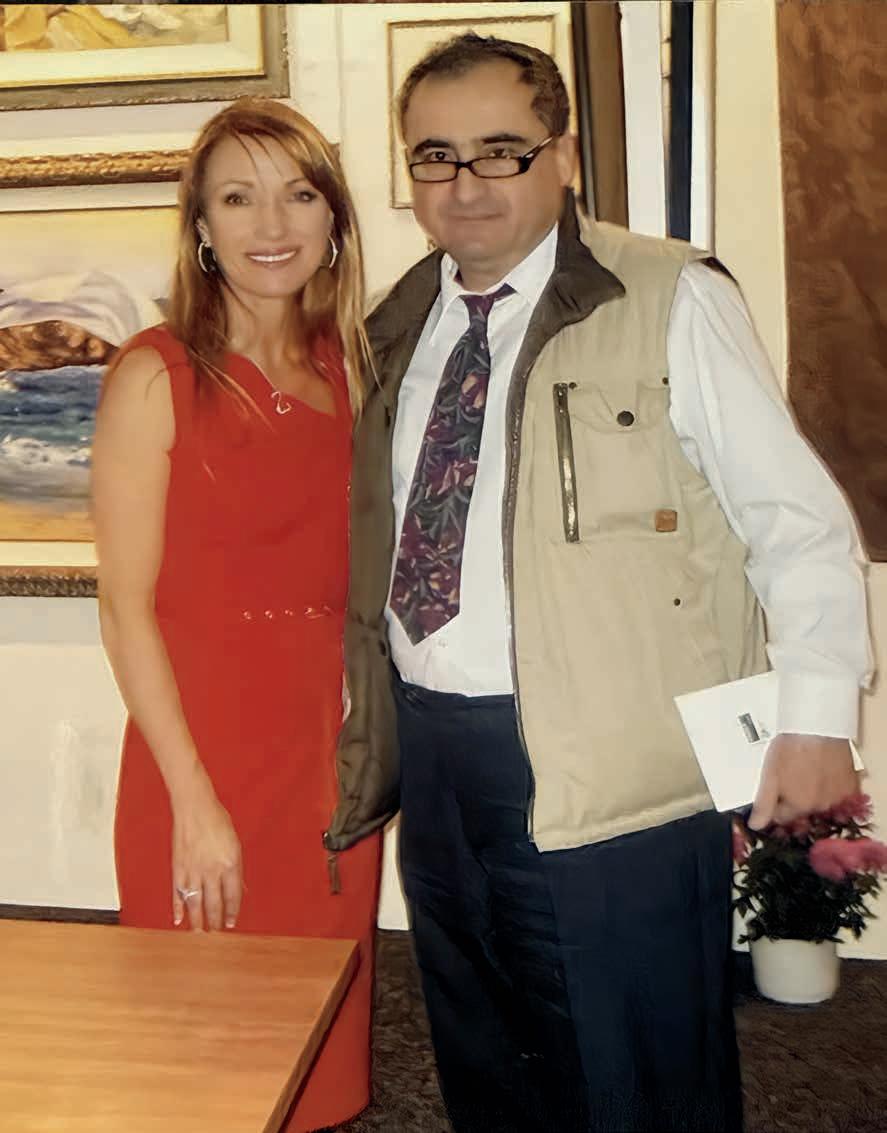
Jane Seymour, author Dr. Movses Zirani
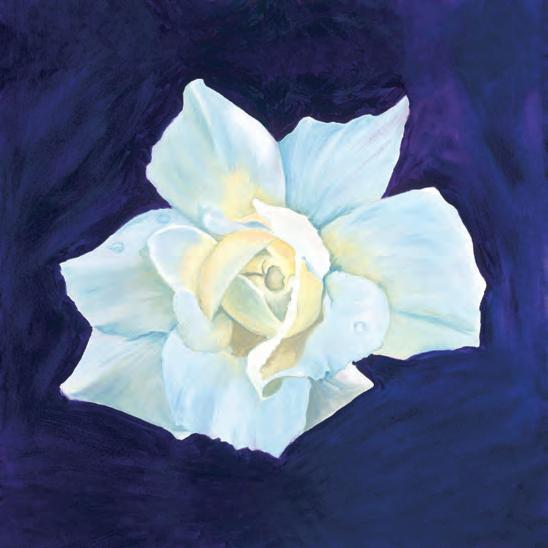
Portrait of an Iceberg Rose, Oil on canvas, 16 x 20”
Portrait of a Stargazer Lily, Oil on canvas, 11 x 14”
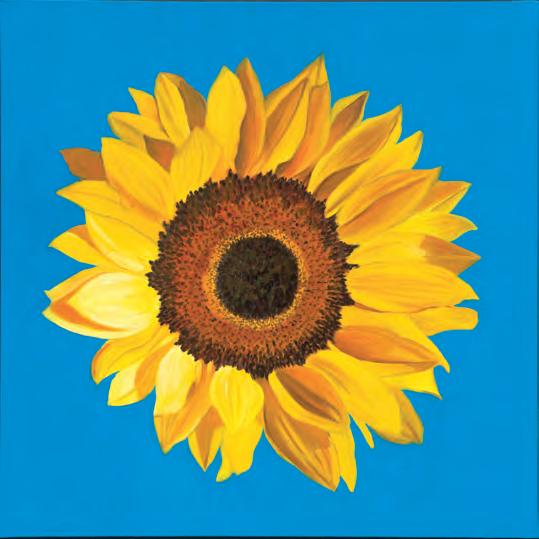
“A sunflower and a Chinese rose…she is wild like the gypsy beauties of the desert.”
is famous for movies like “Live and Let Die” (James Bond), “The Tunnel”, “After Sex”, “The French Revolution” and many other films which testify to that fact. However, and in spite of all this, she has devoted an important part of her time (and continues to do so) to painting, where the flowers play a pivotal role. She not only paints flowers, but also natural scenes, still life paintings and portraits. The latter group includes self-portraits. Moreover, Seymour’s flowers are aspects of her character, because not only does she feels intimate with the flowers, but also expresses herself through them.
She is a beautiful flower herself, with much depth and content, and the flowers she paints are the different charms of her ego.
That is why her flowers claim our special attention. They have a special meaning and artistic worth in fine art.
As we have seen, each of Jane Seymour’s flowers has the nature of a self-portrait, where not only the artists’ taste and attitude toward those sensitive and delicate beings are expressed, but in which we are also given the possibility to know her a step further as a “sensitive and delicate being”—as a flower. Of the irises, the daisies, the lilies, the roses and other flowers she paints, her sunflowers and Chinese roses are noteworthy. When we talk about sunflowers in fine art, we remember van Gogh’s, which are the evidence of a burning and fuming anguish. Jane Seymour’s sunflowers do not suffer; they live to open up to life and to make it more beautiful. They are sensual and lively beings—ready to charm and guarantee the continuity of life, just like the awakening of spring or the sixteen-year-old girl…
Seymour’s Chinese rose is wild, like the gypsy beauties of the desert. She is both a sunflower and a Chinese rose; a lily, an iris or another flower. Like the flowers she paints, they seem to be brought to life and personified during acting. In fact, she is that flower which has bloomed at the right time and in the right environment; that being who constitutes a beautiful conception of the nature-subordinate instinct of motherhood, and is called to make life and nature beautiful; to enhance the charm of art. Each of the flowers Seymour paints is an Eve, a first mother, who is beautiful, fascinating and sensual. She is identified with her colorful flowers.
Actress artist Jane Seymour will be exhibiting her work at Artexpo New York for further information, www.coralcanyonpublishing.com
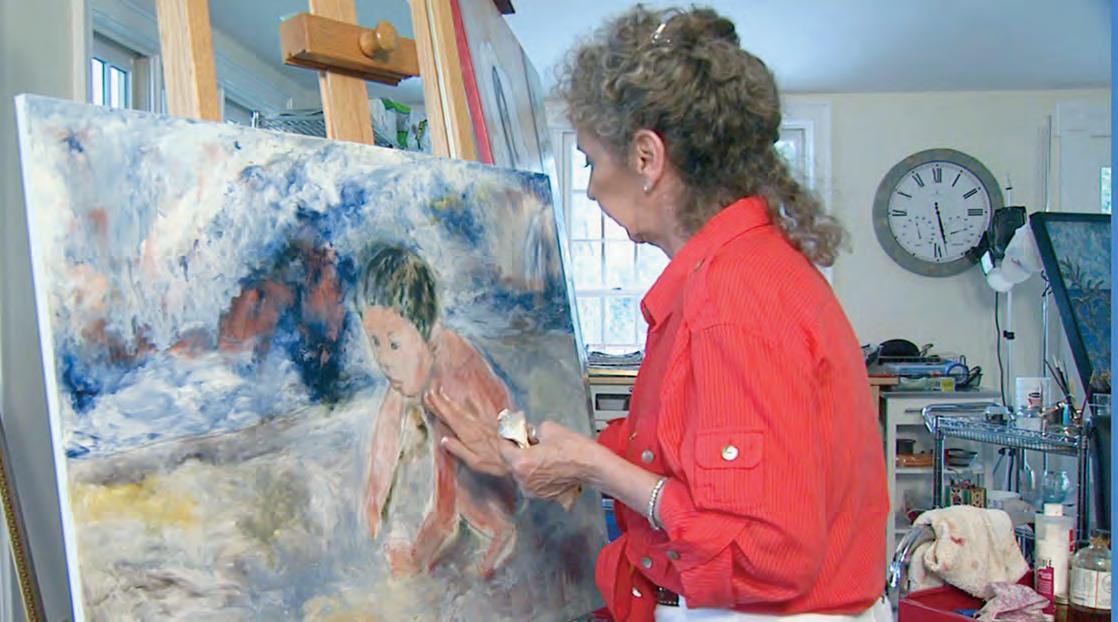
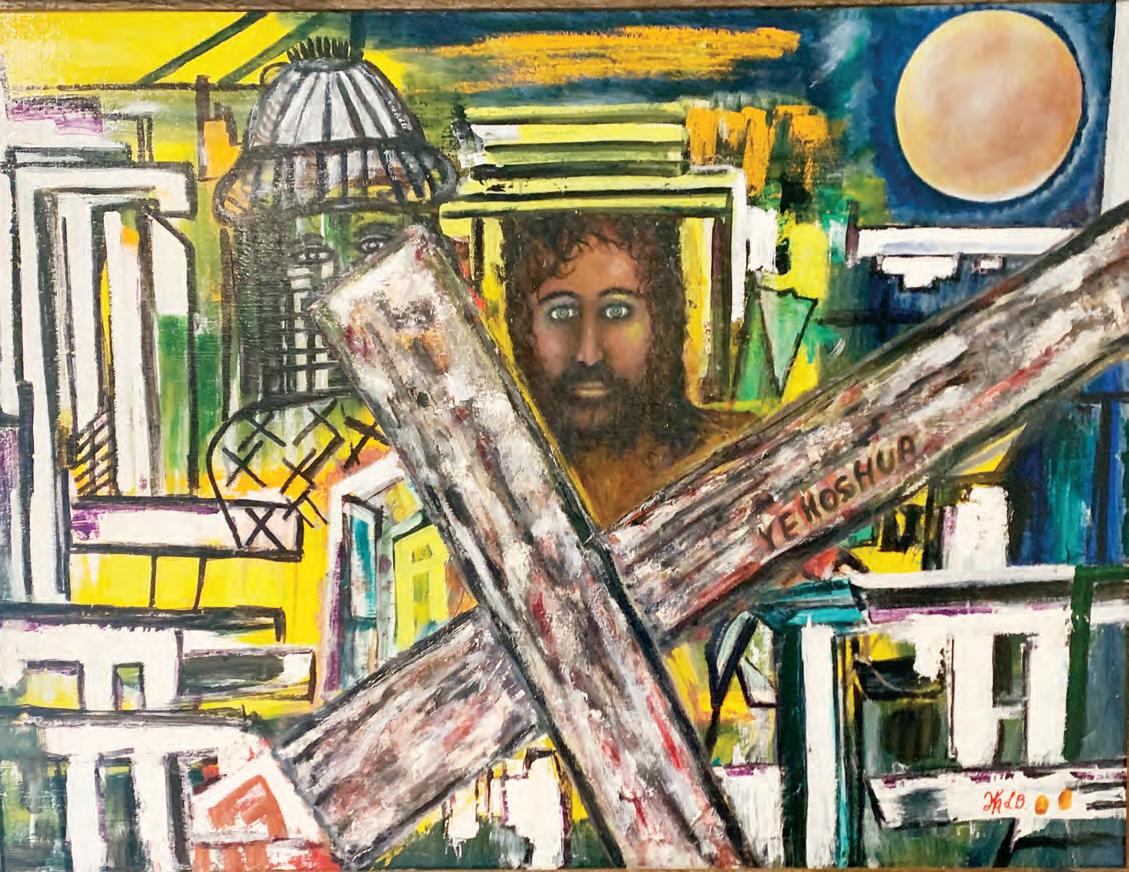
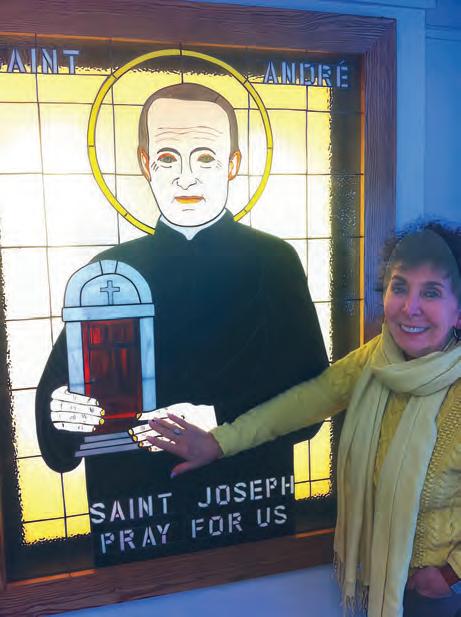
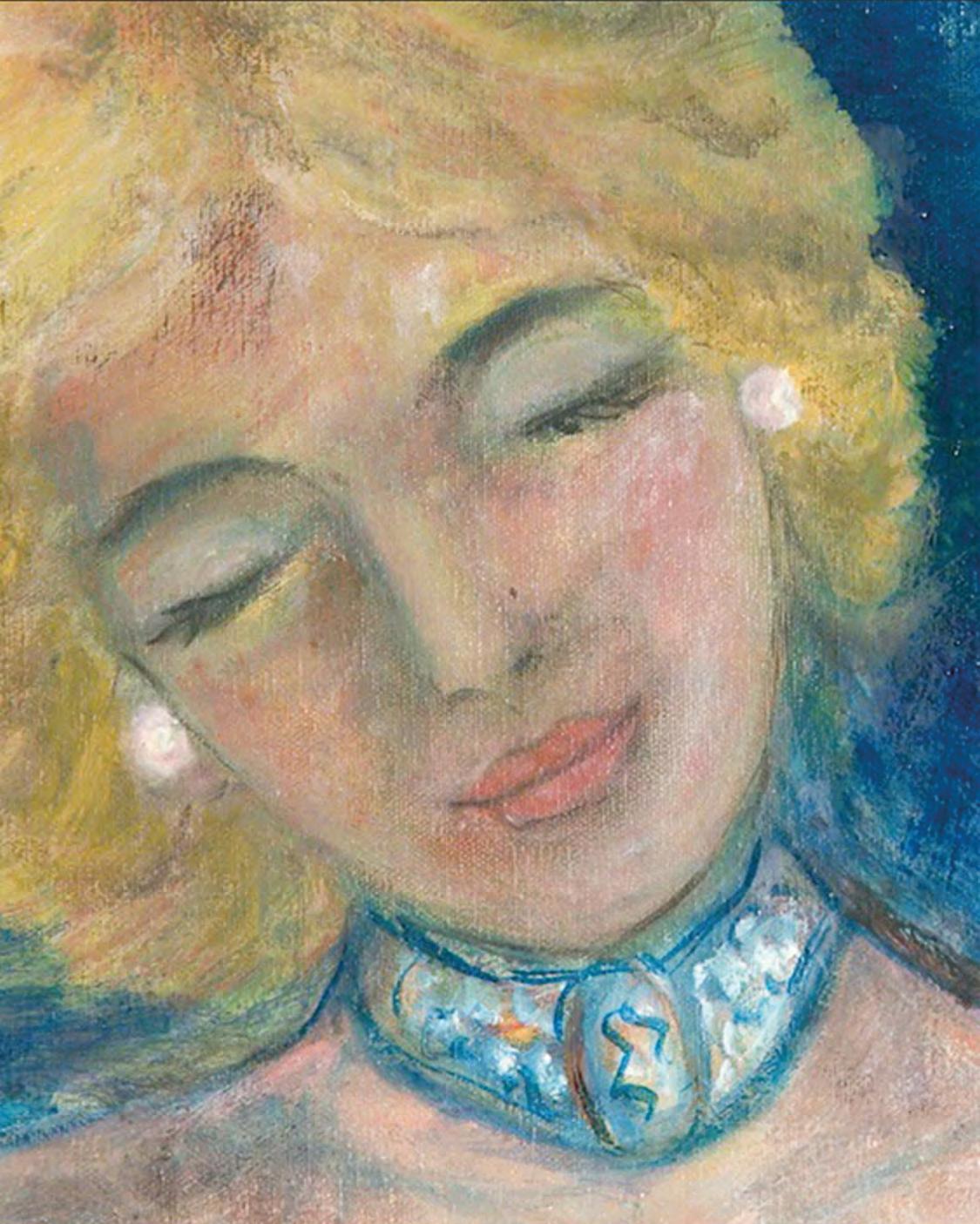
A scientist, psychologist, holistic therapist, artist, author and pioneer in intentionally creating art for healing, to say that Helen Kagan, Ph.D pours her heart and soul into every painting would be an understatement. She expresses her belief in the inter-connectedness of mind-body-spirit in art as a catalyst for healing individuals, society and the environment.
Her powerful paintings are a testament of her theories in action.
Quotes the artist: “I agree with Picasso who said, “Art washes away from the soul the dust of everyday life.”
Forging a path intertwining Fine and Expressive Arts with the Art of Healing, Kagan combines certain frequencies of color, positively charged intention, embedded spiritual messages and energetically balanced composition. The resusltant works of art are stunning — at first by their powerful colors and then, on close examnination, by the sheer volume of paint occupying every inch of canvas. They are intentionally designed to exude power. Just as beauty is in the eye of the beholder, healing is in the heart of the healer and the “healee.” It’s
By VICTOR BENNETT FORBES
a true interaction of energy from a vessel of harmony, light, color and as the artist admantly states, gratitude.
Helen has been developing and practicing her unique, trademarked concept of “HealingArts” as a vehicle for emotional, physical, mental and spiritual well-being to enhance healing for those in need of assistance on any one or more of the levels just mentioned.
Over the course of many years, many worlds and many art fairs, it can be fairly stated that Helen’s passionate works shine live vibrations of bright colors, heavy textures of paint and a charisma of high energy from an unnamed source of pure purity. In person viewers can feel a sense of peace and hope and even from these pages. Helen’s work is internationally recognized with enthusiastic collectors enjoying the multiple benefits of possessing an original Kagan.
Following is an interview with Helen Kagan specifically for our 50th Anniversary Golden edition
“My Life Journey, in general, is about resilience, survival, determination, and a quest for
Freedom. Creativity and Selfexpression, Faith and Gratitude, and intentional Evolving (thanks to multitude of challenges!) have not been just abstract concepts, but very realities of my Journey. My quest leading to this profound understanding was not linear, to say the least. Growing up in a Communist State of what then was the USSR, where oppression and control were a daily reality, formed my beliefs, values and a great respect for freedom to express yourself. I immigrated to the US as a refugee, with very limited luggage allowed. I brought my Jewish heritage, three graduate degrees, zero English, one hundred dollars, two small suitcases, and an unending thirst to explore the World and its meaning.
Coming from a family of scientists, I was curious about the left/right brain synergy which led me to study mathematics and science and then to psychology, therapy, healing and fine art to arrive at my destiny to create my unique venue HealingArts™. As a refugee from Russia, my art reflects an existential view on life, a desire to bridge Realities and heal the Past. The further I am on my
Journey, the more I evolve, the more my art ascends to higher vibrations and reflects higher dimensions of being. Communicating on subliminal levels it delivers Love and Healing through positively charged intention, healing frequencies of color, embedded spiritual messages, sacred geometry, and energy balance, which brings you in touch with your own Quest, and facilitates your own healing Journey.
I believe it is critically important for a Visionary artist to have a strong and unique message we communicate to others. A message that can touch people’s Souls, uplift your Spirit, and warm your Heart. This is how I understand the Purpose and Mission of my HealingArts™
What inspired you to pursue healing art as your life’s work?
As a Healing Artist and a Complex-PTSD survivor who dedicated my life to helping others,
I believe it is my Duty, my Vision, Mission and Purpose to create art for healing, especially in our trying times, amid Worldwide multiple crises, wars, fear, pandemics, anxiety, stress and uncertainty. I envision bringing my unique “wearables”— colorful designer
clothes and homeware — not only to individuals to enjoy wearing and/ or using these beautiful creations at home, but to create and bring various items of hospital-ware and hotel-ware to HealthCare and Hospitality facilities to make my HealingArts™ available to patients, clients, visitors, guests and staff working long shifts as a vehicle for healing and well-being and to assist in recovery. My work has been proven to also promote joy and happiness by introducing highvibrational experience, meditation and relaxation. My passionate vibrant art is often described as “symphony of colors” and as a vehicle for wellbeing and is exhibited in multiple venues, national and International Shows, Artsy.net, major ArtFairs (ArtExpo, ArtBasel, RedDot, Spectrum). Helen is reocognized by many sources, published, awarded, podcasted, filmed, and hosted her own Talk Show with BoldBrave TV. What’s your HealingArts’ philosophy
Kintsugi is a Japanese art form of repairing broken pottery by mending the areas of breakage with gold, silver, or platinum. It’s a philosophy embracing the beauty of imperfectioniin which “brokenness” can be transformed into “new, beautiful and valuable.”
Creating Harmony, Series Kintsugi. Acrylic mixed media on canvas 36” x 48”
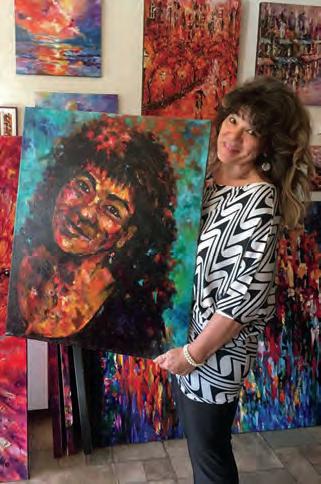
In her studio with self-portrait
in simple terms? Was there a turning point in your life that deepened your calling?
I believe we are “Spiritual Beings on a Human Journey,” and that art is a spiritual path and a transformational process . I believe my HealingArts brings healing and well-being to everyone in need by serving as a Portal for intentional connection with your True Self, to heal on deepest level, to empower you and bring harmony, love and peace. There were many “turning points” or rather “Lessons” as I call them which deepened my calling as a healer. HealingArts™ was born 30 years ago when I first practiced healing as a holistic practitioner in New York City. Being a scientist, psychologist & therapist helped me to conceptualize and develop my unique approach, being a healer and artist — to express it in soulful ways to touch your Heart and uplift your Spirit. I was devoted to creating culturally-competent clinics for disenfranchised immigrant populations from scratch, with
my ‘broken English,’ and zero resources available. I worked three jobs, successfully developed and ran clinical Programs I hosted international delegations coming to learn from my experience and was featured in The NYTimes (front page Metro Section) and on TV & Radio. I developed my healing practice using multiple energyhealing modalities.
I was helping people heal in many different and creative ways, called myself a ‘holistic psychotherapist’ (sounded quite provocative then), my HealingArts blossomed serving people in need, and I was happy doing authentically what I loved. Then I burned out. Completely. That’s when I was picked up by Ambulance from the streets in Manhattan. Soon after that ER episode, my multiple old traumas got re-activated from the amount of stress trying to not only survive, but “make it in America”, by living my Purpose, Vision, and Mission. My complex-PTSD came to bloom without asking my
permission. I had to stop working altogether which was devastating. I was totally crushed, and I didn’t know how to be sick — that was a new “lesson” I had to learn. It was NOT authentic as I only learned how to survive. But I knew I had to bring myself back. I had to get myself back to my “new normal”, whatever it meant.
My HealingArts™ became an authentic source for my own healing which I’ve been bringing to the world since, offering my unique way of healing through art. I do believe art heals, I live through art — it is my spiritual path, transformational process, a way of being. What makes my art transformational for others? The same what it did for me — it creates a colorful sacred space to “feel good.” Synergistically integrating fine art, expressive arts, art of healing, and more specifically healing frequencies of colors, embedded spiritual messages, sacred geometry and energetically balanced composition, my HealingArts™ enhances well-
Helen Kagan, Enchanting Forest. Series Vermont I Love You, Acrylic canvas, 24” x 36”
being, brings love and gratitude to feel authentic, joyful, and alive. What are your healing practices?
I have studied and worked with so many healing modalities, well-known and those I intuitively created. To name a few: Yoga, TaiChi, Qi-Gong, NLP, Hypnosis, Trance-Dance, Polarity Therapy, Cranio-Sacral Therapy, Art Therapy, EFT, Reiki, IM School of Healing (five years), Biology of Trauma, Spiritual Counseling, Sacred Geometry, Neurographics, and a few others.
As a result of my training, practice, and healing gifts, HealingArts™ creates a powerful experience by infusing the space with a captivating spirit and transforming it — both internal and external — by creating a high-vibrational sacred space for meditation and rejuvenation that bridges real and imaginary dimensions. It inspires a sense of wonder and awe while radiating a unique colorful aura, which creates a Portal for intentional meaningful connection with Higher Self to heal wounds on deepest Soul levels. It facilitates your own journey of transformation to a healthier happier You, and deeper
understanding of your TrueSelf. It brings Harmony, Light, Love, and Peace.
Not easily categorized, my work is simultaneously transformational, introspective, vibrant, multidimensional, and healing. A first-generation RussianAmerican, I bring my unique pointof-view, one that conveys depth and understanding of spiritual concepts and messages of the current “real and alternate” turbulent times, of a sensitive Soul, not foreign to the colorful abstraction of contemporary and Russian artistic traditions. My unique art reflects deep existential expressionist emotionality while communicating well-being and creating an enchanting unforgettable healing experience.
What is your vision for the future?
I envision the future of art as a medium for healing and transformation. I believe it is my Purpose-driven Mission to keep creating my life-affirming soulful HealingArts to make a difference in peoples’ lives by bringing colors, healing and hope. After many years of doing other important things while wearing different
“hats”, creating and running clinics for disenfranchised populations, developing from scratch my unique Healing practice, my Higher Self finally “dragged” me to this magic place where I allowed myself to become the Artist I’ve always been. That place in my Soul where I feel Home. That magic place where I created my unique concept HealingArts ™ , then Holistic Intelligence ™ , then ArtSynergism ™ , and WearableHealingArts®.That sacred space where the most important things are Light, Love and Gratitude.
I don’t believe in “mistakes”. I believe there are “lessons” given to us to learn, and they will be given again, and again to finally get it what we need to learn on our Journey. Practicing Forgiveness. Knowing your Strength. Speaking your Truth. Learning Self-Love. Embracing Gratitude. We also need to find and define our WHY-s. I am finally clear about my “WHY”. I chose to be an Artist that I was born to be, and that is my Truth. But… it took me almost 30 years to realize that I can’t NOT do it because it is my Truth, because this is WHO I AM.
Helen Kagan, Composition #3, Chroma. Series Abstract Sunsets, 36” x 48”
“I am sharing a message of healing and well-being. I believe in Hope, Harmony, Healing. Giving people a chance to believe in themselves, that they’re not broken, and everything can be healed! This is the main Message,Vision and Purpose of my work.”
– Helen Kagan
Helen Kagan, In Search Of Meaning. Collection EnergyArt, Acrylic mixed media canvas, 48”x 36”
METAMORPHOSIS. Canvas 1 of a diptych of two paintings 4’ x 6’ ft. each.
“This artwork was guided and channeled. I am humbled and grateful for this powerful co-creation! There is a huge Universal Heart pulsating through the Galaxies, embracing and bringing Peace, Love, Harmony and Beauty to all the world’s religions, people, universes and beyond. It is VERY meaningful.”
“My latest “invention” integrating Neurographics+ Kintsugi in the same painting. This drawing is for “Removing limitations, anxiety, procrastination”.
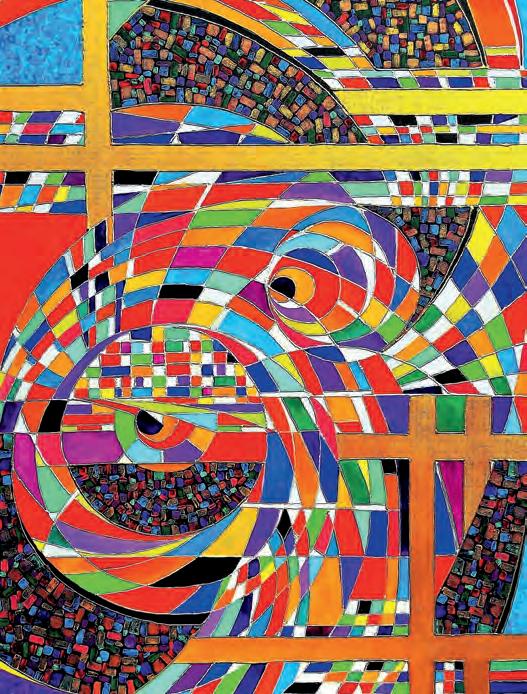
Finding Harmony in Chaos. Collection Bridging Divides
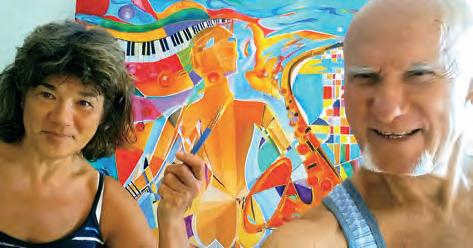
Helen Kagan collaborated with several other artists creating unique synergistic art works. One of her favorite artists was the late otirios Gardiakos (GARSOT). This unique concept created by Helen– Art SynergismTM – is much more than just two artists working together. It gives each of their individual gifts a new dimension, a new way to expand into something greater than just their individual selves. Helen and Garsot painted together, simultaneously on the same canvas, without defind parameters or tasks, being in a free-flo. Says Helen, “We integrated our individual techniques, forms and styles while intertwining, embracing and enhancing each other’s spontaneous colors and movements. Always present in this concept is a beautiful authentic holistic oneness with the Creator-Universe-Source allowing us to be channels for this synchronicity to deliver a colorful, powerful, soulful and healing experience to all.”
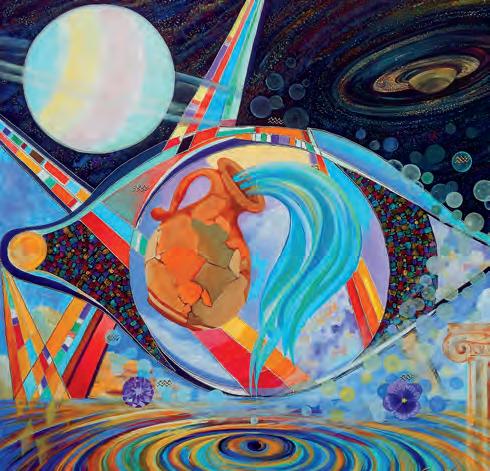
ArtSynergism by HKagan & Garsot. Aquarius Collection Eyes of the Zodiac.
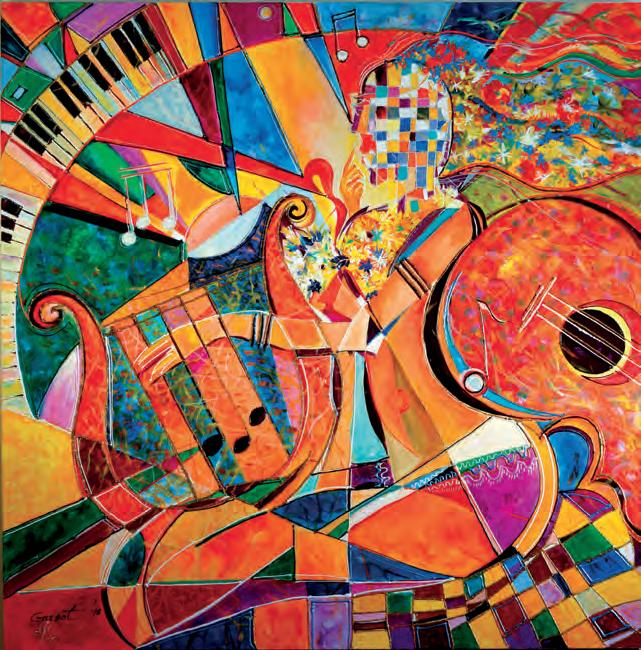
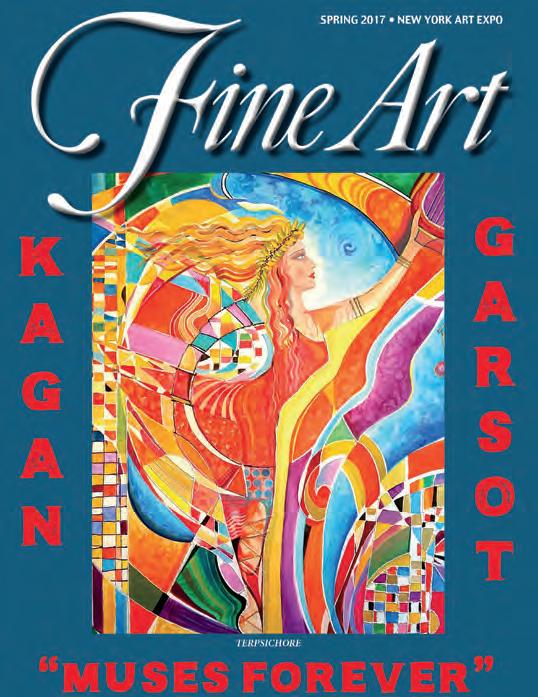
Muses Forever. Collection Muses & Music. Screen 10 x 8 ft
(Side 1)
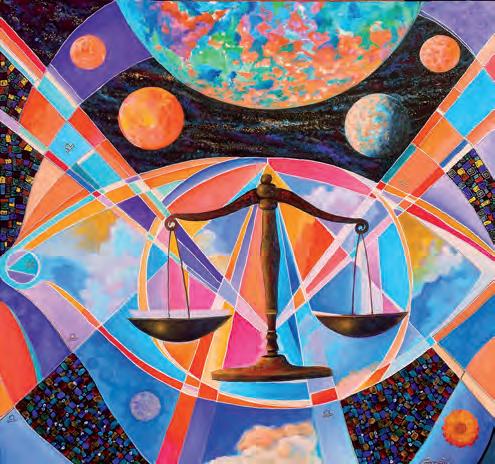
ArtSynergism by HKagan & Garsot. Libra Collection Eyes of the Zodiac
As war disrupted Europe’s economy and art market—twice in the first half of the 20th century—the United States provided refuge to both European and American artists whose work was revolutionary. After a parade of stylistic “isms” such as Cubism, Fauvism, and Surrealism, artists embraced abstraction as the formal strategy that best suited their artistic purpose and made New York City the international capital of the art world.
In today’s cultural climate, with instant access to anything and everything, a new “ism” would be called a mash-up. That, in the most complimentary terms, is usually reserved for a musical composition when a pair of distinctive styles merge into a combination of the two. For the art history buffs, this energetic and thoughtful application of paint to canvas will be forever known as ArtSynergism, a creation of and by two very interesting and accomplished artists from very different backgrounds. The legendary Greek, Sotirios Gardiakos (Garsot), combined forces with a Russian emigre who is a highly regarded in the Healing Arts field, Helen Kagan, PhD. “This,” says Ms. Kagan, “is much more than just two artists working together, inventing as we go. In fact, this collaboration gives each of our individual gifts a new dimension, a new way to expand into something greater than just our own individual selves.”
Adds Garsot, “It is important to me that art be respected as it has much to teach us. To that purpose, we see ourselves as ambassadors of art for the next generation and all the generations to come. We are following in the footsteps of artists from prehistoric days right through the greats of art history and as we learned from the past, generations to follow will understand through our art what happened today.”
This interaction of Garsot and Kagan is greater than the sum of its parts. They create by painting together, simultaneously on the same canvas without defined parameters or tasks, freely flowing, integrating their individual techniques, art forms, styles, intertwining, embracing and enhancing each other’s spontaneous colors and movement. “Always present in this process,” continues Kagan, “is that completely authentic
ArtSynergism A PROJECT OF GARSOT & KAGAN
organic holistic Oneness with the Creator, Universe, Source—allowing us to just be channels for this amazing spontaneity and synchronicity.” “As a musician and composer,” notes Garsot, “I am doing the fine art of music. Playing synthesizer and writing material, I am forever inspired by the muses and this collection reflects that. Right now we are working on a ten ft. long by seven and a half ft. high composition, a double faced screen.”
How did you meet and work together?
We met several times in the last few years showing together in different galleries and exhibits and liked each other’s work. We thought of perhaps doing one painting together just to see how it could go. Garsot drove to my Studio (a 100 miles away) and we did our first Muse. It was easy and joyful; totally spontaneous with no prepping. This became the beginning of our “Muses and Music” Series... as well as our ArtSynergism concept. What is the concept of “ArtSynergism”?
The concept has Greek origins (synergos), and I thought that it’s just a perfect description for what we do. “ArtSynergism” as a concept, has not been used or referenced in Fine Art. Therefore I can say that while collaborating on our new “Musical” Series we are developing a new perspective, a new movement. How does it relate to your work in other fields and your art?
It feels like I am living my dream! Being a scientist, holistic practitioner and artist (in that order), I’ve been creating and developing various projects bringing the ArtSynergism concept into whatever I’ve been doing. Always. Since 1998 I’ve been developing my “Healing Arts” venue integrating Arts of Healing and Fine Art. “Synergy” experience is something universal for me. It is how I understand my Purpose. Collaborating with Garsot was very special, as if we were meant to create art together. Our synergistic process was smooth, beautiful, and healing!
Who are your influences — artists of the past, people outside of art?
Many Masters. Mainly Impress ionists, Post-Impressionists, Expressionists (Monet, Pissaro, Cezanne, Picasso, Matisse, van Gogh, Seurat, Modigliani, Klimt, Kandinsky, Miro, Chagall...) And of course, my Father – a Nobel man, a real Scientist (a triple PhD), an Inventor with over 500 inventions and patents (all belong to the USSR Government...), a Jewish man who never gives up. I am definitely his daughter...
How will ArtSynergism impact the world in general and the art world in particular?
I don’t think there are many examples in the history of art when two (or more) artists collaborate on a large volume of works — not taking turns, not dividing canvases, or one day - one, the other dayanother, etc. The creative process happens spontaneously without much preparation or negotiation between us, just following the flow of creativity and spontaneity, while integrating many different styles and techniques in the same painting.
It is a very interesting and exciting creative process. Our collaboration gives each of our individual gifts a new dimension, a new way to expand into something greater than just our own individual “selves.”
I think the more people will enjoy or even use our approach in the future, and more truly beautiful artworks will be co-created. More artists will bring positive and healing art, and more people will better their relationships in general.
As a holistic therapist and artist, my belief is that it’s all about relationships — your relationship with yourself, with God, family, loved ones, and all others. I am truly enjoying collaborating with Garsot who is very positive, a great visionary who’s been creating his own “Positive Surrealism” for over 50 years!
Synergistic
Humanity. Mission, Vision, Purpose. Healing. These are not just words for me. I believe Art heals. I believe in the inter-
connectedness of mind, body and spirit. This is why I’ve been creating my “Healing Arts” for many years… It is no accident Garsot and I created “ArtSynergism.”
How do you devise your paintings and what is the depth of your interaction?
One day we just started to paint together, without big preparations or long discussions about who does what, when, and how, we just took a large canvas, paints, brushes and got to work! We each had our own sets in the beginning, then we started to pick up each other’s stuff. Now we share everything — paints, brushes, etc.
Who has the last word in your collaboration?
There’s basically no questions of “what to do” or how, when, where, or who has the last word. It is often Garsot simply because I respect him being older and more experienced, but this amazing creative synergistic process does embrace both of us, and the “proverbial” holistic Oneness is so strong that I feel we are just being channels for this sacred spontaneity and synchronicity.
Our Series Muses and Music consists of 10 large square paintings one for each of 9 Muses, and the 10th Mnemosyne — Mother of All Muses. This Series is bright, light, complex, spiritual, enigmatic, and just beautiful! Everything about it — bright sparkling colors, energetically balanced composition, ancient theme, embedded healing messages, and of course, the beauty of the Muses and the Music — envelops you with an amazing ambiance full of Light, Love, Music, Beauty, and Healing.
We hope you find yourself gently guided to immerse into, relax and enjoy an embracing warmth, sparkling brilliance, powerful soulful experience and the healing vibrations of “Muses and Music”— the unique HealingArts™ Series.
Helen Kagan, Kaleidoscope Of Life. Acrylic canvas, 36 x 48
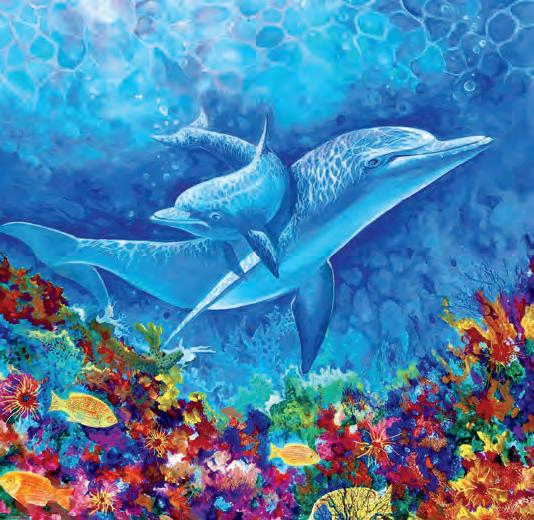
Kagan and Garsot created three collections together: Muses and Music, Eyes of the Zodiac and Serenity Blues. The last collection, unnished unfortunately due to Garsot’s transition, was specically created to have the soothing images and colors placed in hospitals to help people to recover and feel better. In Helen’s words, “My purpose is to encourage healing through art in our turbulent times of Worldwide crisis, wars, fear, anxiety and stress. People are overwhelmed and uncertain. I feel it is my duty to continue creating art for healing and I believe that now more than ever, our world needs positive energy, Spiritual intention, gratitude, and a lot of healing art. My passionate vibrant healing arts are a vehicle for joy and well-being — a statement of all my beliefs.”
ArtSynergism by HKagan & Garsot. Scorpio Collection Eyes of the Zodiac.
ArtSynergism by HKagan & Garsot. Dolphins’ Love Series Serenity Blues
Fine Art Magazine Spring 2017 Artexpo New York edition
What is your advice to younger gerations?
The way for me to express myself is via art, as well as writing, music, movement, and a way to heal myself and help others heal. I am here to bring this message to the world that my Art is Healing; it is Love and Light; it is a healing tool that can help you on your Journey to YourSelf.
Here’s my advice to everyone, and not only to “young healers and artists” — don’t ever STOP! Keep going. If you believe in your unique “message”, your Mission will eventually pick up. Everything new and innovative takes time for people to recognize it, change their own (old) paradigm to accept new, and then, hopefully, accept yours. I am speaking from my own, tough, rough full of challenges, setbacks, obstacles, trauma, drama, etc. yet so valuable life experience:
– HELEN KAGAN
For Helen Kagan’s full portfolio and gallery, please visit www.helenkagan.art, www.helenkagan.com, www.helenkagan.net, www.wearablehealingarts.com
Helen Kagan, Chakras of the Universe. Collection 5D. Acrylic, on canvas 48” x 36”
Helen Kagan, Between the Heaven & Earth. Series Sunsets & Blues, Acrylic on 48” x 36”
Helen Kagan, Big Bang Series My Universes, Collection EnergyArt, Acrylic on Canvas, 36” x 48”
KEN KEELEY
“My Paintings Have Been Very Good To Me”
What we love about this art business is the lasting friendships one can make; how you can watch a fellow human being develop his skill in a linear fashion.
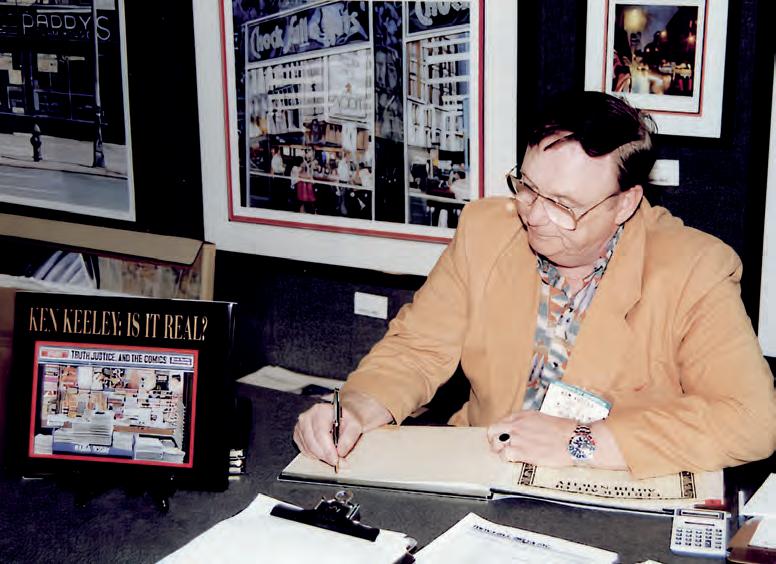
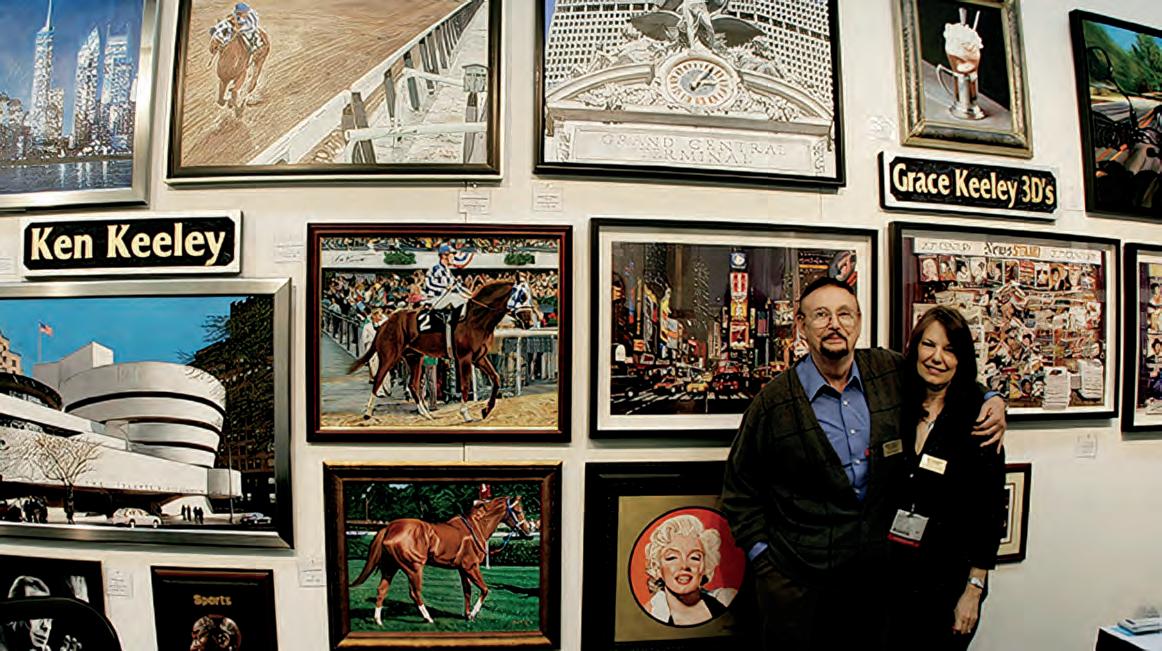
We have been writing about Ken Keeley since the early days of our inception and also worked with him on one of SunStorm/Fine Art’s first hardcover books, which Ken is signing at Artexpo in the accompanying photo.
Over the years, Ken Keeley has proven that the race is not to the swiftest. He is an artist and a man who has endured by staying true to his vision and by keeping himself on task. Internationally known for his meticulously detailed paintings, which have been widely reproduced in posters and serigraphs up until his death in 2020, Keeley has steadily created his four or five large canvasses, and a few smaller ones each year like clockwork, without compromise
Ken Keeley signing his book “Is It Real” by Victor Forbes
Ken in his studio in Jacksonville, Florida, photo courtesy Grace Keeley
Speaking to Ken Keeley is much like looking at his paintings. He is a Photo Realist who paints in a lucid style that somehow conveys the stark reality of the moment without any of the cold sterility of the genre. Keeley, famous for his newsstands and cityscapes, is hot on the new developments around Times Square, with the strong Disney pres ence, which should give him fodder for a new updated series of paintings and is excited about his forthcoming pass to photograph the action on the floor of the New York Stock Exchange, which he will be doing during Expo week, between stints at the Cosmopolitan booth where he will be signing posters for his fans and collectors.
Florida life agrees with the former New Yorker, who was born in Brooklyn, before moving to Queens at a fairly young age. He attended the School of Industrial Arts on 51st Street and Lexington Avenue, graduated in 1952, and went in the service with the Korean War in full blast. “The school itself,” recalls Keeley with the same attention to detail so evident in his art, “was actually a Civil War hospital, quite a place, with a very good training program for Industrial Arts. We had to wear a shirt and tie every day. It was strict and we also had to march to class. They said they we were being trained for the business world, but nobody,” he said with a wan smile detectable from a thousand miles away, “Told me about this…” (meaning the imbroglios of the art world).
Keeley stayed in the service some 27 years. As a contracting officer in the Air Force, he traveled “all over the place — Europe, England, Japan — before winding up at the Suffolk County, New York, Airport with the 106th Air Rescue & Recovery Group. After retiring, Keeley took a job in an art gallery. “The owners told me to stay there during the week and they let me open a studio in the back where I could paint. If a customer walked in I would take care of them.”
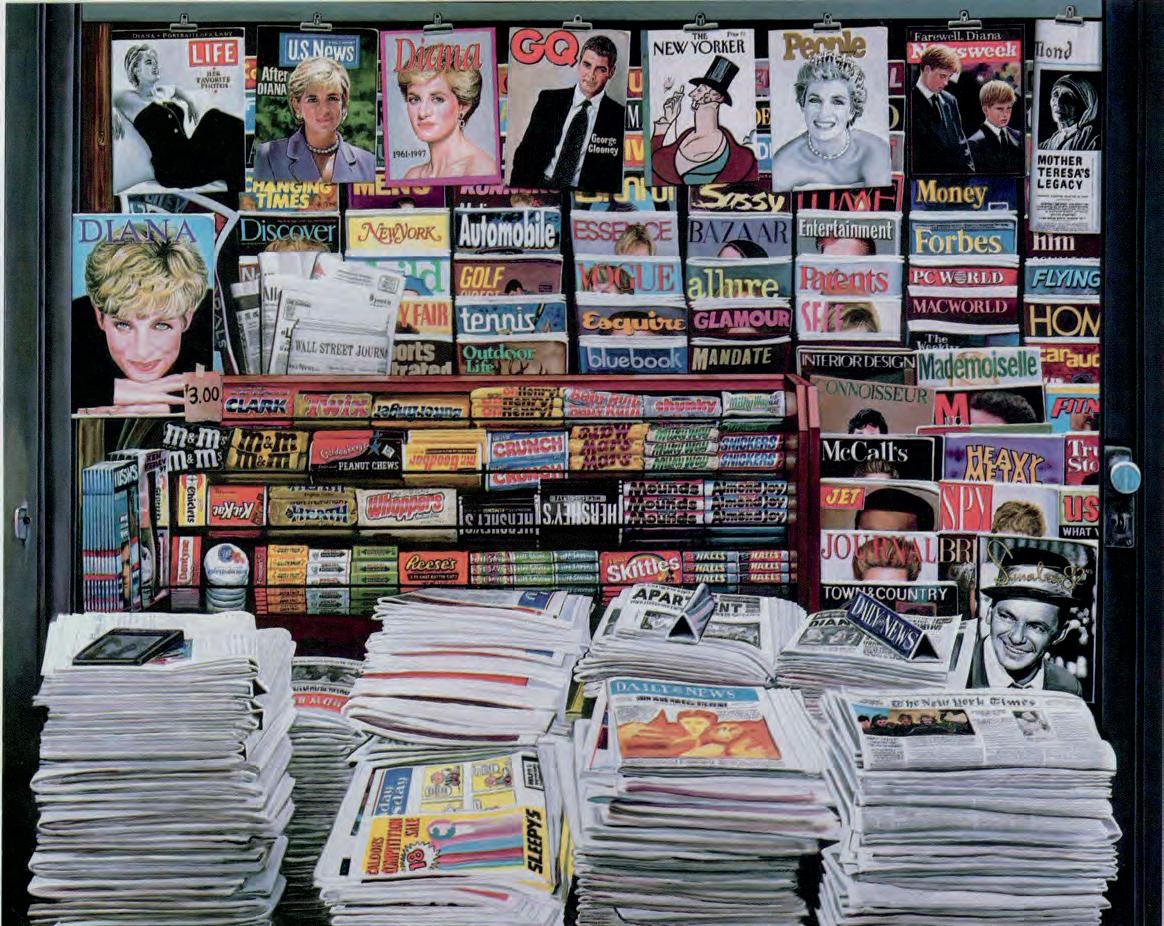
There are probably few people in the world who are more familiar with Ken Keeley’s art than we at SunStorm. We printed his book; his posters and postcards. We have seen his work in the photo stage, the color proof and separation stage, the offset and silkscreen print, the cibachromes (remarqued) and the originals. Keeley hides nothing from the viewer. In fact, he packs plenty of information, including, in every piece, his name embedded somewhere in the midst of the action. Still, after all these years, I couldn’t tell you if the black imagery on the newspapers is in reality typeset copy or finely Greeked facsimile in a hieroglyph created by the former career Air Force man. Keeley is no flatterer. He tells it like it is. Titles
Welcome Night
his paintings in the same way. Whether you examine them in print form as they come off a printing press moving at thousands of sheets per hour, as a screen print or even-especially- looking at the original, you begin to see the hidden, darker aspects of Keeley’s world coming to life. Interplay between shadow and light, between movement and impasse are earmarked by elements that are unmistakably Keeley. “The paintings are coming out better than ever, probably because I work so much. I can see the improvement, I can feel it. I’m just going to keep on painting the way I’ve been, try to do each piece better than the last one. I guess you can say you’re always learning. It seems like I have a knack now, I don’t know how I do it, but I can get a color from a photograph in a real short period of time. I guess I know what makes that color, a certain kind of blend and mixture. Duplicating the colors of magazines and candy bars has worked out well. The lettering has been learned through trial and error. It’s called shaving: to get the lettering as clear and precise, you keep shaving the sides of it rather than try to do a straight line-it sharpens up the lettering that way.
Keeley knows the public likes his work, and he is becoming more and more comfortable with the celebrity status. When I go to a show and my paintings are out there, there’s a reaction. At The Gallery Center in Boca Raton, I had my latest painting on display, Diana. I had to hide, almost, the accolades were too much for me. At least I did my job, the painting, the prints are a reflection of the work.
“I was with Bruce Helander, on Worth Avenue in Palm Beach for five years and doing nothing but newsstands. He would sell them as fast as I could paint them!”
Artists who are wonderful, important and possibly even great imbue their work with a quality that can best be described as artless. When Cary Grant seduces the leading lady while stealing her jewels, you don’t think of that as work. The wonderful wildlife painter, Don Eckelberry, has achieved a stature in his field not because he was the first to paint, from nature, every bird in North America in every significant plumage, but because he knew how to put a look in a duck’s eye that told you everything you needed to know about the artist and his subject.
Ken Keeley is vaulting into the ranks of the elite not so much by charting new territory in his street scenes and newsstands but because he gives his trueto-life works a life of their own. Keeley’s collections of candy bars and magazines; storefronts and street scenes grab your interest and captivate it. Transcending the limits of technical virtuosity, Keeley has become one of the more recognizable artists working today — and not simply because the paintings he creates are of New York City’s most recognizable vistas.
His interpretations of various Manhattan landmarks — past and present —including but not limited to Times Square, Trump Tower, Radio City, Paddy’s Clam House, Prince Street and many more intricate portraits of newsstands, candy stores, fruit stands, well-known restaurants and street corners have earned Keeley international acclaim. The artist’s research involves photographing literally hundreds of sights for potential paintings from many angles, often a treacherous feat when you’re trying to shoot a fish store from across a typically well-trafficked New York street. The final paintings are not just faithful translations of these images but reconstructions devised by the artist that always include some whimsical or private code. Keeley’s reluctance to fit into that very slick element that is known in the art world as Photo Realist or Super Realist is not just a natural resistance to be categorized: his mature body of work contains the detail inherent in the aforementioned divisions of the art world, with a luminosity and sensitivity that separates Keeley from those other very gifted artists who simply assault us with their more-than-perfect recreations. Keeley, like Eckelberry, gives his work a feeling and personality that adds beauty and grace to what could very easily fall into the mundane.
With all his success, Keeley remains the consummate artist: disciplined, humble, and very serious about his work. He is at the point in his career where he cannot produce paintings quickly enough to meet the demand, and unlike many other artists working today, he will hear nothing of studio assistants, projectors or any other process that will speed up production. This artist’s work is more than real — it is true. — VBF
59th St Bridge – immortalized in song by Simon & Garfunkle (“Feelin’ Groovy”) and on canvas by Ken Keeley
Ken Keeley – Memories That Linger
Much like the Coca Cola sign that is an integral part of his Times Square paintings, Ken Keeley has become, over the course of his career, a classic in his own right. He is an artist who strikes a chord in collectors not only for their instant connections with the familiar scenes that are his milieu, but for the style of realism that he has developed and refined. Keeley’s particular high level of acceptance in a very competitive field is based upon his sincere dedication to both his subject matter and the art of painting itself. A few degrees removed from the glaring and blaring Super Realism of a school of painters who came to prominence and almost as quickly disappeared, Keeley’s particular form of kinder and gentler portrayals of New York scenes and newsstands continues to open major portals to success for his work.
Another of the secrets to Keeley’s success is that he takes no shortcuts in creating these paintings, which are always large canvasses with every square inch filled with detail. In 20th Century Newsstand, which took the
better part of five months, painting 50 hours a week to complete, he counts no less than 30 portraits among the stacks of newspapers and display of candy bars. Everyone who had any impact on life over the last hundred years can be found here: Teddy Roosevelt, Charlie Chaplin, Sinatra, Picasso, Babe Ruth, Eisenhower, Liz Taylor, Louis Armstrong, Ronald Reagan, Elvis and John Travolta among them. Newspaper headlines blaring “Hitler Is Dead”, “Clinton’s Lawyers Scrambling”, “Dewey Defeats Truman”, “Mets Hit The Top”, “Nixon Resigns” and “Kennedy Killed By An Assassin’s Bullet” form compelling reading and an equally compelling 50” x 80” oil painting.
Enthusiasm is the byword for Keeley. Getting up in the morning and hitting that canvas, it helps that he has built himself an idyllic 4,000 square foot retreat on a lake in Florida. After spending a good part of his career on Long Island, New York, he rhapsodizes about his life down South. “Each day offers something new,” he says. “Presenting new possibilities. Even though creating these
20th Century Newsstand
paintings is very time consuming, I never get bored.”
Keeley says that by concentrating on a specific portion of the painting it is like doing a painting in itself. “That’s why it doesn’t get boring. There’s something different to focus on everyday to paint, or to finish.”
Having just completed construction of an attachment to his home for his painting studio, Keeley is quite comfortable juxtaposing the excitement of his new hometown’s annual automotive endurance race with the indigenous wildlife he has come to love, “Especially the birds. All kinds of beautiful birds come here: herons, all the Florida birds.” When asked to be more specific, he pauses to find his bird book. “The one I really like is a hawk, they call it red but he’s more of a yellow or cream color.” The pages turn and Keeley ascertains that it is indeed a Red Shouldered Hawk. “He’s claimed this place as his domain. He’s always here. A beautiful flyer, sort of the native hawk down here of southern Florida. He loves those majestic oak trees and the lake that surround the place.”
“I’m working on an updated piece, a new Times Square. I would say it’s going to be my best Times Square to date. I have done a few of those but this one is exciting; highly detailed. There’s a lot in it.” Rendered as a winter twilight scene, from photographs Keeley took during the holiday season, the 48” x 68” oil painting is destined for the Sundook Gallery in Boca Raton.
He’s also been commissioned to do another newsstand. “I’ll work on it for at least four months.” Again, it will be a montage of various magazines and newspapers with no theme picked out at the moment. His collector, though, doesn’t mind. “These newsstands show our history and he tells me he has a lot of faith in my selections.” To be totally accurate, Keeley prowls libraries and hunts for old newspapers. “Sometimes you get lucky.”
Today, Keeley tools around town in one of those new Chrysler PT Cruisers, a little silver one, that looks like the getaway car from Bonnie and Clyde. It’s a good life — painting, watching the birds and getting ready for the auto race at which Porches, Jaguars, and Ferraris come to Sebring and race for twelve straight hours on open runways at the airport.
“This last year has been very good for me in the arts. I’ve never been so successful. All my paintings are sold, and even in a soft economy, I’m doing well.” He’s still working fifty hours a week in front of the canvas, “otherwise it would never get done” and has one devout collector who wants to buy a painting every six months. “There’s no way to speed up process, each painting seems to take a little longer as I want to outdo what I did in the prior one. There’s more detail in the newsstands, in the Times Square Broadway has different signs and new lighting effects but the Coke sign stays the same, that’s pretty much there forever…”
As are the memories evoked in each work created by Ken Keeley.
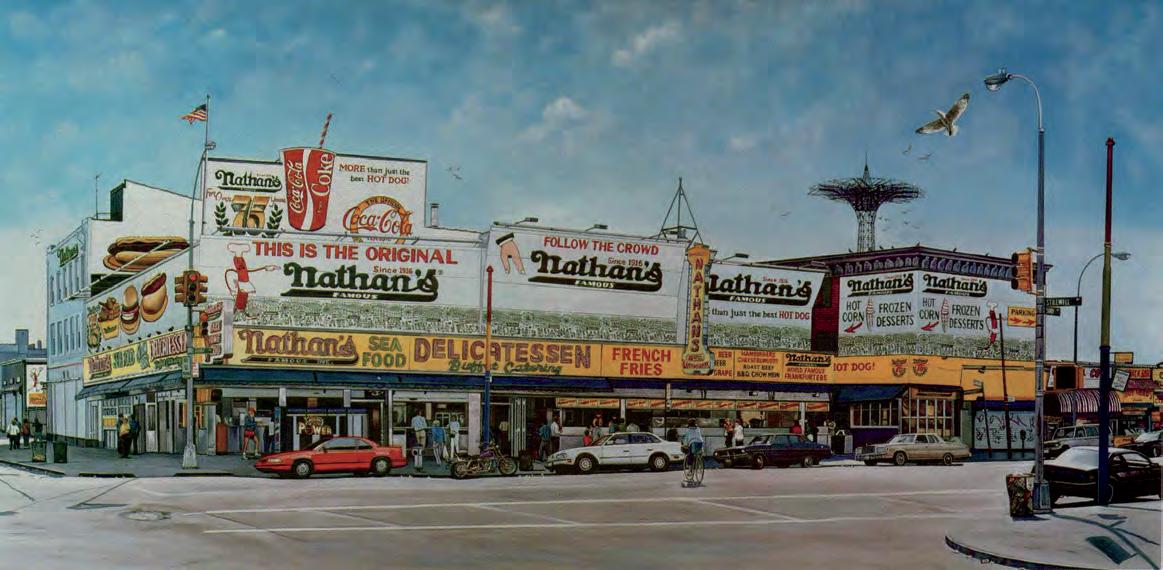
Nathan’s Famous
Homage To Andy Warhol
GRACE & KEN – A LOVE STORY IN REAL TIME
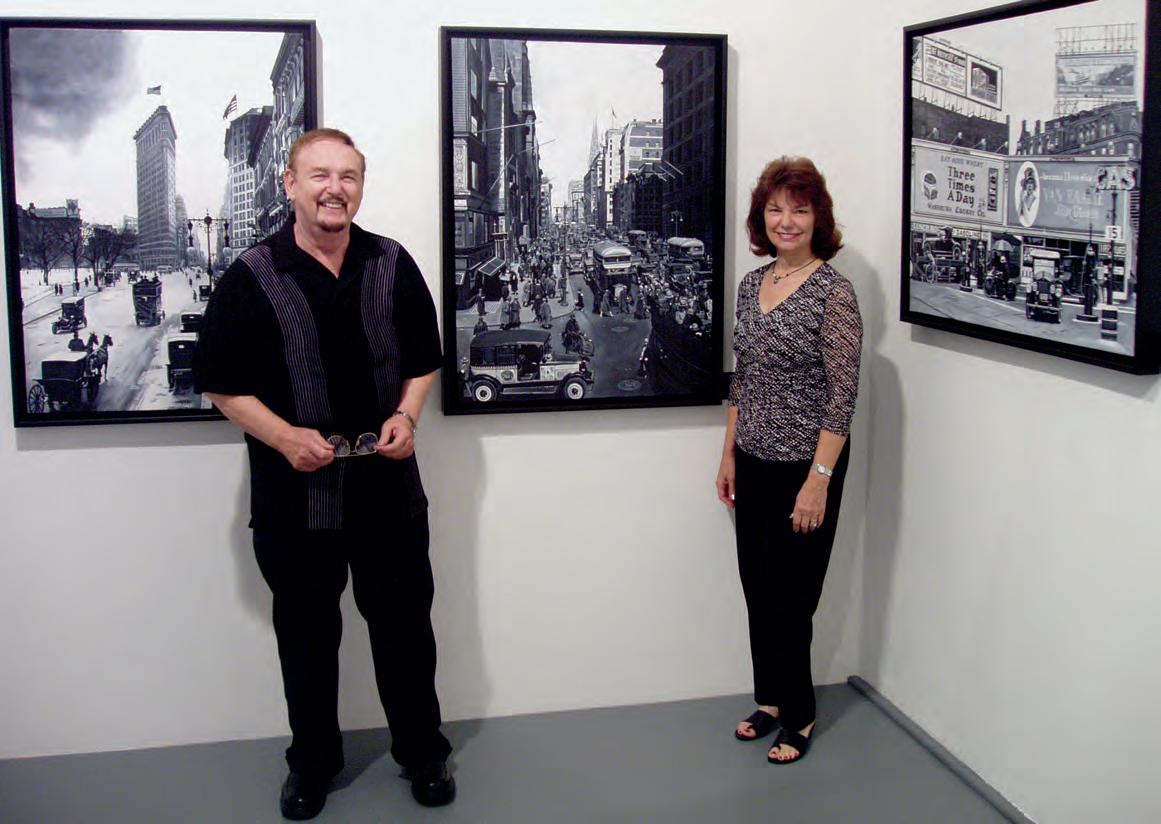
Ken & Grace at Tribeca exhibition
Ken & Grace at Artexpo, NYC
VBF: When did you and Ken meet?
GRACE: In 2000. Mutual friends introduced us and the friend of Ken’s was asking if my friend knew of anyone as Ken was lonely, by himself after his wife had passed away. My friend mentioned that I was her supervisor and she thought highly of me. Later, she called me concerned that she had stepped out of line by giving my name. But anyway, it all worked out.
VBF: Yes it did!It all worked out. How many years were you together before he passed?
GRACE: 20.
VBF: Were you doing artwork at all before you met him?
GRACE: No. I was totally blind to the arts. I thought the Walmart $49 special was beautiful. I really had no experience in art. When took me to his home, I was just floored to look at all of his artwork. It was everywhere. He had big Newsstands on the walls, just magnificent. And, yeah, it was just amazing. Eventually, you began working on 3D interpretations of Ken’s paintings and you exhibited side by side in New York at Artexpo adding some pizazz to the booth, expanding the work. You’ve come a long way! We were there with him from the get go, at our first printing plant in Medford, very near his home town at the time. Those were wild, wild days. But Ken was always stable. He was always consistent. He never changed. Whatever happened in the industry, he just went with the flow and did his work.
GRACE: Yes, that was him. Absolutely.
VBF: You also mentioned about him being very punctual.
GRACE: That was Ken. He told me he would pick me up at a certain time for the initial date and he was driving in my driveway exactly at that moment.
VBF: I’ll bet he was. We especially enjoyed printing his big posters. My favorite was “Nathan’s Famous”.
GRACE: That was a big one.
VBF: I love that blue sky behind the building. I used to go there as a kid, eat the hot dogs. In latter years, you made lovely 3D versions of Ken’s work and displayed side-byside with him atArtexpo and other galleries.
GRACE: That was important to me. Ken was always enthusiastic and always felt that his next painting was going to be his best one. He would tell me, ‘I’ve got to come up with a project. What ideas do you have?’ and we would brainstorm together. At one point, I mentioned to him about painting some Tiffany lamps. He got real excited about that and did a series which we never published as editions, but they were beautiful. One with a piano, another just a sofa chair and an end table with a Tiffany lamp and a book upside-down on the table. There was a window in the background. It was gorgeous, a beautiful, beautiful painting. He did about seven different paintings of Tiffany’s and they all sold. Ken loved authenticity. He would ask me to research things and was very specific, such as buses on New York City streets of a certain era and I would pull up different things online, print them out and put them on the dining table. He would say ‘I kind of like this one or I need one that’s at a little more of a different angle.’ So I’d go back to the computer and see what I could find for him. Other times he would ask me to find historical images from St. Augustine as he wanted to paint the churches. I took pictures of a number of different cathedrals and churches
and he made seven different paintings. I still have all of the originals. After he passed, our friend who has a gallery on Amelia Island, which is north Jacksonville, exhibited those works. In his gallery only people that live on the island can exhibit their artwork but he made an exception for Ken and exhibited them at the gallery there for a month. That was exciting. We didn’t have any sales, but we did have some strong interest. People were able to view his work and that was the whole idea.
VBF: Just get it out there and let people see. That’s pretty great. I could talk about him all day. He was just such an important factor in our lives as young publishers and printers. We kind of started around the same time and we’re glad he had such great success.As neophytes in printing, we learned a lot from him — how he would travel around New York City with his camera and shoot these things for the newsstands and cityscapes. It’s a lifetime of memories, a lifetime you’ve been through with him.
GRACE: I know what I’ve got in my heart from Ken. I’ve got his work all around me here at home. His studio was upstairs. He would go up there let me know how things were going. He would tell me, ‘I’ve got something but I’m not going to tell you what it is yet, but I’ve got some thoughts I’m going to be working on. And then he’d come down and sometimes be frustrated when it was not working out. Other times he’d come down so excited. ‘Oh, yes. This is going to be a great one. This is going to be great’ and he would tell me, ‘Don’t come up there till I tell you. I don’t want you to come in yet, and before you come in, you have to knock.’ It was so cute because he would flip the painting around so that I wouldn’t see anything yet or he wanted to position the chair he wanted me to sit in to look at the painting on the wall. ‘You’ve got the eagle eye. You tell me, what is it that you see?’ And usually my eye would go to something that wasn’t quite right. One time I said to him, ‘That’s a handsome man you’ve got there, but I don’t know who it is,’ and he said, ‘But I painted it just like the picture. I did it exactly like that.’ ‘I’m sure you did,’ I responded. ‘It’s beautiful but I just don’t recognize who it is.’ It was an actor and he was so frustrated with me. Then a few hours later he came down and said, ‘You were right. You were absolutely right. His nose was wrong.’ Or the eyes were not positioned evenly.
VBF: How great that you could do that for him!
GRACE: It was great! We just had a real match, really enjoyed working together and then there were the shows. He had enough stress on him to get everything set up and I would make sure all of the artwork was wrapped, identified and ready to display and sell, just to please him. To make those days for him so pleasant. I didn’t want to get in the way. The first show I went to, he had the New York Stock Exchange painting there. He painted me in it. I had no idea what to expect. There was a woman who came in and he was talking to her about the painting. She said, ‘I love it. I know you put something personal in your artwork. What is it that you can show me that’s personal in this piece and I’ll buy it? He turned around and he pointed to me and then he pointed to my picture in the painting.
VBF: That is a great story.
GRACE: She was so excited and she bought it.
GEVORG YEGHIAZARYAN
Echoes of the Essence of Eternal Life
“Life is full of strange absurdities, which, strangely enough, do not even need to appear plausible, since they are true.”
– Luigi Pirandello
The concept of absurdity, often associated with the aftermath of the Second World War, is not the exclusive domain of the representatives of “Absurd Literature” (such as A. Camus, S. Beckett, F. Kafka, J.-P. Sartre, J.A. Adamov, H. Pinter, etc.). While this notion may hold true in literature, the reality is different in the realm of art. Since the dawn of time, both natural disasters and wars have existed, often giving rise to absurd situations that have found expression in art—consciously or subconsciously—to varying degrees.
Today, when illogical and seemingly meaningless phenomena occur on the global stage, there are often deeper, logical foundations behind them—truths that are more real than what is merely visible or tangible. In our daily lives as well, many events may appear illogical or “meaningless,” but beneath these surface appearances lie intangible and complex truths. These deeper realities often manifest instinctively and naturally through the works of gifted artists.
This is precisely why Gevorg Yeghiazaryan avoids mundane, tangible surroundings and “takes refuge” in the spiritual realm. Here, the term “spiritual” should not be understood in a purely religious sense or as blind faith in the divine. Rather, it refers to the human subconscious—the inner world where inherited and traditional phenomena, memories, visions, and impressions from life’s trials continuously mingle. As an introspective and deeply sensitive artist, Gevorg mines this inner world, shaped by the crucible of life, in search of spiritual, though perhaps forgotten, concepts accumulated over time. These ideas emerge through his art as echoes of the essence of eternal life.
For instance, his “First Mother Goddess” figures do not merely express the relationship between mother and child, nor do they relate directly to the “Madonna and Child” theme commonly found in iconography or Renaissance art. Instead, Gevorg’s depictions of mother and child represent the “Primeval Woman”—the first mother of the human race, the source of all life, embodying divine feminine creative energy. They echo mythological archetypes such as the Sumerian Inanna, Babylonian Ishtar, Indian Devi, Egyptian Isis, Armenian Dzovinar, Jewish Eve, and Greek Gaia.
However, whereas ancient cultures often portrayed the “First Mother” as a solitary figure, Gevorg chooses to depict her unified with the child—as a single, inseparable whole. It is no coincidence that he titles his works with phrases like “Eternity”, “Source of Life”, “Eyewitness”, “Metamorphose”, “Timeless Echo”, “Verdict,” “Duality,” and “Bliss”, all of which are dedicated to the immortality of life.
Though the image of the Mother stems from his tribal and cultural heritage, when refracted through Gevorg’s unique historical and artistic perspective, it becomes a symbol of life that is both beginningless and endless. In his work, the Mother and Child—two distinct yet
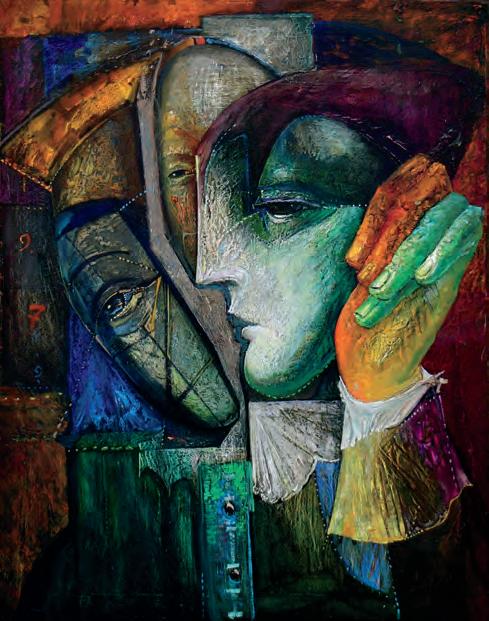
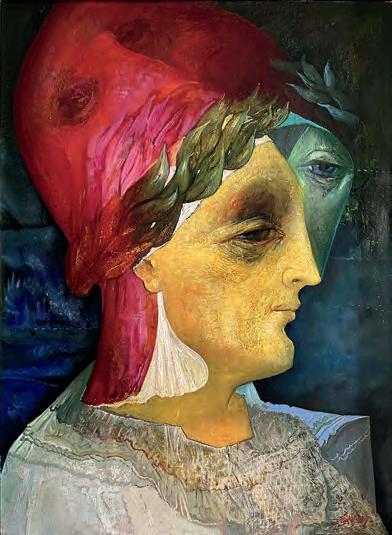
interdependent beings—merge physically and spiritually to form a singular sacred entity. Their bodies are intricately interwoven, their limbs and features shared: two hands, one body, one face—yet this face is simultaneously seen from both the front and the profile.
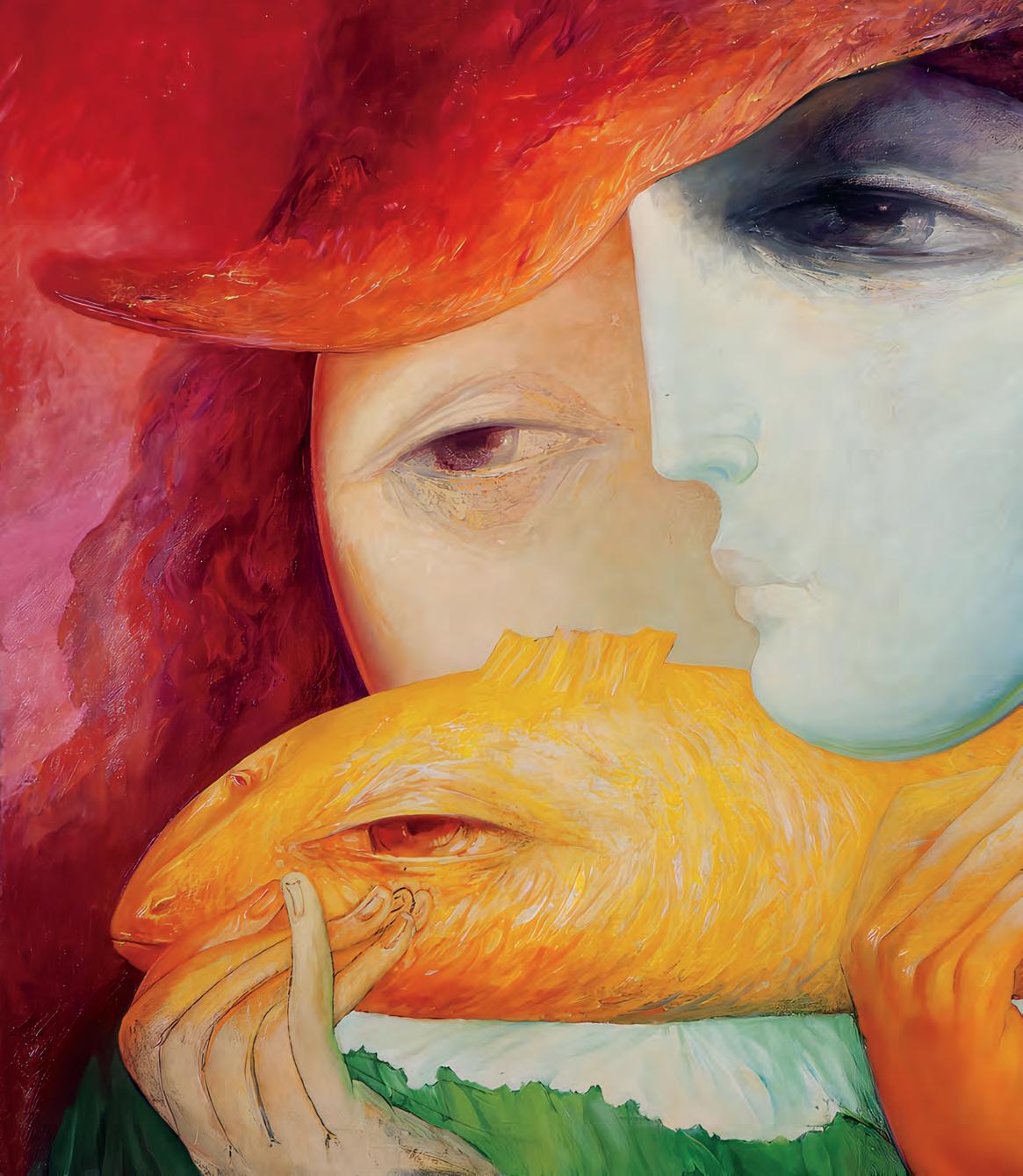
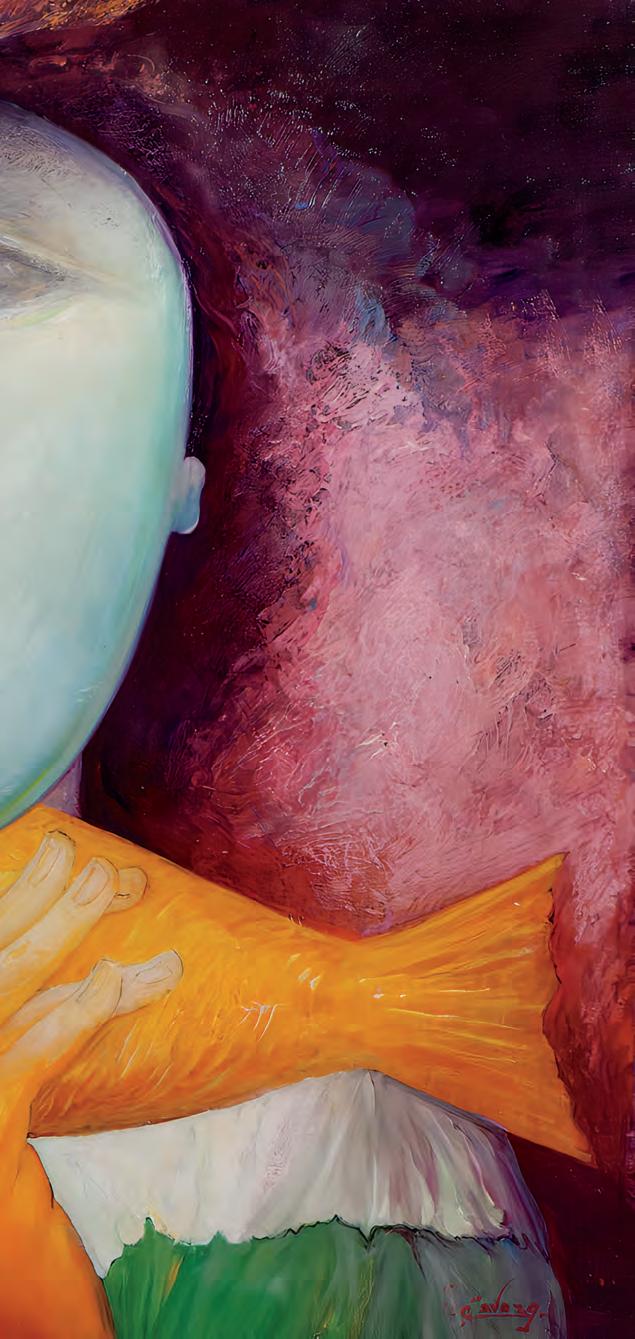
Even in a work titled “Duality”, where the Mother and Child are depicted alongside a fish, the symbolism points to unity. The fish, in Armenian tradition, is also revered as a protector of water and a source of life. In his ongoing artistic exploration, Gevorg sometimes introduces a third face, not to suggest a Christian-style “Trinity,” but rather to portray multiple personalities fused into a single entity—akin to the many-headed deities of Indian mythology. Here, the artist himself seems to merge with the images he creates, seeking identification with them.
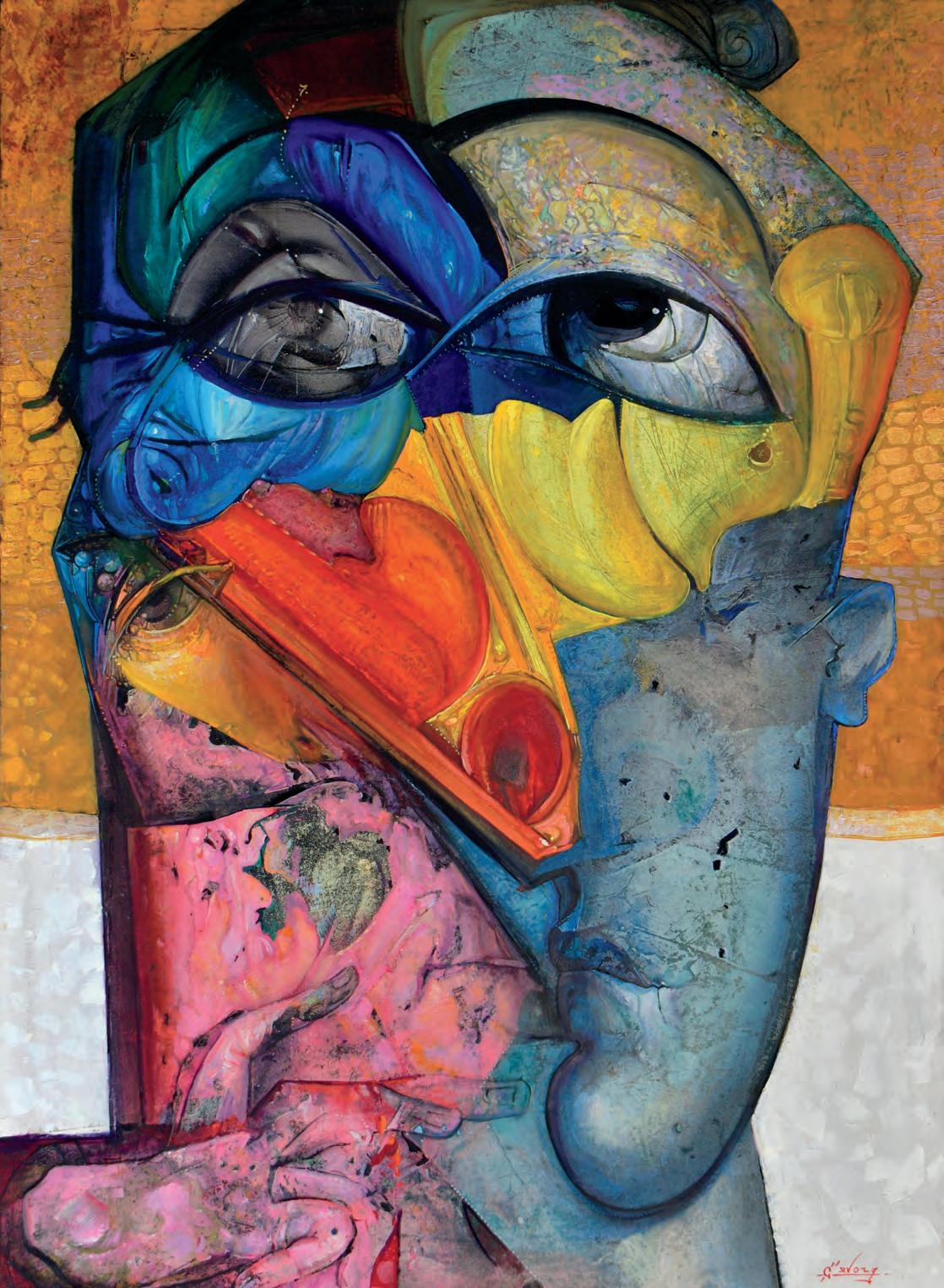
When Pablo Picasso said, “I paint objects as I think them, not as I see them,” he claimed the right to express subjective perception over visual accuracy. He deconstructed the human face, showing it both from the front and the side at once, exploring its duality or even duplicity. Gevorg adopts a similar approach—not to mimic Picasso, but to express his own vision. His Mother and Newborn are
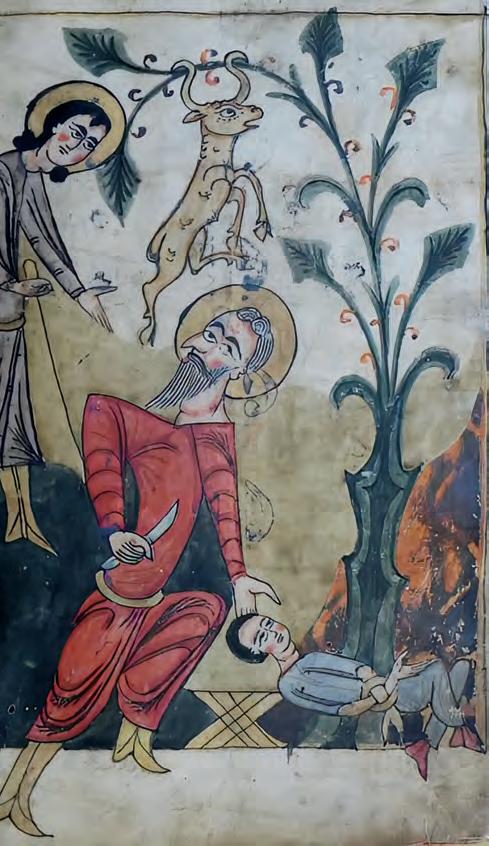
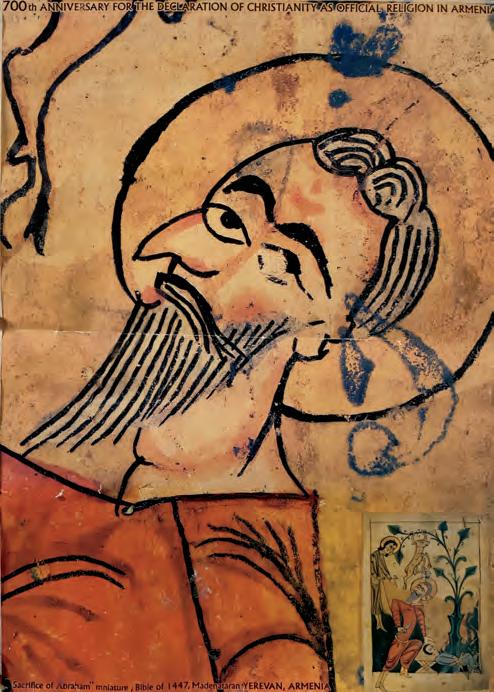
11th Century Armenian miniature, Sacrifice of Abraham
distinct personalities that he aims to unify into one image: on one side, the life-giving essence of motherhood; on the other, the pure innocence of childhood—both depicted simultaneously.
While Gevorg’s stylized and often distorted faces may seem reminiscent of Picasso, his inspiration likely comes from deeper, older sources. Throughout art history, we find examples of faces shown both in profile and frontal views. In ancient Egyptian art, the eye—considered divine—was always shown frontally, even in profile depictions. This
rule created stylizations that might appear “incorrect” to the modern eye, yet they held sacred significance. Similar representations appear across Etruscan, Minoan, AztecToltec and Greek frescoes and pottery. Even in Ancient Eastern, Indian, and European manuscripts, and notably in Armenian miniature painting, this stylistic device recurs. For example, in a 15th-century parchment manuscript from the “Khizan” school of Vaspurakan, there is a miniature depicting Abraham preparing to sacrifice Isaac. Abraham’s face is shown in profile, but his eye looks
Gevorg Yeghyazarian, Duality, 97 x 116 cm, oil on canvas, 2013
directly at the viewer—illustrating this very stylistic phenomenon. Picasso, known for studying diverse world cultures, was likely inspired by such traditions. Likewise, Gevorg seems to draw from the same wellsprings, making it more accurate to say that both artists were inspired by shared sources, particularly ancient Egyptian frescoes and Armenian miniatures.
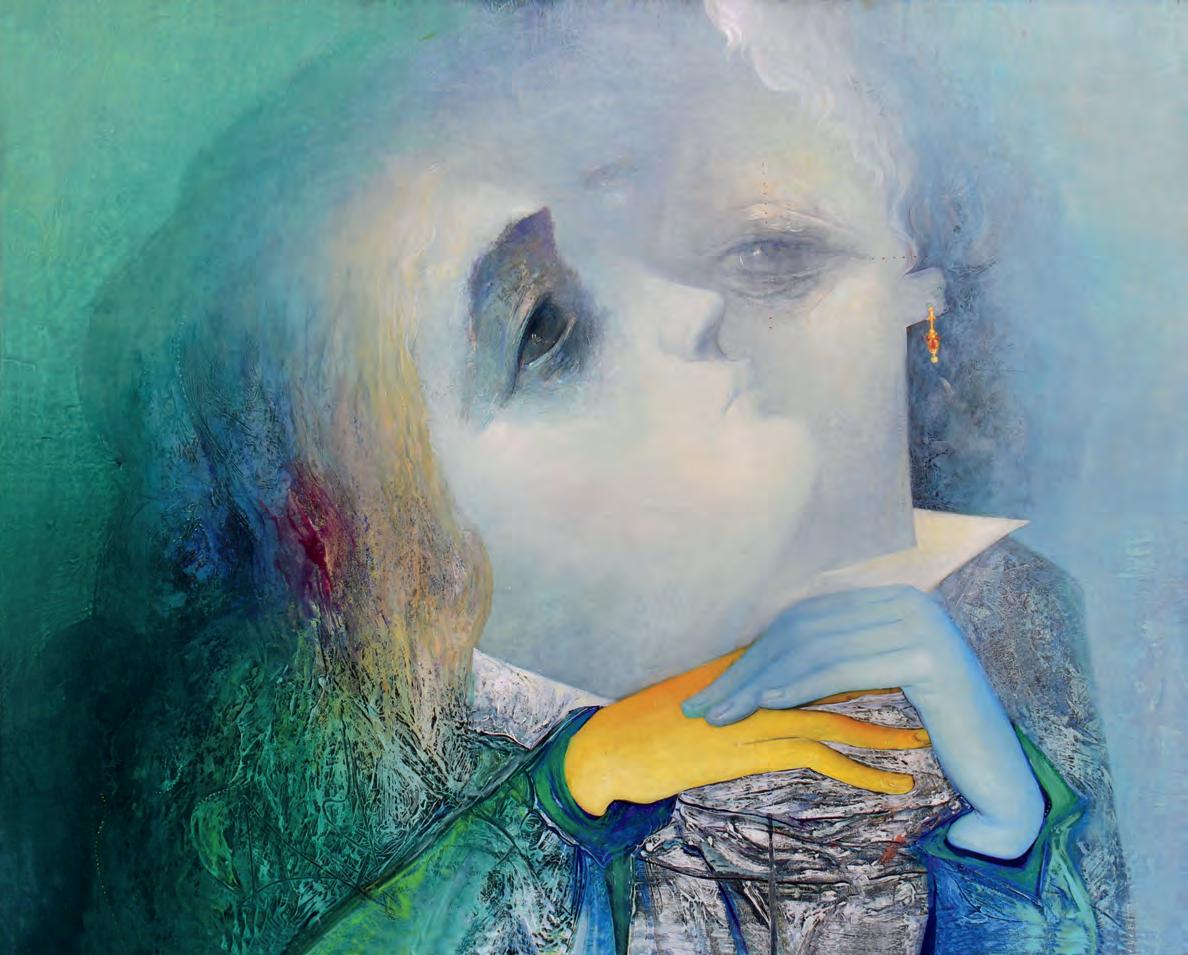
Gevorg delves deep into the human psyche, portraying the Mother as the origin of all life. Yet he also lets his imagination soar into the cosmos. In this dimension, his female figures are not sexualized. Rather, they are strange
but earthly beings, otherworldly entities with ambiguous gender. While drifting through space, they sometimes encounter symbols of modern civilization—squares, circles, triangles—that obstruct their path and freedom.
If in his first artistic realm Gevorg seeks the “Divine” within the depths of humanity, in the second he looks for the “Human” within the vastness of the divine cosmos. Mosses Zirani, Ph.D. in Fine Art
Gevorg Yeghiazarian, 5-1 Dimension, 60 x 50 cm, oil on canvas, 2014
Gevorg Yeghyazarian, Metamorphose, 116 x 89cm, oil on canvas
Gevorg Yeghyazarian, Dante, 73 x 100cm, oil on canvas
Gevorg Yeghiazaryan, Timeless Echo, 130 x 162cm, oil on canvas
Gevorg Yeghiazaryan, Between Dimensions, 130 x 160cm, oil on canvas
BERDJ TCHAKEDJIAN
The Orgasm of Nature as the Fertility of Art’s Joy
“The wisest and noblest teacher is nature itself.” (Leonardo Da Vinci)
“The earth has music for those who listen.” (William Shakespeare)
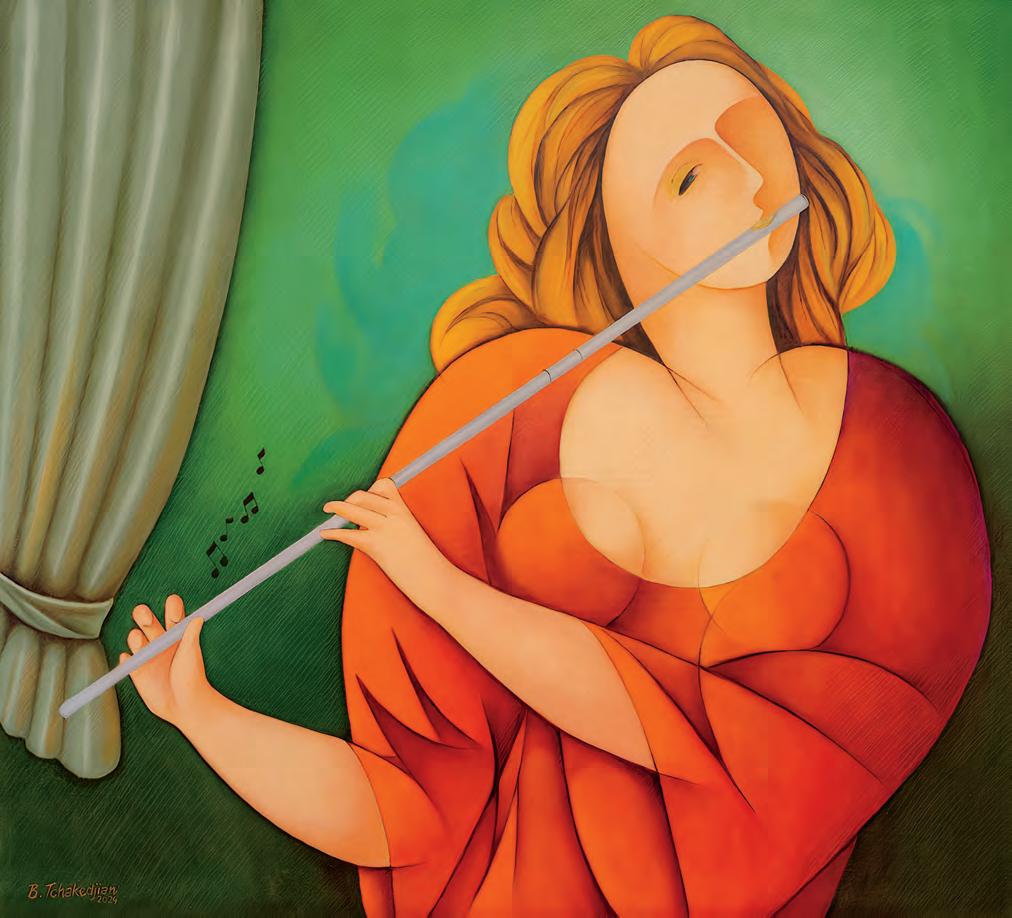
Berdj Tchakedjian, The Flutist In Her Red Dress, 94 x 102 cm, oil on canvas
What we call here the “orgasm of nature” refers to the natural, healthy sensuality that ennobles a person’s animal inclinations, transforming them into a serious, symbolic, and creative release. The world’s oldest civilizations have always considered this form of sensuality as a sort of divine “delight,” believing that the gods themselves were in a constant state of ecstasy. Humans, however, only felt this orgasm of nature during the performance and the act of fertility, when their personal boundaries could at last extend to the divine. They also believed that every part of nature was endowed with this ecstasy, which was anthropomorphized and worshipped, the most common of its personifications being deities such as the Earth Goddess. It is no coincidence, then, that the Latin word natura is derived from the root nascor, “to be born.”
Through nature comes forth life and its very meaning.
This multidimensional Mother Nature lives on in time through rebirth and renewal and appears to be in a constant state of ecstasy and sensuality. When an artist fosters this metaphysical and elementary understanding of Mother Nature inside their inner world as both an inspiration and a vision to grasp, from own their birth suddenly springs a symbolic meaning and manifestation of creation. We see this when we look at and take in Berdj Tchakedjian’s work through the lens of his artistic evolution.
Tchakedjian, whose art is inspired by Mother Nature and the Eternal Feminine, knows nature through many of her elements, from the scorching sand dunes where he spent his youth to the biting cold of the Northern Hemisphere where he currently resides. It is the image of his wife, Nairi, that he has brought forth in the “virgin” nature as the maternal figure embodying Mother Nature through her “external charms” as well as her “inner wisdom.” In his work, woman and nature, united and intertwined, form a growing whole, whose external charms are strengthened and completed through internal balance and harmony. This can also be found in his still lifes, where the depicted fruits and objects possess a certain erotic appearance, content, and expressiveness.
Tchakedjian penetrates the inner world of the female figure by interlacing the goddess he loves and adores with his beloved and adored nature, endowing this image with the various attributes of the female body (breasts, vaginas, buttocks, thighs…), which serve to beautify
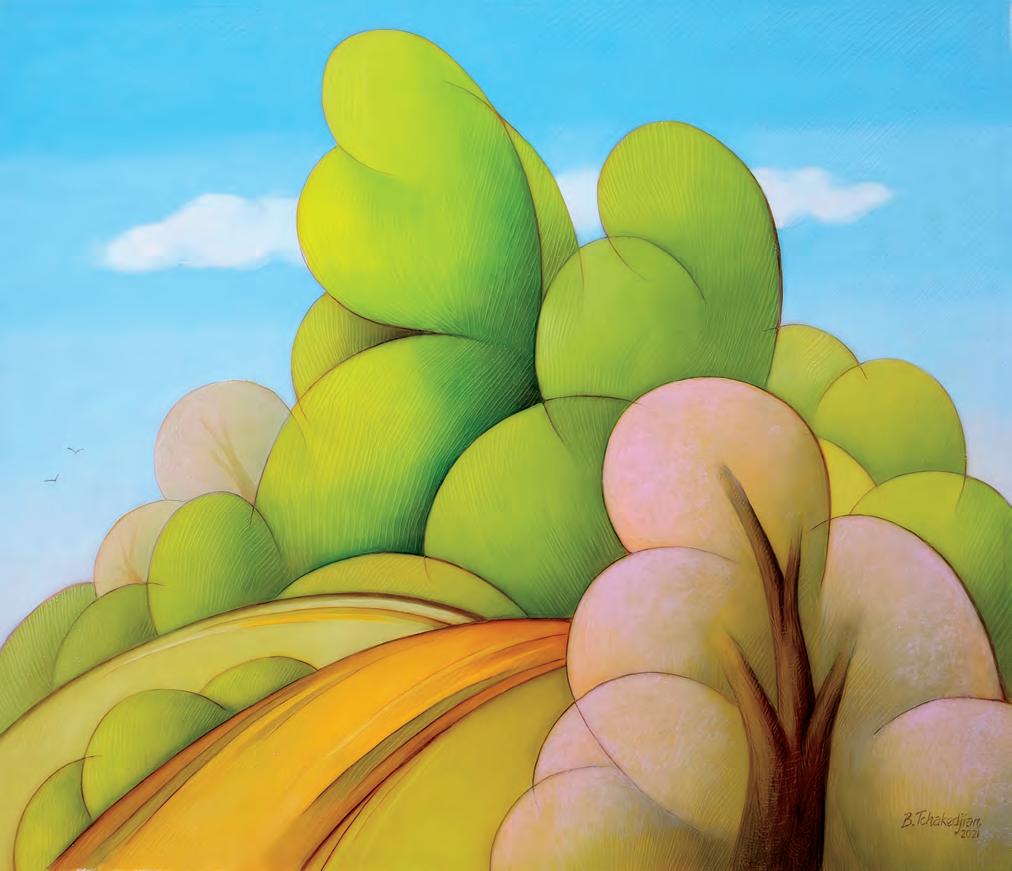
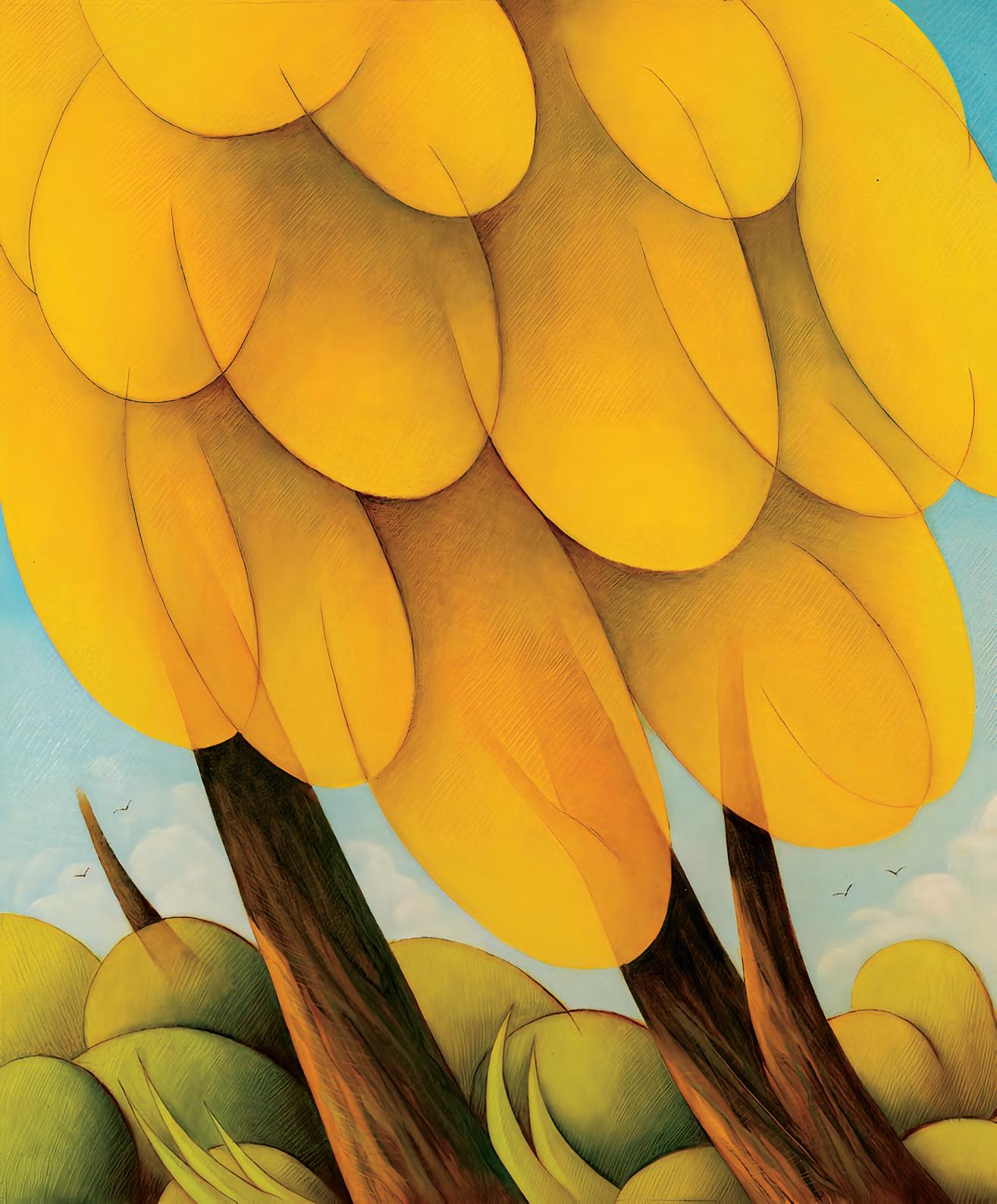
Berdj Tchakedjian, Nature in the Fall, 94 x 102 cm, oil on canvas
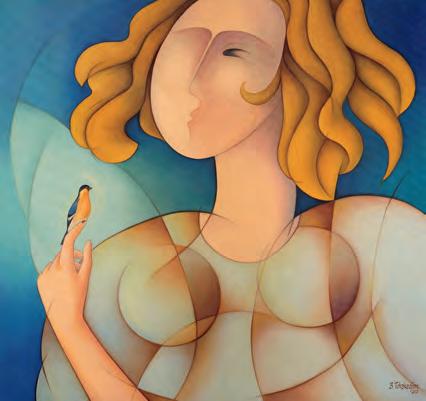
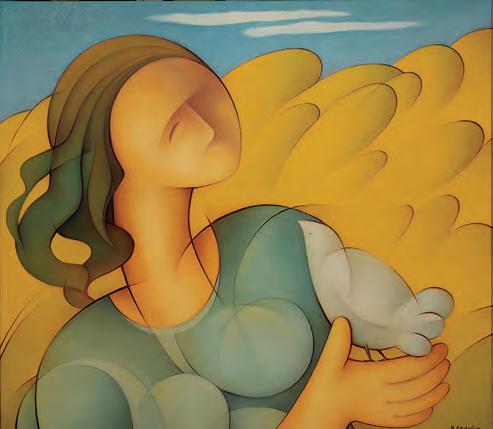
Berdj Tchakedjian, The Beauty and the Bird, 94 x 102 cm, oil on canvas
the natural world and bring sense to life. Though Tchakedjian’s world seems to be in a constant state of ecstasy, his female figures, despite their nakedness, are refined and elegant. Their feminine beauty can be found not in the physical appearance of their naked bodies nor in their lustfulness, but rather in a certain restrained yet “eager” expression where Mother Nature and the Eternal Feminine, in harmony with one another, appear
to be conceiving the symbolic creation of life through a moment of peace and mystery. Likewise, the widespread tranquility depicted in Tchakedjian’s portrayal of nature is satisfying and enchanting to the art-loving eye.
How? Tchakedjian’s first teacher will always be Mother Nature, with her angelic musicality that requires a competent listener to fully understand… Without being lustful or similar to the likes of Rodin, Dali or Egon Schiele, Tchakedjian creates through everyday inspiration. He lives in nature, in communion with her, just as with his life partner, Nairi, who acts as both his muse and his wife. As such, we are made to see nature, especially in her spring and fall colours, we are met with insects, birds, and other beautiful animals, who are blended into the background and act as heralds of renewal and livelihood. Tchakedjian is not interested in all that which hinder beauty and disturb the peace of a setting; he flees these disruptions. However, this doesn’t mean that he romanticizes nature, nor does he depict it like the Impressionists. Rather, with his colourful, expansive prism, he paints a world where all is peaceful, vibrant, and bright, miles away from life’s troubles and conflicts and, especially, its atrocities.
Tchakedjian is foremost a worshipper of the light: in his paintings, light and shadows are interlaced with
Berdj Tchakedjian, Dialog, 100 x 112cm, oil on canvas
Berdj Tchakedjian, Spring Impulse, 61x78cm, oil on canvas, 2021
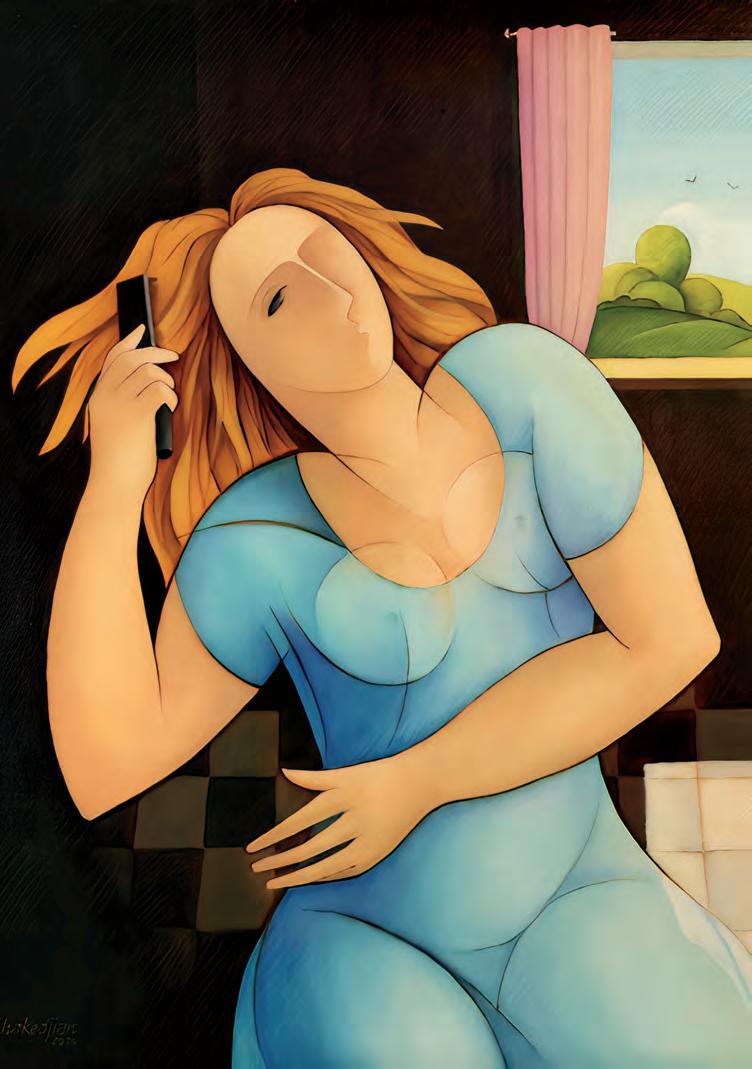
Berdj Tchakedjian,
“In this day and age when humans are ceaselessly defiling Mother Nature, and when women’s rights have reached a standstill in many societies, Berdj Tchakedjian’s art allows us to feel for the beauty of both nature and women, and their vital importance in our lives.”
nature and the Mother figure, bestowing his work with philosophical depth. His nudes aren’t perfect goddesses with glorified feminine figures, like the Hellenistic ideal of female beauty or the portraits done by Renaissance painters. Their charm and grace shine from within, extending to the nature and everyday life that surrounds them, because they aren’t painted to look like dolls or for the pleasure of the eye alone, but are felt as Beauty itself. It is here that a painter’s strong, innate intuition,
working outside of logic alone, is revealed; through it, the painter can render that which took place in his sensual, inner world, where Mother Nature and the Eternal Feminine set the terms for the very stuff of life. This cannot be mistaken for vulgarity or pornography.
From the delicate colours to the expressiveness of his brushstrokes, Tchakedjian has created art so unique that its imitation is unthinkable. He belongs to the select club of painters whose work doesn’t require a
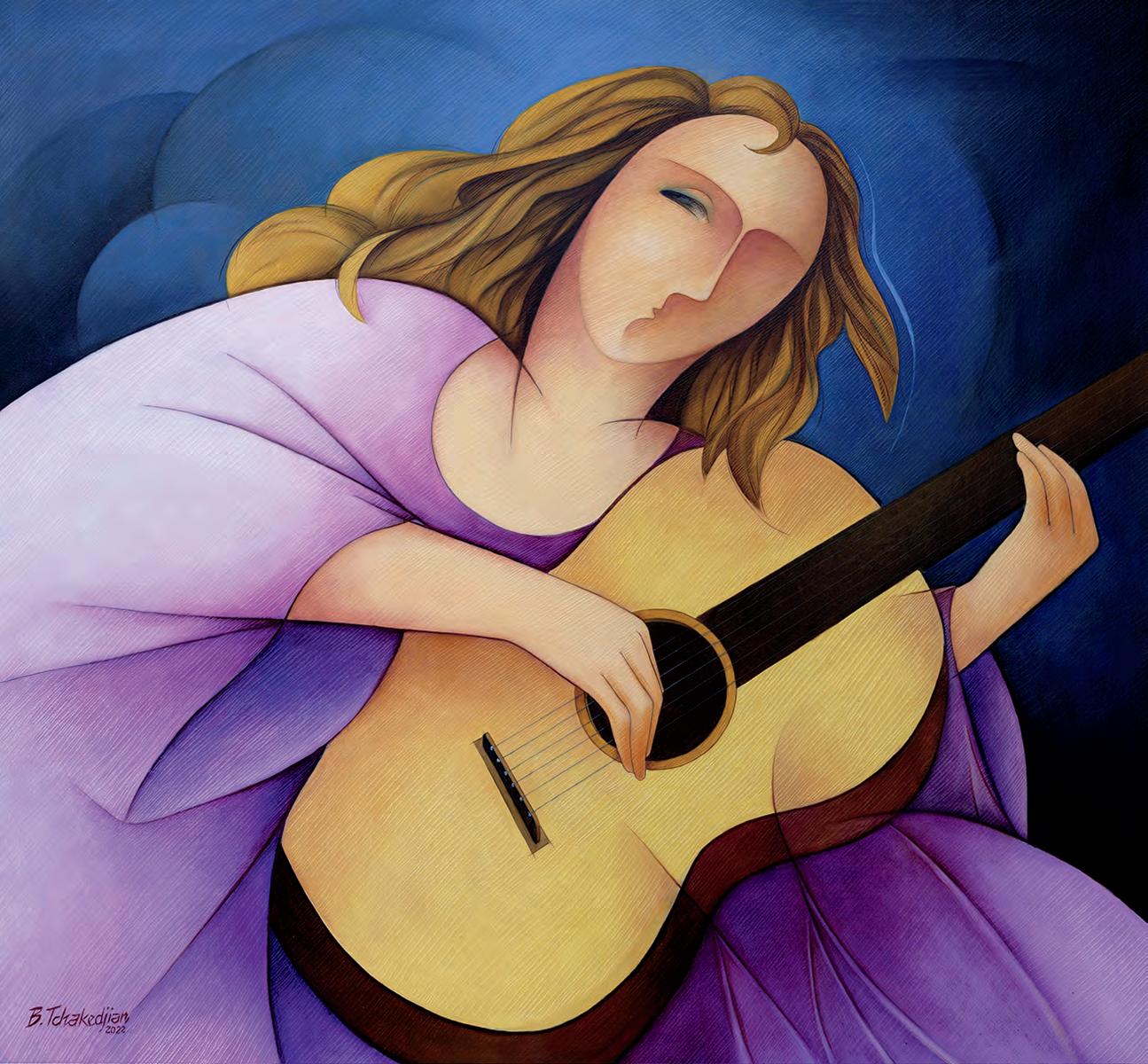
Soft Music, 94 x 102cm, oil on canvas
Berdj Tchakedjian, The Flight of the Heron to the South, 94 x 102 cm,oil on canvas
signature to be recognizably theirs.
Tchakedjian’s art makes one thing very clear: he is in love, not with a singular woman and nature alone, but by the joining of these two into one being which fills him with drunken ecstasy. Even though he has reached old age, he continues to create with the same excitement as a teenager in the throes of puberty. There are very few artists – Hokusai, Michelangelo and Picasso come to mind – who have continued to create in their later years with renewed enthusiasm, perfecting their art until the very end. Berdj Tchakedjian is one of them.
In this day and age when humans are ceaselessly defiling Mother Nature, and when women’s rights have reached a standstill in many societies, Berdj Tchakedjian’s art allows us to feel for the beauty of both nature and women, and their vital importance in our lives.
Mosses Zirani, Ph.D. in Fine Art
Berdj Tchakedjian, A Sunbeam, 94 x 102 cm, oil on canvas (detail)
THE HYLOZOIST
On the
Occasion
of Arshile Gorky’s 120th Anniversary
In reality, Hylozoism is neither an art school nor a movement or concept belonging to any specific genre of art. Although it carries some connection to faith, it is not a religion in the way we understand the term today. Rather, it is a philosophical expression that, over time, has transformed into a way of life—a worldview that naturally emerged during humanity’s process of becoming human, and found expression in nearly all ancient cultures... as the vitality of matter and the inner spiritual link between life and the visible, tangible world.
In this sense, hylozoism would reveal itself in Ancient Greek philosophical thought as the harmonious coexistence of spirit and matter. Thales and his followers believed that “Nature is inherently vital and animated.” The word hylozoism is derived from two ancient Greek words: hyle meaning matter, and zoe meaning life. Even in our current times, followers of the Shinto religion in Japan believe that the elements of Nature—and even man-made objects—are alive, they live, and each of them possesses its own life, meaning, and essence. This belief, despite some differences, closely resembles Taoism, whose founder Laozi believed that “the TAO is not a God, but a universal force that flows through everything.”
Nearly all true and talented artists—consciously or unconsciously, to greater or lesser extents—are hylozoists. When they depict nature or still life, they instinctively seek to give life to natural phenomena or lifeless objects, to spiritualize them as living and breathing beings. As for the others, from Expressionists to Surrealists and Abstractionists, they manifest spiritualized emotions and experiences from within their own inner worlds. These groups, in many ways, appear closer to hylozoism than their predecessors from traditional art schools.
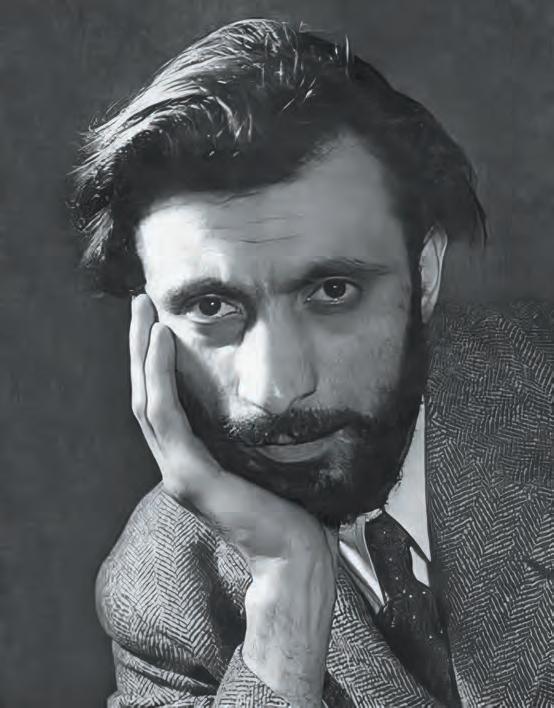
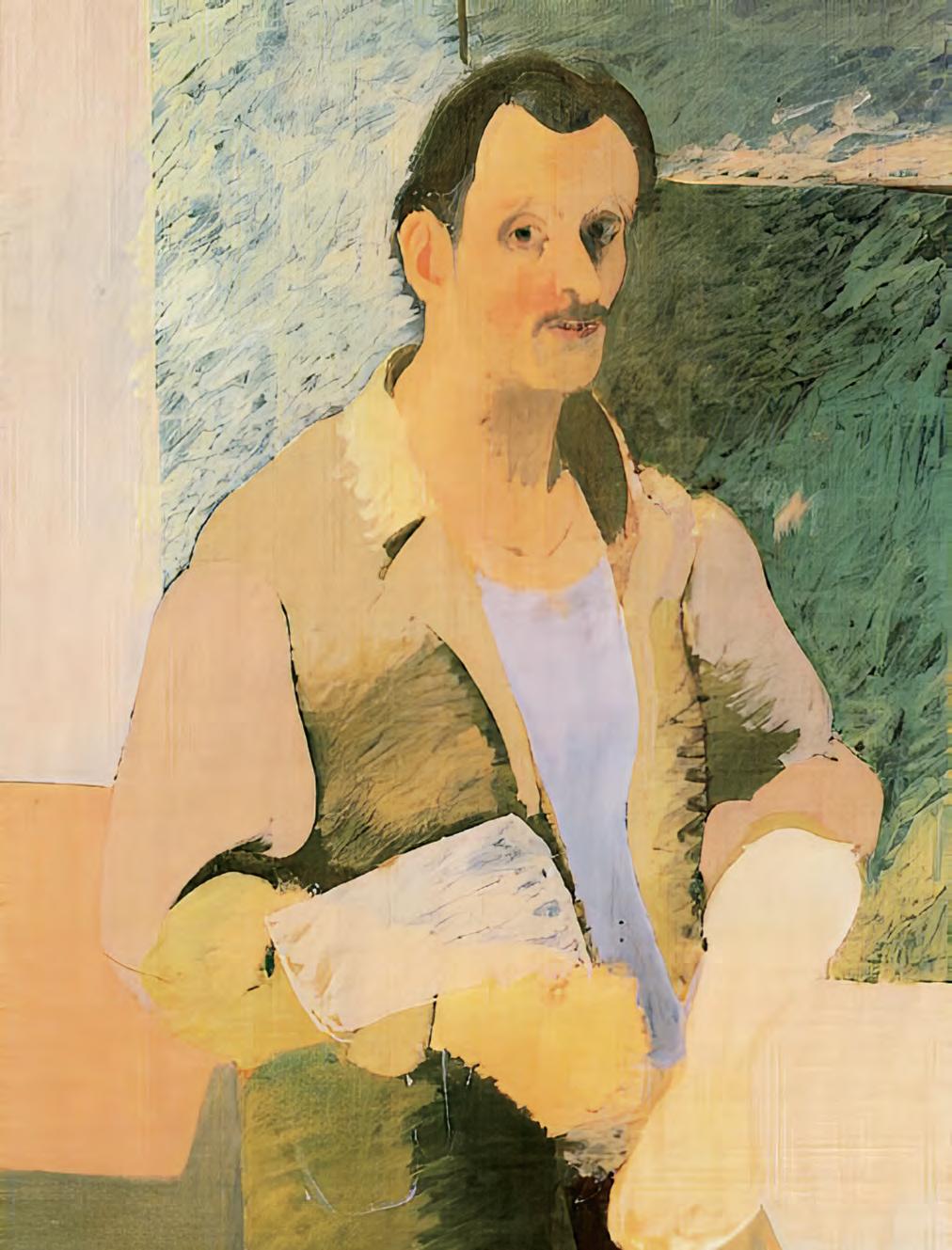
However, Arshile Gorky stood apart from all of them. Throughout his memory, he would return to the life and environment of his childhood in his birthplace. After infusing these experiences with meaning and spiritual energy, he expressed them on canvas as visions and emotions. Yet, above anything else, what held vital importance
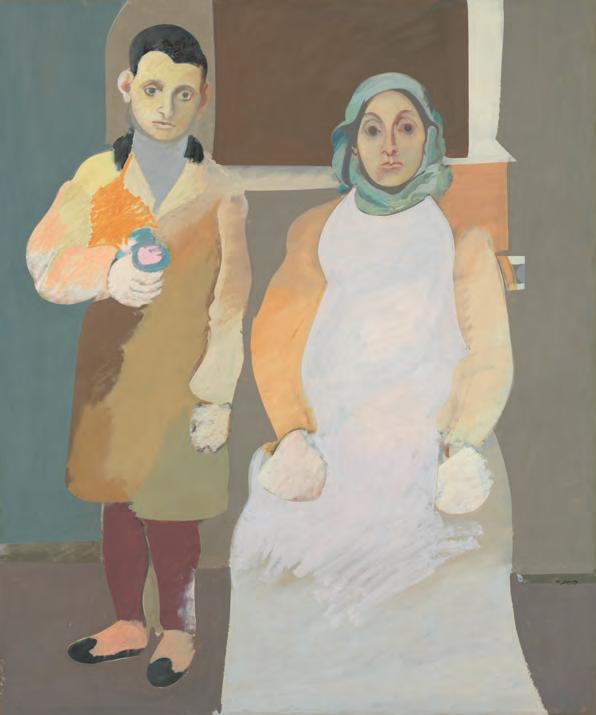
How My Mother’s Embroidered Apron Unfolds in My Life
for him were his living and breathing dreams—lived moments and dreams shaped by the unique environment and daily life of his hidden, personal past.
And therein lies the greatness of Gorky’s talent and the key to his visionary originality.
However, who is this genius whose creative life can best express the anxieties of “searching” for a spiritual homeland torn apart by genocide and their reflection on universal issues?
Vostanik Adoyan was born near Lake Van, in the village of Khorkom, in 1904 (or, according to his sister Satenik, in 1902). In 1915, he participated in the April defense of Van as a supporter of the freedom fighters and, according to some accounts, as a sharpshooter. After the fall of Aygestan, during his family’s escape, near Igdir they encountered a group of Armenian volunteer fighters who safely escorted them to Etchmiadzin. After staying there for several weeks, they moved to one of Yerevan’s poorest neighborhoods—Kond—where his mother died at the window, from starvation.
In 1919, with his sister, he moved to Tiflis, then to Batumi, Constantinople, and finally, through Greece, to the U.S. in 1920. He first lived in Boston with Satenik, then moved to New York, where he faced numerous difficulties. His artistic maturation and flourishment was eventually followed by his tragic end: he took his own life.
So where did his art derive its aesthetic value from? Or what assured the uniqueness of his vision?
“Memory is the germ of the artist,” said Arshile Gorky.
Memory indeed acted as the “germ” not only for him but for many truly profound artists. In Gorky’s case, this becomes a necessary key for interpreting his work—a fact echoed by others as well. One of the most famous American painters, Jacob Kainen noted:
“Later, in the 1930s, I realized that he wanted to maintain the structural inevitability of the masters while more and more surrendering to his national memories and tormented unconscious.”
And so it was.
Gorky’s eternal inner turmoil, filled with anxious emotions, forged in his spiritual and intellectual crucible, emerges as line, hue, and inner light. His raw, unmediated experiences saturated with a haunting purity—surface spontaneously in his creations, which tolerate no constraint. The distorted figures, and figures in general, after
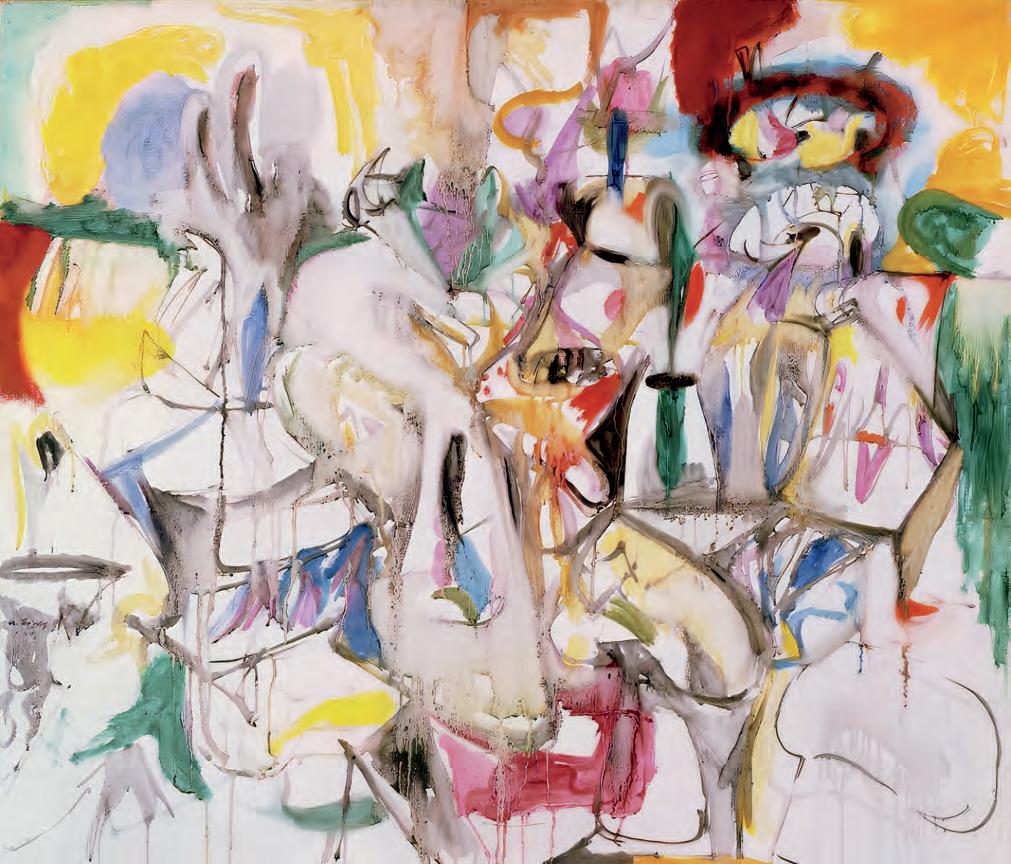
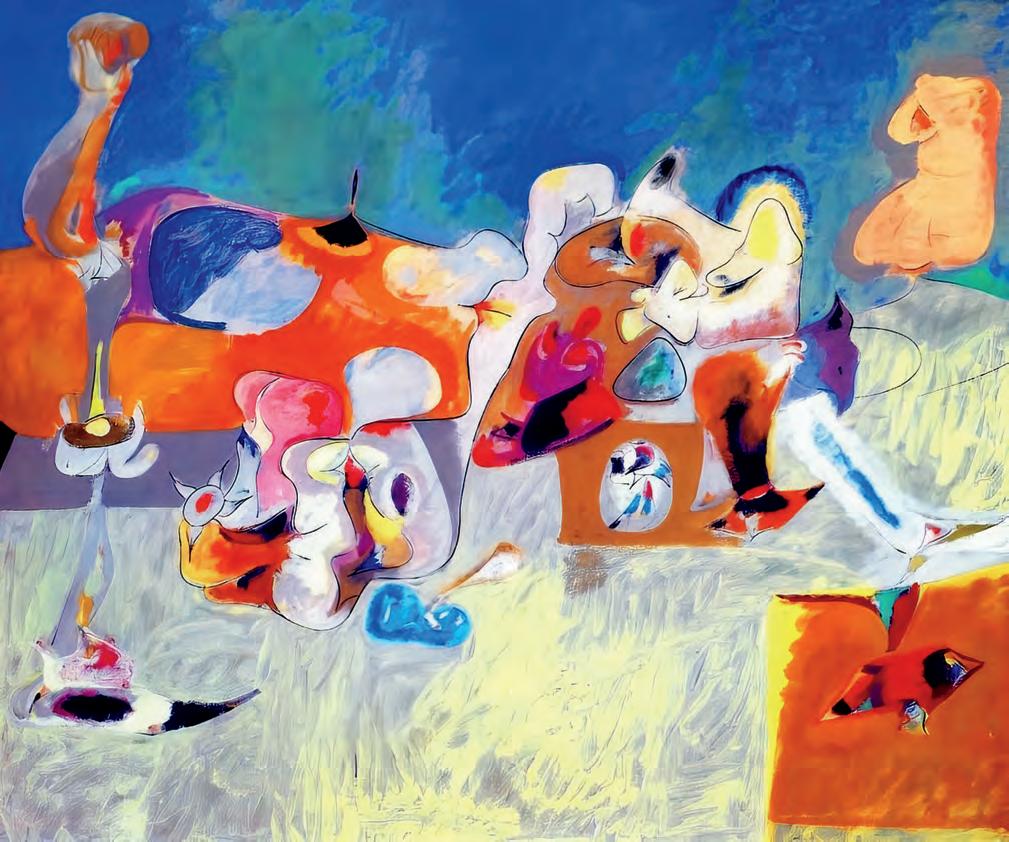
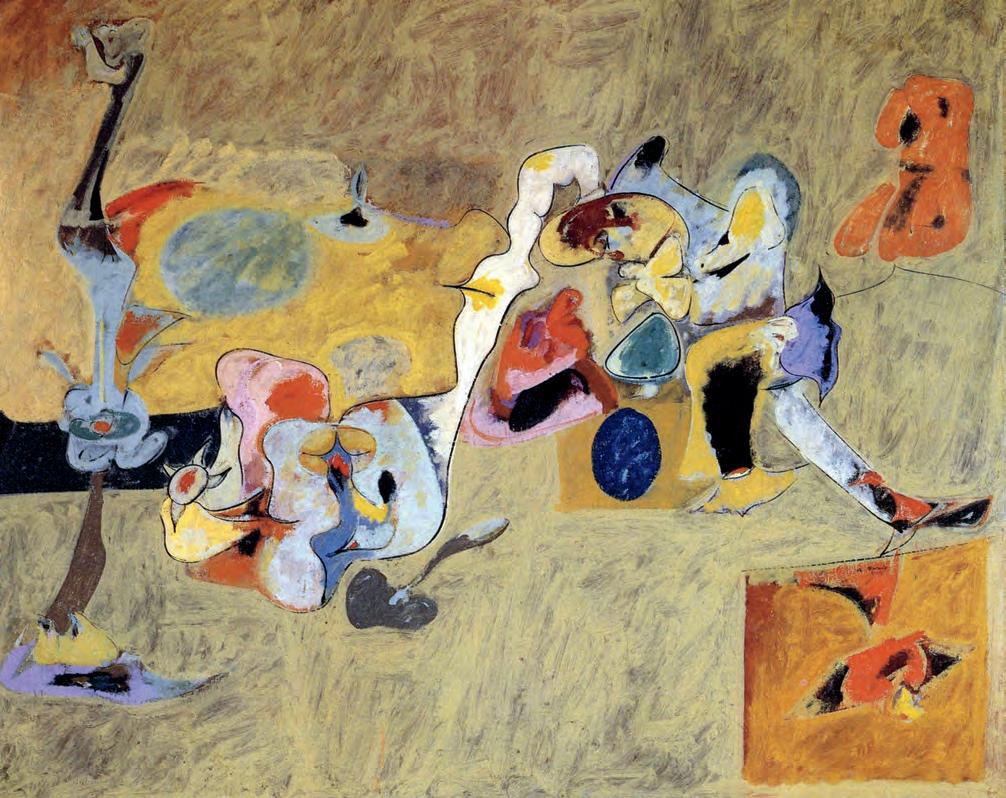
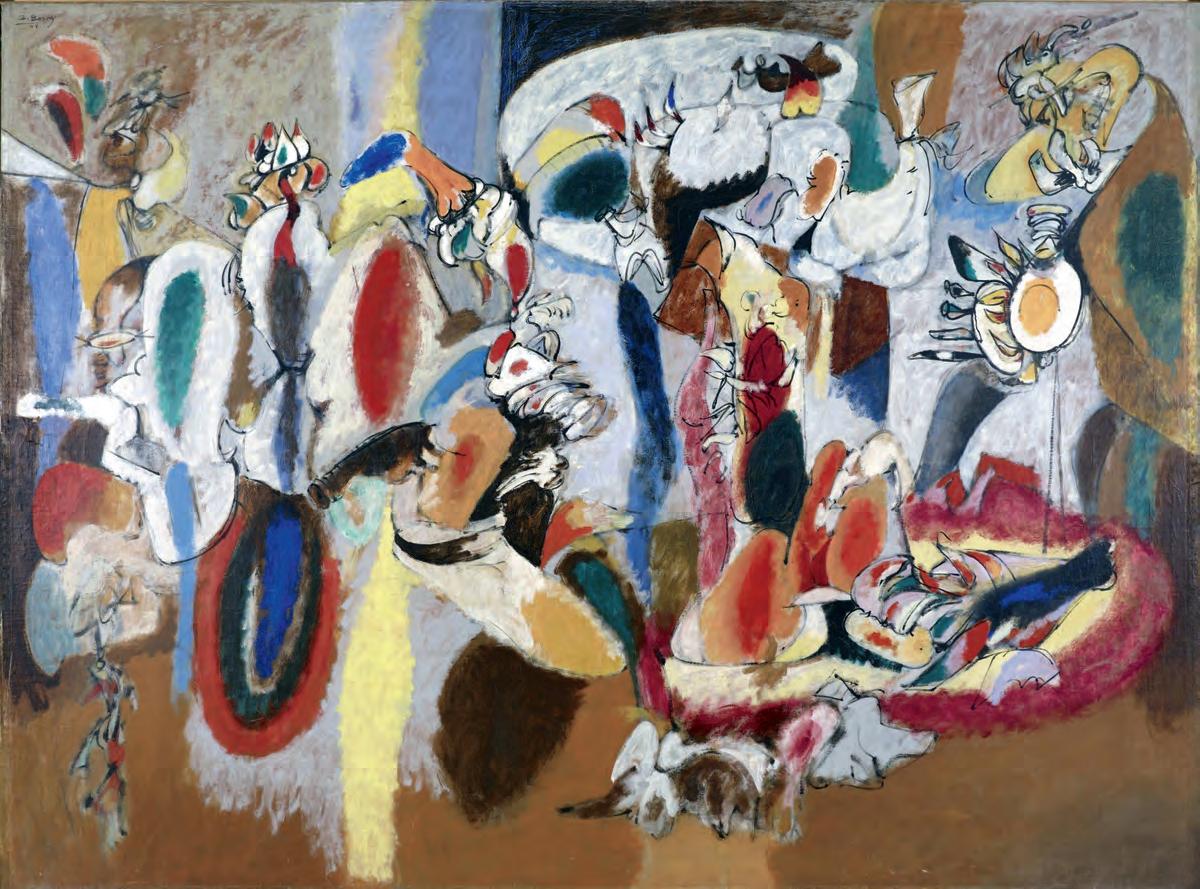
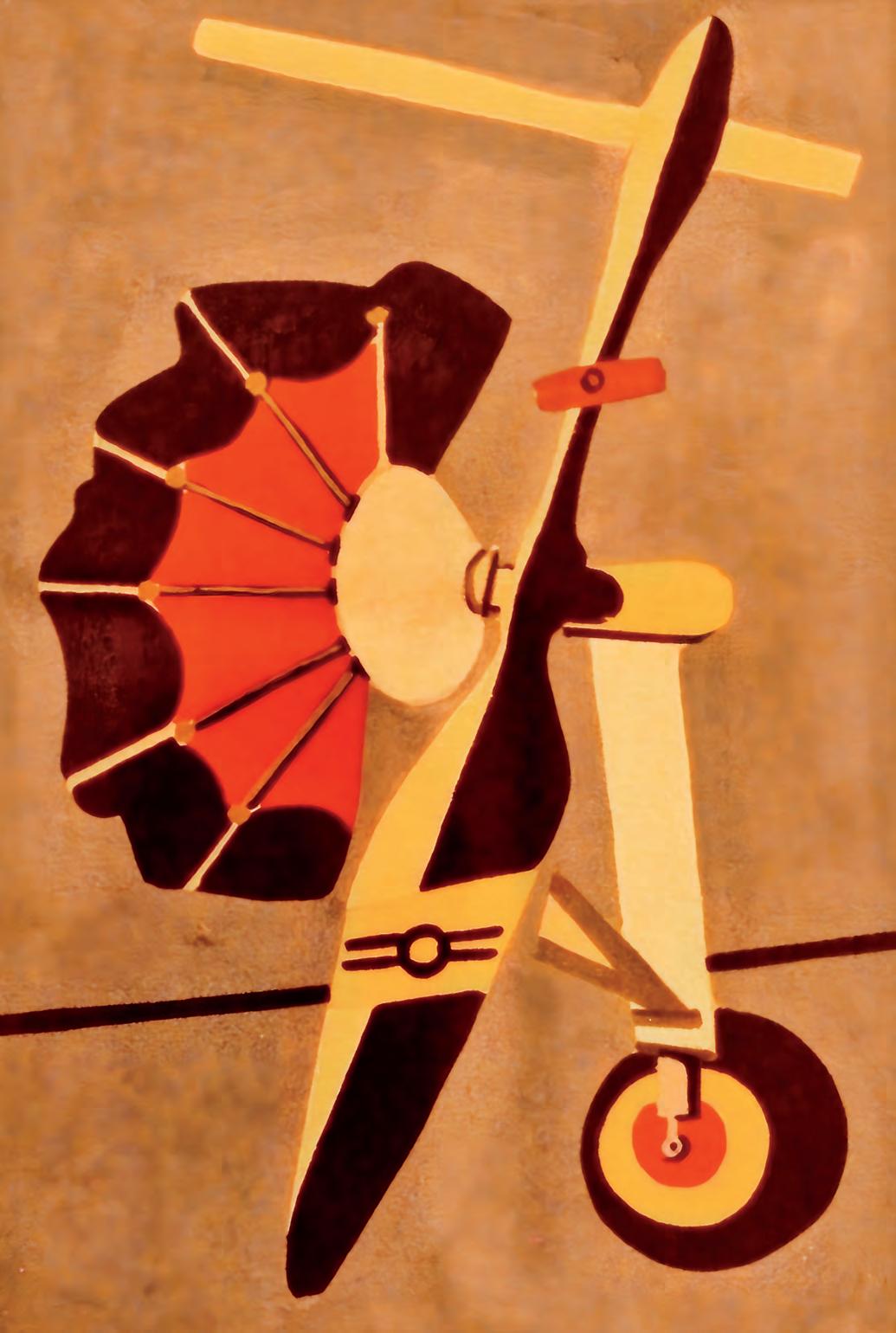
The Plough and the Song, 1947
Scent of Apricots
germinating in the depths of the past, bypass the present… to blossom and flourish upon the uncontainable canvas of the future.
This is precisely why Gorky not only surrendered to his “national memories and tormented unconscious,” but also excavated the very human sources of his own inner world—to relive and express them upon the slippery surface of American life. Though all this stems from the mythologized memories of his birthplace, they are refracted through the feverish life of America and reframed through the emotional prism of a nostalgic exile, transformed into visionary emotions and germs of memory—manifesting like a sacred rainbow on the virgin canvas.
To understand Gorky’s Art substantially, let us recall his own testimony. In one of his letters, Gorky himself admits: “For all of this, I am indebted to our Armenian art.”
While to better appreciate Arshile Gorky’s place and role in the history of art, let us recall André Breton’s testimony: “
Gorky is the greatest and most unique painter in the history of American art.”
Gorky was a phenomenon, and for this reason, art critics could not entirely place him within any single “ism.” Barbara Rose writes: “It still remains unsettled whether Arshile Gorky is the last great Surrealist or the first Abstract Expressionist.”
Beyond those mentioned above, many other critics—including John Graham, Harry Rand, Julien Levy, and more than a dozen others—greatly admired his art, but could not fully understand him. This was because Gorky came from a culture unfamiliar to them, was shaped by a different temperament, and carried a unique aesthetic worldview. Gorky justifiably objected:
“They call my mother’s eyes ‘Picasso-like,’ and Armenian melancholy ‘Byzantine’ or ‘Russian.’ When I correct their mistakes, they say these corrections are just the exaggerated nationalism of small nations. That infuriates me... Art is above nationalism; it represents the universal human vision.”
If those art critics had been familiar with the anguished and melancholic eyes portrayed in Armenian miniature painting, they would not have called Gorky’s mother’s eyes “Picasso-like”—but would rather have wondered: “Was Picasso perhaps influenced by Armenian miniature art?”
Indeed, Gorky’s art is different from others and hard to fit into any “ism,” because at its core it is hylozoist— believing in the vitality of all matter. While hylozoism is not unique to Armenian art. But it is nevertheless deeply embedded in the Armenian cultural consciousness, stretching back through millennia.
Although it is widely accepted that Gorky is one of the founders of the Abstract Expressionist school, in truth, he was fundamentally a hylozoist. And for Gorky, more than living plants, stones, or bones, the concept of “Living Dreams” held greater significance—those dreams that opened themselves through memory onto his art as spiritual visions, as multicolored echoes of the past.
With complete conviction, Gorky would say:
“In a short time, we were forced to see and experience many things: the Turkish atrocities, the massacres and the Genocide, our exile, the destruction of our homeland. I remember all of it. We, the survivors, cannot help but respond to all this with the greatest possible intensity.”
Thus, Gorky placed not only himself—but an entire post-Genocide generation—under a moral imperative to respond with the greatest artistic force as strongly as possible. Yet this was not about revenge. It was about artistic power, self-affirmation, and above all, the defense and renewal of a unique and high culture.
Although countless books, monographs, and articles have been written and published about Gorky’s artistic life and work—and although nearly every major modern gallery and museum proudly exhibits examples of his art—his legacy has yet to be truly studied and appreciated through the prism of ancient cultural traditions, especially through the essential lens of Hylozoism.
And in order to show where his uniqueness flows from, and how Arshile Gorky seems to be inspired, perhaps in the next issue of Fine Art Magazine we will dedicate a special article to the various stages of his creative life and attempt a thorough analysis and interpretation of his work…
– Mosses Zirani Ph.D. in Fine Art
The Liver is the Cock’s Comb
Study of Aerodynamic Shapes
SATENIK AND GORKY
On the Occasion of Arshile Gorky’s 120th Anniversary
Among the towering figures of American art, Arshile Gorky had three sisters: Agabi, Satenik, and Vartoosh. The eldest, Agabi— his father Sedrak Adoyan’s daughter from a first marriage— has remained a marginal figure in his biography. In contrast, Satenik not only followed Gorky’s life closely but also made tangible contributions to his creative journey. Although biographers often rightly emphasize Vartoosh’s role, they have unjustly relegated Satenik to the margins of history.
It was this oversight that led me, in the summer of 1979, to travel to the United States to conduct research for my doctoral dissertation on modern American art–particularly the work of artists of Armenian origin. Determined to speak with Satenik and fill in certain gaps in Gorky’s biography, I sought her out.
but what’s done is done. Best not to mention any of this to Satenik.”
A few days later, Richard brought me to Satenik’s home. She received us with warmth and graciously answered all of my
begin with, could you tell us about young Vostanik?
Providence, Summer 1979
Of all the painters of Armenian-origin, it was Arshile Gorky who first captured my interest. And among sculptors, it was Ruben Nakian—himself one of the most prominent American sculptors. When I met the Boston-based painter Richard Tashjian and asked him about Gorky’s second sister, Satenik, he answered:
“I know her well—she lives here. I’ll take you to her. But be warned: her son once destroyed and discarded some of Gorky’s handwritten notes and drawings, thinking that they were useless objects. He later regretted it—
questions. She explained, among other things, that when Gorky was living with her in the Providence neighborhood of Boston, his studio had caught fire and many of his artworks had been destroyed.
The following interview—still preserved as an audio recording in my archives—is not only fascinating and valuable but also contains important new information, particularly for biographers of Gorky. Now, forty years later, I publish an important portion of it for the first time in Fine Art Magazine, edited slightly for clarity, but without altering the meaning in any way.
M.Z.: Dear Mrs. Avetissian, to
S.A.: You know, our village— Khorkom—where we were born, was right on the shore of Lake Van. From a young age, we’d go down to the water to swim. I remember little Vostanik drawing fish, birds, plants, flowers, and sometimes even our portraits in the sand. When we were very young, we first moved to “Vostan,” my mother Shushanik’s birthplace, and lived there for a while. Later, we relocated to Aygestan— the Armenian quarter of Van. The city had only a few Turks, and they lived alongside Armenians. All three of us—Vostanik, Vartoosh, and I—attended the school in Aygestan. By then, our father had already come to the U.S., so we hardly remembered him. But there’s one memory I do hold clearly: When our father was about to leave for America, he lifted us children onto a horse and took us to our large and fertile field, where a beautiful spring would flow. Lake Van was right nearby. Waters from the mountains would merge with the lake’s currents. It was such a lush and lovely place. If Ado—Gorky’s cousin, who lives in Armenia—hears this, he’ll know exactly what I’m talking about. I want to tell it in detail so that if he ever hears it, he’ll know it’s me. My mother had prepared us a wonderful meal. We sat by the spring and ate. In the end, our father kissed us and cried. Then we parted ways and returned home. After that, he went to Constantinople, then to Europe, and finally settled here, in Providence.
M.Z.: Let me interrupt you there. In his letters, your brother often mentions the Armenian plow, the
Arshile Gorky Adoyan
Self Portrait
scent of apricots, and rich colors.
S.A.: Yes, because we had an abundance of orchards—more than anyone else. We were the wealthiest family in that village. We owned 500 sheep. In the summers, they would graze in the mountains, and in the winters, they would return to the village.
We had a tree known as the “Cross Tree.” Women who suffered from tremors or spiritual ailments would go there, tear a strip from their clothing, and tie it to the tree to be healed or to have their wishes granted.
Our mother was still young then. She took care of us and sent us to school. My brother was very gifted—he would draw maps at a very young age. Stepan Jamkochian, who was a close relative of my mother’s, wouldn’t let him draw. In 1915, we were forced to flee after the fall of Van’s famous self-defense battle…
At this point, Satenik became emotional and couldn’t continue. I changed the subject.
M.Z.: Do you remember anything from Yerevan?
S.A.: In Yerevan, first we lived on Astafian Street—now it’s called Abovyan. Our family lived in the house of a man named Katarovsky. But I wasn’t there for long. I came to America in 1916.
M.Z. – Did your mother stay behind while the three of you came here?
S.A. – No, I wasn’t supposed to come either. My older sister Agabi’s husband had volunteered for military service. He was supposed to take his wife and son with him. But my sister cried and insisted that unless one of the children came too, she wouldn’t go. I was the oldest, so they sent me. My mother, Vostanik, and Vartoosh stayed behind and moved to the Kond neighborhood (in Erevan), during that time, war was ravaging near Yerevan… I didn’t know anything at the time. My mother passed away there—on March 1st, 1919. That same day, I got married here. I received the letter just like that, advising me of the news.
M.Z. – Do you remember how you traveled from Van to Yerevan?
S.A. – We escaped along with all the people. I went with my elder sister Agabi (she has passed away now), her fiveyear-old child, my mother, Vartoosh, and Vostanik.
M.Z. – When did Vostanik come to America?
S.A. – He came in 1920.
M.Z. – Alone?
S.A. – No, with Vartoosh, because our mother had already passed away in 1919.
M.Z – Did they come with a group?
S.A. – No, with a man from Van named Tigran—I can’t recall his last name. Tigran came with his wife to Constantinople, then here.
M.Z. – And they found you here?
S.A. – Yes, in Watertown. I was married, but I lived with my elder sister because I was sick and bedridden. That’s when my brother and Vartoosh arrived.
M.Z. – You and your family went through a difficult path by the time you got to Eastern Armenia, during the genocide. Please tell me more about your stay there.
S.A. – We went and rented a house for about a week in Etchmiadzin. That’s where we saw Ado and his brother. It wasn’t an orphanage—it was a nice place where they brought children. Inside the courtyard of Etchmiadzin was the seminary.
M.Z. – Did Vostanik go there too?
S.A. – Yes, we were all together—we were never separated from each other. Many of our relatives died there... We wanted to take Ado and his brother—his name was Azad— with us to Yerevan, but we couldn’t find their mother and aunt. My mother said, “You and Agapi will watch over the children, so that Ado and his brother don’t get sick or that something happens to them.” Eventually, in the morning we were going to Yerevan... but they (Ado and his brother) weren’t there, and we felt awful... Should we cry or not cry...? We came to Yerevan. My sister Agapi came too, and she fell ill. My mother brought back an entire yerama (a large jug) of vinegar... My sister completely lost her senses... Two days later she recovered from that illness.
M.Z. – And after you came here, when...
S.A. – I went to live with my father... I had a half-brother, from my father’s other wife...
M.Z. – Did Vostanik meet his father here?
S.A.: Yes! Vostanik and my sister Vartoush lived with him for 8–9 months. Because… Vostanik had a great sense of humor. My father (here) had gotten married. Now my brother would jokingly say, “Why did you marry this woman?” He was very humorous—excessively so. He had a very good singing voice, used to sing, and had very handsome features—truly beyond handsome. Look at his photo… He looked like our mother…
M.Z.: Another question. Recently, I came across a book written about Arshile Gorky where there was a poem signed by him. Did your brother write poetry?
S.A. Yes!
M.Z.: In Armenian or in English?
S.A.: In Armenian.
M.Z.: Do you know where those poems are?
The Artist and His Mother
S.A.: I don’t know.
M.Z.: Is it possible Vartoosh might have them?
S.A.: No, Vartoosh doesn’t have them.
M.Z.: Was your brother ever in Sochi?
S.A.: Sochi is a seaside resort on the Black Sea. They would go there, swim... We all used to swim in Khorgom… The Black Sea isn’t our place. But almost all of his paintings are about Khorgom. About his house—he drew the Tree, the Plow… Together with Yenovk, they made two of them—one for himself, one for Yenovk (as a prototype for a tombstone). --But how did Vartoosh come to possess it
I don’t know, I have no idea.
M.Z.: As far as I know, one is in the Washington Museum of Modern Art.
S.A.: Gorky’s was with Vartoosh. If she gave it to them, I don’t know.
M.Z.: They say Vostanik often spoke about his birthplace—Van.
S.A.: Every time we were together, we would talk about it. When Vartoosh was living with my eldest sister, she would attend art school.
M.Z.: I’m not sure if I understood correctly. They say Gorky wanted to go to Armenia if it became independent.
S.A.: I don’t know, I haven’t heard that. But he loved Armenia and wanted it to be independent. We all did. We all loved Armenia and wanted it to be free. Wouldn’t you want that?
M.Z.: Of course…
S.A.: Who wouldn’t want their country to be free… The Armenian people have suffered so long and still couldn’t gain independence. We love our homeland.
M.Z.: What do you know about Gorky’s final days?
S.A.: His final days lasted quite a while. Gorky came and stayed with me for eight days.
M.Z.: I believe he had an accident before that…
S.A.: Yes. If he hadn’t had that accident, things wouldn’t have turned out the way they did.
M.Z.: What injuries did he have from the accident?
S.A.: His neck was broken, and his arm…
M.Z.: Did he have any other illness?
S.A.: Yes, he was suffering from cancer—and personal issues... My brother had surgery—they didn’t tell me. For my daughter Varsik’s wedding, we sent him an invitation, and he didn’t reply… How could he not respond? He adored Varsik… (Here, too, she began to get emotional. And though I was also affected, to distract her, I said:)
M.Z.: Another question—American critic Julien Levy was said to be one of his closest friends, was that the case?
S.A.: No. He was not his closest friend—he was the one who exploited him the most.
M.Z.: And how did Julien Levy end up with so many of Gorky’s paintings?
S.A.: The story goes like this. In his final years, Levy would give him money every month in exchange for a painting. That’s how those works slowly accumulated in his possession.
M.Z.: Was Julien Levy with him when the accident happened?
S.A.: Yes, he was in Levy’s car. In the back seat were Levy’s wife and their dog, who both came out unharmed, while my brother was seriously injured.
M.Z.:Some believe the accident may have been intentional.
S.A .: I don’t know... They say there was a terrible rainstorm... I don’t think so. That’s impossible.
M.Z.: Mrs. Avetissian, you mentioned earlier that Schwabacher wrote the most accurate account of him. Would you like to talk about that?
S.A.: I can’t say... Do you want me to get the book? (Her daughter, Varsik, went to fetch the book and placed it on the table.)
M.Z.: At the time the plane transporting Gorky’s works crashed, do you know how many paintings were lost?
S.A.: No, I don’t know exactly. I think it was six.
M.Z.: Some say the entire collection vanished.
S.A.: I don’t know... I only know that they were purchased for a very low price.
M.Z: Do you have any of his sketches on paper?
S.A.: We have other works. My daughter Varsik has one... it’s an oil painting. We loaned them to the Boston Museum of Fine Arts. (They were loaned in exchange for rent income that supported the mother and daughter.)
M.Z.: Do you remember his painting “The Artist and His Mother”, which now hangs in New York’s Whitney Museum, when did he start painting it?
S.A.: Of course. That’s the only one—he didn’t paint another like it. We went to see it. He told us about it. I was always ill, and they would hide everything from me. They’d say, “Poor Satenik, let’s not tell her—let her not know.” They never told me anything. Even his surgery—I had no idea... (In reality, there are two versions of The Artist and His Mother, the second being at the Smithsonian American Art Museum in Washington.)
M.Z.: Did you ever try painting?
S.A.: No, but my daughter Varsik paints.
M.Z.: In this book (gesturing to Schwabacher’s book on the table), there is a mention of the painted eggs. Where are they now?
S.A.: Oh! If only we had kept those eggs... I kept them in a cupboard for 10–15 years. But we moved so many times, here and there, and they were lost. You should’ve seen them... One had the dome of Akhtamar (prominent Armenian church in Van) on it...
M.Z.: He painted on the eggs themselves?
S.A.: Yes, he painted all over the eggs... truly beautiful. Entire monasteries. The Cathedral of Vostan—Saint Nshan—my mother’s monastery, he painted its dome... and wrote on them. Do you know what those eggs were? They were just eggs... but the paintings were all Armenian— monasteries of Armenia... Only Armenian monasteries and Van. All of Van was painted on those... our village... (After a pause, she became more serious and continued).
S.A.: ...My mother had three daughters and no son. She made a vow and went on pilgrimage to the Sultan Saint Karapet Monastery of Mush. She climbed the 100 steps of the monastery on her knees and sacrificed a sheep, hoping for a son. And then, her prayer was answered, and Vostanik was born.
Interview Conducted by Mosses Zirani Ph.D.in Fine Art
“Noah’s Ark” as a Temple of Art
The “Noah’s Ark” art gallery—originally conceptualized in Moscow and later established in Yerevan—has, since its founding, expanded its global presence, participating in more than 30 international art fairs. From Europe and the United States to South America and the Far East, the gallery has exhibited in cities including Beijing, Singapore, Sydney, and Melbourne, among others. Despite challenging economic conditions today, “Noah’s Ark” continues to make significant strides on the international stage.
In celebration of the 50th anniversary of Fine Art Magazine and the 30th anniversary of the “Noah’s Ark” gallery, we had the pleasure of interviewing its founder and director, Dr. Mosses Zirani—also a permanent art critic for Fine Art Magazine—who generously shared his insights.
First of all, could you tell us when and how “Noah’s Ark” was founded?
The idea for “Noah’s Ark” emerged in 1995 in Moscow, initiated by art critic Henrik Igityan in collaboration with two artloving friends, Ruben Avagyan and Mher Sahakyan. It was later relocated to Yerevan and Beirut. By the time I met Igityan in Yerevan, the foundation had already been laid. Before the gallery officially opened in Beirut, we published two albums—Tree of Life and Gallery Noah’s Ark. Each consisted of 134 pages, printed in a run of 5,000 high-quality copies. These albums reflected the style and vision of the art we wished to share with the world.
Our first exhibition took place in 1995 at the Emmagoss Exhibition Hall in Beirut. The following year, once our current location was set, we hosted a larger exhibition titled Post-Soviet Painting, which made a strong impression with its
innovation and quality—especially given the historical context of the region. We also published a companion album of the same name, featuring works by artists from Russia, Ukraine, and Armenia, such as Konstantin Khudyakov, Yuri Tsvetaev, Ruben Abovian, Samuel Gareguinian, Al. Maltsev, Vahram, and Andre Kostin. The show also included works by artists like M. Chemiakin, Al. Isatchev, G. Yeghiazaryan, and M. Alexandrov.
Do you follow any specific design principles in presenting your art?
Absolutely.
Could you elaborate on these principles?
A publisher’s goal should not be to create an album that’s merely affordable and attractive, where the designer’s personality overshadows the art. Instead, the art must be presented clearly, beautifully, and without distractions. The album’s design should not compete with the artworks but rather serve as a quiet conduit, inviting the reader into an intimate and engaging experience with the art itself.
You’ve also emphasized the importance of high-quality printing.
That’s right. Printing visual art should not be confused with commercial
printing—like advertisements for fast food. It’s an art form in its own right.
What determines the highest printing quality?
Quality depends on three key stages: photography, color separation, and printing. Each requires precision. Although today’s technology has evolved, nothing surpasses natural light and the human eye. Ideally, artworks should be photographed on sunny days in shaded areas— between 10:30 and 11:30 AM or between 3:30 and 4:30 PM.
Why those specific times?
Physics tells us that morning light has a yellow hue, afternoon light tends toward red, and evening light is more violet. Capturing artwork under balanced natural light gives the most accurate color reproduction.
Do you still follow that method?
We did in the beginning. But with advancements in photography and AI, we now use digital methods that closely match those natural light results.
Does all this come at signicant cost?
Certainly. Art should never be
Left to right Mosses Zorani and Victor Forbes at New York Art Expo
treated cheaply. Every effort must be made to ensure the highest quality in presentation. True art cannot abide forgery, and mediocrity never survives the test of time. Poor-quality printing can damage the perception of the artwork and harm the reputation of the gallery.
Let’s return to a major question: how did a gallery based in Lebanon and Armenia reach the international art scene?
From the beginning, our ambition was to become a “Temple of Art” — a cultural institution akin to an opera house or museum. We’ve remained true to that mission, guided by our own “Ten Commandments” of artistic integrity and quality.
You also emphasize the uniqueness of the art you represent. What sets it apart?
Our specialty is a genre we refer to as Absurd Surrealism, which has yet to gain widespread recognition internationally.
“Absurd Surrealism”—this is a term I first heard from you. Where does it come from?
As the name implies, it’s a form of Surrealism that accentuates the Absurd. Though authors like Camus, Beckett, Kafka, Sartre, and others popularized the Theatre of the Absurd in literature, from the start it was not their monopoly. The concept predates them — and persists beyond them. Much of life can seem illogical or meaningless. Yet beneath this apparent absurdity lie profound and complex truths. True artists instinctively reveal these deeper layers through their work. As Luigi Pirandello said, “Life is full of absurdities, which strangely enough, do not even need to appear plausible, since they are true.”
How did this movement develop historically?
The Soviet regime imposed fabricated ideals. Its sudden collapse during the Perestroika era felt equally surreal. Emerging from that turmoil, artists from former Soviet states began expressing themselves freely—not through learned traditions but by trusting their instincts. Initially dubbed Post-Soviet Painting or
Fantastic Realism, their work soon revealed a common thread: a strong sense of the Absurd.
Do you think Absurd Surrealism is limited to the ex-Soviet region?
Not at all. It already existed in the West, too, but remained categorized under broader surrealism. Absurdity and Surrealism are both artistic responses to crisis — be it political, economic, or existential. Together, they express a profound commentary on the human condition. Given today’s ongoing global conflicts and uncertainty, more and more artists naturally gravitate toward the themes of the Absurd and that of Surrealism, throughout which they discover that they can fight for the perseverance of humankind. Also, artists can take upon themselves the mission to preserve and promote higher values on a cosmic level, referring to what gives meaning to humans and separates them from other animals, specifically by going above surfacelevel and hedonistic pleasures.
So does “Noah’s Ark” exclusively feature Absurd Surrealist art?
While that is our signature theme, we also collaborate with and exhibit works by a wide range of notable artists.
Could you give us some examples?
Certainly, over the years we have collaborated and continue to collaborate with artists (and/or their foundations) of various genres, including but not limited to the following: Yuroz and Michael Cheval (USA), Detlef Gotzens (Germany–Canada), Paul Ygartua and Berdj Tchakedjian (Canada), Salvador Dalí (Spain), Carzou, Jansem, and Asadour (France), Emmanuelle Ferraccioni and H. Bezdikian (Italy), Thor Lindeneg (Denmark), and Guillermo Didiego, Marsela Cazabouri, and Silvia Celcer (Argentina), among others.
Back to our original question: how did you make your debut internationally?
Our first major opportunity came in 1998 at Beirut’s inaugural international art fair, organized by Laure d’Hauteville, where “Noah’s Ark” had taken part in. She introduced me to art critic Patrick Barrer,
A Corner of Nosh’s Ark booth at Arteclasica Buenos Aires
Andre Bardon Founder of Arteclasica next to Noah’s Ark booth
from left to right Mosses Zirani, Omar Sherif and Elo Sarajian
Modern Masters’ Marque, Melbourne
Johnesco Rodriguez awards Elo Sarajian the Noah’s Ark Prize, Art’Monaco
Dr. Gil Schneider and Mosses Zirani. Singapore, 2016
Ex-Queen of Iran Farah Diba Pahlavi and Elo Sarajian, Monaco, 2013
Mosses Zirani and Etienne Chatton, at Europ’Art 2000. Geneve
Lorenzo Rudolf, Founder Art Stage Singapore, Mosses Zirani, Noah’s Ark
Actress and Artist Jane Seymour with Art Critic Mosses Herkelian
who invited me to participate in the “Europe Art 2000” jubilee exhibition at Geneva’s Palexpo Center. I was hesitant at first, but Laure encouraged me by pointing out that Patrick had selected only us from the entire Middle East. The result exceeded all expectations. One of our artists, Vahram, was named among the top 40 international participants. His painting The Midnight Game was even selected as the top work by the “Fantastic Art Museum” in Gruyères and added to their permanent collection. This was our official entry into the international art world. From there, we participated in fairs across Europe and North America. In 2008, while exhibiting at ArtExpo New York, we were first featured in Fine Art Magazine. That feature marked the beginning of a deeply rewarding collaboration.
In what ways was it rewarding?
While we already had some visibility in North America, Fine Art Magazine helped significantly raise our profile in Europe. Before that, a few American and Canadian outlets had covered us. But when my article The Eternal in the Present appeared in the Fall 2009 issue of Fine Art , public interest grew markedly.
How did that impact your gallery’s reach?
In 2010, during Art Monaco ’10, we shared copies of Fine Art
with the organizers. That opened doors to collaborate with European publications like LUX IMMO and L.A. Art, which are multilingual and distributed in New York, Moscow, London, Paris, and Monaco. This, in turn, led to partnerships with esteemed figures in the art world— individuals who appreciated our mission and helped us grow. We also had the honor of meeting global cultural icons who supported us, including Charles Aznavour, Jane Seymour, Omar Sharif, Pelé, Queen Farah Diba, Ayrton Senna, and Leza and Eric Lidow. Most importantly, we remain deeply grateful to our
friends Jamie and Victor Forbes. For 50 years, they have published Fine Art Magazine with passion and integrity, providing a platform for “Noah’s Ark” to share its vision. On this momentous occasion, we offer them our heartfelt congratulations and gratitude.
And on that note, allow us to congratulate you and your family on the 30th anniversary of “Noah’s Ark.” Wishing you continued success!
Jamie Ellin Forbes, Publisher Victor Bennett Forbes, Editor FineArt Magazine/SunStorm Arts Publishing Co., Inc.
Left to right, Victor Forbes and Herag Herkelian
Left to right Herag Herkelian, Deborah Forbes, Victor Forbes, Elo Sarajian, Plattsburgh New York, 2025
ART vs. Alzheimer ’ s
By DENISE CARVALHO
The following story is excerpted from WE ARE ALL CHILDREN AT THE END, a book which covers the author’s experiences with her mother Ceny who in the last few years of her life began suffering with Alzheimer’s. During these last years, learning how to draw and paint could be said that greatly expanded her time here on earth by giving her hope and beauty. Maybe any of us would think that the opportunity to experience life through one's freedom of expression, or through the right to earn a living in anything one believes in or feels good at, or even being strong and determined to win against impossible odds, or facing life with courage and resilience despite the fact that no one believed you, maybe all of that wouldn't be enough to fight against this numbing of oneself, this predator of hope, turning hope into becoming zero. These are words one does not want to hear: Tbe neurologist gave mother the ultimatum: “Ceny, you can no longer drive, as you have been diagnosed
with early Alzheimer’s.” She didn’t believe him but was forced to accept or at least pretended she agreed with him. The point was, she couldn’t forget she had given reasons for his ultimatum: crashing in a tunnel when she couldn’t remember where she was.
It was in Rio, around 2012 or 2013 when she crashed her car in a tunnel as she was wondering “where am I?” That led to a visit to her neurologist, and to various exams, leading to the diagnose and treatment. Strangely though, mom’s high blood pressure (which she had since she was in her 50s’) and incontinence (when she was in her early 80s) led to a series of exams showing an excessive accumulation of cerebrospinal fluid (CSF), or Hydrocephalus. We, her children, were stunned, when we found out that she needed a ventriculoperitoneal (VP) shunt. It seemed that it was not so unusual with patients with Alzheimer’s.
Family portrait, Ceny Carvalho's Mother (the baby), Aunt and Uncle, Curitiba, Paraná, Brazil
“She could do much more than what she first thought.”
Mom's life had been robbed from her in so many ways, perhaps, she thought she agreed with some of the many choices she never made.
One could say that Ceny had a good life. She was cared for, loved by many, guided by a few, never worked for a living although she wanted to, she played the piano to entertain her graundchildren, but hardly believed she had any talent. She also forgave others and never gave up on them. She always believed in God and trusted his will unconditionally. But she wanted to know herself, to know whether she could be somebody, though she accepted the love of her family, but feeling deeply unknown. Once she asked me on the phone from Brazil: "Why can't I remember who I am?" And I responded to her from thousands of miles away in the United States: "You are my mother, and you are a wonderful human being. Just feel who you are inside your heart."
Mom always wanted to earn her own money, having a career as a librarian or a teacher, but she wasn’t allowed, although she earned her diploma as a Librarian from the Military Academy. She also spoke French, Spanish, some English, besides being a gifted writer in her own native Portuguese.
Since Ceny became a mother at 18, a role which was assigned by a social tradition to her, she grounded herself through the structures contained within her marriage, motherhood, and home. Ceny saw herself through an objective optics regarding her daily chores, which demanded a certain control
The author and her mother, 2017
and capacity to judge and choose. Yet, she kept selfless, patient, understanding, somewhat trapped in her submissive housewife practices and seldom feeling free in performing her sociable everyday life. Quiet, she had learned to be a listener rather than an influencer, aware of her inclusion amongst the women she grew up with, keeping herself groomed, tasteful, and someone whose appearance made her look distinct, yet humble.
“I came to understand that I could help my mother via art and we began the process of making art.”
As mom didn’t believe in her artistic talents, I decided to teach her to draw first, and that was totally by intuition. While teaching art history at Bloomington University, I found a byzantine book of architecture, and although it looked difficult at first, I realized that every church or castle were clearly defined by repetivive geometric forms. I decided to teach Mom to copy these churches, but using a playful manner, almost trivializing the task, stating: “All you have to do is to copy the geometric forms, the rectangles of the buildings, the triangles of the roofs, the squares of the windows, etc. etc. etc.”
As an artist myself, I had discovered that the best way of developing one’s creative abilities is to follow one’s own path toward discovery, whether by intuition or by copying. By using the simple rules of copying something as simple as squares and rectangles, mom began to realize that she could do much more than what she first thought.
“If she was born in Matisse’s or Picasso’s household, she would have been seen as a child prodigy. I wish she still had that drawing.”
Before that, Mom had never studied art except in preschool. She had never seriously learned to draw or paint as an adult. A couple of times, she helped my aunt to color some of her decorative flowery designs on fabric. These works on fabric were so beautiful that I collected and tried showing them when I was directing Agartha Art Gallery, an online gallery owned by the British artist Rose Feller. My aunt had been a metal sculptor and later began learning how to paint on fabric. But Mom accepted the impositions of her generation, without ever considering if she had any talent.
In fact, one day, when Mom and aunt Necy were still kids in primary school, Ceny had done her first drawing for an art class and was so proud of it. She came running to show her sister, excited, wanting her to be the first one to see it. It wasn’t a tree house, but a house on top of a tree. It would be great to see this work now, but it was probably trashed or left behind.
But seeing my mother’s abilities to challenge what was the norm, I could perceive her as a genuine artist. Through her art, one can state that Ceny was beyond the obvious expectations of her generation. She was probably a conceptual artist in her own right but didn’t know it.
When Necy (her sister) saw the tree over a house, she coulnd’t stop laughing, thinking how completely incongruous it was. She even showed it to her school buddy next to her and both exploded in laughter.
The young Ceny felt deeply embarrassed, but swallowed it with a smile, as she had done it many times. Yet, that sorrow, that rejection, was still there. She didn’t say a word. She seemed to have realized how that thought discouraged her. Yet, her smile was there, frozen, unaware of itself.That day in school, she realized she had no artistic talent. A light dimmed in her eyes. “She told me that my drawing didn’t make any sense,” without a shred of emotion.
Aunt Necy expected her to draw a house like eveyone else would have done it. But Ceny’s house was so much more creative, so avant-garde that no one could understand it. If she was born in Matisse’s or Picasso’s household, she would have been seen as a child prodigy. I wish she still had that drawing.
Back to her geriatric age, Ceny used to practice the piano two or three days a week, but lately, she couldn’t keep up, feeling lost reading the score, something she couldn’t have anticipated. It felt like emptying the past by letting go. Perhaps she was too young when she realized her own lack, aware that she could never surpass or even equate to her mother’s prodigious talent as a concert violinist and accomplished pianist even as a child.
Yet, Ceny was never envious of her mother’s talents. Instead, she deeply and sincerely admired her mom's amazing accomplishments, always encouraging her to play the piano, having the entire family completely silent watching her recital at home, as that was something seen in the theater. Before she married, Ceny's mom, Nice (like the French city, Nice), had to let go of her career as a concert violinist after Juarez (her future husband at the time) expressed his jealousy to her fans begging her to let go. He was concerned that her career would destroy everything, her role as a wife and their love for each other.
The Piano (p. 186)
“Strangers to Our Bodies” (p. 207)
When Mom first came from Brazil, unfortunately, she slipped in the shower and broke her hip. I held Mom’s legs slowly down and out of the SUV, placing her feet on the ground.We were both petrified that she would fall again; I vigilantly coached her every step; her eyes so fixated on the ground she couldn’t see the door. Her fear was contrasted by my obsession with detail, our perceptions so close and so far, like lines that could never meet.
After my mom was discharged from the hospital, I took over doing her rehabilitation at home as we had no more financial means to pay for any more medical support. In front of the dresser, staring at the mirror, we began our daily workout.
I counted, “One, Ceny Myriam Gomes de Carvalho; two, Ceny Myriam Gomes de Carvalho; three... Keep it up,” running back and forth from the kitchen as I was preparing the food. Lying down in bed, Mom continued the exercise, slowly turning her foot around one at a time. Then, she slightly raised each of her legs ten times, with a folded towel under the upper part of the left leg. Finally, she tried to move her legs sideways, the most difficult and painful of the exercises. We counted together. Mom could hear my voice from the kitchen, as she repeated the numbers with me, her voice stronger. Counting together gave her rhythm; it worked like a metronome, giving her purpose and a sense of time. Working five days a week, the exercises made her stronger. Being fit reminded her of her own diligence a few years earlier in Brazil, a time when she practiced Tai Chi at the beach. She was already in her early 80s then.”
“The two sisters were best of friends, together for more than eighty years for thick and thin, witnessing their own experiences as a film, sitting on the first row.”
Her mind was not always there. Mom stared at me expressing confusion when she was about to begin her exercises. “Who are you?” she asked. “Are you my teacher or my daughter?” “I am both,” I answered surprised. Anything I did revealed Mom’s confusion about who was performing those tasks. At breakfast the next morning, she asked again when the teacher would come back, fascinated, I suppose, with the teacher’s decisiveness and forceful nature. For mom, the teacher and I were opposites. When I came back from work in the evening, she greeted me with a kiss as mother to daughter. Then at six p.m., the usual time for the physiotherapy, she opened a big smile and welcomed the teacher. A few hours later, with calmer eyes, she kissed me goodnight.
“Alone at Home” (p. 213-215)
Mom understood how privilege could be lost. Privilege was not just money, but freedom of moving your limbs freely, coming and going as you please, even if it was to follow your daily routine. For me, it was the freedom to choose who to be, and what way of life spoke deeper within me.
For mom was a different story. Being in the now, allowed her to make choices of what to contemplate, whether a breakfast on Skype with her sister who lived in Brazil, or to daydream while waiting for me to return from work. She thought about days gone by, and how she was as a young adult. She wanted to do so many things, and to do them well. She wanted to be proficient in French and English, believing that she would be free to express it, but she never imagined herself working. Deep down she never earned that freedom to work. She translated a research paper from French to English for me. But now, it wasn’t her dictating her actions, but Alzheimer’s erasing her fluency. Even before Alzheimer’s, many times she mixed her children’s names, but now she couldn’t even remember them, lost wondering who they were.
“Ceny, are you listening?” Necy asked on Skype. “Cenyyyyy???”
“Yes,” struggling to make a simple ‘yah’ heard. “What?” insisting, “I can hear.”
Finally sound came out of her mouth. Slowing down to make each word clear to her, “NOW YOU ARE BECOMING AN AMERICAN... SO... you have to speak English.”
Every word took a lot of repetition, but neither Necy, nor Diche (my nickname as a child) wanted her to give up. The feeling was that her brain didn’t let her push further. Or she was so down to have lost everything that she was giving up. It was a huge effort from Ceny to respond, almost as her brain cells weighed tons. No matter what, she opened a smile when I reminded her of how ‘titia’, as I called Aunt Necy, enjoyed teasing her. “She has always been your most avid teaser and supporter,” humorously. Her eyes glittered, and she smiled. She knew I meant it.
“
The two sisters were best of friends, together for more than eighty years for thick and thin, witnessing their own experiences as a film, sitting on the first row. Holding each other’s hands, both sisters had gone through so much — love and marriage, raising their children, the insurmountable loss of loved ones. How could time become other than history? Mom loved Necy maybe even more than her own children. But their idiosyncrasies didn’t change over time. Necy’s teasing tendencies made her see life lighter, humor holding her to this earth; mom’s timidity allowed her to deepen her spirituality, distilling the love she learned from her parents like the finest wine.
Now as Mom was recovering in my place in Bloominghton, her lonely eighty-eight-year-old sister always left a strong impression, with her presence lingering hours after they exited the internet. Mom and Aunt Necy had always been close. In the last decades, they had kept a two-hand diary that was never written, their daily phone conversations, sharing even the most uninteresting details of their routines. Now that both had reached old age, they were suddenly separated by thousands of miles. Even when Mom was in the hospital, skype was the great invention that enabled them to prove they were hanging in there. At home, they ate together on Skype, Mom showing off her morning blueberries or lunch’s yummy yogurts, the latter she previously disliked, but it was worth it to stir a bit of envy into her sister.
The two sisters had their names invented. Necy was Nice (their mother) backwards, and Mom was Necy backwards. Their identities might have been defined by their own reversal as a strategy of acceptance of their differences. Their physical appearances were also very distinct. Mom had dark hair and brown eyes, while Necy had blond hair and green eyes. While Necy was vain and flirtatious, Mom was shy and innocent. Her introverted temperament was a target for being put on the spot by Necy, but without malice. Mom’s naivete was some-what encouraged or teased by family members picking on everyone’s typical features as a form of humor. Being laughed at was friendly conflated with laughing with, and everyone’s uniqueness was perceived as an original trait neither to be proud nor shameful.” (pgs. 215 and 216)
The couple dancing is one of the paintings Mom copied from a book of Renoir’s works, including this series of paintings titled Dance at Bougival, Dance in the Country and Dance in the City, painted between 1883 and 1919.
Mom also copied Renoir’s painting titled Woman Holding a Fan. I was so impressed with mom’s painting as it looks almost exactly as Renoir's. It seems that she caught the aura of this woman’s face. Her eyes and teeth showed through her slightly opened lips is so realistic to the point that it captures the aura of the original piece by Renoir.
This makes me think that or she was extremely talented and never found out, or this ability to copy almost precisely is an ability that many people with autism also have. Perhaps, could be possible that my mother was able to focus on much greater depth due to her complete isolation within her thoughts, which here also shows as an aspect of her survival determination, despite her own complete disconnect from other aspects of reality.
I also noticed that many of the early modernists made copies of other artists’ paintings. So, copying amongst artists was a manner of learning and yet redefining one's own perception of the object of interest, and perhaps complimenting the achievement of the first artist by reentering the path to that specific painting.
Excerpts from the chapter “Finding A Method” (p. 243-249)
“Mom’s memory was a mixture of fragments of the past, dreams, visions or words that she saw or heard in her mind, ghosts as guests, and in some moments, there were rare but funny and preplexing moments of acute clarity.
Before I began teaching mom to draw, I wanted to exercise her moments of clarity by trying something simple: asking her to correct a multiple-choice test my students have taken a couple of days before. She only had to find if the questions were right or wrong according to the exam key. After half an hour staring at the exam sheet, Mom could not apply herself to match the key to the student’s answer. I realized she needed a different approach than a logical one to apply more mechanical tasks.
On the following days, I continued to research what could stimulate or enhance her logical capacity. One afternoon, flipping the pages of a catalogue with photographs of French Rococo furniture, I noticed how the high quality of the images made the furniture’s contours and texture appear so clear, so precise. The sumptuous lines of the Louis XV chair provided a simple but complex experiment. My eyes were glued to its details. They reminded me and Mom of Grandma Nice.
Grandma Nice used to love Louis XV furniture. She loved it so much that she needed to have one, or two, in her home. The thought that it was probably a museum collectible had not been contemplated. She consulted with her son, the Benedictine Monk who had lived in Rome and spent five years in the Vatican writing his doctoral dissertation in theology. She knew he knew all about Gothic and Rococo architecture, art, and even furniture. They had talked about how much she admired Rococo design, the elegance, the dreamy and sweeping buoyancy.
For Grandma, and now for Mom, it was not vanity, but memory. Grandma Nice had Louis XV furniture in her parents’ home, when she was a baby. That baby sat on the Rococo chair seen on the cover of the book, We are All Children at the End. Next to Nice was her eldest sister, Edmée, dressed in a long puff sleeve organza dress with a rubbled collar beautifully embroidered with pearls and wearing shiny boots and white gloves. Her hair wvas red and curly and on her head was a large Victorian hat. Her brother stood with long linen shorts and white collar over a navy sailor long sleeve boy shirt,also wearing a hat, boots, and a Victorian era cane for his three and a half feet size. The baby, Nice, sat calmly with a serious look on her face, dressed more simply in a baby dress with ribbon ties on top of her tiny shoulders.
Now Mom delved deep down in her own restrained self, probing, examining, calm, withdrawn, trying not to show how anxious she felt attempting to draw this photo. But I could see through her, and she slightly smiled a Mona Lisa smile. To draw this chair will be mom’s task, I thought with great expectation almost as if I had found the cure for Alzheimer’s.
Indeed, copying seems quite mechanical, but copying something challenging can be enthralling, as it makes us aware of the shifting in the perception of the object, giving an experience of cocreation. Initiation or mimesis had been claimed by the ancient philosopher Aristotle to be part of the human capacity to apprehend, and the beginning of creativity. The history of painting shows that the emulating nature enables humans to first wonder by perceiving its apparently unpredictable method. Imitation then was not creating a mirror image of the original but entering an in-between experience of perceiving and creating. If any extraordinary copy would rather become another matrix, then we have reached the ability to create.
As if each line was a filament of a path followed by her eyes, I wanted my mom to see up and personal the walking details of each of these filaments and then realize the forms that they made. I wanted Mom to forget what object it was, its name and what function it had, to think of it as fragments of a puzzle. Although consciousness is not a puzzle, the thrill engaging with an object is that it takes us to understand it little by little.
Mom began her first drawing, then her second, third, and so on. Copying from an art history magazine of Rococo furniture, amongs other styles. Mom was copying and redefining chairs, lamps, chandeliers, tables, armoires, and even a couple of women dressed “dreamy” Victorian Era gowns became her most desirable subject matter. She could see her mother or sister in them, and each day drawing had become an opportunity to find someone from her past.
Mom improved quite a bit from her broken femur, and from an infection that almost killed her. When we finally returned from Indiana, USA, back to my home in the Poconos, Pennsylvania, Mom was in great shape. For that reason, she decided to visit her sister and children in Brazil, as she wanted to bring them some of her paintings as gifts from her most recent passion for the arts. So, she traveled by plane alone but completely guided in what to do during her trip. I spoke with the airline's airtraffic controller, making sure that she would have assistance during the flight. My younger brother was going to pick her up at the airport, and she would be brought to him on a wheelchair, just to avoid another accident. After a month in Rio, she finally returned to the United States, now with her American Green Card.
After celebrating her return with a few good laughs, Mom and I dedicated the next couple of weekends to start a new body of work. Since she had donated several works to her family and friends in Brazil, her stack of paintings had diminished, as she generously donated several of her pieces to friends and family, she now needed to get back into production. I was her guiding source, while she acknowledged her responsibility through her painterly tasks, as I also had to travel to New Jersey to teach. At one moment, Mom owned the full praise of her painting’s accomplishment, at another she’d admire it but had trouble remembering that she did it. I couldn’t trust mom’s cognition about her own improvement, so I decided to assume that she must be getting better, since she wasn’t getting worse.
After celebrating her return with a few good laughs, Mom and I dedicated the next couple of weekends to starting a new body of work.
One of Cena’s many Byzantine drawings
The art process was not scientific enough to provide a clear evaluation of cognitive success. Artists who were at the edge of insanity could be geniuses in capturing great lucidity in their own reality. Other artists borrowed from the mentally insane to make their own artwork, such as the Art Brut of Jean Dubuffet. A famous Brazilian modernist, Ivan Serpa, not only painted portraits of the mentally disabled, but also organized exhibitions with works made by them. Reason and art would stand on opposite stances as an artist’s profusely subjective vision defined the prerogatives of the piece. How viewers saw it could define if it was art at all, as in Gabriel Orozco’s Empty Shoebox, dismissed, or kicked by visitors as expected, when entering one of the main galleries of the Museum of Modern Art in New York.
The completion of an artwork was another issue. Most artists considered their pieces finished when they decided they were finished, which concluded it was impossible to determine whether an artwork was ever completed. Obliquely, the history of art was based on the judgment artists and viewers shared of the work’s successful completion. Contradictorily, unfinished works could also be considered beautiful and successful. And what was thought as Unfinished would work as being subsumed as finished.
Leonardo’s Mona Lisa exemplified a real woman whose soul could not be perfectly captured by the artist, and he continued to develop the work further, until someone else decided the work was completed. Nonetheless, the painting was considered the quintessential female image of the Italian Renaissance as its iconic standard of beauty passed on to the next generations.
“Between
a Probable Impossible and An Impossible Probable” (p. 250-255)
Mom discovered the local shades of green and mixed them with the yellows and ochre tones of the landscapes of van Gogh in the South of France. I told her that in the twentieth century color composed the language of expression and purity redefined the logics of any method. By building an allusive structure of color juxtaposing color, in two hands, we focused on the linear development of major works of art. I told Mom about the importance of virtuoso precision in artworks
of the seventeenth and eighteenth centuries. Then we tried to meticulously copy Jean-Baptiste Greuze's Child Asleep on His Book, aware we could never reach his genius on punctilios detail. Not in our wildest dreams could we become the old masters or even their forgers. Mom laughed with joy as she noticed the unprecedented possibilities that were unfolding, yet aware of her shortcomings. For her to become an artist was to have a new life, not succumbing to her own forgetfulness, not being forgotten by others, turning into an immortal. Perhaps, only a dream. We both laughed. Then we worked on copying Elizabeth Vigée-Lebrun's happy self-portrait, inspired by the early writings of the Enlightenment. She was a court painter celebrated by her numerous portraits of the French aristocracy. She made thirty portraits of Marie Antoinette, the last one with her children, known as being a propaganda painting in pleas of the Queen as a mother, before she was sentenced for treason and death by decapitation. In a period when only men vied to become court painters, Vigée-Lebrun was a painter and a privileged woman. Even today, women artists were still relegated to less visibility and access than their male counterparts. But privilege still determines whether a woman can shatter the unseen and, apparently unbreakable, glass ceiling.
Painting could be a gift to that spiritual strength, even if unexpected. The universe presented the situation; it defined its donor and its receiver. No self- or other interest, no world systems orchestrating or financing it. The gift of painting could only happen in the present tense,
without promises, without expectations. It was more important than fame and fortune. It was about hope, health, joy, surprise, and persistence. It was also about finding beauty. Mom used to think of beauty as someone’s beautiful face or a crispy and clear day of spring. But now, beauty was much more. It was the incomprehensibility of shape in an illusively field of time and space, colors changing in front of her eyes; an expression she didn’t know she had in her to create it.
One morning, she surprised me with a drawing of the blue sky. She said, “it is so beautiful, so blue.” Blue was now both beauty and color in an entire sheet of paper, made with a color blue pencil, with a few green shades alluding to the trees, and lines promising an airplane flying in the open sky. I showed her a book with paintings by Monet and said that the impressionists captured color in a similar fashion. It was about capturing, as if you were manifesting it as matter from the fleeting perception of your sight. Capturing color was making it hers.
I realized that I was not the one teaching Mom, but it was she who was teaching me. Mom stood totally static and almost breathless observing my brushstrokes, altering her initial sketch on the canvas. She followed along my expectations, or better frustrations, with changes on her own breathing pattern, surprising me when she noticed the same inconsistencies and shortcomings in the paintings as I, thinking I had more knowledge, was wrestling to find. As an artist I could go on forever seeking a resolution for the challenges in my work. Both excited and anxious, I kept going in search of the perfect stroke, of the ultimate shape that rendered the work its feeling of completion. But it was like a continuous labyrinth of tortuous dead ends, like life itself. I finally told mom, we had to leave the painting unfinished, waiting for it to dry a bit so we could continue our tour de force.
For mom, the vision of beauty and the wonder of art was far more valuable than the things to be produced or consumed. It was unprecedented for her, unknown and profound, which could transform her humble but bold chance-taking into a palpable skill, her beginner’s cultural vision into a higher grasp of universal mystery. Her art functioned to expand her own personal desire, and as I saw it, to make her more proactive in her own ability to crush the reactive tendencies of her illness. She didn’t grasp that, but her loss of memory and of her own identity put her in the perfect position to find the unpredictable. What could be better than that for someone who had given up on her perception of the world?
Our next paintings became more complex, as portraits of Renoir and Picasso generated richer palettes and new metaphors to the human portrait. The modernists allowed much more freedom than the more classical portraitists. Mom could finally begin a canvas totally on her own, still afraid but daring, aware that in painting some traces could be accidents. She still thought of family members as she began copying the artists’ works but then arrived at a new place where these painted figures became something new. They could be more dignified, less sad, or with different body features, as we noticed that through our mistakes we could create new possibilities, new references, new memories. The portrait of a Spanish woman with her shawl and fan became her best oil painting so far. As we continued to paint, we studied what in the works were awareness of the artists’ experiences. In Picasso’s original work, how the model was sitting in his studio, the walls behind the woman which contained sketched lines, accidental and intentional were left as part of the work. We noticed that the wavy shades of gray on the wall created a silhouetted shadow of the woman’s body, as Picasso might have intended to redefine the objective detail of the room by playing with the possibility of the unexpected. Mom was impressed with the ability to rethink what was seen with what was imagined. I asked her to add something new to her work.
She created a lamp with a lobster’s foot, pushing the bar further along her imaginary.
Intrigued by how I was capturing her, mom decided to paint me. She depicted me as a byzantine icon, with a halo over my head. I told her I wasn’t a saint. “I don’t even know if I still can paint. Painting is a gift, and sometimes you can’t find it again.” Mom didn’t listen. Instead, I insisted I would help her to paint my portrait. For me to paint myself was very difficult. I didn’t want to use the mirror, although it wouldn't be too easy copying my own image, and it probably wouldn’t help Mom or me to discover what we knew about each other. Memory image, I thought, is known as a primal art language used in the Paleolithic Age. Helping my mother to make my portrait, I sought my own features through lines, colors, lights and shades. I was determined that whatever I knew about myself was misinformation, assimilated traces of seeing, not being. I wanted to deconstruct myself as a finding in the making. As I was helping Mom to paint my portrait, both she and I cried when we suddenly recognized me as a younger girl, long before I’ve left home to live in a foreign country. We were both the only ones who could recognize me as a young woman in the painting.
Mom’s portrait would have to follow a similar approach, a memory image that could lead to a primal understanding of who she was. It started quite predictable, as I copied what I saw, from the part where an assimilated image dictated the composite of forms. Then, I allowed more flexibility, more flow, letting my eyes depict more than the obvious, trying to grasp the
real person, returning to something archaeological, primal of mom’s face.
After I saw the exhibition Unfinished at the MET in 2016, I realized how Mom’s Portrait had something to add to the idea of an unfinished painting.
Ceny, the author and her husband Leif
Just a note about these thoughts added here, that when I began to write this book, I had decided to create various forms of claiming the characters, sometimes shifting from one character to another, or experimenting with the narrator as taking over various voices of the characters as if intentionally suggesting a multiplicity of personas sharing identities in the book.
In these two chapters of the book, the distinction between my experience as an artist and professor of art history and my mother’s beginning with a process she had never studied or experimented herself is expressed. My first realization from mom is that she could not do anything that once was based on memory and practice, such as playing the piano or peeling a potato. Maybe it is interesting to consider the difference from playing the piano (which she never thought of herself great at, perhaps by comparison to her mother) and making a painting. But under this challenge, Mom seems to have awakened a new ability to overcome her own limitations by taking a new approach to painting through her imagination. She decided to copy from a very old photograph from her mother as a baby, with her aunt and uncle also as children.
For Mom, to paint was the renewal of some form of private language. By observing her interest awakening, I began revisiting her own memories of painting. I started making mom’s portrait, as I wanted to test how much I could capture about my own mother. I studied her eyes, searching for knowledge beyond judgement. I didn’t want to see the logics of her features, but to capture the complexity and contradictions of her being the concern, the frailty, the despair, the melancholy, the hope that escaped without her knowledge. I wanted to find a new energy and the freedom to express it all over again.
Author's Note:
I would like to acknowledge the works of the great masters that my mother, Ceny, had the opportunity to be inspired, transforming her own experience. This is an Alzheimer’s patient's interpretation.
Copy of Picasso, Portrait of Olga in an Armchair, (Olga Khokhlova, a dancer in Sergei Diaghilev’s company Ballet Russes) from 1918
ITA BULLARD • ARTISTE - WARRIOR
Champion of Equal Rights, Human Rights and Justice for “Common Law” Victims
A classic communicative Gemini born, May 22, 1940, Ita Mauricette Lewenkron’s initial arrival on earth took place in Pairs, 1940, coinciding almost to the day the Nazi army casually yet triumphantly marched through her home city. Fortunately, her little family was on their way out as Hitler’s army was on its way in and they spent the next half-decade hiding in the countryside of Clermont-Ferrand and beyond as the Occupation lingered. It is a historic little place, among the oldest cities of France. The first known mention of it was by the Greek geographer Strabo, who called it the “Metropolis of the Arverni”. The city was at that time called Nemessos, a Gaulish word for a sacred forest, and was situated on the mound where the current cathedral of Clermont-Ferrand now stands. During World War II, many Jews took refuge in the region, as it was situated in a so-called “Free Zone.” It didn’t last too long as in the summer of 1942 and onward most were compelled to leave by the police or forced into hiding to escape what would have been certain extinction had the invaders and their enablers discovered their hiding places.
Indeed, the years from occupation to liberation were most harrowing and to this day, thunderstorms still send Ita into somewhat of a tizzy as the seemingly ceaseless explosions during her infancy and early childhood have left a searing, noisy scar across her psyche. Ita’s situation was a far cry from peaceful and safe. Hers was a daily fight for survival on a series of farms deep in the countryside. It didn’t take too long for the invaders to corral her father, who fortunately walked free after his first encounter for not being able to produce the dreaded papers one was supposed to be carrying. Had he had them in those early days, he most certainly would have been sent to a death camp. As it was, a year later when he was found and stopped again, his Jewishness was revealed and he was sent away. Again good fortune was on his side and he went to a camp in France as opposed to a train ride to extinction further east.
On a recent trip back to France, Ita had the distinct pleasure of seeing her brother Henri (eighteen months young-er) as well as reconnecting with the Grippon family who, at the risk of their own lives, hid a Jewish family on their farm. For Ita revisited the countryside where her family rode out the war, completing a life-cycle that be-gan on the eve of the most horrific of eras. While her life now is one of peace, comfort and contentment, she will never forget the difficulties and the kindnesses, the treachery and the heroism, the pain and the love. Ita’s life to-day reflects all of that and her vibrant, powerful, thoughtful and at times astounding and masterful works of art — clearly self-taught — reflect the joy of life that she universally shares with all. Her world — “the whole world” — she says, “is all about colors. Like flowers in our heart, let them bloom.”
Uncommon Conceptions About Common Law
At the age of 21, Ita left France bound for New York City where she met an ambitious and charismatic business entrepreneur who was playing guitar at a Café at whuch a celebration of the end of the 6 Day War was in full swing. The handsome man playing guitar caught her eye, romance bloomed and Ita spent the next 35 years with Horace Bullard with him in a plethora of successful ventures as partner/ secretary/treasurer/family manager and companion. Ita and her father together developed the recipe for the Kansas Fried Chicken chain that Horace opened in Harlem as no other franchise would dare enter that neighborhood and succeeded to the point where there were franchises as far away as Japan. When the relationship unfortunately ended, Ita found herself in a debilitating situation in which she had to leave the penthouse and fend for herself, barely surviving on social security. The stress and torment this put her under was finally resolved in court but only because her lawyers took her case on contingency. They eventually won a settlement but the trauma of that experience has led into Ita waging a war against the harsh difficulties brought about by the legalities and misconceptions of Common Law against wives (or husbands). “Contrary to popular belief,” states Ita, “Only a few states recognize common law marriages. Many people still assume that by living together for a period and holding themselves out as man and wife, they attain the rights of being married. Often people think the magic number of years is seven. The reality is that New York does not recognize common law marriage. To have a valid marriage in New York, you need to marry formally under the eyes of the law. Parties who cohabit or live together without a church or civil ceremony cannot generally attain the rights that a married couple does upon divorce. Although the specific requirements of common law marriage vary between differing jurisdictions, a common law marriage is generally established when the parties: a) live together for an extended period of time; b) hold themselves out in a public manner as a married couple; and c) demonstrate an intention to be married. Accordingly, when one party asserts the existence of a common law marriage, he or she has the burden of proving an affirmative response to most of the following questions: 1) Did the parties’ file joint income tax returns? 2) Did the parties openly hold themselves out to be husband and wife in their interactions with neighbors and friends? 3) Did the parties maintain joint banking and/ or credit card accounts or purchase property in joint names? 4) Did the woman begin using the man’s last name? 5) Did either party name the other as their spouse on their health insurance, life insurance policy or pension? Children born out of wedlock have the right to support by both parents, but spousal support will not be awarded, nor does either party have a clear claim to equitable distribution of assets. Without a marriage license, you are not legally entitled to inherit if your partner dies.”
“With all that we had done together, we had never officially tied the knot. From 2003-2006, I was going to court on an average of several times per year. I was left with no income whatsoever, no medical insurance; bank accounts and credit cards closed, collecting unemployment, selling my jewelry and family antiques. My attorneys’ firm took my case on contingency. They (Beldock, Levine and Hoffman) did an incredible amount of work formulating a Constructive Trust case. No divorce here, though, as New York State does not support common law marriage. I have endured disappointments, but on the whole, they have been overcome with so much love and blessings that they fade rapidly away. I feel I am blessed and I’m sharing what I have learned: Life is to be enjoyed and we are here to make other people enjoy their lives as well. That’s what it is supposed to be whether it is your own family, your friends’ family or anyone. That’s why we have the weddings, parties and family events and put them in the right place in your heart and in your mind.
After the settlement, Ita traveled to the Adirondack Park region of New York State with her friend and lover Lucas Baker, whose family resided in the region. Lucas, suffering form cancer and knowing that his time was short, was determined to make sure Ita would be in a very good place after he was gone. The quiet serenity of Lake Champlain, situated in the Adirondack Park region of upstate New York. Valcour Lodge, located on Valcour Bay across from Valcour Island one of the more famous locations in Revolutionary War history, where Benedict Arnold delayed the British advance in 1776 which led to the British defeat at Saratoga in 1777 became home and studio/gallery in 2007. Ita has become a well known and loved member of the community, participating in various community projects, ranging from hosting Chamber of Commerce meetings to benefits for the local PBS and has donated numerous paintings for fund raising auctions for PBS and various other local and national/international charities.
Following is Lucas Baker’s tribute to Ita, “Weaver of Dreams On Canvas”.
IIta Bullard Weaver of Dreams on Canvas
ta Bullard creates original art with an eclectic mix of techniques and absolutely no pretension. Her muses have come from deep within her spirit to find fulfillment through many years of dedication to authenticity and honesty of expression. There is no other painter like her. Although she still seeks to evolve both techniques and scope of her new projects, she is at rest and happy with all her work to date. This work forms a continuum that reflects an inner life. To view her work is to look at her soul “through a glass brightly.”
Bay
Her abstracts can bring you into an alternative universe. Her lack of pretension creates few boundaries that could keep the viewer out. The colors speak for themselves and the shapes sometimes change before the eye, like clouds in a bright sky. The paintings are alive. Oil is layered, the color applied in such a way that changes of light in the room dramatically change the appearance of the paintings. They breath, they sing, they are companions with stories and lives of their own summoned up from another world and presented though the prism of the artist and her skills.
By LUCAS BAKER
Ita Bullard creates original art with an eclectic mix of techniques and absolutely no pretension. Her muses have come from deep within her spirit to find fulfillment through many years of dedication to authenticity and honesty of expression. There is no other painter like her. Although she still seeks to evolve both techniques and scope of her new projects, she is at rest and happy with all her work to date. This work forms a continuum that reflects an inner life. To view her work is to look at her soul “through a glass brightly.”
and she enjoys the physical contact with the canvass. “When I touch the canvas, I feel so close to the process that I become filled with what I call genetic memories which guide me in a physical as well as mental and emotional dialogue with the work. It takes me into another dimension that offers much more than the studies of
“When you are young you begin by being very free in form and intention, but then you learn all the contemporary fashions and you study the techniques of the masters. Then, after more time, you wish to return to that more childish phase, that freer moment in time, so that the canvas can evolve and bring out things that you did not even think about, things that come from another place. That’s what I like, mostly.
Her studies of the masters are interpretative experiences of their techniques and subjects. They are important because they provide a further perspective into those works as she expands some aspects and leaves others less articulated. Ita explores canvas and paint on a level that is often pre-conscious in its basic nature and therefore all of her work reflects a certain degree of primitiveness. This primitive approach is, however, informed by years of practice. The result is an artist who can make the unreal real, who can put a dream on your wall or project a muse directly into your heart.
Her abstracts can bring you into an alternative universe. Her lack of pretension creates few boundaries that could keep the viewer out. The colors speak for themselves and the shapes sometimes change before the eye, like clouds in
Ita paints with knife, brush and hands. Her work is both traditional and childish.
She paints with her hands because it “evokes the child within”
a bright sky. The paintings are alive. Oil is layered, the color applied in such a way that changes of light in the room dramatically change the appearance of the paintings. They breath, they sing, they are companions with stories and lives of their own summoned up from another world and presented though the prism of the artist and her skills. Her studies of the masters are interpretative experiences of their techniques and subjects. They are important because they provide a further perspective into those works as she expands some aspects and leaves others less articulated. Ita explores canvas and paint on a level that is often pre-conscious in its basic nature and therefore all of her work reflects a certain degree of primitiveness. This primitive approach is, however, informed by years of practice. The result is an artist who can make the unreal real, who can put a dream on your
“My work, many times, has no preconceived notions. I let the canvas speak to me rather than just start from a visual composition. I would rather let the canvas and colors tell me what the composition should be than to intellectually establish the forms. At times, it is important for me to attempt to paint with the old master’s techniques and subjects. I do this for my own development as an artist and to explore imaging with oil as closely as possible to the way they might have.”
“I consider my art a gift to myself. I am humbled by the process and am forever seeking to advance my ability to evoke emotion through the painting. Most of the time I look at my worktable and pick colors without a plan. Other times I will decide to try to channel a painter and his/her style. If I were to try to copy van Gogh’s style intellectually, I would fail. But after intense study of him and his techniques I can begin to simply “see” the images as they take form in front of me. I do not copy the masters but interpret them in my own way by sharing their vision, style and techniques. My ambition is to approach them and benefit from their experience, not to emulate them.”
Valcour
across from Valcour Island one of the more famous locations in Revolutionary War history, where Benedict Arnold delayed the British advance in 1776 which led to the British defeat at Saratoga in 1777.
My father, my mother, my brother and I were taken into the countryside and the farms and we were there for the whole time of the war. They took it upon themselves to take their two children and leave. My grandmother did not. She stayed in the suburbs of Paris and lost her husband. He went away in the morning and came back.
wall or project a muse directly into your heart.
Ita paints with knife, brush and hands. Her work is both traditional and childish.
“When you are young you begin by being very free in form and intention, but then you learn all the contemporary fashions and you study the techniques of the masters. Then, after more time, you wish to return to that more childish phase, that freer moment in time, so that the canvas can evolve and bring out things that you did not even think about, things that come from another place. That’s what I like, mostly.
“My work, many times, has no preconceived notions. I let the canvas speak to me rather than just start from a visual composition. I would rather let the canvas and colors tell me what the composition should be than to intellectually establish the forms. At times, it is important for me to attempt to paint with the old master’s techniques and subjects. I do this for my own development as an artist and to explore imaging with oil as closely as possible to the way they might have.”
“I consider my art a gift to myself. I am humbled by the process and am forever seeking to advance my ability to evoke emotion through the painting. Most of the time I look at my worktable and pick colors without a plan. Other times I will decide to try to channel a painter and his/her style. If I were to try to copy van Gogh’s style intellectually, I would fail. But after intense study of him and his techniques I can begin to simply “see” the images as they take form in front of me. I do not copy the masters but interpret them in my own way by sharing their vision, style and techniques.
My ambition is to approach them and benefit from their experience, not to emulate them.”
“When I want to feel turbulence, passion and exuberance, I will paint in total abstract form. Abstract is electrifying, violent, unsettling — an escape into a random world of dissonant visual rhythms and themes. It is music into colors, a cacophony of reflected light that leaves an emotional imprint on the viewer. It is there to evoke a primitive catharsis that is all to rarely available in a pure form.”
“For instance, the Star of David is an example of how a pre-conscious approach to abstract painting resulted in a concrete notion. Only after being viewed by others did I begin to identify the energy and forms with my conscious memories and thoughts.”
Born in Paris, France at the beginning of World War Two, Ita spent her earliest years in fear of noises like explosions and loud knocks on doors. The Nazis took her father when she was two and she did not recognize the man when he returned years later. Her mother, brother and she hid in a farmhouse near Vichy by brazen French citizens with whom she is still close today while the German Army sought to eliminate them as a family and a race.
In 1945 the family returned to Paris to find that they had no more home and that everything that they had prior to the war was gone. They found a flat on the outskirts of the city and her father went back to work as a tailor. In 1948, at the age of eight, she attended a Protestant boarding school placed by her parents to hide her identity as a Jew and protect her in case the anti-Semitism of the War resurfaced
“Her idiomatic sense of color lends explanation to her mental reference. She has a great sense of color and a well-constructed purpose for putting paint on canvas.”
“Autumn” - Ita’s painting of the serene French countryside where her family hid out from the Nazis during WW II This painting is taking me back to childhood where my grandmother lived in France in the fall, which was a beautiful time and the colors were beautiful. Even though I didn’t paint it then, I think I painted it like 40 years later, I still feel what I felt then when I look at it now. Even though it was poor and kind of sad, when you think back, it’s always nicer. No matter how difficult the time was, and this was a difficult time. It was like right after war and everything. But still, it’s got warmth into the memories.
— Jamie Ellin Forbes
with more harassment. Even though the war was over, there was always an underlying feeling of being judged as someone unsavory, a “persona non-gratis” in France.
Ita later attended public school but still always felt like an outsider. One middle school art teacher contacted Ita’s parents with news that she believed that the child possessed tremendous talent for the arts and that she ought to pursue these. Her father looked disparagingly on these “talents” and forbid her to continue her art studies.
After high school, she pursued a career of sewing as her father dictated for three years until she met an American Airman and married him. He returned to the U.S. and she never saw him again but she was able get a divorce after receiving a green card, which she used to come to America. She came to find her father’s brothers and sisters that he had not seen or heard from since before the War. She found the relatives and subsequently brought her parents here, as well.
During her very busy years with Horace, Ita found time and the space to begin creating the collection of oil, watercolor, acrylic, gouache, and sculpture that now number over 200 pieces.
Red Horse
Star of David
Ita’s paintings reflect her life. They’re created in a wide variety of styles and commemorate the joys and sorrows that color her world. The artist who painted this picture says she barely escaped the sad fate of these children as “In 1944, Nazis discovered more than 40 Jewish children hiding in an orphanage in Isur, just a few miles away from where I was in hiding with my family. Decades later, I painted this scene, imagining how the children felt when they were sent to a concentration camp. And I portrayed a lot of their fears in their eyes.
More of Ita’s work and life online at https://www.studioitalew.com/home https://www.pbs.org/video/january-16-2026-a1yfle/ https://video.nhpbs.org/video/ita-rntl50/
“As I got older, my dream was to leave France, come to the United States and I follow my heart and I follow signs in my life. So I found a coin on the beach once when I was about 15 and it was an American half dollar or dollar, I’m not sure, and I thought this was my sign I was going to go to America.”
My name is Ita Bullard. I’m a woman. I’m an artist.
I’m strong and I will overcome almost anything that I’m faced with.
I follow my heart basically. I don’t go by the rules but I go by the righteous rules, the ones from your heart, the one from your soul, the one that tells you you’re doing the right thing in spite of the fact that it could be in the eyes of everyone the wrong thing. I’m a rebel.
I do not like to follow rules in general. I am a woman. At first I was a little girl.
I think I still am inside. I’m hiding behind this woman.
Thesmall strip of land on New York’s Atlantic coast that for over 100 years provided thrills, amusements, and escape to untold millions is known as Coney Island.
Referred to as the “Sodom by the Sea” by the New York Times in 1894, this most famed amusement complex was a twenty-block mecca of roller coasters, side shows, carnival acts of all kinds, and food without end. Home of Nathan’s Hot Dogs, a lively boardwalk, and a white sand beach that at times was so filled you couldn’t lie down, Coney Island was the summer destination for generations of City dwellers. More than simply an escape from New York’s sweltering summer streets, Coney Island embodied a new American attitude toward entertainment…a vivid living reminder of the past that still attracts sun worshipers and thrill seekers. It has been the favorite subject of photographers for decades. As a boy Horace Bullard delighted in this magical land and as a man he sought to not only recreate and share his childhood with others, but to rebuild and revitalize a part of New York City that was rotting with neglect. Sadly, it was not to be.
Our Kansas Chicken store at the fabled Shore Theater, Coney Island, before it all came apart.
ITA, at home on Lake Champlain, 2025
“I paint with my hands because it “evokes the child within” and she enjoys the physical contact with the vcanvass. “When I touch the canvas, I feel so close to the process that I become filled with what I call genetic memories which guide me in a physical as well as mental and emotional dialogue with the work. It takes me into another dimension that offers much more than the studies of constructive forms that I have made over the years.”
More than seventy years after his death, the recently canonized Brother André Bessette, C.S.C., remains beloved for his mercy to the sick, for his devotion to St. Joseph, and for his role in the construction of the majestic Oratory of St. Joseph in Montréal, which continues to be visited by millions of pilgrims each year. Pope John Paul II lauded Brother André as a “man of prayer and friend of the poor who led a life dedicated to the relief of human suffering.” Ita Bullard recently painted the face and hands of Brother André to complete this stained glass window donated by Don Strack to the St. Alexander Roman Catholic Church in Morisonville, NY. Says Ita, “I want to be here to enjoy my legacy, to keep divinity not in a religious way, but in a human way.”
Yehosua, oil on canvas, 42” x 48”
I started this before the untimely death of Diana. This painting is about a life interrupted. I started the painting because I like Princess Di. She was very pretty and very kind and everybody loved her. There wasn’t, I don’t think, a person in the world that didn’t love Princess Di. And suddenly there was this terrible news that she was killed in a car accident just before she planned to be married. So I couldn’t finish it. I couldn’t finish the painting and I thought about it again later on and I said maybe I would finish it. But somehow or other, her life ended and then the painting should end too.