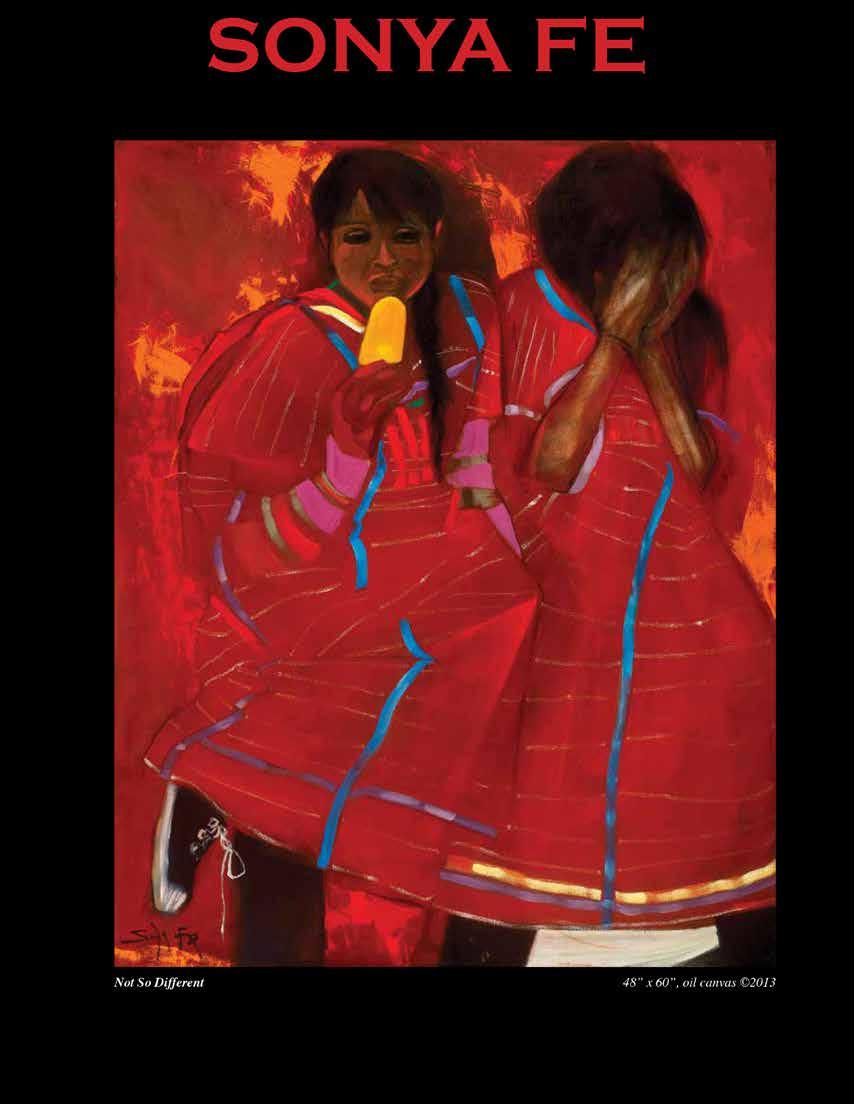
“Ilove creating art that reflects my life and experiences, as well as changing the foundation for the production and perception of contemporary art. Canvas or mural paintings provide me the opportunity to explore the tactile qualities of expressive brushstrokes, rich color and translucent layering. Drawings empower me with a straightforward yet efficient means to communicate ideas. And printmaking offers a hand-processed technique that allows me to achieve multiple originals.
The beauty of rejoicing in tradition brings our community together. I take pride in Mexican folklore, both the Indigenous and the European. I am inspired by a wide range of artists from Mexican painter Frida Kahlo to American animator Alan Zaslove, to Chicana muralist Judy Baca. And so many more. And I seek inspiration from daily life, from moments big and small, from children and animals, and from what I find funny and from what I don’t.
There is a delight and honor in experiencing tradition but a responsibility and challenge for making it relevant in our times. Telling the truth is beautiful. My art explores and questions my own self and identity, reflecting my inner world. By sharing what we think and feel, we can be better understood. Our experiences and points of view matter. And we can inspire others.
The visual and performing arts can reflect a beautiful commemoration of resilience and community. I hope that my art empowers communities and individuals, addresses cultural power structures, and confronts people with problematic issues. And creates beauty.”
– By Sonya Fe with David Bischoff
Sonya Fe’s work is on view at Acost-Strong Gallery • 200 Canyon Rd, Santa Fe, NM 87501
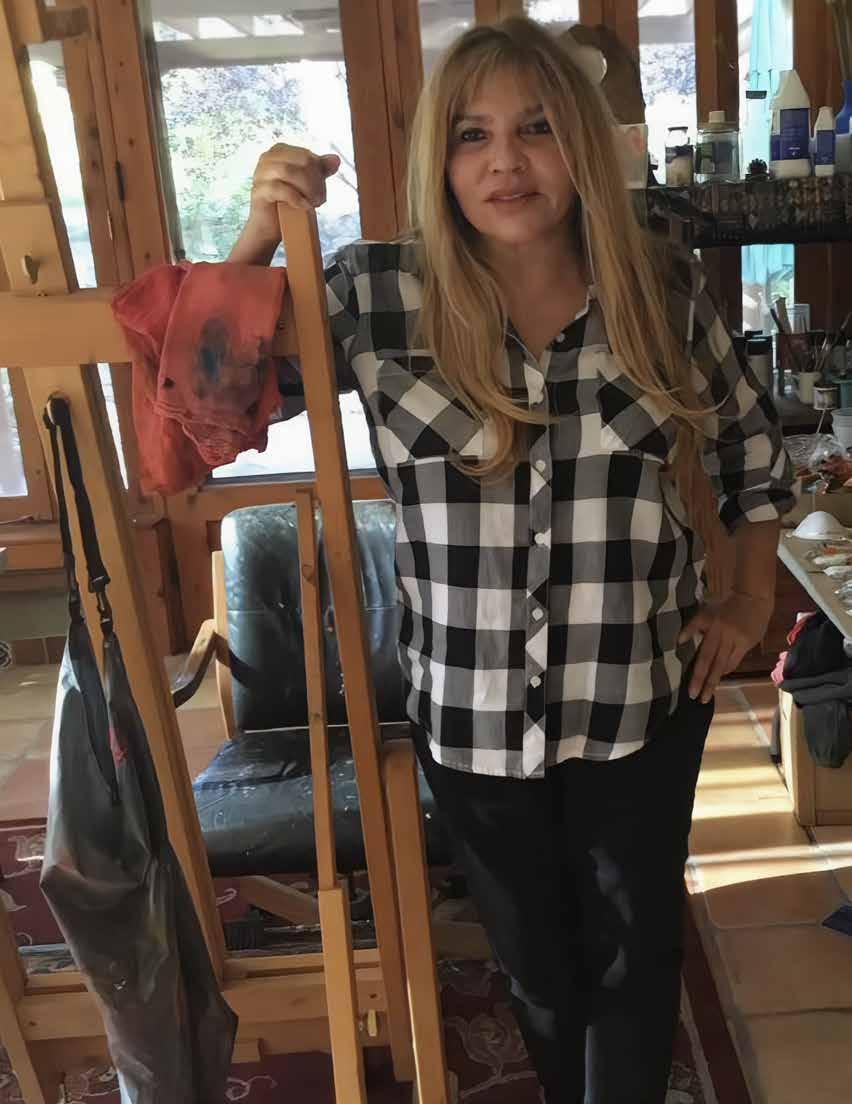
Recently, I had the opportunity to speak with Sonya Fe on the phone, engaging in a thoughtful conversation about her artistic intentions and influences. Our discussion revisited themes previously stated by David Biscoff, and further explored Sonya’s cultural inspirations, which stem from her European, Indigenous, and Jewish heritage. Sonya Fe’s work is distinguished by her ability to extract emotion through both color and subject matter. This unique approach elevates her body of work, positioning her among the most distinctive women artists of the early 21st century. Her style and vision are comparable to renowned artists such as Frida Kahlo, Lenora Carrington, and Leonor Fini from the 20th century, all of whom brought strong, independent perspectives to their art. Women like Sonya Fe, who possess a clear and powerful artistic vision, play a significant role in changing how we perceive the world through art. Their influence continues to challenge and expand our understanding of creativity and expression.
–Jamie Ellin Forbes, Publisher, Fine Art Magazine
Jamie: As an artist, you’re very dedicated to your heritage and to bringing in a cultural experience. I never quite understood why when I saw your paintings I always felt as if I had been invited home. The atmosphere was so very comfortable for me. I would like to know more about your process, bringing your cultural profile, feel or experience fresh into your painting. You were explaining to me your background. Like myself, you have a Jewish parent and one Native American. Your reservation is north of my reservation in Las Cruces Sonya Fe: Yes. You and I are very much the same. We’re almost identical at some level culturally, and it’s very rare.
Jamie: As you said, neither of your parents practice religion. Mine both told me, as your parents told you, “think for yourself,” correct? Well, that’s why you feel so familiar to me. We’re the same. But what I see in your art is you invite people into this very warm experience, as I recall it as a young person, culturally, that’s very Southwest American. Would you say that’s accurate?
Sonya: Well, I don’t know, I don’t really consider myself as Southwest, because I’m so busy, wrapped up in my own world. I’m just painting what I have experienced. Maybe the reason why you feel comfortable with it and other people do is because, like I said, we all experience the same thing, but just at different times in our lives. And that’s how we can relate to one another. I agree with you.
Jamie: I’m in agreement that everybody relates on a very universal level. But I do think that the colors you use, the symbolism contained within the images as compositions, even though they’re figurative works — impressionistic figurative work that’s very symbolic — they lend a feeling to a culture that really needs to be remembered, called into mind, spoken or related to as special, in my opinion.
Sonya: Okay, I’ll buy that.
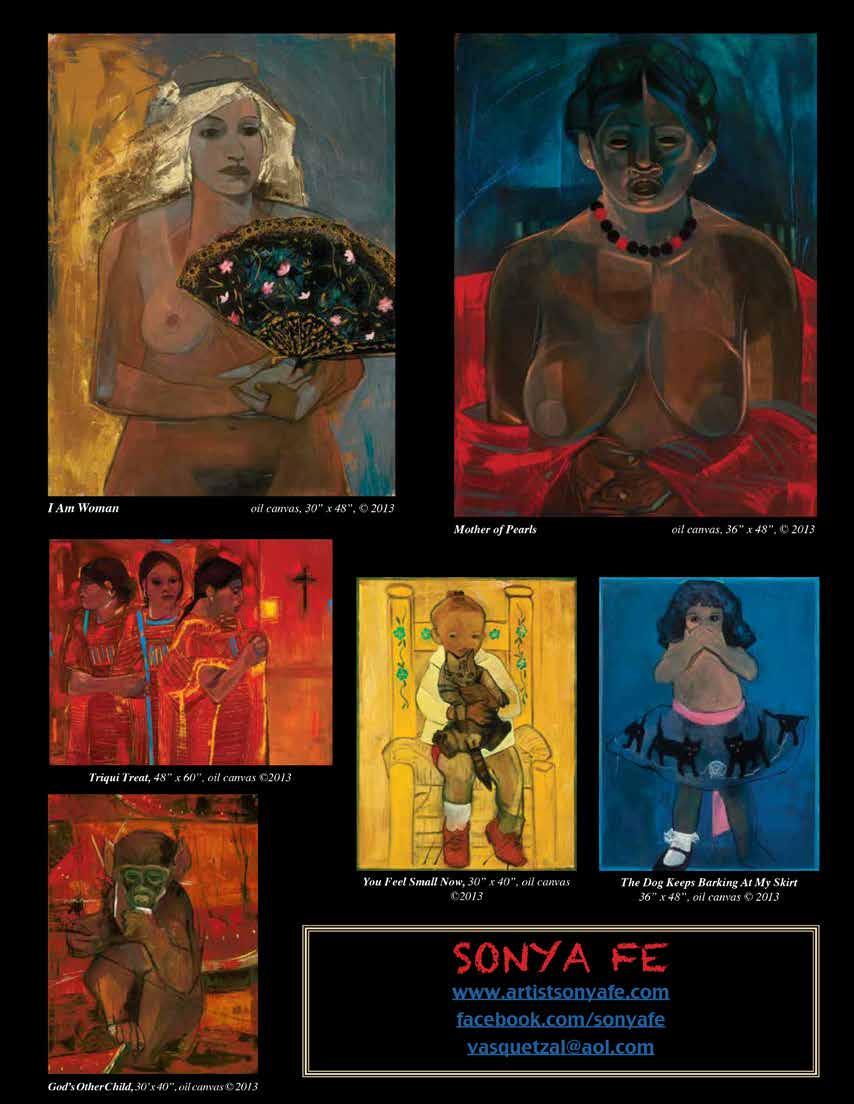
Jamie: I’m looking at your painting of a little girl on a chair holding a cat and I think it just embraces all the love in the world. And the chair is painted with colors very much your palette. There’s yellow, there’s red. How do you arrive at your subjects for each painting? Is it just intuitive?
Sonya: Well, you know, it’s a funny thing. I’ll be sitting here
with my husband, and we’ll just be having conversations. And then I start thinking about my next painting and I have to get something that I have to be excited about. I just don’t want to repeat myself because that’s boring and then I want to paint. How do I get my subjects? We’ll have conversation and then things spark. I get ideas from the past, my experiences. My husband would talk and he talks about his experiences and I’ll get ideas. And it’s just like a light that turns on that’s most of what I’m thinking of.
Jamie: Alchemy, like in chemistry.
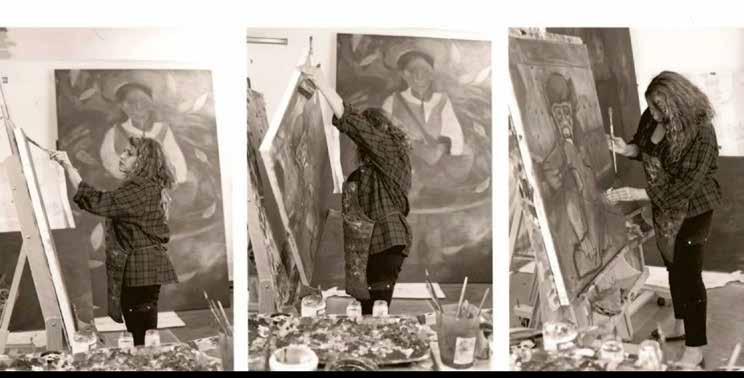
Sonya: Yeah, it’s like a wildfire too. You get an idea and then it spreads and then you want to act on that. As I’m painting —starting a painting — I do not know what it’s going to look like finished because when I’m applying the paint, I get ideas as I’m painting. Like if I’m putting, let’s say, a blue color down and I’m thinking, what would look good with this blue besides this red or this or that? And I’ll put the painting away for about 10 minutes and look at it and I get an idea. So that would be nice. I have to be excited when I’m painting my art.
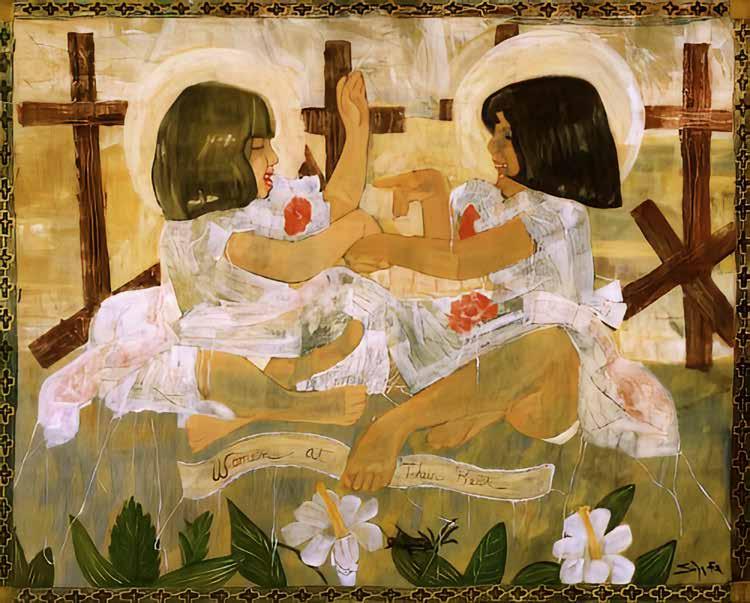
Jamie: Yes, your art conveys an excitement. Your pieces carry tremendous energy. I don’t know if you’re aware of that, but they really invite. They emote a lot of energy. So the pieces that you sell to your collectors, the pieces that you hang in your special collections, they all bring the energy of who you are. In “Women At Their Best,” they’re two little girls. I would think those are white party dresses.
Sonya: They’re my nieces when they were small. They’re little girls. They were so happy playing, you know, patty cake. And I’m looking at them thinking, oh, if you can only stay like that. We grow up, we get involved, we get in relationships. And how many times you — this happens to boys too, I guess, but I’m a woman so I’m speaking for the girls — you grow up, you’re happy, you’re sassy, and then you’re a teenage girl, you’re still kind of like that, but then you start changing and start doubting yourself. Life happens and then you’re no longer that snappy little girl. You’re taking on the society’s dish in you. I tried to avoid that at all costs growing up. I didn’t care what society said. Maybe that’s why I was never asked to the prom in high school.
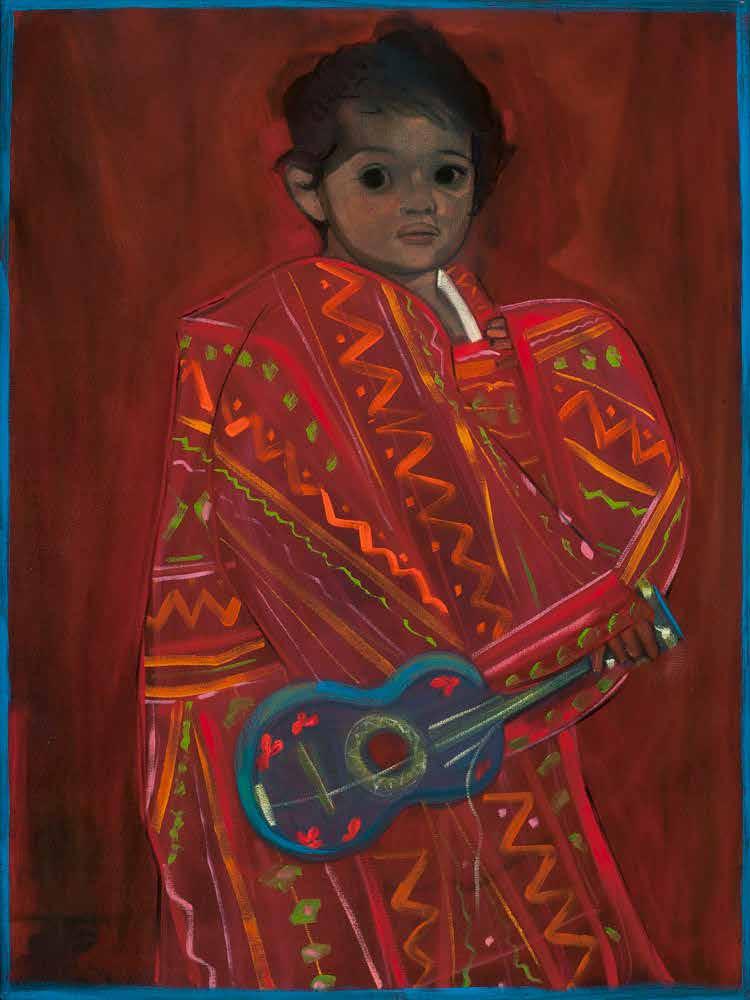
Jamie: It’s a very good trait. Then there’s “Soy Mariachi” which I like very much.
Sonya: That’s my son when he’s a little guy, yeah. A very sweet face, huh?
Jamie: I love this…he’s got his guitar.
Sonya: Yeah, little toy guitar and he’s wearing a serape.
Jamie: But you’ve taken liberties with the design in the serape, correct?
Sonya: Oh, yes, I’m not one to copy exact. I’m not going to get a piece of material and do it exactly, that constipates me. I can’t move. I have to be free with my creativity.
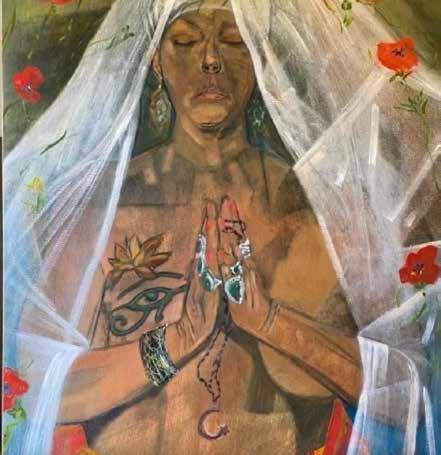
Jamie: And then you have “Here She Lies.”
Sonya: There’s a veil, a gauzy veil, looks like red poppies and the Eye of Horus. A young lady came to me and she was telling me she would like a portrait of herself, she was a breast cancer survivor and if you look, there’s one breast, maybe you can see it, and then there’s an eye painted on the other breast. This was a portrait she commissioned, and it was rather a sad
story. When she was about 25 or 27, they told her she had breast cancer and she wasn’t gonna make it.
Jamie: Oh, my.
Sonya: She’s 70-something now. So this is her burial piece. She wanted me to paint her burial piece, and she’s into the Egyptian culture, so that’s why that is the way it is.
Jamie: That’s amazing.
Sonya: What a story behind that, huh? I almost teared up when she was telling me.
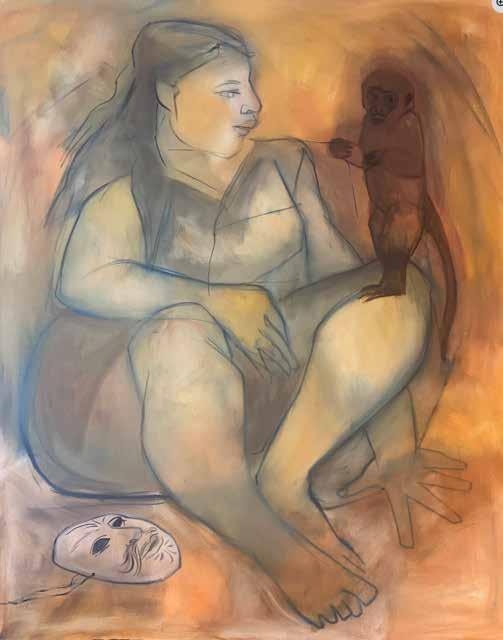
Jamie: Then in next piece there’s the monkey. Good company, too. There’s the monkey sitting on the knee of the woman.
Sonya: I like big paintings. On this particular piece, I didn’t want to make it a solid painting. It was more like a large drawing that I did with oil. I love drawing large women, and in fact, when I posted, I said, thank you, large women. They are so much more fun to paint because they have so much nerve and so much on their body to draw and paint. I like drawing extremely thin women when I’m just doing a drawing. Just using flat colors. Design-wise, they’re great. But for me to jump a canvas, oh, I love the big women. And what better company is a monkey? I like drawing monkeys, so that’s why they’re in a lot of my works.
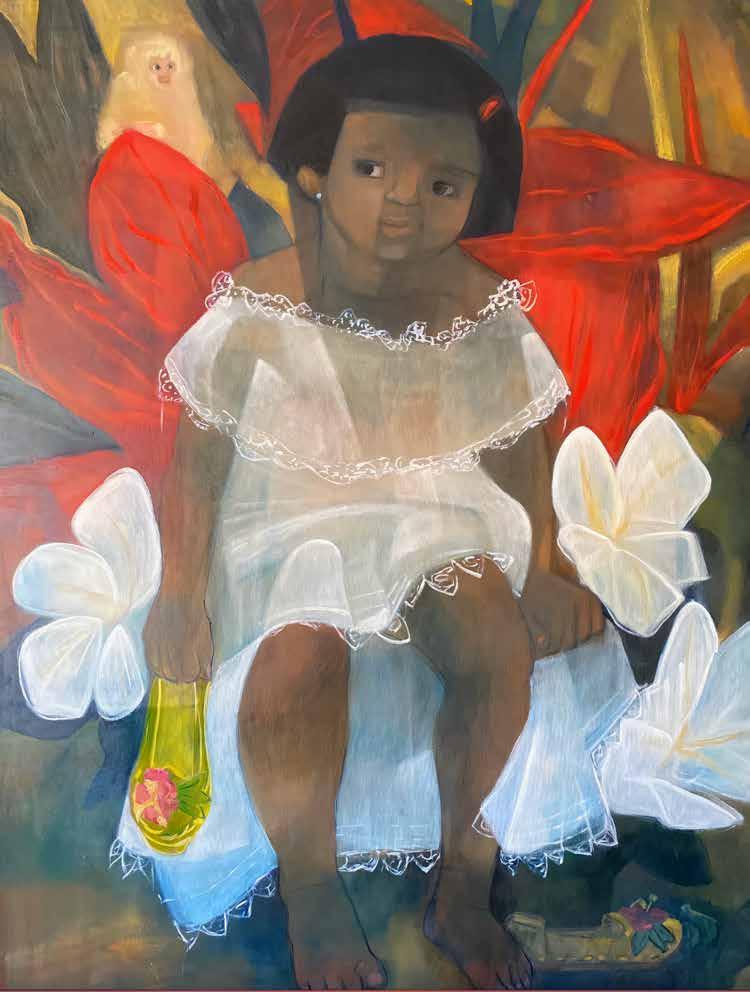
Jamie: There’s another monkey in “I Don’t Like Wearing Shoes, Okay?” I love this particular piece — a little girl, she doesn’t wanna wear shoes, and the monkeys are more or less someone she can relate to because they don’t obey.
Sonya: These little monkeys are okay. People have pet monkeys, and the monkeys don’t compare to them. You know, everybody, children are like little monkeys. They’re gonna do what they want, even behind your back, anyway.
Jamie: And they should.
Sonya: Yeah, they gotta be kids, they gotta be free until society gets help.
Jamie: Lucky you! You were not taught about society, right? I don’t think I was.
Sonya: I like to branch out and paint men and women, but the children are just so much more fun to paint. Kids are kinetic energy.
Jamie: It’s a really great piece. I think you could really hang it next to, I’m trying to think of an Impressionist painter. I can’t liken it to any of the Impressionist painters I can recall this moment but it’s that type of Impressionistic painting where it goes back to the truth of the moment.
Sonya: You’re thinking of probably Manet or Monet? I was thinking Manet, actually. Yeah, I was thinking Manet. You know how I got inspired by that piece because the honest thing, when the little kids from, I believe, Syria, that country was having problems and they showed that little boy on the shore dead.
Jamie: I remember that.
Sonya: That was horrible. I was just thinking so much about them. The little child on that painting is neither boy nor girl. It’s supposed to be a child.
Jamie: I would not have figured that out but that’s an incredible piece.
Sonya: Thank you. That’s why the child has short hair like a little boy but it’s wearing a dress like a girl.
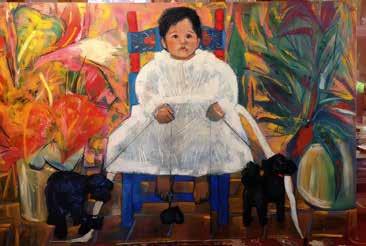
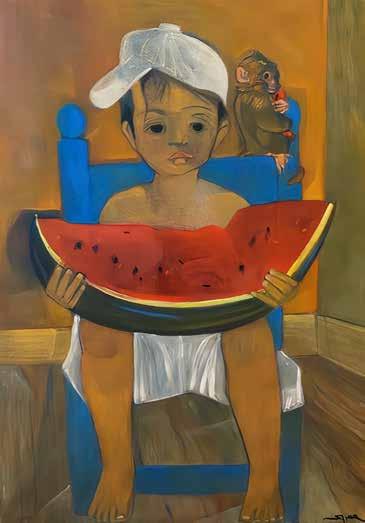
Jamie: I wanted to ask you about one more piece, “Watermelon Series Three.” Okay, I’m so busy doing heavy duty stuff, serious pieces. And after I asked, I just want to have fun with color and fun. So what better way? Children and monkeys. What I did was I had three canvases and I had the monkey canvas in the middle. He’s on his chair eating watermelon. And then another canvas on the right side of the monkey is a little boy eating watermelon. And then on the left side of the monkey is a little girl eating watermelon. And in the paintings of the little boy and girl, the little monkey is either underneath the little girl eating the watermelon. And then the boy’s painting, the little monkey is wrapped around the top of the chair. So let’s give the monkey equal time. So I put him on the chair in the middle of the painting.
Jamie: I love that piece because it’s fun.
Sonya: Yeah. It’s just, anybody, anywhere can relate. If you eat watermelon, you can relate to the piece, right?
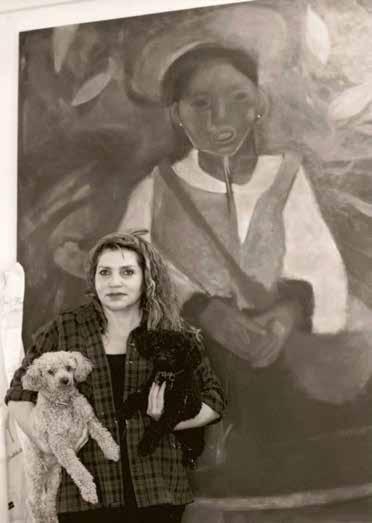
Jamie: That’s right. And the piece next to it is, there’s a photo by Andres Olivares.
Sonya: Yes.
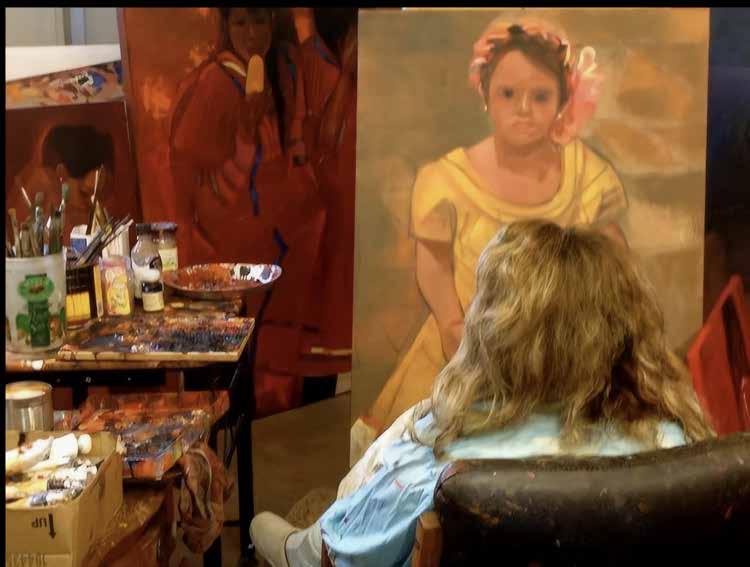
Jamie: What is the painting in back of that? I see the dog and you and the painting.
Sonya: It’s a real tall painting called, “As Leaves Fall, Young Girls Grow.” It’s about the seasons — every time there’s a new season, someone’s got to get taller and taller until they reach adulthood. That’s more or less what that’s about.
Jamie: They’re all incredible. Do you have a favorite amongst the group we spoke of?
Sonya: “Soy Mariachi”, because that’s my little boy. I don’t know if you can see it there, but if you get close to that painting, I was painting his eyes and my hand slipped and a straight little eyelash came out, you know, right on the painting. A perfect accident, I left him alone. That’s what I like about that painting, it’s a straight little eyelash on one of the eyes. It came out so perfect. I said, okay, I’m leaving it.
Jamie: Well, that’s an artistic decision, you know, and people have to know when to leave the energy of the moment in the artistic piece. And that’s the artist’s decision.
Sonya: Or as we like to say, when the act of God arrives, leave her alone.
Jamie: Ha, ha, ha, that’s too funny. thank you for your time with me.
“If you eat watermelon, you can relate to the piece, right?”