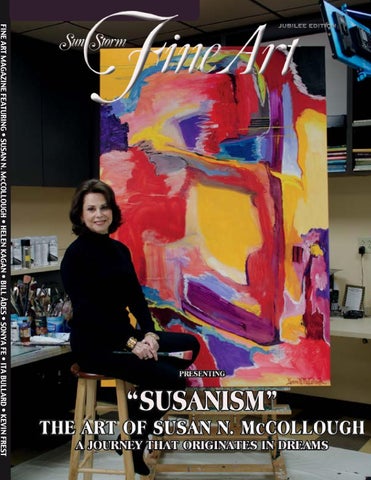
FINE ART MAGAZINE FEATURING • SUSAN N. McCOLLOUGH • HELEN KAGAN • BILL ÀDES • SONYA FE • ITA BULLARD • KEVIN FREST
FINE ART MAGAZINE • OCTOBER 2026 • 1
SunStorm SUMMER • 1986 • $2.00
Jamie Forbes, Ruth-Ann Thorn, and Andrea McGrafferty at the White Room Gallery, Septembr 1, 2026
From The Publisher
In Loving Memory of Peter Max ✰ America’s Artist ✰ 1937–2026
PETER MAX ✰ AMERICA’S ARTIST
Victor Forbes and myself have been publishing SunStorm Fine Art magazine in one form or another since October 31, 1975. Fifty years is a long enough while to get the hang of it. Publishing and markets have changed. Artists reflect the stream of consciousness in which they live. We continue to capture the essence of the times in which all create. Artists, musicians, actors, photographers, film makers and writers bring their artistic efforts to the public eye. Our mission has been helping others. Along the way we have forged many friendships. In the photograph above, my dear friend and Native American cousin Ruth-Ann Thorn invited me to review my history and current efforts on her This is Indian Country television show. I am an elder in the Manzanita Band of the Kumeyaay Nation. Our Tribes are located in San Diego adjacent to one another. We taped at my friend and Andrea McCafferty, Gallery co-owner with Kat O’Neil at the White Room Gallery, East Hampton, promoting our cultural perspectives incorporated within our artistic approaches to business. Andrea was incredibly welcoming. Filming in The White Room as the backdrop was the perfect space. Just thinking about all the people I met along the way and great privilege it has been for my life’s work to reflect the arts community — local, national and international. The breadth of my experience gave me pause for thought. Victor thinks we were “influencers.” Basically, that’s what Ruth Ann thought. Me? I think artists are artists and always need a place to tell their stories. I love story telling. Sun Storm Fine Art will continue to keep on keeping on. Jamie Forbes, Publisher, co-owner SunStorm/Fine Art Magazine
Peter Max 1937-2026
As we go to press, we learned of the passing of Peter Max. He was a great friend of SunStorm over the years and we collaborated often, always with great love and success. We will have complete coverage of our work together in our next issue. RIP.
www.sunstormfineartmagazine.com
Founded 1975
JAMIE ELIN FORBES Publisher info@fineartmagazine.com 631-339-0152
VICTOR FORBES Editor victor@fineartmagazine.com 518-593-6470 POB 481, Keene Valley, NY 12943
©2026 SunStorm Arts Publishing Co. Inc FINE ART MAGAZINE • OCTOBER 2026 • 3
SUSAN N. McCOLLOUGH “A Free Spirit In Life As In Art”
Dr. E. Gaylon McCollough and Susan N. McCollough with their stallion, Sonshyer
“Susan N. McCollough is a multi-faceted, international artist who captures the essence of her emotions on canvas, reaching deep within her soul. You feel the emotions from canvas to canvas and your mood quickly changes. Bold color schemes of intense hues create excitement unrivaled as you absorb her originality and uniqueness. Spontaneous movement, expressed translucency, veiling of sequences, flickering gold, goes beyond description and can be enjoyed independently of content. She has mastered Contemporary Art. Susan lives and works in Gulf Shores, Alabama where her gallery and studio are a major part of her life.” By VICTOR BENNETT FORBES
S
Kay Daughdrill, Exhibitor/Florence Biennale 2005, Curator/American Sport Art Museum and Archives, Daphne, AL
usan N. McCollough is a classic example of an anomaly. Born in the Borough of The Bronx, New York City, her family moved south when she was six years of age. She stepped quite naturally into her destiny as a classic Southern Belle without compromise. A collegiate beauty queen at the University of Alabama, she met a handsome football star who played center on a national championship team coached by the legendary Bear Bryant with alltime great quarterback Joe Namath. Today E. Gaylon McCollough, MD FACS, is an internationally recognized and board-certified surgeon and teacher. The founder of The American College of Rejuvenology and the McCollough Institute for Appearance and Health, Dr. McCollough has been recognized as one of the preeminent doctors in America and is author of 28 books.
FINE ART MAGAZINE • OCTOBER 2026 • 4
A graduate of Dothan High School, Susan was crowned Miss Dothan High School, Class Beauty, School Beauty, Homecoming Queen, Dothan High Key Club Sweetheart and a majorette for DHS Marching Band, Outstanding Twirler at Florida State University Twirling Camp Susan was also honored as Alabama’s State Key Club Sweetheart. She also participated in the Miss America’s, Miss Alabama State Pageant and emerged in the top five. As the State of Alabama’s entry in the Miss Alabama International Beauty Congress, Long Beach, California (which became the Miss Universe Pageant), Susan finished in the top 15 in the Miss USA pageant and won an acting scholarship to Playhouse “90”, located in Los Angeles, California. In 2020 ATI recognized her as one of its ART TITANS – Masters of the New Era documentary series. She received the award in New York in 2023. The documentary, “Art Titans – Susan N. McCollough, A FINE ART MAGAZINE • OCTOBER 2026 • 5
Dr. Gaylon McCollough, University of Alabama offensive Center, 1962-64
Susan N. McCollough received the “SPECIAL PRIZE FOR HUMAN RIGHTS IN 2015 TRIBUTE TO ANNE FRANK” awarded by The Associazione Culturale Accademia “Italia in Arte Nel Mondo in Lecce, Italy.
Journey of Inspiration,” is available on Vivid Arts Network and Roku. While femininity, charm, beauty and elegance abound, there is a streak of old time Bronx confidence evident in her paintings as in “you can take the girl out of The Bronx but you can’t take The Bronx out of the girl” to paraphrase Lynyrd Skynyrd’s Ronnie Van Zant (substitute “Dixie” for “Bronx” and “boy” for “girl”). The combination of tenderness and power manifests in a vibrant collection of art, a body of work that she considers “a labor of love, fun and exciting with every brush stroke.” Susan’s palette is varied yet consistent — a distinctive array of colors and compositions mining depths of Abstract Expressionism, Surrealism and Color Field with a strong sense of the Fauves mixed in to create art that excites the senses while stimulating the mind. The finished paintings bring to mind the reds of Rothko, the blacks of Franz Kline. The sun-kissed yellows merge into a subject matter soft and strong, some reminiscent of Dali yet all retaining an originality that can only come from the heart, mind and soul of a confident artist. Susan is a combination of magician and construction worker. Her forms appear out of the nowhere and into the here whether they be portraits in charcoal or phantasmagorical splashes of pure imagination with all kinds FINE ART MAGAZINE • OCTOBER 2026 • 6
of subtleties hidden within. The melding of opposites — this anomaly — results in masterful representations where form, subject matter and color are both comforting and challenging, leaving a viewer to wonder what was she thinking/feeling when she painted that. We may never know and actually, it is of little or no importance. She paints with a fiery disposition like a Maestro leading an orchestra or Muddy Waters leading his blues band. Tempos change, volume is raised and lowered, lyrics scowl and smile. Messages come charging off the canvas, vibrating through the ground and air. Put your ear to the floor and like Tonto, you too will hear the galloping horses on the trail. Then there is the softness of golden silence. The longing for a peaceful world amidst the maelstrom of life which in her art is a natural process. “The mind of this artist, a beautiful artist with a beautiful spirit, knows no bounds,” states Salvatore Russo, International Art Critic and Curator, Rome, Italy, “Fingerprints on canvas. Signs of the soul. Ref ined storms of light. Storms of color fall down against human injustices. The paintings of Susan N. McCollough go beyond the hedge to reach the inf inite. An inf inite that corresponds to a large cultural ref inement that characterizes each of her works.”
MORE ABOUT SUSAN & Dr. McCOLLOUGH Susan served on the Art Committee and as a member of the Board of Trustees at the United States Sports Academy for more than 16 years. The USSA attracts and honors artists from around the world and is solely responsible for selecting featured artists for the Artist of the Year Award. She now serves on the committee as Artist Emeritus and on the Academy’s Board of Trustees as Board of Trustees Emeritus. In June 2024, Susan received an Honorary Ph.D. from the esteemed United States Sports Academy for her work in the arts and as a member of the Board of Trustees. In 2023, Susan became co-benefactor of the University of Alabama’s “The Susan Nomberg McCollough Fine Arts Initiative”. The Initiative is an international contemporary art exhibition and conclave that will be held every two years on the campus of and at galleries affiliated with The University of Alabama. It is supported by Mrs. Susan Nomberg McCollough and Dr. E. Gaylon McCollough for the sole purpose of creating a venue by which to feature University of Alabama art and artists. The initiative will showcase artists and provide them with a platform to exhibit their work, connect with potential buyers and collectors, and interact with fellow alumni and leading art professionals on a regional, national, and international scale for years to come. Susan and Dr. McCollough are also co-benefactors of the University of Alabama’s “McCollough Institute for Pre-Medical Scholars,” a one-of-a-kind academic initiative designed to prepare “tomorrow’s phenomenal physicians” for the road ahead. Susan is a member of the Women’s Art World organization in Marrakech, Morocco. The WAW’s mission is to bring together and promote Women’s Art in a world of different cultures, languages and art. Today there are 20 countries and 35 artists represented in Women’s Art World. Susan is also a member of ICAF (International Culture and Arts Federation) in Seoul, South Korea; NOMA (New Orleans Museum of Art) in New Orleans, Louisiana; BMOA (Birmingham Museum of Art) Birmingham, Alabama; MMofA (Mobile Museum of Art) in Mobile, Alabama; Metropolitan Museum of Las Vegas, Las Vegas, Nevada; MOMA (Museum of Modern Art) New York City, New York; MMOA (Metropolitan Museum of Art), New York City, New York and DMA (Dallas Museum of Art) Dallas, Texas.
OF HEAVEN AND EARTH, Oil on Linen, 44” x 96” 2016
“OF HEAVEN AND EARTH”
This is the name of the wonderful art piece I have been so lucky to acquire from Susan N. McCollough. After several trips to Susan’s Gallery, I fell in love with all her work but especially Of Heaven And Earth and wanted to bring it home. This painting drew me in from the start. Her unique strokes of color and use of varied composition take our minds to places that stir the imagination. I see something different every time I look at it, so it will forever be fresh, new, and exciting, just as Susan’s gallery is. I often visit to get a glimpse of the new paintings she has created and talk with her about ideas that might become reality on the next big canvas. She always gives us an adventure in art no matter what subject she paints, and I look forward to seeing what her colorful strokes bring out next. Susan is a great friend, mentor and inspiration to my own work. We are so proud of her talent and wonderful success nationally and in the international Art world and I am very proud to say Of Heaven And Earth is going home with me, where it belongs. Thank you, Susan. – Maria M. Bastin Gulf Coast Arts Alliance Gulf Shores. AL
FINE ART MAGAZINE • OCTOBER 2026 • 7
MYSTICISM, Acrylic on canvas, 60” x 48”, 2021
COUNTERPART 1 & 2, Diptych, Oil on canvas,36” x 72” each
“I find it all a labor of love, fun and exciting with every brush stroke.” In Susan’s blend of abstractions with reality, one imagines the artist must go through some serious work and thought to get to that particular point. Words fall short in describing such a process. “It’s been very difficult to describe it,” she told me in a recent interview. “I’ve been painting for many years and a lot of the galleries and museums always say that when someone looks at your work, they should know immediately who painted that painting. I wrestled with that concept for many, many years until I had a breakthrough and understood I’m just not one of those people… that’s not how I work — that’s not how my mind works anyway.” Either way, the paintings have a distinct style and connection to each other and when people view them in the continuum, they do all pertain to each other, they carry a theme through them somewhere between power and longing. So there is no specific genre in which to place these works other than a new one, “Susanism.” Why not? Continues the artist, “Maybe it’s coming through, but not as you know it was meant to be. Early on, I would dream my paintings or when I was in that in-between stage of a thought and trying to sleep — I know it sounds a little strange — but once I got into that realm, I learned how to keep myself in that moment of falling asleep and being able to finish the painting in thought. I did that for many years and now I don’t do that as much, but when I go to my studio, I always know what colors I’m going to use and they’re very strange, too, because I put colors together that normally maybe shouldn’t go together, but by the time I finish the painting it all works.” FINE ART MAGAZINE • OCTOBER 2026 • 8
“I have never thought about why I paint. If I go back in time it would be like most children. I started trying to draw the heads or pictures they tell you in the back of magazines and it would say ‘Draw Me! If you have an interest in drawing Enter this Contest.’ I would always do the drawing, but never thought about entering. Then I would draw pictures out of the encyclopedia. Then I noticed my Mother had an interest in art. Later in life she took lessons but mostly she was self-taught. I continued to draw and there was always an influence of art in my home. It wasn’t until my freshman year at the University of Alabama that I took an elective art course. It was ceramics with Frank Engel. After that I took every art course I could. I almost double majored in art without even trying. I married; I painted. I worked; I painted. I had children; I painted. I traveled; I painted. I guess I always came back to painting. “I was fortunate early on to have sold every painting that I painted. I might have saved one or two because I did not want to part with them and even this year I let one of those go. I never took great photos or kept any real records, just scattered here and there with a voice always saying, ‘Susan, you must keep better records.’ My Mother kept track of everything that I sold. I now treasure her handwriting and the names of paintings we would come up with and who purchased
them, all in her beautiful handwriting. At ninety-two, my Mother Dorothy (Dottie to her close friends) passed away but her journals are irreplaceable.” Starting a new year in 2025, Susan closed her gallery and moved from The McCollough Institute to new quarters in Gulf Shores, Alabama at the MacLand Ranch. The opening exhibition was titled Past and Present. Most days you will findthe artist at work in the studio, where she continues to sculpt, paint, and exhibit her art. “It is a new endeavor,” continues Susan, “and one that now, in this time in my life, just seems to make sense. My father Max was 100 years young in February 2017 and passed away in August 2017. He used to go into the Gallery with me every morning and open-up and close it in the evening, but he said that he was going into retirement. My husband Gaylon and I decided together that this was a long time in coming. I have always just painted for myself and for commissioned pieces. Early in my career I would enter shows but not recently until now have I begun to do more paintings and more showings and enjoying it more, I guess because I can. I paint from the excitement of the blank canvas. I paint with freedom of inner-feelings, movement, connection of space, combination of colors, playing with negative space until it all speaks to me. My ideas come from so many things that just fill my head all the time. They come FINE ART MAGAZINE • OCTOBER 2026 • 9
INTO THE WILD, Oil on canvas, 88” x 64”, 2021
“Before I paint a new canvas, many times I will envision painting it as I fall asleep and I work it out in my head until I know the direction I will take the next morning. Sometimes I do not wait till the next morning.” from our travels, the faces I see, the natural works of nature and creations of mankind, the architecture, the people we meet and mostly the feeling I get just waiting to start a new canvas. I look at things that are realistic in nature and change them into abstract paintings. I’m trying some of these abstractions with reality.” Noted art critic and art historian Sabrina Falzone of Milan concurs. “Susan N. McCollough’s Landscapes of the Unconscious is an artistic research that opens new creative scenarios, comparable to chimeras of the unconscious and evocative as unexpected windows of the soul…turning towards a dreamlike language of great visual impact. The American artist manages to find her personal style to express her own inner world... The passion and the impetus of the pictorial gesture is witness to, above all, a viable artist’s temperament that expresses itself with spontaneous freedom.” FINE ART MAGAZINE • OCTOBER 2026 • 10
Dr. E. Gaylon McCollough, Facial Plastic Surgeon, husband) Susan Nomberg McCollough, Artist; Viviana Puello, Editor and CEO of Art Tour International Magazine; Michelle Jordan, Assistant Director of The Susan N. McCollough Gallery/Studio at Artexpo, New York City
ABSTRACT 2020, Oil on canvas, 48” x 72”, 2020
FINE ART MAGAZINE • OCTOBER 2026 • 11
LONDOLOZI, Acrylic on canvas, 48” x 60”, 2013
ILLUSIONARY JOURNEY, Oil on canvas, 48” x 74”, 2016 FINE ART MAGAZINE • OCTOBER 2026 • 12
FINE ART MAGAZINE • OCTOBER 2026 • 13
FINE ART MAGAZINE • OCTOBER 2026 • 14
CONNECTING SOULS, Oil on canvas, 72” x 48”, 2025
FINE ART MAGAZINE • OCTOBER 2026 • 15
INTERDIMENSIONAL PERSPECTIVE, Oil on canvas, 60” x 72”, 2024
THE GUARDIAN, Oil on canvas, 45” x 63”, 2015 FINE ART MAGAZINE • OCTOBER 2026 • 16
“A leap in a world in which colors move everything. Intense and brilliant, the chromatic structure of this painting gives the observer the key to read the real meaning of it and get connected with the artistic aim of the painter. Opposite feelings and emotions are the leitmotiv of the pictorial aim of Susan N. McCollough, a free spirit in life as in art, an artist who shares the colored ocean of her soul with the spectators, who are not only passive observers, but active part of the creative process of this painting. A well balanced abstraction of eality and a good imaginative language.” – Sandro Serradifalco, General Director, Effetto Arte Magazine, Palermo, Italy
FINE ART MAGAZINE • OCTOBER 2026 • 17
WILDFIRE, Oil on canvas, 40” x 50”, 2024
Susan N. McCollough’s exhibition at Pensacola State College’s Anna Lamar Switzer Center has been well-received by the community with steady daily attendance and well over 200 guests for the artist’s reception. The paintings and sculpture on display represent a cross section of Susan’s vast talent and interests. There is a connection between the works that becomes evident upon seeing them in this venue. Although the paintings are separated by time, their cohesive compositions make this exhibition a must see for anyone who enjoys abstract and impressionistic art. – Vivian Spencer Director/Curator, Switzer Center for Visual Arts FINE ART MAGAZINE • OCTOBER 2026 • 18
MELTING INTO SPRING, Oil on canvas, 48” x 60”, 2015
Susan N. McCollough’s work is difficult to peg. She has her own namesake gallery in Gulf Shores, Ala., where some of her breezy abstract paintings fit right in with the coastal lifestyle. The acrylics and oils are fairly large and command attention with their kinetic fields of scratchy lines, arcs, rings and stripes. — Mike Roberts July 2, 2015, “Pensacola News Journal” FINE ART MAGAZINE • OCTOBER 2026 • 19
UNTITLED 508, Oil on canvas, 72” x 48”, 2024
FOCUS, Oil on canvas, 48” x 48”, 2018 (Insert)
“May your works, Susan, travel to many continents and your art be recognized for all the value and intent you put into each painting. You make us travel in magical lights and according to your canvases we feel all the love you put inside. Your creations are wonderful and we have so much fun to watch them. We will always be unalterable on your works because we feel all the intensity that you put there.” Michele Matray Art Agent ART Cubisme Sculpture Lyon, France January 2017
FINE ART MAGAZINE • OCTOBER 2026 • 20
FIGURATIVELY SPEAKING I * II, Diptych Oil on Linen 45” x 63”
FINE ART MAGAZINE • OCTOBER 2026 • 21
STAR FIRE, Oil on linen, 35” x 38”, 2016
On Friday, July 18, 2014, we had the pleasure of attending the Gala Reception at the Marx Library on the USA campus for Susan N. McCollough. Viewing Susan’s extraordinary creations spanning over 30 years, we perceived the depth and breadth of her influences, the focus and discipline of her research, and we felt her joyous explorations into the ART WORLD. Her works are beautiful, impressive, and inspirational like the artist herself. The show documents her progression as an artist and communicates her love and passion for painting, living, and giving. The Galaxy Series is a special gift... It is Glorious! Susan’s “The Eagle Nebula” is literally breathtaking. A magnif icent masterpiece that transcends SPACE and TIME! Like all the great global masters, Susan creates, “The ART of the Possible, the True and the Beautiful.” — Sandra Diane O’Conner Page Global Motionist Master Painter Co-Founder Global Motionist Masters ART Movement Winner of the National Art Teacher of the Year Award with similar awards in the State and region. FINE ART MAGAZINE • OCTOBER 2026 • 22
TRANSITION, Oil on canvas, 48” x 60”, 2015
“Playing with positive and negative space until it all speaks to me.” www.susannmccolloughart.media • susannmccolloughart@aol.com 251-948-9696 FINE ART MAGAZINE • OCTOBER 2026 • 23
G
“A painting is not a picture of an experience, but is the experience.”- Mark Rothko
J
ohn Morgan Crapps rode into Manhattan’s vibrant Soho neighborhood — international capital of the art world — in the early 90s in a truck called “Miracle.” His arrival in New York City at the height of an era driven by Warhol, Basquiat, Haring and a legion of famous and soon-to-be-famous artists had to be somewhat of a culture shock not only for Soho, but for this very enthusiastic businessman/photographer/artist from Live Oak, Florida of “Way Down Upon The Swanee River” fame. Our initial interactions are well-documented in a cover feature in SunStorm Fine Art Magazine included in these pages. We were introduced by our printing and advertising client Ellie Miner, owner of the Ambassador Gallery on Spring Street, which featured many of the exciting artists of that time, including such celebrities as Jerry Garcia, Bob Guccione, Tony Curtis, Roger Daltrey of The Who and Tico Torres of Bonjovi. Crossing paths with rock stars and super models — Claudia Schiffer, David Copperfield, Brooke Shields, Eva Herzigova, Phyllis Diller, Tony Curtis, Tico Torres and Billy Joel —were all a part of the vibrant Ambassador Gallery scene. Into this walked John Morgan Crapps whose presence, his poodles, and general demeanor eclipsed the work. With a bank account fattened by his Ready Freddy convenience store/gas stations, a taste for $200 bottles of wine, and a genuine love of art, he was a character straight out of Midnight Cowboy living in the bright lights of the Big Apple. “While overshadowed by the famous artists and the burgeoning underground scene of the Lower East side, looking back today,” states Fine Art Magazine Publisher Jamie Ellin Forbes (who also served as the Director of the Fine Art Museum of Long Island FAMLI) “The works featured in this second volume retrospective book stand as unique. Unconstrained by the context of time, the work itself is energetic, almost frenetic … fresh and new. John was not afraid to break the mold and deliver a composition of inner raw feeling. His art follows no rules nor regulations. The colors used express his moment as felt. This body of paintings stands alone and when reviewed today takes on a significance that sets them apart contextually. The language of John’s work states his ability to express impression via color and composition. This talent cannot be taught, but is rather earned, formed by inner experience. His work comes to light in the life of a very ordinary southern boy, young man, and later adult who most likely never fit in. Observing John’s paintings for the first time, it was difficult to discern what his genre was. Years later it is apparent John had no genre just a unique perspective shared as his vision through his body of work. Hopefully the time has arrived for the art world to see the importance of these paintings by John Morgan Crapps. FINE ART MAGAZINE • OCTOBER 2026 • 24
The Gospel According to John Morgan Crapps
ood, if not all, art arguably emanates from a void, a universe at once so vast it broaches the infinite and so minute it can be held in the palm of one’s hand, balled up in a closed fist. An artist gives meaning to the meaningless, pouring out his or her heart and soul onto a vacuous slate of emptiness; mixing color, brush strokes and draftsmanship to create a composition that gives dimension to the singular; life to desolation and meaning to a visualized thought. Coherence is often, though not always, required and many hours, days, months or even years of contemplation go into the creation of a single canvas. Whereas Pollock could splash out a monstrous driptych in a frenzied few hours, his contemporary, Pousette-Dart, would work on paintings over the course of decades, pulling out canvases begun in the 1930s, to refine even as he approached his death in the 1990s. In the case of the subject at hand, one John Morgan Crapps, the cosmos spins in an orbit fraught with visions — some incredibly lucid and brimming with the here and now consciousness of journalistic clarity (Dammit, The Stars Have Fallen Off The Flag…), others swirling in a whorl of contradictions (Wildastic River), seeking transformation even as millions of gallons of swimmerets from the Okefenokee Swamp of Georgia are distilled — like a Swedish vodka — to crystalline clarity each day, filtered through the limestone to form the springs of the Suwanee River, a body of water that surrounds his birthplace (Live Oak, Florida) on three-sides, a small town which remains his home today. It is not a stretch for an armchair analyst to note that artist and man is a product of the soil, the history and the purification process that transforms the Georgian swamp water — dark like a weak cup of coffee saturated with the tannins from billions of leaves, roots and bark — into the clear, cool (72 degrees) springs of the fabled “Swanee” River. You would have to understand that the tides and water table of The Suwanee begin as the dark waters of the Okefenokee Swamp, just as the Hudson River’s roots can be traced to a small stream on New York’s tallest mountain. A work in progress, like his beloved river, churning out billions of gallons of the coolest and clearest inspiring works of well-orchestrated brilliance coupled with a fair share of hard-won coherence emanating from the dementia of the terrain. Full of contradictions, of darkness and light, unreal and real, death and immortality, John Morgan Crapps is a walking rendition of De Old Folks At Home with Back in the New York Groove as the chorus. But while Stephen Foster never even saw the stream he made world-famous, John Morgan Crapps has carved out a life for himself as an artist whose creations are light years beyond the capacity of understanding to the “old folks at home.” In fact, Crapps’ penchant for the knock-out blow in his paintings, his technique, his, shall we say “punch-line,” shorts out the circuits of most of the hometown crowd. This carries over into his outside life, as well (note his perfect record of losses in political quests) and his approach which borders somewhere between “screw ’em if they can’t take a joke” to that of a forlorn suitor/prophet despondent over lack of recognition in his hometown, yet determined to endure. His life and paintings move somewhat seamlessly between Live Oak, the Big Apple, and the art capitals of America and Europe. He has been received at the White House, has beheld the beauties in Cannes, and been recognized in the same breath as Rauschenberg, Haring and Johns for his artistic contributions to the cause of combating mental illness. You can put John Morgan Crapps in a French Riviera bistro, with a thousand dollar bottle of wine in front of him and the flavor and mannerisms of Live Oak remain in every word, every thought, every deed. Choosing a medieval typeface for the preceding page’s eleven word headline is an editorialization, admittedly, but it brings us, in a cinematic sense, to a further understanding of the philosophical and etymological basis for what is seemingly just a title of a painting. Of course, the evolutionists amongst us will gloss over this rather quickly. We all came from tadpoles, this work of art states, and Crapps paints a whole school of them on a massive canvas, rolling out of their own little universe, sperm-shaped and sperm-like in dedication to their mission of spawning the human race. Crapps’ tadpoles are a happy lot in their undersea garden, devoid of any danger, real or implied, from anything. These little creatures are living in their own world, quite swimmingly, thank you, and have never even dreamt about the human race: the group of which they were precursors, according to millions of believers (or, you might say, non-believers). But, if you know your history, you will note that when the Bible belt was put together, Northern Florida was the notch that tied up that belly. So when a son of Suwanee County comes out with a major painting called In The Beginning They Was Tadpoles…and I Can Prove It, seen by hundreds of thousands at the Woodstock ’99 Festival, memorialized in book, website and exhibition of same name, as well as in museum exhibits and magazine pages, he is contentiously throwing the high hard one to the power elite of his dry (as in alcohol-free) hometown. John Morgan Crapps, with his six by eight foot canvas, is, by raising the question of “How are we here?” as opposed to “Why are we here?”, basically giving a tadpole-sized finger to a whole heap of people, many of whom are his neighbors of many years and many generations. Never one to run from a good argument, Crapps approaches the problem creatively, fueling the fire, raising questions while some would say he’s raising hell. So in the spirit of seeking an answer, and to further understand exactly what the artist is trying to do here, and the depth of this slightly innocuous work of art, we searched the scriptures. FINE ART MAGAZINE • OCTOBER 2026 • 25
$49.95 ISBN 978-1-883269-09-8
18-593-6470
fineartmagazine.com
781883 269098 FINE ART MAGAZINE •9OCTOBER 2026 • 26
JOHN MORGAN CRAPPS - 1947-2026 John Morgan Crapps, 78, passed away on Thursday, May 21, 2026 at the HCA Florida Suwannee Emergency in Live Oak, FL after a brief illness. John was born on November 17, 1947 in Hines, Dixie County, Florida to P.C. Crapps, Jr. and Virginia Birchfield Crapps. John is survived by his brother, Daniel Crapps and his sisters, Betsy Burch, Jenny Johnson (Bill), and Dicy Hannum. Other survivors include many nieces and nephews and their families, as well as his special friend, Judy Taylor. John was preceded in death by his parents and five brothers: Claude, III, David, Peat, James, and George Crapps. The Crapps family moved from Hines to Live Oak in 1950 when John was three years old. He attended Suwannee County schools until his junior year when he transferred to Staunton Military Academy in Staunton, VA. After graduating from SMA in June of 1965, he enrolled at The University of Alabama in Tuscaloosa where he enjoyed a vibrant campus life, all major sports programs (especially Coach Bear Bryant football), and some of his academics. Everyone knew not to call or visit John when he was watching Alabama football games! In 1970, he earned a Bachelor of Science degree in Commerce and Business Administration, and for the rest of this life, he was a loyal and supportive alumni. Following his college graduation, John served his country by joining the United States Navy until his honorable discharge in December 1975, after which he returned home and began a long career in banking at the Hamilton County Bank in Jasper, FL. Subsequently, he opened three successful locations of his Reddy Freddy (named after his dog) convenience stores in Suwannee County. One of John’s passions was his involvement in art, especially painting and photography. He referred to his paintings as “Wildastic” because they represented the bold, colorful, and creative side of his personality. Some consider him to be an important American painter, and his works have been shown in several locations, including the Ambassador Gallery in New York City, as well as some shows in Palm Beach, FL. No one enjoyed life as much as our John. He was a free spirit who lived life on his own terms. He enjoyed the simple things: his dogs and birds, a favorite drink, a Cuban cigar, a good book, and his favorite hat! We all knew that underneath his crusty exterior was a kind, funny, gentle, generous and compassionate man who loved his family, and they loved him.
“In the beginning, they was tadpoles…and I can prove it.” Oil on canvas 8’ x 6’ From the Artists For Peace & the Environment Collection, Curated by Jamie Ellin Forbes for Woodstock ’99
well known melodies in the world, originally published on October 1, 1851. From a banking family, Crapps owned and operated a string of Ready Freddy gas stations and convenience stores, which in good times has allowed him to not only paint, but to acquire a substantial collection of art. He has plans to build a museum for these works in Live Oak but in the meantime has donated a number of pieces to the town, which now decorate the offices of the county seat. On a walk around Soho, he was so taken by Mikhail Chemiakin’s ultra-life size sculpture chained to the front of the Mimi Ferzt Gallery on Prince Street that he has been working feverishly for years to amass enough capital for such a major acquisition. The bronze is a goddess of some repute, with many sets of breasts adorning her front and an equal amount of buttocks bringing up the rear. From the moment Crapps first encountered this sculpture, he has been obsessed with placing it in an outdoor square in Live Oak. In the interim, he has collected a wide variety of works from artists ranging from Picasso to Gloria Vanderbilt, all of which were featured in his museum and then donated to the University of Alabama. He is formed and molded by the tides and water tables, the tranquility and the injustices, the two-legged predators and the many good people who have played such a positive role in his life from childhood. The glorious beauty of the region mingles with memories of robber barons and mean-spirited folk and are branded into the history of the region and the landscape of John Morgan Crapps’ heart. His artistic journey continues through a second half century, with this book covering in depth the life and times of a native son possessing the vision of an artist: as incongruous a concept as one might find in a land known more for its tobacco and watermelons, where life, for the most part, carries on as it did a century ago
Per John’s request, there will not be a service. If you would like to remember him in a special way, please make a donation in his memory to Heritage Park and Gardens, a place he dearly loved.
THE JOHN MORGAN CRAPPS STORY • FINE ART BOOKS
“In the beginning,” according to the Good Book, King James version, “there was the word, and the word was made flesh and dwelt among us … full of grace and truth.” “In the beginning,” Crapps paints, “they was tadpoles …” Here we must stop and ask, does he mean, really mean “They was …” or does he mean “There were …” If we go with the former, we must surmise that Crapps, in his panhandle vernacular, is telling us that whatever he is referring to, in the beginning was. Does he mean the only things that were around were (was) tadpoles, or that in the beginning, mankind was a tadpole, and only a tadpole? Or that amongst what was around in the beginning were tadpoles? Are you following this? To understand the entire body of John Morgan Crapps’s work, we must relate it back to his hometown. Born on a ranch, his mother was chased across a pasture by a menacing bull on the day of his birth. The antediluvian aspects of the Live Oak power elite, entrenched in their theories, have been a thorn in the painter’s side almost ever since. He has challenged them psychically and politically and has a perfect record (zero wins in five campaigns electorally) but continues to battle in the spirit realm, even to the point of creating his own gospel, in his own town, positioned 30.29 degrees north of the equator and 82.98 degrees west of the prime meridian, between Jacksonville and Tallahassee along Interstate 10 near the Suwannee River and the Georgia state line. Live Oak (pop. 6,332) is the most prominent of the charming towns that dot the landscape of north-central Florida, a region often described as the “Original Florida.” John Morgan Crapps is somewhat of a legendary character here, hailing from a family dating back almost to the beginOKS ning of the history of the town, which was founded in 1863 by the Pensacola and Georgia Railroad. Live Oak took its name from a large oak tree which stood beside a pond along the Old Spanish Trail (US 90). Unfortunately, the tree no longer exists, but in its day, the “Live Oak” provided comfort and a very popular spot for settlers and railroad workers who would stop to rest in its shade, eat their lunches, and water their horses The first settlers in what would become Suwannee County were the Timucuan Indians, a proud and fierce tribe whose villages and trails dotted southeastern Georgia and northern Florida over five hundred years ago. The tribe earned its ), Jamie Ellin Art & formername from the Timucua word “thimogona,” which means ong Island “my enemy.” Live Oak was formally established by the white man in 1878. Ordinances passed at the time included fines for using profanity; prohibition of shops and establishments from opening on Sundays; a ban on parking mules or horses on paths and sidewalks; and punishment to those who might “needlessly hammer pots at hours when slumber should have been the order of the day.” A p o p u l a r tourist site is the State Folk Culture Center, named in honor of Stephen Foster, composer of The Old Folks at Home, the song that memorializes the river. In 1851, Foster was a young musician searching for a Southern river Designer that would fit into a song he was composing. Searching an atlas with his brother, Morrison, he located a meandering Publishing Co. Inc. river in North Florida that54995> would fit his intentions. Taking Box 481 New York 12943 out the “u” and an “n,” Stephen Foster created one of the most
“DAMMIT! THE STARS HAVE FALLEN OFF THE FLAG & WE’RE IN BIG TROUBLE” THE
JOHN MORGAN CRAPPS STORY PUBLISHED BY SUNSTORM ARTS PUBLISHING CO.
BY VICTOR B. FORBES • INTRODUCTION BY JAMIE ELLIN FORBES FINE ART MAGAZINE • OCTOBER 2026 • 27
John Mor
True A peciall rebellio and ph ist, ban distinc remna Equal was bo the Su out a status with se lected Storm/ Forbes repres Enviro at Woo with a lending in sore
“Wailing Wall,” painted by the artist at the age of 13
PROPHESIES, DREAMS AND VISIONS
Bill Adés is a Brooklyn-based artist who has maintained an independent studio practice for nearly 40 years. “My passion began at the age of 13 when I came across an old set of oil paints in the attic of my childhood home,” he said. “I immediately took a liking to them, and after doing several paintings throughout my high school years, chose to continue my passion through college, eventually graduating with a Bachelor of Science in Painting from New York University in 1992.” Since then, Bill has worked in several different media, especially in large-scale where he could truly utilize his energy through each color and brush stroke. “While my creations stem from spontaneous thought processes, in actually I see my art as a collaborative process, which culminates with the viewer’s input; I invite the viewer’s perception no less than what I am thinking in my mind.”
T
FINE ART MAGAZINE • OCTOBER 2026 • 28
he wind was whipping around Brooklyn, coming in across the Upper New York Bay, through the Verrazano Narrows, over the Gowanus Canal and under the roadway known as the BQE, making for a wicked December afternoon in New York City. This was a part of town better known for auto body shops and junkyards, but in the ever-expanding and changing diaspora that is the Art World,
the new frontier had arrived here in the form of artist studios, a computer repair center and soon to be trendy restaurants. FINE ART MAGAZINE • OCTOBER 2026 • 29
“I practically lived at the ‘Met,”
recalls Adés of his frequent visits to New York City museums. Adés is a New York University graduate who holds a B.S. in Art with a specialization in Studio Art and grew up immersed in the subject.
FINE ART MAGAZINE • OCTOBER 2026 • 30
Don Quixote, 8’ x 9’, Oil on canvas (detail)
FINE ART MAGAZINE • OCTOBER 2026 • 31
CAPTAIN TRIPS
I recovered this painting which had been missing for six years. It is of the great Jerry Garcia and it had graced the walls of an old office building in Midwood, Brooklyn along with some of my large works free of charge. Upon discovering that the landlord was going to throw them out, I recovered most of my works, however my Jerry ended up missing for several years. I asked the landlord if he had seen this painting and asked to check the suite it had been hanging in and he said it was not there and probably got thrown out. I assumed that it was true or someone just walked off with it (this building for the area it’s in has absolutely no security). One day, while checking up to see if any of my other work was there, I passed by a makeshift office and lo and behold, guess what I found??? Nobody was in the office and I did not hesitate. I walked right in, took it off the wall and was ready to walk out when I stopped and said to myself, “Hey, this guy’s a thief and I’m not. I’m going to wait around for him – he probably went to use the john.” “Captain Trips” 2007 Oil on canvas 20” x 20” Sure enough he returned and I informed him that this was my work and I was taking it. I introduced myself and showed him my name which was still on the back of the painting (It was almost like he was scared and said “take it, take it...”). I offered to sell it to him but he declined. I asked him his name and he declined to give that info as well. It wasn’t until I left and saw his name above the office that he in fact was the same landlord who threatened to throw out my art. Just imagine the nerve of this guy throwing away an artist’s work which he had put his heart and soul into, and which had added a lot of color to this hole in the wall (I kid you not — just check out this s**t house), which he didn’t even have to pay for, and then keeping certain pieces for himself. He said he doesn’t have any of my other works but who knows. Anyway “Captain Trips” is back and for sale and this artist is more excited than ever to create some exciting new works. I believe this is a sign. —BILL ADÉS
“I Found A Love For Painting”
Visiting Bill Adés’ studio, taking in the panorama of the paintings — arranged in a haphazard fashion that completed a circle beginning and ending at his doorway — was very much akin to being at a Grateful Dead concert. The music flowed sonorously, going hither and you, but one thing you could count on was that the band always came back to a point of reference, something you could sink your teeth into. The music and this room full of art would take you way out there, but always bring you home to the comfort of a melody, a familiar tune. While the Dead referenced everyone from Kesey to Otis Redding to Merle Haggard, Bill Adés takes you on a voyage through recent art history. Pollock, de Kooning, Sam Francis, Estéban Vicente and Rothko are visited by a painter coming into his own, whose strength as an artist is based on an emotional capacity to tell a story through brush strokes and depth of color. Stephen’s Presence occupies a space of honor in the studio, an ode to his brother who died in a hiking accident. The other paintings all seem to be in agreement, finding a heart-space of truth and dignity in the realm in which they operate. The FINE ART MAGAZINE • OCTOBER 2026 • 32
meeting over, we walked out into the bitter Brooklyn air, Adés flip-flops and sockless feet scorning not only the cold, but any danger lurking on the unswept ground, much like the Hari Krishna’s I met at a Florida music festival, when Pigpen and Duane Allman were still alive, who trod barefoot across litter strewn fields to reach their destination, under what they considered divine protection. Much like an artist walking in the County of the Kings. As a mountain man, I was being strong as I waited to get into the building where Bill Adés maintained his studio. There was no way one could be buzzed in so I hung out on the stoop, enjoying the bitter cold and recalling a poem I wrote about the same Gowanus Canal many years ago. After a while, Bill arrives (memorable for the flip-flops on his feet), lets me in and we follow a very complex path through many hallways to his atelier at the rear of the building. After a little small talk about how they’re cleaning up the Canal and that you can’t dispose of your paint and turpentine down the sink anymore, I walk over to the small portrait featured
BLUES MAN & THE RABBI
In the Attics of My Life there are filed away countless images by thousands of very talented artists and sculptors, many of which have appeared in the pages of SunStorm/Fine Art over this past half century. Probably millions of keystrokes on a variety of typesetting machines and an equal number of sheets run through our variety of printing presses. Many images. Blues Man is in my top all time five https://www.youtube.com/watch?v=2ozp2P_ENBo
Two Men
“Blues Man” – Ron McKernan, better known as Pigpen The soul of the f irst incarnation of The Grateful Dead
at the top of this page. “Pigpen,” I say, giving away my age, and he nods in recognition. “Nobody ever got that one before,” said Bill, an amiable fellow born about 20 years too late to have personally experienced Haight Ashbury and the Summer of Love. “I’ve been to a lot of shows, but well after Pigpen died.” I related how “I once met him outside the Capitol Theatre in Portchester, NY in 1970 shortly after the Kent State massacre. There was a bomb scare and we all had to leave the building, even the band. Congregating in the parking lot, I met Pig and Bob Weir and told them that my friends and I had been to a lot of concerts and that we had never seen them perform “Love Light,” McKernan’s signature song quest, or if we even went back into the theatre for the rest of the show, but next to that painting called Blues Harp was one with the words “Captain Trips” painted as an arch over the unmistakable face of Jerry Garcia, the Grateful Dead’s guitarist and spiritual leader. –VBF FINE ART MAGAZINE • OCTOBER 2026 • 33
Stephen’s Presence
It shall come about after this that I shall pour out My Spirit on all mankind; And your sons and your daughters will prophesy, Your old men will dream dreams, Your young men will see visions.” – JOEL 2:28
Shavasana (Relaxation pose)
“Dreams” is actually based on a dream or a vision. This is also related to my painting “Stephen’s Presence.” Steve was my brother who passed away at age 20. He died while looking at a view in the mountains and fell over a cliff. So I had a vision where there was almost like this electrical light show in my bedroom with figures and black. But then there was a light—his face, as if fighting off those images. I believe that was my brother coming down to protect me from negative forces. – Bill Adés “An artist is one who perceives more than his fellows, shavasana.jpg who records more than he has seen.” —Edward Gordon
Dreams FINE ART MAGAZINE • OCTOBER 2026 • 34
The Herald (detail)
Mourning Sun FINE ART MAGAZINE • OCTOBER 2026 • 35
Tree Of Knowledge
Cosmic Fusion
Left: “The New Anthem” (based on the American flag). “I see this painting as a representation of all the division and discord going on in the country today. While you had protests and civil disobedience in the 60’s, everyone was basically on the same side — wanted to see a better society and expressed themselves from a place of love. Today’s is the opposite where the ones trying to recapture the spirit of the 60’s operate from a place of hate and overall disrespect for the older generation.” – Bill Adés
FINE ART MAGAZINE • OCTOBER 2026 • 36
Pomegranates
Shadow
Connecting FINE ART MAGAZINE • OCTOBER 2026 • 37
BATSIRAI OF ZIMBABWE
End Of Days
“End of Days” heralds a future era of universal peace — a time of spiritual perfection and the world to come. The exact timing is hidden, focusing instead on living righteously now. BILL Adés WEBSITE: WEBSITE: https://www.abbacoart.com/about-the-artist FINE ART MAGAZINE • OCTOBER 2026 • 38
“I use bold color, texture, and symbolic imagery to speak to the human condition — our connections, our tensions, and our shared experiences. The goal isn’t decoration. It’s dialogue. Each piece I make asks the viewer to reflect on where we come from, and who we are becoming.”
FINE ART MAGAZINE • OCTOBER 2026 • 39
Batsirai Muskwe
“Born on August 2, 1974, I went to school in Harare and completed my secondary education at Lord Malvern High School. There, I studied art as a subject and developed a passion and love for the arts. I am mostly self-taught, conducting my own research and utilizing the facilities of the National Art Gallery, including the art library, during my younger years from the early 1990s to 1995. During this same period, I also learned stone sculpting. Subsequently, I attended Harare Polytechnic, where I studied screen printing and obtained a certificate in that discipline. I have been commissioned to do work which was put on the Zimbank calender, I did work for IDBZ. Direct report magazine, directory publishers, several wimpy restaurants, Econet Zimbabwe and Bh Botswana, I also did the artwork on the cover of the National foods of Zimbabwe annual report 2014. I Have works in private collections in Zimbabwe, England, America, Japan, China, Belgium, Canada, South Africa, Holland, Germany and Botswana.
My work is an interpretation of the African story from my perspective, expressed through masks, abstract, and semi-abstract paintings. I convey feelings, emotions, and thoughts through my masks and abstract pieces. My art explores various aspects that connect the past and present, shaping the modern African way of life. Additionally, I occasionally comment on the socioeconomic situation. FINE ART MAGAZINE • OCTOBER 2026 • 40
FINE ART MAGAZINE • OCTOBER 2026 • 41
FINE ART MAGAZINE • OCTOBER 2026 • 42
FINE ART MAGAZINE • OCTOBER 2026 • 43
FINE ART MAGAZINE • OCTOBER 2026 • 44
FINE ART MAGAZINE • OCTOBER 2026 • 45
FINE ART MAGAZINE • OCTOBER 2026 • 46
FINE ART MAGAZINE • OCTOBER 2026 • 47
BATSI WHATS APP ••• CELLPHONE NUMBER: +263772657704 EMAIL ADDRESS: bbdmuskwe@yahoo.com
“I am a multidisciplinary artist working in painting, printmaking, and sculpture. My work explores identity and culture through a lens that merges traditional craft with contemporary ideas.” FINE ART MAGAZINE • OCTOBER 2026 • 48
FINE ART MAGAZINE • OCTOBER 2026 • 49
Wonder Years
Photographer Kevin Frest Finds Gold In A Neon Rainbow Foreword to Kevin Frest’s book “Poetry of The Night” by VICTOR FORBES
You may recall the Jimmy Reed’s “Bright Lights, Big City” or Jay McInerney’s novel of the same title and then of course Steve Gaines’ “The bigger the city, the brighter the lights…” masterpiece on Lynyrd Skynyrd’s Street Survivors album. The urban photography of Kevin Frest brings all these classics to mind but perhaps none more than The Box Tops’ “Neon Rainbow” whose leader Alex Chilton sang these words with such soft passion that I must drop a few lines here with props to the writer Wayne Carter Carson: “Moving lights, flashing sights/They can warm the coldest nights All the people going places/Smiling with electric faces… What they’ve lost the glow replaces/and life is love In a neon rainbow…” Truly, this book doesn’t need any essay, just the lyrics to his theme song because they suit Kevin Frest’s story to perfection. Yet if a picture is indeed worth a thousand words, this tome should be a novel. But time is tight and we have to choose our words and our projects with the utmost of care and I am sure that you will agree that the pictures in The Poetry of The Night read like a film noire classic replete with dangerous city streets and here and there an equally dangerous femme fatale. I’ve been following Frest’s career for more than a couple of decades, sometimes working side by side in the promotion of some great artists. Frest’s enthusiasm for life and art hasn’t waned in all these years and he remains a happening dude, abiding and thriving in his life’s work which can be summarized succinctly as an arc of creativity propelled by LUZ. The roster of artists he has represented and championed were part of a burgeoning cultural scene in which we both wholeheartedly participated with varying degrees of success coupled with some serious heartbreak. These days, Frest brings his own work to the forefront. His fascination, respect and love for his subject matter of recent years — NEON — becomes a represention of a fraction of hundreds of photo shoots. These images will take you on a road trip from the mean streets and rail yards of FINE ART MAGAZINE • OCTOBER 2026 • 50
Tail o’ the Pup
New York City to the bucolic forests, quaint villages and high peaks of the Empire State. The results of his forays around the country in search of rapidly disappearing time stamps exude a warmth with characteristics of cinematic scope. Poetic power is found in these live scenes. These are not dioramas in museums but real settings. As he says, there is quite a difference in looking at a jungle scene indoors compared to coming across a den of lions in the open. His most recent quest in upstate New York yielded a veritable treasure chest at an Adirondack landmark called Tail o’ The Pup, a combination roadside motel and barbecue emporium in Ray Brook, halfway between Lake Placid and Saranac Lake, built in1911 and still glowing. He’s been scouting for classic vintage neon all over the country and never imagined he would find such a treasure trove in 100 year old rustic cabins — “The most unique neon installation in the country. The neon gods certainly had my back in this expedition.” The urban photographer from Brooklyn hit the jackpot in the North Country. In finding these live scenes, Frest is forever on the hunt. It’s a lonely, time- consuming and somewhat dangerous way to make a buck. First you have to find the signs, which is somewhat akin to an archaelolgical dig as extinction of the species has consderably thinned the herd. Once found, plans need to be made to return after dark to get the shot at which time one can only hope the light will be burning brightly (or at least turned on) and any miscreants roaming the streets after dark will leave a man sporting some expensive camera equipment be. He is an explorer on the hunt for gaseous gold, another image for his collection. To create the singular shots that comprise this collection, Frest analyzes every angle, corner and element in the day before returning at night to capture his prey. To get passing humans into the shot, Frest “thinks” them into position as a yogi makes clouds disappear in the sky. These images dance beneath a neon rainbow, as the Dion song plays on. “And the night stood still.” “Poetry of the Night”
“I often think that the night is more alive & more richly colored than the day” ~ Vincent Van Gogh FINE ART MAGAZINE • OCTOBER 2026 • 51
Artist Statement My fascination with neon started very early. Growing up, our family operated a Dairy Queen. On the roof of our store was a beautiful neon sign with a glowing ice cream cone. That glowing cone represented home and family to me and I remember looking up at it to this day. In my twenties I was experimenting with creating neon signs and artworks using neon as an element of the work. We went on to collaborate with Erte (the father of art deco) to create a series of sculptural works called the Erte Luminieres which used neon to illuminate etched glass versions of Erte’s classic Art Deco designs. Expanding on this concept we created many works … some of monumental size. I have always been drawn to the work of American artist Edward Hopper. He had a way of communicating the essence and feeling of the scene with simple and elegant compositions and figures. My photographic god has to be Henri Cartier-Bresson. For like him I believe the true power of photography is the ability to capture “The Decisive Moment” that passing gesture or interaction that becomes universal and timeless. My current work Your Moment Of Neon is my vision inspired by these masters. My night scenes are frequently lit by neon giving the compositions a signature color and vibrancy. I compose with simple and strong geometry to bring your eye into the story of the scene. They are my painterly expressions of “The Decisive Moment” Using neon as a thematic device I explore the city finding scenes, bather in saturated neon color, that tell stories about the energy, excitement and pathos of the urban nightlife. I’m fascinated by the emergence of the street art and graffiti movements and I’m meeting the artists and becoming expert in this new, exciting and growing area of the art market. We all live half of our lives at night and I hope these scenes bring up memories’ of your life in the urban landscape. Kevin J. Frest www.FrestStudio.com @FrestStudio
Street Photography is a visual art form that features honest chance encounters and randomly candid incidents, within a public atmosphere. Framing and timing can be key aspects of this genre with the aim being to create images at a decisive or poignant moment in a transcendent adaptation. As a result, the street photographer can be seen as an extension of the viewer, an observer of the streets. Kevin Frest’s distinctive approach explores the urban landscape finding scenery, bathed in saturated neon color, that shares a narrative about the electricity, vigor and emotion that FINE ART MAGAZINE • OCTOBER 2026 • 52
is New York City after dark, and is true to form in Street Photography. “Often, I visualize the feeling and scenery then I wait. New York City, which is unlike any other city in the world, then arranges the happenstance thereafter providing more substance and points of interest than one could ever anticipate. Other works of mine are created from fast moving hand held shots in classic Street Photography. Night scenes are frequently lit by neon giving the compositions a signature color and vibrancy. Compositions with simple and strong geometry
Village Blues
bring the viewer’s eye into the story of the scene. Frest’s painterly expressions reveal latent Surrealist affinities. Using a layering technique to create an amalgam of multiple exposures, a unique view of the atmospheric surroundings is realized. The final result are images depicting captured moments that are so fleeting but have the arresting ability to create a lasting memory.
Mama Tried FINE ART MAGAZINE • OCTOBER 2026 • 53
Helen Kagan HealingArts™ Color•Energy•Harmony•Gratitude
FINE ART MAGAZINE • OCTOBER 2026 • 54
FINE ART MAGAZINE • OCTOBER 2026 • 55
A scientist, psychologist, holistic therapist, artist, author and pioneer in intentionally creating art for healing, to say that Helen Kagan, Ph.D pours her heart and soul into every painting would be an understatement. She expresses her belief in the interconnectedness of mind-body-spirit in art as a catalyst for healing individuals, society and the environment. Her powerful paintings are a testament of her theories in action. Quotes the artist: “I agree with Picasso who said, “Art washes away from the soul the dust of everyday life.” Forging a path intert wining Fine and Expressive Arts with the Art of Healing, Kagan combines certain frequencies of color, positively charged intention, embedded spiritual messages and energetically balanced composition. The resultant works of art are stunning — at first by their powerful colors and then, on close examination, by the sheer volume of paint occupying every inch of canvas. They are intentionally designed to exude power. Just as beauty is in the eye of the beholder, healing is in the heart of the healer and the “healed.” It’s a true interaction of energy from a FINE ART MAGAZINE • OCTOBER 2026 • 56
By VICTOR BENNETT FORBES vessel of harmony, light, color and as the artist adamantly states, gratitude. Helen has been developing and practicing her unique, trademarked concept of “HealingArts” as a vehicle for emotional, physical, mental and spiritual well-being to enhance healing for those in need of assistance on any one or more of the levels just mentioned. Over the course of many years, many worlds and many art fairs, it can be fairly stated that Helen’s passionate works shine live vibrations of bright colors, heavy textures of paint and a charisma of high energy from an unnamed source of pure purity. In person viewers can feel a sense of peace and hope and even from these pages. Helen’s work is internationally recognized with enthusiastic collectors enjoying the multiple benef its of possessing an original Kagan. Following is an interview with Helen Kagan specifically for our 50th Anniversary Golden edition “My Life Journey, in general, isabout resilience, survival, determination, and a quest for Freedom. Creativity and
Self-expression, Faith and Gratitude, and intentional Evolving (thanks to multitude of challenges!) have not been just abstract concepts, but very realities of my Journey. My quest leading to this profound understanding was not linear, to say the least. Growing up in a Communist State of what then was the USSR, where oppression and control were a daily reality, formed my beliefs, values and a great respect for freedom to express yourself. I immigrated to the US as a refugee, with very limited luggage allowed. I brought my Jewish heritage, three graduate degrees, zero English, one hundred dollars, two small suitcases, and an unending thirst to explore the World and its meaning. Coming from a family of scientists, I was curious about the left/right brain synergy which led me to study mathematics and science and then to psychology, therapy, healing and fine art to arrive at my destiny to create my unique venue HealingArts™. As a refugee from Russia, my art reflects an existential view on life, a desire to bridge Realities and heal the Past. The further I am on my Journey, the more I evolve, the more my art ascends to higher vibrations and reflects higher dimensions of being.
Communicating on subliminal levels it delivers Love and Healing through positively charged intention, healing frequencies of color, embedded spiritual messages, sacred geometry, and energy balance, which brings you in touch with your own Quest, and facilitates your own healing Journey. I believe it is critically important for a Visionary artist to have a strong and unique message we communicate to others. A message that can touch people’s Souls, uplift your Spirit, and warm your Heart. This is how I understand the Purpose and Mission of my HealingArts™. What inspired you to pursue healing art as your life’s work? As a Hea l ing A r tist and a Complex-P TSD sur v ivor who dedicated my life to helping others, I believe it is my Duty, my Vision, Mission and Purpose to create art for healing, especially in our trying times, amid Worldwide multiple crises, wars, fear, pandemics, anxiety, stress and uncertainty. I envision bringing
In her studio with self-portrait
my unique “wearables”— colorful designer clothes and homeware — not only to individuals to enjoy wearing and/or using these beautiful creations at home, but to create and bring various items of hospital-ware and hotel-ware to HealthCare and Hospitality
facilities to make my HealingArts™ available to patients, clients, visitors, guests and staff working long shifts as a vehicle for healing and well-being and to assist in recovery. My work has been proven to also promote joy and happiness by introducing highvibrational experience, meditation and relaxation. My passionate vibrant art is often described as “symphony of colors” and as a vehicle for well-being and is exhibited in multiple venues, national and International Shows, Artsy.net, major ArtFairs (ArtExpo, ArtBasel, RedDot, Spectrum). Helen is recognized by many sources, published, awarded, podcasted, filmed, and hosted her own Talk Show with BoldBrave TV. What’s your HealingArts’ philosophy in simple terms? Was there a turning point in your life that deepened your calling? I believe we are “Spiritual Beings on a Human Journey,” and that art is a spiritual path and a transformational process. I believe my HealingArts brings healing and well-being to everyone in need by serving as a Portal for intentional
Creating Harmony, Series Kintsugi. Acrylic mixed media on canvas 36” x 48”
Kintsugi is a Japanese art form of repairing broken pottery by mending the areas of breakage with gold, silver, or platinum. It’s a philosophy embracing the beauty of imperfectioniin which “brokenness” can be transformed into “new, beautiful and valuable.” FINE ART MAGAZINE • OCTOBER 2026 • 57
Healing (five years), Biology of Trauma, Spiritual Counseling, Sacred Geometry, Neurographics, and a few others. As a result of my training, p r a c t i c e, a n d h e a l i n g g i f t s , HealingArts™ creates a powerful experience by infusing the space with a captivating spirit and transforming it — both internal and external — by creating a high-vibrational sacred space for meditation and rejuvenation that bridges real and imaginary dimensions. It inspires a sense of wonder and awe while radiating a unique colorful aura, which creates a Portal for intentional meaningful connection with Higher Self to heal wounds on deepest Soul levels. It facilitates your own journey of transformation to a healthier happier You, and deeper understanding of your True Self. It brings Harmony, Light, Love, and Peace. Not easily categorized, my work is simultaneously Helen Kagan, Enchanting Forest. Series Vermont I Love You, Acrylic canvas, 24” x 36”
connection with your True Self, to heal on deepest level, to empower you and bring harmony, love and peace. T here were ma ny “t u r n i ng points” or rather “Lessons” as I call them which deepened my calling as a healer. HealingArts™ was born 30 years ago when I first practiced healing as a holistic practitioner in New York City. Being a scientist, psychologist & therapist helped me to conceptualize and develop my unique approach, being a healer and artist — to express it in soulful ways to touch your Heart and uplift your Spirit. I was devoted to creating culturallycompetent clinics for disenfranchised immigrant populations from scratch, with my ‘broken English,’ and zero resources available. I worked three jobs, successfully developed and ran clinical Programs I hosted international delegations coming to learn from my experience and was featured in The NY Times (front page Metro Section) and on TV & Radio. I developed my healing practice using multiple energyFINE ART MAGAZINE • OCTOBER 2026 • 58
healing modalities. I was helping people heal in many different and creative ways, called myself a ‘holistic psychotherapist’ (sounded quite provocative then), my HealingArts blossomed serving people in need, and I was happy doing authentically what I loved. Then I burned out. Completely. That’s when I was picked up by Ambulance from the streets in Manhattan. Soon after that ER episode, my multiple old traumas got re-activated from the amount of stress trying to not only survive, but “make it in America”, by living my Purpose, Vision, and Mission. My complex-PTSD came to bloom without asking my permission. I had to stop working altogether which was devastating. I was totally crushed, and I didn’t know how to be sick — that was a new “lesson” I had to learn. It was NOT authentic as I only learned how to survive. But I knew I had to bring myself back. I had to get myself back to my “new normal”, whatever it meant. My HealingArts™ became an
authentic source for my own healing which I’ve been bringing to the world since, offering my unique way of healing through art. I do believe art heals, I live through art — it is my spiritual path, transformational process, a way of being. What makes my art transformational for others? The same what it did for me — it creates a colorful sacred space to “feel good.” Synergistically integrating fine art, expressive arts, art of healing, and more specifically healing frequencies of c ol or s , e mb e d d e d s pi r it u a l messages, sacred geomet r y and energetically balanced composition, my HealingArts™ enhances wellbeing, brings love and gratitude to feel authentic, joyful, and alive. What are your healing practices? I have studied and worked with so many healing modalities, well-known and those I intuitively created. To name a few: Yoga, Tai-Chi, Qi-Gong, NLP, Hypnosis, Trance-Dance, Polarity Therapy, Cranio-Sacral Therapy, Art Therapy, EFT, Reiki, IM School of
transformational, introspective, vibrant, multidimensional, and healing. A first-generation Russian-American, I bring my unique point-of-view, one that conveys depth and understanding of spiritual concepts and messages of the current “real and alternate” turbulent times, of a sensitive Soul, not foreign to the colorful abstraction of contemporary and Russian artistic traditions. My unique art reflects deep existential expressionist emotionality while communicating well-being and creating an enchanting unforgettable healing experience. What is your vision for the future? I envision the future of art as a medium for healing and transformation. I believe it is my Purpose-driven Mission to keep creating my lifeaffirming soulful HealingArts to make a difference in peoples’ lives by bringing colors, healing and hope. After many years of doing other important things while wearing different “hats”, creating and running clinics for disenfranchised populations, developing from scratch
my unique Healing practice, my Higher Self finally “dragged” me to this magic place where I allowed myself to become the Artist I’ve always been. That place in my Soul where I feel Home. That magic place where I created my unique concept HealingArts™, then Holistic Intelligence™, then ArtSynergism™, and WearableHealingArts®.That sacred space where the most important things are Light, Love and Gratitude. I don’t believe in “mistakes”. I believe there are “lessons” given to us to learn, and they will be given again, and again to finally get it what we need to learn on our Journey. Practicing Forgiveness. Knowing your Strength. Speaking your Truth. Learning SelfLove. Embracing Gratitude. We also need to find and define our WHY-s. I am finally clear about my “WHY”. I chose to be an Artist that I was born to be, and that is my Truth. But… it took me almost 30 years to realize that I can’t NOT do it because it is my Truth, because this is WHO I AM.
Helen Kagan, Composition #3, Chroma. Series Abstract Sunsets, 36” x 48”
FINE ART MAGAZINE • OCTOBER 2026 • 59
METAMORPHOSIS. Canvas 1 of a diptych of two paintings 4’ x 6’ ft. each. “This artwork was guided and channeled. I am humbled and grateful for this powerful co-creation! There is a huge Universal Heart pulsating through the Galaxies, embracing and bringing Peace, Love, Harmony and Beauty to all the world’s religions, people, universes and beyond. It is VERY meaningful.”
Helen Kagan, In Search Of Meaning. Collection EnergyArt, Acrylic mixed media canvas, 48”x 36”
“I am sharing a message of healing and well-being. I believe in Hope, Harmony, Healing. Giving people a chance to believe in themselves, that they’re not broken, and everything can be healed! This is the main Message,Vision and Purpose of my work.” – Helen Kagan FINE ART MAGAZINE • OCTOBER 2026 • 60
“My latest “invention” integrating Neurographics+ Kintsugi in the same painting. This drawing is for “Removing limitations, anxiety, procrastination”.
Finding Harmony in Chaos. Collection Bridging Divides FINE ART MAGAZINE • OCTOBER 2026 • 61
ArtSynergism by HKagan & Garsot. Libra Collection Eyes of the Zodiac
ArtSynergism by HKagan & Garsot. Aquarius Collection Eyes of the Zodiac.
Helen Kagan collaborated with several other artists creating unique synergistic art works. One of her favorite artists was the late otirios Gardiakos (GARSOT). This unique concept created by Helen– Art SynergismTM – is much more than just two artists working together. It gives each of their individual gifts a new dimension, a new way to expand into something greater than just their individual selves. Helen and Garsot painted together, simultaneously on the same canvas, without defined parameters or tasks, being in a free-flow. Says Helen, “We integrated our individual techniques, forms and styles while intertwining, embracing and enhancing each other’s spontaneous colors and movements. Always present in this concept is a beautiful authentic holistic oneness with the Creator-Universe-Source allowing us to be channels for this synchronicity to deliver a colorful, powerful, soulful and healing experience to all.”
Muses Forever. Collection Muses & Music. Screen 10 x 8 ft (Side 1) FINE ART MAGAZINE • OCTOBER 2026 • 62
As war disrupted Europe’s economy and art market—twice in the first half of the 20th century—the United States provided refuge to both European and American artists whose work was revolutionary. After a parade of stylistic “isms” such as Cubism, Fauvism, and Surrealism, artists embraced abstraction as the formal strategy that best suited their artistic purpose and made New York City the international capital of the art world. In today’s cultural climate, with instant access to anything and everything, a new “ism” would be called a mash-up. That, in the most complimentary terms, is usually reserved for a musical composition when a pair of distinctive styles merge into a combination of the two. For the art history buffs, this energetic and thoughtful application of paint to canvas will be forever known as ArtSynergism, a creation of and by two very interesting and accomplished artists from very different backgrounds. The legendary Greek, Sotirios Gardiakos (Garsot), combined forces with a Russian emigre who is a highly regarded in the Healing Arts field, Helen Kagan, PhD. “This,” says Ms. Kagan, “is much more than just two artists working together, inventing as we go. In fact, this collaboration gives each of our individual gifts a new dimension, a new way to expand into something greater than just our own individual selves.” Adds Garsot, “It is important to me that art be respected as it has much to teach us. To that purpose, we see ourselves as ambassadors of art for the next generation and all the generations to come. We are following in the footsteps of artists from pre-historic days right through the greats of art history and as we learned from the past, generations to follow will understand through our art what happened today.” This interaction of Garsot and Kagan is greater than the sum of its parts. They create by painting together, simultaneously on the same canvas without defined parameters or tasks, freely flowing, integrating their individual techniques, art forms, styles, intertwining, embracing and enhancing each other’s spontaneous colors and movement. “Always present in this process,” continues Kagan, “is that completely authentic organic
Ar tSynergism
A PROJECT OF GARSOT & KAGAN
Polyhymnia, (48” x 48”) from the Series Muses and Music ©2016 Garsot and Kagan
holistic Oneness with the Creator, Universe, Source—allowing us to just be channels for this amazing spontaneity and synchronicity.” “As a musician and composer,” notes Garsot, “I am doing the fine art of music. Playing synthesizer and writing material, I am forever inspired by the muses and this collection reflects that. Right now we are working on a ten ft. long by seven and a half ft. high composition, a double faced screen.” How did you meet and work together? We met several times in the last few years showing together in different galleries and exhibits and liked each other’s work. We thought of perhaps doing one painting together just to see how it could go. Garsot drove to my Studio (a 100 miles away) and we did our first Muse. It was easy and joyful; totally spontaneous with no prepping. This became the beginning of our “Muses and Music” Series... as well as our ArtSynergism concept.
What is the concept of “ArtSynergism”? The concept has Greek origins (synergos), and I thought that it’s just a perfect description for what we do. “ArtSynergism” as a concept, has not been used or referenced in Fine Art. Therefore I can say that while collaborating on our new “Musical” Series we are developing a new perspective, a new movement. How does it relate to your work? It feels like I am living my dream! Being a scientist, holistic practitioner and artist (in that order), I’ve been creating and developing various projects bringing the ArtSynergism concept into whatever I’ve been doing. Always. Since 1998 I’ve been developing my “Healing Arts” venue integrating Arts of Healing and Fine Art. “Synergy” experience is something universal for me. It is how I understand my Purpose. Collaborating with Garsot was very special, as if we were meant to create art together. Our synergistic process was smooth, beautiful, and healing! FINE ART MAGAZINE • OCTOBER 2026 • 63
body and spirit. This is why I’ve been creating my “Healing Arts” for many years…It is no accident Garsot and I created “ArtSynergism.” How do you devise your paintings and what is the depth of your interaction? One day we just started to paint together, without big preparations or long discussions about who does what, when, and how, we just took a large canvas, paints, brushes and got to work! We each had our own sets in the beginning, then we started to pick up each other’s stuff. Now we share everything — paints, brushes, etc.
Thalia (48” x 48”) from the Series Muses and Music ©2016. A collaboration by Garsot and Helen Kagan. She is a beautiful Muse of Comedy and Pastoral Poetry. She’s also a “country girl” with a Comedy mask in one hand and some musical instrument in the other, usually a trumpet, and has a crown of ivy on her head. Our Muse is hanging out in beautiful multi-colorful fields, replete with mountains and clouds.
Who are your influences — artists of the past, people outside of art? Many Masters. Mainly Impress i o n i s t s , Po s t - I m p r e s s i o n i s t s , Expressionists (Monet, Pissaro, Cezanne, Picasso, Matisse, van Gogh, Seurat, Modigliani, Klimt, Kandinsky, Miro, Chagall...) And of course, my Father – a Nobel man, a real Scientist (a triple PhD), an Inventor with over 500 inventions and patents (all belong to the USSR Government...), a Jewish man who never gives up. I am definitely his daughter... How will ArtSynergism impact the world in general and the art world in particular? I don’t think there are many examples in the history of art when two (or more) artists collaborate on a large volume of works — not taking turns, not dividing canvases, or one day - one, the other day - another, etc. The creative process happens spontaneously without much preparation or negotiation between us, just following the flow of creativity and spontaneity, while integrating many different styles and FINE ART MAGAZINE • OCTOBER 2026 • 64
techniques in the same painting. It is a very interesting and exciting creative process. Our collaboration gives each of our individual gifts a new dimension, a new way to expand into something greater than just our own individual “selves.” I think the more people will enjoy or even use our approach in the future, and more truly beautiful artworks will be co-created. More artists will bring positive and healing art, and more people will better their relationships in general. As a holistic therapist and artist, my belief is that it’s all about relationships — your relationship with yourself, with God, family, loved ones, and all others. I am truly enjoying collaborating with Garsot who is very positive, a great visionary who’s been creating his own “Positive Surrealism” for over 50 years! Synergistic Humanity. Miss-ion, Vision, Pur-pose. Healing. These are not just words for me. I believe Art heals. I believe in the interconnectedness of mind,
Who has the last word in your collaboration? There’s basically no questions of “what to do” or how, when, where, or who has the last word. It is often Garsot simply because I respect him being older and more experienced, but this amazing creative synergistic process does embrace both of us, and the “proverbial” holistic Oneness is so strong that I feel we are just being channels for this sacred spontaneity and synchronicity. Our Series Muses and Music consists of 10 large square paintings one for each of 9 Muses, and the 10th Mnemosyne — Mother of All Muses. This Series is bright, light, complex, spiritual, enigmatic, and just beautiful! Everything about it — bright sparkling colors, energetically balanced composition, ancient theme, embedded healing messages, and of course, the beauty of the Muses and the Music — envelops you with an amazing ambiance full of Light, Love, Music, Beauty, and Healing. We hope you find yourself gently guided to immerse into, relax and enjoy an embracing warmth, sparkling brilliance, powerful soulful experience and the healing vibrations of “Muses and Music”— the unique HealingArts™ Series.
Helen Kagan, Kaleidoscope Of Life. Acrylic canvas, 36 x 48
Fine Art Magazine Spring 2017 Artexpo New York edition
Kagan and Garsot created three collections together: Muses and Music, Eyes of the Zodiac and Serenity Blues. The last collection, unfinished unfortunately due to Garsot’s transition, was specifically created to have the soothing images and colors placed in hospitals to help people to recover and feel better. In Helen’s words, “My purpose is to encourage healing through art in our turbulent times of Worldwide crisis, wars, fear, anxiety and stress. People are overwhelmed and uncertain. I feel it is my duty to continue creating art for healing and I believe that now more than ever, our world needs positive energy, Spiritual intention, gratitude, and a lot of healing art. My passionate vibrant healing arts are a vehicle for joy and well-being — a statement of all my beliefs.”
ArtSynergism by HKagan & Garsot. Dolphins’ Love. Series Serenity Blues
ArtSynergism by HKagan & Garsot. Scorpio Collection Eyes of the Zodiac. FINE ART MAGAZINE • OCTOBER 2026 • 65
Helen Kagan, Between the Heaven & Earth. Series Sunsets & Blues, Acrylic on 48” x 36”
What is your advice to younger gerations? The way for me to express myself is via art, as well as writing, music, movement, and a way to heal myself and help others heal. I am here to bring this message to the world that my Art is Healing; it is Love and Light; it is a healing tool that can help you on your Journey to YourSelf. Here’s my advice to everyone, and not only to “young healers and artists” — don’t ever STOP! Keep going. If you believe in your unique “message”, your Mission will eventually pick up. Everything new and innovative takes time for people to recognize it, change their own (old) paradigm to accept new, and then, hopefully, accept yours. I am speaking from my own, tough, rough full of challenges, setbacks, obstacles, trauma, drama, etc. yet so valuable life experience: FINE ART MAGAZINE • OCTOBER 2026 • 66
Helen Kagan, Chakras of the Universe. Collection 5D. Acrylic, on canvas 48” x 36”
“NEVER GIVE UP.” Namaste.
– HELEN KAGAN
Helen Kagan, Big Bang Series My Universes, Collection EnergyArt, Acrylic on Canvas, 36” x 48”
SONYA FE
For Helen Kagan’s full portfolio and gallery, please visit www.helenkagan.art, www.helenkagan.com, www.helenkagan.net, www.wearablehealingarts.com FINE ART MAGAZINE • OCTOBER 2026 • 67
“I
Studio shots – Black and whites by Andres Alvarez – colors by Arturo Vasquez. Above photo by Andres Alvarez
love creating art that reflects my life and experiences, as well as changing the foundation for the production and perception of contemporary art. Canvas or mural paintings provide me the opportunity to explore the tactile qualities of expressive brushstrokes, rich color and translucent layering. Drawings empower me with a straightforward yet efficient means to communicate ideas. And printmaking offers a hand-processed technique that allows me to achieve multiple originals.
Women At Their Best
The beauty of rejoicing in tradition brings our community together. I take pride in Mexican folklore, both the Indigenous and the European. I am inspired by a wide range of artists from Mexican painter Frida Kahlo to American animator Alan Zaslove, to Chicana muralist Judy Baca. And so many more. And I seek inspiration from daily life, from moments big and small, from children and animals, and from what I find funny and from what I don’t. There is a delight and honor in experiencing tradition but a responsibility and challenge for making it relevant in our times. Telling the truth is beautiful. My art explores and questions my own self and identity, reflecting my inner world. By sharing what we think and feel, we can be better understood. Our experiences and points of view matter. And we can inspire others. The visual and performing arts can reflect a beautiful commemoration of resilience and community. I hope that my art empowers communities and individuals, addresses cultural power structures, and confronts people with problematic issues. And creates beauty.” – By Sonya Fe with David Bischoff Sonya Fe’s work is on view at Acosta-Strong Gallery • 200 Canyon Rd, Santa Fe, NM 87501
FINE ART MAGAZINE • OCTOBER 2026 • 68
Cheech Marin FINE admiring Sonya’s work ART MAGAZINE • OCTOBER 2026 • 69
A Conversation With The Artist with my husband, and we’ll just be having conversations. And Recently, I had the opportunity to speak with Sonya Fe on the phone, engaging in a thoughtful conversation about her artistic intentions and influences. Our discussion revisited themes previously stated by David Biscoff, and further explored Sonya’s cultural inspirations, which stem from her European, Indigenous, and Jewish heritage. Sonya Fe’s work is distinguished by her ability to extract emotion through both color and subject matter. This unique approach elevates her body of work, positioning her among the most distinctive women artists of the early 21st century. Her style and vision are comparable to renowned artists such as Frida Kahlo, Lenora Carrington, and Leonor Fini from the 20th century, all of whom brought strong, independent perspectives to their art. Women like Sonya Fe, who possess a clear and powerful artistic vision, play a significant role in changing how we perceive the world through art. Their influence continues to challenge and expand our understanding of creativity and expression. –Jamie Ellin Forbes, Publisher, Fine Art Magazine Jamie: As an artist, you’re very dedicated to your heritage and to bringing in a cultural experience. I never quite understood why when I saw your paintings I always felt as if I had been invited home. The atmosphere was so very comfortable for me. I would like to know more about your process, bringing your cultural profile, feel or experience fresh into your painting. You were explaining to me your background. Like myself, you have a Jewish parent and one Native American. Your reservation is north of my reservation in Las Cruces Sonya Fe: Yes. You and I are very much the same. We’re almost identical at some level culturally, and it’s very rare. Jamie: As you said, neither of your parents practice religion. Mine both told me, as your parents told you, “think for yourself,” correct? Well, that’s why you feel so familiar to me. We’re the same. But what I see in your art is you invite people into this very warm experience, as I recall it as a young person, culturally, that’s very Southwest American. Would you say that’s accurate? Sonya: Well, I don’t know, I don’t really consider myself as Southwest, because I’m so busy, wrapped up in my own world. I’m just painting what I have experienced. Maybe the reason why you feel comfortable with it and other people do is because, like I said, we all experience the same thing, but just at different times in our lives. And that’s how we can relate to one another. I agree with you. Jamie: I’m in agreement that everybody relates on a very universal level. But I do think that the colors you use, the symbolism contained within the images as compositions, even though they’re figurative works — impressionistic figurative work that’s very symbolic — they lend a feeling to a culture that really needs to be remembered, called into mind, spoken or related to as special, in my opinion. Sonya: Okay, I’ll buy that. Jamie: I’m looking at your painting of a little girl on a chair holding a cat and I think it just embraces all the love in the world. And the chair is painted with colors very much your palette. There’s yellow, there’s red. How do you arrive at your subjects for each painting? Is it just intuitive? Sonya: Well, you know, it’s a funny thing. I’ll be sitting here FINE ART MAGAZINE • OCTOBER 2026 • 70
then I start thinking about my next painting and I have to get something that I have to be excited about. I just don’t want to repeat myself because that’s boring and then I want to paint. How do I get my subjects? We’ll have conversation and then things spark. I get ideas from the past, my experiences. My husband would talk and he talks about his experiences and I’ll get ideas. And it’s just like a light that turns on that’s most of what I’m thinking of. Jamie: Alchemy, like in chemistry. Sonya: Yeah, it’s like a wildfire too. You get an idea and then it spreads and then you want to act on that. As I’m painting —starting a painting — I do not know what it’s going to look like finished because when I’m applying the paint, I get ideas as I’m painting. Like if I’m putting, let’s say, a blue color down and I’m thinking, what would look good with this blue besides this red or this or that? And I’ll put the painting away for about 10 minutes and look at it and I get an idea. So that would be nice. I have to be excited when I’m painting my art. Jamie: Yes, your art conveys an excitement. Your pieces carry tremendous energy. I don’t know if you’re aware of that, but they really invite. They emote a lot of energy. So the pieces that you sell to your collectors, the pieces that you hang in your special collections, they all bring the energy of who you are. In “Women At Their Best,” they’re two little girls. I would think those are white party dresses. Sonya: They’re my nieces when they were small. They’re little girls. They were so happy playing, you know, patty cake. And I’m looking at them thinking, oh, if you can only stay like that. We grow up, we get involved, we get in relationships. And how many times you — this happens to boys too, I guess, but I’m a woman so I’m speaking for the girls — you grow up, you’re happy, you’re sassy, and then you’re a teenage girl, you’re still kind of like that, but then you start changing and start doubting yourself. Life happens and then you’re no longer that snappy little girl. You’re taking on the society’s dish in you. I tried to avoid that at all costs growing up. I didn’t care what society said. Maybe that’s why I was never asked to the prom in high school. Jamie: It’s a very good trait. Then there’s “Soy Mariachi” which I like very much. Sonya: That’s my son when he’s a little guy, yeah. A very sweet face, huh? Jamie: I love this…he’s got his guitar. Sonya: Yeah, little toy guitar and he’s wearing a serape. Jamie: But you’ve taken liberties with the design in the serape, correct? Sonya: Oh, yes, I’m not one to copy exact. I’m not going to get a piece of material and do it exactly, that constipates me. I can’t move. I have to be free with my creativity. Jamie: And then you have “Here She Lies.” Sonya: There’s a veil, a gauzy veil, looks like red poppies and the Eye of Horus. A young lady came to me and she was telling me she would like a portrait of herself, she was a breast cancer survivor and if you look, there’s one breast, maybe you can see it, and then there’s an eye painted on the other breast. This was a portrait she commissioned, and it was rather a sad
story. When she was about 25 or 27, they told her she had breast cancer and she wasn’t gonna make it. Jamie: Oh, my. Sonya: She’s 70-something now. So this is her burial piece. She wanted me to paint her burial piece, and she’s into the Egyptian culture, so that’s why that is the way it is. Jamie: That’s amazing. Sonya: What a story behind that, huh? I almost teared up when she was telling me. Jamie: Then in next piece there’s the monkey. Good company, too. There’s the monkey sitting on the knee of the woman. Sonya: I like big paintings. On this particular piece, I didn’t want to make it a solid painting. It was more like a large drawing that I did with oil. I love drawing large women, and in fact, when I posted, I said, thank you, large women. They are so much more fun to paint because they have so much nerve and so much on their body to draw and paint. I like drawing extremely thin women when I’m just doing a drawing. Just using flat colors. Design-wise, they’re great. But for me to jump a canvas, oh, I love the big women. And what better company is a monkey? I like drawing monkeys, so that’s why they’re in a lot of my works. Jamie: There’s another monkey in “I Don’t Like Wearing Shoes, Okay?” I love this particular piece — a little girl, she doesn’t wanna wear shoes, and the monkeys are more or less someone she can relate to because they don’t obey. Sonya: These little monkeys are okay. People have pet monkeys, and the monkeys don’t compare to them. You know, everybody, children are like little monkeys. They’re gonna do what they want, even behind your back, anyway. Jamie: And they should. Sonya: Yeah, they gotta be kids, they gotta be free until society gets help. Jamie: Lucky you! You were not taught about society, right? I don’t think I was. Sonya: I like to branch out and paint men and women, but the children are just so much more fun to paint. Kids are kinetic energy. Jamie: It’s a really great piece. I think you could really hang it next to, I’m trying to think of an Impressionist painter. I can’t liken it to any of the Impressionist painters I can recall this moment but it’s that type of Impressionistic painting where it goes back to the truth of the moment. Sonya: You’re thinking of probably Manet or Monet? I was thinking Manet, actually. Yeah, I was thinking Manet. You know how I got inspired by that piece because the honest thing, when the little kids from, I believe, Syria, that country was having problems and they showed that little boy on the shore dead. Jamie: I remember that. Sonya: That was horrible. I was just thinking so much about them. The little child on that painting is neither boy nor girl. It’s supposed to be a child. Jamie: I would not have figured that out but that’s an incredible piece. Sonya: Thank you. That’s why the child has short hair like a little boy but it’s wearing a dress like a girl.
Even While Sitting, Kids Are Kinetic Energy
Jamie: I wanted to ask you about one more piece, “Watermelon Series Three.” Okay, I’m so busy doing heavy duty stuff, serious pieces. And after I asked, I just want to have fun with color and fun. So what better way? Children and monkeys. What I did was I had three canvases and I had the monkey canvas in the middle. He’s on his chair eating watermelon. And then another canvas on the right side of the monkey is a little boy eating watermelon. And then on the left side of the monkey is a little girl eating watermelon. And in the paintings of the little boy and girl, the little monkey is either underneath the little girl eating the watermelon. And then the boy’s painting, the little monkey is wrapped around the top of the chair. So let’s give the monkey equal time. So I put him on the chair in the middle of the painting. Jamie: I love that piece because it’s fun. Sonya: Yeah. It’s just, anybody, anywhere can relate. If you eat watermelon, you can relate to the piece, right? Jamie: That’s right. And the piece next to it is, there’s a photo by Andres Olivares. Sonya: Yes. Jamie: What is the painting in back of that? I see the dog and you and the painting. Sonya: It’s a real tall painting called, “As Leaves Fall, Young Girls Grow.” It’s about the seasons — every time there’s a new season, someone’s got to get taller and taller until they reach adulthood. That’s more or less what that’s about. Jamie: They’re all incredible. Do you have a favorite amongst the group we spoke of ? Sonya: “Soy Mariachi”, because that’s my little boy. I don’t know if you can see it there, but if you get close to that painting, I was painting his eyes and my hand slipped and a straight little eyelash came out, you know, right on the painting. A perfect accident, I left him alone. That’s what I like about that painting, it’s a straight little eyelash on one of the eyes. It came out so perfect. I said, okay, I’m leaving it. Jamie: Well, that’s an artistic decision, you know, and people have to know when to leave the energy of the moment in the artistic piece. And that’s the artist’s decision. Sonya: Or as we like to say, when the act of God arrives, leave her alone. Jamie: Ha, ha, ha, that’s too funny. thank you for your time with me. FINE ART MAGAZINE • OCTOBER 2026 • 71
Here She Lies
Good Company 2
Soy Mariachi FINE ART MAGAZINE • OCTOBER 2026 • 72
FINE ART MAGAZINE • OCTOBER 2026 • 73
Photos by Andres Alvarez
Photo by Andres Alvarez
i dont like wearing shoes FINE ART MAGAZINE • OCTOBER 2026 • 74
Watermelon Series 3
“If you eat watermelon, you can relate to the piece, right?” FINE ART MAGAZINE • OCTOBER 2026 • 75
FINE ART MAGAZINE • OCTOBER 2026 • 76
FINE ART MAGAZINE • OCTOBER 2026 • 77
GILDA The Transformative Artistic Vision of GILDA
PHOTO COURTESY EliteVanta.com
GILDA’S UNIVERSE
OF LOVE & KINDNESS FINE ART MAGAZINE • OCTOBER 2026 • 78
A contemporary American artist always in search of a creative expression that has a message to convey, GILDA has made pop art-style animal portraits and monumental wall mosaics her distinctive trait: her works have become synonymous with a transformative art and cultural involvement where creativity is not an end in itself but is in search of a meaning linked to nature, to life, to a connection that lasts over time, with the continuous intention of evoking emotions and reflections. What really makes an artist’s work of lasting value? Of course, one must have the requisite skill sets i.e. “Exquisite technique coupled with artistic vision.” When you add “heart” to that — and compassion — then you have GILDA. GILDA’s work must therefore be read along two lines: on the one hand, it is the fruit of her personal artistic expression made of vibrant colors and full backgrounds, with the outlines of the images black and defined but still soft, without sharp edges. She often replaces vibrant colors with pastel ones, on canvases or ceramics, which contribute to a further lightness, an element that also emerges from her spontaneous way of working, free from patterns and superstructures. On the other hand, it carries with it the intention of leaving a cultural legacy with its own meaning: her large community installations of mosaics are often exhibited in institutions such as children’s museums, hospitals and public spaces, and result in a definition of art that undermines the traditional one. These monumental pieces that have reached lofty valuations are conceived first and foremost as lasting vehicles of social connection. This translates into an artistic production that is interesting both for investors and for all those who want
to join these values: a lasting cultural capital that promotes the good of the community, reinforcing brand values centered on transformation, healing and the interconnection between humanity and nature, all principles that align with corporate social responsibility and sustainable luxury. For those who view art as an enduring legacy, and not just a collectible, GILDA’s work offers a capitalization on cultural influence, inspiration that resonates beyond the canvas and therefore, for collectors, investments and brands seeking educational impact, translates into an alignment with a visionary force that fuses art and message. “I love endangered animals and all animals very, very much. When I touch them, or look these beautiful mysterious creatures, with their graceful silhouettes they seem like something very extra special. They were given to us humans as if like a gift from the outer galaxies of the universe. They help us and we help them also. Thus they seem like the important and missing puzzle pieces to a larger story. A puzzle of a yet fully unknown space and time that pulls us in the right directions in our lives. In my paintings I’m trying to communicate this spinning energy around them of things bumping and flying around them in the mini galaxies, but they are the beauty and the calm at the center. “I worked on developing and improving at becoming a better sculpture artist for many years, and mostly focusing on making figurative oversized heads made out of ceramic clay - but I was also painting many museum-sized portraits as well but then I really wanted to have some control over the backgrounds of my art works not just the central figures of humans or animals. So then I fully merged back on fully FINE ART MAGAZINE • OCTOBER 2026 • 79
focusing on improving the paintings more towards what I was looking for to communicate to myself and my viewers. Even the ceramic sculpture heads I made had this strange mysterious connection to an outer space feeling around the heads. So on the painted canvases I’m developing more of the entire puzzle ambiance while the animals are the important central piece. “In 2022 I was invited by curator Xu Jin from the LINKONG Contemporary Art Museum in Beijing, China to participate with a large collection of my Pop Art Animal Paintings at their international exhibit, for the opening ceremonies of their new Museum, a high-profile partnership opportunities for global brands looking for authentic connections with their audience. Being able to align with an artistic vision that promises to involve the public in a narrative of creativity, innovation and social impact was an extraordinary experience, as their guidance is rooted in a rich art historical knowledge, and heritage. Their continued appreciation of and their historical knowledge of the ancient art works from the past, as well as modern day artists, has been very inspiring.” Gilda was raised in the midst of poets, writers, artists and actors of the “Beat Generation” who were friends of her father Thomas Krampf, himself as well-known poet of the era. She saw first-hand pain and struggle in the midst of great creativity in which, according to noted art scholar/ curator Denise Carvalho in her essay on GILDA entitled The Poetics of Art, “poetic intensity and complexity is synthesized in visual beauty through a feeling of tenderness in the silent and peaceful faces of her figures, almost as if she tries to find FINE ART MAGAZINE • OCTOBER 2026 • 80
harmony between bliss and struggle in the creative process. In addition, her messages of hope cannot but reveal a sense of altruistic mission, demonstrating her intention to make art and poetry into healing conduits that are accessible to everyone.” Fueled by some of the giants of those days, GILDA grew to spend many years teaching and directing huge community mosaic murals with several hundred children and their families assisting. “We achieved ceramic mosaic tiled murals as large as 9 by 25 feet, that were placed in various children’s museums and hospital lobbies permanently, that are now worth towards past the million figure in appraised and insurance value. I never sold any of them just donated them. But again I was trying to see the possibilities of what a large group of talented artists of all ages could create together. I allowed anyone to give me input on improving the design even, of the mosaics, as we went along. “I’m very interested in the art works of other artists and how amazing and unique each artist is. I’ve taught and studied a lot about the ancient and modern art history of the entire world. Choosing the right colors is very important for me and I’m always using and choosing new ones. Every painting is very unique and different than the one before it. Painting is like a positive wonderful mysterious adventure for me, full of new things to discover, and each new paintings are like the next part of the story. “My message for myself, is about loving animals and continuing to being fascinated by them and grateful to them, and learning new things about them, from them. I think animals are very important, so much that they are worthy of being studied more, so we can all continue to learn more ways to communicate with them.” www.artsy.net/artist/gilda
“Art Enables Us To Find Ourselves and Lose Ourselves At The Same Time” – Thomas Merton
GILDA’S creative process is not confined to a single medium. From contemporary museum sized canvases to largescale mosaics, her art works are rooted in a desire to communicate something bigger — something naturally creative. Gilda’s exhibitions have taken her around the world. “Art has always been my way of breathing purpose into passion — not just in creating beauty, but in connecting people, uplifting communities, and finding the creative bond we share with one another, and with nature. My creative process is not confined to a single medium or style.” From contemporary museum sized painted canvases to large-scale mosaics, GILDA’S work is rooted in a desire to communicate something bigger, something naturally creative. This vision, is inspired by the visual energy created by great cartoon artists, and Pop artists of the past — yet grounded in the images of the here and now. Whether I’m painting a 6 by 6 foot Pop Art style indoor museum mural, with spray paints or air brush, or working to complete a museum sized Ceramic Tiles mosaic, I’m always reaching for that creative thread that binds us, even in my own individual paintings. “My paintings are about transformation of the still space of canvas into an energetic visual dynamic. When you stand before one of my pieces, I hope you experience not just colors and texture, but a positive energetic feeling. FINE ART MAGAZINE • OCTOBER 2026 • 81
“Animals hold a special place in my heart too. Through my art, I honor their stories — the baby owl healed by a dedicated Veterinarian, and rescued animals given a second chance. I believe that the healing bonds that often spark a lasting friendship between rescuer and rescued animals, lights a path, through the darkness we sometimes see in the world.”
FINE ART MAGAZINE • OCTOBER 2026 • 82
FINE ART MAGAZINE • OCTOBER 2026 • 83
Chrissy Moore Art Advisory has written the following description: "Money” by GILDA 4 ft h by 5 feet long on a mixed media painting with collage on a large mounted photograph is a bold contemporary artwork that blends digital photography with mixed media collage, mounted on foam core. Measuring 4 x 5 feet, the work draws from Pop Art, Street Art, and Graffiti traditions. Layered imagery, spray-painted symbols, and found visuals reference consumer culture, wealth, power, and mass media. Iconic faces, dollar signs, and cartoon figures collide, using appropriation and urban aesthetics to question value and desire in modern society. The composition is energetic and fragmented, reflecting the noise and excess of capitalism. GILDA’s use of collage and photography creates depth and texture, blurring the line between high art and street culture. Money is a striking example of contemporary mixed media art that speaks to identity, commerce, and visual overload in the digital age.”
FINE ART MAGAZINE • OCTOBER 2026 • 84
FINE ART MAGAZINE • OCTOBER 2026 • 85
The breadth of GILDA’s’s skill, her giving spirit and unique creative sense has lent itself to success — unlimited possibilities within diverse communities, as well as the international art world. Gilda Oliver art works are protected by the “Numeraire Future Trends using their Digital Product Passport Finger Printing Technology “
FINE ART MAGAZINE • OCTOBER 2026 • 86
GILDA spent many years teaching and directing huge community mosaic murals with several hundred children and their own families assisting her. “We achieved ceramic mosaic tiled murals as large as 9 by 25 feet, that were placed in various children’s museums and hospital lobbies permanently, that are now worth towards past the million figure in appraised and insurance value. I never sold any of them just donated them. I was trying to see the possibilities of what a large group of talented artists of all ages could create together. I allowed anyone to give me input on improving the design — even of the mosaics — as we went along. It was such an amazing experience working with huge crowds of artists on mosaics.
FINE ART MAGAZINE • OCTOBER 2026 • 87
Art is something that touches people’s spirit. “At one point everything that you used, wore or gave as a gift was made by hand or selected from nature. Art, dance medicine and storytelling —culture was a tangible expression of personality and your connection with nature and other people. Painting with passion and purpose, Gilda Oliver has been in the trenches of creativity for as long as she can remember. Her work is a dynamic, social force that inspires individuals by attracting the public’s attention and participation and serves to drive the progress of culture from Manhattan to Moscow and points betwixt and between. A renown ceramicist, sculptor and painter, GILDA incorporates elements of diverse styles, techniques and eras to come up with something truly her own in a variety of media. FINE ART MAGAZINE • OCTOBER 2026 • 88
GILDA’S work at Linkong Contemporary Art Museum in Beijing, China
FINE ART MAGAZINE • OCTOBER 2026 • 89
Uncommon Conceptions About Common Law
ITA BULLARD • ARTISTE - WARRIOR Champion of Equal Rights, Human Rights and Justice for “Common Law” Victims
A classic communicative Gemini born, May 22, 1940, Ita Mauricette Lewenkron’s initial arrival on earth took place in Pairs, 1940, coinciding almost to the day the Nazi army casually yet triumphantly marched through her home city. Fortunately, her little family was on their way out as Hitler’s army was on its way in and they spent the next half-decade hiding in the countryside of Clermont-Ferrand and beyond as the Occupation lingered. It is a historic little place, among the oldest cities of France. The first known mention of it was by the Greek geographer Strabo, who called it the “Metropolis of the Arverni”. The city was at that time called Nemessos, a Gaulish word for a sacred forest, and was situated on the mound where the current cathedral of Clermont-Ferrand now stands. During World War II, many Jews took refuge in the region, as it was situated in a so-called “Free Zone.” It didn’t last too long as in the summer of 1942 and onward most were compelled to leave by the police or forced into hiding to escape what would have been certain extinction had the invaders and their enablers discovered their hiding places. Indeed, the years from occupation to liberation were most harrowing and to this day, thunderstorms still send Ita into somewhat of a tizzy as the seemingly ceaseless explosions during her infancy and early childhood have left a searing, noisy scar across her psyche. Ita’s situation was a far cry from peaceful and safe. Hers was a daily fight for survival on a series of farms deep in the countryside. It didn’t take too long for the invaders to corral her father, who fortunately walked free after his first encounter for not being able to produce the dreaded papers one was supposed to be carrying. Had he had them in those early days, he most certainly would have been sent to a death camp. As it was, a year later when he was found and stopped again, his Jewishness was revealed and he was sent away. Again good fortune was on his side and he went to a camp in France as opposed to a train ride to extinction further east. On a recent trip back to France, Ita had the distinct pleasure of seeing her brother Henri (eighteen months young-er) as well as reconnecting with the Grippon family who, at the risk of their own lives, hid a Jewish family on their farm. For Ita revisited the countryside where her family rode out the war, completing a life-cycle that be-gan on the eve of the most horrific of eras. While her life now is one of peace, comfort and contentment, she will never forget the difficulties and the kindnesses, the treachery and the heroism, the pain and the love. Ita’s life to-day reflects all of that and her vibrant, powerful, thoughtful and at times astounding and masterful works of art — clearly self-taught — reflect the joy of life that she universally shares with all. Her world — “the whole world” — she says, “is all about colors. Like flowers in our heart, let them bloom.” FINE ART MAGAZINE • OCTOBER 2026 • 90
At the age of 21, Ita left France bound for New York City where she met an ambitious and charismatic business entrepreneur who was playing guitar at a Café at whuch a celebration of the end of the 6 Day War was in full swing. The handsome man playing guitar caught her eye, romance bloomed and Ita spent the next 35 years with Horace Bullard with him in a plethora of successful ventures as partner/secretary/ treasurer/family manager and companion. Ita and her father together developed the recipe for the Kansas Fried Chicken chain that Horace opened in Harlem as no other franchise would dare enter that neighborhood and succeeded to the point where there were franchises as far away as Japan. When the relationship unfortunately ended, Ita found herself in a debilitating situation in which she had to leave the penthouse and fend for herself, barely surviving on social security. The stress and torment this put her under was finally resolved in court but only because her lawyers took her case on contingency. They eventually won a settlement but the trauma of that experience has led into Ita waging a war against the harsh difficulties brought about by the legalities and misconceptions of Common Law against wives (or husbands). “Contrary to popular belief,” states Ita, “Only a few states recognize common law marriages. Many people still assume that by living together for a period and holding themselves out as man and wife, they attain the rights of being married. Often people think the magic number of years is seven. The reality is that New York does not recognize common law marriage. To have a valid marriage in New York, you need to marry formally under the eyes of the law. Parties who cohabit or live together without a church or civil ceremony cannot generally attain the rights that a married couple does upon divorce. Although the specific requirements of common law marriage vary between differing jurisdictions, a common law marriage is generally established when the parties: a) live together for an extended period of time; b) hold themselves out in a public manner as a married couple; and c) demonstrate an intention to be married. Accordingly, when one party asserts the existence of a common law marriage, he or she has the burden of proving an affirmative response to most of the following questions: 1) Did the parties’ file joint income tax returns? 2) Did the parties openly hold themselves out to be husband and wife in their interactions with neighbors and friends? 3) Did the parties maintain joint banking and/ or credit card accounts or purchase property in joint names? 4) Did the woman begin using the man’s last name? 5) Did either party name the other as their spouse on their health insurance, life insurance policy or pension? Children born out of wedlock have the right to support by both parents, but spousal support will not be awarded, nor does either party have a clear claim to equitable distribution of assets. Without a marriage license, you are not legally entitled to inherit if your partner dies.” “With all that we had done together, we had never officially tied the knot. From 2003-2006, I was going to court on an average of several times per year. I was left with no income whatsoever, no medical insurance; bank accounts and credit cards closed, collecting unemployment, selling my jewelry and family antiques. My attorneys’ firm took my case on contingency. They (Beldock, Levine and Hoffman) did an incredible amount of work formulating a Constructive Trust case. No divorce here, though, as New York State does not support common law marriage. I have endured disappointments, but on the whole, they have been overcome with so much love and blessings that they fade rapidly away. I feel I am blessed and I’m sharing what I have learned: Life is to be enjoyed and we are here to make other people enjoy their lives as well. That’s what it is supposed to be whether it is your own family, your friends’ family or anyone. That’s why we have the weddings, parties and family events and put them in the right place in your heart and in your mind. After the settlement, Ita traveled to the Adirondack Park region of New York State with her friend and lover Lucas Baker, whose family resided in the region. Lucas, suffering form cancer and knowing that his time was short, was determined to make sure Ita would be in a very good place after he was gone. The quiet serenity of Lake Champlain, situated in the Adirondack Park region of upstate New York. Valcour Lodge, located on Valcour Bay across from Valcour Island one of the more famous locations in Revolutionary War history, where Benedict Arnold delayed the British advance in 1776 which led to the British defeat at Saratoga in 1777 became home and studio/gallery in 2007. Ita has become a well known and loved member of the community, participating in various community projects, ranging from hosting Chamber of Commerce meetings to benefits for the local PBS and has donated numerous paintings for fund raising auctions for PBS and various other local and national/international charities. Following is Lucas Baker’s tribute to Ita, “Weaver of Dreams On Canvas”.
FINE ART MAGAZINE • OCTOBER 2026 • 91
Ita Bullard
Weaver of Dreams on Canvas
After Degas
Hunger
and she enjoys the physical contact with the canvass. “When I touch the canvas, I feel so close to the process that I become filled ta Bullard creates original art with an eclectic mix of techniques with what I call genetic memories which guide me in a physical as and absolutely no pretension. Her muses have come from well as mental and emotional dialogue with the work. It takes me deep within her spirit to find fulfillment through many years into another dimension that offers much more than the studies of of dedication to authenticity and honesty of expression. There is constructive forms that I have made over the years.” no other painter like her. Although she still seeks to evolve both “When you are young you begin by being very free in form techniques and scope of her new projects, she is at rest and happy and intention, but then you learn all the contemporary fashions with all her work to date. This work forms a continuum that reflects and you study the techniques of the masters. Then, after more time, an inner life. To view her work is to look at her soul “through a you wish to return to that more childish phase, that freer moment glass brightly.” in time, so that the canvas can evolve and bring out things that you Her abstracts can bring you into an alternative universe. Her BAKER By LUCAS did not even think about, things that come from another place. lack of pretension creates few boundaries that could keep the viewer That’s what I like, mostly. out. The Ita colors speakcreates for themselves andwith the shapes sometimes Bullard original art an eclectic mix of dramatically “My work, many has noofpreconceived change thetimes, appearance the paintings.notions. They I change before the eye, like clouds in a bright sky. paintings are techniques and absolutely no pretension. HerThe muses have come let the canvas speak to me rather than just start from a visual breath, they sing, they are companions with stories and lives alive. Oil is layered, the color applied in such a way that changes from deep within her spirit to find fulfillment through many of composition. I would rather let the canvas and colors tell me their own summoned up from another world and present-what of light in the room dramatically change the appearance of the years of dedication to authenticity and honesty of expression. the composition should to and intellectually establish the forms. ed though the prism of be thethan artist her skills. paintings. They breath, they sing, they are companions with stories At times, it is important for me to attempt to paint with the old There is no other painter like her. Although she still seeks to and lives of their own summoned up from another world and Her studies of the masters are interpretative experiencevolvethough both techniques scope herher newskills. projects, she is master’s techniques and subjects. I do this for my own development presented the prism and of the artistofand es of their techniques and subjects. They are important beas an artist and to explore imaging with oil as closely as possible at rest and happy with all her work to date. This work forms Her studies of the masters are interpretative experiences of cause they provide a further perspective into those works continuum and thatsubjects. reflects an innerarelife. To view her workthey is to to the way they might have.” theiratechniques They important because as she leaves Iothers less artic“I expands consider some my artaspects a gift and to myself. am humbled by the provide perspective works as she expands lookaatfurther her soul “through ainto glassthose brightly.” ulated. Ita explores canvas and paint on a level that is ofprocess and am forever seeking to advance my ability to evoke some aspects and leaves lessinto articulated. Ita universe. explores Her abstracts can others bring you an alternative ten pre-conscious in its basic nature and therefore all of her emotion through the painting. Most of the time I look at my canvas paint a level that is often pre-conscious its could basic Herand lack of on pretension creates few boundaries in that worktable and pick colors without a plan. Other times I will decide work reflects a certain degree of primitiveness. This primnature andthe therefore her colors work reflects a certain degreeand of keep viewer all out.ofThe speak for themselves to tryapproach to channelis,a painter andinformed his/her style. If I were to try to copy primitiveness. This primitive approach is, however, informed by however, by years of practice. the shapes sometimes change before the eye, like clouds in itive van Gogh’s style intellectually, I would fail. But after intense years of practice. The result is an artist who can make the unreal result is an artist who can make the unreal real, whostudy bright paintings arewall alive. Oil is layered, the col- The of him and his techniques I can begin to simply “see” the images real, awho cansky. put The a dream on your or project a muse directly can put a dream on your wall or project a muse directly into applied as they take form in front of me. I do not copy the masters but into or your heart.in such a way that changes of light in the room your heart. interpret them in my own way by sharing their vision, style and Ita paints with knife, brush and hands. Her work is both techniques. My ambition is to approach them and benefit from traditional and childish. FINE ART MAGAZINE • OCTOBER 2026 • 92 She paints with her hands because it “evokes the child within” their experience, not to emulate them.”
I
By Lucas Baker
My father, my mother, my brother and I were taken into the countryside and the farms and we were there for the whole time of the war. They took it upon themselves to take their two children and leave. My grandmother Ita paints with knife, brush and hands. Her work is both traditional and childish. “When you are young you begin by being very free in form and intention, but then you learn all the contemporary fashions and you study the techniques of the masters. Then, after more time, you wish to return to that more childish phase, that freer moment in time, so that the canvas can evolve and bring out things that you did not even think about, things that come from another place. That’s what I like, mostly. “My work, many times, has no preconceived notions. I let the canvas speak to me rather than just start from a visual composition. I would rather let the canvas and colors tell me what the composition should be than to intellectually establish the forms. At times, it is important for me to attempt to paint with the old master’s techniques and subjects. I do this for my own development as an artist and to explore imaging with oil as closely as possible to the way they might have.” “I consider my art a gift to myself. I am humbled by the process and am forever seeking to advance my ability to evoke emotion through the painting. Most of the time I look at my worktable and pick colors without a plan. Other times I will decide to try to channel a painter and his/her style. If I were to try to copy van Gogh’s style intellectually, I would fail. But after intense study of him and his techniques I can begin to simply “see” the images as they take form in front of me. I do not copy the masters but interpret them in my own way by sharing their vision, style and techniques. My
ambition is to approach them and benefit from their experience, not to emulate them.” “When I want to feel turbulence, passion and exuberance, I will paint in total abstract form. Abstract is electrifying, violent, unsettling — an escape into a random world of dissonant visual rhythms and themes. It is music into colors, a cacophony of reflected light that leaves an emotional imprint on the viewer. It is there to evoke a primitive catharsis that is all to rarely available in a pure form.” “For instance, the Star of David is an example of how a pre-conscious approach to abstract painting resulted in a concrete notion. Only after being viewed by others did I begin to identify the energy and forms with my conscious memories and thoughts.” Born in Paris, France at the beginning of World War Two, Ita spent her earliest years in fear of noises like explosions and loud knocks on doors. The Nazis took her father when she was two and she did not recognize the man when he returned years later. Her mother, brother and she hid in a farmhouse near Vichy by brazen French citizens with whom she is still close today while the German Army sought to eliminate them as a family and a race. In 1945 the family returned to Paris to find that they had no more home and that everything that they had prior to the war was gone. They found a flat on the outskirts of the city and her father went back to work as a tailor. In 1948, at the age of eight, she attended a Protestant boarding school placed by her parents to hide her identity as a Jew and proFINE ART MAGAZINE • OCTOBER 2026 • 93
Boston Dancer
“Her“Autumn” idiomatic sense of color - Ita’s painting of thelends sereneexplanation French countryside where her family hid out from the Nazis during WW II to her mental reference. She has a great of color lived in France in the fall, which was a beautiful time and the colors This painting is taking me back to childhood wheresense my grandmother and a well-constructed purpose for putting paint on it like 40 years later, I still feel what I felt then when I look at it now. were beautiful. Even though I didn’t paint it then, I think I painted canvas.” Even though it was poor and kind of sad, when you think back, it’s always nicer. No matter how difficult the time was, and this was a
Ita’s paintings reflect her life. They’re created in a wide variety of styles and commemorate the joys and sorrows that color her world. The artist who painted this picture says she barely escaped the sad fate of these children as “In 1944, Nazis discovered more than 40 Jewish children hiding in an orphanage in Isur, just a few miles away from where I was in hiding with my family. Decades later, I painted this scene, imagining how the children felt when they were sent to a concentration camp. And I portrayed a lot of their fears in their eyes.
— like Jamieright Ellinafter Forbes difficult time. It was war and everything. But still, it’s got warmth into the memories.
tect her in case the anti-Semitism of the War resurfaced with more harassment. Even though the war was over, there was always an underlying feeling of being judged as someone unsavory, a “persona non-gratis” in France. Ita later attended public school but still always felt like an outsider. One middle school art teacher contacted Ita’s parents with news that she believed that the child possessed tremendous talent for the arts and that she ought to pursue these. Her father looked disparagingly on these “talents” and forbade her to continue her art studies. After high school, she pursued a career of sewing as her father dictated for three years until she met an American Airman and married him. He returned to the U.S. and she never saw him again but she was able get a divorce after receiving a green card, which she used to come to America. She came to find her father’s brothers and sisters that he had not seen or heard from since before the War. She found the relatives and subsequently brought her parents here, as well. During her very busy years with Horace, Ita found time and the space to begin creating the collection of oil, watercolor, acrylic, gouache, and sculpture that now number over 200 pieces.
Red Horse
Star of David
FINE ART MAGAZINE • OCTOBER 2026 • 94
Fine Art Magazine • 43
More of Ita’s work and life online at https://www.studioitalew.com/home https://www.pbs.org/video/january-16-2026-a1yfle/ https://video.nhpbs.org/video/ita-rntl50/ FINE ART MAGAZINE • OCTOBER 2026 • 95
“As I got older, my dream was to leave France, come to the United States and I follow my heart and I follow signs in my life. So I found a coin on the beach once when I was about 15 and it was an American half dollar or dollar, I’m not sure, and I thought this was my sign I was going to go to America.”
did not. She stayed in the suburbs of Paris and lost her husband. He went away in the morning and came back. My name is Ita Bullard. I’m a woman. I’m an artist. I’m strong and I will overcome almost anything that I’m faced with. I follow my heart basically. I don’t go by the rules but I go by the righteous rules, the ones from your heart, the one from your soul, the one that tells you you’re doing the right thing in spite of the fact that it could be in the eyes of everyone the wrong thing. I’m a rebel. I do not like to follow rules in general. I am a woman. At first I was a little girl. I think I still am inside. I’m hiding behind this woman. FINE ART MAGAZINE • OCTOBER 2026 • 96
T
Our Kansas Chicken store at the fabled Shore Theater, Coney Island, before it all came apart.
he small strip of land on New York’s Atlantic coast that for over 100 years provided thrills, amusements, and escape to untold millions is known as Coney Island. Referred to as the “Sodom by the Sea” by the New York Times in 1894, this most famed amusement complex was a twenty-block mecca of roller coasters, side shows, carnival acts of all kinds, and food without end. Home of Nathan’s Hot Dogs, a lively boardwalk, and a white sand beach that at times was so filled you couldn’t lie down, Coney Island was the summer destination for generations of City dwellers. More than simply an escape from New York’s sweltering summer streets, Coney Island embodied a new American attitude toward entertainment…a vivid living reminder of the past that still attracts sun worshipers and thrill seekers. It has been the favorite subject of photographers for decades. As a boy Horace Bullard delighted in this magical land and as a man he sought to not only recreate and share his childhood with others, but to rebuild and revitalize a part of New York City that was rotting with neglect. Sadly, it was not to be. FINE ART MAGAZINE • OCTOBER 2026 • 97
“I paint with my hands because it “evokes the child within” and she enjoys the physical contact with the vcanvass. “When I touch the canvas, I feel so close to the process that I become filled with what I call genetic memories which guide me in a physical as well as mental and emotional dialogue with the work. It takes me into another dimension that offers much more than the studies of constructive forms that I have made over the years.”
ITA, at home on Lake Champlain, 2025 FINE ART MAGAZINE • OCTOBER 2026 • 98
FINE ART MAGAZINE • OCTOBER 2026 • 99
Yehosua, oil on canvas, 42” x 48”
More than seventy years after his death, the recently canonized Brother André Bessette, C.S.C., remains beloved for his mercy to the sick, for his devotion to St. Joseph, and for his role in the construction of the majestic Oratory of St. Joseph in Montréal, which continues to be visited by millions of pilgrims each year. Pope John Paul II lauded Brother André as a “man of prayer and friend of the poor who led a life dedicated to the relief of human suffering.” Ita Bullard recently painted the face and hands of Brother André to complete this stained glass window donated by Don Strack to the St. Alexander Roman Catholic Church in Morisonville, NY. Says Ita, “I want to be here to enjoy my legacy, to keep divinity not in a religious way, but in a human way.”
I started this before the untimely death of Diana. This painting is about a life interrupted. I started the painting because I like Princess Di. She was very pretty and very kind and everybody loved her. There wasn’t, I don’t think, a person in the world that didn’t love Princess Di. And suddenly there was this terrible news that she was killed in a car accident just before she planned to be married. So I couldn’t finish it. I couldn’t finish the painting and I thought about it again later on and I said maybe I would finish it. But somehow or other, her life ended and then the painting should end too. FINE ART MAGAZINE • OCTOBER 2026 • 100
FINE ART MAGAZINE • OCTOBER 2026 • 101
Orangutan in Tree
Jamie Ellin Forbes: “For The Love of Creatures”
“I’m A Wild Mustang Who Was Rescued”
FINE ART PHOTOGRAPHIC PRINTS As a photographer, Fine Art Magazine publisher Jamie Forbes steps into each moment, capturing the intrinsic energies exchanged between her subjects and her camera offering viewers not only a historical record but also revealing the deeper intent present within every photograph. www.sunstormfineartmagazine info@fineartmagazine.com • 631-339-0152