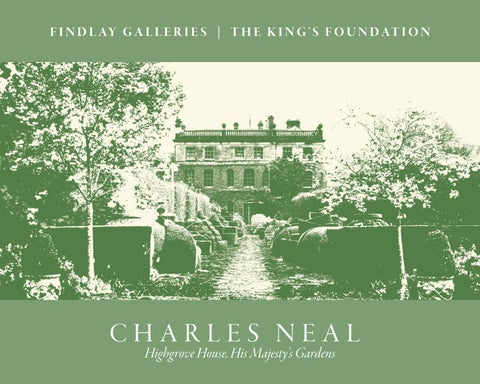
F I N D L AY G A L L E R I E S | T H E K I N G ’ S F O U N D AT I O N
CHARLES NEAL Highgrove House, His Majesty’s Gardens
1
Findlay Galleries is proud to support The King’s Foundation America, Inc. With every painting purchased from this exhibition 20% of proceeds from the sale of works in this exhibition will be a tax-deductible donation paid directly to the foundation. (Applicable until April 30, 2025) The King’s Foundation America, Inc is registered as a 501(c)(3) non-profit organization. Contributions to The King’s Foundation America, Inc. are a tax deductible to the extent permitted by law. 1600 Bausch & Lomb Place, Rochester, NY 14604 | EIN 61-2055366
2
E S T.
1870
F I N D L AY G A L L E R I E S T H TR HE R EE E C CE ENN TT U U RR I I E ES S I NI NA R AT R T
CHARLES NEAL C O N T E M P O R A R Y
B R I T I S H
I M P R E S S I O N I S T
Highgrove House, His Majesty’s Gardens
165 worth avenue , palm be ach, florida 33480 • (561) 655-2090
32 e ast 57 th street, 2 nd floor , ne w york , ne w york 10022 • (212) 421-5390
W W W.FINDL AYG A LLER IES.COM
3
INSIDE PHOTOGRA
1
APH SPREAD
2
TO BE EDITED
3
My wife and I are delighted with the outcome of Charles Neal’s exhibition, The Spirit of Belvoir, which depicts the cherished views of Belvoir Castle. We are very grateful to the Findlay Galleries and Jimmy Borynack for staging this fundraising exhibition in aid of the American Friends of Belvoir Castle Foundation. This will help enormously with the ongoing restoration, conservation and educational needs to ensure the future of my family home, Belvoir Castle, for future generations. We hope to welcome many more visitors, including you, to our home over the coming summer season or whenever you might find yourselves in England.
TO BE EDITED
4
Charles Neal - Introduction The first Painted Garden exhibition was a collection of works I had put together as an exhibition celebrating Rosemary Verey’s garden at Barnsley, Gloucestershire and was presented by Astley House Fine Art. His Majesty, The King ( then HRH the Prince of Wales) kindly opened the exhibition in May 1994, which was also attended by Rosemary Verey at the Museum of Garden History, Lambeth, London, in support of the Museum. The painted garden theme has continued to celebrate prominent gardens in Britain. Over the past thirty years, it has included various gardens in France, Italy and the USA, including The Painted Garden at Highgrove House, His Majesty’s Garden collection. From the outset and subsequent Painted Garden collections, the emphasis has been on exploring and depicting the relationship of owners of gardens and society with nature by participating as cocreators through gardening and engagement with the land. Each collection has sought to express the particular and unique narrative of the garden by interpreting the process initially as abstract thought, through vision, to the actualization of those intentions. Each garden can be realized as a manifestation of creative expression borne out of philosophical and spiritual perspectives. The Painted Garden Highgrove is an interpretation of the gardens within the estate created by collective advisers along with His Majesty’s ideas, plans and underlying philosophical viewpoint of life and its relationship to the natural world. The creator of a garden, particularly over a long time of engagement, is an everevolving process and a personal journey resulting in a transient created space. Effectively, this collection is an internalization of the created spaces and their ambiance, which I responded to in new terms of reference and visual language.
5
The overall approach to compositional narrative portrays the philosophical and spiritual emphasis, wherein particular spaces within the gardens are painted as distinct themes by focusing on their uniqueness. The Terrace Garden, Kitchen Garden, Lily Pool Garden and Carpet Garden have a common element in the form of water sources. In each case, the movement of water is a central dynamic. Water is presented as a slow, constant, quiet source, which can be seen as a spiritual symbol of constant replenishment to life. The peaceful sound and its constancy of flow affect a source of reassurance in life, giving power and energy. In each of these garden designs, the layout radiates from the central element of a water source. This pattern represents a symbolic manifestation of the emanation from Divinity, the ‘Undisclosed One.’ It is similarly depicted in the Rose Window designs of the great Medieval Cathedrals of Europe and equally in the Eastern Faiths in the form of a Mandala, an abstract formulation. The planet and its present and future state depend to a greater degree on whether human thought is constructive and sympathetic or destructive and dismissive of nature and our inextricable relationship with the earth. In each garden, His Majesty the King expresses His alignment with nature through nature-related object metaphors rather than highly stylized forms of expression within the garden themes. The experience of the gardens at Highgrove and, hence, the overall ambiance of the estate leaves one with a distinct sense that the creator of Highgrove’s gardens has a deep connection and holistic view of the natural world, along with its rhythms and sacred being.
6
7
8
9
A Message from James R. Borynack & Adolfo Zaralegui We at Findlay Galleries are privileged to host The King’s Foundation as we unveil an extraordinary collection of commissioned paintings of Highgrove House and Gardens by the contemporary British Impressionist, Charles Neal. This distinguished collection has evolved through various phases, beautifully capturing the enchanting and historic vistas of His Majesty King Charles III’s private residence and its esteemed gardens. Notably, Charles Neal holds the honor of being the first artist granted permission to portray the breathtaking beauty of this remarkable estate’s gardens and landscape architecture.
We are truly honored to support these remarkable endeavors by hosting the Benefit Exhibition of Charles Neal’s collection, “Highgrove House, His Majesty’s Gardens,” which will be exhibited at our Palm Beach galleries.
As the premier sponsor of The King’s Foundation Inaugural Palm Beach event, we take immense pride in supporting the Foundation’s mission to foster sustainable communities and transform lives through innovative place-making projects and educational programs. His Majesty The King serves as the Royal Founding President, having established the charity in 1990 during his tenure as Prince of Wales. Among the notable initiatives is The Snowdon School of Furniture, founded by Lord Snowdon and now housed within Highgrove Gardens. This school is dedicated to the art of furniture making and hosts a summer school program, further enriching the legacy of the Foundation.
James R. Borynack Chairman & CEO Wally Findlay Galleries International, Inc.
Adolfo Zaralegui President & COO Findlay Galleries, Inc. 10
The Front Facade The approach from the main entrance frames the house with a soft appearance. There is a romantic mix of Georgian neo-classical styled architecture and the mantel of nature in colorful purple Vine –Vitis Coignetiae, Golden-variegated Ivies, and Jasminum Officinale are wrapped around the facades and visually extend into the surrounding gardens. The juxtaposition of geometric expression and the free form of nature are complementary. The softness of bounding foliage and the afternoon casting of shadows add to the early autumn ambiance and a sense of passing time.
11
Highgrove House, The Front Facade En plein air - Afternoon light | oil on panel | 20 x 30 in. | FG© 141683 12
The Rose Pergola The Rose Pergola, with its verticals of spaced stone pillars, provides the perfect compositional framing for the view towards the distant Cottage Garden and adjacent Mediterranean Garden. This allows for the consideration of sub-compositions within the overall picture plane. Painting into the light adds dynamism as the elements of gardens are etched out, thereby creating a series of stages. The play of light on the stone slabs adds to the dance of transient sunlight, whilst the colorful planting of borders is in their brilliance. There is a sense of completeness in the design and play with nature.
13
The Mediterranean Garden from the Rose Pergola En plein air - Afternoon Light | oil on panel | 20 x 30 in. | FG© 141668 14
"After gazing for many years at the patterns and colors of one of the small Turkish carpets in my room at Highgrove, I couldn't help feeling what fun it would be to use those patterns and colors to create a theme for a garden. The challenge would be to see if you could almost create the effect of being within the carpet."
– His Majesty King Charles, III, Highgrove: A Garden Celebrated
The Carpet Garden Afternoon Light oil on canvas | 32 x 48 in. FG© 141685
15
16
The Carpet Garden The inspiration to realize an Islamic Garden at Highgrove came from His Majesty the King, who adapted the design of two Persian carpets at Highgrove and transposed the shapes and motifs into a living garden. The garden is unique in its interpretation of a Paradise Garden, achieving the experience of being within a sacred enclosure. The composition explores the garden’s ambiance in late morning and afternoon light. In all aspects of light and seasons, walking through the Moorish Doorway, the garden invites visitors to experience the spiritual world beyond the veil of the sensory world. The Islamic walled garden style (developed from the ninth-century) is a representation of Heaven as an enclosed space separated from the material world, mirroring the image or state of being on earth of an archetypal reality of paradise. As the central element of the garden, the water feature symbolizes the source of creation, spiritual sustenance, and rejuvenation emanating from the undisclosed Divine Consciousness. The Paradise Garden was equally expressed in medieval Europe as ‘Hortus Conclusus’ or ‘Enclosed Garden’. 17
18
The Carpet Garden Late Morning Light oil on canvas | 32 x 48 in. FG© 141686
19
20
The Sundial Garden The concepts for the Sundial Garden have changed over time. Initially, it was designed as a rose garden, according to the advice of influential garden designer Lady Salisbury. However, new ideas for the layout and planting schemes have revised this space and its ambiance. Central to the narrative is the sense of passing time being measured and marked by the sundial’s transient cast shadows. The bounded garden visually breaks out through the decorative gates to other rhythms of light and seasonal changes being a reminder that all is held in a moment before the birth of a new moment.
21
The Sundial Garden En plein air - Morning Light - View to the Meadow | oil on panel | 20 x 30 in. | FG© 141669 22
The Sundial Garden Here the north border is planted with striking Lilies with a backdrop haze of Hydrangeas in soft colors, interspersed with bright strong colors and adding to the vibrant setting. Bounding topiary provides structure to a suspended array of floating colors. Within a few days the Lilies disappear thereby reinforcing the notion of transient time.
23
The Sundial Garden En plein air - Morning Light | oil on panel | 16 x 30 in. | FG© 141670 24
The private Sanctuary of His Majesty the King is a retreat for contemplation and spiritual reflection, a place envisioned by the King. Set within the Arboretum and surrounded by nature in all its seasonal garments, the building invites a feeling of total connectivity. This aspect of sacred manifestation through the sacred ground and humankind acts as a mirror of Divine Creation. This ‘A lter–Realist’ composition combines the structure of the Sanctuary with its spiritual purpose and surrounding transient nature as one presence. The doorway’s interior illumination alludes to the Sanctuary’s sanctified space, created by the integrated light through the two stained glass windows seen from the east side. I then reconfigured it to form a mandala that also relates to the stone inset mandala on the entrance ground space.
The Sanctuary - Sacred Ground Alter Realism - Afternoon Light oil on canvas | 30 x 40 in. FG© 141691 25
The stone pillars dissolve towards the ground, suggesting that whatever form, all is one and reduces to elemental light energy– the light radiating forth from the doorway. The inscription carved on the lintel (Lighten Our Darkness We Beseech Thee, O Lord) is an excerpt from the third evening Collet, ‘for aid against all perils’; it reminds us of our human condition and actions and that we are collectively an integral part of the Universe and its dynamics. The Sanctuary is based on sacred geometry, was devised by Professor Keith Critchlow and created from a design by Charles Morris. It is a clay-lump construction in the cob building tradition made of subsoil, chalk and chopped straw.
26
The Terrace Garden The Terrace Garden collection explores and responds to the created ambiance. Adjacent to the west-facing aspect of the house, the garden has an intimacy to its space and can be seen as an extension of the house interior through the open French doors (an interior philosophy and outward expression through nature). With its relaxed planting, the Terrace hints at southern French gardens yet incorporates the Cotswold country natural style. The distinctive and central water feature is the pond, which is made of old millstone. Surrounding it are pebbles that have become the habitat for nature, with fish, insects, small mammals and birds all taking advantage of the water source. The west orientation affords full advantage of the tracking sun throughout the day. The early morning light from the east to the setting sun in the evening, where the view of the Thyme Walk is etched out in excellent perspective. More than anywhere else, the Terrace Garden visually articulates a very personal expression of feeling and vision of the collective interrelation of the world in all its aspects of being.
27
The Terrace Garden En plein air - Morning Light - View to the French Doors | oil on panel | 20 x 30 in. | FG© 141671 28
29
The Terrace Garden En plein air - Morning Light | oil on panel | 20 x 30 in. | FG© 141672 30
The Kitchen Garden The Kitchen Garden, enclosed in original Eighteenth-Century walls, is laid out as a decorative potager. The patterns are based on intricate seventeenth-century designs, and the arrangement of herbs, fruits and flowers produces a garden of delights. Periodically, whilst painting this view, a pigeon would alight on the same pinnacle, which is a wonderful example of coexisting rhythms and claims by nature
31
The Kitchen Garden En plein air - Morning Light - The Open Door | oil on panel | 20 x 30 in. | FG© 141675 32
The Kitchen Garden The garden is centered with an ornate two-tier pedestal water feature set in a lily pond, with the garden layout radiating outwards. Over time, the gradual building up of the moss has changed the stylized Italian fountain into a more organic form. Birds and insects drink from the ever-present water source that, through its silence, replenishes all that are refreshed by it.
33
The Kitchen Garden En plein air - Morning Light - The Central Avenue SE | oil on panel | 20 x 30 in. | FG© 141676 34
The Kitchen Garden The garden is centered with an ornate two-tier pedestal water feature set in a lily pond, with the garden layout radiating outwards. Over time, the gradual building up of the moss has changed the stylized Italian fountain into a more organic form. Birds and insects drink from the ever-present water source that, through its silence, replenishes all that are refreshed by it. Periodically, whilst painting this view, a pigeon would alight on the same pinnacle, which is a wonderful example of coexisting rhythms and claims by nature
35
The Kitchen Garden En plein air - Afternoon Light - Central Avenue NW | oil on panel | 20 x 30 in. | FG© 141674 36
The Cottage Garden The original Cottage Garden was created under the guidance of Rosemary Verey, a renowned plantswoman at the time known for her distinctive approach to soft borders and high-key color arrangements. The garden space emphasizes nature and the country style with a sense of the Cotswolds. The oak summer house, made from local oak, appears to grow out of the soil, much like the Cotswold villages, which are perceived as having been built from Cotswold stone fashioned directly from the earth. Within the summer house is placed a wooden seat, again with connections to natural materials formed through human design. The lawn winds its route along the garden, creating a sense of unfolding mystery to adjoining gardens yet to be experienced.
37
The Cottage Garden En plein air - Afternoon Light - Central Avenue | oil on panel | 20 x 30 in. | FG© 141677 38
The Lily Pond Garden The Lily Pool Garden is a highly stylized garden centered on a quatrefoil-shaped water feature that introduces water to the surrounding lower pool. Albeit the garden was created in a Mediterranean style, the metal working and finish to the water feature could relate to the Arts and Craft Movement. The four outflows can be seen as the four directional compass points or ‘the Four Winds.’ The mirrored water surface connects sky and land through reflections which constantly create an ever-changing magical sense. The view looks towards the west elevation of the house, and the perspective is just off-center. Throughout painting at Highgrove, the resident pigeons would alight on an element of the scene. Here, a pigeon drinks from the pool, further adding to the narrative.
The Lily Pond Garden Afternoon Light - View to the Thyme Walk oil on canvas | 40 x 60 in. FG© 141687 39
40
The Arboretum Alter Realist The Daughters of Odessa - The Pathway oil on canvas | 30 x 60 in. FG© 141687 41
42
The Arboretum (pages 41-2) is portrayed as an ‘A lter Realist’ composition depicting an adaption of the ‘Daughters of Odessa’ sculpture set within the colorful ambient beauty of Japanese Acers and Rhododendrons. The ‘Pathway’ is my adaptation of the American sculptor Fredrick Hart’s original intention, as seen in the Arboretum. Here, the Daughters walk separately in search of a pathway to new future hope. One daughter ( the youngest) looks back on past events, and her pose could be interpreted as a gesture—‘Why?’ Another daughter leads and looks to a distant part of the Arboretum, where an outer gate is situated. ‘Daughters of Odessa’; also entitled ‘Martyrs of Modernism’, represents the lives of Anastasia, Tatania, Olga and Maria, the children of Tsar Nicholas II of Russia who were killed in the Bolshevik Revolution in 1918. As expressed by Frederick Hart: “The title ‘Martyrs of Modernism’ also alludes to the beautiful qualities of life; that is “To have Faith, Hope, the awareness in the power of beauty and have joy in the innocence around us, which seems to have faded in the 21st Century.” The Daughters of Odessa metaphorically represent faith, Hope, Innocence and Beauty. In a broader context, they can symbolize the free will to search for and live these qualities. 43
44
The Green Pool Goddess of the Woods oil on canvas | 30 x 60 in. FG© 141689
45
46
The structural assembly with the large, lush Gunnera Manicata and water outflows delivered from clam shells (recycled pieces from Edward VII’s gardens at Sandringham) surrounded by Spugna stones creates a sense of an ancient civilization, all supported with remnants of architectural elements from Hereford Cathedral, adding a medieval dimension and resulting in a dreamlike setting. The pool, decked with water lilies, is surrounded by varieties of hydrangeas, and the brilliant lime green duckweed further creates an otherworldly, mystical atmosphere. In visual terms, I introduced the Woodland Nymph (Goddess of the Wood—Spirit of Calm and Stillness), seated on one of the banks, looking at the beauty created in the changing morning sunlight while an ornamental crane drinks at the poolside. The Goddess of the Woods is located in the Stumpery and was sculpted by David Wynne (1926-2014). The Goddess of the Woods refers to archetypal forms such as Isis, Natura and Sophia, the Divine feminine aspect of Creation. Therefore, rather than depicted in solid form, she is seen as an ethereal spiritual being within the compositional narrative.
47
48
“Find Tongues in trees, books in running brooks, sermons in stone and good in everything’ that hidden until realized are the traces and fragments of history, affirmations of lives once lived and times past” – William Shakespeare, As You Like, 1599
The Green Pool Goddess of the Woods oil on canvas | 30 x 60 in. FG© 141689
49
50
RECOGNITIONS Photos and Media Charles Neal / The King’s Foundation
Catalogue Design James Muldoon / Findlay Galleries
Writing Charles Neal
51
Please contact our galleries for inquiries, acquisitions and consignments. Palm Beach
(561) 655-2090
palmbeach@findlayart.com 165 Worth Avenue
Palm Beach, Florida 33480
New York
(212) 421-5390
newyork@findlayart.com
32 East 57th Street, 2nd Floor
New York, New York 10022
w w w . f i n d l ay g a l l e r i e s . c o m
Copyright © March 2025, Wally Findlay Galleries International Inc. All rights reserved. No part of the images or text in this catalogue may be duplicated without permission of Findlay Galleries. Prices and availability of artwork featured in this catalogue are subject to change without notice.
52
E S T.
1870
F I N D L AY G A L L E R I E S T H R E E
53
C E N T U R I E S
I N
A R T