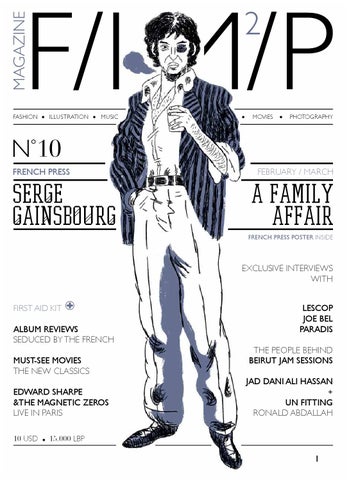
FASHION
ILLUSTRATION
MUSIC
FRENCH PRESS
MOVIES
PHOTOGRAPHY
FEBRUARY / MARCH
FRENCH PRESS POSTER INSIDE
EXCLUSIVE INTERVIEWS WITH FIRST AID KIT
ALBUM REVIEWS SEDUCED BY THE FRENCH MUST-SEE MOVIES THE NEW CLASSICS EDWARD SHARPE &THE MAGNETIC ZEROS LIVE IN PARIS 10 USD
LESCOP JOE BEL PARADIS THE PEOPLE BEHIND BEIRUT JAM SESSIONS JAD DANI ALI HASSAN + UN FITTING RONALD ABDALLAH
15.000 LBP
1
2
F/I/M²/P - FEBRUARY / MARCH 2014
3
4
F/I/M²/P - FEBRUARY / MARCH 2014
PARLEZ-VOUS LE FRANCAIS?
I
ISSUE N 10
t’s true what they say about the French: They’re rude, arrogant, cynical and stressed out of their berets. That being said, however, let’s keep in mind that no one’s perfect, really and that those who do veer close to perfection make for quite boring company. In fact, this goes to show that we should be thankful for the French and their flaws. Thank you. Thank you for being so far from perfect. Thank you, Gainsbourg. Your unmatchable arrogance and excessive personality have made of you one of the biggest French names of our time. Cheers to your obsession with love, women and sex and to your appetite for life. We should thank you for your addiction to alcohol and nicotine, your incessant nagging and difficult character; for every ridiculous word you ever dared say out loud and every public scandal you so easily brushed off; for your provocative nature and unidentifiable attitude, your “too-honest-for-your-own-good” candidness; for your madness; for your nerve. Without Gainsbar there would be no ‘Javanaise’, no ‘Chanson De Pervert’ and no ‘Black Trombonne’. We wouldn’t listen to his ‘Requiem Pour Un Con’ with complete awe and admiration. We wouldn’t smile to Bardot and her ‘Comic Strip’ and France Gall’s ‘Poupées De Cire’, Elisa would be a name with no melody ... It is thanks to Mr. Gainsbourg that we got to know Jane Birkin and still gawk at her grace to this day, that we can’t help but feel Serge’s energy whenever we think of Charlotte. His faults are what make us love him, or hate him for that matter, but never feel indifferent towards him. What other imperfection should we be thankful for? The exoticism of YSL, the negativism of Benjamin Biolay, the “spiritual” absurdity of Sebastien Tellier, the lunacy of -M- (Matthieu Chedid), Funès’ humour, Coco Chanel, Truffault, Godard and his “nouvelle vague”, Dior, Paradis (at 16 and today), Lou Garrel, Claude Monet … I could go on for hours but you get the point. This is an homage to this exuberance and these faults that reign high atop the culture, the music and the cinema that create this aura around France and Paris, and make them so aesthetically god-like. Welcome to your crash course on French Culture, enjoy your journey and our complimentary French press coffee!
Cathy.
GUEST
EDITOR’S LETTER PHOTOGRAPHS OF CATHY FRANGIE PLAYING AROUND WITH AN ‘M’ (MATTHIEU CHEDID) MASK
OUR GUEST EDITOR CATHY FRANGIE HELPS US SHAPE AN ISSUE TO GUIDE YOU THROUGH THE “LES MUSTS” OF FRENCH CULTURE, BOTH HERS AND OURS.
5
COVER STORY GAINSBOURG 47 FRENCH ROYALTY COVER STORY ILLUSTRATIONS BY RAMI TANNOUS ARTICLE BY PAMELA KARAM & FLORENCE THIREAU
OUR PEOPLE EDITORS IN CHIEF / CREATIVE DIRECTORs Rudy shaheen & MOHAMAD ABDOUNI MANAGING PARTNER FATIMA M. EL MARINI BUSINESS DEVELOPMENT MANAGER krystel kouyoumdjis ASSOCIATE EDITOR KARL HITTI FASHION EDITOR CHARLES HADDAD GUEST EDITOR CATHY FRANGIE RESPONSIBLE DIRECTOR LAMIS KHAWAJA EXHIBITING PHOTOGRAPHER CAROLINE TABET EXHIBITING ILLUSTRATOR JOELLE ACHKAR
FOR UPDATES, NEWS & ADDITIONAL CONTENT
CONTRIBUTING PHOTOGRAPHERS CLARA ABI NADER Grégoire Le Du JINANE CHAAYA RAMI HAJJ ANTOINE CARLIER Cédric Viollet OLIVER MOHR JENNY BRAUER CONTRIBUTING ILLUSTRATORS OTHMAN SELMI SAEED ABU-JABER IMAD GEBRAYEL CARLA HABIB JOSEPH KAI KAMAL HAKIM CYNTHIA MERHEJ MICHEL KARSOUNY BENOIT DEBBANE JOY FAYAD TANIA KHAZZAKA EXHIBITING FASHION DESIGNER RONALD ABDALLAH CONTRIBUTING WRITERS CATHY FRANGIE CLARA ABI NADER FLORENCE THIREAU NISRINE NAJEM SERGE KALDANY SERENA EL HADDAD STEPHANIE KOYESS PAMELA KARAM ANDY ASHJIAN KARIM ABOU ZAKI MICHELLE WAZAN
6
F/I/M²/P - FEBRUARY / MARCH 2014
A LA CARTE FASHION
52 PARADIS // INTERVIEW AFTER-HOURS
09 THE FASHION ARTICLE C’EST À LA MODE, GURL
A VERY SPECIAL “MERCI BEAUCOUP” TO MS. NATHALIE, “LA TRÈS BELLE” MODEL
60 RONALD ABDALLAH UN FITTING
ILLUSTRATION 80 JOELLE ACHKAR EXHIBITING ILLUSTRATOR
MUSIC
34 BEIRUT JAM SESSIONS // INTERVIEW THE BRADY BUNCH KIDS
20 NOUVELLE VAGUE THE STORY BEHIND THE COVERS 78 MYLENE FARMER TO EACH THEIR MADONNA
14 JOE BEL // INTERVIEW STRIPPED & ACOUSTIC
MOVIES
FEATURES
16 JAD DANI ALI HASSAN // INTERVIEW “TASHBI7”
22 MINUS 1 A CULTURAL SPACE UNDER THE HEART OF BEIRUT
55 GENERATION GAP
94 MOVIE REVIEWS 90 ALBUM REVIEWS 50 LOUIS DE FUNÈS RABBI JACOB
100 LIVE REVIEW EDWARD SHARPE LIVE IN PARIS 98 SOUNDTRACK REVIEW LE VOYAGE DANS LA LUNE
REGULARS 18 THE BLOGGER
PHOTOGRAPHY 102 THE MIXTAPE 26 CAROLINE TABET EXHIBITING PHOTOGRAPHER
24 LESCOP // INTERVIEW ICE POP AT ITS BEST
7
SUBSCRIBE WWW.ANTOINEONLINE.COM SIX ISSUES A YEAR FOR THE PRICE OF FIVE
CONTACT US If you have any questions or comments If you are a stockist and would like to carry our publication If you would like to submit your work email us at info@fimp-mag.com Printed in Beirut WWW.FIMP-MAG.COM
8
F/I/M²/P - FEBRUARY / MARCH 2014
ARTICLE BY CHARLES HADDAD
ILLUSTRATIONS BY OTHMAN SELMI
Every decade in fashion history has had its “Eureka!� moments and sometimes if we are lucky enough we get more than one. It just so happens that most of those moments had one thing in common; Paris. That city has given us so much, from Amelie to stinky cheese, but most importantly it gave us FASHION. We wake up in the morning and throw on a sweater and a pair of jeans rather than a corset, thank you Frenchies. Unless your name is Dita Von Teese of course, then OMG WE LOVE YOU. Excuse our fan-girl moment, now hop onto our Parisian tour bus and fasten your seat belts as we take a little stroll down La Rue de fashion monuments.
9
COCO CHANEL
10
F/I/M²/P - FEBRUARY / MARCH 2014
FASHION ARTICLE: A QUICK LESSON IN FRENCH FASHION HISTORY
W
e begin our journey at atelier Paul Poiret nicknamed “Le Magnifique” which we believe is French for badass designer dude. Stop rummaging through your brain, no he is not showing at Paris Fashion Week; It is a shame his label did not live on, however this man is considered the first couturier to utilize the technique of draping rather than traditional techniques of construction. Therefore he was one of the first who liberated women from the horror of boning and grommets. Instead he introduced his exotic geisha like kimono coats, flowing harem pantaloons, hobble skirts and the neoclassical empire line; refiguring a woman’s body. The 1910s belonged to him, but a decade later we saw a shift in trends. The look of the time was the “garçonne” look, also known as the flapper style. Popularized by the likes of Jean Patou, Jeanne Lanvin and Coco Chanel, who were the first to introduce the idea of sportswear into a woman’s wardrobe. We doubt that Mademoiselle Chanel needs any introduction, her name is synonymous with her signature tweed suit, a boxy cut jacket with braided passementerie paired with a matching pencil skirt, along with being a pioneer with jersey knits, costume jewelry, the little black dress and of course the number one selling perfume in history. Jump ten years ahead, the 1930s were a monumental decade for fashion. A woman by the name of Madeleine Vionnet was one of the first to challenge the corset. She once said “A woman’s muscles are the best corset one could imagine”. Well she must have had one hell of a personal trainer…just saying. This lead to one of the greatest inventions in fashion history; the bias cut. She single handedly created a new way of dressmaking. The 45 degree angle of a woven cloth creates a stretch that one can only achieve at that angle. She wrapped and twisted the body with beautiful textiles with little to no inner construction. A true master of cut, and an architectural dressmaker, with a logical mind to understand that there is a body in between the front and back of a garment. This was around the same time that Madame Grès, was making quite the stir with her incredibly draped and pleated frocks. She has no doubt created some of the most beautifully intricate couture pieces that the industry has ever seen. She and her best friend Silk Jersey would wrap around her clients’ body, ruching and tucking until she compressed every inch away. A few years down the road, its 1947 the French industry is dwindling but leave it to Mr. Dior to revolutionize and revive. All it took was a wasp-waisted, silk-shantung bar jacket paired with a 25 yard black circle skirt that whipped fashion back into shape. They called it “The New Look”, a style that evoked the belle époque when the female figure was celebrated for its hourglass silhouette. However Mr. Dior had some fierce competition; Two colleagues by the names of Hubert de Givenchy and his mentor Cristobal Balenciaga. Both rejected the body conscious
silhouette with sack dresses, and cocoon coats that stood away from the body. Hubert de Givenchy had quite the impact with his debut collection presented in 1952 of woman’s separates. He was the first to introduce the idea of a high-end ready to wear line. Dressing the likes of his bestie/muse one little miss Audrey Hepburn on and off screen. The infamous little black dress in Breakfast at Tiffany’s made headlines and secured his name in the fashion hall of fame. There was a lot of give and take between him and Mr. Balenciaga, someone he considered a mentor, companion and idol. Cristobal Balenciaga was known for his architectural approach to dressmaking; an expert tailor respected for his unflinching eye and technique. He therefore took Hubert under his wing and simultaneously crafted and created. Then came along Mr. Dior’s successor a tall skinny Yves Saint Laurent, who was shamed for attempting to modernize the house’s DNA. Fear not; he opened shop in 1962, under his own name and the rest was history. Thanks must be offered to his partner in crime Pierre Bergé who was his Mount Everest. Remember that little shift dress with primary color blocking, that little nod to Mondrian? Yeah, remember that one? That gangster inspired men’s suit fit for a gentlewoman, “Le Smoking” yeah, ring a bell? A visionary, a fearless risk taker, breaking molds and making new ones, simply known as YSL. Then along came the glorious eighties, oh how we love you so. The decade of the power bitch, thanks to the likes of French maverick Thierry Mugler. A designer who epitomized theatrical fashion with his overly sexual, body modifying creations. From dominatrixes and aliens, to motorcycle chicks all in waist cinching corsetry, protruding shoulder pads and the occasional handle bars with side mirrors. Another nod must go to the original “l’enfant terrible” Mr. Jean Paul Gaultier and his “underwear as outerwear” take on clothing. Like, why not dress the material girl in a cone bra, right? Lets not forget his years of manipulating the trench, his nautical stripes and gender bending creations. Nor should we forget about his peer at the time, a couturier in every sense of the word; Christian Lacroix. After his stint at Jean Patou he moved on to open his own shop and slapped Couture silly. His eye for color and his textile manipulation brought him to the front of the line which forced the industry to sit and watch closely. It is evident that this man came from a background in historical costume. He had an interesting formula: take an 18th century crinoline, some macrame, a little tribal textiles, a vintage Le Sage embroidery, throw in a pinch of folklore, stir away and voila LACROIX! Well kids, here is where we get off, and we hope that this was as enlightening for you as it was entertaining for us. The next time you try to put together an outfit, know that once upon a time someone did something significant for you to have the clothes you wear today. Now watch your step and kindly get off this bus cause it’s a rental. A bientôt yo. - (F)
11
CHRISTIAN DIOR JEAN PAUL GAULTIER
12
F/I/M²/P - FEBRUARY / MARCH 2014
YVES SAINT LAURENT
CHRISTIAN LACROIX
13
INTERVIEW: JOE BEL // STRIPPED & ACOUSTIC
JOE BEL
INTERVIEW BY KARL HITTI PHOTOGRAPH BY GRÉGOIRE LE DU
WHAT’S A GIRL TO DO? WELL, IN JOE’S CASE, THAT WOULD BE DROP OUT OF COLLEGE AND CHOOSE TO PURSUE MUSIC AS A FULL TIME VOCATION. BALLS-Y MOVE, GIVEN THAT SHE’S IN A LONG LINE OF PEOPLE WHO HAVE BEATEN HER TO THE PUNCH AND BEEN DOING SO FOR YEARS! SO WHAT IS IT THAT MAKES HER STAND OUT? WE HAD A LITTLE CHAT WITH HER ...
LIGHTNING ROUND // FRENCH KISS OR FRENCH PRESS BOTH! // ‘RECKONING SONG (ONE DAY)’, THE ORIGINAL MIX OR WANKELMUT REMIX ORIGINAL, DEFINITELY // RED HAIR OR RED VELVET CAKE RED HAIR // PARIS HILTON OR PARIS JACKSON WELL, PARIS JACKSON // JOE JONAS OR JOE JACKSON JOE JACKSON! LOVE HIS MUSIC! // LORIE OR LOANNA I DON’T KNOW // SERGE GAINSBOURG OR CHARLOTTE GAINSBOURG SERGE // CARLA BRUNI OR BRUNO MARS I LIKE BRUNO MARS’ VOICE BETTER // FRANÇOIS HOLLANDE OR SAUCE HOLLANDAISE BOTH // SKINNY JEANS OR BRITNEY JEAN I DID NOT LISTEN TO HER ALBUM SO I’D SAY SKINNY JEANS // CROISSANT OR CRONUTS TRADITIONNAL CROISSANT
14
F/I/M²/P - FEBRUARY / MARCH 2014
Is it true that you dropped out of a Master PROGRAM in History of Arts in order to pursue music? That would mean that you weren’t sure about this direction all along! What caused you to change your mind? I always wrote songs and I’ve always been singing them, but only for myself… I think I did not need to share them before. I was rather interested in making them. But it took more and more space in my head. I was obsessed by these ideas, these words, these melodies… So I decided to stop everything else when I felt it was an emergency. We’d describe your music as being groove folk with some jazzy suave elements. How would you define your musical style? It’s quite difficult for me to define it, I would say it’s Pop music with shades of Soul, Afro, Folk… Warm things. But I never planned to make this kind of music, I mean, it’s just what I do! You come from Grenoble, so essentially, you are an all French girl. What drove you to write your music in English? Does that make you feel like it would have a wider reach? English is just my second language, since I have an American family. I never think about the result before making my songs. I hope it will continue that way; I don’t want to wonder about who I reach or anything else… I only concentrate on what I need to express. It’s quite a selfish thing actually! I do that to feel good. Me first! But now that I share my songs and I see it can make people feel good too, I feel even better. Name 5 artists that define the type of music you listen to.
an opening act, people are always kind. I only suffered sometimes because I’m clumsy and I forget to turn my guitar on, or because I spill water on stage… People I work with are always like “oh no, don’t give her a bottle of water, she’s dangerous!” Seeing that we have mentioned Asaf Avidan, they had a pretty big hit with ‘Reckoning Song’ but as the Wankelmut remix. How would you feel if one of your singles wERE to become a huge hit? But there’s a catch! It was in the shape of a club thumping remix. Ha ha! I guess I would be proud of my song and jealous at the same time because it’s another version that people listen to! I know Asaf Avidan doesn’t like this remix that much, and I can understand that… A lot of people think that is the music he actually does. When you make a song, everything has sense; the music speaks, not only the words. If you change the music, you send another message. It must be weird to hear your voice on music you did not write and that says something different. There has been a rise in alternative music on the mainstream charts in the past months. Does this give you hope for an easier breakthrough or is the mainstream something that you don’t look forward to? Of course, I would be happy if my songs were listened to by a lot of people ! But it’s not something that matters when I DO things. I don’t think about that. To me it’s not something possible, I’m always thinking “It can’t happen to me”. So I focus on what’s important to me: songs, music, singing, playing… expressing myself and trying to enjoy it !
I would say : Stevie Wonder, Paul Mc Cartney, Fela Kuti, Manu Chao and Flavia Coehlo.
In ‘Stronger’ you sing about a partner that seems to break down and depend on you a lot, this ends up destroying your relationship. As an independent women in today’s concrete world what is it you really look for in a partner?
Through the magic of internet we’ve seen you playing the guitar and synthesizer, what other instruments have you mastered / are there any instruments that you don’t master?
Honesty. With him or herself first. That’s what I say in this song. If you’re not honest with yourself, you can’t be honest with the one you love and you can’t make things last long and be deep and strong. Plus, you can’t really help each other...
I play guitar, piano, synths, and I work a lot with computers to compose my music and I write all the parts. Then a real bass player and a real drummer come to play them on stage or in studio.
Your debut EP In The City, although mostly acoustic still has a strong neat production that holds it together, do you plan on keeping the same sound when recording your debut album? What are your future plans for this coming year?
You’ve been on tour with the likes of Asaf Avidan and Corneille to name a few, have you had any time for yourself with this constant moving around? Would you mind sharing a funny story that you fell victim to as an opening act? I don’t have much time for myself but I try! I was able to rest a bit last summer. Thankfully, I never suffered that much from being
I write my music for several instruments, and I’d like my album to still be simple, but with more aspects of who I am. The beat, the bass lines and little keyboards are very important in my work. So this year will be all about recording and playing on stage with these instruments, but keeping it simple and true. - (M)
15
FILMMAKER: JAD DANI ALI HASSAN
INTERVIEW BY CLARA ABI NADER PHOTOGRAPH BY JINANE CHAAYA
What inspired you to write such a movie about sexual orientation and its place in a relationship between siblings? Was it based on personal experience, a story you were once told or pure fiction? Share with us more about the movie and what went on behind writing the story. A few years back, a good friend of mine discovered that his sister was gay, and even though he had no ethical issue with the matter, the news shocked him severely mainly because she did not trust him with the truth. I remember him saying “I wish my sister were dead”, again not because of her sexual orientation but because he felt betrayed by her lack of trust: as if everything he thought he knew about his sister was now being questioned. At that moment, I imagined how he would react to news of her actually dying and I started comparing the common points between the different stages of grief and stages of acceptance to such news. When unexpected, both situations involve “shock/denial; guilt; anger; acceptance, and finally reconcilation”. I wanted to write a film in which the main character, who by hallucinating his brother’s presence, would finally learn to make peace with the unexpected news of his brother’s sexuality as well as his unexpected death. Apart from the two protagonists, the two brothers, there is the omnipresent third character. Who, or what does he represent? How essential is his role in understanding the full idea? I like to think that when two persons are having an argument and one is as stubborn as the other, there’s no way to resolve anything unless a third person is there to break the ice. This third character –portrayed by Fouad Yammine- adds an awkward humor and gives the other characters the chance to realize that playing the “misunderstood martyr” will never fix one’s issues. He’s essential to creating a different approach to the main plot. Tell us about the subtle music composition that follows the characters throughout the film? The film features a lot of long takes and a lot of dialogue and I wanted to tell this unrealistic story in a realistic way. To me, if music was to be present, it had to be diegetic (in this case, coming from a radio), and should only enhance the ghostly atmosphere of the film instead of adding drama or comedy. Also, since the two brothers’ conversation ends unexpectedly, I decided to insert a song that would give the viewer some time to recollect his thoughts and breathe a little. Do you believe you’ve achieved all you wanted out of the dialogue, or was it a big challenge to convey the message that you intended on transmitting to the audience? What I love about dialogues is that even when a film is extremely
16
F/I/M²/P - FEBRUARY / MARCH 2014
talkative, it’s what is NOT being said that has a stronger effect. When the character is lying, hiding something, avoiding/changing a subject etc. It expresses intention as well as character/attitude. “Message” seems like a big word, I wouldn’t really say that I have one. I really enjoy putting these characters and these situations on screen, after that, different messages are inevitably going to reach all sorts of people. I hope I’ve put enough words that can raise enough question marks and interests. The opening sequence is exquisite. Were there any scenes in specific that inspired it, scenes that you attempted at paying homage to? Or did you work straight from a white canvas? Thank you! I remember this scene taking a lot of energy from Tarek Yaacoub, the main actor. I’m not sure where the inspiration came from, but I’ve always had the habit of starting stories by jumping directly into the issue. I don’t like introducing characters before plot; I’d rather start directly with the problem and then slowly reveal who the characters are. The problem usually lies in opening up to the parents about one’s sexual orientation rather than to the brothers or sisters. Was there any social impact you were trying to make? I didn’t want to tackle the subject the obvious way. Two male brothers can be quite direct, sarcastic and even provocative in the most bizarre way. Brothers treat each other like equals, whereas parenthood is usually based on achieving this equality between parents and children. I wouldn’t say there’s a social impact, but the idea of brothers facing this situation opened more roads to humor and awkwardness while remaining touching and sensitive. What was the general reaction of viewers who have seen your movie? Did they relate or were they more stand-offish? As for every film ever made, there is always a bit of both. I’ve had people both insulting it and loving it for the same reasons. It’s fascinating how we can react to films, and I don’t categorize them as “good/bad responses”. Anything that can lead to a debate is worth talking about. What are some of your favorite film directors? I’m very inspired by American Cinema, especially Paul Thomas Anderson and Martin Scorsese… Brilliant storytellers! What about some of your favorite films? It’s easy for me to choose my favorite authors but not my favorite films… I like directors because I like the particular way they perceive film, but I don’t have to choose their films as my favorites, because when it comes down to it, I love the entire craft. - (M)
17
WRITTEN BY STEPHANIE KOYESS
365 blanc délicieuse musique gainsbourg family
18
F/I/M²/P - FEBRUARY / MARCH 2014
THE BLOGGER
365 blanc (365blanc.blogspot.com)
E
va Truffaut, is a French (saw that coming didn’t you?) visual artist, actress, and photographer. Born into a cinema-crazed family, with Francois Truffaut for a father, you could imagine the cultural nutrients of her upbringing. Her pictures are heartwrenching: grainy, hit with crude contrasts, subjected to long exposures, portraying ghost-like faces and urban sceneries all in unadorned black and white, just like we like them. And it’s only natural that her blog (one of many, and this one in occurrence) is also drenched in white. It’s a collection of artworks that appease and please the eye. But there is more to it than just a visual treat: it mostly proves that all essentials, like your go-to white tee or that little black dress, come in black and white. Thrown against a white backdrop, all the posts have white (or almost) backgrounds, and carry little black (or almost) elements, that make all the difference. Although simple, they provoke and are as essential as a quick laugh that makes your day better, as essential as a little quote that quickly snowballs into an existential dilemma (while sitting at your office desk), as essential as an impromptu gasp when your eyes cross a bizarre piece of art and as essential as a little visual silence that creates a physical one up in that messy box you call your head. Life essentials, in black and white (or almost). - (P)
délicieuse musique (DElicieusemusique.com)
T
his, we’ve been guarding secretly for far too long, enjoying it selfishly down to the very last crumbs. This, is where the delicious things are. This, is full of guilty pleasures you want to devour curled up in bed, while licking the remains to the bone. Delicious are French pastries; the one that crumbles, the one that crunches, the one that melts, the one that overwhelms your palate with a zesty cream. And delicious is this French music blog indeed. Délicieuse Musique’s selection is nothing short of your next door patissier’s window shop: A curation of a motley of musical delicacies by six French guys from Bordeaux. Calling on all your senses, the posts include gems filed under eight different musical genre: from Minimal and House music, to Pop and Hip-Hop. The time bracket however, is as loose as them “Moulin Rouge girls”. The blog puts young fresh talents at the front and reminds you of some forgotten dusty treasures, all the while keeping you up to speed with today’s hippest. The tracks and songs posted, are always pleasing, if not entrancing. But the best are definitely those of the artists they signed on their record label. Délicieuse Records, is the label they created due to the massive success of the website; delivering acts, such as the hypnotizing Parra for Cuva and Bakermat, that never ever fail to surprise and satiate. - (M)
gainsbourg family (Gainsbourgfamily.tumblr.com)
W
elcome to the life of the French equivalent of a Royal family. Their name, their aura, their peculiarities are all at the bottom of so many people’s obsession and infatuation with them. This Tumblr page will feed the biggest “baddest” voyeur in any of us with an entire family life depicted in pictures. But these are far from being the embarrassing photographs your grandma keeps on the fridge with those dolphin magnets, or the awkward family portraits haunting the living room since 1962, where everyone looks like they dressed up for Halloween. Theirs, are stunning family pictures you could only dream of calling your own. Scrolling through the images will suck you into a whirlpool. What makes it hard to look away? Well for one, Jane’s beauty and sensuality are so effortless and so overwhelming it hurts. That, against Serge’s unusual physique is, weirdly enough, incredibly appealing. Charlotte’s baby pictures will make you squeak due to the cuteness overload and there’s something in Kate’s eyes that is way too mature for the kid she was. If it were anyone else, some images such as the nude photographs of Jane and the girls, or the one of baby Charlotte holding a cigarette, would’ve had you frowning in disapproval. However they are of utmost charm and will leave you basking in the eccentricity and glamour that this iconic family embodies. - (P)
19
UNDER COVERS: NOUVELLE VAGUE
NOUVELLE VAGUE SOMETHING OLD, SOMETHING NEW, SOMETHING BORROWED AND SOMETHING BLUE ARTICLE BY MOHAMAD ABDOUNI
ILLUSTRATION BY SAEED ABU-JABER
IF YOU HAVE YET TO COME ACROSS A TUNE BY FRENCH COVER BAND NOUVELLE VAGUE, ALLOW US TO FORGE THE IMAGE THAT WILL FOREVER COME TO MIND WHEN YOU POP IN ONE OF THEIR RECORDS: SUMMER SUN, SANDY BEACHES, PRIVATE POOLS AND WHITE WINE.YOU WILL WANT NOTHING ELSE AS A BACKDROP TO YOUR SUNBATHING AFTERNOONS AND OILED BODIES; WHICH IS SURPRISING WHEN YOU CONSIDER THE NATURE OF THEIR CRAFT.
M
arc Collin and Olivier Libaux, the two men behind the project, originally set out to take on songs (not tracks, but songs) that were “hidden” within the arrangements and Punk energy of their time, and showcase the beautiful tunes, captivating lyrics and vocal melodies beneath the commotion of their original renditions. They’ve taken on the greats of Punk and New Wave and stripped them right down to their bare naked selves: The Clash, The Cure, Joy Division, The Cramps, Blondie, Billy Idol, Buzzcocks, Soft Cell … You name it, they’ve covered it – over the rhythms and beats of a 60’s Bossa Nova. As for the punch line, ladies and gents, it comes in the form of an all star cast of performers that redefined those classics in their own signature voices: The duo have garnered the aid of everyone from Nadeah to Camille, Julien Doré and Vanessa Paradis. They’ve even had Yelle sashay her way through Jad Wio’s ‘Ophelie’ (Yes, the song about Zoophilia) and effortlessly pass it on as a little treat to nibble on while enjoying your tea, wine or prescription meds; whatever makes your Sunday afternoon less cumbersome. Marc Collin, A.K.A. Ollano, Indurain, Volga Select and Suburbia, is a musical wonder that has lurked in the shadows, hiding behind these different aliases, for a good part of the past two decades. He has worked with the likes of Xavier Jamaux, Ivan Smagghe, Mélanie Pain and Helena Noguerra; releasing great records that have prevailed in the realms of New Wave, French Pop, film scores and even House music. A chance encounter at a friend’s place in 1998 led to Olivier Libaux playing guitar for Collin on a track off the soundtrack for Kidnappeurs: their first musical venture together. Mr. Libaux himself is far from being one to be taken lightly as well. He has released two exquisite solo records (with Helena, Katerine, Lio, Dominique Dalcan, Barbara Carlotti and JP Nataf), L’heroïne Au Bain and Imbécile, and played with the likes of Emilie Simon and Carla Bruni. Their first release as Nouvelle Vague (Nouvelle Vague, 2004) called on none other than French sweetheart Camille to bravely take on rough cuts such as ‘Guns of Brixton’ (The Clash), ‘In A Manner Of Speaking’ (Tuxedomoon) and ‘Making Plans For Nigel’ (XTC). Albeit there being standout tracks in their first collection, none compared to her cover of Dead Kennedy’s ‘Too Drunk To Fuck’. Having a young Camille coyly tumbling through and slurring her words as she chants incessantly “too drunk, too drunk, too drunk, too drunk to fuck” (while giggling none the less) gave the original hard-edged male-driven hit a whole new life and a completely different setting. Other standout tracks are Eloisia’s ‘Love Will Tear Us Apart’ (Joy
20
F/I/M²/P - FEBRUARY / MARCH 2014
Division) and ‘Just Can’t Get Enough’ (Depeche Mode), but to be fair, everyone’s contribution to the record is quite the joyful listen. As they prepped for the release of Bande A Part in 2006, they stuck with previous collaborators Mélanie Pain, Silja and Marina but also managed to get Gérald Toto (‘Heart Of Glass’, Blondie) and Phoebe Killdeer (‘Dancing With Myself’, Billy Idol) on board for several killer tracks covering Yazoo, Siouxsie And The Banshees, The Sound and A Certain Ratio. 2009 brought with it Nouvelle Vague’s third installment 3 (Also called NV3), in which they again stuck to a lineup of their previous collaborators while also having Ms. Nadeah Miranda join in on the fun for a few studio recordings (The Police’s ‘So Lonely’ and The Stranglers’ ‘Get A Grip On Yourself’). Almost a decade after their first release, Nouvelle Vague put out their “Pièce De Résistance”: a collection of all-French New Wave and Punk classics revisiting their own yesterday and calling on the who’s who of the contemporary French Pop scene. Let’s break it down, shall we? Couleurs Sur Paris (2010) has Coeur De Pirate doing Gamine, Vanessa Paradis duetting with Etienne Daho, Julien Doré toning down Elli et Jacno while Sako, Olivia Ruiz, Emily Loizeau and Cocoon take on Dogs, La Mano Negra, Noir Désir and Stephan Eicher. Once again, however, Camille takes to TC Matic’s crude ‘Putain, Putain’ (as she does to Dead Kennedys’ ‘Too Drunk To Fuck’ on the first release) and transforms it into a standout track, making it seems as light and fun as a day in the sun. There’s much merit to be handed to a project that has been able to maintain both quality and momentum while sidestepping the path of songwriting and original composition. Over the span of four albums, Nouvelle Vague has become a force to be reckoned with, a cover band to rule all other cover bands and we kid you not, music that will reign over your summers to come as well. Though they have been quite dormant these past few years, there’s still pleasure to find basking in Marc and Olivier’s similar yet separate side projects. Collin’s Hollywood, Mon Amour (2008) took the idea behind Nouvelle Vague and applied it to 80’s Hollywood movie theme songs while Libaux did the same on an album’s worth of Queens Of The Stone Age covers (Undercovered, 2013) with such names as Inara George, Emiliana Torrini and Alela Diane. Listen well, the next time you’re driving back home from a disappointing late summer night out … Nouvelle Vague - ‘Guns Of Brixton’. You can thank us later. - (M)
21
INTERVIEW: MINUS 1 // UNDER THE HEART OF BEIRUT
INTERVIEW BY THE PEOPLE BEHIND F/I/M2/P PHOTOGRAPH BY JINANE CHAAYA Nisrine Faddoul & FADY MANSOUR ARE SHAKING THINGS UP UNDERGROUND WITH THEIR NEW CULTURAL CONCEPT-SPACE, RIGHT UNDER THE HEART OF BEIRUT. THE DASHING DUO TAKE SOME TIME OFF THEIR BUSY PLANNING SCHEDULES TO HAVE A LITTLE CHAT WITH US.
Walk us through it, What is minus 1 EXACTLY? minus 1 is a progressive creative space and a platform for artistic and social endeavors; it aims to facilitate the production and dissemination of art by taking down social and financial barriers for artists and audiences. Located in an underground garage, minus 1 holds collective exhibitions for up-and-coming artists, offers a performance and workshop space for individuals and collectives and takes an active part in social campaigns.
HAVE THERE BEEN ANY PLEASANT SURPRISES TO OCCUR SO FAR WHILE YOU’VE BEEN WORKING ON THE PROJECT? There is joy in things on all different scales at minus 1; it’s delightful meeting so many talented and passionate individuals and also becoming part of larger cultural ecosystem. If there is any one thread I could single out as most pleasant, it would be the snowball effect that attracted all the amazing individuals and ideas along the way.
Now that minus 1 is a reality, is it exactly how you had imagined it would be?
The space is underground, hence the name. How has that both helped and challenged you?
minus 1 is mutable; it was conceived as a space whose form and function are contingent on its occupants and their works at any moment. The idea was of a space that would be a vehicle for creative and sociallyforward ideas and works. My initial idea for the space was a factory where I could design and sell furniture. Looking at minus 1 in its current form is very much like looking at a dream coming true.
The fact that minus 1 is underground makes it harder to spot or grasp. It is not easy for most to identify with the underground or to seek it. But this also makes minus 1 more desirable, more discreet and much more suitable for accommodation of different art forms.
Were there any challenges along the way? The very nature of the concept is challenging. minus 1 depends on the situational element more than anything else. Strategies, campaigns, and happenings emerge out of necessity and demand. At minus 1, we keep our fingers on the pulse of Beirut subcultures and try to partake in cultural dialogue. The nature of the work is both thrilling and challenging.
22
F/I/M²/P - FEBRUARY / MARCH 2014
you’VE travelled the world in preparation for minus 1. How has that affected and influenced the space itself? It should be mentioned that I have not traveled the world, but I would certainly love to do that. Of all the beautiful countries and journeys I’ve been on, I have acquired a real appreciation for the many different cultures beyond those of the Middle East and the democratization of arts. I am an avid believer in making art and cultural artifacts accessible. That’s what I bring from that to the space.
How does minus 1 stand out as a cultural space? What is unique about it? The non-corporate aspect, the simple procedures and regulations, the progressive works. These are things that make our minus 1 an anti-gallery, a place where art production and interaction are facilitated and encouraged. What are your views on the Lebanese Arts and culture scene today? The Lebanese cultural scene has always been vibrant; it attracts people from all backgrounds. The cultural ecosystem is very rich and complex and we hope the space that is minus 1 will be of benefit to it and of service to the different subcultures. If you had to pick one corner in minus 1 as your favorite, and one item, which would they be? My favorite corner would be the kitchen, which has a prominent Indian element. I can’t choose any one item. Where do you see minus 1 in 5 years? What is the mission you have set out to accomplish? The long-term goals are to establish the space as a reference point, an effective player in production and dissemination of arts, and a facilitator for artists and their works. It is beautiful to see how minus 1 has been attracting both women in fur coats and kids in ripped jeans. - (F/I/M2/P)
23
INTERVIEW: LESCOP // FRENCH ICE-POP AT ITS BEST
INTERVIEW BY CATHY FRANGIE PHOTOGRAPH BY ANTOINE CARLIER Mathieu Peudupin, THE MAN BEGIND LESCOP AND THE PRIDE AND JOY OF FRENCH POP NOIRE RECORDS GIVES US AN INSIGHT ON THIS, HIS NEW PROJECT PAST-ASYL, AS WELL AS THE RECORD AS A WHOLE AND WHAT IT HOPES TO ACHIEVE IN THE MIDST OF THE FRENCH MUSIC SCENE TODAY.
Why LESCOP? It doesn’t mean anything, this is just a name, it’s a very comon name in Brittany. How did it all begin and who’s behind the music? It all began with Johnny Hostile and me. We had wanted to work together for a very long time. He’s got a band called John & Jehn and I was a huge fan of their music. He offered to work on my solo album and I thought it was a wonderful idea, so we started to write songs together, then a friend, Gaël Etienne (ex- Koko Von Napoo), joined us and we were in fact three guys working on my solo album. What did you grow up listening to as a kid? Punk Rock bands like the Sex Pistols, The Damned and The Buzzcocks and 60’s stuff like The Doors; I’m a huge huge huge huge fan of Jim Morrison... Which French artist inspired you the most and which one still does to this day? A French punk band called Strychnine. I really love their violent energy and their lyrics
are amazing too, they are really a reference for me, even if my music is different. They’re so raw, so violent and so sincere - I love them. I’m also a big fan of Daniel Darc and his exband Taxi Girl, he died recently, that was terrible news, he was really inspiring, really talented and a wonderful person too; he’s the most talented French songwriter of all time, his lyrics are eternal... What is your favorite album and your favorite track of all time? Strange Days by The Doors!! Like every sensible person!! No? On your self-titled debut album, you seem to mention a bunch of countries and a lot of places: ‘La Nuit Americaine’, ‘Tokyo La Nuit’, ‘Paris s’endort’, ‘Ljubjana’, ‘Los Angeles’… Can you tell us more about it? Are those places you’ve been to, had experiences in and got inspired by for this Album? Well, I live in Paris, I love Ljubljana, it’s a beautiful city, very romantic where I spent an incredible week, this song is about that experience. And I also love L.A. and America.I am a huge fan of American movies like Gilda “I’M A HUGE FAN OF JIM MORRISON”
24
F/I/M²/P - FEBRUARY / MARCH 2014
and All About Eve, ‘La Nuit Américaine’ talks about that kind of Hollywood movies... But it’s also a reference to a 70’s French song by Yves Simon called ‘Au Pays Des Merveilles De Juliet’, great song, incredible.... I’ve never been to Tokyo, the song is about Yukio Mishima. Tell us more about your next record. Will it still have the same cold-Pop feel to it? When will it be released? Well that’s a very good question, I ask it to myself everyday!! But I don’t have the answer, let’s be patient.... ‘La Foret’ has been your most blogged about track so far. Could you tell us more about it? What was the inspiration behind it? It’s about murder! A girl meets a boy in a forest and kills him because of all the bad things he’s done to her! It’s a very feminist song actually... But it’s also about eroticism and all the violence we can find in love! What was it like touring and performing in France? Will you be performing in other territories anytime soon and maybe even sing in English? I don’t want to sing in English, everyone sings in English, crappy lyrics with a crappy accent, I don’t like crap, I like good songs, I couldn’t write and sing a good song in English... I love touring in France, I love the audience there, it’s a love story between me and them! But I also love to sing in other countries, and it’s very funny to sing in French in Germany or America, I feel like Maurice Chevalier hahaha!!! I wish I could sing everywhere... What contemporary French artist would you just love to collaborate on a track with? Maybe Marc Desse, he’s a very talented French singer, you should listen to his song called ‘Ma Fiancée’ it’s so great... Where do you see yourself in 10 years? WHAT DO YOU SEE YOURSELF DOING? Writing songs, stories for movies and still practicing Kung Fu!! - (M) “I DON’T WANT TO SING IN ENGLISH, EVERYONE SINGS IN ENGLISH”
25
PHOTOGRAPHER 26
F/I/M²/P - FEBRUARY / MARCH 2014
Tell us briefly about you and about what it is that Throughout your education and career thus far, makes you do what you do. how have you been influenced by the French culture? I’m a photographer born in Beirut. During the war my parents left Lebanon for France where I spent part of my childhood and teenage years. I discovered photography at a young age; around 11 years old. It was almosT like a sign that I would work with images. Curiosity and constant discovery are two main motors.
Being partly raised in Paris definitely influenced me as a child. Growing up in this big city had an impact on my relationship to space and movement. I walked a lot in the streets, dwelled for hours in parks and was constantly exposed to the cultural melting pot of the cosmopolitan aspect of Paris.
If you could mention one person whom you think What inspired the series you’re exhibiting and what had a huge impact of the French culture in the field was the concept behind it? of your expertise, who would it be? I was inspired by the book ‘écrit dans un jardin’ by French writer Marguerite Yourcenar. it was the main drive behind the series. It’s a small book of observations about nature. I worked on the photographs according to some elements of the texts. I searched for a certain kind of silence in each image, the same silence that you get from gazing at natural surroundings.
Nicéphore Niepce who was the inventor of positive photography (1822) Professionally, what is a project you’ve always wished you took part of but haven’t gotten the chance to? I would love to work with book publishers like Delpire, Filligrane AND Xavier Barral. - (P)
27
28
F/I/M²/P - FEBRUARY / MARCH 2014
29
ECRIT DANS UN JARDIN Les racines enfoncées dans le sol, les branches protectrices des jeux de l’écureuil, du nid et des ramages des oiseaux, l’ombre accordée aux bêtes et aux hommes, la tête en plein ciel. Connais-tu une plus sage et plus bienfaisante méthode d’exister?
30
F/I/M²/P - FEBRUARY / MARCH 2014
Signe hermétique de l’air, triangle vide, pointant vers le haut. Par les jours calmes, la pyramide verte se soutient dans l’air en parfait équilibre. Par les jours de vent, les branches agitées esquissent le commencement d’un vol.
31
Beauté des instantanés qui fixent l’image de l’eau jaillissante, fusant hors d’elle-même, rebondissant vers le haut, comme la gerbe d’écume d’une vague fracassée au bord d’un rocher. La vague morte engendre ce grand fantôme blanc qui dans un instant ne sera plus. L’espace d’un déclic, l’eau pesante monte comme une fumée, comme une vapeur, comme une âme.
32
F/I/M²/P - FEBRUARY / MARCH 2014
Ton corps aux trois quarts composé d’eau, plus un peu de minéraux terrestres, petite poignée. Et cette grande flamme en toi dont tu ne connais pas la nature. Et dans tes poumons, pris et repris sans cesse à l’intérieur de la cage thoracique, l’air, ce bel étranger, sans qui tu ne peux pas vivre.
EXCERPTS FROM THE BOOK BY MARGUERITE YOURCENAR
33
INTERVIEW: BEIRUT JAM SESSIONS // THE BRADY BUNCH KIDS
Beirut Jam Sessions INTERVIEW BY THE PEOPLE BEHIND F/I/M2/P
PHOTOGRAPHS BY RAMI HAJJ
if you’re wondering who was behind bringing you some of the coolest acts of the past couple of years, look no further. ANTHONY, JESS AND TALIA the trio behind beirut jam sessions have one main aim in mind: bringing the top of the crop of the up-and-coming musicians right to your neighbourhood, AND THEY’VE GIVEN US THEIR FIRST EVER INTERVIEW.
34
F/I/M²/P - FEBRUARY / MARCH 2014
What’s the story behind Beirut Jam Sessions? How did the three come together? Anthony We all have different versions of the story and how it came together. Personally, I’d been planning something for quite a while and the idea was gnawing at me as I was living abroad at the time when I initially wanted to start the whole thing (under a different name) - which was about 4 years ago. Luckily, by the time I got the courage to quit everything, come back to Beirut and dive into this (while being completely clueless of what I was doing at the time), I’d suggested the idea to Jessica and Talia - who were as excited about it as I was and then we made it happen together. Jessica Our relationships have evolved around music. We went to dozens of concerts together and it seemed logical for us, once the project started shaping up to bring what we loved the most about living abroad to Lebanon: affordable concerts, good music and good vibes. Take us backstage on what goes on before and after a gig? Anthony Haha! Backstage...well, I don’t spend that much time backstage. I’m mainly on the ground double-checking everything and setting up. The bands drink, eat and just hang out with some of the crew and the local acts performing with them. It’s usually quite a cool place to be. Personally I usually wait until the show is over before I drink. And after the gig, once everyone’s gone it’s time to start cleaning up the mess we left behind. Sometimes we party… often I ditch and go sleep. Jessica Nothing fancy, really. We have a nice bar backstage and some good food to put everyone at ease before the concert. What is the biggest challenge you face when it comes down to putting all the pieces together and getting the show running? What is the most rewarding? Anthony The biggest challenge is Lebanon itself. It has blown up in our faces before and it will happen again. We go through months of hard work, only for it to fall to pieces when a band decides to cancel because some idiot decided to blow someone or something up. The most rewarding thing is just making something happen. Taking an initiative, sticking to it despite everything and seeing people show up at the show is always an amazing feeling which we never recognize until it’s over and done. Talia One of the greatest rewards to me is seeing the relationship starting and growing between the bands and the Lebanese audience, since we always choose artists that aren’t really mainstream. It’s such a beautiful thing to witness! We also kept contact with most of the bands we brought and
it’s heartwarming to see the love they have for our country after their stay. Every single one of them wants to come back! Lebanon has its flaws, but when an artist decides to come over despite what they see in the media, you know you’re going to go through quite an awesome experience! For example, one of Emilie Gassin’s Lebanese band members got off stage to have a drink at the bar right in the middle of the show… only in Lebanon. Nadeah got food poisoning right before her gig and still somehow managed to perform like a goddess…only in Lebanon. The power cut (“ta2 el dijoncteur” as they say) during We Were Evergreen’s gig and they ended up doing a few songs a-capella in the middle of the crowd… only in Lebanon. So even when you do put all the pieces together to get the show running, you never know what’s going to happen and the spark between the crowd and the bands is bigger than all of that. Our country is also our uniqueness; it’s always better to look at it that way. Jessica We’re a year and a half young! Every step of the way is a challenge. But at the end of that concert day, when people leave the venue with smiles on their faces and when the exhausted band members run all over the place with what’s left of their adrenaline rush thanking their crowd and telling us they can’t wait to be back, we know we might have done something right. Nothing can be more rewarding than making people happy, and if at least one person leaves a Beirut Jam Sessions concert happier or in a better mood than when he/she came in, then we must be doing our job. Some artists are known for wanting specific things (from treatment to items) before they go on stage. What is the most outrageous request you’ve dealt with so far, if you’ve had any? Anthony Luckily for us, I don’t think we’ve had anything to deal with that’s been extravagant or weird. Usually the food demands scare me, but then the girls handle it and I just avoid getting involved in that. Talia A pink nail clipper. And we found one of course. Jessica We’ve been lucky enough to bring over awesome human beings. One musician once asked for postcards and stamps. He’s used to writing letters to his daughter before going on stage. It is a lovely gesture. Which has been your favorite gig so far? Anthony All have been great gigs. Seriously, I’ve enjoyed every single one of them. But there was something pretty damn special about We Were Evergreen. I absolutely love them. Talia Same here. I loved them all with a special crush on Emilie Gassin and We Were Evergreen.
35
INTERVIEW: BEIRUT JAM SESSIONS // THE BRADY BUNCH KIDS
Jessica Emilie Gassin because we weren’t even close to imagining what a great gig it would be, especially that she had only met the musicians 48 hours before getting on stage. And of course the adorable We Were Evergreen made magic happen at the Warehouse. Ideal concert. Who would it be? Where? Anthony Right now, I’m very much into Foals. Talia & I saw them live a couple of months back and they were incredible (ask me next week and I’ll have a different answer). So it’d have to be them. Where? It’s not like there’s a venue in this country anyways, so absolutely anywhere. Talia My ideal concert would be a Green Festival. I know the perfect place on the road to Qadisha with Roman ruins in the middle of nowhere. Imagine 3 days of camping & music, with people like Feist, Chilly Gonzales, Valerie June, Alabama Shakes during the day, and others like Hot Chip, M.I.A (ft Assange?), Chromeo, The Shoes, C2C at night! Since I’m dreaming I’d also add a Rock stage with Arctic Monkeys (only performing their 1st album tracks and getting rid of their current attitude), Foals, The Black Keys... And of course our favorite local bands Mashrou’Leila, Postcards, the Wanton Bishops, Who Killed Bruce Lee, Charlie Rayne… and many more. I know that Jess is going to get excited by my answer and continue with my list. Jessica Since we’re dreaming here, I would also add to the Qadisha festival a stage where we’d have the Beatles (or their hologram version) performing their first gig in the USA. And then the Rolling Stones would give us a special performance for their millionth anniversary together. I could go on for pages. Another ideal setup for a concert in Beirut would be the Piccadilly venue. Imagine this magnificent setting with Katie Melua performing along with a symphonic orchestra! We sure know that working with your friends is not the easiest thing to do, how often do you guys argue when planning a gig? Who’s the bossiest amongst you? Who’s the angriest? Who’s the one to keep it together? Anthony We argue far less now than we did at the beginning when we were still learning everything together. We still do, but it’s a quick 5-10 minutes thing and then we move on to something else. I’d say I’m the angriest and the one most likely to be seen as the “bad cop”. The ladies keep everything together far better than I do. Jessica All the difficulties that we can come across as a group of friends working together are compensated by the fact that we know each other so well that it makes a whole lot of things easier. When we do argue, we know how to patch things up quite fast. When our egos clash, we know how to calm each other down.
36
F/I/M²/P - FEBRUARY / MARCH 2014
Which artist would you have to bring our way and have perform here for you to feel that you’ve made it? Anthony They’re all on the verge of death, but if by some miracle Paul McCartney, Robert Plant or Jimmy Page were to make it here with us, I’d quit this job because nothing else would make sense. I’d also follow them on their way to death because it would be more than a life’s goal. No but to be honest, nothing in this world will ever make me feel like we’ve made it. We’re too ambitious to feel that, I think. Talia I like the fact that we are different. It wouldn’t be interesting to be competitors with the big concert producers, the country is small and there is space for everyone. I am happy with the artists we’ve already chosen and I know I’ll have a smile on my face when they’ll all get bigger. Our first gig was supposed to be Passenger and Emilie Gassin; he was completely unknown at that time, just backpacking around the world and busking to play his music everywhere. So I think we’re on the right track, as Anthony said, I don’t know if we’ll ever feel like we’ve made it, but with time we’ll have a better vision of what we’ve accomplished. We also have the sessions on YouTube that are a really important aspect of our project; having a session of Matthieu Chedid (-M-) is a huge thing for me, as I grew up singing all his tunes! We are doing our best to push the local scene. For example, we filmed the first video of The Wanton Bishops and organized their Album launch, and you can tell that these guys are going to go far and we’ll be proud to say we were there at the start and had a role to play. It’s not about us, nor about them, there is just a great creative energy in Beirut and we’re all part of it, even you guys at F/I/M 2/P and I’m sure it will all be clearer 10 years from now. Jessica As long as awesome musicians are composing new records, we wouldn’t want to stop what we’re doing even if we’d have organized our dream concert or festival by then. You want to keep doing what you love for as long as you can, right? Who should we be looking for in the coming year? What do you have in store for us? Anthony Just keep your fingers crossed that we won’t get any bombs and we’ll make things happen. I promise you that. Until then, it’s always better to stay silent. Talia ...and tuned :) We’re always online with new sessions released every now and then. Jessica Some fresh new sounds from abroad! - (M)
37
38
F/I/M²/P - FEBRUARY / MARCH 2014
ARTICLE & INFOGRAPHIC BY PAMELA KARAM ILLUSTRATIONS BY RAMI TANNOUS When talking about Serge Gainsbourg one must be very careful so as not to get lost in the cyclone that he is. When you read articles about him, or listen to his music you can’t help but wonder; what was this man thinking? [And you don’t necessarily mean it in a bad way; you just really can’t fully follow his trail of thought] Allow us to attempt and explain as much as humanly possible the Gainsbourg phenomenon.
I
t all started in 1928, when Lucien Ginsburg was born to a Russian Jewish immigrant family in Paris. While growing up, he, like thousands of others, had to endure the gruesome cruelty of the Nazi regime. He was forced to wear the distinctive “yellow star”, a symbol that profoundly disturbed him in his teen years. His mother tried her best to sew the icon in a way that was unnoticeable so he would not be totally cornered out. Luckily, the family was able to flee from Paris to Limoge where they remained until the end of World War II. (Otherwise we might have never known this iconic figure) Gainsbourg started off his career as a painter and, to earn his living, played the piano like his father in bars. It wasn’t long before he decided to change his name from Lucien Ginsburg to Serge Gainsbourg; Simply because “the first one reminded him of a Gentleman’s hairdresser.” says Jane Birkin, his companion of more than 12 years. That was the moment he ceased to be a painter and became a performer. One of the first singles he released was ‘Le Poinçonneur des Lilas’, the song talks about a Paris metro ticket man whose job was to punch small bullet-like holes in passengers’ tickets [a job that ceased to exist thanks to the oh-so-lovely technology]. The lyrics were morbid, since the guy was extremely bored and dreamed of drilling one last bullet hole to his head, to finally, be buried in one. With time, the songs didn’t get any brighter. If the lyrics weren’t gloomy, they were highly erotic. And back in the 60’s that was worth headlines and even getting banned from radios altogether, because of the inappropriate content of the texts. It is through his collaboration with France Gall that Gainsbourg gained some respect at the beginning of his career. ‘Poupée De Cire, Poupée De Son’ was the first single he wrote for her, and the title won the Eurovision song contest in 1965. The young singer collaborated with Serge, until the man couldn’t help himself and wrote the single ‘Les Sucettes’. She recorded it with a pure heart, while he wrote it with a big smirk on his face. It is true that Gainsbourg took advantage of her. We would say it is not entirely his fault that the girl didn’t read
between the lines (why would a man write a song about licking lollipops and enjoying it anyway?). It was only natural that the single caused a scandal in France; and the controversy that arose from the song, although a big hit for Gall, threw her career off-track for several years. Gainsbourg was a player, a player in the field of words. He used both French and English to his advantage. The album Love on the beat could easily be one of many examples in Serge’s repertoire [Beat written bite in French means penis]. ‘Lemon Incest’, a collaboration with his daughter, Charlotte, appeared on this album. This title too, had a play on words; ‘Lemon Incest’ translates to “un zeste de citron” in French, which sounds a lot like incest. The lyrics are nothing short of shocking; with the then-twelve-year-old saying “The love we will never make is the most beautiful, the most pure [...]” (Needless to say that the public was profoundly disturbed). Serge was not faithful to one type of music. During his career he flirted with Pop, Rock, Reggae and Hip Hop. His frivolous nature was not constricted to his women. Considered to be way ahead of his time, Gainsbourg crossed many boundaries with his work. And no, we are not only talking about the nature of the songs. One of the first songs he wrote for France Gall was ‘Laisse tomber les filles’. And odds are, no matter how old you are, you have heard this title. The message of the song can be summed up by “you’ll get yours”. Stop seeing so many girls, you can’t play with innocent hearts without being punished, you’ll be left alone and you will be the one crying. Self-fulfilling prophecy? That incredible talent however was not wrapped up in the regular pretty boy type package… It’s time we described his physique for the few readers that have never stumbled upon one of his pictures [and we hope you’re not many]. With his prominent ears, heavy lidded eyes, and famously pronounced nose; Gainsbourg was not the typical type to turn heads while walking down the streets. He even declared once “Ugliness, is in a way superior to beauty, because it endures.” But, somehow, the artist managed to become a sex symbol, rivaling [dare we say] Jim Morrison and Mick Jagger. Serge got whomever he desired,
39
COVER STORY: A FAMILY AFFAIR // SERGE GAINSBOURG whenever he felt like it. Even Brigitte Bardot, the 60’s bombshell fell for his charming self and paved the way for countless other women. [If only we could understand how he did it]. His love for women was never discreet and he never tried to hide his emotions from the eagerly awaiting public. He might have been obsessed with sex, or even relentlessly painting nudes, but strangely enough, Gainsbourg was very “pudique” [The word can not be perfectly translated in English. Mainly it is when someone is shy of his physical appearance]. His children never saw him naked, nor did his women and practically not even himself. It is said that he would cover his penis with his hand while standing in front of a mirror. And to be honest, that seems quite absurd. How could he write such sexual songs, cause so many scandals about his libertine views and be extremely shy at the same time? Then comes the OCD. At the time, there was no such thing as an obsessive-compulsive disorder, but Gainsbourg fits the profile perfectly. He was a very fastidious man. He would know if one of his children moved any item around the house, even just one single inch. At dinner, the rules were strict; no talking and no hands on the table. Till this day his house on rue Verneuil remains intact; his daughter Charlotte used to dream of turning it into a museum. Today the outside walls are covered with graffiti. It is his fans’ way of showing him that he is still a huge part of their lives and that he is not forgotten. As always, when you have the mind of a genius, it is only normal that you get drawn to using substances to inhibit your boiling senses. For Serge it was the old-fashioned way; Alcohol and cigarettes, anywhere, anytime and at every occasion. Wherever he went he was the life of the party, people would buy him drinks and he would return the favor till the day the heavy partying became more of an addiction than anything else and the soirées were not as festive anymore. When alcohol becomes a remedy, a compulsion and a fixation it is only normal to encounter many health problems. At 45 his lifestyle caught up with him for the first time and handed him his first heart attack. Consumed by his dependence, the man carried on his obscene habits. This is when he started showing up wasted to interviews, allowed himself to say whatever he wanted, like telling Whitney Houston that he wished to fuck her on national television (which caused quite a stir on stage, while Serge repeated it in French so that there would be no confusion). It’s like he was not responsible for his own actions. While remaining somehow true to his original character, a new identity seemed to emerge towards the end of the performer’s life; Gainsbarre. That was the moment he ceased to be a performer and became a legend. This alter ego was a far less interesting man. He surfaced for the first time in his lyrics, and like many other alcoholics Serge blamed Gainsbarre for all his wrongdoings. It was a completely different side of him; a violent, uncontrollable side. He blamed Gainsbarre for his transgressions, became aggressive and this behavior started to get tiring for the people who surrounded him; Especially for his partner at the time, Jane Birkin who had to endure his heavy drinking every night. Unfortunately this story (like many others) doesn’t have a fairytale ending. Whether it was because of the late nights, the heavy smoking, or the constant drinking, Serge Gainsbourg died of a heart attack on April 2nd 1991 at the age of 62. The day he passed away France stood still for a second. His daughter didn’t leave his bedside for four days. His street was covered with fans for weeks. Magazines and newspapers carried headline tributes to the man they often criticized and his funeral attracted a large crowd; even taxi drivers and police officers showed up to pay their respect to their long lost friend. - (M2)
40
F/I/M²/P - FEBRUARY / MARCH 2014
41
COVER STORY: A FAMILY AFFAIR // BRIGITTE BARDOT & JANE BIRKIN
ARTICLE BY PAMELA KARAM
W
hen the world’s sex symbol asks you to write the most beautiful love song you can imagine, you comply. Especially if you’re Serge Gainsbourg, the ultimate ladies man, and that bombshell was your lover… Upon Brigitte Bardot’s request, Serge went back to his apartment and spent a sleepless night writing two love songs for her, his muse. The first song was ‘Bonnie & Clyde’ and the second was none other than the infamous single ‘Je t’aime … Moi Non Plus.’ They recorded both titles instantly, but then the sex symbol’s conscience started weighing on her and she asked for the second song to remain private, buried in a box somewhere. It was as if she woke up one morning and suddenly realized that she was actually married and couldn’t have her husband be a cuckold any longer. Naturally, Serge felt betrayed. He swore to himself never to collaborate on a song with anyone again and locked “Je t’aime … Moi Non Plus.’ somewhere far away in his mind. A few years later a new woman stormed into his life – waltzing into his parents’ place in Avenue Bugeaud. Her name was Jane Birkin. In that house, she met a boy who plastered giant posters of Brigitte Bardot in every nook and cranny. He was listening to ‘Je t’aime … Moi Non Plus,’ – the version he had recorded with the woman in the posters [We can only imagine how Birkin must have felt]. In an interview recalling that moment, Birkin said she found that title to be quite disturbing and extremely erotic. “It really made you weak in the knees… It was something really hot”. His love story with this new woman made him forget all about his torrid love affair with B.B. and Gainsbourg eventually broke the promise he had made to the sex symbol. He found a way around the restrictions without hurting his old flame and was able to release that tension he had held inside for so long. He recorded the single again, this time with Jane Birkin. Overcoming her anxiety, the English beauty accepted; fearing that some other ravishing girl would sing it instead. The rest is sensual history! The song was released and the world went crazy. It made headlines and everyone in the world seems to remember where they were the first time they heard the highly erotic single. The song became THE track to play on a sexy night in, to the point that Jane Birkin was in a Russian taxi once and when she told the driver that she was the one who moaned on the track, he turned to her and said: “I had six children to that song”. And the story of that track doesn’t end there. Once Brigitte Bardot was single again, she contacted Gainsbourg, and said ”I’m no longer married, we could release the record.” Since the song was originally meant to be a declaration of love to her, B.B. found it perfectly logical that they should take it out of that box and carve it onto a record, in order for it to be engraved forever, as a symbol of the love they once shared. [Now that’s the perfectly romantic ending that story deserved] Hence two versions of the sensual single, one with each beautiful temptress that held Serge’s heart at one point in time. Now back to temptress number 2 (yes we’re avant-garde that way). Jane Birkin was born and raised in England and it was highly improbable that this woman would end up living the love story of her life in another
42
F/I/M²/P - FEBRUARY / MARCH 2014
country. But her career path sent her to France, where she auditioned for a movie, Slogan. Though she did not speak French, she got the part and starred next to Serge Gainsbourg. That was the first time they laid eyes on each other and it sure wasn’t love at first sight. When they met, he was 40 and she was 22. Their age didn’t matter, their past didn’t either and the rest of the world became just a spectator, in awe of their enthralled romance. Their first night together was not glamorous. Jane invited him to dinner worried that her co-star was not fond of her. She described him as a “ghastly man who was arrogant and made her feel like a worm.” Their date was far from perfect – it ended with Serge drunk and passed out in a hotel room – yet somehow, it was the beginning of one of the most iconic love stories of all time. She was his muse and to this day, more than twenty years after his passing, she still can’t seem to shake his image from her head . She surrounds herself with his work, performs his songs and constantly talks about him in interviews; it seems that Jane Birkin is still profoundly taken with the relationship she once had. However, Serge was just as taken by her. Jane’s charm was undeniable; effortlessly beautiful yet somewhat of a tomboy; her face emanated serenity and her smile was radiant. With her willowy figure and bohemian style she was a leading fashion icon in the 60’s and 70’s. After all, it is no simple coincidence that Hermès named their signature “Birkin” bag after her. Although she was considered to be a very beautiful woman, Jane had a hard time accepting her physique while growing up. Her mum, Judy Campbell, was an actress and an undeniably stunning woman. She doesn’t consider herself to be remotely as engaging as her mother and was overshadowed by her beauty. That’s why she built a self-deprecating carapace. That might have also been the reason why she was a tomboy and desperately tried to hold on to that boyish image. She even tried to hang out as long as possible with her brother Andrew, trying to be a boy and dreading that if she turns into a girl she would lose him in some way and she was not entirely wrong. Then, one day, she wore a turquoise dress and when her brother saw her standing at the top of the stairs, he said, “it’s over.” Gainsbourg’s presence looms so large in Birkin’s history that it’s hard to concentrate on her life before and after him. However, we’re up for a challenge... She was married for the first time at 19 to John Barry, a man 13 years her senior. He was most famous for composing the James Bond theme song. With him she had her first daughter, Kate. At 22 her life seemed to fall apart when her husband left her and her infant daughter. That was the first of many times where Birkin had to learn to jump back up and take life by the horns. While her love story with Serge Gainsbourg was the most influential in Pop culture, Jane never actually stated that it was with him that she experienced the unrivaled love story; perhaps out of respect for the other fathers of her daughters. Their iconic relationship was not always enchanting. They had many fights, some brutal even, but what pushed Birkin away in the end was Serge’s love for the bottle. And so, 13 years into their love story, she left him and there she was alone once again, this time in her thirties,with two kids under her arms. It was not long though before she found her third and last husband Jacques Doillon (some might even say she left Gainsbourg for him) with whom she had her third daughter. (continued)
43
COVER STORY: A FAMILY AFFAIR // BRIGITTE BARDOT & JANE BIRKIN Even after the breakup, Serge and Jane continued to talk to each other, having some sort of weird partnership and collaborations. He proceeded to write songs for her and she never stopped singing. Though it must have been tormenting to read lyrics that were clearly addressed to her about how hard it was to carry on without her. But according to Jane, in the logic they shared somewhere in a parallel bohemian life, they didn’t consider this to be all that strange; in fact, Serge was even chosen to be Lou’s (Birkin’s last daughter) godfather. Today, Jane Birkin still performs Serge’s songs on stage. It might be her way to reconnect with the man she once loved. She performs titles from her own repertoire and many others that Serge delegated to her after his death. At 67 she is still active, and six years ago released her last album Enfants d’Hiver. A recollection of memories she shared with her family, as a kid, in Isle of Wight while also honoring a Burmese political figure Aung San Suu Kyi. It might also be considered a reflection on the inevitable passing of time and the aging process. The girl in the turquoise dress might not have been the most talented singer, or the most brilliant actress, but Jane managed to star in countless movies, record more than 20 records, and receive an order of the British Empire. Today she is 67 years old, and has three beautiful, talented daughters; each from a different man, each representing a separate path in her life. Though Jane has showed again and again that she’s strong enough to withstand relationship pains, recent events did unfortunately test her resilience. In December 2013 Jane Birkin was at a concert, singing the emotional song ‘La Javanese’ when disturbing news broke through the auditorium. Oblivious to the tragedy unfurling, she carried on with the show, giving it her best. It was only once her performance ended and she went backstage that she learned the tragic news and her life was forever changed. Her eldest daughter, Kate Barry, had just committed suicide, leaping to her death from her 4th floor apartment in Paris. A mother’s worst nightmare.. It is true that Birkin might not have fit the mold of the typically perfect mother. But she has always had great regard towards her children. In a way, they are her greatest accomplishment and she is proud of all three of them, each for different reasons. We can only imagine the gaping hole left by the absence of Kate in those regular family gatherings Jane’s always talking about. Once, in an interview, the star talked about the past, and how you can’t do anything to change it. She also made a reference to dead people. “Of course, the past is better because you can’t verify anything,” she says. “You can’t go back. And so it goes up a notch, like dead people. What I’ve noticed with dead people is that they go up a nice notch and you can’t even think of anything cruel or nasty to say about them anymore because they’ve just become sort of saintly and so we only remember the nice things – perhaps that’s a rather comforting thought for the future.” God works in mysterious ways. On a lighter, more scantily clad note, allow us to take you back to 1934, when God (yes, the same mysterious one) created Brigitte Bardot. She was perfection incarnate; from her well endowed body, to her gorgeous golden hair, her face that swings between virtuous virgin and femme fatale, and even her perfectly imperfect gapped teeth. “Dieu créa la femme” and Bardot was definitely the mold of the perfect one. A bewitching icon, that once was, believe it or not, an ugly child according to her mother. Puberty, you did it right!
44
F/I/M²/P - FEBRUARY / MARCH 2014
Bardot’s claim to perfection was later backed by none other than Jane Birkin, who admitted having desperately tried to find flaws in the woman. When the two women shared a hot scene in Don Juan 73 directed by Roger Vadim, Birkin who had every reason to despise Bardot admitted “It was fascinating to be lying next to her, acting [...] I studied her from head to toe. Maybe to find a flaw, but there was none.” Roger Vadim, six years Bardot’s senior, was also her husband. She owes him her acting career, as he had vowed, when they got married, to turn her into a screen star and he kept his promise. Their relationship was very rocky at the beginning especially since B.B.’s family rejected him – which even led her to a thankfully botched suicide attempt at the age of 18. After fleeting appearances in a few movies, Vadim decided it was time to parade Bardot at the Cannes Film Festival. That stunt was a success, as the little rookie’s pout and poses, projected her onto an array of influential magazines. His “sex-on-legs” of a wife (we are quoting him of course) caught the attention of international eyes and quickly became the sex (oozing) symbol. Enter Gainsbourg, the man who took the seductive actress Vadim had created and turned her into a sensual songstress. Saying he was infatuated with her would be an understatement. He obviously had a lot in common with the rest of the planet, but in late 1967 he was able to hold her and call her his own, although she was still married at the time. Their short but ardent affair became an iconic relationship. Her breathtaking looks were offset by his bizarre physique and her demons matched with his. This contrast was the source and remedy to their troubled selves as they helped each other perceive themselves differently: Bardot was not just a sex-symbol with him and scoring her affection and attention helped him forget about his unease towards his physique. It all began when they met on set more than a decade before their affair happened. But this first meeting led nowhere. Then one morning he called her. They met up in her apartment, around the piano, to play ‘Harley Davidson’ for her to test and sing. Ironically enough she was terrified of bikes. But a bottle of Moet & Chandon later (because when you talk about stars of this caliber champagne is never a shocker), she hummed and sang with surprising ease. He was hooked, as was she, and an intense 3-month long perfect relationship was born. When she was asked about it once Bardot said that phase was the definition of happiness itself. But then one morning, the reverie had to end and so what was once a dream come true for “Gain-Gain” (Yes, they had nicknames for one another and everything) became a mere fleeting memory. The man who wrote two singles in one night found himself submerged in numerous singles dedicated to his brief relationship. That’s how the initials B.B. saw the light of day, with a single of the same title featured in the album. Serge poured all his emotions inside this record that was according to B.B. “the best declaration of love anyone has ever made [to her]”. Of course, we agree, especially when he starts describing her beauty and her naked body. And for a brief moment you can almost smell “the Guerlain perfume in her hair”. Not everything about “Sex on legs” is flawless however. She has her faults, not physical ones of course, but deep issues with accepting change – namely Muslims in France. She was fined more than once for “inciting racial hatred”. She has also made a few slandering remarks regarding gay men; which she eventually apologized for and stated: “Apart from my husband—who maybe will cross over one day as well—I am entirely surrounded by homos. For years, they have been my support, my friends, my adopted children, my confidants.” Nothing’s perfect is it! - (M2)
COVER STORY: A FAMILY AFFAIR // CHARLOTTE GAINSBOURG ARTICLE BY PAMELA KARAM
W
e have to admit; it’s a little exciting to know that stars hang out together, like the rest of us do. They have arguments, crushes, feelings and relationships; and that leads to babies. These kids are not born equal to other kids. They have been tailor made; their genes are almost close to perfection. Whether it’s looks or a natural talent; they are bound to inherit something from their parents. And the mix between both parties is always interesting. What if your mother was a movie star with pure feminine features that look almost drawn by Botticelli himself, while your father was a mad man, ahead of his time, not necessarily good looking; But what he lacked in looks, he more than made up for in charm.Well, you’d be Charlotte Gainsbourg. The fruit of a long love story between Jane Birkin and Serge Gainsbourg; her parents. That being said, being born with talent and a pair of star genes doesn’t mean that you’re not going to struggle to make it in the business. Charlotte had a hard time in her career; just like any other artist (maybe a little less, given who her parents were) especially when she had to perform on stage. She is an extremely shy person (much like her father who drowned his fear with alcohol before every concert) and has a hard time relaying her emotions to the public. She is extremely self-critical and doesn’t know how to navigate between showmanship and insincerity. Maybe it’s because of her background, the legacy she was left with and the burdening task that fell on her shoulders. Charlotte has had a hard time dealing with the death of her father whom she looks up to and in a way idolizes. Be it on the emotional side or the professional one, the artist is still profoundly marked by her father’s flair. She was once quoted as saying (After recording an album with Beck and collaborating on the writing) “Beck kept pushing me to write, but my father’s genius weighs heavy on me”. Charlotte’s talent is not restricted to music. She has taken part in countless movies like The Antichrist and Melancholia By Lars Von Trier. Her first appearance as an actress was at the age of 12. She played Catherine Deneuve’s daughter in the film Paroles et Musique in 1984. In 1986, Gainsbourg won a César award as the “Most Promising Actress” for her role in L’effrontée. That night, on camera, her father gave her a rather long kiss on the lips to congratulate her the minute her name was pronounced. As for her looks, this woman has a peculiar aura surrounding her. She is not the typical movie star; her face is not symmetrically perfect, her figure is a little boyish, but she still manages to have something extraordinary about her. When you look at her, she is not the type you get bored of quickly. She mostly took the looks from her mother, but then again, if you look long enough you begin to decipher some manly traits in her face. What is sure is that, at the age of 43, the star still looks like a teenager and seems like she still hasn’t figured out just how beautiful she is. Throughout her career, the actress has never been one to turn down a role because of its inappropriate content… well, except once. While she had no problem slicing off her genitals in The Antichrist, or starring in the movie Nymphomaniac (and having to pose nude); Gainsbourg weirdly refused to play her father in the movie Gainsbourg, je t’aime… moi non plus. She didn’t even watch the film. She still can’t listen to his music. She doesn’t visit his grave, but hangs out all the time in his house, preserving the placement of everything, conserving the way he left his things more than twenty years ago. This is the only place where she reconnects with him and relives moments she shared with her father.
When she was nine, Charlotte’s parents got divorced. The household that barely held her and raised her was shattered completely. Right around that time, she started playing the piano, training at her mother’s house, pouring all her negative energy onto that instrument. Until the day came, when she felt that she was ready to finally play in front of her father. The experience must have been quite nerve-racking. But it turned out that Serge was very supportive of his daughter and it was part of the experience they shared over the years. The father-daughter collaboration paved way for an album release a few years later. With ‘Lemon incest’ (the first released single of the album) being considered one of the most controversial songs of both their careers. Charlotte’s career is divided, just like her parents’, between music and movies. Her musical trajectory was interrupted by the death of her father and it took her some time before she was able to release another single. The reason why she waited so long to restart her singing career is not totally clear. Whatever the reason was, this time allowed her to create a certain distance between her own identity as a performer and an identity guided by her father. During the long hiatus, she focused on movies; taking on hard, emotional roles, mostly of tormented women. In 2007 the star nearly died after a minor water skiing accident. Severe headaches led to the discovery of blood due to a hemorrhage in her head. Her brush with death wasn’t easy on her and she constantly felt like she was going to die; unable to believe that her surgery was successful. That year she recorded a new album, IRM (the French abbreviation for MRI), written and produced by Beck. It was her way of dealing with her trauma, and exteriorizing her demons. It was during that time that she starred in Lars Von Trier’s The Antichrist. A rather heavy role to play, especially that the original intention was to get over her heavy ordeal (Let’s just say that we can see her father’s influence on her). But she doesn’t totally agree, since she was reported saying in an interview that when you have to get in the skin of something that extreme, you forget about yourself for a while. And we must say, in a twisted Gainsbourg way, her explanation makes sense. Although she throws herself into her work and delivers great results, being a performer is not Charlotte’s main focus. She is a dedicated mother of three children, and family is everything to her. She met her partner Yves Attal (to whom she is not married) when she was only 19. The woman learned a lot from her parents’ experiences and tries to be present for her kids as much as possible while preserving her relationship. The only connection her kids have with their grandfather (since they never got the chance to meet him) is through Serge’s domicile; a place she shares with them with some precaution, so as to shield them from the amalgamate of weirdness and melancholia that resonate through the walls. Still, it is fair to say that the “eternal teenager” has not grieved her father properly; she struggles with memories of him every day. She tries to commemorate him through her work and doesn’t judge it good enough. It’s always hard to be the descendant of someone that made it in the business. Especially if your father was not only a musician, but an unparalleled social phenomenon. It would be unfair to Charlotte to end this article on that note. So we would like to declare our deep appreciation for her and her craft. The woman that believes she is not worthy of all that fuss is in fact entitled to every grain of it and continues to amaze us with her peculiar choices. - (M2)
45
46
F/I/M²/P - FEBRUARY / MARCH 2014
COVER STORY: A FAMILY AFFAIR // LOU DOILLON
ARTICLE BY FLORENCE THIREAU
I
nside the Gainsbourg-Birkin family but standing on her own on its margin is “mademoiselle” Lou Doillon, as she likes to call herself. The 31 year old Parisian style icon and daughter of Jane Birkin had quite a peculiar childhood. She was raised by both her dad, Jacques Doillon, an indie film director, and her “Daddy number two,” as she tenderly calls Serge Gainsbourg. Serge passed away when Lou was 10 years old and after quite a tumultuous childhood, Lou took some time to find her place as an artist. Upon browsing various social networks, one learns that she is quite an eclectic person with sharp artistic tastes that go beyond merely fashion. She’s an avid reader of German philosopher Friedrich Nietzsche, Sylvia Plath and Samuel Beckett (she acted in Beckett’s Premier Baiser directed by Arthur Nauzyciel). She loves David Lynch and trendy Quebecois director Xavier Dolan. Nevertheless, until recently, Lou was best known for taking her bulldog for a walk to the Aligre organic market in Paris, posing for some of the most refined fashion designers of the planet, such as Isabelle Marant and Givenchy and acting in some movies that never really grabbed the attention of the public - the latest being Un Enfant de Toi, a touching “ménageà-trois” love story, directed by her father. Unlike her half-sister Charlotte, Lou has never really made it on the movie scene, and we’re not sure she ever had the ambition to.
This was the extent of her fame until one beautiful summer’s day in 2012, when Lou released her debut EP, an ensemble of folk ballades fittingly entitled Places. Produced by the beloved Electro-Pop singer Etienne Doho and entirely written and composed by Lou, the album was a critical hit and allowed her to come out from under the shadows of her other family members. Everyone started to take an interest in Lou who finally pojected her passion for folk legends such as Patti Smith, Lou Reed, Cat Power, Nick Drake and Leonard Cohen, musically moving to new places, away from the Gainsbourg influence. We saw her music video for ‘I.C.U’ and began daydreaming. In the video, directed by Antoine Carlier, Lou loses herself in the labyrinth of Parisian streets; searching for sunrays and hanging around in lonely coffee shops. Then the night falls and something mysterious happens. Her deep and broken voice carries us. Lou is no longer a face; she is a feeling, a sensation. Something evanescent is emerging, a blues that fits her hemmed lips and leather boots. Lou is a soul singer who dresses up like a Rock girl. She’s nostalgic but melancholic. She smiles when she’s performing on stage. She holds her guitar and seems to be drawn by a peaceful strength. It’s like she’s saying: I don’t need to prove anything, I am Lou Doillon. I’ll continue to explore. Time is flying. Love is romantic. Loneliness is inspiring... - (F/M 2)
47
48
F/I/M²/P - FEBRUARY / MARCH 2014
COVER STORY: A FAMILY AFFAIR // LUCIEN GAINSBOURG & KATE BARRY
ARTICLE BY PAMELA KARAM
S
ometimes one’s family can be a heavy burden. There’s a certain level of expectations to live up to and with time, it drains you. Sometimes it would be easier if you were just born in another family; under different circumstances. But the fact remains you can’t choose where you are born (at least as far as we know). It is one of the few things that do not stem from your own free will.
Yet she was unaware of her talent and unable to overcome her troubled teenage years – unable to adjust. And so, in December 2013, she tragically decided to put an end to that struggle and jumped from her 4th floor balcony in Paris. In her apartment, police found prescription pills and no sign of forced entry. Who knows, she might be at peace at last, but we just wish she stayed here a little bit longer, we would’ve loved to see what was in store for her.
For Kate Barry, life in the spotlight was not a simple walk in the park. Maybe because she was the first child of the first broken marriage. Maybe because she was the eldest one, or maybe because she was the only English one. Somewhere, somehow she felt like she was the odd one out; the black sheep. But she sure as hell wasn’t. She was a very talented woman, yet she couldn’t see it and sadly she had a hard time adjusting to her unconventional childhood.
From the eldest to the youngest of the clique, from the most tormented, to the freest, the one who got away… It’s common knowledge that when you’re the young one you get away with so much more, you are not held accountable for your failures and in a way, whatever you end up doing, everyone will cheer you on. Well, that’s also true in the Gainsbourg family, as it was for Gretl in the Von Trapp family).
Born in England in1967, Kate was the daughter of Jane Birkin and John Barry (the famous English composer). When she was only two years old her parents broke up, and her mother embarked on a new journey – one filled with controversy, love, sex and deceit. And all that was not easy on the fragile young girl. Shortly after blowing her first candles, Kate moved from her mother country to France where she lived her entire life. New melodies rang in her ears as her mother left the first composer and started a new life with another one, Serge Gainsbourg, only to move on to a third companion, Jacques Doillon, when Kate was barely 13 years old. Unlike the rest of her siblings, she was never fond of being in front of the camera, much preferring to be the one behind the lens. “ I built my personality in the adversity, not wanting to do like the rest of them, wanting to be behind the camera rather than in front… I almost built my image with the negative.” Her mother’s demons weighed on her, especially during her teenage years, and manifested themselves in the form of alcohol, white powder and prescription pills. The idea that all the people who surrounded her were well known to the public eye, and to a certain extent even adored, made Barry think about why she was famous. “At first, I was better known because of my family: my mother, my stepfather, my father, my sisters … now I hope I’m known a bit more for my own work”. Though she studied fashion design, in 1996 she shifted to a career in photography, which kicked off with a major exhibition in Japan. Afterwards her images were published in several major publications, including British Vogue and Paris Match. She had a certain way of capturing the essence behind every woman she photographed; each one radiating a different feel. She first started with her family, taking portraits of her sisters as well as her mother. But then her portfolio expanded to include the likes of Catherine Deneuve, Carla Bruni (she took the picture of her album cover Quelqu’un Qui m’a Dit), Monica Bellucci and Audrey Tautou to name a few. She was a true artist, who knew how to capture women in their intimate moments and take a sneak peak at their soul.
Lulu Gainsbourg, born in 1986, is Serge Gainsbourg’s last child and the only one he had with Bambou (his last partner). We don’t know whether it is a coincidence that Lucien is the name he chose for his last child after having let go of it at the beginning of his career, or if it was Serge’s way to redeem his demons through his newborn. Lulu was only 5 years old when his father passed away and the memories he shared with the late legend are not many. Still, the day of his passing was not easy on him – the child found himself sitting in front of the piano all day, trying to recall by ear all the Disney songs his father used to play for him and one by one started to tackle all the notes. When he played it to his mum she reportedly said “you’re starting the piano tomorrow,” and he did. Lucien was always submerged in music and started his career in the business by composing his own tracks, while helping Beck produce Charlotte’s (his half sister) third album IRM. He wanted to break free, and in order to do so, released his first album in 2011. From Lulu To Gainsbourg, a record dedicated to his late father, comprised of 14 of Serge’s most well known songs. He needed to pay tribute to him before finding his own path. And he didn’t do it alone; with names like Vanessa Paradis, and Johnny Depp (whom he knows on a first name basis, because when you’re a Gainsbourg that’s what you do…) collaborating on many singles throughout the record. It is with utmost certainty that we announce that Lulu is a talented young man. Lulu is currently working on his next album, one that would be entirely made of his own work. He might be more of a composer, but has been reportedly writing lyrics too. His dream is to work on movie soundtracks “[...] I am more of a composer than a songwriter. I don’t write lyrics yet. I’m trying right now for my next album but it’s really hard. I’ve been a huge fan of film scoring since I was a kid.” The road to success is only just beginning for the young star who currently call New York home. It’s like he is trying to carry on, right where his father left off. Achieving things his father never did; like learning English for example. Taking a new crowd by storm, an upbeat crowd, a crowd that resembles him, without relying too much on the privileges he was granted as he was born with the silver Gainsbourg spoon in his mouth. - (M/P)
49
LE COMEDIEN: RABBI JACOB
lOUIS dE FUNES ARTICLE BY NISRINE NAJEM
ILLUSTRATION BY IMAD GEBRAYEL
LONG BEFORE COMEDY BECAME JUST ANOTHER PRODUCT ON THE PROCESSED CHEESE ISLE IN OUR SUPERMARKETS, THE FRENCH GAVE US ONE OF THE MOST INFLUENTIAL COMEDIANS OF THE 20TH CENTURY.
I
t was L’avare that saved us the evening before our literature exams back when we were too cool for school and Les Aventures de Rabbi Jacob that kept us company while jets were dropping bombs all over the country; De Funès remains one of our favorite comedians and one of the most influential actors of the French movie scene. Barely 1.64m tall with a big nose and slim figure, De Funès wasn’t exactly your typical-looking movie star, but there was something about his demeanor, his raw talent and his ability to convey strong emotions with his dramatic facial expressions that helped him win over the crowds as well as his fellow colleagues. Born in 1914 to Spanish immigrant parents, Louis De Funès found school pretty boring so he decided to invest his energy elsewhere by becoming a class-A prankster and a pianist. Someone up there really wanted this guy to carve out a career in the arts; After a misdiagnosis, De Funès was deemed unfit to join the French army during world war II so he became a pianist in a small bar in Pigalle (a district in Paris, in case you were wondering). His days behind the piano saw the birth of the character he became most known for: a nervous man, constantly squirming in his seat and grimacing (you can say he was socially awkward way before it was cool. You can even say he was the original hipster. Ok scratch that, we got a bit carried away). But although the character was loved by those who came to see him play, it would take many years for him to be recognized for it. The decision to become an actor wasn’t an easy one; De Funès was taking acting lessons at the time but never thought he’d have a chance of making it due to his lack of resemblance to James Dean (We totally made that up but you get the point). But with a little encouragement from his wife (who happens to be Guy De Maupassant’s grand-daughter) and Daniel Gélin, a good friend (also an actor, director, screenwriter and estranged father of Maria Schneider), he decided to take a shot at it. It was Gélin who helped him get his first roles. When De Funès, 31 at the time, got his first part as an extra in the movie La Tentation de Barbizon in 1945, he had one task: Open a door and say: “c’est par ici Monsieur”; which translates into “this way, sir” (promising start, we know). For a couple of decades, De Funès would go on to play in over 70 movies, mainly as an extra or minor role. He began building momentum in movies like Antoine et Antoinette and La Traversée de Paris. To make ends meet, he would work multiple jobs, ultimately settling on a rigorous routine of dubbing the Italian series Toto in the morning, filming in the afternoon and doing theatre in the evening (doesn’t it make our 9 to 5 lives feel like a breeze?). De Funès’ big break, or at least when the critics started noticing him, was in 1957 with Ni vu, ni connu where he was described as one of the best contemporary French comedians (hallelujah!). His next success came in his theatrical career where his role in the 1962 play, Oscar, hit
50
F/I/M²/P - FEBRUARY / MARCH 2014
big; he would meet the same success in cinemas about five years later. The link between De Funès and the comical character he had created became almost absolute. After the success of the movie Pouic-Pouic in 1963, he went from triumph to triumph. Producers and directors started fighting over him and he was soon offered big roles that led to what he became most famous for: Le Gendarme De Saint-Tropez by Girault in 1964 where De Funès’ character was able to manifest fully in the role of a clumsy police officer who proved so lovable that it spawned 5 additional sequels over the course of 18 years in what became known as the infamous “Gendarme” series. While Gerard Oury’s 1971 La Folie des Grandeurs allowed De Funès to manifest his short-tempered character with grimacing facial expressions, it was Les Aventures de Rabbi Jacob that gave him international fame; Jews and Christians alike were laughing at his misfortunes – proving once again that he was indeed the king of comedy. In the early 1970’s, De Funès was still working in both theatre and film. Overworked, he suffered two heart attacks and was forced to slow down and ultimately give up his theatrical career. His film career was also compromised due to his weakened physical condition. The risk of a relapse was a risk that movie insurers didn’t want to take. Thankfully, the highly determined producer Christian Fechner finally managed to get an agreement for a two-week insurance coverage and ventured into the production of L’Aile ou la Cuisse with only a small portion of the movie insured. When the film was released on October 27, 1976, the French public was anticipating De Funès’ return with almost six million viewers lining up. The actor continued to film movies but at a much slower pace than before. In 1980, he made one of his old dreams come true by turning a play by Molière into a movie. Thus L’Avare was released on the big screen. That same year, De Funès received a César d’honneur for his entire career. Later, one of his sons advised him to read a novel by René Fallet entitled Soupe aux Choux, which he deemed to have the potential to be a good movie and indeed the movie proved to be another big success at the box office. Le Gendarme et les Gendarmettes (the last instalment in the “le Gendarme” series), produced in 1982, would be his last film. On the evening of the 27th of January 1983, he went to bed as he was very tired and suffered a heart attack. Emergency ambulance carried him away to the University Hospital of Nantes, where he died at 8:30 pm. Rabbi Jacob fell asleep forever; Fufu (like they affectionately called him) was lost to us; leaving behind images and memories of family albums that we flip through when we wish for life to be lighter. Thirty years after his death, the popularity of the actor is intact. Most of his films have become cult classics. - (M)
51
INTERVIEW: PARADIS // AFTER-HOURS
INTERVIEW BY SERENA EL HADDAD PHOTOGRAPH BY CÉDRIC VIOLLET THE BOYS OF PARADIS MAKE AFTER-HOURS MUSIC FOR THE LATE-PARTY RAVER AS WELL AS THE SMOKED OUT HOME-BOUNDS. NO MATTER WHERE YOU LISTEN TO THEIR RECORDS, THEY WILL TAKE YOU SOMEWHERE ... SEXY AND REFINED. THE LADS TELL US ABOUT WHERE THEY’VE BEEN AND WHAT THEY’RE DOING NOW THAT THEY’RE ESTABLISHED BACK IN PARIS. Hey boys! Could you start by giving us an insight on what the project is all about? Bonjour! Thanks for having us! To put it simply, Paradis is about making contemporary French songs influenced by the music surrounding us and so for the moment it’s been mainly club music but recently we’ve been opening up to a lot of other things, like slower stuff and generally music to listen to at home. We definitely want to explore as many forms of music as possible. Do you credit your French background and the culture you grew up in as having the biggest effect on your music? Well, we both lived quite a bit outside of France as children, so it’s a special relationship with France. It’s our country but sometimes it feels almost exotic because we feel very close to some of the other cultures that we were fortunate enough to grow up with, in Argentina, Portugal, England… Maybe growing up with French culture but as “outsiders” helped us see French as a beautiful sounding language in music. It’s funny because it felt pretty natural to us whereas most young musicians in France seem to be writing songs in English. We’ve been living in Paris for a few years now but there’s always something that feels new to us here, because it’s not entirely home. Maybe we feel the same kind of romanticism in French as any foreign tourist visiting Paris would. If you had to categorize the music you guys put out, under what genre would you place it? Maybe Pop music? Because we listen to so many genres, House and Techno of course, but also lots of Soul and R ‘n’B music, Disco… But when it comes down to making our songs, although sound is important to us, it’s just
52
F/I/M²/P - FEBRUARY / MARCH 2014
about trying to do something effective, with direct emotions and accessible to everyone. Could you tell us a bit more about some of the many people you’ve worked with as well as your collaborators? Tim Sweeney, for example … We released our first two records with Tim Sweeney on his own label, Beats in Space. It was a big deal for us, when he heard the music, he replied super quickly saying he wanted to start a label and that he would like us to be the first release. It’s a great memory! We also get to dj together every once in while when he comes to Europe which is nice too. In Paris we kind of make our own music in our own corner, we don’t really feel like belonging to any particular scene here because, even though a lot of things are happening here in the music scene these days, we don’t feel especially close to anything in particular. Let’s see, maybe this will change in the future, things are moving a lot right now. As for the other people we’ve been collaborating with, it’s always been about the music only. We’ve heard that parties were your main source of inspiration, how is that so when the music that you guys release plays much more like an after-hour late-night-drive soundtrack Parties are influential for us on many levels… Firstly there’s the music, which is the main influence. The energy contained in club music, whatever the genre, how loud it is, the way people react; it makes a big impression on us. Then there’s the emotions and situations people share at night, the sadness, the happiness, the excitement, the disappointment… these themes always seem to come back when we write lyrics for instance. And then, maybe the reason why our music sounds like an after-hour kind of
thing is because it’s a reflection on all of this. After all, one of the best moments to us in a night out is when it’s late, in the morning, when you have more space to dance, when the noisy stuff is over, when it gets deeper, maybe when the music gets less functional and a little more emotional. We always like to play “late in the morning”, it’s the best! Do you believe that in some aspect YOU GUYS ARE bringing something new to the scene, something that might not already be there? In terms of the electronic music scene, not really, we don’t consider ourselves as innovators or anything like that, although some other artists are truly groundbreaking today and there’s endless room for that. It’s something we’re always interested in though, pushing the sound forward, but on the other hand, we do hope there’s something special in the way we use French singing in contemporary music. How is it working together? Are you usually on the same page or do you disagree most of the time and end up in bloodshed? And how doesyour relationship affect the outcome? Working together can be tough because we obviously have our own opinions on a lot of things, but over time it’s become much easier because it’s as if we’d managed to build a common musical ideal, so anything we’re going to discuss musically or creatively is in a way going to serve that purpose. It feels like we’ve been able to put aside some of our personal feelings about this and that, in order to concentrate on what matters to both of us, collectively… As for the outcome and how it’s affected by our relationship, well, our music together sounds nothing like what either of
us would have done on our own, and that feels strange but really great! You GUYS went from pure instrumentals to integrating vocals. Is that a tool that you believe will help you grow a bigger fan base and reach a wider audience? It wasn’t so much about reaching a wider audience or anything like that, although that would be very nice, it’s more that we felt like using voices at some point in our music, just like any other instrument, for the tone and the richness of a voice. On the other hand, most of the music that has stuck the longest in our minds over time are songs, with lyrics and so on. There are exceptions of course but yes, songs! When it comes to remixing tracks, how do you guys come together and decide on which tune you’d like to give your special treatment to? We’ve only done a couple of remixes, but every time it’s about how much we both like the original music, or at least some parts of it, like a strong melody or a type of instrument we haven’t used in our own music. If we have a “coup de coeur” we usually go for it! They often take quite long to make, as long as our own stuff really, because we try and write some lyrics over the remix and make it almost like an original song itself. It’s a really exciting thing to do; hopefully we can do more in the future! What are your upcoming planS, projects, albums and gigs? We’ve been working on our first album for some time now, it took us a little while, and we can’t really say when it’ll be ready, but we really look forward to sharing this with the world! - (M)
53
LESSON NUMBER FOUR // A TRIBUTE TO ISABELL FOR ABSOLUT VODKA
ROSES ARE RED,VIOLETS ARE BLUE
robert isabell DOES ABSOLUT TOO In our fourth installment of the ABSOLUT Collaborators allow us to present ABSOLUT ISABELL: a field of blooming flowers and colorful arrangements of fragrances carving a beautiful bouquet in the shape of a lavender tinged vodka bottle. Robert Isabell, who operated a floral shop in Midtown Mahatten, was (and we’re quoting none other than the reigning queen of Vogue Magazine Ms. Anna Wintour) “the king of the event world.” Isabell brought magic to Studio 54 by having four tons of glitter dumped on the floor for a New Year’s Eve event; making guests feel like they were standing on stardust. It doesn’t get any more romantic and glitzy than this!
ROBERT ISABELL June 2, 1952 - July 8, 2009 Minnesota, USA Event Planner YOU CAN NEVER TELL WHEN A DISCUSSION REGARDING FLORAL ARRANGEMENTS AND THE ART & ARTISTS BEHIND IT MIGHT OCCUR. YOU BETTER GO THROUGH THIS, IT JUST MIGHT COME IN HANDY: - Isabell was born in Duluth, Minnesota, where he worked in a flower shop as a youth. - He sent his mother, who had helped support him during his struggling years, on cruises around the world at least once a year. - In the 1990s, Isabell decorated the royal weddings of the Miller sisters, heiresses to a duty-free shopping empire. For Alexandra, who married an Austrian prince, he turned a tent into a rose-colored replica of Hong Kong, where the bride grew up. For Marie-Chantal, who married a Greek prince at a London estate, he created a classical temple and garden. - In one of the events he planned, the lights that illuminated the field behind the tent were so extensive that they could have been mistaken for a flight runway and had to be cleared with Heathrow.
ABSOLUT VODKA E’ LA SCELTA MIGLIORE. GUSTATELA LISCIA, CON GHIACCIO O NEI DRINKS E NEI COCKTAILS.
- He tried his hand at making perfume and was obsessed with the idea of making a product that didn’t smell artificial. - He gave no indication of ever having a romantic partner.
54
F/I/M²/P - FEBRUARY / MARCH 2014
ARTICLES BY KARL HITTI & KRYSTEL KOUYOUMDJIS
ILLUSTRATIONS BY CARLA HABIB
55
GENERATION GAP // LAFAYETTE
NAME: LAFAYETTE COUNTRY OF ORIGIN: FRANCE GENRE: POP DOWNLOAD: EROS AUTOMATIQUE SOUNDS LIKE: THE BIRD AND THE BEE
L
ove and betrayal under the Eiffel tower, a subject matter that has always engulfed how French culture is portrayed. For a country that has been lauded for so long as being one of the most romantic, it seems ludicrous for it to also take on the title of most frigid. For every committed loving relationship, you will also find one with a penchant for adultery. The French are in fact the most progressive when it comes to the subject; clearly not making any excuses for their slippery fingers, with the latest hiccup to burst onto the international scope being François Hollande’s not-so-discreet extramarital affair with Julie Gayet. Frédéric Beucher is determined to give us French romanticism as it always was destined to be portrayed, with a big drop of melancholia. By adopting the name Lafayette, he leads a new movement in the country’s popular music, where singers are bringing back the golden era of music. An era where sex was the referred to subject matter and dandy crooning was the only way to go at it. His quest to destroy prudes started back in 2006, when he formed a band called One Two with help of a friend of his that went under the name Séverin. Together they released two albums under the watchful eyes of Sony BMG and Domino Records. They
56
F/I/M²/P - FEBRUARY / MARCH 2014
parted ways in 2009 and Frédéric decided to take matters into his hands. Today he is the premiere artist of Entreprise, a joint label linked to Third Side Records and dedicated to exclusively producing French artists. His musical endeavors take shape in a three-part EP release extravaganza that goes under the name La Trilogie Amoureuse (The Love Trilogy). Part One titled Eros Automatique, was aided by the lovely singer/actress Alka Balbir. The duo lament their way through a rituallike description of a lover aided by a perfect backdrop of 80’s synth. The adoption of the classic Female/Male duo from that same era was also applied in Part Two Mauvaise Mine, but this time Liza Manili took on the guest vocals. Final chapter La Glanda, made up for the lack of womanly vocals by featuring actress Luna Picolit-Truffaut in the awkwardly erotic yet kitschy video clip that takes place by the side of a pool. Lafayette marries Phillipe Katerine’s self disdain with Sebastien Tellier’s pop mastery and Serge Gainsbourg’s vintage appeal with Jacques Dutronc slickness. Dandy French Pop is alive and well; just don’t expect it to be faithful to you.
GENERATION GAP // SINGTANK
NAME: SINGTANK COUNTRY OF ORIGIN: FRANCE GENRE: INDIE ROCK DOWNLOAD: THE PARTY SOUNDS LIKE: FRANZ FERDINAND
T
he French indie rock scene has always had a certain tinge of electronica to it. Ultimately all of the artists that seem to have made any sort of international impact have always juggled electronic and rock sounds. Phoenix lead the pack, while other notable mentions like The Dø and Pony Pony Run Run even casually dip into Power Pop territory at various points of their careers. A young man and his sister are currently trotting to join them on their radio-crafted pedestals, but these two are sticking to pure Indie Rock credentials. Singtank are a pair of siblings with big contemplations. Alexandre de la Baume makes up for his lack of celebrity experience with a stellar understanding of composition. The eldest, Joséphine has been in the public eye for quite some time now as an actress who cites Romain Gavras and Ron Howard as co-workers but also as a model for Agent Provocateur. There also is no shortage of glitz and glamour when you are the wife of producer trendsetter Mark Ronson. She contributes as the band’s main writer. And finally when it comes down to the vocals, they are passed around. The De la Baumes have never strayed too far from one another while growing up. They state music as being one of the
pillars of their strong knitted relationship. Alexandre and Joséphine both started taking piano courses together when they turned 6. As age, external factors and distance interfered, they always met up back in Paris to bond over designing melodies together. This dynamic is actually exactly how their debut album, In Wonder came to fruition. Ms. De la Baume was in London, while her brother was residing in Shanghai. Over the course of three years, they regularly swapped lyrics and refrains over cyberspace. Once on the same soil, they met up and perfected all of the material they had been working on until a demo of theirs fell in the lap of Nelle Hopper (Massive Attack) who immediately offered to produce the unsigned band’s material. In Wonder is backed by a massive variation in different styles while remaining completely cohesive as a whole. Tracks vary between a Brit Rock influenced brand of feistiness and folky stripped down simple bluesy productions. Added bursts of energized Franz Ferdinand and Scissor Sisters inspired tracks are also nuanced into the mix of homogenous tracks.
57
GENERATION GAP // PARADIS
NAME: PARADIS COUNTRY OF ORIGIN: FRANCE GENRE: ELECTRONIC, LOUNGE, DEEP HOUSE DOWNLOAD: HÉMISPHÈRE SOUNDS LIKE: PHOENIX
T
here’s something about French DJs. Pop or Rap with a French twist may have never dominated the international airwaves but their EDM has always been on another level. From Daft Punk, Air and Justice to even David Guetta, there seems to have always been a croissant-honing patriot roaming around the intercontinental musical waters. Paradis are a local grown disc-juggling duo that may dive into these electric blue oceans in a couple of years. The brooding twosome has a small trait that sets them apart from the rest of the bunch; they lend their own voices to their productions and the result is nothing short of delectable. Like any self-respecting DJ, Simon Mény and Pierre Rousseau met while dancing the drunken night away at a friend’s house party in the swanky Paris Area of Boulevard Saint-Germain. This chance meeting took place in 2010 and immediately revealed itself as being blissful vinyl love at first sight. The following day, with no time to waste, they met up again and instantly started constructing harmonious house tunes together. The regular meetings translated into DJ-ing gigs that seem to be proliferating at an exponential rate. One of their first big breaks happened when they ran into radio personality and music producer extraordinaire Tim Sweeney. This eventually led to Paradis being signed to Mr. Sweeney’s New York label, Beats in Space.
58
F/I/M²/P - FEBRUARY / MARCH 2014
Simon and Pierre both cut their teeth on classical instruments and while the academic may have been swapped for Punk-Rock and Hip-Hop during their teen years, their cores remained intact. Soul music is what the duo agrees on for a very peculiar reason; it is the only type of music that can make you dance while shattering your heart in the mellowest manner. And they have been able to translate this ambiguous characterization into a concocted brand of House music. Paradis already have two maxi CDs under their belt, the first being Parfait Tirage while the latter is titled Hémisphère. Frail disco beats are meshed with an ember base and give the listener a very sensitive yet somewhat unassuming musical experience. B-side ‘Je M’ennuie’ details the story of a lonely soul determined to crash through life routines and leave everything behind. Airy French vocals appear throughout the songs before dying out and leaving room for aching synthetics and Pop melodies. It is only a matter of time before our economic depression slips into our daily lives. This unknown duo are a step ahead of their time, melancholia dance raves are to become the norm soon enough, you’ll say “we told you so”.
GENERATION GAP // ELEPHANT
NAME: ÉLÉPHANT COUNTRY OF ORIGIN: FRANCE GENRE: POP DOWNLOAD: DANSE, DANSE SOUNDS LIKE: SHE & HIM
A
lmost everything about this girl/guy duo makes perfect musical if not all-round sense. Lisa Wisznia and François Villevieille met at night during the winter of 2007... Seems to be quite the case these days. Too many success stories seem to start off with: “we met at a party…. Bla bla bla… we’re famous now”. Éléphant is a duo that was offered a song by The Dø (‘Oui, Peut-être Non’ )and an opening act spot for Benjamin Biolay. So, winter night, probably at a party, Francois, concert violinist, guitarist and pianist; Lisa, actress who may or may not lie about her age at auditions; a bond is forged around their excitement at the idea of writing songs and interpreting them. They apply their Jack-of-all-trade backgrounds to their music and supplement it with self-made videos and a heavy online presence; YouTube, MySpace and Facebook; “Because nowadays songs are often listened to online… without visuals, they cannot travel.” Kicking it off with the singles, ‘Lisa’ and ‘Rien’ Éléphant emerge onto the scene with videos that seem straight out of an anime-tinted Lewis Carroll universe. An EP later Collective,
Mon Amour, and this duo seems to be well on its way to making it with the big names. Their music engulfs you with a soothing, light feel reminiscent of summer road trips with the windows rolled all the way down, walking on the sand and giggling with a friend/lover (imagery well incorporated into their videos). Refusing to “grow up” and act their age at the cusp of 30, the duo allowed themselves full freedom both lyrically and musically when it came to the recording of Collective, Mon Amour. They practically played all the music on the album themselves; leaving a bit of space for Marlon B, sound engineer extraordinaire. In fact, even in their performances, they seem to favor their solo presence on stage – just the 2 of them – dressed in pink and blue. Though we may be jealous of most of these “guy meets girl at party, BAM! Famous!” scenarios, we nonetheless do not begrudge it in the case of Éléphant… It’s nice to have such a light soundtrack to paint the moroseness of daily life with light shades of pink and blue… Keep a lookout for their full lenth which should be out soon. We’ve got a feeling we have quite the stars-in-the-making on our hands.
59
60
F/I/M²/P - FEBRUARY / MARCH 2014
61
62
F/I/M²/P - FEBRUARY / MARCH 2014
63
64
F/I/M²/P - FEBRUARY / MARCH 2014
65
66
F/I/M²/P - FEBRUARY / MARCH 2014
67
68
F/I/M²/P - FEBRUARY / MARCH 2014
69
70
F/I/M²/P - FEBRUARY / MARCH 2014
71
72
F/I/M²/P - FEBRUARY / MARCH 2014
73
74
F/I/M²/P - FEBRUARY / MARCH 2014
75
76
F/I/M²/P - FEBRUARY / MARCH 2014
77
78
F/I/M²/P - FEBRUARY / MARCH 2014
MYLENE: THE FRENCH’S ANSWER TO MADONNA
MYLENE FARMER ARTICLE BY ANDY ASHJIAN
ILLUSTRATION BY KAMAL HAKIM
YOU MIGHT HAVE ALWAYS BEEN A BIT TOO CAREFUL AND HAVE AVOIDED GIVING HER A CHANCE, BUT THAT WOULD BE QUITE UNFAIR OF YOU. ALLOW US TO GIVE IT A SHOT, WE MIGHT CONVERT YOU AFTER ALL ... “There’s only one queen, and that’s Madonna B****!”
Y
es, maybe. If you say so anyway… But you know what? This statement could be true anywhere but in France. In the French Kingdom of Pop, Madonna has a serious competitor to the Throne, and this competitor would be none other than the Oh-so-great Mylène Farmer. Salve Regina! Over the past four decades, Mylène Farmer has reigned supreme on the French number-one hits charts; so much so in fact that she’s the most successful recording artist of all time in France. Quite the icon you could say… With her crystalline voice and neurotic universe, which breaks every single taboo and uncomfortable truth, Mylène brought the French-Pop microcosm to a whole new dimension. Her long-term collaboration with her producer, co-writer and director Laurent Boutonnat, gave birth to a multitude of controversial songs and brilliant risqué music videos, each treated like a short movie, and brought the music videos genre to a whole new level that no French artist was able to challenge ever since. Mylène is not really what you would call a victim of the tabloidshowbiz-culture, quite the contrary. In fact, her appearances in the media are very rare, her precious interviews and interventions are drip-fed and despite her long absences, she does little to no promo when releasing a new record. She refuses all kinds of honors and awards, whether it is a musical award, a statue in Paris’ wax museum or even the very prestigious French Legion of Honor. Damn, the lady doesn’t even want an entry in the dictionaries! Claiming that whatever she has to say is in the lyrics of her songs, she preserves mystery about her life and as we all know, mysteries create myths and cult! Mylène Farmer has been a “Mother Monster” for quite some time. That’s right Gaga, you didn’t reinvent the wheel. Every single one of her interventions is eagerly awaited by her large fan-base, with a significant portion coming from the LGBT community. Her show tickets are sold-out within few hours and a single eye contact between her and one of her fans is interpreted as an “intense communion moment”. Some of the Farmerians go as far as worshiping her, in some-sort of a Marian-cult where Mylène manifests in their tormented dreams; hence the nickname “L’Ange Roux”.
H
er first minor success in the mid-eighties ‘Maman À Tort’ was about the impossible lesbian love between a teenager girl committed to a psychiatric institution and her nurse. The music video directed by Boutonnat showed a Lolita-like Mylène in a revealing nightgown. Talk about an epic start! With this first video, a benchmark was set. Throughout her records, she brought up a number of other controversial themes like libertinism (‘Libertine’), abused women (‘Tristana’) androgynous looks (‘Sans Contrefaçon Je Suis Un Garcon’), and even sodomy in ‘Pourvu qu’Elles Soient Douces’ which is to date, still considered as the ultimate ode to sodomy. You
would expect that with such topics, the lyrics would be harsh or blunt, but definitely not. Mylène offers beautiful almost literary lyrics, and some people might not even get what she’s talking about because of the ambiguous identity they bear. Apart from breaking important social taboos, the Farmerian universe can not be compared to the average Pop-figure dull repertoires, since she refers a lot to literary and historical imagery with controversial ambiguous figures such as Ludwig II of Bavaria – to whom she dedicated ‘Maman A Tort’- a melancholic bavarian cutey who had an impossible love affair with the great Wagner - or the Chevalier D’Eon, a French knight and spy, who cultivated the ambiguity about his sexual identity and was considered as one of the earliest openly transvestite/transgender people. The historical references were not only limited to the lyrics, The ‘Pourvu qu’Elles Soient Douces’ 17-minute music video is a historical masterpiece written as a short movie depicting a fictional episode of the Seven Years War between 18th century France and England. Apart from its length and unusual plot, it can be considered as one of the most brilliant music video in the history of Pop music because of every single taboo it breaks; violent and sexual scenes, allusions to sodomy, full frontal nudity (first one for a french artist) and prostitution. With big-ass light effects, large screen walls, futuristic scenery props, armies of dancers and musicians and magnificent costumes - designed by Mr. Jean-Paul Gaultier himself for the latest show Timeless 2013 - Mylène Farmer’s live shows are really, REALLY huge. With her on-stage excellence, Mylène gets her audience a one-way ticket to her neurotic, phantasmagoric universe with an intense emotional rush mixing tears, joy and real happiness and a live proof of the amazing connection between the Lady and her audience, which literally invades the concert halls’ neighborhoods waiting for the show and snaps up all kinds of twisted promotional products. The most twisted of these products being probably the Sextonic-singing, strass-encrusted dildo displayed in a coffin-shaped box (Mylène Farmer en Tournée, 2009) Having said all this, it’s quite obvious that the Farmerian universe arouses passions, but not always in a positive way. Several conspiracy-led topics might be brought up: Is Mylène’s ghostly presence in the media, discretion or a way to perpetuate the myth that makes her some kind of a goddess in the eyes of her fans, while she is in fact a great marketing guru, that likes to be on top of everything and control every single aspect of her public image? This kind of questioning will remain un-answered and the soon-to-be 50-year-old Mylène Farmer will remain a mystery to us all, so we might as well keep enjoying her repertoire while waiting for the announced mindblowing project she’s currently working on with some sort of a rock band. This band being the extraordinary Muse! Makes you want to see what it’s all really about, doesn’t it? - (M)
79
ILLUSTRATOR 80
F/I/M²/P - FEBRUARY / MARCH 2014
Tell us briefly about you and about what it is that Throughout your education and career thus far, makes you do what you do. how have you been influenced by the French culture? I’m 29 years old and have been a freelance illustrator for almost 7 years now. I specialized in illustration at ALBA and came back to it again as a teacher in 2009. I am mostly active in the world of children illustration. To me, illustration is a combination of lines, forms, balance, materials, colors and contrasts and the thing I like the most about it is the possibility it offers of creating new worlds.
French culture has a taboo-free view of the body, sensuality and nudity. To draw properly, one must first understand the ins and outs of his own body, and I believe that French culture has taught me that. If you could mention one person whom you think had a huge impact of the French culture in the field of your expertise, who would it be?
What inspired the series you’re exhibiting and what Hergé and his clean stroke without a doubt! was the concept behind it? Professionally, what is a project you’ve always wished A lady lost in a reverie is accosted by a “story- you took part of but haven’t gotten the chance to? man” who turns her silent world upside down by reciting love poems to her. She finds herself Being a writer, creator and illustrator of a book for immersed in his pages and learns the language of children or adults. Also, I draw and paint on pebbles Molière. This series of 5 illustrations is a comic which I am exhibiting at Orient 499, but I’d like to take portrayal of my mad love affair with French that further: sculpting and engraving in stone as well as creating volumetric forms. - (I) literature and poetry.
81
82
F/I/M²/P - FEBRUARY / MARCH 2014
83
84
F/I/M²/P - FEBRUARY / MARCH 2014
85
86
F/I/M²/P - FEBRUARY / MARCH 2014
87
KEEP A LOOK OUT BIPOD IS ON ITS WAY
Do not miss out on our coverage of Bipod in the April/May issue.
WWW.MAQAMAT.ORG
88
F/I/M²/P - FEBRUARY / MARCH 2014
FOR THE MODERN DAY ARTIST & CULTURALLY INTRIGUED INDIVIDUAL 90 ALBUM REVIEWS
94 MOVIE REVIEWS
98 SOUNDTRACK REVIEW
100 LIVE REVIEW
THE MIXTAPE
PHOTOGRAPH BY CLARA ABI NADER
89
BENJAMIN BIOLAY // LA SUPERBE NAÏVE // 2009
REVIEW BY ANDY ASHJIAN ILLUSTRATIONS BY CYNTHIA MERHEJ “We found the new Gainsbourg!” We’ve been hearing this statement since Benjamin Biolay released his first album Rose Kennedy in 2001. Being a concept album – a genre that Serge Gainsbourg mastered with Histoire de Melody Nelson – in addition to his Gainsbourg-like deep voice, made the comparison too easy; almost annoying. Over the last decade he became French music’s Wunderkind, mashing commercial success and artistic credibility through various collaborations, like dusting-off the octogenarian everlasting singer Henri Salvador. However it took Biolay a nasty break-up with his wife Chiara Mastroianni (Catherine Deneuve’s daughter. Deneuve being… oh surprise, one of Gainsbourg’s muses), two very somber albums, and being dropped by Virgin Music and moving to the indie record label Naïve, to finally deal with his inner demons and release the first album that is worth a comparison with the legendary Serge Gainsbourg with hints of other references as well, such as the late Alain Bashung or even The Smiths.
ask yourself what the twenty-something other tracks are here for. You’ve got to admit it though, the song is so damn efficient that it makes you land directly into Benjamin’s melancholic and bitter romantic mood. The pinnacle of this would be the sad, almost pathetic ‘Night Shop’, in which he describes the long anxious, sleepless nights that we all experienced at one point, with thousands of crazy, absurd, self-destructive or nostalgic thoughts crossing one’s mind when hitting rock-bottom after the rise and fall that is a break-up. With its raw-emotions and open-book aspect, ‘Ton Héritage’, would be the most touching, almost heart breaking piece on the record. This lullaby is some sort of “Letter to my child” warning about the heavy weight a moral heritage might involve. This correspondence approach is pushed forward with two other tracks, ‘15 Août’ and ‘15 Septembre’, spread out on both ends of the album, depicting the origin of that oh-so-nasty-break-up and the final closure after going through hard feelings, addiction, anger and doubt.
What makes this double-album really stand out compared to the previous ones is the evolution of the feelings and state of mind throughout the album: It starts off with a classical chords piece with a dark take on love (‘La Superbe’). We are then bumped into a euphoric Britpop optimistic overseas escapade (‘Prenons Le Large’) to finally reach a much needed sunset-warm ending. Here lies the ultimate proof that Biolay is capable of doing what few others can: crafting an album that moves from style to style, alternating between foggy melodies and sunnier ones, and shifting through a wide range of musical styles; the usual “Nouvelle Chanson Française”, Smiths-ish Britpop (‘Prenons le Large’), Synthetic Pop (‘Assez Parlé De Moi’), Jazz (‘La Toxicomanie’), Dub (‘Padam’) and even Tangotinged unidentified musical styles (‘Buenos Aires’). Yet these shifts never seem dull or discrepant, they’re even brilliantly held together by Biolay’s sensual, speech-like voice, but hey, since we cannot always avoid collateral damage, ‘La Toxicomanie’ is somehow an epic fail in its attempt at producing a drunkennight jazzy track, similar to Gainsbourg’s early ‘Ce Mortel Ennui’. No more jazz for you Wunderkind!
Another element strengthening the Gainsbourg resemblance, which B.B. might be tired of by now, would be the duets. Back in the day, Gainsbourg performed a variety of duets which depicted the era he lived in perfectly: The liberated, sensual, almost erotic sexual revolution that happened during the late 60’s, the climax being the song ‘Je t’Aime... Moi Non Plus’ performed with Jane Birkin. At the record’s high point, ‘Brandt Rhapsody’ – performed with another “Nouvelle Chanson Française” icon, the exquisite Jeanne Cherhal – Biolay tackles today’s less dreamy reality: relationships and passion being devoured by the “metro-boulot-dodo” routine. The song portrays a dialogue between man and woman, on what seems to be sticky post-its left on the kitchen counter or the coffee table, slowly slipping into a series of missed messages until the last link breaks with the man leaving.
The opening track is the cycle song ‘La Superbe’ – its first few notes are sampled from Morrissey’s hypnotic ‘The Teachers Are Afraid Of The Pupils’. As contradictory as it may sound for an introduction, this song gives you the feeling that a tragic end of a romance would, and after listening to that, you might even
90
F/I/M²/P - FEBRUARY / MARCH 2014
This 22-track double album may bear the same melancholia and cynicism as the previous ones, but it has this ounce of optimism and acceptance – much needed after the tortured spleen of the last two records. We can’t deny the fact, that the songs have to grow on you, but still, there’s no doubt in considering La Superbe as the most achieved record released by Benjamin Biolay to date, where he displayed his tremendous capabilities in musical arrangements and his great ambition in carving out his place among the hotshots of the “Chanson Française”. And if one song would get him there it would definitely be ‘Brandt Rhapsody.’ - (M)
91
ALBUM REVIEWS
SEBASTIEN TELLIER // SEXUALITY RECORD MAKERS // 2008
REVIEW BY KARIM ABOU ZAKI Warning, by listening to this album you might mysteriously end up pregnant, and you will like it. Barely into the record you’re exposed full-frontal to what is really on French singer/ songwriter/composer Sebastien Tellier’s mind. It’s le sex! That’s assuming you haven’t seen the album cover depicting a man and his donkey on a giant naked woman’s torso, gazing at her p... shutyourmouth! Sebastien is a terrific mood-maker, and he sets it right with this sonic treat that exemplifies an orgasm. The vibe is slick and slippery, creating a lubricating sound that drips with poise and style. The wholeness is partly attributed to the helping hand of Guy-Manuel de HomemChristo, the golden-helmed half of Daft Punk and his production sensibilities. A concept album about 70’s-80’s scifi lovemaking, it never manages to sound too forced or tryhard. Warm Electro R’n’B, vintage synthesizers and drum machines keep the album warm and velvety with several chord progressions simulating the activity he’s describing. The music is accentuated by soothing sensual vocals, cooing irresistibly and charmingly in both French and English. You’ll also find the occasional samples of female moaning sprinkled on some tracks demonstrating their utmost satisfaction with Tellier’s craft. As cohesive as the album is, it packs a lot of variety. Tellier can achieve a lot even when not given much and always manages to create something interesting. On ‘Divine’, he is working solely
92
F/I/M²/P - FEBRUARY / MARCH 2014
with a drum machine, keys, a bassline and his own voice, yet manages to create a Bebop symphony that sounds like a hornedup Grease. ‘Roche’ kickstarts the album with the sound of beach waves bringing in the heat, painting an image of a love in the summer sun, tied in with melodic vocals “en Français”: “Je sens la chaleur de l’été... Say aaaah”. The sexiness continues with ‘Kilometer’, a Funky downtempo with basslines and guitar licks, manifesting Tellier’s endurance and stamina. “Baby you like me, you’re touching my body” prides Tellier as moaning resonates in the background. This continues and increases on the X-Rated ‘Pomme’, before the song pauses near the end to give you a chance to catch your breath, then returns to its steady chord progressions to cool you off. The ride continues on the slow and svelte ‘Look’, Tellier “just wants to play” and sings about something we are all guilty of: eyef******. He also channels his inner Marvin Gaye on ‘Elle’, a sweet euphoric number about that warm fuzzy emotion inside. See, it’s not all sex, he’s got feelings too! He even lays them out on the most sincere track of the album, the space piano ballad ‘L’amour et La Violence’: “Dit moi ce que tu pense/De ma vie/J’aime aussi”. Tellier is not a glorified pornstar, he’s simply turning his fantasies into music. - (M)
ALBUM REVIEWS JACQUES DUTRONC // 1968
VANESSA PARADIS // LOVE SONGS
M (MATTHIEU CHEDID) // ÎL
DISQUES VOGUE // 1968
UNIVERSAL // 2013
UNIVERSAL // 2013
REVIEW BY ANDY ASHJIAN
REVIEW BY ANDY ASHJIAN
REVIEW BY ANDY ASHJIAN
After a first album that boasted no less than five of his major hits (and introduced the antisystem cigar smoking cynical classy dandy), Jacques Dutronc issued his second record Jacques Dutronc in 1968. Since the man doesn’t give a proper name to his records - as a matter of fact all seven of his albums between the mid 60’s and the mid 70’s lack a proper title - the album is usually referred to as ‘Il Est Cinq Heure, Paris s’Éveille’, one of Dutronc’s finest pieces. Highly recognizable with its improvised flute solo, the song describes the walk home of a night clubber as the city’s busy bees slowly awake. With its various wacky musical arrangements (‘La Publicité’, ‘La Métamorphose’), the great sitar-supported track (‘Hippie Hippie Hourah’) and the goahead type, spirited lyrics such as the short but efficient ‘Fais Pas Ci, Fais Pas Ça’, or the juvenile ‘Courrier du Coeur’ lyrics which are a clear demonstration of Dutronc’s successful collaboration with the songwriter Jacques Lanzmann at its best, this album is what you would call a “grand-cru” and a must in every self-respected 60’s French discography. - (M)
After geniuses such as Gainsbourg, Lenny Kravitz and Matthieu Chedid, it’s now Benjamin Biolay’s turn to produce and arrange Vanessa Paradis’ latest piece of heaven (no pun intended) with the collaboration of a bunch of other French boys-next-door such as Adrien Gallo from BB Brunes. Love Songs is a twenty-track album where Paradis sings about dawning, sensual or disillusioned love with this miles-ahead recognizable tone of hers. Through mellow ballades (‘L’au-delà, C’est Quoi?’), groovy beats (‘Love Song’, ‘Les Espaces et les Sentiments’), fresh riffs (‘Mi Amor’), Leonard-Cohen-like ballads (‘The Dark It Comes’, performed with C. Barat from The Libertines) and lovely acoustics (‘Station Quatre Septembre’) Biolay unites his mesmerizing arrangements of perfectly layered horns and strings with Vanessa’s voice, on this harmonious double record. The most representative song of that harmony would be the end duet ‘Les Roses Roses’, where both of their suave voices mash-up in the most precious romantic ballade. Believe it or not, the magic is still here! - (M)
Introduced as the album of “Letting-go and ultimate fun” during promo, M’s latest record Îl takes us on a tour around the globe’s oceans with its insular theme and is wide ranging in terms of musical styles; veering between explosive Pop-Rock (‘La Grosse Bombe’), neo-dreamy-Pop (‘Océan’, ‘La vie tue’), Gipsy Jazz (‘La maison de Sarai’), Caribbean Folk (‘Laisse Aller’) and even a failed attempt at noisy Flamenco (‘Baia’) and so on. As a matter of fact, the highpoint of the album is, without any doubt, the highly energetic first single ‘Mojo’: This song will literally make you want to perform all kinds of crazy choreographies or maybe even air-guitar in front of your mirror. Even if it lacks wellcrafted lyrics as it would be expected from M given his honorable pedigree - grandson of the poet Andrée Chedid – with its brilliant layered arrangements, this album is tailormade for flamboyant and sheer-Rock live performances. The once pink-suited and pointy-haired Ziggy Stardusty avatar “M”, has given way to a funky musician who dropped the mask: Matthieu Chedid. - (M)
KID LOCO // A GRAND LOVE STORY
M83 // SATURDAYS = YOUTH
THE SHOES // CRACK MY BONES
YELLOW PRODUCTIONS // 1997
ROCKFIELD STUDIOS // 2008
SOUTHERN FRIED // 2011
REVIEW BY KARIM ABOU ZAKI
REVIEW BY KARIM ABOU ZAKI
REVIEW BY KARIM ABOU ZAKI
“Produced and mixed with incomparable taste and perception by the still handsome but real stoned Kid Loco”, reads the accurate liner notes on A Grand Love Story, the luscious debut by French musician, DJ, and producer JeanYves Prieur, aka Kid Loco. This romantically ambitious project finds Loco smoked out, intricately weaving an array of samples and instrumentation, lacing them with Electrinica, Acid Jazz and Trip Hop, forming a beautifully sculpted soundscape both enriching and enticing. The product is a warm delight that playfully treads a thin line between groovy and strange on one end and sensual and dangerous on the other, but never delving too much into either extreme. It’s a consistently satisfying listen with arrangements and passages that seductively captivate your attention with an underlying dirty bass line baptized in heavenly Electronica. A true labor of love, this album is just as fresh now as it was when it was released 17 years ago. Fix yourself a ‘drink’ and just give in to it. - (M)
If you’re lying on your bed feeling nostalgic and reminiscing about your teenage years, Saturdays = Youth is the album for you. An admitted John Hughes tribute – director of such movies as The Breakfast Club and Sixteen Candles – this album is a sonic blast from the past. This was the goal of Mr. Anthony – the man behind M83 – on this, his fifth record, and he more than pulled it off. The music pays homage to the 80’s with spacious synths, repeated guitar riffs and shoegazing, reaching for massive levels of grandeur. It’s usually a slowburn, then an expansion of sound before the song rockets, blows the roof off your bedroom and soars into the stratosphere. Gonzalez likes to do it big and he also likes melodrama both in sound and words. The lyrical content is true to the era he was connecting with: looking back at young love, self discovery, desire and the lows and highs of teen angst. This isn’t M83’s best record but it’s pretty darn ambitious, painting massive horizons and transporting your brain into a different dimension. - (M)
The Shoes’ impressive debut Crack My Bones will have you tapping your feet almost immediately with infectious opener ‘Stay The Same’, a melodic Disco-Electro number that quickly ignites and sets the tone for the devastatingly epic popgasm that soon erupts. Band members are Guillaume and Benalways from Reims, France; an Electro duo that had only been notable for their remixes (Marina and the Diamonds and Ladyhawke), and production skills (Shakira)... up until this album that is. A collaborative effort with numerous artists, everyone had a hand in everything from keys, vocals, percussion, to mixing and production. The catchiness of this album is due to this extraordinary workmanship. The arrangements are pristine and intricate, the sound is lively and enticing and the choruses are cunning earworms. ‘Time To Dance’ is a dance-your-face-off jam, complete with chanting, drums and overzealous keys. This is Pop music done right, people! Walk a mile in these shoes. - (M)
93
L’AMOUR DURE TROIS ANS FRÉDÉRIC BEIGBEDER // 2012
REVIEW BY MICHELLE WAZAN ILLUSTRATIONS BY MICHEL KARSOUNY Frederic Beigbeder took the world by storm (or France at least) with his book, L’Amour Dure Trois Ans, which prompted a lot of debate and interventions from renowned professionals; but this success was accrued with the adaptation of his novel into a feature film bearing the same title and starring Gaspard Proust and Louise Bourgouin, a lovely creature with even lovelier legs. In his first attempt at the craft, Beigbeder actually directed the film himself and as a consequence, the film remained rather faithful to the novel. So much so that some may say it turned the movie into a tribute to his book by its division into chapters and the incorporation of written text into scenes; nevertheless, if that’s the case, it was done quite tastefully. Moving on... L’Amour Dure Trois Ans is a light movie yet it provides us with a pessimistic, gloomy view on love and relationships as you might have guessed from the title (the novel is even darker). It also invites us into Beigbeder’s consciousness as this is yet another of his semi-autobiographical works. Now Frederic Beigbeder is an intriguing character; at least we think so. We’ve been harboring a crush for him ever since we read 99 Francs which was also made into a movie. Funny facts about Fred, he’s appeared in a French porno, he’s been arrested several times including once for snorting coke off the hood of a car in the middle of Paris (who doesn’t like a bad boy?) and is also the creator of the Sade Literary Award in homage to the Marquis de Sade (that should say enough.) L’Amour Dure Trois Ans follows Marc Maronnier (Gaspard Proust) a literary critic and writer who ventures in the writing of a pamphlet on the lie that is love after his recent divorce and failed suicide attempt. The pessimistic, cynical mask he wears hides a hopeless romantic that is revealed as soon as he meets his cousin’s wife Alice (Louise Bourgouin). His relationship with Alice is not devoid of problems and contradictions and as such allows the character to dwell in the darkness and dullness of his loveless life. As a testament of his turmoil, Maronnier writes
94
F/I/M²/P - FEBRUARY / MARCH 2014
L’Amour Dure Trois Ans in which he bashes everything you know about love, summarizing it with his thesis: love lasts 3 years. Although the movie is highly critical of the concept of eternal love, the book somehow leaves a darker impression in the reader’s mind. With sentences such as “love is a magnificent disaster: you know you’re headed for the wall and yet you can’t help but speed up” (it sounds better in French) or “loving someone who loves you back is narcissism but loving someone who doesn’t, now that’s love” (so does this one) you get a taste of the bitterness that has overpowered Maronnier and a glimpse into the actual rhetoric of the book; such sentences were either integrated as written text or in amusing situations such as a best man speech. Indeed, Maronnier’s emotional unrest is surrounded by the upcoming weddings of two of his closest friends, JeanGeorges a veteran gigolo now turned gay and played by the surprising Joey Starr, a French rap artist; and Pierre’s wedding to his libertine companion Kathy, a French “bourge” intent on communicating exclusively in English. These joyful events turn Maronnier into a monster engulfing him deeper in his loss of belief in love. The movie is swayed by songs composed by Michel Legrand, Maronnier’s personal favorite, such as ‘Windmills of your Mind’ or ‘I’ll Wait for You’; it also features a charming cover of Your Song (you know, that song Ewan McGregor sings to Nicole Kidman in Moulin Rouge) by Ellie Goulding. Now you know of our crush and so we must encourage you to watch this movie and even buy the book if you like, it will surely entertain despite certain scenes where very little seems to happen. The ending (spoiler alert!) will definitely surprise you if you haven’t read the book and will have you totally convinced that indeed, love lasts three years… at least for Marc Maronnier. - (M)
95
MOVIE REVIEWS ADULTÈRE (MODE D’EMPLOI)
INTOUCHABLES
LA CAGE AUX FOLLES
CHRISTINE PASCAL // 1995
OLIVIER NAKACHE & ÉRIC TOLEDANO // 2011
ÉDOUARD MOLINARO // 1978
REVIEW BY MICHELLE WAZAN
REVIEW BY SERGE KALDANY
REVIEW BY SERGE KALDANY
Vincent Cassel, the evernude (every damn movie! But we’re not complaining…), plays Bruno, an unfaithful husband indulging in the pleasures of sexual slavery and very mild bondage while his wife (Karin Viard) struggling with jealousy, stress and her repressed attraction to her husband’s best friend begins her introduction to the extra conjugal life with no other than Richard Berry, the best friend, a Lebanese drug smuggler in Paris. It all takes place in the 24 hours leading up to the results of a business competition in which the married couple had taken part. The movie is somewhat disorganized with scenes sprouting up from nowhere. Sometimes you’re not quite sure what’s going on but it is cynical, bold and most of all hot. The movie wasn’t that well received in France and was the final work of director Christine Pascal who sadly killed herself shortly after. Watching this movie will surely make you want to spice things up, acquire new equipment and maybe just maybe invite someone extra into your bedroom. - (M)
The year 2011 saw one of the best movies in a while, the 5-Oscar-winner silent movie, The Artist, a French movie. Back in France however, people were queuing to watch another French movie, one that has completely overshadowed the caricatureskilled face of Jean Dujardin. Philippe (François Cluzet) is a very wealthy man who is suffering from quadriplegia due to an accident. Driss (Omar Sy) is a young hooligan from the Paris projects. This is the tale of how those two very different characters came together in the most unexpected circumstances and formed an “untouchable” bond, so strong nothing could break it. Intouchables is a movie that even the most macho of men, say Clint Eastwood, couldn’t go through without using up two boxes of tissues, one for tears of sadness, and the other for tears of laughter. This two-hour movie will transport you to a story, a true one, which somehow brings back hope of love and humanity; two concepts we honestly think were being watered down in the past decade. - (M)
The French are good at making croissant and surrendering to the Germans. They also whip out a good Electro album every now and again. But the thing they’re most famous for is French humor, which brings us to this, an icon in the French comedy world. The screenplay is written by Francis Veber, a man responsible for a number of other movies like Le Diner de Cons, La Chèvre, and Tais-toi. Take it from us, he’s a funny man. This Oscar-nominated screenplay goes as such: A couple is finally going to announce their engagement to both sets of parents over dinner. Sounds pretty simple. Well it never is. The woman’s parents are a couple of conservative folks, and the man’s... well… let’s just say that his gay father and his partner, stage name Zaza Napoli, run a transvestite club. Let the fun begin! Oh! One last thing, ‘folle’ in French insinuates the not-so-conservative, not-too-quietor-introverted type of gay. Here’s what you’ve got to look forward to, along with extravagant actors, funny quid-pro-quos, and drama ... a whole lot of it. - (M)
LA GUERRE EST DÉCLARÉE
LE MAGASIN DES SUICIDES
JEUX D’ENFANTS
VALÉRIE DONZELLI // 2011
PATRICE LECONTE // 2012
YANN SAMUELL // 2003
REVIEW BY MICHELLE WAZAN
REVIEW BY SERGE KALDANY
REVIEW BY MICHELLE WAZAN
La Guerre Est Declarée tells the story of a couple’s struggle with their infant’s disease. Romeo and Juliette (yes, we know) find out that their 18-months-old Adam has a brain tumor, nothing surprising there, these two were doomed from the top because of their names; a joke they didn’t fail to make in the movie. Released in 2011 and directed by Valerie Donzelli (who also plays Juliette), La Guerre Est Declarée tells the actual real life events that happened to her and Jeremy Elkaim who plays Romeo. The story is one of hope. Throughout the film, the characters remain strong even when their tragedy naturally takes its toll on their relationship. Despite it all, Romeo and Juliette push through everything for the safety of their son. The movie paints a realistic picture of what it means to be a parent facing the uncertain fate of your child. You won’t find yourself weeping throughout the duration of the film. Instead, you will feel empowered and able to face whatever life throws your way. - (M)
The translation of the title is quite simply:The Suicide Shop. A family-owned business sells all sorts of small knick-knacks and gadgets you might need if you wish to kill yourself. If you ask us, we don’t know how this store is successful, it’s not like they can count on loyal customers! In any case, as the story unfolds, the morbid ambiance of this shop gets disrupted by the arrival of a newborn baby. And if you think the plot sounds creative, wait till you actually watch this beautifully drawn script. Criticize the French as much as you want, and trust us we’re the first in line to do it, but this movie and its illustrations have recaptured the ever so fleeting Parisian charm. It also helps to watch a whole load of Frenchmen dropping dead during the entirety of the movie. Watch this movie, and watch it till the end. Make sure not to miss the credits, which are full of creative ways to take your own life, for fun, or… you know… for ideas… (For legal reasons we are obligated to insist that the final statement of this review was intended as a joke. Thank you.) - (M)
We’ve seen this movie several times and will judge you if you haven’t watched it at least once. Jeux d’enfants joins the equally wonderful Marion Cotillard and Guillaume Canet in their first venture together, one that is quite symbolic if you know the two have been together for a while. Sophie (Cotillard), the daughter of Polish workers, and Julien (Canet) who’s lost his mother as a boy are bound together by a sick twisted game of dare. A simple cookie box in the shape of a carousel leads them into all sorts of trouble as they dare each other to the most sadistic and ludicrous of bets. Sophie and Julien spiral in a game of self and mutual destruction which stems from their concealed love for each other and their inability to express it without their dares. What we love most about Jeux d’enfants is its ending which is as confusing and charming as the rest of it, but we won’t ruin it for you. You think you’re in a destructive relationship? Think again. - (M)
96
F/I/M²/P - FEBRUARY / MARCH 2014
MOVIE REVIEWS
8 FEMMES FRANÇOIS OZON // 2002
REVIEW BY SERGE KALDANY Let’s play Cluedo… Suzon (Virginie Ledoyen), a college student, returns to her home for Christmas break. Her family and maids, all women, quickly submerge her with love and affection, singing away their joy – this is a play originally after all. Her mother Gaby (Catherine Deneuve) is exhilarated to have her eldest daughter back and have her whole family reunited. Her bliss is quickly shattered when the body of her husband is discovered, stabbed in the back. Since no stranger was in the house, suspicions arise quickly. Augustine (Isabelle Huppert), Gaby’s tachycardic sister, is first on the list. Having been nursing a deep and long hatred and jealousy for her sister and her pseudo-happy marriage, she has motive to kill the man. In all the commotion, the younger sister Catherine (Ludivine Sagnier), an arduous cine-file, blocks all tears and emotions at the sight of her dead father and locks up the crime scene. She teams up with Suzon to investigate the murder of their father, sparing absolutely no one; not
even their mother. Hearing the devastating news from an anonymous caller, Pierrette (Fanny Ardant), the victim’s sister joins the cast to add even more dramatic inquiry. She stirs up the tense situation and causes everyone to go mental and begin their accusations; Her brother’s dead and she’s having fun f**king with everyone’s heads. The cast grows fuller as more characters get introduced and maids who seem to have a whole lot to hide start ... Wait. Pause here for ironically mistimed songs and … a striptease…? Atop the whole family and staff sits the grandma Mamy (Danielle Darrieux), a wise old woman. The truth is going to come out and she seems like she knew the whole story all along… or to be more accurate the whole eight truths…. You learn to fear women and their devious plots and treacheries. Theft, adultery, greed, lust, materialism, lies, murder, we count 7 offenses, you know, like the number of deadly sins. Let’s recap and recount… so that makes 8 women, 1 man, 1 dead man, a couple of motives, and a delicious estrogen-raging twist, an unmissable chick flick, literally. - (M)
97
AIR // LE VOYAGE DANS LA LUNE VIRGIN // 2012
REVIEW BY SERGE KALDANY ILLUSTRATION BY BENOIT DEBBANE Le Voyage Dans La Lune is a fantasy dreamt up by a very dead Frenchman by the name of Georges Méliès. Georges Méliès started off as an illusionist, well known for his brilliance behind a camera. He led a lot of breakthroughs in filmmaking and was way ahead of his time. His most notable work is of course Le Voyage Dans La Lune, or “A Trip to the Moon”, in 1902. The 15-minute long film is about the dream of going to the moon, and the mad science behind this ludicrous and supernatural adventure. Méliès also thought to add color to his moving picture. Short on colored cameras, he used to hand color every frame of his movies through sleepless nights. Unfortunately, back in those days when Herbert, Theodore, and Elmer were popular names, the camera couldn’t record sound either, so Le Voyage Dans La Lune was a silent movie, with your usual hyperactive frantic music box as a soundtrack. They were simpler times. A little over a hundred years later, the movie re-emerged and was being set up to be re-exposed to the public. This time around, the music was going to be handled by experts and who better than a band called Air, A-I-R, for Amour (that’s love for you French snubbers), Imagination (guess the translation of that one), Rêve (and dream) to add sound to a film about travelling to the moon? Air is a French Electronica band consisting of a duo of mysterious characters (evidently Daft Punk wasn’t enough). But at least with French Electronica, you can assume it’s as safe as money in the bank… no wait… money in the bank before 2006. Wait, what were we talking about?... Oh, yeah, Air!…
98
F/I/M²/P - FEBRUARY / MARCH 2014
Air is the band that can capture emotions in only 3 notes. They are by far the best option for any movie soundtrack, and they have been prolific at doing just that. If you pick a random song from their rich discography, you probably won’t know it, but at some point, you will recognize a snippet from a TV show or even a movie. This is due to their capacity to induce in you feelings you may have never experienced before. Their range and diversity are limitless and you can always find the perfect Air song to fit any situation. In this particular soundtrack, emotions tend to spurge heavily. Forget about the movie, the music alone gives the sensation of futuristic adventure in space. Couple that with a dash of dementia sounds and cosmic eagerness and you would understand one of the many layers of this album. Le Voyage Dans La Lune is so surreal that we can give you a plot summary of the music: It all starts with the ‘Astronomic Club’ preparations to depart, as ghosts of space pirates haunt the background. Ignition, and lift off into the ‘Seven Stars’. Quickly, the spaceship begins experiencing a ‘Parade’ of problems and the men and women stuck in the imminent crash are starting to suffer from ‘Moon Fever’. Happily, the ‘Sonic Armada’ collides smoothly with the unsuspecting moon to end up victorious on this ‘Cosmic Trip’. Here, relief and excitement flow like Lava, oozing from an angry volcano. So in essence, Méliès… genius, Air… amazing, together…. holy mother of sublime art! - (M2)
99
EDWARD SHARPE & THE MAGNETIC ZEROS L’OLYMPIA, PARIS // JANUARY 28TH, 2014
REVIEW BY BEIRUT JAM SESSIONS ILLUSTRATION BY JOY FAYAD Some bands just have a special aura about them. When you watch them live, you feel that you can proudly say to yourself 20 years from now when they’re long gone ‘I saw them live’. Edward Sharpe and The Magnetic Zeros fit right into that category. You don’t get to play at L’Olympia in Paris unless you’re a pretty big deal. The legendary façade of the venue with its neon lights spelling out the name of the band that’s playing is the sort of thing any music enthusiast loves seeing. So as we sat on the floor and waited for the show to start, we were obviously curious to watch the opening act as we always pay particular attention to them. The musicians who get that special opportunity to open for a massive band tend to give their all during those 20-odd minutes to make sure everybody remembers them. Unfortunately for the opening act of this gig, Foy Vance, some of us had mistaken him for Vance Joy just by reading the name (cut us some slack! It’s only one letter!). For those unaware of Vance Joy, his song ‘Riptide’ grabbed the number 1 spot in the illustrious Triple J top 100 of the year for 2013. He’s getting pretty big pretty fast. So it’s safe to say that Foy was nothing like Joy…or something like that. As Foy stood alone in the middle of the stage with his guitar, no band mates, and a big moustache that’d make Shahid Khan proud, his mellow songs were nice. But that’s about as far as it went. Unless you’re a proper solo artist like Tallest Man On Earth, you should not be granted permission to stand alone and just strum songs which usually have a full band to accompany them. It just makes the musician look bad and doesn’t do their work justice. Anyway, let’s focus on the big boys (and girl) of the night. Alex Ebert, the band’s frontman, fresh from winning a Golden Globe for Best Original Score in a motion picture for the film All is Lost, took to the stage with his other 9 band members. Nine! Neuf! Neun! Nueve! That’s 1 member away from being an actual football team on stage! For any audience, that’s an absolute delight as there’s so much to look at and listen to! For a promoter, and especially for a sound engineer, this would be an absolute nightmare! Considering that each musician plays at least 3 different instruments, there were easily over 30 instruments on stage: guitars, keyboards, banjos, drums, a bass, a ukulele, a synthesizer, a saxophone, a trumpet, an accordion, a clavinet and so much more. It was breathtaking to look at!
100 F/I/M²/P
- FEBRUARY / MARCH 2014
The gig kicked off with a tribute song as they covered Nina Simone’s ‘Ain’t got no/I got life’, which was a pleasant surprise. Once that got the crowd going! They followed up with a plethora of their hits as the night went on. ’40 day dream’, ‘Janglin’, ‘Man on Fire’, ‘Better Days’, ‘If I were Free’ etc... We have to give a special mention to the 2 incredible voices behind this band. Alex is an absolute beast on stage. We’re sure many of you have seen videos of preachers possessed by a ‘spirit’ and then moving like complete maniacs all over the place. Well with Alex Ebert it’s exactly the same thing, except that he looks to be possessed by his music. He’s full of energy, awesome dancing moves and has a simply sublime voice. He was a joy to watch! By his side, standing still, looking incredibly cute and charming, was Jade Castrinos. Staying firmly grounded on the opposite side of the energy spectrum from Alex, she seemed to be controlled by some sort of power that surrounded her with an air of calmness. Lots of people rave about Florence Welch or Hannah Reid because of their particular presence on stage and how high their voices can go. With Jade though, what’s special is the fact that despite not being very mobile on stage (except during a couple of songs), her voice is possibly more enchanting than that of Welch or Reid. It’s a pretty subjective matter, but she can pull off absolutely anything when she sings. Oh and she’s always, always, smiling which just projects a positive energy around the whole place. To end the performance, right before the ‘encore’, they sang their now worldwide hit ‘Home’. It’s a song we’re pretty sure they’re sick of by now. During the song there’s that classic moment when Jade and Alexander share a few pleasantries with one another, but this time, instead of doing that, they gave the microphone to 2 girls in the audience to tell their own stories. It was quite humbling to see that occur before our very eyes and to see the look on Alex & Jade’s faces when the girls were explaining how much the band’s music meant to them. All in all, it was a mesmerizing performance and one that everyone should try and watch if ever they have the opportunity. - (M)
101
COMPILED BY CATHY FRANGIE // VIDEO SEQUENCE BY CLARA ABI NADER
102 F/I/M²/P
- FEBRUARY / MARCH 2014
01 ‘TOUTES LES FILLES SONT FOLLES’ THOMAS DU TRONC FEAT. MATTHIEU CHEDID (M) “Toutes les filles sont folles.” *moans*
08 ‘je m’appelle jane’ mickey 3d & jane birkin “Dis Birkin C’est quoi ce vieil accent que tu traînes Et qui te rend l’air antipathique?”
02 ‘Il Est Cinq Heures, Paris S’éveille’ 09 ‘Stéréo’ bb brunes An pierle “Les travestis vont se raser Les stripteaseuses sont rhabillées Les traversins sont écrasés Les amoureux sont fatigués.”
03 ‘Chacun fait ce qui lui plait’ chagrin d’amour “Cinq heures du mat´ j´ai des frissons Je claque des dents et je monte le son.”
04 ‘say yes’ wax tailor feat. asm “One, two, three Condition red. Repeat, condition red This is not an exercise Repeat, this is not an exercise.”
05 ‘Putain ça Penche ’ alain souchon “Putain ça penche On voit le vide à travers les planches Putain ça penche On voit le vide à travers les planches.”
06 ‘Fais Pas Ci, Fais Pas Ça’ jacques dutronc “Fais pas ci, fais pas ça Viens ici, mets toi là Attention prends pas froid Ou sinon gare à toi.”
07 ‘the lady is back’ arthur h “Ladies and gentlemen The Lady of Shangai is back.”
“Swim swimming pool Cool cool be cool Une poule m’enroule en brasse coulée Swing swinging foule Ça m’rend maboule.” 10 ‘slow disco’ lescop “Tu te tiens là sans bouger Lorsque tu commences à chanter J’admire les dessins sur ta peau Ta robe fendue dans le dos.”
11 ‘paris t’es belle’ mickey 3d “Paris la nuit, J’ai pas dormi, J’ai des envies de poésie. Paris Hilton, T’en fais des tonnes.”
15 ‘leylie brown’ louis “Crois-tu aux vents bleus d’été, Ceux qui emmènent la chaussée?”
16 ‘après moi le déluge’ alex beaupain “Je t’attends, tu t’étends Sur un autre sujet Que moi.”
17 ‘Paris-Seychelles’ julien doré “On s’était dit des choses Que l’on ne tiendra pas Le temps que l’eau se pose Sur nos ronces lilas.”
18 ‘amoureux solitairs’ nouvelle vague “Eh toi, dis-moi que tu m’aimes Même si c’est un mensonge, puisque je sais que tu mens.”
12 ‘comic strip’ brigitte bardot & serge gainsbourg “Viens petite fille dans mon comic strip Viens faire des bull’s, viens faire des WIP ! Des CLIP ! CRAP ! des BANG ! des VLOP ! et des ZIP !”
19 ‘elle’ matthieu chedid (m)
13 ‘rien’ éléphant “Qui m’attire ? Toi J’aime ton rire quand Tu t’ébruites non Je t’explique.”
20 ‘waves’ camille
“Îl est une lune Perdue dans un désert Son coeur rouge flamme Aime l’orange amère.”
“Dot dot dot Dot dot dot dot dash dash dash Dot dash dash Dash dash Dot dash.”
14 ‘silbo’ feloche “C’est une île au paradis où les humains sifflent aussi Le plus beau chant du plus bel oiseau, c’est le silbo gomero C’est le silbo gomero.”
LISTEN TO THE MIXTAPE ON-THE-GO
103
104 F/I/M²/P
- FEBRUARY / MARCH 2014
LEST WE FORGET: THOSE WHO SHOULD’VE MADE IT
HONORABLE MENTION COMPILED BY THE PEOPLE BEHIND F/I/M2/P ILLUSTRATIONS BY TANIA KHAZZAKA FASHION
MOVIES
André Courrèges Christian Louboutin Claude Montana Emmanuel Ungaro Franck Sorbier Guy Laroche Hubert de Givenchy Inès De La Fressange Jacques Fath Jean Patou Jeanne Lanvin Jeanne Paquin Louis Vuitton Madeleine Vionnet Marc Bohan Nicolas Ghesquère Paul Poiret Pierre Balmain Sonia Rykiel The Callot Soeurs
Alain Delon Audrey Tautou Cecile De France Cédric Klapish Gaspard Ulliel Gerard Depardieu Isabelle Adjani Jean Du Jardin Jean Reno Jean-Luc Goddard Jean-Paul Belmondo Jean-Pierre Jeunet Jeanne Moreau Julie Delpy Laetitia Casta Louis Garel Luc Besson Marc Caro Romain Duris Thierry Lermitte
ILLUSTRATION
MUSIC
PHOTOGRAPHY
Bastien Vivès Blutch Caroline Andrieu Denis Bodart Follon Georges Lepape Ingrid Liman Jean-Jacques Sempé Laurent Corvaisier Lovisa Burfitt Margaux Motin Marion Fayolle Moebius Nicolas De Crecy Ruppert & Mulot Serge Blotch Serge Clerc Stéphane Manel Vainui de Castelbajac Yves Chaland
Camille Carla bruni Charles Aznavour Daft Punk Damien Saez Edith Piaff Emilie Simon Emily Loizeau Francoise Hardy Georges Brassens Grand Corps Malade Julien Dore Justice Katerine Leo Ferre Madeleine Peyroux Noir Désir Thomas Fersen Wax Tailor YELLE
Agnes Varda Andrea Klarin Ben Hassett Brassaï Cyril Lagel Edouard Boubat Eliott Erwitt Guy Bourdin Henri Cartier-Bresson Jacques Henri Lartigue Jean loup Sieff Jean-Paul Goude Louis Daguerre Nathaniel Goldberg Patrick demarchelier Pierre & Gilles Raymond Depardon Robert doisneau Sarah Moon sophie Calle
105
106 F/I/M²/P
- FEBRUARY / MARCH 2014
107
Who delivers F/I/M²/P to your mailbox anywhere in the world?
108 F/I/M²/P
- FEBRUARY / MARCH 2014
One year, six issues, subscribe now on www.antoineonline.com