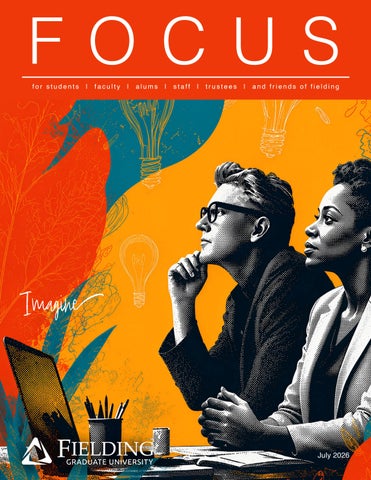
FOCUS for students
|
faculty
|
alums
|
staff
|
trustees
|
and friends of fielding
Imagine
July 2026
FOCUS July 2026
President Lynne D. Richardson, PhD
INSIDE THIS ISSUE
Editor-in-Chief Catherine Ryan Editor Marie Sonnet, PhD Donor Pages Editor Marlen Bautista Graduate Pages Editor Bridget L. Brady Art Director Rob Grayson, Boone Graphics Graphic Design Studio B at Boone Graphics Dolan Frick FOCUS is published by Fielding Graduate University 2020 De la Vina Street Santa Barbara, CA 93105 FIELDING.EDU Please send reader responses to communications@fielding.edu About the Cover: Imagine honors the Fielding community’s capacity to envision what is possible and then actively bring that possibility into the world with courage, care, and purpose. Across this issue, we meet alums, scholar-practitioners, faculty, and staff who imagine more humane systems of care, more inclusive communities, more just organizations, more sustainable futures, and deeper ways of learning, leading, healing, and belonging. ©2026 Fielding Graduate University. All rights reserved. No portion of this publication may be reproduced in any form without prior written permission from Fielding Graduate University.
12
Trust Me: Inside the Cult
03 Letter From our President Celebration 04 Community and Graduation 06 Merger News 07 Inner Life of Learning 08 Meet Fielding’s New President 10 Speech Therapy and Orthodoxy 12 Trust Me: Inside the Cult 16 Changemaking in Hong Kong 17 Compassion Across Borders 18 Journey of Resilience 19 Autism Renaissance 20 Magic Maker 22 Environmental Sustainability 24 Elephants in the Room 25 Passion for Financial Aid 26 In the News 28 Awards 29 Just Published 33 Thank You for Your Support 34 Founders’ Circle 35 Schools and Programs 36 Master’s and Certificate Graduates 37 Doctoral Graduates 39 Fielding at a Glance
FIELDING GRADUATE UNIVERSITY | Fielding.edu
LETTER FROM THE PRESIDENT
FIELDING FORWARD
Dear Fielding Community, Welcome to the July 2026 issue of FOCUS. This issue arrives at an important time in Fielding’s history and offers a meaningful opportunity to celebrate the people, ideas, and commitments that continue to define this extraordinary community. The theme of this issue, Imagine, is relevant on so many levels. At Fielding, imagination is the beginning of inquiry, the spark behind research, and the force that helps scholar-practitioners bring new ideas into practice. Across these pages, you will see imagination expressed through courage, care, creativity, and purpose. At the same time, we are imagining Fielding’s next evolution into reality, together and in real time. In this issue, you will read about developments in Fielding’s merger with Excelsior University and the opportunities this new era opens for us. You will also learn a little more about me, as I help guide Fielding through this historic transition and join you in carrying its mission forward. You will meet remarkable Fielding alums whose stories show the reach and relevance of scholar-practitioner leadership. Christine Marie, PhD (Media Psy ’20), tells us about her extraordinary role in Trust Me: The False Prophet, the Netflix docuseries that rose in April to No. 1 on Netflix’s television charts. The series drew global attention to Dr. Marie’s courageous, ethically complex work exposing a cult leader for crimes against women and girls. Her story is a powerful example of research, lived experience, and determination becoming a force for meaningful change.
You will hear from Chaim Greenberg, PhD (IECD ’25), whose work with children and families in Orthodox Jewish communities reflects his unique style of bridge-building. As a speech-language pathologist, longtime clinical leader, and recent Fielding graduate, he brings developmental insight, cultural understanding, and deep compassion to helping children be more fully seen and supported. You will also get to know Fielding’s own Debbie Lemke as we celebrate her 36 years of service, including the grace, precision, and behind-the-scenes magic she brings to Fielding’s in-person gatherings. Hers is one of several stories in this issue that open a window into the remarkable lives, commitments, and imagination of Fielding colleagues whose work and service continue to uplift, inspire, and create new possibilities. This issue also honors Fielding’s commitment to sustainability, showcasing how an institutional value planted more than 50 years ago continues to thrive and grow through research, leadership, and action. Thank you for being part of Fielding’s story. I am delighted to serve you, and I look forward to all we will imagine and build together.
Lynne D. Richardson, PhD President Fielding Graduate University
3
4
FOCUS | July 2026
CELEBRATING COMMUNITY, LEGACY, AND FIELDING’S LARGEST GRADUATION BY MARIE SONNET, PHD (HOS ’16)
S
produced by Dianne Travis-Teague, Senior Director of Alumni Relations, the event’s theme, “Rooted in Purpose. Growing in Possibility,” celebrated both the deep foundation of Fielding’s scholar-practitioner community and the forward-looking spirit that has long defined the University.
On the eve of Fielding’s largest graduation ceremony ever, the gathering marked an important moment in the life of the University. Sponsored by the Fielding Alumni Association and
For decades, Fielding learners and graduates have carried their education into communities, organizations, professions, and social systems around the world. Their work has reflected a shared commitment to purpose-driven leadership, rigorous inquiry,
et against the backdrop of its long-standing Santa Barbara home, Fielding’s pre-graduation Community Celebration Reception in June brought together alums, graduates, faculty, staff, partners, special guests, and members of the community for an evening of celebration, reflection, and connection at the Hilton Santa Barbara Beachfront Resort.
FIELDING GRADUATE UNIVERSITY | Fielding.edu
meaningful practice, and social impact. The reception offered an
opportunity to recognize that legacy not as something fixed in the
DOCTORAL VOYAGE
Excelsior University.
BY ALMA BOUTIN-MARTINEZ, PHD
past, but as a living source of energy for the planned merger with The formal program opened with a welcome from Dr. Leah
Johnson (EdD ’10), who served as emcee for the evening. The Honorable Salud Carbajal (MA ’03), U.S. Representative for
California’s 24th Congressional District, offered a featured alumni voice reflecting the broad impact of Fielding graduates. Fielding’s outgoing President Dr. John Bennett (HOD ’06) celebrated the strength of Fielding’s community, and he introduced Fielding’s incoming President Lynne Richardson, PhD, who thanked
attendees for the enthusiastic welcome. She was followed by Excelsior University President Dr. David Schejbal, whose
comments emphasized the promise of Fielding’s next chapter within Excelsior.
Dr. Alma Boutin-Martinez, Associate Provost for Institutional
Effectiveness and Continuous Improvement, contributed a poetic reflection that brought an inspiring, personal dimension to the evening’s theme.
The following day, Fielding’s graduation ceremony proved equally
inspiring. Highlights included a Navajo prayer offered by Miranda Haskie, EdD (ELC ’02), Associate Faculty in the School of
Leadership Studies and Fielding’s Facilitator of the Navajo Nation Cohort Group. Speaking on the eve of his retirement, President Bennett delivered an emotional convocation address, reflecting
on the extraordinary strengths of the more than 100 assembled
graduates and the vital importance of their changemaking work in today’s world.
Keynote speaker Ivory A. Toldson, PhD, Fielding Trustee, Professor at Howard University, Editor-in-Chief of The Journal of Negro
Education, and former White House advisor, spoke to the purpose, power, and impact of Fielding’s scholar-practitioners and alums.
Throughout the day, volunteers guided visitors through an interactive Fielding legacy exhibit showcasing 52 years of Fielding’s missiondriven history and its planned future within Excelsior University.
Together, the reception, graduation ceremony, and exhibit honored the people, ideas, and commitments that have shaped Fielding for more than half a century, while looking ahead to the University’s next chapter, affirming the enduring power of scholarship that creates a more just and sustainable world.
It began as a meeting of heart and mind, fueled by the intention to change the world— starting with your own. You set sail to innovate, embarking on a voyage of intellectual discovery. The gravitational pull of your inquiry drew you into hours of solitude, a vast sea of sacrifices, a multi-chaptered path of research and revision. Amid the uncharted waters, theories became your anchor, methodology your helm, analysis your sail, conclusion your port. When you steered off course, the steady, warm glow of the lighthouse, tended by advisors and loved ones, guided and grounded you. As, by your work, you generated power and light to illuminate previous contributions and forge new knowledge. You have, by your persistence, reached the point of arrival into the community of scholars and practitioners. Today we welcome and celebrate you. Reflect on what you’ve learned in your voyage. Tend the lighthouse for future voyagers. Share the boundless strength within you. Be the wind for inspiration and action! Create a more just and sustainable world! Onward!
5
6
FOCUS | July 2026
FIELDING’S FUTURE TAKES SHAPE BY LYNN SAFRANEK
Fielding’s planned merger with Excelsior University, a primarily online institution based in Albany, New York, continues to move forward as leaders from both universities work together to shape a strong future for Fielding and its students. Behind the scenes, collaborative planning is underway to support a transition, while required regulatory reviews progress. The merger will ultimately create the Fielding College of Psychology and Behavioral Sciences at Excelsior—a new home for Fielding’s distinctive academic programs and learner-centered approach, designed to carry the legacy of Fielding’s mission forward. Before the merger can be finalized, however, both universities must complete several approval steps. One important milestone is what regulators call a “change in control.” This occurred July 1 after Fielding and Excelsior received approval from their institutional accreditors—the Middle States Commission on Higher Education (MSCHE) for Excelsior and the WASC Senior College and University Commission (WSCUC) for Fielding. A change in control transitioned Fielding to a new governance structure, replacing the current Board of Trustees with a new board composed of leaders from both Fielding and Excelsior while additional approvals are completed. During this period, Fielding will continue operating as Fielding Graduate University, with separate presidents, provosts, and board oversight remaining in place. At the same time, deeper operational integration work will begin and Excelsior will participate closely in financial and other decisions. The merger remains subject to additional regulatory approvals, including from the U.S. Department of Education. Until those approvals are complete, Fielding will maintain separate institutional accreditation through WSCUC. Fielding’s new board reflects a blend of institutional knowledge, higher education leadership, nonprofit governance, and professional expertise. Four members bring deep ties to Fielding, including previous service on Fielding’s board, while three join from Excelsior’s Board of Trustees.
The representatives are: David Baime, BA, MA, senior vice president for government relations and policy analysis at the American Association of Community Colleges, has spent decades advancing higher education policy and advocacy at the national level. He also is a current member of Excelsior’s board. Karin Bunnell, PhD (HOS ’98), is principal of Hatteras Consulting, LLC, and brings decades of experience in organizational development, leadership training, and nonprofit board service. She was a longtime member of Fielding’s former board and is chair of the new board. William “Bill” Huffaker, PhD (HOS ’09), serves as senior vice president of talent at Newell Brands. Dr. Huffaker has more than 25 years of global leadership experience at organizations including Google, Microsoft, and Visa. He previously served on Fielding’s former board. Michael W. Klein, JD, PhD, director of government relations at the Pinelands Alliance, brings deep expertise in nonprofit and higher education policy, law, finance, and governance. He previously served on Fielding’s former board. He is secretary of Fielding’s new board. Matt Loeb, MBA, a veteran executive and board leader, currently leads Optimal Performance Seekers, LLC, advising boards and senior executives following leadership roles in nonprofit and technology organizations. He is the immediate past chair of Excelsior’s board and serves as vice chair of Fielding’s new board. Nicola Smith, JD, MBA, a faculty member in Fielding’s School of Leadership Studies, offers extensive experience in higher education and a longstanding commitment to social justice and educational access. She previously served on Fielding’s former board. Tony Spearman-Leach, BS, BA, senior director of institutional advancement at the National Academy of Public Administration and an Excelsior alum, brings experience in philanthropy, alumni engagement, and public service leadership. He also is a current member of Excelsior’s board and serves as treasurer of Fielding’s new board. The new board will help guide Fielding through this period of change while stewarding the mission and values that have defined the University for more than 50 years. Fielding also extends deep gratitude to members of the previous Board of Trustees who provided years of thoughtful leadership and stewardship. To learn more, visit fielding.edu/excelsior.
FIELDING GRADUATE UNIVERSITY | Fielding.edu
7
THE INNER LIFE OF LEARNING GRADUATE STUDY DEEPENS HOW WE THINK, LEAD, RELATE BY OKOKON UDO, PHD
W
hen I came to Fielding, I had the distinct feeling that I had found my people.
It was not something I could immediately explain. Rather, it was a recognition that unfolded over time, a sense that the questions I had been carrying and the ways of thinking and relating I had been drawn to, were not only welcomed here, but shared. We often think of education as the acquisition of knowledge. We enroll in programs to gain skills, deepen expertise, and expand what we know. This framing is not wrong, but it is incomplete. It assumes that learning is something we accumulate, rather than something that also reshapes us. At Fielding, something more is happening. Learning here is not confined to the classroom or the page. It unfolds in the tension between theory and practice, in dialogue across difference, and in the ongoing negotiation between who we have been and who we are becoming. Knowledge does not remain external. It begins to press inward. What emerges is the inner life of learning. This inner life is not always comfortable. There are moments when a new perspective disrupts a long-held belief, when language gives form to something we have felt but never named, and when we recognize ourselves in ways that complicate our sense of identity. In such moments, learning is not simply about understanding the world differently. It is about encountering ourselves differently within it. These encounters often follow a familiar rhythm. There are moments of awakening, when something previously unseen comes into view; moments of reclaiming, when we find language for our own experience and voice; moments of reweaving, when we begin relating differently to others, to our work, and to ourselves; and moments of regenerating, when those shifts begin to shape how we live and lead. This movement is not linear, nor does it happen only once. It is a rhythm we return to throughout our lives.
What makes this especially meaningful at Fielding is that it is not limited to students. It is present across the ecosystem for faculty, staff, and all who participate in this shared field of inquiry, if we are paying attention to what is unfolding. The same questions that shape a student’s learning often shape our own. In this way, Fielding is not only a place where learning happens. It is a field in which we are all, in different ways, being shaped. The scholar-practitioner model creates the conditions for this to occur. Learning here is not separated from life; it is embedded within it. We do not step away from our contexts to learn. We bring our full lives into the process—professional, personal, and relational. A concept encountered in reading is tested in conversation. An idea discussed in seminar is felt in a moment of leadership. A framework becomes real not when it is understood, but when it is lived. Over time, many of us discover that the deeper work of education has been something more than knowledge acquisition. We have been participating in a process that asks not only, What are you learning? but also, Who are we becoming—together? Perhaps that is the invitation at the heart of the Fielding experience: To recognize that learning is not only about gaining knowledge, but about becoming more fully engaged in the ongoing work of being human—thoughtful, relational, and responsive to a world that calls for both understanding and care. And perhaps, in the end, the true measure of our education is not only what we know, but how we have been changed in the process and how those changes live on in the way we show up with and for others. Dr. Okokon O. Udo is Director of Fielding’s Evidence Based Coaching Program and its MA in Organization Development and Leadership. A scholar-practitioner, ICF Professional Certified Coach (PCC), and Certified Management Consultant (CMC), his work focuses on identity, relational leadership, and the integration of learning and lived experience.
8
FOCUS | July 2026
FIELDING’S NEW PRESIDENT STEPS UP TO THE PLATE BY CATHERINE RYAN
O
n Alabama’s Gulf Coast, where Lynne Richardson, PhD, lives with her husband, Woody, the days come with a peaceful yet busy choreography: eagles in the trees across the canal, a heron fishing from the dock, barges and cruise ships passing through the Intracoastal Waterway, and boats of every size tracing the route between Mobile and Pensacola Bays. It is a fitting home base for a leader whose career has been defined by momentum, navigation, and transformation. On July 1, Dr. Richardson became president of Fielding Graduate University at a pivotal moment in the institution’s history. She is charged with guiding Fielding through its planned merger with Excelsior University and its transition into the Fielding College of Psychology and Behavioral Sciences. Richardson brings a rare mix of academic, administrative, financial, and accreditation experience to the role. She earned her PhD in Marketing from the University of Alabama, then earned tenure and promotion to full professor at the University of Alabama at Birmingham. There, she served as MBA Director and Associate Dean for Undergraduate Programs and External Relations before beginning a long career as a business school dean. She went on to lead business schools at Ball State University, Mississippi State University, the University of Mary Washington, Iona University, and the University of Montevallo. At the University of Mary Washington, she also served as vice president of administration and finance and CFO. Her accreditation record is equally substantial. Active in the Association to Advance Collegiate Schools of Business since the mid-1990s, Richardson served two nonconsecutive terms on the AACSB Board of Directors, mentored six schools, participated on 32 accreditation peer review teams, and led AACSB’s Women Advancing Management Education and Small Schools Network affinity groups. Richardson is known as a data-driven decision maker with
high emotional intelligence, a leader who pairs close analysis with careful listening. In the interview that follows, she talks about what drew her to Fielding, how she plans to engage its community while leading it forward, and how such serious work is strengthened by clear communication, accountability, and a healthy dose of levity.
Welcome to Fielding, Dr. Richardson! What drew you to Fielding, and what made you say yes to the presidency? I come to Fielding with a strong appreciation for its distinctive programs and the commitment of its community. I was drawn to Fielding’s mission, its graduate focus, and the personal challenge of leading Fielding through the merger with Excelsior University. Fielding has built something rare in higher education: a community where scholarship and real-world impact are inseparable. It’s an honor to help guide Fielding through this transition and into its next chapter as part of Excelsior, while working alongside people so deeply committed to learning, leadership, and social change.
You have led academic communities through growth and transition. As you begin your presidency at Fielding, how will you engage its community, set priorities, and guide the work ahead? I will spend the first months holding one-on-one Zoom meetings with as many Fielding core faculty and staff as feasible, along with small-group conversations. I want to know the people behind the work, and I want to hear their perspectives on Fielding’s strengths, opportunities, and future. At the same time, I will spend significant time in the data. The best decisions come from considering what people say and do alongside what the data tells us. I will also meet, as appropriate, with external stakeholders, including alums, Excelsior partners, and accreditors. That combination of evidence, experience, and conversation will guide the decisions ahead.
FIELDING GRADUATE UNIVERSITY | Fielding.edu
People who know your work describe you as both data-driven and deeply people-centered. How would you describe your leadership style in your own words? I’m interested in and care about people, not just as colleagues, but as human beings who bring their personal selves to work. At the end of the day, however, the job has requirements and expectations, so I lead with accountability, communication, and a focus on achieving goals. I am transparent with information and solicit ideas from the smart people I work with. I try to lead as a just and inclusive leader, bringing a diversity of voices to decision making while understanding that, ultimately, decisions are often mine to make. That balance matters to me. Leadership should create space for people to be heard, but it also requires clarity, accountability, and the willingness to act.
As Fielding and Excelsior move toward a shared future, what values will guide your leadership in helping the Fielding community navigate this next chapter with confidence, clarity, and growth? First and foremost, good communication is key as we move through the merger. We will need to communicate well both internally with Fielding faculty and staff and externally with Excelsior, accreditors, alums, and donors. Every organization has a different culture, so preparing Fielding employees for the Excelsior culture, as best as possible, will be critical to a smoother transition for all. I do hope that we can enjoy the work along the way. We spend a lot of time working, so we should intentionally schedule fun, too! We understand that you love to travel and that you live on Alabama’s Gulf Coast, in Gulf Shores. We’d love to know where you were born, and where life has taken you. How did you come to live along Alabama’s coast? What is it like there?
I was born in Bainbridge, Georgia, the daughter of a high school, and later college, basketball coach. We moved to Alabama, where both of my parents grew up, when I was a year old. I spent ages 4–18 in Montevallo, a small town south of Birmingham, where my dad began the men’s basketball program at what had been an allwomen’s college. I describe my childhood as one of having a village raise me. Small-town life was the best as a kid. I did my undergraduate degree at Montevallo in 3 years, worked in Birmingham while completing my MBA at UAB (thanks, tuition reimbursement!), and then completed my PhD in marketing at the University of Alabama. I went back to my MBA school as an assistant professor, was fully promoted, and served as MBA director and then associate dean for Undergraduate Programs and External Relations. Along the way, I married Woody, a strategic management
9
professor, and we had three children. In 2001, we began my dean journey, moving to Indiana, Mississippi, and Virginia. Woody retired in 2020 to live his dream of fishing on the Gulf Coast, but I was not quite ready. I chose to move to New York for a couple of years for another dean role, then retired in 2023. After 6 months of what is now referred to as my “first retirement,” I became interim dean of my undergraduate alma mater for 2 years. I retired for the second time in December 2023. We live along the Intracoastal Waterway, essentially a river between Mobile and Pensacola Bays. Woody can fish off the dock or from his boat in our “backyard.” Will you share more about your home life? What might visitors observe?
Our home is a small cottage on the water. I spend most of my days either in my office, in the sunroom facing the water, or on the dock. We are entertained daily by the variety of craft that pass, from American cruise ships to barges to multimillion-dollar yachts, some with helicopters on top, to speedboats and jet skis. We also enjoy watching the eagles that sit across the canal in the top of a tree, or the heron that “fishes” off our dock, plus the assorted rabbits, squirrels, and birds that visit our yard. I read many genres of books, and if I watch television, it’s probably some type of sports competition. Travel is my passion. We made it a family goal to visit as many states as possible in the United States while the kids were still home. We hit 42. Since then, my husband and I have visited all 50 and are now working on international travel. Because of work and personal trips, my current total is 40 countries. A trip to Antarctica is booked for January 2027. This will be my sixth continent. Australia is next! Our three kids are in their 30s and work as a university fundraiser, project manager, and plant controller. Each lives on the East Coast. We prioritize getting together as a family every Christmas. Last year, we went to Harpers Ferry, West Virginia. The 2 years prior, we gathered in Virginia and Florida. No one else has said “I do” yet, besides us! As you begin this new chapter, what do you most hope the Fielding community will come to know about you and your leadership?
I will listen carefully, look closely at the data, communicate as clearly as I can, and make decisions with Fielding’s long-term strength in mind. This is a meaningful time in Fielding’s history, and I respect the responsibility that comes with helping guide our community through it. My goal is to honor what makes Fielding unique while helping best position its programs, people, and scholar-practitioner tradition for the future.
10
FOCUS | July 2026
FAITH, FAMILY, AND FINDING A CHILD’S VOICE CHAIM GREENBERG BRIDGES SPEECH THERAPY AND ORTHODOXY BY CATHERINE RYAN
Fielding alum Chaim Greenberg, PhD (IECD ’25), and family visiting Arizona for Passover, April 2026.
T
he photograph that accompanies this story shows Fielding alum Chaim Greenberg, PhD (IECD ’25), in Orthodox attire with his wife and four sons. That matters because the perspective he brings to his work has been shaped, in part, by the world he grew up in. In the Orthodox Jewish communities where he practices, Dr. Greenberg is not an outside expert looking in. He studies Torah daily, is completing rabbinic ordination, and has built his career helping children and families in Brooklyn and Rockland County, New York, where he was born and now lives with his own family. Greenberg is a speech-language pathologist, clinical director, private practitioner, and a recent graduate of Fielding’s Infant and Early Childhood Development (IECD) doctoral program. At the heart of his story is how he has built that life from inside a religious world that is deeply traditional, tightly knit, and not always quick to embrace new academic or clinical ideas.
In the Orthodox schools where he has worked for more than a decade, Greenberg serves as a bridge among teachers, therapists, and families. He helps with case formulation, consults with educators, and supports parents in understanding their child’s needs. He says meaningful change often begins when families and teachers start seeing a child differently. In practical terms, that has meant helping them rethink assumptions about children who are sometimes described as lazy, oppositional, or unwilling. His path to this work began with something painful and personal. At about 3 years old, Greenberg noticed that he stuttered. He remembers the struggle to get words out and the way that shaped him. “It had a meaningful impact on my quality of life,” he says, adding, “I still stutter, though mildly. More importantly, I no longer see stuttering as something that defines me. In many ways, it has helped me develop resilience, empathy, and a deeper understanding of others. I no longer feel embarrassment or shame around moments of stuttering.”
He learned early on that a speech difficulty can shape whether a person enters a conversation, raises a hand, or chooses silence. Greenberg’s empathy deepened as he met others living with the same struggle. Their experiences, together with his own, sharpened his sense of purpose.
While working as a Hebrew language consultant in a special education school, he discovered his calling: helping children with developmental, language, and learning differences. He noticed that many were quickly judged and misunderstood.
Early in his career as a speech therapist, Greenberg often felt something essential was missing. Children completed tasks and gave expected responses, but he observed that compliance was not the same as growth. “They were answering questions to get through the task rather than connecting to the content itself,” he says. That realization changed his approach. “Communication cannot be separated from the whole child,” he says. If a child seems distant, frustrated, shut down, or oppositional, Greenberg considers what may be getting in the way. He wants to know whether the child feels safe, settled, interested, connected, and ready. He wants teachers and parents to ask those questions, too. “Children are naturally driven toward engagement and connection,” he says. But that path, he adds, “may look different for each child.”
A large part of his job, both as a clinical director and as a private practitioner, is helping adults slow down and think more carefully about a child. “Meaningful change rarely happens simply by giving people more techniques,” he says. “It often begins when people start seeing the child differently.”
That shift can matter anywhere, but Greenberg says it can resonate especially deeply in religious communities, where family life is central and children are understood within a close cultural framework. He knows those strengths well and speaks of them with affection, pointing to the “strong family commitment, care for
FIELDING GRADUATE UNIVERSITY | Fielding.edu
“I hope my own contribution to the field is to help bridge areas that are too often separated: speech and emotional development, science and relationship, clinical skill and human understanding.” children, loyalty, and deep investment in helping children succeed” within Orthodox Judaism. At the same time, he says, parts of the Orthodox world still carry stigma around therapy, developmental differences, and diagnosis. He has also found that families sometimes come to therapy expecting the professional to simply “fix” the child and hand the child back improved. He helps parents understand that their role is crucial. “Parents are one of the most important therapeutic resources a child has,” he says. Greenberg says Orthodox life has helped shape his approach to working with children.
“Orthodoxy is the world I was raised in and the framework of life I know best, so naturally it has shaped many of my values and perspectives. It has influenced how I think about family life, responsibility, meaning, and the importance of relationships. On a deeper level, it has also informed how I understand attachment and security. The concept of a loving and reliable connection— whether in family relationships or in one’s relationship with God—has helped me appreciate how foundational safety, trust, and unconditional care are for healthy development.” Greenberg’s dissertation chair at Fielding, Lorraine EhlersFlint, PhD, core faculty in Fielding’s IECD doctoral program, commends his research and work.
“As an Orthodox Jewish practitioner, Chaim works tirelessly to introduce his personal and professional community to holistic views of child development,” Dr. Ehlers-Flint says. “He cares deeply about shifting the developmental lens regarding children’s neurobiological vulnerabilities, honoring the importance of the whole child approach and including families in treatment. As an expert speech and language pathologist with years of clinical experience, Chaim brings a rare level of practical wisdom to his work.” Earning his doctorate at Fielding was challenging, Greenberg says. He was raising a family, working full-time, serving as a family caregiver, and absorbing the emotional blow of losing his father during his studies. He faced another obstacle, too. “In many Hasidic communities, advanced academic life—particularly in the sciences—is not always familiar territory. For some, a doctorate is simply outside the frame of reference, and for others, it may feel distant from the values of traditional communal life. Navigating that difference required clarity about why the work mattered to me.” He also knew he was not doing it alone.
“My wife, in particular, was central to everything. My primary language growing up was Yiddish, and English was not a strong
11
language for me in early adulthood. She spent countless hours helping me learn, read, and grow academically. My children were also deeply encouraging throughout the journey.” He says that, in many ways, his doctorate was a family achievement. Fielding, meanwhile, helped transform the way he understood the work itself.
“My journey through Fielding’s IECD program deeply shaped the way I understand and approach this work,” Greenberg notes. “The integration of developmental, relational, and reflective frameworks—along with the mentorship of Fielding’s Dr. Lorraine Ehlers-Flint—helped me move beyond a purely skills-based model toward a more dynamic understanding of children’s experiences.” Fielding also supported his growth as a reflective practitioner and leader.
“As a religious Jew, I felt deeply respected within Fielding’s diverse learning community, and I appreciated the program’s flexibility and understanding of my schedule and commitments. This experience strengthened not only my professional development, but also my sense of belonging within the field, and continues to influence how I think, supervise, and show up in my work with children, families, and colleagues.” Greenberg also names Dr. J. Scott Yaruss, a renowned speechlanguage pathologist, as an important influence in his work on stuttering. “He helped me appreciate that sometimes the goal is clear, but the path must change. We may need to find a different door to reach the child. His work also expanded my understanding of the importance of counseling within stuttering therapy.” Greenberg sees his work as a way to connect worlds that are too often kept apart. “I hope my own contribution to the field is to help bridge areas that are too often separated: speech and emotional development, science and relationship, clinical skill and human understanding. I also hope to continue mentoring others, both in my leadership roles and privately, in the same spirit that I was mentored,” he says. Greenberg’s schedule is split between Brooklyn and work closer to home in Rockland County. During his lengthy commutes to Brooklyn several times each week, he uses the drive time to listen to history podcasts, contemplate new clinical insights, and think through the children, families, and clinicians he works to support. Then he heads into schools, clinics, and conversations, working to bring more understanding and uplift to the lives of the people he serves.
If you ask him what matters most in his own life, the answer comes easily. “At the center of everything,” he says, “is family.” His home is full of energy, humor, and conversation. His children know him as someone who likes to keep things lighthearted but purposeful. “One of the anchors of our family life is Shabbat,” Greenberg says. “From Friday evening through Saturday night, we put away phones, electronics, and other outside distractions and focus on family, prayer, rest, and being present with one another.”
His professional life matters deeply to Greenberg, but it is not the core of his identity. “The deepest joy,” he says, “comes from being a husband and father.”
12
FOCUS | July 2026
THE FIELDING ALUM BEHIND NETFLIX’S # 1 TRUE-CRIME DOCUSERIES CHRISTINE MARIE ON THE DANGER AND MORAL STAKES OF TAKING ON A CULT LEADER BY CATHERINE RYAN
A
s Trust Me: The False Prophet climbed to #1 on Netflix’s television charts in April, Fielding alum Christine Marie, PhD (MEDIA PSY ’20), found herself at the center of a global conversation she had spent years making possible, often at enormous personal risk. The four-part docuseries follows Dr. Marie, a cult psychology expert, and her husband, videographer Tolga Katas, as they documented and helped expose Samuel Rappylee Bateman, a selfproclaimed prophet and leader of a small Fundamentalist Church of Jesus Christ of Latter-day Saints (FLDS) splinter group in the Short Creek community along the Arizona-Utah border. Bateman’s crimes against women and girls led to his 2024 federal sentence of 50 years in prison. The evidence Marie and Katas gathered helped build the federal case against Bateman, but it came at a cost Marie is still reckoning with. For years, they worked in the Short Creek area along the Utah-Arizona border, building relationships within the fundamentalist community where Bateman was based. Marie gradually earned the trust of Bateman and his immediate family, including more than 20 wives, at least 10 of whom were minors when he claimed them as his. All the while, she knew that the truth she was documenting would one day feel like betrayal. Ultimately, at Bateman’s invitation, Marie and Katas spent 2021 documenting him directly, often daily, along with his family and followers. His goal was self-aggrandizement. For Marie and Katas, their work had a different purpose: to gather evidence of child sexual abuse. Marie’s Fielding doctoral work examined humiliation, victimblaming, coercion, misrepresentation, and the traumatic
consequences of media narratives. As she was completing her dissertation, that research became lived practice during the Bateman saga. She earned her PhD in Media Psychology in 2020, just before her undercover work entered its most dangerous phase. Her expertise in cult psychology, and her own history as a survivor of cult-based human trafficking, gave her work unusual depth. “To say that Christine Marie’s documentary Trust Me helped others is an understatement. It changed lives,” notes Fielding’s Dr. Karen Shackleford, core faculty in the Media Psychology doctoral program and Editor of the APA journal Psychology of Popular Media. “Christine Marie entered Fielding knowing the purpose of her dissertation work. She made her goals become a reality, and she did that exceptionally well.” In this follow-up to Fielding’s April feature story about Marie, she reflects on the shock of sudden public attention, the danger and moral weight of going undercover, the Fielding education that helped shape her approach, and why she believes the series succeeded not because it was watched by so many, but because it helped people find the courage to stand up for others.
Watching the extraordinary response to your docuseries Trust Me: The False Prophet, what is going through your mind right now, personally and professionally? I am in a state of shock, to be honest. The positive outpouring from around the world is absolutely surreal. It is beyond my expectations. On a personal level, I feel validated for my decision to use a nonjudgmental, harm reduction approach with this stigmatized people rather than attacking them about things I disagreed with. On a professional level, I hope this series shows that by
FIELDING GRADUATE UNIVERSITY | Fielding.edu
not sensationalizing a heart-breaking story or not simplifying a complicated character, media can create empathy and even healing for victims of true crime who have the courage to tell their stories. While you were living undercover inside the cult, building trust with people whose lives were shaped by abuse, fear, and coercion, what moments were the most intense, morally complicated, or emotionally unforgettable?
One intense moment was when my husband Tolga and I were in the car with Sam and three of his “wives,” when he started explaining the nightmare that he put them through, justifying it with religion. I immediately recognized it as ritualistic sexual abuse. My entire nervous system started exploding, and I had to battle to think straight enough to know how to respond. It was difficult to not let my natural emotions guide my actions in the moment. Another complicated time was when Sam informed me that he had named one of the babies after me. Of course, I was honored, but I was also distressed imagining what that mother, a wife, and true believer in Sam, would feel when she learned that her child was named after the person who would ultimately put her child’s father in prison for life.
How did you carry that emotional burden while you were undercover, and how do you carry it now as the success of the docuseries unfolds? This internal conflict was more difficult than I can even describe. The more Sam’s followers loved me, the more I went home and cried. Sometimes it was excruciating to keep going, but I knew I must. When I got weary, I focused on the 13-year-old girl ( Jane Doe) who was quietly crying next to me in the car when Sam
described the abuse that he had put her through. That single memory filled me with determination, not just to help get her to safety, but all his victims. I am still close with Jane Doe today and she’s doing great. She told me she wanted the story to come out to help prevent this from happening to others, and that has been honored. The series has been a success, not because so many people watched it, but more importantly, because it impacted people in a positive way. Viewers worldwide have shared stories like how this series gave them the strength to speak out against their abusers or to walk away from coercive situations. Therapists have shared how this story has informed their practices, teenagers have written about how this series helped them decide on a career path, and people have mentioned the conversations it inspired them to have with their loved ones and to do more to help others. It was all worth it.
What gave you the courage to take on an unpredictable cult leader who tightly controlled more than 20 women and girls he claimed as wives, all seemingly under his spell? I kept thinking of the phrase, “Friends don’t let friends drive drunk.” When we love people, sometimes we have to do what is in their best interest even if they will be upset. I hope people will find an example in the courage of Julia, a featured character who risked her life and reputation to stop the abuse, and also in Nomz, the first wife to publicly speak out against Sam. Sometimes, doing the right thing comes with difficult consequences. In spite of that, this series shows the good that can happen when people power through that fear, do the right thing anyway, and let the chips fall where they may.
13
14
FOCUS | July 2026
As far as my motivation? I was informed by my own story. I will never forget how painful it was that law enforcement didn’t care enough to hold my own false prophet accountable. I was determined to get Sam behind bars for his atrocities no matter what. His victims deserved that.
As you became immersed in the Bateman investigation, including recording him as he described acts of ritualistic sexual abuse, were there moments when you realized: This is not just related to my research—this is my research coming alive in the most urgent way possible? Yes, yes, yes! It was a perfect storm of circumstances that I was in the right place with the right background and the right education to help me be effective. My education at Fielding played a role in my ability to be successful in this situation. When I was writing my dissertation, we moved to Short Creek, the historically FLDS-dominated community on the Arizona-Utah border where Bateman lived, and for personal reasons, I decided to take one more Fielding class, a social justice class, taught by Karen Shackleford. At the time, I was an anti-polygamy activist with a huge amount of bias against the FLDS, influenced significantly by the way they were consistently portrayed in the media.
As far as danger, things became really scary when we learned that Sam had been regularly teaching that God required the death of certain unworthy people to ensure their own salvation. It was called “blood atonement,” and it was murder in a way that involved the spilling of blood, reframed as an act of kindness. I asked Sam, “Who qualifies for blood atonement?” He looked at me straight in the eyes and said, “People who intentionally go against the prophet.” That would include me. We were on pins and needles. The FBI came in the nick of time.
However, learning more about stigmatization, marginalization, stereotypes, vulnerable populations, ethnic groups, and more in her class, I started to have a life-changing perspective shift. I realized I needed to stop judging and start helping people. The first step was to see these people as unique individuals. At the same time, I was doing a deep dive into the impact of media misrepresentation and humiliation for my dissertation, and I realized I was living in a community-wide case study of the vary topic I was researching. My media psychology education helped me build bridges with the FLDS, who were known for not talking to outsiders and never being in the media.
I knew what I was dealing with, so I understood that those women who were fawning over him were likely driven by fear and the need to survive under his coercive control. I believed they had traumacoerced attachment, or trauma bonds, but not genuine love.
Your work resulted in a real-world intervention that helped rescue and protect real people. At what point did you realize you’d crossed from documentation into something far more consequential and even dangerous?
In the beginning, there was no plan to make a documentary on Sam. My husband Tolga was doing a different project with the hopes of countering some of the dehumanization of the FLDS people. When Sam wanted to be in it, I was totally against it because he did not represent the FLDS people; he started his own bizarre offshoot. However, we came to believe that filming him might result in a way to get more information, including evidence about him if possible. As we were filming, we didn’t even fully realize the evidentiary power of what we were turning into law enforcement. It became clearer at the trial and sentencings when our footage was repeatedly pulled up by prosecutors to underscore their case beyond dispute.
What were the most surprising or revealing things you learned about power, manipulation, belief, and survival, first from your earlier experience as a victim of cult abuse and later while infiltrating Bateman’s group?
Seeing how he abused his power over all of his followers to benefit himself at their expense was disturbing, especially since I really cared about these people. The most surprising thing was to see how this man, who wasn’t even particularly smart, was able to completely destroy the critical thinking of his followers, including the natural instincts of the parents to protect their children.
You have described your life’s work as helping dignify people who have been humiliated, stigmatized, or misrepresented. How does someone who stands up for others tell hard truths without turning trauma into spectacle? What advice can you offer to others? First, understand that we did not produce or direct this documentary series. Ark Media did. We filmed the drama as it was happening, including each other, but because my husband and I turned out to be characters in the story, it became too ethically complicated for us to steer the storyline. We entrusted the entire project to director Rachel Dretzin, but that was after months of trust-building and conversations about victim sensitivity, protecting the minors, and so on.
FIELDING GRADUATE UNIVERSITY | Fielding.edu
I shared things I had learned in media psychology with Rachel, including what contributes to victim blaming and empathy, what I thought was wrong with other documentaries in the past, and how important it was to show the psychology of cult mind control and coercion to enable viewers to put themselves in the shoes of these women. She took all that to heart, but I suspect she knew all that already. I also did not want this project to be a story about Sam or emphasize the gruesome details of his crimes. Neither did she. Many graphic criminal aspects of the story were left out or significantly toned down. Nothing was sensationalized, and none of Sam’s crimes were reenacted. The narrative included a lot of the psychological backdrop and focused on three survivors who saw abuse and ultimately did something about it.
There is something strikingly poetic about seeing your Fielding diploma appear full screen in the documentary, especially given how closely the series is tied to your Fielding dissertation. Did that feel surreal to you? What does it mean to have your academic journey so visibly and publicly connected to an investigation now reaching many millions of viewers around the world? Interestingly, attending Fielding’s Media Psychology PhD program came as a result of a fictionalized and exploitive docudrama about my own trafficking survivor story that resulted in online cruelty and victim-shaming. At the time, I felt like the most hated, slut-shamed mother on the planet, making it an experience so devastating, it was hard to survive. I had to find a way to make something good come from that experience, and Fielding was my path for that. It literally healed me. I was later able to use my Fielding education in a real-life experience that resulted in helping to free other women and children from human trafficking. By using raw, authentic, verité media, the entire production team, including Netflix, delivered a profound example of using media for good. The public responses repeatedly included words like “empathy,” “kindness,” “not sensationalized,” “not exploitive,” “victim-sensitive,” “changed my opinion,” “impacted me deeply,” “couldn’t stop thinking about it,” “inspiring,” and others. All the credit goes to Ark Media and Netflix who worked together to get this right. Not only is Trust Me: The False Prophet helping other people, but the positive public outpouring towards me is a gift I never expected. It makes me feel like I am now the most loved woman on the Internet. How is this even possible? I am forever grateful to Fielding. Furthermore, I am awestruck at how my education at Fielding Graduate University helped my own narrative arc come full circle! When I saw that the series included a shot of my diploma from Fielding in the footage, I was over the moon. It was perfect.
Looking back on your time at Fielding, what experiences stand out as most meaningful to you? And in what specific ways did your graduate education shape your voice, your research, and the path your career has taken? Some highlights from my Fielding experience that contributed to my effectiveness started off with the critical thinking class taught by Gary Hare. That was monumental for me because it helped me understand how people are so deeply subjected to influences that they are unaware of. There’s a lot of cult psychology that can be unpacked by understanding critical thinking. All my professors reshaped my worldview in some positive, meaningful way, whether it was through the information I learned from them or the private conversations we had during the in-person sessions. My dissertation chair, Jerri Lynn Hogg, and the rest of my committee did more than make sure I was on the right academic road. They really cared about me as a person and encouraged me with so much positivity. It made me believe in myself when the going got rough. There were countless topics in media psychology that helped me along the way, including learning how to accept my own story and reframe it with a positive purpose. Learning about everything from social identities to storytelling to narrative psychology to archetypes and more—it all played a role.
Where are you based now, and what would we experience if we could spend an ordinary day with you at home, from your daily routines and private practice to the personal moments that ground you? I live in the same house in the same Short Creek town, and I love it here. The scenery is picturesque, the people are wonderful, and I have good friends who are my support network. I wake up early, make myself coffee, then I sit in my office and start writing by 6 am. I have a couple books in the works. I am still on the front lines helping people when I can. I have a menagerie of emotional support animals. Caring for them helps keep me grounded. One of my hobbies is fixing up and decorating this old house. It’s turning out to be adorable! People in need often stay with us and comment on how lovely and safe it feels to be here. It’s a colorful, creative home that I call Gingerbread Haven. Professionally, I have been doing a lot of press and podcasts, always hoping to educate and inspire people to have more kindness and empathy for others. Now I desire to get more involved in the academic world, including launching some new research projects. I am so grateful to Fielding for changing the course of my life. I’m also grateful to Ark Media and Netflix for using media the right way, helping to turn my own trauma into triumph. I still can’t believe it.
15
16
FOCUS | July 2026
TRANSFORMING CARE FOR AT-RISK CHILDREN AND YOUNG MOTHERS IN HONG KONG BY CATHERINE RYAN
I
n Hong Kong, where towers of glass and concrete rise above some of the most crowded neighborhoods on earth, Fielding alum Charmaine Tidmarsh, PhD (IECD ’24), has spent nearly two decades focused on the smallest and most vulnerable lives: babies and young children who begin life without the steady presence of a loving family.
I oversee is our early intervention therapeutic services, which address a significant service gap in Hong Kong,” Tidmarsh says. “With my background as an occupational therapist trained in the UK, along with my Fielding degrees in infant and early childhood development, I feel well positioned to help lead and strengthen this area.”
Dr. Tidmarsh, a registered occupational therapist in the United Kingdom and Hong Kong, is Director of Clinical and Residential Services at Mother’s Choice, a Hong Kong nonprofit serving children without families and pregnant teenagers, where she has worked for more than 16 years. Her role places her at the intersection of crisis response, early childhood care, and institutional change. She oversees residential homes for young girls experiencing crisis pregnancies, as well as children from birth to age 6.
Tidmarsh describes Fielding’s IECD program as transformative. She says it deepened her understanding of how research and evidence can influence colleagues and shape practice. It “supported me tremendously and strengthened my confidence as a leader. It gave me greater assurance in making executive decisions, especially when developing and evaluating programs.”
The scale of Tidmarsh’s work is remarkable. Mother’s Choice has 160 staff members, and Tidmarsh directly oversees 81 of them. She also helps guide programs that depend on more than 400 volunteers. “Her responsibilities include strategic planning, staff training, and the development of prenatal, postpartum, and parenting programs for young mothers and caregivers. Tidmarsh’s leadership is distinguished by its breath and philosophy. Her work is grounded in trauma-informed, relationship-based care, with a focus on infant and youth mental health, early intervention, and systems-level change. She is intent on making residential care more humane, more developmentally informed, and more capable of meeting the needs of children whose first experiences have been marked by disruption. “Over 70% of the babies in our care are prenatally exposed to substances and present with complex attachment needs due to adverse early caregiving experiences.” In response, she says, “Our approach to caring for infants is intentional and holistic, addressing their physical, social, and emotional development,” particularly during “the golden years of early childhood.” The goal is not only to serve children and families inside Mother’s Choice, but to develop “best practice models that can be shared with other NGOs to elevate standards of care more broadly.” Another priority is early intervention. “Another critical area
The program also helped her deepen her understanding of trauma, which she sees as a pattern that can persist across generations. “In my line of work, we often encounter not just one or two, but sometimes three generations of trauma,” she says. In her years at Mother’s Choice, she has witnessed crisis pregnancies occur across two generations within the same family. For Tidmarsh, that reality reinforces the need for care that is consistent, evidence-based, and grounded in developmental understanding. Her instructors at Fielding describe her as both visionary and generous. Joseph Constantine, PhD, a core faculty member in Fielding’s Infant and Early Childhood Development doctoral program, calls Tidmarsh “a true leader and innovator in caring for orphaned children in Hong Kong.” He adds, “Her work has set the stage for others in the space to have a far-reaching impact on the lives of children and families.” Jenene W. Craig, PhD, Fielding’s IECD program director, sees in Tidmarsh the kind of global practitioner-scholar the program is proud to cultivate. “Charmaine represents both the discipline of occupational therapy and the beautiful international space that the IECD PhD program serves.” Tidmarsh says the knowledge gained through Fielding’s IECD program equips people to think critically, lead with clarity, and build practices that create lasting change. As she puts it, scholarpractitioners “might not be able to change the entire world but can make a meaningful impact within their sphere of influence.”
FIELDING GRADUATE UNIVERSITY | Fielding.edu
17
COMPASSION WITHOUT BORDERS ALUM DELIVERS RELATIONSHIP-BASED CARE TO NEURODIVERGENT CHILDREN BY CATHERINE RYAN
F
rom New York to Japan, Brazil to Hong Kong, Fielding alum Colette Ryan, PhD (IECD ’24), is helping reshape how neurodivergent children and families are supported. With more than 30 years of clinical and relationshipbased care expertise, Dr. Ryan is an international leader in autisminformed practice, offering hope and guidance across continents.
Ryan has spent more than three decades working across a wide range of settings. Today her impact stretches internationally as she advances autism-informed care through clinical work, parent support, training, and supervision. Ryan is an Infant Mental Health Specialist and a DIRFloortime® Expert Training Leader with the International Council on Development and Learning (ICDL). DIRFloortime® is a childcentered, play-based approach for autistic children and those with developmental differences, focusing on emotional connections to support social, communication, and cognitive growth. It involves following the child’s lead, joining their play, and encouraging deeper interaction and shared engagement, often, though not always, on the floor. Ryan has devoted her career to neurodivergent children and caregivers through parent coaching, reflective supervision, professional training, and direct services. She has worked as an autism educator and early intervention specialist, spoken at U.S. and international conferences, and holds degrees in special education, early childhood education, and infant and early childhood development. She completed a fellowship in infant mental health at Montclair State University. For 13 years, Ryan has expanded DIRFloortime® internationally, bringing it to Hong Kong, Australia, England, and Italy, while exploring opportunities in Kiev and the UAE. She later introduced Floortime to Japan. “I began my Japan journey in May of 2022, and it changed me in so many ways,” Ryan notes. “I love the architecture, culture, and food so much, but it’s the people I love the most! I am currently in New
York, continuing to travel, and I am still on my Japan journey, hoping to continue bringing Floortime to the children and families there.” What distinguishes Ryan’s work is the heart she brings to it. “Colette brought her care and compassion for her research participants with her every day,” says Dr. Georgeanna Robinson, Fielding faculty research specialist and Infant and Early Childhood Development (IECD) PhD program leader. “Her excitement in conducting her very meaningful research was palpable, even through the long process of analysis and writing. Her findings shed light on the importance of supporting parents when working with autistic children and the wider utility of DIR than had been previously recognized.” “Since completing my degree at Fielding, I have used what I have learned in many ways,” Ryan comments. “I am currently a reflective supervisor for six Healthy Families organizations in New York State, and I am a Floortime supervisor for DIRect Floortime, an organization providing home-based Floortime services in New Jersey. And I continue to teach DIR classes for ICDL.” Her doctoral experience expanded both her confidence and career. “Since gaining so much from my Fielding IECD PhD, I have expanded my private practice (Engage, Relate, Communicate) to provide DIR services via telehealth to children around the world, supporting families with their neurodivergent children, and providing reflective practice to several organizations,” Ryan says. “And I have supported families in person in several areas around the world! Thank you, Fielding!” A major surprise of Ryan’s academic journey was falling in love with research. “I loved my time at Fielding!” she says. “I made wonderful friends, received so much support, and learned more than I ever thought I would. I never thought I would fall in love with research, but here I am, currently co-writing a chapter on DIR research. I had the most amazing experience while researching when I found my own research during a Google Scholar search!” That sense of joy, humility, and humor balances Ryan’s serious commitment to those she serves. Across clinics, classrooms, trainings, and collaborations, she focuses on helping others feel seen, supported, and empowered.
18
FOCUS | July 2026
FROM VILLAGE TO VOICE: A DOCTORAL JOURNEY OF RESILIENCE BY MARIE SONNET, PHD (HOS ’16)
L
ong before Dr. Jinnea Terrell (HD ’25) earned her PhD from Fielding’s School of Leadership Studies, she had begun to understand one of the central questions that would animate her scholarship: How do people build the networks—the “village”—that help them survive, thrive, and move toward purpose?
Dr. Terrell describes her childhood as marked by hardship but also by love. Her father struggled with addiction and later died because of it; her mother faced significant challenges of her own. Around them, however, stood an extended network of family members, church members, and community leaders who stepped in with care and expectation. That early experience of being held by a village became a lens through which she would come to understand family strength, social capital, and the power of systems that truly support people. Terrell’s path to the doctorate included profound loss and interruption. As a young college student, after losing her first child at birth, she became pregnant with her second child and made the difficult decision to leave school. Two years later, she was a single mother raising a toddler and newborn. Rather than accept that circumstance as the end of her educational dream, she began to see the community support systems available to her—not as a final destination but as a bridge to the next step. With each degree she earned, she built greater stability, confidence, and possibility for herself and her sons. That sense of purposeful return is now central to her professional life. Terrell first encountered Head Start as a parent seeking resources for her family. Today, she serves as Director of Operations for Gateway Community Action Partnership’s Philadelphia Early Head Start programs, helping lead the very kind of system that once helped support her. Gateway has noted that her service
there grew from parent leadership in the Parent Committee, Policy Council, and Board into staff roles that included Family Partnership coordinator and director of the County Council for Young Children. As Director of Operations, she oversees staff, families, community relationships, and a multimillion-dollar grant—work she approaches with the knowledge of someone who understands what families are navigating. After earning her first master’s degree from Lincoln University, Terrell knew she wanted to pursue doctoral studies. Her early experiences at other institutions left her seeking something more engaging and person-centered. Fielding, she says, met that requirement. “I have always carried a desire to be more, to do more, and to create impact, and Fielding has helped me bring that vision into clearer focus.” Although classes were held remotely, she shared that they felt personal, relational, and intellectually alive. Faculty did not ask her to set aside her identity or lived experience; instead, they helped her to integrate who she is with the scholar and leader she was becoming. Her dissertation, Mom, Me, and the Village: A Single Black Mother’s Exploration of Social Capital, reflects that integration. Chaired by Dr. David Blake Willis, the study examines how single Black mothers define, build, and draw upon their villages, and how those networks shape resilience, success, and possibility. The work is both scholarly and deeply rooted in Terrell’s own commitments: to honor women whose strengths are too often overlooked and to better understand the social conditions that help families flourish. Dr. Willis comments, “Jinnea is a shining star, a champion of Black and All Mothers, and an important new scholar in the Academy. She stepped up and then, without hesitation, moved from strength to strength in her doctoral studies. I was honored to support Jinnea during her journey to the PhD.” For Terrell, earning the PhD is not only a personal milestone. It is a family legacy transformed and a platform for wider impact. She plans to teach, coach, conduct research, and continue advocating in communities where support can change the arc of a life. She says that Fielding helped her bring that purpose into clearer focus— recognizing her gifts, sharpening her voice, and affirming that her story is not separate from her scholarship and her contributions to the community.
FIELDING GRADUATE UNIVERSITY | Fielding.edu
19
FACULTY SPOTLIGHT IS AUTISM CARE ENTERING A RENAISSANCE? BY CATHERINE RYAN Before Carrie Alvarado, PhD (IECD ’17), became a leader in reimagining autism care, her sense of what families deserve was shaped by a grandmother who refused to let convention dictate her child’s life. Now Chief Operating Officer and Clinical Director of San Antonio’s Autism Community Network, Alvarado works at the intersection of clinical care, research, teaching, advocacy, and systems change. She is also part of Fielding’s story, first as a graduate of the inaugural Infant and Early Childhood Development PhD cohort in 2017, and now as a core faculty member. “My passion comes from my own family history,” Dr. Alvarado explains. “I grew up with my Aunt Jenny, my mom’s younger sister, who had Down syndrome and was autistic. Jenny was born in the 1950s, at a time when specialists advised my grandmother, Lorraine, to place her in an institution for the sake of her other children. Instead, my grandmother bravely chose to raise Jenny at home, surrounded by family. Because of her courage and advocacy, all of us grew up alongside someone with very high support needs who also inspired deep compassion and profound respect. “Life was far harder for Jenny than it ever should have been. The supports available to her and to my family were nowhere near sufficient, certainly not affirming or accommodating. Jenny deserved better. Growing up in that context instilled in me a lifelong drive to search for what better could look like, and to find and work alongside others equally committed to raising the bar for people and families who experience and navigate the world differently.” That early lesson in belonging continues to animate Alvarado’s work with children, families, clinicians, and students. Her approach is grounded in neuro-affirming, relationship-based care and a belief that meaningful support begins with humility. Professionals, she says, must set aside assumptions, listen deeply, and recognize parents as essential partners. Alvarado says that autism care is moving through a hopeful shift, one led increasingly by autistic people, families, researchers, clinicians, educators, and communities willing to rethink what support can and should look like. “What gives me hope right now is that there are so many of us coming from such varied experiences and backgrounds,” she says. “There is truly a movement underway. A profound paradigm
shift being brought to the forefront, an ‘autism renaissance’ as one of my favorite researchers, Elizabeth Torres, has named it. Autistic individuals are finding their voices and sharing their lived experiences, engaging in collaborative research and advocacy, ensuring that contemporary therapies, policies, and funding are responsive not only to their real needs but also to their true abilities. “Parents and family members are increasingly engaged, taking their power back and recognizing their unique expertise in supporting their children. Clinicians and educators are actively seeking more respectful, impactful ways to ensure that children’s potential is fully recognized and nurtured. Entire communities are leaning into this work, committed to becoming more accommodating and inclusive. I receive calls every single day from karate studios, corporations, design firms, schools, hospitals, sports venues, you name it. People are leaning in. They are dedicated to building a better, more inclusive world.” When Alvarado entered Fielding’s IECD program, she was raising two young children, welcomed a third during the program, and had a husband in residency. The program allowed her to keep building her career while remaining present to family life. “I have deeply valued my journey at Fielding, both as a student and now as a member of the faculty. It has offered me a meaningful sense of belonging within a global and diverse community committed to purposeful change. As a graduate of Fielding’s inaugural IECD PhD cohort, the experience profoundly shaped me as a scholar, a clinician, and as a person, strengthening my confidence in my voice and clarifying my sense of purpose. As a student, I felt genuinely supported, with my professional work and personal commitments thoughtfully honored. Returning to Fielding as core faculty has brought that journey full circle, continuing to enrich my life and allowing me to actively contribute to a shared mission I deeply believe in.” What does she love about her work? “I’m far more invested in curiosity and growth than in chasing perfection, and I’ve found real joy in leaning into challenge rather than fearing it. I feel profoundly grateful to be living a life of meaning, and I see my greatest gift to the world as helping to create space for others to discover that same sense of purpose and meaning for themselves,” Alvarado concludes.
20
FOCUS | July 2026
FIELDING’S MAGIC MAKER THE WOMAN BEHIND THE WELCOME BY CATHERINE RYAN
B
efore Debbie Lemke became the driving force behind Fielding’s events, she found herself standing beneath two immense sixth-century Buddhas in Afghanistan, carved into remote sandstone cliffs along the Silk Road corridor northwest of Kabul. Surrounding them, she observed hundreds of man-made caves dotting the rock walls—a significant network of abandoned monks’ cells and meditation chambers. Just then a young boy materialized, tempting her with a challenge: Did she want to climb to the top of the tallest Buddha? The statue rose 180 feet above the valley floor. She followed him through a labyrinth of narrow, hidden stairways until they emerged from the cliff above the Buddha’s head. Below them, the lush Bamiyan valley unfurled in a breathtaking sweep, green and luminous against the backdrop of the Hindu Kush’s snow-capped peaks. She stood spellbound by the scale and beauty of it all.
As suddenly as he appeared, the boy pocketed his coins and vanished. She was left to descend the maze of caves alone. There were dark tunnels, wrong turns, and no one in sight. “It was scary,” she recalls. “But eventually I made my way out and was so happy I didn’t pass up that once in a lifetime experience.” Although the statues were targeted and destroyed by the Taliban in 2021, the site has since been deemed a UNESCO World Heritage Site. This story offers a fitting introduction to Lemke, who this year marks 36 pivotal years at Fielding. It captures her signature calm under pressure, sense of adventure, and steady instinct for finding the best path forward. Those same traits have shaped her long tenure as Fielding’s Director of Event & Conference Services. She is the person who manifests the University’s communal life. If a Fielding event feels seamless, that’s because Debbie Lemke makes it so. Lemke joined Fielding in 1990. At the time, she was Director of Catering at Santa Barbara’s historic El Encanto hotel. Before that, she worked at the Santa Barbara Zoo directing special events. She mentions that she was drawn to Fielding’s mission, which aligned with hers: to promote a more just and sustainable world. Over the decades, Lemke has organized hundreds of University gatherings, helping bring Fielding’s events to its widely dispersed
community, from Global Sessions staged across the United States and Canada, to new student orientations, research sessions, and board meetings. In 2019, she received Santa Barbara County’s Hospitality Employee of the Year award. What Lemke accomplishes is uniquely complex. Fielding’s Global Sessions, week-plus schedules of in-person lectures, meetings, and major graduation events, for example, unfold in hotels across North America. Lemke somehow transforms these hotels into temporary campuses. Each year she faces the same challenge: finding unique venues large enough to meet the University’s academic and technical event needs, yet intimate enough that students, alums, faculty, and staff feel part of a shared community that otherwise lives largely online. Fielding’s needs have changed dramatically since the years when Lemke organized Global Sessions at La Casa de Maria Retreat Center near Santa Barbara, without internet or room phones. “Paper bathmats and just two payphones,” she laughs. One favorite memory takes her back to the early 1990s, to the Banff Springs Hotel in Canada, chosen for a Fielding research session. She recalls securing an amazing $61 room rate for that historic hotel. “When I did the site inspection beforehand, I remember waking up at 2 am and walking all areas of the hotel to ensure we could accommodate anyone with ADA requirements. It worked, and it was a magical experience to be there during the Elk mating season in Banff National Park.” Elena I. Nicklasson, MA (ODC ’21), Fielding Vice President of University Relations, calls Lemke’s decades of service “a rare kind of institutional dedication—steadfast and deeply professional.” What stands out most, Nicklasson adds, is the respect Lemke inspires everywhere she goes. “From Fielding faculty and students to hotel managers and staff, Debbie earns admiration for her integrity, consistency, and kindness. Debbie’s attention to detail, calm leadership, elegance, and unwavering commitment to excellence set a high standard.” Katrina S. Rogers, PhD, Fielding President Emerita and current core faculty member, says that thanks to Lemke, Global Sessions unfold as if by magic. “There is no ‘one best story’ about Debbie Lemke,” Dr. Rogers comments. “I’ve seen her stand courageously in the face of an upset colleague, holding her ground with dignity
FIELDING GRADUATE UNIVERSITY | Fielding.edu
21
Lemke has been honored with multiple awards for Outstanding Service to Students and Faculty and numerous presidential citations for her work.
and grace. I’ve seen her compassion for a student in tears over a presentation. I once saw her late at night, sweet-talking a copy machine to help a faculty member copy notes at the last minute. Debbie chooses to make a difference wherever she is.” Sherry Lynn Hatcher, PhD, Fielding Professor Emerita in the School of Psychology, puts it simply: For Lemke, no concern is too small. Travel glitches, dining needs, classroom setup, medical help, Lemke handles it all. “Debbie Lemke is a unique, incredible asset to Fielding for her caring, empathy, and ability to stand up for what is right and ethical. I have felt fortunate to call Debbie my friend, from those early years into my retirement,” Hatcher notes. There have been harder moments, too. Lemke vividly remembers the January 2018 Global Session held during the fatal Montecito mudslides. The freeway into Santa Barbara closed, buried beneath deep mud and debris. Students, faculty, alums, and hotel staff found inventive ways to arrive, including by boat. Fielding’s host hotel also sheltered mudslide victims who had just lost everything, including family members. “That January really put things into perspective for me,” Lemke says. “It reminded us what is truly important in life.” That larger perspective carries into one of the most deeply felt dimensions of Lemke’s work: sustainability. She serves on Fielding’s Sustainability Advisory Council, moving the University toward more sustainable event practices, and she requires event venues to forgo disposable plastics at Fielding events. Likewise, she implemented Fielding’s Green Regalia Program—graduation regalia made from recycled bottles—which also proved to be a cost savings for graduates compared with traditional rentals. Lemke says her environmental commitment traces back to her years at the Santa Barbara Zoo, where children and wildlife were ever-present. “I was always aware of my role in doing my part to protect the world for their future,” she says. “The animals had a huge impact on me, too, since they can’t speak for themselves and are at the mercy of humans.”
Lemke has been honored with multiple awards for Outstanding Service to Students and Faculty and numerous presidential citations for her work. She also created Fielding’s original volunteer program, which was ultimately adopted as a staff benefit. Fielding is woven through the arc of Lemke’s life: her marriage, the birth of her only child, her husband’s two cancer diagnoses, and his eventual passing in 2019. “Fielding has been a part of so many major milestones in my life,” she comments. At home, Lemke lives in her beloved 800-square-foot cottage in Santa Barbara’s Marine Terrace, a blufftop neighborhood known for its sweeping coastal views. She loves to travel, and over the years she has explored Nepal, Kashmir, India, Hong Kong, Singapore, Thailand, Japan, Kuala Lumpur, the South Pacific, and Europe, among other destinations. She is also a devoted reader and names the late Nobel laureate Hermann Hesse as a favorite author. “His books had a huge impact on me. His interest in Eastern religious, spiritual, and philosophical traditions, combined with his involvement with Jungian analysis, resonated with me as a young woman interested in all the same things.” If he were alive, she says, she would invite him to dinner for a spirited conversation. She treasures time with her daughter and son-in-law, long walks on the beach with her rescue dog, Cooper, and she speaks fondly of round-the-world trips taken without a fixed itinerary, booking flights on the spot. Spontaneity taught her, she says, “how much you can learn about the world and yourself just by visiting new places without an agenda.” For generations of the Fielding community, Lemke’s contributions are profound. Each year, students, faculty, alums, and staff crisscross the continent to gather at University events, arriving to discover that someone has already anticipated their every need, ensuring Fielding’s signature sense of welcome and belonging. What may seem magically effortless is, in truth, the result of extraordinary devotion. Through that devotion, Lemke continues to help define the spirit of Fielding.
22
FOCUS | July 2026
THE UNIVERSITY THAT MADE SUSTAINABILITY A FOUNDING PRINCIPLE TURNING ECOLOGICAL CONVICTION INTO LEADERSHIP, SCHOLARSHIP, ACTION BY MARIE SONNET, PHD (HOS ’16)
I
n March 2025, Fielding clinical psychology doctoral candidate Andrew Sears sent a message to the Fielding community. Its opening line was direct: “The mission is to solve climate.” The mission was not only to study or write about it, but to solve it. He announced the launch of the Fielding Climate Alliance, a new student-led initiative that would bring together scholars, faculty, and alums across all disciplines to take climate action. It was the latest chapter in a story that Fielding began 52 years ago. It’s a story about what happens when an institution decides, at the level of its founding, that education and the pursuit of social and environmental justice should be inseparable. Fielding was founded on a premise that was radical then and seems countercultural now: Graduate education could and should be a vehicle for positive social change. The founders were asking not just “What should students know?” but “What kind of world should their knowledge serve?” Social and ecological justice would become the twin pillars of its institutional identity. In 2023, marking Fielding’s 49th anniversary, then-President Katrina S. Rogers, PhD, and the Sustainability Advisory Council codified this tradition with a Global Ecological and Social Justice Service Year Proclamation, a document that spoke of humanity’s “kinship with all living and non-living entities of this earth” and the ethical imperative of centering Indigenous knowledge in how we learn to inhabit the planet.
OUR PEOPLE The people Fielding has gathered around this mission tell the story as vividly as any institutional document. President Emerita Dr. Rogers, core faculty member in the School of Leadership Studies (SLS), holds an MA in Environmental Law and Policy from Vermont Law School alongside two doctoral degrees in history and political science. She taught environmental politics as a Fulbright Scholar in Germany, led environmental advocacy work at the Grand Canyon Trust, and initiated scholarly research about the ecological selves of leaders, their individual worldviews, and the inner transformation that must accompany serious effort at sustainability leadership. She serves as Chair of Fielding’s Sustainability Advisory Council, which was established in 2008. In
2025, she was appointed associate editor of Earth Stewardship, the new international journal of the Ecological Society of America, where she is helping to shape the global conversation about how science and society can move together toward a genuinely sustainable future. Dr. Rogers, along with SLS Faculty Emeritus Dr. Rich Appelbaum, Dr. Fred Steier, and Dr. David Blake Willis initiated the Sustainability Leadership Doctoral Concentration in 2011 with Dr. Appelbaum at the helm. His scholarship asked why the promises of corporate social responsibility so reliably fall short. The answer was that sustainability requires a systemic understanding of how global supply chains, labor exploitation, and environmental destruction are structurally connected. This understanding is exactly what Fielding’s doctoral concentration is designed to produce. Dr. Appelbaum, along with Fielding colleagues Drs. Steier, Paul Stillman, and Willis explored these topics in their book, Leadership in Sustainability: Perspectives on Research, Policy, and Practice (Fielding Press, 2021). SLS Core faculty Dr. Alexander Laszlo is now directing the Sustainability Leadership Doctoral Concentration. He is a polycultural systems scientist whose work encompasses science, spirituality, and socio-ecological transformation. Dr. Laszlo explains that he has a productive quarrel with the word “sustainability,” a term that calls for us to live within the carrying capacity of our environment. While necessary, he believes this is insufficient. Laszlo states that the goal for humanity has evolved from survivability to sustainability and now into the concept of thrivability. This is the capacity of individuals, communities, organizations, and ecosystems not merely to endure but to flourish together. It is the difference between a company that avoids doing harm and one that actively regenerates the communities and ecologies it operates within. In this vision, communities are resilient and successive generations inherit not just a livable planet but a genuinely good one. Fielding has made thrivability a unifying thread that weaves together actively, measurably, joyfully flourishing ecosystems. Dr. Andreas Miles-Novelo, a core faculty member in Fielding’s
FIELDING GRADUATE UNIVERSITY | Fielding.edu
23
Fielding’s doctoral concentration in sustainability leadership challenges students to examine the gap between what organizations promise and what they practice, and to develop the critical insight and courage to close it.” Media Psychology program, asks the question: What does a rapidly warming planet do to the human mind? He and Dr. Craig A. Anderson co-edited a special section of the November 2025 issue of Psychology of Violence, entitled “Climate Change and Violent Behavior.” The authors document the psychological pathways through which climate change drives aggression and violence, not just through heat, but through displacement, resource stress, and the slow erosion of the social fabric. In their December 2025 piece, “Science in a World on Fire” in Social and Personality Psychology Compass, Miles-Novelo and Anderson discuss how current U.S. policies threaten the ability to conduct critical scholarship necessary to understand the complexity and severity of negative social outcomes induced by climate change. Connecting ecological crises to human behavior in ways that demand both scientific rigor and moral urgency is the kind of research that sits at the heart of Fielding’s sustainability commitment.
OUR SCHOLARSHIP Fielding’s doctoral concentration in sustainability leadership teaches more than the history of environmental regulation or the mechanics of environmental, social, and governance (ESG) reporting, though it surely does. It teaches students to think critically about why sustainability efforts fail and about the gap between what organizations say and what they do, about the structural forces that make genuine ecological commitment so difficult, and about the leadership qualities required to close that gap. It is, deliberately, a social science program rather than an engineering one. Its premise is that the sustainability crisis is fundamentally a crisis of values, systems, and power, and that those are exactly the domains where human-centered scholarship has something irreplaceable to contribute. Representing the type of innovation in sustainability possible at Fielding, Dr. Rogers and Vice President of University Relations Elena I. Nicklasson, MA (ODC ’21), have worked together with adult learners to examine the impact of sustainability education. Their findings reveal that, overall, sustainability education increased motivation and perceived empowerment, leading many respondents to intend concrete actions despite acknowledging practical constraints such as time, finances, or competing priorities. In April 2026, they presented their paper, “Reimagining Adult Education: Unlocking Sustainable Futures,” at the International Conference on Environmental, Cultural, and Social Sustainability at the University of Athens, Rhodes.
OUR PRACTICE Beyond the classroom, Fielding’s Institute for Social Innovation (ISI) has for more than two decades connected alums to realworld sustainability projects. One ISI Fellow, Dr. Shelli Hendricks, PhD (ODC ’24), is developing a model of leadership through ecotourism and ocean empathy in the Caribbean, expanding sustainable practices in island communities one dive trip at a time. Another ISI Fellow, Dr. Kerul Kassel, PhD (HOS ’11), lead editor of Developing a Sustainability Mindset in Management Education (Routledge, 2018), runs the First Nature Ranch in Florida, where veterans, at-risk teenagers, and corporate leaders learn regenerative leadership through relationships with horses and the land. These works are what Fielding’s commitment to applied communityembedded scholarship looks like in practice. Fielding’s institutional commitments are actionable. Since 2016, it has been a signatory of the United Nations Principles for Responsible Management Education, committing the University to the Sustainable Development Goals and the United Nations Global Compact. It has pledged its support to the Paris Agreement. Its Sustainability Advisory Council, a body that includes students, staff, alums, environmental lawyers, dialogue practitioners, Fielding faculty, and sustainability consultants, meets regularly to hold the institution accountable to the values it professes. Council member Debbie Lemke, Fielding Director of Event & Conference Services, introduced a plastic-free approach to our conferences—no straws and no water bottles. Our University Relations team uses a local printer that has good labor practices and offers recycled paper. FOCUS is printed on that type of paper. When we order marketing materials, we also go to great lengths to order goods that are sustainable and have minimal plastic packaging. Through scholarship and practice, Fielding community members aim to listen closely to the world, bring humanistic scholarship to bear on its most urgent challenges, and believe that rigorous, courageous, ecologically grounded education remains one of the most powerful tools we have. Dr. Laszlo sees this as a higher mission for humanity during these times of turbulence and transition: to be the thriving systems we wish to see in the world. “This is what the sustainability leadership concentration is all about: preparing change agents to become true game changers of life-affirming, future-creating, and opportunityincreasing expressions of thrivability.” Fielding’s founders would be very pleased.
24
FOCUS | July 2026
THE ELEPHANTS IN THE ROOM
UNTANGLING FEAR, CONFLICT, AND HARD CONVERSATIONS BY CATHERINE RYAN
F
ielding alum Marcia Ruben, PhD (HOS ’07), has spent much of her career listening for what people know but do not say.
In boardrooms, leadership teams, classrooms, and coaching sessions, she has watched capable people grow quiet around the very issues that most need their attention. Conflict goes unnamed. Trust thins. Decisions are delayed. Teams learn to move carefully around the “elephants in the room,” even when everyone knows they are there. For Dr. Ruben, known professionally as The Untangle Doctor, those moments are not side issues. They are the work. Her new book, The Neuroscience of Leadership: Rewire. Untangle. Lead. (Fielding Press, 2026), brings together more than three decades of executive coaching, organizational consulting, teaching, and research. Drawing on neuroscience, complexity theory, adult development, growth mindset, and leadership practice, the book explores what keeps people stuck and how they can begin to move forward with greater clarity, trust, and effectiveness. That question has been with Ruben since childhood. “My fascination with this field began when I was a child,” she says. “My parents were refugees to the United States as children, and they and their parents fled Europe just before WWII broke out. Many of those left behind were killed. I learned about this as a young girl, and that began a lifelong quest to understand human behavior. How could this have happened? And what could I do to prevent it from happening again? I became determined to acquire the knowledge and skills to understand and transform human behavior.” That early search led her to anthropology at UC Berkeley, with mathematics as a minor, then to counseling, organizational consulting, leadership development, and Fielding’s Human and Organizational Systems program. Across those fields, Ruben kept following the same thread: how people, relationships, and systems become tangled. At Fielding, she found a scholarly home for the questions she had already been asking in practice. Her doctoral work examined how people in organizations make sense of messy, complicated problems. Fielding also changed how she saw herself. “I loved being at Fielding—the people, the faculty, the feeling of genuine intellectual openness,” Ruben says. “The faculty supported
us not just in required coursework but in shaping research and dissertation projects around what mattered most to each of us. That kind of academic freedom was rare and precious.” When she completed her doctorate, the accomplishment altered her sense of what was possible. “I remember thinking, ‘If I could do this, I can do anything,’” she says. “I wasn’t just a practitioner anymore, I was a scholar-practitioner, grounded in evidence-based research. That shift changed how I showed up with clients, how I designed curriculum, and ultimately how I wrote this book.” In The Neuroscience of Leadership, Ruben distinguishes between tangled and untangled leadership. A tangle, she explains, is any pattern in thinking, relationships, teams, or culture that prevents people from functioning at full capacity. Tangled leadership is reactive, guarded, blame-oriented, and fear-based. Untangled leadership is clearer, more accountable, more curious, and more able to create psychological safety. “Tangled leaders aren’t simply making bad choices,” Ruben says. “Their brains are running well-worn threat-response patterns, the same autopilot circuitry that kept our ancestors alive. The problem is that those patterns were designed for physical danger, not organizational complexity.” That distinction has become central to Ruben’s work with leaders. Again and again, she sees the same problem: People have not taken the time to genuinely know one another. Without trust, feedback becomes risky, difficult conversations stall, and leaders avoid the decisions they most need to make. “In practice, when I work with a leader, I listen intently for what lies underneath what they present,” Ruben says. “What is tangled? How is anxiety or fear clouding their thinking? Is this a systemic issue or a personal one? What untangling process might serve them best?” Ruben’s gift is not pretending those tangles are simple. It is helping leaders see that they are patterns. “When I explain the biology, something in them relaxes,” she says. “They recognize it’s not a character flaw; it’s a pattern. And patterns can change.” The Neuroscience of Leadership: Rewire. Untangle. Lead. is available in print and Kindle editions on Amazon.
FIELDING GRADUATE UNIVERSITY | Fielding.edu
THE CLARITY KEEPER
KORINNE PETERSON’S PASSION FOR FINANCIAL AID BY CATHERINE RYAN
K
orinne N. Peterson, EdD, starts and ends most days looking out over the water. From her home in Swansea, Massachusetts, near Boston, she says the ocean provides her a daily reminder to pause, reset, and regain perspective. She brings that careful approach to her work at Fielding, where Dr. Peterson serves as Director of Financial Aid and Scholarships. Her days involve complex and shifting federal rules, deadlines, forms, borrowing decisions, and students’ very human worries. Peterson understands students’ financial concerns. She was a firstgeneration student. She earned her master’s degree while working full time and managing family responsibilities, then completed her doctorate while working full time at Fielding. She knows what it is like to carry school, work, money, family, and doubts all at once. “I experienced how confusing and overwhelming the process can be without guidance. I did not have a clear roadmap, and I had to figure a lot out on my own. I had no real understanding of what I was signing or how financial aid worked,” she says. A missed form, a misunderstood deadline, or an unread message can create stress that follows a student into class, work, and home life, she explains. At Fielding, where most students are adult learners with full lives, that really matters. “They are not just students,” Peterson says. “They are professionals, caregivers, and often the primary support for their households. Time is limited, and the margin for error is small.” Her goal is clear: “I want students to feel informed, respected, and clear on what comes next. I am direct; I set expectations, and I hold a high bar for compliance and integrity,” she says. “At the same time, I am grounded in the reality that every decision affects a real person. Students deserve transparency and someone who will advocate for them within the bounds of regulations.” There is a family story behind her commitment to access. Peterson’s mother worked for 36 years in information technology at Brown University. She never attended college herself, but she respected the community around it. As Peterson remembers, her mother would say, “Those students put food on the table for my children every day.”
“That stayed with me,” Peterson says, “and serves as a reminder that higher education changes lives, not just for students but for families and communities as well. Students are often making significant financial decisions without the full picture, especially those who are first-generation or navigating the process independently. My belief is that access is not just about getting in. It is about whether students can stay, complete their programs, and do so without unnecessary financial strain.” Now, Peterson is focused on helping Fielding students navigate a financial aid landscape in flux. With federal changes including those connected to the One Big Beautiful Bill still taking shape, she wants to ensure students move through their programs with intention, planning, and support. Her advice is simple and worth taping to a laptop: Start early, read the messages, ask questions, know the full cost of the program, and do not rely on general internet searches for answers that depend on your own school and situation. “We are here to guide and support,” she says. “My goal is to replace confusion with clarity and to help students make informed decisions. To see students ultimately complete their program and move forward is incredibly rewarding. We become part of their journey, even if it is behind the scenes, and that is something I never take for granted. It is also something I never get tired of.” Outside work, Peterson loves to snowboard. “It was definitely a humbling experience at first,” she says. “There were a lot of falls along the way, but I stuck with it, and now it is something I genuinely love to do. Snowboarding lets my brain ‘shut off ’ and be in the moment.” At Fielding, she brings that same patience and determination to her work with students navigating financial aid’s complicated terrain. The path may not always be simple, but she knows just how much the right guidance can change the ride.
25
26
FOCUS | July 2026
IN THE NEWS AI AND OPEN SCHOLARSHIP Fielding doctoral candidate Shana Pote has been selected for the FORCE11 Research Communications and Scholarship Institute, an international virtual program on scholarly communication in the era of artificial intelligence. Pote will teach “Governing Thought in the Age of AI,” examining how generative AI is reshaping scholarly reasoning, authorship, responsibility, and knowledge production. She will also serve as a panelist for the Closing Plenary, “AI: Pedagogical Partner or Scholarly Disruptor?” Her Fielding research focuses on AI’s impact on doctoral education, including questions of authorship, legitimacy, assessment, and academic identity. APA DIVISION 35 PRESIDENT-ELECT Lauren Mizock, PhD, core faculty in Fielding’s Clinical Psychology PhD Program, is the 2026-2027 PresidentElect of the American Psychological Association (APA) Division 35, the Society for the Psychology of Women. Her areas of expertise include culturally relevant clinical practice, teaching, and research; gender and mental health; and mental illness and recovery. Dr. Mizock recently co-edited, with Fielding core faculty Patrick Sweeney, PhD, The Fielding Handbook of Qualitative Research (Fielding Press, 2026). VIRTUAL POSTER SESSION Fielding’s 2026 Virtual Poster Session opened March with an impressive display of scholarly breadth. Students, alums, faculty, and collaborators from various program areas came together to disseminate research, build community, and advance the scholar-practitioner mission. The 13 posters spanned trauma and PTSD, emotion regulation, athletic identity, COVID-19 sequelae, queer and autistic healthcare experiences, illness coping, identity navigation in a polarized era, human trafficking, business innovation, and virtual reality mindfulness. More than 50 attendees watched and engaged in dialogue with presenters, exchanging questions and ideas across disciplines.
PERSONALITY RESEARCH PRESENTED Fielding faculty and students presented three empirical studies on personality measurement at national psychology
conferences in February and March, highlighting collaborative, faculty-mentored research conducted through Fielding’s Clinical Psychology program. Led by core faculty member Steven R. Howell, PhD, the research team shared findings drawn from large datasets examining the Big Five personality dimensions at the 2026 conferences of the Eastern Psychological Association and the Southwestern Psychological Association. APA DIVISION 35 MENTORING AWARD Konjit V. Page, PhD, Fielding Clinical Psychology core faculty, has been selected to receive the Bonnie R. Strickland and Jessica Henderson Daniel Distinguished Mentoring Award from APA Division 35, the Society for the Psychology of Women. The award recognizes feminist mentoring and honors the legacy of two distinguished psychologists whose careers have helped expand leadership, access, advocacy, and mentoring for women and people of color in psychology. RACE, HISTORY, AND DEMOCRACY Fielding marked the 10th anniversary of the Marie Fielder Center for Democracy, Leadership, and Education on March 27 with a celebration at the National Press Club in Washington, DC, bringing together scholars, alums, students, and leaders from around the world to honor a decade of social justicecentered scholarship and advocacy. The event featured a luncheon and a moderated conversation with Pulitzer Prize-winning journalist Nikole Hannah-Jones (pictured), whose work has profoundly shaped national dialogue on race, history, and democracy. Center Director Dr. Katherine (Katie) McGraw reflected on the significance of the milestone and the Center’s continued mission to advance democracy, leadership, and education into its next decade of impact. INSTITUTE FOR SOCIAL INNOVATION In March, Fielding’s Institute for Social Innovation (ISI) Symposium highlighted the work of several ISI Fellows and offered the broader Fielding community a look at how alums were advancing research, healing, and social change through innovative practice. Presentations explored topics ranging from Indigenous and Western healing frameworks to strength training as a model for sustained recovery and relapse prevention to community storytelling and restorative practices for families impacted by mass incarceration.
FIELDING GRADUATE UNIVERSITY | Fielding.edu
FIELDING AT SfAA CONFERENCE Fielding students, alums, and faculty traveled to Albuquerque, New Mexico, in March for the Society for Applied Anthropology’s 86th Annual Conference, where they shared research alongside scholar-practitioners and social scientists across disciplines. Dr. David Blake Willis and Dr. Tracy Long chaired sessions on social resilience, collaboration, and community wellness that explored belonging, empowerment, identity, adversity, trauma, and well-being in immigrant and marginalized communities. NAVAJO EDUCATION CONFERENCE In June, Fielding co-hosted the 10th Annual Navajo Educational Conference at the Navajo Nation Museum in Window Rock, Arizona, where faculty and representatives joined Navajo educators and community leaders for sessions on communitybased Indigenous research, education sovereignty, and pathways to higher learning for Navajo students. Fielding also participated in the preconference at Diné College, featuring the Infant and Early Childhood Education program and qualitative research methods, with opportunities for attendees to connect with Fielding students and engage in discussions led by Navajo scholar-practitioners. FIELDING’S 2026–2027 JOSSELSON CHAIR Fielding has named Susan Goldberg, JD, PhD (CLIN PSY ’07), as the 2026–2027. Ruthellen Josselson Chair in Qualitative Inquiry. Her term as Chair begins September 1. A Fielding alum, core doctoral faculty, psychologist, attorney, and qualitative scholar, Dr. Goldberg brings decades of experience in psychology, law, communityengaged research, clinical practice, and social justice to the role. As Josselson Chair, she plans to expand student support, offer a speaker series, fund student research and conference travel, and continue strengthening qualitative inquiry across the Fielding community. SUSTAINABILITY LEARNING In April, Fielding’s Vice President of University Relations, Elena I. Nicklasson, MA (ODC ’21), and Katrina S. Rogers, PhD, President Emerita and core faculty member in the School of Leadership Studies, presented preliminary research at an international sustainability conference in Rhodes, Greece. Their study explored how adult learners learn about sustainability, whether that learning leads to action, and what barriers stand in the way. Initial findings showed that many surveyed Fielding students had limited prior exposure to sustainability education, while qualitative responses highlighted practical, emotional, and everyday barriers to action.
SUSAN ARMIGER ON CNBC Susan Armiger, a scholar-practitioner in Fielding’s Leadership for Change program and president and CEO of The Catalight Group, is featured in a new CNBC documentary short exploring the future of brain health and healthcare delivery. The Transformative Power of Value-Based Care in Brain Health, which premiered on March 30, examines how value-based care can improve brain health outcomes for individuals while also strengthening communities, health systems, and economies.
NANT 16 CONFERENCE CO-CHAIRS Fielding IECD Program Director Jenene Craig, PhD (IECD ’15), and faculty Christy Gliniak, PhD (IECD ’22), served as co-chairs of the National Association of Neonatal Therapists’ NANT 16 Conference again this year, reflecting Fielding’s continued leadership and active contribution within the neonatal and early childhood development community. NANT brings together leaders across neonatal therapy and early development, and this year’s conference presented an important opportunity to strengthen connections, share insights, and elevate the impact of interdisciplinary collaboration in this critical field. REMEMBERING JAMES MARLATT Fielding alum James ( Jim) Leonard Marlatt, PhD (HOS ’12), MBA, CEC, PEng, and an Institute for Social Innovation Fellow at Fielding, passed away on October 14, 2025, leaving a legacy of scholarship, leadership, and relational generosity. A distinguished scholar-practitioner, certified executive coach, and geological engineer, Dr. Marlatt spent his life combining transformative phenomenology, mindful inquiry, and global business experience to advance personal, social, and ecological justice. Marlatt’s contributions to Fielding scholarship were profound. He codeveloped transformative phenomenology as an applied social phenomenology. He also contributed to numerous books published by Fielding Press and other publishers.
27
28
FOCUS | July 2026
AWARDS PRESIDENTIAL MEDAL OF DISTINCTION Fielding’s Presidential Medal of Distinction is the highest institutional honor awarded by the Office of the President to recognize extraordinary contributions that exemplify Fielding’s mission of advancing social justice, academic excellence, and transformational leadership. It honors individual faculty, alums, students, donors, or leaders whose work has significantly impacted the university, the field of scholarship, or society at large. The new recipients are GARY WAGENHEIM Gary Wagenheim, PhD, has provided long-standing leadership to Fielding as a former Chair of the Board of Trustees. He has contributed significantly to Fielding’s academic foundation and strategic direction, including establishing a scholarship fund to support future students. His steady guidance, mentorship, and commitment have strengthened Fielding’s institutional and financial stewardship.
KARIN BUNNELL Karin Bunnell, PhD, has served in multiple senior leadership roles on the Board of Trustees, including Vice Chair, Chair of the Governance Committee, and Chair of the Strategy and Business Development Subcommittee of the Executive Committee. She has played a central role in advancing Fielding’s strategic planning, governance effectiveness, and institutional partnerships. Her service reflects deep institutional knowledge, strategic discernment, and enduring dedication to Fielding’s mission.
KAREN BOGART Karen Bogart, PhD, has provided distinguished service to Fielding as a former Chair of the Board of Trustees and currently serves as Chair of the Academic Affairs Committee. Her leadership has supported critical presidential transitions, academic oversight, and governance continuity during pivotal moments in the University’s history. Her thoughtful and principled stewardship has helped shape Fielding’s academic integrity and longterm institutional vision.
KIPNES SOCIAL INNOVATION AWARD Terry M. Curley, EdD candidate in Fielding’s Educational Leadership for Change program, has received the 2026 Dianne Kipnes Award for Social Innovation for a project that will help Navajo families hear, practice, and preserve Diné Bizaad, the Navajo language, in homes, schools, and community spaces. In Birdsprings, Arizona, and the nearby Little Singer Community School, Curley will work with fluent Elders, educators, community leaders, and multigenerational households to record everyday Diné phrases, stories, and simple directions in the voices of local speakers. Linked to QR codes placed in homes, classrooms, and community spaces, the recordings will make the language easier to hear, practice, and carry forward in the places where family life unfolds. For Curley, the work is deeply personal. He grew up hearing Diné Bizaad at home from his mother, Thelma, but after her death, the language slowly fell silent in his own life. Years later, through his work with Navajo families and the generosity of fluent speakers around him, he began speaking again. His Kipnes Award project extends that journey to others, helping youth and families build confidence, ease the fear of speaking, preserve local language knowledge, and strengthen connection across generations. As Curley said in accepting the award from Dook’o’ołííd, one of the four sacred mountains of the Navajo Nation, “This is a blessing for all of us. Nizhoni doo Hozho Nahasdlii (Beautiful and Beauty Will Be Restored).”
FIELDING GRADUATE UNIVERSITY | Fielding.edu
29
GOLDSTEIN DISSERTATION SCHOLARSHIP Fielding scholar Keeley P. Mitchell, MA, a 2023 alum in Human Development and doctoral student, has been awarded the Michael and Jinny Goldstein Endowed Board Scholarship for Dissertation Research Advancing Social Justice. Her research explores African American international migration and its impact on mental and physical wellbeing, with the goal of growing this work into a book and documentary that uplift Black communities and expand conversations about life beyond U.S. borders. This scholarship supports Keeley’s work and affirms the importance of research that advances meaningful social change. CLINICAL PSYCHOLOGY DEI AWARDS Fielding’s Clinical Psychology DEI Committee has named Core Faculty member and Director of Research Practicum Training Alayne “Mimi” Ormerod, PhD, and doctoral student Shania Greenwood as the 2026 recipients of the Clinical Psychology Diversity, Equity, and Inclusion Awards. Presented annually, the awards recognize one faculty member and one student whose leadership, scholarship, mentorship, and service help advance a more inclusive and socially responsive learning environment. ALAYNE ORMEROD Alyne “Mimi” Ormerod, PhD, was honored for more than 12 years of dedicated service to Fielding as a teacher, advisor, mentor, and scholar. Dr. Lauren Mizock, Core Faculty member and Co-Chair of the DEI Committee, praised Ormerod as “a generous advisor and mentor to students across cultural backgrounds,” noting her support of multicultural research and attention to sexual and gendered violence.
SHANIA GREENWOOD Doctoral student Shania Greenwood was recognized for her scholarship, leadership, and service to historically marginalized students and communities. She serves as Treasurer, Special Events, and Press Coordinator of the Black Student Association at Fielding. She recently completed her doctoral internship at the Center for Multicultural Training in Psychology at Boston University School of Medicine and is completing a dissertation on body image and social media representations of Black women.
HONORING EXCEPTIONAL LEGACIES Following a March 2026 decision by Fielding’s Board of Trustees, three distinguished faculty are now newly honored as emeriti, a designation honoring faculty whose exceptional contributions have shaped Fielding’s scholarly identity and deepened its community’s intellectual life, embodying the values of engaged, transformative education. The Professor Emeritus designation reflects the highest recognition our institution bestows upon faculty, recognizing a career of distinction and ongoing connection to the Fielding community. RICH APPELBAUM Rich Appelbaum, PhD, Professor Emeritus, Human and Organizational Development, is an internationally recognized sociologist whose scholarship on global labor, inequality, sustainability, and political economy has brought distinction to Fielding and beyond. His commitment to applied, socially engaged scholarship resonates powerfully with Fielding’s mission, and his work has inspired students to connect rigorous academic inquiry with real-world transformation.
VALERIE BENTZ Valerie Bentz, PhD, Professor Emerita, Human and Organizational Development, has been a foundational presence in Fielding’s intellectual community, bringing her pioneering work in mindful inquiry, phenomenology, and transformative social science to generations of doctoral students. Her scholarship has helped define what it means to pursue deeply human-centered research, and her mentorship has left an indelible mark on scholars across disciplines.
DON TRENT JACOBS (FOUR ARROWS) Don Trent Jacobs, EdD, Professor Emeritus, Educational Leadership for Change, widely known by his Lakota name Four Arrows, has brought a courageous and distinctive voice to Fielding’s educational mission. His work at the intersection of Indigenous worldview, critical education, and transformative leadership has challenged and enriched our scholarly community. His deep commitment to justice, wisdom, and authentic human development reflects the aspirations of Fielding’s educational philosophy.
ARMY MEDAL RECIPIENT Fielding congratulates Dr. Kristine Jacquin for her extraordinary work supporting military service members and veterans, for which she was recently awarded a U.S. Army medal. A beloved leader in the School of Psychology, Dr. Jacquin has served in numerous Fielding roles and is widely recognized for her innovation, mentorship, and deep, student-centered commitment. After more than 15 years of extraordinary service, she stepped down from her full-time leadership roles at Fielding July 1 to begin a new chapter as Professor of Forensic Psychology at a large public R1 university. She will remain part of the Fielding community as Associate Faculty, continuing to support her doctoral students through their research practica and dissertations.
30
FOCUS | July 2026
FIELDING PRESS NEW RELEASES THE WORLD CAFÉ: SOCIAL INNOVATION IN ACTION The World Café (Fielding Press, 2026) is Fielding’s landmark book about the worldwide phenomenon of the World Café—a powerful approach to bringing people together through conversation, story, shared meaning, and collective discovery— co-founded by Fielding graduate Juanita Brown, PhD (HOS ’02), and her spouse, David Isaacs. The World Café, edited by President Emerita Katrina S. Rogers, PhD, with associate editors Frederick Steier, PhD, Flavio Mesquita da Silva, PhD, (HOS ’17), and Elena Nicklasson, MA, (ODC ’21) the book is a definitive handbook for organizing and leading World Café encounters around the globe. With contributions from 20 scholars worldwide, the book is intentionally organized around the Café’s design principles, showing how these conversations can deepen understanding, shape strategy, support healing, and spark social innovation across diverse groups, cultures, and settings. Wit Ostrenko, former chairman of the Association of Science Centers in Washington, DC, says The World Café “will be of great value to both scholars and practitioners who want to engage people thoughtfully, surface important ideas quickly, and turn conversation into lasting impact.” The book is available in print and Kindle editions on Amazon. THE NEUROSCIENCE OF LEADERSHIP: REWIRE. UNTANGLE. LEAD. Written by Fielding alum Marcia Ruben, PhD (HOS ’07), The Neuroscience of Leadership (Fielding Press, 2026) is a groundbreaking guidebook for leaders navigating the relentless complexity of today’s world. Drawing on more than three decades of executive coaching, organizational consulting, and research at the intersection of neuroscience and leadership, Dr. Ruben weaves together proven leadership practices, complexity theory, adult development, and hard-won wisdom into a narrative that is as practical as it is compelling. At the heart of the book is a deceptively simple yet transformative distinction: the difference between tangled leadership—reactive, blame-driven, and fear-based—and untangled leadership, grounded in clarity, accountability, and psychological safety. Readers learn to identify the deeply wired habits that quietly undermine their effectiveness, do the inner work required to interrupt them, and then turn outward—untangling relationships, teams, and cultures—so they can bring out the best in others and lead with confidence and skill through a world that grows more complex by the day. The book is available in print and Kindle editions on Amazon.
THE FIELDING HANDBOOK OF QUALITATIVE RESEARCH Edited by Clinical Psychology faculty Dr. Lauren Mizock and Media Psychology faculty Dr. Patrick Sweeney, The Fielding Handbook of Qualitative Research (Fielding Press, 2026) provides a practical guide for students conducting qualitative research, covering approaches such as grounded theory, phenomenological analysis, participatory action research, narrative analysis, and reflexive thematic analysis. The volume features contributions from 20 authors representing Fielding’s Clinical, Media, HOD, and EdD programs, along with scholars from Georgia State University, the City University of New York, the University of Massachusetts Boston, and Ajman University in the UAE. Praised by leading scholars as a timely and impactful resource for social-justiceoriented qualitative inquiry, the handbook is available in print and Kindle editions on Amazon. COACHING EDUCATION: FOUNDATIONS OF EXCELLENCE Coaching Education: Foundations of Excellence (Fielding Press, 2026) is a volume sponsored by the Graduate School Alliance for Education in Coaching (GSAEC) that highlights the growing importance of graduate-level coaching education in a rapidly evolving professional landscape. Edited by Carrie L. Arnold, PhD (HD ’17), associate faculty in Fielding’s Evidence Based Coaching (EBC) Program, and Charline S. Russo, EdD, with contributors including EBC associate faculty Dr. Deborah George-Feres, Dr. Laura L. Hauser, Dr. Carrie Arnold, and Fielding EBC Program Director Dr. Okokon Udo, the book features contributions from 45 leading scholar-practitioners who explore key academic standards that strengthen the coaching profession and promote ethical, evidencebased practice. Through research, case studies, and reflective questions, the chapters integrate theory and practice to support coaching program directors, educators, students, and practitioners in advancing coaching as a credible, impactful, and socially responsive field. “With clarity and sensitivity, this book examines the essential pillars of coaching and thoughtfully invites dialogue on ethics, inclusion, and effective practice across varied cultural landscapes,” notes executive coach Dr. Yene Assegid, PhD. The book is available in print and Kindle editions on Amazon.
UPCOMING RELEASES Clinical Psychology and Psychopathology: A Training Manual Clinical Psychology and Psychopathology: A Training Manual by Dr. Emile Guibert, edited by Dr. Raymond Hawkins, is scheduled for a summer 2026 release. This book is the English translation of the French original, which has received wide acceptance and acclaim in francophone countries, including Canada’s Quebec. Fielding Press obtained the worldwide English rights to this book in May of this year.
FIELDING GRADUATE UNIVERSITY | Fielding.edu
Clinical Psychology Today Clinical Psychology Today, edited by Fielding faculty Dr. Jessica Emick-Seibert, is scheduled for an autumn 2026 release. It will comprise nine chapters co-written by more than 15 faculty and alums of Fielding’s Clinical Psychology program. The book is the fourth in a series that includes the previously released Organization Development Today, Human Development Today, and Media Psychology Today.
centered leadership. Challenging traditional command-and-control models, the authors make the case for trust, psychological safety, connection, and collaboration as essential foundations for generative leadership in today’s world. Drawing on their Fielding experience and ISI fellowship, Curran, Thompson, and Feng connect scholarpractitioner inquiry with practical approaches to strengthening teams, organizations, and communities.
MORE AUTHORS IN PRINT
INDIGENOUS WISDOM AND TRADITIONS Fielding Faculty Emeritus Dr. Don Trent (Four Arrows) Jacobs and alum Susan McVicker, PhD (HOS ’17), have each published peer-reviewed articles in the Australian and New Zealand Journal of Family Therapy (2026). The articles appear in the same special issue of the journal. Trent’s article, “Restoring Relational Balance: Family Therapy Through the CAT-FAWN Indigenous Lens,” connects fear, authority, words, and nature to family practice. McVicker’s piece, “Worldview as Medicine: Traditional Kituwah (Cherokee), Internal Family Systems and Kinship Worldviews,” explores how Indigenous traditions and family systems therapy shapes worldview and healing.
DEVICE-DISTRACTED PARENTING Fielding alum Don Grant, PhD (Media Psy ’14), past president of the American Psychological Association Division 46, and Karen Shackleford, PhD, core faculty in the School of Psychology and editor of Psychology of Popular Media, an APA journal, have authored a new article in the June 18 issue of Frontiers in Psychology’s Media Psychology section. “Mommy, Do You Love Your Phone More Than Me? Parental Device Use and the Adolescent-Caregiver Attachment Bond” examines how adolescents’ perceptions of being ignored by a primary caregiver in favor of a phone or other digital device may affect the parent-child bond. Drawing from a general population of teens ages 12 to 17, the study found that when teens feel habitually dismissed in favor of a caregiver’s device, they report less secure attachment, including more anxious or avoidant patterns. The authors also developed a unique measurement scale focused not just on interrupted conversations, but on teens’ felt experience of being overlooked when seeking attention, connection, or care. PSYCHOLEGAL SCHOLARSHIP Dr. Brian L. Cutler, psychologist, Dean of Faculty at Fielding Graduate University and director of the Media Psychology and Applied Psychological Science programs, published an invited commentary, “A Time for Change in Law and Human Behavior,” in Law and Human Behavior (2026), one of the leading peer-reviewed journals in forensic psychology and psycholegal research. Cutler reflected on his tenure as the journal’s Editor-in-Chief from 2005 to 2011 and revisited how he helped modernize the journal through editorial reforms, faster peer-review timelines, stronger publishing infrastructure, and a more collaborative leadership model that broadened representation across forensic psychology. His commentary underscored the lasting impact of process, mentorship, and scholarly leadership on the field of psychology and law. LEADING WITH FOUR FORCES Fielding ISI Fellows Kathleen Curran (HOS ’20), Randal Joy Thompson (HOS ’14), and Jane Feng (HOS ’15) have published The Four Forces: Inspiring Emergent Generative Team Leadership in a Complexponential World (Inspired by Nature and the Tao) (Emerald Publishing Limited, 2026). The book explores how intent, hope, care, and love can help leaders and teams navigate rapid change, uncertainty, and complexity through relationship-
GETTING TO THE YES Fielding EdD candidate Kimberly Dye is translating decades of advancement leadership experience into practical guidance for nonprofit leaders. Her 2025 book, Getting to the Yes: A Board Member’s Guide to Philanthropic Leadership, is the latest publication in her ongoing book series Getting to the Yes (independently published). Framed as a strategic extension of her dissertation research on fundraiser turnover and burnout, the book explores how leadership alignment, role clarity, psychological safety, and a strong culture of philanthropy can help boards, CEOs, and professionals build healthier, more sustainable organizations. Dye says Fielding helped deepen her work by giving her the theoretical grounding, language, and systems-based frameworks to examine why certain governance and fundraising practices succeed, strengthening her approach as both a scholar and practitioner. NYT BESTSELLING AUTHOR Alum Steven Hassan, PhD (HOS ’21), an ISI fellow, has turned personal experience into a career dedicated to exposing undue influence and authoritarian control. He credits Fielding with sharpening his thinking, transforming his self-concept, and giving him the credibility to expand his work into legal, clinical, and policy arenas. With his 2025 publication of Understanding Cults: The Official Workbook (Freedom of Mind Press), Dr. Hassan has written four books on the subject of mind control. His book The Cult of Trump: A Leading Cult Expert Explains How the President Uses Mind Control (Simon & Schuster, 2019) propelled Hassan onto the NYT bestseller list. A former member of the Moon cult, mental health professional, and cult expert often cited by the media, Hassan has spent decades advancing research, clinical training, and advocacy around cults, trafficking, institutional abuse, and extremism.
31
32
FOCUS | July 2026
RACE AND RESILIENCE Fielding alum Dr. Maximiliano Camarillo (CLIN PSY ’86) has completed writing a new memoir, A Long Road Away From Compton’s Mexican Barrio: A Chicano Therapist’s Memoir on Race, Resilience, and a Fading American Dream (pending publication by Arte Publico), reflecting on his journey as a person of color, a scholar, and a mental health professional. The book draws on his experiences navigating higher education, serving marginalized communities, and building a career that culminated in his role as Director of Counseling and Psychological Services at UC Santa Cruz. Camarillo credits Fielding’s student-driven model with helping him pursue research on Latino college student mental health while balancing work and family, shaping his identity as both a clinician and advocate. RETHINKING YOUTH SPORTS Fielding alum and ISI Fellow Joseph Foran, MA (OMD ’10), brought his experience as a youth sports leader, soccer-league co-founder, father, and scholar-practitioner to his first book, Misusing the Young: Essays on Soccer Refereeing, Youth Sports and Protecting Those Who Matter Most (Lex Quinque Books, 2026). Through a collection of essays centered on soccer, Foran examined the broader youth sports industry, advocating for young athletes and highlighting the often-overlooked teenage referees who make many games possible. He also credited Fielding’s scholarpractitioner approach with helping him use academic research to pursue practical solutions and real-world change. ILLUMINATING MARIE CURIE Fielding alum Devon Jersild, PhD (CLIN PSY ’07), a psychotherapist and O. Henry Award–winning writer, released her debut novel Luminous Bodies: A Novel of Marie Curie (Paul Dry Books, 2026). Drawing on her psychoanalytic training at Fielding, the novel explores the inner life of Marie Curie, tracing her scientific achievements alongside personal struggles, including public scrutiny following her relationship with physicist Paul Langevin. The author says her inspiration for the book was ignited while she was submitting her application to Fielding’s Clinical Psychology program. LEADING THROUGH CONVERSATION Fielding alum Kathy Cowan Sahadath, PhD (HOS ’10), drew on more than 30 years of experience in leadership and organizational systems to translate her doctoral research into practical tools for leaders through her fourvolume Conversations That Inspire Change series. Rooted in her Fielding research on how leaders experience and enact change within complex systems, the series emphasizes human-centered, reflective, and conversation-based approaches to transformation, helping leaders
build trust, inclusion, and momentum in their organizations. In addition to the series, Dr. Sahadath also published Entrepreneurial Learning at Work (Business Expert Press, 2026), extending her focus on leadership, learning, and sustainable change. VIRTUAL LEARNING LEADERSHIP When pandemic-era learning shifted online, Fielding alum Dr. Gail Wilson (HD ’21) turned her lived experience as a leadership educator into new scholarship on connection, presence, and transformation in virtual classrooms. In her article, “Still in Scrubs: An Autoethnographic Narrative of Teaching, Learning, and Leading in Virtual Spaces,” published February, 2026, in the Journal of Leadership Education, Wilson explores how relational presence, empathy, autonomy, and reflection can deepen engagement and leadership development in online learning. POSITIVE CORE COACHING Fielding EBC faculty Dr. Kathy Norwood (ELC ’13) and alum Dr. Mary Ann Burke (ELC ’13) have published Appreciative Inquiry for the Evolving Coach: Unleashing the Positive Core (Coaches Revolution Press, 2025). Drawing on decades of academic scholarship and applied experience, the authors present a strengths-based framework designed to support coaches navigating uncertainty while deepening their impact across individuals, organizations, and systems. POWERFUL STORYTELLING Drawing on 30 years of experience as a psychologist, researcher, and core faculty member in Fielding’s Human Organization and Development program, Dr. Annabelle Nelson explores the transformative power of narrative in her new book, Storytelling, Wisdom, and Archetypes (Mandorla Books, 2026). Blending psychology, spirituality, and Indigenous wisdom traditions, the book presents storytelling as a lived practice that helps people make meaning of their lives, heal emotional wounds, and embrace growth through life’s challenges. RESILIENCE AND LEADERSHIP Fielding alum Sonia Alvarez-Robinson, PhD (HOD ’13), turned profound personal loss into a foundation for leadership, resilience, and service to others. She credits Fielding’s scholar-practitioner model with helping her make meaning of her lived experiences and better understand human development, social psychology, and organizational culture. She is now serving as Associate Vice President for Strategy and Organizational Effectiveness at Georgia Tech, while also teaching and writing about resilience in her recent book, Lessons in Resilience (Life Shift, 2026).
FIELDING GRADUATE UNIVERSITY | Fielding.edu
33
THANK YOU FOR YOUR SUPPORT
Fielding is grateful for the generous support of the following individuals who made contributions or pledges from January through June 2026. They’ve helped fuel the success of our students and the future of Fielding. To make a gift please contact giving@fielding.edu. Marjester Bailey
Julie & James Harding
Natasha Miller-Zahn & Kristen Miller
John L. Bennett & Eric T. Jonson
Sharon Jean Hawley-Crum
Karen S. Bogart & Zachary Smith
Linda Honold
Elena I. Nicklasson
Alma & Paul Boutin
William Huffaker & Darin Severns
Judith Boykin-McCarthy
Kay Knox
Alayne Ormerod
Joyce Burland
Diana Kunkel & Trish Cleary
Beverly & Dan Palley
Kathryn Coates
Julia Lechuga
Caroline Dott
Tracy N. Long
Lessa M. Riviere
Keith Earley
Sarah N. MacDougall
Jeanne & Edward S. Gavrin
Louis Marucci
Constance & Jay Shafran
Marc Hanlan
Katherine McGraw
Gary Wagenheim
Mette Norgaard
Cynthia Scott
IN HONOR OF
IN MEMORY OF
“In honor of Fielding faculty.” —Karen S. Bogart
“In memory of Dr. Marie Fielder.” —Beverly Palley
“In honor of Dr. Susanne Jensen.” —Caroline Dott
“In memory of Lucy Scott.” —Cynthia Scott “In memory of Jack and Harriett Savage.” —Sharon Hawley-Crum
34
FOCUS | July 2026
FOUNDERS’ CIRCLE BEQUESTS & OTHER PLANNED GIFTS Anonymous Pauline Albert Natalie Ammarell Peggy Azad* Nancy Baker John L. Bennett Valerie Malhotra Bentz Dorothy Billington* Linda & Marvin Branch Lynn Bursten Don D. Bushnell* Christine Clark Kelly Clark Anna DiStefano D’Ann Downey Nanine Ewing* Melody Fortenberry Jeff Frakes
Leola Furman Kathy D. Geller Tracy Gibbons John H. Gladfelter* Jinny & Michael* Goldstein Sharon Hawley-Crum Linda Honold Roberta Jensen Anne Kratz Diana Kunkel & Trish Cleary Sarah N. MacDougall Paige & Don Marrs Barbara A. Mather Carol Wilburn & Charles McClintock Sara Miller McCune Pamela S. Meyer Eileen Morgan Susan Lapine & Donald Mroz
CREATE A LEGACY. INSPIRE THE FUTURE. Fielding’s Founders’ Circle recognizes visionaries who include Fielding in their long-term giving plans. As a Founders’ Circle member, you help ensure that future generations of scholar-practitioners will continue to lead with purpose, equity, and integrity.
FOUNDERS’ CIRCLE • A complimentary Fielding publication each year to stay informed and inspired • Insider updates directly from the Leadership Team
Christi Olson Wendy Overend Marilyn Price-Mitchell Kathleen Randolph Katrina S. Rogers Rochelle Santopoalo Nancy & Paul Shaw Andrea Shields Judith Silverstein James Skibo* Nicola Smith Carol Sommerfield Ted J. Takamura Charlotte & Roland* Troike Pamela Van Dyke Marjorie J. Woo Patricia Zell *Deceased
PLANNED GIVING A planned gift to Fielding offers you the unique opportunity to support the causes you care about while maintaining flexibility and control during your lifetime. • Retain full control of your assets while you need them. • Modify your gift at any time if your circumstances or intentions change. • Choose your method of giving, such as a fixed dollar amount, a percentage of your estate, or a specific asset. Every planned gift, large or small, helps shape Fielding’s future and empowers students who are changing the world.
LET’S START A CONVERSATION
• Invitations to exclusive gatherings—both virtual and inperson—celebrating your impact
To learn more about the Founders’ Circle or how a planned gift might best reflect your values, contact
• Special recognition opportunities in Fielding communications and events
805.898.2926 | giving@fielding.edu
Vice President of University Relations Elena Nicklasson
Your legacy begins with one thoughtful decision. Let’s explore how you can make a lasting difference.
FIELDING GRADUATE UNIVERSITY | Fielding.edu
35
FIELDING SCHOOLS AND PROGRAMS SCHOOL OF LEADERSHIP STUDIES
SCHOOL OF PSYCHOLOGY
DOCTORAL DEGREES
EdD, Leadership for Change
DOCTORAL DEGREES
PhD, Applied Psychological Science
MA, Infant, Child, & Family Mental Health & Development
PhD, Human Development
PhD, Clinical Psychology
PhD, Organizational Development & Change
CERTIFICATES
Concentrations
Concentrations
Health Psychology
Coaching
Neuropsychology
Creative Longevity & Wisdom
Social Justice & Diversity
Higher Education Leadership Inclusive Leadership for Social Justice K-12 and Teacher Education Learning and Development Media, Technology & Innovation Organization Development Somatics, Phenomenology & Communicative Leadership Sustainability Leadership
MASTER’S DEGREE
MA, Organization Development & Leadership
CERTIFICATE
Evidence Based Coaching
Forensic Psychology
PhD, Infant and Early Childhood Development, Mental Health & Neurodiversity
Concentrations
Developmental, Individual Differences, Relationships (DIR®) Reflective Practice & Supervision PhD, Media & Technology
Concentrations
Positive Psychology & Media Psychology & Audience Engagement Social Media Research
MASTER’S DEGREE
MA, Applied Media Psychology
Clinical Psychology, Postbaccalaureate Media Psychology (with optional emphases in Media Neuroscience or Brand Psychology & Audience Engagement) Neuropsychology Specialization Training Program Respecialization in Clinical Psychology, Postdoctoral
CENTERS AND INITIATIVES The Institute for Social Innovation helps individuals, nonprofits, businesses, and government organizations create effective, efficient, sustainable, and just solutions to social problems via research, leadership, and organizational development.. The Marie Fielder Center for Democracy, Leadership, and Education is a multidisciplinary research and advocacy center aimed at advancing diversity and inclusion throughout society. The Alonso Center for Psychodynamic Studies aims to expand the application of psychodynamic ideas, treatments, and principles both within the Fielding community and in the larger society.
36
FOCUS | July 2026
MASTER’S AND CERTIFICATE GRADUATES NOVEMBER 1, 2025 – MAY 30, 2026 SCHOOL OF LEADERSHIP STUDIES CERTIFICATE IN EVIDENCE BASED COACHING
Rita Agarwal Gia Marie Angluin Ara Anoshiravani Cristin Babb Montague Baltimore Matthew Bennett Megan Conway Bley Cara Herzberg Sheryl Anne Hicks Brittany Marie Hogan Laudir Lugo Tammy Mallaise Michele Mignogna Lorraine V. Nickels Kailie Ponto Erin Shea Lara Skutt Monique Verdonck
MASTER OF ARTS IN HUMAN DEVELOPMENT
Adrine Bazikyan Shauna Anne Wilson Betof Tracy Nicole Frederick Ana Herrera Edda Jonsdottir Terry Jeanne Kerler Veronika Kolesnikov Kelli Lavallee Michele Dawn Plummer Carol Russo
MASTER OF ARTS IN ORGANIZATIONAL DEVELOPMENT AND CHANGE
Jennifer Agyemang Boafoh Unique Brathwaite Jamie Marie Fergerson Samantha Garrison Lisa J. Koss Koneiko Nelson
Michelle Erica O’Grady Aaron Eugene Seldon Constance Janise Smith Deneen Michelle Snow Jacob Adam Styburski
MASTER OF ARTS IN ORGANIZATION DEVELOPMENT AND LEADERSHIP
Shabeena Khan Victoria Morgan Heather Marie Taylor
SCHOOL OF PSYCHOLOGY CERTIFICATE IN CLINICAL PSYCHOLOGY
Aisha Abdi Christina Andrade Lisa Annunziato Ariana Mary Arriago Desirae Viola Bitar Ana D. Cerrato-Young Holly Michele Collisi Franchesca Olivia Delice Mary Jane Edmonds Jeanette Elizabeth Elbattah Jessica Moree Farmer Calah Fortune Erin Denise Foster Marah Grace Green Ashlee Grover Angelina Halpern Tiffany Sue Judt Karmelyn Lee Ashlee Lortie Jennifer Eyram Moore Danielle Rose Muilenburg Tammy O’Brien Brenna Orr Spencer Parsons Christina Marie Perkins Syhisha Rachell Shipman Jessica Nacole Simich Mark Stone Hadar Talmid Rachel Elizabeth Wiggins Kaytee Ana Younker
MASTER OF ARTS IN APPLIED MEDIA PSYCHOLOGY
Hesna Al Ghaoui Vicki Lynn Duffy Gunel Ipeksu Durmaz Daniel Regan Girard-Domena Ikaika Kamimoto Rawaa Milner Lindsay Shaffer Erin Kirsten Stein Andrew Davies Whiteman Ripley Jene Young
MASTER OF ARTS IN INFANT, CHILD, AND FAMILY MENTAL HEALTH AND DEVELOPMENT
Jolianna Bear Nakyra Caprice Dixon Lauren Alysse Hammond James Son Nguyen Gabrielle Peer Sandra C. Sanchez Taylor Shields Kayla Zervos
MASTER OF ARTS IN INFANT AND EARLY CHILDHOOD DEVELOPMENT WITH AN EMPHASIS IN MENTAL HEALTH & NEURODIVERSITY Johana Carolina Caicedo Jessica Frederick Dianna Jeanne Garcia Laura Jacqueline Guyn Rose Lerva Jean Baptiste Lindsey Anne Macaraig Jenny McFarland Fathumo Abdullahi Mohamed Lara Melissa Deanne Oxford Katerri Pringle-Green Stephanie Rodenberg-Lewis Nora Savoy Taungela Sledge Maria R. Turner Ebony Nicole Williams
MASTER OF ARTS IN PSYCHOLOGY
Maria Brockhaus Mira Knowles Cristina Marie Lugo
MASTER OF ARTS IN PSYCHOLOGY WITH AN EMPHASIS IN APPLIED PSYCHOLOGICAL SCIENCE
Stephanie Firestone Elizabeth Denis Caro Taylor Katelyn Tortora Christopher M. Vetrano
MASTER OF ARTS IN PSYCHOLOGY WITH AN EMPHASIS IN CLINICAL PSYCHOLOGY
Morgan Baumgartner Miriam Boateng Julie Nicole Dismang Monique C. Gilmore Kirsten Meredith Joan Graham Rachel Hanley Anh Lauren Ho Ryan Lebert Asha Lockett Victoria Mashburn Paul Lothar Munn Arnella Sareka Myers Blair Dunaway Silvis Jenna Winkelman Jeffrey Allan Zeuner
MASTER OF ARTS IN PSYCHOLOGY WITH AN EMPHASIS IN MEDIA AND TECHNOLOGY
Evan Day Catherine Greer Garry Murdock Adelyn Pair Shira Service Kelly Noelle Williams
FIELDING GRADUATE UNIVERSITY | Fielding.edu
DOCTORAL GRADUATES NOVEMBER 1, 2025 – MAY 30, 2026
SCHOOL OF LEADERSHIP STUDIES
Kamille Ann Williams
A Teacher Action Study: Analyzing the Importance of Family and Cultural Values to Guide Student-Defined Success
DOCTOR OF EDUCATION WITH AN EMPHASIS DOCTOR OF IN LEADERSHIP FOR PHILOSOPHY CHANGE IN HUMAN DEVELOPMENT Marjester Donna Bailey Exploring the Final Frontier: Navigating Generational Diversity in Hybrid Workplace Settings - A Qualitative Research Study
Danielle Coats
Reclamation of the Quantum Self: A Multidimensional Approach Toward Integral Transpersonal Justice
Alaya Advaita Dannu
The Midwife of Memory: Rebirthing a World of Ceremony, Balance, and Continuity Through Ancestral Cosmogenic Dreaming and Embodied Memory
Janice Maria Edmondson
Should Standardized Tests be Replaced by Other Assessment Measures for Minoritized Students with Specific Learning Disabilities?
Hendrik Roelof Krabbendam Teachers Re-Imagine Their Public School: Evidence Supporting Innovations in K-12 Facility Design
Theresa Le Voy Reid
What Evidence Supports the Idea that the Agency of Music is a Significant Resource for Spiritual Healing
Yvette Strickling
A Pathway for African American Students: A Case Study of Hip-Hop Education at Chandler-Gilbert Community College
Marissa Thola
The Relationship Between Success and Access to Support Systems of International Students in a Rural Community College
Kymberly Renee Odessky Akouris
From Hardship To Healing: The Role of Group Coaching in Changing WellBeing Among Adults
Andrea Suzanne Arden Somatic Awakening: Finding Embodied Empowerment
Melanie Kay Buchleiter
Incorporating Indigenous Epistemologies to Re-define and Implement Business Success
Amera Jullanar Douglas
The Strong Black Woman Schema: Help or Hinderance to Black Women’s Mental Health?
Astrid Eberhardt Emond
Unique Journey’s Common Ground: A Narrative Inquiry Into Women’s Transformative Nature-Based Adventures After Life Hardships
Katie Shannon Guts
Discourse of the Unsayable: A Phenomenological and Contemplative Inquiry Into Complex Trauma, Epistemic Violence, and Decolonial Healing
Julie Hammar
Women, Leadership, and Self-Efficacy Understood Through a Developmental Lens
Lukia Koliussi
Reality Perception, Self-Presentation, and Context Collapse in the Social Media Era: An Ontological and Dramaturgical Exploration
Constance Hollingsworth Pierce
Resilience in Balance: A Study of Black Married Mothers Navigating Multiple Roles
William Clayton Pineda
Framing Responsibility for Polling Place Closures: An Ethnographic Content Analysis
Mayra Valdez
Factors That Promote the Flourishing of Latinas After Experiencing Childhood Trauma: A Narrative Inquiry Study
Engaged and Inclusive Teams in Remote Work Environments: Focus on Post-COVID
Sarah Rath Kith
Leader Inclusiveness, Power, Ethics, Conflict, and Employee Engagement
Lynne Keitumetse Lets’ela
Reflective Practices and Psychological Safety: A Phenomenological Study of Senior Leaders in Healthcare
Andrew McCoy
Exploring the Collaborative Nexus: Essential Elements of AcademicIndustry Research Partnerships
DOCTOR OF PHILOSOPHY IN HUMAN & ORGANIZATIONAL Lalique Renée Metz SYSTEMS
Aida Lewis
The Impact of U.S. Higher Education Degrees on the Self-Concept of Graduate Diasporic West African Women in Executive Leadership Roles
DOCTOR OF PHILOSOPHY IN ORGANIZATIONAL DEVELOPMENT & CHANGE
Laurel Ann Coleman
How the CEO of a Small Black Business Leverages Innovation to Develop a Successful Business Relationship and a Novel Product
Post-Traumatic Growth and Ego Development: A Developmental Perspective on the Therapeutic Process
Lynn Marie Sanchez
Chinese Labor Trafficking in the United States: An Exploration of Barriers to Identification and Effective Intervention
Maria Sinanis
Entrepreneurial Identity of Individuals Who Launch Businesses After Age 50
Chantel Sorochuk
Independent Coffee Shops and the Third Place
Tackling the Narrative: A Former NFL Player’s Case Study of CTE and Scientific Messaging
Errol Anthony Johnson
Darlene M. Steele
Lisa Kim
Sujatha Venkataraman
Idris Rashad Holyfield
Exploring the Impact of Transformational Leadership and Corporate Culture on Organizational Effectiveness in Financial Intermediaries: A Qualitative Multi-Case Study Understanding Specific Challenges Managers Encounter in Building
LIFT EVERY VOICE AND SPEAK: The Untold Stories of Black Women Tokens in the United States Workplace Soul Work: Its Role in Perceiving Group Life
37
38
FOCUS | July 2026
SCHOOL OF PSYCHOLOGY DOCTOR OF PHILOSOPHY IN INFANT & EARLY CHILDHOOD DEVELOPMENT WITH AN EMPHASIS IN MENTAL HEALTH & NEURODIVERSITY
Chaim Greenberg
The Relationship Between Emotional Regulation and Stuttering: Severity and Impact
Sarah Suzelle Hare
Exploration of a New Open-Source Autism Screening and Monitoring Tool
Michelle Carrillo Harris
Exploring the Interplay Between Teacher Self-Regulation, TeacherChild Relationship Quality, and Teacher Job Satisfaction in Early Childhood Educational Settings
Linda Her
Angels and Ghosts in Life: A Study of Intergenerational Trauma and Resilience in Hmong Refugee Families
Joshua Metz
A Dance of Distraction: Examining the Impact of Parental Technology Use on Parent-Child Interactions
Jessica Mooney
Regulation Before Learning: An Autoethnography of One Mother- Occupational Therapist’s Journey Through School Distress, Homeschooling, and Neurodivergence
Sarah Muir
Foster Parenting: A Hybrid Evocative and Analytical Autoethnography
Mary Ann Gaby O’Connell Analysis of Functions of Unconventional and Conventional Gestures in Children With Autism
Kaitlyn Jo-Ann Opar
Parental Responsivity and Child Pragmatic Language Skills: Examining the Relationship Between Maternal and Paternal Responsivity and Perceptual Ratings of Social Pragmatic Use of Language in Early Childhood
DOCTORAL GRADUATES Continued Cynthia Ann Preston
Early Signs and Symptoms of Pediatric Bipolar Disorder in Young Children Ages Birth to Three: Advancing Clinical Assessment for the Pediatric Developmental Clinician
Julie Lorraine Sanborn
Centering Relationships: Exploring Early Relational Health in Pediatric Practice
Kerielle Linne Smith
Examining the Correlational Relationship Between Early Intervention Program Factors and Self-Reported Parental Self-Efficacy
Tiffany Smith
What Do Speech-Language Pathologists Know About the Intersection Between Early Language Skill Development and SocialEmotional Development to Guide Their Intervention Practices With the Early Childhood Population?
Julie Marie TorokMangasarian
An Exploration of the Professional Identity Development of InfantFamily and Early Childhood Mental Health Specialists
Jennifer Malloy
The Effects of U.S. Legislation on Transgender Healthcare
Quynh-Huong Nguyen
Reimagining Healthcare Equity: Structural Barriers, Language Accessibility, and the Lived Experiences of Vietnamese Im/ Migrants
DOCTOR OF PHILOSOPHY IN PSYCHOLOGY WITH AN EMPHASIS IN APPLIED PSYCHOLOGICAL SCIENCE
Janine Margaret Ray
Menopausal Symptoms and Experiences Associated With Relationship Status and Quality
Crystal Weeden
Identity Disruption as a Mediator Between Relationship Closeness and Physiological Reactions in Bereavement
DOCTOR OF PHILOSOPHY IN PSYCHOLOGY WITH AN EMPHASIS IN CLINICAL PSYCHOLOGY
LeAna Edwards Georgeanne Adrienne Wisen Narratives of the Gullah Geechee Understanding How Parental Factors Shape the Development of Children’s Emotion Regulation from Within the Parent-Child Relationship
Annie Louise Wolverton Measuring Child and Caregiver Interactions
DOCTOR OF PHILOSOPHY IN PSYCHOLOGY
Zion David Hall
Implicit Bias Predicts Juror Verdicts in Interracial Police Brutality Cases
Colleen Marie Hodnett Kocik
Kimberly Marie LarsenKrugman
The Empathic Professor: Exploring How College Students Experience Empathy and Selfobjecting
Christin Lynn Lee
Loss of a Loved One, Complex Grief, and Grief Ritual Participation During COVID-19
Tatiana Helena Rodriguez Vrem
The Relationship Between Microaggressions and Mental Health in Hispanic Students in 2-Year Colleges Versus 4-Year Universities
Timothy Wilkins
Mindfulness Intervention for Fibromyalgia Delivered Through a Smartphone App
DOCTOR OF PHILOSOPHY IN PSYCHOLOGY WITH AN EMPHASIS IN MEDIA AND TECHNOLOGY
Sarah Alicia Barker
Extending the Evidence: AIAugmented Meta-Analysis of Recent VR-Based Mindfulness Interventions
Brooke Allen Criswell
Community and their Perspective on Happiness
Gender, Political Affiliation, Parental Status Stereotypes in Political Candidate’s Twitter Bios
Jaqueline Rossi Green
Amber Valerie Dillard
A Moderated Mediation Model of PTSD Symptoms Following Military Sexual Assault: The Roles of Institutional Betrayal, Reporting Status, and Organizational Power
Edward Richard Gutierrez
Stigmatization, Shame, and Relapse: An Examination of General Strain Theory in Methadone Maintenance Treatment
Lecsy T. Hernandez
Adapting UTAUT Models for Car Seat Safety: Examining Factors Associated With Parental Behavioral Intention to Use an Artificial Intelligence-Based Augmented Reality mHealth App
Stacy M. Griffin
The Multi-Threat Framework of Stereotype Threat in Digital Gaming: Examining Women’s Advance or Withdrawal Response
Julie Rose Watson
The Role of Emotion Awareness and Ethnic Identity in Predicting Suicide Ideation Among Native Americans
Autism Spectrum Disorder (ASD) and Restricted and Repetitive Behaviors (RRBS): Age, Anxiety, and Protective Factors as Predictors of Onset or Maintenance of RRBS
Susan Joan Lang-Gould
Yuval Joseph Kernerman
Meisam Zamanabadi
A Social Comparison Model of Social Media: Moderating Roles of Resilience and Support
The Relationship Between Caregiver Substance Use, College Student Substance Use, and ADHD Status
Tuning In, Tuning Out: The Cognitive and Motivational Drivers of Podcast Companion Engagement in Transmedia Narratives The Effect of Fake News on the Amount of Election Campaign’s Media Teams’ Mindfulness
FIELDING GRADUATE UNIVERSITY | Fielding.edu
39
FIELDING AT A GLANCE UNIVERSITY for the Working Professional
EMERITUS TRUSTEES
ENROLLMENT 901 Students
DEMOGRAPHIC Women 82%. Men 18%.
White
47%
Black or African American
Nancy Baker, PhD
Hispanic or Latino
Karin Bogart, PhD
Two or More Races
Keith Earley, PhD, JD
19% 14% 7% 5%
International Students1 Asian
4%
American Indian or Alaska Native
2%
Michael Goldstein, JD*
Race/Ethnicity Unknown1
2%
Russ Goodman, MBA*
Non-resident Alien
1%
Bo Gyllenpalm, PhD
Hawaiian or Pacific Islander
0%
Linda Honold, PhD Judith Katz, EdD Otto Lee, EdD E. Nancy Markle Fred Phillips, PsyD* Margarita Rosenthal, PhD* María Viola Sánchez, PhD Connie Shafran, PhD Nancy Shapiro, PhD Nicola Smith, JD Gary Wagenheim, PhD Patricia Zell, JD *deceased
STUDENT-FACULTY RATIO 10:1
OUR DIVERSE STUDENT COMMUNITY
Michael Ali, PhD
Karin Bunnell, PhD
AGE RANGE 21 – 77
Total Faculty 144
Aggregated data based on Fall 2025 census data as reported to the Integrated Postsecondary Education Data System (IPEDS). 1 Grouped together in IPEDS as Race/Ethnicity Unknown
Total Staff 82
THE VALUES THAT DEFINE FIELDING Our Mission: We provide exemplary interdisciplinary programs for a community of scholarpractitioners within a distributed learning model grounded in student-driven inquiry and leading to enhanced knowledge. Our Vision: Educating leaders, scholars, and practitioners for a more just and sustainable world Academic Excellence: We commit to the highest quality scholarship, research, and practice.
Community: We support a collaborative learning environment built on inclusion and mutual respect. Inclusive Excellence: We embrace a blend of perspectives and global understandings to navigate complex human experiences, fostering academic excellence and multiplicity of thought that drives innovation and supports each person’s academic, personal, and professional success. Learner-Centered: We create an interactive experience that responds to the interrelated personal and professional lives of our students. Social Justice: We commit to advancing equality and justice in our university and the local, national, and global communities impacted by our work.
Transformational Learning: We inspire a re-examination of one’s worldview and underlying assumptions, enabling a deeper understanding of oneself and society.
2020 DE LA VINA STREET SANTA BARBARA, CA 93105 FIELDING.EDU
STAY CONNECTED. IGNITE POSSIBILITIES. A changemaker’s journey thrives with community involvement and support. We invite you to join the Fielding Alumni Association, our dynamic community of 8,325 alums worldwide who are helping transform the world through leadership, innovation, and social impact. Membership in the Fielding Alumni Association brings you tremendous opportunities to grow, connect, and thrive with your peers. Enjoy lifetime membership benefits that open doors to exclusive resources: access to the alumni directory, robust access to the Fielding library, a complimentary Pro Zoom account, and more. Alums, students, and faculty are all welcome! Join us in charting the future: Visit alumni.fielding.edu today. Ready to show your Fielding pride? Order your Fielding merchandise here: www.fielding.edu/store Please share your accomplishments here: www.fielding.edu/news/share-your-accomplishments alumni.fielding.edu
Questions? We’d love to hear from you: alumnirelations@fielding.edu