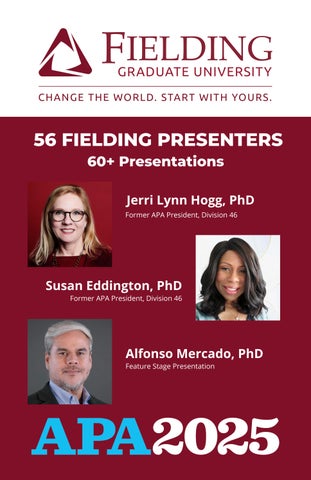
56 FIELDING PRESENTERS 60+ Presentations Jerri Lynn Hogg, PhD Former APA President, Division 46
Susan Eddington, PhD
Former APA President, Division 46
Alfonso Mercado, PhD Feature Stage Presentation
Fielding’s School of Psychology PhD in Clinical Psychology
An APA accredited* conventional doctoral program delivered in an unconventional way.
PhD in Applied Psychological Science
Program focuses on the application of psychological theories and methods to real-world settings
PhD, Master’s, Certificate in Media Psychology Where technology meets human experience. PhD, Master’s, and Certificate offered.
PhD, Master’s in Infant and Early Childhood Development Emphases in mental health and neurodiversity.
* The Clinical Psychology PhD Program is accredited by the American Psychological Association. Questions related to the program’s accredited status should be directed to the APA Office of Program Consultation and Accreditation (750 First St. NE, Washington, DC 20002 or 202-336-5979). The clinical psychology program received initial accreditation by the APA in 1991.
Fielding Clinical Psychology Faculty,
Anthony Greene, Ph.D. Honored with
APA Division 45 Award for Mentorship and Service
Fielding.edu/Psychology
A Leader in Psychology Graduate Education for over 50 years Whether you’re interested in the APA accredited Clinical Psychology program, Media Psychology, General Psychology, or Infant and Early Childhood Development, all of our programs are designed for individuals balancing career, family, and community responsibilities while achieving their educational goals.
Kristine M. Jacquin, PhD Dean, Curriculum & Innovation Clinical Psychologist
Become part of Fielding Graduate University’s community of scholarpractitioners and help define the future of psychology in: • clinical practice • applied psychology • use and design of media technologies • specific mental health needs of infant and early childhood development
Connie Veazey, PhD Program Director Clinical Psychology
Fielding Graduate University Select APA Presenters
APA-accredited PhD in
Clinical Psychology
PhD in Clinical Psychology* Fielding’s doctoral program in Clinical Psychology is accredited by the American Psychological Association. It is the only distributed learning program accredited by the APA. The Psychology PhD serves adults, many of whom who have trained or worked in the mental health field. Our unique distributed learning model blends the best of in-person learning opportunities with digital formats.
Postbaccalaureate Certificate in Clinical Psychology Only 7% of applicants to all APA accredited clinical psychology programs are accepted each year. This is why we created the postbaccalaureate certificate program. 87% of our postbac certificate graduates are accepted into an APA accredited PhD program, including Fielding’s PhD in Clinical Psychology program.
* The Clinical Psychology PhD Program is accredited by the American Psychological Association. Questions related to the program’s accredited status should be directed to the APA Office of Program Consultation and Accreditation (750 First St. NE, Washington, DC 20002 or 202-336-5979). The clinical psychology program received initial accreditation by the APA in 1991.
Fielding.edu/Psychology
Neuropsychology Specialization Training Program The program is designed for licensed psychologists who want to extend the scope of their assessment practices and treatment interventions to include neuropsychology. Study with renowned neuropsychologists Dr. Elkhonon Goldberg based in New York City, New York, and Dr. Arnold Purisch based in Orange County, California.
Elkhonon Goldberg, PhD Neuropsychology Specialization New York, NY
Postdoctoral Certificate in Respecialization in Clinical Psychology The postdoctoral certificate program is designed for doctoral level psychologists who, as part of their professional development, want to become licensed clinical psychologists. The program’s academic and clinical coursework and supervised clinical training prepares you for licensure. Entering students must hold a PhD in Non-Clinical area of Psychology such as social, developmental, or organizational psychology.
Arnold Purisch,, PhD Neuropsychology Specialization Orange County, CA
PhD, Master’s, or Certificate
Media Psychology PhD in Psychology with an emphasis in Media and Technology The Fielding PhD in Psychology with an emphasis in Media & Technology prepares students to work at the intersection of psychology theories and media technologies. The curriculum blends the study of social behaviors, cognition, perception, and emotion with the research skills you need to be a specialist in psychology applied to media and technology.
100% ONLINE Master’s in Applied Media Psychology You can earn your master’s degree in this innovative field through our 100% online Media Psychology program, while maintaining your professional career and living in your own community. Our program offers great flexibility and attention to your individual goals, small classes, and the ability to interact directly with faculty and colleagues.
Certificate in Media Psychology Fielding offers a 3-course, 100% online certificate in Media Psychology designed for professionals in diverse fields.
Fielding.edu/Psychology
100% ONLINE
PhD in Psychology with an emphasis in Applied Psychological Science Fielding offers a program that focuses on the application of psychological theories and methods to such real-world settings as communities, business, industry, education, government, and the military. It applies core knowledge found within social psychology, cognitive psychology, developmental psychology, industrial/organizational psychology, human factors, and research methods/statistics to answer student-inspired practical questions. Fielding’s doctoral program in Psychology has a unique learning model that employs the best distance learning opportunities. Students will gain expertise by conducting psychology research at the doctoral level after securing a breadth of knowledge in the core fields of psychology, then taking a deep dive into a focal area of interest (e.g., teaching psychology). Graduates are well-suited for academic positions in colleges and universities as well as applied positions in both for-profit and nonprofit organizations.
PhD, Master’s Infant and Early Childhood Development (IECD)
Fielding Graduate University Select APA Presenters
PhD in Infant and Early Childhood Development The Fielding PhD in Infant and Early Childhood Development (IECD) with an emphasis in mental health and neurodiversity is a degree serving multiple disciplines as they apply their work using the lens of infant mental health (IMH) and development. The program was initiated by Stanley Greenspan, MD, and Serena Weider, PhD, to promote research supporting relationships, individual differences, and development (DIR®) in working with infants, children, and their families. The field of Infant and Early Childhood Development is exciting and highly rewarding. The first years of life lay the foundation for all domains of human development, including the basic relationship building blocks needed for the capacities to feel, love, adapt, and develop a sense of self. The program is interprofessional in structure, including mental health professionals (Clinical and counseling psychologists, MFT, SW), OT, PT, SLP, medical professionals (MD, RN), social services professionals as well as educators Carrie Alvarado, Ph.D., OTR and policymakers. IECD Core Faculty
Fielding.edu/Psychology
100% ONLINE Master’s in Infant, Child, and Family Mental Health and Development TThe MA in Infant, Child, and Family Mental Health and Development prepares clinicians and educators to support families’ social, emotional, and developmental needs with a strong focus on culture, equity, and inclusion.
Jenene Craig, PhD IECD Program Director
The pandemic exposed deep systemic challenges—including racism, inequity, and lack of access—that intensified an already growing mental health crisis. Families have been especially affected, highlighting the urgent need for culturally competent, well-trained professionals. Yet many still lack adequate education and support, contributing to professional stress and limiting effective outcomes.
Christine Gliniak, Ph.D., OTR/L, IECD Core Faculty 2025 NANT Researcher of the Year
Fielding Graduate University Select APA Presenters
Presenter: Tatyana El-Kour, PhD, MA, MS, RDN, FAND Title: Shaping Choices: How AI and AGI Influence Media Consumption, Food Decisions, and Consumer Psychology Summary: This presentation explores how cutting-edge research reveals AI and AGI are transforming media and food choices by leveraging emotional and behavioral data to shape consumer decisions—raising urgent ethical questions about autonomy, privacy, and psychological well-being.
Presenter: Don Grant, PhD, MA, MFA Title: Evidence-Based Healthy Device Management Practices and Skills For Caregivers Summary: While much attention has been given to adolescent device use, less is known about the behaviors and beliefs of caregivers. This session explores how a caregiver’s own device habits may influence their child and the parent-child bond. Led by a globally recognized media psychologist and author of a recent national study, this interactive presentation offers research insights along with practical strategies for healthy device management in caregiving.
American Psychological Association 2025
Presenter: Susan J. Eddington, PhD, APR Title: Media Psychology and Technology: Past, Present, and Future—A Presidential Panel Discussion Summary: This distinguished panel, featuring current and past presidents of Division 46, will examine the key issues, enduring challenges, and inspiring possibilities that lie ahead for media psychology. Of Note: Dr. Eddington is a former APA President, Division 46.
Presenter: Kimberly B. Harrison, Ph.D. Title: Incorporating Screentime Management into Therapeutic Interventions for Children and Teens Summary: This presentation will define when and where technology is necessary, helpful and practical juxtaposed with when it creates social, emotional and behavior problems in children and teens. Intervention tools will be identified for empowering parents, creating balanced lifestyles, and reducing emotional distress.
Fielding Graduate University Select APA Presenters
Presenter: Jerri Lynn Hogg, PhD Title: The AI Revolution: Exploring Social and Psychological Impact of Strong AI Summary: This presentation examines the psychological foundations of AI and human-technology relationships, exploring their impact on society and human experiences. It provides psychologists with insights to navigate this evolving landscape, addressing benefits and challenges of AI integration in various aspects of life, from social interactions to consumer behavior. Of Note: Dr. Hogg is a former APA President, Division 46.
Presenter: Janelle L. Peters, M.A. Ph.D. Student, Research Assistant Title: Antisocial Egocentricity and Test Effort Predict Unprofessional Conduct in Police Officers Summary: Public safety is dependent on citizens’ ability to trust law enforcement. Research suggests the PAI is useful in predicting problematic behaviors of law enforcement candidates prior to employment. Our results revealed that PAI scores on antisocial egocentricity, inconsistent responding, and positive impression management predicted officers receiving citizen complaints in the first year of employment.
American Psychological Association 2025 Presenter: Harry Voulgarakis, PhD, BCBA-D Title: Impact of the SDARI Program on Loneliness and Sense of Belonging in Autistic Individuals. Summary: This study assessed the SDARI program’s impact on loneliness and belonging in autistic individuals. Using the SRS-2, results showed improved social connection and reduced loneliness, highlighting the potential of structured interventions to support relational well-being. Presenter: Jamila M. Williams, MS, MBA PhD student Titles: (1) Attitudes About Psychedelic Treatments in a General U.S. Sample. (2) Stronger Cultural Identity Predicts More Negative Attitudes About Psychedelic Treatments Summary: (1) About 8.8 million U.S. adults use psychedelics, increasingly for therapy. In a study of 299 adults, participants held neutral views on their effects and safety, with no link between attitudes and age. (2) Indigenous populations valued psychedelics and held high regard for their positive effects on cultural and religious practices. We surveyed 299 U.S. adults to learn how their cultural identity relates to attitudes toward psychedelics. Findings revealed stronger cultural identity is correlated with negative attitudes toward psychedelics.
Fielding Graduate University Select APA Presenters Presenter: Julie Dismang, Ph.D. Student, Clinical Psychology Title: Mass School Shooters Experienced More Adverse Childhood Events than Other Types of Mass Shooters Summary: Despite growing concern over mass shootings, little research has explored shooters’ childhoods. This study found that mass school shooters experience significantly higher rates of adverse childhood experiences (ACEs) than other mass shooter types.
Presenter: Ashley Whitworth, MA Title: Benefits of Medication Assisted Treatment in Correctional Settings and BeyondSummary: Medication-assisted treatment (MAT) is used in correctional and community settings to treat substance use disorder. Despite some criticism, its benefits outweigh the challenges during and after incarceration. Title: Psychological Differences in Tattooed and Non-Tattooed Police Officer Candidates Summary: Our research found that tattooed police officer candidates display higher rates of psychopathic deviance, mania, anxiety, and alcoholism risk than candidates without tattoos. However, non-tattooed candidates are more likely to exhibit characteristics of hypochondriasis, hysteria, paranoia, and schizophrenia.
American Psychological Association 2025 Presenter: Caroline G. Cortright PhD student Title: Recognizing and Responding to Workplace Microaggressions: A Qualitative Exploration Summary: Microaggressions, often shaped by systemic oppression, harm marginalized individuals and are especially common for women in professional settings. While past research has focused on the impact on targets, this study explores how people recognize and respond to microaggressions at work. Participants will view staged videos involving disability-based microaggressions and record their reactions. Preliminary analysis suggests varied responses—ranging from empathy to denial—based on participants’ identities. Findings aim to inform workplace training on awareness, intervention, and allyship.
Presenter: Angie Aquino, PhD student Title: A Systematic Review of ADHD Prevalence and Comorbidities in Military Servicemembers and Veterans Summary: Our research systematically synthesized results of 15 journal articles according to PRISMA guidelines. Using data from 35,110 participants, we discovered ADHD prevalence rates are higher among veterans (20%) than military servicemembers (7.6%). Comorbid conditions were common (89.1%) and indicate the importance of evaluating comorbidities to decrease ADHD misdiagnosis.
Presenter: Alfonso Mercado, Ph.D. 3 Presentations including one on the Feature Stage Presentations: Mercado, A., Venta, A., & Moreno, O. (August 8, 2025). ICE and Psychology: Immigration Policies and Impact on Clinical Practice, Research, and Training. Feature Stage Presentation at the American Psychological Association Annual Convention, Denver, Colorado. Mercado, A., Burrell, E., Newton, C., & Studwell, K. (August 9, 2025). Advocacy in uncertain times: ACC’s role in APA’s/APASI’s current and future directions. Presentation at the American Psychological Association Annual Convention, Denver, Colorado. Demanarig, D., Beasley S.T., Hita, L., Cokley, K., Hashem, H., & Mercado, A. (August 9, 2025). Application of the Cross-Racial/Ethnic Solidarity Framework to Combat Anti-Palestinian Racism. Presentation at the American Psychological Association Annual Convention, Denver, Colorado. Presenter: Divina Fernandez, Ph.D. Student, Clinical Psychology Title: Gender & Cultural Differences in Services Experiences of Late Diagnosed Neurodivergent Summary: This poster presents the current literature on how gender and culture impact the age of service delivery experiences for neurodiverse parents
Fielding.edu/Psychology