


Photo courtesy Kendra Cofer

Liberty Hill Digest is more than a magazine—it’s a connector, storyteller, and champion for our community. Since 2020, we’ve shared 550+ stories and mailed 400,000 free copies to keep Liberty Hill informed and inspired. Each issue highlights local people, nonprofits, students, first responders, and city events that define who we are. Our annual Giving Thanks & Giving Back edition and rotating nonprofit column amplify causes that strengthen our city. At our core, we celebrate what’s good, foster connection, and help Liberty Hill thrive—together.
Meet our Pros - industry professionals, business owners, and subject matter experts from leading local companies who share their knowledge and expertise to bring readers practical advice, how-to tips, best practices, and current and emerging trends.
To learn more about becoming a Featured Professional, contact info@lhtxdigest.com or 512.746.4545.
PUBLISHER
Cathy Payne
WRITERS / COPY
EDITORS
Ann Marie Kennon
Charlotte Kovalchuk
GRAPHICS & DESIGN
Sandra Evans
CONTENT
Camy Reynolds
ADVERTISING info@lhtxdigest.com 512-746-4545
Liberty Hill Digest is a Fidelis Publishing Group, LLC publication and a product of AdvocateNewsTX Newspaper.
Copyright © 2026 • All rights reserved. Liberty Hill Digest is published monthly and mailed USPS, free of charge, to homes and businesses in Liberty Hill, TX zip codes.


Hall's Roofing & Sheet Metal, LLC
Family owned since 1939. Roofing professionals specializing in full-service roof repair, installation, and replacement.
HallsRoofing.net 512-864-7579

Moore Liberty Buildings Chad & Amanda Moore
Thousands of structures built since 2015.
MooreLibertyBuildings.com 512-548-6474
SCAN THE CODE FOR E-SUBSCRIPTION AND NEVER MISS AN ISSUE.

FOLLOW US ON FACEBOOK FOR FOLLOW-UPS AND OUTTAKES LHDigest




During one weekend in April, Kalahari Resorts & Conventions was flooded with superheroes and princesses throughout Hero Camp—a two-day retreat hosted by L4 Cares for 10 families with children battling terminal illnesses. The goal of the biannual camp, which began in 2024, is to provide families with space to breathe and reconnect away from medical routines and hospital settings. From water park adventures to visits from beloved costumed characters, the weekend was filled with moments that let families simply enjoy being together.
“Hero Camp creates a space where families facing serious medical challenges can step away from the weight of it all and simply be together— laughing, connecting, and making meaningful memories,”
says Kendra Cofer, founder of L4 Cares, a local nonprofit that supports families and individuals facing life’s most difficult challenges. In addition to helping families with kids with serious illnesses, the organization also focuses on supporting military families in need, the elderly,
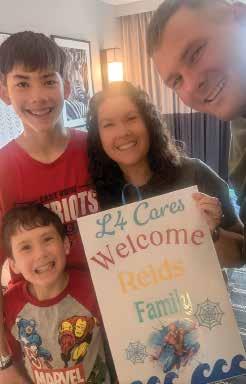
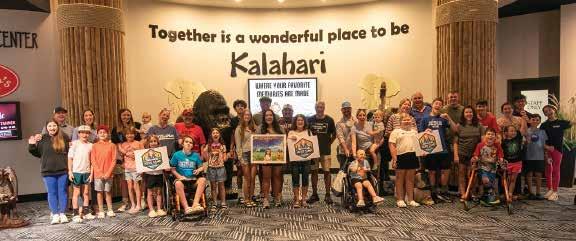
and those facing crises and disasters. “At the heart of it is community—making sure families feel seen and supported, siblings feel just as special and included, and that each family can build strength not only within their own home, but alongside others who truly understand their journey. Bringing these families together creates such a wonderful healing bond of community.”
Hero Camp meets families whenever they are at in their journey, offering encouragement, understanding, and moments of joy during seasons that can feel overwhelming. “Whether a family is newly diagnosed, in the middle of treatment, post-treatment, walking through something like a heart transplant, or even honoring a child whose angel has gained their wings—this camp is for all of them,” Kendra says.
While the weekend is centered on creating unforgettable memories, it also reflects a larger mission: building lasting support systems for families long after Hero Camp ends. That vision is what continues to inspire the
next chapter for L4 Cares. Kendra says, “Watching that kind of joy come to life at Kalahari was incredibly powerful, and it’s what continues to drive our vision of building a permanent 20-acre home right here in Central Texas where that connection and community can grow yearround.”

and 6.

How research security, university partnerships, and state policy are shaping Texas’ next generation of innovation.
In my first article of this three-part series on education, I covered the 89th Texas Legislature’s historic investments into public education and empowerment of parents to keep the public education system accountable. In the second, I covered the steps Texas has taken to ensure freedom of speech and academic excellence for our institutions of higher education.
For the third entry in the series, let’s look at how our institutions of higher education serve as economic engines, national security assets, workforce pipelines, and hubs of innovation, and how the 89th Texas Legislature acted to safeguard those vital functions from intellectual property theft, including espionage from foreign adversaries.
From stories of professors stealing research to sell for personal gain, to well-meaning but naive researchers partnering with their counterparts in adversarial foreign governments, to repeated accusations of how taxpayer money is wasted on niche research without obvious real-world application, universities across our nation have lost the trust of the public when it comes to research and innovation.
This last session, Texas took the lead in restoring that faith, taking steps to restructure our institutions to focus on good stewardship of taxpayer funds, both in what research they choose to fund and in how they protect that research.
This last session, Texas took the lead in restoring that faith, restructuring our institutions to focus on stewardship, security, and measurable outcomes. In doing so, Texas did not just respond to national concerns. We built the first comprehensive, statewide frameworks aligning research, economic development, and national security. Other states are now beginning to follow that model.
Texas does not just compete with other states for jobs anymore. We are competing for entire industries built over time through research, workforce development, and strong partnerships between universities, industry, and government. The work happening inside our public universities is directly tied to the future of sectors like semiconductor manufacturing, artificial intelligence, biotechnology, energy systems, and aerospace. These are not abstract ideas. They shape our ability to remain competitive as a state.
Federal funding trends reflect this shift. Research dollars are being directed toward large, coordinated efforts that bring multiple institutions and industry partners together. These projects are designed to move ideas beyond the lab and into real-world application. That means the way states compete has changed. It is no longer about one university outperforming another. It is about whether a state can operate as a connected system that can deliver results at scale. If Texas wants to continue leading, we must recognize that reality and act accordingly.
When I was first elected as your State Representative in 2016, Texas only had 3 major research universities, one of which was private. I knew that our state could, and must, do better. As Chairman of Article III of Appropriations, which oversees funding our public and higher education institutions, I worked with leaders in both chambers to help lay the groundwork for the Texas University Fund (TUF), which was passed the following session.
The TUF set aside $1 Billion into an investment fund. The proceeds from those investments are used to fund research in universities across our state that previously did not have access to a reliable stream of research funding. With TUF funds, they are able to make long-term research investments, which can yield greater long-term benefits for the state.
Texas is now leading the nation in the number of research universities classified as “Tier 1” by the Carnegie Institute, with 16 in total. However, that distinction only tells the world that those institutions spent $50 million per year on research, which doesn’t mean much on its own. What matters is not only how much we spend, but that those investment produce quality, relevant research that advances our position as a global economic leader.
Texas institutions of higher education maintain strong relationships with the energy, aerospace, healthcare, and advanced manufacturing industries, ensuring that research investments drive job creation and economic growth, not pet projects. Our growing economy continues to attract talent and investment across the country, but coordination across institutions remains a challenge.
Universities naturally compete for talent and funding, but Texas policy is increasingly structured to ensure that institutions also operate collaboratively. The Coordinating Board’s research planning framework explicitly requires institutions to demonstrate cross-disciplinary collaboration, partnerships with other Texas institutions, and alignment with regional economic priorities. Competition can encourage excellence, but we succeed better when we work together rather than competing against each other as isolated campuses.
The more competitive the research initiative, the larger and more multidisciplinary the team required to accomplish the goal. Coordinated research networks allow companies and government partners to move in the same direction.
Texas has the talent and institutional capacity to compete at that level. Achieving that goal requires viewing the state’s universities as components of a broader innovation system and keeping that system secure from foreign influence and the potential theft of the research they produce.
Research security is ultimately about maintaining trust. Federal agencies require institutions to demonstrate strong security standards when awarding funding for classified research projects with the Departments of Defense, Energy, Commerce and Agriculture, which comprise the largest research and development budgets worldwide. Texas recognized early that research security is not just about preventing bad outcomes, it is about enabling growth. Rather than wait for mandates, Texas acted ahead of most of the country to build a structured, statewide approach to research security that allows institutions to collaborate, compete for federal funding, and engage with industry while protecting sensitive research.
Our universities are required to maintain policies to handle secure academic research by keeping intellectual property secure from international espionage and foreign governments so that Texas remains a research destination for industry nationwide. Industry research attracts proprietary industry partnerships like advanced manufacturing, supply-chain investment, and the jobs that follow.
The development of Silicon Valley provides a well-known example. Federal investment in university research during the early decades of the technology industry helped create collaborative networks that laid the foundation for one of the most productive innovation regions in the world.
The benefits from securing our research institutions lead to the passage of SB 1565 in 2023, creating a Research Security Officer (RSO) position at each Higher Education Institution in Texas with research capacity. SB 1565 made the SROs responsible for handling classified information, controlled unclassified information (i.e. trade secrets and proprietary designs), and foreign influence reporting.
SB 1565 made the RSOs responsible for handling classified information, controlled unclassified information (i.e. trade secrets and proprietary designs), and foreign influence reporting.
With those positions established, last year I authored and passed HB 127, which formed the Research Security Council, bringing all the RSOs across Texas together to develop best practices, create a common framework, and allow participating institutions to share information about potential security threats.
HB 127 also increased research security by requiring RSOs to review and vet all gifts, grants, and donations to a university or university employee from an adversarial foreign government, an organization or individual acting on behalf of an adversarial foreign nation, or any group, individual, or organization identified as a potential security threat by the Governor. It also placed those same vetting requirements on all cultural exchange programs within institutions of higher education.
HB 127 established enforceable accountability measures to ensure compliance. Institutions must certify adherence to research security requirements as a condition of receiving state appropriations, are subject to periodic audits by the State Auditor, and must cure any identified violations within a defined timeframe. Failure to do so can result in loss of eligibility for fu-
ture funding. The bill also reinforces existing institutional consequences by integrating research security requirements into university policies and aligning violations with existing criminal statues related to theft of trade secrets.
HB 127 created consistency across Texas institutions and prevents conflicting standards for universities collaborating on major research projects. This approach is supported by efforts such as the Academic Security and Counter Exploitation Program, which focuses on protecting research from espionage and intellectual property theft while allowing legitimate collaboration. Innovation depends on partnership, but those partnerships must be built on transparency and mutual benefit.
The goal is not to slow progress, but to ensure it can be secure and sustainable. Without a shared commitment to research integrity, Texas cannot fully scale its research ambitions. Building a state-of-the-art secure research ecosystem will require funding, but it is a proven investment direly needed to get our state not just to the top ranking, but to the top of our true potential.
Since 2009, the Texas Higher Education Coordinating Board has required every research university and emerging research university to develop long-term Strategic Plans for Research, creating a statewide framework that aligns institutional priorities with Texas’ economic and workforce needs.
These are not abstract exercises. They require institutions to clearly define their research priorities, demonstrate how those priorities will translate into economic impact, expand partnerships across institutions and industry, and align doctoral education with high-demand workforce needs. This framework reflects an important reality; research ecosystems are built over decades, not 2-year funding cycles. Long-term planning allows institutions to make sustained investments in talent, infrastructure, and partnerships that support continued growth and competitiveness. Today, Texas is building on to that foundation. For the first time, the state is pairing research security with a structured research strategy, ensuring that growth in research capacity is coordinated, accountable, and directly tied to economic development.
Workforce initiatives ensure that graduates are prepared for the evolving economy. Governance reforms strengthen institutional accountability. However, research drives the discoveries, technologies, and industries that power growth.
Research security policies protect intellectual property and integrity of the state’s research enterprise. Strategic planning encourages institutions to align their efforts with statewide priorities. Greater coordination allows universities to pursue larger research initiatives and attract greater investment.
Together, these efforts create the foundation for a modern research ecosystem.
Texas already possesses the talent, institutions, and economic strength necessary to lead the nation in research-driven innovation. The challenge ahead is ensuring that these assets operate as a coordinated system rather than in isolation.
The state will remain positioned to build one of the most secure and competitive research economies in the country as long as Texas protects its research enterprise and aligns its institutions toward shared goals.
The next chapter of Texas prosperity will not be defined by any one university or policy. It will be defined by how well we integrate them; into a system stronger than the sum of its parts.and competitive research economies in the country as long as Texas protect its research enterprise and aligns its institutions toward shared goals.
The next chapter of Texas prosperity will be bound by the strength of the systems that are built together.

Throughout this series, there has been a focus on accountability, workforce readiness and maintaining strong academic standards within higher education. Research plays an important role in supporting this series expositionWorkforce initiatives ensure graduates are prepared for the evolving economy. Governance reforms strengthen institutional accountability. However, research drives the discoveries, technologies, and industries that power growth.




by Charlotte Kovalchuk

Spring in Central Texas is the sweet spot between winter’s hibernation and summer’s relentless heat—the perfect time to rethink what a regular fitness routine looks like for you.
For many, that means stepping away from treadmills and weight rooms and taking things outside. Across Williamson County, parks, trails, and open spaces offer countless ways to move your body that feel less like a workout and more like a fun outdoor adventure. Whether you’re looking for a low-impact activity, a friendly competitive sport, or a full-day nature outing, there’s no shortage of ways to get out and enjoy the spring season.

Since the pandemic, pickleball has exploded in popularity as a safe, accessible sport for players of all ages and abilities. A hybrid of tennis, Ping-Pong, and badminton, it’s easy to pick up and made for social play. One of the best things about pickleball is its flexibility—you can play on converted tennis, basketball, or volleyball courts. Throughout Williamson County, dedicated courts make it easy to grab a paddle and play.
FREESTYLE COMMUNITY CENTER: Rental courts with a more structured setup. Cost: $20 per court. 75 Seward Junction Loop, Liberty Hill
GEORGETOWN TENNIS CENTER: Dedicated courts with a club-style feel. Reservations required. Cost: $2/hour per person. 400 Serenada Dr, Georgetown
MCMASTER ATHLETIC COMPLEX: Free, casual courts ideal for drop-in play and beginners. Cost: Free. 101 Walden Dr, Georgetown
GEORGETOWN RECREATION CENTER: Indoor and outdoor options with leagues and programming. Cost: Free for members / $5 day pass. 1003 N Austin Ave, Georgetown
SOUTHWEST WILLIAMSON COUNTY REGIONAL PARK: Spacious courts in a multi-use park setting. Cost: $2/day or $50/year. 3005 Co Rd 175, Leander
Central Texas offers trails that turn a hike—whether a short loop or a full-day trek—into a memorable experience. From gentle paths for beginners to challenging terrain for seasoned hikers, there’s something for every skill level and sense of adventure.
RED OAK LOOP is an approximately six-mile, easy loop (around 2.5 hours) at River Ranch County Park in Liberty Hill, featuring a 500-year-old live oak named for former Wilco Parks Director Randy Bell, with scenic views of Liberty Hill and the South San Gabriel River.
THE GOOD WATER TRAIL LOOP offers one of the region’s most ambitious experiences—a 28-mile loop around Lake Georgetown that doubles as one of Texas’ few thru-hikes. While some take it on over multiple days, others challenge themselves to complete it in a single push, navigating everything from rocky hills to open grasslands.
For something slower paced, THE CEDAR PARK SCULPTURE GARDEN blends art and nature into an ever-changing outdoor gallery. With sculptures rotated twice a year, each visit offers something new and engaging for both body and imagination. Find the sculpture garden next to the Cedar Park Recreation Center, 1435 Main Street.
Further south, THE VIOLET CROWN TRAIL continues to expand as Central Texas’ first regional trail system. Stretching from Zilker Park in Austin toward the Lady Bird Johnson Wildflower Center, it connects neighborhoods, green spaces, and scenic landscapes in one continuous route
For those craving something more immersive, THE PECAN SPRINGS KARST PRESERVE offers guided hikes through a 1,205-acre protected ecosystem rich with native plants and wildlife. Located in northern Williamson County just five miles west of Jarrell, this preserve gives hikers the chance to observe wildlife, learn about conservation, and enjoy the Hill Country landscape. A guided hike is scheduled for 9am on Sunday, April 19. Admission is $10 per person, and registration is available at hillcountryconservancy.org.
If you’ve ever noticed metal baskets scattered through a park, you’ve probably come across a disc golf course. The game follows the same basic idea as traditional golf—make your way through a series of holes in as few throws as possible—but swaps clubs and balls for flying discs. Set in public parks, courses use trees, hills, and open space as natural obstacles, making each round feel a little different. Here are a few local courses to check out:
LARIAT DISC GOLF COURSE: Nine-hole course in Liberty Hill’s Lariat neighborhood that’s enjoyable for both beginners and experienced players.
SAN GABRIEL PARK, PINNACLE PARK, RIVERY PARK: Georgetown offers a well-rounded mix for all skill levels. San Gabriel Park and Pinnacle Park are both 9-hole, beginner-friendly courses—great for families, quick rounds, or learning the game, with shorter holes and lighter technical demands. Rivery Park’s 18-hole course adds more variety, with longer fairways, some elevation, and a balance of open and wooded play.
WILLIAMSON COUNTY DISC GOLF COURSE: Known locally as “Wilco,” this 18-hole course in Leander is one of the most challenging in the area, with long, tightly wooded fairways that demand precision and control.

OLD SETTLERS PARK DISC GOLF COURSE: A staple of Round Rock’s sports culture, this 18-hole course is known for its tight, tree-lined fairways and emphasis on accuracy over distance. A solid step up for players looking to refine their game.
FLYING ARMADILLO DISC GOLF CLUB: A destination course an hour’s drive from Georgetown in San Marcos, featuring both a full 18-hole championship course and a quirky 18-hole mini course with creative obstacles.








by Linda A. Thornton

It was the largest animal migration in human history. An estimated six – 10 million cattle moved along the Chisholm Trail. Though the cattle drive only existed for less than twenty years, its legacy is a testament to the spirit of the cowboy culture. Along the way, it earned Texas its number one status in beef cattle production in the U.S.
The Chisholm Trail name first appeared in newsprint in the April 10, 1869, edition of the Georgetown, Texas' Watchman newspaper. The article stated that "the hostile Indians of the Plains have been permanently removed from the route known as the Chisholm Trail and drovers can now take the trail with security from molestation."
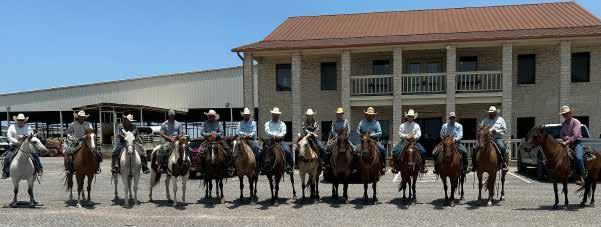
The Chisholm Trail was not a single, unbroken route. The network of pathways spread over a wide area and then narrowed at river crossings. Jesse Chisholm, its creator, originally established the wagon road to connect his trading posts. In time, it became known as the safest way to pass through the Indian territory.
The cattle drives were a rough and tumble business born of necessity. After the Civil War, Texas had an oversupply of cattle valued at only $2 – $5 per head. The North faced a beef shortage, and the same cattle could be sold there for $40 per head.
Spanning almost 1000 miles, the Chisholm Trail started in southern Texas and traveled through Oklahoma to the Pacific railroad’s new station in Abilene, Kansas, where the cattle could then be transported.
The journey took between two and three months, with herds traveling approximately 15 miles per day. From the trail boss, the cook, the drovers – whose name preceded that of cowboy – to the least experienced wranglers – sometimes as young as 12 years old – an experienced crew of 12 could manage a herd of 2000 – 3000 cattle.
Threats were around every corner including floods, river crossings, droughts, stampedes caused by lightening, and thirsty animals becoming crazed at the smell of water.
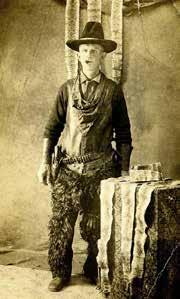

Vaqueros – from the Spanish word “vaca” for cow – were known as the original cowboys. United by their ability and rugged life, the melting pot of white, black, and Mexican vaqueros helped to define the Texas cowboy.
The cowboys of yesteryear might be plumb surprised to see their functional workday gear: wide brimmed hat, waist overalls – jeans of today – bandanna, chaps – protective leg gear – boots, and spurs – a tool to cue their horsesbecome so fashionable.
The chuck wagon is a part of our culinary heritage. The horse drawn mobile kitchen designed for cattle drives, was a precursor to today’s food truck. Homage is still paid to its hearty meals at cook-off competitions featuring authentic tools and recipes.
Our culture has celebrated the rugged, independent spirit of the cowboy through literature, art, songs, and movies. Rawhide, a top TV show that portrayed the trail ride challenges of the drovers, rode into living rooms weekly. The western movie genre went “Hollywood,” as Roy Rogers, John Wayne, and their predecessors were featured in action-packed box-office hits.
While the cowboys lived in a constant state of peril, little did they know what effects the cattle drives had back home in their state.
Financial institutions, along with the shipping industry, expe rienced immediate growth.
Significant profits help establish mega ranches, such as King Ranch. “Cow Towns” sprung up along the trail with much need ed services. Related ranching businesses, such as saddle-making and blacksmith ing were born. The demand for health ier cattle encouraged improvements in breeding, fencing, and water access.
By the 1890’s cattle drives were becom ing a relic of a bygone era. The invention of barbed wire gave ranchers a way to inexpen sively fence in their property, blocking tradi tional trail routes. The expansion of the rail
road into Texas made the long-distance transport unnecessary. The outbreak of Texas Fever, transmitted to cattle by ticks and fleas, initiated a quarantine against Texas cattle from entering other states.
At Capitol Land and Livestock in nearby Schwertner, Texas, general manager, Tom Madden says their business still replicates the Chisholm Trail. They endure the same mud, blood, and guts that’s synonymous with livestock and transport cattle on many of the same highways and byways. The only difference is that today, 18-wheelers have replaced horses.
Known as one of the nation’s largest cattle dealers, their cowboys – the most employed in central Texas – still work the company’s 20,000 acres much the same as their Old West counterparts. These resources give them the competitive advantage to be able to offer specialized services.
Liquidating their inventory of fresh calves daily, ranchers can choose between an immediate purchase or utilizing their weaning program, a crucial process where the calves are separated from their mothers’ milk and introduced to feed before being shipped.
President/CEO Jim Schwertner’s great grandfather, Adolph, rode the Chisholm Trail, probably never dreaming that a way to get a product to market would result in a massive enterprise that would have a lasting effect on introducing Texas culture to the world.


Just a 30-minute drive from Liberty Hill, Rita’s Italian Ice & Frozen Custard offers a refreshing escape from the Texas heat with a dessert stop revolving around treats not often found in Central Texas: fruity Italian ice and creamy frozen custard.
Part of a beloved East Coast-born brand that’s been delighting dessert lovers since 1984, Rita’s has quickly become a go-to gathering place for locals—showing up for everything from first dates and family celebrations to casual meetups and spontaneous sweet treat runs.
It all started in the summer of 1984, when former Philadelphia firefighter Bob Tumolo set up a small Italian ice stand on his front porch in a suburb of Philadelphia. Named after his wife, the original shop was built on a simple idea: to create the best-tasting, highest-quality Italian ice around. Sal Raccuglia, owner of Rita’s in Round Rock, can attest to that claim. Having grown up in Pennsylvania just two minutes away from a Rita’s, he said he’s never tasted anything that compares. “I have tried other Italian ice shops,” Sal says, “and that was by far the best.”
What began as a neighborhood treat quickly grew into something much larger. Today, Rita’s Italian Ice has expanded to more than 30 states, including Texas, which is home to two Rita’s in Round Rock and New Braunfels. After considering nearby communities like Georgetown, Cedar Park, and Leander, Sal ultimately chose Round Rock for its growth and stability. “It felt the most established, so I wanted to start there as my first staple store.”
The shop opened in April 2025 at the Shoppes at Forest Commons on Gattis School Road, bringing a dessert long associated with the Philadelphia area into a region better known for ice cream and snow cones.
“Austin
was missing something,” Sal says. “It gets really hot here, and there’s not much Italian ice. I wanted to bring it out here.”
He adds that with Central Texas growing so quickly, residents can look forward to a taste of Rita’s signature treats in the future.

At the heart of Rita’s is its signature Italian ice—a dairyfree dessert made from water, sugar, and fruit—smoother and softer than a snow cone, lighter and less dense than sorbet with a scoopable, almost creamy texture. With a rotating lineup of more than 95 varieties, each visit feels like a new experience, whether you’re craving something light and citrusy or rich and decadent. For your first stop at Rita’s, start with some customer go-to picks: mango (the number one bestseller) as well as other fruity favorites like cherry, strawberry, watermelon, or tropical-vacation-in-a-cup pina colada.
Beyond Italian ice, there’s also frozen custard: a silky dessert similar to ice cream but richer and thicker due to the addition of egg yolks. The gelati layers velvety custard with Italian ice for the best of both worlds, while the blendini whips the two together into a smooth, almost milkshake-like consistency that sits somewhere between dessert and drink.
More than just a dessert stop, Rita’s has become a local hangout where people come to cool off and connect while sharing something sweet together. Families swing by after Little League games, friends meet up for a midweek treat, and couples often find it an easy, low-pressure first date spot.
“Our main audience is definitely families—they can all get a treat for under $30, which is hard to find around here,” Sal says.

“We also see plenty of couples on dates, and we’ve had many people tell us this was where they had their first date—or even where they first met.”
For first-time customers, there’s an added welcome: download the Rita’s Italian Ice & Frozen Custard app and after your first purchase, you can enjoy a free Italian ice, custard, gelati, or blendini during your next visit.

3720 Gattis School Rd #200 Round Rock ritasice.com

