Leadership, responsibility, and trust—at home and in the community
PHOTO BY RSX STUDIOS
WHO WE ARE
Liberty Hill Digest is more than a magazine—it’s a connector, storyteller, and champion for our community. Since 2020, we’ve shared 550+ stories and mailed 400,000 free copies to keep Liberty Hill informed and inspired. Each issue highlights local people, nonprofits, students, first responders, and city events that define who we are. Our annual Giving Thanks & Giving Back edition and rotating nonprofit column amplify causes that strengthen our city. At our core, we celebrate what’s good, foster connection, and help Liberty Hill thrive—together.
FEBRUARY FEATURES
4 / MEET RUPAL CHAUDHARI
7 / RECOVERY AND HOPE FROM 2025 FLOODS
COLUMNS
10 / KIDS & EDUCATION • JP2 TEEN COURT
12 / BELLE CHIMES IN • HOME, HEROES & HEART
PUBLISHER
Cathy Payne
WRITERS / COPY
EDITORS
Ann Marie Kennon
Charlotte Kovalchuk
ASK A PRO
FEATURED PROFESSIONALS
Meet our Pros - industry professionals, business owners, and subject matter experts from leading local companies who share their knowledge and expertise to bring readers practical advice, how-to tips, best practices, and current and emerging trends.
To learn more about becoming a Featured Professional, contact info@lhtxdigest.com or 512.746.4545.
Hall's Roofing & Sheet Metal, LLC
Family owned since 1939. Roofing professionals specializing in full-service roof repair, installation, and replacement.
HallsRoofing.net 512-864-7579
Moore Liberty Buildings Chad & Amanda Moore
Thousands of structures built since 2015.
MooreLibertyBuildings.com 512-548-6474
CONTRIBUTORS
Linda A. Thornton
GRAPHICS & DESIGN
Sandra Evans
Ann Marie Kennon
CONTENT
Camy Reynolds
IT/WEBMASTER
Ann Marie Kennon
CONSULTANT
W. Ben Daniel
ADVERTISING
info@lhtxdigest.com 512-746-4545
Liberty Hill Digest is a Fidelis Publishing Group, LLC publication and a product of AdvocateNewsTX Newspaper.
SCAN THE CODE FOR E-SUBSCRIPTION AND NEVER MISS AN ISSUE.
FOLLOW US ON FACEBOOK FOR FOLLOW-UPS AND OUTTAKES LHDigest
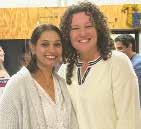
RUPAL CHAUDHARI Leading With Trust
A LIFESTYLE PROFILE OF RUPAL CHAUDHARI, CANDIDATE FOR WILLIAMSON COUNTY COMMISSIONER, PRECINCT 2
As an attorney, business owner, advocate, and volunteer, it can be difficult for Rupal Chaudhari to truly step away from her work. Not because she doesn’t value rest, but because she is deeply invested in the people and places around her. When she does slow down, what grounds her most isn’t a title or position. It’s family, a strong work ethic, and the rhythms of a close-knit community.
Where Leadership Begins
Family, she believes, is where everything begins. The values instilled by her parents who came from humble beginnings and emphasized education, integrity, and hard work, continue through her own role as a wife and mother. Surrounded by a strong support system, she sees family as both an anchor and a source of energy. “When your heart is full, you’re able to give back,” she explains. “You can’t pour from an empty cup.”
Like many women in leadership, motherhood became Rupal’s first proving ground. It was where decisions stopped being abstract and began carrying real, immediate consequences for others. Being a mom, she says, has been deeply hum-
bling—teaching her how to care for another human being in a way nothing else can. “That kind of responsibility changes you,” she reflects. “It teaches you to think beyond yourself and to make tough decisions for the good of those who depend on you.”
That perspective, the personal and practical, has shaped how Rupal leads. Whether she’s evaluating policy or making business decisions that affect real livelihoods, she has learned to focus less on optics and more on outcomes. “Decisions aren’t theoretical,” she says. “They affect real people and real families.” Accountability, fiscal discipline, and follow-through aren’t abstract ideals for her; they’re habits formed by responsibility.
As an attorney, Rupal has seen how even well-intentioned policies can create unintended consequences. What may look minor on paper can quickly become a burden for working families, seniors on fixed incomes, or small business owners trying to stay afloat. That awareness fuels her belief in careful, measured government—one that respects independence while still protecting people from harm.
by Ann Marie Kennon • photos courtesy Rupal Chaudhari
Her service as a CASA volunteer has deepened that conviction. Working with children at their most vulnerable has shaped her not only as a leader, but as a mother. “You don’t see cases or policies,” she explains. “You see kids who need safety, stability, and someone firmly in their corner.”
For Rupal, protecting children isn’t just good policy, it’s a responsibility shared by parents, neighbors, and the entire community.
Service, Not Spotlight
Education is another place where her values come into focus. Having earned the confidence of local education leaders, Rupal believes strong schools and strong communities depend on a true partnership with parents. Her own life was shaped by the education her parents fought to provide, something they never had themselves, and she sees parental involvement, transparency, and high standards as essential to raising confident students and resilient communities.
Those relationships aren’t limited to formal settings. Rupal is a familiar face to the Over The Hill Gang at the Liberty Hill Senior Center, where she spends time visiting, listening, and engaging with residents. To her, service isn’t something you wait to be asked to do. “When you want to serve, you just show up and help,” she says.
Her approach to leadership echoes an idea often attributed to Abraham Lincoln: that people are best governed through trust, not fear or force. Leadership, in her view, isn’t about
holding power—it’s about preparing others, being transparent, and taking responsibility for decisions. That philosophy also guides how she balances compassion with accountability. Compassion, she believes, should help people move forward, not enable problems to continue.
Looking ahead, Rupal hopes residents won’t remember her name as much as they notice how their daily lives feel—whether systems work, infrastructure keeps pace, and families feel heard. She takes that responsibility personally, committed to listening even when there is disagreement.
In the end, Rupal Chaudhari’s case isn’t built on slogans or sound bites. It’s built on lived responsibility—first at home, then in her profession, and throughout her service to others. Now running for Williamson County Commissioner in Precinct 2, she offers families and individuals steady judgment, earned trust, and leadership grounded in real-world consequences. For Precinct 2, the choice is clear.
I witnessed firsthand Rupal Chaudhari’s character and capabilities—she is intelligent, compassionate, and genuinely takes the time to listen and find reasonable solutions.
—
Donald Baker
Long-time Liberty Hill Resident
Former Austin Police Department Commander
I met Rupal last year and spent a couple hours getting to know her over coffee. I was impressed with her story and her heart. It’s obvious that she cares about the people she serves and wants to do a good job. Even though county commissioners do not have a direct impact on public education it is important for the district and the county to have a good working relationship for future planning and infrastructure in our area. Rupal is a supporter of public education as she has two kids who are currently in public school. She is well qualified for the job and I’m proud to vote for her.
— Megan Parsons
Liberty Hill ISD School Board President
Pd. Pol. Ad. Rupal Chaudhari for Williamson
THE WATER RECEDED THE WORK CONTINUES
Last July, devastating floods swept through parts of Central Texas. For many in the Bertram community, the destruction felt personal—because it was.
C.R. Williamson, great-grandson of “Three-legged Willie” Williamson, and his wife Gayle are familiar, well-loved faces. When floodwaters rose that weekend, they, their daughter Donna and her husband Randy, found themselves trapped inside the home that held decades of family life.
As water climbed nearly to the ceiling, the family made a split-second decision that would save their lives. They climbed onto the roof and waited for rescue. First responders later cut them out and evacuated them by boat, an ordeal that still feels surreal.
When the water finally receded, nearly everything was gone. Vehicles, clothing, furniture, and family keepsakes were lost. The house itself was left nearly unrecognizable— saturated and unsafe—requiring a complete gut down to the framing. Recovery would not be quick or simple.
After Headlines Fade
That reality is what L4 Cares founder Kendra Cofer encountered when she first met the Williamsons. She visited flood-affected areas to observe recovery efforts already underway. When she met C.R. and Gayle and heard their story, the magnitude of what they were facing was immediately clear.
“My heart went out to them,” Kendra said. “I didn’t know what the plan was going to be yet, but I knew we needed to stay with them.”
Like many families impacted by the flood, the Williamsons stared at uncertain future as insurance would not cover the full rebuild.
A Chain of Yeses
Kendra began making calls. One of those calls was to Tracy Hayes with CWS Corporate Housing. “Anytime there’s a need in the community, we feel very privileged to help,” Tracy said. “And because we have access to furniture and housewares, we’ve been able to support people who are trying to get a fresh start.”
Through partnerships with nonprofits serving veterans, homeless youth, and many others, Tracy has seen how dignity is restored when someone has a place they’re proud to call
home. “When Kendra called about the Williamsons, it was a no-brainer,” she said. “They’re just such a neat couple.”
"Community" Becomes Personal
Tracy mentioned the situation to her son-in-law, Justin Jacobs, owner of Grand Endeavor Homes, and asked if he would be willing to visit the property. No decisions or promises were made in advance, but the group set out to understand the scope of what had been lost.
Standing inside the stripped shell of the house, Justin recognized C.R. from years earlier—a reminder of how closely connected the community truly is. “This wasn’t just a project,” Kendra said. “This was someone we knew.” Justin made it clear this was not a business venture. After walking the home and listening to the family’s story, he made a quiet decision that changed the course of their recovery.
Six months later, the Williamsons’ home has been completely rebuilt from the studs up. Walls, systems, finishes, and furnishings have been replaced. What was once a hollowed-out structure is now a place of warmth again.
But Justin is quick to redirect attention away from himself. “This isn’t about me,” he said. “It’s about helping your neighbor—and remembering there are still people who haven’t recovered yet.” Tracy agrees and hopes the story serves a larger purpose. “This isn’t to toot anyone’s horn,” she said. “But maybe it inspires one builder, or framer, or window company to step in and . We can all make a difference.”
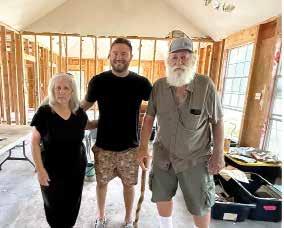
Justin Jacobs (center) with Gayle and C.R. Williamson in their home prior to the start of construction.
The Work Continues
While the Williamsons’ story is one of renewal, many families are still waiting. In places like Sandy Creek, residents remain displaced months later, living in RVs while navigating permits, codes, and the long process of rebuilding. “The work is still going on,” Tracy said. “It’s just not in the news anymore.”
Through grants, donations, and partnerships, L4 Cares continues working behind the scenes—coordinating donated flooring, rebuilding driveways, distributing gift cards, and connecting families with resources. They saw the impact of that presence when furniture was delivered to the Williamson home. “The transformation wasn’t just physical,” Kendra said. “Their eyes were shining. They were laughing, telling stories about family gatherings. You could see hope return.”
For the Williamsons, Justin, Kendra, and Tracy, the hope is simple: that this single home might serve as a reminder to stay aware, look around, and help when we can.
L-R: Kendra Cofer, Ronnie Williamson, Gayle and C.R. Williamson, Justin Jacobs, Tracy and Scott Hayes
by
TEEN COURT
Investing Early, Changing Trajectories
On a Monday night in Williamson County, something quietly powerful is happening.
Teenagers—dressed professionally, speaking carefully, and carrying themselves with intention—step into roles most adults won’t experience until much later in life. They serve as jurors, clerks, bailiffs, and attorneys, advancing through the ranks as they master each responsibility, with the opportunity to preside as judge once they’ve earned that trust. They listen. They question. They deliberate. And they learn—sometimes for the first time—that their choices carry real weight.
This is WILLIAMSON COUNTY YMCA TEEN COURT, and for Judge Angela Williams, Precinct 2 Justice of the Peace, it represents much more than an alternative docket. It is a proactive investment in young people—and in the future of the community they will one day shape.
A NATURAL FIT
Teen Court is a peer-led program that addresses first-time, Class C misdemeanor offenses committed by juveniles. Instead of appearing before a traditional judge, eligible teens have
their cases heard by a courtroom of trained student volunteers under adult supervision. “It’s accountability,” Judge Williams says, “but it’s accountability with purpose.”
That distinction matters. Rather than defaulting to fines or formal prosecution, Teen Court emphasizes education, responsibility, and early intervention— an approach she believes aligns naturally with the mission of a Justice of the Peace court. And, as of January 1, 2025, that philosophy is no longer optional.
THE LAW THAT CHANGED THE LANDSCAPE
In 2023, the Texas Legislature passed House Bill 3186, formally known as the Texas Youth Diversion and Early Intervention Act (TYDEIA). The statewide law requires every justice and municipal court to adopt a written plan offering diversion services—rather than criminal prosecution—for children accused of fine-only misdemeanor offenses, excluding traffic violations and public intoxication.
Judge Williams didn’t just implement the new law. She helped define how it works locally. “I personally wrote the required verbiage for our court,” she
explains. “The law requires courts to clearly explain diversion options to families, and I wanted ours to be thorough, transparent, and accessible.”
Under TYDEIA, juveniles charged with eligible Class C offenses: disorderly conduct by language, minor assault, theft, vaping or tobacco violations, graffiti, or trespassing, may enter a diversion program for up to 180 days if both the child and a parent or guardian agree. Successful completion means the offense does not appear on the juvenile’s record at all. “It’s a huge opportunity,” Judge Williams says. “It gives kids a chance to course-correct early, before a mistake follows them.”
Teen Court is one of several approved diversion strategies under the act, with educational programs, counseling, mentoring, community service, life skills training, and wellness or rehabilitation services. In Williamson County, Teen Court has become a cornerstone of that early-intervention approach.
A LIFE EXPERIENCE
The judge speaks often about the environment Teen Court creates. From professional dress standards to courtroom decorum, it is intentionally dif-
Teen Court orientation 2025 and Judge Angela Williams (inset)
Ann Marie Kennon
ferent from what many young defendants have ever experienced. “For some of these kids, it’s the first time they’ve seen people their own age speak confidently, behave professionally, and take responsibility seriously,” she says. “That experience stays with them.”
Unlike a fine quietly paid by a parent, Teen Court requires participation, reflection, and accountability. Juvenile defendants engage directly with the process, and with peers who are modeling responsibility in real time.
And sometimes, remarkable things happen. “We occasionally see juvenile defendants come back as volunteers,” Judge Williams says. “They’ve been on the other side. They know what it feels like and they want to give back.”
GROWING IN THE RANKS
Teen Court volunteers don’t start at the top. Students typically begin as jurors, then advance to jury foreman, clerk, or bailiff. With time, commitment, and demonstrated readiness, they may try out for assistant attorney roles, either for the state or the defense.
Watching that progression is one of the most rewarding aspects of the program for the judge. “Some students start out very quiet, almost afraid to speak,” she says. “A year or two later, they’re standing up making an argument to a room full of people. You can literally see their confidence build.”
Not every participant will pursue law, but every participant gains transferable life skills: public speaking, critical thinking, professionalism, empathy, and leadership. Many students include Teen Court on résumés and college applications, and Judge Williams regularly writes letters of recommendation for volunteers who request them.
The program averages about 50 student volunteers on Teen Court nights, all contributing willingly. Their involvement doesn’t just benefit individual defendants, it strengthens the broader community. “It improves public safety,” she explains. “It saves resources. And it helps young people become responsible, productive citizens.”
There’s also something unique about teens holding one another accountable. “Kids relate to kids,” she says. “Some juveniles already distrust authority. But when they see peers taking this seriously, dressing professionally, speaking respectfully, it changes the dynamic and the response.”
JUDGE WILLIAMS' "WHY"
The judge's passion is deeply personal. She is a mother of six, with three children attending local schools, and she has spent decades mentoring young people in and outside the courtroom. “I understand the value of investing early,” she says. “This program isn’t just about keeping a misdemeanor off a record. It’s about building character before patterns form.” Her hands-on leadership reflects that belief. She attends every Teen Court session, viewing her presence not as ceremonial, but essential. “Some nights,” she says, “I just sit back in awe of these kids.”
A PROGRAM WORTH THE WORK
Teen Court requires time, coordination, and commitment but for Judge Williams, the return is undeniable. Under her leadership, the program has grown steadily and earned recognition with a 2024 Achievement Award from the National Association of Counties. “It’s a lot of work,” she admits. “But it’s worth it every time.”Because for every teen who learns accountability early, before consequences grow heavier, the community grows stronger. And that, Judge Williams believes, is justice done right.
“Youth diversion programs provide several benefits for young individuals and the community. By offering alternatives such as teen court, educational programs, mentoring, counseling, or community service, these programs allow young offenders to avoid a permanent criminal record if they complete the diversion agreement.”
Judge Angela Williams
HOME, HEROES & HEARTS
February used to mean something different.
Happy birthday, Abraham Lincoln— who told the truth even when it was wildly inconvenient, and who paid a steep personal and political price for believing all people were created equal.
Happy birthday, George Washington—kneeling in the snow at Valley Forge, praying not for a dozen roses, but for the survival of an entire nation.
For some time, it's meant Black History Month—a time to honor the struggle, resilience, and brilliance of generations who fought for freedom long after Lincoln signed the paperwork.
But, like Christmas hijacking Jesus for Santa, February has become vaguely more about romance, vaguely about sales, and very specifically about cinnamon-scented bears the size of Saint Bernards. And, this year, it's even about getting hammered on Mardi Gras.
Our forefathers gave us a republic— if we could keep it. We gave them... a long weekend and a clearance rack.
Don’t get me wrong, I’m not here to shame anyone's longing to please their sweetheart. I’m just saying we’ve gotten a little confused. When Honest Abe gets reduced to a clip art top hat and George Washington’s birthday is mostly known as “That Mattress Sale Week,” maybe we’ve lost the plot a little.
I mean, I’ve seen actual commercials where retailers try to combine Valentine’s Day and Presidents Day. “Show them you care—with 20 percent off select recliners!” Hmm... George crossed the Delaware for this?
Somewhere between Monticello and eternity, Thomas Jefferson is furiously editing a pocket Constitution to remove “February” altogether and replace it
with “Seriously?” He’s probably just relieved we haven’t added a Black Friday to every holiday, because nothing says “life, liberty, and the pursuit of happiness” like trampling a stranger for a discounted flat-screen.
Still, maybe Mr. Jefferson would be a little proud. The backyard gardeners. The Little Free Libraries. The citizens with compost bins and Constitution-themed dish towels. Somewhere out there, someone is quoting him while canning jam—and honestly, that’s probably closer to his vision than how quickly Cupid-pink booted Santa-red out of the seasonal aisle on December 26.
We’re a country that has not-ironically consumed our own consumer culture. Every holiday is now a shopping season. We can’t commemorate anything without coupons. Christmas gave us Santa. Easter gave us marshmallow chickens. And February—the month of Lincoln, Washington, and Black Pride— has given way to Galentine’s Day, a surcharge in flower delivery fees, and anxiety about dinner reservations.
And let’s not forget Mardi Gras—our annual nationwide permission slip to eat, drink, and lose our minds before Lent starts. A tradition rooted in Christian repentance… now celebrated with glitter beads, king cake, and public indecency.
Do revelers even know they’re participating in a Jesus-based activity? Doubtful. But you’ve got to admire the commitment.
And just for fun—because Belle loves a teachable moment—(big inhale) Mardi Gras is in February this year because the first Sunday after the first full moon after the Spring Equinox is Easter and Ash Wednesday is 40 days before that (and if you're like, hey, it's really 46—
well, Sundays don’t count because they’re technically little Easters, even during Lent, because nothing says spiritual consistency like carving out a few cheat days from your own repentance plan) and Fat Tuesday is the day before Ash Wednesday—the last big blowout before the solemn season begins and that’s when people load up on beads and bourbon before pretending to behave for 40-ish days.
Whew! Clear as gumbo, right?
This year, I’m going to lay my iPad down next to the little cross on my piano and give up doomscrolling—because nothing says repentance like trying to give up anger for Lent. Now, if only there was a device I could channel my covert narcissism into and be rid of THAT for Lent, too.
Anyway, for a culture that loves to chant “Because, science” whenever it suits us, we sure don’t care what lunar-solar-calendrical magic puts the party on the calendar—just so long as we don’t miss the date to catch plastic beads and scream "Throw me something, mister!"
So maybe this month, in between the boxed chocolates and bead parades, we pause long enough to remember the men who gave us more than a long weekend. Maybe we try to be a little more honest like Abe, a little more resolute like George, and a little more forgiving like Jesus—especially when the world feels cold and we’re all just counting the days to Spring Break.
Because the older I get, I don’t want to think I’m getting crankier—just less impressed by shiny things wrapped in foil, and more appreciative of truth, sacrifice, and the kind of love that doesn’t melt under pressure.