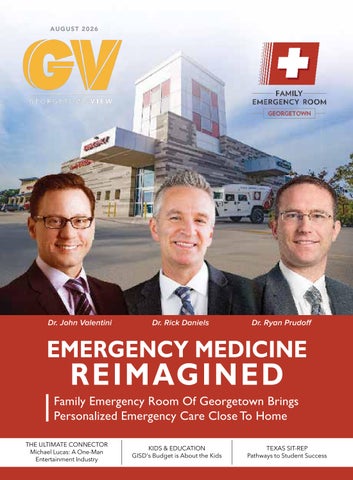
AUGUST 2026
Dr. John Valentini
Dr. Rick Daniels
Dr. Ryan Prudoff
EMERGENCY MEDICINE
REIMAGINED
Family Emergency Room Of Georgetown Brings Personalized Emergency Care Close To Home THE ULTIMATE CONNECTOR Michael Lucas: A One-Man Entertainment Industry
KIDS & EDUCATION GISD's Budget is About the Kids
TEXAS SIT-REP Pathways to Student Success AU G U S T 2 0 2 6
1
2
AU G U S T 2026
AU G U S T 2 0 2 6
1
WHO WE ARE
I
n an age where the rush of daily news often overshadows the deeper narratives that shape our community, the Georgetown View constantly strives to be an eager beacon of positivity and unity. Far more than just a lifestyle magazine, our publishers and staff are committed to creating a means of getting to know what makes our community thrive: its people and their impact. Since its inception in 2009, the Georgetown View has not only reported on the great stories and people in our city but also tak-
en pride in actively contributing to its enrichment. Through donations exceeding $100,000 in advertising, we have extended our support beyond the printed page to organizations that further amplify the voices of those who work tirelessly to make a difference, ensuring their missions reach as many eyes and hearts as possible. But we are also good at doing what we do–showcasing prominent local businesses and community agencies and initiatives like ROCK, Georgetown ISD students, FFA, 4-H, and many more on our covers and in multi-page features. These not only celebrate their contributions but also inspire readers to personally engage and participate in the missions of these community pillars. In every story, from first responders and veterans to the latest city events and programs, our purpose is to foster a sense of pride and connection. In addition to these, every November our "Giving Thanks and Giving Back" issue shines a spotlight on local
PUBLISHER Cathy Payne cathy@georgetownview.com SENIOR WRITERS / CONTENT EDITORS Ann Marie Kennon • Charlotte Kovalchuk CONTRIBUTING WRITERS Linda A. Thornton • Steve Fought CONTENT MANAGER Camy Reynolds GRAPHIC DESIGN Sandra Evans • Ann Marie Kennon • Joni Mozis BUSINESS DEVELOPMENT Jesse Payne WEBMASTER Ann Marie Kennon ADVERTISING 512.746.4545 info@georgetownview.com Georgetown View is a Fidelis Publishing Group, LLC publication and a product of AdvocateNewsTX Newspaper. Copyright © 2026 All rights reserved. Georgetown View is mailed monthly via USPS to homes and businesses in Georgetown, TX zip codes. Mail may be sent to: Georgetown View P.O. Box 203 • Jarrell, TX 76537
nonprofits and philanthropic efforts, reminding us of the power of community support and the importance of gratitude. In short, we believe the Georgetown View is more than a mag-
SCAN THE CODE FOR E-SUBSCRIPTION AND NEVER MISS AN ISSUE.
azine; it is a vital part of the community’s fabric that spotlights advocacy, education, and celebration. We hope you will agree it stands as a testament to what we can all achieve when we choose to focus on the positive and the possible.
2
AU G U S T 2026
FOLLOW US ON FACEBOOK FOR FOLLOW-UPS AND OUTTAKES GeorgetownViewMagazine
CONTENTS AUGUST FEATURES 6
COVER FEATURE • FAMILY E.R. IS REDEFINING THE FAMILY DOCTOR
COLUMNS 14 TEXAS SIT-REP • TEXAS NEEDS MORE SKILLED WORKERS 18 KIDS & EDUCATION • STRONG SCHOOLS, STRONG BUDGET Sponsored by InnerSpace Cavern
20 ASK A PRO • SILK & STONE ACUPUNCTURE 24 WHAT MAKES TEXAS, "TEXAS"? • THE CHISHOLM TRAIL 26 ASK A PRO • INNERSPACE CAVERN 10 THE ULTIMATE CONNECTOR • MICHAEL LUCAS ENTERTAINMENT
29 BUSINESS PROFILE • AUSTIN ORTHOPEDIC INSTITUTE 30 WORTH THE DRIVE • RITA'S ITALIAN ICE 32 POPPY TALKS • SQUIRRELS AND AMERICAN EXCELLENCE
AU G U S T 2 0 2 6
3
4
AU G U S T 2026
ASK A PRO • FEATURED PROFESSIONALS Meet our Pros — professionals, business owners, and subject matter experts from leading local companies who share their knowledge and expertise to bring readers practical advice, how-to tips, best practices, and current and emerging trends. To learn more about becoming a Featured Professional, contact info@georgetownview.com or 512-746-4545.
Hall's Roofing & Sheet Metal, LLC Austin Orthopedic Institute Board-certified orthopedic surgeon specializing in sports medicine, joint reconstruction, and orthopedic trauma, with over 15 years of surgical expertise. www.AustinOI.com 512-856-1000
Inner Space Cavern One of the best preserved caves in Texas, Inner Space Cavern has hosted hundreds of thousands of visitors since 1966 and offers a variety of activities year round. InnerSpaceCavern.com 4200 S IH-35 Georgetown
Doleva Elite Tree Certified Arborists to care for your trees! Our large equipment makes jobs efficient and economic, and prevents damage to lawn or property. Serving Georgetown since 2009. DolevaEliteTree.com 512-943-8733
Family owned since 1939. Roofing professionals specializing in full-service roof repair, installation, and replacement. HallsRoofing.net 512-864-7579
Keller Commercial & Home Services Experts specializing in maintenance, enhancement, and design. Armed with cutting-edge tools and programs — driving rapid growth in architectural landscaping. KellerServicesTX.com 512-930-4769
Moore Liberty Buildings Chad & Amanda Moore Thousands of structures built since 2015.
MooreLibertyBuildings.com 512-548-6474
Silk + Stone Acupuncture Personalized holistic treatments blending traditional Chinese medicine and modern insight, addressing pain, hormones, digestion, fertility, and stress to restore balance.
The Wesleyan Providing a new, bountiful experience of aging full of purpose, passion, and possibility for more than 50 years.
SilkAndStoneAcupuncture.com (512) 818-4949
TheWesleyan.org
Prime Wellness and Longevity Personalized hormone therapy, weight loss, and wellness plans to help clients optimize health, boost energy, and feel their absolute best. PrimeWellnessand Longevity.com 512-240-4456
Wild Birds Unlimited Expert advice, quality seed, and feeders. Let us provide joy to you and your backyard birds. We bring people and nature together and do it with excellence. GeorgetownTX.wbu.com (512) 763-1081
AU G U S T 2 0 2 6
5
COVER FEATURE
FAMILY EMERGENCY ROOM AT GEORGETOWN
24 / 7 / 365
PERSONALIZED PATIENT SERVICE & ENHANCED EMERGENCY CARE
A
welcoming, personal greeting in a comfortable waiting area awaits patients who come to Family Emergency Room at Georgetown. The goal of this premier health care provider—located at 1210 W. University Ave. in Georgetown, next to Walgreens—is to provide personal, patient-centered care that combines a state-of-the-art facility with caring attention. The beautiful Georgetown facility treats children and adults in a comfortable, private setting that truly puts patients first. From day one, the mission was to create a practice where patients receive the care and attention they deserve, directly from a Board Certified Emergency Physician. “I wanted to practice personalized Emergency Medicine in an environment that would allow me to spend as much time with my patients as needed. This is an exceptional facility that allows me to truly focus on patient needs while ensuring an effective treatment plan,” Dr. Ryan Prudoff says. Dr. John Valentini, Dr. Prudoff, and Dr. Rick Daniels are Board Certified in Emergency Medicine and have nearly 70 years of combined experience. They are well prepared to handle any emergency, from broken bones to heart events. The facility is equipped with a CT scanner, X-ray, and ultrasound, as well as a full in-house
6
AU G U S T 2026
laboratory equipped with a state-of-the-art PCR Rapid Testing, which detects 21 viruses and bacteria in about one hour. Comprehensive cardiac evaluations are performed utilizing Cardiac Coronary CT Angiography, which directly visualizes heart vessels and can accurately determine coronary heart disease without an invasive catheter procedure. “We are very fortunate to have Coronary CT angiography in our practice. It enables us to safely discharge patients home who present symptoms concerning for heart disease,” Dr. Prudoff says. Dr. Valentini adds, “We ensure the highest safety standards for our patients and staff. Our facility maintains an exceptional standard of sanitation, including individual in-room and central HEPA filtration, UV and chemical sterilization, and fresh linens for every patient.”
COVER FEATURE
I took my daughter here for what I thought was a broken index finger. When we walked in, it was clean and the receptionist was very inviting and friendly. Registration was easy on the iPad. We were seen so quickly that I was still completing my daughter’s registration info. As we walked back I noticed the place was still exceptionally tidy (loved that). Nurse came in, tech came in, doctor followed right behind them. I was taken back by how well and promptly they attended to her for a little broke finger. She went straight back for X-rays. Discharge paperwork and what to do at home list was super simple and very reader friendly. We were in and out in under an hour.
Everyone at Family Emergency Room was incredibly kind and genuinely compassionate. From the moment we arrived and through diagnosis and treatment, we felt we were in good hands. Dr. Daniels is an exemplary physician who patiently listens, asks great questions, and is thorough in his effort to provide an accurate diagnosis and effective treatment. Best of all, he truly cares. The facility is clean and has all the modern equipment that is needed to diagnose and treat their patients. The entire experience was outstanding.
I have had to utilize this facility a few times now over the years and have had a great experience each time. I've never had to wait to be seen, and everyone I have encountered has been friendly and caring. Each doctor that I have seen always took their time with me, and never made me feel judged or rushed. I once had to call the day after a visit with some follow up questions, expecting to leave a message, but the doctor actually got on the phone with me to address my concerns. They seem to genuinely care about you and making you feel better.
IMPROVING EMERGENCY CARE
KEEPING UP WITH GROWTH
Doctors and staff take time to build rapport with every patient, and every patient leaves with the doctor’s contact information. “It is my hope that patients receive a level of care that will make stressful situations more comfortable. Patients deserve that personal attention. It was important for us to create a practice where clients have continued access to their physician. I enjoy talking with patients and giving them any support needed to facilitate their healing,” Dr. Valentini says.
With Georgetown continuing to attract new residents from all over the country, Family ER strives to meet the increasing need for immediate health care services. “New residents need quality and safe care in their neighborhoods,” Dr. Valentini says. “We’re here to serve the fastest growing communities in Williamson County when the unexpected happens!” Family ER meets their community neighbors by supporting local businesses, participating in school PTA functions, and attending Chamber and community events.
Among the many 5-star Google reviews, high quality care is mentioned constantly. One recent review says, “This is by far the best ER I have ever been to in my life. Unfortunately, I’ve had quite a few visits to ERs…this one outshines them all. I actually don’t dread having to go to the ER because the experience is always so above par here.”
Stop by to meet your local doctors and follow Family ER on Facebook and Instagram to save the dates for upcoming CPR classes, preventative screenings, and more.
"We are honored to provide medical services to Georgetown, as well as Jarrell, Liberty Hill, and surrounding communities," Dr. Valentini says. "And to serve as a trusted community partner."
"
WE ENSURE THE HIGHEST SAFETY STANDARDS FOR OUR PATIENTS AND STAFF
DR. VALENTINI
To learn more about Family Emergency Room at Georgetown, call 512-690-4590, or email jvalentini@familyemergencyroom.com.
AU G U S T 2 0 2 6
7
8
AU G U S T 2026
AU G U S T 2 0 2 6
9
PEOPLE
by A nn Ma r i e Ke nnon • p h otos c ou rte s y M i c h a e l Lu c a s
WHEN MOST PEOPLE RETIRE, THEY TAKE UP GOLF. MICHAEL LUCAS TOOK UP AN ENTIRE INDUSTRY.
T
his Heritage Oaks resident has spent more than six decades building relationships in radio, entertainment, sales and live music. Today, those relationships fuel two growing ventures: Lucas Artists, which books performers for events of all kinds, and Music for Seniors USA, a nationwide service connecting professional entertainers with retirement and assisted living communities. Ask Michael why he never retired, and he laughs. "Why would I retire? To do what?" he says. For him, even at 86, the answer was obvious. The music business had been calling him back for decades. His story began in Texas radio during the 1960s, when local disc jockeys often knew the musicians who filled dance halls, clubs and community events. Bands regularly stopped by the station looking for help with promotion and bookings. Before long, Michael found himself managing performers and helping them secure gigs. 10
AU G U S T 2026
'GOLF' BECAME A BOOKING AGENCY Over the years, his career took him through radio, advertising and automotive sales, but he never lost his connection to the entertainment world. When he retired in 2002, he enjoyed a little golf but he never found 'leisure time' to be quite as satisfying. When one of his old connections called and asked for help booking an Austin party band, that one band quickly became two. Then five. Then dozens. Today, Lucas Artists books everything from dance bands and jazz groups to comedians, magicians, emcees, face painters and specialty entertainers. Corporate receptions, nonprofit galas, birthday parties, HOA events, weddings and community festivals all fall within the company's reach. "If I don't have exactly what you're looking for, I usually know where to find it," he says. That confidence comes from a lifetime of relationships.
PEOPLE THE MOST VALUABLE CONTACT LIST IN TOWN In an era when many people simply search online and hope for the best, Michael serves as a personal matchmaker between clients and performers. He learns what kind of event a client is planning, what atmosphere they want to create, and what budget they have available. Then he recommends entertainers who fit the occasion.
Just as importantly, he helps clients avoid disappointment. "We don't work with garage bands," he says. "We only work with professionals." That emphasis on quality has become a hallmark of his business. Michael carefully vets performers and relies on entertainers who understand that success involves more than musical talent. Professionalism, reliability and audience engagement matter just as much as the songs themselves.
SONGS CAN REACH PLACES WORDS CAN'T Those same standards helped inspire Music for Seniors USA. The idea began almost accidentally when retirement communities began asking Michael for weekday performers. What began as a handful of bookings soon revealed a significant need. Communities wanted dependable, professional entertainment, while musicians appreciated meaningful weekday work and the concept grew rapidly. Today, Music for Seniors USA serves communities across Texas and in markets including Phoenix, Las Vegas, Florida, North Carolina and California. Lucas and his team continually recruit and evaluate performers who know how to connect with senior audiences.
The work has also produced some of his most memorable moments. He recalls visiting a memory-care community where a resident spent her days waiting in the lobby for her mother to come pick her up. Staff members explained that she had been a singer in her younger years. Later that evening, Michael watched her slowly make her way toward a live performance. As the music played, she moved to the front of the room, rose from her wheelchair and began dancing with the lead singer. A caregiver told him it was the first time they had seen her stand and participate that way. Experiences like that remind him why music matters. "It stirs something that's still there," he says. Yet even as Music for Seniors USA expands nationwide, Michael remains focused on the same principle that guided him throughout his career: relationships first. He still receives calls from former customers and colleagues he met decades ago. Those friendships, he says, are worth more than any business success. "My son asked me one time how I sold so much," he says. "I told him I made a lot of friends. Your enemies won't buy from you." At an age when many people are slowing down, Michael is still building networks, creating opportunities and helping people connect through entertainment. And when the day finally comes to write the last chapter? He already knows what he wants to say.
"What a ride!"
One Call. Endless Possibilities.
Looking for a dance band for a wedding? A jazz trio for a cocktail reception? A comedian for a corporate retreat? A magician, emcee, face painter or specialty act for a community event? Lucas Artists takes the guesswork out of entertainment booking by connecting clients with vetted, professional performers for events large and small. Weddings • Corporate Events • Galas • Birthday Parties • HOA Gatherings • Fundraisers • Holiday Celebrations LucasArtistsPromotions.com • MusicForSeniorsUSA.com
Professional entertainment. Personal service. Decades of trusted relationships.
AU G U S T 2 0 2 6
11
12
AU G U S T 2026
AU G U S T 2 0 2 6
13
TEXAS SIT-REP
sto r y an d p h o tos c ont r i b u te d by CO L TER RY W I L S O N, US A R MY R ETI R ED, TX Re p, D i s t 20
Texas Needs More Skilled Workers And More Pathways to Success
Over the course of a three-part series, I examined the role education plays in Texas’ future and the steps your Texas Legislature has taken to strengthen it at every level. In the first article, I discussed our historic investments in public education, efforts to empower parents, and reforms designed to improve accountability and student outcomes. In the second, I examined how Texas is restoring trust in higher education through greater transparency; stronger governance; protections for free speech; efforts to prevent radical
activists from disrupting classes, occupying campus property, and vandalizing university facilities; and enacting safeguards against foreign influence and research theft. In the third, I explored how our universities serve as engines of research, innovation, workforce development, and economic growth. Together, those efforts share a common goal: ensuring that educational institutions remain focused on serving students, taxpayers, and the long-term interests of our state.
That brings us to the final piece of the puzzle: workforce education.
E
ducation is not merely an end unto itself; it must also prepare Texans for productive, meaningful lives and careers. Whether that means earning a degree, conducting cutting-edge research, serving in the military, starting a business, or mastering a skilled trade, our education system succeeds when it creates opportunities that lead to success. While universities drive innovation and research, Texas’ continued prosperity also depends on the men and women who build our homes, maintain our infrastructure, manufacture advanced products, care for patients, and repair critical equipment, all to keep our economy moving. As Texas experiences unprecedented population and economic growth, the demand for skilled workers has never been greater.
14
AU G U S T 2026
From electricians and plumbers to welders and HVAC technicians, Texas faces workforce shortages in many of the careers that support economic growth. Every new home, school, hospital, and advanced manufacturing facility depends on highly trained professionals. We need industrial maintenance technicians, construction trade workers, automotive and diesel technicians, advanced manufacturing technicians, health care support professionals, and teachers, along with countless others. Meeting these workforce needs will require more than simply encouraging every student to pursue the same path after high school. Texas succeeds when students have many pathways to success.
PATHWAYS TO SUCCESS For generations, higher education has been viewed as the primary route to economic opportunity. While a college degree remains an excellent option for many students, learning a skilled trade is equally valuable and equally important. The men and women who build our homes, maintain our power systems, repair our vehicles, care for patients, and keep our industries operating are indispensable to Texas’ future. I believe every student deserves the opportunity to discover their talents and pursue a path that matches their goals, abilities, and passions. That belief has driven me to make advancing vocational education in Texas a core focus as your State Representative, working to
TEXAS SIT-REP achieve historic investments in career and technical education and workforce training.
INVESTING IN TECHNICAL EDUCATION One of the most significant investments has been the establishment of the Texas State Technical College (TSTC) endowment. Rather than spending these funds once and moving on, Texas invested approximately $850 million into a permanent endowment. The investment earnings support annual distributions of roughly $40 million per year for the construction and capital improvement of new and existing TSTC facilities. This approach allows TSTC to continuously expand training capacity while preserving the principal investment, providing Texans with workforce training opportunities for generations to come. At the K-12 level, Texas has also expanded support for Pathways in Technology Early College High Schools, better known as P-TECH programs. As Article III Chairman for Appropriations in 2021, I spearheaded an investment of $100 million per biennium to help school districts build and expand these programs by purchasing equipment, developing facilities, and allowing students to begin participating in these programs as early as seventh grade. Early exposure helps students discover their interests, explore careers, and begin earning valuable credentials long before graduation. P-TECH programs offer far more than industry certifications. Students can earn associate degrees, Level 1 and Level 2 certificates, workforce experience, college coursework, and direct engagement with employers. They gain access to high-demand career fields including healthcare, cybersecurity, advanced manufacturing, information technology, and logistics.
and technology they will encounter in the workforce, helping them transition seamlessly into careers. Additional workforce investments include the Texas Reskilling and Upskilling through Education (TRUE) Grant Program. Established in 2021, TRUE grants support public higher education institutions as they create, redesign, and expand short-term workforce training programs in high-demand occupations. These programs are developed in partnership with employers and other workforce stakeholders and focus on preparing students for careers in less than six months. Likewise, the Texas Invests in Meaningful Employment, or TIME, Grant Program builds upon successful workforce initiatives by supporting short-duration training programs that lead directly to credentials of value. These programs prioritize occupations with strong workforce demand and earning potential, helping students move quickly into meaningful employment. What ties these investments together is the idea that education works best when institutions work together.
BREAKING DOWN EDUCATIONAL SILOS For too long, public education, community colleges, technical colleges, universities, workforce boards, and employers often operated in separate silos. Each plays an important role, but students were frequently left to navigate those systems on their own. Texas has increasingly moved away from that approach. Today, state policy encourages institutions to think less about where one system ends and another begins, and more about how they can work together to help students succeed. That means introducing students to career opportunities earlier,
Perhaps most importantly, students can access these opportunities at no cost to themselves. Texas has also strengthened workforce training through the Jobs and Education for Texans, or JET, Grant Program. JET grants support community colleges and schools by funding expensive workforce training equipment such as welding labs, advanced manufacturing machinery, and healthcare simulation equipment. Students train using the same tools
AU G U S T 2 0 2 6
15
TEXAS SIT-REP expanding access to dual credit and workforce credentials, strengthening partnerships between school districts and colleges, and ensuring educational programs align with real needs. Employers and community colleges have become especially important partners in this effort. Employers help identify workforce shortages and provide internships, apprenticeships, and work-based learning opportunities. Community colleges serve as regional workforce hubs with established facilities, experienced instructors, strong industry relationships, and grant-writing expertise. Through dual credit programs, workforce certificates, P-TECH partnerships, and industry training initiatives, students can begin earning college credit and workforce credentials while still in high school. Despite this progress, challenges remain, especially for smaller school districts. Many workforce grants require competitive applications and significant administrative expertise. Unfortunately, the schools that often need assistance the most are frequently the least likely to have dedicated grant-writing staff. At the same time, workforce education programs are administered through multiple agencies and funding streams, creating complexity for schools attempting to navigate the system.
PREPARING TEXAS FOR THE FUTURE
from secondary education into postsecondary education and careers. Rather than asking institutions to operate independently, the bill encourages collaboration among school districts, community colleges, technical colleges, workforce boards, and employers. Just as importantly, the bill recognizes that students need guidance as they navigate those pathways. By supporting investments not only in facilities and equipment, but also in the faculty, staff, and advising capacity needed to deliver workforce education programs, Texas is creating new opportunities for career counseling and student support. Community colleges and technical colleges increasingly have the authority and incentive to work alongside local school districts, helping students understand available career pathways, earn credentials, and educational choices to workforce opportunities.
BUILDING CONNECTED PATHWAYS In practical terms, that means more opportunities for shared facilities, shared equipment, coordinated workforce programs, stronger regional partnerships, and more intentional career guidance for students. It also means students can move more easily between educational systems while earning credentials that employers value and that Texas’ economy needs.
Recognizing these challenges, the Legislature passed Senate Bill 1786 in 2025, allowing community colleges and independent school districts to partner more effectively.
Texas’ future depends on our ability to develop the workforce that a growing economy requires. That means recognizing that success comes in many forms and ensuring every student has access to opportunities that fit their goals.
SB 1786 directed the Texas Education Agency, Texas Workforce Commission, and Texas Higher Education Coordinating Board to coordinate workforce grant programs, align funding streams, reduce duplication, and support seamless pathways
But it also means recognizing that no single institution can accomplish that mission alone. Public schools, community colleges, technical colleges, universities, workforce boards, and employers each have a role to play.
THE BOTTOM LINE The future of workforce education is not about building isolated programs. It is about building connected pathways. Whether a student chooses a university classroom, a military uniform, a small business venture, or a skilled trade, Texas benefits when they are prepared to succeed. By strengthening partnerships, aligning systems, and expanding pathways, we are building a stronger Texas, one student, one credential, and one skilled worker at a time. 16
AU G U S T 2026
AU G U S T 2 0 2 6
17
KIDS & EDUCATION
by A nn Ma r i e Ke nnon • p h otos c ou rte s y GI S D Com m u ni c a t i o ns
Strong Schools, Strong Community When people think about public schools, they often think about test scores, football games or graduation ceremonies. But behind every student success story is a district working to balance academic excellence with responsible financial stewardship. That balancing act is on full display in Georgetown ISD.
W
hile final state accountability results will not be released until later this month, preliminary data shows encouraging gains across the district. According to district leaders, every campus has demonstrated academic improvement, with some schools posting significant growth in student performance. "The most important thing is that kids are learning," says Superintendent Dr. Devin Padavil. "Not only are they learning, but they're learning at a really high level." Those results reflect years of work by teachers, principals and support staff who remain focused on student achievement. They also reflect a commitment by district leadership to make difficult financial decisions while protecting the classroom experience whenever possible.
BALANCING THE BUDGET That commitment recently led the Georgetown ISD Board of Trustees to adopt a balanced budget for the coming school year. In an era when more than half of Texas school districts are operating with deficits, district leaders view a balanced budget as an important sign of fiscal responsibility. The challenge is that balancing the budget has become increasingly difficult. 18
AU G U S T 2026
Like families across Central Texas, school districts face rising costs for insurance, healthcare, fuel, utilities and everyday operations. At the same time, state funding has not kept pace with inflation, creating financial pressure for districts throughout Texas. Over the past several years, Georgetown ISD has streamlined operations and reduced expenses in areas that would have the least impact on students. Those efforts have helped maintain financial stability, but district leaders say they are approaching a point where additional cuts could begin affecting classrooms and student services.
SUPPORTING THE PEOPLE CLOSEST TO KIDS One area of particular concern is employee compensation. "We've done everything we can to protect the classroom," Dr. Padavil says. "The next decisions become much more difficult because they begin to affect the student experience and the people who work closest with kids." To address that challenge, the district is exploring options that could generate additional operating revenue, including the possibility of asking voters to consider adding some of the district's available "copper pennies" to the maintenance and operations tax rate. District officials say the additional
KIDS & EDUCATION
revenue would help support teacher and staff compensation while preserving the educational programs families have come to expect. District leaders also emphasize that tax rates and tax bills are not always the same thing. Future revenue projections will depend on certified property values and any action ultimately taken by the Board of Trustees. As those discussions continue, the district's focus remains on maintaining strong academic outcomes while responsibly managing taxpayer dollars. The conversation, however, extends beyond schools alone. Even residents without children in Georgetown ISD have a stake in the district's success. Strong schools help attract families, employers and investment to a community. They also play an important role in supporting property values and
maintaining the quality of life that makes Georgetown such a desirable place to live. In other words, great schools are not simply an educational asset. They are a community asset.
INVESTING IN GEORGETOWN'S FUTURE As Georgetown continues to grow, district leaders say their commitment remains unchanged: support great teachers, provide exceptional opportunities for students and remain responsible stewards of taxpayer dollars. Judging by the progress students are already making, that investment is producing results. Editor's Note: Some information in this article may evolve over the course of the summer. Readers are encouraged to visit our website at GeorgetownView.com for the latest Georgetown ISD updates, including academic performance data, budget information, and future board action.
AU G U S T 2 0 2 6
19
ASK A PRO • HEALTH & WELLNESS Silk + Stone Acupuncture Personalized holistic treatments blending traditional Chinese medicine and modern insight, addressing pain, hormones, digestion, fertility, and stress to restore balance. SilkAndStoneAcupuncture.com • (512) 818-4949
Why Do I Keep Waking Up at 3am?
One of the most common questions in clinic: “I’m exhausted… so why can’t I sleep?”
For some, it’s trouble falling asleep. For others, it’s waking at 1, 3, or 4 a.m.—wide awake, mind suddenly active, body exhausted but unable to settle back into rest. Most people assume this is simply stress, getting older, or “just how they sleep now.” But waking during the night—especially at the same time—often tells us something important about what is happening beneath the surface. In Chinese medicine, sleep is viewed as a reflection of overall balance in the body. When sleep is disrupted, we look deeper. Is the nervous system stuck in overdrive? Are hormones shifting? Is the mind having trouble settling? Is the body holding onto tension it hasn’t fully processed? These patterns can show up as difficulty falling asleep, waking between certain hours, vivid dreams, restless sleep, or waking exhausted despite getting enough hours in bed. This is where Chinese herbal medicine can be especially effective. Rather than simply trying to “knock you out,” herbal formulas are chosen based on your specific pattern of symptoms—whether that looks like racing thoughts, light sleep, frequent waking, or feeling wired even when you’re exhausted. The goal is to help the body return to a state where sleep happens naturally. Acupuncture often works alongside herbal medicine by helping regulate the nervous system, calm the mind, and support deeper relaxation. One of the biggest misconceptions about insomnia is that the only solutions are melatonin or prescription medication. In reality, with the right support, the body can often relearn how to sleep. And that’s where real healing begins.
20
AU G U S T 2026
ROOFING
SERVICE
Need reliable roofing services?
PRoof Repair PShingle Roofing PGutter Cleaning PStorm Damage Repair PMetal Roofing PRoll Off Dumpster Rentals PRoof Installation & Replacement 512-864-7579
www.hallsroofing.net
We Offer Free Inspections
AU G U S T 2 0 2 6
21
22
J U N E 202 6
AU G U S T 2 0 2 6
23
WHAT MAKES TEXAS "TEXAS"
I
by L i nda A. Th or nto n
THE CHISHOLM TRAIL & CATTLE DRIVES
t was the largest animal migration in human history. An estimated six to ten million cattle moved along the Chisholm Trail. Though the cattle drive only existed fewer than 20 years, its legacy is a testament to the spirit of the cowboy culture. Along the way, it earned Texas the number one status in beef cattle production in the United States.
The Chisholm Trail name first appeared in newsprint in the April 10, 1869 edition of the Georgetown, Texas' Watchman newspaper. The article stated that "the hostile Indians of the Plains have been permanently removed from the route known as the Chisholm Trail and drovers can now take the trail with security from molestation."
THE CHISHOLM TRAIL WASN’T REALLY A TRAIL The Chisholm Trail was not a single, unbroken route. It was actually a network of pathways spread over a wide area, which then narrowed at river crossings. Jesse Chisholm, its creator, originally established the wagon road to connect his trading posts. In time, it became known as the safest way to pass through the Indian territory. Nineteenth-century cattle drives were a rough and tumble business born of necessity. After the Civil War, Texas had an oversupply of cattle, which was valued at only $2–5 per head but the North was facing a beef shortage, and the same cattle could be sold there for $40 per head. Spanning almost 1,000 miles, the Chisholm Trail started in southern Texas and traveled through Oklahoma to the Pacific railroad’s new station in Abilene, Kansas, where the cattle could be transported by rail. 24
AU G U S T 2026
WANTED: ADVENTUROUS TYPES FOR CATTLE DRIVE The journey took two to three months, with herds traveling approximately 15 miles per day. From the trail boss, the cook, and the drovers to the least experienced wranglers— sometimes as young as 12 years old—an experienced crew of 12 could manage a herd of 2000-3000 cattle. Threats were around every corner including floods, river crossings, droughts, stampedes caused by lightning, and thirsty animals becoming crazed at the smell of water.
WHAT MAKES TEXAS "TEXAS"
COWBOYS RIDE THEIR WAY INTO AMERICAN CULTURE Vaqueros—from the Spanish word “vaca” for cow—were the original drovers. United by their ability and rugged life, the melting pot of white, black, and Mexican vaqueros helped define what would become the Texas "cowboy" over time. The cowboys of yesteryear might be surprised to see their functional workday gear: wide brimmed hat, waist overalls, bandana, chaps, boots, and spurs–tools to cue their horses—have become fashion statements. The chuck wagon is a part of our culinary heritage. The horse-drawn mobile kitchen designed for cattle drives was a precursor to today’s food truck. Homage is still paid to its hearty meals at cook-off competitions featuring authentic tools and recipes. America has celebrated the rugged, independent spirit of the West through literature, art, music, and film. Beginning with "Buffalo Bill" Cody's spectacular Wild West shows in the late 1800s, the nation began to romanticize cowboy culture and the legends of the frontier. That fascination only grew through Hollywood Westerns starring icons like John Wayne and Roy Rogers, television favorites such as "Rawhide," and countless songs and stories that transformed the working cattle hand into one of America's most enduring heroes.
THE RISE AND THE DEMISE OF THE CATTLE DRIVE While cowboys faced constant danger on the trail, they had little way of knowing the lasting impact the cattle drives were having back home. The booming cattle trade fueled economic growth far beyond the ranches themselves. Banks, railroads, and shipping companies expanded to meet the industry's demands, while the profits from the cattle boom helped establish legendary operations such as King Ranch. Along the trails, bustling "cow towns" sprang up to provide lodging, supplies, and markets for both drovers and ranchers. Entire industries—including saddle makers, blacksmiths, and other skilled trades—flourished alongside the growing ranching economy. As the industry matured, ranchers also invested in improved breeding programs, fencing, and reliable water sources, laying the foundation for a more efficient and sustainable cattle industry.
railroad lines reached deeper into Texas, allowing cattle to be shipped directly from local railheads rather than driven hundreds of miles to Kansas. Adding to these changes, outbreaks of Texas Fever—a tick-borne disease that threatened northern herds—led many states to quarantine cattle from Texas. Together, these developments made the great cattle drives increasingly impractical, marking the end of one of the most iconic chapters in American history.
WHAT DRIVES TODAY’S CATTLE MARKET? While the days of long cattle drives have passed, the spirit of the Chisholm Trail lives on at Capitol Land & Livestock in nearby Schwertner. General Manager Tom Madden says the business still faces many of the same challenges as the trail drivers of old—working through mud, dust, harsh weather, and the unpredictable nature of livestock. The biggest difference, he notes with a smile, is that today's cowboys load cattle onto 18-wheelers instead of driving them north on horseback. Recognized as one of the nation's largest cattle dealers, Capitol Land & Livestock employs more cowboys than any other operation in Central Texas. Those cowboys continue to work more than 20,000 acres, relying on many of the same horsemanship and cattle-handling skills their predecessors used more than 150 years ago. In addition to buying and marketing cattle, the company offers specialized services for ranchers, including a unique weaning program that allows freshly weaned calves to adjust from mothers' milk to feed before being shipped. The program helps reduce stress on the animals while preparing them for the next stage of production. For President and CEO Jim Schwertner, the connection to the Chisholm Trail is also deeply personal. His great-grandfather, Adolph Schwertner, rode the trail during the great cattle-drive era. It's unlikely he could have imagined those rugged journeys would one day evolve into a thriving cattle enterprise—or that they would help establish Texas cowboy culture as one of the most recognizable symbols of the American West.
By the 1890s, the era of the great cattle drives was drawing to a close. Several innovations and challenges combined to bring an end to the openrange tradition. The invention of barbed wire allowed ranchers to fence their land inexpensively, closing off the trails that had carried millions of Longhorns north for decades. At the same time, expanding AU G U S T 2 0 2 6
25
ASK A PRO • NATURAL WONDERS Inner Space Cavern One of the best preserved caves in Texas, Inner Space Cavern has hosted hundreds of thousands of visitors since 1966 and offers a variety of activities year round. InnerSpaceCavern.com • 4200 S IH-35 Georgetown
KARST, AQUIFERS, AND RECHARGE The Edwards Aquifer is huge—the surface area above the aquifer covers about 3,600 square miles. Aquifers provide many people with drinking water, but also provide water for industrial and agricultural uses.
WHAT DOES IT ALL MEAN? In Hill Country, we hear a lot about aquifers and recharge, and occasionally karst. What do these terms mean, how do they relate to each other, and why are they important? Karst refers to the landscape characterized by the dissolution of soluble rocks (e.g., limestone, dolomite, or gypsum) by slightly acidic water. Some features of karst landscapes include sinking streams, springs, sinkholes, and caves. The process that forms these begins with rainwater. Rainwater picks up small amounts of CO2 from the air, and even more from decaying plant and animal matter in the soil, becoming carbonic acid. This weak acid travels through the soil, then through cracks and pores in the bedrock, slowly dissolving the rock, while making the cracks and pores larger. This process continues for thousands of years. As the water continues downward, it reaches an area where all the pores, cracks, and other spaces are full of water. Think about digging a hole in the sand at the beach. Dig far enough and the hole will partially fill with water. The upper surface is called the water table (at the beach, this would be sea level) and the area beneath the water table is the aquifer. An aquifer is a natural reservoir of underground water held within porous rock that can deliver water in usable quantities. In other words, you can dig a well and pump water out of it. In karst areas, large aquifers can form. The Edwards Aquifer, named after the Edwards rock formation, is the source of water in our area. These rocks formed more than 100 million years ago when Central Texas was covered by a shallow sea. Limestone formed in this shallow sea from the accumulation of shells and skeletons of marine animals, which were compacted and cemented together over time. The main mineral in limestone is calcite (calcium carbonate), which dissolves in carbonic acid. This created an enormous area underground for water storage. 26
AU G U S T 2026
Aquifers have contributing, recharge and artesian zones. The contributing zone of the Edwards Aquifer is mostly on the Edwards Plateau and Hill Country, where surface water runoff flows downhill to recharge (refill) the aquifer. The recharge zone is where the surface water sinks into the ground and enters the aquifer. Nationally, aquifers provide drinking water for almost half the population and more than 60 percent of farmland irrigation. Over the last 50 years, the amount of groundwater withdrawals has tripled. When groundwater is taken faster than it can be replenished (recharged) by rainwater, the water table is lowered and decreases the amount of water available for use. Over time, wells have to be dug deeper in order to reach the water table. The gradual land surface subsides when the spaces previously occupied by water become filled by downward movement of sediments.
AU G U S T 2 0 2 6
27
28
J U N E 202 6
BUSINESS PROFILE Austin Orthopedic Institute • AustinOI.com • (512) 856-1000 • Austin | Georgetown | Marble Falls Board-certified orthopedic surgeon specializing in sports medicine, joint reconstruction, and orthopedic trauma, with over 15 years of surgical expertise.
Built Around the Patient NEW GEORGETOWN OFFICE BRINGS ORTHOPEDIC CARE AND PHYSICAL THERAPY TOGETHER UNDER ONE ROOF One Team. One Location. One Recovery Plan. From diagnosis and surgery to rehabilitation, patients can receive coordinated care every step of the way.
A
s one of the fastest-growing communities in Central Texas, Georgetown continues to attract new residents, businesses, and healthcare providers. Austin Orthopedic Institute is among them, opening a new office that expands access to specialty orthopedic care and adds a dedicated physical therapy department. Founded by board-certified orthopedic surgeon Dr. Joel Hurt, the practice has served patients throughout Central Texas for years with a focus on personalized care, patient education, and strong clinical outcomes. "Georgetown has experienced tremendous growth, and patients deserve
convenient access to high-quality orthopedic care close to where they live," Dr. Hurt says. "Our goal has always been to provide exceptional care while helping patients understand their injuries and treatment options so they can make informed decisions."
The new office will also feature a dedicated physical therapy department, led by Director of Physical Therapy Alanna DiBiasi, PT, DPT, FAAOMPT (Fellow of the American Academy of Orthopaedic Manual Physical Therapists). With a doctorate in physical therapy and experience ranging from military medicine to orthopedic sports rehabilitation, Alanna believes the biggest benefit of in-house therapy is improved continuity of care. "Under one roof, we already have access to the patient's imaging, surgical notes, and treatment history. If we have a concern or question, we can speak directly with the surgeon rather than waiting days for callbacks or records transfers."
"When physical therapists and surgeons work every day, communication happens immediately." —Dr. Alanna DiBiasi Director of Physical Therapy
Dr. Joel Hurt, Orthopedic Surgeon & Founder
That collaboration can be especially valuable for patients recovering from procedures such as ACL reconstruction, joint replacement, rotator cuff repair, and other orthopedic surgeries. Therapists can tailor rehabilitation programs based not only on the patient's condition, but also on the surgeon's specific recommendations and the individual's personal goals. Dr. DiBiasi says many patients are surprised to learn that physical therapy is not simply a series of exercises.
Instead, therapists work closely with each patient to develop a customized plan designed around what matters most to them, whether that's returning to sports, walking comfortably, staying active with grandchildren, or simply getting back to daily life. Physical therapy services are expected to begin July 1, shortly after physicians begin seeing patients in the new Georgetown office. Notably, Dr. Hurt says the therapy program is open not only to AOI surgical patients, but also to individuals recovering from procedures performed elsewhere. Together, the expanded practice and integrated rehabilitation services reflect Austin Orthopedic Institute's commitment to delivering high-quality, patient-centered orthopedic care with greater convenience and stronger outcomes for Georgetown-area residents. The new physical therapy office is located at 1410 Blue Ridge Drive (off Westinghouse Dr.) in Georgetown.
WHY IN-HOUSE PT MATTERS Faster communication between providers One location for appointments and rehabilitation Coordinated treatment plans Better continuity of care AU G U S T 2 0 2 6
29
WORTH THE DRIVE
Sweet Escape
by Ch a r lot te Kova lc h u k
Rita’s Italian Ice & Frozen Custard Brings a Taste of Summer to Round Rock
J
ust a 20-minute drive from Georgetown, Rita’s Italian Ice & Frozen Custard offers a refreshing escape from the Texas heat with a dessert stop revolving around treats not often found in Central Texas: fruity Italian ice and creamy frozen custard. Part of a beloved East Coast-born brand that’s been delighting dessert lovers since 1984, Rita’s has quickly become a go-to gathering place for locals—showing up for everything from first dates and family celebrations to casual meetups and spontaneous sweet treat runs.
A SWEET BEGINNING It all started in the summer of 1984, when former Philadelphia firefighter Bob Tumolo set up a small Italian ice stand on his front porch in a suburb of Philadelphia. Named after his wife, the original shop was built on a simple idea: to create the best-tasting, highest-quality Italian ice around. Sal Raccuglia, owner of Rita’s in Round Rock, can attest to that claim. Having grown up in Pennsylvania just two minutes away from a Rita’s, he said he’s never tasted anything that compares. “I have tried other Italian ice shops,” Sal says, “and that was by far the best.” What began as a neighborhood treat quickly grew into something much larger. Today, Rita’s Italian Ice has expanded to more than 30 states, including Texas, with Rita’s in Round Rock and New Braunfels. After considering nearby communities like Georgetown, Cedar Park, and Leander, Sal ultimately chose Round Rock for its growth and stability. “It felt the most established, so I wanted to start there as my first staple store.” Rita's opened in April 2025 at the Shoppes at Forest Commons on Gattis School Road, bringing a dessert long associated with the Philadelphia area into a region better known for ice cream and snow cones.
“AUSTIN WAS MISSING SOMETHING,” SAL SAYS. “IT GETS REALLY HOT HERE, AND THERE’S NOT MUCH ITALIAN ICE. I WANTED TO BRING IT OUT HERE.” He adds, with Georgetown growing so quickly, residents here can also look forward to a taste of Rita’s signature treats.
COOL CLASSICS At the heart of Rita’s is its signature Italian ice—a dairy-free dessert made from water, sugar, and fruit—smoother and softer than a snow cone, lighter and less dense than sorbet with
30
AU G U S T 2026
a scoopable, almost creamy texture. With a rotating lineup of more than 95 varieties, each visit feels like a new experience, whether you’re craving something light and citrusy or rich and decadent. For your first stop at Rita’s, start with some customer go-to picks: mango (the top seller) as well as other fruity favorites like cherry, strawberry, watermelon, or tropical-vacation-in-a-cup piña colada. Beyond Italian ice, there’s also frozen custard: a silky dessert similar to ice cream but richer and thicker due to the addition of egg yolks. The gelati layers velvety custard with Italian ice for the best of both worlds, while the blendini whips the two together into a smooth, almost milkshake-like consistency that sits somewhere between dessert and drink.
HITTING THE SWEET SPOT More than just a dessert stop, Rita’s has become a local hangout where people come to cool off and connect while sharing something sweet together. Families swing by after Little League games, friends meet up for a midweek treat, and couples often find it an easy, low-pressure first date spot.
“OUR MAIN AUDIENCE IS DEFINITELY FAMILIES—THEY CAN ALL GET A TREAT FOR UNDER $30, WHICH IS HARD TO FIND AROUND HERE,” SAL SAYS. “We also see plenty of couples on dates, and we’ve had many people tell us this was where they had their first date— or even where they first met.” For first-time customers, there’s an added welcome: download the Rita’s Italian Ice & Frozen Custard app and after your first purchase, you can enjoy a free Italian ice, custard, gelati, or blendini during your next visit.
3720 Gattis School Rd #200 Round Rock • ritasice.com
AU G U S T 2 0 2 6
31
POPPY TALKS
by A nn Ma r i e Ke nno n
SQUIRRELS AND AMERICAN EXCEPTIONALISM
Summer is a great time for Poppy-style observations and contradictions, so here are a few that came to mind during the semiquincentennial.
Two hundred and fifty years seems old for a country and young for a civilization. We are a little like a teenager who has accomplished incredible things while still occasionally putting the lawn mower away with no gas in it and leaving the milk on the counter. At 250, America is old enough to know better and young enough to do it anyway. And we often do it with great flair. Americans, for our part, are fiercely independent people who somehow all end up at the same Home Depot or Costco on Saturday morning. On the Fourth of July, many of us celebrated freedom by sitting in traffic on the way to crowded fireworks shows. After earlier complaining about the heat while simultaneously cooking meat outdoors. As contradictions go, that's a pretty American one. Even though Texas in August is basically like being on the sun's front porch, I still spend a lot of time on my own porch watching the backyard wildlife. Yesterday I happened to see a squirrel standing on a tree branch with the morning sun behind it, and for the first time I had to admit that people who call squirrels "tree rats" may have a point. The lighting was unfortunate for the squirrel. Normally, all you notice is that magnificent fluffy tail. But with the sun shining through it, I could clearly see that underneath all that glamour was a pencil-thin rat tail with an outstanding marketing department. Thinking about it, rats and squirrels are not all that different. Similar size. 32
AU G U S T 2026
Similar teeth. Similar habits of stealing food that doesn't belong to them. Similar talent for showing up where they aren't invited. Still, the squirrel has the advantage of that pretty tail. It's the wildlife equivalent of hiring a really good public relations firm. Without it, a squirrel is basically a tree rat with a better hairdo. As a squirrel enthusiast myself, I realize some squirrel lovers may wish to send strongly worded letters but I stand by my position. Remove the fluffy tail and ask people which animal they'd rather have living in the oak tree over the driveway. The squirrel suddenly loses a surprising amount of public support. But the more I thought about it, the more I realized the tail isn't just decoration. A squirrel's tail is a blanket, parachute, rudder, communication device, and sunshade all rolled into one. As an American, I respect that kind of efficiency. Maybe that's one reason America has done pretty well for herself over the last 250 years. We tend to love things that can do more than one job. The Swiss invented the Army knife. Americans looked at it and thought, "That's a good start." When we improve things, we're not really done until they mow the yard, make coffee, charge a phone, and maybe launch a satellite while they're at it. After all, we're the people who came up with Walmart, Iron Man, and the hat that lets you drink out of two cans without using your hands. We are also the nation with armed forces so capable that we set aside entire teams of highly trained pilots in spectacular aircraft simply to have them fly around and say, "Check this out!"
And if that sounds a little juvenile, I suspect that's because it is. At some point, somebody looked at one of the most advanced airplanes on Earth and thought, "You know what would make this even better? If six of them flew really close together upside down while belching out colored smoke." Every country has its own version of a squirrel tail that is there simply to show off for... everybody. But those things matter here because they remind us who we are when we're at our best. Maybe that's why I connected with the squirrels today. They remind me of America: a little chaotic, surprisingly resourceful, and occasionally found where they shouldn't be. And always carrying around a lot of accessories not merely for survival, but sometimes just for flat-out awesomeness. For those who may still doubt me, I have one more word: Buc-ee's.
P. O. B ox 2 0 3 | Ja r re ll, TX 76537