• Updates from Our Global Affiliate Networks and lots more!
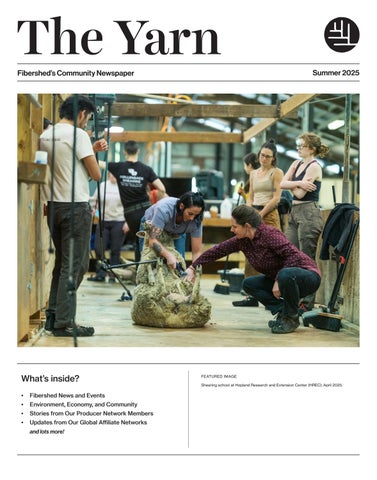
Shearing school at Hopland Research and Extension Center (HREC), April 2025.
FEATURED IMAGE
Fibershed is a nonprofit organization that develops regional fiber systems that build ecosystem and community health. Our work expands opportunities to implement climatebenefiting agriculture, rebuild regional manufacturing, and connect end users to the source of our fiber through education. We transform the economic systems behind the production of material culture to mitigate climate change, improve health, and contribute to racial and economic equity.
The Yarn is produced once per year, for our expansive Fibershed Community.
All members of the Fibershed Northern California Producer Network receive a copy in the mail as part of their membership benefits.
We’re pleased to share this annual print newsletter, a collection of stories from Fibershed’s Northern California Producer Network. This newsletter includes a beautiful array of narratives written by community members just for these paper pages. We’re grateful to read the words of Cory Gunter Brown, Helen Krayenhoff, Keyaira Terry, and Saill White, who contributed personal stories and reflections for us to enjoy. If you have a story idea that you’d like to share with our 180+ member community, we encourage you to send your ideas forward. We’ll be putting a call out again next spring for your writing. In the meantime, if you would like to connect with the Producer-led Social Committee to find out more about what is being cooked up by the community and for the community, you can reach out to the team members listed on p. 10. Always feel free to reach out to the staff at the nonprofit; there’s a list of folks on p. 26–27 who are here to support you. If you have an event you want us to promote, you can email producer@fibershed.org to add it to the calendar on our website. Just note that some of the folks we work with only have a few hours a week or month to share with us. We’re grateful for the time we have with them, but if you don’t hear back right away, just wait a few days and we’ll circle back with you. We look forward to seeing many of you in November, and in the meantime, we hope you all have a wonderful gardening season, joyful time in your pastures and rangelands, and productive time in your mills and studios.
Fibershed Learning Center Environment
Workshops and Classes at the Learning Center
The Fibershed Learning Center has been hosting workshops on natural dyes, natural fibers and textiles, folk craft, and other sustainable artistry skills for the last several years, since the dawn of our brick-and-mortar location. New for this year, our educational engagement is working to illustrate the connections between the folk craft topics we have traditionally offered and the roles they play in our environmental systems.
Over the last year, Education Coordinator Elissa Callen has been building new visions for the Learning Center, drawing from her intersectional background in the arts, horticulture, and ecology. She is committed to nurturing community fluency in consumption practices and their systemic connections with our ecosystems.
This past spring, Fibershed hosted a naturalist event for the first time, showing attendees how to begin witnessing the depth of biodiversity all around us, in addition to the harvesting of it. In April 2025, we hosted a bioblitz led by Damon Tighe, in which participants got to see and document many organisms they might not have seen before, right here in the “backyard” of the Fibershed Learning Center on Black Mountain Ranch. Participants in this event also observed a native wild flax species, which is related to traditional linen fiber plants. The following month, we hosted a workshop on processing flax into linen fibers, taught by Sandy and Durl of Golden State Linen.
2025 Classes
Upcoming topics for workshops at the Fibershed Learning Center include biobased textiles, natural ink and pigment making, introduction to indigo shibori, wool felting, and more. Classes on different subjects are continually being added to our calendar. Visit our website to see an up-to-date, detailed list of upcoming classes.
Seeking Instructors
The Learning Center is expanding our educational offerings and seeking more instructors. In addition to specialists in folk craft and sustainable artistry, we are also seeking educators on subjects related to nurturing and environmental care, including traditional ecological knowledge, environmental and biological sciences, conservation, gardening, and community engagement.
If there is a topic on which you’re interested in leading a class, we would love to hear about it. To learn more about teaching with us, or to submit a teacher application or workshop proposal, visit our website at fibershed.org/learningcenter.
If you have any additional questions, concerns, or feedback, you can also reach us at learningcenter@fibershed.org. Please include “Learning Center Education” in the subject line of your email.
Add Your Event to Our Public Calendar
Events led by Fibershed Producers, occurring at Fibershed venues, or echoing Fibershed’s mission can be added to our public community calendar (fibershed.org/ events).
Do you have a special event coming up? Make a calendar request by emailing Allison (producer@fibershed.org).
Learn more about our work in and around the Fibershed Learning Center at fibershed.org/learningcenter
Updates from the Healthy Soils Program (HSP)
by BRONTE EDWARDS
“Many years ago, we travelled to Ireland on a ‘sheep tour.’ While travelling around to various farms, I was fascinated by hedgerows, marking the edges of fields. In September, the hedgerows were full of birds! The images welded to my soul and I thought I would like to establish hedgerows on our small ranch. The Healthy Soils Program provided the resources to do that, and we are very grateful for the support from the state of California and the Fibershed.”
The Healthy Soils Program (HSP) is a collaboration among state agencies and departments to promote the stewardship of healthy soils in California’s agricultural land. As one of fourteen block grant recipients, Fibershed manages a three-year grant, with $4 million allocated for direct payments to Producers for on-farm projects that support practices for our Climate Beneficial™ Verification Program.
Impact
This grant directly supports 19 Fibershed Producers (17 wool, 2 cotton) in the implementation of land stewardship practices across 3,817.81 acres and 17 counties.
Money allocated Fibershed is supporting Healthy Soils practices on farms across California with our $4 million grant, with $1.5
“The combination of a relatively heavy compost application mixed with seed has had a stunning impact on our pasture. Our cattle tenant’s family owned this ranch for 40 years before us and he says he hasn’t seen the pastures so productive in all that time. He just got a grant to apply the same mix of compost and seed to his home ranch.”
LYNN MOODY Blue Oak Canyon Ranch
MARCIA BARINAGA, Barinaga Ranch
TOP Hedgerow planting at Blue Oak Canyon Ranch. BOTTOM Meadow at Barinaga Ranch.
TOP TO BOTTOM Workshops at the Fibershed Learning Center: Flax Processing with Sandy and Durl of Golden State Linen, Willow Fence with Charles Kennard, and Natural Palettes: Late-Spring to Summer Dyes with Sasha Duerr. Photographs by Elissa Callen.
Kaos Sheep Outfit and Partners Receive Redwood Region RISE Grant Award
by STEPHANY WILKES
Lake County–based Kaos Sheep Outfit and its partners have been awarded a Redwood Region RISE Grant, one of just ten transformative projects selected. The Redwood Region includes Del Norte, Humboldt, Lake, and Mendocino Counties. Each of the winning projects will address critical challenges in this region through sustainable food systems, renewable energy projects, affordable housing solutions, workforce training, cultural preservation, and forest management practices, with the goal of overcoming persistent barriers to economic advancement in rural and tribal areas.
Kaos and its project partners—which include UCCE Humboldt–Del Norte Counties, the UC Hopland Research & Extension Center, GHD Engineering, Materevolve, and Fibershed—will receive $607,000 for a feasibility study to assess the potential for a regional wool industry cluster within the Redwood Region. The project will address the persistent disconnect between in-state raw fiber production and finished product development, while examining workforce development needs, market demand for wool products, and necessary infrastructure investments to create a viable regional supply chain from raw wool to finished products. The project builds on prior work that examined potential sites for a wool scour facility in Humboldt County. All awarded projects have a completion date of September 2026.
For more information, visit the California Center for Rural Policy website at ccrp.humboldt. edu/redwood-region-rise-news/catalyst-awards
New Wool Mill Opens in Humboldt County, Reviving Vital Industry Nearly One Hundred Years after Historic Mill Closed
by SHAWN EDWARDS
Nearly a century after the closure of the historic Humboldt Bay Woolen Mill, Humboldt County is once again home to a wool processing facility. The launch of the Lost Coast Spinnery marks the revival of a once-thriving local industry.
Located in the heart of historic Fernbridge, the Lost Coast Spinnery is the first wool mill in Humboldt County in nearly one hundred years. It provides custom processing services for sheep ranchers, fiber artists, and designers committed to ethical, local, and environmentally responsible production. With a mission rooted in land stewardship and community resilience, the mill is more than a business—it’s a critical piece of the regional regenerative fiber economy.
“This mill brings Humboldt’s wool economy back home,” said Shawn Edwards, founder of the Lost Coast Spinnery. “It’s an investment in soil health, biodiversity, and future generations—not to mention rural livelihoods and sustainable fashion. As a kid grew up on a farm in Wheatland with sheep and cattle. It was a full circle life. Then later as an adult watched my dad in Loleta finally give up on agriculture altogether mainly due to the cost of shipping his wool out of state.”
A Natural Fiber with a Regenerative Future
The reopening of a local family-operated mill means that Humboldt County ranchers no longer need to ship raw wool out of state or discard it entirely. Now, they can have their fiber washed, carded, and spun locally, creating yarns, batting, felt, and other materials for home goods, fashion, and artisan use—all traceable from sheep to shelf.
“This isn’t just about wool,” said Thomas Nicholson Stratton, a local sheep producer and fiber systems advocate. “It’s about regeneration—of our landscapes, our economies, and our relationship to the materials we use every day.”
Producer Network
Natural Dyer’s Spring Market at the Fibershed Learning Center
On May 10, 2025, members of the Northern California Producer Network gathered at the Fibershed Learning Center in Point Reyes Station for a Natural Dyer’s Spring Market. Members sold their wares and engaged in participatory, hands-on demonstrations.
Producer Network
Welcome to Our New Northern California Producer Network Members!
We want to welcome and highlight producers who have joined our Northern and Central California Producer community since the publication of the previous issue of this newsletter. As always, you can find information about local fiber, dyes, and skills within our community, alongside direct links to contact or support their enterprises, in our Producer Directory at fibershed.com/producer-directory.
As of March 2024, we have 184+ Producer members in our original Northern California Fibershed.
Kin Weaver
Nevada County, California
Annyea Healy gratefully resides in the Northern Sierra Foothills, within Nisenan Territory, tending to her homestead alongside her family and many animal and plant friends. There they grow flowers, vegetables, and herbs and care for their Angora and La Mancha goats, llamas, and chickens. Through reciprocal, respectful, loving relations with her animal kin, Healy grows, harvests, spins, botanically dyes, felts, and weaves their beautiful natural fibers into one-of-a-kind creations, as well as providing food and fiber to her community. Healy facilitates workshops for folks to learn and practice these skills at various primitive skills gatherings and at the annual women’s retreats hosted every spring on her homestead in Nevada City, California.
kinweaver.com
Lost Emu Farms
Santa Cruz County, California
Billie Thibodeau provides prescribed grazing services with her herd of goats and sheep to coastal counties north of San Francisco. She has raised goats and sheep for eight years. She has a background in farming, with specialities in closed loop systems, rotational grazing, and regenerative agriculture. She is an artist, knitter, and lover of nature.
lostemufarms.com
Stillwater Farms
Shasta County, California
Stillwater Farms, located at Stillwater Homestead in beautiful Shasta County, began raising registerable Jacob sheep in 2019 for both fiber and meat, carefully selecting animals for their premium wool. Stillwater’s small flock includes two-horned and four-horned sheep, and the farm uses some rotational grazing to ensure the health of both the animals and the land. The farm is in the process of getting its herd registered. The wool from its sheep is hand sorted for texture and color.
In addition to selling farm-produced wool from its Jacob sheep, Stillwater Farms also provides ethically raised, quality animals for pets, show, farming, and meat, specializing in New Zealand, Mini Rex, and Tamuk rabbits; Boer goats; and Kune Kune pigs. The farm’s commitment to sustainable, ecofriendly practices ensures that all aspects of the homestead support a healthy and productive environment.
stillwaterorganicfarms.com
Siren Song Fleece Works
Nevada County, California
Siren Song Fleece Works is a mermaid-owned wool and fiber mill offering custom small-batch processing services and products, including washing, roving, art batts, and handspun yarn. Siren Song’s new facility at Lucchesi Vineyards is located in beautiful Grass Valley, where its micro flock of Icelandic sheep can sometimes be seen grazing between grapevines. Come visit for a tour or a workshop, and don’t forget to bring your work in progress to craft while you enjoy a glass of estategrown wine.
Whether you are looking for ecofriendly and mindful washing of your prize sheep’s wool, or you are finally ready to turn those fleeces you’ve been stashing in the closet into the roving you’ve been dreaming of, Siren Song is ready to work its magic! It is committed to customer satisfaction and to the environment. Plus, a portion of all sales goes toward protecting the local watershed.
sirensongfleeceworks.com
Duren DyeWorks, Wool Ranch & Mill
Calaveras County, California
Located in the Sierra Nevada foothills, Duren DyeWorks, Wool Ranch & Mill is home to a small flock of registered Merino and Border Leicester sheep. It offers premium blanketed fleeces in an array of natural colors for handspinners and fiber artists, as well as breeding stock for those wanting to enhance their fiber flock. Duren’s mini mill can also process your fibers into woolen batts and roving.
durendyeworks.com
Traditional Tanners
Oregon
Traditional Tanners uses natural methods to transform sheep and goat hides into soft and washable heirlooms, helping farmers make additional income selling their hides through farmers markets, websites, and social media. People love getting their hides from someone who they know raised the animals in a good way, and having the hides naturally tanned completes the picture. Traditional Tanners helps farmers understand how to preserve hides for tanning (it’s easy) and ship cost effectively, and the company provides placards and resale support after tanning. Traditional Tanners also buys raw skins of Jacob, Icelandic, and Churro sheep and other interesting breeds.
Traditional Tanners started in 1989 with a vision of making garments from local and natural materials. Finding out that hides were frequently just thrown away, the company dove into the art of tanning, focusing for many years on making buckskin from deer. In 2007 Traditional Tanners became certified organic for tanning sheep and goat skins and, in recent years, started to offer a tan and return service for farmers.
braintan.com
EDITORS’ NOTE We’ve grandfathered Traditional Tanners into our Northern California Producer Network until there is more support in Oregon for Fibershed organizing, and we also acknowledge and support the incredible work that Traditional Tanners offers by way of plant-based tannin tanning of hides to our California-based producers.
Producer Voices
Hear from your fellow Northern California Producer Network Members. Want to share a project or an update? How about sharing a call to action, a resource, or a poetic musing? We’re ready for your submissions. Write to affiliates@fibershed.org with the subject “Northern California Producer Voices.” We will fit submissions as we have space and prioritize timely submissions.
The Natural Dye Handbook
by Heidi Iverson
Heidi Iverson’s new book, The Natural Dye Handbook, was featured at the May 10 Natural Dyer’s Spring Market at the Fibershed Learning Center. It was wonderful to see so many members of the public learning about natural dyes for the first time, as well as old pros enjoying Iverson’s dye demo.
Her book is an invitation into a slower, more mindful world of plant connections. It features her own hand-drawn illustrations, recipes, and personal insights generated from many years of experience in the world of natural color.
Follow Heidi on Instagram at @honeyfolkclothing You can purchase her book at your local bookstore or directly from Heidi via bookshop.org/shop/honeyfolk_books
For Us, By Us: Producer-Led Events Committee Forms in Summer 2025
In June 2025, a small group of Northern California Fibershed Producer Network Members met to discuss the nuts and bolts of the newly formed Events Committee. How would we make decisions? How would we manage our budget? How would we communicate with Fibershed and with Producers at-large? How would we hold ourselves accountable for our main job: to create and operate events for Fibershed Producers in Northern California?
We hashed it out, set ourselves up, and began planning events for 2025–26. We’ll be sharing more on these events in upcoming e-newsletters. We look forward to engaging with our fellow Producers, maintaining time-honored events (such as the Dance Palace marketplace in November and Producer meetups), and introducing new and fresh events around various parts of Northern California.
How did this Events Committee come to be? After a series of calls, a Producer-led working group, Zoom meetings with Producers at-large, a report and recommendation to Fibershed, and a transition team process (over the course of 2023–25), Producers and Fibershed moved forward with the formation of the committee, which came fully into being in June 2025. For more information on how to participate (it may not be too late!), check your March 2025 Fibershed e-newsletter.
We are looking for representatives from Humboldt, Lassen, and Modoc Counties, the Central Valley, and the Central Coast to join the Events Committee. Please email norcalfibershed@gmail.com for general inquiries or if you are interested.
And mark your calendar for November 8, 2025 at the Dance Palace in Point Reyes Station. The Events Committee will be hosting the marketplace, and we hope to see you there.
With Love,
Irma Mitton-Rodriguez (San Mateo County), irmwrites@gmail.com
Sarah Keiser (Sonoma County), sarah.keiser@wildoathollow.com
Marie Hoff (Shasta County, north state, and Oregon border), admin@fullcirclewool.com
Charlene Schmid (Solano County, Central Valley), charlene@integrityalpacas.com
Helen Krayenhoff (Alameda County, larger Bay Area), kassenhoff@lmi.net
Earth, Wool, Fungi, and the Fiber Between
by KEYAIRA TERRY
Since returning to my hometown of Ukiah, California, nearly three years ago, I’ve been relatively quiet, adjusting to rural life and everything that comes with being a first-time homeowner, land steward, and sheep owner. In that time, I’ve been slowly developing a new body of work that feels like the culmination of many threads I’ve been weaving—both literally and figuratively.
As a Fibershed Producer, I’ve long been committed to using materials that are local, regenerative, and deeply personal. But this series, Earth + Fungi, is the first time it’s felt like all those pieces have truly come home.
These sculptural works pair handwoven, naturally dyed fibers with hand-formed terracotta vessels. The fiber is often colored using mushrooms, leaves, and kitchen scraps. These are the materials that surrounded me growing up. What I once overlooked, I now see as abundant, beautiful, and worthy of reverence.
Each piece is made with wool fiber that was sourced and processed entirely within our local Fibershed system and over half are hyper-local, never once leaving our Mendocino County borders. These pieces are a quiet celebration of this land: abstract meditations on decay, rebirth, and the unseen magic of mycelium below the surface. It’s slow work and intentionally so. That’s what love most about the Fibershed community: the shared belief that slowness, stewardship, and story matter.
I’m also working toward integrating fiber from our own sheep into future works. Since moving here, my husband and I have practiced rotational grazing on our small acreage. While we’ve made our share of beginner mistakes, in this third season, it feels like we’re finally finding our rhythm. Every decision—from pasture planning to fencing—is made with soil health and carbon impact in mind.
My hope is that these pieces invite others to slow down, too. This is more than art. It’s a process. It’s place. And it’s deeply personal.
Find Keyaira’s work at keyaiira.com
Events Committee
RIGHT Images courtesy of Keyaira Terry.
ABOVE Heidi Iverson at the Fibershed Learning Center.
Producer Voices
Being Human/Human Being: Through the Praxis of Handwork with Bark, Bast, and Leaf
by CORY GUNTER BROWN, EARTH MY BODY
Over the last five years, I’ve found myself moving through difficult, often simultaneous, experiences: the pandemic, multiple wildfire evacuations, health issues, and housing insecurity. As a result, I’ve been without a natural dye studio, or any dedicated creative space, for myself or my business, Earth My Body, since the beginning of 2020. As a creative person, this has been challenging financially, but more than that, it’s been challenging on a deep soul level. In answer to that challenge, I’ve found myself moving deeper and deeper into relationship with my ancestral self, the self that longs to live the way all our ancestors on this Earth lived for hundreds of millenia.
I’ve believed for a long time that handwork is a human right and an essential part of our well-being. I’ve embodied the ancient and perpetual praxis of forming mind into matter since I was a little one. Transforming the images in my mind, through my hands and natural materials, into beautiful, functional forms has always brought me pleasure, delight, and well-being. This is the thing that continuously soothes my spirit and weaves the material of my being as I move through time and space. Without access to my natural dye work, which had become my focus over the last sixteen years, I began seeking other ways of working with my hands, of soothing
my soul and weaving myself into being, ways that take up much less space than a natural dye studio. One of the paths I found was basket weaving, which I came to realize was a lifelong subconscious desire, this practice of tending leaf, twig, bark, root, vine, grass, bramble, and rush. I stumbled onto this path during the pandemic through the beautiful work and digital teachings of Suzie Grieve and Hanna Van Aelst. Their skillful teachings, along with my love of foraging, twined together in my mind with awareness-altering teachings I received from the wonderful Tamara Wilder in 2018.
Over the course of a weeklong cordage making class with Tamara titled Everything Twisted, in which thought would simply be twisting fibers for five days (silly me), we were guided on a journey of ancestral handwork through flint knapping, green woodworking, bark slipping, retting, pit baking, shell scraping, stem cracking, and leaf pounding. All this beautiful work served the purpose of extracting bark, bast, and leaf fibers from a variety of plants and twisting them into cordage—practiced while sitting on the earth, beside a lake, under a massive madrone and the big open sky. Tamara’s gentle and generous knowledge, paired with years of small moments of noticing, shifted something deep inside me, as though it rolled aside a massive stone blocking the entrance to a vast valley of understanding. came to see
that to be human is to be in perpetual sacred relationship with the Earth through handwork and the energy of our own bodies.
I now have a deeper understanding of the way shaping need into form, with hands and body, was practiced by all our ancestors, every day of their lives, until very recently: the daily praxes of shepherding, hunting, hide tanning, fiber gathering/ processing/spinning/weaving, clothing and adorning, clay working, woodworking, food gathering and processing, medicine making, stone carving, flint knapping, basket weaving, shelter making, and land tending. understand these things to be an essential part of being human and human well-being. can feel this truth in the ancestral chasm at the center of my being.
I now understand that we don’t just live on this Earth, we are of this Earth—a part of a whole that is only truly whole when we are able to live holistically interwoven in perpetual, cyclical interdependence with our plant, animal, mineral, soil, water, wind, sun, and moon kin, the elemental essentials.
But I neurodivergently digress. So, this is how, in the absence of familiar space and stability, found myself birthed out onto the land, seeking soul soothing through relationship with the living world and new forms of handwork.
I began learning the seasonal rhythms of bark slipping, the act of carefully peeling bark from certain trees at certain times; identifying abundant non-native plants to work with as am a non-native creature; and taking part in the cycles of drying, soaking, and mellowing for weaving. focused on making tiny baskets, as an entire tiny basket studio can fit in a single tote bag. At first gathered bark and leaves from the locally abundant Eucalyptus globulus and Chasmanthe floribunda respectively, with permission from landowners. These materials are wonderful and very available.
More recently, I began a careful courtship with salvaged willow bark—careful because gathering bark is much more impactful to a tree than gathering withies, which are regenerative. Gathering bark involves larger branch removal or even cutting down a whole young tree. I’m also tentative about gathering willow because I live on unceded Huchiun Ohlone land (Oakland), and though I was born and raised here, this is not my ancestral land; neither is there any public land nearby where it’s legal to gather plants. In these complex contexts, my intention is to be careful (as in, full of loving care) when interweave and interact with the land, to be in a respectful and ethical relationship, and to not take what isn’t for me.
At the same time, willows keep throwing themself into my path—sometimes quietly, a few small branches cut by the side of the road, and sometimes loudly, in a tantrum of collapsed trees, crushed under the immensity of a fallen redwood. In these instances, feel good gathering bark from these branches, as know they will swiftly dry out and become ladder fuels or be removed and chipped, which renders the bark either unobtainable or obliterated. And I’m comfortable in the role of scavenger; it’s a skill that has always been part of my life. Having grown up with few resources, it comes naturally.
These lovely serendipitous moments with salvaged willow offer immense solace. The mesmerizing and methodical practice of slipping bark from branch is such a sensory one. First, you use a tool made from the willow itself to slip under the cut bark edge and slide along its length, carefully peeling the bark back to reveal the smooth bonelike wood beneath. Then as you slide your fingers between the wood and bark, slowly releasing one from the other, you encounter an almost amphibious wetness and the faint scent of melon. Once released, the bark can be rolled as is or split, inner from outer, a magic trick that tickles me every time.
I’ve made quite a few tiny baskets from Eucalyptus bark and Chasmanthe leaves. I’ve not yet woven anything from my slowly growing willow bark collection. For now I’m enjoying the beautiful, somatically nourishing gift of gathering and processing, transforming bark and leaf through my handwork, from the realm of the vegetal into the realm of the human animal, with immense gratitude, wonder, and respect for the generosity of plant beings for giving us life and the knowledge our ancestors collectively kept alive.
Follow Cory at earthmybody.com and on Instagram at @_.earth.my.body._
IMAGES Courtesy of Cory Gunter Brown.
Producer Voices
Discovering New Local Color
by HELEN KRAYENHOFF
Blue pigment from yellow and red flower petals?! I’ve been in the thrall of plant pigment alchemy for many years, which drives a daily search for new natural dye plants. But this was something magical and startling.
From a neighbor’s yard, I had picked a few faded flowers from a Gaillardia x grandiflora hybrid—a common low edging plant—and included them in a bundle of experimental plant material on a skein of white wool yarn. After steaming the bundle, opened it up and found that one plant had produced sky blue and bright light green. Which one was it? After a process of elimination, I determined it was the Gaillardia and knew had discovered something special.
So, I placed an order with Fedco Seed Co. for a related species: Gaillardia artistata (commonly called blanket flower). It is a tall wildflower native to the Great Plains and a very hardy perennial that pumps out tons of blooms. planted the seeds a year ago in the spring, and once the plants started flowering, they continued to bloom for a full ten months, giving me lots of material to use. I made an immersion bath with the flowers and a beautiful soft green emerged; it wasn’t much affected by modifiers like iron or changes in pH. Eco-printing on cotton was also quite successful.
I discovered this natural dye plant in the same way I’ve discovered others. I pick a little piece of something from the side of the road and a bigger piece of some invasive weed, and do some helpful deadheading of faded blooms on my neighbor’s sidewalk edging plants. Oftentimes, get no color from these or just another yellow that doesn’t get interesting with modifiers, but then sometimes there’s pure magic!
This spring I grew lots of Gaillardia artistata seedlings for our nursery, and I’m happy to report that many people bought them. Perhaps a few of these plants will inspire folks to discover the joyful alchemy of dyeing with Gaillardia and finding new local color near their homes.
Two Rock Corner and Community Land Shepherds
by SAILL WHITE
My tiny farm in Two Rock is my test bed for experimenting with small acreage sustainability and production. Three years ago, I added a little mob of grazers to my homestead, and now my sheep produce enough wool for a few sweaters a year; my goats keep me and my friends supplied with as much fresh, nourishing cheese as we can eat; and I’m thrilled at how my attempts at adaptive multi-paddock grazing have brought lush and diverse plant life to a pasture that had previously been a eucalyptus-infested feedlot for too many horses.
There are so many questions that arise when you are new to livestock. Is my goat in pain or does she want a boyfriend? How much chicken feed did the sheep eat— and if it’s as much as I think it was, how do I keep them from bloating and dying? How the heck will I convince this demonically kicking doe that being milked is more enjoyable than attempting homicide? I have learned so much—from hands-on experience and observation, from madly scouring the internet, but most of all from our local community of livestock folk.
Two years ago, learned to shear sheep. This pursuit has blessed me with piles of lanolin- and poop-laden laundry, bruises in the weirdest locations, sweat, tears, extreme exhaustion, and the occasional black eye.
It has also brought me the joy and occasional frustration that comes from tending to sheep and their people. I love being immersed in the loose-knit, big-hearted, wildly diverse community of Northern California livestock keepers—from people who earn a living from their grazing, meat, wool, or dairy operations, to folks who have a few decorative pet lawn sheep.
I take great pleasure in learning from the animals and their keepers, and in sharing what have learned. More and more, am able to support folks who have even less experience than I do.
Because I’m a software developer when I’m not hanging with the grazers, and because love maps, wrote a little map application that I’m hoping will strengthen and expand our livestock community. This map lets people who have livestock skills drop a pin that links to a listing. Users can choose to make their listings publicly visible or visible only to other users. It’s wonderful to see people in our Northern California livestock community putting themselves on the map! I warmly welcome all of you to join us.
You can find out more and see our map at communitylandshepherds.org/ shepherd-map
TOP Helen Krayenhoff at the Fibershed Learning Center.
OTHER IMAGES Courtesy Helen Krayenhoff.
IMAGES Northern California Shepherd Map, communitylandshepherds.
communitylandshepherds.org
Producer Stories
by STEPHANY WILKES
Ryan Mahoney’s family arrived in Rio Vista, California, in the 1870s, not long after the Great Flood of 1862 dumped ten feet of water in forty-three days. That event moved Rio Vista to its present-day location, where a vertical-lift truss bridge now carries California State Route 12 across the Sacramento River. Richard “Dick” Emigh, Mahoney’s grandfather and ranching and shepherding mentor of twenty years, was born in Rio Vista in 1929, shortly before natural gas was discovered there in 1936. The Rio Vista Field has operated continuously since, but so have the land stewardship and carbon sequestering practices of the Emigh family.
These cherished values are now embodied by Mahoney, a fifth-generation rancher. He hopes to bring the family’s sixth and seventh generations to the land and stewards it accordingly, in partnership with nature. Mahoney bought the familyrun company, which has twenty employees, five years ago. “I’m out there every day,” he said.
“My grandfather gave us a jumpstart on carbon farming,” Mahoney explained, referring to the 20,000 acres that now sequester 2,500 metric tons of CO2 per year. “There was originally grain farming, but yields dropped along with soil nutrients. We stopped farming twenty years ago to go to pasture rotation with cattle. We moved away from commercial fertilizer in the mid-2000s, and my grandfather was big on developing water trough systems.”
Water management and climate resilience are inseparable. Water troughs keep livestock from drinking out of stock ponds and streams, preventing erosion—and thus soil-carbon emissions—and keeping water clean. Practices that optimize both water usage and carbon dynamics include wetland conservation, sustainable agriculture, agroforestry, and riparian zone protection. Emigh Ranch’s water
troughs are powered with wind and solar energy. The sheep graze beneath massive windmills, the first of which were installed in the 1900s.
“We always had sheep but didn’t always have wool,” Mahoney said. In addition to providing beef for Snake River Farms and lamb for Niman Ranch and Superior Farms, he started Emigh’s Fine Wools two years ago. It is a scrumptious, allAmerican yarn line with various weights and brilliant colors, as well as some readyto-wear beanies. Mahoney recounted, “In 2023, Grandpa passed away in a blanket made from his wool. It was the first time in eighty, ninety years of wool growing that he had that. It’s meaningful.”
About eight years ago, Mahoney began working with Fibershed and the Solano Resource Conservation District, which helped Emigh Ranch develop a carbon farm plan. Carbon farm plans describe ways to increase a working ranch’s capacity to capture carbon from the atmosphere—which has too much carbon dioxide— and store it beneficially, as in grasslands and soil organic matter. Emigh Ranch uses livestock management software that allows for recordkeeping on pasture management, rotation, rest periods, and carbon farm plan practices and benefits. Their wool is certified Climate Beneficial™.
“Our goal is to capture what we did, not look great,” Mahoney said. “I tend not to follow buzzwords. Look at the quality of the product itself. Health and well-being are directly related to the product. Fine, strong, long, uniform fiber reflects a good operation caring for sheep well. Don’t get wrapped up in a sales pitch. A lot of certifications are meaningless, like ‘non-hormone.’ Hormones are illegal in the US. If you do it, you lose your sheep and go to jail. ‘Grass fed’ is a legitimate label, but in some cases it is so loosely regulated as to mean that an animal can
be on a grain diet for 90 days or less, prior to slaughter. So people slaughter at 89 days of grain feeding and put the ‘grass fed’ label on it. That is in contrast to what Loren Poncia is doing at Stemple Creek, for example. They do an excellent job, in terms of both attention to the animals and to grass growing, but other people do not have Loren’s integrity. And you see it in the finished product: his beef is higher yield with higher marbling. We need to get back to trusting each other, to building relationships. We’ve lost a lot of trust and are letting marketing, rather than quality, drive our decision-making.”
Mahoney wants to help new producers get started, and he understands that everyone doesn’t have the benefit of generations-spanning relationships with experienced ranchers like his grandfather. To that end, he shares his knowledge as one of the three hosts of the Sheep Stuff Ewe Should Know podcast, along with UC Davis livestock veterinarian Dr. Rosie Busch and Dan Macon, livestock and natural resources advisor for the UC Cooperative Extension.
“The podcast is great for new producers,” Mahoney said. “My goal is to help anyone starting out. It’s kind of old-school, sharing that knowledge on the other side of the wall. It’s intentional conversations between the three of us but available for anyone in the industry. Hopefully the podcast will inspire someone to get sheep and run them.”
Cohost Busch said, “Ryan is very even tempered and thoughtful in his way about many things. Especially the livestock. believe it comes from his lifelong mentorship with his grandfather Dick Emigh. A great shepherd that can walk through his flock without disturbing even the birds around him. He takes in the scene, reflects, and with a quiet, calm, and patient demeanor, he considers a steady and measured approach to almost all situations. He is calculated. Not without risks, but he
understands that growth and improvement don’t come without risk. His way with the livestock is an artform. And their health and wool quality are a reflection of that care. His wool is incredible! My daughter loves her ballet wrap sweater made with it. She wears it twice a week to ballet.”
Cohost Macon added, “Ryan is one of those unusual producers who keeps track of his wrecks so he can learn from them. Like all of us, he makes mistakes—what separates Ryan is his ability to think through how to avoid similar mistakes in the future.”
Words for all of us to live by.
So, what’s next for Mahoney and Emigh Ranch? “Habitat development, hedgerow planting,” he said. “One of the best things to do, if you want to sequester more carbon, is to look for more ways to incorporate organic matter into the soil. The easiest way for most people to do that is by applying some sort of compost product. Focus on hedgerow planting, water management, and rotating grazing livestock with special attention to rest days.”
At risk of planting words in Mahoney’s mouth, can’t help but remark that he sounds that rarest thing in our always unprecedented, challenging times: hopeful.
“I do have a lot of hope,” he said. “The US consumes most meat and textiles. We live in the market that’s the best.”
Find the Emigh family’s high-quality wools at emighfinewools.com
Ryan Mahoney and Emigh Fine Wools
LEFT TO RIGHT Ryan Mahoney at Emigh Ranch, Rio Vista; Ulatis Creek restoration at Emigh Ranch with Fibershed, March 2025.
Producer Stories
bellweather: Fire Medicine, Fire Craft
by STEPHANY WILKES
“We have this idea that land is untouchable, that to touch land is disturbance,” brontë velez said. “Well, we need to become comfortable with disturbance. Everything that’s happening is disturbing.”
In relationship with the Kashia Pomo Cultural Department, to whom they are accountable, and in community with sheep, cotton plants, poetry, friends, neighboring ranchers, and dance, velez and Jiordi Rosales are co-stewarding The School for Inclement Weather, also known as bellweather. They are working to heal land with skillfully practiced fire and grazing. At the school, land tending is not just a practical matter: it is spiritual, philosophical, communal, and ancestral, and brontë and Jiordi embrace and celebrate its complexity.
Healing
Through Fire and Grazing
“We need the spiritual aspects to fortify us in the climate emergency,” brontë said.
brontë, Jiordi, their fellow resident Nathalia Scherer, and seasonal bellweather residents tend 365 acres—many of them heavily forested and too steep to mow—at the very south end of the Coast Range, in northwest Sonoma County, California. Creeks and streams run west toward wetter hills from bellweather’s dryer, hotter
ridge, the fir, oaks, redwood, and bracken fern dense in areas that have not burned in a long time, fed by two winter seasons of record-breaking rains.
Jiordi points north, to a hillside so steep it is nearly vertical. “These ravines are so steep they are hard to walk, and also very difficult to run mobile fence through. You couldn’t prep them for grazing if you wanted to. Riparian areas like that can get really overgrown. In those areas, fire is a more appropriate form of maintenance than grazing. And with the logging history in the region, the displacement of Indigenous peoples and knowledge, especially in the Coast Range, the land is in a deep state of suppression and disrepair.”
While grazing and prescribed burns have become more common in Northern California since the devastating wildfires of 2017–2018, which took the town of Paradise and a substantial part of nearby Santa Rosa, fire is a less common practice on individual properties than grazing. Fire is necessary for the health of California ecosystems, but prescribed fire can also seem complex, bureaucratic, and intimidating.
Over the past year, bellweather has had three burns, in three adjacent areas: one in October 2023, when grass and vegetation were dryer; another in May 2024, when
the grass was green and shorter; and the third in early June 2024 through the night, when humidity levels were higher than they would be during the day. About two dozen trained firelighters and holding resources tended each fire: a certain number of people and resources must be present to monitor and address any concerns. Planning a prescribed fire in advance is difficult without the wide web of relationships necessary to fulfill the necessary prescription. There isn’t much advance notice because conditions have to be exactly right—low wind, specific temperatures, and humidity—and conditions are always changing.
Fire’s Role in Ecosystem Health
“We don’t get a perfect burn,” Jiordi said, smiling. “Not yet. That first re-entry burn is not always pretty—we are walking a fine line with these prescriptions. We are both aiming to lighten the fuel load phase by phase, over the course of many years, and at the same time contending with an intensely clogged forest and the need for a fire hot enough to consume some of the dead, heavy fuels that are blocking light from reaching the forest floor. If we attempted to do it all at once with a big fire, we could easily damage the trees we are working so hard to protect. Too soft of a fire and nothing would ignite. This 60-acre area took three attempts before we got the conditions just right, which involved some higher flame lengths and an immense amount of perimeter preparation. Some people expect low-intensity fires in steep, high-density forests, from what they’ve been shown on social media of gentler environments, and they see our mountainous re-entry burn and say, ‘What you’re doing is excessive.’ I’d say it’s more appropriate to think colonialism was ‘excessive.’
The commercial logging industry, Sudden Oak Death, and now these annual bomb cyclones are ‘excessive.’ So these fires are going to feel intense for people, at first. Maybe if we keep working, the next generation gets a perfect burn.”
“I watched the Park Fire daily briefings,” Jiordi added, “and not once did they mention the correlation between land-use and fire behavior, like the impact clear-cut logging has on fire severity and rate of spread. Instead it’s read simply as ‘a lot of down and dead fuels.’ That leads people to conclude it wasn’t affected by industry or a specific style of land management. If we can’t name and piece these things together, connect
a fire running through this, we won’t change our behavior or the behavior of fire.”
“But care is not always pretty either. We want care to be idyllic and sometimes it’s grotesque,” brontë said. “We take life to give life. There’s hesitation there. It’s edgy. But, after a burn, it’s like the land can breathe again, when the forest gives way to the meadows that held their boundaries so well here, when they were living under the consistent fire return intervals of the Kashia. The plant life completely changes.”
Jiordi has spent the past five years studying and practicing to become a California State-Certified Prescribed-Fire Burn Boss. It is an enormous—and rare— responsibility. As of August 2024, there are just 43 active State-Certified Burn Bosses in a state with 39.5 million people. What exactly does a Burn Boss do?
Jiordi said, “We perform prescribed-fire planning, obtain all the state and local approvals and permits, develop and implement burn plans, bridge all the people from land-owners to fire agencies to tribal members that need to be involved with a burn.” They also monitor fire effects, maintain prescriptive requirements, and conduct an After-Action Review. There is initial certification training and required, annual continuing education.
Jiordi is quick to point out this was not a solo endeavor: the Kashia Pomo Cultural Department sponsored his study, as well as events at The School for Inclement Weather to help more people obtain Fire Fighter 2 certification. This certification is the entry-level qualification for wildland fire suppression, prescribed fire use, and safety. Jiordi was also supported in learning by Fire Forward, which mentored him through the additional trainings and state-evaluation process. We have to move with the question: What is the land asking for?
Read the entire article on the Fibershed blog, originally published February 10, 2025, at bit.ly/bellweather-fire
Find brontë and Jiordi on Instagram at @littlenows (brontë) and @jio.rosales (Jiordi)
Producer Stories
From Waste to Wonder: How Wool Pellets Are Reviving Soil Health
by GRAYDON GORDIAN
When most people think of wool, they think of sweaters, blankets, coats, and other finished goods made from this soft, comforting material. Most people don’t think about the waste involved in the production of wool products, and even fewer think of fertilizer. A small group of pioneering sheep and alpaca growers is hoping to change that.
Belly wool, tag wool, and sometimes wool too coarse to be used in textiles end up in storage or, worse, landfills. But this excess material can, with the help of ranchers like Mandy Schmidt and Charlene Schmid, serve a purpose. The wool pellets made from waste wool are a “super food” for the soil, in the words of Schmidt, who runs Marin Coast Ranch, a multigenerational farm in Marin County, California, that raises sheep, cattle, and goats.
“Pellets, when used as a soil amendment, can replace unnatural fertilizers,” she said. “Wool has high water-retention capacity, helping to keep soil moist for longer periods, reducing watering frequency in gardens but also extending the nutrient density lifespan of pasture grasses.”
“Living in a delta region, my land is solid clay,” said Schmid, whose Vacaville, California, farm, Integrity Alpacas & Fiber, has grown from just four alpacas when it was founded in 2013 to a herd of more than forty today. “Working pellets in will help create spaces for aeration and increase the microbial life in the clay.”
Creating a non-synthetic source of nitrogen, moisture retention, and increased soil porosity are just some of the benefits of wool pellets. Others include natural pest control—the lanolin in the wool repels pests like slugs and snails without harming broader invertebrate biodiversity—and carbon sequestration. Up to 50 percent of the weight of wool pellets can be carbon, which stays in the soil even as the pellets break down.
Both Schmidt and Schmid have been integral to the establishment of wool pellet production in the United States.
“One of my contributions to the pellet movement included funding the first wool shredding machine made in the US,” said Schmid. “I worked closely with Buskirk Engineering for nearly a year as they developed the prototype into reality.”
At the same time, Schmidt received a grant from the Marin Agricultural Land Trust to purchase a wool pellet machine. She first started it up in the spring of this year. Now she finally has a use for the collection of waste wool that had been building up in her barn for years.
“Dirty wool is an underutilized magic ingredient for gardens that would otherwise end up in a landfill,” she said. “Bonus: the dirtier, the better!”
“There is no shortage of unprocessed fiber,” said Schmid. “I have collected and purchased alpaca and sheep wool tags from a variety of Fibershed members. Everyone have worked with is excited with prospects and relieved that they don’t have to take it to the dump.”
For gardeners, farmers, and other individuals hoping to grow healthy, thriving plants for personal or professional reasons, wool pellets turn would-be waste into a tool for soil transformation.
You can purchase wool pellets from Mandy Schmidt at marincoastranch.com and get in touch to learn more at marincoastranch@gmail.com You can purchase wool pellets from Charlene Schmid at integrityalpacas.com and get in touch with her at charlene@ integrityalpacas.com
Multiple requests for comment were placed with Point Reyes Compost; however, they were not ready to respond to our interview requests at this time. We’re excited to hear that they will be launching a wool pellet business soon! We wish them all the best and look forward to featuring them when their product comes to market.
Affiliate Network
Updates from Fibershed’s Global Affiliate Network
The Fibershed Affiliate Program supports an international grassroots network that promotes the development of regional fiber systems communities, including economic and noneconomic growth, in the form of building relationships and new global networks. Fibershed Affiliates are grounded in place-based community organizing efforts that work to connect fiber farmers, processors, and artisans. Fibershed offers Affiliate members ways to share stories, and enhance their organizing efforts, through online webinars, social media, networking, and project feedback. The Fibershed Affiliate Network includes groups worldwide with a diverse array of interests—from design challenges and fiber field research to community education projects—and a shared goal of strengthening regional fiber systems.
Toward Regenerative Textiles: Reimagining Utah’s Wool Industry for Ecological and Community Well-Being
by RACHAEL LAURITZEN
This spring conducted a study through Westminster University, SLC, examining how Utah’s wool textile system could be reconnected through a regenerative, communitybased approach. Utah is one of the top producers of sheep in the United States but, like other parts of the country, has been losing wool processing infrastructure as consumer awareness of the value of locally produced wool has waned over the last few decades. My research aimed to understand how to recombine local economic health with regenerative agriculture practices and sustainable textile production that benefits both the land and the people who work it.
The global textile industry relies on an economic model that prioritizes profit for corporations at the expense of social, ecological, and local economic health and is the second highest polluting industry in the world. As it expands, it relies on unsustainable practices that shrink producer profits, undervalue workers, and overproduce clothing that is often worn only a few times before being thrown away. These practices aggravate climate instability and increase economic inequality between corporations and the workers supporting them.
Using an ecocentric perspective—one that values the well-being of all life—this study explores how local economies might move away from the dominant model through a regional case study of Utah’s wool textile economy. Through interviews with local stakeholders, I investigated how practices in Utah may align with principles of regenerative agriculture and ecocentric values. The study also examines what changes in policy, market dynamics, and consumer awareness would be needed to support a truly regenerative local textile system.
One major theme from my research is the severe market strain felt by Utah wool producers. Participants described being squeezed by multiple pressures, including global market pricing, complex government policies, loss of local infrastructure, and labor shortages. The consolidation of the textile supply chain under global capitalism has made it increasingly difficult for small producers to survive, let alone thrive. Fast fashion, in particular, undermines value for quality and durability, devalues skilled labor, and accelerates ecological harm.
Despite these challenges, the study found significant opportunities for systemic change. Many stakeholders expressed values that align closely with ecocentric and regenerative principles: a love of the land, dedication to craftsmanship, and concern for economic and ecological sustainability. These values offer a foundation for a
To join the Affiliate Network and become part of Fibershed’s global movement, visit fibershed.org/ affiliate-directory 2025
more localized and resilient wool economy that centers quality over quantity, land stewardship, and community well-being.
However, to make change happen, critical barriers must be addressed. These include investing in processing infrastructure, better valuing agricultural expertise, and improving communication among stakeholders. Tensions over rangeland use compound the problem, making collaborative solutions more urgent.
The study data supports a holistic, community-based approach to revitalizing the industry, including raising public awareness about the value of local wool, investing in local infrastructure and training, and promoting dialogue among the different stakeholder groups in order to reconcile differences between them and create mutually beneficial and regenerative solutions.
In the end, my research calls for a reimagining of textile systems as part of a broader shift toward reconnecting people with the land, with one another, and with the full life cycle of the products they consume while offering a path forward—one rooted in sufficiency, care, and shared responsibility.
Rachael Lauritzen is part of Utah’s High Desert Fibershed. Learn more at fibershed.org/ affiliate/high-desert-fibershed-utah/
by STIJNTJE JASPERS, Program Director, Fibershed Nederland, and Advocacy Lead, European Fibershed
At Fibershed Nederland, we’re stepping up to protect the future of regenerative, natural, and biodegradable textiles. Across Europe, local producers and innovators are proving that a better textile system is possible. But they need supportive legislation—not rules that work against them.
The European Union is moving toward a circular and climate-neutral economy. As part of this shift, the Green Claims Directive and the Product Environmental Footprint (PEF) method aim to improve the credibility of sustainability claims. While the intention is good, the current PEF approach for textiles is flawed.
A Flawed Method for Textiles
PEF is based on Life Cycle Assessment, a tool for measuring environmental impact. It works for industrial products but not for farm-grown materials. In PEF, impacts like land use and emissions are fully counted for agriculture—but fossil-based materials like polyester get a free pass, as oil extraction is treated as having less environmental cost.
The result? Synthetic garments receive a better PEF score than natural ones, even when the latter are biodegradable, are renewable, and support biodiversity. PEF also ignores microplastic pollution, excludes meaningful measures of circularity, and assumes stronger materials always last longer—though in practice, natural fibers are often worn and valued for years.
From Technical Draft to EU Policy
In April 2025, the Technical Secretariat finalized the PEF rules for textiles, clothing, and footwear and handed them to the European Commission. Despite feedback, the proposed changes—such as including circularity and microplastics—were not adopted. The coming months are crucial: the Commission can still intervene.
This matters because PEF is influencing several key EU policies:
• Green Claims Directive: PEF can be used to justify sustainability claims without the need for additional data.
• Ecodesign for Sustainable Products Regulation: PEF is listed as a preferred labelling method.
• Extended Producer Responsibility: Waste fees may be based on PEF scores.
Call for Change
Fibershed Nederland is actively working with partners across Europe to push for fair treatment of natural fibers. We’ve engaged with EU politicians, civil servants, nongovernmental organizations, and businesses, and we have joined the Make the Label Count (MTLC) coalition. In April we took part in MTLC’s Farm to Fashion Roundtable at the EU Parliament (read the report on the European Fibershed website).
As a coalition partner, Fibershed shared MTLC’s petition—signed by more than three thousand citizens—and cosigned the joint letter delivered in May to the European Commission, urging them to:
• Recognize natural fibers’ benefits in sustainability policies;
• Ensure science-based environmental criteria to prevent greenwashing; and
• Promote a responsible fashion model that limits fast fashion and encourages biodegradable, renewable, and recyclable fibers.
Let’s Rethink the System
The EU is also reviewing its Bioeconomy Strategy—an opportunity to align textile policies with regenerative agriculture. Stakeholders will be contributing to the public consultation until June 23, 2025; this is an opportunity to share our perspective and understanding of the value of our fiber farming systems.
Natural fiber producers are already delivering climate and biodiversity benefits. They deserve recognition, not red tape. Smarter metrics and better policy can build a textile system rooted in regeneration, tradition, innovation, and connecting fiber with food production for a holistic approach.
Sustainability is not just about reducing harm—it should be about creating positive change. Let’s make sure EU policies reflect that.
For information on Fibershed Nederland, visit fibershed.nl
To read our report on MTLC’s Farm to Fashion Roundtable at the EU Parliament, visit europeanfibershed.org/resource/advocacy-round-table-bioeconomy
Why Tokushima Matters: The Heart of Japan’s Indigo Tradition
by KENJI OKA
Note from Editor: We want to extend a warm welcome to Fibershed Japan.
Tokushima Prefecture holds a special place in the story of Japanese indigo. For centuries, this region has been home to the cultivation of Polygonum tinctorium the plant used to make Sukumo—a fermented indigo leaf that is essential for traditional natural dyeing.
Thanks to its ideal climate, rich soil, and access to clean water, Tokushima became Japan’s historical center for indigo farming, especially during the Edo period (1603–1868). Today it remains one of the few places where Sukumo is still produced using time-honored, labor-intensive methods passed down through generations.
This deep-rooted connection between land, people, and craft makes Tokushima vital not only to preserving the artistry of indigo dyeing but also to maintaining the biodiversity of this culturally important plant.
For information on classes in traditional Japanese natural dyeing, paper making, and textile craft, coordinated by Kenji Oka, please reach out to awaichi.08056675971@ezweb. ne.jp
ABOVE Stijntje Jaspers at the European Parliament in Brussels for an EU roundtable focused on natural fibers.
LEFT TO RIGHT Kenji Oka in the indigo field; “Hanada” High-Purity Precipitated Indigo.
Community Event 2025 Transhumanance Festival
The Transhumanance Festival in Petaluma is an annual celebration dedicated to reconnecting people to the land. The festival reintroduces the age-old practice of transhumance—the tradition of moving livestock from one grazing ground to another in a seasonal cycle.
Fibershed Staff Updates
Rebecca Burgess Executive Director
harvestingcolor@gmail.com
My work with Fibershed covers each of our program areas related to fundraising, supporting our team with strategy, direction, administration, and boots-on-theground project leadership. manage the writing and reporting of general operating and earmarked grants. In terms of supporting our community of Producer leaders, this year I’ve had the honor of working with Charlene Schmidt and Craig Wilkinson to prepare our site for the Spring Farmers Market; coordinated a free-tothe-public dye demonstration and basketry workshop. I’ve fundraised successfully for the Interim Producer Governance Group and the Social Committee to have the resources that they need to organize Producerfocused events across Fibershed’s geographical area. am the point person to receive articles and story ideas that you’d like to see printed in The Yarn. continue to fill my days (and nights!) with fostering partnerships across our regional textile economies, Climate Beneficial™ agriculture, and education and policy programming— from designing and hosting hands-on Soil-to-Soil practicums for university professors from a range of public and private universities across the United States, to working as an advisor on the Fibers Fund, teaming up with Lexi Fujii on the statewide coalition of leaders to drive effective policy on textile waste, and working with Stephany Wilkes, Jaime Irwin (Kaos Sheep Outfit), John Bailey (University of California Hopland Research and Extension Center), and UC Extension on the exciting Wool Industry Cluster Analysis for Northern California. Our partnerships and movement building continue to inspire and shape how soil-to-soil fiber and natural dye systems are viewed, incentivized, and successfully implemented by a host of public institutions and privatesector businesses.
My role is funded by small private donations and our earmarked funding for regenerative agriculture.
Bronte Edwards
Climate Beneficial™ Agricultural Manager
bronte@fibershed.org
As Fibershed’s newest team member, support Producers on the ground in implementing a variety of carbon farming practices. am a sheep producer in the Bay Area and thus am very familiar with the robust and innovative community that proactively supports our Climate Beneficial™ Verification Program and the procurement of high-quality wool and fiber goods. stay busy engaging with the agricultural community and keeping a pulse on the successes and challenges of Fibershed’s wool Producers. My work directly supports Fibershed Producers in the stewardship of their lands with both boots-on-the-ground technical support and carbon farm planning support.
Contact me if you have questions about carbon farming practices or how to integrate sheep grazing on your farm or property. My role is primarily funded by the State of California’s Healthy Soils block grant.
Nica Rabinowitz
Climate Beneficial™ Verified Sales and Supply Chain Development Manager
nica@fibershed.org
advocate for Fibershed’s network of Climate Beneficial™ Verified (CBV) Producers by building and nurturing partnerships with mills, manufacturers, and brands, with the goal of creating market pathways for CBV fiber. develop educational materials and engage with both new and existing partners to highlight the value of farm-forward sourcing and the regenerative practices that improve soil and water health, biodiversity, and resilience on crop and rangelands.
My work supports long-term systems change in the textile and fashion industries by making Climate Beneficial™ fiber, fabric, and products more accessible to source and market. By connecting the supply chain from soil to finished product, promote California Producers and help bring California-grown CBV cotton and wool to the marketplace.
Contact me if you have any ideas for how to share Climate Beneficial™ fiber and agricultural practices with our regional and global Fibershed communities. My role is currently funded through a regenerative agriculture–focused philanthropic grant. My role was formally funded through the United States Department of Agriculture Climate Smart Commodities grant.
I’m grateful for the opportunity to update Fibershed’s community on the changing tides that we have been navigating. We liken our experiences to a strand of kelp in an underwater seaweed forest; as the tides move in and move out, ebbing and flowing, we have to flex and anchor ourselves to the rocks to stay in existence. Since the inauguration of this new administration, there’s been a great deal of tidal ebbing occurring, and we’re, of course, very curious about when, if ever, the flowing will begin. We understand that the impacts to individuals, organizations, and other countries and their citizens are far more consequential—and, in many cases, dire—than what we are experiencing. And yet, it seems important to share that the congressionally approved funding to build US-based markets for Climate Beneficial™ wool and cotton—which was allocated and had been serving its purpose for two and a half years—was frozen and then canceled. We’ve had some staffing changes related to this, including job losses. We want to make sure you know who is still on staff and what those of us who remain here are doing, as well as to restate our commitment to soil health, public education, state-level policy, and market development. —Rebecca Burgess
Project and Program Support
Mary Kate Randolph Climate Beneficial™ Verified Systems Manager
oversee the systems supporting the national Climate Beneficial™ Verified (CBV) Program, nurturing its growth by balancing scientific rigor with practical solutions that help the communities we serve thrive.
Day to day, organize and analyze data, coordinate with stakeholders, develop resources, and conduct research to ensure Producers like you have the tools and guidance to maximize your impact. By managing our Measuring, Monitoring, Reporting, and Verification (MMRV) system, aim to lighten your data load while helping you communicate your stewardship and unlock new market opportunities—building systems that reflect the real, on-the-ground work you do and ensure your stories and metrics contribute to a national climate solution.
Reach out if you’re curious about the program’s evolution and new ways to engage, you want to explore the CBV Holistic Impact Framework and Outcome Metrics, or you have ideas for materials that could better integrate the program with your operations. I’m eager to learn from our communities and collaborate on practical solutions that support lasting land and climate resilience. My role is now funded through a regenerative agriculture–focused philanthropic grant to serve climate-beneficial data and supporting systems. It was previously funded by the USDA Climate Smart Commodities grant.
Navit Reid Grants and Project Manager
navit@fibershed.org
support Fibershed’s newest line of work: managing large grants in collaboration with the State of California, UC Extension, and a network of Resource Conservation Districts and other nonprofit partners. Through these partnerships, we’re able to provide technical assistance and grant funding to growers across Northern California for climate-beneficial activities—from the planning stages through project implementation.
Get in touch if you have projects in mind that could use some additional financial support or you have general questions on how the cost-share reimbursement process works.
The Healthy Soils Program fully funds my role. Funds for the current program are made available to CDFA by the California Air Resources Board, with an upcoming Healthy Soils Program that will be funded via Prop 4 state bonds.
Vicki Russo Director of Business Administration admin2@fibershed.org
My work supports Fibershed’s financial operations specific to cash-flow management, including accounts payable/receivable, aspects of the financial components of our grants, and bank account management. also support human resources with new hire onboarding and employee benefits management. Additionally, I support general operations. My role is funded by small philanthropic donations.
Elissa Callen
Education
Coordinator
learningcenter@fibershed.org
My work involves curating and hosting the educational classes that the Fibershed Learning Center offers our local community. These classes are chosen to reflect accessible skills that can inform or be integrated into a more environmentally sustainable way of living and thinking. In addition to focusing on sustainable craft, we are integrating other land-based topics to help holistically demonstrate that knowledge of and respect for our local environmental ecosystems are foundational in sustainable practice.
Contact me to get involved at the Learning Center, share teacher referrals, or if you have a class or event idea! You can learn more at the newly updated Learning Center webpage: fibershed.org/learningcenter.
My role is financially covered by revenue from classes and Learning Center offerings.
Lexi Fujii
Advocacy Manager
lexi@fibershed.org
am currently working part-time on a contracted basis, supporting Fibershed’s policy and advocacy work, with a focus on California’s textile extended producer responsibility (EPR) law (Senate Bill 707: The Responsible Textile Recovery Act). I am also facilitating a six-week internship in partnership with Sacramento State University that focuses on policy tools to support Fibershed’s soil-to-soil textile system vision, encouraging students in environmental and fashion studies programs to think critically about our fiber and fashion systems and their interrelation with the environment, global communities, and human health.
Contact me if you’re interested in SB707 and Fibershed’s current advocacy efforts. My work is funded through a foundation grant allocated specifically for extended producer responsibility policy programming.
Courtney Lockemer Affiliate Network Coordinator
affiliate@fibershed.org
coordinate Fibershed’s Affiliate Network, composed of more than seventy-five grassroots organizations around the world that are building textile economies in their regions. manage and implement ways for Affiliate members to share knowledge, collaborate on solutionoriented projects, build community, and enhance their organizing efforts. This includes online meetups, a monthly newsletter, educational webinars, an Affiliate Slack workspace, Working Groups, and project feedback.
Contact me if you would like to learn about how regional Fibersheds around the world are addressing challenges in regional textile supply chains, such as research, ecosystem mapping, prototyping, and community engagement and education. Funding for my role is from small grants and individual contributions.
Allison Reilly Producer Coordinator and Shepherd producer@fibershed.org
am contracted by Fibershed for a small number of hours monthly to maintain and renew Producer memberships, onboard new Producers, and send a monthly Producer newsletter to keep us all connected and updated on upcoming relevant events and resources such as education and funding opportunities. also help maintain the Climate Beneficial™ and C4 fabric inventory at the Learning Center and pack and send yardage orders.
Contact me if you need any assistance with your Producer membership or have any ideas on how we can better support Northern California Producers. My position is funded through our general operations budget, which comes from small private donations.