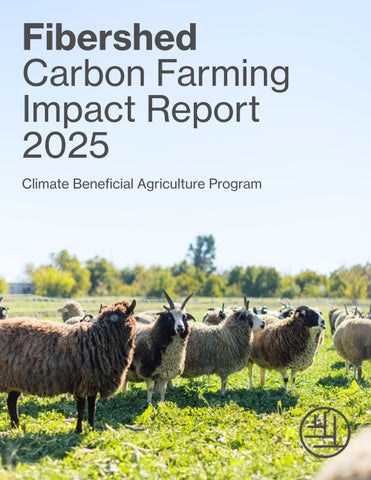
Fibershed Carbon Farming Impact Report 2025
Climate Beneficial Agriculture Program

Carbon Farming Practices p. 4 Healthy Soils Program Block Grant p. 8
Climate Beneficial™ Verified p. 10
Direct Investments p. 13
Climate Beneficial Fiber Partnerships p. 14
Carbon sequestration estimations were calculated using COMET-Planner, California Department of Food and Agriculture (CDFA) COMET-Planner, COMET Farm, and data sourced from Rebecca Ryals and Whendee L. Silver, “Effects of Organic Matter Amendments on Net Primary Productivity and Greenhouse Gas Emissions in Annual Grassland Ecosystems,” Ecological Applications 23 (2013): 46–59.
Learn more and support our Climate Beneficial work at fibershed.org

The Importance of Our Work
Agriculture is responsible for nearly 25 percent of emissions globally. At the same time, agricultural soils represent one of the most underutilized tools we have for climate mitigation.
Soil organic carbon sits at the center of this opportunity. Increasing soil organic carbon improves water infiltration and retention, buffers crops against drought and extreme rainfall, and supports the biological activity that underpins long-term productivity. As the second-largest carbon sink on Earth, our soils have the capacity to rebalance carbon between working lands and the atmosphere—but only if they are properly managed.
By improving agricultural management through practices such as diverse crop rotations, prescribed grazing, and native plant integration, farmers can build soil organic carbon while strengthening biodiversity and resilience across the landscape.
Our 2025 Carbon Farming Impact Report highlights land stewards in Fibershed’s Climate Beneficial Agriculture Program, alongside updates on the Climate Beneficial™ Verified (CBV) Program and its B5 (Beneficial 5) framework, which together support regenerative practices through funding connections and measurable environmental and community impact metrics.
What is Mg CO2e?
Mg refers to metric tons (also known as MT, tonnes, or megagrams) and is equal to 1,000 kilograms or about 2,204.6 pounds. It is a common way of quantifying and measuring greenhouse gas emissions.
159,169 acres were enrolled in the Climate Beneficial Agriculture Program in 2025, representing a 189 percent increase over the average acreage implemented in the prior four years.
984 climate-benefiting practices have been implemented by producers since the program began in 2016.
Since the inception of the Climate Beneficial Agriculture Program in 2016, enrolled producers have implemented carbon farming practices that we estimate will sequester more than 238,655 metric tons of CO2e over the next twenty years.
CO₂e (carbon dioxide equivalent) is the standard unit for quantifying greenhouse gas emissions. Because different greenhouse gases contribute to global warming at varying degrees (methane, for example causes twenty-five times more warming than carbon dioxide), using CO₂e allows the impact of all the greenhouse gas emissions to be expressed in a common unit, where 1 Mg CO₂e is the global warming equivalent of 1 metric ton of carbon dioxide.
Common Carbon Farming Practices and Benefits


Compost Application on Rangeland and Cropland
Compost has many benefits for the soil, including increasing soil water-holding capacity and improving soil health and fertility. Compost application also increases forage production from 40 to 70 percent without synthetic inputs. Additionally, it increases soil organic carbon and builds healthy, stable soil, which in turn increases microbial activity—such as worms, microbes, and fungi— and can help store carbon in the soil over the long term.
66 practices implemented in 2025
Prescribed Grazing (Rotational Managed Grazing)
Prescribed grazing matches livestock grazing periods to plant growth cycles, leading to improved soil and plant health and overall biodiversity. It can also be used to rebalance and encourage growth of desirable plant communities, minimizing soil erosion while reducing the presence of invasive plants and fuel loading. Prescribed grazing is a key practice for landscape management.
46 practices implemented in 2025
Cover Crop
A cover crop covers the soil between annual crops, reducing soil erosion and compaction, and leading to improved soil health and water retention, while providing an important off-season pollinator habitat. It also acts as a natural weed suppressant, minimizing the need for herbicides, returning essential nutrients to the soil between crop cycles, and minimizing the need for fertilizer, so fewer toxins leach into the soil and water.
32 practices implemented in 2025
Mulch helps conserve soil moisture and moderate soil temperature by reducing evaporation and maintaining more consistent conditions, supporting plant health and drought resilience. As organic mulch decomposes, it also improves soil health and structure by building soil organic matter, feeding soil microbes, and enhancing overall soil function. Finally, mulch reduces erosion and supports water infiltration by protecting soil from heavy rain impact and runoff, helping to retain water in the landscape.
11 practices implemented in 2025
Mulching
Meridian Farm
Bowles Farming Company
Mustang Acres
Bare Ranch


Hedgerow Establishment
Hedgerows can act as a living fence and wildlife corridor, minimizing the impact of habitat fragmentation. They create a habitat for beneficial insects, songbirds, and small mammals and reduce distribution of airport particulate matter. Hedgerow establishment is a key practice for natural integrated pest management.
19 practices implemented in 2025
Range Planting (Annual or Perennial)
Range planting establishes adapted perennial grasses, forbs, legumes, shrubs, and trees that provide or improve forage for livestock and habitat for wildlife. This practice enhances soil and water health, helps reduce soil erosion, improves water quality and water infiltration, and can increase soil organic matter and ecosystem function. By promoting perennial plant growth and root biomass, range planting can also increase carbon storage in both plant biomass and soils, contributing to climate mitigation.
15 practices implemented in 2025
Riparian Restoration
Riparian restoration is a key practice for natural integrated pest management. It improves surface water flows, minimizes soil erosion, and reduces the movement of chemicals, pesticides, pathogens, and nutrients between surface water and groundwater. In addition, it lowers elevated water temperatures, which benefits native aquatic flora and fauna, and restores the habitat in localized biodiversity hot spots. Most notably, riparian restoration often provides the highest carbon drawdown per acre, per year.
3 practices implemented in 2025
Elimination of Glyphosate-Based Herbicides
Eliminating glyphosate-based herbicides reduces ecotoxicity in soil and water, which prevents biodiversity loss and reduces environmental harm to human communities.
3 practices implemented in 2025
Pedretti Ranches
Emigh Livestock, Mahoney Ranch, Ulatis Creek
Barinaga Ranch
Blue Oak Canyon Ranch

Carbon Farming Practices Implemented
CROPLANDS
Compost application to cropland
Cover crop
No till
Nutrient management
Residue and tillage management
Strip till
Conservation crop rotation
Crop livestock integration
Contour buffer strip
Filter strip
GRAZING LANDS & PASTURELANDS
Prescribed grazing
Compost application to rangeland
Range planting
Forage and biomass planting
AGROFORESTRY
Mulching
Hedgerow establishment
Silvopasture establishment
Tree/shrub establishment
Windbreak and shelterbelt establishment
Windbreak and shelterbelt renovation
Alley cropping
Multistory cropping
Forest harvest management
RIPARIAN SYSTEMS
Critical area planting
Grassed waterway
Riparian forest buffer
Riparian restoration
Riparian herbaceous cover

Carbon Farming Practices, CO2e Drawdown by Category
CUMULATIVE SINCE 2016 AND PROJECTED TWENTY-YEAR IMPACT
CO2e Drawdown since 2016
Twenty-Year Total Impact with Future Drawdown
2025 Overview
Producers in the Climate Beneficial Program collectively (across all incentives programs) implemented a total of 251 carbon farming practices in 2025, 39 percent of which received funding from the California Department of Food and Agriculture Healthy Soils Program or US Department of Agriculture cost shares. These practices account for an estimated 26,894 Mg of CO2e sequestered and 53,943 Mg CO2e drawdown projected over the next twenty years.
Compost application, prescribed grazing, and planting a cover crop were the most commonly implemented practices. Compost application on rangeland accounted for the largest amount of carbon drawdown.
Since 2016, Producers have implemented 984 carbon farming practices that we estimate have sequestered 80,174 Mg CO2e to date, and 238,655 Mg CO2e over the next twenty years.
California Department of Food and Agriculture Healthy Soils Program Block Grant
In 2025 Fibershed received a three-year $5 million block grant. We utilized these funds as a foundation to build and launch the Healthy Soils Program (HSP) block grant, which provides grants to Producers to aid them in transitioning to healthier soil management practices. To execute this plan, we built contractual partnerships with local Resource Conservation Districts and enrolled fifty-three Producers in our program. Growers receive $4 million of cost-share reimbursements for implementing fourteen different climate benefiting practices on their land, including compost applications; hedgerow, riparian, and range plantings; and cover cropping.
These practices will be implemented over the next three years on 5,248+ acres throughout the state, resulting in enhanced biodiversity, improved soil health, and a reduction in carbon dioxide emissions by more than 9,829 metric tons annually.
We are implementing practices in seventeen counties in California: Alameda, Colusa, Fresno, Glenn, Humboldt, Kings, Lake, Marin, Mendocino, Merced, Modoc, Monterey, San Luis Obispo, San Mateo, Santa Cruz, Solano, and Sonoma.
HSP Practice Breakdown
NUMBER OF COMPLETED PRACTICES, 2025
Compost application to rangeland, 57
Cover crop, 12
Hedgerow establishment, 11
Range planting, 7
Currently, there is a persistent gap between the support state-level agencies such as the California Department of Food and Agriculture are able to provide and what growers actually need to carry these transitions through to completion.
Meaningful on-the-ground support requires funding the entire transition, not just the practices themselves. For this reason, we have allocated $1 million of the HSP block grant to provide technical assistance and administrative support. This investment ensures equitable access for all grant participants and addresses the full range of needs that arise during implementation, including application assistance, support with digital tools and mapping, on-site advisory visits, and soil sampling. At least 25 percent of all funding and technical assistance provided supports socially disadvantaged farmers and ranchers (SDFR)*.
*An SDFR, as categorized by the State of California 2017 Equity Act, is a farmer or rancher who has been subjected to racial or ethnic prejudices because of their identity as a member of a group without regard to their individual qualities. Those groups include African Americans, Native Americans, Alaskan Natives, Hispanics, Asian Americans, Native Hawaiians, and Pacific Islanders.
Forage and biomass planting, 1
Prescribed grazing, 3
Mulching, 4
No till, 6

“Many years ago, we travelled to Ireland on a ‘sheep tour.’ While travelling around to various farms, I was fascinated by hedgerows, marking the edges of fields. In September, the hedgerows were full of birds! The images welded to my soul and I thought I would like to establish hedgerows on our small ranch. The Healthy Soils Program provided the resources to do that, and we are very grateful for the support from the state of California and the Fibershed.”
LYNN MOODY, BLUE OAK CANYON RANCH HSP GRANTEE
Overall HSP Program Snapshot
PLANNED, 2025–28
53 producers enrolled
40% of which are socially disadvantaged farmers or ranchers (SDFR)
482 practices enrolled
5,248 total acres enrolled
$3,957,815 total planned practice payments to producers
32% of which is for SDFR
The figures above are based on enrollment as of November 25, 2025. Enrollment and verification of practices will continue on a rolling basis, with funds dispersed and/or reallocated until all funds have been exhausted.

“The HSP grant led to a collaboration with Point Blue’s Students and Teachers Restoring A Watershed (STRAW) program. The organization focuses on positive impacts on climate change, water conservation and environmental causes. STRAW is generously covering costs through their Roots Project funding, that the HSP grant does not. The ripple effects of the HSP grant has led to this beautiful partnership with Fibershed and STRAW, which multiplies the impact of our collective environmental conservation actions.”
FIONA WONG, MUSTANG ACRES HSP GRANTEE
2025 HSP Program Snapshot COMPLETED
33 producers paid
101 practices implemented
3,103 acres implemented
$916,681 total practice payments made to producers
The figures above are based on enrollment as of November 25, 2025, and include all practices verified to date and reimbursed. Because practice verification and producer payments continue on a rolling basis, some practices completed in 2025 will be paid in 2026. Their acreage is reflected here, and the associated reimbursements will be included in future reporting once payment is received.


As a verification and product label, Climate Beneficial™ Verified (CBV) provides an industry-aligned mechanism to compensate growers for landscape transformation and deliver brands the data and storytelling assets necessary for their climate reporting goals.
Over the past year, we launched the B5 or “Beneficial 5” Verification Framework to quantify, monitor, and reward growers for improvements based on outcomes from implemented practices. The framework is designed to deliver maximum value to growers, support whole-farm, place-based planning, and meet brand requirements in the landscape of claims and evolving Scope 3 reporting through outcome measurement of progress over time.
CBV Standards Version 2.0 Released
This year we published a revised version of the CBV Standards. This document outlines our tools for measurement and soil testing protocols, practice criteria, outcome metrics and framework, and the governance model with regional partners that grounds the work in both cotton and wool systems. It also reflects the ongoing evolution of the program, integrating the latest scientific research, on-the-ground learning, and emerging market reporting needs.


California CBV Cotton Impacts OVER THE FIRST FOUR PROGRAM YEARS
1.77 Mg/acre average Mg CO2e reduction and sequestration in 2024
140% improvement in soil organic carbon by early adopters in 2021–24
37% average reduction in synthetic nitrogen (fertilizer) from conventional baseline
20% average year-over-year reduction in synthetic nitrogen
40% average reduction in synthetic pesticides from conventional baseline
Full elimination of glyphosate
Full elimination of WHO Class 1a chemicals (extremely hazardous)
The figures above are based on California farmer impact data from the 2021–24 harvest seasons. Pesticide reductions are measured by volume of active ingredient and include insecticides, generic pesticides, and herbicides. Soil organic carbon values are based on 2021–24 data, averaged across growers for years of Climate Beneficial in-field practice implementation.
Beneficial for SOIL HEALTH
Soil Health Improvement
Increased Carbon Stock
Beneficial for WATER SECURITY
Increased Water Efficiency
Reduced Water Pollution
Beneficial for BIODIVERSITY
Biological Diversity Increased Habitat Preserved
Pesticide Risk Reduced
Beneficial for CARBON CAPTURE
Beneficial for COMMUNITIES
Emissions Reductions
Increased Carbon Sequestration
Investment into Rural Economies
Grower Engagement
Value Chain Collaboration
Climate Beneficial California Cotton Life Cycle Assessment (2025)
Net negative emissions
A 2024 peer-reviewed study (ISO 14040/44:2006 and 14067:2018) found Climate Beneficial cotton achieves -1.56 kg CO₂ per kg of fiber, 143.8 percent less than conventional cotton from the same farm.
Carbon-negative impact
This outcome is driven primarily by soil carbon drawdown, positioning Climate Beneficial cotton as a carbon-negative material when soil carbon sequestration is sustained over time.
Life cycle assessment (LCA) is a standardized, science-based methodology used to quantify the environmental impacts of a product, process, or system across its entire life cycle—from raw material extraction through production, use, and end of life—following ISO 14040/44:2006, with ISO 14067:2018 providing specific requirements for quantifying and reporting product carbon footprints. Brands reference LCAs to meet Scope 3 and changing regulatory requirements, manage climate risk, improve sourcing decisions, and support credible, transparent claims.
Recognizing Grower Commitment and Climate Impact
All growers enrolled in the CBV Program, both verified and transitional, were issued certificates of verification (CoV). The CoV validates that program requirements have been met, while connecting on-farm practices to fiber and associated greenhouse gas impacts. Historical Producers, who in some cases have participated since the program’s inception, have received cumulative GHG impact reports for their practice histories, providing a tangible tool to showcase their ongoing dedication and commitment.
We issued fifty-two certificates of verification in 2025. We issue these documents annually to support marketing and communications around growers’ fiber, providing a comprehensive overview of CBV field- and fiber-level data, in-field practice implementation, and associated greenhouse gas impacts and improvements resulting from active program involvement.

“Climate Beneficial gave us a framework to be more intentional about what we’re doing.”

CERTIFICATE OF VERIFICATION


“
Beneficial™ Verification isn’t just a label, it’s a system. It builds relationships between brands and growers, mills and designers, consumers and land. And those relationships are what make change stick.”
LAB
LAURA SANSONE, NEW YORK TEXTILE
NORTHEAST REGIONAL LEAD, CBV WOOL, CLIMATE BENEFICIAL FIBER ALLIANCE

Five Years of Incentives to Reduce Barriers to Implementation
Between 2020 and 2025, Fibershed allotted a total of $2,054,660 to growers to support the implementation of climate-benefiting farming practices. These funds were a combination of private philanthropy and local, state, and federal cost-share programs. A total of 212 projects were completed, and 14,348 acres were enrolled.
As part of the HSP block grant, and based on project planning we conducted in 2025, Fibershed will reimburse $3.1 million to Producers between 2026 and 2028 to implement climate-benefiting farming practices. These funds will yield 384 additional projects on 2,146 acres.
Direct Investments to Growers FOR PRACTICE IMPLEMENTATION, 2020–28 $50,696
Maximizing the Value and Impact of Carbon
The gap between voluntary carbon market prices and social cost of carbon–based (SCC)* valuations is widening, increasing the demand for outcome-based programs that reflect true societal climate costs.
To account for the SCC, the EPA currently estimates a central value of $190 per metric ton of CO₂e, a number that places a greater weight on future climate damages than past calculations.
The Climate Beneficial Program does not plan to develop carbon credits, but we have—through our incentives program—calculated an amount per ton that we estimate represents a truer cost than other values. We estimate that we have provided an average of $319.74 per metric ton of CO₂e to growers through the Climate Beneficial Program’s incentive payments, which aligns with the upper range of carbon valuations.
In contrast, the voluntary market price value falls between $30 and $120 per metric ton of CO₂e, with often less than 50 percent of these sums going to the grower.
*The SCC is an estimate, in dollars, of the economic damages that result from emitting an additional ton of carbon dioxide into the atmosphere. See Elijah Asdourian and David Wessel, “What Is the Social Cost of Carbon?” Brookings, March 14, 2023.
A National Network of Climate Beneficial Fiber Partnerships
2025 USDA Partnerships for Climate-Smart Commodities, National Project Update
Since the federal termination of the United States Department of Agriculture (USDA) Partnerships for Climate-Smart Commodities (PCSC) grant in April 2025, Climate Beneficial Fiber regional partners have collectively convened to keep the work going. As a result, our engagement with growers through the Climate Beneficial Program has deepened beyond the parameters of the federal grant program, even as resources have become more limited.
This collective partnership, now called the Climate Beneficial Fiber Alliance, includes the Carbon Cycle Institute, Fibershed, New York Textile Lab, and Seed2Shirt—all of which work directly with food and fiber growers in Alabama, California, Georgia, Indiana, New York, North Carolina, the Northern Great Plains region, and Tennessee to accelerate the adoption of soil-regenerating agriculture practices through improving access to markets.
What We Enable as a National Alliance
The Climate Beneficial Fiber Alliance works across key agricultural regions in the West, Midwest, Southeast, and Northeast, prioritizing equity by targeting 40 percent of funding to small and underserved growers. The Alliance has an established, well-coordinated, multiregional network of farmers, technical assistance providers, supply-chain partners, and market channels, demonstrating that this collaborative model works—and that it can scale.
Here are the key pillars of our work:
Regionally Based Grower Support Networks
By leveraging existing relationships, grants, and technical assistance capabilities, we empower the provision of highly localized guidance and resources—helping growers implement and sustain Climate Beneficial practices.
Regionally Based Market Opportunities
We create market pathways for growers by connecting them to multi-scale brand partnerships, supply chains, and co-op networks.
Regionally Based Grower Engagement and Events
We held seven community events in order to build both public awareness and relationships between our community members.
Program Regions and Associated Implementation Partners
Wool Fibershed Climate Beneficial climatebenficial.com
Cotton Fibershed Climate Beneficial climatebenficial.com
Wool New York Textile Lab newyorktextilelab.com
Cotton Seed2Shirt Southeastern BLACKollective seed2shirt.com
What We Have Achieved Together
USDA PSCS Grant PRACTICES COMPLETED IN 2025
Range planting, 1
Strip till, 2
CB Fiber Alliance Summary Enrollment
Climate Beneficial Grower Engagement (By Region)
Before the USDA PCSC grant ended, $486,151 in cost-share reimbursements went out to growers across 4 regions, spanning 22 projects and 5,960 acres Region Producers Enrolled
Climate Beneficial Practice Acreage (By Region)
Addressing Funding Gaps and Looking Ahead to 2026
The catalytic institutional support for this work was funded by the USDA PCSC program, which was terminated by the Trump Administration in the first quarter of 2025. Sustained funding for the Alliance is sought so that we can deepen the support provided to growers nationwide: expanding carbon farm planning services, increasing producer enrollment across underserved and small farm communities, and expanding
marketing and supply-chain capacity in order to meet the rapidly rising market demand. Bringing climatebenefiting natural fibers to the market to meet this demand requires sustained investment from both private and public funders. The level of national impact we need to truly achieve our goals cannot be met through fragmented regional projects alone.
Compost (cropland), 2
Cover crop, 10
No till, 4
Compost (rangeland), 3

“Working
with Fibershed aligns with our values to care for the land and community, produce a quality regenerative product, and leave the land in better shape for future generations.”
JIM JENSEN
JENSEN RANCH & TOMALES SHEEP COMPANY
Thank You
A special thank you to the community of producers in our Climate Beneficial program for your land stewardship this year. This report is a celebration of you! Your carbon farming practices and ongoing dedication to this work reflects the leadership, commitment, and care you have for the health of our soils, ecosystems, and communities.
PO Box 221
San Geronimo, CA, 94963
fibershed.org
Board of Directors
Rebecca Burgess, MEd
Chair
Kat Anderson, PhD
Marlie de Swart
Treasurer
Dustin Kahn
Secretary
Contributors
Mary Kate Randolph
Bronte Edwards
Nica Rabinowitz
Cass Marketos
Navit Reid
Erick Perez
Photography
Paige Green
Design
Nicole Lavelle