Rencontre du réseau Promotion MINT Netzwerkanlass MINT-Förderung 23.10.2024
Astro Pi Challenge in the Classroom Continuing Education for Teachers
Author(s): Magdalena Herová1, Urs Meier2 & Andrea Maria Schmid2 Hochschule Luzern1, Pädagogische Hochschule Luzern2
The Astro Pi Computer and the Programming Challenge
International Space Station
Photo: ESA
Photo: NASA
The International Space Station (ISS) is orbiting Earth at the altitude of 400 km. It has been continuously inhabited since November 2000 by alternating crew and serves as a plattform for microgravity and space environment research.
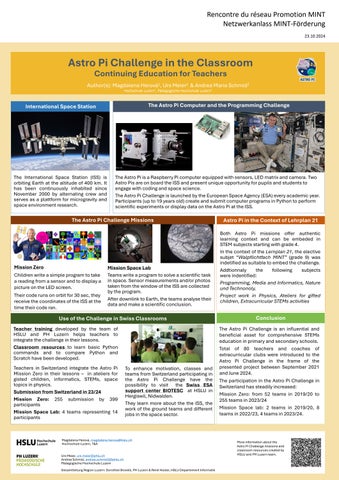
The Astro Pi is a Raspberry Pi computer equipped with sensors, LED matrix and camera. Two Astro Pis are on board the ISS and present unique opportunity for pupils and students to engage with coding and space science. The Astro Pi Challenge is launched by the European Space Agency (ESA) every academic year. Participants (up to 19 years old) create and submit computer programs in Python to perform scientific experiments or display data on the Astro Pi at the ISS. Photo: ESA
The Astro Pi Challenge Missions
Mission Zero Children write a simple program to take a reading from a sensor and to display a picture on the LED screen. Their code runs on orbit for 30 sec, they receive the coordinates of the ISS at the time their code ran.
Astro Pi in the Context of Lehrplan 21
Mission Space Lab Teams write a program to solve a scientific task in space. Sensor measurements and/or photos taken from the window of the ISS are collected by the program. After downlink to Earth, the teams analyse their data and make a scientific conclusion.
Conclusion
Use of the Challenge in Swiss Classrooms Teacher training developed by the team of HSLU and PH Luzern helps teachers to integrate the challenge in their lessons. Classroom resources to learn basic Python commands and to compare Python and Scratch have been developed. Teachers in Switzerland integrate the Astro Pi Mission Zero in their lessons – in ateliers for gisted children, informatics, STEMs, space topics in physics. Submission from Switzerland in 23/24 Mission Zero: 255 submission by 399 participants Mission Space Lab: 4 teams representing 14 participants
Both Astro Pi missions offer authentic learning context and can be embeded in STEM subjects starting with grade 4. In the context of the Lernplan 21, the elective subjet “Walpflichtfach MINT” (grade 9) was indetified as suitable to embed the challenge. Addtionnaly the following subjects were indentified: Programming, Media and Informatics, Nature und Technonoly, Project work in Physics, Ateliers for gifted children, Extracurricular STEMs activities
Photo: Elisabeth Flury
To enhance motivation, classes and teams from Switzerland participating in the Astro Pi Challenge have the possibility to visit the Swiss ESA support center BIOTESC at HSLU in Hergiswil, Nidwalden. They learn more about the the ISS, the work of the ground teams and different jobs in the space sector.
Magdalena Herová, magdalena.herova@hslu.ch Hochschule Luzern, T&A Urs Meier, urs.meier@phlu.ch Andrea Schmid, andrea.schmid3@phlu.ch Pädagogische Hochschule Luzern Gesamtleitung Region Luzern: Dorothee Brovelli, PH Luzern & René Hüsler, HSLU Departement Informatik
The Astro Pi Challenge is an influential and beneficial asset for comprehensive STEMs education in primary and secondary schools. Total of 80 teachers and coaches of extracurricular clubs were introduced to the Astro Pi Challenge in the frame of the presented project between September 2021 and June 2024. The participation in the Astro Pi Challenge in Switzerland has steadily increased: Mission Zero: from 52 teams in 2019/20 to 255 teams in 2023/24 Mission Space lab: 2 teams in 2019/20, 8 teams in 2022/23, 4 teams in 2023/24.
More information about the Astro Pi Challenge missions and classroom resources created by HSLU and PH Luzern team.