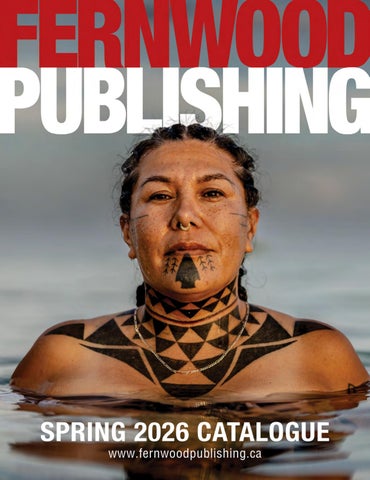
Fernwood Publishing Spring 2026 Catalogue

Page 1


Eighteen Indigenous ancestral skin markers from fourteen Nations and cultures around the world discuss their reclamation of traditional tattooing practices.

Contents

00 Introduction: Coyote Juggles His Eyes | Dion Kaszas

01 A Visual Language: Skin Marking in Mekeo, Papua New Guinea |  Julia Mageʼau Gray

02 Cherokee Tattoos: Medicine for the Marked |  Jerrid Lee Miller & Nathalie Standingcloud

03 I am a seed which was sewn in the heavens of Rangiātea | Julie Paama-Pengelly

04 Skin Marking for Indigenous Fijian Women with The Veiqia Project |  Dulcie Stewart, Yasbelle Kerkow, and Donita Vatuinaruku Hulme

05 Embodied Fonua: Reconstructing Tātatau in Aotearoa | Terje Koloamatangi

06 7Estez: I Am Tattooing | Jacqueline Merritt

07 Nlaka’pamux Skin Marking | Dion Kaszas

08 Ancestral Skin Marking as Healing for Indigenous 2SLGBTQIA++ | Mel Lefebvre

09 Tattooing in Caring Relationship to One Another and the Land | Sheri Osden Nault

10 PrePhilippine Living Traditions | Natalia Roxas

11 Tracing Ancestral Lines of Responsibility and Connection | Anne Spice

12 Emerging from the Tides: My Community and I | Nahaan

13 Reclaiming Ancestral Tohono O’odham and Yuchi Tattoo Practices |  Missy Dunn-Mahan

14 Learning the Visual Language of the Land: Mi’kmaw Blackwork | Gordon Sparks

15 Wahkótowin: Building Connections Across Time | Nolan Malbeuf

Photo: Nlaka’pamux tattoo artist Dion Kaszas tattoos ripple patterns on Nlaka’pamux community member Ecko Aleck’s leg during an laka’pamux Blackwork session on Shuswap Lake, BC. Photo: Billie Jean Gabriel (July 2021).

Contributors

Julie Paama-Pengelly

is of Ngai Te Rangi descent, and in her Tā moko practice she is credited with being the pioneering female moko artist in Aotearoa

Donita vatuinaru Ku Hulme is the proud daughter of English and Fijian migrants (vasu Nadroga) and lives on the traditional lands of the Wallumedegal in Warrane, Sydney.

Dulcie stewart is of Fijian (Bua, Tailevu, Rewa, and Kadavu) and colonial settler heritage. She is an artist, librarian, family historian, and the lead researcher of The Veiqia Project.

Jerri D l ee m iller

is a citizen of Cherokee Nation. He is a father of three and works as a language archivist for Cherokee Nation

Julia m ageʼau g ray is a Papua New Guinea Australian artist, dancer, and mother deeply rooted in Mekeo skinmarking traditions.

t erJ e Koloamatangi

is a tufunga tātatau (tattooing craftsperson), arts practitioner, and researcher, whose work is centred in the revitalization of Tātatau (customary tattooing from the Tonga archipelago).

yasbelle Ker Kow is an Australian-born Fijian (vasu Batiki, Lomaiviti) artist and filmmaker.

n at H alie

stan D ingclou D is a Cherokee, Mvskoke, Salish, and Kootenai professional tattoo artist and actress from Tahlequah, OK.

Jacqueline m erritt

is a Tsilhqot’in tattoo practitioner and comes from a place known as Xeni Gwet’in or, in English, the Nemiah Valley, BC.

m el l efebvre is a Two-Spirit Michif, Nehiyaw, French, Irish citizen of the Manitoba Métis Federation and is a mother, scholar, artist, writer, community worker, and ancestral skin-marking practitioner

m issy

Dunn- m a H an comes from the Tohono O’odham Nation, “people of the desert,” original lands of southern AZ and Mexico on her maternal side and southeastern nations of the Yuchi, Zoyaha “Children of the sun,” and Mvskoke “Creek” peoples of TN, GA, and AL on her paternal side.

a nne sP ice is from the Deisheetan Clan, Crow moiety, of the Tagish/Tlingit people and a citizen and member of Kwanlin Dün First Nation in Whitehorse, Yukon.

sH eri o s D en n ault

is a Two-Spirit Métis artist, community activist, and educator.

g or D on sPar K s is a Mi’kmaw wood carver and a tattoo artist that comes from Pabineau First Nation.

n a H aan is a Tlingit language facilitator, traditional tattooer, storyteller, carver, designer, muralist, spoken word poet, and leader for Náakw Dancers.

Book Editor Bio

Dion Kaszas is a Nlaka'pamux ancestral skin marker and born-again Coyote. He has been at the forefront of reviving Indigenous tattooing in Canada, training, mentoring, and teaching the next wave of Indigenous revivalists. He specializes in large-scale Blackwork projects that celebrate and enhance the lives of all human beings. He has curated two major exhibitions highlighting Indigenous ancestral skin markers and their ancestral practices, and launched the Transformative Marks podcast in 2024. In 2019, he began developing Nlaka’pamux Blackwork, and today, he tattoos so the coming generations have a living, vibrant tattooing tradition informed by their ancestors’ teachings, methods, and imagery

n atalia r oxas is a prePhilippine tattoo practitioner and Philippine gastronomy Advocate and Wanderer.

n olan m albeuf is a Métis tattoo artist from Sipisihk (Beauval), Northwest Saskatchewan.

Grid photos displayed in this spread are reproduced with permission from Terje Koloamatangi (2022–2025).
Editor Photo: Indigenous tattoo artist Dion Kaszas stands in the forest on Nlaka’pamux Blackwork collaborator Megan Samms’ ancestral property in the Codroy Valley, NFLD.
Photo: Carolina Andrade (2022).

Introduction

Fortoo long, the world has been peeking over the hill at Indigenous ancestral skin marking through the omnipresent colonial eyes of the neo-primitivists, anthropologists, casual researchers, and culture vultures of the tattoo community. ... Too often, scholars come to practitioners and Knowledge Keepers for interviews and then position themselves as the experts. Even though they came to us for the knowledge they claim to be experts in, the time has come for scholars to clearly acknowledge they are not experts in Indigenous knowledges. How does a colonizer understand what it is like to collaborate with a community member to mark their body with a design, pattern, or placement that has been dormant for one hundred, two hundred, three hundred years? In positioning themselves or allowing others to position them as experts, academics, researchers, and scholars create categorical, theoretical, and methodological boxes around our ancestral practices. ... This anthology insists on positioning the practitioner as the expert and gives space for each artist to express what they know and how they have come through the process of reviving their ancestral skin marking practices. It is time for us as descendants, now ancestors, to remember who we are. We don’t need the seductive theories, philosophies, and books from the colonial Coyotes. Our knowledge, our practices, the old ways are in our DNA. It’s time to remember.

u Excerpt from “Coyote Juggles His Eyes” by Dion Kaszas

Photo: Kristin Pope (2024). a ceremony to prepare us, Megan Samms with collaborators Kelsey Street, Rebecca Sharr, and Kristin Pope. Nlha7kápmx and Mi’kmaw artist Megan Samms is braided into a field of sweetgrass in Katalisk, Ktaqmkuk (Codroy Valley, NL), during a ceremony and art action in September 2024. Samms body is marked with ancestral motifs made by Dion Kaszas.

1. Photo: Dion Kaszas (2023). Mi’kmaw Blackwork tattoo gifted in exchange for work renovating Gordon’s tattoo studio, Culture Tattoo and Piercing, in Bathurst, NB.

2. Photo: King Dionee (2023).Tattoo in progress of Missy Dunn-Mahan at The Desert Bloom Tattoo.

3. Photo: Anahí Gonzales (2024). Métis cultural tattooer Sheri Osden Nault tattoos Genevieve Buchanan.

4. Photo: Alfred Dennis (2024).

5. Photo: Nathalie Standingcloud (2024). The beautifully executed beadwork-style tattoo by Nathalie Standingcloud that won Best of Show at the second annual Indigenous Tattoo & Music Fest in Albuquerque, NM.

6. Photo: Carolina Andrade (2022). Nlaka’pamux tattoo artist Dion Kaszas inks the back of Megan Samms during a Nlaka’pamux Blackwork tattoo session in the Codroy Valley of Newfoundland.

One step, one poke at a time, we can find that balance, and in doing so, we will light the way for generations to come. —Jacqueline m erritt

Revival and Resistance

Tattooing is very important to me because it’s the oldest form of healing through physical pain that I can think of. When thinking of tattooing or skin marking, you’re applying this image or this ink on this person that’s receiving it, and they’re giving you a blood and pain sacrifice in return, and that blood and pain sacrifice is their form of healing. Their body is saying, “I need something.” Their spirit is saying, “I know what you need.” Then the mind will talk with the body. I call it the emotional sickness that we deal with sometimes in life, and it’s caught up right inside you. From my experience, the only way to release the emotional sickness is that you have to use more than just your inner voice praying. You need that voice as well as the physical pain to extract that negativity from your spirit. Your spirit tells your body, “This is what you need to do.” We need to bleed that negativity out. Now, that’s an access point that we focus on, force that negativity out from, and pray on, and you can literally feel it come out. Then you tattoo that image, which makes you stand up, be taller, be stronger, wiser. That’s tattoo medicine 101 for me.

u Excerpt from “Learning the Visual Language of the Land” by Gordon Sparks

Photo: Gordon Sparks (2024). Selfie by artist at the beginning of a day on the trapline, near Pabineau, NB.

Embodied Practice

Embodied cultural practices acknowledge the significance of the body in connection to knowledge. Through a physical connection, understanding is embodied. This knowledge is then transmitted through cultural practice from body to body across generations. Embodied practices are learnt through observing, imitating, and repeating, until the actions repeated become second nature. You don’t think about it; you just do it. That has been the main mode of how generational knowledge is transmitted in Pacific cultures.

u Excerpt from “A Visual Language” by Julia Mageʼau Gray

1. Photo: Ranu James (2022). Marking Moale with Revareva in Tāmaki Makaurau Auckland, Aotearoa New Zealand.
2. Photo: Julia Mageʼau Gray (2024). Moale in Motu Bilas, QAGOMA, Brisbane, QLD, Australia.
3. Photo: Julia Mageʼau Gray (2015). Elaka at Pacific Games in Port Moresby, Papua New Guinea.

Tools, Hands, Bodies

Whenwe receive our ancestral marks in the way that we were intended with traditional tools that mirror the same ones used thousands of years ago, there is an awakening of something deep within us .... It echoes down through our DNA and speaks to an ancestral memory. For many in the Filipino diaspora who receive their cultural tattoos in the traditional way, there is often the realization (whether during the ceremony or sometime after) that they may be the first in their families to wear these marks in generations.

When describing the traditional skin markings of the archipelago known as the Philippines, it is extremely important to note that Philippine culture is not monolithic. The Philippines consists of over seven thousand islands. Dispersed throughout these islands, there are more than 180 different ethnolinguistic groups, with varied cultural motifs, patterns, and designs that are considered appropriate for its members to wear. This does not take into account that the number of Elders who practise traditional tattooing or even wear the marks themselves is dwindling at an alarming rate. The number of first-hand resources, let alone well-documented or recorded accounts, is severely limited. To be involved in a traditional and cultural practice is a daunting undertaking for anyone who wants to learn about these traditional markings, especially when you are a diasporic person. Where do you even begin?

u Excerpt from “prePhilippine Living Traditions” by Natalia Roxas

Photo: Natalia Roxas (September 2021).First time hand tapping her tattoo brother, Kristian Kabuay, with guidance of her teacher, Lane Wilcken in Las Vegas, NV.

Skin Marking to Heal

Skin marking is service. It is a way for me to give back to other community members. It is medicine that heals them and me. Holding each other’s spirits in that shared space is medicine for us all. Ancestral skin marking is so much more than the tool used or the design drawn. It is about all the brilliant layers and textures and experiences that make up our communities, like the constellations in the night sky of this continuously expanding universe.

I spend more and more time feeling and experiencing life as simply a being, tapping into my body as energy in relation with other energies. In other words, attempting to live a life beyond a state of resistance or recognition ... I do not always want to be radical or labelled, kept in one box, to be perceived. As energy, we are always in flux, perpetually picking up bits of information that then transform us, however slowly, into something new. And because of that, I like to honour that experience by spending time there. I simply want to be.

Since our bodies are so politicized, the ongoing narrative has a tendency to focus on sovereignty as a nation-to-nation relationship with the settler state, but what about our relationship with ourselves? Skin marking tangiblizes that sovereignty and creates a relationship with the self that is based on gratitude, responsibilities, and healing. Sovereignty then is brought into a more intimate, mindful, and energetic experience, an embodied celebration of who we are as individuals. The ripples of this empowerment then extend as waves, outward into our communities.

u Excerpt from “Skin Marking to Heal” by Mel Lefebvre

1. Photo: Zijian Wang (2024). Skinmarking ceremony for Joey and Jen, who are husband and wife in Oakland, CA, to honour their ancestors and ask for guidance and protection.

2. Photo: Zijian Wang (2024). Dipping the bone tools to start a marking ceremony in Oakland, CA.

3. Photo: Em Angeles (2024).A skin-marking ceremony in Oakland, CA.

4. Photo: Kat Sonter (2020). Julia and daughter Vasa marking Ade Revareva on Ranu James in Beerwah, QLD, Australia.

5. Photo: Donita Vatuinaruku Hulme (2022). Margaret Aull (left) and Yasbelle Kerkow (right) assisting Julia Mage’au Gray marking Donita Vatuinaruku Hulme at Toi Kiri, Aotearoa.

6. Photo: Mel Lefebvre (2022).Making bone skin-stitch needles with Dion Kaszas in 2021 to 2022.

7. Photo: Mel Lefebvre (2022). Making a bone handpoke needle.

8. Photo: Natalia Roxas (2021). Tools that are handmade being constructed by Natalia Roxas in Las Vegas, NV.

Our tattoos contain the knowledge of the processes of colonization and our resistance and resilience to it.

Context & Marketing

ENDORSEMENT

The stories shared in Truly Tribal are contemporary and personal, yet united in situating tattooing as part of ongoing efforts to reclaim a larger web of traditional knowledge in the ongoing wake of colonialism. Although tattoos are organic and temporary, linked to the lifespan of the individual that wears them, the knowledge surrounding their creation is holistic and dispersed. This inspiring publication, authored by Indigenous creators, is a significant contribution to our understanding of how contemporary Indigeneity is being expressed.

—Dr. sH aron f ortney, Klahoose First Nation, Sr. Curator of Indigenous Collections, Engagement and Repatriation at the Museum of Vancouver

TITLE METADATA

Pub Date May 2026

8 x 10” • 292 pages • 9781773638096

Hardcover • $65.00

Digital Format • $34.99

Territory Rights: World

Projected ship date: April 7, 2026

Carton quantity: 16

ART055000 — ART / Body Art & Tattooing

ART041000 — ART / Indigenous Art of the Americas

SOC062000 — SOCIAL SCIENCE / Indigenous Studies

HIS028060 — HISTORY / Indigenous Peoples of the Americas

AUDIENCE

• Indigenous studies / visual anthropology

• art and design students

• tattoo culture / museum and gallery audiences

• activists and general readers interested in decolonization

KEY SELLING POINTS

• A global anthology of Indigenous tattoo artists reclaiming ancestral skin marking across fifteen Nations and cultures.

• Explores tattooing as resistance to colonial erasure and an expression of Indigenous sovereignty, identity, and belonging.

• Includes over 200 full-colour photographs showcasing ancestral and contemporary tattoo practices.

• Written by Indigenous practitioners — “about us, from us, for us.”

• Essential reading on cultural resurgence, decolonization, and Indigenous rights for artists, scholars, and activists.

PROMOTIONS & PUBLICITY PLAN

• Booksagram review by queer tattoo historian and artist Monet @fossilevidence.

• Podcast interviews on Original Peoples Podcast Ongwehonwe, Inchunwa and Land Back for the People.

• Feature on CBC by Jenelle Duval, and a video interview on APTN.

• Print book reviews in indigenous magazines like Native Max Magazine, Indigenous Religious Traditions, Tattoo Society Magazine, and Inked Magazine. The latter is the most widely read tattooing magazine in the world.

• Book tour in independent bookshops across Canada as well as book talks at “Indigenous Tattoo and Music Fest” in Albuquerque New Mexico and “Toi Kiri: World Indigenous Arts Festival” in Mount Maunganui, New Zealand.

Order Information

CANADIAN ORDERS

General Sales

University of Toronto Press Distribution 5201 Dufferin Street, Toronto, ON, M3H 5T8

tel: (416) 667-7791

toll-free: +1 (800) 565-9523

e: utpbooks@utpress.utoronto.ca

For any queries relating to ordering, accessing or availability of our books, please visit fernwoodpublishing.ca/ordering, or send us an email to orders@fernpub.ca

Institutional Bookstores can place orders directly with UTP distribution. Please email utpbooks@utpress.utoronto.ca.

Trade Sales

Ampersand Inc.

ampersandinc.ca

toll-free: (866) 849-3819

toronto office

tel: (416) 703-0666

321 Carlaw Ave, Suite 213 Toronto, ON, M4M 2S1 Canada

vancouver office

tel: (604) 243-5594 2440 Viking Way Richmond, BC, V6V 1N2 Canada

INTERNATIONAL ORDERS

United Kingdom

Central Books Ltd 50 Freshwater Road, Chadwell Heath, London, England, RM8 1RX

tel: +44 (0) 20-8525-8800 e: orders@centralbooks.com

United

States

Columbia University Press / Ingram Publisher Services

For more information about exam copies and institutional orders, please contact your Columbia University Press sales representative, or visit cup.columbia.edu/for-instructors.

southeast: Catherine Hobbs tel: (804) 690-8529

e: ch2714@columbia.edu

northeast: Conor Broughan tel: (917) 826-7676

e: cb2476@columbia.edu

midwest: Kevin Kurtz tel: (773) 316-1116

e: kk2841@columbia.edu

west: William Gawronski tel: (310) 488-9059

e: wgawronski@earthlink.net

Australia, New Zealand & Asia

Brad Hebel

tel: (212) 459-0600, Ext. 7130

e: bh2106z@columbia.edu

DIGITAL REVIEW COPIES

Promotions & Publicity

For media requests, please contact art@fernpub.ca

Educators/Instructors

We can provide examination copies of our books for consideration as course texts. Please contact us at examrequest@fernpub.ca.

After generations of colonial suppression, Indigenous tattooing practices have experienced a resurgence led by artists and informed by community stories, protocols, and Elders. In Truly Tribal, they discuss their reclamation of tattoos as tangible reminders of their communities’ enduring rights, relationships, and responsibilities.

This beautiful anthology embodies the phrase “ about us, from us, for us. ”

Alongside stunning photos of their work, practitioners within this anthology discuss restoring a tradition that has survived colonial erasure, including the revival of ancestral tattoo designs, symbols, and motifs; the re-envisioning of meaning and protocols; and the refashioning of ancestral application methods, such as the use of bone tools and pigments alongside contemporary tools and inks. Their expert academic analyses and heartfelt storytelling respond with authenticity to a global awakening of cultural mark-making practices, offering teachings that can be shared while acknowledging that some ancestral inheritances are not for public consumption.

Turn static files into dynamic content formats.

Create a flipbook
Issuu converts static files into: digital portfolios, online yearbooks, online catalogs, digital photo albums and more. Sign up and create your flipbook.