Climate-related financial disclosures
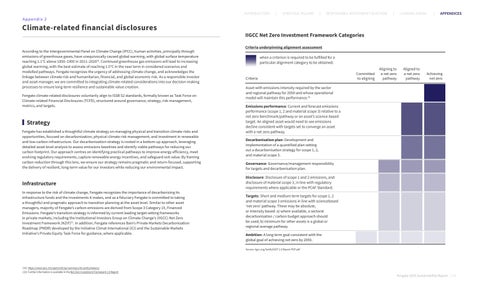
Our ability to pursue decarbonization opportunities within our infrastructure portfolio is dependent on various factors such as the asset type, Fengate’s level of operating control, and commercial structure among other considerations. For example, the majority of social assets we manage such as hospitals, courthouses, and schools have been built to standards such as LEED silver and gold certified, where energy efficiency has been optimized based on technically and commercially feasible energy solutions. Beyond that, further decarbonization of social assets poses a unique challenge due to the operational demand of critical healthcare services and therefore must be evaluated on a case-by-case basis.
Based on our assessment, most operating assets are not yet aligned, some assets are preparing to align through the exploration of a transition plan, and several have commitments to align. Our renewable assets are well-positioned to be net-zero with minimal transition efforts given the nature of their operations.
With Fengate’s ongoing engagement, select assets are undergoing or planning for an SBTi alignment exercise, with the focus on setting long-term net-zero targets. Energy efficiency projects, electrification of major heating and cooling systems, and on-site renewable energy are examples of initiatives taken where there are technically and financially feasible pathways.
Fengate Infrastructure Fund V decarbonization strategy
Fengate is committed to working with investors to continue to enhance our decarbonization strategy across the firm. The firm believes in the importance of addressing the systematic risk of climate change on its investments, as well as the broader impact those investments have on society. This perspective is consistent with Fengate’s fiduciary duty to its investors and its license to operate in the communities in which it has the privilege to invest.
In 2025, Fengate rolled out its latest approach to decarbonization for Fengate Infrastructure Fund V, the flagship fund within Fengate’s infrastructure platform through the following process:
▪ Incorporate climate risk into ESG due diligence with increased focus in Fund V on transition readiness, and decarbonization feasibility
▪ Measure Scope 1+2 emissions and report emissions data annually following GHG protocol and PCAF Scope 3 Category 15 Financed Emissions Methodologies
▪ Set science-based targets (SBTi) where feasible
▪ Adopt an acceptable alternative approach to support transition where SBTi is deemed not feasible
This process will vary on an asset-by-asset basis, as Fengate’s ability to exercise control varies based on factors including but not limited to asset class, commercial structure, and operating control.
Real estate
Fengate continues to adopt a data-driven approach to assessing the evolving physical and transition-related climate risks across the real estate assets that we manage. This includes an annual benchmarking of property-level energy and GHG emissions information, including an assessment of GHG intensity against the Carbon Risk Real Estate Monitor’s (CRREM) Global Decarbonization Pathways which allows Fengate to prioritize assets for decarbonization efforts.
Real estate decarbonization roadmap
In 2025, Fengate was focused on the identification of asset-level decarbonization levers to identify opportunities to decarbonize the operating assets we manage while optimizing energy efficiency, equipment life, comfort, and financial performance. We have also strategically selected assets across our commercial and residential portfolio to complete net-zero decarbonization studies, based on emission intensity, geographic carbon exposure, and equipment life. The recommended decarbonization levers and capital investment timeframes inform practical and cost-effective assets and portfolio-level decarbonization roadmaps which are currently under development.
Progress on our decarbonization roadmap
Developed baseline GHG emissions
▪ Developed a baseline emissions forecast for the assets we manage under our current operating scenario
▪ Defined our base year for target-setting purposes
What we have accomplished
▪ Reviewed available science-based targets to understand plausible pathways for select assets in the portfolio 1
Identified low-carbon and energy-conservation measures and initiated pilot projects
Real estate sustainable design
Fengate formalized its approach to sustainable design through the creation of its Sustainable Design Guidelines (“The Guidelines”) – a consistent framework that sets a standard of excellence for residential design and development. Created with the community in mind, The Guidelines integrate environmental sustainability, support climate adaptation, and prioritize tenant and community well-being, providing a structured approach to managing climate related risks and opportunities across new residential developments.
The Guidelines include the following six categories: energy and carbon, wellness and accessibility, water and waste reduction, landscape and biodiversity, climate resilience, and community and workforce – and are grouped into core and enhanced targets. New residential development projects are assigned to either core or enhanced targets based on commercial and technical feasibility, recognizing that each project has unique goals and has different market contexts that should be considered.
In the energy and carbon category, Fengate evaluates energy efficient mechanical systems to reduce operational emissions and support the transition to a low-carbon future. Solutions such as geo exchange systems and air source heat pumps are assessed on a project by project basis, considering feasibility, costs, performance benefits, and tenant experience. The Guidelines also promote lower embodied carbon through material selection and design decisions that reduce lifecycle emissions.
In the climate resilience category, Fengate assesses physical climate risks using Mitiga EarthScan. Where elevated risk is identified, the responsible investment team works with project teams to incorporate practical mitigation measures, such as improved stormwater management, heat mitigation design strategies, resilient materials, and site-specific landscaping, to support resident well-being and protect longterm asset value.
Where we are headed
2 3 4
▪ Completed more than 12 decarbonization and energy audits across commercial and residential portfolios in 2025
▪ Identified high-impact, high-return investment energy conservation measures (ECMs) that focus on operational optimization and net operating income (NOI) uplift
▪ Launched two low-carbon pilot projects using hybrid heat-pump rooftop units at FCIF assets
Develop and implement decarbonization and capex roadmap
▪ Conduct cost benefit assessments to identify opportunities delivering the greatest operational efficiency and resource savings
▪ Develop a feasible implementation plan through 2040 based on identified ECMs and low carbon measures based on pilot results
▪ Begin implementation of priority measures across the portfolio
Standardize, monitor, and report on progress
▪ Standardize key energy and decarbonization measures into specifications and/or retrofit guidelines to ensure consistent implementation across the portfolio
Climate considerations are embedded throughout The Guidelines, with low-carbon design and physical climate risk management forming key focus areas. Through this approach, development projects follow a consistent process to reduce emissions, strengthen asset resilience, and increase investment in renewable and low carbon systems, where feasible.
The Guidelines ensure climate-related risks and opportunities are integrated into the design and development of Fengate’s residential portfolio.
▪ Establish phased milestones and allocate resources to support timely and effective execution The Guidelines will be formally piloted across select projects in 2026 and 2027. Future sustainability reports will include an update on the implementation process and early outcomes.
▪ Set absolute and intensity-based reduction targets, where possible, and monitor progress using a dedicated energy management platform
▪ Report on progress annually to maintain transparency and accountability
The six categories of Fengate’s Sustainable Design Guidelines include:
1. ENERGY AND CARBON REDUCTION
Governance
Our climate governance model aims to ensure that climate-related risks and opportunities are integrated into all levels of leadership and management activities and are addressed throughout the entire investment lifecycle. Our climate governance approach aligns with our firmwide responsible investment governance framework as described in the Responsible Investment Governance section of this report. The framework on this page highlights key functions within our broader responsible investment governance structure, including climate-specific roles and responsibilities.
Risk management
Fengate’s climate risk management includes physical and transition risk assessment at the asset level and strategic level. Changes in climate patterns, market shifts, technology advancement, and jurisdictional nuances of climate regulations require ongoing monitoring of climate risks and opportunities and a strong understanding of how they may impact investment and asset management activities. Since 2023, Fengate has continued to follow the process below on climate risk management:
1. Define scope
Time horizon
Provides overall strategic direction and oversight on key climate topics and issues
Leads the development and implementation of our climate strategy including assessment of material risks and opportunities and their potential impact on our investment and broader firm objectives
Reviews and provides strategic guidance on potential climate-related risks and opportunities associated with an investment, which are identified during due diligence, prior to approvals
Fengate conducts climate risk scenario analysis over three time periods, including short (2025-2030), medium (2030-2040), and longer-term periods (2040-2050). A broader timeline allows for a comprehensive assessment of climate change impacts throughout an asset’s lifecycle, improving its resilience and sustainability during ownership and post-exit.
Climate scenarios are projections of future GHG emissions, used to explore the potential impacts of climate change under different socioeconomic conditions. The Mitiga EarthScan climate scenarios are based on the climate scenarios developed by the Scenario Model Intercomparison Project (ScenarioMIP)36.
The leads within each business unit oversee the implementation of climate-specific initiatives within their portfolios, aligned with their mandate. Leads will collaborate with specific functional teams within a business unit, such as the investment, development and asset management teams to execute on climate-specific priorities for the assets they manage or potential investments
These scenarios combine Shared Socioeconomic Pathways (SSPs) and Representative Concentration Pathways (RCPs):
SSPs are scenarios that describe possible social and economic development between now and 2100
RCPs describe how GHG emissions interact with the climate system, based on climate science and atmospheric physics
Climate scenarios
Emissions
2. Define climate-related risks and opportunities
Physical climate risk
Physical risks refer to the physical impacts of climate change. Physical risks include acute risks, such as the increased severity and frequency of extreme weather events, and chronic risks, such as longer-term increases in average temperatures and changes to local ecosystems.
3. Climate risk scenario analysis
Fengate examined the potential exposure and vulnerability of our infrastructure and real estate portfolios to a range of climate hazards that include a range of potential occurrences of climate-related physical events that may cause damage or loss. We assessed the assets’ potential impact from physical climate risks over a short, medium, and long-term timeframe under different climate scenarios. This assessment was supported by our partnership with Mitiga’s EarthScan tool and its associated risk rating methodology, utilizing multiple futures models such as CMIP6 published by IPCC. For each scenario and timeframe, Fengate screened potential exposure across the assets by considering two dimensions:
Exposure assessment
Exposure to six physical climate hazards through Mitiga EarthScan through an assigned rating from A (very low climate-related exposure) to F (extremely high climate-related exposure) for each hazard category using a statistical modeling approach. Fengate can extract a range of quantitative forecasts to assess the preparedness and resilience of an asset.
Exposure: Is the source of risk or opportunity due to climate change (e.g., exposure to extreme heat, carbon prices or renewable energy)
Vulnerability assessment
Vulnerability is evaluated per asset, taking into account type and existing resilience measures. Risk metrics are shared with the investment team and technical advisors during due diligence to ensure climate resilience in asset design and specifications. It is also shared with the asset management teams for ongoing monitoring and resilience preparation.
Vulnerability: Refers to how the asset is impacted by the changing exposure
Transition risks refer to the impact of various potential market changes during the global transition to a low-carbon economy. Fengate may be exposed to a variety of transition risks. Primarily, these involve government commitments (e.g., climate action, net zero, energy transition). We also seek to address the evolving preferences and expectations of our key stakeholders.
The transition to a low-carbon economy presents many opportunities, including resource efficiency and clean energy sources, new products and services, and access to new markets. Fengate continues to invest in transition opportunities such as energy transition technology, low-carbon buildings, and climate-resilient assets. We also recognize that Fengate can play a significant role in the transition by spurring innovation, improving resiliency and increasing the focus on the social impacts of climate change.
Fengate understands that there are known and unknown limitations to conducting climate risk assessments, and is committed to evolving our approach and methodology as additional information, tools, climate data, and best practices become available. We aim to highlight all key assumptions and known limitations throughout the report, where relevant and applicable.
Transition risk assessment
The shift to a low-carbon economy is driven by climate policies, investor attitudes, technology, and market demand. Fengate recognizes climate transition risks and opportunities as essential for risk management. The company tracks jurisdictional carbon policies, sector regulations, market trends, and asset operations by conducting annual assessments of GHG emissions and carbon intensity to gauge exposure to transition risks over different timeframes.
About Mitiga EarthScan
Ratings are calculated based on a suite of climate hazard exposure metrics, which are generated by applying statistical modeling approaches to exposure metrics to describe how climate hazard probabilities change for a given location over time and across future emissions scenarios. EarthScan Ratings, rooted in impact quantification based on physical buildings, are not directly applicable to non-built asset types such as wind and solar assets. As a result, the ratings are supplemented by underlying physical metrics such as flood inundation depth or heatwave length as the primary source of valuable data for risk assessment for non-built assets.
Climate risk assessment findings
Fengate reconducts a physical climate risk assessment through Mitiga EarthScan’s Climate Risk Tool across all of Fengate’s investment funds every two years.
Infrastructure
Across Fengate’s infrastructure funds, assets have relatively low to moderate exposure to climate-related hazards within the next 5 to 20 years.
Looking forward to 2030-2050, heat stress will experience a slight increase across the portfolio of assets under two of the more carbon-intensive climate scenarios as global temperatures rise. Assets located in certain southern U.S. locations are expected to be more exposed to temperature increases over the next decade, while assets in Western Canada are expected to experience higher precipitation risk.
Mitiga EarthScan ratings are calculated using a standardized methodology based on the statistical properties of physical metrics in each risk category.
EarthScan
Rating
Flooding The flooding signal is based on inundation height (m) from coastal and riverine flooding for undefended lands, accounting for sea level, storm surges, terrain elevation, and other factors.
Wind risk Extreme wind estimates (m/s) exposure to high wind speeds by estimating wind gusts at an asset’s location, covering events such as extratropical cyclones, tropical cyclones, and tropical storms.
Heat stress Heat stress signals estimate exposure to heatwaves (days) and extreme temperature events (oC) based on heat wave length and maximum temperature.
Precipitation risk The extreme precipitation signal estimates the annual maximum expected 5-day precipitation (mm) for a given year.
Drought The drought signal captures the aridity of different geographies, measured based on maximum number of consecutive dry days.
Wildfire The wildfire signal identified locations where wildfire danger is high and where wildfire dangers are increasing over time, measured by the Fire Weather Index (FWI).
EarthScan Score
Extremely poor: Extremely high climate-related risk exposure
Very poor: Very high climate-related risk exposure
Poor: High climate-related risk exposure
Moderate: Medium climate-related risk exposure
Good: Low climate-related risk exposure
Excellent: Very low climate-related risk exposure
Real estate
Based on our physical climate risk assessment, Fengate’s real estate assets have relatively low exposure to climate-related hazards within the next 5-20 years. This is primarily a result of the geographic locations of the properties we manage, which are primarily in suburban and industrial areas of southern Ontario. As we continue to expand our real estate investment across North America, Fengate will be actively evaluating asset exposure and vulnerability to physical climate risk throughout the due diligence and investment holding period.
Metrics and targets
Since 2023 when Fengate first adopted a formal GHG inventory review, the firm continues to focus on the completeness and quality of GHG data gathered and reported. This includes increasing the scope of emissions quantification to include additional funds and engaging with portfolio companies on third-party GHG data assurance. Fengate measures Scope 1, Scope 2, and Scope 3 Category 6 Employee travel and Scope 3 Category 15 Financed Emissions as part of its emissions inventory, following GHG protocol and PCAF methodology.
Scope 1 emissions represent direct emissions arising from the stationary or mobile combustion of fuels onsite. Scope 2 emissions represent indirect emissions from purchased electricity or steam consumed. Scope 3 Category 6 tracks emissions from employee travel activities and Scope 3 Category 15 Financed Emissions track the emissions from Fengate’s investment in underlying assets and portfolio companies. We have calculated our emissions profile for infrastructure and real estate for the 2025 period, including Fengate Core Infrastructure Fund III (CIF III), Fengate Infrastructure Fund IV (Fund IV), Fengate Yield Fund (YF), Fengate Commercial Income Fund (FCIF), Multifamily Income Fund (MFIF), LPF Barrie, and LPF Realty Retirement Fund LP (Seasons). Please refer to Appendix 1 for further details regarding Fengate’s 2025 emissions profile.
Table: Example of Fengate Infrastructure Fund IV’s portfolio-level exposure to physical climate risk across multiple climate scenarios and time horizons