Moving transport into the fast lane

Competition for transport infrastructure assets can be intense, but North America still offers attractive long-term opportunities, says Fengate’s Darcy Wilson
If anyone wondered whether transport would remain critical in an age defined by digital technology, the covid-19 pandemic and subsequent shifts in global supply chains have removed any nagging doubts.
The global economy has, and likely always will, depend on well-functioning highways, railways, sea ports and airports.
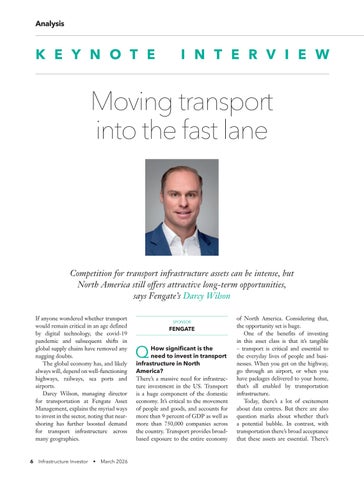
Darcy Wilson, managing director for transportation at Fengate Asset Management, explains the myriad ways to invest in the sector, noting that nearshoring has further boosted demand for transport infrastructure across many geographies.
QSPONSOR FENGATE
How significant is the need to invest in transport infrastructure in North America?
There’s a massive need for infrastructure investment in the US. Transport is a huge component of the domestic economy. It’s critical to the movement of people and goods, and accounts for more than 9 percent of GDP as well as more than 750,000 companies across the country. Transport provides broadbased exposure to the entire economy
of North America. Considering that, the opportunity set is huge.
One of the benefits of investing in this asset class is that it’s tangible – transport is critical and essential to the everyday lives of people and businesses. When you get on the highway, go through an airport, or when you have packages delivered to your home, that’s all enabled by transportation infrastructure.
Today, there’s a lot of excitement about data centres. But there are also question marks about whether that’s a potential bubble. In contrast, with transportation there’s broad acceptance that these assets are essential. There’s
longevity to the asset class, people are going to continue to travel through airports and other types of transport infrastructure, and these assets are very unlikely to be disrupted. Some transport assets have been around for 100 years, and I think there’s good indication that they’ll still be around for another 100 years.
QWhat makes a particular transport asset attractive for investment?
We believe a good transportation infrastructure investment needs stable, predictable and recurring cashflows. A transport business ideally needs contracted revenues. And if it doesn’t have contracted revenues, it needs a long history of stable cashflows. A transport business has to have the ability to pass through inflation and other cost increases – that’s something investors often find attractive about successful transport businesses.
Most investors are also underallocated to transportation. LPs and GPs alike want to invest more in transportation infrastructure but have struggled to do so. Unlike with digital infrastructure or energy infrastructure, the opportunities in transport are generally pretty difficult to access. This is because there are high barriers to entry, and a lot of transportation assets are government-owned or held in generational ownership.
Re-globalisation, consumer and population growth as well as deteriorating transportation infrastructure are driving the need for private investment. It’s an exciting time to be a transportation investor in North America, particularly in the US. We have a development community that’s hungry and an infrastructure backlog that the public sector cannot finance alone. The sector requires a specialised and focused mid-market business development or sourcing approach. If you can unlock these opportunities as a manager, you can create interesting and attractive investments.
QHow do trends like nearshoring play into the investment thesis?
Some people are talking about deglobalisation, but we think it’s more accurate to describe the trend as re-globalisation. Every CEO is thinking more holistically about their supply chains and building more resiliency into those. Instead of just relying on a China strategy, there’s a lot more thinking about a China-plus-one strategy.
That’s leading to shifts in trade patterns. Nearshoring is taking place and it’s creating new centres for production and new supply chains. I’m a big believer that North America is going to benefit from this. Despite some of the political rhetoric, there’ll be increased need for cross-border rail and intermodal transportation.
Certainly, because of all this nearshoring, there’ll be growing appetite for more port infrastructure. This includes infrastructure to support short sea shipping between Mexico and the US Gulf Coast. This is increasingly important for supply chains.
QYou said opportunities to acquire assets are limited. What does that mean in terms of the level of competition?
All infrastructure investors want more transportation exposure, so it’s a very competitive environment. That said, there’s a depth and breadth of opportunities, particularly in the mid-market. We’re very focused on opportunities outside of the sellside process. We prioritise bilateral dealflow, and we also find broken processes provide great opportunities to find interesting investment opportunities at attractive valuations. There are also a lot of potential ways to invest in this asset class. You can buy operating companies, back developers or even build assets. Actually, a lot of
infrastructure investors don’t like to build things; they don’t like to take on construction risk. But as both an investor and a developer, we’re comfortable doing that – it’s a major benefit that Fengate brings to its investments and a key differentiator.
Taking on development risk is all about finding the right development partners. That means finding the right team that’s ultimately going to be responsible for building assets, along with creditworthy counterparties. We have a build-to-core mindset, and selectively look for companies with a pipeline of capital spending where we can add value through our expertise and then de-risk those assets through construction.
“Re-globalisation, consumer and population growth as well as deteriorating transportation infrastructure are driving the need for private investment”
QWhere are the best opportunities for private investors in North America?
Airport infrastructure is perhaps the best example. In the US, most airport infrastructure is owned and operated by governments, particularly local governments. There’s been some successful examples of private capital being brought in to improve airport infrastructure, like at LaGuardia or JFK. But I’d say those are the exception, rather than the norm.
Investors like airports because there’s a moat around any potential asset and there are clear barriers to entry. If they can’t invest in the terminal infrastructure, they’re looking at other options that aren’t as public-facing. That could be hangars, warehouses or even fixed-based operators.
Also in aviation, we’re starting to pay a lot of attention to aerial firefighting. I think everyone recognises the increased intensity of wildfires throughout North America, as well as the essential service provided by wildfire prevention and response. These assets are highly resilient; they benefit from government contracts that are highly likely to be renewed and they’re asset-intensive businesses.
We’re excited about subsectors across air, land and sea transport. The
rail sector in North America is one to watch, particularly with large-scale railroad mergers taking place. It will be interesting to see if that leads to more divestitures or outsourcing of short line and rail services.
QWith the current macroeconomic and geopolitical uncertainty, why is now the right time to invest in transport?
In the US, transport infrastructure is very low on the list of priorities for the administration. We view that as an opportunity. It means there’s not going to be a lot of government financial support to build transportation infrastructure assets in this country. There’s a much greater need for private investment.
This administration certainly isn’t standing in the way of private investment in infrastructure, either. And in the mid-market, the businesses that we invest in are generally not reliant on government financial support.
Most sectors within transportation are inherently cyclical, and being able to take a long-term investment view is critically important. We’re coming out of probably the worst supply-side, capacity-driven freight recession since the global financial crisis. This is therefore a huge opportunity.
Particularly in the mid-market, there’s a lot of good transportation infrastructure businesses that are owned by mid-market private equity. They’ve gone through a very tough rate cycle and they’re looking for liquidity solutions. All combined, it’s a pretty opportune time to put capital to work and benefit from a recovering freight market.
QHow will technological innovation affect investing in transport in the coming years?
We’re seeing some interesting technologies that take a basic infrastructure asset and turn it into a smart asset. This
represents a convergence of digital and data infrastructure with transportation. Leveraging recent advancements in telecommunications (integration of cellular and satellite) and cloud computing significantly lowers the barriers of entry for simple digital devices. These can measure the performance and condition of a transportation infrastructure asset in real time and open up a lot of possibilities.
Looking forward, I think there are two big opportunities for technology and artificial intelligence in transportation that will be fuelled by the big data boom. One is on revenue and cost optimisation. That means utilising technology and AI to improve revenue generation.
For example, with dynamically priced parking, you can use AI to determine pricing by calculating levels of demand based on historical trends. The cost side is similar. Transportation businesses have a lot of cost centres, which can use AI to better understand and optimise. There will be a need for infrastructure assets of the future to be fully connected to IoT devices providing the necessary data to leverage AI.
The other piece, which is equally important, is on using technology to help extend asset life cycles. These are long-term assets. Think of a port, an airport or a railroad. They are all generational assets and need to be well maintained. But maintenance can be very expensive.
Utilising technology for preventative maintenance can be a huge opportunity for value creation. The technology can be used to make decisions on maintenance work that potentially avoids much larger costs a few years later by leveraging real-time analytics for assets that are in motion and cannot always be inspected by people.
We’re also seeing some simple solutions that don’t rely on AI but can add significant value – for example, new locking systems for intermodal containers to prevent theft when travelling on rail. n