The Metaphor of the Wall of Separation: Baptists and the First Amendment
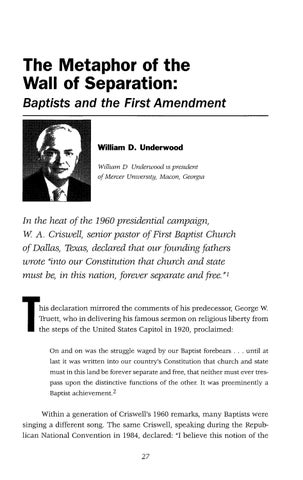
William D. Underwood William D Underwood is president of Mercer University, Macon, Georgia
In the heat of the 1960 presidential campaign, W. A. Criswell, senior pastor of First Baptist Church of Dallas, Jbxas, declared that our founding fathers wrote "into our Constitution that church and state must he, in this nation, forever separate and free/'1
T
his declaration mirrored t h e c o m m e n t s of his predecessor, George W. Truett, w h o in delivering his famous s e r m o n on religious liberty from the steps of the United States Capitol in 1920, proclaimed: On and on was the struggle waged by our Baptist forebears . . . until at last it was written into our country's Constitution that church and state must in this land be forever separate and free, that neither must ever trespass upon the distinctive functions of the other. It was preeminently a Baptist achievement. 2 Within a generation of Criswell's 1960 remarks, m a n y Baptists were
singing a different song. T h e s a m e Criswell, speaking during the Republican National Convention in 1984, declared: "I believe this notion of the 27
28
Baptist History and Heritage I Summer/Fall 2008
separation of church and state was the figment of some infidel's imagination."3 The guilty "infidel" was, of course, Roger Williams, the father of the Baptist tradition in America. Before exploring what has brought about this sea change in attitude and whether the change is a positive one, the story of the metaphor of the "wall of separation" between church and state should be told, with the Massachusetts Bay Colony as the starting point.4 Baptists and Church-State Separation in Colonial America The Puritans left England for the New World to obtain religious liberty. When they arrived, they promptly established a society that was every bit as oppressive as the one in England that they had left behind. The founding of Plymouth Colony in 1620 marked the beginning of an early New England tradition of religious intolerance.5 The Massachusetts Bay Colony taxed its citizens to provide financial support for ministers of the established church, limited the suffrage and the right to hold office to members of the established church, and eventually required non-members to attend church services.6 Puritan authorities had a Baptist, Obadiah Holmes, publicly flogged on the streets for conducting a Baptist worship service in a private home. 7 Anne Hutchinson was tried and convicted of heresy for challenging the power of religious authorities, who then exiled her from the colony,8 and Roger Williams was also exiled from the colony as a result of his perspective on the proper relationship between the church and governing civil authorities. Brent Walker has dubbed Williams "our all-time all-star."9 Williams believed that civil magistrates had no authority in religious matters— "that they could not even require people to keep the Sabbath."10 He was opposed to the design of English flag, which at that time had a bright red cross on it. Williams asserted that including the Christian icon in the national emblem constituted a clear mixing of nationalism and faith. He also opposed the requirement that every oath of office conclude with the words "so help me God," because those words would be applied to unbelievers as well as to believers and thus would reduce invoking God's name to empty form and ritual.11 Calling for a "hedge or wall of separation between the Garden of the church and the wilderness of the world," Williams believed that such a hedge would protect the garden of the church from the wilderness of
The Metaphor of the Wall of Separation
29
the state. 12 He asserted that the church could do little damage to the state, which he believed was necessarily corrupt, but instead was concerned with protecting the church from the corrupting influences of government, "believing that the ambition and vices of men could pervert the church, turning faith into simply a mechanism for achieving temporal power." 13 According to Williams: The unknowing zeal of Constantine and other emperors did more hurt to Christ Jesus' crown and kingdom than the raging fury of the most bloody Neros. In the persecutions of the latter, Christians were sweet and fragrant, like spice pounded and beaten in mortars. But these good emperors, persecuting some erroneous persons, Alius, etc., and advancing the professors of some truths of Christ—for there was no small number of truths lost in those times—and maintaining their religion by the material sword—I say, by this means Christianity was eclipsed, and the professors of it fell asleep. Babel or confusion were ushered in, and by degrees the gardens of the churches of saints were turned into the wilderness of whole nations, until the whole world became Christian, or Christendom.14 When his friend, Governor John Winthrop, had Williams expelled from the Massachusetts Bay Colony, Williams fled to Rhode Island and three years later, in 1639, he founded the first Baptist church in North America. 15 There in Rhode Island, Williams established a religiously free society, at least by the standards of his day. The commitment to religious freedom expressed in the First Amendment is often thought of as an idea that was revolutionary in its day. But more than 125 years before the First Amendment was ratified, Williams and John Clarke successfully petitioned the King of England to approve the Rhode Island Charter of 1663. That charter expressed the aspirations of the people of Rhode Island "to hold forth a lively experiment that a flourishing civil state may be maintained among his Majesty's subjects with full religious liberty." The charter added that "no person within the said colony shall hereafter be in any wise molested or called in question for any difference in matters of religion." 16 The commitment to religious liberty and separation of church and state was later amplified by early Baptist leaders, including Isaac Backus,
30
Baptist History and Heritage I Summer/Fall 2008
who protested a Massachusetts law that required all citizens to pay an "ecclesiastical tax" to support the Congregational Church.17 Backus denounced the requirement that Baptists and other non-Congregationalists be forced to support a brand of Christianity that they opposed.18 Writing in 1781, Backus expressed his view that since "religion must always be a matter between God and individuals, no man can be made a member of a truly religious society by force or without his own consent, neither can any corporation that is not a religious society have a just right to govern in religious affairs."19 "The notion of a Christian commonwealth should be exploded forever," John Leland, yet another Baptist, declared in 1790.20 The early Baptists were deeply principled. They were willing to be beaten, imprisoned, ostracized, and exiled for their commitment to freedom of the individual conscience. Principles mattered to these people, although surely an element of enlightened self-interest is evident in the commitment of these early Baptists to separation of church and state. But like the Quakers and Jews, Baptists were a religious minority who faced persecution in the American colonies where the government served as an arm of the dominant religious group—Anglicans in Virginia and Congregationalists in Massachusetts, for example. As late as 1774, the Anglican establishment imprisoned dissenting preachers in Virginia, including Baptists. Jon Meacham summed up the situation in his bestseller American Gospel: "the Baptists were a persecuted minority, and if they could convince the Anglican and Congregationalist majorities in the Revolutionary era to leave them alone, then the persecution would stop."21 Baptists and the American Constitution The Baptists ultimately succeeded. They persuaded enough people with influence to carry the day. Freedom of the individual conscience became our first freedom when the national government was founded following the American Revolution. Baptists prevailed because the idea of intellectual freedom appealed to influential Enlightenment thinkers and political leaders in America, including Thomas Jefferson and James Madison. And Baptists prevailed because religious freedom and respect for religious diversity made practical sense in a new nation consisting of states in which different denominations dominated. If the national
The Metaphor of the Wall of Separation
31
government could not establish a national religion, Anglicans in Virginia could not be subordinated to Congregationalists in Massachusetts. Mark Noll observed that "any effort to establish one particular faith would have drawn violent protests from adherents of other denominations."22 Although the Baptist position ultimately prevailed, success did not come easily. It took time. As originally adopted in 1787, the United States Constitution failed to assure the religious freedom sought by Baptists, although article VI, clause 3 took an important step by providing that "no religious Tfest shall ever be required as a Qualification to any Office of Public Tïust under the United States."23 This clause received a great deal of attention during the 2008 primaries, because Republican presidential candidate Mitt Romney argued that under this clause "no candidate should be rejected because of his faith." According to Romney, "There are some who would have a presidential candidate describe and explain his church's distinctive doctrines, lb do so would enable the very religious test the founders prohibited in the Constitution."24 Tb the extent Romney argued that the government could not require a candidate for federal office to explain his faith as a requirement for office, he was certainly correct. But equally clear is that the Constitution does not prohibit individual citizens from considering the religious views of candidates for federal office, which might have a direct bearing on issues the candidate would address once in office and could tell something about a candidate's moral and ethical commitments.25 Baptists who believe in freedom of conscience respect the right of individuals to reach their own conclusions on matters of faith, but this commitment to freedom does not equate to respect for the conclusions they might reach. While prohibiting religious tests for holding public office was a good start toward securing religious liberty, it was a limited first step. The Constitution did not prevent the government from establishing a state church, for example, or from imposing taxes to support that church. For these reasons, as soon as Thomas Jefferson saw the draft of the Constitution, he expressed his disappointment with the absence of an express declaration broadly ensuring freedom of religion.26 Tb address this deficiency, at the first session of the first Congress, James Madison proposed an amendment to the Constitution to guarantee religious freedom.27 His proposal became the First Amendment,
32
Baptist History and Heritage I Summer/Fall 2008
which described six separate but related freedoms—freedoms that collectively guarantee the intellectual freedom essential for a free and democratic society. The First Amendment provided that: Congress shall make no law: (1) respecting an establishment of religion, or (2) prohibiting the free exercise thereof, or (3) abridging the freedom of speech, or (4) of the press, or (5) the right of the people peacefully to assemble, and (6) to petition the Government for a redress of grievances.28 Obviously, Jefferson and Madison deserve much of the credit for production and acceptance of the First Amendment, and while some have overstated the role played by Baptists, as did George W. Truett in 1920 when he stated that the First Amendment "was preeminently a Baptist achievement," Baptists certainly deserve some of the credit. Church historian Randall Balmer observed that "the success of the Rhode Island experiment in church-state separation and religious liberty figured explicitly into the congressional debates surrounding the Bill of Rights in 1789, discussions that led to the First Amendment."29 As sweeping as the scope of the six guarantees found in the First Amendment, the protection they afforded was limited in one important way. The First Amendment restrained only "Congress" from infringing on individual rights. Individual states retained the power to establish state churches, to require attendance at services of those churches, to impose taxes to support a favored church, and to impose religious tests on state officeholders. And a number of states did infringe in these ways on individual rights.30 As late as 1808, North Carolina refused to seat a Jew who had been elected to the state legislature based on a state law that required all officeholders to be Christians of the Protestant variety.31 Established churches existed in a number of states, until eventually the last was disestablished in Massachusetts in 1833.32 Nonetheless, the idea of a free marketplace of ideas, as guaranteed by the First Amendment, presented an appealing model. A number of the states moved quickly to adopt state constitutional protections similar to those found in the First Amendment. In Georgia, for example, delegates to the state Constitutional Convention of 1798 included a paragraph in the state constitution which provided that:
The Metaphor of the Wall of Separation
33
No person within the State shall, upon any pretence, be deprived on the inestimable privilege of worshipping God in a manner agreeable to his own conscience, nor be compelled to attend any place of worship contrary to his own faith and judgment, nor shall he be obliged to pay tithes, taxes or any other rates for the maintenance of any minister or ministry, contrary to what he believes to be right or hath voluntarily engaged to do. No one religious society shall ever be established in the State in preference to another, nor shall any person be denied the enjoyment of any civil rights merely on account of his religious privileges.33 The convention delegate who authored this provision is said to have been a prominent Baptist preacher, Jesse Mercer, 34 who would later assist in founding the flagship Baptist university in Georgia that today bears his name. While Baptists in Georgia led the effort to guarantee religious freedom in the constitution of that state, Baptists in Connecticut agitated against the established church of their state. Writing to President Thomas Jefferson in October of 1801, the Danbury Baptist Association of Connecticut complained about their status as a religious minority in a state in which "religion is considered as the first object of legislation; and therefore what religious privileges we enjoy (as a minor part of the state) we enjoy as favors granted, and not as inalienable rights; and these favors we receive at the expense of such degrading acknowledgements, as are inconsistent with the rights of freemen."35 The letter summarized the perspective of Baptists "that religion is at all times and places a matter between God and individuals—that no man ought to suffer in name, person, or effects on account of his religious opinions—that the legitimate power of civil government extends no further than to punish the man who works ill to his neighbor." 36 Jefferson's response offered little concrete assistance. As president of the national government, he had no authority over the Connecticut legislature, which maintained an established church until 1818. Jefferson nonetheless expressed his concurrence with the commitment of Baptists to religious freedom:
34
Baptist History and Heritage I Summer/Fall 2008 Believing with you that religion is a matter which lies solely between Man & his God, that he owes account to none other for his faith or his worship, that the legitimate powers of government reach actions only & not opinions, I contemplate with sovereign reverence that act of the whole American people which declared that their legislature should "make no law respecting the establishment of religion or prohibiting the free exercise thereof," thus bunding a wall of separation between Church & State.37
The metaphor of a wall of separation, articulated by Williams and then employed by Jefferson, would reappear periodically through our history. President Ulysses Grant, speaking in opposition to public financial aid to Catholic schools, said in 1875: Encourage free schools, and resolve that not one dollar appropriated to them shall be applied to the support of any sectarian school. . . . Leave the matter of religion to the family altar, the church, and the private school, supported entirely by private contribution. Keep the Church and State forever separate.38 The United States Supreme Court first acknowledged the metaphor of the "wall of separation" in the Court's 1878 decision in Reynolds v. United States.39 The court in Reynolds affirmed the bigamy conviction of a Mormon, who had argued unsuccessfully that the Free Exercise Clause of the First Amendment shielded him from prosecution because the Mormon church imposed upon male members the obligation to engage in polygamy. In the course of its analysis, the court cited Jefferson's letter to the Danbury Baptist Association, including that portion referring to the "wall of separation between church and state." 40 Not until the Supreme Court's 1947 decision in Everson v. Board of Education41 did the metaphor of the wall of separation became a central feature of the court's freedom of religion jurisprudence. The Everson decision is important because the court recognized that one effect of the Fourteenth Amendment was to make the Establishment Clause of the First Amendment apply to the states as well as the federal government. 42 Everson is also important because of the court's broad construction of the Establishment Clause:
The Metaphor of the Wall of Separation
35
The "establishment of religion" clause of the First Amendment means at least this: Neither a state nor the Federal Government can set up a church. Neither can pass laws which aid one religion, aid all religions, or prefer one religion over another. Neither can force nor influence a person [to] go to or remain away from church against his will or force him to profess a belief or disbelief in any religion. No person can be punished for entertaining or professing religious beliefs or disbeliefs, for church attendance or non-attendance. . . . In the words of Jefferson, the clause against establishment of religion by law was intended to erect "a wall of separation between Church and State."43 Since the Everson decision in 1947, the Supreme Court has employed the metaphor of the wall of separation in more than 125 Supreme Court decisions.
Neo-Baptists and Their Interpretation of History Williams's metaphor of the wall of separation has now become an important symbol of our national commitment to respecting the rights of religious minorities and dissenters. Yet it has come under attack by many of today's most visible Baptist voices, voices that sing a very different tune from the old Baptist advocates of freedom of conscience. The late Jerry Falwell, a Southern Baptist preacher, asserted in Listen America that any "diligent student of American history finds that our great nation was founded by godly men upon godly principles to be a Christian Nation." Falwell added that he did "not believe in the separation of church and state, nor did our founders." 44 Ordained Baptist clergyman Pat Robertson charged that the radical left "have kept us in submission because they have talked about separation of church and state. There is no such thing in the Constitution. It's a lie of the left, and we're not going to take it anymore." 45 In his booklet, In Defense of Mixing Church and State, Baptist clergyman Rick Scarborough lamented that "a whole generation of Americans has grown up believing that the Constitution demands the separation of church and state." According to Scarborough, "that is simply a lie introduced by Satan and fostered by the courts." 46 As an Alabama Supreme Court justice, Baptist Roy Moore placed a monument to the Ifen Commandments in the lobby of the Alabama Judicial Building. When
36
Baptist History and Heritage I Summer/Fall 2008
asked about his refusal to accommodate similar displays representing other faiths, Moore responded that when the founders talked about "free exercise of religion" they meant Christianity. These neo-Baptists claim that no religious expression other than Christianity (and perhaps Judaism) enjoys the protection of the First Amendment.47 They favor a nation in which the power of government is employed to advance their version of Christianity, whether it takes the form of government-sponsored prayer in pubic school, government funding for Christian education and other faith-based initiatives, and government-sponsored Christian religious displays in public facilities and places. They would limit the scope of the Establishment Clause to nothing more than prohibiting the government from endorsing one Christian sect over another as the official national church. In return for support of this vision, they have provided largely uncritical support for the agenda of one political party, as many progressive Christians have for years supported the agenda of a competing political party. Ibday's neo-Baptists are wrong as a matter of history. The United States is a Christian nation only if what is meant is that more citizens claim Christianity as their religion than any other religion. But in that sense, one might also say that the United States is a white nation, or a female nation. Such a claim about America is not, of course, what the neo-Baptists are asserting. What they are asserting is that our government is based on Christian principles and was established to give a preference to Christianity over other faiths. Nothing in our governmental structure supports such a conclusion. The Constitution makes no reference to God, a Creator, or a Supreme Being of any sort. Indeed, to the extent the Constitution speaks to the religious character of the nation at all, it requires neutrality (no religious test for office, no establishment of religion, free exercise of religion—not only Christianity).48 Confirming this intended neutrality, a treaty with the Muslim nation of Tripoli initiated by President Washington, completed by President Adams, and ratified by the Senate in 1797, declared that "the government of the United States is not in any sense founded on the Christian Religion."49 The "founding fathers" that today's neo-Baptists seek to emulate are not the men who signed the Declaration of Independence, led us through the Revolutionary War, and then crafted our Constitution and Bill of
The Metaphor of the Wall of Separation
37
Rights. Some of the most influential among these men do not appear to have themselves been Christians.50 Thomas Jefferson, Benjamin Franklin, and others scoffed at many of the doctrinal tenents of orthodox Christianity. Jefferson edited the gospels to take out the miracles and the virgin birth. Franklin, in a letter dated March 9, 1790, wrote: "As to Jesus of Nazareth . . . I think the system of morals and his religion as he left them to us, the best the world ever saw, or is likely to see; but I apprehend it has received various corrupting changes, and I have . . . some doubts as to his divinity."51 Meacham concluded in his American Gospel that the "American religious landscape at the conclusion of the Revolution was pluralistic and somewhat chaotic: it bore little resemblance to the portrait of a devout, churchgoing America that the religious right loves to paint today."52 Mark Noll pointed out that in "1790 something like only 10 percent of Americans professed membership in a Christian church."53 Rather than Enlightenment figures such as Jefferson, Franklin, and Madison, who played leading roles in founding the United States, the "founding fathers" that neo-Baptists seek to emulate appear to be the Puritan leaders who sought to establish a Christian commonwealth in the Massachusetts Bay Colony. Rather than taking their lead from the founder of the Baptist tradition in America, their role models appear to be the religious/civil authorities who saw to it that Williams was exiled because he advocated religious freedom—their heroes are men like John Winthrop. Tb envision the kind of society they seek to impose, one should examine the Massachusetts Bay Colony for clues. As for the neo-Baptist claim that our legal system is based on the Tfen Commandments, that may have been the case in the Massachusetts Bay Colony. Yet that was clearly not true in the United States. Indeed, an obvious tension exists between the law found in our Constitution and the Ifen Commandments. We are commanded that "Thou shalt have no other gods before me," yet the Establishment Clause prohibits the government from promoting one god above another. We are also commanded that "Thou shalt not make unto thee any graven images," yet the Free Exercise Clause protects an individual's right to worship an idol if that is where his or her conscience leads. We are commanded not to take the name of the Lord our God in vain, and while blasphemy was a crime in parts of colonial America, such a law today would violate the First
38
Baptist History and Heritage I Summer/Fall 2008
Amendment's guarantee of free speech. No law prohibits us from coveting, or lying, or failing to honor our parents, and while adultery was at one time a crime in most states, today the adultery laws have either been rescinded or are unenforced and are perhaps unenforceable. That leaves murder and theft. Making the case that the United States is a Christian nation because its citizens criminalize murder and theft is difficult given that these are crimes in every nation in the world.54 While the commandments are revered moral laws that are honored by individuals and that are enforced by God, they are not civil or criminal laws enforced by our government. Baptists and the Changing Perspective on Church-State Separation An objective examination of our nation's history and laws is not what has caused the neo-Baptists to reject Williams's metaphor of the wall of separation. The changed perspective among many Baptists on separation of church and state reflects disagreement with a Supreme Court that has struggled to balance the imperative of protecting the free exercise of religion, while also prohibiting the establishment of religion. Some Baptists believe that the court's decisions enforcing the Establishment Clause have threatened their freedom under the Free Exercise Clause. Of course, reasonable minds can and do disagree about how to apply the religion clauses of the First Amendment to particular concrete issues. Rejecting the separation of church and state because of disagreements with particular applications of the doctrine, however, is like throwing the baby out with the bath water. Yet, the court has contributed to the problem with decisions that are sometimes difficult for almost everyone to understand, such as when the court concludes that a display of the Tfen Commandments in a Kentucky courthouse violates the Establishment Clause, while another decision announced the same day concludes that a display of the Ifen Commandments on the lawn of the Tfexas capital does not.55 Decisions like these make the court's religion clause jurisprudence seem arbitrary, which causes a loss of confidence in the court. Much of the rhetoric about the Supreme Court's decisions reflects either ignorance or, even worse, an intent to mislead others about the meaning of the decisions. In holding that the government could not
The Metaphor of the Wall of Separation
39
compel students to recite a prayer written by government bureaucrats,56 the Supreme Court was not "kicking God out of our schools," as many demagogues assert. Surely, not even the United States Supreme Court is that powerful, nor was the court banning prayer from public schools. Prohibiting students from praying in school would violate the Free Exercise Clause—at least in cases in which the prayers were not disrupting classes or other school activities. Justice O'Connor once observed that "nothing in the United States Constitution as interpreted by this Court. . . prohibits public school students from voluntarily praying at any time before, during, or after the schoolday."57 Wholly apart from disagreement with or misinformation about the court's decisions, the strength of many Baptists' commitment to separation of church and state has varied depending on whose ox is being gored. Some Baptists were strongly committed to separation of church and state when the separation principle was being employed to defeat taxpayer funding of parochial schools. The commitment began to wane, however, when the separation principle was employed to prevent public schools from imposing prayers and Bible study on students. One of our most admired Baptists, evangelist Billy Graham, protested after the Supreme Court's 1962 school prayer decision: "I am shocked at the Supreme Court's decision," he said. "Eighty percent of the American people want Bible reading and prayer in the schools. Why should the majority be so severely penalized by the protests of a handful." This comment reflects a failure to appreciate that protecting a dissenting religious minority from the majority is the whole point of the First Amendment. Graham's comment may also reflect that our perception of our selfinterest has changed. Soul liberty protected individual conscience from the tyranny of the majority, something important to Baptists when they were a persecuted minority. Tbday, Baptists are the largest Protestant denomination in America. Now that Baptists have gained the upper hand, some want the government to sponsor, advance, and endorse our religious perspectives.58 Baptists certainly would not be the first oppressed minority to because an oppressive majority after gaining the upper hand. Remember the Puritans, who fled religious tyranny in England, only to become religious persecutors in Massachusetts. Perhaps what has occurred among neo-Baptists is an inevitable byproduct of success. As the Lord Bishop of
40
Baptist History and Heritage I Summer/Fall 2008
Salisbury once proclaimed, "Every party cries out for Liberty & toleration till they get to be uppermost, and then will allow none."59
Conclusion The fact the neo-Baptists misrepresent our national history in challenging the separation of church and state and that they maybe self-interested in seeking to employ the power of the government to advance their particular religious views, however, does not necessarily mean that the change they advocate is a bad idea. The robust free market of religion in this country has, after all, resulted in some pretty strange fruit being sold. Among the groups that courts in this country have found to have qualified as religions deserving of protection under the First Amendment are Santerías, Hare Krisnas, Scientologists, Aquarians, Rastafarians, Wiccas, Gnostics, Coptics, and Voodoists, not to mention the variety of charlatan faith-healers making the rounds on cable television and in convention centers. Indeed, the brand of Christianity advocated by neo-Baptists is a product of the free market. The only alternative to a free market of religion, however, would be to allow the government to determine what is orthodox. Who wants politicians to determine what doctrines are believed? Who thinks that government bureaucrats have some special insight into God's truth? While one religious group may have the upper hand today, what would happen if tomorrow a group with veiy different religious perspectives gains dominance? What about the experience in other nations, which demonstrates that government-directed religion eventually destroys authentic faith? Power corrupts, and almost daily headlines provide reminders that corruption existed within the government. When the church is aligned with the government, is not the church eventually stigmatized by the failings of government? By allowing the church to become beholden to government power, does not the church necessarily lose its independence and thus its prophetic voice? Indeed, have not today's neo-Baptists, by becoming intoxicated with political power and prestige, become apologists for government policies seemingly at odds with the life, ministry, and teachings of Jesus? Is not there compelling evidence that when the church and the state combine, the church necessarily loses its vitality? Look at what is occurring in various places in Europe today. In Great Britain, less than 3 percent
The Metaphor of the Wall of Separation
41
of the population attends services conducted by the established Church of England. Leaders of the state Lutheran Church in Sweden successfully petitioned parliament to be disestablished, so that the church could benefit from competing in a free market. Since Sweden moved to a free market of religion, one Lutheran pastor reported that "I think we all see a stronger sense of commitment now. People realize it's up to them to maintain our churches, not the government."60 Observing what has occurred in Sweden, ecclesiastical leaders in Norway now want to follow suit.61 The truth is that by guaranteeing a free religious and intellectual market, the First Amendment has created in the United States the most robust religious environment of any nation in the world. The result of "religious deregulation" has given "American churches a new dynamism, a new effectiveness in fulfilling the Great Commission, and a new vitality in bringing the gospel to the people."62 Why would those who call themselves conservatives want to now invite the government into our religious life? Thank God for old-fashioned Baptists—Roger Williams-style BaptistsBaptists who will continue to stand with unpopular religious minorities, Baptists like the leaders of the Baptist Joint Committee for Religious Liberty, who wage the daily wars for religious liberty and to preserve the wall separating the garden of the church from the wilderness of the government, and Baptists like the members of the Baptist History and Heritage Society, who work to remind Baptists of their rich and important heritage.
1. W. A. Criswell, "Dr. Truett and American Freedom" (Sermon, First Baptist Church, Dallas, TX, July 3, 1977) http://www.wacrisweU.org/Search/transcriptframecfm/sermon/ 655.cfm, accessed October 3, 2008. 2. George W. Truett, "Baptists and Religious Liberty," in God's Call to America, by George W. Truett, ed. J. B. Cranfill (Philadelphia: Judson Press, 1923), 50. 3. Quoted in William M. Tillman, Jr., "Religious Liberty," in Has Our Theology Changed? Southern Baptist Thought Since 1845, ed. Paul A. Basden (Nashville, TN: Broadman & Holman, 1994), 306. 4. This article draws on a number of sources but three have been especially helpful: Randall Balmer's Thy Kingdom Come An Evangelical's Lament (New York: Basic Books, 2006); Jon Meacham's American Gospel God, the Founding Fathers, and the Making of a Nation (New York: Random House, 2006); and Mark A. Noll's The Scandal of the Evangelical Mind (Grand Rapids: Eerdmans Publishing Co., 1994). 5. Meacham, American Gospel, 45. 6. Ibid., 48-49. 7. J. Brent Walker, Church State Matters Fighting for Religious Liberty in Our Nation's Capital (Macon, GA: Mercer University Press, 2008), 27.
42
Baptist History and Heritage I Summer/Fall 2008
8 Meacham, American Gospel, 49-50 See also Susan Jacoby, The Age of American Unreason (New York Pantheon Books, 2008), 31 9 Walker, Church-State Matters, 27 10 Edmund S Morgan, The Puritan Dilemma The Story of John Winthrop (Boston Little, Brown and Company 1958), 118, 125 11 Roger Williams, The Bloudy Tenent of Persecution for Cause of Conscience, ed Richard Groves, (Macon, GA Mercer University Press 2001), xxi-xxii 12 Quoted in Balmer, Thy Kingdom Come, 42 13 Meacham, American Gospel, 54 14 Williams, The Bloudy Tenent, 112 15 Morgan, The Puritan Dilemma, 129 16 Quoted in Balmer, Thy Kingdom Come, 42 17 Ibid 18 William G McLoughhn, ed, Isaac Backus on Church, State, and Calvinism Pamphlets 1754-1789 (Cambridge Harvard University Press, 1968), in Noll, The Scandal of the Evangelical Mind, 65 19 Quoted in Balmer, Thy Kingdom Come, 35 20 John Leland, pamphlet, 1790, in Forrest Church, The Separation of Church and State Writings on a Fundamental Freedom by America's Founders (Boston Beacon Press, 2004), 92 21 Meacham, American Gospel, 142 22 Noll, The Scandal of the Evangelical Mind, 65 23 U S Const, art VI, cl 3 24 Mitt Romney, "Faith Speech" (speech, George Bush Presidential Library, College Station, TX, December 6, 2007) 25 Expecting devout individuals to somehow insulate their decision from their faith is neither desirable nor reasonable When candidates claim that their faith will not affect their decisions as an elected official, they are either not being honest with themselves and with the country or their faith is not a very important part of who they are Of course, at times public officials make decisions that are contrary to their personal religious beliefs, such as when President Jimmy Carter acted to enforce Roe ν Wade as a result of his obli gation to uphold and enforce the laws of the United States, despite his personal opposition to abortion Candidates are free to keep their religious perspectives to themselves, but the growing tendency is for candidates to tout their faith when helpful and then to argue that their particular faith perspective is an improper consideration when it becomes a liability 26 Reynolds ν US , 98 U S 145, 163 (1878) 27 Id, 164 Madison's proposed amendment with respect to religious liberty read "The civil rights of none shall be abridged on account of religious belief or worship, nor shall any national religion be established, nor shall the full and equal rights of conscience be m any manner, or any pretext, infringed " See Annuals of Congress, 1, 434 During the debates, this proposed amendment was modified to its present form See also Everson ν Board of Education, 330 U S 1,39 η 27(1947) 28 U S Const, amend I 29 Balmer, Thy Kingdom Come, 45 30 Noll pointed out that at the time that the First Amendment was ratified in 1791, five states provided tax support for ministers, and those five states plus seven others had religious tests for public office See Noll, The Scandal of the Evangelical Mind, 64 31 Meacham, American Gospel 108 32 Ibid, 82 33 Oliver Hillhouse Prince, comp, A Digest of the Laws of the State of Georgia Containing All Statutes and the Substance of All Resolutions of a General and Public Nature, and
The Metaphor of the Wall of Separation
43
Now in Force, which Have Been Passed in this State, Previous to the Session of the General Assembly of Dec 1837 (Athens, GA Published by the author, 1837), 912 34 William Bacon Stevens, A History of Georgia (Savannah, GA The Beehive Press 1972), 501, Julie Whidden Long, Portraits of Courage Stories of Baptist Heroes (Atlanta, GA Baptist History and Heritage Society, and Macon, GA Mercer Press, 2008), 36 See also Charles D Mallary, Memoirs of Elder Jesse Mercer (New York J Gray, 1844), 100 35 "Letter from the Danbury Baptist Association to President Jefferson, October 7, 1801," in Church, The Separation of Church and State, 128 36 Ibid, 127 37 Ibid, 130 38 Quoted in Meacham, American Gospel, 143 39 Reynolds ν US , 98 U S 145, 163 (1878) 40 Ibid, 164 41 Everson ν Board of Education, 330 U S 1 (1947) 42 I d , 15 43 I d , 5-16 44 Jerry Falwell, Listen America1 (Garden City, NY Doubleday and Company, 1980), 29 45 Pat Robertson, "Address to the Christian Coalition," God and Country rally, Greenville, SC, November 1993, in Church & State (April 1996) 10 46 Quoted in Balmer, Thy Kingdom Come, 46-49 47 Ibid, 60 48 The Declaration of Independence refers to "Nature's God" and a "Creator," demon strating that the m e n who signed the Declaration were not atheists 49 "The Treaty of Tripoli, Article II," in Church, The Separation of Church and State, 123 50 Meacham, American Gospel, 8 51 Quoted m ibid , 21-22 52 Jacoby, The Age of American Unreason, 39 53 Noll, The Scandal of the Evangelical Mind 63 54 Mark Osier, "Aseret Had'Varim in Tension The Ten Commandments and the Bill of Rights," Journal of Church and State 49, no 4 (Autumn 2007) 683 This article contains an extended and insightful analysis of the tension between the Ten Commandments and federal and state law in the United States 55 Compare McCreary County ν ACLU, 545 U S 844 (2005), Van Orden ν Perry, 545 U S 677(2005) 56 The Supreme Court's school prayer decision in 1962 involved a prayer composed by govern officials in New York, who then directed principals to cause the prayer to be said aloud by each class in the presence of a teacher at the beginning of each school day See Engel ν Vitale, 370 U S 421,422(1962) The Court held that the practice breached the "consti tutional wall of separation between Church and State since we think that the constitu tional prohibition against laws respecting an establishment of religion must at least mean that in this country it is no part of the business of government to compose official prayers for any group of the American people to recite as part of a religious program carried on by government " Id , 425 57 Wallace ν Jaffree, 472 U S 38, 67 (1984) 58 Balmer, Thy Kingdom Come, 51 59 Meacham, American Gospel, 48 60 Quoted in Balmer, Thy Kingdom Come, 48 61 Ibid 62 Noll, The Scandal of the Evangelical Mind, 66
^ s Copyright and Use: As an ATLAS user, you may print, download, or send articles for individual use according to fair use as defined by U.S. and international copyright law and as otherwise authorized under your respective ATLAS subscriber agreement. No content may be copied or emailed to multiple sites or publicly posted without the copyright holder(s)' express written permission. Any use, decompiling, reproduction, or distribution of this journal in excess of fair use provisions may be a violation of copyright law. This journal is made available to you through the ATLAS collection with permission from the copyright holder(s). The copyright holder for an entire issue of a journal typically is the journal owner, who also may own the copyright in each article. However, for certain articles, the author of the article may maintain the copyright in the article. Please contact the copyright holder(s) to request permission to use an article or specific work for any use not covered by the fair use provisions of the copyright laws or covered by your respective ATLAS subscriber agreement. For information regarding the copyright holder(s), please refer to the copyright information in the journal, if available, or contact ATLA to request contact information for the copyright holder(s). About ATLAS: The ATLA Serials (ATLAS®) collection contains electronic versions of previously published religion and theology journals reproduced with permission. The ATLAS collection is owned and managed by the American Theological Library Association (ATLA) and received initial funding from Lilly Endowment Inc. The design and final form of this electronic document is the property of the American Theological Library Association.