She-Preaches, $¡$؛€ ٢$, and Messengers from the Lord: British
Baptist
Wome
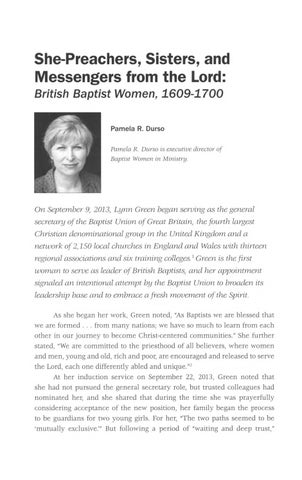
P am ela R. Durs©
Pamela R. Durso is executive director ٠/ Baptist Women in Ministry.
On September 9, 2013, Lynn Green began serving as the general secretary ofthe Baptist Union ofGreat Britain, the fourth largest Christian denominational group in the United Kingdom and a network of2,150 local churches in England and Wales with thirteen regional associations and six training colleges.1Green is the first woman to serve as leader ofBñtish Baptists, and her appointment signaled an intentional attempt by the Baptist Union to broaden its leadership base and to embrace a fresh movement ofthe Spirit. As she began h e r work. G reen noted, “As Baptists we are blessed th at we are form ed . . . from m an y nations; we have so m u ch to lea rn from each o th er in our jo u rn e y to becom e C hrist-centered co m m u n ities. ״sh e fu rth e r stated, “We are com m itted to th e p riesthood of all believers, w here w om en and m en, young and old, rich an d poor, are encouraged and released to serve the Lord, each one differently abled and u n iq u e .ص At h e r in d u ctio n service on S eptem ber 22, 2013, G reen noted th at she h ad not p u rsu ed the general secretary role, b u t tru sted colleagues had no m in ated her, and she shared th a t during th e tim e she was prayerfully considering acceptance of th e new position, h e r fam ily began the process to be guardians for two young girls. For her, “The two paths seem ed to be 'm u tu ally exclusive. ״׳But following a period of “w aiting and deep tru st,״
She-Preachers, Sisters, and Messengers from the Lord
37
G reen w as n am ed as guardian an d also appo in ted as general secretary.^ W hile G reen's ap p o in tm e n t as th e top den o m inational leader m arks a m ajor shift, she jo in s a h o st o f British Baptist w o m en who, for 400 years, have b e e n faithful ch u rch m em bers, outspoken leaders, and fiery preachers. Even in the early decades o f th e se v e n te e n th ce n tu ry as British Baptist churches first beg an organizing, w o m en played a role. T h ey o u tn u m b ered th e m e n in Baptist churches, an d “th ey played a m ore active role in Baptist life th a n did w om en in th e c h u rc h o f E ngland or am ong B resbyterian ordered congregations."4 T h ese years w ere n o t easy o nes for Baptists in England. T he A nglican C hurch was, of course, a state-established church, and m em bership in the church was not m erely an expectation b u t a re q u irem en t. Earticipation in dissenting religious groups was forbidden as a violation o f the law o f the land, and those w ho refused to com ply w ere subjected to spiritual sanctions as w eh as financial penalties, w h ile th e en fo rcem en t of sanctions and penalties varied from p arish to parish, leaders o f th e chu rch and th e state sought to “suppress ideas w hich m ight be u sed to u n d e rm in e th e ir political and religious legitim acy.5 ״As a d issenting group, Baptists w ere perceived as a th rea t to social and ecclesiastical order, an d as a result, th e y suffered m uch p ersecutio n an d often w ere targeted for ^ n i s h m e n t . T hroughout m ost o f th e se v e n te e n th century, British Baptist w om en experienced oppression and lived w ith the th re a t o f persecution. Yet despite the hard sh ip o f m em b ersh ip and participation in this dissenting religious m ovem ent, a good n u m b e r o fth e se w om en h eld fast to th e ir convictions and w ere faithful to th e ir churches. T his article highlights the p resence and influence of those w o m en and th e ir contributions to th e early Baptist m o v em en t in E ngland from 1608 to 1700 an d argues th a t am ong early British Baptists, w om en found places of service an d som etim es ev en places of leadership in Baptist churches.
A Woman of Influence W hile Jo a n H elw ys was n o t p re se n t at th e founding of th e earliest Baptist church, h e r in flu en ce an d ex periences w ere certainly foh by th e sm all congregation th a t jo in e d to g eth er in A m sterdam in 1609. In 1595 Jo an A shm ore m arried T hom as Helwys, an d th e couple settled at th e H elw ys fam ily estate n e a r N ottingham . In 1596 the first of th e ir seven children
Baptist History & Heritage اSpring 2014
38
was b o rn . D uring th e early years o f th e se v e n tee n th century, th e H elw ys ho m e b ecam e a m eetin g place for th e region's ? u rita n clergy.^ T h eir visitors enjoyed discussing theology an d debating religious issues. One freq u en t visitor, Jo h n Smyth, soon becam e a close friend to the H elw ys family. Eventually, b o th T hom as an d Jo an adop ted Sm yth's Separatist beliefs and jo in e d his co n g re g a tio n / As p en alties for religious d issen ters grew m ore severe, th e H elw ys family provided funds for th e ir congregation to relocate to H olland and th ereb y escape p ersecution. T hom as H elw ys trav eled w ith the group in 1608, b u t Jo an stayed b e h in d in E ngland w ith th e seven children, ?erh ap s the couple in te n d e d for h e r to com e at a la te r tim e, or th e y possibly th ought th a t she w ould escape p ersecu tio n if he was gone.8 His departure, however, did not shield Jo an from scru tin y b y th e British officials for she was soon arrested and im p riso n ed in York, accused o fb e in g a Brow nist a nd charged w ith refusing to take an oath o f loyalty to th e C hurch o f E n g la n d / A pparently, she was released w ithin several w eeks and b ro u g h t back to co urt a few m onths later.10 T he ultimate, outcom e o f h e r case is unknow n. In
1612,
following
a
division
w ithin
the
A m sterdam
church,
T hom as Helwys, along w ith te n ch u rch m em b ers loyal to him , re tu rn e d to England, settling n e a r L ondon at Spitalfield. T here th ey p lan ted the first Baptist ch u rch on English soil. Jo a n surely jo in ed h e r h u sb an d in this new church, b u t no m e n tio n is m ade of h e r in his later w riting w ith one exception. H e n a m e d Jo an in his wih. T hom as died in prison, som etim e b etw een 1615 and 1620, an d in h is wih, h e b e q u e a th e d his w idow ten p o u n d s.11 A lthough h e r official m em b ersh ip an d association w ith th e earliest Baptist churches in A m sterdam and Spitalfield cannot b e doeum ented, Joan H elw ys's strong co m m itm en t to h e r d issenting beliefs and h e r w illingness to risk im p riso n m e n t surely in sp ired those Baptists w ho gathered w ith h e r husb a n d for w orship an d w ho re tu rn e d w ith h im to England. Before returning, T hom as h ad w ritten , “A nd le t n o n e th in k th a t we are altogether ignorant, w h at building, and w arfare we take in hand, and th a t we have n ot sat dow n and in som e m easu re thoroughly considered w hat the cost and danger m ay b e . ^׳׳Jo an 's experience h ad already tau g h t h im the danger o f w hat lay ahead for h im an d his fohow Baptists.
She-Preachers, Sisters, and Messengers from the Lord
39
Women Deacons and Deaconesses Prior to his re tu rn to England, H elw ys w rote several d o cum ents defending the actions and beliefs o f his group, including a confession of faith, Λ Declaration o f Faith o f the English People Remaining at Am sterdam in Holland. In this 16H confession he established guidelines for ch urch governm ent, w hich included th ese instructions: ״T h e officers of every church or congregation are e ith e r elders, w ho b y th eir office do especially feed the folk concerning th eir souls (Acts 20:28, Peter 5:2, 3) or deacons, m e n and w om en, who by th e ir office relieve th e n ecessities of th e poor and im p o ten t b re th re n concern in g th e ir bodies (Acts 6:1-4). Two years earlier, Jo h n Smyth, who, along w ith Helwys, h a d form ed the Baptist chu rch in A m sterdam , also h a d set forth guidelines th at included w om en's service as deacons. In 1609 he w rote Paralleles, Censures, observations, in w hich h e stated, ״th e chu rch has th e pow er to elect, approve, and ordain h e r ow n elders, also to elect, approve, an d ordain h e r ow n deacons, b oth m e n and w om en." W hether th e chu rch in A m sterdam or th e one in Spitalfield actually had w om en serving as deacons is unclear, b u t th e inclusion o f w om en by Sm yth and H elw ys in th e ir guidelines for chu rch stru ctu re and th e ir intentional m en tio n o f w om en's service to tire ch u rch as deacons points d e a rly to th e ir p referen ce for g en d er inclusion w ith regard to th a t particular office of ch urch leadership. T he two Baptist founders m ay well have stood alone in this preference, for no o th er early English Baptist confessions m en tio n ed w om en deacons, an d som e confessions clearly stated th a t deacons w ere to be m en. According to English B aptist h isto rian Jo h n Briggs, ״W omen are not specifically identified in an y o f th e la te r confessions of faith of eith er G eneral or Particular Baptists in th e se v e n te e n th c e n tu ry .14'׳ By th e late 1600s a handful of English Baptist churches had appointed widows to assist m ale deacons, w hile o ther churches elected deaconesses. Records from Broadm ead C hurch in Britsol indicate th at in 1670, the church selected four w om en as deaconesses: Sister Smith, Sister Spurgeon, Sister Webb, an d Sister Walton, and M ary West was recognized as a deaconess as early as 1671. T he assigned duties of'these w om en w ere to visit the sick, w om en and m en, and to provide encouragem ent, comfort, and spiritual consolation.15 Clearly, for early English Baptists th e lead ersh ip of w om en as deacons was n o t a foreign concept, ev en if th e concept w as n o t alw ays fully lived out
40
Baptist History & Heritage اSpring 2014
in th e first h a lf of th e sev e n te e n th century. By the last p a rt of th e century, for som e am ong th e G eneral Baptists, w om en serving the chureh in leadership roles h ad m oved b e y o n d a concept to an accepted practice.
Women Preachers Even before Baptist w om en w em serving as deacons and deaconesses, th ey w ere preaching. A 1641 d o cu m en t revealed th a t six w om en, A nne H em pstall, M ary Bilbrow, Jo an e Bauford, Susan May, Elizabeth Bancroft, and Arab ella T hom as, h ad b e e n preach in g th ro u g h o u t England in the 1630s . ئThe w om en, w ho hailed from M iddlesex, Kent, C am bridgeshire, and Salisbury, d eclared th a t th e y took up p reaching b ecause “th e re was a deficiency of good m en, w herefore it w as b u t fit th a t v irtuous w om en should supply th eir p laces.”^ H em pstall stated th a t she h ad received h e r calling during a vision of th e biblical p rop h etess A nna. H em pstall's preaching astonished h e r listeners, n o t so m u ch b ecau se o f h e r c o n te n t or even because she was a w om an preaching; th e y w ere asto n ish ed th a t she p reach ed such lengthy serm ons. T he au th o r of th e 1641 d o cu m en t w rote, “long did she preach, an d longer 1 dare avouch th a n som e o f th e au dience w ere w illing. ئ״ A nother early English Baptist w om an preacher, Mrs. Attaway, was a lace-m aker an d m e m b e r o f Bell-Alley Church, a G eneral Baptist congregatio n in London. In th e mid-1640s T hom as Edwards, a B resbyterian m in ister and a v e h e m e n t o p p o n en t o f Baptists, labeled Mrs. A ttaw ay as th e “m istress o f all th e she-preachers on C olem an S treet. وا'׳T his Baptist '׳sh e-p reach er” b eg an in 1645 speaking at sessions h e ld on T resday afternoons at four o'clock. H er initial au dience w as com prised only of w om en, b u t in response to th e influx of a huge crow d o f people, including m an y m en, Mrs. Attaway op en ed h e r m eetin g s to all w ho w ould like to attend. Edwards n o ted th at “th e re cam e a w orld of people, to th e n u m b e r o f a th o u san d .20״ D uring o ne gath erin g Mrs. A ttaw ay offered “a w ord o f exhortation” from Acts 2, noting th a t th e pro p h ecy of Joel w as now bein g fulfilled for the Spirit o f God was bein g p o u red out o n h an d m aidens. A fter speaking, Mrs. Attaw ay led a len g th y p ray er an d th e n re a d Jo h n 14:15: “Ify o u love me, keep m y co m m an d m en ts.” Edw ards noted, “A nalyzing th e chapter as w ell she could, she th e n spoke u p o n th e text, draw ing h e r doctrine . . . for the space of som e th ree q u arters o f an h o u r.” She th e n op ened the floor for discussion.
She-Preachers, Sisters, and Messengers from the Lord
41
“for th a t w as th e ir custom to give lib erty in th a t k in d .' صO n som e occasions, this k in d o f liberty resu lted in expressions o f opposition. At a Ja n u a ry 8 m eetin g a w om an from th e Bell-Alley congregation asked Mrs. Attaway “w h at w arran t she h ad to p reach in this m an n e r. ״w h e n question ed about the m ean in g o f “th is m anner," th e w om an responded th at Mrs. Attaway should only p reach to th e baptized. A h e a te d discussion of infant b ap tism ensued, b u t in th e course of th e conversation, Mrs. Attaway noted th a t she was n o t p reaching b u t w as exercising h e r gifts in the m a n n e r set forth in 1 ? e te r 4:10-11, th a t she was fulfilling th e H ebrew s 10:25 comm an d th a t C hristians “exhort one another," an d th a t she was obeying M alaclfi 3:16, w hich in structed, “T h en th e y th a t feared th e L oro spake often one to another: an d th e L oro heark en ed , an d h eard it. ال״ For m ost tw enty-first c e n tu ry readers, Mrs. Attaway clearly was taking on th e role of p re a c h e r during th ese sessions. But she w as h esitan t to identify h e rse lf as a p re a c h e r of th e gospel. In terestin g ly enough, Edwards and m an y of those in atten d an ce at h e r m eetings easily assigned h e r the title of preacher. Several explanations for th e difference in percep tio n about h e r role have b e e n offered. C urtis
w.F reem an asserted th a t sev en teen th -cen tu ry
Baptists “recognized th e ir p reach ers as valid if th e y w ere called b y a gathered congregation,23 ״and Mrs. A ttaw ay’s Tuesday afternoon sessions w ere not sponsored b y a ch u rch or u n derstood to b e official ch u rch services. Thus, because she h ad n o t received a congregational call, h ad n ot b e e n officially recognized as a m inister, an d did n o t serve a local congregation, she understood h e r role as th a t of an exhorter, n o t as a preacher. T he o th er fact to note is that, in describing Mrs. Attaway as a preacher, Edwards certainly did n ot in te n d th e use of th e title to be co m p lem en tary or a blessing of h e r w ork bu t in stead m e a n t his w ord choice to b elittle h e r role. H e offen w rote derisively of “illiterate m ech an ic p reach ers . . . [and] w o m en an d boy preachers," all of w hich w ere un th in k ab le becau se of th e ir lack of ed ucation an d training.24 At th at Jan u ary 8 gathering, following Mrs. Attaway’s quotations of scripture, the contentious discussion continued w ith oth er objections m ade b y the Bell·Alley m em b er along w ith several m en in th e audience. Eventually Mrs. Attaway stood, offered a p rayer of thanksgiving for the occasion, and w alked away from th e table. A nother w om an stood and concluded tire m eeting. In reporting on this m eeting, Edwards asserted th a t Mrs. Attaway left the m eeting because she was not fit to argue questions on baptism , b u t his recording o f this lively debate actually ا
h e r openness to dialogue and diversity of
42
Baptist History &Heñtage اSpring 2014
opinion, h e r em brace of freedom ofconsoience, h e r com m itm ent to believer's baptism , and h e r w illingness to w alk aw ay from angry retorts.^
A Woman Church Founder D uring th e sam e period in w hich Mrs. A ttaw ay was preaching in London, D orothy H azzard was at w ork in Bristol founding w hat w ould eventually b eco m e a Baptist church. A few years after th e 1631 death of h e r first husband, A n thony Kelly, D orothy m arried M atthew Hazzard, an Anglican m inister w ho h ad arrived in th e city to serve St. Ewins C hurch. Even before h e r m arriage to Hazzard, D orothy was clearly a spiritual lead er in Bristol. As Edw ard Tferrill described, It migbtbe said ofher as of Ruth (fiidl), all fee city did know her to he a virtuous woman: she was like a he-goat before the flock. For in those days Mrs. Kelly was very famous for piety and reformation, well known to all, bearing a living testimony against fee superstitions and traditions of those days, and she would not observe their invented times and feasts, called holy days. At which time she kept a ^ ־ocer’s shop in High-street, between fee Guilders' Inn and the High Cross, where she would keep open her shop on fee time they called Christmas day, and sit sewing in her shop, as a witness for God in the midst of the oity, in the face of the sun, and in the sight of all men; even in those very days of darkness, when, as it were, all sorts of people had a reverence ofthat particular day ahove all others. And as fee Apostle saith, 1 Cor. viii. 7, There was not in every man that knowledge; for some, with conscience ofthe idol unto this hour, eat it as things offered unto an idol, and their conscience being weak is defiled. But this gracious woman (afterwards called Mrs. Hazzard), like Dehorah she arose, with strength of holy resolution in her soul from God, even a mother in Israel, and so she proved: hecause she was fee first woman in this City of Bristol that praoticed that truth of ye Lofe, which was feeu hated and odious, namely, separation.“ S cm etim e a rc u n d 1640 D orctby an d four otbers, G oodm an Atkins, Mr. Bacon, G oodm an Cole, an d Rlcbard M oone, b eg an m eetin g each Sunday afternoon in h e r hom e, w h ich was located at fee u p p e r en d of Broad Street. T here tb ey discussed th e ir d isco n ten t w ife fe e false w orship taking place at St. Ewins. W ith D orothy as th e ir leader, th ese conversations soon resu lted in action.27 Edw ard Tferrill, w ho w as a m em b er of fee B roadm ead C hurcb as
She-Preachers, Sisters, and Messengers from the Lord
43
early as 1663 and w ho k e p t a h ^ w r i t t e n account o f th e church's progress, rec o u n te d D orothy's gradual separation from h e r husband's church. He rep o rted th a t one Sunday she w alked out o f th e ch urch service during th e m iddle o f h e r h u sb a n d ’s serm ons, declaring th at he "upheld th e law fulness of im ages an d paintings in churches." T he in cid en t grieved Dorothy, causing "a very sore conflict in h e r spirit" for she k n ew th e re w ould be an “ill report" if she left, and she also feared th a t she w ould b e “a b ad exam ple u nto others if she did refrain an d n o t go. ^״But in th e end, she d e te rm in e d th at she m u st n ev er again listen to one o f h e r h u sb an d 's serm ons, and she held tru e to h e r w ord .^ Terrill fu rth e r rep o rted th a t on an o th e r Sunday, D orothy w as on h e r w ay to th e service ju s t to h e a r th e readings from th e Book o f C om m on ?rayer, w h e n she p au sed to read h e r Bible. She h a p p e n e d to open h e r Bible to Revelation 14 and read verses 9-11: A nd foe th ird angel followed them , saying w ith a loud voice, If any m an w orship th e b east and his image, an d receive his m ark in his forehead, or in his han d , th e sam e shall d rin k o f th e w ine of foe w rath o f God, w hich is p oured o u t w ithout m ixture into foe cup of his indignation; and h e shall b e to rm en ted w ith fire and b rim sto n e in th e presen ce of th e holy angels, an d in th e p resen ce o f foe Lamb: A nd foe sm oke of th e ir to rm e n t ascen d eth u p for ever an d ever: and th e y have no rest day n o r night, w ho w orship the b east an d his image, and w hosoever receiv eth th e m ark of his n am e.30 D orothy k new th a t she could n e v e r again a tte n d m ass or h e a r a service taken from foe Book of C om m on ?rayer.3 ؛Following th a t experience, the five-m em ber group resolved to separate th em selv es com pletely from "foe false church" an d vow ed th a t "they w ould in th e strength and assistance of th e Lord, com e forth o f th e w orld an d w orship and Lord m ore purely, preserving th e re in to th e ir end."'3؛ Because o f th e dan g er o f persecution, D orothy about this sam e tim e secured a h ouse outside o f tow n, w here two or th ree fam ilies could gather safely. T h e house was at tim es u sed b y p reg n an t w o m en w ho traveled th ere from o th e r parish es to deliver th e ir baby, hoping to “avoid th e cerem onies of th e ch u rch .33״ Because o f h e r strong beliefs an d h e r co m m itm en t to be p a rt of a "New ^ s t a m e n t ch u rch ,” D orothy challenged th e social, political, an d religious
Baptist History & Heritage اspring 2014
44
view s of h e r day. But w ith every step she took tow ard living out h e r eonvietions, she took a step firrther from the beliefs o f h e r husband. At tim es, M atthew H azzard seem ed to b e troubled b y his affiliation w ith th e A nglican traditions an d th u s sided w ith his wife, b u t he continued in his role as vicar at St. Ewins. O ne o f his ch u rch m em b ers co nfronted Hazzard, predicting th a t since D orothy h ad left the church, she w ould also abandon the m arital bed. T he prediction, however, did n o t prove to be true. D orothy a nd M atthew H azzard rem ain ed m arried, an d she '׳approving h e r h e a rt to th e Lord, w alked before him , w ith h e r husband, in his o r d in n c e s blam eless, (to his death n e a r th irty years afterw ards). T he sm all group led by D orothy co n stituted as a ch u rch during the E aster season of 1640. T h at y e a r ״a baptized m a n , ״Mr. Cann, visited Bristol, an d w h en D orothy le a rn e d o f his p resen ce in the city, she invited him to h e r hom e. She soon recognized th a t C ann w as a Baptist, and w ith his help, the sm all group organized into a church. A lthough th e y founded the church, w h ich w ould be called B roadm ead Church, so m etim e around 1640, the exact date th a t th e ch u rch em braced Baptist view s is unknow n. In the early 1650s th e new ch u rch beg an discussions about th e n ecessity of b ap tism following a confession o f faith, an d b y 1670, m o st o f th e church m em bers h ad experien ced b eliever's b ap tism .35 As a m e m b e r o f B roadm ead Church, D orothy seem ed “to have b e e n equal to th e w hole o f th e m e n ” w ho started the church w ith her,36 an d she rem a in e d a faithful and active m e m b er of th e church u n til h e r d eath on M arch 14, 1675.37
Writing Women Prophetesses A final group o f Baptist w o m en active b etw een 1640 an d 1680 w ere Baptist prophetesses, a te rm u sed b y Curtis ٠/
w.F reem an in his 2011 book, A Company
Women Preachers: Baptist Prophetesses in Seventeenth-Century England, A
Reader38 E rcem an estim ated th a t in th e mid-1600s as m an y as 300 w om en p ro p h etesses w ere active in England, an d h e discovered th a t at least fortyseven o f th ese w om en left b e h in d w ritings, o f these, nine w ere B aptists.^ T hese Baptist w om en, like th e ir A nglican counterparts, “w rote declarations, autobiographies, p ro p h etic judgm ents, doctrinal disputes, appeals for toleration, epistles, an d accounts of sufferings.”׳٠٠ F reem an's book has w ritings b y or about seven o f th e Baptist prophetesses: K atherine childley, Sarah Wight, Elizabeth Foofo, Ja n e Tbrner, A nna Trapel, K atherine Sutton,
She-Preachers, س ؛ ةأة
,
and Messengers from the Lord
45
and A nne W entw orth. Included in th e book are th irte e n docum ents, num berin g about 700 pages. M any o f th ese docu m en ts w em p rin te d as p am p h lets and w ere circulated w idely th ro u g h o u t England. Six of th ese seven w om en p ro p h etesses h ad ?articu lar (Calvinistic) Baptist ties. T he seventh, Childley, associated w ith a church th a t m oved into ?articu lar Baptist circles, b u t h e r w ritings indicate th a t she m ay have rem ain ed an In d ep en d en t. T hese w om en shared som e basic theological understandings, an d m ost o f th e ir w ritings in clu d ed a conversion narrative as well as stories about trance-like visions. Each w om an was prophetic in h e r w riting a n d /o r speaking, and m ost o f th e seven h ad som e connection to the politics of th e ir day. O f th e seven, two are of p articu lar interest: Sarah Wight and Elizabeth ?pole. T he story o f Sarah W ight is found in The Exceeding Riches ٠/ Grace Advanced, w hich was w ritten in 1647 b y h e r fellow church m em bers and edite d b y H enry Jessey, a p ro m in en t Eondon Baptist pastor. Wight was converted to the faith at the age of sixteen following four years of em otional and m ental struggles, suicidal tendencies, and a seventy-six day fast that left h e r tem porärily deaf and blind. D uring h e r fast she h ad visions of Jesus, saw herself being crucified, and testified of h e r rebirth in Christ, w h e n the fast ended on Ju n e 11, Wight was instructed in a vision to be a m inister and a witness. Wight soon m oved to th e countryside, w h ere she served and encouraged pilgrim s at h e r hom e. $he also sp en t tim e talking w ith w om en w ho h ad b e e n in flu en ced b y h e r experience. Some o f those conversations are recorded in Exceeding Riches,41 an d b y sharing about h e r sick b ed experienees a n d h e r visions b o th in conversation and in w riting, W ight transform ed painful m o m en ts o f h e r hfe into o p p o rtu n ities to "preach ״the g o sp e l.42 sh e “p reach ed״: “Jesu s C hrist found m e an d loved me, before I could love him . He cam e to m e in th e m ost disconsolate condition th a t ever [a] soul was in. w fnm I m u st e ith e r b e delivered, or be destroyed, I could abide no longer, th e n C hrist cam e. C hrist is m y life, an d m y life is h id w ith C hrist in God.'43׳ A lthough lim ited inform ation is kn o w n about Wight's later life or h e r continuing influence, h e r experiences as recorded in E?(ceeding Riches as well as a later writing, A Wonderful Pleasant and Profitable Letter (1656), point to h e r unique role in early Baptist hfe. H er y outh an d h e r m ystical experiences and detailed visions are reflective of Catholic religious w om en such as Julian of Norwich, b u t the descriptions of Wight's revelations, as preserved by h e r Baptist pastor, are “consistent w ith toe doctrines of grace for Particular Baptists."4‘؛
Baptist History & Heritage اSpring 2014
46
A nother Baptist w om an w riting prophetess, Elizabeth Boole, w as first a m em b er o f th e London Baptist ch u rch pastored b y W illiam Kiffin in the early 1640s. By th e en d o f th e decade she h ad established a relationship w ith Baptists in A bingdon, w ho w ere led b y J o h n Bendarves. In 1648-1649 Boole served as a sp iritual advisor to th e Council o f Officers of the a rm y in w hitehall. She m e t w ith th e m tw ice—on D ecem ber 29, 1648 and Ja n u a ry 5, 1649, d u rin g the m o n th s in w hich th e y w ere debating th e fate of King C harles 1, w ho h ad b e e n defeated during th e Second Civil War. At the first m eeting Boole spoke b ased on a vision she h ad had, advising th e council to use the pow er God h a d given th e m to im prove th e n atio n for the Lord. She refused to give specific in stru ctio n s as to how th e pow er m ight b e used. T he council invited h e r back ju s t fifteen days before C harles’s trial was to begin, and th is tim e, she offered m ore concrete advice, recom m en d in g th a t th e y not execute th e king, sabring, “Stretch n o t forth the h a n d against h im .”45 H er reco m m en d atio n w as n o t w ell received, and th e king was u ltim ately found guilty an d b e h e a d e d on Ja n u a ry 30.46 As th ese events unfolded, Poole en co u n te re d m u c h criticism and was forced to defend h e r p ro p h etic gifts w ith in h e r Baptist world. In response, she w rote two treatises in 1649: A n A larum o f War an d A nother A larum ofW ar. T he longer titles p o in t to a strong conviction th a t h e r w ords w ere ^ o p h e tic an d should have b ee n received w ith g reater care. T his is especially clear in A n Alarum ofW ar Given 0 ؛the A rm y and to Their High Court ofjustice (so called) revealed by the will ٠/
God in a vision ؛٠ E. Poole (sometimes a messenger ٠/ the Lord to the General Council, concerning the Cure o fth e L and and the m anner thereof). Foretelling the judgements ٠/ God ready ؛٠ fall upon them for disobeying the word o f the Lord in taking aw ay the life ofthe King. T h ese w ritings w en t unheeded, and Boole lived o u t th e re m a in d e r o f h e r hfo in relative obscurity in A bingdon.47
Conclusion For m ore th a n 400 years the great m ajority o fh isto ries w ritten and published about Baptists have n o t in clu d ed stories o f w om en m em b ers and leaders and have failed to explore th e in flu en ce an d contributions of those w om en. In re c e n t years, research ers an d historians have w orked to correct this problem , an d th e y have even b e e n successful in uncov ering w ritings about and by the earliest British Baptist w om en.
She-Preachers, Sisters, and Messengers from the Lord
47
A careful com pilation of se v en teen th -cen tu ry sources reveals m an y o f th e w ays th a t w om en did in d eed contribute to the Baptist m o v em en t in those early days. T hey h ad a variety of roles in th e church from m e m b er to d eaco n /d eaco n esses to p reach er to w riting prophetess. T hese w om en did n ot d em a n d ch u rch lead ersh ip roles or even aspire to them . T hey w erc not radical fem inists or advocates of g en d er equality. In stead th e ir roles w ithin Baptist churches an d th e ir co m m u n ity seem to have b e e n driven b y th eir response to th e leading o f th e Spirit, th e ir firm conviction th at God was leading them , and th e ir desire to b e faithful an d obedient, w h ile th ey w ere clearly in th e great m in o rity am ong early B aptist leaders and preachers, w om en did m ake significant contributions an d filled m eaningful roles. BH&HS '"Baptist U n io n ap p oin ts w om an lead er an d se e k s fresh im a g e,” Ekklesia, S ep tem b er 9, 2013, h ttp ://w w w .e k k le s ia .c o .u k /n o d e /1 9 0 3 3 , a ccesse d S ep tem b er 25, 2013. 2Ibid. 2‘‘Lynn Green inducted as General Secretary of the Baptist U nion of' Great Britain," The Baptist Times, h ttp ://w w w .b a p tist.o rg .u k /A rticles/3 7 2 6 9 6 /L y n n _ G reen _ in d u cted .a sp x , a ccesse d S ep tem b er 25, 2013. ^Curtis w. Freem an, ed., A Com pany ٠/ Women Preachers: Baptist " ¿٢، Seventeenth-Century England, A Reader (Waco, TX: Baylor University Bress, 2011), 2. ؛Stephen Wright, The Early English Baptists, ־ و ﻫ ﺔ ل4’ ( ةولWoodbridge, Suffolk, UK: The Boydell Press, 2006), 3. SJ. Glenwood Clayton, ‘‘Tbom as Helwys: A Baptist Founding Father,” Baptist History & Heritage 8 /1 (January 1973): 4. 7Ibid. 8Richard Groves, introduction to A short Declaration ofthe M ystery oflniqu ity (1611/1612), by Thom as H elwys, ed. Richard Groves, Classics o f Religious Liberty, vol. 1 (Macon, GA: Mercer University Press, 1998), xxi. 8Ronald Albert Marchant, The Puritans and the Church Courts in the Diocese of York, 15601642 (Longmans, 1960), 163. ’1’Groves, xxi. ""Thomas H elw ys and his part in religious history," h ttp ://w w w .n o ttin g h a m p o st.c o m / L eader-relig io u s-lib erty /story-12238885-d etail/story.h tm l, accessed Septem ber 25, 2013. '2Thom as H elwys, A short Declaration of ¡Te M ystery of Iniquity (1611/1612), ed. Richard Groves, Classics o f Religious Liberty, vol. 1 (Macon, GA: Mercer U niversity Press, 1998), Appendix, 154. 13Ibid., Article 20,121-122. '*John H. Briggs, "She-Preachers, Widows and o th e r Women: The Fem inine Dim ension in Baptist Life Since 1600,” The Baptist Quarterly 31/7 (July 1986): ،337. See also Charles w. D ew eese, Women Deacons and Deaconesses: 400 Years of Baptist Service (Macon, GA: Mercer U niversity Press, 2005), 51. '؛Edward Terrill, The Records of a Church of Christ Meeting in Broadmead, Bristol, 1640-1688 (London, Hanserd Knollys Society, 1865), 162. T'errill's records were edited from fe e original m anuscript, and n otes w em added by Nathaniel Haycroft. The Bunyan Society pubhsbed feis version of'Terrill's records in 1865.
Baptist History & Heritage اSpring 2014
48
16A Discoverie of Six Women Preachers in Middlesex, Kent, Cambridgeshire «١،١ ؛Salisbury (n.p., 1641). Although the six w om en are not specifically identified as haptlsts. Baptist scholars such as Edward Caryl Starr and William Thom as W hitley included this docum ent in their bibliographies o f Baptist writings, indicating that the w om en were Baptists. See Edward Caryl Starr, A Baptist Bibliography: Being a Register o f Printed M aterial By an d About Baptists, Includr ing Works Written Against the Baptists, 25 vols. (Philadelphia: Judson Press, 1947-1976), and W illiam Thom as W hitley, A Baptist Bibliography: Being a Register of the c h ie f M aterials for Baptist History, Whether in M anuscript ٠٢ in ¿ آم؛١١, Preserved in England, Wales, and Ireland, 2 vols. (London: Kingsgate Press, 1916-1922). Carolyn Blevins also believed these w om en to b e Baptist. See Women’s Place in Baptist Life (Brentwood, TN: Baptist History & ׳Heritage Society, 2003 ), 26. 17A Discoverie ofSix Women Preachers, 1. 18Ibid. 18Q uoted in Dorothy p. Ludlow, “Shaking Patriarchy's Poundations: Sectarian Women in England, 1641-1700," in Triumph over Silence: Women in Protestant History, Contributions to the Study o f Religion, no. 15, ed. Richard L. Greaves (Westport, CT: G reenwood Press, 1985), 96. 7؛؛Thom as Edwards, Gangraena: ، ؛٠٢ Catalogue and Discovery ٠/ M any ٠/ the Errours, Heresies, Blasphemies, and Pernicious Practices ٠/ the Sectaries ٠/ This Time (London: Printed for Ralph Smith, 1645) 1:31. Available online at h t t ^ / / w w w .archive.org/stream / ga n g raen alan d 200du p eu oft#p age/n 5/m od e/2up , accessed Septem ber 26, 2013. 21Ibid., 30. 22Ibid., 31. 2؛־Freeman, A Com pany of Women Preachers, 7. 24Edwards, Gangraena, Epistle Dedicatory, B. 25Ibid., 32. 26Tterrill, "The Records ٠/ « Church of Christ Meeting, 40-41. 27Ibid., 44.
2"lh-id 2؛؛Ibid., 43. 30King Jam es Version. 31Laura Clark, "Dorothy Hazzard, Broadmead Baptist Church, Bristol, 11K," h t t p : // w w w .b ro a d m ea d b a p tist.org.u k /h istoryp age.p h p ?con ten t = h istory/h azzard .h tm , accessed Septem ber ^5, 2013. 32Terrill, The Records ٠/ « Church o fc h rist Meeting, 45. 33Ibid., 43 34Ibid., 48. 35Roger Hayden, ed., The Records of a Church o fc h rist Meeting in Bristol, 1640-1687, Bristol Record Society's Publication, vol. 23 (Bristol: Bristol Record Society, 1974), 47. ؛؛*'׳John Swaish,Chronicles ٠/ Broadmead Church, Bristol: 1640-1923: A Brief Narrative (Bristol: Y ou n gQ H um p h ^fs, [1927]), 1.3. 17Terrill, The Records o f a Church o fc h rist Meeting, 107. 13'Freeman, A Com pany of Women Preachers. 39Curtis w. Freem an, “Visionary W omen am ong Early Baptists, Baptist Quarterly (January 2010), 11. Also available online at h tt p : //d iv in ity .d u k e .e u /s it e s /d e fa u lt /f ile s /d o c u m e n ts / fa cu lty -fr eem a n /v ision ary-w om en -am on g-early-b ap tists.p d f, accessed Septem ber 26, 2013. 40Kirsten Thea Timmer, “English Baptist Women under Persecution (1600-1688): A Study o f Social Conformity and Dissent," Baptist H istory & Heritage 41/1 (Winter 2006): 23. 4‘Freeman, A Com pany ٠/ ٣٠١١١٠۶١[Teachers, 21. 42Ibid., 149. “ Sarah Wight, "The Exceeding Riches o f Grace Advanced" (London: Printed b y Matthew Sim m ons, 1647), in Freeman, A Com pany ٠/' ٣٠١١١٠١١, 195. 44Freeman, A Com pany of Women, 148.
She-Preachers, Sisters, and Messengers from the ﻣﺢ־?مﺀ
49
45Ibid., 23. 46Ibid., 22-23. 47Ib id , 23.
NURTURING FAITH EXPERIENCE AUGUST 18-23 , 2014 im en tal e x p erien c e " in X[)e.‘^ Big־؛ 8 اار>·ن ) إأا M>g. 1 8 -2 3 .W'ill be a.6'<׳, addressing re tre a t ،»[)pornm key issues ity.Wim hile p-؛، e׳־tin g e o n g re gational y. th meingroup istry 6>،l als؛؛ ١٦ ،( أا shape a tnodel o '؛r'؛ الاآا 1 - ﻣﺎeee!)ts
١١*؛
ا[؛
األ[ا
in M o n ta n a , n so(؛،< s־؛ 8اﺑﺎال؛ 1، ﻣﺎB ap tists Today, B aptist اlist،)r>’ ،and lle rita g e Society . )<(،< الا ' اﺗﺮ£ ا' ا1ﺛ׳ﺊ،أﺑﻤﻨﺄأا I'ellow ship of N(>]'£) C a ro lin؛، ٨١١٢١ ٦٦١٢ ׳ittm an C e n te r ‘1 of Ca،'dne WY'؛־־££ا’ا£ إ ؛ل*־ا ׳ ا׳ اP rogram m ing '.١١٦١١ اآأل؛((ا good use of the ׳١’١١٨١١{׳ tale n ts W’itldn£ ١٢ .؛؛١٦'٠١١١١ as ١٦٧١١ -as leaders in M o n tan a
U ^T€ s ،ا 200 (l)ase'،l, >< ١٦ double o e eu p a n ey ) and includes : ) ־ •ان،( اااtran sp o rta tio n ؛1 ﻟال(ﺀ־ اa ؛rp 0 t[־٨٢١٦١٨١ ؛١١ Bozem an (Aug . 18١١١١ ( ؛؛؛airp o rt ef'rom־ paMm،£־ 1()ث/ ) ا؛ ا ' ا. ؛ألا. ﻣﻘﺊ2 3 ( W estern 1، ؛ آ ' ا•الا؛١١١٦ housing in Bozem an ou M onday night .\ •ا1 ث־ال،־ا؛ ﺟﻞ0 ا M onday d in n er duamgl) Saturday hreal. f‘a st؛ • 'اآ0׳- ا1 أا؛0 <; آا־١١١ o r one night in Yellou'stone N ational’؛ lodging،! ؛٠٨١٦، ٠ T h ree niglns lodging, meeals £ C £ and e s؛، ؛١٢ Parade Rest (iue'st£ ٨١٦٢٦١ ١١٢־[)؛ West Yellow M ontana stone־.
LODGING Mousing at th e ['٨١١٢٠١١ ،'١١١٢١ ا’ا11־ )ا( ا ؛* ا
e lu dPark e s[[؛ االأا؛' ا
* ٨١١٢١ .lodges
For private rooms. ؛١٢١٢١ 8250.
REMINDER ٠ £ ٨٢٠١٦
p erson is resp onsib le for Ids >(١آ־ال ־
R eservations should£ ٢٠
)(١١١١ O'avel to؛١١١٢١£■)< ١١١ B ozem.؛m
١١١ ٢٠ ٨^ *)()(s>؛׳ ١١ ؛١ p o ssib le .*
.١١١ •١٢٦١ £ ١١١٢ will £ ־٢٠ sp en t؛١١ £ ١٢٠ -great ou td o o rs, w ith op tio n a l .'¡etirities
٢٨٢٨١١١,
reservation 8400 ee'؛ )٦١٢٢٦ . payable to ،* ﺗﺎ،) رر0', ﺀﺑﻢ.*' '!')( day. P.O. Box 6318 . nem 31208 6318o؛ 1؛A)؛ اال/ N F M ontana" £؛ 88()() ا 1(؛ ."־ال:־ ا־ ا٢١١١٢٠ ٦١١١١٢ ־15