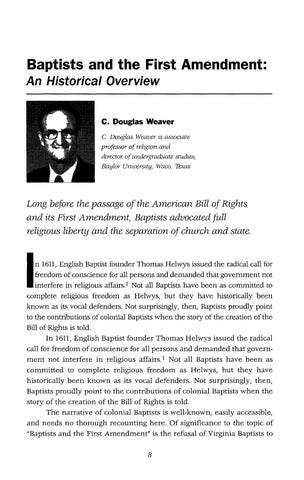
Baptists and the First Amendment: An Historical Overview C. Douglas Weaver C Douglas Weaver is associate professor of religion and director of undergraduate studies, Baylor University, Waco, Texas
Long before the passage of the American Bill of Rights and its First Amendment, Baptists advocated full religious liberty and the separation of church and state.
I
n 1611, English Baptist founder Thomas Helwys issued the radical call for freedom of conscience for all persons and demanded that government not interfere in religious affairs.1 Not all Baptists have been as committed to complete religious freedom as Helwys, but they have historically been known as its vocal defenders. Not surprisingly, then, Baptists proudly point to the contributions of colonial Baptists when the story of the creation of the Bill of Rights is told. In 1611, English Baptist founder Thomas Helwys issued the radical call for freedom of conscience for all persons and demanded that government not interfere in religious affairs.1 Not all Baptists have been as committed to complete religious freedom as Helwys, but they have historically been known as its vocal defenders. Not surprisingly, then, Baptists proudly point to the contributions of colonial Baptists when the story of the creation of the Bill of Rights is told. The narrative of colonial Baptists is well-known, easily accessible, and needs no thorough recounting here. Of significance to the topic of "Baptists and the First Amendment" is the refusal of Virginia Baptists to 8
Bapnsts and the First Amendment
9
support a "general assessment" tax in the aftermath of the disestablishment of the Church of England. Eloquent orator Patrick Henry argued that a tax—with each citizen choosing which church received the required contribution—would sustain a moral foundation for government. Baptists were the only religious group to fully support James Madison who won the day when he perceptively declared that the tax was tyrannical and a form of established Christianity.2 Not all Baptists supported the 1787 ratification of the federal constitution. With the memories of persecuted dissent still fresh, fears of centralized authority were evident. Popular evangelist John Leland voiced this concern, especially when no adequate protection for religious liberty seemed forthcoming from the founding fathers. One story— practically an icon in Baptist lore, though secular historians ignore it—is how James Madison met with Leland and agreed to promote a bill of rights that would guarantee religious freedom for all citizens. In turn, Leland withdrew his opposition to the federal constitution, and decided not to pursue a candidacy opposing Madison for the Virginia delegation to the constitutional convention.3 Baptist Voices of the Nineteenth and Early Twentieth Centuries Without explicitly referencing the First Amendment, Baptists in the nineteenth century trumpeted a clarion call for the separation of church and state. In the ante-bellum era, Francis Wayland, president of Brown University, wrote in 1857 that "soul liberty"—a phrase borrowed from Roger Williams to describe the "absolute separation of church and state"—was the "peculiar glory" of Baptists. Wayland believed that Baptist "garments have never been defiled by any violation of the rights of conscience."4 The same message was heard in the post-bellum era. New York pastor Thomas Armitage wrote in 1882 that "when a Baptist shall rob one man of soul-liberty, by statue, penalty and sword, he will cease to be a Baptist for that reason."5 In his inaugural faculty address at Southern Baptist Theological Seminary in 1872, William H. Whitsitt exhorted listeners to uphold the "entire separation of church and state." Churches seeking government support desired a "covert of defense under the wing of the civil power, whither she may flee in an hour of defeat and
10
Baptist History and Heritage I Summer/Fall 2008
distress." For Whitsitt, genuine religious freedom meant that "the church and its ministers, as such, lose entirely their political position and political power" in favor of spiritual power.6 Baptist "giants" of the early twentieth century reinforced the message of their predecessors. In the North, for example, Walter Rauschenbusch said Christians must be involved in society but that "our Baptist forefathers insisted on that separation because they saw that it wrought mischief when unspiritual men, actuated by political or covetous motives, tried to interfere with the centers of religious and moral life."7 Helen Barrett Montgomery, the first woman president of the Northern Baptist Convention, highlighted her views on religion and government in 1921 while a candidate for the public school board in Rochester, New York. When asked if her religious commitments would conflict with her work, she declared, "I believe that church and state should be entirely separate; that conscience should be absolutely free; that public schools, supported by taxation of all the people, should be free from any tinge of sectarianism. I stand for justice to all religious beliefs, and to those who hold no religious belief." Religious education, Montgomery recognized, was to be done in the home and the church.8 Among Southern Baptists, E. Y. Mullins, president of Southern Baptist Theological Seminary (1899-1928), and George W. Ihiett, pastor of First Baptist Church, Dallas (1897-1944), embodied denominational leadership on issues regarding First Amendment freedoms. According to Mullins, soul competency—the cardinal Baptist distinctive that each individual was competent to have direct access to God—demanded full religious liberty for each conscience. In a seminal speech in 1923 on religious liberty to the Baptist World Alliance, Mullins referenced the language of scripture and the First Amendment. Religious liberty implies the greatest of human rights... (it) implies right of free utterance and propagation of truth . . . (it) implies the right of free association and organization for religious purposes . . . (it) implies the right of men to demand of governments under which they live protection in the free exercise of their religion. . . . Baptists believe in religious liberty for themselves. But they believe in it equally for all.9
Baptists and the First Amendment
11
Truett, in his frequently cited 1920 speech from the steps of the nation's capítol, remarked, "That utterance of Jesus, 'Render therefore unto Caesar the things which are Caesar's, and unto God the things that are God's . . . once and for all, marked the divorcement of church and state."10 Reminiscent of Francis Wayland, Truett declared that "Never, anywhere, in any clime, has a true Baptist been willing, for one minute, for the union of church and state, never for a moment." Like Helwys and Mullins, Truett extended religious freedom to all: "Although the Baptist is the very antithesis of his Catholic neighbor in religious conceptions and contentions . . . a Baptist would rise at midnight to plead for absolute religious liberty for his Catholic neighbor, and for his Jewish neighbor, In 1936, support among and for everybody else."11 Southern Baptists for Truett also expressed support for religious liberty resulted freedom of the press. A free press should not be "censured by the Sultan, nor in the formation of what sizzled by some Czar." Yet, he begged became the Baptist Joint newspaper editors to take the moral high road. He lamented that many a newsCommittee on Public Affairs, paper sifted "through the sewers and which developed into cesspools for matter with which to fill its columns It plunges its accursed beak a pan-Baptist religious liberty into the putrescent carcasses of crime agency that now represents and virtue, and it parades it all before a fifteen Baptist groups. waiting world."12 In 1936, support among Southern Baptists for religious liberty resulted in the formation of what became the Baptist Joint Committee on Public Affairs (BJC), which developed into a pan-Baptist religious liberty agency that now represents fifteen Baptist groups. From its inception, the BJC has consistently trumpeted the separation of church and state. The Supreme Court: Public Figures The nation's Supreme Court interprets the First Amendment. Baptists have made contributions through the highest court. One was Charles Evan Hughes (1862-1948). Hughes was one of the most influential persons in
12
Baptist History and Heritage I Summer/Fall 2008
American public life in the early decades of the twentieth century. His public career included service as governor of New York (1906-1910), an associate justice of the U. S. Supreme Court (1910-1916), and secretary of state to presidents Warren G. Harding and Calvin Coolidge. Hughes was the first Baptist to serve as the court's chief justice (1930-1941).13 "Charles the Baptist," as Hughes was dubbed when he was governor of New York, was heavily involved in Northern Baptist life. Raised in the home of a Baptist minister, Hughes was educated at Northern Baptist-affiliated schools, Madison University (Colgate) and Brown University.14 In 1889, he joined Fifth Avenue Baptist Church, the wealthiest Baptist congregation in New York. Five years later, Hughes began teaching Sunday School there. His pastor was a college friend, William H. P. Faunce, from whom Hughes heard a socially minded evangelical liberalism characteristic of some Northern Baptist leaders. When the Northern Baptist Convention was organized in 1907, Hughes was named its initial president.15 Part of the Hughes legacy is a concern for First Amendment freedoms. During the Red Scare after World War I (1920), he chastised the New York state legislature for being anti-democratic when it expelled five duly elected Socialist members. One political commentator noted that Hughes defended dissent in light of his Baptist heritage that fought for religious liberty.16 After being appointed chief justice of the Supreme Court, Hughes immediately helped expand the parameters of First Amendment freedoms. In Stromberg v. California (1931), the Hughes court overturned the conviction of Yetta Stromberg, a nineteen-year-old communist sympathizer who had been convicted for displaying (raising) a red flag where she worked as a summer camp counselor. This decision violated a "red flag law" whose purpose was to curtail seditious anti-American activity. Legal observers note that the court's opinion that was written by Hughes—while not technically a free speech analysis—was assumed by subsequent court decisions to mean that free speech included nonverbal symbolic expression (e.g., flags).17 Of extreme importance was that Stromberg v. California was a pioneer case in which the "due process" protections in the Fourteenth Amendment were applied to a First Amendment freedom. In other words, a First Amendment freedom—in this case free speech—was protected from state interference.18
Baptists and the First Amendment
13
Hughes also helped incorporate freedom of the press into the Four teenth Amendment in what has been called the first great press case, Near v. Minnesota (1931).19 Jay Near, known for his controversial atti tudes, criticized government officials for doing nothing to stop corrup tion: the "bootlegging and racketeering" of "Jewish gangsters." Minnesota authorities halted the publication of Near's Saturday Press, accusing him of violating a "Public Nuisance Law (1925)" that banned the publication of material that was "malicious, scandalous and defamatory." The Supreme Court under the leadership of Hughes, however, ruled against censorship in this case and thus afforded significant freedom to the press. Prior restraints—a concept that referred to governmental activity that halted publications—were judged to be "presumptively unconstitu tional" except for "exceptional cases."20 In the aftermath of the Stromberg and Near decisions, one contemporary asserted that Hughes had demon strated a "greater fondness for the Bill of Rights than any Chief Justice this country ever had." 21 Hughes's Baptist commitment obviously to individual conscience contributed to his legal insights. Hugo Black was one of the most influential Supreme Court justices of the twentieth century. Writing about Black's years as a justice, his biog rapher opined, "A more formally irreligious man would have been hard to find. Black had long since drifted away from organized religion."22 Black occasionally attended All Souls Unitarian Church in Washington, D.C. His memoirs clearly reflected a lack of concern for traditional doctrine. Black 23 quipped, "I can't exactly believe and I can't exactly not believe." Black's family, however, recalled that ι he still read the Bible during his Wash ington years. A code of ethics^ largely based on Jesus' parables and 1 24 Corinthians 13, captured his interest. Why cite Black in this study? He was raised and converted in a Baptist family in Alabama.25 During his young adult years, he was a deacon and taught Sunday School for sixteen years (1910-1926) at First Baptist Church, Birmingham, sometimes having over a thousand men in his class.26 Black's pastor for several years was Alfred James Dickenson (1901-1918), who has been called the most theologically liberal Alabama pastor of his day. Dickenson was a social gospeler, a strong advocate of the separation of church and state, and an ecumenist except for his suspicion of Catholicism.27 Despite Black's shift away from organized religion during
14
Baptist History and Heritage I Summer/Fall 2008
his Supreme Court tenure, his strong stance for First Amendment freedoms finds helpful contextualization in light of his Baptist background. For Black, the importance of the First Amendment to American democracy could not be overemphasized. His biographer said it colorfully, "the mere mention of the First Amendment always made him lunge for it like a drunk diving for a jigger of whiskey."28 Black considered First Amendment freedoms "absolutes." When the Amendment stated that "Congress shall make no law," he believed "no law" meant "no law" shall abridge freedom of speech or the press.29 Legal attempts to restrict these freedoms were flawed because "if you say it is half free, you can rest assured that it will not remain as much as half free."30 Even in the midst of Cold War anti-communism, Black asserted, "I do not believe that it can be too often repeated that the freedoms of speech, press, petition and assembly guaranteed by the First Amendment must be accorded to the ideas we hate or sooner or later they will be denied to the ideas we cherish."31 Black was involved in ground-breaking decisions regarding the religion clauses of the First Amendment. In 1947, Everson v. Board of Education was the first case to make the Establishment Clause applicable to the states via the Fourteenth Amendment.32 Black invoked the language of Thomas Jefferson to say that the government must uphold a wall of separation of church and state. Ironically criticized for breaching the wall by allowing the state to reimburse children who needed to ride public transportation to attend their private school, Black said the wall must never be breached.33 The concept of "wall" became the controlling metaphor for subsequent rulings on the Establishment Clause, and Black became known as a strict separationist or absolutist when it came to prohibiting government involvement in religion.34 Black is perhaps best known for his majority opinion in Engel v. Vitale (1962), the case in which the Supreme Court ruled that governmentsponsored prayer in the public schools was unconstitutional. Such prayer was a violation of the First Amendment's Establishment Clause. The justice noted that persecution of conscience had historically resulted from government involvement in religion. Interestingly, during the preparation of his opinion, John Bunyan's Pilgnm Progress lay on his desk. When Black read his decision to the Supreme Court, he added the remark, "the prayer
Baptists and the First Amendment
15
of each man from his soul must be his and his alone." 35 Some critics believe that Black's anti-Catholicism explained his separationist perspective 36 The response is incomplete at best. Factoring in Black's Baptist background is necessary. His perspective reflected at least in part the Protestant, especially historically Baptist, focus on the sacredness of the individual conscience and the disdain for coerced religion. 37
Implementing Separation in the Twentieth Century Even before the advent of the Religious Right, interpreting and implementing First Amendment freedoms was at times complicated. During the antebellum period, Baptists, like many other Americans, generally had no sense that First Amendment freedoms applied to slaves. In addition, for over a century Americans have wrestled with the issue of religion and the public schools. Protestant-styled devotions were a regular staple during the early years of public education, but a more secular orientation became evident in the late nineteenth century. A renewed focus on classroom devotions, however, occurred between World Wars I and II. By 1960, half of the nation's school districts had religious exercises. 38 Many Baptists certainly accepted the Protestant ethos found in the public schools and the larger public square. Religiously motivated Sunday closings were expected. In 1924, Missouri Baptists called for a law to prohibit public schools from showing disrespect to the Bible. Numerous Baptists were involved in battles over evolution that called for the literal reading of the biblical account of creation to be taught in the public schools. 39 However, voices opposing religious devotions in public schools were also heard. In 1888, for example, a motion was made at the annual meeting of the Stone Mountain Baptist Association, Atlanta, Georgia, to urge the daily reading of the Bible "without comment" in the pubic schools. Judge John T. Pendleton, a prominent member of Second Baptist Church, Atlanta's most prestigious church, opposed the resolution, and the association subsequently tabled the motion. In the 1920s and 1930s, Virginia Baptist leaders likewise opposed compulsory Bible reading in the schools. 40 Concerns about First Amendment issues were complicated by Protestant-Catholic relations. Harsh rhetoric was evident on both sides in the pre-Vatican II era. Historic Baptist calls for religious liberty had never been simply expressions of anti-Catholicism, but suspicions of
Baptist History and Heritage I Summer/Fall 2008
16
Catholicism made the waters of separation murky at times. Protestants, including Baptists, believed that the waves of Catholic immigrants coming to America would result in the spread of indoctrinating parochial schools in a Catholic union of church and state, and a denial of First Amendment freedoms. Baptists opposed American presidents, including their own Harry liruman, who desired an ambassador to the Vatican.41 During the 1960 presidential election, W. A. Criswell, pastor of First Baptist Church, Dallas, warned that a Kennedy victory would crush America's commitment to church-state separation. Baptists were quick to cite Catholic examples when warning about threats to the First Amendment; however, many were less kind when court cases began to place boundaries on the nation's traditional "Protestant ethos."42 In particular, Baptist reaction to the 1962-1963 Supreme Court decision that prohibited government-sponsored school prayer in the public school classrooms was decidedly mixed.43 Baptist reaction to the 1962-1963 BiUy Graham was horrified. Execu^ - . . tive-secretary of Ifexas Baptists T. A.
Supreme Court decision that r
„^
x
, - A , -
Patterson commented that both
prohibited government-sponsored Baptists and atheists might consider school prayer in the public school & e m l i n g o n p r a y e r a "****' ™e decision, in Patterson's eyes, was a
classrooms was decidedly mixed, «further paganization of American life."44 Most denominational leaders, however, including Southern Baptists, American Baptists, and African-American Baptists, supported Black's ruling. E. S. James, editor of the Baptist Standard (Tfexas), voiced his approval by noting that the author oì Engel v. Vitale, Hugo Black, was Baptist. Herschel Hobbs, president of the Southern Baptist Convention (SBC), called Black's decision the most important ruling in favor of freedom of religion in America since the creation of the Constitution because it upheld the "absolute separation of church and state."45 Some Baptists supported the many bills that members of Congress proposed, but never passed, to enact a prayer amendment. Reuben Alley, editor of the Religious Herald (Virginia), however, was blunt in his criticism of politicians acting like evangelists: "If they, indeed, believe that religious instruction by state agents and the printing of religious slogans on government issues are proper procedures to make a righteous nation,
Baptists and the First Amendment
17
they might intensify the program by requiring an impression of the slogan "In God We Thist" on all atomic bombs and on all revenue stamps which the government issues for use on liquor bottles or other liquor containers."46 During the 1960s, questions about how to define the religion clauses of the First Amendment became even murkier. Baptists generally accepted the idea of government aid to students and aid to church-related hospitals because of "services rendered,"47 but they disagreed about whether government aid could be given to Baptist colleges for construction purposes. After fierce debate, most Baptist state conventions rejected attempts to support the Higher Education Facilities Act (1963). Battles about voucher programs and other funding programs, however, lay in the near future.48 Baptists and the Religious Right Baptist voices on First Amendment freedoms had never been univocal. A public divorce and repudiation of the wall of separation of church and state, however, was revealed in the rise of the Religious Right. Jerry Falwell, founder and later chancellor of Liberty University in Virginia, helped birth the movement. In the early years of his ministry, Falwell adhered to the Independent Baptist perspective and preached separation from the world and disavowed involvement in political activity. According to Falwell, the "biological holocaust" caused by the "pro-abortion" Roe v. Wade (1973) was the primary reason for his entry into political activism and the 1979 organization of the face of the religious-political right, the Moral Majority. Falwell came to epitomize the new fundamentalist Baptist perspective that abhorred the idea of the separation of church and state. The founding fathers, he declared, did not intend for government to abandon Christian truth; they simply desired to stop the government from interfering with the affairs of the church.49 Consequently, Falwell strongly supported a school prayer amendment to reverse Engel v. Vitale.50 In his 1987 autobiography, Falwell declared his support for a free press and free speech, writing, "I do not believe in censorship of any kind."51 Ironically, he was embroiled in a lawsuit that eventually made it all the way to the Supreme Court, Hustler Magazine, Inc. v. Falwell. In November 1983, Hustler Magazine ran an advertisement about Campari
18
Baptist History and Heritage I Summer/Fall 2008
Liqueur that contained the name and picture of the Baptist pastor and was entitled "Jerry Falwell talks about his first time." In the advertisement, which noted it was a parody, Falwell talked about "the first time" he had an inebriated incestuous relationship with his mother. Falwell sued for libel, invasion of privacy, and the infliction of intentional emotional distress. He initially won at the lower court level on the emotional distress claim.52 Larry Flynt, owner of Hustler Magazine, retorted that if parody was outlawed, then political cartoonists would be out of work. In the end, the Supreme Court voted 8-0 to overturn Falwell's victory. The court noted that First Amendment rights could not be set aside, even if speech was offensive, when it was reasonably understood that the speech made no claim to factuality. Falwell had strongly argued for the freedom of religious expression in the public square. Flynt now reminded him that free speech was for everyone.53 Baptist participation in the Religious Right on First Amendment issues has most recently been seen in the controversy surrounding a Southern Baptist layman, Judge Roy Moore, of Alabama. Known as the "Tfen Commandments Judge," Moore convened court proceedings with prayer and displayed the Tfen Commandments in his courtroom. In 1995, the ACLU filed a lawsuit against him, but Alabamians responded by electing Moore as the chief justice of the Alabama Supreme Court (2000). The judge defiantly placed a 5,300-pound monument of the Tfen Commandments—derisively called Roy's Rock—in the lobby of the judicial building in the state capítol of Montgomery, Alabama. "Roy's Rock"figurativelywent to trial in August 2002. That November, a U. S. District ruled against Moore because the judge's intent was clearly to advance Christianity, and thus the monument violated the Establishment Clause of the First Amendment.54 Religious conservatives, including hordes of Southern Baptists, rallied around Moore. Baptist Press anointed him a "modern day Daniel." Rick Scarborough, founder of the Christian advocacy group Vision America (1998), cast the battle over the Ifen Commandments in stark terms, "We must be able to acknowledge God, or there's no difference between us and the former Soviet Union."55 Moore defiantly continued his defense, claiming that when the nation's founders spoke of the "free exercise of religion," they meant Christianity since they had not been exposed to what are now
Baptists and the First Amendment
19
referred to as the world's major religions. Historian Randall Balmer later noted that Moore's logic would restrict free press to newspapers only. 56 Moore was removed from his office as chief justice of the Alabama court system on November 13, 2003. At their annual state convention meeting the following week, Alabama Baptists affirmed "the recognition of the biblical antecedents of our legal system and the public display of the Tfen Commandments" and warned that "forces are at work in this nation, that, if left unhindered, would execute an agenda to systematically remove references to God from the public domain." 57
The Southern Baptist Controversy Looking at the recent Southern Baptist controversy through the lenses of First Amendment freedoms highlights reveals some of the differences between the warring groups of conservatives and moderates. Like Falwell, most leaders of the Southern Baptist "conservative resurgence" rejected the strong commitment to separation of church and state extolled by the BJC in favor of an accommodationist approach, and thus, they asserted that the government should better facilitate the free exercise of religion instead of acting against religion. For many, accommodation meant honoring America as a Christian nation. Consequently, conservatives passed a resolution at the 1982 SBC annual meeting that supported President Ronald Reagan's proposal for a school prayer amendment. In 1984, Criswell embodied the new way for Southern Baptists, reversing his earlier support for church-state separation with the now famous sound bite, "I believe this notion of the separation of church and state was the figment of some infidel's imagination."58 The BJC, then led by its colorful executive director, James Dunn, denounced Reagan for playing "petty politics with prayer" and for being "deliberately dishonest" when he encouraged Religious Right leaders who suggested that God had been kicked out of the public schools and the decline of American society was the result. Dunn declared, "It is as if the Divine could be dumped into a wheelbarrow and carted out. The charge that everything went wrong because they threw prayer out of schools is patent poppycock." Authentic prayer was never subject to government regulation. Besides, as long as there are math tests, Dunn retorted, students will pray in schools. 59 According to Dunn, fundamentalist Baptists had developed a "new
20
Baptist History and Heritage I Summer/Fall 2008
revised standard version of the First Amendment."60 Baptists, now a majoritarian faith, had forgotten that their Baptist ancestors were a dissenting minority that had been persecuted by state-established religion. Thus, Dunn questioned whether Baptists in the Bible Belt, who might endorse government-sponsored prayer, would be happy with a majoritarian prayer being said in Buddhist Hawaii or Mormon Utah?61 Throughout the 1980s, Dunn and his opponents sparred. Dunn warned that advocacy for school prayer, tuition tax credits, and school vouchers were civil religion and aped the political agenda of the Religious Right. In the eyes of conservatives, the leader of the BJC had accepted secularism, and his repudiation of Reagan's prayer amendment was the unforgivable sin. After several attempts in the eighties, the SBC withdrew its financial support from the BJC in 1991. Controversy over the concept of a free press was also evident in the SBC controversy. (One important question to consider: should the press in Baptist life be a denominational public relations agency or an independent news organization?) Soon after Lloyd Elder was named head of the Baptist Sunday School Board (BSSB) in 1984, he published a speech by the board's former president James Sullivan, in which Sullivan had criticized SBC conservatives. The board trustees rebuked Elder for publishing the speech and also for allowing the use of some Sunday School lessons that they deemed to advocate liberal theology.62 Years later, BSSB trustees actually halted the publication of a history of the agency, written by well-known Baptist historian Leon McBeth, because it was deemed "totally skewed to the liberal side."63 One key component to the fundamentalist victory in the SBC was the ultimate redefining of what a free press looked like in denominational affairs. Judge Paul Pressler, one of the political architects of the "conservative resurgence," repeatedly disparaged the work of Baptist Press, the convention's official news outlet. Pressler's critics, including Wilmer Fields, who retired as director of Baptist Press in 1987, said that the judge intentionally attempted to intimidate editors. Without question, Pressler disliked Field's successor, Al Shackleford, and Dan Martin, the news editor. Shackleford was accused of taking moderate positions and "initiating interviews" that opposed conservatives. Both men were fired in 1990 as the fundamentalist victory in the convention was completed.64
Baptists and the First Amendment
21
Southern Baptist leaders have not simply had First Amendment issues with moderates. In 2002, a conservative scholar, Sheri Klouda, was hired to teach Hebrew at Southwestern Baptist Theological Seminary. In 2006, Paige Patterson, who became the seminary's president after Klouda's hiring, terminated her. Patterson's decision was based on the SBC's declaration that only men can be pastors. Therefore, he said, women should not teach theology to men. Klouda sued and claimed gender discrimination and breach of contract. The federal court, however, ruled that the government is prohibited by the First Amendment from involving itself in ecclesiastical matters, such as disputes over Early Baptists like Thomas theology. In this situation, unlike the Helwys and Roger Williams case of Falwell and Hustler Magazine, were "prophets" ofpluralism, the First Amendment protected the 65 conservative position. advocating religious liberty Multiple Visions Today
for all, including atheists
As the first decade of the twentyand Muslims. But when first century draws to a close, multiple Baptist voices understand the First pluralism fully bloomed, Amendment in starkly different terms. some Baptists did not want Baptists in the Religious Right continue to lose America's traditional their recent attack against the concept white Protestant hegemony. of the separation of church and state. Albert Mohler, president of Southern Baptist Theological Seminary, argued that moderate Baptists have practically idolized the Baptist distinctive of religious liberty by obsessing over their understanding of separation of church and state, which has in reality led to a damaging secularization of American discourse and values.66 What else lies behind the rejection of church-state separation by the Religious Right? William D. Underwood, president of Mercer University, suggested that some "neo-Baptists," forgetting that early Baptists were a minority that was persecuted by religious establishments, have succumbed to the seduction of the power of majoritarian rule.67 These neo-Baptists believe America was established as a Christian nation and needs to return to its roots. The loss of cultural dominance in
22
Baptist History and Heritage I Summer/Fall 2008
the face of pluralism evidently was a factor that weakened support for church-state separation. Early Baptists like Thomas Helwys and Roger Williams were "prophets" of pluralism, advocating religious liberty for all, including atheists and Muslims. But when pluralism fully bloomed, some Baptists did not want to lose America's traditional white Protestant hegemony. For instance, white-flight academies and schools appeared in the 1960s in light racial integration. Baptists previously had been critical of the requests of parochial schools for government aid, but supporters of these new Christian private schools clamored for it. The mixed reaction—or more accurately the significant reaction against the Supreme Court prayer decisions of 1962-1963—revealed a "soft underbelly" in support of the separation of church and state as the proper understanding of the First Amendment. T. A. Patterson once noted his fear of the growing "paganization" of American society. The fear of "secular humanism" became the rallying cry for those who experienced anxiety over pluralism and what they considered the loss of Christianity's status in the public square. This loss of cultural dominance has been focused most clearly—post 9/11—on the fear of Islam. Reassertion of America's supposed Christian identity—not a separation of church and state that opponents fear will give Islam an opportunity to make inroads into American society—has become the reason to attack the separationist perspective of the First Amendment. On the other hand, the BJC continues its separationist perspective and adheres to the Jeffersonian wall of separation of church and state. Religion and government do interact; the public square needs the involvement of religious people.68 Faith-based initiatives touted by President George W. Bush are seen as violations of the First Amendment. At the same time, the BJC was a major player in Equal Access legislation (1984) on behalf of "free exercise." Of course, diversity exists within those bodies cooperating with the BJC. In the past year, Seventh Day Baptists almost voted to withdraw from the BJC, and some American Baptists and Cooperative Baptist Fellowship partnering churches do not always agree with the BJC's positions on government aid to religion.69 Many African American Baptists have supported the right for federal funding of faithbased social programs. At the same time, Bruce Gourley of Mercer University's Center for Baptist Studies in referencing the positions of a
Baptists and the First Amendment
23
colonial Baptist, John Leland, pushed the issue even farther by contending that most separationists question why modern Baptists are comfortable with the ministerial tax exemptions that are provided in our current American tax system.70 Gourley's version of strict separationism has found little hearing. Baptists are proud defenders of the First Amendment, but especially in today's landscape, one must ask what that means. Final Thoughts
In 2000, in Santa Fe Independent School District v. Doe, the Supreme Court ruled that officially sanctioned public school prayer could no longer be voiced at high school football games. The decision was considered another slap in the face of "free exercise" by its opponents. Baptist historian and church-state expert Edwin Gaustad disagreed. He affirmed that authentic democracy was a society in which the rights of the minority were safe and secure. After noting that the complaints in the Santa Fe case were from Catholics and Mormons living in a Baptist dominated region, Gaustad concluded, "That they did so anonymously suggests the strong, if sometimes subtle power of majoritarian opinion . . . the power of the majority is such that it requires little or no constitutional protection. In the free exercise school yard or the open prairie, the buffalo does not need to be protected from the field mouse."71 ESZ33 1. Thomas Helwys, A Short Declaration of the Mystery of Iniquity (1611/1612), Richard Groves, ed. (Macon, GA· Mercer University Press, 1998), 37, 51, 53. 2. C. Douglas Weaver, In Search of the New Testament Church The Baptist Story (Macon, GA: Mercer University Press, 2008), 76. 3. Ibid., 77. 4. Francis Wayland, Notes on the Principles and Practices of Baptist Churches (New York: Sheldon, Blakeman, 1857), 137. 5. Thomas Armitage, "Baptist Faith and Practice" in Baptist Doctrines Being an Exposition, in a Series of Essays hy Representative Baptist Ministers, of the Distinctive Points of Baptist Faith and Practice, ed. Charles A. Jenkens, (St. Louis: Chancy R. Barns, 1880), 37. 6. William H. Whitsitt, "Position of the Baptists in the History of the American Culture (1872)/' The Whitsitt Journal, 13 (Fall 2005), 9-10. 7. Walter Rauschenbusch, "Why I Am a Baptist," Christian Ethics Today (April 1995): 23. 8. Kendal Mobley, "Helen Barrett Montgomery, 1861-1910: From Progressivism and Woman's Emancipation to Global Mission" (Th.D. diss., Boston University School of Theology, 2004), 145-48, 242-43 9. E. Y. Mullins, "The Baptist Conception of Religious Liberty (1923)," in The Life of Baptists in the Life of the World, ed. Walter B. Shurden (Nashville: Broadman Press, 1985), 60-63. 10. G. W Truett, "Baptists and Religious Liberty" (1920). See http://www.biblebe-
24
Baptist History and Heritage I Summer/Fall 2008
lievers.com/truett_baptist_religious.html, accessed May 16, 2008. 11. Ibid. 12. George W. Truett, "The Coming of the Kingdom in America," in The Baptist World Alliance, Second Congress, 1911 (Philadelphia: Harper & Brother Company, 1911), 423. 13. Betty Glad, Charles Evan Hughes and the Illusions of Innocence A Study in American Diplomacy (Urbana: University of Illinois Press, 1966), 1. James A. Henretta, "Charles Evan Hughes and the Strange Death of Liberal America," Law and History Review, 24 (Spring 2006): 1 See http://www.historycooperative.Org/journals/lhr/24.l/henretta.html, accessed May 16, 2008. 13. Glad, Charles Evan Hughes, 12, 103. 15. Ibid., 61. Henretta, "Charles Evan Hughes," 4. For information on William Faunce, see William Brackney, A Genetic History of Baptist Thought (Macon, GA: Mercer University Press, 2004), 272-74. 16. Glad, Charles Evan Hughes, 101. Henretta, "Charles Evan Hughes," 23. Hughes defended conscientious objectors on religious grounds. See C. C. Goen, "Baptists and ChurchState Issues in the Twentieth Century," American Baptist Quarterly, 6 (December 1987): 233. For Hughes' Baptist view of religious liberty, see Address of Charles Evans Hughes at the Laying of the Cornerstone of the National Baptism Memorial to Religious Liberty (Philadelphia, 1922). 17. Richard A. Parker, ed., Free Speech on Thai Communication Perspectives on Land mark Supreme Court Decisions (Tuscaloosa- University of Alabama Press, 2003), 57-62. The red flag law was deemed constitutionally "vague and indefinite." The extent and definition of nonverbal expression was tested in later court rulings. See http://www.fac.org/faclibrary/case.aspx?case = Stromberg_v_CA , accessed May 17, 2008. 18. William G. Ross, The Chief Justiceship of Charles Evan Hughes, 1930-1941 (Columbia: University of South Carolina Press, 2007), 174. The Fourteenth Amendment reads, "No State shall. . . deprive any person of life, liberty, or property, without due process of law." 19. Ibid., 175. Parker, Free Speech, 69-81. See http://supreme.justia.com/us/283/697/ case.html, accessed May 18, 2008. 20. Parker, Free Speech, 73, 76, 81. Hughes did not give blanket freedom to obscenity or speech that threatened national security. 21. Joseph Pollard, quoted in Merlo Pusey, Charles Evans Hughes (New York: Columbia University Press, 1951), 2:729. 22. Roger K. Newman, Hugo Black A Biography (New York: Pantheon Books, 1994), 521. 23. Ibid. See also Hugo L and Elizabeth Black, Mr Justice and Mrs Black The Memoirs of Hugo L Black and Elizabeth Black (New York: Random House, 1986), 112, 143, 243. 24. Black, Mr Justice, 21, 33, 92-93. Hugo Black Jr., My Father A Remembrance (New York: Random House, 1975), 173-75. 25. Hugo Black, Jr., says his father grew up in a Primitive Baptist Church. See Black, Jr., My Father, 10. 26. Black, Mr Justice, 8. See also Wayne Flynt, Alabama Baptists Southern Baptists in the Heart of Dixie (Tuscaloosa: University of Alabama Press, 1998), 318. 27. John Howard Burrows, "The Great Disturber: The Social Philosophy and Theology of Alfred James Dickinson" (M.A. thesis, Samford University, 1970), 78-107. Flynt, Alabama Baptists, 246, 253, 297. 28. Newman, Hugo Black, 211, 506. 29. Hugo Black, A Constitutional Faith (New York: Alfred A. Knopf, 1969), 45-46. Irving Dillard, ed., One Man's Stand for Freedom Mr Justice Black and the Bill of Rights A Collection of His Supreme Court Opinions (New York: Alfred A. Knopf, 1963), 472, 477. 30. Black, Constitutional Faith, 47. 31. Communist Party ν Subversive Activities Control Board 367 U. S. 1, 137 (1961). 32. Cantwell ν Connecticut (1940) was the first case to apply the free exercise religion
Baptists and the First Amendment
25
clause of the First Amendment to the Fourteenth Amendment. See Walfred H. Peterson, "Liberty and Justice for All," in Baptists and the American Experience, James E. Wood, ed. (Valley Forge, PA: Judson Press, 1976), 97. 33. For the text of Everson ν Board of Education, see Terry Eastland, ed., Religious Liberty in the Supreme Court The Cases That Define the Débate over Church and State (Washington, DC: Ethics and Public Policy Center, 1993), 59-82. Connie Mauney, "Justice Black and First Amendment Freedoms: Thirty-Four Influential Years," The Emporia State Research Studies, 35 (Fall 1986) ,42. 34 Newman, Hugo Black, 362-64, 418, 497. Ewing Township (New Jersey) had no school buses and compensated students who took public transportation to schools, public or private. Black cited the "child benefit" idea—aid to students, not to the religious organization—which was first used by the Hughes court. See Edwin Gaustad, Proclaim Liberty Throughout All the Land A History of Church and State in America (New York: Oxford University Press, 2003), 94. 35. Newman, Hugo Black, 521-23. Mauney, "Justice Black," 43. Black also supported the 1963 case, Abingdon ν Schempp, that ruled school-sponsored Bible reading and recitation of the Lord's Prayer were unconstitutional. 36. In the 1920s, Black was briefly a member of the KKK. Black's son noted that his father later read Paul Blanshard who was critical of the Catholic Church. See Black, Jr., My Father, 176. 37. Newman notes the Protestant influence. See Newman, Hugo Black, 521. 38. James Wood, Jr., "Religion and Public Education in Historical Perspective," Journal of Church and State (February 1972): 399, 404. 39. Goen, "Baptists and Church-State," 228-29, 232. 40. Stone Mountain Baptist Association (Atlanta, Georgia), September 4, 1988, minutes. Horace Mann, the "father of public education," allowed for Bible reading (without comment) but favored a focus on teaching general moral principles. For Virginia Baptists, see Fred Anderson, "This Week in Our History," Religious Herald (February 2, 1989), 12. 41. Goen, "Baptists and Church-State," 243. For a discussion of Baptists and antiCatholicism, see Bill J. Leonard, Baptists in America (Columbia University Press, 2005), 164-67. J. M. Dawson of the BJC harshly criticized President Truman, asking if America was going to kneel to the Vatican. See Doug Weaver, "Baptists and Presidential Elections: Harry Truman," The Baptist Studies Bulletin, 7 (February 2008), http://www.centerforbaptiststudies.org/bulletin/2008/february.htm, accessed May 18, 2008. 42. Goen, "Baptists and Church-State," 240. For the 1960 presidential election and Criswell's comment, see Doug Weaver, "1960 Presidential Campaign: John E Kennedy and 'the religious issue,'" The Baptist Studies Bulletin, 7 (March 2008), http://www.centerforbaptiststudies.org/bulletin/2008/march.htm, accessed May 18, 2008. 43. Reaction to the 1963 decision that ruled school-sponsored Bible reading and recita tion of the Lord's Prayer unconstitutional was similar to the 1962 decision about prayer. See Eastland, Religious Liberty, for the texts of Engel ν Vitale, 1962 (125-46) and Abingdon ν Schempp, 1963 (147-68). 44. John W Storey, Texas Baptist Leadership and Social Christianity, 1900-1980 (College Station: Texas ASM University Press, 1986), 214. Gaustad, Proclaim Liberty, 81. Flynt, Alabama Baptists, 524. Leonard, Baptists, 176. 45. "Hobbs Praises Ban on Governmental Prayers," Biblical Recorder (July 14,1962), 18. E. S. James, "Prayer in the Public School," Baptist Standard (July 4, 1962), 5. 46. Reuben Alley, "Editorial...Crisis," Religious Herald (October 22, 1964), 10. 47. Reuben Alley, "Editorial. .Federal Funds for Denominational Schools," Religious Herald (September 12, 1963), 10. E. W Price, "GB President Examines, Backs 'Services Rendered' Principle," Biblical Recorder (October 10, 1964), 10.
26
Baptist History and Heritage I Summer/Fall 2008
48 For the story of direct aid to colleges, see Edward L Queen II, In the South the Baptists are the Center of Gravity Southern Baptists and Social Change, 1930-1980 (Brooklyn Carlson Publishing, Ine , 1991), 103-09 49 Jerry Falwell, Strength for the Journey An Autobiography (New York Simon and Schuster, 1987), 337 50 Ibid, 358-63 51 Ibid, 371 52 See h t t p / / w w w law umkc edu/faculty/projects/ftnals/conlaw/hustler html for the court's opinion, accessed May 20, 2008 53 For Flynt's perspective on Falwell, see "Larry Flynt My Friend, Jerry Falwell," Los Angeles Times, May 20, 2007 See http //www latimes com, accessed May 20, 2008 54 Randall Balmer, Thy Kingdom Come How the Religious Right Distorts the Faith and Threatens America (New York Basic Books, 2006), 46-61 55 Michael Foust, "Roy Moore called 'modern-day Daniel' as thousands rally to show support," Baptist Press, August 18, 2003 See http //wwwbaptistpress com, accessed May 15, 2008 56 Balmer, Thy Kingdom Come, 61 "Judge suspended over Ten Commandments," CNN, August 23, 2003 See http //wwwenn com, accessed May 15, 2008 57 "Ala Baptist resolutions include Ten Commandments, war in Iraq," Baptist Press, November 20, 2003 See http //wwwbaptistpress com 58 Leonard, Baptists, 158 59 Larry Chesser, "Establishing Religious Beliefs A Threat To Liberty," Report from the Capitol, (November-December 1981) 16 60 James Dunn, "Back to the Bill of Rights' Beginning," in Everett C Goodwin, e d , Baptists in the Balance The Tension between Freedom and Responsibility (Valley Forge Judson Press, 1997), 289 61 James Dunn, "Should Congress Pass a Prayer School A m e n d m e n t 7 No," Western Recorder (March 7, 1995), 6, 14 62 David Τ Morgan, The New Crusades, the New Holy Land Conflict in the Southern Baptist Convention, 1969-1991 (Tuscaloosa University of Alabama Press, 1996), 117-18 63 Ibid, 119-20 64 Ibid, 121-23 65 "Judge dismisses Klouda lawsuit against Patterson, Southwestern," Baptists Today, 26 (May 2008), 12 66 Leonard, Baptists, 179-80 67 Bill Underwood, "First Amendment Implications for Baptist Identity," presentation to the annual meeting of the Baptist History and Heritage Society, May 22, 2008, Atlanta, Georgia 68 Gardner Taylor said separatationism was not strict separation See Gardner Taylor, "Baptists and Human Rights," in Wood, Baptists and the American Experience, 69 69 "Seventh Day Baptists vote to remain part of Baptist Joint Committee," Baptist Joint Committee for Religious Liberty" See http//www bjconlme org/news/news/ 091007% 20_ Seventhday htm, accessed May 15, 2008 70 Bruce Gourley, "In Response Tb Franklin Graham on Separation of Church and State," The Baptist Studies Bulletin, 5 (January 2006) See h t t p / / w w w centerforbaptiststudies org/bulletm/2006/january htm, accessed May 16, 2008 71 Edwin Gaustad, "Football, Prayer and Texas," The Whitsitt Journal (Fall 2000) 7
^ s Copyright and Use: As an ATLAS user, you may print, download, or send articles for individual use according to fair use as defined by U.S. and international copyright law and as otherwise authorized under your respective ATLAS subscriber agreement. No content may be copied or emailed to multiple sites or publicly posted without the copyright holder(s)' express written permission. Any use, decompiling, reproduction, or distribution of this journal in excess of fair use provisions may be a violation of copyright law. This journal is made available to you through the ATLAS collection with permission from the copyright holder(s). The copyright holder for an entire issue of a journal typically is the journal owner, who also may own the copyright in each article. However, for certain articles, the author of the article may maintain the copyright in the article. Please contact the copyright holder(s) to request permission to use an article or specific work for any use not covered by the fair use provisions of the copyright laws or covered by your respective ATLAS subscriber agreement. For information regarding the copyright holder(s), please refer to the copyright information in the journal, if available, or contact ATLA to request contact information for the copyright holder(s). About ATLAS: The ATLA Serials (ATLAS®) collection contains electronic versions of previously published religion and theology journals reproduced with permission. The ATLAS collection is owned and managed by the American Theological Library Association (ATLA) and received initial funding from Lilly Endowment Inc. The design and final form of this electronic document is the property of the American Theological Library Association.