African American Baptist Women: Making A Way Out of No Way
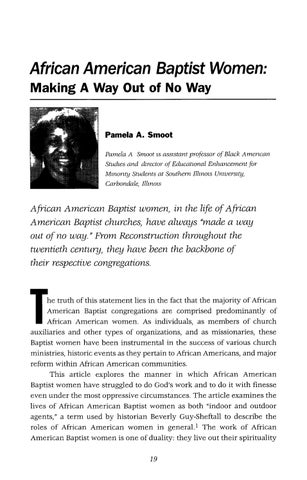
Pamela A. Smoot
:
:
•fcllr !illlifciC :
Pamela A Smoot is assistant professor of Black American Studies and director of Educational Enhancement for Minority Students at Southern Illinois University, Carbondale, Illinois
African American Baptist women, in the life of African American Baptist churches, have always "made a way out of no way." From Reconstruction throughout the twentieth century, they have been the hackhone of their respective congregations.
T
he truth of this statement lies in the fact that the majority of African American Baptist congregations are comprised predominantly of African American women. As individuals, as members of church auxiliaries and other types of organizations, and as missionaries, these Baptist women have been instrumental in the success of various church ministries, historic events as they pertain to African Americans, and major reform within African American communities. This article explores the manner in which African American Baptist women have struggled to do God's work and to do it with finesse even under the most oppressive circumstances. The article examines the lives of African American Baptist women as both "indoor and outdoor agents," a term used by historian Beverly Guy-Sheftall to describe the roles of African American women in general. 1 The work of African American Baptist women is one of duality: they live out their spirituality 19
20
Baptist History and Heritage I Winter 2007
inside African American Baptist churches and they work for reform outside their churches, often encountering great challenges and taking on herculean tasks. This article accomplishes the goals set forth above in four sections: (1) African American Baptist women as missionaries, focusing on the lives and contributions of Louise "Lulu" Fleming, Nora Antonio Gordon, Emma Delaney, and Sarah Williamson, all who served as missionaries in Africa; and Shirley Russell, who was a missionary in Haiti; (2) African American Baptist women as leaders, focusing on the lives of Maggie Lena Walker, who was an entrepreneur and was also the moving force behind a mutual-aid society, and Nannie H. Burroughs, who served as an institution-builder; (3) African American Baptist women as civil rights workers, focusing on Mary Fair Burks and JoAnne Robinson, who were the "movers and shakers" of the Montgomery Bus Boycott; and (4) African American Baptist women as founders of women's ministries, ministries located outside and inside the church. These women include Diana Marshall, founder of New Dawn Beginnings Ministries, and the leaders of the Women's Ministry of Pittsburgh's Ebenezer Baptist Church. In addition, the article will demonstrate how these Baptist women prepared to meet their respective challenges and to complete successfully their tasks by "making a way out of no way."
African American Baptist Women Missionaries African American Baptist women were pioneers in the great work in Christian missions. They established a noble record of leadership in the National Baptist Convention, U.S.A., Inc. (NBC-USA), and the Lott Carey Baptist Foreign Mission Convention. The African American missionary tradition derives from the eighteenth-century evangelism that stressed that God deals directly with the individual and that all faithful Christians have a sacred duty to share their faith with others. 2 Missionary work may be characterized by two dimensions: (1) the spiritual dimension, which describes those Christians who attempt to convert other people through religious instruction and preaching, and (2) the temporal dimension, which identifies the work of those Christians performing tasks of a humanitarian nature such as providing their charges with an education or medical care. 3 In the nineteenth century, African American
African American Baptist Women: Making A Way Out of No Way
21
Baptist women who served on foreign mission fields worked as nurses, teachers, and preachers. Others performed even greater tasks. Louise "Lulu" Fleming was born a slave in Hibernia Clay County, Florida, on January 28, 1862. She graduated from Shaw University in 1885 and left the United States two years later for the mission field. Assigned to Palabala, Congo, by the Woman's Baptist Foreign Missionary Society of the West, her initial charge was to teach primary classes in English. Returning to the United States in 1892, because of declining health, she realized that she needed "to make a way out of no way," and thus, Fleming enrolled in the Leonard Medical School and subsequently completed the medical course at Philadelphia's Woman's Medical College. In addition to teaching, Fleming could now provide much needed medical care to the people she was to serve in the mission field. Nora Antonio Gordon, the daughter of two former slaves, also dedicated her life to foreign missions. She entered Spelman Seminary in 1882 and graduated in 1888, and under the auspices of the Woman's Baptist Missionary Society, she too was assigned to the Congo after additional training as a missionary. Although Gordon taught Sunday School and day classes, her ideas were similar to those held by members of early black women's clubs. Those women emphasized the teaching of good morals to black women and girls. Gordon wrote, "If we can save women, girls and have intelligent Christian wives and mothers, it would change the entire atmosphere of the community."4 In Sisters, Servants, or Saviors? National Baptist Women Missionaries in Liberia in the 1920s, Jeannine DeLombard presented the story of three early-twentiefh-century women: Emma Bertha Delaney, Susie Taylor, and Eliza Davis. These women established missions and schools in Liberia, which grew into flourishing institutions within ten years.5 Delaney founded Suehn Industrial Mission in Montserado County, Liberia, in 1912, using land donated by the Liberian government. Because of limited resources, she was compelled to "make a way out of no way." She raised a substantial amount of money to support the school while she was on furlough in the United States. Delaney also established sewing classes and a women's society in Malawi. In establishing their school, Susie Taylor and Eliza Davis performed intense physical labor. They cleared the land of trees and other vegetation themselves so that the Baptist Industrial Academy in
22
Baptist History and Heritage I Winter 2007
Liberia could be constructed. With few resources or no resources, these women "made a way out of no way." Being a missionary in the foreign field was no easy task during the nineteenth century, but by the end of the twentieth century, missionaries had access to new technology and to more advanced medical care, and thus, their work was perhaps not as difficult. One twentieth-century female missionary, Shirley Russell, who is now an ordained minister of Pittsburgh's Ebenezer Baptist Church, spent twelve years serving in Haiti during the tumultuous Baby Doc Duvalier dictatorship. While there, Russell observed the mistreatment of many people. The political circumstances "did not allow her to say or preach anything except Jesus Christ." Nor could she verbalize any negative criticism of the Haitian government without incurring possible retaliation. Clearly understanding the political climate and the restrictions, Russell assumed her charge as a missionary. Many African American Baptist women in foreign missions focused their work on education and medical care, and most paid close attention to the needs of women. Russell's emphasis, however, was on children. She founded an orphanage in Port-au-Prince, Haiti, called the "Love Center Mission." The mission provided children with a safe place to sleep and fed and clothed them. The mission's goal was "to take the children out of darkness [and] into the marvelous light."6 An already existing, twostory structure was purchased, and the new orphanage was equipped with a pharmacy and a huge kitchen. Russell recalled, "I had forty-three children in the orphanage and eventually almost 200. Sometimes, I would wake up in the mornings to find children on the doorstep with a note attached to them."7 Russell realized that as an American she had everything compared to many people in Haiti, but as a missionary, she felt compelled to adapt to her environment. Russell ate the same food she served the orphans, but when she drank the same water, she became quite ill. She remembered that illness: "After three days of being one 'sick sister,' I recovered. Once the water was out of my system, I was alright."8 This setback was only a minor one for Russell because Ebenezer Baptist Church in Pittsburgh, Pennsylvania, soon began providing additional support for the Haiti mission station by ensuring a weekly delivery of water by truck. While in Haiti, Russell realized that there were significant religious
African American Baptist Women: Making A Way Out of No Way
23
differences between the Christianity she proclaimed and the faith of the Haitian people, but she refused to make any adjustments on her part. God, she said, "sent me there to introduce those bound in voodoo to Jesus Christ and many of the Haitians believe in Voodoo like we believe in Jesus Christ."9 Preaching the gospel among Haitians once resulted in her being kidnapped, and her life was threatened. Those whom she was trying to help conspired against her, and she was physically snatched, placed into a car, and forced to sit at a table all night. During that night, she focused on prayer, and the next day, she was released and her life was spared. Russell was driven to a location where she could find her way back to Port-Au-Prince. Russell attributed her safe arrival back at the orphanage to Jesus, the way maker. African American Baptist Women Leaders African American Baptist women have had an enormous impact on the lives of members of their race in several different capacities. The women have worked within state and national Baptist conventions, black women's clubs, and fraternal orders, and they have been entrepreneurs. In all capacities, the individual efforts of these Baptist women leaders have benefited the African American community. Within African American Baptist denominations, the place of women has been one of continuous debate. Yet, African American Baptist women "contributed to the advancement of the black church and community, [and] they constituted the largest group of African American Christians" in the United States.10 Largely through their organized fundraising, Baptist churches became the most important institution in black communities. In an effort to clarify the debate about women's roles, Guy-Sheftall noted that "a majority of those engaged in this discussion about the proper roles for African American women" recognize that these women must be both "indoor and outdoor agents."11 Maggie Lena Walker became such an agent. She was born July 15, 1867, in Richmond, Virginia, to Elizabeth Draper, a laundress, and Eccles Cuthbert, an Irishman and newspaper correspondent. Walker's early education took place in a school that had no plumbing and was led by an all-black faculty. At fourteen, Walker joined Richmond's oldest and largest African American Baptist congregation, First African Baptist Church, and she was baptized during the Great Richmond Revival of 1878. Prior to
24
Baptist History and Heritage I Winter 2007
graduating from the Normal School in 1883, she joined the Good Idea Council No. 16 of the Independent Order of St. Luke, which was one of the many mutual-aid societies in Richmond.12 This order, founded by Mary Prout in 1867, focused on women's sicknesses and had a death mutual-benefit association. Two years after its inception, William T. Forrester served the organization as grand secretary. Under his watch, the treasury dwindled to $31.61, and the order was $400 in debt despite its expansion into New York and Virginia, and despite having 1,080 members and 57 councils.13 Forrester relinquished his position, citing a lack of progress, and Walker replaced him as grand secretary.14 The order soon thrived under Walker's leadership. The membership increased to more than 100,000, the number of councils grew to 2,010, and the order expanded and was soon active in 28 states. Walker's early accomplishments included the creation of a juvenile department, an educational loan program for young people, and the St. Luke Herald, a weekly newspaper. More importantly, in 1903, she founded in Richmond, Virginia, the St. Luke Penny Savings Bank, and thus became the first woman bank president in the United States. During this same year, under her leadership, St. Luke built a three-story brick headquarters to house its operations. Iwo years later, in 1905, Walker led twenty-two of St. Luke's black women in establishing a department store called the Emporium. Walker then began to focus on economic opportunities that would enhance the prospects of Richmond's African American community, especially for African American women. In general, these women faced limited job opportunities and low wages. In 1900, 83.8 percent of African American women worked in domestic or personal service. In Richmond, less than one percent of the employed African American women worked in clerical or skilled positions. In addition to domestic or personal service positions, many black women of this era worked as sharecroppers or laborers in tobacco establishments. Elsa Barkley Brown, in her article "Womanist Consciousness: Maggie Lena Walker and the Independent Order of St. Luke," noted that St. Luke "was especially important to the community in terms of employment." Its enterprises afforded African American women employment opportunities with what was considered high wages in those days, and women could earn as much as $50 per month.
African American Baptist Women: Making A Way Out of No Way
25
Fifty-five clerks worked in the St. Luke's home office, which represented more than one-third of Richmond's African American clerical workers in 1920.15 Walker's successes as a banker and entrepreneur landed her an invitation to address the Women's Convention in 1920 so that she could provide African American Baptist women with financial advice.16 Her message focused on hope and encouraged women to build their selfesteem, to have courage, and to establish a new sense of spirituality. Given the circumstances that most African American women were facing in the early twentieth century, as they encountered racism, sexism, and sometimes stressful work environments created by white male employers, Walker's accomplishments gave the women hope that they too could "make a way out of no way." Later, St. Luke's department store was sabotaged by several of Richmond's white merchants and subsequently closed, but other business components of the St. Luke order continued to serve the community.17 While Walker was institution-building in Richmond, Nannie Helen Burroughs, founder of the Women's Convention, an auxiliary to the National Baptist Convention (NBC), was determined to establish a training school for girls. Her idea of a school received overwhelming support from the Women's Convention, but soon met opposition from the NBC president, E. C. Morris, who claimed if a school was built, the women would lose interest in foreign missions. Despite his strong opposition, the National Training School for Women and Girls was established in October 1909, in Washington, D.C.'s Lincoln Heights community. Burroughs clearly understood and accepted the unfortunate reality that the vast majority of black women would be domestic service workers. As a result, she asserted that the purpose of building such an institution was to professionalize domestic work, to dispel the characterization of black women as lazy, to build finer womanhood, to enhance employment opportunities, to train women to do mission work in other lands, and to prepare women as Bible teachers for Sunday Schools.18 The task of developing the new school was complex, but Burroughs took on this task and sought to protect and sustain the new school. In 1915, the NBC split into two conventions, and if the National Training School had been tied to the denominational structure, both sides would
26
Baptist History and Heritage I Winter 2007
have attempted to claim it in the squabble.19 During this time of tension, Burroughs sought legal advice from E. Hilton Jackson, a distinguished white Southern Baptist lawyer. He assured her that the school's charter, which had been issued in Washington, D.C., included a provision that declared the school's independence from the NBC and stated that the school would be managed by a board of trustees.20 By 1929, the school was flourishing with eight buildings situated on eight acres of land, 102 students, eight teachers, and four assistants. Then came the Great Depression, which had a disastrous effect on the school's donors and threatened its power base. African Americans, who provided financial support for the school, were devastated by this economic disaster. Many of them could barely afford to sustain themselves and their families, and they could not continue donating extra money to the school. Unable to raise sufficient monies to pay the mortgage or the faculty and staff, Burroughs was forced to close the school. In a letter to Una Lawrence, a leading white Southern Baptist woman, Burroughs wrote: "It is sound business to save the property by paying what we can to raise the mortgage debt."21 That property was worth an estimated $225,000. Making a herculean effort, Burroughs reopened the National Training School, and she used innovative ways to do so. She needed $2,000 in cash to install a heating plant and $1,000 for repairs and paint.22 "Making a way out of no way," she sought two methods to raise the necessary funds and offered an incentive. Her plan was to obtain $1.00 per month from 1,000 people and that money would go toward school repairs and current expenses. She also would urge 100 churches, organizations, or individuals to give $100 in one payment or in installments. She then formed a committee of 100 people under the direction of two Baptist ministers, T. J. King, pastor of Ebenezer Baptist Church, Pittsburgh, Pennsylvania, and J. C. Austin, pastor of Pilgrim Baptist Church, Chicago, Illinois. Both men were nationally known leaders within the Baptist denomination. Also on that committee was Sarah E. Miner of Washington, D.C.23 The committee was charged with the task of soliciting donors, which proved to be successful, for in 1937, Burroughs was able to reopen the school. The names of the donors were published in the newly established National Training Professional School Bulletin.
African American Baptist Women: Making A Way Out of No Way
27
African American Baptist Women as Civil Rights Workers From its inception, African American women played a major role in the Civil Rights Movement. They organized activities, performed most of the mundane tasks, mobilized existing social networks, disseminated information, and coordinated activities.24 The presence and participation of African American women in the movement can be explained in terms of religious commitment. For example, the movement grew out of churches, and women participated in their churches more than men did. This phenomenon continued through the 1980s, when a study of black religious organizations revealed that women represented 75 to 90 percent of the participants in church-related activities.25 Often the history of the Civil Rights Movement has been perceived by persons and taught in the nation's classrooms as if it were initiated by Martin Luther King, Jr., which was definitely not the case. While this statement is not intended to disrespect this historic icon and his legacy, the truth, especially about the Montgomery Bus Boycott, is that it took place as a result of the leadership of two African American Baptist women: Mary Fair Burks and JoAnne Robinson, both of whom were English professors at Alabama State College in Montgomery. They were also members of Montgomery's Dexter Avenue Baptist Church, where King served as pastor. Reared in Montgomery, Burks was an early civil rights activist, and during the 1930s, she blatantly violated segregation laws by riding whiteonly elevators and using white-only restrooms. Formally educated at Alabama State College, Burks earned a Bachelor of Arts degree in English literature. Later, she earned a Master of Arts degree in African American literature from the University of Michigan. Upon completing her graduate studies, Burks returned to Montgomery and began a teaching career. She later earned a doctorate in education from Columbia University. In 1946, this African American Baptist woman founded the Women's Political Council (WPC), a grassroots organization of African American professional women who hoped to end Jim Crowism in Montgomery and to increase the participation of women in civic affairs. A native of Culloden, Georgia, JoAnne Robinson received her education in Macon's segregated public school system. She became a schoolteacher after graduating from Fort Valley State College. After teaching for five years, Robinson relocated to Atlanta and earned a Master of Arts
28
Baptist History and Heritage I Winter 2007
degree in English from Atlanta University. In 1949, she accepted a teaching position at Alabama State College as an English professor. Robinson soon became involved in Montgomery's civic affairs by affiliating in 1950 with the WPC.26 David Garrow, a Civil Rights scholar, asserted that both women had daunting and disturbing experiences on Montgomery's city buses. As a response to the policy of segregated seating, which they highly despised, Burks and Robinson decided that the WPC should target the racial practices of the bus company, should repeatedly ask the city to dismantle discrimination in public transportation, and should address the conduct of abusive white bus drivers. 27 The leadership of these African American Baptist women was critical to the success of the Montgomery Bus Boycott. The women were the initiators and the "movers and shakers" of what would became a community-wide movement following the arrest of civil rights activist Rosa Parks. After Parks' arrest and in preparation for the boycott, Robinson created a flyer urging Montgomery blacks not to ride the city's buses. She mimeographed 50,000 flyers and enlisted the help of two Alabama State College students to distribute them among Montgomery blacks. In many cases, the students read and explained the flyers to illiterate African Americans, hoping that this effort would encourage greater participation. The first day of the boycott was a great success. In addition to initiating the boycott, African American Baptist women played crucial roles in sustaining it. 28 Robinson and Burks occupied places on all major committees related to the bus boycott, shared in the planning and strategies to desegregate the bus system, managed the carpool system for domestic and other workers, and made demands on city officials. Not until the end of the first day of the boycott did many of Montgomery's African Americans believe that such a brazen effort could be successful; by the end of that day, King and other African American male leaders and ministers had stepped to the forefront and had become the visible leadership of the boycott. When the boycott ended thirteen months later, Robinson and Burks were forced out of Montgomery and had to find employment elsewhere. Because of their leadership efforts in the boycott, they were penalized by state officials, who took the women's teaching positions from them.
African American Baptist Women: Making A Way Out of No Way
29
African American Baptist Women as Founders of New Ministries For over one hundred years, great controversy has arisen over the African American woman's place in American society and also her place in African American Baptist churches. James W. Johnson wrote, "A true woman should not intrude herself on a man's world or do a man's work, such as making laws or preaching. A true woman . . . holds undisputed ways in the gentler walks of life. She thinks she is as great in the pew as man is in the pulpit and hence, she strives to satisfy the Lord and not the bubbling ambition of her soul."29 In the face of this mindset, African American Baptist women have been forced to "make a way out of no way" and find ingenious ways to serve God and their churches. One way that women have successfully been able to engage in such service is through the establishment of women's ministries and church auxiliaries. A recently founded ministry, New Dawn Beginnings Outreach Ministries, based in Pittsburgh, Pennsylvania, was established by Diana Marshall, an ordained minister. Marshall received her formal ministerial training at the American Baptist Theological Seminary Extension School and Harty Bible School in Pittsburgh. After suffering several family tragedies, Marshall recalled, "I was depressed and miserable. The Lord laid on my heart to change my 'misery to ministry,' which began with a Friday night Bible study in my home." The purpose of this outreach ministry was to help those lost, left out, and ignored and to improve their situations. Unlike many ministries and some social service agencies, New Dawn Beginnings does not provide Band-Aids forbad situations, but rather teaches women how to stay fed and to stay dry.30 Tb achieve this goal, New Dawn Beginnings established eight programs, including GED preparation classes; the "Feed and Harvest Market"; the "Friday Night Flight" program; the back-to-school backpack distribution; the delivery of Thanksgiving baskets; and the "Jesus Joy and Toy Campaign."31 Feed the Harvest Market is held on Saturdays, and donated electrical appliances are given away in order to attract people's attention. The women workers serve hot dogs and hamburgers, then they present a gospel message and "give them Jesus." During "Friday Night Flight," members of New Dawn use their personal funds to feed the hungry in West Park, which is located on Pittsburgh's north side. Barbara Crosby, a registered nurse, explained the ministry's approach to the delivery of Thanksgiving baskets:
30
Baptist History and Heritage I Winter 2007 We do not want soups that people have had in their cupboards forever. We want the people to have the same kind of foods we are having—turkey, ham, dressing, green beans, sweet potatoes, cranberry sauce, and dessert. We give complete baskets to the needy. While other organizations require the recipients to pick-up their Thanksgiving baskets, members of New Dawn deliver the baskets to them. And believe me, we have been to some places where people are living in conditions you could not even imagine.32
In other words, the New Dawn workers strive to make Thanksgiving a memorable one for the people they serve. The "Back-to-School Back Pack" program is designed to assist children returning to school each fall. In the past few years, New Dawn Ministries successfully solicited a school bus from Laidlaw Bus Company, and after identifying students who would not ordinarily have backpacks, several volunteers obtained new backpacks and stuffed them with donated school supplies and filled the entire bus with these backpacks, which were then distributed to the students. The "Jesus Joy and Tby Campaign" held each December was established by New Dawn and the Women's Ministry of Ebenezer Baptist Church, l b collect toys for the campaign, New Dawn places donation boxes in churches, health facilities, and other venues. Following the collection of toys, New Dawn works with the staff at the Sojourner House, which is a facility for women addicted to drugs and alcohol. The women living at the house are in treatment programs and have their children residing with them. These children are the recipients of the toy campaign. Another ministry offered by Sojourner House is geared toward children whose mothers are incarcerated. The successes of New Dawn Ministries are many. During 2004 and 2005, the ministry distributed free clothing to the homeless; fed an excess of 800 people during February through its "Bread of Life Ministry;" provided 250 families with substantial Thanksgiving baskets; gave 250 children new toys for Christmas; and invited 200 children to board a school bus donated by Laidlaw Bus Company and to select a new backpack filled with school supplies. 33 For the beneficiaries of New Dawn ministries, what seemed to be "a way out of no way" was made possible.
African American Baptist Women: Making A Way Out of No Way
31
Conclusion
African American Baptist women have made a positive impact on the lives of people who have benefited from their work on the foreign mission field, in churches, and in the African American community. Spiritually, morally, socially, educationally, and economically, these women have met needs. The struggles they encountered, the oppression they faced, and the sacrifices they made surely reflect the words of the renowned abolitionist Frederick Douglass, who said, "Without struggle, there is no progress." These words may aptly be applied to the efforts of the Baptist women who are the focus of this article. The idea of African American Baptist women and their ability to "make a way out of no way" can be attributed to their church membership. More than 60 percent of the members of African American Baptist churches are women. Because of the obvious gender imbalance and overwhelming presence of African American Baptist women in churches, women play a greater role than men in empowering the church. Joyce Dungey, a member of Nashville, Tennessee's Friendship Baptist Church, noted, "The women were there, worked hard financially, and did whatever needed to be done.34 The responses to the roles that African American Baptist women held have been varied, but many African Americans are grateful for the leadership and work of women. When asked about the role of women, Sidney Logwood, pastor of Rock Hill Baptist Church in Carbondale, Illinois, responded with a quote from Audrey Lawson Brown: "Neither the family nor the church could continue without the participation of women. In church and home, women are aspired to be first and foremost mothers who nurture, teach, nurse and sustain the body, and spirit of the sacred and secular."35 Logwood asserted that African American Baptist women are essential to the church and contribute heavily to its survival, but he contended that ultimately "Jesus is the way maker." ESQ 1 Beverly Guy-Sheftall, Daughters of Sorrow Attitudes Toward Black Women, 1880-1920 (New York: Carlson Publishing Co., 1990), 155. 2. Sandy Dwayne Martin, "Missionary Movement," in Black Women in America An Historical Encyclopedia, vol. 1, eds. Darlene Clark Hine, Elsa Barkely Brown, Tiffany Patterson, and Rosalyn Terborg-Penn (New York: Carlson Publishing Company, 1990), 1817. 3. Ibid.
32
Baptist History and Heritage I Winter 2007
4. Sylvia M. Jacobs, "Nora Antonio Gordon, 1866-1901," in Black Women in America, vol. 1, 494. 5.Jeannine DeLombard, "In Sisters, Servants, or Saviors? National Baptist Women Missionaries in Liberia in the 1920s," The International Journal of African Historical Studies 24, no. 2 (1991): 330. 6. Shirley Russell Pierre, telephone interview by Pamela A. Smoot, May 15, 2007. 7. Ibid. 8. Ibid. 9. Ibid. 10. Evelyn Higginbotham, "Baptist Church," in Black Women in America An Historical Encyclopedia, 1:84. 11. Guy-Sheftall, Daughters of Sorrow, 155. 12. Gertrude Marlowe, "Maggie Lena Walker," in Black Women in America An Historical Encyclopedia, 1:1214. 13. Elsa Barkley Brown, "Womanist Consciousness: Maggie Lena Walker and the Independent Order of St. Luke," Signs 14, no. 3 (Spring 1989): 616. 14. In 1880, African American men were extended invitations to become members of the Independent Order of St. Luke. Walker sought to encompass the entire African American community within the order because she believed that anyone who was interested, regardless of their socio-economic status and occupation, should be able to participate in the work. 15. Brown, "Womanist Consciousness," 624. 16. Ibid., 170. 17. From its inception, the Emporium faced great opposition from Richmond's white retailers who feared serious competition and losing African American customers. First, they also sought unsuccessfully to purchase the future site of the Emporium for a price higher than was paid by the Independent Order of St. Luke if it would agree to forego the idea of and opening the department store. The proposition fell on deaf ears. These white merchants contacted wholesale retailers in New York and threatened to discontinue their business relationship with them if they sold goods to the Emporium. 18. "National Training School for Women and Girls, Miss Nannie H. Burroughs, President," in Una Lawrence Collection, Nannie Burroughs, Box 1, FF 3.3, Southern Baptist Historical Library and Archives (SBHLA), Nashville, TN; and Sharon Harley, "Nannie Helen Burroughs: The Black Goddess of Liberty," Journal of Negro History 81, no. 1 (Winter 1996): 4. 19. Nannie Burroughs to Una Lawrence, May 1, 1937, 2, in Lawrence Collection, Box 1, FF 29. 20. "Baptist Convention Hardly Will Open National Training School," St Louis Argus, August 5, 1938, in Una Lawrence Collection, Nannie Burroughs, Box 4, FF 7, 1938, SBHLA. 21. Nannie Burroughs to Una Lawrence, May 1, 1937, 3, in Lawrence Collection, Box 1, FF 29. 22. Nannie H. Burroughs to Una Lawrence, May 1, 1937, 4, in Lawrence Collection, Box 1, FF 29. 23. Pamphlet, National Trade and Professional School For Women and Girls, 2, in Lawrence Collection, Box 1, FF 25. 24. Karen Sacks, "Gender and Grassroots Leadership," unpublished paper, University of California at Los Angeles, undated, 5, 16. 25. Charles Payne, "Men Led, but Women Organized: Movement Participation of Women in the Mississippi Delta," in Trailblazers and Tbrchbearers Black Women in the Civil Rights Movement, eds. Vicki L. Crawford, Jacqueline Rouse, and Barbara Woods (New York: Carlson Publishing Company, 1990), 5. See also Cheryl Gilkes, "Together and In Harness: Women's Traditions in the Sanctified Church," Signs 10, no. 4 (Summer 1985): 679.
African American Baptist Women: Making A Way Out of No Way
33
26. Mary Fair Burks, "Trailblazers: Women in the Montgomery Bus Boycott," in Black Women in United States History, vol. 16, eds. Darlene Clark Hine, Elsa Barkley Brown, Tiffany Patterson, and Rosalyn Terborg-Penn (New York: Carlson Publishing Company), 74. 27. David Garrow, "Women's Political Council," in Black Women in America An Historical Encyclopedia, vol. 2, eds. Darlene Clark Hine, Elsa Barkely Brown, Tiffany Patterson, and Rosalyn Terborg-Penn (New York: Carlson Publishing Company, 1990): 989. 28. Stewart Burns, "Women's Political Council," in Black Women in America. An Historical Encyclopedia, 2:1280. 29. Guy-Sheftall, Daughters of Sorrow, 155. 30. Barbara Crosby interview by Pamela A. Smoot, Pittsburgh, PA, June 1, 2007. Crosby is a registered nurse, a member of Ebenezer Baptist Church, and secretary of New Dawn Beginnings Outreach Ministries. 31. New Dawn Beginnings Outreach Ministries, Inc. (Undated pamphlet). 32. Crosby interview, June 1, 2007. 33. "New Dawn Outreach Ministries, Inc.: From Misery to Ministry," Rejoice, Black Church Journal and Directory, vol. 3-4, Pittsburgh, PA, October 2005. 34. Joyce G. Dungey interview by Pamela A. Smoot, April 21, 2007. 35. For more information, see Audrey Lawson Brown, "Afro-Baptist Women's Church and Family Roles: Transmitting Afro-centric Cultural Values,