Businesses of any size based in Greater Lincolnshire or with significant operations in the area
ONS estimates for 2025 indicate that there are 38,665 VAT and/or PAYE registered enterprises located in Greater Lincolnshire.
The senior business decision makers in these enterprises with responsibility for employee recruitment, development and training, represent the population to be researched.
ONS Business Workbook 2025
Table 10 - Number of VAT and/or PAYE based enterprises in districts, counties and unitary authorities within region and country by employment sizebands
not necessarily true zeros.
NB We appreciate that there are likely to be at least as many entities that are NOT registered for VAT or PAYE but they will normally be micro businesses: sole traders, consultants and freelancers, who do not employ anyone. Therefore, skills gaps can only apply to them personally.
We recognise that a minority may have made unsuccessful attempts to recruit others and so have experienced skill shortage. VAT or PAYE registration were NOT qualifying criteria to participate in the research, presence of at least one employee based in Greater Lincolnshire was applied as a criteria.
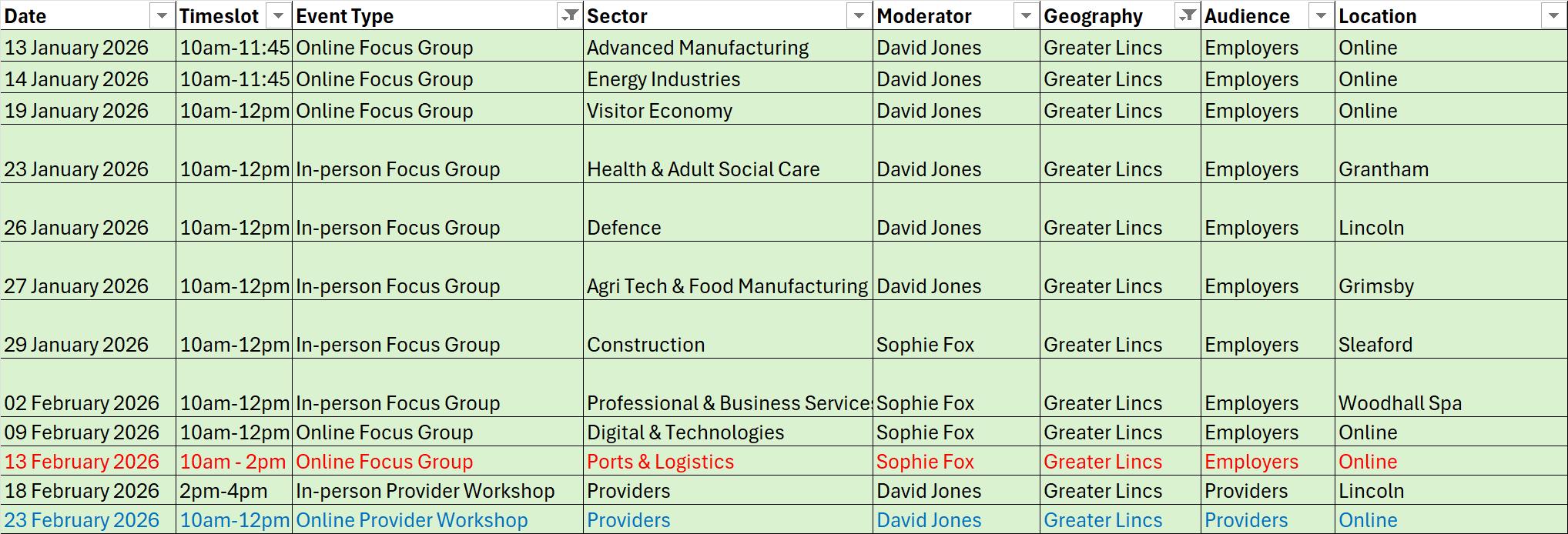
Focus Groups | Conducted with senior decision makers in the Priority Sectors plus two workshops with Providers
Nine x 2-hour Focus Groups were conducted with Employers in the Priority Sectors between 13th January and 10th February 2026.
Two x 2-hour Workshops with the representatives of Education and Training Providers were conducted between 18th and 23rd February 2026
• 6 of the Focus Groups and the Provider workshop were conducted in-person
Participant recruitment to the Focus Groups was handled by the FSB in collaboration with GLCCA.
NB A Focus Group with employers in the Ports & Logistics sector was scheduled to take place but low engagement meant that this had to be cancelled. It was replaced with an additional workshop with Providers, based upon the level of demand to engage from this population.
Some general insights | The size of an Employer organisation can mean that skill shortage for a large organisation can present as a skills gap for a small or micro business.
Large or Medium Size Organisation
Several IT Managers. IT 100% of what each jobholder does.
An unfilled vacancy here is Skills Shortage.
Small Business
1 x Operations Manager. IT around 30% of their responsibilities
Individual weakness in IT is a Skills Gap.
Micro Business
1 x Owner or MD. IT around 10% of their responsibilities
Individual weakness in IT is a Skills Gap.
Some
general insights | Standard Occupational Classifications (SOCs) struggle to keep up with new and emerging job roles.
The ONS Standard Occupational Classifications (SOCs) last underwent a major updated with the introduction of SOC 2020, which was released in February 2020, exactly six years ago.
Occupations and job roles have changed and evolved in quite fundamental ways since then, particularly in Digital & Tech, Renewable Energy, etc. There was very little, if any, talk of AI back in 2020 for instance.
Given the richness of published data available that relates to the SOCs we can understand the appeal of relying quite heavily on these data sets to identify the Potential Priority Occupations that were proposed by Greater Lincolnshire Council and used as stimulus with the Focus Group and incorporated in the Online Survey.
However, the speed of role evolution and new roles emerging, is likely to mean that the fastest moving sectors see a disconnect between the roles that are regarded as recruitment priorities for them and the Potential Priority Occupation stimulus used within the research.
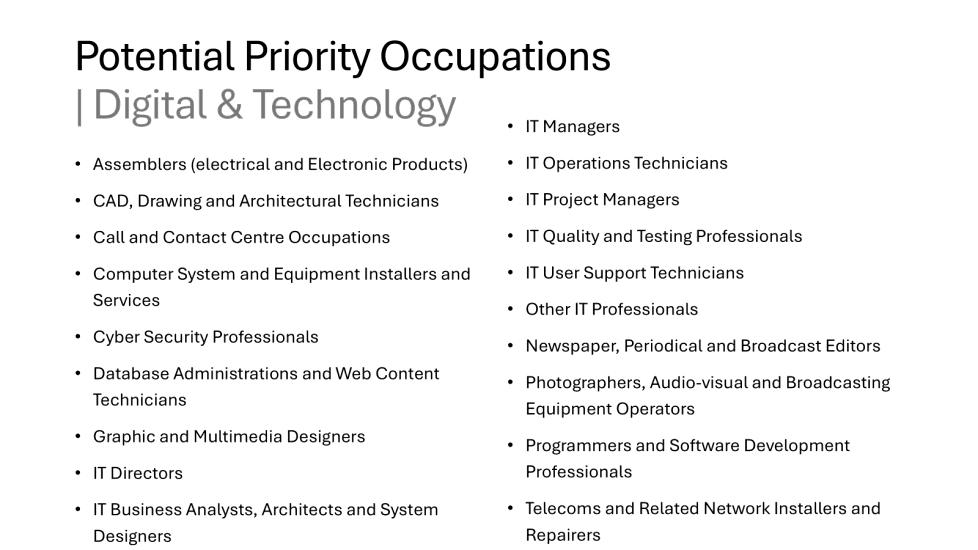
of Potential Priority Occupations stimulus slide used within the Focus Groups.
Example
1.0 Participant sample profile
Sector | Overall, survey participants drawn from the Priority Sectors account for over 63% of the total sample or 264 participants.
Which industry sector does your organisation primarily operate within?
| By Priority Sector status groups
NB Many of the results and findings from the survey will be reported using this consolidation of all Priority Sectors combined versus all of the Non-priority Sectors combined. The aim is identifying variations in these robust sample bases, that can then be investigated in greater detail at a more directional level.
Some of the survey results will be reported split across each of these seven Priority Sectors. Whilst the bases here are comparatively larger, the findings should still be regarded as directional in nature, rather than statistically robust.
Which industry sector does your organisation primarily operate within?
Sector | Seven of the ten Priority Sectors each account for at least 3.6% of the sample and can be reported on individually.
Base: Marine (excluding Ports) (n=0), Space and Air (n=0), Hair and Beauty (n=1), Environmental Services (n=2), Scientific (including Life Sciences) (n=2), Wholesale (n=3), Energy Industries (n=4), Critical Minerals (n=5), Defence and Security (n=5), Real Estate Activities (n=6), Transport, Ports and Logistics (n=6), Public Administration and Local Government (n=8), Creative and Cultural (n=14), Visitor Economy (including Accommodation and Food Service) (n=15), Agriculture, Forestry, Fishing and Food Manufacturing (n=16), Financial Services (n=19), Retail (n=26), Construction (n=31), Education (n=32), Other (n=34), Health and Social Care (n=44), Professional and Business Services (n=47), Digital and Information Technologies (n=48), Manufacturing and Engineering (n=48), Sample Size = 416
Size | At 21%*, the share of organisations in the Priority Sectors with known annual turnover in their last financial year of between £1m - £4.9m, was markedly higher than for the Non-priority Sectors (17%*).
Which of the annual turnover bands below would your organisation fall into, based upon performance in your last financial year?
Incidence of achieving annual turnover of £10m-£49.9m was also much higher in the Priority Sectors.
*NB Percentages here ignore participants answering ‘Don’t know’ which can often be where T/O is not emphasised as a metric, e.g. Defence, NHS, Education, etc.
Size | Over half (51%) of the Professional and Business Services organisation have annual turnover below £249k, whereas 44% in Advanced Manufacturing achieved £10m+.
Which of the annual turnover bands below would your organisation fall into, based upon performance in your last financial year? | By Priority Sector
The firmagraphic profile of the Priority Sectors is very different. Published ONS data for VAT and/or PAYE registered businesses should be referenced to aid comparative understanding of the composition of each sector.
Location | 71% of the organisations in the Priority Sectors have their head office or primary location in Greater Lincs; they are therefore invested in the area’s skills profile and capacity.
Please select the description below that best reflects the location of your organisation.
Total Priority Sectors Non Priority Sectors
Our head office or primary location is in Greater Lincolnshire.
We have significant sites, operations or employees in Greater Lincolnshire but our head office is located elsewhere.
Base: Our head office or primary location is in Greater Lincolnshire. (n=294), We have significant sites, operations or employees in Greater Lincolnshire but our head office is located elsewhere. (n=122), Sample Size = 416
District | A comparatively larger proportion of the Priority Sector participants’ organisations are based in: South Kesteven (+4.8% v Non), North Lincs (+4.4%) South Holland (+3.6%) or West Lindsey (+2.8%).
Which district, from those listed below, is your organisation based in (e.g. head office or primary location)?
Boston Borough (n=13), City of Lincoln (n=70), East Lindsey (n=30), North East Lincolnshire (n=42), North Kesteven (n=28), North Lincolnshire (n=36), South Holland (n=15), South Kesteven (n=34), West Lindsey (n=22), None of the above (n=4), Sample Size = 294
Employee base | Priority Sector employer organisations are more likely than Non-priority to be Small Businesses with 11-49 employees (22% .v. 12% Non), whereas the latter are more likely to have No employees (12% v 6% Priority)
What size is the total current workforce in your organisation?
54% of participants in the Priority Sectors work in organisations with 50+ employees, equating to Medium or Large enterprises. 23
Employee base | 44% of the participants in Digital and Tech, 35% in Advanced Manufacturing and 34% in Health and Adult Social Care, are working in large organisations with 250+ staff.
Approximately, what percentage of your overall workforce is based in Greater Lincolnshire? | By Priority Sector
Conversely, 55% of the participants from the Professional and Business Services sector are working in organisations with fewer than 10 employees, if any.
We assume that account will be taken in the LSIP of:
• Total employees by size band of organisation within each of the Priority Sectors and overall, for GLCCA.
• Both size and sector, independently and when combined, merit careful consideration.
Workforce location | 40% of the total sample of employers, have all of their staff based in Greater Lincolnshire, and in that way, are directly invested in the skills ecosystem in the area. Approximately, what percentage of your overall workforce is based in Greater Lincolnshire?
Workforce location | Employers in the Non-priority Sectors, across each size of business, are more likely than those in the Priority Sectors, to have all of their employees based in the GLCCA area.
Approximately, what percentage of your overall workforce is based in Greater Lincolnshire? | By size of workforce and priority status
Base: Priority Sectors/Micro (less than 10 employees) (n=48), Priority Sectors/Small (11 to 49 employees) (n=57), Priority Sectors/Medium (50 to 249 employees) (n=69), Priority Sectors/Large (250+ employees) (n=73), Non Priority Sectors/Micro (less than 10 employees) (n=33), Non Priority Sectors/Small (11 to 49 employees) (n=18), Non Priority Sectors/Medium (50 to 249 employees) (n=37), Non Priority Sectors/Large (250+ employees) (n=46), Sample Size = 381
Recruitment | 84%* of all employers have either recruited new employers, or tried to do so, over the last 12 months, with incidence rising to 88%* for the Priority Sectors.
Approximately, how many Full-time Equivalent (FTE) employees have you recruited to your organisation over the last 12 months?
The mode number of new recruits in Priority Sector organisations in 2025 was 2-5 employees.
*NB Percentages exclude ‘Don’t know’.
Base: None - no attempt made to recruit (n=64), None - but did try and recruit (n=9), 1 (n=32), 2-5 (n=67), 6-10 (n=45), 11-20 (n=52), 21-30 (n=37), 31-40 (n=17), 41-50 (n=20), 51-100 (n=25), More than 100 (n=32), Don't know (n=16), Sample Size = 416
Recruitment experience trend | 40% of employer organisations indicated that recruitment was ‘Harder’ or ‘Much harder’ in 2025 compared with 2024, with this perception equally widespread in Priority and in Non-priority Sectors.
Compared with 2024, would you say that recruiting new employees to your organisation in 2025 was...?
Recruitment experience trend | The incidence of finding recruitment ‘Much harder’ has risen by +3.1% to 11.5%, compared with the equivalent LSIP Phase 2 survey in 2024.
LSIP 2026-29 Survey Jan-Feb 2026 = Compared with 2024, would you say that recruiting new employees to your organisation in 2025 was...?
LSIP 2023-26 Phase 2 Survey Sept-Oct 2024 = Over the last 12 months, would you say that recruiting new employees to your organisation has been...?
Recruitment experience trend | Agri-Tech and Food Manufacture (mean 1.81/5.00) appear to have found recruitment particularly difficult in 2025.
Compared with 2024, would you say that recruiting new employees to your organisation in 2025 was...? | By Priority Sector
Based upon mean ratings, five of the eight Priority Sectors that we can report on individually, delivered ratings that indicated greater aggregate difficulty with recruitment than was the average or norm across the total sample (2.71/5.00).
Recruitment experience trend | Whilst small bases Agri-Tech and Food Manufacturing, along with the Visitor Economy are the most likely Priority Sectors to have found recruitment ‘Much harder’ in 2025 than in 2024.
Compared with 2024, would you say that recruiting new employees to your organisation in 2025 was...? | By Priority Sector
48% of the employers in the Construction sector found recruitment ‘Harder or Much harder’ in 2025 compared with a year earlier, the second highest incidence among the Priority Sectors.
Please briefly describe below, what you feel has made recruitment harder or much harder in 2025.
Advanced Manufacturing Because there are to many applicants for to fewer roles
Advanced Manufacturing Higher costs, skills gaps and mismatches
Advanced Manufacturing Its was Harder we were searching for people with some skill levels
Advanced Manufacturing lack of candidates with relevant skills
Advanced Manufacturing lack of candidates with required skills and experience
Advanced Manufacturing Lack of required skills, finding people with right attitude and approach.
Advanced Manufacturing Lack of skills. Even though apprenticeships are in place the level of competency they come out with is not good enough
Advanced Manufacturing Lack of suitable applicants, particularly for minimum wage roles
Advanced Manufacturing Less applications, no shows for interviews and low standard candidates
Advanced Manufacturing minimal interest; our rural location makes it less appealing
Advanced Manufacturing National living wage increases has made the bottom end of the market more competitive. Engineering / Technical skills are in short supply for some trades.
Advanced Manufacturing The relevant skills are more difficult to find. Too many degree qualified people that don’t have relevant skills for industry
Advanced Manufacturing Trying to encourage younger people into manufacturing is tough.
Advanced Manufacturing We are finding it hard recruiting because we have to many people for roles advertised
Agri-Tech and Food Manufacturing Lack of good calibre candidates
Agri-Tech and Food Manufacturing more people using ai, not thinking for themselves, less common sense and skill
Agri-Tech and Food Manufacturing No one wants to change iobs
Agri-Tech and Food Manufacturing younger generation not wanting to work normal hours, lack of interest in sector as deamed as hard work
Construction Increased costs to taking on new starters
Construction Is harder to find normal people nowadays
Construction It is difficult to attract talent.
Construction Lack of construction skills and experience
Construction Lack of new blood into the industry
Construction People don’t apply for the vacancy
Construction People’s are not educated
Construction Quality of applicants
Construction quality of applicants and minimum wage increases
Construction Salary expectations, shortage of applicants, recruitment agencies, skills shortage of applicants, lack of loyalty
Construction You have to be so careful to select the right candidate to protect yourself and your business more so now than ever before
Defence Generating interest level in suitable candidates
Defence No one is will to risk
Digital and Technologies A couple of issues, the labour market has a shortage and there is also an issue of skill mismatch
Digital and Technologies Because it is more harder to find the right people with the proper skillset
Digital and Technologies Higher costs, more expensive youth employment.
Digital and Technologies I don't get much qualified candidates as usual.
and Technologies
Key to highlights:
Yellow = Widest theme within a Priority Sector or full data set where a small volume of responses
Larger amount of applicant from overseas even when specifying we are not looking for overseas. Overabundance of contractors applying instead of FTE. Quality of candidates has seemed to have decreased, running into candidates who can’t answer questions without an AI answering for them.
Digital and Technologies My company only employs specialists within our industry so getting someone who lives near by or willing to relocate was extremely difficult.
Digital and Technologies Not as many quality candidates that have the required skills we are looking for.
Digital and Technologies People under qualified
Digital and Technologies
Digital and Technologies
Digital and Technologies
Recruitment has become harder in 2025 due to a combination of skills shortages, increased candidate expectations, and intensified competition for talent. Rapid advances in AI and technology have widened the gap between available skills and employer needs, while candidates now expect higher pay, flexibility, and purpose-driven work.
Recruitment in 2025 has become increasingly difficult due to several interconnected factors, primarily centered around supply and demand issues, skills gaps, candidate expectations, and economic pressures.
Skills shortages and specialization – Demand for niche, AI-adjacent, and hybrid skill sets continues to outpace supply. Candidate selectiveness – Candidates have higher expectations around pay, flexibility, purpose, and speed of process, and drop out quickly if these aren’t met. Increased competition
Digital and Technologies The skill sets we want are harder to find
Digital and Technologies There were fewer suitably qualified candidates in 2025, making hiring more difficult than in 2024. As technology is evolving, some candidates have refused to upskill
Digital and Technologies Too many people applying
Digital and Technologies We have had a lot of competition in 2025
Energy Laziness
Energy Nobody want to work and the young people expect the moon on a stick
Please briefly describe below, what you feel has made recruitment harder or much harder in 2025.
Health and Adult Social Care AI writing resumes and giving interview techniques to candidates who are not appropriate. Applicants not qualified to correct level
Health and Adult Social Care Because the state of the economy
Health and Adult Social Care Changes in immigration, lack of interest in social care
Health and Adult Social Care Financial funding
Health and Adult Social Care
Health and Adult Social Care
Health and Adult Social Care
Health and Adult Social Care
Lack of good quality candidates who are qualified for the roles.
Lack of people interest in care work
Lack of suitable applicants
People apply and then do not respond or simply apply without experience and don't want to start on a lower wage and received the full training. AI generated CV's that appear good on the surface but when interviewed the experience doesn't match the data placed on the CV. The market is also swamped with people looking for sponsorship.
Health and Adult Social Care people don't want to work
Health and Adult Social Care
People will come in for interview, go through the process and will not carry on but expected to be paid for the training. Some will say that it is not for them as soon as they started. The others did not turn up for interview.
Health and Adult Social Care Recruitment has become harder in 2025 due to persistently low wages in health and social care, which makes it difficult to attract and retain staff. Training requirements are increasingly demanding and can be hard to access, while the role itself is physically and emotionally demanding, leading many potential candidates to seek work in less challenging sectors.
Health and Adult Social Care The immigration laws for international hires and the lack of local candidates for specific job requirements.
Health and Adult Social Care The quality of recruits has worsened
Health and Adult Social Care Think because we are rural and people are struggling to commit to healthcare jobs
Health and Adult Social Care
We use the NHS Jobs website for recruitment. That recently changed and it is a challenging website to navigate. Our organisation is quite wide ranging regarding job roles but I am aware that other positions have struggled to find suitable applicants for the role - this is usually at the interview stage were there appears to be a combination of low confidence and lack of comptence.
Ports and Logistics People are tending to stick with their current employer due to the economic climate.
Professional and Business Services Difficulty finding qualified candidates
Professional and Business Services Our primary operation is recruitment of temporary labour into the food, warehousing, and logistics sector. The appetite for employment in these sectors amongst the 'native', particularly younger generation has diminished significantly over time. Reliance on labour from overseas remains but since Brexit we have experienced significant challenges in recruiting people into more skilled roles. The 'quality' - in the broadest sense of the word - of migrant labour available since Brexit has declined and the gap between entry-level and more skills roles is often to large to bridge for these workers.
Professional and Business Services Poor quality of applications, difficulty in people turning up for interview, expense of advertising vacancies - and I wouldn’t mind that if it was at least successful in leading to a recruit
Professional and Business Services Quality
Professional and Business Services Quality of candidates not there. Candidate expectations too high.
Professional and Business Services Requirements
Professional and Business Services Trying to find people who will work is difficult
Professional and Business Services Wages
Visitor Economy Lack of skilled personal answering recruitment advertisement
Visitor Economy Lack of trained personnel
Visitor Economy People are reluctant to work and there are so many dual job roles they only want specific venues or roles
Visitor Economy quality of applicants, lacking range of skills and far too many (about 40%) spurious applications on Indeed
Please briefly describe below, what you feel has made recruitment harder or much harder in 2025.
Non Priority Sectors Applicants over use of AI makes recruitment much harder.
Non Priority Sectors Budget cuts
Non Priority Sectors Candidates are not suitable and fewer apply
Non Priority Sectors Didn’t seem to be many genuine motivated candidates.
Non Priority Sectors Due to lack of support and candidate experience
Non Priority Sectors fewer suitable candidates
Non Priority Sectors Finding people with the right talent is hard but finding someone who actually wants to work is even harder. People have no incentive to work as they receive to much in benefits.
Non Priority Sectors Finding the right skills set for the roles.
Non Priority Sectors Finding the right talent
Non Priority Sectors I think the sector is low paid but expecting higher qualified staff
Non Priority Sectors It’s just harder to find more trustworthy people who aren’t going to drop out of the job a week later
Non Priority Sectors Lack of people applying
Non Priority Sectors Lack of people wanting to work in early years
Non Priority Sectors lack of skills in land management for resilient futures, ecology, biodiversity, project management
Non Priority Sectors Less qualifications coming through, less applications, less genuine application's
Non Priority Sectors Level of skills versus the aptitude and desire to want to teach
Non Priority Sectors More to choose from but less suited to fill the roll
Non Priority Sectors no-shows at interviews
Non Priority Sectors Not enough suitable applicants
Non Priority Sectors People are not as qualifed
Non Priority Sectors People aren’t interested
Non Priority Sectors People don’t seem to want jobs
Non Priority Sectors People just don’t want to work. They have no loyalty, respect or even the decency to reply to a message. I am so fed up of trying to recruit I have kept my business small now because I haven’t got the patience for the process
Non Priority Sectors Production
Non Priority Sectors Recruitment in 2025 was harder due shortage of skilled applicants in our sector.
Non Priority Sectors Recruits do not want to work, do not turn up to interviews, generally have no work ethic.
Non Priority Sectors Shortage of money for recruitment
Non Priority Sectors Specification on operation
Non Priority Sectors Talent for head office roles have been harder to recruit for.
Non Priority Sectors The changes in law and regulations have been the greatest hindrance for recruiting. It is very difficult for a small company to navigate regulations and incur extra monetary obligations.
Non Priority Sectors The contracts I have want qualified staff but the business model and content we provide doesn't warrant this. So its difficult to balance. So basically its our contracts expectations have shifted.
Non Priority Sectors The economy is declining
Non Priority Sectors The minimum wage increase made our jobs a lot less competitive
Non Priority Sectors The quality of employees walking through the door has reduced.
Non Priority Sectors The recruitment market pool, particularly for skilled jobs, seems to be less and less.
Non Priority Sectors The volume of applications has increased and applications are submitted with similar cover letters and CVs which suspect are AI generated. These are the two main factors that contributed to a longer selection process is taking longer.
Non Priority Sectors Too many cvs coming in
Non Priority Sectors Unable to compete with public sector remuneration (despite delivering public sector contracts) Employee expectations not viable for our roles eg 100% home working Higher incidence of health / mental health challenges that make working in environments challenging/ unsafe Applicants drop out during recruitment process General standard of applicants is lower than 5 years ago
Non Priority Sectors We primarily use Indeed for recruitment. We have an extremely low staff turnover, which does present some challenges when recruiting. Indeed doesn't really offer the tools that align precisely with how we would like to describe the position or the company as a whole. We have explored apprenticeship programmes for young people on more than one occasion, but the process does not fit with our company or ethos, so we have instead chosen to employ young people directly and train them ourselves.
Non Priority Sectors We require someone who has access to a vehicle and a lot of applicants did not
Non Priority Sectors Willingness to work in young people
Non Priority Sectors Younger sense of entitlement.
Please briefly describe below, what you feel has made recruitment much easier in 2025.
Advanced Manufacturing Advanced AI tools that screen resumes faster and more accurately.
Construction It feels like a lot of companies are letting staff go/that there are more people looking for new employment
Digital and Technologies AI screening tools , remote interviews, better job platforms faster communication.
Digital and Technologies Because it was easier getting people
Digital and Technologies Because we got more interested people
Digital and Technologies In 2025, my employment got easier thanks to better remote work tools clearer communication and more automation of repitative tasks. I also had flexible hours and stronger team support which helped me stay productive and less stressed compared to 2024
Ports and Logistics Recruitment has become easier in 2025 due to better use of AI and digital tools, improved online job platforms, and more flexible working options that attract a wider pool of candidates.
Professional and Business Services Many candidates are available, it is a question to find the one with the required experience/abilities.
Professional and Business Services More people has AI skill
Professional and Business Services mORE SKILL EMPLOYEE IS THERE Non Priority Sectors Better
Non Priority Sectors I don’t know it’s just easier to talk to people now
Non Priority Sectors Predictive analytics helping identify high-potential candidates early.
Intent to recruit | 85% of the organisations expressing an opinion, intend to recruit at least one employee over the next 3 years.
Approximately how many new employees do you intend or envisage seeking to recruit, over the next 3 years, incorporating both replacements and any growth?
Whilst recruiting 2-5 new employees is the mode answer across both the Priority and Non-priority Sectors, the Priority Sectors have a markedly greater intent to recruit 6-10 new employees (+2.5% v Non), 21-30 (+4.5%) and 41-50 (+4.2%).
to recruit | The Visitor Economy has the most disparate future intent on recruitment with joint modes at both 2-5 new recruits and 100+.
Approximately how many new employees do you intend or envisage seeking to recruit, over the next 3 years, incorporating both replacements and any growth? | By Priority Sectors
3.0 New roles and new skills
New roles and new skills | 39% of employers in the Priority Sectors anticipate needing new roles or new skills in the next 3-5 years, a +7% higher incidence than for Non-priority.
Are there any new roles or new skills you anticipate needing in the next 3–5 years, that are not currently available in the local labour market?
New roles and new skills | Over a third of the employers in five of the Priority Sectors, anticipate needing new roles or new skills over the next 3-5 years.
Are there any new roles or new skills you anticipate needing in the next 3–5 years, that are not currently available in the local labour market? | By Individual Priority Industry Sectors
Please briefly describe below the new roles or new skills you anticipate needing in the next 3–5 years, that are not currently available in the local labour market.
Industry Sector Please briefly describe below the new roles or new skills you anticipate needing in the next 3–5 years, that are not currently available in the local labour market.
Advanced
Manufacturing AI skills, practical hands on skills.
Manufacturing Data analytics / IT roles to support the business digital strategy. We will need the workforce to have better IT skills both IT literacy and also system understanding.
Advanced
Manufacturing Data centre and UPS
Advanced
Manufacturing Digital - Data
Advanced
Manufacturing I would say more skills such as marketing skills will be beneficial as we require more people with these types of expertise in these fields.
Advanced
Manufacturing IT dept is needing suitable roles
Advanced
Manufacturing Leadership skils
Advanced
Manufacturing Operators. I believe new machine would be acquired moving forward we would need skilled individual who can operate such machines
Advanced
Manufacturing Specialist courses in Fire Protection/ Fire Alarm sector. Including Security. Engineers Office Experience Project Management Sales
Advanced
Manufacturing We have an in house compliance role and an in house IT analyst
Advanced
Manufacturing we require skilled roles throughout production and simply there are no candidates in the Lincolnshire area. Our sector, design and print, which is one of the biggest in the UK isnt mentioned in your list of sectors, because it falls under the wider manufacturing sector.
Advanced
Manufacturing welding of both aluminium and steel. fabricators, vehicle painters, purchasing manager
Ground worker
Construction Advanced Ai tech team.
Construction Cards for machines
Construction Computer use and AI
Construction Employees with more knowledge in AI and utilising it
Construction Good communication,trust
Construction Learning about ai.
Construction Multi traders
Construction Qualified electricians and welders
Construction Quantity Surveying, Site Management, Design
Construction Quantity Surveyor Site Manager
Construction
Please briefly describe below the new roles or new skills you anticipate needing in the next 3–5 years, that are not currently available in the local labour market.
Digital and
Technologies Advanced AI governance specialists quantum-safe cybersecurity experts compliance expertise
Digital and Technologies AI & Machine Learning Ethics Specialist to guide responsible AI development and compliance. Generative AI Prompt Engineer / Human-AI Interaction Designer to craft and optimize complex prompts and workflows. Cybersecurity for Quantum Computing specialists focused on securing systems against future quantum threats.
Digital and Technologies AI analysts
Digital and Technologies Ai Ethicists & Algorithimc Bias Auditors
Digital and Technologies AI Ethics and Governance Specialist – to ensure responsible, fair, and compliant use of AI systems. Generative AI Trainer/Prompt Engineer – experts who can fine-tune, prompt and optimize large language and creative models for enterprise use. Sustainability Data Analyst
Digital and
Technologies AI specialist, data analysts, cybersecurity experts, automation engineers, advanced managers.
Digital and Technologies Ai tools
Digital and Technologies Automation & Robotics Engineer
Digital and Technologies Chief operations officer
Digital and Technologies cloud architects
Digital and Technologies Cyber security, information the and computer engineering.
Digital and Technologies Database analyst
Digital and
Technologies I anticipate a growing need of advanced digital and data driven skills that are currently limited in the local Labour market
Digital and Technologies Looing ahead to 2028, several new roles and skills are expected to become crucial in the workforce, many of which are not currently abundant in the local labor market. This shift is primarily driven by advancements in technology, evolving job demands, and changing societal needs
Digital and Technologies Media campaign team, they should be in charge of putting the company names on every social media platforms and handle advertisement campaign
Digital and Technologies More ai adept roles
Digital and Technologies Over the next 3–5 years, we anticipate needing advanced skills in AI and automation engineering, cybersecurity risk and resilience, and data analytics for predictive decisionmaking, which are currently limited in the local labour market. In addition, roles combining IT, facilities management, and sustainability expertise such as smart infrastructure specialists and energy optimization analysts are expected to be in short supply.
Digital and Technologies People who actually know what they're doing
Digital and Technologies Quantum computing engineer and AI ethics is neded
Digital and Technologies
Roles like AI ethicists and data privacy specialists is going to be big key.
Digital and Technologies Skilled engineers
Digital and
Technologies skills in AI, data analysis, automation, cybersecurity and digital platforms are emerging rapidly and are not yet sufficiently available in the local workforce.
Digital and
Technologies Social Media manager.
Digital and Technologies Software testing, IT support
Digital and Technologies
Please briefly describe below the new roles or new skills you anticipate needing in the next 3–5 years, that are not currently available in the local labour market.
Health and Adult Social CareAI
Health and Adult Social CareAi's professional
Health and Adult Social CareApprentice and qualified social workers
Health and Adult Social CareBlood work
Health and Adult Social CareBranching out
Health and Adult Social CareCybersecurity Analysts to protect against new threats like AI-driven attacks and future risks from quantum computing.
Health and Adult Social CareDelegated clinical tasks
Health and Adult Social CareEmerging tech skills like AI, machine learning, data science, and cybersecurity, green skills in sustainability and renewable energy.
Health and Adult Social CareHealthcare professionals with a digital skill set.
Health and Adult Social Carein the field of artificial intelligence
Health and Adult Social Caremanagement roles
Health and Adult Social CareNew medical protocol and the constant update of procedure
Health and Adult Social CareOver the next 3–5 years, we anticipate a need for care workers with enhanced clinical skills to support hospital-at-home services. This includes competencies such as monitoring vital signs, supporting longterm conditions, medication support, basic clinical observations, and working closely with community nursing and NHS teams. These more clinically focused care roles are not currently widely available within the local labour market.
Ports and Logistics I anticipate a growing need for roles and skills related to AI and automation, advanced data analysis, and digital transformation. Skills combining technical expertise with adaptability, problem-solving, and cross-functional knowledge are likely to be in short supply in the local labour market.
Ports and Logistics We need sales based people as opposed to the operational experience I and my colleagues have.
Professional and Business
Services A variety of social skills
Professional and Business
Services Admin
Professional and Business
Services Adopting technology as an enabler for business wide processes
Please briefly describe below the new roles or new skills you anticipate needing in the next 3–5 years, that are not currently available in the local labour market.
Non Priority Sectors Advanced AI, and specialist academic and research knowledge
Non Priority Sectors AI and computer skills
Non Priority Sectors AI competency
Non Priority Sectors AI experience
Non Priority Sectors AI expertise
Non Priority Sectors AI knowledge base.
Non Priority Sectors Basic system training for older candidates who have the traits to do.thr work buy not IT skills
Non Priority Sectors Core team to support schools
Non Priority Sectors Cybersecurity specialists with financial-sector compliance experience
Non Priority Sectors Data / digital relevant to voluntary sector
Non Priority Sectors digital marketing, cloud computing, renewable energy, green technologies, sustainable practices, care workers, mental health support, healthcare management, automation, robotics, advanced manufacturing techniques, supply chain management, logistics coordination and transport operations
Non Priority Sectors E-commerce Data Analyst
Non Priority Sectors Environmentally based roles with specific qualifications and skills not readily available in the local labour market. Also technical roles with essential criteria where qualifications are not readily available. Also impacted by national shortages of social workers, solicitors, surveyors will continue to become harder to recruit to.
Non Priority Sectors Expertise in data privacy and regulatory compliance will be needed.
Non Priority Sectors Girls activator role that specifically focuses on the increase of girls engagement
Non Priority Sectors Global partners or marketers who understand their local markets
Non Priority Sectors Manager for outdoor activities Manager for events
Non Priority Sectors Marketing expert
Non Priority Sectors More managing positions both local.and regional.
Non Priority Sectors More resources
Non Priority Sectors People who actually work hard
Non Priority Sectors People who are fluent in AI
Non Priority Sectors Probably learning how to compute numbers into tables
Non Priority Sectors project management of DEFRA funded Lincoln and Witham Landscape Recovery Project; ecologists and farm advisors with knowledge of nature based solutions for resilient, regenerative, cost-effective, (in terms of extreme weather, flooding and drought, rising input costs) ways of managing water, soil, food production and nature; knowledge and experience of delivering cost effective nature-based solutions to mental health;
Non Priority Sectors Regional managers i can't cover the whole area so I need to get people to do this for me.
Non Priority Sectors Retail managers and staff. Head of Retail operations, Senior Managers of Retail specifically focused on operations.
Non Priority Sectors Skills like in-house production
Non Priority Sectors Specific programming languages, wireless electronic engineering, (very few Trained Retail, Trained Warehouse)
Non Priority Sectors Teaching skills in retrofit, green energy etc.
Non Priority Sectors Vehicle engineers
Non Priority Sectors we expect to need more people with advanced digital, data analysis and automation skills, which are currently hard to find in the local labour market
Non Priority Sectors We have significant challenges recruiting lecturers, assessors and technicians in areas like Engineering, Construction trades, Digitial. We also have issues recruiting to professional service area functions particularly coding, data and cyber security. This means we cannot provide local and regional employers the skilled workforce they need as we have our own capacity challenges.
4.1 Advanced Manufacturing
Focus Group | Participant sample
Non Exec Director
• Multiple roles held
• NED of automation software company based in Greater Lincolnshire – which is a gold standard apprenticeship organization
• 24 staff in the UK and 12 in South Africa
• Partner organisations in India and Ghana as well
• NED of a manufacturing company also based in Spalding
• Manufactures in China as well
• Looking to expand into America
• Member of the trade association for the bulk handling industry.
Managing Director
• Robotics and automation solutions provider
• Full turnkey design and build
• The build of machines is completed in Grantham
• 30 employees, including 6 apprentices
• Trades internationally.
Project Manager
• School of Science and Technology
• HEI in the East Midlands
• Focuses upon Knowledge Exchange, research and innovation
Owner
• Small precision engineering business based in Grantham
• 4 employees.
• Institution is a strategic partner in the creation of the Automated Distribution & Manufacturing Centre (ADMC) in Ashfield - which is a 3,000 sqm flagship project designed to be a centre of excellence for automation, supporting SME growth
The participant sample demonstrates that small Advanced Manufacturing businesses, with fewer than 50 employees, can still incorporate significant international operations and customer bases.
Skill shortages | Underlying issues – an ageing workforce
• Ageing workforce: cohort retiring or getting close to doing so. Hard to attract replacements into the industry, as a whole. Longstanding problem for at least ten years. One firm had calculated the average age of their workforce at 55. Whilst the ageing profile of the workforce, particularly seniors, is a longstanding issue for the sector, it was felt that it could become ‘exponential’increasing very rapidly to shackle the whole sector.
• A ‘huge gap’ is coming when the current cohort of senior management and leadership retire, that could see the whole sector across the UK ‘reallystruggleand gobackwards’.
• Finding a recruit with all-round knowledge probably means that they are aged 50+ on entry to the business: They are then only likely to stay working in the business for a short time.
• More fragmented and smaller entities reduces sector profile: The historic demise of several larger engineering companies in some geographies can reduce sector visibility locally, even though many micro and small firms are continuing to prosper.
• Lack of appreciation of the centrality and immediacy of what the sector does: “everything that we touch or use every day is, will have gone through some sort of material handling process.”
• Schools not equipped to introduce students to the sector: They were felt not to have the teachers or the equipment to give students a sense of the ‘physical’ side.
• The structural loss of polytechnics was felt to have very significantly reduced the teaching of practical engineering at an advanced level, with universities taking a more theoretical approach, that often relied upon exposure to a ‘sandwich’ year in industry, to create a better balance in theoretical:practical knowledge: “If you're not doing it, how can you actually claim to be that engineer or that practitioner?”
Skill shortages | Underlying issues – the mindset and attitudes of new entrants
• A different mindset is felt to exist among new entrants and less experienced staff: “They don't really want to be an engineer. It's mostly… it's a job…you find the odd one that, like me, lives it, if you get what I mean. We go home at night being curious, and we'll go on YouTube, and we'll look at videos, and we have that natural curiosity that extends past the working day.”
• The shortcomings in mindset, were felt to go all the way back to lost opportunities, probably in Years 4-6 of Primary Education: “When I've ever done any kind of, activities with, you know, primary school kids, stuff like that. You see them all, they're really good, they're really tactile, they're using their hands, they're really, you know, getting into stuff and then they get into that period of their education where it just gets battered out of them, basically, and it's all about exams and hitting milestones and things, and they do very little skill-based education, it's all academic.”
• Going into engineering can be regarded as something of a last resort: “Typically, most of them (FE Students) had not really achieved very much at school, and it was kind of like, well, what can I do then? And they just ended up doing engineering. They've got no joy for it, you know.”
The emphasis placed by Secondary Education on learners going on to HE courses was felt to have robbed engineering of many ‘brilliant’engineers, leaving the pool of engineers as now ‘verysmallandof poorquality’. The HEI participant acknowledged that the chance had already been missed with many learners by the time they enter Uni.
Skill shortages | Implications for the sector – reduction in portable technical skills and unexpected gaps in training
• There was an identified risk that the reliance felt to be placed upon employers rather than FE/HE to practically teach technical skills had the potential to create junior engineers with very job-specific, less generalist, less portable skills. As an employer would only train on the particular skills needed to do a specific job: “They'll be controlled by the companies they're in, rather than be generic, to be able to jump from company to company, or to take these technical skills somewhere else.”
• Structural risk for the UK economy, if Manufacturing decays due to skill shortages: ”We keep ignoring the big elephant in the room. Which is basically all our manufacturing's just going to go abroad if we don't train people to actually make stuff. You know, they have loads of data engineers and people that do all analytics and stuff like that. Brilliant. We will need them, I completely accept that, but they won't have a job, unless we've still got people in making things.”
Skill shortages | Existing responses to address issues
• More far-sighted firms have already set out to develop their own future leaders from Apprentices onwards but it is acknowledged to be “very difficult to find the right type of person that wants to do engineering” – this led to one firm working very closely with schools to offer students opportunities to come in an ‘try engineering’ – introducing the learners to basic marking out, drilling and tapping holes.
• Some proactive offers of industry help to FE were not taken up: “I've said, ‘I will come in if you need me to, and I will help. I will sit in that classroom with your tutor, and I… I will fill in them gaps of knowledge that you don't have’…They say ‘That's a brilliant idea, we'll talk about that again sometime’, and then it doesn’t happen…the offer gets extended again, and another six months go by, and then it's another year, and, you know, nothing really moves on.” (GL)
Skill
shortages | Roles that are difficult to recruit
• Senior Engineering Technicians and Professionals: Losing one very experienced manager can mean having to find 2-3 people to replace them, as they have acquired multiple skills, encompassing 3 or 4 jobs, over a long career - “He can work every machine, he can… you know, he can design, he can use CAD software, everything. But finding those people, they're a rare breed these days, you just can't find them anywhere.”
“The country has a cultural issue that engineers are not valued and there is no longer a career pathway. Most senior managers are financial based.”
• Their future successors as Business Owners and Leaders, particularly in Micros: “I've not had any luck, really, over the last, sort of, five years, finding anyone that can, sort of, step into my shoes and do what I do.”
• Instrumentation and Control (I&C) Engineers: with the appropriate professional certificates and/or specialised diplomas (HNC/Level 3).
• Electronic Engineers: Who can repair and fix devices down to a component level. NB This role is distinct from more general electricians.
Skill shortages | Occupations likely to become hard to recruit over the next 3 years
• Unsurprisingly, AI, Robotics and Automation were referenced here: “That is where everybody's seeming to go now, because they can't get the staff, they can't get the people, so they're looking for automation. There's no automation engineers and things like that.” It was acknowledged that employers are still working through their needs here and so the training requirement is often hard to specify. “We know there will be a demand, we don't know what that demand will be, and we don't know, really, which areas are going to spike more than others.”
NB The ONS Standard Occupation
Classifications (SOCs) do not yet fully incorporate emerging roles in: AI, Robotics and Automation. Consequently, care needs to be taken to ensure that these are not missed.
On AI, Robotics, and Automation, should Employers and relevant Providers of all types, be collaborating more extensively, on both the commercial opportunity that could be harnessed and the training needs that sit alongside achieving the desired outcomes?
Potential Priority Occupations
| Advanced Manufacturing
• Assemblers (vehicles and metal goods)
• Electricians and Electrical Fitters
• Elementary Process plant operatives
• Fork-Lift Truck Drivers
• Large Goods Vehicle Drivers
• Managers in Storage and Warehousing
• Mechanical Engineers
• Metal Machining Setters and Setteroperators
Key: Mentioned spontaneously
Endorsed as a priority when prompted
Not regarded as a priority
• Metal Working Machine Operatives
• Metal Working Production and Maintenance Fitters
• Production Managers and Directors in Manufacturing
• Production, Factory and Assembly Supervisors
• Routine Inspectors and Testers
• Vehicle technicians, mechanics and electricians
NB Stimulus like this for each sector was only presented after all spontaneous input on Skills Shortages had been gathered from participants.
• Welding Trades
Only Occupations explicitly referenced as being a priority or not regarded as a priority, are highlighted accordingly. Roles that are not highlighted, were not referenced.
Advanced Manufacturing | By a distance, Engineering Technicians (39%) have most widely been difficult to recruit over the last 12 months, followed by Engineering Professionals (27%).
Which, if any, of the occupations listed below, have you found it difficult or very difficult to recruit, over the last 12 months? (Please tick all that apply)
Base: Assemblers (vehicles and metal goods) (n=3), Electricians and Electrical Fitters (n=9), Elementary Process plant operatives (n=5), Engineering Professionals (n=12), Engineering Technicians (n=17), Fork Lift Truck Drivers (n=4), Large Goods Vehicle Drivers (n=2), Managers in Storage and Warehousing (n=4), Mechanical Engineers (n=9), Metal Machining Setters and Setter-operators (n=8), Metal Working Machine Operatives (n=4), Metal Working Production and Maintenance Fitters (n=5), Production Managers and Directors in Manufacturing (n=7), Production, Factory and Assembly Supervisors (n=8), Routine Inspectors and Testers (n=1), Vehicle Technicians, Mechanics and Electricians (n=3), Welding Trades (n=5), None of the above (n=11), Sample Size = 44
Advanced Manufacturing | Looking ahead over the next 3 years, Engineering Professionals (32%) are regarded most widely, as likely to be hard or very hard to recruit.
Which, if any, of the occupations listed below, do you believe will be hard or very hard to recruit, over the next 3 years? (Please tick all that apply) | Advanced Manufacturing
None of the above Engineering Technicians Engineering Professionals
Production Managers and Directors in Manufacturing
Electricians and Electrical Fitters
Elementary Process plant operatives Welding Trades
Production, Factory and Assembly Supervisors
Mechanical Engineers
Metal Working Production and Maintenance Fitters
Metal Machining Setters and Setter-operators
Managers in Storage and Warehousing
Large Goods Vehicle Drivers
Assemblers (vehicles and metal goods)
Vehicle Technicians, Mechanics and Electricians
Metal Working Machine Operatives
Routine Inspectors and Testers
Fork Lift Truck Drivers
Base: Assemblers (vehicles and metal goods) (n=5), Electricians and Electrical Fitters (n=8), Elementary Process plant operatives (n=7), Engineering Professionals (n=14), Engineering Technicians (n=12), Fork Lift Truck Drivers (n=2), Large Goods Vehicle Drivers (n=5), Managers in Storage and Warehousing (n=5), Mechanical Engineers (n=6), Metal Machining Setters and Setter-operators (n=5), Metal Working Machine Operatives (n=3), Metal Working Production and Maintenance Fitters (n=5), Production Managers and Directors in Manufacturing (n=8), Production, Factory and Assembly Supervisors (n=6), Routine Inspectors and Testers (n=2), Vehicle Technicians, Mechanics and Electricians (n=3), Welding Trades (n=7), None of the above (n=11), Sample Size = 44
Please list below any other occupations or roles, not referenced in the previous two questions, that your organisation has either found it difficult to recruit over the last 12 months and/or anticipates being difficult to recruit in the future?
NB Each participant could provide up to five free text answers to this question. Each row provides an individual participant’s response(s).
Skills gaps | Key technical needs – the fundamentals
• In some geographies at least, the technical fundamentals were felt to be missing at entry level: “The students come out today and they don't even know, like, why a bolt is a bolt and a screw is a screw. They don't know why you should use this type of file. They don't know why you should…centre drill a hole first. It's really basic stuff.” There was a feeling that advanced Health & Safety content or Continuous Improvement principles like Kaizen were being focused on too much to the detriment of practical, fundamental skills that sit at the heart of entry level roles –“That’s what pays their wages.”
Skills gaps | Key technical needs – training to rollout the use of new technologies and new kit
• Duplicating supplier training to contain cost and maximise autonomy and control: Once a technological kit supplier (e.g. FANUC robot) has delivered specialist training on the equipment, employers may then need to replicate this training in-house as the number of employees required to know how to use or maintain the kit grows. Employers end up identifying their own trainers and teaching resources on the kit –“We have to look after ourselves, really, but more so.”
FANUC robots are industry-leading, 6-axis industrial robots known for their yellow colour, high reliability, and versatility across manufacturing, including welding, material handling, painting, and assembly. Ranging from compact arms (LR Mate) to heavy-duty palletizers (M-410), they operate using specialized controllers and teach pendants for precise, automated, or collaborative (green CR/CRX series) tasks.
Where the same models of kit are being widely installed and adopted across one or more industry sectors, could more be done to aid employers in rolling out training beyond the initial onboarding period that the kit supplier will cover?
Skills gaps | Key technical needs – systems integration
• Systems integration skills for Software Engineers are hard to find, hard to build up and hard to keep updated: “People who know how to get the different bits of legacy equipment to talk to each other and also understand the process that the manufacturer's using…. That whole system is producing something, and if it isn't joined up, and it isn't thought through, there's a problem.”
Skills gaps | Key soft skills – communication, communication and communication
• Communication and interpersonal skills of younger, less experienced staff and new entrants were highlighted: “The ability for a younger generation to actually be able to speak to customers, and actually work with the customers, and have that sort of confidence, to actually apply the knowledge and the experience that they're gaining.” - Is enough emphasis placed upon FE and HE learners explaining to others the technical work that they are doing and why it is necessary?
• by a relatively fast-growing Small Business.
Potential Priority Skills Gaps
| Advanced Manufacturing
• Ability to use automation systems (PLC/HMI)
• Integrating digital tools into manufacturing processes
• Harnessing AI and Machine Learning
• Programming, maintaining and reconfiguring industrial robotics
• Advanced data analytics
• R&D and prototyping
Key: Mentioned spontaneously
Endorsed as a priority when prompted
• Flexible problem-solving
Not regarded as a priority
• Systems Thinking
• Management & Leadership
• Teamworking & Collaboration
• Communication
Skills gaps | Organisational impacts
• High dropout rates among Apprentices and other junior employees
• Higher risk of a disconnect between what junior engineers are doing or not doing and end customer expectations
• Employers having to pick up responsibility for a lot more introductory practical training that FE did previously
• Reduced capacity to capitalise upon environmental monitoring opportunities
• Slower rollout in the use of new technologies and new equipment
• Weaknesses in manufacturing systems that were harder to identify and harder to rectify
Barriers encountered | Every aspect of access to provision – geographic, transport, funding et al
Geographic pockets of perceived poor provision: e.g. Grantham .v. Lincoln, Grimsby or Boston.
Students considering career options and apprentices of 16-17 not having transport: “There'sno publictransport, really,thatyou canspeak of…we'realmost, like,kneecapping thembeforethey start.”
Absence of provision locally, serves to extend time out of the business:
Limited or no provision locally of FE courses that would deliver new entrants to help fill skill shortages: “Wenow struggletofind FEcollegeswho canofferwelding skills,whocan offerthe mechanicalskills thatweneedin the manufacturing company.”
Access to appropriate courses to fill skills gaps: “There'sareal lackof,kindof, opportunityto getcertification withintheWest Country,really. We'relookingto travel300miles, andthat'seven throughECITB funding.”
Providers and Employers to have the forums and accountabilities to collaborate more widely and actively on how to better understand the provision demands arising from AI, Robotics and Automation in Advanced Manufacturing.
Second Priority
Build more relationships between industry and schools at both Primary and Secondary levels to help create and foster a love of practical ‘hands-on’ technical skills.
Third Priority
The industry ‘ask’ is not clear enough right now but needs articulating as quickly as possible, with Provider input and buy-in from the outset.
This is likely to require local initiatives, on say STEM ambassadors, and proactivity as changes to the National Curriculum in this area, will come through far too slowly.
General priorities for the LSIP | From pragmatic to strategic
MCERTs were the specific case referenced here but the principle involved goes wider than this. E.g. Is our area offering provision that reflects future operational compliance requirements?
Make sure that Certification provision is keeping pace with change
Whilst the ECITB came in for specific praise other bodies may well be able to usefully assist with guidance, resources and funding. Don’t rely solely on Growth Hubs to do this job.
Maximise awareness of what industry training boards can offer
Getting the balance in provision and supply right between increasing the numbers of practically and technically well-equipped new entrants whilst having the skills to capitalise upon robotics and automation at the right level. A dichotomy summated in the comment:“Who’smakingtherobots?”
Make sure any ‘Advanced Centres’ can be resourced
Offer more tailored support to academically or interpersonally weaker Learners
Do not repeat the mistakes of the Advanced Manufacturing Centre fir Rail located in Doncaster, which closed after 2 years of operation as it could not recruit the staff required. Avoid just poaching staff from FE Providers already working locally.
The sector is felt to be losing potential good engineers because they do not originate a unique and compelling CV and/or do not come across well at first interview. More Learners need to have the skills to do themselves justice early on.
4.2 Agri-Tech and Food Manufacturing
Focus Group | Participant sample
Learning and Development Manager
• Seafood manufacturer
• 3 sites
• 400 people in Greater Lincolnshire Consultant
• Representative body for UK seafood industry.
HR and Development Manager
• Farming and livestock multi-enterprise
• 65 employees – half in visitor, half in farming side Director
• Agri-tech AI startup
• Camera-based livestock weight prediction and feed optimization
Skill shortages | Underlying issues – Talent pipeline shrinking and misconceptions about the sector
Declining education and training pipeline: Universities and colleges have reduced specialist provision (e.g., food science, technical placements, agriculture), shrinking the talent pipeline. Courses that once fed directly into the sector have disappeared or become too expensive.
• “Food science as a discipline in universities has been declining for maybe 25, 20 years… there isn't a pipeline of talent coming through the main universities.”
• “Placement years have sort of disappeared from the university courses… people sort of getting that practical experience within manufacturing.”
Low awareness and misconceptions of the sector: Young people have little understanding of agri-tech, food tech, or manufacturing careers. Many see these as low-skilled or unattractive, despite strong salary and progression potential.
• “Nobody knows what it is… in terms of opportunities and young people saying that’s a good career, have you heard of it?“
• “You don’t get many kids leaving school thinking it’s fun or attractive working in a factory… putting on your factory coat.”
Skill shortages | Underlying issues – roles becoming more technical and workforce ageing
Rising skill requirements but unchanged perceptions: Roles that were once seen as “basic” have become highly technical, requiring digital, mechanical, animal welfare, and analytical capability but the labour market still views them as low-skilled.
• “A stock person… has traditionally been seen as quite a basic role and it’s not… it’s a very technical area these days.”
Ageing workforce and loss of heritage skills: Large proportions of skilled workers are nearing retirement, and there is limited succession planning. Losing these individuals means losing decades of tacit knowledge.
• “We have a manager… on his retirement pathway now… replacing that person… is going to be very difficult.”
• “Our director is going, if my key people leave I don’t have a succession plan… what are we doing about it?”
Skill shortages | Underlying issues – technical talent being picked-off by higher paying sectors, disconnects with providers
Competition from other higher-paying sectors: Engineering and technical talent is being attracted into energy, renewables, offshore work, defence, robotics and other advanced manufacturing sectors.
• “Manufacturing now being the most attractive sector in the area for engineers… the renewable energy side is becoming more attractive.”
• “Other sectors have these gaps… and you read between the lines they’ll solve their problem by pinching from the other sectors.”
Limited industry and education coordination: Disconnects between universities, colleges and employers mean curricula don’t reflect industry needs; research and innovation often fail to reach farms or factories.
• “The trickle from Lincoln College to actual farm… it’s not happening.”
• “There isn’t a lot of cross-working… no specific forum between advanced manufacturing and food manufacturing.”
Difficulty attracting and retaining young talent: Young employees often seek flexibility, faster career progression, and work that feels meaningful. Employers report motivational issues and weaker work readiness.
• “The younger generation… flexibility is much more important, and they don’t think it’s attractive working in a factory.”
• “They lose interest too quickly… the force they came in with wasn’t the same after.”
High costs of recruitment, training and wage pressures: Raising minimum wages and NI contributions increase the cost of hiring and training, especially for SMEs and start-ups.
• “I can’t as a start-up afford extremely highly paid qualified people… minimum wages… it hurts small businesses.”
• “It’s been a huge on-cost facing into the national insurance increase… makes it more expensive to hire any young person.”
Skill gaps | Underlying issues
Transport and mobility: Lack of driving licences or access to transport prevents young people from accessing rural jobs.
Understanding of career pathways: Many young people see university or STEM pathways as “not economical,” deterring them from entering technical careers.
Skill shortages | Roles difficult to recruit for
Pig livestock roles: Stock persons are increasingly technical (medicines, antibiotics, welfare, feed systems, trials); calibre and expectations misaligned with traditional perceptions. It’s a small workforce numbers but a high skill intensity; succession risk for senior technical managers with 30+ years’ experience.
• “…a stock person on a pig farm has traditionally been seen as quite a basic role and it's not… they're handling medicines, they're handling antibiotics, they're needing to basically do the basic levels of welfare, veterinary practice and livestock management… it's a lot more than that.”
General agricultural roles: Anything required understanding of mixed crop and livestock operations, technical livestock management ad high-level welfare and veterinary-adjacent competence.
• “We have a core team… looking after approximately two and a half thousand acres of mixed grass, potatoes, peas, sugar beet… Then we have breeding units… a manager, assistant manager and stock people… It’s the calibre we struggle with.”
Skill shortages | Roles difficult to recruit for
Engineering: Sector generally struggles due to ageing engineering workforce and competition from renewables/energy for talent. Specific roles include maintenance engineers, manufacturing/automation engineers and food processing engineers.
• “Engineering… I think a lot of the other businesses tend to find they've got a slightly more aging workforce in engineering.”
AI/software/tech roles for agritech: For smaller and early-stage agri-tech businesses AI engineers, software developers (front and back end), applied AI/data roles on-farm systems are difficult to find. There’s a very limited local talent pool, candidates lack work readiness and start-ups cannot compete on salary.
• “We are in AI, so finding specialized people in and around Louth is hard…”
• “Kids should be having… someone telling them what's happening [in AI]… there’s no awareness… They need exposure.”
Skill shortages | Roles difficult to recruit for
Seafood technical functions: Quality assurance, technical managers and new product development (NPD) are hardest to recruit, these are critical roles with limited university pipeline due to a decline in food science and food technology courses plus low awareness among young people.
• “The toughest area that we find to recruit into is the food technical side of things. So both quality… probably the biggest issues in the quality side…”
• “…equally the new product development. So both sitting under that food technical bracket. I think that's pretty consistent across all of the seafood businesses.”
Operational roles: Lower-skilled roles are fillable and easy to recruit at entry level however supervisor/manager recruitment is harder. There’s a lack of clear development pathways for internal progression.
• “…we're quite good at recruiting into operations in the lower-skilled roles but actually maybe not into the supervisor and managerial positions and we struggle a little bit more there…”
• “…thinking about how we can create those pathways to upskill people into those areas.”
Skill shortages | Roles likely to become difficult to recruit for over next 3 years
Heritage skills: Roles such as fish filleting and hand-skill craft roles, whilst not new are expected to become even harder to recruit for. Fish filleting for example is a high skilled manual craft that younger generations are not entering, smaller companies rely on heavily and cannot be auto effectively unless within a very large business. It’s a financially rewarding role but not well known or promoted.
• “…fish filleters are highly skilled and they're not being trained in the same way and young people are not coming into that profession.”
• “It does tend to be on the job… it’s a hand skill that is unlikely… ever to be automated. It can be automated, but only the big businesses would [do it].”
• “Some of the salaries are really good… it is a hand skill… almost like an artisan job, a heritage skill.”
Skill shortages | Roles likely to become difficult to recruit for over next 3 years
Robotics-enabled agricultural roles: As robotics adoption accelerates (e.g., autonomous machinery, precision systems), the future workforce will need skills is robot operation, sensor and machine learning interpretation and digital/remote farm management. Roles that are likely to be difficult to recruit to are robotics farm technicians, precision agriculture operatives and digital livestock system operators.
• “Robots working in farm… they are not very far away… automation is at the peak.”
Broader AI literacy and digital skills across the workforce: Even where new job titles don’t yet exist, AI competence, basic programming logic and data interpretation skills will be required across multiple job families. The challenge is that schools and colleges currently do not provide sufficient exposure, and young people cannot see the career pathways. This will widen the gap further.
• “Kids should be having… a teacher who’s telling them what’s happening [in AI]… they are not aware… they need that exposure.”
• “…the career pathways are very defined for existing trades… but with AI people can’t see the pathways.”
• “We need loads of kids to understand how they can use both AI and automation.”
Potential Priority Occupations
| Agri Tech and Food Manufacturing
• Agricultural and Fishing Trades
• Animal Care Services Occupations
• Butchers
• Farm Workers
• Farmers
• Fishing and other elementary Agriculture Operations
• Fishmongers and Poultry Dressers
• Food, Drink and Tobacco Process Operatives
• Horticultural Trades
• Managers and Proprietors in Agriculture and Horticulture
• Packers, Bottlers, Canners and Fillers
• Restaurant and Catering Establishment Managers and Proprietors
• Routine Inspectors and Testers
•
Key:
Mentioned spontaneously
Endorsed as a priority when prompted
Not regarded as a priority
New Occupation - Aquaculture: Anticipated skills demand for planned on-land salmon farming in Grimsby within two years. Local skills/providers currently lacking (expertise exists in Shetlands and similar regions) but this is an up-and-coming need.
Warehouse operatives – not an issue and not difficult to recruit to or retain people in.
Commercial trader roles are a recruitment issue – require strong commercial acumen and global trading knowledge with a specific skill set like logistics, supply chains, negotiating and imports/exports.
Missing – AI, R&D and technology roles.
Difficult – skilled butchers is a shortage. No abattoir currently operating in Lincolnshire, increasing transport, animal welfare concerns, and sustainability issues.
Agri-Tech and Food Manufacturing | From a very small base, the somewhat generic ‘Agricultural and Fishing Trades’ has been the role that has proved difficult to recruit over the last 12 months, for the widest number of employers.
Which, if any, of the occupations listed below, have you found it difficult or very difficult to recruit, over the last 12 months? (Please tick all that apply) | Agri-Tech and Food Manufacturing
Food, Drink and Tobacco Process Operatives Warehouse Operatives
Packers, Bottlers, Canners and Fillers
Managers and Proprietors in Agriculture and Horticulture
Horticultural Trades
Weighers, Graders and Sorters
Routine Inspectors and Testers
Restaurant and Catering Establishment Managers and Proprietors
Fishmongers and Poultry Dressers
Fishing and other elementary Agriculture Operations
Base: Agricultural and Fishing Trades (n=5), Animal Care Services Occupations (n=0), Butchers (n=0), Farm Workers (n=0), Farmers (n=1), Fishing and other elementary Agriculture Operations (n=0), Fishmongers and Poultry Dressers (n=0), Food, Drink and Tobacco Process Operatives (n=2), Horticultural Trades (n=1), Managers and Proprietors in Agriculture and Horticulture (n=1), Packers, Bottlers, Canners and Fillers (n=1), Restaurant and Catering Establishment Managers and Proprietors (n=0), Routine Inspectors and Testers (n=0), Warehouse Operatives (n=2), Weighers, Graders and Sorters (n=0), None of the above (n=2), Sample Size = 10
Agri-Tech and Food Manufacturing | Looking ahead over the next 3 years, employers most widely anticipate ‘Farm Workers’ being difficult to recruit.
Which, if any, of the occupations listed below, do you believe will be hard or very hard to recruit, over the next 3 years? (Please tick all that apply) | Agri-Tech and Food Manufacturing
Routine Inspectors and Testers
and
Packers, Bottlers, Canners and Fillers None of the above
Horticultural Trades
Food, Drink and Tobacco Process Operatives
Fishing and other elementary Agriculture Operations
Animal Care Services Occupations
Weighers, Graders and Sorters
Restaurant and Catering Establishment Managers and…
Managers and Proprietors in Agriculture and Horticulture
Fishmongers and Poultry Dressers
Butchers
Among skilled roles: Routine Inspectors and Testers, Farmers and Agricultural and Fishing Trades, are each anticipated as being difficult to recruit by a fifth of the sample in this sector.
Base: Agricultural and Fishing Trades (n=2), Animal Care Services Occupations (n=1), Butchers (n=0), Farm Workers (n=3), Farmers (n=2), Fishing and other elementary Agriculture Operations (n=1), Fishmongers and Poultry Dressers (n=0), Food, Drink and Tobacco Process Operatives (n=1), Horticultural Trades (n=1), Managers and Proprietors in Agriculture and Horticulture (n=0), Packers, Bottlers, Canners and Fillers (n=1), Restaurant and Catering Establishment Managers and Proprietors (n=0), Routine Inspectors and Testers (n=2), Warehouse Operatives (n=2), Weighers, Graders and Sorters (n=0), None of the above (n=1), Sample Size = 10
Please list below any other occupations or roles, not referenced in the previous two questions, that your organisation has either found it difficult to recruit over the last 12 months and/or anticipates being difficult to recruit in the future?
Bar staff Kitchen staff
Data / technical analysts Computer scientists
estate maintenance person
Financial Controller Experienced Adminstrators
none more tree surgeon Vouanteer ground worker Landscaper Farm worker
Skill gaps | Technical skills
Digital and data skills:
• Data literacy and analytics: Ability to interpret production data, use digital sensors, analyse productivity, and feed insights into decision-making (e.g., yield optimisation, livestock growth analysis).
• “We need… less reliance on the senior manager having those skills and more reliance on… people…
trained so they can actually have that
data analysis and
feed into the farm as a whole.”
• Digital system integration: Understanding how multiple technologies (GPS, nitrogen sensors, farm management systems) connect and communicate.
• “The
technologies are all there… but they don’t talk to each other… I can see that having a real technical gap of having people with the full breadth of knowledge to understand all of the systems.”
• Use of automation and agri-tech: Operating advanced machinery that increasingly does the work previously classed as manual (e.g., precision farming equipment).
•
Skill gaps | Technical skills
Engineering and technical operator skills
• Engineering shortages: Particularly multi-skilled engineers with both electrical and mechanical expertise.
• “Engineering, multi-skilling of engineers is probably one for us, having them both skilled in the electrical and mechanical space.”
• Technical operator skills: Moving machine minders into more advanced technical operator roles that combine engineering knowledge, digital skills, and problem-solving.
• “We’re talking about a program… to meet this technical operator need, which… borders on engineering… and that digital analytical piece would be key.”
• Refrigeration and energy engineering: Especially relevant in sectors with large cold-storage estates.
Skill gaps | Technical skills
Leadership and management: There is a need for stronger leadership capability across technical teams. This is particularly important for those progressing from operator roles into supervisory or technical management positions.
Agriculture and food production technical competencies
• Loss of accredited training: Mandatory competencies in pig farming (moving/handling, farrowing, servicing) no longer have formal accreditation, creating a training gap.
• “Within the pig industry, the majority of what we would call our mandatory competencies don’t have any accreditation anymore… we’re having to… turn it into an internal certificate.”
• Specialist production knowledge: Need for senior stock-people with specialisms (farrowing, service, nursery) who can support managers.
• Understanding breeding and productivity technologies: Using data to make decisions on livestock health, growth, and breeding sources
Skill gaps | Technical skills
Food safety and compliance: There are gaps in food safety training including level 3 and 4, HACCP qualifications and understanding regulatory standard and digital traceability requirements.
• “We’re always trying to increase kind of food safety knowledge… things like food safety level 3s, level 4s, HACCP… these things are expensive.”
Higher-level technical knowledge:
• Advanced scientific skills: Food science, biological sciences, and product safety expertise; businesses struggle to recruit new entrants.
• “It requires scientific knowledge… it is a profession when you need that external qualification.”
• Lack of higher-level (Level 6–8) technical programmes: Universities not sufficiently engaged in offering vocational, applied programmes needed in these sectors.
• “There’s so few coming in and looking for that career, the businesses are looking for operators out of the skills and moving to these roles.”
Skill gaps | Soft skills
Problem-solving and critical thinking: There’s a gap in the ability to troubleshoot digital systems, interpret data and make informed decisions. This is essential as technology becomes more integrated into everyday.
Adaptability and learning agility: The workforce needs to adapt to rapid digitalization, new regulatory requirements and changing production methods. Employees who are trained for older systems struggle to transition.
• “Technology exists and technology is proven, but some people are running faster… the farmers who understand the data will always run a lot faster.”
Self-management and professionalism: There are challenges related to time management, reliability of younger workers and overall workplace readiness. This increases the resource burden of supporting early-career apprentices.
• “The time and resource needed for young people is a huge commitment… businesses are thinking about how are we going to manage productivity.”
Communication and collaboration: These skills are necessary for cross-functional technical teams, apprenticeship providers, businesses and universities who are working together and translation of data insights into operational decisions.
Potential Priority Skills Gaps
| Agri Tech and Food Manufacturing
• Operating and maintaining digital systems, sensors, robotics and automation systems
• Advanced data analytics, including of soil and plants
• Interpreting and applying data insights for decision support
• Food safety
• Quality assurance
• Regulatory compliance
• Cybersecurity skills
• Specialist knowledge of precision agriculture
• Drone operation skills
Key:
Mentioned spontaneously
Endorsed as a priority when prompted
Not regarded as a priority
• Change management (As adaptability and agility)
• Collaborative problem-solving
• Commercial knowledge to scale up technology applications
Training provision | In-house and outsourced
Internal and in-house training: Level 2 Food Safety delivered internally (higher levels require external provision and there is a lack of funding available), general basic skills development especially for farm staff and technicians.
External specialist training:
• Engineering training delivered by strong local providers (HETA, CATCH), frequently used and positively reviewed.
• “Engineering is the one that we would specifically source locally… HETA are great.”
• Higher-level food manufacturing and technical skills via the University of Lincoln’s National Centre for Food Manufacturing (NCFM).
• “We're fortunate with the university being a specialist provider of higher level food manufacturing skills.”
• Business admin, project management, and support roles trained through local colleges (e.g., Franklin College).
• Leadership development: Future Seafood Leaders programme (100+ people trained across 18 months). A sector-designed Seafood Leadership Bootcamp delivered in collaboration with Lincoln University.
• “We’ve worked as a cluster to design a sort of seafood leadership boot camp… addressed needs very well.”“
• Future Seafood Leaders program, we’ve had about a hundred and something through it.”
Training | Barriers to training
Funding: Uncertain, short-term funding streams, unclear future cycles that hinder planning, and the absence of support for higher-level qualifications such as Level 4 Food Safety.
• “It’s just a bit of a minefield… not knowing what’s coming.”
• “Increasingly short-term nature of funding… skills improvement fund absence etc.”
Use of bootcamps has increased accessibility and affordability of specialist programmes.
• “We’ve funded it through a boot camp to make it more accessible.”
Training availability and gaps: AI, data, and analytics courses are limited and often not contextualised to food, farming, or seafood sectors. Lack of accredited basic animal welfare training after City & Guilds withdrew their offer. Some training simply not available in Greater Lincolnshire, requiring travel outside the region.
• “City and Guilds have drawn theirs… there’s a gap between basic animal welfare and the Lantra courses that kick in after that.”
• You may have encountered a situation where you've wanted to source some training externally… not been able to source it in Greater Lincolnshire at all.”
Training | Barriers to training
Workforce & sector barriers:
• Difficulty attracting digital specialists due to lower pay in farming/food vs tech sectors. Need for hybrid capabilities (data + field work), which is an unusual combination.
• “I would not find someone over here… they would expect automatic remote working… banking sector pays more.”
• “It’s a tricky balance… somebody who’s happy to go into a field and check sensors but also has digital skills.”
• Varied workforce readiness: Some older workers open to technology if it improves productivity. Some younger workers less engaged or distracted despite being “tech native.”
• “The 60-year-old… is up for the game… I think it’s the 18-year-old who’s got this mobile phone and more distraction.”
• Sector culture and expectations sometimes lag behind technological change.
Provider-side constraints: FE and HE providers struggle to keep pace with rapid developments in AI. Colleges can teach fundamentals, but sector-specific application is missing.
• “AI is moving faster than any provision can keep up with… next year, it might already feel out of date.”
Training | Improvements or innovations in training
Local specialist provision: Engineering training quality is the only thing that would be sourced locally, particularly through HETA, CATCH (due for major expansion) and NCFM (University of Lincoln) is a nationally recognised specialist provider and highly valued.
• “HETA and CATCH are really outstanding… CATCH is about to massively expand.”
• “The university being a specialist provider… well respected and well known.”
Leadership development: The Future Seafood Leaders programme is regarded as a major success with national uptake. The Seafood Leadership Bootcamp has improved management and leadership pipeline development.
• “We believe [Seafood Leadership Bootcamp] has addressed needs very well.”
• “We’ve had about a hundred and something through it… Scotland have picked it up.”
Better provider-employer links: Franklin College has been responsive and is building deeper connections with local industries. Cluster-based design of programmes (e.g., seafood sector collaboration) is working well.
• “They’re very responsive… a good provider… we have a good link with them.”
Training | Top priorities for improvement in training provision
Flexibility & responsiveness: Training that can respond quickly to emerging needs such as short courses, sector-led, modular, not restricted by apprenticeship frameworks. Less bureaucracy and greater agility in funding models (especially for urgent or niche training needs).
• “We would like real… ultimate flexibility for sectors to respond without too many constraints.”
• “We don’t want to be too constrained, but we’d like some funding.”
AI, data, and digital upskilling for existing employees: Foundational data analysis training for current staff. Sector-specific AI/data application training (how to apply it on farms, in factories, with sensors, robotics, drones). Support for transitioning experienced workers into more digital roles.
• “There is this big piece about upskilling existing employees into use of data, AI, data analytics.”
• “Even getting to confidence around data would be a good place.”
Addressing key gaps in accreditation: Reintroducing or replacing basic accredited animal welfare training (lost when City & Guilds withdrew). Ensuring higher-level food safety qualifications (e.g., Level 4) are available and funded.
• “City and Guilds have drawn theirs… we need to look at how we can get that for the future.”
Training
| Top priorities for improvement in training provision
Workforce pipeline development: Continuing and expanding leadership pipelines (e.g., seafood model). Encouraging pride and career identity in technical/operator roles, not just managerial pathways.
• “Training has been put on the back burner… industry allowed to slide to its bottom level.”
• “There should be pride in being a technician or operator.”
Employer-led collaboration: More industry clusters designing joint training (pig sector was specifically mentioned). Better sector-to-sector learning (e.g., farming learning from advanced dairy or international models).
• “Collaboration within the industry… would help us define better what we need.”
Improving alignment between providers and industry: Ensuring providers can contextualise delivery to real processes and equipment. Strengthening FE/HE capability in AI and digital which is currently behind pace.
4.3 Construction
Focus Group | Participant sample
Office Manager
• Company of 40 subcontractors
• Predominantly fit kitchens
Office Manager
• Building contractor
• 40 employees HR
Health and Safety and Business Development
Lead
• Company of 40 subcontractors
• Predominantly fit kitchens
Planner
• Planning consultancy
• 6 employees Director
• Membership based organization that represents micro and small construction firms across the region.
• Leads apprenticeship and cross sector training across construction, civils and engineering.
Irregular work and lack of security: Unpredictable scheduling in construction makes many roles unattractive to potential recruits who want stability. Self employment makes income unpredictable.
• “If we haven’t got work for two or three days they’re not getting paid… they’ll look elsewhere.”
• “We cannot guarantee them five days a week… that is what we struggle with.”
Compliance burden and credential creep: Ever changing site induction requirements deter candidates and makes it difficult to ensure stable work.
• “It’s another responsibility back to the lads… there’s a lot of things changing.”
Generational differences and COVID impacts: Young workers entering the workforce post Covid often lack confidence, initiative and communication skills.
• “They have been conditioned to just enough… keep my head down and get through this.”
Unrealistic pay expectations: Some new entrants overestimate their value compared to their actual skills, creating tension and recruitment difficulties; it’s believed this is fuelled by comparing themselves to social media content.
• “You’re not worth 250 pounds a day… you can’t read drawings and your brickwork’s not that good.”
Skill shortages | Underlying issues – academic routes promoted, accessibility and problem solving
Poor careers advice: Schools heavily promote academic routes and overlook vocational and construction pathways.
• “Construction is for people who aren’t academic… totally wrong.”
• “Careers advice is not independent… planning never gets mentioned.
Rural access barriers: Limited access to nearby training centres and poor transport links mean many potential learners simply can’t reach the courses available.
• “It’s really difficult in rural areas… there’s only a limited number of courses people can do locally.”
Lack of problem solving among new entrants: College training often focuses on idealised scenarios, leaving young workers unprepared for real world complexities.
• “They are trained to build new houses but when they go to repair something… they are not able to solve that problem.”
Skill shortages | Roles difficult to recruit for
Labourers and off loaders: Labourer roles are the hardest to fill due to irregular work patterns and low motivation; workdays vary unpredictably which undermines retention.
• “It can be a horrible job… motivation is gone if you’ve been sat for a while waiting.”
• “We struggle with labourers because part of the business, we win contracts because we can get the delivery done.”
Line managers: Smaller firms depend on promoting from within, but many site-based staff move into management without the training or skills needed. As a result, businesses often end up with capable tradespeople in roles that require stronger people and business management abilities.
• “They expect to become managers and expect to have the management skills…that’s our strongest area of skills gap.”
• “Our skills shortages are at the management level and that is business skills because we are so niche that we organically grow.”
Skill shortages | Roles difficult to recruit for
Estimators and quantity surveyors: These roles demand a rare mix of technical depth, commercial judgement, and precision, making them hard to fill.
• “They need to know where every screw, every bolt is...what they need to know is specific”
• “It is really important for us to have good estimators and surveyors… it is a very niche skill set.”
Drivers: Because deliveries are nationwide and tightly scheduled, firms struggle to hire sufficient reliable drivers to keep up with demand.
• “We might have ten off loaders but only two drivers so how can we get to three places.”
Trainers, assessors and college lecturers: Colleges struggle to hire trade lecturers because experienced tradespeople can earn significantly more by staying on site. Lecturer salaries can’t compete with industry wages, leaving providers unable to attract the skilled staff they need
• “Bricklayers at entry level are earning more than the lecturers… providers just can’t recruit.”
• “The providers, they just cannot recruit. Bricklayers at entry level are earning more than the lecturers.”
Skill shortages | Roles difficult to recruit for
Heritage and traditional trades: Skills needed for older buildings, traditional methods, and specialist materials are disappearing as experienced workers retire, creating a clear shortage in conservation expertise. Much of the local housing stock depends on these skills, making the gap increasingly critical.
• “A lot of our housing stock is older and needs those special heritage skills.”
• “We have not mentioned heritage skills.”
• “Collyweston slate roofers and lead workers… there is a gap.”
Town planners: A lack of visibility around the planning profession means too few young people choose it, leading to persistent shortages. Awareness among students is minimal, and planning is rarely included in school careers guidance, limiting the pipeline into the field. It is rarely included in the curriculum.
• “Town planning is just not ever mentioned at careers fairs… it’s never on their agenda.”
• “Generally there is a shortage of young people wanting to pursue it as a career. Town planning is just not on the agenda.”
Skill shortages | Roles likely to become difficult to recruit for (Over next 3 years)
Groundworkers: Candidates expect rapid progression, avoiding manual work. Perception that “wet trades” are low status.
• “Nobody wants to do the wet trade work… they all think they’re above it.”
Multi trade operatives: Small firms increasingly need flexible workers who can handle a range of tasks rather than single specialisms. Increasing demand for flexible workers. Small firms need staff who can work across multiple trades.
• “They are really crying out for multi trades like Level 2 NVQ.”
Plant maintenance engineers: These hybrid roles fall between sectors and do not neatly align to apprenticeship funding, restricting the talent pipeline. Not classed clearly in funding structures. Current apprenticeship funding rules exclude hybrid roles.
• “Plant maintenance engineers are not counted by construction and not counted by engineering either.”
Skill shortages | Roles likely to become difficult to recruit for (Over next 3 years)
Heritage trades: Demand for specialist heritage work remains high, while new entrants into these crafts are very limited.
• “Traditional buildings still need those special heritage skills…stonemasonry, heritage windows etc.”
Ventilation, electrical and digital hybrid roles: The rapid growth of digital tools, automation and sustainability expectations are creating new skills gaps.
• “The pace of IT is exponential… managers are overwhelmed.”
Trainers and assessors: Without improving pay and recruitment routes, the shortages already experienced in FE provision are likely to worsen. Expected to worsen as pay gaps widen.
• “The providers just cannot recruit… lecturers are not paid enough.”
Potential Priority Occupations
| Construction
• Bricklayers
• Carpenters and Joiners
• Civil Engineers
• Construction and Building Trades
• Construction and Building Trades Supervisors
• Construction Project Managers and Related Professionals
• Construction Operatives (asLabourers)
• Groundworkers
• Electricians and Electrical Fitters
• Elementary Construction Occupations
• Metal Working Production and Maintenance Fitters
Key: Mentioned spontaneously
Endorsed as a priority when prompted
Not regarded as a priority
• Mobile Machine Drivers and Operatives
• Painters and Decorators
• Plumbers and Heating and Ventilating Engineers
• Production Managers and Directors
• Quantity Surveyors
• Road Construction Operatives
• Scaffolders, Stagers and Riggers
Missing: Roofers, Trainers, heritage skills and planners.
Construction | ‘Construction and Building Trades Supervisors’ (31%) is the skilled role that was difficult to recruit for more employers than any other, over the last 12 months.
Which, if any, of the occupations listed below, have you found it difficult or very difficult to recruit, over the last 12 months? (Please tick all that apply) | Construction
Base: Bricklayers (n=6), Carpenters and Joiners (n=7), Civil Engineers (n=8), Construction and Building Trades (n=8), Construction and Building Trades Supervisors (n=9), Construction Operatives (n=9), Construction Project Managers and Related Professionals (n=6), Electricians and Electrical Fitters (n=4), Elementary Construction Occupations (n=0), Groundworkers (n=8), Metal Working Production and Maintenance Fitters (n=1), Mobile Machine Drivers and Operatives (n=2), Painters and Decorators (n=3), Plumbers and Heating and Ventilating Engineers (n=2), Production Managers and Directors in Construction (n=0), Quantity Surveyors (n=6), Road Construction Operatives (n=3), Scaffolders, Stagers and Riggers (n=0), None of the above (n=8), Sample Size = 29
Construction | The relatively generic ‘Construction and Building Trades’ (32%), alongside the more specific ‘Bricklayers’ (21%) and ‘Carpenters and Joiners (18%) are predicted to be in the top six most difficult to recruit roles.
Which, if any, of the occupations listed below, do you believe will be hard or very hard to recruit, over the next 3 years? (Please tick all that apply) | Construction
None of the above Groundworkers Construction and Building Trades
Construction and Building Trades Supervisors
Construction Operatives Bricklayers
Carpenters and Joiners
Quantity Surveyors
Plumbers and Heating and Ventilating Engineers
Road Construction Operatives Civil Engineers
Production Managers and Directors in Construction
Electricians and Electrical Fitters
Metal Working Production and Maintenance Fitters
Construction Project Managers and Related Professionals
Scaffolders, Stagers and Riggers
Painters and Decorators
Mobile Machine Drivers and Operatives
Elementary Construction Occupations
Base: Bricklayers (n=6), Carpenters and Joiners (n=5), Civil Engineers (n=3), Construction and Building Trades (n=9), Construction and Building Trades Supervisors (n=6), Construction Operatives (n=5), Construction Project Managers and Related Professionals (n=1), Electricians and Electrical Fitters (n=2), Elementary Construction Occupations (n=0), Groundworkers (n=7), Metal Working Production and Maintenance Fitters (n=1), Mobile Machine Drivers and Operatives (n=0), Painters and Decorators (n=0), Plumbers and Heating and Ventilating Engineers (n=3), Production Managers and Directors in Construction (n=2), Quantity Surveyors (n=4), Road Construction Operatives (n=2), Scaffolders, Stagers and Riggers (n=0), None of the above (n=6), Sample Size = 28
Please list below any other occupations or roles, not referenced in the previous two questions, that your organisation has either found it difficult to recruit over the last 12 months and/or anticipates being difficult to recruit in the future?
Construction other1 Construction other2
Civil Engineering
Estimator Commercial Manager Setting out Engineers
General labourer
HR
In house designers
It and AI specialist
Non skilled labour Forklift driver
Plasterer
Shipping Brick manufacture Marketing Eco Manager
Temporary BMU riggers Permanent BMU maintenance engineers Fall protection System Designers
Welders
Skills Gaps | Technical Skills
Estimating and commercial awareness: Accurate estimating is crucial for cost control and profitability but remains a major gap across firms.
Digital systems skills: Workers at all levels increasingly need to navigate complex client platforms and digital tools.
• “Digital skills… managers are overwhelmed with how much digital support they need.”
AI and automation basics: Automation is creeping into admin, project management and pricing tasks, creating new upskilling needs.
• “Anything that is automation… the pace of IT is exponential.”
Plan reading and site layout: Learners often leave college without the ability to confidently interpret building drawings.
• “Layout, reading, site planning… big skills gap.”
Multi trade competence: Firms want versatile workers who can perform a broader range of tasks than traditional single trade roles.
Compliance administration: Administrative competence is becoming essential due to rising paperwork, documentation and accreditation requirements.
• “The burden of paperwork and compliance is totally disproportionate.”
Skills Gaps | Soft Skills
Poor communication, professionalism and workplace behaviour: A major soft skills deficit concerns communication, appropriate conduct, and the ability to interact confidently.
• “It’s the personable skills and the softer skills like being able to answer a phone.”
• “They won’t look anybody in the eye… no confidence.”
• “There’s such a big age gap between someone who’s 50 and someone who’s 20 in that standard of workplace behaviour.”
• “People buy people… you have to have something about you – motivation and personality.”
Low motivation, work ethic and unreal expectations: Younger workforce lack drive, are easily demotivated and have unrealistic expectations about progression and pay.
• COVID era entrants have been “conditioned to just enough… keep my head down and don’t say anything, I’ll get through this.”
• “Some think they’re worth £250 a day… but can’t read drawings or set a job out.”
• “There’s no enthusiasm… even to buy a basic screwdriver.”
• Labourers lose motivation quickly: “Motivation’s gone if you've been sat for a while waiting.”
Skills Gaps | Soft Skills
Lack of initiative, problem-solving and independent thinking: New entrants can only complete tasks when told exactly what to do, with very limited problem solving capability.
• Young workers “want to be told what to do… there is nothing else there,” and they are “ticking a box but just not delivering.”
• “They don’t have the problem solving abilities… they’re trained to build new houses, but when they go in to repair something… they’re not able to solve that problem.”
• Apprentices are “not skills ready” – they may have technical basics, but cannot apply them independently.
• “Everything’s got to be broken down into task specific steps… no initiative.”
Adaptability, resistance to change and resilience: Many workers, especially those new to the workforce, struggle to adapt to changing expectations, digital systems, and on site variability.
• “They don’t like change, some of these guys aren’t young… but we need to keep them.”
• Younger entrants struggle with adaptability; they are “fine if you give them a task, but there is nothing beyond that.”
Potential Priority Skills Gaps
| Construction
• Co-ordination of more complex builds
• Skills in Building Information Modelling (BIM)
• Digital modelling
• AI-enabled (planning)
• Net-zero materials knowledge
• Understanding complex building codes, standards and regulations
Key:
Mentioned spontaneously
Endorsed as a priority when prompted
Not regarded as a priority
• Risk management and mitigation
• Communication • Team leadership
• Creative thinking/problem solving
• Conflict resolution
• Commercial awareness
Training | Training undertaken
Management and leadership training: Several firms have already invested in structured management development for staff progressing from on site roles into supervisory or management positions.
• Level 5 management and leadership programmes: “We are developing level fives at the minute and doing a lot of one to one coaching.”
• One-to-one coaching for new managers: “There’s a lot of coaching… workflow analysis, interaction with finance, HR, marketing.”
• Apprentices: “I currently have cross country about 30 apprentices across 11 providers.”
• Bricklaying and carpentry: “We generally always have a bricklayer and a carpenter apprenticeship.”
• Trainee planners and university work-placement students: “We have a trainee planner… and we’re doing some work experience with the uni as well.”
External training partnerships: Some employers have engaged in external partnerships to support employability skills.
- “I used to go into Leeds University and do a seminar for their interview skills… that was really helpful.”
Training | Training undertaken
Technical training: Mandatory training is delivered to meet on-site compliance requirements, this includes things such as health and safety, site readiness, manual handling, asbestos, confined space awareness, managerial awareness and other compliance modules.
Development of on-the-job training and portfolios: Some organisations have implemented internal training structures to evidence learning and improve the practical readiness of workers.
• Portfolio based skills development for apprentices and new entrants: ““One of the things I’ve introduced in the last two years is the portfolios… they have to evidence it.”
• Structured on site learning with experienced trades (‘grandfather rights’) : “Our older guys love teaching the younger ones… passing their skills on.”
Digital skills and systems training: Not always done through formal routes and courses, companies have been training staff in digital tools due to client requirements. There was an emphasis on ongoing internal support for digital literacy as workloads increase.
Training | Barriers to training
Lack of relevant or local provision: Some professional disciplines, such as planning, have no local training routes at all.
• “…there are no planning courses in Lincolnshire”
Funding misalignment: Employers shoulder most of the training burden while receiving a very small share of apprenticeship funding.
• “We get 5 percent and colleges get 95% of the funding, although 80% of apprenticeship learning is done by us.”
• “We get £1,000 pounds but we have 80% of the burden.”
Excessive cost and fragmentation of accreditation: Multiple accreditation schemes duplicate effort and cost, making compliance difficult to manage.
• “I have to belong to CHAS and Constructionline and several others… they are the same thing but different.”
• “They all do the same thing … it's just a farce.”
Training | Barriers to training – experienced tutor shortages, overly academic courses, tick-box over building competence
Providers unable to hire qualified tradespeople as trainers: Low FE salaries mean providers cannot attract skilled tradespeople into teaching roles.
• “Providers just cannot recruit because trade pay outstrips teaching pay.”
Overly academic course content not aligned to real work: Theoretical courses often do not prepare learners for practical work in real construction environments.
• “The course hasn’t moved on in 20 years… massively academic… not preparing them for work.”
Excessive induction and compliance requirements: Training is often reduced to online box ticking rather than meaningful competency development.
• We have something like 72 hours of online induction. It is just ticking boxes.”
Training | Top priorities for training – More meaningful feedback from training providers
Improved and more meaningful feedback from training providers: There needs to be more detailed, contextualised feedback on apprentices’ progress. Current feedback is limited to numeric measures (1 – 4) with no explanation. The needs is to understand what apprentices can do, evidence of their skills development and assessment of their performance in real-world contexts. The lack of practical knowledge among some college apprenticeship staff was highlighted as a barrier to meaningful assessment.
• “Providers made to give us feedback reports… I’m used to literally every one of them produce a page of dialogue contextualising how well they’re doing and evidencing it. I get now 12 measures of a number one to four and that’s all I get.”
• “I’d rather somebody who’s been on a site tell me they can do this job rather than somebody who’s got no skills or relevance to the job but telling me how good my apprentice is.”
• “80% of an apprenticeship is delivered by us… 20% of them and they get 95% of the funding and we get five. There’s a massive… swing there somewhere.”
Training | Top priorities for training – much greater focus on measured outcomes
Training provision needs to be measured and designed around job outcomes: There’s frustration that some courses do not lead to real employment; courses that consistently do not lead to jobs should be ‘dropped’ – colleges and universities should be judged on job outcomes. Provision should be aligned to local labour market needs, rather than national “Tier 1” priorities that do not reflect Lincolnshire’s realities.
• “I would love to see the new CTECs, but also all the colleges and universities, any course measured on job outcomes, in the same way that Ofsted goes into school and gives them ratings.”
• “Drop the courses that are not leading into jobs… If it’s not leading to a job drop it and get some courses in that are specific for jobs in the local areas.”
• “The focus… is to deliver local skills improvements, I mean the clue’s in the title, but [you’re] not going to improve local skills by looking at tier one.”
Training | Top priorities for training – greater inter-connectivity between experiences on-site and at college
Better integration between training providers and employers: Hands-on, real-world learning opportunities are highly valued. Employers want the ability to visit providers and see apprentices practising skills in safe environments (e.g., brickwork bays). “Grandfather rights” / experienced tradespeople could be used to demonstrate practical skills. Planning in particular, needs more on-the-job and placement opportunities, clearer pathways into the profession and more local training options.
• “Something else that we all talked on that we really like is our grandfather rights, the old boys, and going into these providers… show you what you can do in a safe environment, because we can’t do that on client sites.”
• “It would be really… valuable for an employer to go in and see their apprentice practise this moment.”
• “Every trainee planner learns from being in the work environment and shadowing more experienced officers and less so in the educational environment… more meaningful connections with education providers at all levels.”
• “I’d love to see a planning course at Lincoln University I’ll run it.”
4.4 Defence
Focus Group | Participant sample
Organisation Role
Commercial consultancy Director/Owner
DEA Aviation Director of Business Development
JD2E HR and Recruitment Consultancy
Lone Star Analysis Managing Director
Metrea Engineering Manager
RAF Coningsby Squadron Leader
RAF Cranwell Station Commander
RAF Cranwell / Air Forces
Leadership Academy Group Captain, Head of Leadership Academy
RAF Digby Station Commander / CO operational unit
RAF Recruiting & Selection Wing Commander
RAF Waddington Commander CSW
SRC UK Business Coordinator
University of Lincoln Representative as observer
Skill shortages | Underlying issues
Ageing workforce and shrinking ex-military talent supply
• 'A lot of our workforce is much older, there is a bit of a car crash coming, it’s (the supply chain) relied a long time on recruiting ex-serving people and that pool just isn’t there.’ (RAF)
• Lack of young people entering key trades (e.g. catering, hospitality, logistics) ‘'When I look at [name of base]… I don’t see young people coming through into those industries.’ (RAF)
Competition for the same limited talent pool
• 'You've now got 5 or 6 organisations based in Lincoln all fighting for the same people.’ (Consultant)
Wage inflation driven by this competition
• 'What that does in my experience is it makes the wages go dramatically high, in fact almost unreasonably so.’ (Consultant)
Contracted services pay too low to attract talent
• 'We don't pay very well in our contracted services… the burden it’s going to put having to put cleaners through an SC (Security Clearance)… it’s not worth it.’ (RAF)
Attracting people to Lincolnshire - the location and perception of it can prove to be a challenge
• 'I don't think it's seen as an attractive place to work… once you're in the job there is a perception that not a lot of other options.’ (Consultant)
Skill shortages | Underlying issues
Work-from-home expectations conflicting with operational needs but WFH has brought staff retention benefits
• 'How do we move from a work-from-home culture to a defend-the-air-base culture and how do we work contracted staff into that?’ (RAF)
Several participants agreed that many candidates are found wanting across several soft or transferable skills
• “…what I think a lot of the people applying for roles are lacking is actually leadership skills, confidence, self worth communication in a physical reality, critical thinking to analyse the data and the information that's being given to them, a level of resilience and agility. A proactive stance and accountability without needing to be fed everything.” (RAF)
• “Resilience is definitely an issue, we get some very interesting people but they have the breaking strain of a KitKat.” (RAF)
Security clearance barriers limiting recruitment, particularly to low paid support and contract roles
• 'Some people are just not prepared to go through it… it could take quite a long time.’ (RAF)
Skill shortages | Existing responses to address issues
Engaging Air Cadets and Air Graduates and youth organisations as future talent pipeline
• ‘The training they receive can be better than basic training…We do monitor that conversion rate but we do not push it ,as it’s a youth organisation…what we would love to do is if we can't get them into the military itself is to get them into defence industry.’ (RAF)
Use of internships and entry-level hiring to build local software engineering capability
• 'For us personally… the internships and the entry-level roles, we do quite well and tend to retain quite well.’ (Supply chain)
Utilising reservists and internal talent for specialist data and analytics roles
• 'One of ours (Data Analysts) is actually a reservist… they’ve basically carved themselves and made themselves indispensable.’ (RAF)
Developing gap-year and early-entry options to broaden recruitment routes
• 'We are looking at opening gap years within the military… it's a really early formation but it's just a thought for the future.’ (RAF)
Skill shortages | Roles that are difficult to recruit
Core and frontline roles
Pilots & Weapon Systems Operators
• 'Pilots are our issue…Brexit legislation changes have restricted operations in Europe.’ (Supply chain)
• 'We’re going to still struggle to recruit the number of pilots we need.’ (RAF)
Licensed Engineers / Aircraft Engineers
• 'Specialist skills… licensed engineers… are our issue.’ (Supply chain)
• 'The BAE Systems tech is being paid double what the RAF technician is… they’re leaving after six to eight years…a diluted engineering workforce.’ (RAF)
Not a shortage as such but a new requirement - GCHQ roles in Lincolnshire
• “New GCHQ recruitment into [base name] for the first time. It’s very exciting. Lots of national interest.” (RAF)
Skill shortages | Roles that are difficult to recruit
Key operational roles
Cybersecurity Engineers
• 'Cybersecurity engineers… that pool in Lincolnshire is slim pickings.’ (Supply chain)
• 'There’s a national issue for us in cyber.’ (RAF)
IT/Software Engineers (Mid-Senior, esp. C programmers)
• 'We struggle with mid to senior engineers with specific C technical depth.’ (Supply chain)
Data Scientists / Data Analysts
• 'I have one single point of failure who is the data scientist… everyone is trying to tap into that individual.’ (RAF1)
• 'We’re desperately short on the data analytics as well.’ (RAF2)
Logistics / Drivers / Fuel & Ops Support
• 'We need drivers… logisticians… fulfilment operators.’ (RAF)
Health & Safety Professionals
• 'Some of the hard gaps that we struggle with is around health and safety…not a shortage of professionals, it’s more about what we are prepared to pay.’ (RAF)
Military Doctors and Medics
• “We are crying out for doctors. They are much easier to recruit when we are at war. The work is felt to be too mundane at other times…We give them training that is second to none.” (RAF)
Skill shortages | Roles that are difficult to recruit
Support and contracted roles
Governance / Compliance / Auditors
• 'Governance and compliance areas… internal auditors… we struggle.’ (Supply chain)
Infrastructure / Estates / Facilities Specialists
• 'We are a very old station, we have an awful lot of infrastructure challenges… it's having someone with the right expertise.’ (RAF)
Welfare Officers / HIVE Hub / Community Support Roles
• 'We have welfare officers…that again we struggle with.’ (RAF)
Chefs & Catering Staff
• 'They seem to really struggle with chefs for the area.’ (RAF)
• 'I think again nationally… we’re short of chefs.’ (RAF)
Hospitality / Accommodation / Hotel Management
• 'I need six hotels worth of experts to run them to the standard we would like…not the standard that we have to accept.’ (RAF)
Cleaning / Real Life Support Roles
• 'They struggle with catering, cleaning…’ (RAF)
• 'Having to put cleaners through an SC… it’s not worth it.’ (RAF)
Skill shortages | Roles that are difficult to recruit
• IT Business Analysts, Architects and Systems Designers
• IT Managers
• IT Project Managers
• IT Quality and Testing Professionals
• Other IT Professionals
• Mechanical Engineers
Service Personnel roles were felt to be missing along with leadership and management roles, with a perceived bias towards blue collar and more cerebral roles.
• National Government Administrative Occupations
• Programmers and Software Development Professionals
Inter-industry support roles were missing too.
• Quantity Surveyors
Defence | Directionally at least, ‘IT Business Analysts’, ‘IT Professionals’, ‘Engineering Professionals’ and ‘Electronic Engineers’ have each proved difficult to recruit over the last year.
Which, if any, of the occupations listed below, have you found it difficult or very difficult to recruit, over the last 12 months? (Please tick all that apply) | Defence
Base: Aerospace Engineers (n=0), Business and Financial Management Professionals (n=0), Civil Engineers (n=0), Cyber Security Professionals (n=0), Electrical Engineers (n=0), Electronic Engineers (n=1), Engineering Professionals (n=1), Engineering Technicians (n=0), Environment Professionals (n=0), Health and Safety Managers and Officers (n=0), Information Technology Professionals (n=1), IT Business Analysts, Architects and Systems Designers (n=1), IT Managers (n=0), IT Project Managers (n=0), IT Quality and Testing Professionals (n=0), Mechanical Engineers (n=0), National Government Administrative Occupations (n=0), Programmers and Software Development Professionals (n=0), Quantity Surveyors (n=0), None of the above (n=1), Sample Size = 3
*NB Care very low base.
Defence | Indicatively, ‘Business & Fin Mgmt. Prof.’ (67%), ‘Programmers and Software Dev Prof.’, ‘IT Prof., ‘Engineering Prof.’ and ‘Electrical Engineers’ (each 33%) may be difficult to recruit over the next 3 years.
Which, if any, of the occupations listed below, do you believe will be hard or very hard to recruit, over the next 3 years? (Please tick all that apply) | Defence
Base: Aerospace Engineers (n=0), Business and Financial Management Professionals (n=2), Civil Engineers (n=0), Cyber Security Professionals (n=0), Electrical Engineers (n=1), Electronic Engineers (n=0), Engineering Professionals (n=1), Engineering Technicians (n=0), Environment Professionals (n=0), Health and Safety Managers and Officers (n=0), Information Technology Professionals (n=1), IT Business Analysts, Architects and Systems Designers (n=0), IT Managers (n=0), IT Project Managers (n=0), IT Quality and Testing Professionals (n=0), Mechanical Engineers (n=0), National Government Administrative Occupations (n=0), Programmers and Software Development Professionals (n=1), Quantity Surveyors (n=0), None of the above (n=1), Sample Size = 3
Please list below any other occupations or roles, not referenced in the previous two questions, that your organisation has either found it difficult to recruit over the last 12 months and/or anticipates being difficult to recruit in the future?
Defence other1 Defence other2
Automation Engineers Engineering Managers
Skills gaps | Key technical training needs
Leadership and People Management
• “We’ve promoted them to failure, they’ve progressed into being a team leader without any leadership skills.” (Supply chain)
Wider expertise in data analysis to reduce reliance on a tiny number of over-worked specialists
• “It's that ability to analyse data through modern means that…middle to senior level management will probably need.” (RAF) – NB Use of AI at some bases is restricted at the moment.
Decision-Making, Critical Thinking and Multi-Specialist Collaborative Problem-solving
• “How do we make better decisions and understand risk, that whole decision piece is growing.”
• “…the work that they do is getting even more complicated because of the geopolitical scenarios that we face. But at the same time, we're going into problem-centric approaches. So, rather than just being a specialist who is amazing at what you do, we are forcing them together, to be able to think laterally about how am I going to solve this problem.” (RAF)
Rewarding self-starting skills development
A participant from the RAF explained that:
Security Awareness and Risk Management
• “Security is a massive gap and without robust security our networks are highly vulnerable.”
Environmental Awareness and Management
• “Environment...competition for resource and…actually truly understanding the environmental legislation, what you can, what you can't do, how we move forward, you know, particularly something like the Air Force where we're burning fuel.” (RAF)
• “Understanding how the world works… So, like world economics, you know, links into logistics, planning and supply chain risk management. If you don't understand some of those international geopolitical challenges for the defence sector.” (RAF)
Skills gaps | Essential and soft skills needs
The importance of essential or soft skills was flagged immediately:
• “…if you're going to be an aircraft engineer, we teach you how to do that bit. We need people to come with the right attitude and for me it's about that attitude piece…that confidence, communication, teamwork, being able to hold the conversation with another person.” (RAF)
Communication skills in multiple settings
• “That ability to stand up in a group setting and express your views or to brief a large audience, the written communication is really important as well.” (RAF)
• “You might be a genius, but if you can’t communicate the issues or work with others, that’s a challenge.”
• “The ability to discuss when you disagree, rather than take positions, that leads to conflict.” (RAF)
Psychological work-readiness
• “…it's almost that wider education about what the world of work looks like, rather than what you wish it was. Because I think that's quite difficult. Sometimes when you sort of get people and go, what did you expect?” (RAF)
Potential Priority Skills Gaps
| Defence
• High-spec fabrication skills (“Low-spec too”)
• Digital & systems integration skills
• AI(-awareness) “deeper than awareness”
• Cyber
• Expertise in designing, testing and integrating large defence platforms
• Logistics planning
• (Supply-chain) risk management “in a broader sense”
• Expertise in geospatial and signals intelligence
Key:
Mentioned spontaneously
Endorsed as a priority when prompted
Not regarded as a priority
• Green/Net-Zero awareness and understanding
• Energy resilience planning and management skills
• Emerging platform knowledge, e.g. regarding quantum, autonomy and electronic warfare support
• Project leadership (“and managing people”)
• Export market knowledge
A well-rounded senior employee was thought to need an appreciation of several of the skills here. A concentration on one of these becomes an occupation or specialist role.
Training provision | What is already happening
Building partnerships with local FE/HE institutions for skills alignment
• 'The training and education side— Lincoln University delivers our professional education.’ (RAF)
But some baffling provision procurement decisions appear to have been made too…
• “Bizarrely, at [RAF Base name in Lincolnshire], Portsmouth Business School deliver our air power studies. Why on earth doesn't Lincoln?...Lincoln provides the Navy’s down in Dartmouth quite near Portsmouth. Yeah, it's ridiculous….it does seem that, you know, when we look at the powerhouse that’s RAF Lincolnshire, why isn't it Lincoln University that delivers our professional education?” (RAF)
Expanding cross-sector defence partnerships via local clusters and providers
• 'Initiatives like this and the Defence Security Cluster allow us to have a closer relationship with industry in ways we haven't had before.’ (RAF)
Leveraging civilian training routes and government funding (DfE/Skills England)
• 'There are a number of pathways… military in certain geographical areas get priorities onto those courses, but I can guarantee the military don’t know that.’ (HEI)
Encouraging collaboration with industry for placements and shared training
• 'We try to correct it with things like mentoring… getting that little bit of cross-thinking because if you’ve all learned the same thing it can be a bit narrow.’ (RAF)
Top two priorities for improvement in training and provision
Address the lack of diversity of thought in training provision –different perspectives, lateral placements, left-field mentors…
Cross map where UK Government funding is at different levels to upskill, as the Military was thought not to tap into this where it could benefit from accessing these resources.
Limited local talent pool, high competition among defence SMEs, and reduced inflow to the supply chain from shrinking Armed Forces workforce.
Engineering & Technical roles
• Shortages in aircraft engineers, licensed engineers, networking/IT programmers, C-language engineers, and those capable of repairing rather than only replacing components.
Cyber & Security roles
• High demand for cyber engineers, security-cleared personnel, and physical/technical security specialists; long SC vetting times worsen shortages.
Project & Programme Management
• Difficulty sourcing project managers with required security clearance who can be physically based in Greater Lincolnshire.
Data Analytics & AI
• Severe shortages of data analysts/data scientists supporting intelligence, analytics, and decision-making.
Leadership, Communication & Resilience
• Widespread gaps in communication skills, critical thinking, confidence, and the ability to work in diverse teams.
Infrastructure, Logistics & Real-Life Support
• Gaps in chefs, catering staff, cleaning, accommodation support, and facilities managers across RAF stations.
STEM & Future Technologies
• Need for skills in space, robotics/automation, environmental technologies, additive manufacturing, and AI-ethics/governance.
4.5 Digital and Technology
Focus Group | Participant sample
Chief Marketing Officer
• Digital and AI skills training provider
CEO
• Digital and AI skills training provider
• 23 employees
Director
• Technical design, consultancy and implementation for film, TV and music industry
• Also runs an incubator supporting ~14 tech startups with £5m+ raised through SEIS/EIS
Careers and Employability Lead
• NHS Lincolnshire Trust
• 15,000 employees
Founder
• Newly established company focusing on SME digital education, generative AI, responsible AI, and ethical AI implementation.
• Strong focus on developing digital technologies and roles within the health sector.
Director
• Software company for private healthcare market
• 108 staff – 50% of the team is technical staff
Director
• Mental health support
• 4 full time staff, as well as part-time
Skill shortages | Underlying issues
Education not keeping pace with industry needs: Universities and training providers are not adapting quickly enough to changes in technology, especially AI, resulting in graduates lacking real-world, applied and work-ready skills.
• “We want the students to be able to demonstrate these kind of skills, but… the development of the content, the curriculum changes… we are far behind.”
• “People coming straight from university… weren’t being educated to a level where they could produce commercial code.”
Lack of work readiness and soft skills: New entrants often lack essential behaviours such as communication, resilience, self-management and teamwork, making them unprepared for the expectations of modern workplaces.
• “Their soft skill attainment is probably quite a bit lower… things like two-way conversation, understanding tasks, completing tasks… those gaps still remain true.”
• “One of the biggest problems… is… their ability to be able to fail and have the self-belief to… get back up after that.”
Skill shortages | Underlying issues
Rapid technological change outpacing workforce capability: AI, automation, robotics, cybersecurity, data engineering and emerging fields like quantum and drone tech are evolving faster than organisations can build talent pipelines for them.
• “AI has already changed our… business functioning… the job market also rapidly evolves.”
• “What you needed engineers 6 months ago for… you don’t need a board now.”
Industry preference for experienced mid-level talent over juniors: Due to rising costs, employers are less willing to take on inexperienced staff; instead, they seek mid-level hires who can deliver immediately; exacerbating shortages at the middle tier.
• “Employers much more prefer now to have work-ready talent… hiring mid-level people who… can land and complete the work straight away.”
• “Newly trained software developers aren’t being taken into those roles… employers want… people that are further along.”
Skill shortages | Underlying issues
Organisational resistance to technological change: Several sectors, particularly the NHS, struggle with cultural resistance, low confidence in technology, and internal gridlock, preventing effective adoption of new tools and increasing demand for specialist support roles.
• “One of the big issues… is people’s lack of faith in AI… we have a lot of organisational gridlock issues.”
• “Things have always been done a certain way… getting that sort of allowing themselves to make that change… is probably the biggest issue.”
Insufficient exposure to real-world tools, data and commercial context: Even when technical skills exist, graduates and early-career staff often lack business-critical competencies such as working with data, interpreting analytics, and applying technologies in organisational contexts.
• “There was… a gap when it came to reporting and analytics and financial information, and how to use that in a business context.”
• “How many AI tools… contextualised knowledge can be transferred into applying directly to the business context… there is a massive big question mark.”
Skill shortages | Underlying issues
Limited local talent pipelines for specialised or emerging roles: Sectors such as robotics, cybersecurity, immersive media, and drone technologies report that talent either must be recruited internationally or is not being trained locally at all.
• “A lot of the specialists… [in robotic surgery] come from abroad.”
• “Drone technology is really popular in China… I have not seen widespread educational provisions here.”
Rising expectations for digital literacy across all roles: Digital skills are no longer confined to technical occupations; all roles increasingly require fluency with tools, AI-assisted workflows, analytics and hybrid work practices but many workers lack baseline capability.
• “The divide is getting bigger and bigger… digital literacy and AI literacy.”
• “It is those base-level roles that we’re struggling to get people to come in to… because it’s not seen as an exciting place to have a digital career.”
Skill shortages | Roles difficult to recruit for
Mid-level Software Developers: There’s a strong demand for mid-level developers, but a lack of candidates who can bridge the gap between newly trained juniors and experienced developers.
• “The big one we're seeing… is the sort of middle ground in software development.”
• “Newly trained software developers aren't… being taken into those roles… employers want to have software developers that are coming in that are further along.”
AI-literacy roles/code review capability: Adoption in AI-assisted coding means they need developers who can understand, interpret and quality-check AI generated code, which are skills that current graduates often lack.
• “People are requesting mid-levels that are getting a lot of the AI to do the code, and then they're just simply doing code review.”
• “We're going to have a gap between those that understand the AI-produced code, and then how to… how to review AI code.
Digital literacy: There’s a widening gap between what universities teach and what businesses need particularly around AI, contextualized digital skills and readiness for the workplace.
• “The divide is getting bigger and bigger… universities are struggling… putting the AI skills into the real business context, we are far behind.”
• “There was an indication of shortage… a 156% rise of skills shortage.”
Skill shortages | Roles difficult to recruit for
IT Project Managers: Technical project roles requiring understanding of data, reporting, and financial metrics are harder to fill. Newer entrants lack confidence using analytics and finance in business decision-making.
• There was also a gap when it came to things like reporting and analytics and financial information, and how to use that in a business context.”
• “That element of financial side of things was something that we did focus on quite heavily…”
Compliance/commercial administrators: Some organisations struggle more with specialist administrative roles than technical ones, particularly navigating government frameworks and commercial compliance processes.
• “The area that we've found hardest to employ people into is more on the commercial, compliance side.”“
• “Getting someone to help out with… God knows how many forms that we need to fill in to be compliant with Crown Commercial Services.”
Junior-level digital roles: The NHS struggles to attract entry-level digital candidates; roles are not perceived as exciting, leading to low-quality applicant pools despite a willingness to “grow your own”.
• “It is those base-level roles that we're struggling to get people to come in…”
• “The quality of applicants that we get for those base-level roles are not great.”
Skill
shortages | Roles likely to become difficult to recruit for over next 3
years
Advanced AI and automation specialists: Roles such as automation engineers, AI-assisted workflow designers, and agentic-AI specialists.
• “Automation engineers… understanding what the human needs to do, but then also how to automate workflows going forward.”
• “Smart people doing smart stuff… letting the robotic processes… Agentic AI… augment processes.”
Cybersecurity and secure-coding professionals: The accelerating use of AI-generated code increases risk, creating strong demand for cyber security, secure coding, and penetration testing expertise.
• “One is cyber security… understanding things like pen testing… making sure… any applications… are secure.”
• “Cybersec is going to become more important as more crappy code's produced.”
Data, data engineering and data visualization specialists: As automation increases, data roles -from entry-level data handlers to PhD-level data scientists - will become more critical. A major gap exists between education and industry expectations.
• “Data can sit with… a data engineer… data input… or a PhD doing deep data research.”
Skill shortages | Roles likely to become difficult to recruit for over next 3 years
AI governance, compliance and implementation roles: Compliance with AI regulation (e.g., EU AI Act) will create shortages in governance and risk-based roles.
• “Do we have enough talents to actually… adopt around compliance, around implementation…?”
• “This type of job roles and responsibilities, we need to really address.”
Emerging tech roles (quantum, drones, immersive tech): New roles in quantum computing, drone operations, low-altitude economy, immersive media, and sensor-rich environments.
• “One of the things the UK is leading at the moment is quantum… that just turns the whole world upside down… you stop needing mathematicians and start needing physicists.”
• “The low-altitude economy… drone technology… is really popular… I have not seen… widespread… educational provisions here.”
Specialist healthcare technology roles (robotics, AI enabled clinical tech): Surgical robotics, high-end medical automation and digital health tech require specialised talent often recruited internationally.
• “We’re doing a lot of work… with robots that perform surgery. A lot of the specialists… come from abroad.”
Skill shortages | Roles likely to become difficult to recruit for over next 3 years
AI adoption, change management and digital confidence roles: Especially in NHS/public sector: roles focused on staff confidence, AI literacy, process change, and cultural readiness.
• “We’ll be wanting to recruit internal staff that are specifically focused on AI usage.”
• “One of the big issues is people’s lack of faith in AI.”
Human centred skills: communication, soft skills & human–AI interface: Growing demand for roles requiring strong interpersonal skills, interpretation of AI outputs, human-in-the-loop decision making.
• “How people can be more human… that interface with the humans is going to become more and more of a skill.”
• “Soft skills are going to become more and more important… as AI speeds up a lot of the technical elements.”
Potential Priority Occupations
| Digital & Technology
• Assemblers (electrical and Electronic Products)
• CAD, Drawing and Architectural Technicians
• Call and Contact Centre Occupations
• Computer System and Equipment Installers and Services
• Cyber Security Professionals
• Database Administrations and Web Content Technicians
• Graphic and Multimedia Designers
• IT Directors
• IT Business Analysts, Architects and System Designers
• IT Managers
• IT Operations Technicians
• IT Project Managers
• IT Quality and Testing Professionals
• IT User Support Technicians
• Other IT Professionals
Key:
Mentioned spontaneously
Endorsed as a priority when prompted
Not regarded as a priority
• Newspaper, Periodical and Broadcast Editors
• Photographers, Audio-visual and Broadcasting Equipment Operators
• Programmers and Software Development Professionals
• Telecoms and Related Network Installers and Repairers
Not only have the roles evolved but the language used has changed.
Missing:
• Digital marketing – story teller, influencer, content creator
• Data scientists
Digital & Tech | ‘Cyber Security Professionals’ (37%) by a distance have most widely been hard to recruit over the last 12 months.
Which, if any, of the occupations listed below, have you found it difficult or very difficult to recruit, over the last 12 months? (Please tick all that apply) | Digital & Tech
Base: Assemblers (electrical and Electronic Products) (n=3), CAD, Drawing and Architectural Technicians (n=7), Call and Contact Centre Occupations (n=8), Computer System and Equipment Installers and Services (n=10), Cyber Security Professionals (n=17), Database Administrations and Web Content Technicians (n=8), Graphic and Multimedia Designers (n=0), IT Directors (n=8), IT Business Analysts, Architects and System Designers (n=7), IT managers (n=4), IT Operations Technicians (n=2), IT Project Managers (n=3), IT Quality and Testing Professionals (n=3), IT User Support Technicians (n=4), Other IT Professionals (n=10), Newspaper, Periodical and Broadcast Editors (n=1), Photographers, Audio-visual and Broadcasting Equipment Operators (n=1), Programmers and Software Development Professionals (n=9), Telecoms and Related Network Installers and Repairers (n=5), None of the above (n=5), Sample Size = 46
Digital & Tech | The research suggests that the skills shortage in ‘Cyber Security Professionals’ is likely to widen further over the next 3 years to 43% of employers, with ‘Programmers & Software Dev. Prof.’ (20%) and ‘CAD…Technicians’ (20%), tough too.
Which, if any, of the occupations listed below, do you believe will be hard or very hard to recruit, over the next 3 years? (Please tick all that apply) | Digital & Tech
Base: Assemblers (electrical and Electronic Products) (n=8), CAD, Drawing and Architectural Technicians (n=9), Call and Contact Centre Occupations (n=4), Computer System and Equipment Installers and Services (n=8), Cyber Security Professionals (n=20), Database Administrations and Web Content Technicians (n=4), Graphic and Multimedia Designers (n=2), IT Directors (n=8), IT Business Analysts, Architects and System Designers (n=7), IT managers (n=4), IT Operations Technicians (n=3), IT Project Managers (n=3), IT Quality and Testing Professionals (n=5), IT User Support Technicians (n=3), Other IT Professionals (n=5), Newspaper, Periodical and Broadcast Editors (n=1), Photographers, Audio-visual and Broadcasting Equipment Operators (n=2), Programmers and Software Development Professionals (n=9), Telecoms and Related Network Installers and Repairers (n=6), None of the above (n=5), Sample Size = 46
Please
A new ceo (our old on died)
Account manager
AI and machine learning engineers
AI based Engineering draftspeople
AI developer
AI Integration Experts in Non-Tech Sectors
Ai tools
AL/ML Engineers
Cloud Infrastructure and Systems
Integration Specialists – professionals with hands-on experience integrating legacy systems with modern cloud platforms, while ensuring security, compliance, and operational continuity, have been particularly difficult to recruit and are expected to remain scarce.
Computer engineering
Cybersecurity specialists
Data scientists/Data Analysts
Database administrators
engineers
Doctors lawyers
Finance and accounting professionals
Financial analyst
HR Analytics & Workforce Planning Specialist
HR Analytics & Workforce Planning Specialist
Information storer IT Project Managers and Delivery Managers
project managers with industry specific experience
Keeping pace with emerging technologies: New technologies and trends – AI, automation, cloud, coding etc. means staff require continuous upskilling.
• “We have to be knowledgeable before anybody else’s, so that we can create the courses, build the courses, and then deliver on the courses.”
Subject matter expertise in technology implementation: Shortage of people who can explain why technology matters – the impact, investment and gain. There’s people who can adopt the tech but not use it to its full potential in elevating its value, ROI and business impact.
• “What we’re not good at… is subject matter experts. Why does it all matter? What is AI, automation, new technology bringing to the party?”
Applied digital marketing and AI related skills: shift from SEO to Large Language Model (LLM) based marketing requires updated digital capability. Many businesses are behind the curve compared to educators who have been preparing for this shift
• “A great example is the change… from SEO into LMM… and how that is changing how marketeers need to work.”
Skill gaps | Technical Skills
Understanding and applying advanced technologies (AI, automation, agentic systems): Lack awareness of what AI enabled processes already exist and how to adopt them effectively.
• “Exactly what is it doing?… Is it bringing… augmenting… simplifying processes… allowing smaller businesses to scale up quicker?”
Lifelong learning capability: Strong capability and mindset for continuous learning is needed, especially in fast-moving tech areas.
• “We can't really stop from learning, and we really need to send this message quite strongly to influence… the younger talents.”
• “Learning doesn't stop when you finish the university degree. If anything, it actually should extend… above and beyond that particular stage of your life.”
Skill gaps | Soft Skills
Commercial awareness and business acumen: Employees often lack appreciation of how their roles fits into organisation goals, financials and performance.
• “You need to understand how your role fits into the bigger picture of the organisation, and what value you bring.”
• “They need to understand the business acumen, and I think that is missing.”
Basic life and financial literacy skills: Younger employees often join the workforce without essential financial knowledge (budgeting, credit, mortgages), requiring organisations to provide training to support wellbeing and reduce future stress.
• “We have to put on external training courses to teach people the basics around finance… how mortgages work… how a credit card works.”
• “They're just not getting taught any of this… and we do that from a perspective of looking after staff and mental health.”
Skill gaps | Soft Skills
Cultural intelligence and cross organisation communication: Employees need stronger skills in understanding internal culture and navigating external, cross organisation, and cross sector cultures (e.g., B2B, digital/physical hybrid working).
• ““This cultural skills is not only internal… but also the external culture, organization to organization… beyond the local geographical area.”
Storytelling and communicating impact: There is a gap in the ability to tell compelling, accurate stories about work, innovations, and processes. This now sits at the intersection of technical and soft skills
• “Storytelling… should be seen nowadays as part of the technical skills.”
• “Good stories will not be known unless someone tells about it… the stories will become more compelling if the people who directly experience the process tell them.”
Curiosity and independent learning: A lack of curiosity limits innovations – employees need to bring broader interested and perspectives into their work which can spark new thinking.
• “Whilst we give people time for job-specific training… it's actually building up the curiosity.”
• “Why aren't the schools going out and talking to [businesses]… there are so many great businesses out there… if we could create an environment where they could come together and learn from one another.”
Potential Priority Skills Gaps
| Digital & Technology
• AI and Machine Learning expertise
• AI integration skills
• AI tool operationalisation skills
• Secure system design and cryptography skills
• Digital forensics skills
• Advanced data analytics and modelling skills
• Advanced statistics skills
• Analytical thinking skills
• Communication skills
Key: Mentioned spontaneously
Endorsed as a priority when prompted
Not regarded as a priority
• Leadership and Management
All relevant but there are some that need to be added or are missing. Needs to be broken down further rather than just the overarching “communication skills” for example.
To add:
• Instructional design thinking skills, or instructional designing skills – bring strategic thinking ahead of actioning
Missing:
• Data Science
• Software development expertise in languages like Python, JavaScript, C++, and cloud-native development
• Cloud computing and infrastructure skills including competence in AWS, Azure, Google Cloud Platform and related DevOps practices
• Skills in automation technologies, orchestration tools and digital system controls
• Quantum – has potential to be a lot more impactful than AI
• UX Design
Need to be able to see what the impact of the roles are on the strategic needs of the business and how it delivers growth or change.
Training | Existing provision – Mandatory and compliance
Mandatory and compliance training: Common to most organisations, particularly those working with vulnerable groups, healthcare or education.
• Safeguarding (for children, young people, and adults)
• Data protection and GDPR (often at a higher level due to regulatory requirements)
• Health & safety compliance
• Best practice in the workplace
These are typically delivered through:
• Internal systems and digital learning platforms
• External providers where specialist compliance expertise is needed
“we have a very robust mandatory training… some of which, though, is government-specified, in terms of safeguarding perspective, and compliance with people's data, more so than just GDPR.”
Training | Existing provision – Technical and specialist
Technical, professional and specialist training: Specialist upskilling depending on industry needs.
• Technical qualifications (e.g., security exams, Microsoft certifications)
• IT and digital skills development
• Clinical training for NHS-related staff
• Apprenticeships across varied disciplines, supported by external providers Some organisations highlighted developing apprenticeship schemes with accredited outcomes (e.g., City & Guilds diplomas) to support both workforce development and career progression.
• “If someone wants to go up and do security exams… with rotating through the Microsoft stuff, they might want to do that self-learning or they might want a course, and we’ll go out for that.”
• “We have a massive apprenticeship offer as well… and we use a range of external providers for that.”
• “I've also worked with and developed apprenticeship schemes… so that they've got accredited qualifications for themselves going forward.”
Training | Existing provision – L&M
Leadership and management training: Recurring investment across employers
• Leadership development programmes for SLT (senior leadership teams)
• Executive-level coaching to support progression into C-suite roles
• HR-related training such as people management, documentation standards, and employee relations
Often these programmes:
• Are initially designed with external consultancy expertise
• Transition to internal delivery by in-house learning & development teams
“Leadership programs for senior executives… was run by an external consultancy company… geared at taking SLT into C-suite level training.”
“A lot of the stuff around leadership and management, we would work with an external provider to pull the course together, but then our L&D department would repeat that going forward.”
Training | Existing provision – Wellbeing and support
Inclusivity, mental health and pastoral training: This ensures staff can identify early signs of difficulty and provide appropriate support.
Training areas include:
• Mental health awareness and recognising behavioural changes
• Creating inclusive learning and working environments
• Skills for interpreting online learner behaviours (for remote teaching)
• Supporting diverse groups of participants
“A lot of mental health and supporting and recognising changes in colleague behaviour… trying to make it a very inclusive… our training is very much about inclusivity.”
“Our tutors are trained in reading mannerisms and behaviours on screen to identify if any of our learners are having difficulties.”
“Ensuring that everybody has a positive experience, and that everybody is an individual.”
Training | Barriers to training
Cost and funding constraints:
• “Some of the compliance trainings… could actually cost a lot… if employers want to send their employee to attend courses over £1,000… that could potentially be a cost-related barrier.”
Quality and consistency of local providers: The area’s local provision is perceived as insufficient, in specialism such as: finance, law, accountancy, patents and R&D, in these instances national providers are relied on.
• “The providers that we've got inside Lincolnshire… haven't given us what we needed at the end.”
• “Unfortunately, Lincoln University… we weren’t happy with some of the candidates that came out previously.”
Limited local training offer: Local “trailblazer” companies working in agri-tech, defence, satellite imaging, and exporting create demand for more advanced technical skills. Their presence fosters more innovative approaches to training and capability-building within the region, even though these success stories aren’t widely shared.
• “Given that we don’t have a lot of higher education providers in Lincolnshire, it's not like we’ve got loads to choose from.
Training | Barriers to training
Geographic accessibility challenges:
• “I can get to London quicker than I can get to Boston or Skegness… so my first reaction, if I can't get it in Lincoln, would be to get on the train and go down to London for it.”
• “I think there's a regional issue… very quickly, if it's not in your bubble, you are having to travel to somewhere like London.”
Suitability and relevance of courses:
• “We need to put some clinical staff through a piece of training… and we’ve gone outside of the county because the providers… haven't given us what we needed.”
Training | Perceived improvements or innovation in training
Growth of high-quality local training providers: Lincolnshire has seen the emergence of strong independent providers (e.g., Newland Partners, Pitorum HR) offering effective and responsive training options for SMEs. These are viewed as reliable, high-quality sources for general and HR-related training needs.
• “So, we have found some really, really good independent providers in Lincolnshire.”
Strategic use of national programs and external specialists: There’s areas local provision is insufficient, such as finance, law, accountancy, patents and R&D, in these instances national providers are relied on.
• “For things like finance and stuff like that, we go out of the county because there isn't enough of us in the county to make it worthwhile anyone's time to.”
Innovation-led skills development driven by high-tech SMEs: Local “trailblazer” companies working in agri-tech, defence, satellite imaging, and exporting create demand for more advanced technical skills. Their presence fosters more innovative approaches to training and capability-building within the region, even though these success stories aren’t widely shared.
• “Within Lincolnshire, we do have some SMEs that have actually… they are the trailblazers in terms of technology, as well as forward-thinking type of businesses in agriculture, in defence.”
Training | Top priorities for improving training provision
Soft skills and workplace readiness: Building communication, teamwork, resilience, curiosity, and understanding of how workplaces function to prepare learners for fast-changing environments.
• “All we need is those soft skills, and that resilience with them, and that curiosity.”
Accessible and flexible training: Training should be easy to access, delivered in varied formats, and scheduled to suit working adults, parents, and young people, so it integrates smoothly into real life.
• “The training need to be accessible”
• “How can we vary this up, so that it's integrated into your working week in an easy way.”
Training | Top priorities for improving training provision
Cross-disciplinary and applied learning: Learners need more opportunities to work on real business challenges, collaborate across subject areas, and develop adaptable, multi-skilled “digital unicorn” capabilities.
• “It's still pretty much… subject knowledge-based… but more importantly, that kind of cross-disciplinary, applied, flexibility, willingness, curiosity.”
• ”You have to be willing to transform into that digital unicorn.”
Future-focused digital capability (AI, marketing, mental health tech): Skills development should include digital marketing, practical AI use, and emerging applications such as AI tools supporting mental health and out-of-hours support.
• “Some kind of AI chat box to help people… something in the evening or weekend.”
• “Online platforms… to help people when the officers are not there.”
4.6 Energy Industries
Focus Group | Participant sample
Senior Advisor Business Transformation
• Fuel refinery operation in Greater Lincolnshire with 1,000 employees in the UK
• Member of ECITB Board
• Governor of large multi-site FE provider.
Skills Project Manager
• Engaged in project to build a prototype fusion power plant in West Burton, Greater Lincolnshire
• Staff are slowly migrating to West Burton, with around 200 already located there
• Also has involvement in the STEP Fusion Skills Collaboration.
Communication Manager
• A contractor for a firm awaiting planning consent for an offshore wind farm, 33 miles from the Lincolnshire coast
• Intent is to cable the energy onshore at Anderby Creek to a substation near Spalding
• £5.5bn in funding
• 80 people in project team now, at construction stage 2,000 jobs are anticipated over a 3 year period, kicking off in 2027 if consent is secured
• Planned 400-500 operational and maintenance staff
• Has personally worked in the Energy sector for 18 years
Director of Strategic Communications
• Independent training provider
• Based near Grimsby
• Focus on running apprenticeships and adult skills courses relating to the processing of hazardous materials.
• Has around 70 employees
The STEP Fusion Skills Collaboration is a 20-year partnership between the UK Atomic Energy Authority (UKAEA) and the East Midlands Combined County Authority (GLCCA), launched in July 2025 to develop the workforce for the UK’s first prototype fusion energy plant, STEP (Spherical Tokamak for Energy Production), at West Burton. It focuses on creating high-value jobs, regional training, and apprenticeships, with construction starting in the early 2030s.
Skill shortages | Underlying issues – Long lead times, immense scale, urgency of requirements
• An ageing workforce in engineering is thought to mean needing to recruit 2,000 new entrants a year just to replace exits.
• Very long project lead times that are reliant upon planning consent being granted: “…the prototype power plant isn't expected to be operational until the 2040s...we're currently doing a lot of skills mapping exercises.”
• Rapid growth in offshore wind in the UK drives a very general need: “We’re going from 35,000 in the industry now…to 100,000 by 2030. So, we need more of everyone.”
• Generating new energy sources from new processing operations does not have an existing resourcing model to follow: This can put the focus on importing some transferable skills from near neighbour sectors like: oil, gas, nuclear, aviation or defence, this in turn generates a need for transition training. The desire to transition is likely to be very age dependent, with those in their 20s, 30s much more inclined than individuals in their 50s.
• Urgent requirements for very high volumes in a particular trade, for a very short contracted period on huge projects: “Imagine trying to find 1,200 of those skill sets (trades) for an 8-week period - it’s very demanding.” Scale and urgency drives up day rate premiums paid, frequently to a 20% premium or higher.
• The scale of projects can produce waves of demand or suddenly boost supply if one or two projects are either put on hold or declined.
• Fluctuations in major projects can create short term scarcity in Senior Managers with the relevant experience and competence. Concerns were also expressed regarding a gulf in quality and capability between Gen Y Millennials (born 1981-96) and Gen Z (born 1997-2012) leaders.
• A view was expressed that the HyMarnham hydrogen production plant near the Trent had struggled with skill shortages: “…it's really difficult for the industry get some of these projects over the line, because they just… the skill set's just not there, the people are not there.”
• The sector continues to suffer from diversity challenges both in relation to females and ethnic minorities.
• The Energy Sector can sometimes be in direct competition with the Marine and Ports & Logistics Sectors for the same skills, which can amplify scarcity.
• Providers to the sector habitually struggle to recruit from the industry. due to pay differentials to tutoring. Fears were voiced by employers that one of the bottlenecks to future training provision, will be the ‘teacher-tutor element’.
Skill shortages | Existing responses to address issues – under-way but may be running late and not at sufficient scale?
• Governor-level involvement in large FE organisation
• Offering industry placements
• Ex-forces transition programmes
• Industry-led STEM workshops in primary and secondary schools: “It's been incredibly popular because these schools (Skegness to Spalding) haven't seen that investment before….and they are really glad to have people coming in, and the teachers are glad to have us doing interactive, STEM activities.”
• Growing regional training capacity in Greater Lincolnshire - creating the UK's largest welding training centre, and along with the Humber Freeport, currently expanding this facility in a £5 million initiative, which will be opening in the next 8 to 10 weeks
• The industrial training provider based in the Grimsby area was confident in their outreach and engagement with young people, highlighting that they received 625 applicants last year for around 150 apprenticeship opportunities. Parents and relatives employed locally in the Energy sector serves to boost both understanding and interest among young people.
NB Because funding is consent-dependent, workforce training or transitioning cannot commence as early as might be desirable, particularly given that some specialist training can span 4-5 years or more.
Skill shortages | Roles that are difficult to recruit
• Electrical Design Engineers
• Advanced Control Specialists
• Instrumentation Design Technicians
• Rigging Specialists
Each quite specific roles, not high volume (c. 24 in a large organisation) but hard to fill and in high demand, particularly around the storage and delivery of clean energy.
From a volume of demand perspective, the following roles were referenced:
• Welders (particularly in relation to transport and storage)
• Pipe fitters
• Mechanical fitters
• Platers
• Electricians
For offshore wind the particular pinch points are thought to include:
• High Voltage Electricians
• Senior Authorised Persons (SAP)
Senior Authorised Person (SAP) electrical training in the UK prepares experienced engineers for high-voltage (HV) safety, switching operations, and issuing safety documents. Courses, often 4–5 days and City & Guilds accredited, combine theory with practical, realistic switchgear exercises. These programs cover HV safety rules, risk assessment, and legal responsibilities, essential for managing industrial/commercial networks.
Skill
shortages | Roles that are difficult to recruit (contd.)
• Business Development Managers (BDMs): Who have both the relevant energy user contacts but also an extensive understanding of newer clean energy sources and processes
• Data Analysis and Digital specialists
Skill shortages | Occupations likely to become hard to recruit over the next 3 years
Many new roles and job types are emerging in clean energy
• Areas of desirable specialist knowledge that were highlighted, included:
• Plasma Physics
• Fusion Engineering
• Magnet Science
• Superconducting Engineering
• Clean Energy Plant Operations
• Commissioning
• Project Management in technically complex settings, incorporating a knowledge of engineering, fusion, commercial and procurement.
Potential Priority Occupations
Key:
| Energy Industries
• Electrical and Electronic Trades
• Electrical Engineers
• Electrical Service and Maintenance Mechanics and Repairers
• Electricians and Electrical Fitters
• IT Managers
• Pipe Fitters
• Plumbers and Heating and Ventilating Engineers
• Production Managers and Directors
• Programmers and Software Development Professionals
• Vehicle Technicians, Mechanics and Electricians
Mentioned spontaneously
Endorsed as a priority when prompted
Not regarded as a priority
NB A note of caution was raised that
Pipe Fitters previously working in Oil & Gas and switching to hydrogen, needed some re-training as the specifications involved differ.
Energy | Directionally, the difficult roles to recruit have recently been: ‘Vehicle Technicians…’, ‘Programmers & Software Dev. Prof.’, ‘Electrical Service & Maintenance Mechanics…’
Which, if any, of the occupations listed below, have you found it difficult or very difficult to recruit, over the last 12 months? (Please tick all that apply) | Energy
Base: Electrical and Electronic Trades (n=0), Electrical Engineers (n=0), Electrical Service and Maintenance Mechanics and Repairers (n=1), Electricians and Electrical Fitters (n=0), IT Managers (n=0), Pipe Fitters (n=0), Plumbers and Heating and Ventilating Engineers (n=0), Production Managers and Directors (n=0), Programmers and Software Development Professionals (n=1), Vehicle Technicians, Mechanics and Electricians (n=1), None of the above (n=1), Sample Size = 4
Energy | Again directionally at least, ‘IT Managers’ and ‘Electrical Engineers’ are set to be hard to recruit over the next 3 years.
Which, if any, of the occupations listed below, do you believe will be hard or very hard to recruit, over the next 3 years? (Please tick all that apply) | Energy
Vehicle Technicians, Mechanics and Electricians Electrical Engineers IT Managers
Programmers and Software Development Professionals
Production Managers and Directors
Plumbers and Heating and Ventilating Engineers
Electricians and Electrical Fitters Pipe Fitters
Electrical Service and Maintenance Mechanics and Repairers
Electrical and Electronic Trades
None of the above % Valid Cases
Base: Electrical and Electronic Trades (n=0), Electrical Engineers (n=1), Electrical Service and Maintenance Mechanics and Repairers (n=0), Electricians and Electrical Fitters (n=0), IT Managers (n=1), Pipe Fitters (n=0), Plumbers and Heating and Ventilating Engineers (n=0), Production Managers and Directors (n=0), Programmers and Software Development Professionals (n=0), Vehicle Technicians, Mechanics and Electricians (n=0), None of the above (n=2), Sample Size = 4 *NB Care very low base.
Please list below any occupations or roles that your organisation has either found it difficult to recruit over the last 12 months and/or anticipates being difficult to recruit in the future?
Energy other1 Energy other2
Energy other3 Mechanical Engineers Programme Managers PhDs
Skills gaps | Key technical needs – AI, technology use and timescales to productive work
• AI integration: “…how to use it effectively.”
• Confidence and competence in using technology per se.
• Reducing the time period between arrival as a new graduate entrant to the business and truly productive working: thought to average around two to three years at the moment – Are the training interventions that have the most significant positive effect on time-to-competence already well understood or not?
• Leadership skills
Skills gaps | Key soft skills
• Communication skills – across all uses face-to-face, verbal, written, presentation, etc.
• Problem solving skills
Potential Priority Skills Gaps
Key:
| Energy Industries
• Specialised skills in renewable technologies
• Carbon Capture & Storage (CCS) systems knowledge
• High-voltage specialism and power systems design
• Hydrogen production expertise
• Safety management expertise
• Advanced data analytics
• Digitisation
Mentioned spontaneously
Endorsed as a priority when prompted
Not regarded as a priority
• Digital transformation leadership
• Programme delivery expertise and complex project management skills
• Expertise in energy efficiency and building performance monitoring and management
• Training and teaching expertise for in-house roles
• Leadership and Management
This list was regarded as pretty comprehensive but would benefit from greater specificity particularly regarding CCS and addressing the absence of some blue-collar skills.
Training provided | Funding-driven constraints in the supply chain have the potential to create skill bottlenecks
• Safety upskilling and safety leadership: invested in by a large corporate, with the training outsourced through a global entity.
• Team training on technology upgrades: outsourced as part of a digital transformation programme.
• Concerns were voiced by large corporates that key smaller firms in their supply chain would only recruit and train against known commercial committed revenue streams, which at best only have visibility 12-18 months out: “So, when you've got the funds available as a project, you're two to three years late (on training), and you've got that gap to fill between FID (Final Investment Decision) and resource demand, and that's where the market tension comes.” This perspective on the supply chain was endorsed by a participant working in it, their business focused near exclusively on in-house training through shadowing but staff having the time to do this well was a major challenge, as capacity is aligned to contracted revenues
• There was felt to be a need for pump priming investment in training: “…ahead of FID to ensure the resource is in the right place at the right project at the right time.” It was floated that initiatives under the Adult Skills Fund could help in plugging this gap.
Training provided | Reactive in Small Businesses, strategic in Large Corporate organisations
• The pre-construction fusion project had been investing in training for personnel at its Oxford base via the Fusion Opportunities in Skills Training, Education and Research (FOSTER programme). Could some of the staff to be located in the GLCCA or Greater Lincolnshire areas receive training under the same initiative?
• Oxford benefits from being home to the Oxford Advanced Skills Training Facility which is analogous to CATCH in North East Lincolnshire.
• Encouragingly the Skills Project Manager in fusion energy commented: “We’re looking to lift and shift a lot of that knowledge we've got in Cumbria and Oxfordshire into the region (centred on West Burton)”. Is the scale, phasing and longevity of this process under the Step Fusion Skills Collaborative understood and factored into plans?
The Fusion Opportunities in Skills, Training, Education and Research (FOSTER) programme, delivered by the UK Atomic Energy Authority (UKAEA), is a national initiative aiming to train over 2,000 people by 2030 to build a skilled workforce for the UK fusion industry. It supports apprentices, graduates, and researchers through Industry PhD schemes, 8-week paid summer internships (£4,500), and international fellowships.
Barriers
encountered | All aspects of access: rurality, transport, capacity and awareness, plus work-readiness
Perceived absence of a central database online that brings together information on all of the relevant training courses on offer related to clean energy production.
Work readiness of Learners continues to be regarded as a real challenge: “…whetherit's timeliness, communication, resilience,thosesorts ofthings…is somethingthatisstill achallengetous todayandwill continuetobe.”
Insufficient capacity in industrial training of apprentices beyond the current heartland geographies: “Weneedlotsand lotsmoreCATCHes!”
Transport challenges for apprentices: “When you'redealingwith apprentices,they can'tnecessarily affordtotravelasfar as,say,akindof someoneona professionalcourse, ormasters.”
Insufficient access to training in rural communities: “weneedtofind solutionsofgetting trainingintorural communities,to ensurethatthose peoplehavegotthe opportunity.”
Top priorities for improvement in provision | Collaboration, co-ordination, sharing best practice, and co-ordinating supply across and between providers of all types
First Priority Regional
collaboration and coordination by providers of all types both from a quality (best practice) and a capacity planning perspective. Minimising competition between providers which was recognised as hard because a lot of the funding for training is competitively tendered for – Could inclusive BID consortiums be formed in more instances to overcome this?
More engaging incentives for the currently economically inactive to take up training opportunities, e.g. free gym membership: “makingsigning uptotraining moreappealing andkindof financially appealing, becauseit comeswith perks.”
Second Priority
How much co-ordination of skill demand is done across and between major clean energy projects, rather than simply within an individual project?
Focus Group | Participant sample
Organisation Organisation type / description Base / area
Joy Tender Loving Care (JOYTLCS) Micro business Domiciliary care
Lincolnshire Co-op Consumer co-operative; pharmacies highlighted as focus
44 pharmacy branches (staff count not specified) Participant oversees apprenticeships, work placements, early careers; Has FE background.
Lincolnshire Co-op Consumer co-operative with pharmacy operations Greater Lincolnshire As above Focus on L&D; Works with pharmacy business leads on skills gaps
Oaksfield Care Limited CQC registered for home care Branston
Sygenta Newly CQC-approved domiciliary/home care provider
Shine Charity operating wellbeing hubs, community cafes; adult education; training incl. Mental Health, First Aid
Greater Lincolnshire (exact base not stated)
Hiring plan: 10 in first 18 months
Across Lincolnshire ~45 staff across county
Whilst an experienced HR professional the participant was new to the care sector; aims to learn recruitment best practice
13 peer support workers and community connectors; Administer community fund
Walnut Care Home care provider with LA contract on the East Coast; Greater Lincolnshire; East Coast ~150 staff
Lincoln College Level 1-3 Health & Social Care provision & apprenticeships
Lincoln area
Highly connected business participant with strong links to sector bodies
Here chiefly in an observer capacity
NB There were no participants in this Focus Group representing the NHS, Private Hospitals or General Practice. If possible, more engagement and consultation with these very significant segments in the sector should be sought, prior to finalising the LSIP.
Skill shortages | Underlying issues identified in the group – transport, low pay, negative perceptions and blocked pathways
Widespread inability to drive, combined with a poor public transport infrastructure makes recruitment much harder in rural Greater Lincolnshire
• “The most obvious one is driving. We could probably fill all of our home care jobs 10 times over if they could all drive. You can't rely on public transport in this county.” (Home Care provider)
Low rates of pay and negative perceptions of the sector
• “Let’s be honest the pay is not fantastic.” (Home Care provider)
• “Care sector… it’s not the most sexiest of roles.” (Home Care provider)
• The UK Government’s Adult Social Care Workforce Survey (2025) found the primary obstacle to both recruitment and retention is better pay in other sectors. Many care workers remain close to minimum wage; as of March 2025, median hourly pay was just 56p above the National Living Wage, with 1 in 5 residential care workers living in poverty. (The Health Foundation – July 2025)
As driving substantive change in the public transport infrastructure is not in scope for the LSIP, should more investment be made in training more Driving Instructors to address the backlog in driving tests and so help more people acquire this key skill more quickly?
16-17 year-olds not having any clear pathway, at that age, into starting their training for a career in Social Work
• The timing of work placements and a perceived rohibition on under 18s in this work setting, means that training for this Profession can only currently start at 18 years of age.
The average waiting times for a practical car test reached 22 weeks as of September 2025. An estimated 1.1 million tests were disrupted by the pandemic, with 360,000 currently unbooked, and the National Audit Office does not expect wait times to return to normal until November 2027.
Skill shortages | Underlying issues general across the UK – Visa falls, low morale, burnout, rising demand from an ageing population
Reduced access to international recruitment
• Visa data shows a dramatic fall in entry visas for care workers in early 2024 — 84% lower than the previous quarter and 87% lower than the same quarter in 2023. (Source: Gov.uk ‘Adult social care workforce survey: April 2025 report’).
• Policy changes restricting immigration have led to fewer British workers entering the sector, worsening shortages
Low morale and high burnout
• Gov.uk surveys show low morale, particularly in domiciliary care (46% reporting morale issues).
• High workloads, emotional strain, unpaid travel time, and lack of progression are commonly cited pressures.
Rising demand from an ageing population
• The sector is one of the UK’s priority areas because demand is growing rapidly with the ageing population.
• More complex needs (dementia, chronic conditions) require more skilled staff — but training pipelines have not kept up.
Skill shortages | Roles that are difficult to recruit
Senior Care Workers
• “They can’t get good senior care workers.” (Home Care provider)
Care Co-ordinators
• Can often be a highly stressful role with logistics and conflict management demands.
• “It’s the job that nobody wants to do… the stress level is important.” (Home Care provider)
Deputy Managers
• Hard to retain or find an experienced deputy manager, with a couple of years in a similar role.
• “I’ve been trying to get a reasonable, skilled deputy manager… they move before they grow.” (Home Care provider)
Social Workers
• Significant county-wide shortage; reliance on agency.
• “Social workers… they’re like hen’s teeth. There just aren’t any. Lots of locums.” (Home Care provider)
Newly-qualified Pharmacists
• Perceived as hard to retain, which creates churn. May be daunted by lacking management skills.
• May not see a development trajectory, can move to Acute where research opportunities are greater and pay may be higher.
• “We really struggle to retain newly qualified pharmacists… there’s a shortage of pharmacists in general.” (Pharmacies)
Relief Pharmacists & Pharmacy Technicians
• Driving required for multi-site work and many do not drive; leads to a reliance on locums.
• “Getting them around from place to place is difficult because a lot of them don’t drive.” (Pharmacies)
Medicine Counter Assistants in pharmacy – have been devalued somewhat to Level 2.
• “Nobody wants to be on the medicine counter… but it’s a really important role.” (Pharmacies)
Skill shortages | New or emerging roles
AI specialist expertise – understanding how to apply it to best effect
• “I think the issue of AI is a big one because we're already seeing some care providers offering this service, saying AI can support with care plans and all these compliance challenges that we currently face, is very time consuming, very, very time consuming. We're already trying to wrap our heads around the different digital systems and then add AI to that…It's very advanced from where we are at the moment.” (Home Care provider)
Potential Priority Occupations
Key:
| Health and Adult Social Care
Mentioned spontaneously
Endorsed as a priority when prompted
Not regarded as a priority
• Registered Community Nurses
• Care Workers and Home Carers
• Early Education and Childcare Assistants
• Generalist Medical Practitioners
• Medical Secretaries
• Nursing Auxiliaries and Assistants
• Pharmacy and Optical Dispensing Assistants
The feeling from this Adult Social Care dominated group was that the numbers of nurses in Greater Lincolnshire was fine but that there were weaknesses and shortcomings in their skill sets. “It’saskillshortagebutnotapeopleshortage.”
• Physiotherapists
• Registered Nurse Practitioners
• Registered Specialist Nurses
• Senior Care Workers
• Social Workers
• Specialist Medical Practitioners
• Welfare and Housing Associate Professionals
• Other Administrative Occupations
• Other Registered Nursing Professionals
Health & Social Care | ‘Care Workers and Home Carers’ (41%) and ‘Senior Care Workers’ (25%) have presented the widest difficulty from a recruitment perspective, over the last 12 months.
Which, if any, of the occupations listed below, have you found it difficult or very difficult to recruit, over the last 12 months? (Please tick all that apply)
| Health & Social Care
Base: Care Workers and Home Carers (n=18), Early Education and Childcare Assistants (n=3), Generalist Medical Practitioners (n=4), Medical Secretaries (n=4), Nursing Auxiliaries and Assistants (n=6), Pharmacy and Optical Dispensing Assistants (n=4), Physiotherapists (n=5), Registered Community Nurses (n=6), Registered Nurse Practitioners (n=7), Registered Specialist Nurses (n=6), Senior Care Workers (n=11), Social Workers (n=4), Specialist Medical Practitioners (n=2), Welfare and Housing Associate Professionals (n=2), Other Administrative Occupations (n=4), Other Registered Nursing Professionals (n=7), None of the above (n=7), Sample Size = 44
Health & Social Care | Looking ahead, the difficulty in recruiting ‘Care Workers and Home Carers’ looks set to widen, up to 50% of employers, with skill shortage for ‘Registered Nurse Practitioners’ and ‘Physiotherapists’ escalating to 20% too.
Which, if any, of the occupations listed below, do you believe will be hard or very hard to recruit, over the next 3 years?
(Please tick all that apply)
| Health & Social Care
Base: Care Workers and Home Carers (n=22), Early Education and Childcare Assistants (n=2), Generalist Medical Practitioners (n=3), Medical Secretaries (n=3), Nursing Auxiliaries and Assistants (n=2), Pharmacy and Optical Dispensing Assistants (n=5), Physiotherapists (n=9), Registered Community Nurses (n=4), Registered Nurse Practitioners (n=9), Registered Specialist Nurses (n=6), Senior Care Workers (n=10), Social Workers (n=4), Specialist Medical Practitioners (n=4), Welfare and Housing Associate Professionals (n=1), Other Administrative Occupations (n=5), Other Registered Nursing Professionals (n=3), None of the above (n=4), Sample Size = 44
Please list below any other occupations or roles, not referenced in the previous two questions, that your organisation has either found it difficult to recruit over the last 12 months and/or anticipates being difficult to recruit in the future?
Health and Social Care other1
Administration staff
Biomedical scientist Senior biomedical scientists
Care Coordinator for homecare Cleaners
Consultant medical staff
Data analyst Specialist engineer
General Nurses
Health
Medical and surgical Consultants
New training staff Paramedics
Nurses Doctors Healthcare assistants
Occupational Therapist Speech Language Pathologist
Occupational therapists Sight impairment officers
Radiographers Occupational therapist
Radiologists
recovery mentor
Registered care mgrs
Registered ManagerOFSTED Registered Managers - CQC Special Education Teachers Senior School Staff Trauma informed Carers
senior engineer at a level of research worker
Theatre assistant Scrub nurse Business development coordinator Health and safety lead
Skills gaps | Key technical needs – Ventilation monitoring, Clinical and Mental Health awareness, balanced competencies in Nursing
Ventilation care and monitoring for Home Care services
• “…the number of people having that (Ventilation) and having carers trained with monitoring and being able to know when things are wrong with the monitor that the patient is using at home, is quite important.” (Home Care provider)
Clinical awareness below Nursing-level, particularly around incontinence and skin health
• “It’s (Clinical awareness) very hard to find and I think it's becoming essential. You can't assume that the district nurse is coming to everybody.” (Home Care provider)
Greater depth and greater importance placed upon Mental Health Awareness
• “…you can still see, and if someone's bleeding out, well, that needs dealing with. Well, mental health is as dangerous as that. I mean, I live in Newark and I think there's been 6, 7, 8 male suicides in December. So, it's definitely that urgent, but it's seen as, you know, ‘ask twice and it's quite simple’ and it really isn't as simple as that.” (Wellbeing Charity)
• “…a lot of our workforce are so frightened of mental health, that they just don't even see it, when they see it.” (Home Care provider)
More nurses with equal competence in co-morbidities in the elderly
Skills gaps | Key technical needs – Logistics, conflict resolution, local delivery, data analysis and technical writing for standards
Logistics (in Home Care)
• Managing staffing rotas where work patterns are sometimes quite complex and time allowances very fine
Conflict management and resolution
• Can often arise in Home Care from unscheduled staff absences
• In Pharmacies staff would sometimes ‘ban’ customers, in part because they did not have the skills to manage and defuse conflict or handle threatening behaviours
Level 2 Pharmacy Assistant training delivered locally
Data and digital skills - both basic and intermediate for analysis
• “…the first thing I wrote was data, so making data-led decisions. So, knowing where to find the data, how to analyse the data, as well…Their digital skills are maybe not where they need to be… decisions based on opinion not fact.“ (Pharmacies)
Technical writing skills to resource the drafting and updating of Standard Operating Procedures (SOPs)
Skills gaps | Emerging skills needs – autonomous working in Nursing, holistic care, ability to drive in Nursing (not just Social Care)
Ability of nurses to work more autonomously
Holistic skills across caring for people with learning difficulties AND health conditions of middle and old age
More Nurses needing the ability to drive and access to a car as more care takes place away from hospitals
Potential Priority Skills Gaps
Key:
| Health and Adult Social Care
Mentioned spontaneously
Endorsed as a priority when prompted
Not regarded as a priority
• Interdisciplinary collaboration
• Budget and cost management
• Care for people with complex needs (e.g. dementia)
• Interpersonal skills
• Leadership
• Communications skills across different care settings
• People management
• Conflict resolution
• Data literacy and analytics
• Digital skills
• Innovation
• Problem solving
• Procurement (Based upon a deeper understanding of the ‘care’ setting)
• Safety and wellbeing competencies (e.g. safe handling) – NB Some perceived duplication or over-supply in delivering this, as preference was for inhouse
• Strategic planning
‘Commissioning’ was felt to be missing from the list.
Training provision | Safe-handling in-house, management development for early-career Pharmacists and praise for Level 5 course provision
Safe-handling was now resourced in-house once an employee had attended a ‘train the trainer’ style course and this approach was preferred as the safe-handling context could then be well understood for that particular Home Care provider
The Pharmacies employer was providing hands-on branch support for training and supporting earlycareer Pharmacists with closer management development
• "I’m going out to branches to support people… older colleagues trying to navigate the training.“ (Pharmacies)
• "They’ve (early-career Pharmacists) got all the pharmacist skills, but suddenly they’re manager… they get eaten alive sometimes.“ (Pharmacies)
One participant had completed a Level 5 course last year and praised the provider involved:
• “I completed my level five last year, and it was tough. It was tough juggling that with work and all the other responsibilities, but the providers I was with, they were very, very supportive, very supportive. And without them, I don't think I would have completed. So’ I know the importance of being paired up with the right provider.” (Home Care provider)
Barriers
encountered | Transport, funding structures and their complexity, pathway blockers and low completion rates
Funding complexity is severely impacting utilisation.
Public transport infrastructure and inability to drive
Possibly unintended consequences of funding structures, e.g.
Qualified Nurses disincentivised to then go on to qualify to do Social Work by removal of bursaries and public funding for a second degree.
Blockers on transferable skills between Nursing and Social Care then inhibiting pursuing higher technical qualifications, e.g. “I'vegotalearneronaTleveladultnursingcourse that'sbeenturneddownby everyuniversityfor physiotherapybecause theysaidshe'snotgota sciencebackground…even educationprovidersnot understanding.Theydoa biology,sotheT-level nursesdoabiologyA-level inoneyear.”(Education provider)
Low completion rates, in part down to unwillingness to release employees for training, e.g.
Introduce a new qualification that reduces the costs involved in updating and refreshing understanding of Compliance with the regulatory framework (particularly CQC)
Ports & Logistics | A third of a very small sample, have experienced difficulty in recruiting: ‘Managers in Transport, Distribution and/or Logistics’, ‘Large Goods Vehicle Drivers’ and/or ‘Directors…’ in the sector.
Which, if any, of the occupations listed below, have you found it difficult or very difficult to recruit, over the last 12 months? (Please tick all that apply) | Ports & Logistics
None of the above
Managers in Transport and Distribution
Managers in Logistics
Large
Directors in Logistics, Warehousing and Transport
Postal Workers, Mail Sorters, Messengers and Couriers
Engineering Project Managers and Project Engineers
Delivery Drivers and Couriers
Weighers, Graders and Sorters
Warehouse Operatives
Vehicle Technicians, Mechanics and Electricians
Train and Tram Drivers
Ship and Hovercraft Officers
Routine Inspectors and Testers
Rail Transport Operatives
Packers, Bottlers, Canners and Fillers
Managers in Storage and Warehousing
*NB Care very low base.
Base: Crane Drivers (n=0), Delivery Drivers and Couriers (n=1), Directors in Logistics, Warehousing and Transport (n=2), Engineering Project Managers and Project Engineers (n=1), Fork Lift Truck Drivers (n=1), Large Goods Vehicle Drivers (n=2), Managers in Logistics (n=2), Managers in Storage and Warehousing (n=0), Managers in Transport and Distribution (n=2), Packers, Bottlers, Canners and Fillers (n=0), Postal Workers, Mail Sorters, Messengers and Couriers (n=1), Rail Transport Operatives (n=0), Road Transport Drivers (n=1), Routine Inspectors and Testers (n=0), Ship and Hovercraft Officers (n=0), Train and Tram Drivers (n=0), Vehicle Technicians, Mechanics and Electricians (n=0), Warehouse Operatives (n=0), Weighers, Graders and Sorters (n=0), None of the above (n=2), Sample Size = 6
Ports & Logistics | Looking ahead, widespread skill shortage is anticipated in: ‘Fork Lift Truck Drivers’ (33%) and ‘Directors…’ (33%).
Which, if any, of the occupations listed below, do you believe will be hard or very hard to recruit, over the next 3 years? (Please tick all that apply) | Ports & logistics
Vehicle Technicians, Mechanics and Electricians Directors in Logistics, Warehousing and Transport
Managers in Transport and Distribution Road Transport
Managers in Storage and Warehousing
Managers in Logistics
Engineering Project Managers and Project Engineers
Delivery Drivers and Couriers
Weighers, Graders and Sorters
Operatives
and Tram Drivers
Ship and Hovercraft Officers
Routine Inspectors and Testers
Packers, Bottlers, Canners and Fillers Postal Workers, Mail Sorters, Messengers and Couriers Rail Transport Operatives
*NB Care very low base.
Base: Crane Drivers (n=1), Delivery Drivers and Couriers (n=1), Directors in Logistics, Warehousing and Transport (n=2), Engineering Project Managers and Project Engineers (n=1), Fork Lift Truck Drivers (n=2), Large Goods Vehicle Drivers (n=1), Managers in Logistics (n=1), Managers in Storage and Warehousing (n=1), Managers in Transport and Distribution (n=1), Packers, Bottlers, Canners and Fillers (n=0), Postal Workers, Mail Sorters, Messengers and Couriers (n=0), Rail Transport Operatives (n=0), Road Transport Drivers (n=1), Routine Inspectors and Testers (n=0), Ship and Hovercraft Officers (n=0), Train and Tram Drivers (n=0), Vehicle Technicians, Mechanics and Electricians (n=1), Warehouse Operatives (n=0), Weighers, Graders and Sorters (n=0), None of the above (n=2), Sample Size = 6
Please list below any other occupations or roles, not referenced in the previous two questions, that your organisation has either found it difficult to recruit over the last 12 months and/or anticipates being difficult to recruit in the future?
• Organisations has food stores, pharmacies, funeral homes and travel
• 2900 employees Owner
• Sole trader
• HR consultancy and coach Owner
• Credit controller
• 5 employees
Skill shortages | Underlying issues
Location and low pay competitiveness: Lincolnshire employers struggle to attract highly qualified professionals because the area is less appealing than major cities and salaries are often lower, reducing the available talent pool.
• “Lincolnshire… isn’t necessarily a destination… local pay is probably not as competitive.”
• “As soon as the pay isn’t the same as… Sheffield or London… people are quite transient, so they will move for a job.”
Lack of early work experience / workplace readiness: Younger entrants often lack basic workplace confidence and communication skills because they have had little exposure to real work environments during education.
• “They’re emerging into the workforce… scared to death of picking up a phone.”
• “They’ve done a Master’s at 22… never done a day’s work… emerging into the workforce fully formed adults [and] frightened.”
Cultural and generational gaps: There’s growing differences in expectations between generations, with some younger workers expecting rapid progression and reward without the same experience or tenure.
• “There is a level of entitlement… they think they should be able to go into a job and every year get more pay.”
• “People… don’t want to graft; they just think, ‘I automatically get that.’”
Skill shortages | Underlying issues
Lack of practical training in education: Many qualifications provide theoretical knowledge but give students little hands-on, real-world experience, leaving them underprepared for employment.
• “You’re not getting any practical skills… no employment experience within your educational journey.”
• “I learned all about the theory… but you’re not getting any practical skills…no real-life employment experience.”
Digital skills gap: Basic and intermediate digital competencies remain inconsistent across the workforce, made worse by outdated systems that limit staff confidence and capability.
• “Digital skills are the gap… our infrastructure is awful and antiquated.”
• “We struggle to find anybody with basic Excel or Word skills… most can do a filter, but that’s the limit.”
Skill shortages | Roles difficult to recruit for
Pharmacists: Recruitment is particularly challenging because the national shortage of pharmacists is magnified in Lincolnshire, where attracting highly qualified professionals to a rural, less city-centric location is difficult.
• “It’s the roles like pharmacists. There’s a shortage there.”
Funeral sector roles: Roles in the funeral profession require a very specific temperament, emotional resilience and a high standard of interpersonal care. Employers said the field attracts fewer applicants, and those who do enter often arrive with entrenched ways of working that make cultural integration difficult.
• “We do struggle with funerals as well to get good people in the funeral business.”
Credit controllers: There’s a lack of awareness of credit control as a professional career path. Few young people pursue CICM qualifications, and many underestimate the skills required particularly phone confidence, emotional resilience and technical financial understanding. Demand is high nationwide, leading even London firms to outsource because they cannot recruit locally.
• “We struggle to find people that are credit controllers… to get somebody that’s qualified credit control is quite hard.”
Skill shortages | Roles difficult to recruit for
Lawyers/solicitors: Legal roles are hard to fill because candidates often favour larger cities with higher salaries, bigger firms, and clearer career progression. Lincolnshire is perceived as a less desirable destination for qualified legal professionals, especially senior solicitors or those aiming for partner-track roles.
• “I know lawyers… are quite a big problem area… Lincolnshire isn’t necessarily the place that they target to go to.”
HR professionals with sector specific experience: HR expertise and sector familiarity are scarce, and transitions between sectors (e.g., public to private) can be difficult due to major differences in pace and culture.
• “HR… can also be quite difficult, because a lot of businesses tend to want somebody who’s already done the industry.”
Managers with strong people skills: Across sectors, there’s a shortage candidates with the interpersonal and leadership capability required to manage teams effectively. Many technically strong individuals struggle with people management, conflict resolution, and difficult conversations, making these roles increasingly hard to fill.
• “It’s hard to find good managers… they just don’t have the skills to do that.”
Skill shortages | Roles likely to become difficult to recruit for over next 3 years
Customer service roles: Customer service roles may become less attractive as AI takes over routine tasks.
• “People aren’t going to want to go into customer service roles, because they don’t believe that they’re going to exist in five years.”
Call-centres and phone-based roles: Phone-based work already struggles to attract younger workers who prefer digital communication over direct calls. As organisations invest in chatbots, automated payment systems, and AI triage tools, candidates increasingly assume call centre roles are declining or will soon be fully automated.
• “Call centres… will become a thing of the past.”
General bookkeeping roles: There’s an expectancy for entry-level bookkeeping routes to shrink as cloud-based finance platforms automate tasks traditionally used to train early-career employees. Tools like Xero and QuickBooks can now complete receipts management, reconciliations, and basic reporting, reducing both the number of roles available and the long-term attractiveness of bookkeeping as a profession
• “General bookkeepers… that will be [gone], you've got Xero and QuickBooks.”
Skill shortages | Roles likely to become difficult to recruit for over next 3 years
Management and leadership roles: Leadership pipelines are weakening as younger workers increasingly avoid people-management roles due to the stress, accountability, and emotional load, creating a growing reluctance to step into supervision and leaving organisations exposed to leadership gaps as experienced managers retire.
• “People… don’t want to be managers… it's not enough reward for the stress.”
HR roles requiring human judgement: HR roles requiring nuanced judgement may become harder to recruit as fewer entrants develop strong interpersonal foundations. While AI can automate certain HR tasks such as basic FAQ queries, scheduling, and initial screening, many HR responsibilities still rely on human judgement. These include grievances, conflict resolution, safeguarding psychological safety, and managing sensitive employee relations.
• “They need to be able to work with AI but retain human judgment… I can’t imagine that’s going to continue.”
Potential Priority Occupations
Key: Mentioned spontaneously
| Professional & Business Services
Endorsed as a priority when prompted
Not regarded as a priority
• Book-keepers, Payroll Managers and Wages
Clerks
• Business and Financial Project Management
Professionals
• Business Associate Professionals
• Business, Research and Administrative
Professionals
• Chartered and Certified Accountants
• Finance and Investment Analysts and Advisers
• Financial Accounts Managers
• Finance Managers and Directors
• Human Resources Administrative Occupations
• Human Resources and Industrial Relations Officers
• Human Resources Managers and Directors
• Management Consultants and Business Analysts
• Marketing and Sales Directors
• Office Managers
• Personal Assistants and Other Secretaries
• Sales Accounts and Business Development Managers
Professional & Business Services | At 46%, not experiencing difficulty recruiting to any of the roles researched, is much higher than in other Priority Sectors.
NB The base for Professional and Business Services in the Survey is quite sizeable at 39, relative to very low participation in the Focus Group.
Which, if any, of the occupations listed below, have you found it difficult or very difficult to recruit, over the last 12 months? (Please tick all that apply)
Prof & Bus Services
Base: Book-keepers, Payroll Managers and Wages Clerks (n=5), Business and Financial Project Management Professionals (n=5), Business Associate Professionals (n=3), Business, Research and Administrative Professionals (n=3), Chartered and Certified Accountants (n=4), Finance and Investment Analysts and Advisers (n=1), Financial Accounts Managers (n=3), Financial Managers and Directors (n=3), Human Resources Administrative Occupations (n=2), Human Resources and Industrial Relations Officers (n=3), Human Resources Managers and Directors (n=2), Management Consultants and Business Analysts (n=2), Marketing and Sales Directors (n=3), Office Managers (n=2), Personal Assistants and Other Secretaries (n=2), Sales Accounts and Business Development Managers (n=4), None of the above (n=18), Sample Size = 39
Professional & Business Services | 18% of employers anticipate future challenges in recruiting ’Book-keepers, Payroll Managers and Wages Clerks’, higher than for any of the other roles researched.
Book-keepers, Payroll Managers and Wages Clerks None of the above
Business and Financial Project Management Professionals
Sales Accounts and Business Development Managers
Business, Research and Administrative Professionals
Accounts Managers Marketing and Sales Directors
Personal Assistants and Other Secretaries
Finance and Investment Analysts and Advisers
Management Consultants and Business Analysts
Human Resources Administrative Occupations
Financial Managers and Directors
Chartered and Certified Accountants
Business Associate Professionals
Human Resources Managers and Directors
Human Resources and Industrial Relations Officers
NB The base for Professional and Business Services in the Survey is quite sizeable at 39, relative to very low participation in the Focus Group.
Which, if any, of the occupations listed below, do you believe will be hard or very hard to recruit, over the next 3 years?
(Please tick all that apply)
| Prof & Bus Services
Base: Book-keepers, Payroll Managers and Wages Clerks (n=7), Business and Financial Project Management Professionals (n=6), Business Associate Professionals (n=2), Business, Research and Administrative Professionals (n=5), Chartered and Certified Accountants (n=2), Finance and Investment Analysts and Advisers (n=3), Financial Accounts Managers (n=4), Financial Managers and Directors (n=2), Human Resources Administrative Occupations (n=2), Human Resources and Industrial Relations Officers (n=0), Human Resources Managers and Directors (n=0), Management Consultants and Business Analysts (n=2), Marketing and Sales Directors (n=4), Office Managers (n=3), Personal Assistants and Other Secretaries (n=3), Sales Accounts and Business Development Managers (n=5), None of the above (n=15), Sample Size = 39
Please list below any other occupations or roles, not referenced in the previous two questions, that your organisation has either found it difficult to recruit over the last 12 months and/or anticipates being difficult to recruit in the future?
& Business other1
AI specialists Web design Artist
Assistant helper Apprenticeship
Business development managers Digital marketing officers Admin that don’t expect £50k!
Business Development Professionals Cleaners Drivers
General Operatives Hygiene Operatives Skilled Operatives / Machine Operatives Team
Engineers Human Resources
It AI Manager Marketing roles
Senior cybersecurity analyst Cloud solutions architect Business intelligence analyst
software developer AI professional tax specialists VAT specialists
Verbal assistance for online stuff Tec people for automation Ai People who can help teach online platforms how to get a leadmagnet live
Someone who understands CRM systems
Skill gaps | Technical skills
Digital skills: There’s a lack of essential digital competencies, with people struggling beyond very basic spreadsheet and document functions.
• “We struggle to find anybody with any sort of basic Excel or Word skills.”
• “Most of them can do a filter, but that’s the limit… if you ask them to do a pivot table or a VLOOKUP, they just don’t know.”
Online learning and digital literacy: Staff often lack confidence using online learning systems, meaning they avoid digital training and miss opportunities to upskill.
• “They’re not comfortable with doing their learning online… missing out on opportunities.”
• “We’re trying to develop more of a learning culture, but a lot of them… would still rather come to a face-to-face session, which we just can’t always do.”
Data analysis and storytelling: Employees can produce data but struggle to interpret or communicate insights, leading to ineffective use of information.
• “People are requesting data… but they don’t know what they want it for… data storytelling is needed.”
• “They’re just literally giving the raw data—they’re not able to tell the story of what it means.”
Skill gaps | Technical skills
Cyber security: Basic cyber-hygiene skills are inconsistent, with staff sometimes handling sensitive data unsafely in everyday tasks.
• “Everybody needs to go [on] cyber security.”
• “I literally heard someone taking card details over the phone in a shop… I said you’re not allowed to do that.”
Technical sector-specific qualifications: Key specialist areas, such as credit control, pharmacy and funeralcare, lack recognised training routes or awareness of existing qualifications.
• “You don’t hear a lot about the CICM… credit control is overlooked.”
• “We’re creating a bespoke funeral apprenticeship… and a bespoke pharmacy tech one, because we just can’t get people with the right skills.”
Skill gaps | Soft skills
Communication skills: Many employees avoid phone calls, struggle to compose professional emails, or default to emojis or informal language inappropriately.
• “Composing an email… I have to sit with them.”
• “Young people don’t want to talk on the phone—they hide behind emails.”
Resilience and confidence: Employees are easily overwhelmed, reluctant to ask for help, or lack the confidence to problem-solve independently.
• “They do crumble quite quickly.”
Customer service mindset: Basic customer awareness, professionalism, and empathy are inconsistent.
• “They just don’t give a s*** anymore… there’s no community feel.”
Work readiness and professionalism: Staff often lack basic workplace expectations such as punctuality, presentation, initiative, and understanding workplace etiquette.
• “General ready-to-work skills are missing.”
People-management & difficult-conversation skills (for future managers): Even potential managers lack the confidence and capability to handle conflict, performance issues or sensitive situations.
• “Managers
them.”
Potential Priority Skills Gaps
| Professional & Business Services
• AI/Machine learning and automation
• Advanced data analysis and modelling skills
• Data interpretation skills
• Cybersecurity and resilience skills
• Risk management skills
• Consultative selling skills
• Stakeholder management skills
• Client relationship management skills
• Leadership
Key:
Mentioned spontaneously
Endorsed as a priority when prompted
Not regarded as a priority
• Self-management and independent working skills at early career stage (esp. where hybrid or WFH)
• Strategic planning and change management skills
• Business strategy and commercial acumen
• Balanced combination of technical specialism expertise and digital capability (for tech-enabled services)
People need better data interpretation skills as they request data without fully understanding what it is telling them or how to best use it.
Missing: Marketing – particularly important for small businesses
Training | Existing provision – lots delivered in-house
Internal training
Organisations utilise a wide range of in-house provision, often used to avoid external costs or because it suits their dispersed workforce.
• In-house L&D delivery, including one-to-one coaching, role-play, scenario-based training and compliance modules.
• “We do a lot of in-house training.”
• In-house coaching provided by a highly qualified internal coach, accessed by all levels including front-line colleagues.
• “We’ve actually got a really qualified coach on the L&D team… anyone can access [her].”
• Digital basics & online learning support (e.g., helping colleagues use the LMS, Excel essentials, online learning navigation).
• Compliance training such as GDPR, anti-money laundering and health & safety.
• “We do like internal training because we’re anti-money laundering… they’ll just do a little section of that online.”
Training | Provision outsourced
External training
Businesses invest in specialist or accredited external providers where skills cannot be built internally
• Apprenticeships (pharmacy, funeralcare, pharmacy technician routes, business admin, etc.).“
• “Apprenticeships have become a lot more respected… the level of qualification you can get.”
• External qualifications such as CICM for credit control, accountancy training, PRINCE2, Insights, and sector-specific technical courses.
• “There’s no apprenticeship for credit control… it’s all accounts.”
• Executive coaching (high-cost programmes for senior leaders).
• “I got an invoice for £35,000 for executive coaching the board of directors.”
• Externally delivered workshops & bootcamps (leadership, people management, digital skills).
• “I’ve been to a couple of workshops… all funded.”
Training | Barriers to training
Complexity and misunderstanding of apprenticeships: The apprenticeship system remains difficult for many employers to navigate and the complexing discourages uptake. Levy, funding rules and the 20% off-the-job requirement deter both managers and learners.
• “An apprenticeship scheme can be really complex to understand… you walk away because you don’t get it.”
• “20% off-the-job is the killer.”
Local challenges: The local training market cannot always meet demand for specialised or niche areas and the geographical area creates logistical and access barriers across a large rural county.
• “There’s no one in the local area… we can’t get someone to do the personal makeup.”
• “Lincolnshire is so massive… trying to put on training for anyone is hard.”
• “There’s no one in the local area offering that.”
Cost challenges: Cost remains a major constraint, especially for small businesses as training is expensive, high-level coaching is seen as disproportionately costly.
• “Some of the things people charge out at… it’s just [too much].”
• £35k coaching invoice example demonstrates disparity in investment.
Training | Barriers to training
Engagement and learner confidence barriers: Staff reluctant to speak up in groups; fear of being wrong; unwillingness to attend away-days; low participation.
• “They don’t want to speak up in front of others… in case they're wrong.”
Smaller organisations often feel excluded from FE and training provision: FE providers and colleges frequently prioritise larger organisations, leaving SMEs feeling overlooked and underserved within the local training ecosystem.
• “Some colleges don’t want to engage with you because you are small.”
Funding uncertainty: Concern over the future of bootcamps and funded training after March.
• “Every workshop… is funded… but funding finishes in March.”
Training | Improvements or innovations in training
• “We’re working with providers to create a bespoke funeral apprenticeship.”
Growing culture of coaching and internal development: In-house coaching increasingly accessible to frontline staff, not just leaders.
• ”Anyone can access the in-house coach… she’s unbelievable.”
Bootcamps offering flexible, low-cost training for SMEs: Particularly successful for digital and people-management topics.
• “These bootcamps are good because you can send any team member on one.”
Shift towards applied learning: Apprenticeships valued for embedding skills immediately into the workplace.
• “With an apprenticeship you bring the learning straight into the team.”
Training | Top priorities for improvement in training
Strengthen management and leadership capability: Developing leadership capability remains critical for organisational resilience and poor people management underpins many workforce issues.
• “Everything comes back to people… if people can’t manage people, it’s going to be really difficult.”
Improve employability, communication, and work readiness: Employability and interpersonal skills are essential to address future workforce challenges. Especially for younger entrants lacking phone confidence, resilience, or workplace etiquette.
• “Communication… is the one.”
• “General employment skills for younger generations.”
• “Work readiness… managing expectations.”
Enhanced digital, AI and future of work skills: Businesses also need support adapting to technological change and its workforce implications. Including Excel, online learning navigation, productivity tools, and AI literacy.
• “You cannot not have AI in that top.”
• “Understanding of the future of work… especially for older workers too.”
Training | Top priorities for improvement in training
Mentoring models for older workers: There’s a need to utilize older workers more effectively; retaining and involving post-55 workers through mentoring is important. There needs to be a structured route for knowledge transfer.
• “They’ve got so much to contribute… they can do mentoring.”
Better school–employer links: Schools and colleges need stronger engagement with local employers; careers support and employer links require improvement.
• “If schools or colleges worked with small businesses… it would help students know what they want to do.”
Policy writing support and capability: Organisations would benefit from clearer support for policy development and organisational practice. Policy writing and updating is a widespread capability gap.
• “There’s this need to update policies… but no one is in a position to do that.”
4.10 Visitor Economy
Focus Group | Participant sample
Director
• Local arts centre and university-run cultural venues
Declining talent pipelines and reduced training availability: Traditional sources of skilled workers, particularly chefs, operational managers and technical roles have weakened.
• “I don't know whether the colleges are still doing chefs courses… I think the courses are a lot smaller.”
• “Trying to find level 4, 5 and 6 qualifications… there seems to be a withdrawal of funding at the higher levels.”
Poor perception of industry conditions: Hospitality roles are perceived as unattractive due to long hours, demanding shifts, and past negative experiences
• “People leaving the industry… not coming back into it because of hours and things like that… previous bad experiences.”
Low candidate motivation or work readiness: Employers note behavioural barriers, especially at entry and lower skilled levels; even when vacancies attract applicants, many are not work-ready or motivated to commit.
• “We can set up 5 or 6 interviews… and they're just not turning up.”
• “Their willingness to work is a little bit short.”
• “Some people join because they need a job… it’s a stepping stone… this’ll do for now.”
Skill shortages | Underlying issues – transport barriers, wider competition for professional roles
Rurality and transport barriers: Rural Lincolnshire’s geography makes recruitment significantly harder as large segments of potential workers cannot reach workplaces reliably.
• “We’re in the heart of rural Lincolnshire… not having people able to come to you reliably… is quite a thought to get over.”
• “Buses don't run at 6am… we ideally like people to be able to drive.”
Competition from remote, higher-paid roles: Strategic and professional roles (marketing, comms, brand, tech roles) are especially difficult to recruit because candidates can work elsewhere, often for London salaries, while living locally. Visitor economy and local employers are out-competed on salary and career pathways.
• “We can’t compete with people living locally but taking that London wage due to working from home.”
Lack of security, casual or fragmented roles in the creative and technical arts: Technical theatre and visual/performing arts roles have become harder to fill due to structural changes. Talented technicians leave the sector for more stable employment.
• “A lot of that work is casual and insecure… not enough work to sustain them.”
Skill shortages | Underlying issues – high attrition, fear of closures
Attracting candidates isn’t the issue, it’s retaining and developing them: Recruitment is relatively strong in some areas, but the real pressure point is training and progression. Even when employers can attract new starters, retention is weak without clear development pathways. With limited structured progression, turnover stays high, which in turn keeps skills shortages ongoing. Retention also hinges on engagement and belonging
• “Availability of candidates is good… the onward development and retention is the important part.”
• “Training doesn’t stop once you’ve joined… there’s got to be that availability to improve retention.”
• “They need to feel part of the organisation… You need to keep somebody’s attention… once that starts to drift, somebody will automatically be looking elsewhere.”
Fear of instability due to closures and economic uncertainty: Workers stay put instead of applying elsewhere due to closures. This reduced mobility means it is harder to recruit.
• “Some people don't like to move in fear of redundancy… with hospitality and leisure establishments closing.”
Skill shortages | Roles difficult to recruit for
Chefs: This was consistently highlighted as the hardest role to fill, specifically Head Chefs who are multifaceted are the most difficult to recruit. Lower-level chefs are easier to recruit, but inconsistent skill levels mean menus must be adjusted to match the capacity of whoever is on shift.
• “We’ve been looking for… a head chef… that head chef needs to be able to… cook with fresh food, prepare menus, and develop his kitchen team.”
• “We’ve had to tailor our menus to the skill set that’s in the kitchen… on certain days we’ve had to say dishes are not available.”
• “They’ll leave here because… they have a fallout… there’s chefs that have done every venue in the local area.”
• The only two positions… that’s been the struggle has been the chef and the receptionist.”
• “This chef issue has been a national issue… with people leaving the industry, not coming back into it because of hours and things like that.”
• “Chefs… I would say… all of those issues have the whole industry in a chokehold.”
Skill shortages | Roles difficult to recruit for
High-level skilled hospitality staff: Shortage of candidates with advanced qualifications in management, health & safety, HACCP, etc.
• “You can get somebody in at level 1 or 2, but trying to find level 4, 5, and 6 qualifications… they’re expensive courses.”
• “There seems to be a withdrawal of funding at the higher levels.”
Strategic-level marketing, comms and brand professionals: It’s hard for smaller local businesses to compete with remote and London-paying roles.
• “We’ve really struggled to develop high-quality marketing comms brand professionals at a strategic level.”
• “We can’t compete with people living locally but taking that London wage.”
Technical roles in visual and performing arts: Technician shortages due to freelance insecurity and reduced touring.
• “Technical skills, in particular visual arts… and performing arts… is another big challenge.”
• “A lot of that work is casual and insecure… that work is not there to sustain them.”
Sales manager for specialist products: Difficulty finding someone with the right commercial experience for a diversified estate (gin, vineyard, beef).
• “At the moment… one real vacancy, and that is for a sales manager… trying to find someone with the right experience.”
Skill shortages | Roles difficult to recruit for
Receptionists: Demand for candidates with hotel experience and shift flexibility.
• “We’ve not had candidates of previous experience of the calibre that we would like… particularly the receptionist.”
Front-of-house management: Shortage of skilled staff able to run shifts effectively.
• “To find real, experienced management that can run shifts… I think there is definitely a gap.”
Operations/venue operations staff: Difficulty finding people with broad operational and logistical experience.
• “Anything operations… keeping the doors open and the lights on… there is still a gap for those people.”
Skill shortages | Roles likely to become difficult to recruit for over next 3 years
Safeguarding, compliance & safety roles in Creative and Venue settings: Emerging shortage in roles connected to compliance safeguarding and meeting new safety regulations in venues – especially within the creative arts and theatre sector..
• “It is things like safeguarding and compliance for venues… there seems to be a lot of new rulings coming in about how venues need to run.”
• “We’re scrambling to keep up… people are having to wear a variety of hats in order to keep all of that afloat.”
Potential Priority Occupations
| Visitor Economy
• Bar and Catering Supervisors
• Bar Staff
• Catering and Bar Managers
• Chefs
• Cleaning and Housekeeping Managers and Supervisors
• Coffee Shop Workers
• Cooks
• Customer Service Occupations
• Hotel and Accommodation Managers and Proprietors
All priorities but training and retention within these roles is the focus.
Visitor Economy | Unsurprisingly, ‘Chefs’ (58%) and ‘Cooks’ (50%) have presented the widest recruitment difficulty over the last 12 months but four more roles have been proved challenging to fill for at least a third of the sample.
Leisure and Sports Managers and Proprietors Publicans and Managers of Licensed Premises
Which, if any, of the occupations listed below, have you found it difficult or very difficult to recruit, over the last 12 months? (Please tick all that apply) | Visitor Economy
Base: Bar and Catering Supervisors (n=3), Bar Staff (n=4), Catering and Bar Managers (n=4), Chefs (n=7), Cleaning and Housekeeping Managers and Supervisors (n=4), Coffee Shop Workers (n=1), Cooks (n=6), Customer Service Occupations (n=1), Hotel and Accommodation Managers and Proprietors (n=2), Kitchen and Catering Assistants (n=2), Kitchen and Catering Assistants (n=2), Leisure and Sports Managers and Proprietors (n=0), Publicans and Managers of Licensed Premises (n=0), Restaurant and Catering Establishment (n=1), Sales and Retail Assistants (n=0), Sports and Leisure Assistants (n=0), Waiters and Waitresses (n=5), None of the above (n=2), Sample Size = 12
Visitor Economy | Employers see little change ahead over the next 3 years in the skill shortages experienced with ‘Chefs’ (50%), pressure may ease somewhat with ‘Cooks’ (25%), whilst growing for ‘Waiters and Waitresses’ (33%).
Which, if any, of the occupations listed below, do you believe will be hard or very hard to recruit, over the next 3 years?
(Please tick all that apply) | Visitor Economy
Leisure and Sports Managers and Proprietors
Base: Bar and Catering Supervisors (n=2), Bar Staff (n=2), Catering and Bar Managers (n=2), Chefs (n=6), Cleaning and Housekeeping Managers and Supervisors (n=2), Coffee Shop Workers (n=1), Cooks (n=3), Customer Service Occupations (n=1), Hotel and Accommodation Managers and Proprietors (n=2), Kitchen and Catering Assistants (n=2), Leisure and Sports Managers and Proprietors (n=0), Publicans and Managers of Licensed Premises (n=0), Restaurant and Catering Establishment (n=1), Sales and Retail Assistants (n=0), Sports and Leisure Assistants (n=0), Waiters and Waitresses (n=4), None of the above (n=3), Sample Size = 12
Please list below any other occupations or roles, not referenced in the previous two questions, that your organisation has either found it difficult to recruit over the last 12 months and/or anticipates being difficult to recruit in the future?
Cleaners/Housekeeping team members Fast food assistants Delivery drivers
Commercial manager Marketing manager Porter
Qualified and experienced managers Maintenance team
Senior Managers (Operations) Facilities Team members Head of Marketing Coffee Machine Engineers General Managers
SIA Operatives
Visitor Experience staff
Skill gaps | Technical Skills
AI skills and creative technology adoption: AI-related skills gaps are widening as digital transformation moves faster than workforce capability. Employers report emerging shortages in understanding and using AI tools, automation, and creative technologies, with many staff lacking the competence or training needed to adopt these systems effectively.
• “A big skills gap that has been identified is in AI training… it’s the future.”
• “AI… there’s all sorts of things… we’ve got AI training scheduled for the whole team.”
• “A lot of places are capitalizing on creative technology… we’re missing out.”
Digital and creative technology skills (including backstage tech): A growing skills gap is emerging, with too few staff confident in using digital tools, creative technologies, or core technical-theatre functions such as lighting, sound, AV, and basic stage management. As technology in the visitor economy evolves rapidly, venues feel increasing pressure to keep pace. Employers now need adaptable, multi-skilled.
• “It’s probably… technology, and the scramble to keep up with all of that… for our backstage techs, the expectation of what our digital media will look like.”
• “We need… multi-skilled technicians… people that can confidently cover lighting, sound, AV, basic stage management.”
Skill gaps | Technical Skills
Digital marketing, CRM, SEO and social media: Venues and tourism businesses face a widening gap in strategic-level digital marketing capability, particularly in areas such as CRM, SEO, analytics, content strategy, and social media management. Many staff can handle day-to-day posting, but the sector struggles with the more advanced skills needed for brand development, long-term digital planning, and effective campaign design. The pace of digital change is accelerating, making it even harder for organisations to keep up.
• “CRM training, SEO management, social media… that is definitely something… our biggest gaps.”
• “Social media branding and marketing… taking it up to that next level… in a cost effective way.”
• “Technology side… social media marketing… is constantly changing and you need to be on top of what’s happening.”
Cyber security awareness: Low staff awareness of online risks, phishing, mobile-device vulnerabilities, and basic cyber safety is creating avoidable exposure. As more work moves online, the risk surface grows, and visitor-facing teams often receive little training in safe digital behaviour.
• “Cyber security… is a bit of a priority… everybody using mobile devices and Wi Fi is potentially leaving the organization open to attack.”
Skill gaps | Technical Skills
Technical budgeting and data/evaluation skills: Weaknesses in budgeting for technical projects and inconsistent data collection and evaluation practices. Funding and impact measurement requirements are increasing, but many organisations lack people who understand budgeting for tech, or consistent evaluation frameworks.
• “Technical budgeting literacy seems to be something that keeps coming up.”
• “Data documentation and evaluation practice… we’re in a bit of a flux… dispersed across a variety of different evaluation practices.”
Compliance, safeguarding and legislative knowledge: Increasing training needs around Martyn’s Law, safeguarding, exploitation, and legal responsibilities for employers. Smaller organisations lack capacity to stay up to date; expectations on employers are rising.
• “Safeguarding… sexual exploitation… people using your venue for illegal activities… that’s only going to escalate.”
• “So many changes… employment law… harassment, bullying, sexual harassment… responsibility placed on the employer.”
Skill gaps | Soft Skills
Customer service quality and complaint handling: Need for stronger customer service, handling rising customer expectations, and managing complaints. Consumers are becoming more discerning and quicker to complain; frontline staff must be prepared.
• “Intensifying the customer service experience… complaint handling… people are going to be a lot more savvy with where they spend their pound.”
People skills and confidence: Shortfall in basic interpersonal confidence, including phone handling and dealing with anxious customers. Rising mental health challenges and anxiety among staff affect service delivery.
• “Consistent and competent people skills… in a world where high anxiety and poor mental health is prevalent… people are afraid to pick up the phone.”
Multitasking and prioritisation: Staff struggle juggling multiple responsibilities and keeping pace with fast moving priorities. Many roles require wearing “multiple hats,” especially marketing and operations roles in small venues.
• “It is very difficult… you have to wear so many hats… knowing which skills you can farm out and which things you need to concentrate on next
Potential Priority Skills Gaps
| Visitor Economy
• Full proficiency in customer service
• Menu design skills
• Kitchen and operations management skills
• Team leadership skills
• Digital marketing skills
• Social media management skills
• SEO and targeted advertising skills
• Sustainability and Green Tourism related skills
• Communication skills in multiple settings and contexts
Missing : technical budget literacy and confidence in finance.
Training provision | Mandatory and food/kitchen-related
Mandatory and statutory training (external): Training required for legal compliance, health and safety, or public-facing operations.
• First aid
• Basic and intermediate food hygiene
• Personal licences
• Health & safety
• Manual handling
• Safeguarding
• Fire safety/safety training
• Data compliance/ online safety
Hospitality and food-related training (mostly external): Skills linked to kitchen work, food safety, and hospitality operations.
• Food hygiene (basic + intermediate)
• Food safety requirements (day-one essentials)
• Mentor / Train-the-Trainer courses for kitchen progression
• Apprenticeships in kitchen/chef roles
Training provision | Customer Service and Digital Marketing
Customer service, people skills and inclusion training: Training aimed at improving service quality, visitor experience, and inclusive practice.
• Customer service enhancement
• Complaint handling
• Conflict management
• Diversity & equality
• Deaf awareness
• Unconscious bias training
• Anti-racist and anti-ableist training
• Empathy Lab: disability & access barriers Digital, marketing and technology training: Training to support digital capability, marketing performance, and technical literacy.
• Digital marketing fundamentals
• Social media marketing
• SEO / CRM
•
• Basic online courses for branding and content
Training provision | Compliance, L&M, Mental Health
Specialist and compliance training for venues and events (mostly external): Training aimed at improving service quality, visitor experience, and inclusive practice.
• Personal licence for events
• Safeguarding for academy teachers / volunteers
• Training linked to Martyn’s Law
• Legislative changes (employment, harassment, sexual harassment)
• Event-specific or heritage-specific training
Leadership, progression and development training: Training to build internal pipelines, promote progression, and support long-term development.
• Train-the-trainer
• Mentor development
• Education and Training Level 3Personal Development Plans (PDPs)
• University development programmes for promotion readiness
• Apprenticeships for career progression
Mental health and wellbeing training (external): A growing category linked to staff welfare and customer interaction.
• Mental
• Wellbeing awareness
Training | Barriers to training
Training affordability: The end of EU-funded programmes has made training significantly more expensive. Employers described needing to “game the system” to access training, or being forced into bundled courses they don’t need, increasing cost and reducing relevance. Funding gaps limit how much small hospitality and visitor economy businesses can upskill their workforce.
• “We’ve done a lot… when there was European funding available… pay for one course and get the next one free.”
• “Since that’s finished… we have to do an obscure course… packaged as two courses… which wasn’t relevant to what we were doing.”
Difficulty in finding local, relevant, quality training providers: There’s a lack of visibility of what training exists locally, limited sector-specific provision and inconsistent communication from local providers like colleges. Utilising a search engine often leads to businesses hiring providers from outside the region. Businesses are left to “figure it out themselves,” leading to poor choices, reliance on external providers, and inefficient use of training budgets.
• “Google doesn’t always allow you to see who’s actually local… like booking a plumber and they’re in Wales.”
• “We’ve never worked with Lincoln College… never seen any adverts for funding or courses.”
• “Suppliers are often outside Lincolnshire… we’re not good at crowding in investment.”
Training | Barriers to training
Staff time and capacity constraints: Small teams cannot absorb downtime, making even affordable training inaccessible. With many organisations operating with minimal staff, any training that requires absence from the workplace becomes difficult.
• “The numbers needed would close us down for those days.” “
• Since that’s finished… we have to do an obscure course… packaged as two courses… which wasn’t relevant to what we were doing.”
Unclear training pathways and lack of guidance for individuals: Development is ad hoc, informal, dependent on employee initiative and not a coherent workforce strategy. Employees who want to develop must often find and choose training themselves, with little structure or advice from employers.
Training inflexibility: Training structures are built for large employers, making them inaccessible for 90% of the visitor economy, which is dominated by micro and small businesses. Skills Bootcamps and similar programmes often require too many participants per employer, making them unworkable for small businesses with small teams.
• “Numbers that would need to be on the course would close us down for those days… need more flexibility.”
• “Instead of creating one for 8 or 10 people… one or two people could go along.”
Training | Barriers to training
Lack of central coordination: The sector lacks a shared intelligence hub, leading to duplication, inefficiency, and missed opportunities for collaboration.
• “A one stop shop for training… that’s what would be most useful.”
• “Better communication of the types of courses available… specific to the industry.”
Mismatch between public-sector approach and commercial realities: Public funded training often misses employer priorities (e.g., revenue generation, productivity, retention) and lack commercial understanding. making it less relevant. This lads to unrealistic expectations around free events or uncompensated labour.
• “They expect everybody to put on events for free… they don’t get it.” .”
• “There’s not a lot of commercial awareness.”
• “They didn’t have a lot of commercial nous… it didn’t feel like they understood the commercial side.”
Reliance on external providers creates issues: Training and external services can become transactional and disconnected from business identity, reducing effectiveness. This happens in technical areas like websites, digital assets or ongoing marketing.
• “They don’t embrace who we are… our voice gets lost.”
• “If you go externally, you don’t own your website… you run into all sorts of problems.”
Training | Barriers to training
Training can be perceived as basic and not going beyond foundation level: Employees plateau at an entry level of understanding, limiting progression, innovation, and competitiveness. Basic courses are easy to access but there is a lack of intermediate and advanced training.
• “Courses cover the basics… we need skills that extend beyond the basics.”
• “Digital courses… were just a brief insight… we’re still learning.”
Training | Issues to address
Need for better alignment and visibility: Local training efforts already exist but remain fragmented, with limited coordination or visibility across Lincolnshire. Organisations are developing similar initiatives in isolation, signalling the need for shared, aligned, and scalable employer-led training.
• “We're trying to do the same thing… there’s got to be support across Lincolnshire.”
Apprenticeship levy is underused and represents a major missed opportunity: Levy is not maximised locally, particularly by organisations that receive it (local authorities, universities) but are not always agile enough to deploy it effectively. Lincolnshire is missing out on economic and investment opportunities because many apprenticeship providers are based outside the county.
• “We rarely underutilize the apprenticeship levy.”
• “Local authorities and universities are not always the most nimble… and I think we could really utilise it.”
Not using the levy is regarded as a big miss as Apprenticeships are seen as highly valuable in raising standards, building pipelines, and stabilising kitchen teams. Future head chefs come from lower-level chefs so investment at the base is critical. Apprenticeships also create accountability within kitchens.
• “The lower chefs turn into the head chefs… it’s a matter of making sure you get them on apprenticeships.”
• “When there’s apprenticeships happening… everybody’s standard is higher… even if you’ve got a head chef who isn’t that bothered, it holds them to account.”
Training | Top priorities for improvement
Local Lincolnshire training portal: Employers repeatedly said they don’t know what training exists, who provides it, which courses are high quality, or what funding is available. The current system is fragmented, confusing, and inefficient. They want a single, curated portal to make it easier for businesses, especially those who are timepoor or smaller venues, to compare and book appropriate training.
• “A hub of information in terms of training opportunities… a one-stop shop for training for Lincolnshire.”
• “Access to an online portal of trusted courses… especially someone Lincolnshire-based.”
• “Better communication of the types of courses available that are specific to the industry.”
Training | Top priorities for improvement
More advanced, flexible and sector-relevant training: Employers said that most existing training covers only the basics, leaving staff without the advanced capabilities needed for modern visitor-facing organisations, particularly in marketing, digital skills, customer service, accessibility, and technical event delivery. It needs to be flexible allowing small businesses to access it by only sending one or two people without closing operations.
• “A lot of online courses cover the basics… we need to extend people’s skills… extensions to the skill set we already have.”
• “We looked at progressive training… but bootcamps need more flexibility… the numbers required would close us down.”
Improved access to funding, grants and clear development pathways: Employers want training that supports staff progression and retention, but the costs, the end of EU funding, and inconsistent guidance make it hard to invest. A clear system of grants, funded courses, and mapped progression routes would help the workforce grow and stay in the sector.
• “Information on any grants for training… or free resources… available in one place.”
4.11 Non-priority Sectors
Please list below any occupations or roles that your organisation has either found it difficult to recruit over the last 12 months and/or anticipates being difficult to recruit in the future?
Actuarial scientist
Advanced Data Analyst
Analysts
Branch Manager
Catering kitchen staff
Chefs General Managers
Cleaners
Contract Manager
controllers
Customer Experience
Data Analyst
Data analysts
Data sceintist
Digital / data
Digital and IT related
Driver/sales
Early engagement lead
Manager
Engineers IT specialist
Environmental Health Officers
Experienced admin support for sector Younger apperienties
Financial analyst Operational analyst
Ground floor wirkers
HR roles indeed fox recruitment
Lack of Funds
Maintenance manager
New work coach
Office Staff (Trainee)
operations managers
Planning/Planners
Practitioners Rewards
Risk Analyst
Sales assistants
Sales assistants
Sales with industry knowledge
Shop Manager
Skilled trade
Social media exec
Software developers
software developers
Software Engineer
Software Engineers
5.0 Staff retention
Staff retention | Incidence of employers finding staff retention
‘Harder’ or ‘Much harder’ YOY has fallen by 4.7% since Sept-Oct 2024 - the first LSIP may have contributed?
Jan-Feb 2026 = Again, compared with 2024, would you say that retaining existing employees within your organisation during 2025 was...?
Sept-Oct 2024 = Over the last 12 months, would you say that retaining existing employees within your organisation has been...?
If anything, the Non-priority Sectors are experiencing greater challenges around staff retention than are the Priority Sectors, in aggregate at least.
Staff retention | Construction (2.70/5.00), Visitor Economy (2.79) and Health & Social Care (2.82) would appear to have experienced the most widespread challenges in retaining staff.
Again, compared with 2024, would you say that retaining existing employees within your organisation during 2025 was...? | By Priority Sector
Staff retention is much less widely an issue in the Digital & Tech (3.46) and Advanced Manufacturing (3.30) sectors.
Mean rating on 5 point scale where 1=Much harder and 5=Much easier
Base: Construction (n=27), Visitor Economy (n=14), Health and Adult Social Care (n=44), Non Priority Sectors (n=126), Professional and Business Services (n=40), Agri-Tech and Food (n=12), Other Priority Sectors (n=11), Advanced Manufacturing (n=43), Digital and Technologies (n=46), Sample Size = 363
Staff retention | Employers in Priority Sectors are much more likely to regard: ‘Uncompetitive rewards package’ (38%), ‘Limited progression…’ (31%), ‘Failure to invest…in training…’ (24%) and ‘Mismatch in expectations’ (24%), as factors making retention harder in their organisation.
Which factor(s) have made it harder or much harder for your organisation to retain employees? (Please tick all that apply)
Base: Long, timeconsuming and/or expensive commutes (n=9), Poor public transport network (n=8), Poor workreadiness (n=14), Mismatch in expectations (n=15), Pay perceived as not keeping pace with alternatives or cost of living (n=26), Total rewards package regarded as not competitive (n=22), Poor work–life balance (n=25), Limited progression and development opportunities (n=20), Job insecurity or unstable working conditions (n=15), Feeling that there are better opportunities elsewhere (n=27), Failure to invest (enough) in training and development (n=14), Relocation or housing challenges (n=7), Poor or failing health (including mental health) (n=12), Other (n=3), Sample Size = 74
6.0 Skills gaps and training provision
Skills gaps | Slightly more employers in the Priority Sectors acknowledge the presence of any skills gaps (+5.8%) and slightly more of them admit that they are severe (+2.3%).
Which of the following best describes the skills gaps in your existing workforce, across the organisation overall?
Don't know
Skills gaps affect many employees and are severe
Skills gaps affect a small number of employees but are severe
Skills gaps affect many employees but are generally minor
Skills gaps affect a small number of employees and are minor
No skills gaps present
Skills gaps | Health and Social Care (95.5%) admits to the widest incidence of any skills gap, Advanced Manufacturing has the widest ‘severe’ skills gaps (24.4%) and Construction has the highest share of severe skills gaps affecting many employees (14.3%).
Which of the following best describes the skills gaps in your existing workforce, across the organisation overall? | By Priority Sector
Industry Sector Please briefly describe the skills gaps that you regard as being severe?
Advanced Manufacturing Ai
Advanced Manufacturing Gaps in technical knowledge
Advanced Manufacturing Lack of knowledge
Advanced Manufacturing Leadership and Management Digital skills
Advanced Manufacturing Much of our demand is for IT
Advanced Manufacturing Production foundry operatives, critical to producing product customer requires.
Advanced Manufacturing There is a disconnect between the skills qualifications predict and the reality of the persons actual skills.
Construction Experience is the biggest problem, people seem to want to climb the ladder without the necessary skills or experience
Construction Groundworkers lack of certified training are expected to be taught on the job (especially when younger) struggle to keep up with the experienced and cause them to loose interest in ground working as a career.
Construction In order to afford our workforce being a small business we have had to recruit unskilled workers & are having to train them from scratch which is time consuming
Construction Management skills, significant development courses and coaching is highly intensive. This is operationally challenging to transition as senior management are leaving post covid.
Construction Some employees need more qualification
Digital and Technologies Advanced AI, machine learning, and data engineering skills, especially in building, deploying, and governing production-ready models at scale
Digital and Technologies Auditors
Digital and Technologies Everything
Digital and Technologies Skilled transpeople, senior technicians , specialist engineers, compliance leads, and experienced supervisors.
Digital and Technologies The skill gaps include advanced data analysis and interpretation and professional who can integrate technical expertise
Health and Adult Social Care Confident Numeracy and Literacy
Health and Adult Social Care Green and sustainable technology
Health and Adult Social Care Leadership, caring skills, wellbeing
Health and Adult Social Care Managers not being able to amnage effectively. Amongst support workers a lack of exprience on supporting so heavily reliant on managers
Health and Adult Social Care
Health and Adult Social Care
Health and Adult Social Care
Ports and Logistics
The most severe skills gaps are in clinically trained care workers who can safely support more complex needs, such as medication administration, and long-term condition management. There is also a shortage of staff with advanced training in safeguarding, dementia care, and digital record-keeping, which are essential for highquality, safe care.
Understanding accountability and taking responsibility. Understanding the job role and the expectations with it. Most people think that doing care is an easy job but it takes a lot to be one as the role involves about dealing with different people with conditions and certain quirks and preference.
Very specialist medical skill sets
Severe skills gaps include advanced digital and IT skills, particularly in cybersecurity, cloud computing, and data analysis, as well as a lack of experienced professionals with strong problem-solving, communication, and leadership skills.
Professional and Business Services AI development
Professional and Business Services
As a two person limited company we often find that we need business support at grassroots level. The IT sector is changing, apps and automation seem to be everywhere… AI and its uses seems to be limitless… but we need to know what and how to use these things safely! Using Xero software for book keeping - would be great to have support there Having wellbeing support for business owners to prevent burnout and stress (I could deliver this)
Professional and Business Services Health
Professional and Business Services
Professional and Business Services
How to get a lead magnet live how to use online platforms to make online course live
I have taken on a school leaver (grammar) and am having to teach him how to write in a logical and coherent manner. His attention to detail is limited and desire to put in anything more than minimum effort is sad
Professional and Business Services Language ability. General levels of intelligence and capacity to learn and develop.
Professional and Business Services
Please see previous answer re client relationship and technology skills
Professional and Business Services Recruitment
Industry Sector Please briefly describe the skills gaps that you regard as being severe?
Non Priority Sectors Automaton crm integration mailshot
Non Priority Sectors Business Acumen. Leadership skills. Business Skills in terms of knowing the best way to grow the business. HR Skills in helping to recruit and retain employees.
Non Priority Sectors Computer skills and AI
Non Priority Sectors HR and people management
Non Priority Sectors In our organization there are over 10,000 volunteers within 60-75 year old age group who do not have digital skills
Non Priority Sectors IT operations
Non Priority Sectors Long term knowledge.
Non Priority Sectors
project management of complex land-based projects involving multiple partners and requiring knowledge and experience of farming, ecology, hydrology, community sector, policy, fundraising, regenerative/nature friendly farming methods, building community and catalysing change amongst land managers
Non Priority Sectors Reliability
Non Priority Sectors Social media marketing. How to market and how to use social media for business and also helps with funding for businesses
Non Priority Sectors statutory roles like social work, educational psychologist, solicitor and surveyors.
Non Priority Sectors
There are not enough applicants versed in AI. Degrees in Computer Science don't really matter when you can't analyse data or integrate databases with AI technology.
Non Priority Sectors this reflects a typical casual social week without over or under stating social activity
Non Priority Sectors Training, knowledge with people
Training provision | The incidence of providing training to address skills shortages by ‘growing your own’ is markedly higher in the Priority Sectors at 76% (+11.7% above Non-priority.)
Over the last 3 years, has your organisation done any of the following... ...provided training to combat occupational skills shortages (e.g. 'grow or develop your own')
Whilst their recruitment experiences over the last 12 months at least are quite similar, more Priority Sector employers are taking steps to address skills shortage through developing their existing workforce.
Training provision | Over 80% of the employers in three of the Priority Sectors are providing training designed to ‘grow their own’: Advanced Manufacturing (86%), Digital & Tech (83%) and Health and Social Care (81%).
Over the last 3 years, has your organisation done any of the following... provided training to combat occupational skills shortages (e.g. 'grow or develop your own’)
| By Priority Sector
Training provision | 78% of Priority Sector employers have provided training to address skills gaps over the last 3 years, compared with 63% for Non-priority Sector employers.
Over the last 3 years, has your organisation done any of the following... ...provided training to address skills gaps in your existing workforce (e.g. improving ability to perform current role)
Whilst the presence of any skills gaps is quite similar, more employers in the Priority Sectors appear to be taking more steps to address this.
Training provision | At 91%, Health and Adult Social Care is the Priority Sector where employers are most likely to provide training to address skills gaps in their existing workforce.
Over the last 3 years, has your organisation done any of the following... provided training to address skills gaps in your existing workforce (e.g. improving ability to perform current role) | By Priority Sector
Employers in the Professional and Business Services sector are the least likely to provide training to plug skills gaps, albeit some of the explanation here will be in the comparatively small and micro size profile of entities in this sector.
7.0 Use and perceptions of training providers
Use of training providers | When outsourcing, over a third of the employers providing training have used ‘Online – free/ open training courses’ (36%) and/or ‘An industry…body’ (35%).
Where has your organisation sourced training from, over the last 3 years? (Please select all that apply) | Where providing training at all
Base: Don't know (n=5), Other (n=6), A local council (n=34), A local university (n=43), A Growth Hub (n=45), A local college (n=58), Technology, equipment or software suppliers (n=71), A training provider, college or university based elsewhere in the UK or beyond (n=87), A local independent training provider (n=89), Internal peer or “on the job” training (n=102), An industry, professional organisation or trade body (n=111), Onlinefree/open training courses (n=112), In-house trainers or training department (n=147), Sample Size = 313
Use of training providers | Employers in the Priority Sectors more widely source training from: An industry…body (+5%), a local ITP (+10%), and/or a Technology…supplier (+11%), with only 18% using a local College and 13% a local University.
Where has your organisation sourced training from, over the last 3 years?
(Please select all that apply) | Where providing training at all
Base: Other (n=6), Don't know (n=5), A local council (n=34), A local university (n=43), A Growth Hub (n=45), A local college (n=58), Technology, equipment or software suppliers (n=71), A training provider, college or university based elsewhere in the UK or beyond (n=87), Internal peer or “on the job” training (n=102), A local independent training provider (n=89), Online - free/open training courses (n=112), An industry, professional organisation or trade body (n=111), In-house trainers or training department (n=147), Sample Size = 313
Satisfaction with providers | Suppliers (51%) and local ITP (46%) both outperform “on the job” training (43%) in securing the highest satisfaction rating. ‘Local college’ lags on this measure due to high ‘ambivalence’ which we have seen in other areas when conducting concurrent research.
Please indicate using the rating scale below your level of satisfaction with the training delivered by each of the providers listed. | Provider only rated where used
Base: A local independent training provider (n=88), A local college (n=57), A local university (n=40), A local council (n=33), A Growth Hub (n=45), A training provider, college or university based elsewhere in the UK or beyond (n=85), An industry, professional organisation or trade body (n=109), Inhouse trainers or training department (n=141), Technology, equipment or software suppliers (n=71), Online - free/open training courses (n=111), Internal peer or “on the job” training (n=101), ${Q24_OTHER} (n=6), Sample Size = Variable
Satisfaction with providers | In aggregate, employers in the Priority Sectors are more satisfied than their peers in Non-priority Sectors, with provision sourced from: ‘A local council’, ‘An industry…body’ or ‘Online’.
Please indicate using the rating scale below your level of satisfaction with the training delivered by each of the providers listed.
Priority Sector employers are less satisfied in aggregate (3.72) with training delivered by ‘A local college’ than are their Non-priority peers (3.90).
Base: A local independent training provider (n=88), A local college (n=57), A local university (n=40), A local council (n=33), A Growth Hub (n=45), A training provider, college or university based elsewhere in the UK or beyond (n=85), An industry, professional organisation or trade body (n=109), Inhouse trainers or training department (n=141), Technology, equipment or software suppliers (n=71), Online - free/open training courses (n=111), Internal peer or “on the job” training (n=101), ${Q24_OTHER} (n=6), Sample Size = Variable
Satisfaction with providers | Directionally at least, dissatisfaction or ambivalence regarding ‘A local college’ appears to be more prevalent in: West Lindsey, North Kesteven and North Lincolnshire.
Please indicate using the rating scale below your level of satisfaction with the training delivered by each of the providers listed. | By Head Office District for ‘A local college’
Base: Boston Borough (n=2), City of Lincoln (n=9), East Lindsey (n=5), North East Lincolnshire (n=6), North Kesteven (n=3), North Lincolnshire (n=4), South Holland (n=3), South Kesteven (n=4), West Lindsey (n=3), Sample Size = 39
Satisfaction with providers | Directionally, ‘A local college’ secures a higher mean satisfaction rating from employers based in: Boston Borough (4.50/5.00) and North East Lincolnshire (4.17).
Please indicate using the rating scale below your level of satisfaction with the training delivered by each of the providers listed. | By Head Office District for ‘A local college’
Base: West Lindsey (n=3), North Kesteven (n=3), North Lincolnshire (n=4), City of Lincoln (n=9), East Lindsey (n=5), South Holland (n=3), South Kesteven (n=4), North East Lincolnshire (n=6), Boston Borough (n=2), Sample Size = 39
NB Care very low base.
Please briefly describe why you were 'Very Satisfied' with your experience of the training
delivered by one or more providers you have used within the last 3 years.
Advanced Manufacturing
Advanced Manufacturing
Because it has done what we needed it to do
Because our tutors cover everything needed in the chosen area
Advanced Manufacturing Clear learning objectives helped me focus on key skills.
Advanced Manufacturing effective and professional
Advanced Manufacturing Extrememly professional
Advanced Manufacturing
Informative, relevant, bite size
Advanced Manufacturing just good quality training with the employees gaining new skills as proposed
Advanced Manufacturing Our floor is quite unique. So nothing better than the experienced operators showing the new people the ropes. No external course can provide that.
Advanced Manufacturing
Advanced Manufacturing
Our in house training team is good
Our staff now meet our current training objectives
Advanced Manufacturing Positive application of learning in the workplace, positive feedback from the employees
Advanced Manufacturing Specialist in the products they sell
Advanced Manufacturing Staff well informed after training
Advanced Manufacturing
The training was well structured, engaging, and clearly tailored to our organisation’s needs. The providers demonstrated strong subject knowledge, delivered content in a practical and accessible way, and ensured sessions were interactive and relevant. Feedback from attendees was consistently positive, and the training had a clear impact on confidence, capability, and day-to-day performance.
Advanced Manufacturing They were well knowledgeable and their methods were easy to grab
Advanced Manufacturing Trainers were knowledgeable and experienced in the subject.
Advanced Manufacturing
Advanced Manufacturing
Advanced Manufacturing
Advanced Manufacturing
Agri-Tech and Food
Very knowledgeable about the matters we were trained in
We have a fantastic in house Compliance Supervisor with experience within our Industry. This is hard to find though.
We have developed our own in-house training programme with a local training provider and directly with awarding bodies.
We talked to them in advance and clearly explained what we required and they were able to deliver.
Manufacturing Improved staff
Construction Bespoke, applicable and cost effective, ROE in terms of training brief
Construction Great work for our needs.
Construction In house training is tailored to our requirements & not generic
Construction Local company we have dealt with for many years that offers the training we require.
Construction
The employee was happy and successfully gained new skills which they are using in their expanded role. They get paid more they are more flexible to the company.
Construction Training that we've organised for the operatives and staff has been informative and enjoyable for members of our company who have a range of learning abilities.
Construction Training was beneficial, well run and the presenter was knowledgeable
Construction Training was relevant and well delivered
Defence High quality, tailored and domain specific with usable / applicable examples that are tailored to our organizational context.
Please briefly describe why you were 'Very Satisfied' with your experience of the training delivered by one or more providers you have used within the last 3 years.
Digital and Technologies
Because the training was very impactful and educational
Digital and Technologies Because we got everything we needed
Digital and Technologies Because we recieved the best services
Digital and Technologies Engaging, professional, got what we wanted
Digital and Technologies helpful and educatging
Digital and Technologies High quality of external training providers for specific areas of expertise. Engaging trainers and interactive sessions.
Digital and Technologies High quality trainers , practical content, flexible delivery measurable outcomes , strong support.
Digital and Technologies High-quality, practical content delivered by knowledge trainers, tailored to our needs and immediately applicable in the workplace
Digital and Technologies I loved how they handled the large staffed to be trained, the quality of learning materials used and offered both exclusive mental and physical training
Digital and Technologies
Digital and Technologies
Digital and Technologies
I was very satisfied with the startup training delivered by Thrive Tribe, particularly because it balanced inclusive business community for micro-businesses with practical execution. The training was genuinely supportive for founders at different stages, tools and frameworks are provided with contexts and peer learning which is valuable, the space was used to test ideas and challenge assumptions and learning from others' journey in a psychologically safe setting.
I was very satisfied with the training because it was practical, up to date and delivered by knowledgeable instructors who made complex topics easy to understand
It has an impact in the day to day opperations.
Digital and Technologies It have been a successful training
Digital and Technologies Sessions encouraged interaction and active participation.
Digital and Technologies Skills gained could be applied immediately on the job.
Digital and Technologies
Digital and Technologies
Digital and Technologies
The employees that came back from the training were able to teach the others and improve overalle morale and production
The trainer was knowledgeable and made complex topics easy to grasp.
The training received was highly relevant to our needs and exceptionally well delivered
The training was done by people that were experienced in the field already, it was relevant, well delivered and practical, which could be applied immediately in the workplace, resulting in noticeable improvements in staff skills and performance.
Digital and Technologies The training was transformative and quite engaging with the required skills gap and it wasn't difficult to understand
Digital and Technologies There was a great improvement after the training
Digital and Technologies These factors combined to create a positive training experience, leaving participants highly satisfied and motivated to implement what they learned.
Digital and Technologies ties with local university specialist training have help us to move into different and newer technologies.
Digital and Technologies
We have improved a lot in those 3 years
We utilise as many resources as we can from internal knowledge from team members to external resources when additional help is needed. Developing the skills of our team is a very high priority for our business. We are 100% employee owned and the vision is that the business will be passed down through the team, a bit like a family business. Team members need to have the desire to develop their skills, this is then supported to ready them for their next role in the business.
Digital and Technologies
Digital and Technologies
Digital and Technologies
As a digital business, we have seen these roles evolve and change over time and we expect this to continue to do so as the digital world develops and the business grows. The real challenge is identifying the skills that need to be developed and finding the right training for those skills which is cost effective and productive for both the team member and the business.
We were very satisfied because the training was well-structured, relevant to our operational needs, and tailored to our industry context. The trainers were highly knowledgeable and used practical, hands-on approaches that enabled staff to apply new skills immediately. In addition, the providers were flexible and responsive, offering ongoing support and adapting content based on our feedback.
We were very satisfied with the training delivered because it was high-quality, practical, and closely aligned with our business needs.
Energy They were coaching how to use their own product
Please briefly describe why you were 'Very Satisfied' with your experience of the training delivered by one or more providers you have used within the last 3 years.
Health and Adult Social Care
Health and Adult Social Care
Health and Adult Social Care
Because the after effect of the training was positive on the Job and task delegations.
Because we got the training we need very cheap for staff
Building our own team of trainers and assessors has transformed the flexibility and quality of the learning opportunities that we offer
Health and Adult Social Care communication and planning
Health and Adult Social Care
Health and Adult Social Care
Health and Adult Social Care
Health and Adult Social Care
Face to face knowledgeable trainers instead of tick box e-learning
I love it
It create room for proximity and easy level up the skills gaps while learning on the job.
It was engaging and delivered by people who understood our needs
Health and Adult Social Care It was quick , preside , extremely experienced and very easy to follow
Health and Adult Social Care It was well structured and tailored to our needs
Health and Adult Social Care met required need
Health and Adult Social Care
Health and Adult Social Care
Health and Adult Social Care
Met the needs required, informative, appropriate pace and different learning styles
Our apprenticeship programme for Social Workers utilises Lincoln University. This has been invaluable at developing our 'grown our own' programme.
Pitched at correct level. Delivered effectively to individuals
Health and Adult Social Care Quality of staff after training
Health and Adult Social Care
Health and Adult Social Care
Health and Adult Social Care
Health and Adult Social Care
Health and Adult Social Care
Health and Adult Social Care
The training that we had is aligned with the needs of our company.
The trainings have been effective as we have seen a 70% growth in work efficiency.
Their teaching skills were beyond expectations, they did really great and everyone that participated gained something.
There has been some changes that included a new practice educator that helped get staff updated to a better standard
They are conscientious and possess a certain degree of professional expertise.
They have been detailed and engaging
Health and Adult Social Care Trainers were hands on. Training materials were up to date.
Health and Adult Social Care
Health and Adult Social Care
Health and Adult Social Care
We developed a strategy of recruiting local people to train as Social Workers. We were able to work with the university to develop our own internal programme which to date has proved very successful. In fact this has allowed us to work outside our organisation and offer our training to the charity sector to enable them to train social workers as well. This fits in with our policy of 'giving back' as a CIC.
We have written our own courses to ensure the content is correct and invested a lot of money in our staff force to develop them as individuals not only for the company but for personal interest.
we used university of derby online mooc course and it was very in-depth and very helpful to the training course we used for our staff and new employees
Please briefly describe why you were 'Very Satisfied' with your experience of the training delivered by one or more providers you have used within the last 3 years.
Ports and Logistics I was very satisfied because the training was well-structured, practical, and relevant to real work needs. The trainers were knowledgeable, the content was up to date, and it could be applied immediately in the workplace.
Ports and Logistics Sessions were engaging and interactive.
Ports and Logistics The quality was very good
Ports and Logistics Training delivered professionally and to predicted timescale
Professional and Business Services All have been excellent. No issues arising from any of the training we have used.
Professional and Business Services Excellent value, format and accessibility
Professional and Business Services High quality and tailored training. Understanding our needs.
Professional and Business Services I was very satisfied with the training because the providers delivered high-quality, hands-on cybersecurity content using industry-leading tools and resources, delivered by knowledgeable instructors in a supportive way that directly boosted my skills and confidence on the job.
Professional and Business Services I’m on a part funded Thrive Tribe Bootcamp cohort 5 It’s been great so far
Professional and Business Services It is targeted to the needs of the profession
Professional and Business Services no issues with feedback
Professional and Business Services People like to learn more.
Professional and Business Services Quality and ambition to learn
Professional and Business Services The in-person training provided by an external training company, but funded by the local council, has by far been the best as the engagement you get with face-toface training is far better, giving much more opportunity to ask questions and gain understanding as you go along.
Professional and Business Services The knowledge and experience from independent trainers reflects how much our employees learn. Good trainers get excellent results
Professional and Business Services The training was satisfactory
Professional and Business Services They are rally helpful for my organizations.
Professional and Business Services they are very professional in there training
Professional and Business Services Training from within
Professional and Business Services Very thing was explained clearly very good support which has been on going after course had finished
Please briefly describe why you were 'Very Satisfied' with your experience of the training delivered by one or more providers you have used within the last 3 years.
Visitor Economy It was very in depth as to the way we were shown in different scenarios how to approach customer care skills
Visitor Economy Our project is unique and training from within ensures that the essence is interwoven with the skills training Visitor Economy Responsive approach that allowed us to feed into the training to make it more bespoke to our needs
Please briefly describe why you were 'Very Satisfied' with your experience of the training delivered by one or more providers you have used within the last 3 years.
Non Priority
Sectors achieved well
Non Priority
Sectors Although simple tasks, achieved what was intended
Non Priority
Sectors As we believe, given the trains to the highest level
Non Priority
Sectors because by working in partnership with national specialists we have learnt 'on the job' and now have skills and experience in house
Non Priority
Sectors Because I did the training myself
Non Priority
Sectors Because it was very easy to understand and also ask questions for more information and clarification
Non Priority
Sectors Content was practical and easy to apply immediately.
Non Priority
Sectors Delivered at pace, with accuracy and professionalism by experts
Non Priority
Sectors Delivered excellent value and measurable results
Non Priority
Sectors Easier to learn on the job, very wide range of needs and skills for the job, can not be taught a lot of it via specific training
Non Priority
Sectors Easy to use and can work at on pace
Non Priority
Sectors Excellent area knowledge and delivery
Non Priority
Sectors Experienced trainers that gain knowledge with your organisations and their values to ensure the training is much more company focused rather than generic
Non Priority
Sectors am very satisfied because the taining was practical, engaging and directly improved the skills my team needed
Non Priority
Sectors I have done the business acceleration course with the thrive tribe which has been invaluable
Non Priority
Sectors I thought it was easy to understand
Non Priority
Sectors I was satisfied with my training because I was trained by professional
Non Priority
Sectors I was very satisfied because the training was well-structured and practical
Non Priority
Sectors I’ve never had an issue with them
Non Priority
Sectors It was fun and easy to do
Non Priority
Sectors It was just at the right level and free
Non Priority
Sectors It was the best way to train people that really got them engaged in the process
Non Priority
Sectors It was training to make the employee competent with the software and hardware we use and code with. They did a good job in training the individuals.
Non Priority
Sectors It was very thorough and informative
Non Priority
Sectors It works well for us and is high quality
Non Priority
Sectors Its in house so easily monitored
Non Priority
Sectors Learning outcomes were clearly explained and achieved.
Non Priority
Sectors Materials provided were clear, useful, and comprehensive.
Non Priority
Sectors Quality of the intervention was good and met our expectations
Non Priority
Please briefly describe why you were 'Dissatisfied' or 'Very Dissatisfied' with your experience of the training delivered by one or more providers you have used within the last 3 years.
Industry Sector Response
Agri-Tech and Food Manufacturing they are thorough and can teach well, however some of the courses could be done in half the time so the stsff get bored and see training as a chore
Construction No reporting of progress just numbers, unqualified incompetent staff (no experience, but PHd s - no good for skills!!)
Construction People are too stupid
Digital and Technologies Because it wasn't up to the quality I paid for.
Digital and Technologies We were dissatisfied with some training providers because the content was often too generic and not sufficiently aligned with our specific technical environment or business needs.
Health and Adult Social Care
Lack of professionalism
Health and Adult Social Care The online trainings dont work as majority of our staff lack computer skills.
Health and Adult Social Care The skills match up were not up to expectations
Non Priority Sectors I’ve never really had a positive experience
Non Priority Sectors It's been a really disappointing experience
Non Priority Sectors Lack of communication
Non Priority Sectors Not a lot of help given
Non Priority Sectors Not regular enough and not as promised
Non Priority Sectors Not the right skills set
Non Priority Sectors Not trained on the systems we used
Non Priority Sectors Online training doesn’t seems to be very affective, especially when the training is prerecorded and staff can rush through.
Non Priority Sectors Software provider training expensive and not incorporated into change management.
Non Priority Sectors Why I was not satisfied was because it was in-house not much effort was dedicated
Professional and Business Services Poor communication, high turnover of staff.
Professional and Business Services Quality
Professional and Business Services The relevance, depth and delivery method of the respective courses
Visitor Economy It didn’t offer sufficient relevant or detailed information to help improve role.
Visitor Economy Prescriptive delivery that seemed to be more about completing the qualification than it was preparing our staff for the next stages
8.0 Types of training offered to employees and how this is sourced
Types of training | Mandatory (45%), Leadership or Management Development (39%) and Wellbeing… (37%) are the three types of training most widely invested in.
Please indicate below which types of training your organisation has invested in for your workforce, over the last 3 years. (Please select all that apply)
| Total sample where training provided
Base: Other (n=3), None of the above (n=5), T Levels (n=25), Sustainability/Net Zero (n=41), Free Courses for Jobs initiative by the UK Government (n=54), Sales, Marketing or Customer Service (n=62), Skills Bootcamps (n=71), Transferrable skills (e.g. Communication, presentation, and teamwork) (n=91), Apprenticeships (n=96), Induction or Onboarding (n=96), Professional Qualifications or CPD (n=105), Technical, Sector-related or Jobspecific Skills Training (n=109), Digital, AI or Future Skills (n=109), Wellbeing, Mental Health or Inclusion (n=117), Leadership or Management Development (n=122), Mandatory or Compliance Training (n=140), Sample Size = 312
Types of training | Employers in the Priority Sectors are more likely to have invested in: Leadership and Management Development (+6%), T-Levels (+5%),Transferrable skills (+3%) and/or Skills Bootcamps (+2%).
Please indicate below which types of training your organisation has invested in for your workforce, over the last 3 years. (Please select all that apply) | Where training provided
Base: Other (n=3), None of the above (n=5), T Levels (n=25), Sustainability/Net Zero (n=41), Free Courses for Jobs initiative by the UK Government (n=54), Sales, Marketing or Customer Service (n=62), Skills Bootcamps (n=71), Transferrable skills (e.g. Communication, presentation, and teamwork) (n=91), Apprenticeships (n=96), Induction or Onboarding (n=96), Professional Qualifications or CPD (n=105), Technical, Sector-related or Job-specific Skills Training (n=109), Digital, AI or Future Skills (n=109), Wellbeing, Mental Health or Inclusion (n=117), Leadership or Management Development (n=122), Mandatory or Compliance Training (n=140), Sample Size = 312
Source of provision by type | Prof Quals/CPD (83%), T Levels (80%), Digital, AI or Future Skills (73%) and Skills Bootcamps (73%) are most widely outsourced by employers.
Were the types of training listed below, sourced from an external provider, delivered by your in-house trainers or both?
Base: Digital, AI or Future Skills (n=109), Sales, Marketing or Customer Service (n=62), Mandatory or Compliance Training (n=140), Technical, Sectorrelated or Job-specific Skills Training (n=109), Apprenticeships (n=96), Leadership or Management Development (n=122), Professional Qualifications or CPD (n=105), Transferrable skills (e.g. Communication, presentation, and teamwork) (n=91), Wellbeing, Mental Health or Inclusion (n=117), Induction or Onboarding (n=96), Skills Bootcamps (n=71), Sustainability/Net Zero (n=41), Free Courses for Jobs initiative by the UK Government (n=54), T Levels (n=25), Other (n=3), Sample Size = Variable
9.0 Gaps experienced in local provision
Absence of local provision | Employers in the Priority Sectors are slightly more likely (38% v 34% Non-priority) to be unable to source provision locally that they would expect to find.
Were there any training or skills development requirements that your organisation has been unable to source locally over the last 3 years, that it would expect to be able to find in Greater Lincolnshire? | Where any training provided
Absence of local provision | Agri-Tech and Food Man (60%), Construction (54%) and Digital and Tech (44%) are the sectors who encountered the most widespread challenges in sourcing training locally in Greater Lincolnshire.
Were there any training or skills development requirements that your organisation has been unable to source locally over the last 3 years, that it would expect to be able to find in Greater Lincolnshire? |By Priority Sector – Where any training provided
Base: Total (n=312), AgriTech and Food (n=10), Professional and Business Services (n=32), Non Priority Sectors (n=103), Construction (n=22), Other Priority Sectors (n=11), Digital and Technologies (n=41), Advanced Manufacturing (n=40), Health and Adult Social Care (n=42), Visitor Economy (n=11), Sample Size = 312
Please briefly describe the training or skills development provision you have been unable to source in Greater Lincolnshire.
Advanced Manufacturing Calibration
Advanced Manufacturing Engineers
Advanced Manufacturing ESOL
Advanced Manufacturing Fire & Security Courses
Advanced Manufacturing Foundry skills; moulding, closing and melting.
Advanced Manufacturing Greater range of degree level apprenticeships.
Advanced Manufacturing In the last 3 years, there were gaps in Welding and Fabrication apprenticeships being offered.
Advanced Manufacturing Not able to provide apprenticeship due to seasonal closures
Advanced Manufacturing Pilot
Advanced Manufacturing Printing and Printing Finishing.
Advanced Manufacturing The appropriate level of apprenticship
Agri-Tech and Food Manufacturing Level of training required on site training
Agri-Tech and Food Manufacturing one day management courses
Agri-Tech and Food Manufacturing Sales Development
Construction C&G 2365 electrical training
Construction Construction Apprenticeship - We have used CITB at Bircham Newton
Construction Crurrier, Ai training
Construction Forklift training
Construction Multi trade trainers
Construction NVQ L3 Accessing and Rigging Temporary and permanent pathways.
Construction Shipping
Construction Site manager courses & ground worker training
Construction Test for machines
Construction Training on the green economy e.g. installation of solar panels.
Digital and Technologies Higher-Level Technical & Digital Skills Training in advanced digital and technical areas beyond basic Skills Bootcamps, such as specialised software development, advanced data analytics or AI skills, remains limited locally. Although Skills Bootcamps cover some digital topics, there’s still a shortage of higher- evel, industry-specific technical courses tailored to employer needs.
Digital and Technologies Advanced AI, cybersecurity, specialist engineering, and leadership development training locally.
Digital and Technologies Advanced AI/ML and Data Engineering training, especially courses that go beyond introductory theory to cover production-grade model deployment (MLOps) and big data pipeline design.
Digital and Technologies Advanced data analytics and data science courses are hard to access in the area.
Digital and Technologies Advanced digital and specialist technical training (e.g AI, cybersecurity, and higher-level data skills) not available locally
Digital and Technologies Ai robotics is something that we would like to move into ,but as yet we require further information and support before we invest
Digital and Technologies Cutting edge digital & STEM skills Cyber security, AI for business and software development
Digital and Technologies higher level IT short courses, E.g. Microsoft Azure certifications.
Digital and Technologies improvement officer
Digital and Technologies In Greater Lincolnshire, some specific training or skills development provisions that organizations have struggled to source locally include: - Advanced Digital Skills: Specialized courses in areas like data science, AI, and machine learning for non-tech industries. - Precision Agriculture Tech*: Training in precision farming technologies, like drone operation and geospatial analysis, for the agrifood sector. - Cyber Security for SMEs: Tailored programs for small businesses to address cyber threats and data protection. - Advanced Manufacturing Techniques: Courses on Industry 4.0 technologies, like robotics and automation, for local manufacturers.
Digital and Technologies Leadership
Digital and Technologies Management training is really hard to find as it covers such a broad range of skills. The area I am struggling to find help with is around guidance for managers to be able to develop team members, how to have those difficult conversations, how to communicate with a team member who can be quite shy and withdrawn. How to bring out the very best in each team member. This is something I am personally learning by reading and listening to Podcasts then working with my managers to develop those skills.
Digital and Technologies These training deficiencies highlight the need for dedicated development initiatives and partnerships to enhance the skills landscape in Greater Lincolnshire, ultimately supporting local economic growth.
Digital and Technologies We have been unable to source specialised advanced data science and machine learning training tailored to business applications, as most local courses focus on basic Excel or introductory analytics rather than practical predictive modelling.
Digital and Technologies While the region is actively developing in the AI literacy space, most available provision currently focuses are limited. As Greater Lincolnshire’s digital ecosystem matures, more glocal perspectives are starting to form. At present, advanced provision tends to come from two directions: compliance-led training driven by regulatory and assurance needs, and hightechnology company training focused on specific platforms or tools, rather than broader, implementation-focused capability building for SMEs and regional organisations. This creates an opportunity to strengthen locally delivered, sector-applied AI capability that bridges global innovation with local economic priorities.
We recommend reviewing the answers provided here against what you know is provided in Greater Lincolnshire, to understand what is genuinely a gap and what is lack of awareness/visibility of existing provision and/or possibly geographic access within our area.
Please briefly describe the training or skills development provision you have been unable to source in Greater Lincolnshire.
Health and Adult Social Care AI specialism
Health and Adult Social Care Clinical skills
Health and Adult Social Care customer service, understanding more about Dementia and how to manage their differences in behaviour. Cooking skills as well if possible.
Health and Adult Social Care Development for leadership and Management in health and social care focussing on Deputies and seniors.
Health and Adult Social Care First aid
Health and Adult Social Care Linca
Health and Adult Social Care Master’s level courses for development
Health and Adult Social Care Oliver Mcgowan training - epilspsey and emergencey medication and fire marshal ( sourced but very expensive )
Health and Adult Social Care Over the last three years, we have struggled to source locally trained staff with enhanced clinical skills, such as medication administration, vital signs monitoring, and care for complex long-term conditions. We would expect that, with investment and development, these skills could be more readily sourced within Greater Lincolnshire in the future to support hospital-at-home and more clinically focused care roles.
Health and Adult Social Care The only way to know if the person
Ports and Logistics I have been unable to source advanced and specialised training locally, particularly in areas such as AI, data analytics, cybersecurity, and higher-level digital skills, which often require providers outside Greater Lincolnshire or online alternatives.
Professional and Business Services Accounting using Xero
Professional and Business Services Ai
Professional and Business Services Basic health and social care training
Professional and Business Services Client relationship
Professional and Business Services First aid
Professional and Business Services Not many qualified people
Professional and Business Services Quality
Professional and Business Services Some (not all) people skills training
Professional and Business Services Technology undstwbd how to use son platforms on line to get an online course out and marketed online with CRM as well Been on course to write the course and the copy for the lead magnets but cannot find how I make it all live online to sell how do you make the leadmagnet live link the course and grow your CRM
Visitor Economy City and guilds catering qualifications
Visitor Economy SIA training
Visitor Economy Skills
Please briefly describe the training or skills development provision you have been unable to source in Greater Lincolnshire.
Non Priority Sectors Advanced Digital and Automation Training:
Non Priority Sectors Advanced supply chain and logistics analytics.
Non Priority Sectors AI, marketing, computer
Non Priority Sectors Compliance
Non Priority Sectors Dei training to suit everyone
Non Priority Sectors Digital training skills
Non Priority Sectors Education sector specific training and development, in particular T Level and Apprenticeship workforce development and education sector conferences.
Non Priority Sectors Everything is geared up for AI - this will just reduce the jobs market. there should be more support in developing team members and giving them skill they can use to do a better job. Use of social media, personal brand, all helps to promote businesses and the teams that work there.
Non Priority Sectors Flexible attendance/blended learning and also regular course dates provided. Difficult unless you require apprenticeships/funded provision that seems to be the default provision.
Non Priority Sectors Funeral skills
Non Priority Sectors Housing training EDI / cultural competency Unconscious bias
Non Priority Sectors HR training that was flexible
Non Priority Sectors Humans resource management,the company needed someone who is capable and more knowledgeable and with different experiences..
Non Priority Sectors I don’t think local colleges are much good
Non Priority Sectors It has been hard to find adult teacher training courses. Such a Pttls further education qualification this used to be very easy to source.
Non Priority Sectors Management
Non Priority Sectors Masters qaulifications
Non Priority Sectors natural flood management, freshwater habitat creation, biodiversity net gain,
Non Priority Sectors Social media marketing and marketing
Non Priority Sectors Specific training such as for site staff or office staff in school
Non Priority Sectors Staff
Non Priority Sectors There appears to be no colleges offering our industry standard training
Non Priority Sectors Videography and drone pilot courses
Non Priority Sectors We give all work people and placements the heist training levels
Non Priority Sectors we have been unable to source advanced digital, ai and specialed data analysis training locally in greater lincolnshire
Non Priority Sectors We have not been able to find those who can code both in blockchain or ethereum networks. Neither were we able to find individuals who could work with agentic models in AI.
10.0 Most pressing training needs
What would you say are the most pressing training need(s) in your organisation, from a technical skills perspective, over the next three years?
Industry Sector Response
Advanced Manufacturing Ability to talk with customers
Advanced Manufacturing Ai
Advanced Manufacturing Allergy training
Advanced Manufacturing Cable Jointers
Advanced Manufacturing Calibration and uncertainty of measurement
Advanced Manufacturing Computer skills
Advanced Manufacturing Continuous improvement IT
Advanced Manufacturing Digital Literacy
Advanced Manufacturing Extended social media management and campaigning
Advanced Manufacturing Fire & Security specific training
Advanced Manufacturing Food safety, Engineering
Advanced Manufacturing Generally everyone moving up a level so we can bring in new trainees
Advanced Manufacturing Instructors for training employee
Advanced Manufacturing It skills
Advanced Manufacturing Knowing how to work
Advanced Manufacturing Leadership
Advanced Manufacturing Make sure the people we hire are skilled in that dept
Advanced Manufacturing
Advanced Manufacturing
Multi skilling. Getting people trained up to be able to work in more than one role within the factory
One of our biggest issues is being able to find the right amount of school students who want to do an apprenticeship rather than go to university. A common comment from industry is that many university degrees are not relevant to industry needs and may explain this weeks report about the large amount of graduates claiming benefits.
Advanced Manufacturing ongoing compliance with changes to legislation
Advanced Manufacturing Practical hands on skills, learning on the job.
Advanced Manufacturing Process automation specialists
Advanced Manufacturing Proving
Advanced Manufacturing skilled machine operation
Advanced Manufacturing Statistical analysis and data literacy across teams.
Advanced Manufacturing Teaching, industry experience
Advanced Manufacturing Time
Advanced Manufacturing Training metal machine setters is a pressing need.
Advanced Manufacturing UPS and Genset specifications
Advanced Manufacturing Upskilling staff in advanced data perusal and interpretation.
Advanced Manufacturing We dont have any pressing training needs
Advanced Manufacturing
We dont have any pressing training needs, we are already sorting them. But see previous answers re lack of skills in printing
Advanced Manufacturing Welding, fitting, painting
Agri-Tech and Food Manufacturing AI chainsaw tickets
Agri-Tech and Food Manufacturing Cloud computing skills
Agri-Tech and Food Manufacturing Fit
Agri-Tech and Food Manufacturing Legislation and IT
Agri-Tech and Food Manufacturing Managers
Agri-Tech and Food Manufacturing Project management and technical / IT
Agri-Tech and Food Manufacturing Teach people more managerial skills
Agri-Tech and Food Manufacturing training and certificate required to do job, ie, forklift, Spray certificates, chainsaw
Agri-Tech and Food Manufacturing Using AI
What would you say are the most pressing training need(s) in your organisation, from a technical skills perspective, over the next three years?
Industry Sector Response
Construction AI and IT development. All the courses are too long, they will be obsolete by the time the come to completion in 12 months.
Construction All trainings are required
Construction Brick laying
Construction Computer skills
Construction Forklift training
Construction General and specialist skills needed for being a competent QS & site engineer
Construction Having the correct training
Construction Health & Safety
Construction Health & Safety and Procurement
Construction It and AI professionals
Construction Learning about ai
Construction More training more better
Construction Multi trade
Construction Persuading management on the necessity for adequate training
Construction Plant operatives and skilled trades.
Construction Procurement, production efficiency,
Construction Site management
Construction Skill at hand. Eg working with hand tools
Construction The training I give people
Construction Use and utilisation of AI
Construction we need to train 2 employees to be level 3 qualified electricians which will be time consuming & costly to our business
Construction Young managers with site skills
Defence It and ai skills
Defence Quality Assurance and System and Software Architecture
What would you say are the most pressing training need(s) in your organisation, from a technical skills perspective, over the next three years?
Digital and Technologies A platform that users are willing to engage with and complete training on
Digital and Technologies Advanced digital skills, cybersecurity training, data analytics automation, and technical upskilling.
Digital and Technologies AI knowledge
Digital and Technologies Ai roles
Digital and Technologies Ai tools
Digital and Technologies
AI, data and automation skills – upskilling staff in data literacy, AI tools (including generative AI), and process automation to improve productivity and decision-making. Cybersecurity and data protection –strengthening skills in cyber risk awareness, secure system design, and compliance to address growing digital and regulatory threats. Cloud and modern IT platforms – training in cloud technologies, systems integration, and DevOps to support scalable and resilient operations.
Digital and Technologies AI, data, and automation skills – Practical use of AI tools, data analytics, and process automation across roles.
Digital and Technologies Azure
Digital and Technologies
By focusing on these pressing training needs, organizations can equip their workforce with the essential technical skills required to thrive in a rapidly changing environment. Investing in continuous learning will not only improve employee performance but also drive organizational success.
Digital and Technologies Cloud computing and architecture training, particularly in multi-cloud environments, cloud security, and infrastructure as code
Digital and Technologies Cloud platform fluency DevOps & automation
Digital and Technologies Conference learning
Digital and Technologies Cyber security
Data analysis and visualization skills would greatly benefit our team.
Digital and Technologies Data analyst
Digital and Technologies Digital skills (data, AI, cybersecurity),cloud and systems modernisation, and advance technical upskilling for emerging technologies
Digital and Technologies education
Digital and Technologies Expanding technical skills in process automation and efficiency tools.
Digital and Technologies First Aid. As were a small company its crucial all employees are first aid trained.
Digital and Technologies General Educational conferencing covering all or most sectors
Digital and Technologies I would say the technology aspect is the most pressing training
Digital and Technologies Improve computer literacy and accuracy. In particular, skills relating to use of AI tools and validating the responses and content generated by AI.
Digital and Technologies Key training priorities include data and digital literacy, systems and software training, cybersecurity, and the effective use of automation and AI tools.
Digital and Technologies Most pressing should be in the IT department, more rigorous security training are mandatorily needed
Digital and Technologies Operational efficiencies across the business, including in peoples day to day work.
Digital and Technologies
Over the next three years, our most pressing technical training needs will focus on data analysis and data literacy, cloud computing, and cybersecurity skills. We also need to upskill staff in automation tools, low-code/no-code platforms, and modern software and systems development. These capabilities are essential to support digital transformation, improve efficiency, and manage growing technological and security demands.
Seminar proposal
Digital and Technologies Software engineering, Mathematics, Statistics
Digital and Technologies Software tester
Digital and Technologies Strengthening software development and coding capabilities.
Digital and Technologies Technological know-how
Digital and Technologies
Technology is evolving faster than traditional job structures, with AI, automation, and data now embedded across all business functions. However, training and roles remain too siloed. The key need is crossdisciplinary capability, specifically: Applying AI in real business and risk contexts; combining automation with process and organisational change; Turning data into clear leadership decisions; wmbedding AI governance into everyday operations and supply chains, etc.
Digital and Technologies
The most pressing technical training needs over the next three years are advanced cybersecurity skills (threat detection, incident response, and third-party risk management), cloud and systems integration capabilities, and data analytics and AI literacy to support automation and data-driven decision-making. In addition, upskilling in smart infrastructure technologies and energy management systems will be critical to support modern, technology-enabled operations.
Digital and Technologies The most pressing technical training needs over the next three years are likely to include upskilling in advanced digital and data capabilities, particularly AI, data analytics, and automation tools, to improve productivity and decision-making.
Digital and Technologies The most pressing technical training needs over the next three years include upskilling staffing data analysis and digital tool, and effective use of technology to support research
Digital and Technologies The most pressing training needs in my organization, from a technical skills perspective, over the next three years is cybersecurity specialist
Digital and Technologies Training employees not to use ai for everything and to use their actual brains
Digital and Technologies Training in AI tech
Digital and Technologies Training needs to be given
Digital and Technologies Training on how most of our systems works
Digital and Technologies Understanding new initiatives like AI.
Digital and Technologies Unsure
Digital and Technologies
We are a web design and digital marketing agency, it's difficult to quanitfy the skills we will need as our industry is so fast changing. Having a team that are adaptable and hungry to learn new skills is vital. For a lot of the technical skills we need the education sector do not have time to write the courses before the skills have evolved and changed. This is something we are aware of and when recruiting we target future employees who want to learn on the job.
What would you say are the most pressing training need(s) in your organisation, from a technical skills perspective, over the next three years?
Energy AI knowledge
Energy Information
Health and Adult Social Care Adult carers.
Health and Adult Social Care AI and technology
Health and Adult Social Care Awareness and implementation of AI technology
Health and Adult Social Care Basic computing, using word, excel, troubleshooting with computers.
Health and Adult Social Care Changing of procedure within emergency care
Health and Adult Social Care clinical skills dementia care
Health and Adult Social Care Common sense
Health and Adult Social Care Conflict Management
Health and Adult Social Care Conflict management
Health and Adult Social Care Cybersecurity and cloud integration
Health and Adult Social Care Data protection and privacy and Cybersecurity skills
Health and Adult Social Care Dementia, behavioural and face to face training
Health and Adult Social Care Digital enablement.
Health and Adult Social Care Funding although using apprenticeships levy
Health and Adult Social Care Getting funding for training courses
Health and Adult Social Care Health
Health and Adult Social Care Healthcare tasks to cover community services
Health and Adult Social Care Healthcare technology & Clinical Informatics. With growing reliance on electronic patient records, staff need to be up to date training on system navigation and data entry accuracy, and device troubleshooting.
Health and Adult Social Care I think it is the cost of training, not just having the person away from their job but the cost of certificated companies that you have to pay such high tuition fees
Health and Adult Social Care I would say Data analytics, digital health records management, and IT systems integration.
Health and Adult Social Care in the field of artificial intelligence
Health and Adult Social Care Incident investigation, PSIRF, GDPR
Health and Adult Social Care Just have compassion and good people skills
Health and Adult Social Care Keeping pace with AI
Health and Adult Social Care Leadership and management skill in a young workforce
Health and Adult Social Care Leadership skills, management skills, resillience,
Health and Adult Social Care Mandatory health and safety
Health and Adult Social Care Medical equipments operation and Maintenance.
Health and Adult Social Care Over the next three years, the most pressing training needs are in clinical and technical skills that enable care workers to safely support more complex care at home. This includes training in medication administration, vital signs monitoring, care for long-term conditions, infection control, and the use of digital care records. Upskilling in these areas is essential to meet the evolving needs of patients and to deliver hospital-at-home services safely.
Health and Adult Social Care People centred care
Health and Adult Social Care Production of music
Health and Adult Social Care Retention skills
Health and Adult Social Care Safeguarding
Health and Adult Social Care Senior nursing staff
Health and Adult Social Care Skills and experience and empathy and understanding and understanding
Health and Adult Social Care Social worker training
Health and Adult Social Care Strategic leadership and op mgt
Health and Adult Social Care Technology
Health and Adult Social Care The technical skills would be on Artificial intelligence
Health and Adult Social Care We have developed our own training devision to ensure staff have access to training from day one. All our courses are CPD accredited. This was done to ensure all staff were supported to achieve the best. However, the use of AI is a constant battle in report writing as it loses the validity of the human touch when depicting real events educating people not to cheat is currently the hardest battle.
Health and Adult Social Care Welfare to Work / Housing Support skillset needed to meet the demand of reducing economic inactivity.
Health and Adult Social Care Writing skills
What would you say are the most pressing training need(s) in your organisation, from a technical skills perspective, over the next three years?
Ports and Logistics Health and Safety
Ports and Logistics Need to upgrade according to new legislation coming in Network security and monitoring.
Ports and Logistics Panel beaters
Ports and Logistics The most pressing technical training needs over the next three years will be upskilling in digital technologies such as AI tools, data analysis, cybersecurity, cloud systems, and improving overall IT literacy to keep pace with new systems and processes.
Ports and Logistics Unknown
Professional and Business Services Accounting and taxation skills
Professional and Business Services adapting to the new MTD system
Professional and Business Services AI security
Professional and Business Services AI skill and mental health training need more.
Professional and Business Services AI skills
Professional and Business Services Artificial intelligence
Professional and Business Services Automation AI Apps Algorithms
Professional and Business Services Automation of processes
Professional and Business Services Business and financial management
Professional and Business Services commercial awareness, business management, consultative selling
Professional and Business Services computer skills
Professional and Business Services Currently none required
Professional and Business Services Digital and AI
Professional and Business Services Digital marketing skills
Professional and Business Services Experience
Professional and Business Services Faster typing
Professional and Business Services Financial and technical skills
Professional and Business Services it and AI skills
Professional and Business Services IT literacy
Professional and Business Services Job recruitment
Professional and Business Services know the basics
Professional and Business Services Marketing training
Professional and Business Services Mentoring and motivation coaching
Professional and Business Services Microsoft
Professional and Business Services People skills are the most lacking in any industry. I help several companies across Lincolnshire with their employees, recruiting and training. Sift skills are definitely needed.
Professional and Business Services Qualities of candidates
Professional and Business Services Sales people
Professional and Business Services special painting techniques
Professional and Business Services The biggest training priority for Air IT Lincolnshire over the next three years is really levelling up our team's advanced cybersecurity skills especially around threat intelligence, cloud security, and using AI to fight attacks so we can stay ahead of the growing threats, new regulations, and the serious shortage of talent out there.
Professional and Business Services The most challenging aspect are the tacit skills which are difficult to train.
Professional and Business Services to learn how to incorporate AI in our business safely
Professional and Business Services Trademark paralegal training - this will be done mostly online via the Chartered Institute of Trade Mark Attorneys
Professional and Business Services Understanding how to work online platforms to get online course live and selling knowing at least one platform and how it works for lead manger and CRM as a small business struggle to find people to help plus automation
Professional and Business Services Use of accounting processes and use of AI
Professional and Business Services Working with AI
Professional and Business Services WORKING WITH AI
Professional and Business Services You need to be very skilled in communication
Visitor Economy Bond specifically
Visitor Economy Chef or Senior Cook
Visitor Economy Customer service and AI training
Visitor Economy Customer servies skills
Visitor Economy Food preparation, security licensing (SIA), LPG Gas Engineers
Visitor Economy Health and safety
Visitor Economy Health and safety Kitchen training and readiness
Visitor Economy IT skills
Visitor Economy Keeping your coursework updated
Visitor Economy More customer care skills
Visitor Economy People Management
Visitor Economy Training
Visitor Economy Understanding changes in legislation
What would you say are the most pressing training need(s) in your organisation, from a technical skills perspective, over the next three years?
Non Priority Sectors Accounting and AI
Non Priority Sectors Accreditation refreshers to enable continuation of practice for compliance.
Non Priority Sectors AI
Non Priority Sectors AI
Non Priority Sectors AI & Automation skills
Non Priority Sectors Ai capacity
Non Priority Sectors
AI development, access locally to qualifications that are necessary for certain roles (ie roadworker) currently doing training needs analysis with recent TUPE of services such as technical roles and ICB roles.
Non Priority Sectors AI experience
Non Priority Sectors AI experts needed to upskill staff.
Non Priority Sectors AI knowledge and effective use of it
Non Priority Sectors Ai probably
Non Priority Sectors Ai training courses
Non Priority Sectors AI training.
Non Priority Sectors Basic numeracy
Non Priority Sectors Basic training
Non Priority Sectors Business Development
Non Priority Sectors closing gaps created by rapid AI adoption, cloud migration, and escalating security threats.
Non Priority Sectors Cloud computing &digital infrastructure
Non Priority Sectors Communication
Non Priority Sectors Communication
Non Priority Sectors Compliance with legal duties and GDPR
Non Priority Sectors Computer knowledge
Non Priority Sectors Computer skills
Non Priority Sectors Computer skills
Non Priority Sectors Computer teqnology
Non Priority Sectors
Confidence with incoming technologies and the use of AI although this is likely to be supported centrally as we are a large organisation.
Non Priority Sectors Consumer duty and analytical skills
Non Priority Sectors Content creation
Non Priority Sectors
Non Priority Sectors
Continued growth of AI and the need to continue to grow, that and the use of Social Media. As a small business, learning the skills to continue in business might become fundamental
Currently we do the majority of training ourselves. But will be looking to find.more out of house training organisations this is seeming to be harder than first thought. As there isnt the funding there once was.
Non Priority Sectors Cybersecurity awareness and technical defenses.
Non Priority Sectors Cybersecurity awareness and technical security skills across the organisation
Non Priority Sectors Data analysis and demand forecasting skills.
Non Priority Sectors
Data Analysis and Interpretation, Cybersecurity, Cloud Computing, Artificial Intelligence (AI) and Machine Learning, Digital Literacy, Programming and Coding
Non Priority Sectors Data Analytics and Ai
Non Priority Sectors Data management and governance training will be essential.
Non Priority Sectors
data processing and moving from visual basic to other software creating programs.
Non Priority Sectors Dealing with change/resilience to change
Non Priority Sectors Design
Non Priority Sectors
Digital / AI (as part of other jobs, not specific roles) leadership development Change management
Non Priority Sectors Digital skills
Non Priority Sectors Digital skills
Non Priority Sectors Digital skills and use of AI
Non Priority Sectors Digital skills in the context of engineering and manufacturing. Use of Ai
Non Priority Sectors Digital training, social media training
What would you say are the most pressing training need(s) in your organisation, from a technical skills perspective, over the next three years?
Non Priority Sectors Environmental education regarding ongoing government regulations. (ECP).
Non Priority Sectors Experienced individuals.
Non Priority Sectors First aid
Non Priority Sectors Functional skills
Non Priority Sectors Getting DEI to the correct level where the company is happy
Non Priority Sectors I need to recruit more teachers / lecturers to meet demand and student applications in the following subjects - Engineering, all contrustion trades, Digitial, English and maths. I need more staff in my Management Information and Data teams with ability to code.
Non Priority Sectors I’m unsure. Maybe more training in child development
Non Priority Sectors In house training capabilities to cut out the middle man
Non Priority Sectors Increasing use. Of AI and tech
Non Priority Sectors Industry experienced trainers such as welders/pipefitters
Non Priority Sectors It
Non Priority Sectors It
Non Priority Sectors IT and system software
Non Priority Sectors IT skills are essential, and keeping up with changes is very challenging for employers and team members. Being able to use things like Microsoft Excel and utilise these tools would really help to grow efficiency.
Non Priority Sectors Knowledge of managing social media and using software packages
Non Priority Sectors Knowledgeable about AI
Non Priority Sectors Lack of knowledge and use when it comes to packages such as word and excel
Non Priority Sectors Lack of training
Non Priority Sectors Making sure that everybody has an up to date canine first aid training certification
Non Priority Sectors Management
Non Priority Sectors Marketing
Non Priority Sectors Marketing and social media marketing
Non Priority Sectors Marketing skills, Business skills, AI and automation skills, Skills in HR.
Non Priority Sectors More seminars
Non Priority Sectors More skills needed in use of IT equipment, and more training needed in behaviour management.
Non Priority Sectors New client acquisition
Non Priority Sectors New products and new syst3ms training
Non Priority Sectors People management
Non Priority Sectors people skills
Non Priority Sectors Physical training, It/technology training
Non Priority Sectors Probably the computing section
Non Priority Sectors Problem solving quickly
Non Priority Sectors Professional boundaries, mental health training
Non Priority Sectors Professionalism on the work place.
Non Priority Sectors Programming
Non Priority Sectors Qualified staff
Non Priority Sectors Retrofit. clean energy etc
Non Priority Sectors Safeguarding and first aid training
Non Priority Sectors Safeguarding and wellbeing training
Non Priority Sectors Sales
Non Priority Sectors Send training
Non Priority Sectors Serviced Accommodation training
Non Priority Sectors Skills with AI
Non Priority Sectors So use crm and automating invoicing and sales emails
Non Priority Sectors Suitably experienced and qualified trainers - pay parity with the industrial sector is non existent so difficult to attract and retain experienced colleagues who will be attracted to jobs in industry that pays significantly more. Succession planning is an issue.
What would you say are the most pressing training need(s) in your organisation, from a technical skills perspective, over the next three years?
Non Priority SectorsSupervisory/Managerial Experience
Non Priority Sectors Sustainability – particularly linked to building services. AI. Professional qualifications. Inclusion.
Non Priority Sectors System integration and API management skills to support digital transformation
Non Priority Sectors Team work
Non Priority Sectors the most pressing technical training needs in our organization over the next three years are in digital skills, data analysis, cybersecurity and automation technologies
Non Priority Sectors The most pressing technical training needs over the next few years in my organization is improving IT related skills competency .
Non Priority Sectors To be able to keep up with advances in technology. Social media, AI, CRMs
Non Priority Sectors Train is getting a lot better than the workplace for all employees
Non Priority Sectors Training for grounds person and the technical operations outdoors
Non Priority Sectors Training in use of AI
Non Priority Sectors Training staff to effectively use new digital platforms and software.
Non Priority Sectors Training uptake we offer comprehensive training but often employees overlook this.
Non Priority Sectors Up to date information
Non Priority Sectors Upskilling in new technologies such as AI and adding to existing skill set to align with competitors, ie, videography, drone photography.
Non Priority Sectors Use of AI
Non Priority Sectors Using AI so we don't fall behind.
Non Priority Sectors We defintely require more training in many different aspects
Non Priority Sectors We have a training school on site , students i full time rolls on 3 year courses , when qualifying we try to accommodate them I permanent work
Non Priority Sectors We need stronger cloud computing and modern financial systems skills
Non Priority Sectors We need to be more clear with people about what our policies stand for
11.0 Perceived improvements in provision
Past improvements | 37% of all employers surveyed indicated that they had noticed significant improvements in provision in Greater Lincs, increasing to 41% in the Priority Sectors.
Over the course of the last three years, have you noticed any significant improvements, innovations or major developments in the provision of training in Greater Lincolnshire?
The incidence of noticeable improvements in provision among Priority Sector employers, is higher than we have seen in two other geographies where concurrent research has been conducted (albeit with a slightly different mix of Priority Sectors).
Past improvements | Digital and Tech (67%) and Health and Adult Social Care (44%) most widely notice improvements in provision, with Construction (26%) least likely to do so.
Over the course of the last three years, have you noticed any significant improvements, innovations or major developments in the provision of training
| By Priority Sector
Please briefly describe the most significant improvement, innovation or major development in the provision of training in Greater Lincolnshire that you have become aware of, over the last three years.
Advanced Manufacturing AI innovation has significantly improved a lot in greater Lincolnshire.
Advanced Manufacturing BSALM offering by Boston College. Apprenticeships offered by University of Lincoln Holbeach Campus
Advanced Manufacturing Increase in Business Innovations Events
Advanced Manufacturing Not sure , other than the fact some skills and precision. Training can allow offers to monitor feedback and work on an entrepreneurs mindset respectively, to improve the way they hand their work.
Advanced Manufacturing Our own training programme
Advanced Manufacturing Production
Advanced Manufacturing Provision of Welding Fabrication Apprenticeships being offered at a local college.
Advanced Manufacturing Skills bootcamps(delivered by us) LSIP, funding for adult skills
Advanced Manufacturing The creation of professional websites and easy navigation to professional workshops and offices
Advanced Manufacturing The goverment have put more money into providing better traning facilities
Advanced Manufacturing The number of business relevant courses has increased
Advanced Manufacturing University of Lincoln Help to Grow Scheme
Agri-Tech and Food Manufacturing Better consistancy of training more employees
Agri-Tech and Food Manufacturing So much choice
Construction Ability to get funding.
Construction Mire people become traders
Construction Not sure how to explain
Construction Upgraded our suppliers to sustainable energy sources
We recommend reviewing the answers provided here against what you know was implemented during the LSIP 2023-26 cycle in Greater Lincolnshire, to understand what is getting noticed and referenced positively and what lacks awareness/visibility and potentially positive impact.
Please briefly describe the most significant improvement, innovation or major development in the provision of training in Greater Lincolnshire that you have become aware of, over the last three years.
Digital and Technologies A successful educational conference training where everyone really benefited a lot
Digital and Technologies Because it was satisfying
Digital and Technologies Better equipment and anti virus software
Digital and Technologies Better level apprenticeships locally, e.g. level 4 IT, although still not always in the right focus areas.
Digital and Technologies Expanded online courses, employer partnerships, flexible appreticeships, digital training infrastructure growth.
Digital and Technologies Fast delivery end and innovation of technology
Digital and Technologies Information packaging is faster than it use to be in the past
Digital and Technologies intellecral training
Digital and Technologies introduction pf flexible online and blended learning programmes, making advanced technical and training more accessible across Greater Lincolnshire Investment in cutting-edge training facilities has boosted skills development.
Digital and Technologies Launch of the Local Skills Improvement Plan (LSIP) to align post-16 education and training with employer needs across the region, engaging employers directly in shaping future skills provision.
Digital and Technologies Local colleges have expanded digital and technology-focused courses.
Digital and Technologies More easy affordable access
Digital and Technologies Noticed the staffs productivity level greatly improved, jobs we outsourced to thridparty compay were now being done internally
Digital and Technologies Organisation and industry can now do things well unlike before that organisations were not having trained employees
Digital and Technologies Over the last three years, a notable improvement in training provision in Greater Lincolnshire has been the establishment of collaborative training hubs that focus on tailored skill development across various industries, particularly in advanced manufacturing and digital technologies.
Digital and Technologies Over the last three years, the most significant improvement in training provision in Greater Lincolnshire has been the stronger alignment of skills training with local employer needs. This has been driven by initiatives such as the Local Skills Improvement Plan, the expansion of flexible, employer-led Skills Bootcamps, and sector-focused partnerships in areas like digital skills, construction, energy, and agrifood making training more responsive, practical, and job-focused.
Digital and Technologies Over the past three years a notable amount of improvement in training provision have emerged and align education more closely to employers needs
Digital and Technologies People are not bent to change and pursuit of knowledge
Digital and Technologies Some key developments include: - *Agrifood Hubs*: Boston College and Lincoln College are developing state-of-the-art facilities for training in hydroponic farming, sustainable food production, and innovative product development. - *Digital Skills Centres*: Stamford College and Lincoln College have established digital skills centres, focusing on areas like cyber security, mobile technologies, and green IT. - *Apprenticeships and Work
Digital and Technologies
The growth of flexible, employer-led digital and hybrid training programmes, including skills bootcamps and apprenticeships, has been the most significant improvement in the provision of training in the Greater Lincolnshire over the last three years.
Digital and Technologies The improvement was that everyone has been improving
Digital and Technologies The Lincolnshire institute of technology launched with £13 million pounds of investment creating state of the art facilities and new co-design employment courses in agri foods, engineering, digital and construction
Digital and Technologies The most significant development in training provision across Greater Lincolnshire over the last three years has been the shift from traditional entry-level digital skills delivery towards applied, business-context digital and AI capability, particularly through employer-aligned, productivity/marketing skills-focused development.
Digital and Technologies
The most significant improvement in training provision in Greater Lincolnshire over the last three years includes several key developments: Agrifood Hubs: Boston College and Lincoln College are developing state-of-the-art facilities for training in hydroponic farming, sustainable food production, and innovative product development, with £2.5m allocated from the devolution deal. - NHS Workforce Training: The University of Lincoln secured a £1.4m grant to transform hands-on clinical training for medics, enhancing student readiness for frontline NHS roles.
Digital and Technologies The most significant improvement in training provision in Greater Lincolnshire over the last three years is the establishment of various initiatives aimed at addressing skills gaps and promoting economic growth. Some notable developments include: - Agrifood Hubs: Boston College and Lincoln College are developing state-of-the-art facilities for training in hydroponic farming, sustainable food production, and innovative product development, with £2.5m allocated from the devolution deal. - Digital Skills Centres: Stamford College and Lincoln College have established digital skills centres, focusing on areas like cyber security, mobile technologies, and green IT. - NHS Workforce Training
Digital and Technologies There has been notable infrastructure development and a rise in innovative programs
Digital and Technologies There have been a significant innovative improvement in artificial intelligence and internet of things that makes it easier to get things done with ease
Digital and Technologies There is a greater move into technology and what the future AI will look like.
Please briefly describe the most significant improvement, innovation or major development in the provision of training in Greater Lincolnshire that you have become aware of, over the last three years.
Health and Adult Social Care a better connected offer across the patch
Health and Adult Social Care Due to the universities expansion there is much more expansion
Health and Adult Social Care Expansion of digital platforms
Health and Adult Social Care More comprehensive skills training
Health and Adult Social Care More effective collaboration between providers and employers. Skills Bootcamps
Health and Adult Social Care More university courses
Health and Adult Social Care My view is that in the health and care sector we have become aware of the value of developing people who live in our communities in terms of growing our own.
Health and Adult Social Care PEople have become more effiecient in their workplace and they do things faster.
Health and Adult Social Care Skills Bootcamps and LSIP framework are the most significant and innovation-driven shift making training more accessible, employer aligned, and responsive to regional growth sectors.
Health and Adult Social Care Skills bootcamps is a standout development in greater Lincolnshire with flexible and employer linked training in areas of higher demands
Health and Adult Social Care Skills Bootcamps is a standout development in Greater Lincolnshire's training landscape over the past three years. Giving adults free employer-linked training in high demand areas.
Health and Adult Social Care Stamford college gives more supporting skills
Health and Adult Social Care The ability to meet with other businesses and speak about the problems regarding recruitment.
Health and Adult Social Care The improvement I noticed is that, our organisation team members have been doing well without any problem.
Health and Adult Social Care The training skills have improved staying up to date with regulations
Health and Adult Social Care The University of Lincoln's £1.4 million investment in transforming NHS workforce training with state-of-the-art simulation environments.
Ports and Logistics Due to the progression of ai there appears to be more online training and development companies than before.
Ports and Logistics More opportunity within training centres
Ports and Logistics The most significant improvement has been the expansion of digital and hybrid training programmes, with more online delivery, partnerships between local colleges and employers, and greater access to flexible, short courses focused on practical skills.
Ports and Logistics The variety that is now offered
Professional and Business Services Ai
Professional and Business Services Ai integration
Professional and Business Services I know there’s been focus on building employability in colleges
Professional and Business Services Lincoln be smarter
Professional and Business Services people are more highly focused on AI skill
Professional and Business Services Quality
Professional and Business Services Skills bootcamp
Professional and Business Services The availability of skills bootcamps seems to have increased significantly.
Professional and Business Services The biggest change I've noticed in training here in Greater Lincolnshire over the last three years is the big rollout of those flexible Skills Bootcamps; they're short, practical courses shaped around what employers actually need in things like engineering, manufacturing, construction and care, so people can pick up useful skills fast and go straight into job interviews with local companies.
Professional and Business Services the breadth, range and access to courses
Professional and Business Services
The opportunity to attend boot camps and Be Smarted workshops linked to Lincoln University
Professional and Business Services there is more professional trainers in our area
Visitor Economy More trainers to use in different
Visitor Economy More training partnerships available
Visitor Economy Seems to be a lack of funding available for the delivery of courses
Visitor Economy The level of customer care has improved with taking theses courses
Please briefly describe the most significant improvement, innovation or major development in the provision of training in Greater Lincolnshire that you have become aware of, over the last three years.
Non Priority Sectors a lot more businesses
Non Priority Sectors A lot of training is very accessible to small businesses. My peers have told me how much the system has improved.
Non Priority Sectors Access to skills bootcamp
Non Priority Sectors Bootcamps and also funded training programs through NCS/CPO
Non Priority Sectors Council run training which was not previously available
Non Priority Sectors Easier to understand
Non Priority Sectors Everyone is ready and willing to learn more skills to help themselves and their organization
Non Priority Sectors Great opportunities available
Non Priority Sectors Great service, good customers feed back
Non Priority Sectors I learnt lots with the thrive tribe business boot camp on how to start and run my new business. Without it I would have given up by now.
Non Priority Sectors increase in online and blended learning, bootcamp offer expanded, employer focussed programmes like HGV Driver scheme.
Non Priority Sectors I've heard the new Digital Centre of Excellence at the University of Lincoln is making waves.It's really boosted digital skills training in areas like cybersecurity, data science, and software development, which is great for local businesses and graduates. Definitely seems like it's helping bridge the skills gap in the region's digital sector.
Non Priority Sectors Medical school and bootcamps
Non Priority Sectors More courses available.
Non Priority Sectors More in-depth training
Non Priority Sectors More opportunities and providers to access training from.
Non Priority Sectors More training companies
Non Priority Sectors More training opportunities which are more easily accessible
Non Priority Sectors New courses available in the local area. And improvements at local colleges
Non Priority Sectors One of the most significant developments in training provision in Greater Lincolnshire over the past three years has been the expansion and delivery of Skills Bootcamps, part of a major government-backed initiative locally that has rapidly scaled up flexible, employer-led training aligned with local labour market needs.
Non Priority Sectors Online option
Non Priority Sectors Probably the solar panels
Non Priority Sectors Provision of digital training including Ai
Non Priority Sectors Scams
Non Priority Sectors Skills bootcamps have been welcome development
Non Priority Sectors the most significant development has been the expanison of online and hybrid training programs , making specialist courses more accessible across greater lincolnshire
Non Priority Sectors The Thrive Tribe is the organisation that have helped tremendously with helping me grow my business
Non Priority Sectors The training offered by local authority has been increased in volume
Non Priority Sectors The training provider I used taylored the training to our specific needs.
Non Priority Sectors There are so many more opportunities although we do our own in house training primarily. I am not much more open to out side training due to the amount of excellent training that is stating to appear.
Non Priority Sectors There is much more support for sme now
Non Priority Sectors There's great improvement on teamwork and same digital compentecy in our organization.
12.0 Priorities for improvement in training provision
Please briefly describe below, up to three priorities for improvement in training provision in Greater Lincolnshire that you would like to see addressed within the LSIP 2026-29. | First Priority mentioned by Priority Sector were categorised to one or more of the main themes
NB The percentages do NOT sum to 100% as a single response can reference several categories and uncategorised responses are not shown here.
The percentage here is on a valid cases basis, e.g. The percentage of participants in a given Priority Sector referencing a theme in their answer.
Please briefly describe below, up to three priorities for improvement in training provision in Greater Lincolnshire that you would like to see addressed within the LSIP 2026-29.
Advanced Manufacturing By far the biggest improvement we could recommend is for the educational sector to have a much better understanding of industry skills requirements and use that as the key driver for training rather than just the amount of students who gain degrees. A much more vocational approach is required in our opinion.
More staff at colleges
More employer engagement from colleges
Advanced Manufacturing Clear progression routes from training to careers. Develop more employer led, sector specific training that reflects real business needs.
Advanced Manufacturing Compliance IT
Advanced Manufacturing Conduct a feasibility study to review expanding and meeting the needs of local, regional and national employers within our training programme
Advanced Manufacturing Continuation of bite size relevant courses or skills bootcamps being deliverd
Source high quality apprentice applications over a range of roles.
Engagement with key people at organisations to promote training
Advanced Manufacturing Course times Course venues
Advanced Manufacturing Digital Skills - Data Science & Data Goverance
Advanced Manufacturing Ensuring that staff qualifications match their skills. Engineers without maths ability are pointless. Admin staff that can’t write are pointless
Advanced Manufacturing Fire & Security courses
Fire & Security - Hands on Training
Increase flexible and modular training options to support upskilling alongside work.
Develop links with Greater Lincolnshire schools and colleges / training providers. Attend careers fairs, give guest speaker / subject specialist talks etc.
Fire & Security - Admin processes (Project Management/ Sales)
Advanced Manufacturing Free Government funded Wider range
Advanced Manufacturing Hiring Training Retention
Advanced Manufacturing Implement training plan for all employees, particularly foundry operatives.
Deliver training per plan
Advanced Manufacturing Leadership and Management development Digital skills and IT system
Advanced Manufacturing Metal machine setters needs a significant improvement.
Advanced Manufacturing More help for small businesses
Advanced Manufacturing More professionals being available
Creation of more training centers
Continuously educate / train workforce.
Continuous Improvement
Availability of more online classes
Advanced Manufacturing One Never Yes
Advanced Manufacturing Process automation skills AI Training and support
Advanced Manufacturing Securing teachers and lecturers for the local college in Grantham so we can source local young talent and have them trained locally
Advanced Manufacturing Skills
Advanced Manufacturing Specific Engineering training college
Better outreach into schools making kids aware of the range of engineering opportunities and the value of these jobs
Food production and technical role training - getting people interested in food manufacturing
Advanced Manufacturing Technical training Skilled work
Advanced Manufacturing To have access to apprenticeship courses that can relate to our industry. I understand it isnt realistic to expect print specific courses, but a wider manufacturing course would be beneficial to enable us to access proper apprenticeships
Advanced Manufacturing Training younger people
Advanced Manufacturing We dont have any priorities for improvement, theres so many people looking for work we dont have any trouble finding suitable applicants
I have no other priorities
Data analysis
Industry Sector
Agri-Tech and Food
Manufacturing
Agri-Tech and Food
Please briefly describe below, up to three priorities for improvement in training provision in Greater Lincolnshire that you would like to see addressed within the LSIP 2026-29.
Improvement priority2
Amount of training
Manufacturing Clarity of access to grant funding
Agri-Tech and Food
Manufacturing
Agri-Tech and Food
Manufacturing
Agri-Tech and Food
Manufacturing
Agri-Tech and Food
Manufacturing
Agri-Tech and Food
Enhancing digital skills
More staff
More technical - IT, computer programming courses
More trainers
Manufacturing training for new entrants and young employees to get certificate needed to do the job
Construction Cheaper
Construction Client ficus
Construction Cscs
Construction Digital training ready for tax changes
Construction Explanation
Construction Extend grandfather rates for 50+ years. They are leaving industry due to burden of 'schooling' - even though competent for 30 years.
Construction funding for training
Construction Good teachers and educators.
Construction Improve Shipping costs
Construction
It and Ai training including cyber security
Construction More courses
Construction More Funding
Construction More people
Construction More young people having a apprenticeships for the skilled jobs
Construction Quality
Construction Technology education
Construction Training facilities county wide
Construction Training to provide qualified electricians.
Construction
Work ready Students [so part of their course should include work experience]
Defence Don’t know
Defence Knowledge of all of the eduactional bodies holistically with feedback and provisions for what they offer. currently there is no 'marketplace' for what is available in Lincolnshire. We know what we know.
Cost
Improvement priority3
Travel
More information about skills providers not sure
Developing specialised training programs
More training
Increase in training providers
More specific training
CPD training for managers that will count towards skill level
Accessibility
Environmental impact
Apprentice positions made simpler
Reliability
Experieneced skilled training providers.
training available locally
Location of training.
Efficiency
Green economy training including installation and maintenance of solar panels and heat pumps
Better training
More Choice in specific areas
More traders
Level of training
Skilled workers apprenticeship
Active recruitment and consistent apprenticeship programmes for all trades
Colleges to ditch Maths & English as part of apprenticeships as it excludes a lot of good kids [I myself never completed my maths/English exams]
Don’t know
Improving access to apprenticeship
better training
More opportunities for self growth training
More hands on training
Ability for young or new entrants to do management courses to build up to become managers
Location
Employees health
Embedding emplyer experts into colleges to verify employees have the skills - cannot use clients sites as unsafe.
Easy to obtain funding.
Employees satisfaction
Sales training closing the deal.
None
Better coverage in schools for construction opportunities
More affordable housing
Promoting good working practises both quality related and safety in the workplace
More financial support to employers who take on SEND students along with more level one courses for these students
Don’t know
Please briefly describe below, up to three priorities for improvement in training provision in Greater Lincolnshire that you would like to see addressed within the LSIP 2026-29.
Industry Sector Improvement priority1
Digital and Technologies AI features
Digital and Technologies AI understanding and progression
Digital and Technologies Awareness
Digital and Technologies
Awareness for employers to know where to go to find the courses, is there one central place? I answered I don't know because I am not sure what courses there used to be and what courses there are now.
Digital and Technologies Better alignment with the employers needs
Improvement priority2
Data storing
Automation and robotics
Networking
The style of learning, it can be hard to make time for team members to step out of the business to do the training. What options can be offered to make this easier?
More flexible and accessible training options
Digital and Technologies Better funding. More opportunities across all industries.
Digital and Technologies Charity
Digital and Technologies Develop cross-disciplinary applied AI and digital transformation training that combines technical skills with real business implementation, sector context, and responsible AI deployment. The focus should move beyond tool awareness towards productivity, workflow redesign, and commercial value creation for SMEs..
Digital and Technologies Digital skills development
Strengthen mid-to-advanced level digital capability pathways, particularly in areas such as automation design, data-to-decision skills, and AI governance in operational environments.
Sector specific training
Digital and Technologies Enhance funding support for workforce upskilling and reskilling. Develop more flexible, modular, and short duration training options.
Digital and Technologies Enhancing digital skills
Digital and Technologies Enhancing Employer Engagement
Addressing skill gaps in keys sectors
Addressing Skills Gaps in Key Sectors
Improvement priority3
Telecom handling
My own AI training and innovation understanding
Courses
The style of training. I am very much about a collaborative workforce- 360 feedback, an environment where all team members are encouraged to develop their personal and technical skills. I don't want my team member to be going for training that doesn't align with my core beliefs and values.
Expansion of digital and technical skills training
Easily accessible.
Expand employer-led, place-based, flexible training models that align directly to regional economic priorities and SME engagement patterns.
Work-based learning
Improve access to training in rural and hard to reach areas.
Improving accessibility and Inclusion
Improving Accessibility and Progression
Digital and Technologies Expan advanced digital ,AI, and cybersecurity training locally. Strengthen employer -led apprenticships and industry-education partnerships. Improve access to flexible . affordable training for upskilling existing workforce.
Digital and Technologies Expand and enhance advanced digital and tech training, including AI/ML, data engineering, cloud architecture, cybersecurity, DevOps/SRE and software integration ensuring courses are practical, industry-aligned and accessible locally.
Digital and Technologies Expansion of advanced digital and technical training
Digital and Technologies Faster verification
Digital and Technologies Finance
Digital and Technologies Goal
Digital and Technologies Improved progression pathways further and higher level of education
Digital and Technologies Increased focus on new tech like AI
Digital and Technologies Inspiring and supporting young people
Develop specialised employer-driven training pathways and apprenticeships that directly link local businesses with training providers, including co-designed curricula, real workplace experience, and strong progression routes into high-skill roles.
Stronger industry alignment and employer collaboration
More specialized employees
Educaty
Innovation
Expanded access to flexible work based training
More focus on digital skills
Supporting existing workforce
Digital and Technologies IT career guidance and progression Cyber security workshops for small businesses
Digital and Technologies IT training
Digital and Technologies Make training readily accessible to everyone who wants to take advantage of it so that the overall levels can improve.
Communicate what training is available and encourage uptake
Digital and Technologies More cyber security Ai
Digital and Technologies More financing
More diverse
Digital and Technologies More local access to advanced digital and technical training. increased industry-tailored and practical courses.
Digital and Technologies more security measures more IT improvement
Digital and Technologies Patience
Digital and Technologies Sourcing more in house training
Digital and Technologies Strengthen crossprovider progression pathways. Develop coordinated level 2 - level 8 routes across FE and HE with transparent credit transfer and upskilling modules
Willingness to learn
Training as many employees as possible in as much as possible
Expand work based learning routes, boost apprenticeshi, T level and industry placements numbers
Digital and Technologies Stronger alignment between training provision and employee need Improved access and flexibility of training
Digital and Technologies Stronger provision of advanced digital and cybersecurity training, with clearer progression routes from entry-level courses to higher-level technical and professional qualifications aligned to employer demand.
Digital and Technologies Success
Digital and Technologies Support for recruiting university students
Greater employer–provider collaboration, including more work-based learning, placements, and co-designed curricula to ensure training delivers job-ready skills and improves retention in the local workforce.
Unique
Alternatives to apprenticeships (we are too small but would love to)
Digital and Technologies The number of staff, would love the enrollment number to go up More available curriculum courses to improve on
Digital and Technologies There needs to be a stronger emphasis on developing specialized training programs in advanced manufacturing technologies, including automation and robotics Focusing on comprehensive digital marketing and IT training programs is crucial.
Digital and Technologies To build the company
To grow
Digital and Technologies Training Training
Increase access to high-quality training infrastructure and resources, such as modern labs, simulation environments, and up-to-date tools, along with funding support for SMEs to upskill existing staff without prohibitive cost barriers.
Greater flexibility and accessibility of training
Faster work done rate
Political
Progress
Stronger alignment between training provision and employers needs
More training on sustainable tech
Creating work vacancies for the youths
Spotting phishing and scams for small business owners
Ensure there is a thriving support community following the training to help reinforce the knowledge and skills gained
Coding
More informing
Flexible learning formats to suit workforce needs
Good company equipments
Finance
Co-design flexible employer driven curricular
Clear progression pathways and careers information
Improved access to flexible and modular training, especially for working adults, through blended and part-time delivery that supports upskilling in areas such as cloud technologies, data analytics, and smart infrastructure.
Creating a lot of things
There should be an increased effort to develop training and education pathways for healthcare roles, particularly in mental health and specialized nursing
To manage well
Digital and Technologies Upskill workforce is digital tools and software relevant to local industries More apprenticeships with flexible schedules for existing employees
Digital and Technologies Visit more companies
Tell me what you can do for me
Digital and Technologies Work readiness, you people do not seem to have the same approach to work that older generations.
Very focused industry specific qualifications
More local training hubs or online options for rural areas.
AI skills
Effective marketing.
Please briefly describe below, up to three priorities for improvement in training provision in Greater Lincolnshire that you would like to see addressed within the LSIP 2026-29.
Industry Sector Improvement priority1
Energy Make sure they can speak English
Energy More alignment to the developments and skills provision for major programmes like STEP Fusion and adjacent powerstations, and their supply chain.
Health and Adult Social Care
1. Digital Skills Training: Increase provision for digital skills, including data analytics, cybersecurity, and emerging technologies.
Health and Adult Social Care A far more connected and administered work experience programme for schools, colleges and graduates. Employers don't have the resource to coordinate this internally and speaking to the educations providers (especially schools) neither do they.
Health and Adult Social Care A more joined up approach. Many organisations are providing the same services, including councils, and I would like to see the best training delivered to all organisations.
Health and Adult Social Care Alignment of curriculum with employers driven demand. This will help learners graduate with exact competencies businesses are hiring for.
Health and Adult Social Care Cheaper
Health and Adult Social Care communcation
Health and Adult Social Care Council
Health and Adult Social Care delivery of courses
Health and Adult Social Care Digital skills
Health and Adult Social Care Driving skills
Health and Adult Social Care Education near Sleaford ?
Health and Adult Social Care Enhanced clinical training for care workers, including medication administration and support for long-term conditions.
Health and Adult Social Care Face to face training
Health and Adult Social Care Health
Health and Adult Social Care
Improvement priority2
2. Healthcare and Life Sciences Training: Enhance training programs for healthcare professionals, focusing on new technologies and innovative practices.
Increase the number of entry-level apprenticeships across all sites.
A forward vision as to what is required for the next 5 years.
Boosting of accessiblity and flexibility of learning. This will help learning possible without disrupting work or family life.
Local
Improvement priority3
3. Green Skills and Sustainability: Develop training programs addressing green skills, sustainability, and environmental practices, supporting the region's netzero ambitions.
Build in digital training within a health care setting into the healthcare curriculum
LEADERSHIP and MANAGEMENT training that is not organizationally bound.
Strengthening quality assurance and staff development across FE Providers.
Efficient
location - we need more local training communication
Help is needed
make sure we keep our values
Sustainable technology
Leadership
Transport issues accessing colleges or uni
Dementia and safeguarding training to ensure high-quality, safe care.
Leadership
Improve accessiblity and flexibility of training for under-represented groups. Strengthen employer engagement of training pathways.
Health and Adult Social Care In house training provided by the trust including stress management In house trainings for junior staff
Health and Adult Social Care Management Training / Skills - more suited to the job and not just based on theory
Health and Adult Social Care Mental health understanding
Health and Adult Social Care
More affordable and accessible trainers that travel and deliver at the workplace
Health and Adult Social Care More help for depression
Health and Adult Social Care Patients
Crisis management
More help for disabled
Training and learning new skills
Health and Adult Social Care Precision Care in handling staff
Health and Adult Social Care
Promotion of trail days in services - bad press sometimes over rides the success stories and people are turned off by this
Health and Adult Social Care Regulations
Health and Adult Social Care Researcher
Health and Adult Social Care SEN education
Health and Adult Social Care Staff retention
Health and Adult Social Care
Freedom
Technical roles
Digital/AI
Digital skills development, including electronic care records and remote monitoring.
Operational mgt
Close the stem-skills gaps through targeted upskilling and higher level qualifications.
Knowledge and skill training for junior staff
Health
Good effective results
Establishing good links with the job centres who I have approached on several occassions but had no response in order to develop a training drive for the health and social care sector where people may be suffering from anxiety and need additional support to take the first steps back to employment. Development of our in house offering to strengthen our staff teams
Rewarding compliance
Artificial Intelligence
The children’s care system
More in face training
Management Direction
THey should focus on how to make people more efficient at their work. They should focus on ensuring more people get trained. They should encourage people to do better everyday.
Health and Adult Social Care Training around CV presentation and interview preparation Customer service and persona centred care Life skills
Health and Adult Social Care
Transferable Skills in communication, time management, punctuality. These are severely lacking in the regional youth workforce
Health and Adult Social Care Understanding the role of care and it's expectations (This is more than wiping someone's bottom) as there is always a stigma attached to it. It does sound very derogative when people think that if they cannot get any job that this is the last option!
Health and Adult Social Care Using AI
Health and Adult Social Care Venues
Health and Adult Social Care
Work readiness and essential skills
Health and Adult Social Care Working in harmony
Customer Service and how to deal with difficult situations.
On line courses
Skilled trainers
Digitalisation
Professionalism in different fields.
Understanding consent, mental capacity and acting on best interest.
More support for apprentices
Funding
Good careers advice and guidance
Knowing more on Artificial intelligence
323
Please briefly describe below, up to three priorities for improvement in training provision in Greater Lincolnshire that you would like to see addressed within the LSIP 2026-29.
Industry Sector Improvement priority1
Improvement priority2
Ports and Logistics Apprenticeship Data
Ports and Logistics
Improved access to specialist IT and digital skills training. Faster response to emerging skills needs.
Ports and Logistics Increase access to advanced digital and technical training, including AI, data analytics, cybersecurity, and cloud skills.
Ports and Logistics Increase in training for school levers
Ports and Logistics Management skills
Ports and Logistics More usage of T levels
Professional and Business
Services Ai
Professional and Business
Improvement priority3
Supervision
More modular and short-course training.
Apprenticeships for school levers
Using modern work experience to help create a talent pipeline
Income
Services AI Leadership
Professional and Business
Services ai compliance
Professional and Business
Services AI skills
Professional and Business Services
Apprenticeship training opportunities - we might consider taking on an apprentice if the college offered suitable course - they may do but I’ve been unable to locate time!!
Professional and Business
Services
Professional and Business
Better marketing of what’s available by local councils, particularly for things like skills bootcamps.
Digital skills
Market growth
Quality education
A wider variety of course content available in skills bootcamps.
Services Better skills boot camps that actually teach valuable lessons for people starting in business. The current options are a joke. More funding for training and workshops.
Professional and Business
Services Cheaper training
Professional and Business
Services Construction skills training - not my business
Professional and Business
Services Digital and AI skills for productivty
Professional and Business
Services Digital marketing
Professional and Business
More networking events.
In depth training
Engineering - not my business
Business development .
Services focus on skills future opportunities
Professional and Business
Services Higher level skills bootcamps
Professional and Business
Removal of the financial contribution for one person limited companies
Services honesty learning
Professional and Business
Services Less a training priority, but what must come first is better engagement of young unemployed workers
Professional and Business
Services Locally sourced trainers Specific to the company needs
Professional and Business
Services Management and sustainability
Professional and Business
skill short courses
integration
Services Managing business relationships Implementation of technologies
Professional and Business
Services More advanced and specialised digital/tech training especially in areas like cybersecurity, cloud computing, AI, and data skills to tackle the big shortages we're seeing in IT and engineering roles.
Professional and Business
Services more cyber security
Professional and Business
Services
Better access to flexible, higher-level apprenticeships and bootcamps particularly for mid-career upskilling and in rural areas so more people can progress without having to relocate or juggle full-time work.
implemented
Stronger collaboration between employers and providers to make sure training is even more tailored to real business needs, with faster updates to courses and clearer pathways from training straight into jobs.
Please briefly describe below, up to three priorities for improvement in training provision in Greater Lincolnshire that you would like to see addressed within the LSIP 2026-29.
Industry Sector Improvement priority1 Improvement priority2
Professional and Business Services More training for skilled labour and trades
Professional and Business Services Organisational skills
Professional and Business Services Our teams mental health
More training in catering/hospitality
CRM procedures
Improvement priority3
More training in accounting
Policies and processes
Staffs happiness my
Professional and Business Services Professional apprenticeship AI training
Professional and Business Services Quality Quality
Professional and Business Services Quality funded training for micro businesses. Orgs with less than 5 FT people are often excluded.
Professional and Business Services RAINING IN AI
Professional and Business Services Security
Professional and Business Services Small business support
Professional and Business Services Unlicensed company
Professional and Business Services Work
Professional and Business Services Work
Sales training
Bitesized ongoing training sessions to avoid them members being out of the business for long periods of time.
Training to enable managers to people manage effectively. This would help avoid disputes in the workplace and costly procedures and claims.
Staying ahead of the AI change curve
Wages
Networking opportunities to promote businesses
Gas/electric
Visitor Economy Communication across the wider county Collaborative learning IT
Visitor Economy Improved access outside of working hours
Visitor Economy Kitchen hygiene
Visitor Economy More available opportunities for younger personnes to be able to train in LPG Engineering on the job, given the high level of LPG services used in Greater Lincolnshire.
Visitor Economy More catering skills made available
Visitor Economy More computer work
More online provision
Kitchen safety, Bladed tools etc
Better funding/investment for those already in employment to upskill and technical training instead of the priority always focusing on those out of employment.
HR link up and well being
Money areas
Visitor Economy Single source of information as to what is available as opposed to hundreds of different emails out of hours flexability
Visitor Economy Soft skills
Visitor Economy Training
Personify
Housekeeping, Laundry facilities best practice
More diversity and inclusion
Comsture
Please briefly describe below, up to three priorities for improvement in training provision in Greater Lincolnshire that you would like to see addressed within the LSIP 2026-29.
Industry Sector Improvement priority1
Non Priority Sectors A more welcoming way of encouraging employees with anxiety and mental health disorders to attend any form of workshop, as they often struggle with attending.
Non Priority Sectors A training passport across the place for key mandatory topics ie GDPR, Safeguarding, cyber etc
Non Priority Sectors Access to all
Non Priority Sectors Advertisement & Access
Improvement priority2
More focus on AI and how it can be used to make daily tasks easier in the business
More apprenticeship providers with face to face provision to small groups, especially technical skills and increase the amount of bespoke training provision when it is not available locally.
Varied options
Soft skills - Customer service. I conduct alot of interviews for the under 25 age group and this is severely lacking.
Non Priority Sectors Ai Sales
Non Priority Sectors AI Sales and marketing
Non Priority Sectors AI Skills
Non Priority Sectors Ai training
Non Priority Sectors Apprentice ships
Better Communications Skills
Marketing priorities
More e learning courses
Non Priority Sectors Asking small businesses of the skills they are seeking. Introduce courses at colleges where anyone can study for a skill certificate in the niche areas I have outlined.
Non Priority Sectors Availability
Non Priority Sectors Awareness of local provision recommendations for local providers
Non Priority Sectors Basic business training
Technology
Non Priority Sectors Be able to use the tech stack we use Be up to date on marketing trends
Non Priority Sectors Better alignment of training with local employers needs and growth Increase progression routes and higher levels skills development
Non Priority Sectors Better availablity
Time to complete training
Non Priority Sectors Better diversification and reach out to wider audiences. Egged compliance with ISO 14001
Non Priority Sectors Better funding to enable growth
Non Priority Sectors Better pay
Non Priority Sectors Bills
Non Priority Sectors Boost programming and coding opportunities
Non Priority Sectors Bring it to a company
Non Priority Sectors Communication
Non Priority Sectors Computer
Non Priority Sectors Digital competency
Non Priority Sectors Digital skills
Non Priority Sectors Education sector training provision in area to be improved.
Non Priority Sectors Employability skills
Non Priority Sectors Energy
Non Priority Sectors energy training
Non Priority Sectors Expand access to advanced digital, ai and data analysis training locally
Non Priority Sectors Expand data analytics learning opportunities
Non Priority Sectors Funding availaibility
Non Priority Sectors General computer skills
Improvement priority3
Improving customer service skills
Raising awareness of careers mapping across partnerships to support understanding of transferrable skills.
Online leaning
Technical skills to help people understand the use of tech alongside everyday roles.
None
Sustainability
Numeracy Skills
More zoom virtual training
To not place the burden of the expense of the above courses on the council tax payer but on the businesses themselves.
Business growth
Money
Enhanced collaboration and training accessibility
Reduce wasted time spent travelling
Industry understanding the importance of training and the cost effectiveness of it in the long run
Offer blended online and in-person courses
Customer service
Teamwork
Numeracy
Experience
Housing
EPC regulations
increase availability of flexible, hybrid and online learning options for working prefessionals
Improve accessible workforce development
Additional support to businesses for recruitment and up skilling
Using AI
Non Priority Sectors Get people educated I'm not sure
Non Priority Sectors Getting 16/30 im work and off benefits
Non Priority Sectors Graphic design using AI
Non Priority Sectors Improvements on First Aid training availability
Nearby location
More free courses for self employed people and those on benefits
Support joint skills initiatives
Sales and marketing
Good communication skills
Management
Professionalism
Services
GGP training
develop more sector specific apprenticeship and skills development programs to fill local skills gaps
Align training with labour market
Retention initiatives to encourage businesses and local people to be employed in Greater Lincolnshire
Software packages, Google, Microsoft
Make it a easier to get reainjng
Speed of course
Not sure
Please briefly describe below, up to three priorities for improvement in training provision in Greater Lincolnshire that you would like to see addressed within the LSIP 2026-29.
Industry Sector Improvement priority1
Non Priority Sectors Incentive for participating in training
Non Priority Sectors It
Non Priority Sectors It skills
Non Priority Sectors IT Support for older delegates
Non Priority Sectors It's up to the board and they don't do it.
Non Priority Sectors Leadership development
Non Priority Sectors Less regulation and longer term investment
Non Priority Sectors Mailing
Non Priority Sectors Management
Non Priority Sectors Marketing systems
Non Priority Sectors More access to local training in Boston
Non Priority Sectors More advanced digital, data, and AI training locally.
Non Priority Sectors More affordable
Non Priority Sectors More choice of courses.
Non Priority Sectors More competition and choices
Non Priority Sectors More courses
Non Priority Sectors More dei training
Non Priority Sectors More employers involved in co-design and co-delivery of curriculum to ensure providers meet their skills gaps - this would increase capacity for more courses in areas such as engineering, plumbing, brickwork, plastering, electrical - providers don't have sufficient workforce to meet demand and need employers to contribute where possible
Non Priority Sectors More external trainer
Non Priority Sectors More first aid spaces to account for the amount of education providers that require the spaces.
Non Priority Sectors More focus on practical, hands-on training in sectors like engineering, manufacturing, and construction to address skills gaps.
Non Priority Sectors More free training
Improvement priority2
Training more easily accessible for the local area and those that don’t drive
Devliepping TA
Computer programming skills
Practical business growth
HR department needs a review.
Change management
Improved visibility, communication and relationships between independent training providers and funders - understand the local skills provision and how it meets specific industry needs
Crm
Communication
Social media
Local property networking gtroup
Stronger links between employers and training providers.
More dates
More accessible
Faster ways to communicate
More variety
improved capital investment in existing providers so residents are learning in indusry standard facilities with up to date equipment and resources
Improvement priority3
More courses available for further development
Literacy
Leadership skills
It's a high risk.
EDI / cultural competency Unconscious/ unconscious bias
Government - faster decision making - provide market assurance / confidence
Pitching
Listening
Protecting my business- trademarks/GDPR
More AI and basic computer training on marketing and media.
Flexible training options for people in work.
Closer to home
Cost.
More facilities
More in job support
improved careers advice pre-16 so school aged children and parents are aware of all available options and careers paths - that there are more options than A levels and University - whilst this is right the path for osme for others they would be better undertaking an apprenticeship - we need to better promote apprenticeships and other programmes across the region to ensure we meet employers skills needs and achieve economic growth and productivity for the region.
Free courses
Cost of training being suitable.
Increased support for SMEs to access training and upskilling opportunities, maybe through more flexible funding or resource options.
Practical use of AI
Non Priority Sectors More frequent courses More
Non Priority Sectors More funding Better spaces for learning
Non Priority Sectors More independent training organisations ive struggled to find any. English as a second language provisions.
Non Priority Sectors More industry-relevant and practical training
Non Priority Sectors More localised specific trsing
Non Priority Sectors More online training
Non Priority Sectors More readily available training that tailors specifically to different sectors
Non Priority Sectors More relevant opportunities for younger people
flexible training options
Our governing body visiting us
Return of Kings Trust
Non Priority Sectors More sector-specific technical training aligned to local jobs. Increased availability of higher-level qualifications.
Non Priority Sectors More specific skills eg health and safety
Non Priority Sectors more training
Non Priority Sectors More training for business owners
Non Priority Sectors More work readiness training
Non Priority Sectors New courses, each year seems to be the same courses.
Non Priority Sectors Nothing the usual political partners trading usual provision.
Non Priority Sectors Offer AI implementation training
Non Priority Sectors Paediatric first aid
Non Priority Sectors Quicker
Non Priority Sectors Readiness for work in schools
More teaching assistant skills for SEND
a lot of properties
More training for HR
Communication training - soft skills
Bespoke provision, smaller businesses that have actual direct experiences and can offer vocational areas and transferable skills.
Promote continuous learning culture
Safeguarding
Easier
Good pays to staff undergoing such training
More evening availability
Enhanced digital skills training, especially in areas like data analysis, AI, and cybersecurity, to future-proof the local workforce.
Larger range of courses
Stronger links between training providers and employers
More qualifications
Better promotion of existing training provision.
Subject training for curriculum
,.
More AI and Automation training
Staffing that is current up to date and qualified as well as competent.
Ensure training matches business priorities
Fire safety
More productive
Please briefly describe below, up to three priorities for improvement in training provision in Greater Lincolnshire that you would like to see addressed within the LSIP 2026-29.
Industry Sector Improvement priority1
Non Priority Sectors Relevant courses, tailored to the business, not off the shelf, unrelated courses set up to feed training companies who have no interest or focus on tailoring to the business
Improvement priority2
Fully funded, it is a failure of the state that applicants are not skilled in Lincolnshire, however businesses are paying more tax to fundmore unemployment and more loss of skills. Training should be tailored and funded via grants - while also noting businesses are not a stop gap for the applicants moving onto another set of benefits if they 'tick' they have been trained.
Improvement priority3
Training needs to start much younger - young people are priced out of the job market by the rise in living wage for stepping stone jobs. Disincentivising businesses to take them on vs someone with more experience at the same rate. Leading to less natural opportunities for young people to gain skills (for free)
Non Priority Sectors Sales
Computer
Non Priority Sectors Skills Training
Non Priority Sectors skills for future-proofed, resilient, nature-friendly food production and land management
skills for assessment and management of biodiversity and habitats especially in farmed landscapes
Customer service
Production
skills around resilient production, procurement and supply of healthy food for consumption in Lincolnshire, diet, health, how to reduce costs of bad diet/obesity, improve activity levels, health and wellbeing saving resources of NHS, Social care, welfare payments etc
Non Priority Sectors Skills programmes
Non Priority Sectors Social media marketing Marketing
Non Priority Sectors Software skills - Microsoft training courses - not online as they do not work
Social Media - how to manage and use effectivley
How to obtain Funding and bidding
Sales - Lead Generation and follow up process - get the most out of Hubspot and similar CRM systems
Non Priority Sectors swift effective up to date
Non Priority Sectors Teacher Training Digital and Ai
Non Priority Sectors There continues to be a significant gap in higher-level qualifications (Level 4+) and technical skills across the region, with shortages particularly acute in advanced manufacturing, engineering, construction, digital and STEM related roles.
Many employers and workers still lack clear awareness of existing training offers and funding streams, and training is not always structured flexibly to suit working adults, micro-businesses or those in rural areas. Strengthening communication between providers and employers, improving guidance on Adult Education Budget and Skills Bootcamp access, and expanding flexible delivery (evening/online) will help align skills provision with real labour market needs.
Employability Skills for job readiness with focus on resilience in young people
There are persistent geographical and socioeconomic disparities in skills levels in parts of East Lindsey, Boston and South Holland, with higher proportions of residents with low or no qualifications and barriers to participation (e.g., transport, digital exclusion). Prioritising basic skills.English, maths and digital literacy, tailored support for under-represented groups, and targeted outreach in disadvantaged communities will improve both equity and local economic participation.
Non Priority Sectors To ensure everyone gets equal and sufficient training
Non Priority Sectors To gain more public traction
Non Priority Sectors To have more training available
Non Priority Sectors Training
Non Priority Sectors Training centres that are comutable from Peterborough
To earn better money
More courses available
Innovation
Conduct a training needs assessment to identify gaps
To be more successful
Better facilities
Expertise
Build a continuous improvement programme
Non Priority Sectors training for older people encouraging softer skills development getting the youngsters to want to work and to respect experiences of others
Non Priority Sectors Training made easier to access
Non Priority Sectors Training to meet future industrial projects in the area
Non Priority Sectors Use of and growth of AI
Non Priority Sectors We need more people to actually engage
Non Priority Sectors We would benefit from a less formal alternative to traditional apprenticeship schemes, particularly for less dynamic roles such as stores work, warehouse operations, and similar positions. A more flexible work experience route that allows us to bring in young people without the administrative burden and rigid structure of formal apprenticeships would better suit our needs. This would enable us to provide practical, hands-on training that aligns with our company culture and operational requirements, whilst still offering valuable opportunities for young people to gain skills and experience in the workplace.
Involve local training providers in all discussions
We need better trainer suited to people’s needs
We would greatly benefit from better local job listing platforms that are well-recognised and actively promoted within the community. Using multi-national platforms like Indeed doesn't always effectively reach the local talent pool we require. A dedicated local recruitment platform or job board, supported and advertised by the local authority, would help us connect with candidates who are already based in the area or looking to work locally. This would be particularly valuable for attracting people who may not regularly use large job sites, and would also support our preference for employing local residents, reducing commute times and strengthening community ties. Additionally, a local platform could better highlight opportunities for people at different career stages, including those seeking entry-level positions or career changes within their own community.
We need to make people involved
Streamlined support and guidance for small businesses employing and training young people outside of formal apprenticeship schemes. We would benefit from access to resources, best practice frameworks, and potentially financial incentives that acknowledge and support employers who are willing to invest in young people through direct employment and on-the-job training. This could include simplified paperwork, clearer guidance on employment rights and responsibilities when hiring younger workers, and recognition that not all businesses operate in a way that aligns with traditional apprenticeship structures. Such support would encourage more local employers like ourselves to take on young people and provide them with valuable work experience and skills development within our community
13.0 Significant barriers when sourcing provision
Barriers | Across all employers: Cost (30%), Access to funding (24%) and Impact on productivity (18%) / Course relevance (18%) are the most widespread perceived barriers when sourcing training.
Please select from the list of options below, what you regard as the three most significant barriers faced by your organisation when sourcing workforce training in Greater Lincolnshire (Please select up to three answer options OR one of the N/A options)
The cost of training
Accessing funding for training
The impact of training time/days on the organisation’s productivity
The relevance of courses available
Willingness of workers to undertake training
Having the time to seek training
Knowing where to seek training
The standard of courses available
The flexibility of training options
The range of courses available
Understanding the level or type of training you need
Insufficient promotion or visibility of relevant training
Lack of online, digital or remote courses available
Difficulty of releasing staff/back filling roles
Transport issues
The courses available are too long
Confusion over the role of different institutions like colleges and universities
The number of places on each course
N/A - We have not encountered any significant barriers
N/A - We do not formally train our staff
The courses available are too short
Base: Knowing where to seek training (n=50), Insufficient promotion or visibility of relevant training (n=39), Having the time to seek training (n=54), Understanding the level or type of training you need (n=40), Confusion over the role of different institutions like colleges and universities (n=25), The range of courses available (n=44), The relevance of courses available (n=66), The courses available are too long (n=25), The courses available are too short (n=13), The number of places on each course (n=24), The standard of courses available (n=48), The cost of training (n=114), Accessing funding for training (n=91), Lack of online, digital or remote courses available (n=36), Transport issues (n=28), The flexibility of training options (n=45), The impact of training time/days on the organisation’s productivity (n=66), Willingness of workers to undertake training (n=58), Difficulty of releasing staff/back filling roles (n=34), N/A - We do not formally train our staff (n=13), N/A - We have not encountered any significant barriers (n=18), Other (n=3), Sample Size = 375
Barriers | Priority Sector employers more widely select as
Top 3 barriers: Course relevance (+4%), Willingness of workers to undertake training (+4%) and Flexibility (+6%).
Please select from the list of options below, what you regard as the three most significant barriers faced by your organisation when sourcing workforce training in Greater Lincolnshire (Please select up to three answer options OR one of the N/A options)
The cost of training
Accessing funding for training
The relevance of courses available
The impact of training time/days on the organisation’s…
Willingness of workers to undertake training
The flexibility of training options
The standard of courses available
The range of courses available
Having the time to seek training
Knowing where to seek training
Insufficient promotion or visibility of relevant training
Understanding the level or type of training you need
Difficulty of releasing staff/back filling roles
Lack of online, digital or remote courses available
The number of places on each course
The courses available are too long
Confusion over the role of different institutions like colleges and…
N/A - We have not encountered any significant barriers
The courses available are too short Transport issues
N/A - We do not formally train our staff
Sectors
Base: Knowing where to seek training (n=50), Insufficient promotion or visibility of relevant training (n=39), Having the time to seek training (n=54), Understanding the level or type of training you need (n=40), Confusion over the role of different institutions like colleges and universities (n=25), The range of courses available (n=44), The relevance of courses available (n=66), The courses available are too long (n=25), The courses available are too short (n=13), The number of places on each course (n=24), The standard of courses available (n=48), The cost of training (n=114), Accessing funding for training (n=91), Lack of online, digital or remote courses available (n=36), Transport issues (n=28), The flexibility of training options (n=45), The impact of training time/days on the organisation’s productivity (n=66), Willingness of workers to undertake training (n=58), Difficulty of releasing staff/back filling roles (n=34), N/A - We do not formally train our staff (n=13), N/A - We have not encountered any significant barriers (n=18), Other (n=3), Sample Size = 375
14.0 Sources of awareness of provision
Sources of awareness | Employers in the Priority Sectors are more widely reliant upon: Internet search (45%), Trade bodies (28%) and Growth Hub (16%), as sources of awareness of training.
How do you typically find out about training and development opportunities?
(Please tick all that apply)
Base: Other (n=6), None of the above (n=24), A local university (n=48), Growth Hub (n=52), A local further education college (n=54), Trade and/or business media (n=60), Referral from HR (n=69), Referral by a direct report or colleague (n=72), Gov.uk website (n=76), A trade or professional body (n=99), Directly from specialist training providers (n=114), Word of mouth (n=122), Business networks (n=124), Internet search (n=157), Sample Size = 374
Communication preference | Just under a quarter of employers in the Priority Sectors would prefer to hear about training and development opportunities in other new ways, beyond their current experience.
Are there any other ways, beyond those typically experienced, in which you would prefer to hear about training and development opportunities?
How would you prefer to hear about training and development opportunities in the future?
Advanced Manufacturing Direct meetings
Advanced Manufacturing email
Advanced Manufacturing Email Communication
Advanced Manufacturing have a dedicated single representative who understands all of the providers, funding, placements etc
Agri-Tech and Food Manufacturing A newsletter via email
Agri-Tech and Food Manufacturing More Agricultural focused training group for Lincolnshire that openly advertises courses rather than little individual group that is only as good as the person running it. More of it
Construction Email
Construction Email
Construction How to sell in the construction market
Construction I would;d like to receive emails of free training available to our employees that may be suitable to their roles
Construction opportunities through the new job centres/ careers/ local business suport platforms coming through DWP - one stop shop for help!
Digital and Technologies Advertisement
Digital and Technologies Email and promotional activities
Digital and Technologies Email Newsletters Regular updates through email newsletters would be ideal, as they allow for detailed information about upcoming training sessions, workshops, and resources tailored to specific interests.
Digital and Technologies Email updates , employer networks , local events, online platforms, and newsletters.
Digital and Technologies Email updates, professional networks, and tragated online portals or platforms.
Digital and Technologies I would prefer to hear about training and development opportunities through targeted email updates and a online platform that provides clear, up to date information
Digital and Technologies I would prefer to hear about training and development opportunities through targeted email updates, supported by a central online portal or newsletter that highlights relevant, employer-focused programmes, funding options, and upcoming courses.
Digital and Technologies I'd prefer to discuss specific training needs and requirements with an advisor so I can ask questions about the course and they can help me match the business needs with the training requirements
Digital and Technologies New papers, podcast and news
Digital and Technologies Official social media channels/websites/newsletters
Digital and Technologies On social media
Digital and Technologies On social media platform like Twitter
Digital and Technologies Physical and scheduled
Digital and Technologies Social media platform like Twitter
Digital and Technologies Through media
Digital and Technologies Through regular email updates or newsletters.
Digital and Technologies Through social media
Health and Adult Social Care A connected offer alongside a training network - this may exist already and may be that we dont access this in the right ways.
Health and Adult Social Care Email Newsletter, Short text or app notifications.
Health and Adult Social Care Learn more through additional means
Health and Adult Social Care Liasing with someone/ a group of similar sector businesses directly to see how we can work in collaboration and support each other to strengthen our staff teams
Health and Adult Social Care Newsletter email
Health and Adult Social Care Newsletters
Health and Adult Social Care Ongoing locally free
Health and Adult Social Care Social media
Ports and Logistics Direct from councils and government
Ports and Logistics Direct liks
Ports and Logistics I would prefer to hear about training and development opportunities through email updates, online platforms or websites, and professional networks such as LinkedIn. Phone calls from HR or training coordinators.
Professional and Business Services Email? Newsletter ? Central resource? Again they may already be presents but in unfamiliar with them
Professional and Business Services Find out about a mailing list or put is on social media
Professional and Business Services Newsletters. To be able to sign up to alerts for specific types of training.
Professional and Business Services Through email news letters
Visitor Economy A central portal for all training opportunities in GL
Visitor Economy Email
Visitor Economy Monthly forums or discussion
How would you prefer to hear about training and development opportunities in the future?
Non Priority Sectors A central hub to search for training - with reviews / recommendations. Place for businesses to connect / share training needs
Non Priority Sectors A dedicated website structured for employers to find what they are looking for.
Non Priority Sectors A third party.
Non Priority Sectors Central training database
Non Priority Sectors Details directly from training providers in the local area
Non Priority Sectors Direct from the official provider - without bias from the training companies wanting to fill spaces to keep their numbers up.
Non Priority Sectors Email
Non Priority Sectors Email
Non Priority Sectors Email, I’d be happy to be on a centralised list that provided information
Non Priority Sectors Have a mailing list emailed to me that I can join that tells me about updates available in the area for opportunities
Non Priority Sectors I would prefer to hear about training and development opportunities through email updates from trusted providers and professionals networks
Non Priority Sectors More help
Non Priority Sectors Personal communication via email would be preferable. Advertising would be the best alternative.
Non Priority Sectors Put on a platform that sends you information regarding training
Non Priority Sectors The City of Lincoln does a good job of sharing what is available - NE Lincs we get no visibility at all.
Non Priority Sectors Training portal
Non Priority Sectors Via email
Non Priority Sectors Via emails
Non Priority Sectors Via sources such as Business Lincolnshire
Non Priority Sectors Weekly updates about training in our local area
15.0 Provider perspectives from the workshops
Provider perspectives | Workshop involving representatives of 9 different organisations
In order to understand the context regarding education and training provision from the providers perspective in the GLCCA area, we conducted an in-person 2-hour workshop involving 8 participants and an online 2-hour workshop involving a further 8 participants. The providers represented across both workshops, are as listed below.
In-Person Workshop
18/02/2026
Think Tank, Lincoln
Organisation Key Details
Riseholme College | FE ~60 staff;
~500 16-18s;
150 apprentices
CATCH | ITP ~420 apprentices; ~75 staff
Step House Training | ITP
University of Lincoln |
HEI
Lincoln College | FE
Supports ~700 apprentices
800 bootcamps
65 staff plus 150 contractors
1,300 apprentices
18,000 students (inc FE)
600 employees;
3,500 16-18 year-olds
14,000 adults
Inspire Education Group | FE/ITP
6,000 16-18 year-olds
10,000 adults;
1,000 apprentices
HETA | ITP 83 staff
900 L3-5
1,000+ adults learners
Boston College | FE 2,500 16-18 year-olds
3,000 adults
500 apprentices
480 staff
Online Workshop
21/02/2026
Organisation
Franklin Sixth Form College (Grimsby)
CATCH | ITP
Lincoln Bishop University | HEI
TEC Partnership | FE
Zoom
Key Details
≈2,100 students aged 16–19
≈200 staff
≈450 apprentices (c. 100 per year)
Thousands on short courses 75 Staff
≈2,000 university students
220 Staff
≈5,400 16–18 learners
≈1,000 apprentices (≈3,700 in Greater Lincs)
1,265 staff (800 in Greater Lincs)
Skegness College (part of TEC Partnership) | FE
Skegness College (part of TEC Partnership) | FE
The Thrive Tribe | ITP
≈260 learners
30 Staff
DN Colleges Group | FE
(Doncaster & North Lindsey/Scunthorpe)
≈200 learners per annum + work with ≈500 small businesses monthly
3 staff
≈2,000 16–18;
600 apprentices; 2,000 adults;
400 HE learners
Provider
perspectives | The positive changes in education and training provision, over the last 3 years
Change Identified
Greater collaboration across FE Colleges and ITPs in particular, driven by the LSIF, was very widely endorsed
The collaboration on training and re-skilling between FEs and ITPs in response to the redundancy situation at the Prax Lindsey Oil Refinery was highlighted as a good example: “Weusedahubandspoke modelthere…andithasbrought usallclosertogether.”(FE)
Is the opportunity for local HE provision within wider FE settings being fully leveraged, particularly in ‘cold spots’ geographically? Is awareness and understanding of this proposition, where it needs to be among learners and their parents?
Provider perspectives | Perceived opportunities for education and training provision in GLCCA over the next 3 years
Opportunity
The Lifelong Learning Entitlement (LLE) which is introduced in January 2027, offers the potential for take up of more modular provision by adult learners and young people alike
How will the best content and LMI modelled data on the impact of AI specifically to the Greater Lincolnshire economy be fed into the LSIP Report and LSIP process? Is any of this data being shared with SME employers too?
Is the best thinking from Jisc and other similar sources on the digital and AI transformation in provision, also being factored into the LSIP process?
There would be real benefit in supporting much greater collaboration and the development of jointly devised strategies on positively harnessing AI between Employers and Providers (and possibly Learners too). Both are independently trying to get to grips with this seismic change at the moment.
Provider perspectives | On the skills shortages and skills gaps in the Priority Sectors
The existence of huge capital projects in other regions is and will draw skilled tradespeople away to higher paid roles.
Skills shortage = Cybersecurity in Employer organisation and in Education
Skills gap = How best for existing staff to harness AI to improve productivity
There was a feeling that more Professional people were looking to go self-employed or start their own micro business, in part at least, to benefit from flexible and hybrid working – provision on ‘starting your own business’ would align with us.
Visitor Economy
There was a feeling that learner numbers on courses relating to this sector were “dropping all the time” and that this was starting to call into question the geographic scale of current provision relating to this sector.
There was also a recognition that Employers are trying to make work in this sector “less seasonal”.
Provider perspectives | Skills needs in the Education sector now and over the next 3 years
The absence of Education among the Priority Sectors was spontaneously remarked upon:
• “There's a key sector that employs 8% of the workers in Greater Lincolnshire, and it's not there as a priority…the Education sector is not there…we have our challenges, where can we get that recognised as a sector.” (FE)
Education Sector skills needs Remarks
Priority Sector
Teacher Training facility next to the Humber
Observations
Rates of pay offered for skilled tradespeople in Construction and Engineering plus also Digital and IT specialists to become tutors, help drive widespread shortages despite some good initiatives in this area
“I'dliketoseeonereallygoodteachingteachertrainingschool,thatwecanallbuyinto. Wecanallthrowmoneyinto.”(ITP)Particularly to aid new tutors joining from industry or the armed forces to make the transition.
Education | Educational Support Assistants (36%), HE Teaching Professionals (32%) and FE Teaching Professionals (32%) are the three occupations that presented the most widespread recruitment difficulties over the last 12 months.
Which, if any, of the occupations listed below, have you found it difficult or very difficult to recruit, over the last 12 months? (Please tick all that apply) | Education
Educational Support Assistants
Higher Education Teaching Professionals
Further Education Teaching Professionals
Other Teaching Professionals
Special and Additional Needs Education Teaching Professionals
None of the above
Teaching Assistants
Primary Education Teaching Professionals
Higher Level Teaching Assistants
School Midday and Crossing Patrol Occupations
Secondary Education Teaching Professionals
The breadth of difficulty in recruiting to the top 3 occupations is markedly wider than experienced in a neighbouring LSIP area based upon concurrent research.
Base: Educational Support Assistants (n=10), Further Education Teaching Professionals (n=9), Higher Education Teaching Professionals (n=9), Higher Level Teaching Assistants (n=3), Primary Education Teaching Professionals (n=4), School Midday and Crossing Patrol Occupations (n=2), Secondary Education Teaching Professionals (n=1), Special and Additional Needs Education Teaching Professionals (n=7), Other Teaching Professionals (n=8), Teaching Assistants (n=4), None of the above (n=4), Sample Size = 28
Education | Looking ahead over the next 3 years, the same three occupation types are most widely thought likely to be hard or very hard to recruit.
Which, if any, of the occupations listed below, do you believe will be hard or very hard to recruit, over the next 3 years? (Please tick all that apply) | Education
Higher Education Teaching Professionals
Educational Support Assistants
Further Education Teaching Professionals
Special and Additional Needs Education Teaching Professionals
Primary Education Teaching Professionals
Other Teaching Professionals
None of the above
Teaching Assistants
School Midday and Crossing Patrol Occupations
Higher Level Teaching Assistants
Secondary Education Teaching Professionals
Base: Educational Support Assistants (n=8), Further Education Teaching Professionals (n=7), Higher Education Teaching Professionals (n=9), Higher Level Teaching Assistants (n=3), Primary Education Teaching Professionals (n=6), School Midday and Crossing Patrol Occupations (n=3), Secondary Education Teaching Professionals (n=1), Special and Additional Needs Education Teaching Professionals (n=6), Other Teaching Professionals (n=5), Teaching Assistants (n=3), None of the above (n=4), Sample Size = 28
Please list below any other occupations or roles, not referenced in the previous two questions, that your organisation has either found it difficult to recruit over the last 12 months and/or anticipates being difficult to recruit in the future?
Education other1
Accountants
Authenticity
Domestic staff
Early years staff
Funding and Data specialists
Education other2
health professionals
Operation teams
Client facing roles
One to one teaching assistants for SEND School governors
Safeguarding
Senco
Senco
Site staff
Site staff
Training Manager
Tutors in skilled vocation areas as they are paid more in industry
Welding instructors
Accountants
Finance staff
Education other3
finance roles
Maintenance assistance
Kitchen staff
Provider perspectives | The needs of learners
Participants highlighted the following priority learner-driven or learner-inspired needs that should be considered as part of the LSIP process in Greater Lincolnshire:
• IT skills – “…phone skills, using a touchscreen, are different from IT skills” (FE1) “Using PC and software is a different set of skills…Using Microsoft software, spreadsheets, even how to save work is a challenge, relative to scrolling.” (FE2) “Some older people may also lack digital skills” (ITP)
• Interview preparation and CV writing
• Work-ready employability skills – “Being professional in a workplace.” (Sixth Form) “Basic behaviours are needed and development is required, across really all curriculum areas.” (FE)
• Communication skills – “They all snapchat each other, they don’t communicate in other ways…They need those oracy skills, the ability to talk confidently to others and present.” (Sixth Form) “Young people can often not be able to express the skills that they do have.” (FE)
• English and Maths at the required level – “They come to us in September and we do an initial assessment of them. We’ve seen them below entry 3 in English and Maths, so the gap to the desired GCSE level is absolutely massive…we’ve go to do something significant on English and Maths, otherwise it is going to get a bigger and bigger problem.” (HE)
• Learner reflection on skills they have developed, and skills they need to work at.
• Employability Passports were referenced as a way to document employability skills and a plea made for a Greater Lincs-wide Passport, with common standards and common currency – “I think it would be really good if we all worked on the same Passport that was endorsed by employers., learners could show this at interview.” (Sixth Form) “I would completely agree the Skills Passport piece and we did that previously in the West Midlands.” (FE)
At HE level, there was also a feeling that the preparedness of First Year undergraduates to develop into independent learners during their time studying at university, had diminished over the years.
16.0 Future intent on cross-cutting skill areas
Future intent | Well over a third of Employers indicated that they were ‘Very Likely’ to source external training relating to AI (36%), with the next most widespread strong intent for L&M (30%) and then Digital – Advanced (26%).
Please indicate how likely or unlikely it is that your organisation will seek to source external training in each of the cross cutting skill areas listed below, over the next 3 years.
Base: Net Zero or achieving environmental goals (n=354), AI (n=359), Digital - Basic (e.g. digital literacy/digital business skills) (n=357), DigitalAdvanced (e.g. web design, technologies for content creation) (n=362), Leadership and Management (n=360), Customer Service (n=358), Literacy and Numeracy (n=359), Sales and Marketing (n=356), Transferable skills (e.g. Communication, presentation, teamwork, etc) (n=361), Diversity in the workplace (n=355), Sample Size = Variable
Future intent | The ranked mean demand profiles among employers are quite similar between Priority and Non-Priority, the former has slightly more appetite for: L&M and Diversity in the workplace.
Please indicate how likely or unlikely it is that your organisation will seek to source external training in each of the cross cutting skill areas listed below, over the next 3 years. Means
Base: Literacy and Numeracy (n=359), Net Zero or achieving environmental goals (n=354), Diversity in the workplace (n=355), Customer Service (n=358), Sales and Marketing (n=356), Digital - Basic (e.g. digital literacy/digital business skills) (n=357), Digital - Advanced (e.g. web design, technologies for content creation) (n=362), Transferable skills (e.g. Communication, presentation, teamwork, etc) (n=361), AI (n=359), Leadership and Management (n=360), Sample Size = Variable
17.0 Closing feedback
Is there any other feedback or input that you would like to provide regarding the skills and/or training that your organisation needs?
Advanced Manufacturing At times the amount of training providers can be overwhelming and hard to understand who is best to go with.
Advanced Manufacturing Colleges are not listening to employers.
Advanced Manufacturing Focused on Fire & Security
Advanced Manufacturing Getting more information
Advanced Manufacturing Help us to develop our own training programmes.
Advanced Manufacturing It would be helpful to have available external course details for 2-3 years as this would help with budget and training needs analysis planning
Advanced Manufacturing lack of local resources
Advanced Manufacturing Training organisations must prepare students for the work environment. Providing qualifications to people with marginal skills undermines the whole qualification value.
Agri-Tech and Food Manufacturing Training Courses used to subsidized and a very wide number of courses, now it is only limited to a few courses. Used to do a training plan over 2 years planned with trainers and money allocated accordingly
Construction CITB Grant system needs simplifying, places like Gainsborough need better local training providers & Colleges need to be more flexible with days apprentices need to attend college/make better use of their site experiences as part of their course
Construction Construction has an ageing workforce and more help is needed for business like opurs to fill the gaps, this need to come from senior Government as well as local.
Construction In the future will need to find out how AI can benefit our company.
Construction The pace of change is stiffening; CITB stopped grants with 30 days' notice. Apprenticeship assessment review is taking too long, and apprenticeships are 80:20, but colleges get all the funding, and say we have to produce skills evidence, not them!
Construction TRAINING OPPORTUNITIES IN CONSTRUCTION AND ITS SERVICES SHOULD BE MORE VISABLE THAN IT IS CURRENTLY. AS A LONG ESTBLISHED COMPANY WE UNDERSTAND OUR TRAINING REQUIREMENTS AND WHERE TO FIND OUR TRAINERS
Digital and Technologies Better communication about available training opportunities would help.
Digital and Technologies CG Vision Cconsultancy is a new start-up business (less than 12 months operational), however it is built on significant prior experience designing and delivering Higher Education provision in areas such as Big Data and AI in Digital Marketing, alongside initial AI capability training across Greater Lincolnshire through Lincoln Be Smarter and Help to Grow Alumni workshops. The challenge is not capability or delivery readiness, it is access to early-stage funding pathways that enable new, specialist providers to participate in regional skills delivery at pace. To be able to access pilot funding, innovation pots, or co-delivery partnership models would allow new specialist organisations such as CGVC to demonstrate impact quickly, support regional priority sectors sooner, and strengthen the diversity and responsiveness of the local training ecosystem.
Digital and Technologies Continuous Learning Culture Promoting a culture of continuous learning is crucial
Digital and Technologies Ensure training is closely aligned within emerging industry needs, practical for day-to-day roles, and accessible locally or online to reach all employees. Friendly staffs and organizers
Digital and Technologies Having taylor made modules that would work for each employee.
Digital and Technologies I don't have any further comments to make for now
Digital and Technologies I will say we need to provide more skills
Digital and Technologies I'm okay with the ones available now
Digital and Technologies Increased employer involvement in course design would improve relevance.
Digital and Technologies More funding , flexible delivery, closer employer collabortion; improved awareness.
Digital and Technologies More management training opportunities.
Digital and Technologies The challenge I am currently working on is how to help each team member get an understanding of their role and what they need to do to get to the next level. I know they are keen to earn more but it's hard to find the right structure to communicate with them the skills they need to develop to reach the next level
Training providers should engage more with local employers to understand needs.
Digital and Technologies We would really value a more flexible, employer-led training system that helps people build practical, job-ready digital and professional skills, with clear pathways for progression and stronger links between training providers and employers.
Digital and Technologies We would welcome more employer-led, flexible training pathways that focus on practical, industry-relevant skills and allow for rapid upskilling as technologies evolve. Greater integration between technical training, certifications, and real workplace application, along with clearer information on funding and support for upskilling existing staff, would significantly help organisations plan and invest in workforce development more effectively.
Digital and Technologies Yes. In addition to the points already raised, we would welcome greater flexibility and responsiveness in training provision to reflect the pace at which technology and skills requirements are evolving. We would also value more employer-led course design, shorter modular programmes, and clearer progression pathways from entry-level to advanced technical skills.
Energy Engineering skills
Health and Adult Social Care Computing skills for senior staff
Health and Adult Social Care Feedback loops for continous improvement.
Health and Adult Social Care I don’t think so
Health and Adult Social Care Interesting survey
Health and Adult Social Care The important things had been mentioned.
Health and Adult Social Care there is no other input.
Health and Adult Social Care To meet the evolving needs of patients and support hospital-at-home services, our organisation requires a workforce with stronger clinical skills, enhanced safeguarding and dementia training, and greater digital competency. We would also welcome more locally available training pathways and funding support to make these upskilling opportunities accessible and sustainable. university of derby were a very good source of information and provided excellent material we so grateful
Health and Adult Social Care We hope for a more diverse range of training content.
Professional and Business Services How a small business can learn how to put a course online from start to finish with all marketing attached
Professional and Business Services its very well implemented
Professional and Business Services The reason I’ve answered don’t know is I might be interested if a suitable course were available!
Professional and Business Services Use local providers with good connections and be agile to meet needs of small businesses
Visitor Economy There are high expectations on employers to offer training and improve skills, but there is less loyalty and ability to retain staff, so investing in developing team members is a risk and can be difficult to convince on return on investment
Is there any other feedback or input that you would like to provide regarding the skills and/or training that your organisation needs?
Non Priority Sectors Asking for 3 year projections is difficult because of constant changing landscape.
Non Priority Sectors Courses taught at university and college are not relevant to the requirements of the area and the needs of the businesses; this is a vicious circle that leads to young people moving out of Lincoln because they don't feel the right jobs are here, but really the colleges and universities should be working backwards - but it does not make economical sense for the universities and colleges to do so if young people are fixated on an unachievable dream that is not only letting the county down; but the country down. The incentives everywhere need to be conjoined to add real value as a whole to the economy and look to becoming more circular, rather than scoring points in isolation.
Non Priority Sectors Ejeh
Non Priority Sectors Faster access to emerging skills training is needed.
Non Priority Sectors I hope things get better for the skills shortage soon.
Non Priority Sectors I think it's a serious issue.
Non Priority Sectors I would like to see more localised grants to train people to become post-16 trainers/teachers/instructors
Non Priority Sectors It would be beneficial to have more flexible training options that cater to shift workers and smaller businesses, as it's often challenging to release staff for training during standard hours. More emphasis on practical, on-the-job training would also be really valuable
Non Priority Sectors It would be good if local training opportunities were easy to find out about online: like in a directory
Non Priority Sectors Marketing and social media and how to become better with technology
Non Priority Sectors More help
Non Priority Sectors Requires online training platform upgrade to provide in house online training. Engagement and communication training is very much needed.
Non Priority Sectors Skills gaps are definitely within people skills, subject specific knowledge is strong. Specifically dealing with difficult conversations and transitions from team roles to managerial roles
Non Priority Sectors Soft skills training improves client communication
Non Priority Sectors Staff need guidance on integrating new systems with existing processes
Non Priority Sectors Stop in-house training
Non Priority Sectors The should help to provide support to organisations to enable them fund cost of skills acquisition to employee's.
Non Priority Sectors Too many youngsters going to university, youngsters lacking social skills
Non Priority Sectors we would benefit from more locally available, industry specific training in emerging technologies and digital skills to keep our workforce competitive
18.0 Summary of findings by Priority Sector
Priority Sector Situation and underlying issues Mode recruitment intent over the next 3 years
Advanced Manufacturing
• Ageing workforce: cohort retiring or getting close to doing so.
• More fragmented and smaller entities reduces sector profile
• Lack of appreciation of the centrality and immediacy of what the sector does
• Structural risk for the UK economy, if Manufacturing decays due to skill shortages
11-20
Key Skills Shortages referenced in the Focus Groups – current and future
Top 3 Priority Occupations from the Survey over the next 3 years
• Senior Engineering Technicians and Professionals
2. Programmers and Software Development Professionals
3. CAD, Drawing and Architectural Technicians
NB SOC derived occupation names are lagging rapid change in the sector
Technical Skills and SoftSkillsGaps –spontaneously mentioned in the Group
• Keeping pace with emerging technologies
• Subject matter expertise in technology implementation
• Applied digital marketing and AI related skills
• Lifelong learning capability
• Commercial awareness and business acumen
• Culturalintelligence andcrossorganisation communication
• Storytellingand communicatingimpact
• Independentlearning
• Basiclifeandfinancial literacyskills
Priority Sector Situation and underlying issues
Energy
Mode recruitment intent over the next 3 years
• An ageing workforce in engineering
• Very long project lead times that are reliant upon planning consent being granted
• Rapid growth in offshore wind in the UK drives a very general need
• Generating new energy sources from new processing operations does not have an existing resourcing model to follow
• Urgent requirements for very high volumes in a particular trade, for a very short contracted period on huge projects
• Fluctuations in major projects can create short term scarcity in Senior Managers
• The sector continues to suffer from diversity challenges
• The Energy Sector can sometimes be in direct competition with the Marine and Ports & Logistics Sectors for the same skills
Key Skills Shortages referenced in the Focus Groups – current and future
Base too low Hard to find specialisms:
• Electrical Design Engineers
• Advanced Control Specialists
• Instrumentation Design Technicians
• Rigging Specialists
• High Voltage Electricians
• Senior Authorised Persons (SAP)
• Business Development Managers (BDMs with industry knowledge and connections
• Data Analysis and Digital specialists
High volume demand:
• Welders (particularly in relation to transport and storage)
• Pipe fitters
• Mechanical fitters
• Platers
• Electricians
Newandemergingroles:
• PlasmaPhysics
• FusionEngineering
• MagnetScience
• SuperconductingEngineering
• CleanEnergyPlantOperations
• Commissioning
• TechnicallycomplexProject Management
Top 3 Priority Occupations from the Survey over the next 3 years
Base too low
Technical Skills and SoftSkillsGaps –spontaneously mentioned in the Group
• AI integration
• Leadership skills
• Technology savvy
• Acceleration to productive working for new entrants, even at graduate level
• Communicationskills
• Problemsolvingskills
Priority Sector Situation and underlying issues Mode recruitment intent over the next 3 years
• Rising demand from an ageing population
Key Skills Shortages referenced in the Focus Groups – current and future
Top 3 Priority Occupations from the Survey over the next 3 years
Technical Skills and SoftSkillsGaps –spontaneously mentioned in the Group Health and Adult Social Care
• Low rates of pay and negative perceptions of the sector
• Reduced access to international recruitment
• Widespread inability to drive, combined with a poor public transport infrastructure makes recruitment much harder in rural Greater Lincolnshire
• Low morale and high burnout
• 16-17 year-olds not having any clear pathway, at that age, into starting their training for a career in Social Work 21-30 Probably Private Sector >100 Probably Public Sector
• Senior Care Workers
• Care Co-ordinators
• Deputy Managers
• Social Workers
• Newly-qualified Pharmacists with Management skills
• Ventilation care and monitoring for Home Care services
• Clinical awareness below Nursing-level, particularly around incontinence and skin health
• More nurses with equal competence in co-morbidities in the elderly
• Greater depth and greater importance placed upon Mental Health Awareness
• Logistics (in Home Care)
• Level 2 Pharmacy Assistant training delivered locally
• Data and digital skills - both basic and intermediate for analysis
• Technical writing skills
• Conflictmanagement andresolution
Priority Sector Situation and underlying issues Mode recruitment intent over the next 3 years
Professional and Business Services
• Location and low pay competitiveness
• Lack of early work experience / workplace readiness
• Cultural and generational gaps in expectations on progression and rewards
• Lack of practical training in education
Key Skills Shortages referenced in the Focus Groups – current and future
Top 3 Priority Occupations from the Survey over the next 3 years
2-5
• Credit controllers
• Lawyers/solicitors
• HR professionals with sector specific experience
• Customerserviceroles
• Call-centresandphone-based roles
• Managementandleadership roles
1. Book-keepers, Payroll Managers and Wages Clerks
2. Business and Financial Project Management Professionals
3. Sales Accounts and Business Development Managers
NB 38% of survey participants answered that ‘None’ of the roles would be hard or very hard to recruit over the next 3 years; the highest proportion across the Priority Sectors.
Technical Skills and SoftSkillsGaps –spontaneously mentioned in the Group
• Digital skills
• Online learning literacy
• Data analysis and storytelling
• Cyber security
• People management
• Customer service mindset
• Workreadinessand professionalism
• Communicationskills
• Resilienceand confidence
Priority Sector Situation and underlying issues Mode recruitment intent over the next 3 years
Visitor Economy
• Poor perception of industry conditions
• Declining talent pipelines and reduced training availability
• Competition from remote, higher-paid professional roles
• Fear of instability due to closures and economic uncertainty
• Low candidate motivation or work readiness
• Rurality and transport barriers
• Lack of security, casual or fragmented roles in the creative and technical arts
• Retention is weak without clear development pathways.
2-5 and >100 Divergent mix of entities by size.
Key Skills Shortages referenced in the Focus Groups – current and future
Top 3 Priority Occupations from the Survey over the next 3 years
• Chefs
• High-level skilled hospitality staff
• Strategic-level marketing, comms and brand professionals
• Sales manager for specialist products
• Technical roles in visual and performing arts
• Receptionists with hotel experience and shift flexibility
• Front-of-house management
• Operations/venue operations staff
• Safeguarding, compliance & safety roles in creative and venue settings
Technical Skills and SoftSkillsGaps –spontaneously mentioned in the Group
• AI skills and creative technology adoption
• Digital and creative technology skills (including backstage tech)
• Digital marketing, CRM, SEO and social media
• Cyber security awareness
• Technical budgeting and data/evaluation skills
• Compliance, safeguarding and legislative knowledge