Greater Lincolnshire Local Skills Improvement Plan
2026-2029
Annex C: Background and Methodology
This section explains the approach used to develop the 2026-2029 Greater Lincolnshire LSIP, and how it aligns with the process set out by the Statutory Guidance. It provides more details on the evidence base methodology, alignment with the LSIP guidance, environment and net zero goals, equality of opportunity, and describes the Governance arrangements.
The LSIP has been developed within the economic and strategic context of the Greater Lincolnshire Combined County Authority area and reflects the authority’s overarching vision of BolderAmbitions,BetterConnected,BrighterFutures.
The LSIP also aligns with national policies and priorities, including:
• The UKs Modern Industrial Strategy (published 2025) and relevant sector plans
• Skills England’s mission of BetterSkillsforBetterJobs
• The Skills and Post-16 Education Act 2022
• The Clean Energy Jobs Plan and Net Zero commitments
Upon future publication of the Greater Lincolnshire Growth Plan and Get Lincolnshire Working Plan (the local Get Britain Working Plan), the LSIP – as a live and responsive document – will be updated to coalesce with the skills priorities included. The 2027 and 2028 Annual Progress Reports will also reflect this.
Greater Lincolnshire LSIP Evidence Base
The Greater Lincolnshire Local Skills Improvement Plan has been developed via a robust evidence base of primary independent research, direct employer and provider insight, existing sector and place-based plans, local labour market information and strategic policy analysis driven by the ERB.
A significant volume of data on sectors, occupations, vacancies, growth/contraction predictions and local provision was generated by Greater Lincolnshire Combined County Authority via Lightcast.
Sector Selection
(e.g. Logistics UK, Associated British Ports, North East Lincolnshire Council, Boston College).
Employers also had a choice of engaging in a range of cross-cutting themed LSIP workshops – based on themes raised by employers at the earliest focus groups. These were held to attract and engage employers from outside of the ten named sectors and explore important issues that were stated to be either challenges or opportunities for local enterprises. Each were held at a strategic location at an FE College (e.g. North Lindsey College in Scunthorpe for the AI workshop due to North Lincolnshire in competition to become a designated AI Growth Zone). The schedule for those events was as follows:
Table No 2 – Schedule of Greater Lincolnshire LSIP Workshops Q1 2026
Date Timeslot Event Name Venue/Location
25 February 2026 10am1pm LSIP WorkshopPublicSectorSkills RiseholmeCollege,Lincoln
27 February 2026 10am1pm
02 March 2026 10am1pm
05 March 2026 10am1pm
13 March 2026 10am1pm
LSIP WorkshopEmployability & Essential Skillsbringincatering SkegnessTEC,Skegness
LSIP WorkshopRural Workforce Challenges Stamford College, Stamford College
LSIP WorkshopAccessibility to Training&Skills BostonCollege,Boston
LSIPWorkshop-AI Skills and Opportunities NorthLindseyCollege,Scunthorpe
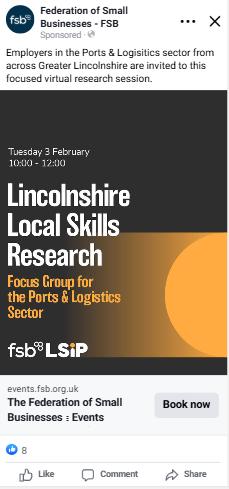
A campaign of targeted social media advertisements, personal invitation and stakeholder invitations and communications was carried out to generate awareness of and bookings for all of the workshops. However, the Rural Challenges and Accessibility to Training and Skills Workshops were cancelled due to lack of bookings. The minimal number of employers who had booked were invited for a one-to-one interview with the ERB, so their opportunity to engage was not cut off.
Figure No 1 – Example paid Meta social post promoting the Ports & Logistics focus groups
Across all the events – focus groups and workshops – 92 employers from a wide range of sectors and all sizes and key locations across Greater Lincolnshire contributed to the LSIP’s primary research.
The bespoke survey fieldwork was conducted between 21st January and 8th February 2026. This was scripted, designed, built and hosted by Habit5 based on a specification set by the ERB. It was also tested by Greater Lincolnshire Combined County Authority and the Governance Group before launch.
Figure No 2 – Screenshots of Greater Lincolnshire LSIP online survey for web and mobile platforms
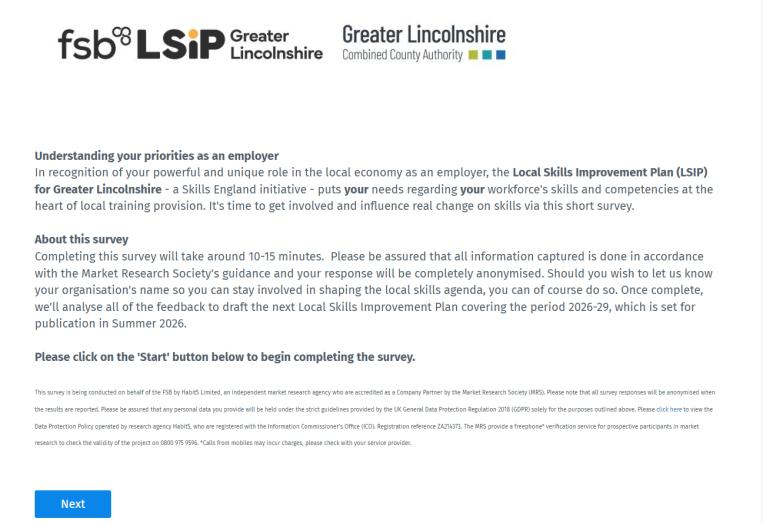

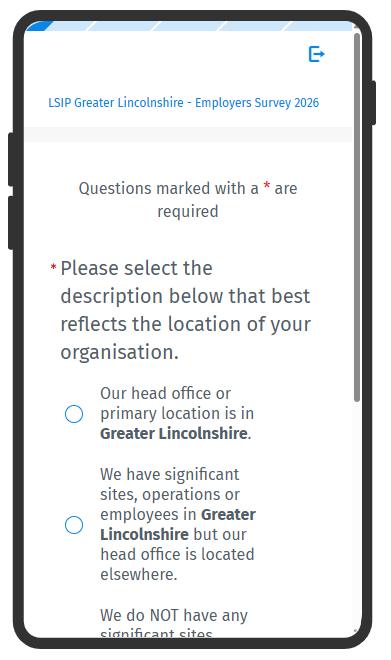

The survey generated 625 participants; however a number of the responses were eliminated due to people taking part from outside of Greater Lincolnshire but with no business or staff presence in the county. Other eliminations were due to incomplete responses or due to the individual declaring a junior job role/level where it was deemed the respondent would not have a suitably strategic view or knowledge of their organisation’s skills challenges and plans. This resulted in 416 whole and relevant responses taken into analysis.
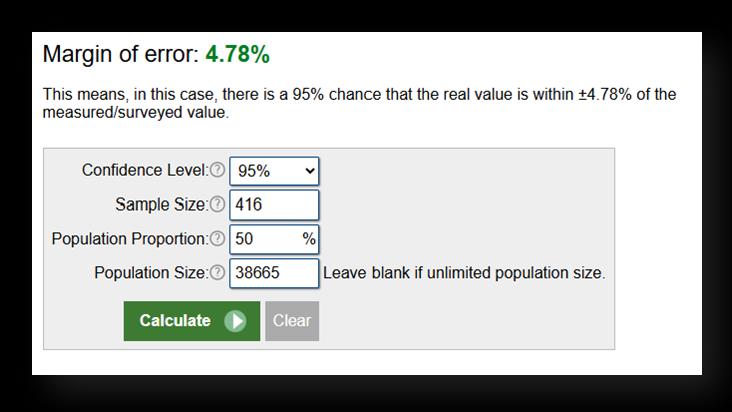
This size of total sample delivered a Confidence Interval of ±4.78 at the 95% Confidence Level, which Habit5 regard as robust, given the degree of difficulty involved in engaging a time poor business population at a challenging time of year. For context, most national public opinion polls reported in national media operate off Confidence Intervals between ±3.00 and ±4.00.
Figure No 3 – Evidence of Greater Lincolnshire LSIP online survey margin of error
Full analysis of the focus groups and survey was carried out between 8th February and 5th March 2026, with a full debrief (the largest ever delivered to any client by Habit5) to the ERB and Greater Lincolnshire Combined County Authority on Friday 6th March.
Employer Communications
The ERB employed a range of marketing and communications tactics to generate maximum reach to include all employers across Greater Lincolnshire. This was additional to the personal invitations, engagement of partners and stakeholders (Greater Lincolnshire Combined Council Authority, DWP, Councils, Providers, Trade and Sector Bodies, Community Groups, place-based agencies and more) and motivating key local business and skills influencers.
When engaging the ERB’s own membership of Greater Lincolnshire SMEs, all-member emails inviting members to the focus groups and to take part in the survey were sent to opted-in records, which resulted in a total of 8,412 individual sends. Across those emails, 5,036 recipients opened and 441 clicked on the target link. A further email campaign to engage employers outside of the ERB’s membership was conducted via Acquirz, a leading supplier of B2B marketing data. A total of 25,624 individual emails were distributed to relevant business recipients, with a 94.4% delivery rate. This generated 2,467 opens and 41 clicks to contact the ERB for a discussion. A locally relevant and professionally suitable Access Partner Panel co-ordinated by Habit5 also generated direct emails, inviting them to participate in the online survey.
Using Meta platforms – Facebook and Instagram – the ERB produced 15 adverts for a paid social media campaign for the focus groups and workshops. Each of these targeted users based on their demographic data associated with their locations, roles and sectors indicated by their platform activity. These generated a total reach of 129,108 plus 387,564 impressions and 1,591 clicks to the event booking pages. This resulted in a total of 65 individual event bookings. Additionally, further bespoke adverts invited participation in the online survey on Meta channels and LinkedIn – the most-used social media platform for business. This activity generated a total reach of 17,699, an impression count of 46,779 and 149 direct clicks to the survey platform.
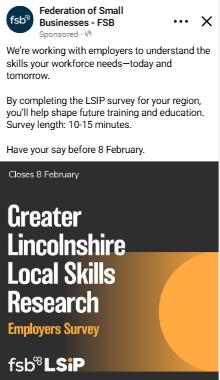
Figure No 4 – Example paid Meta social post promoting the online survey
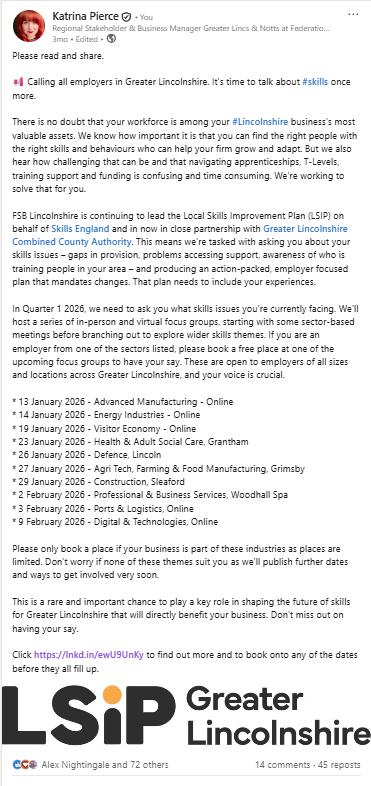
Also on LinkedIn, the ERB LSIP lead published a significant count of organic posts throughout Q4 of 2025 and Q1 of 2026 to engage contacts. Additionally, three boosted posts, all calling local employers to action drove 37,734 impressions, reach of 20,481, 122 reactions and 52 reposts.
Figure No 5 – Example boosted LinkedIn social post promoting the LSIP engagement opportunities
All of this activity does not include reach, impressions and clicks generated by organic emails, social media posts and engagement stimulated by LSIP partners and stakeholders who were issued a package of template communications in January 2026.
Provider Engagement
As Training Providers are critical partners in developing and delivering the Local Skills Improvement Plan, the ERB ensured all relevant post-16 providers from across Greater Lincolnshire were engaged in the process.
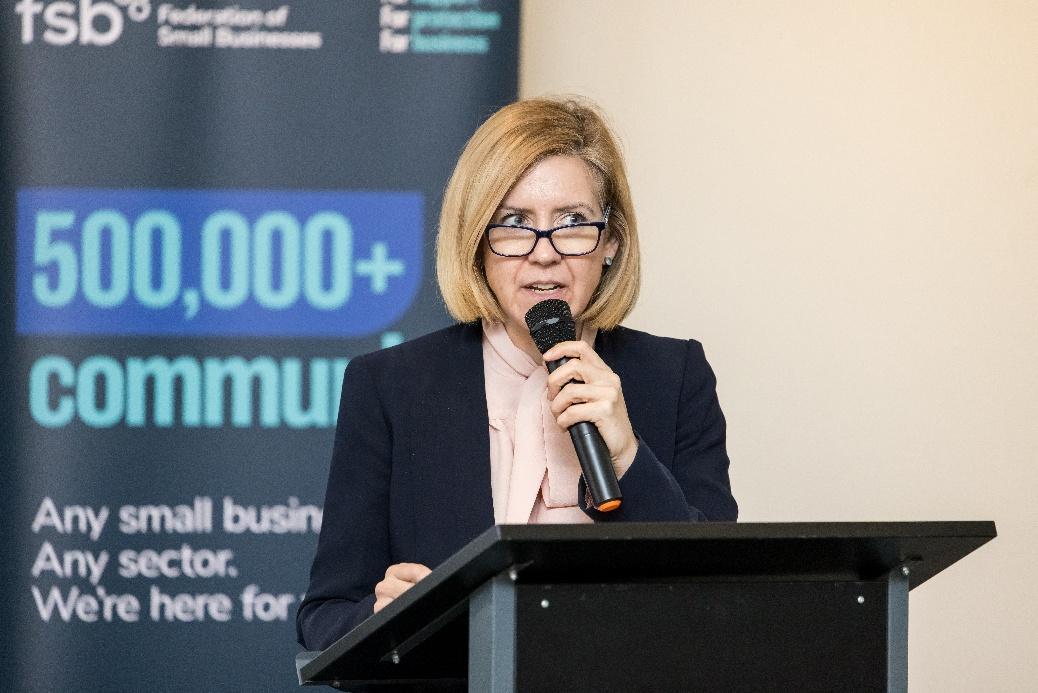
All CEOs/Principals from Further Education (FE), Higher Education (HE) and relevant Independent Training Providers (ITPs) were invited to attend a launch reception marking the commencement of all engagement touchpoints for development of the new LSIP. This took place on Monday 12th January between 4pm and 6pm at the International Bomber Command Centre in Lincoln. Fifty-nine attendees, including Provider representatives, heard the ERB and Dame Andrea Jenkyns (Mayor of Greater Lincolnshire) outline the importance of collaboration throughout the LSIP process and the call to action to share details of the focus groups, workshops and survey with their networks of employers.
Image No 1 – Dame Andrea Jenkyns, Mayor of Greater Lincolnshire, speaking at the LSIP Launch Reception on 12th January 2026
All providers were issued with a package of template communications of emails, social posts and images to maximise reach to the county’s employer base.
Providers were also invited to attend a choice of two provider-only workshops to feed in their experiences of provision, local engagement with employers, funding challenges and their own perspectives as employers. This activity was analysed in line with the Employer primary research. The dates and locations of the two sessions were as follows:
Table No 2 – Schedule of Greater Lincolnshire LSIP Provider Workshops, February 2026
Date
18February 2026 2pm4pm In-person
Workshop
Tank, Lincoln 23February 2026 10am12pm Online Stakeholder Workshop
Workshop
Once full analysis of all data and primary research had been completed and priority themes were emerging, a five-hour Provider Summit was held at the DoubleTree by Hilton Hotel in Lincoln on Friday 20th March 2026. At this, FE, HE, ITPs and local authority adult skills leads had the opportunity to receive a welcome from Cllr Rob Waltham (Leader of North Lincolnshire Council and Chair of the GLCCA Employment & Skills Board), get an update on the LSIP engagement process since the 12th January launch, hear from Dr Mel Collins from Skills England on the central role Providers play in LSIPs and to understand central themes identified via a presentation from David Jones of Habit5.
The main thrust of the day was on reviewing the draft LSIP priority themes and on collaborating to suggest ideal actions and activities based on the evidence base. Each table reviewed a priority theme and was facilitated by a member of the LSIP Governance Group. Their group work was collected by the ERB and is included in Part Two and Annex B of the LSIP.
Images 2, 3, 4 and 5 – Providers in attendance and collaborating at the LSIP Provider Summit on Friday 20th March 2026
District Council, The Bridge, UK Atomic Energy Authority, UK Food Valley, UK Seafood Federation and West Lindsey District Council.
Adherence to Skills England LSIP Guidance
In line with the statutory guidance, the development of the Greater Lincolnshire LSIP programme undertook the following stages:
Stage 1: Defining the Skills Needs
• Examine existing labour-market intelligence and wider economic evidence.
• Testing, refining and expanding findings through structured employer engagement.
• Highlight and prioritise the key skills requirements emerging from the evidence.
Stage 2: Determining Required Changes and Actions
• Joint analysis and decision-making between the Employer Representative Body and the Strategic Authority.
• Close collaboration with providers and wider delivery partners, including the LSIP Provider Summit
• Agreement on the system-wide changes needed to improve:
o The alignment of provision with employer need
o Accessibility and flexibility of training
o Clear and coherent progression pathways
o Effective employer engagement
Stage 3: Producing the LSIP
• Draft the LSIP in accordance with the statutory guidance.
• Embed expected outcomes, impacts, success measures and monitoring arrangements.
• Maintain continuous oversight and review through established governance structures.
Note: Detailed delivery activities are outlined in Annex B, which operates as a live document throughout the three-year LSIP cycle. These will be updated via the 2027 and 2028 Annual Progress Reports.
Ownership & Governance
The Greater Lincolnshire Local Skills Improvement Plan is delivered via a collaborative approach to ensure correlation with the Statutory Guidance, an open and transparent engagement methodology, and timely delivery against deadlines.
The designated ERB for Greater Lincolnshire is the Federation of Small Businesses (FSB). FSB has been the designated ERB for the Greater Lincolnshire (formerly Greater Lincolnshire & Rutland) LSIP since 2022 and successfully delivered the 2023 LSIP. FSB has ultimate accountability for:
• delivery of the process and the plan including authoring and publication to set deadlines in line with statutory guidance
• regularly and thoroughly reporting to Skills England on a range of development and delivery matters
• owning and managing the budget
• driving and delivering all employer engagement
• liaising with providers and stakeholders as well as employers within the county
• generating a robust evidence base via primary research and gathering relevant LMI, labour market, sector and economic data
• managing strategic relationships
• setting up suitable and strong governance procedures
• authoring the LSIP publications
The appropriate Strategic Authority (SA) for this LSIP is the Greater Lincolnshire Combined County Authority (GLCCA). The Authority was founded in February 2025 and is now led by Mayor Dame Andrea Jenkyns since the May 2025 Mayoral Election. The combined authority has responsibility as “strategic convenor”; ensuring the LSIP aligns with and compliments other local strategic plans (including the Local Growth Plan and Get Lincolnshire Working Plan) and a unified approach to skills delivery. GLCCA also provides key labour market, economic and provision data to inform the LSIP’s development. Critically, the SA has powers – alongside the ERB - to approve the LSIP before submission to Skills England.
In terms of Governance, the Greater Lincolnshire LSIP has a robust structure in place which oversees the development process and ascertains the validity of the Plan.
Governance is managed by two groups. The first group is a strategic Governance Group, comprised of key members drawn from local authorities, FE, HE and DWP with extensive expertise in skills, training and workforce issues. This group meets monthly via Teams to guide, advise and challenge on business engagement, development, the priority themes and activities. The second group – the LSIP Employer Panel - is populated by micro, small, medium and large sized employers from across the county to act as
advocates for the LSIP, boost business engagement, ensure sector and location representation and feed in notable employer issues to be explored by the wider research programme. The Chair of the Employer Panel also joins the LSIP Governance Group to ensure connection between the two assemblies and a robust process.