Small Business Index Scotland Q4 2025
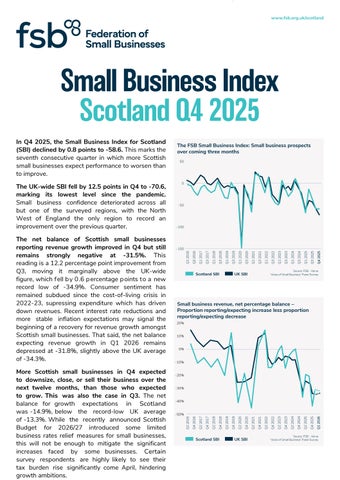
In Q4 2025, the Small Business Index for Scotland (SBI) declined by 0.8 points to -58.6. This marks the seventh consecutive quarter in which more Scottish small businesses expect performance to worsen than to improve.
The UK-wide SBI fell by 12.5 points in Q4 to -70.6, marking its lowest level since the pandemic. Small business confidence deteriorated across all but one of the surveyed regions, with the North West of England the only region to record an improvement over the previous quarter.
The net balance of Scottish small businesses reporting revenue growth improved in Q4 but still remains strongly negative at -31.5%. This reading is a12.2percentagepointimprovementfrom Q3, moving it marginally above the UK-wide figure,whichfellby0.6percentagepointstoa new record low of -34.9%. Consumer sentiment has remained subdued since the cost-of-living crisis in 2022-23, supressing expenditure which has driven down revenues. Recent interest rate reductions and more stable inflation expectations may signal the beginning of a recovery for revenue growth amongst Scottish small businesses. That said, the net balance expecting revenue growth in Q1 2026 remains depressed at -31.8%, slightly above the UK average of-34.3%.
More Scottish small businesses in Q4 expected to downsize, close, or sell their business over the next twelve months, than those who expected to grow. This was also the case in Q3. The net balance for growth expectations in Scotland was -14.9%, below the record-low UK average of -13.3%. While the recently announced Scottish Budget for 2026/27 introduced some limited business rates relief measures for small businesses, this will not be enough to mitigate the significant increases faced by some businesses. Certain survey respondents are highly likely to see their tax burden rise significantly come April, hindering growthambitions.