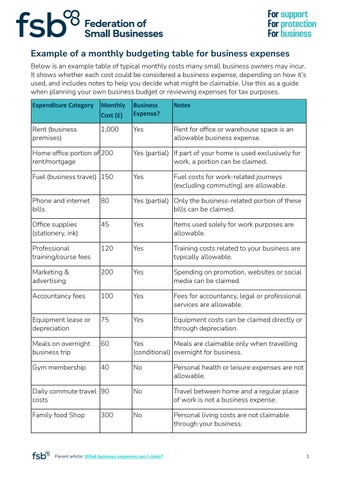
Example of a monthly budgeting table for business expenses Below is an example table of typical monthly costs many small business owners may incur. It shows whether each cost could be considered a business expense, depending on how it’s used, and includes notes to help you decide what might be claimable. Use this as a guide when planning your own business budget or reviewing expenses for tax purposes. Expenditure Category
Monthly Cost (£)
Business Expense?
Notes
Rent (business premises)
1,000
Yes
Rent for office or warehouse space is an allowable business expense.
Home office portion of 200 rent/mortgage
Yes (partial) If part of your home is used exclusively for work, a portion can be claimed.
Fuel (business travel) 150
Yes
Phone and internet bills
80
Yes (partial) Only the business-related portion of these bills can be claimed.
Office supplies (stationery, ink)
45
Yes
Items used solely for work purposes are allowable.
Professional training/course fees
120
Yes
Training costs related to your business are typically allowable.
Marketing & advertising
200
Yes
Spending on promotion, websites or social media can be claimed.
Accountancy fees
100
Yes
Fees for accountancy, legal or professional services are allowable.
Equipment lease or depreciation
75
Yes
Equipment costs can be claimed directly or through depreciation.
Meals on overnight business trip
60
Yes Meals are claimable only when travelling (conditional) overnight for business.
Gym membership
40
No
Personal health or leisure expenses are not allowable.
Daily commute travel 90 costs
No
Travel between home and a regular place of work is not a business expense.
Family food Shop
No
Personal living costs are not claimable through your business.
300
Parent article: What business expenses can I claim?
Fuel costs for work-related journeys (excluding commuting) are allowable.
1