Back the Base: FSB Scotland 2026 election manifesto

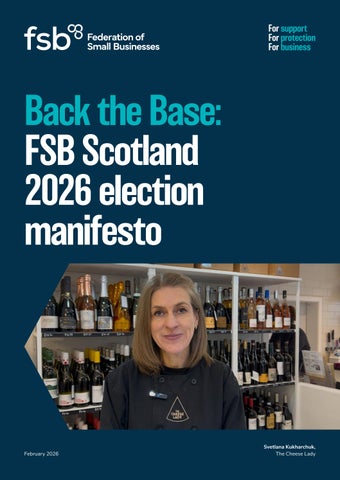
Svetlana Kukharchuk, The Cheese Lady
It’s a truth widely accepted (and evidenced) that small businesses are the backbone of the Scottish economy.
At the last count1, there were an estimated 377,925 small and micro businesses operating in Scotland: over 98% of all Scottish private sector companies. Together, these small businesses employ over 940,000 people and turn over £98bn annually.
There’s a lot of people behind those stats. Not merely ‘businesses’ but small business owners and self-employed people working hard to contribute to the economy, nationally and locally. They’re not a homogenous bunch either, with diverse needs, ambitions and plans; different to each other and crucially, very different to those of larger businesses.
At the start of 20252, we asked the small business community in Scotland about their needs, ambitions and plans. Hundreds of them shared their views on topics including business support services, town centres, taxation and regulation, and net zero, to name just a few.
More than half (56%) of respondents to our survey told us they planned to grow their business in the next two years. Of the 44% of respondents not planning to grow, 30% intended to remain the same: and that’s OK. Small business owners and self-employed people in this category are still making a significant economic contribution and deserve to be supported to continue doing so, despite not falling into the ‘unicorn’ or ‘high growth’ category.
To support small businesses – those with ambitious growth plans and those without alike – this manifesto sets out some key asks that we’re calling on the next Scottish Government to commit to delivering. Each has been directly identified by Scottish small business owners and self-employed people as being vital to encouraging their growth and stability and therefore supporting economic growth for the whole of Scotland.
The Small Business Bonus Scheme (SBBS) is, rightfully, recognised as one of the Scottish Parliament’s most successful policy interventions since its formation. Time and time again, our members describe it as a “lifeline”, allowing them to do things they may not otherwise have been able to, such as employ a member of staff from the local community.
We note (and participated in) the evaluation3 of the SBBS by the Fraser of Allander Institute in 2022. We are supportive of the finding that better data collection is required in order to properly evaluate the success of the scheme. However, given our 2025 survey found evidence of an increase to small businesses’ regulatory compliance burden, we must warn against exacerbating this through excessive, additional data collection requirements.
22% of small businesses told us they thought the SBBS should be maintained at its current levels, while 21% said it should be reformed completely. Discontinuation of the scheme was supported by less than 2% of respondents.
We are calling on the next Scottish Government to commit to maintaining a Small Business Bonus Scheme.
With changes made to its current form, carefully designed with small businesses, in order that the level of relief they are afforded does not penalise them in comparison to other parts of the UK.
Given the most recent rates revaluation, which has seen some small businesses receive notice of increases to their rateable values (RVs) of up to 400%, it’s particularly urgent that the scheme’s eligibility thresholds are revisited to ensure it continues to achieve its aim of supporting small businesses.
Additionally, it is our view that any reform of the current non-domestic rates system must also include reform of the assessor system. Scotland currently employs 14 assessors, resulting in 14 separate valuation rolls as well as a myriad of practice notes.
In order to reduce inefficiency and complexity, and increase accountability and transparency, it is our recommendation that responsibility for the administration of the non-domestic rates system is transferred to Revenue Scotland, mirroring the role of the Valuation Office Agency (VOA) for England and Wales.
The development of a revised Business and Regulatory Impact Assessment (BRIA) was one of the most significant outcomes of the New Deal for Business4 , initiated by the Scottish Government in 2023. Coupled with the Policy Cycle process codesigned with business, the extended analysis of small business impact which officials should now undertake before the introduction of any new policies, taxes or regulations can help us avoid issues of the past, when the potential impact on small businesses had not been adequately considered.
To achieve best practice, BRIAs should be started at the very beginning of the consultation process for new policies and regulations. However, as their
3 An Evaluation of the Small Business Bonus Scheme, Fraser of Allander Institute
4 Delivering a New Deal for Business, Scottish Government
status currently remains optional, we are still seeing government consultations published without being accompanied by even a partial BRIA. At the same time, the compliance burden on small businesses is growing, with 14% of respondents to our 2025 survey telling us they spend more than eight hours, a full working day, on paperwork associated with regulatory compliance each week.
Therefore, in order to ease business concerns around policies and regulations being designed without their input, we are calling on the next Scottish Government to mandate adequate business impact assessment of all future policies and regulations they bring forward.
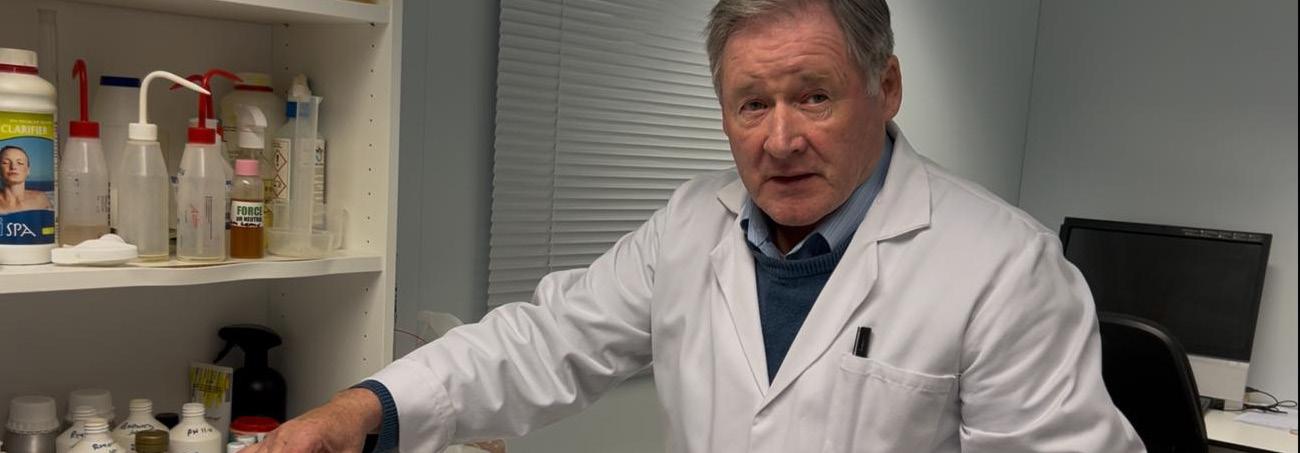
Tom McLean, Bio Cleansers Ltd
Scotland’s small business community already plays a significant role in creating the skilled workforce our economy needs. However, if they are to go further, they cannot do so alone. Our 2025 survey found that three quarters of small businesses do not currently employ – and have never employed – an apprentice, with the primary barrier to doing so being financial capacity. At the same time, skills shortages continue to restrict growth and productivity across the economy. FSB’s Small Business Index for Q4 2025 found that one in five small firms reported a lack of appropriately skilled staff as a major barrier to expansion.
For many small employers, the costs of taking on an apprentice are prohibitive. FSB engagement with small construction firms in 2025 highlighted the scale of the challenge: one business reported that the cost of employing an apprentice over a four-year period
exceeded £80,000 – a level of investment that is out of reach for many firms who are already battling rising operating costs.
Government has previously recognised these challenges, including in 2021 when a £15 million apprenticeship support package5 was introduced, which included £5,000 for employers recruiting or upskilling a 16–24-year-old apprentice, and £3,500 for employers taking on or upskilling apprentices aged 25 and over.
To unlock the full potential of apprenticeships, we propose that the next Scottish Government introduce an ‘Apprenticeship Accelerator Grant’. This targeted intervention would help small businesses meet the upfront and ongoing costs of employing an apprentice, lowering barriers to participation and enabling more firms to invest in training the next generation.
The last decade or so has seen some key progress made in terms of Scotland’s procurement system with legislation including the Procurement Reform (Scotland) Act 2014 removing some of the barriers for the smallest businesses in accessing public procurement opportunities.
5
Despite this, our research tells us that only 23% of small businesses have ever tendered for a public contract. And for almost three quarters of those who have, the process they encountered in doing so was complex and challenging to navigate. Specifically, the majority (78%) said they felt that the system and paperwork
used in the process were more geared towards larger businesses, with qualifying requirements (e.g. levels of Public Liability Insurance required) disproportionate to the value of the contract being tendered.
Advancement of the community wealth building agenda in recent years has seen some positive momentum in terms of increasing expectations on public sector bodies to increase their amount of spend with local businesses. As things currently stand, however, progress on increasing spend has either stalled or
slowed across local authorities, with only a 3.5% increase6 in the amount spent with local enterprises overall since 2010/11.
Therefore, we are calling on the next Scottish Government to explore further reforms to the Procurement Reform (Scotland) 2014 Act that will make it easier for public contract opportunities to be accessed by small, local businesses.
Small businesses are key actors in the delivery of progress on Scotland’s transition to net zero. For some, designing and delivering innovative products and services that reduce emissions is central to their business operations. Responding to our 2025 survey, almost half of respondents told us they had made changes to their business, for example installing a low or zero emissions heating system.
But many small businesses don’t understand where they fit into government plans on net zero. Our 2025 survey also found that over two fifths of Scottish small businesses felt they have no understanding of Scottish Government targets around net zero.
The government-funded Business Energy Scotland service is a welcome resource for Scottish businesses, offering practical advice and interest-free loans. However, awareness of the support available is low: almost 90% of respondents to our survey said they had never engaged with any government support initiatives with regards to the transition to net zero. And anecdotally, FSB members who have tried to engage with the advice service tell us of long waiting times for a response after making initial contact.
Undoubtedly, this is down to a capacity issue for Business Energy Scotland. Those members who have eventually received advice or support are positive about their experience. With efforts around the transition required to ramp up significantly in the next parliament, we are calling on the next Scottish Government to
increase funding for advice services like Business Energy Scotland and consider whether the current offering is truly meeting the needs of small businesses.
For example, we would like to see more grant funding become available, as well as a focus on providing advice on opportunities for those small businesses who currently – or could – make up the supply chain with regards to the transition to net zero. The latter will also require greater policy clarity from the next Scottish Government in order to make explicit the economic opportunities for Scottish small businesses, as opposed to the financial and regulatory burden that it currently presents to as to some.

Almost two thirds of respondents to our 2025 survey stated they had used Business Gateway’s services, whereas only 18% had engaged with Scottish Enterprise. 10% had engaged with Highlands & Islands Enterprise and 2% with South of Scotland Enterprise. These were not surprising results; our members frequently tell us their needs and ambitions don’t align with those of Scotland’s three enterprise agencies, therefore they are unable to access any of the support offered. On the other hand, Business Gateway is frequently identified as an important part of a small business owner’s journey, most often at the beginning.
The budget provided for Business Gateway remained static between 2020/21 and 2024/257 at £16.3m, with any changes for the current budgetary year yet
to be confirmed. At the same time, the most recent Scottish Budget (for 2026/27) commits £325.6m across the three development agencies. Given where most businesses are looking for support, this seems a strange priority.
To increase the amount of practical support on offer to Scotland’s small business and self-employed community, we are calling on the next Scottish Government to increase funding for Business Gateway year on year, with a particular view to providing a tangible means of encouraging more people into self-employment as a way out of economic inactivity and to addressing the most common barriers to business growth, such as the transition from being self-employed to an employer.
Scotland’s town centres and high streets are vital to our economy and communities. They create jobs, drive economic output, and serve as central hubs where people come together to work, socialise and feel connected.
And small businesses are at the heart of Scotland’s high streets. Indeed, more than two fifths of respondents to our 2025 survey told us that their business operates in or near a high street or town centre. However, at the same time, more than half reported a negative view of the high street or city centre their business operates in or near.
Reasons for this negative perception include parking restrictions, littering, empty units, potholes and broken pavements. Some respondents commented on a lack of diversity in terms of the retail mix available, while others suggested that rising rents and non-domestic rates bills were driving businesses out of long-standing premises.
The asks we are making of the next Scottish Government on non-domestic rates and procurement would go some way to addressing some of the challenges experienced by town centre small businesses. And while actions taken by recent governments with regards to town centre regeneration and planning are welcome, ongoing reports by FSB members of issues with planning, licensing and local governance arrangements leads us to call for more action on town centre regeneration by the next Scottish Government.
Business Improvement Districts (BIDs) have had success in driving town centre regeneration in some areas, however feedback from our members finds mixed views in others. With the current legislation around BIDs now 20 years old, we believe the time is right for a review in order to ensure adequate impact assessment and representation of small businesses within the system.
Commit to maintaining a Small Business Bonus Scheme
Mandate adequate business impact assessment of all future policies and regulations
Introduce an ‘Apprenticeship Accelerator Grant’
Explore further reforms to the Procurement Reform (Scotland) 2014
Increase funding for advice services like Business Energy Scotland
Increase funding for Business Gateway year-on-year
Take more action on town centre regeneration and review the current BID legislation