Spring Arts & Entertainment Preview


Pages 7-17


![]()


Pages 7-17


by Patricia Leslie
Everyone is invited to come one, come all Saturday to the big free day at the National Building Museum for the “Big Draw” for children of all ages to learn more about drawing to (adults hope) better understand our world today.
It’s a great way to spend a spring day with the family at the museum which hosts its third annual “Big Draw” with new exhibitions upstairs on specialized schools of the 1930s and the rebuilding of a university chapel.
The Building Museum is hosting the event with other D.C. museums and institutions in sessions of interactive storytelling, songs, drawing and more.
Tomasz Wiktor, a multi-media artist from Paris and native son of Poland will demonstrate his techniques of virtual reality drawings, while illustrator Trap Bob will show off her new four-foot-tall coloring book.
David Macaulay, the Caldecott Medal-winning author and illustrator of the classic, The Way Things Work, will demonstrate how he works and he will lead small workshops. (Sign up at nbm.
org/event/the-big-draw/)
And, as long as they last, free copies of his Rome Antics (1997) will be given out.
The grownups in the crowd can truck on upstairs to see “A Better Life for Their Children: Julius Rosenwald, Booker. T Washington and the 4,978 Schools that Changed America,” and “The Tuskegee Chapel,” which was destroyed by fire in 1957.
In 1912 philanthropist Julius Rosenwald and Booker T. Washington, the founder and president of Tuskegee University, joined interests and money to begin building schools for Black children in 15 Southern and border states.
To avoid drawing attention and possibly arson from surrounding communities, the schools were designed in modest, plain styles with lots of windows for natural heating in winter and air flow in hot summers. Heat, supplied by the communities which agreed to “buy in,” was not always affordable.
A short video runs adjacent to a portion of a recreated Rosenwald classroom


Continued from Page 8
with desks of the period, a lunch tray, a globe and copies of books which were later distributed to high schools, too, including White schools.
An interactive map shows original school locations, photographs and their uses today, some which still stand in Maryland and Virginia. (D.C. had no Rosenwald schools.)
Photographer and curator Andrew Feiler traveled more than 25,000 miles, visited 105 schools and interviewed dozens of former students, teachers, preservationists, and community leaders to document and tell this story of the schools which made a difference in the lives of Black school children like Maya Angelou, John Lewis and Medgar Evers and many more who are listed.
Some 500 of the schools still remain and have been renovated as community centers, senior centers, churches, private residences and even a truck rental sales office.
But some are near collapse and a movement to create a national historical park to commemorate the Rosenwald schools is underway.
The schools and chapel exhibitions are
presented jointly in a series of photographs, artifacts, models and drawings.
The cause of the fire at the Tuskegee Chapel was originally thought to be lightning, but recent debate has focused on arson, according to the exhibition. After it burned, Tuskegee students built it back from 1967-1969 using 1.2 million bricks of Alabama clay.
For the “Big Draw,” visitors may bring their own materials or use those at the Building Museum. Other museums and institutions participating in the festival are the National Museum of Women in the Arts, the Postal Museum, the Maryland Institute College of Art, the D.C. Public Library, and the Embassy of Poland whose representatives will present stories of culture, history, and international connections to Poland.
The National Building Museum, 401 F St., NW, Washington, DC 20001, on the Red Line at Judiciary Square, four blocks from the National Mall with one of the best gift shops in all of D.C. Open 10 am - 5 pm, Thursday - Monday. Info@nbm.org; 202-272-2448. Regular admission is $10, adults; $7, seniors and students, but free all day this Saturday for all.


by Patricia Leslie
Eighty years and 80 works by 68 women artists from around the globe are on display in the newest exhibition at the National Museum of Women in the Arts, “Making Their Mark: Works from the Shah Garg Collection.”
The San Francisco-based collection is a large, dynamic show, established by collectors who are among “the most influential in the United States,” NMWA says.
Komal Shah and her husband Gaurav Garg began their joint collection in 2014 to extol contemporary female artists through paintings, sculpture, installations, textiles, beadwork, ceramics and more.
Featured are underrepresented artists and others who are better known, like Joan Mitchell (1925, Chicago – 1992, France), Barbara Chase-Riboud (b. 1939, Philadelphia) and Judy Chicago (b.1930, Chicago).
Intrigue and conversation are triggered by these mostly abstract expressionists who help kick off March’s Women’s History Month at the museum. (I can’t wait to go back and take in more!)
At the entrance to the exhibition, visitors are invited to take a “Political Ribbon (Fondazione Furla/GAM Milan),” 2022 made
by Andrea Bowers (b. 1965, Wilmington, Ohio) who applied silkscreen ink on satin with phrases like “Sexism Sucks” and “It Is Not Enough to Be Compassionate.”
Barbara Chase-Riboud’s 2016 sculpture “Malcolm X #17,” is a tall, treelike structure with bark of gold patina in recognition of an “historical icon whose life radiated far beyond the politics of the temporal,” she wrote. It celebrates “light, movement, and material union,” according to the label.
Judy Chicago used acrylic spray lacquer on acrylic with a base of glass and plexiglass for her 1968 “Dark Red, Blue, Green Domes (small).”
Uman is a self-taught artist born in 1980 in Mogadishu, Somalia which her family left for Kenya during the Somali Civil War. Later, Uman moved to Denmark and lived with her aunt and then going to New York City where she sold art on the street.
Now she lives in upstate New York where she combines art history with her own experiences and love of South African music to produce art like “Amapiano Dance,” 2022-23 on view.
An artist who uses a “hole puncher” is
on Page 12


Continued from Page 11
Howardena Pindell (b.1943, Philadelphia) who began punching “chads” around 1970, long before they became synonymous with the 2000 presidential election. She spray paints and applies acrylics through stencils on fixed canvases for her chads. Her “Untitled #7 Bahia, Brazil,” 2023 is a mixed media on canvas.
Some unusual materials Pindell uses are talcum powder and perfume.
Joyce J. Scott is an artist born in Baltimore in 1948, who, with the help of others, finished making “Harriet’s Quilt” in 2022 in honor of abolitionist Harriet Tubman (1822-1913). Scott used glass and found plastic beads, yarn and fabric knotted by her late mother (below).
Elizabeth Talford Scott (1916-2011) was born on Blackstock Plantation in
Enoree, S.C. where her family lived as sharecroppers and handed down sewing and needlework techniques from generation to generation.
Scott’s intricate 1992 piece, “Save the Babies” loosely follows the shape of a shield for “protection and healing,” the wall label says. Cotton, synthetics, metallic and embroidery threads, bead, shells, sequins and buttons are some of the items Scott used.
Olga de Amaral (b.1932, Bogota, Columbia) was an important figure in the 1960s development of Latin American abstraction whose 1995 “Alquimia Plata 6 (B)” shows her talents. Using gesso, acrylic paint, and gold and silver leaf, she made a thousand woven linen tiles evoking Bogota’s roof tops.
One of my favorite pieces in the galleries was “Sisters,” 2021 by Tschabalala Self (b. 1990, New York City), a large

mixed media of two figures whom the artist calls “avatars” which permits her to reclaim “interpretative authority” over Black women’s bodies, she says. Velvet, felt, tulle, marbleized cotton and craft paper are some of the materials she used.
The Shah Garg artists ques-
tion male dominance in the art world and “envision art history as an interconnected web of influences and affinities among artists who subvert traditional narrative and hierarchies in a historically patriarchal field,” according to a statement.
Indeed, NMWA continues
its promotion of the Guerrilla Girls’ mantra, asking: “Do women have to be naked to get in the Met. Museum?”
Three percent of the artists in the Modern Met section are women; 83 percent of the
Continued on Page 14


BY LISA SINROD
This movie surprised me. I am not a fan of anything Frankenstein, and yet the originality and creative quirks of this jam-packed two-hour ride directed by Maggie Gyllenhaal gave me an exciting and enjoyable experience. The best way to describe the genre of this film is to call it a horror-thriller with feminist undertones. The R-rated film opened nationally on March 6, and is not something I would suggest taking young teens to see based on all of the reasons for its rating.
The plot revolves around a newly created companion (the Bride) for Frankenstein’s monster in this reimagining of the classic “Bride of Frankenstein” story written by Mary Shelley. For the uninitiated, Mary Shelley visited Lord Byron’s villa in Switzerland along with her partner in 1816. Lord Byron, who was a famous poet, proposed a contest in which those visiting would each write a ghost story. Shelley wrote of a gifted scientist named Victor Frankenstein who uses his lab equipment to create a life (the monster) and then is horrified by what he has created. Shelley expanded her short story (the ghost story) into a novel which was published anonymously in 1818 with the title “Frankenstein; or, The Modern Prometheus.” All derivations of the Frankenstein franchise stem from this long-ago story written by a young British woman on holiday.
This film is set in 1930s Chicago, where Frankenstein’s monster (soulfully portrayed by Christian Bale) seeks the help of a scientist to create a companion to become his bride. The monster has been knocking around since his creation early in the last century and is profoundly lonely. Annette Bening is terrific in the role of Dr. Leonora Whittle, the scientist who revives a murdered young woman named Ida to become the monster’s bride. The elaborate equipment she assembles for this undertaking is strange-
ly fascinating. Jessie Buckley plays multiple roles in the film, which are a showcase for her talent. She portrays the original Frankenstein author, Mary Shelley, providing a narrative anchor to the plot. She appears as Ida, the murdered woman who is revived to become the Bride, and she also portrays the Bride. She brings great energy to all three interconnected roles. Buckley carries the film at times when the script seems a bit too chaotic. This past year has been big for Buckley, who is currently nominated in the Best Actress (Academy Awards) category for her role in “Hamnet”. The Irish actress was also directed by Maggie Gyllenhaal in “The Lost Daughter” in 2021.
As Frankenstein’s monster gets to know the Bride, things don’t go exactly as he had envisioned. This Bride is very independent and refuses to be controlled by men. Unlike the docile Bride seen as a silent figure in the 1935 film “The Bride of Frankenstein”, this Bride expresses anger about exploitation and doesn’t exist just to serve the monster. Despite this, the Bride and the monster form a strong connection which sets up the underlying themes of the movie. There are some rebellious punk and “riot grrl” vibes mid-way through the movie, which seem completely out of context and yet are oddly charming. Bale’s solid performance humanizes the monster, who seems to be a deep thinker with good intentions.
This movie is not for everyone. It is raw and raucous and engages in sardonic innuendo. It’s a difficult film to describe and even harder to say who will enjoy its unusual approach and who won’t. Since the film’s release, audience reaction has been decidedly mixed, so you may fall on either side of that equation. If you decide to see it, be prepared for some violent content and coarse language, which seems to be reflective of the environment of its characters.


Continued from Page 12
nudes are female.
A 400-plus page Shah Garg color hardback catalogue is available in the museum shop for $65. The exhibition has already traveled to several venues in the U.S. and heads next to Arizona State after NMWA.
NMWA is open Tuesday - Sunday, 10 a.m. to 5 p.m. at 1250 New York Ave., NW, Washington, D.C. 20005. 202783-5000, nmwa.org.
Adults, $16; DC residents and seniors, $13; free to members, those 21 and under, those with disabilities and to all who visit the museum on the first Sunday and second Wednesday of every month.
NMWA joins the National Building Museum for its free “Big Draw” day for all ages this coming Saturday, March 14.


BY FALLS CHURCH NEWS-PRSS
Northern Virginia and the greater Washington, D.C., region are home to one of the richest performing arts communities in the country. From professional theaters and internationally renowned concert halls to grassroots arts organizations and chamber ensembles, the area offers a remarkable range of cultural experiences year-round. Institutions such as Signature Theatre, Arena Stage, GALA Theatre, Creative Cauldron, and the Center for the Arts at George Mason University, along with organizations including Falls Church Arts, the Falls Church Chamber of Commerce, Little City Concerts, Amadeus Concerts, Providence Players of Fairfax, Little Theatre of Alexandria, Vocal Arts Fairfax, Orla Conway Music, and the Gay Men’s Chorus of Washington, D.C., collectively shape a vibrant arts ecosystem that serves audiences of all ages.
These organizations span the full spectrum of performing and visual
arts—professional musicals, classical concerts, community theater productions, children’s programming, vocal ensembles, and visual arts exhibitions—demonstrating how deeply the arts are woven into the cultural life of Northern Virginia and the nation’s capital.
At the heart of this cultural landscape is the Center for the Arts at George Mason University, a premier performing arts venue that has hosted world-class musicians, theater companies, dance ensembles, and family programming for more than three decades. Located on the George Mason University campus in Fairfax, the Center draws artists from across the globe while also serving as an educational resource and performance hub for the university and the surrounding community.
The Center’s programming spans classical music, jazz, interna-


tional ensembles, dance, and family-friendly performances, reflecting the diversity of the region itself. The 2026 season continues that tradition with events ranging from internationally acclaimed Irish musicians to beloved children’s entertainment.
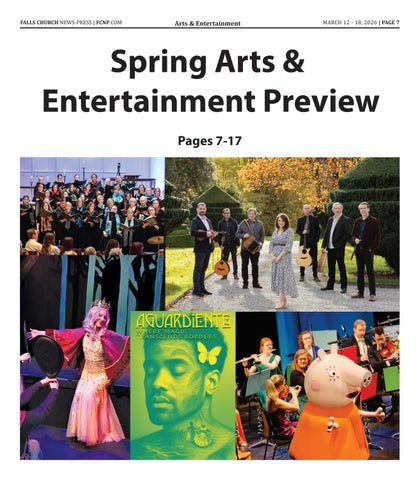
One such event is the appearance of Danú, one of today’s most celebrated traditional Irish music ensembles. The group performs Friday, March 20 at 8 p.m., bringing the vibrant sounds of Ireland to Northern Virginia audiences.
Widely praised as a “compellingly original” ensemble by the Los Angeles Times, Danú has spent more than two decades captivating listeners with a rich blend of ancient Irish melodies and contemporary compositions. The group’s instrumentation—featuring flute, tin whistle, fiddle, button accordion, bouzouki, and vocals—captures the spirit of traditional Irish music while allowing for dynamic interpretation and innovation.
Danú’s musicians are internationally recognized virtuosos whose
performances have taken them to prestigious venues including the Hollywood Bowl in Los Angeles and Symphony Space in New York City. Their music has been broadcast live on major networks such as NPR, the BBC, and the CBC, and their seven critically acclaimed albums have earned numerous honors from BBC Music and Irish Music Magazine.
Audiences attending the Fairfax performance can expect an immersive evening of music that blends spirited dance tunes, lyrical ballads, and dazzling instrumental interplay. As Strings Magazine described the ensemble, Danú offers a performance that is “impressive, immersive and uniquely and unmistakably Irish.”
The concert runs approximately 90 minutes with intermission and is appropriate for audiences of all ages. Ticket prices range from $38 to $60, with half-price tickets available for youth through Grade 12, making the event accessible to families and students interested in
exploring traditional music.
Introducing Young Audiences to the Orchestra
The Center for the Arts also emphasizes family programming designed to inspire the next generation of arts lovers. One highlight of the spring season is Peppa Pig — My First Concert, scheduled for Saturday, April 11 at 1 p.m. and 4 p.m.
This lively and interactive performance introduces children as young as 18 months to the world of orchestral music. Peppa Pig, along with Mummy Pig, Daddy Pig, and George, takes young audiences on a musical adventure featuring live performances by the Southbank Sinfonia.
During the show, Peppa and George learn about the different sounds instruments make when played together, exploring musical themes and pieces drawn both from the popular children’s television series and from the broader orches-


Continued from Page 15
tral repertoire. Children are encouraged to participate by clapping, moving, and engaging with the music, transforming the concert into an interactive learning experience.
Critics have praised the program as “a fun and interactive introduction to a live orchestra that will take Peppa Pig fans on a magical musical journey,” according to The Live Review.
Recommended for children ages two and older, the performance runs approximately 55 minutes with no intermission—a length designed specifically for younger audiences. Ticket prices range from $41 to $65, and the 4 p.m. performance will include audio description and sign interpretation, reflecting the Center’s commitment to accessibility and inclusive programming.
Celebrating Latin American Culture at GALA Theatre
While the Center for the Arts brings global performers to Northern Virginia, Washington,
D.C.’s GALA Theatre highlights the vibrant artistic traditions of the Latino community. Located in the historic Tivoli Theatre in Columbia Heights, GALA has spent decades producing bilingual productions that celebrate Latin American heritage and storytelling.
This spring, GALA presents the world premiere of Aguardiente: Where Magic Transcends Borders, running April 30 through May 24.
Commissioned by GALA, the production is a new musical conceived by Luis Salgado of Puerto Rico and Daniel A. Gutiérrez of Colombia.
Salgado, who also directs and choreographs the production, collaborated with Gutiérrez to create a work that blends Caribbean rhythms, theatrical storytelling, and the literary tradition of magical realism associated with Nobel Prize–winning author Gabriel García Márquez.
The musical follows two New York–based writers from Colombia and Puerto Rico who return to their ancestral roots. Through music and
storytelling, they rediscover their cultural heritage and explore the emotional ties that connect diaspora communities to their homelands.
The score incorporates traditional and contemporary rhythms including cumbia, bomba, and currulao, creating a vibrant musical landscape that reflects the cultural diversity of the Caribbean and Latin America. As the characters reconnect with their heritage, the narrative explores themes of identity, migration, and artistic inspiration.
Presented bilingually with surtitles in English and Spanish, the production reflects GALA Theatre’s longstanding commitment to making Latino stories accessible to audiences from diverse backgrounds.
These performances exist within a larger network of arts organizations that collectively sustain the region’s cultural vitality.
Signature Theatre, based in Arlington, is widely regarded as
one of the country’s leading regional theaters, particularly known for its inventive productions of contemporary musicals and bold reinterpretations of classic works. The theater has received numerous Tony Awards and nominations, and its intimate performance spaces allow audiences to experience musical theater at close range.
Nearby in Washington, D.C., Arena Stage stands as one of the nation’s most influential regional theaters. Founded in 1950, Arena Stage helped pioneer the regional theater movement and continues to premiere new American plays while presenting innovative revivals. Its campus along the Southwest Waterfront includes the iconic Fichandler Stage, the Kreeger Theater, and the Arlene and Robert Kogod Cradle.
Community theater also plays an important role in the region’s cultural life. The Providence Players of Fairfax and the Little Theatre of Alexandria provide opportunities for local actors, directors, and designers to participate in high-quality productions. These organizations not
only entertain audiences but also foster artistic development among community members.
The Falls Church Chamber of Commerce supports many of these cultural initiatives by helping connect local businesses, arts organizations, and residents. Through partnerships and events, the Chamber helps strengthen the local creative economy and ensures that arts programming remains a visible and valued part of community life.
Falls Church itself has become a hub for smaller but highly influential arts groups. Creative Cauldron, located in the heart of the city, produces professional theater, concerts, and arts education programs. Known for its innovative musical productions and intimate venue, Creative Cauldron offers audiences a close-up experience with performers while nurturing emerging artists.
Continued on Page 17


Continued from Page 16
The visual arts are represented by Falls Church Arts, a nonprofit organization that showcases local artists through rotating exhibitions and community programming. The gallery provides opportunities for both established and emerging artists to display their work, contributing to the city’s growing reputation as an arts destination.
Classical and chamber music lovers can find exceptional programming through organizations such as Amadeus Concerts and Little City Concerts. These groups present performances by professional musicians in intimate settings, often highlighting lesser-known repertoire alongside beloved classical works.
Meanwhile, Vocal Arts Fairfax offers opportunities for singers of all ages to participate in choral performances, helping cultivate a vibrant vocal music community.
Another beloved ensemble, the Gay Men’s Chorus of Washington, D.C., combines artistic excellence with advocacy. Known for its powerful performances and community outreach, the chorus performs a wide range of repertoire— from Broadway standards to contemporary choral works— while promoting inclusivity and equality through music.
Together, these organizations illustrate how the per-
Orla Conway Music contributes to the region’s musical landscape through educational initiatives and performances that celebrate traditional and folk music traditions.


forming and visual arts function as a collaborative ecosystem across Northern Virginia and Washington, D.C. Large institutions such as the Center for the Arts at George Mason University and Arena Stage bring internationally recognized performers and major productions to the region, while smaller groups and community theaters create opportunities for local participation and artistic experimentation.
This ecosystem benefits audiences by offering an extraordinary diversity of cultural experiences. On any given weekend, residents can attend a professional musical in Arlington, a chamber concert in Falls Church, a community theater production in Fairfax, or an international dance performance in Washington.
Educational initiatives further expand the impact of these

organizations. Many theaters and music groups provide workshops, youth performances, and school partnerships designed to inspire young artists and cultivate future audiences.
Family-friendly programming—such as Peppa Pig — My First Concert—demonstrates how arts institutions are actively working to introduce children to live performance at an early age. At the same time, concerts like Danú and innovative productions such as Aguardiente offer adult audiences the opportunity to experience music and storytelling from around the world.
Beyond entertainment, the arts play a crucial role in strengthening community identity and economic vitality. Cultural organizations attract visitors, support local businesses, and provide employment for artists and creative professionals. They also serve as spaces where communities gather, share
stories, and explore diverse perspectives.
In Northern Virginia and Washington, the performing arts reflect the region’s global character. Irish traditional music, Caribbean musical theater, American drama, and children’s orchestral programs all coexist within the same cultural landscape.
As institutions like the Center for the Arts at George Mason University, GALA Theatre, Signature Theatre, Arena Stage, and numerous local organizations continue to collaborate and innovate, the region’s arts scene remains dynamic and ever evolving.
For residents and visitors alike, the message is clear: whether through a lively Irish concert, a child’s first encounter with orchestral music, or a groundbreaking bilingual musical celebrating Caribbean heritage, the performing arts continue to bring communities together and enrich the cultural life of the entire region.


