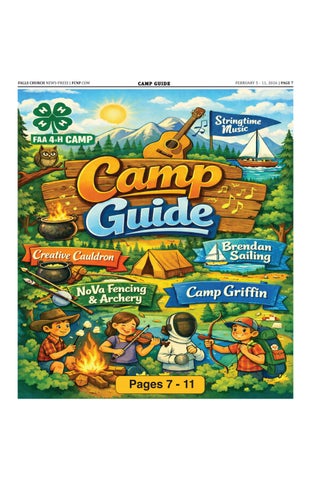
Pages 7 - 11
![]()

Pages 7 - 11
by Falls Church News-Press
It starts innocently: “We should look at camps.” Ten minutes later you’ve got 14 tabs open, three waitlists, and a growing suspicion that summer break is actually a full-time administrative job. Here’s the good news: Falls Church families have options and not just the same old stuff. These camps hit different lanes: 4-H, music, sailing, theater, fencing, archery, and a solid all-summer anchor.
First up: FAA 4-H Camp, the classic summer reset button. This is the kind of camp where kids get a little sun, a little dirt, and a lot of confidence without needing a screen or a fancy pitch. It’s teamwork, cabin friendships, camp traditions, and the kind of independence that shows up when your kid suddenly starts packing their own bag like it’s no big deal. FAA’s setup is also very parentfriendly: there’s an orientation listed in early June, and families handle transportation to camp and pickup at the end of the week. Translation: it’s structured, it’s real, and it’s the kind of camp that makes kids feel older in
the best way.
If your child is even slightly music-curious, or you’ve been hearing a lot of “I want to learn violin!” followed by immediate abandonment of the idea, StringTime Music is a low-pressure doorway into the world of strings. This is not a “you must already be amazing” situation. It’s the opposite: try it, play it, see what happens. Beginners are welcome, and by the end of the week kids have something to show for it, usually a performance that’s equal parts adorable and legitimately impressive. It’s a great fit for families who want their child to learn something new without committing to a full year of lessons before they’ve even touched the instrument.
Now for something genuinely special: Brendan Sailing. If you’ve got a kid with learning differences, especially a kid who sometimes gets overlooked or boxed into the wrong kind of structure, this program is built for them. Brendan Sailing focuses on tailored instruction and confidence-building through sailing, and the magic is in how personal it is. Sailing isn’t easy. It’s wind, balance,


coordination, and decision-making all happening at once. But that’s why it works. When kids master it, even just a little, you can see the posture change. It’s not just “camp was fun.” It’s “I can do this.”
On the complete other end of the spectrum, in the best way, is Creative Cauldron, which is basically Falls Church’s answer to “my kid needs to create something.” These camps mix theater, music, movement, and art, usually built around a theme, and they wrap with a final performance and art show. That’s the sweet spot for a lot of kids: not just games and activities, but a project, a team, a build-up, and then the big moment. If your child loves costumes, characters, storytelling, or just thrives when they can be expressive and loud, or quietly brilliant in the corner designing something, Creative Cauldron is a summer win.
If your child is more action and precision, let’s talk NoVa Fencing & Archery. First: yes, this is as cool as it sounds. Second: it’s not just for kids who already know what a foil is. Beginners are welcome, equipment is provided, and it’s structured so
kids learn real skills while still getting the camp energy of games, challenges, and friendly competitions. The week-ending tournament is the kind of thing kids will replay in their heads like a movie scene, especially if they get a dramatic comeback win. It’s focused, it’s physical, and it has that rare combo of discipline and fun that parents love because it wears kids out and teaches them something.
And if you’re looking for the dependable, all-summer anchor, something that covers a wide range of ages and runs like a well-oiled machine, Westminster School’s Camp Griffin is that option. It stretches across most of the summer, uses age-based groups so your rising 1st grader isn’t stuck doing the same thing as your rising 8th grader, and it’s built for families who want flexibility. Camp Griffin is the kind of place that becomes part of a family’s summer rhythm: same place, same people, different weekly adventures, and a lot fewer “what are we doing this week?” moments.
Here’s the real takeaway: these camps aren’t competing for the same
kid. They’re different lanes: outdoor growth, creative performance, music discovery, adaptive skill-building, and sporty precision. That’s not to say your kid can’t fit into more than one. Most kids do. Summer’s long, interests overlap, and growth doesn’t happen in just one lane. The trick is matching the camp to your child’s favorite kind of challenge at this moment.
If you want your kid to come home dirt-covered and confident: FAA 4-H.
If you want a beginner-friendly “try music” week that actually sticks: StringTime.
If your child thrives with individualized support and big confidence gains: Brendan Sailing.
If your house is currently full of drama, songs, and storytelling: Creative Cauldron.
If your child wants a sport that feels like a movie: NoVa Fencing & Archery.
If you need a reliable summer backbone with options: Camp Griffin.
And yes, your “we’ll figure it out later” week is coming fast.


by Falls Church News-Press
Every spring and summer, families across Northern Virginia and the broader DMV hear the same pitch: If your kid wants to play in college, you need the right travel team, the right camps, the right showcases, now. Add in constant NIL headlines and social media highlight reels, and it becomes easy to believe scholarships and money are everywhere. They are not.
Recruiting is real. Opportunity is real. But so is another reality: youth sports has become a profit-driven industry that can drain families financially while selling expectations that do not match the math.
The money side of youth sports is no longer minor.
According to the Aspen Institute’s Project Play parent survey, the average sports family spent $1,016 on a child’s primary sport in 2024. That represents a 46 percent increase since 2019, rising roughly twice as fast as inflation during that same period.
That figure is only the average. Once travel schedules, hotel weekends, private training, equipment, and showcase fees are added, many families spend several thousand dollars per year. For some elite club
programs, annual costs can climb well into the five figures.
This is how families get pulled into the sports rat race. Not because they are careless, but because the system is built to make every additional expense feel necessary.
When does recruiting actually start?
Despite the hype, recruiting generally starts later than many parents expect.
Freshman year should focus on development. That includes skillbuilding, strength, academics, and learning how to compete at the high school level.
Sophomore year is when targeted camps and showcases may make sense, but only if the athlete is ready to compete and stand out.
Junior year is often the most important recruiting year, when evaluations, communication, and offers are most common.
Senior year still presents opportunities, particularly at the Division III, NAIA, and junior college levels.
The families who navigate this best are not the ones doing the most. They are the ones doing the right things at the right time.
The odds of playing in college are smaller than many think.
According to NCAA estimates, only a small percentage of high school athletes go on to compete at the NCAA level. In many major sports, the number ranges from roughly 3 to 8 percent, depending on the sport.
Scholarships are even rarer. The NCAA recruiting fact sheet states plainly that only about 2 percent of high school athletes receive athletics scholarships.
Those numbers are not meant to discourage capable athletes. They are meant to ground families in reality, because chasing long odds can carry real financial and emotional costs.
Who should first-time families listen to?
For families new to recruiting, honest guidance matters more than hype.
Travel or club coaches often play a major role because they operate on the same circuits as college coaches and understand where athletes realistically fit.
High school coaches remain important for development, mentorship, and recommendations, even if college coaches scout fewer high school games than they once did.
Athletes themselves must also learn to advocate. College coaches
want communication from the player, not just parents. A clear email, a short highlight video, and genuine interest go a long way.
NIL remains the most misunderstood part of the process.Name, Image, and Likeness has changed college athletics, but it has not turned college sports into a paycheck for everyone.
Data from NIL platforms consistently shows that the majority of NIL money flows to football and men’s basketball at the highest levels. Other sports share a much smaller slice, and many athletes receive modest deals or none at all.
Here is the uncomfortable truth families need to hear: if a child is not among the best players on their own team or trending toward the top tier in their region, NIL should not be part of the plan. That is not a judgment on effort. NIL rewards elite performance and market demand, not participation.
High school sports has changed too.
Lost in the recruiting conversation is another reality. High school sports itself has changed.
In many communities, high school athletics used to be the center of local sports culture. Today, travel
teams, club seasons, and year-round schedules have shifted attention away from school teams and toward private circuits.
That is a loss, because high school sports is not supposed to exist only as a recruiting pipeline.
For most kids, high school sports is about community. It is about wearing school colors, playing with friends you grew up with, seeing familiar faces in the stands, and building memories that last long after the final whistle.
Those seasons matter. You do not get them back.
Keeping it affordable, realistic, and meaningful.
For many families, the healthiest approach is also the most sustainable. Stay within your means. Choose camps strategically. Focus on development over exposure.
The DMV is rich with opportunity. Colleges across Virginia and Maryland host summer camps and prospect events that allow athletes to learn, compete, and be evaluated without spending a fortune or living out of hotels.
Families can give their kids a summer to remember without mortgaging their future or setting expectations built on social media myths.