T H E O F F I C I A L P U B L I C AT I O N O F T H E F O R E I G N C O R R E S P O N D E N T S ’ C L U B
|
H O N G KO N G
|
J U LY 2 0 2 6
FROM THE PRESIDENT
Dear Members,
PHOTO: BEN MARANS
I am very pleased to take on the role of President of our Club for another Board year, and I thank you for your support in the last 12 months. Last year my focus was on getting our lease renewed and navigating the ever-changing landscape for journalism in Hong Kong. We had a successful year on all fronts, not just securing our lease, but also hosting a number of wonderful guest speakers, providing top notch food and drink events, and scheduling workshops and continued education for working journalists. Some of our most popular speakers in the last year included the author of ‘Empire of AI’ Karen Hao, China expert Zhou Bo and retired judge Henry Litton, showcasing the diverse topics we cover at the Club. Our recent Journalism Conference, which marked the 10-year anniversary of the event, was a particular highlight as it showed some of the best of what the Club can offer. We hosted more than 130 attendees, who spent a Saturday discussing difficult stories, mental health challenges and how to create a strong newsletter, to name just a few topics. Be sure to check out our coverage of the conference on page 8, as well as our related podcasts. The coming year will include more of the same. We will look onwards and upwards as we continue to cherish our gorgeous club house while looking to the future. Our calendar will once again be full of events, and our Committees are already working to bring in new speakers for you. But as we look to the future of the FCC, we need to think about our position in Hong Kong. We have a wonderful reputation as a centre of thought and conversation, and as one of the best bars in town to grab a (cheap) drink while making interesting conversation. But we also have an undeniable reputation as rather old-fashioned, specifically in some of the attitudes that can sometimes be heard around the bar. Let me be clear, our Club is a place where all our Members and their guests should feel welcome, regardless of their gender, race, age or sexual orientation. Inappropriate comments will not be tolerated. I ask that you help us encourage an environment that welcomes a diverse, intellectually curious and engaging membership by being respectful of others and calling out transgressions when you see them. Our Club is as good as its Members, both present and future, and I want to nurture this in the coming year. I also hope to use the next 12 months to grow our membership. It is important that we continue to bring in new Members so that our Club can survive and thrive well into the future. What better way to do that than to fill the Club with our friends? Be sure to invite your friends to our events or for a drink around the bar. Applications are always available at the front desk, and Members are given an F&B credit for every friend they introduce. As always, please let me know if you have ideas or questions about the Club. The Board, the staff and I are here to serve. Cheers,
Morgan M. Davis Hong Kong July 2026
THE CORRESPONDENT | JULY 2026
1
The Foreign Correspondents’ Club, Hong Kong 2 Lower Albert Road, Central, Hong Kong Tel: (852) 2521 1511 Fax: (852) 2868 4092 Email: fcc@fcchk.org Website: www.fcchk.org
The Board of Governors 2026-2027 President Morgan M. Davis
First Vice President Jing Yang
Second Vice President Christopher Slaughter Correspondent Member Governors Jennifer Jett, Karen Koh, Dean Napolitano, Peter Parks, Paul Tait, Laura Westbrook, William Zheng Journalist Member Governors Zela Chin, Joe Pan Associate Member Governors Fu Ka Min, Tom, Alan Forbes Macdonald, Lynne Mulholland, Stephen Vickers Club Treasurer Stephen Vickers Club Secretary Fu Ka Min, Tom
Professional Committee Conveners: Zela Chin, Morgan M. Davis, Jing Yang, William Zheng Press Freedom Committee Conveners: Morgan M. Davis, Laura Westbrook, Jing Yang, William Zheng Constitutional Committee Conveners: Fu Ka Min, Tom, Peter Parks Membership Committee Conveners: Zela Chin, Jennifer Jett, Joe Pan Communications Committee Conveners: Paul Tait, Laura Westbrook, Jing Yang Finance Committee Treasurer: Stephen Vickers Convener: Lynne Mulholland House/Food and Beverage Committee Conveners: Karen Koh, Lynne Mulholland Wine Tasting Group Chairperson: Cammy Yiu Building – Project and Maintenance Committee Conveners: Alan Forbes Macdonald, Christopher Slaughter Wall Committee Conveners: Peter Parks, Christopher Slaughter Charity Committee Conveners: Morgan M. Davis, Dean Napolitano
CONTRIBUTORS Thierry Arensma Thierry has been producing photojournalistic reports since 1985. In parallel, he develops a personal body of work focusing on portraiture, still life and architecture. He is known for his books created following his travels, notably ‘Instant Donné' in which, a year after the tsunami, he paid tribute to the people he met along the coasts of Colombo and Madras, southern Sri Lanka and Tamil Nadu.
Aaron Busch Aaron is the FCC’s first Social Media Journalist Member, writing on various online outlets since 2020. He splits his time between news reporting and cricket commentating, as well as broadcasting in Hong Kong and internationally. His nightly Substack on Hong Kong news can be found at tripperhead.com
Helena Hu A lawyer by profession, Helena also writes for numerous publications and has contributed to the Financial Times, Harvard Business Publishing, Hong Kong Lawyer Journal and others.
Hugo Novales Hugo is originally from Chicago and joined the FCC just prior to graduating from HKU's Master of Journalism programme. As the Club’s in-house journalist, he covers events for the website and social media, contributes to The Correspondent, and also helps organise and promote workshops for early/mid-career journalists.
Douglas Wong Douglas was President of the FCC from 2012-13 and Treasurer from 2017-19. He is currently an editor for Bloomberg Intelligence in London. He has also led Bloomberg News Asia legal and government coverage in Hong Kong and reported for the Financial Times and The Straits Times in Singapore.
Samra Zulfaqar (Zhou Si Ya, Samra) Samra joined CNN as a freelance News Editorial Researcher and Planning Producer following her internship covering political and social issues across East and Southeast Asia. Before that she interned at NBC News, primarily contributing to the Israel-Gaza War live blogs. She recently graduated from The University of Hong Kong with a degree in Journalism and International Relations.
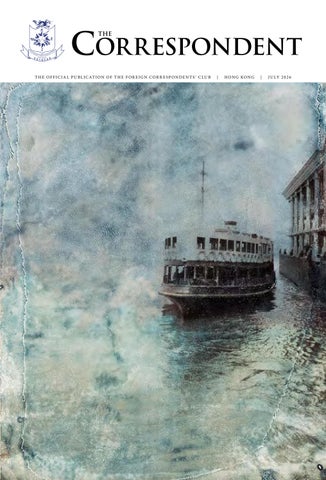
Editor Ann Tsang Email: editor@fcchk.org Design Artmazing! Cover Image Thierry Arensma Printing Elite Printing: Tel: 2558 0119 Advertising Enquiries FCC Front Office: Tel: 2521 1511
2
THE CORRESPONDENT | JULY 2026
The Foreign Correspondents’ Club Hong Kong was Incorporated in Hong Kong on 21 May, 1952. The Correspondent ©2026 is published four times a year by The Foreign Correspondents’ Club, Hong Kong. All views expressed in all articles are those of the authors and are not necessarily those of The Foreign Correspondents’ Club Hong Kong. All content contained in The Correspondent may not be reproduced in any manner whatsoever without authorisation. Advertisers warrant and represent that the descriptions of the products or services advertised are true in all respects. The Foreign Correspondents’ Club Hong Kong assumes no responsibility for claims made by advertisers and makes no recommendations as to the purchase or sale of any product, service or item. ©2026 by The Foreign Correspondents’ Club Hong Kong. All rights reserved.
CONTENTS THE COR R ESPONDEN T
|
J U LY 2 0 2 6
1 From the President 4 Club News 8 Journalism Conference Celebrates Decade Milestone
10
10 Onto The Ice House The FCC has occupied some diverse addresses throughout its history, and by 1980, with a massive rent increase looming at Sutherland House, Members faced yet another relocation. The wish list was straightforward: central location, easy access from offices, and preferably somewhere that wouldn't be demolished to make way for another skyscraper. 14 A Letter From London After three years in London in which he didn't expect most of his social life to still revolve around friends of the FCC, former President and Treasurer Douglas Wong writes a missive from the British capital to the club he finally visited again in January. The FCC diaspora he reflects, is bound by an inextricable glue of engrained memories and friendships forged. 16 On The Wall
16
20 Chasing The Elusive Thierry Arensma’s ‘HK’ series, made during a trip in 2010, offers an unusual deep vision of the city. The photographer’s glance puts a deep bias and technical on the urban reality of a city fuelled by historical contrasts. 24 A Neon Requiem The numbers tell a stark story. In the 1980s, more than 100,000 neon signs illuminated Hong Kong's skyline. Today, fewer than 400 remain. This precipitous decline frames the urgency behind ‘City of Lights’, Keith Macgregor's expansive new archive documenting the neon-drenched streetscapes that once defined the city's visual identity.
20
38
28 The Alchemy of Light and Shadow In the pantheon of 20th century photography, certain names have immediate recognition—Avedon, Penn, Beaton, Newton, et al. Yet there exists a quieter legend, a master whose work graced the pages of Vogue and transformed the language of beauty advertising, who somehow remained in the shadows of his more celebrated peers. Victor Skrebneski was that rare artist: universally respected within the industry, yet criminally under-appreciated. 34 WSET Makes A Splash! On 13 June, the FCC presented its introductory wine appreciation course - the WSET (Wine & Spirits Education Trust) Level 1 Award in Wines. An industry first among Hong Kong's private clubs and perfect for beginners, the wine course offered foundational knowledge and engaging tutorials for those new to wine study, providing a hands-on introduction to the world of viticulture. 36 In Vino Veritas 38 Food for Thought: The Ascent of Thai Cuisine 40 Food for Thought: Beyond The Stereotypes with Peter Find 42 Reciprocal Club: The Penang Club 44 New On The Block 48 Obituary: Carsten Schael 50 Obituary: Derek P. Williams
42
52 Click! 56 Don’t Beat About The Busch
THE CORRESPONDENT | JULY 2026
3
CLUB NEWS
ANNOUNCING THE NEW BOARD about plans for the coming year. The AGM was followed by the first meeting of the new Board for 2026-2027. Congratulations to all of our newlyelected Board Members and thank you to our outgoing ones for their contributions to the FCC.
CREDIT: FCCHK
The FCC’s 2025-2026 Board Year was concluded by our Annual General Meeting (AGM) at the end of May. Members were invited to listen to the Board’s report on the Club’s progress and achievements over the past year. Members also voted on Club-wide matters and were able to ask questions
The new Board Members are as follows: PRESIDENT Morgan M. DAVIS FIRST VICE PRESIDENT Jing YANG SECOND VICE PRESIDENT Christopher SLAUGHTER CORRESPONDENT GOVERNORS Jennifer JETT Karen KOH Dean NAPOLITANO Peter PARKS Paul TAIT Laura WESTBROOK William ZHENG JOURNALIST GOVERNORS Zela CHIN Joe PAN ASSOCIATE GOVERNORS FU Ka Min, Tom Alan Forbes MACDONALD Lynne MULHOLLAND Stephen VICKERS
4
THE CORRESPONDENT | JULY 2026
NOMINATIONS FOR 8TH CORRESPONDENT GOVERNOR The FCC Nomination Meeting was held on Wednesday, 22 July 2026 for the purpose of accepting oral nominations for the 8th Correspondent Governor for the year 2026 – 2027 due to the withdrawal of a candidate from the election on 20 May, 2026 Under the provisions of the Articles of Association, the Board of the Club shall consist of eight Governors who are Correspondent Members elected by Correspondent Members. Since there were only seven candidates in the Correspondent Governor category in the election for the year 2026-27, the Board decided to hold a by-election to fill the vacancy. A Correspondent Member Governor must be a Correspondent Member and nominations must be made and seconded by Correspondent Members. An election by mail ballot was held subsequently and the mail ballot papers together with a list of candidates accepted were sent to all Members of the Club one week after the Nomination Meeting. The result of this by-election will be posted on the FCC website shortly.
PRESS FREEDOM DAY STATEMENT On the occasion of World Press Freedom Day on 3 May 2026, the FCC issued the following statement. “The Foreign Correspondents’ Club Hong Kong stands in solidarity with journalists and media professionals worldwide, and supports their efforts to continue their work without interference and physical or online violence. Globally, the state of press freedom is deteriorating. Economic pressures on media outlets, ownership concentration, and the increasing use of AI threatens jobs and creates misinformation and audience distrust among other factors, leading to worsening working conditions for journalists. Recent figures from Reporters Without Borders and the Committee to Protect. Journalists show that press freedom is still being undermined by lethal violence and widespread detention of journalists around the world. In addition, government censorship through actions such as management control of media outlets, blocking of the internet, restricting journalist visas or freedom to travel, and using legal means to silence critics is on the rise. Independent journalism is essential to truth, accountability, and informed public life, and it must be protected wherever it is under pressure. Journalism is not a crime.”
WALKING FOR KINDNESS
MENTORSHIP PROGRAMME KICKS OFF On 26 May, Correspondent and Journalist Members taking part in the FCC’s inaugural Journalism Mentorship Programme met for a casual kick-off event in the Hughes Room. Led by Correspondent Governor Jennifer Jett, the one-year programme pairs a dozen early- and mid-career journalists with mentors from news outlets including Bloomberg, CNN and The New York Times, giving FCC Members a chance to benefit from each other’s rich and varied experience.
On 2 and 7 May, the FCC collaborated with ImpactHK for a private Kindness Walk, which was generously sponsored by a Member. Volunteers departed from the ImpactHK centre in Tai Kok Tsui and distributed food and necessities to people experiencing homelessness, as well as to street cleaners and the elderly. Look out for more charitable activities in which you can participate.
ERRATUM: We would like to apologise for an error made in the April 2026 issue of The Correspondent. The Fireside Chat with Irish singer Eleanor McEvoy was hosted by Associate Governor Lynne Mulholland and not President Morgan Davis as stated.
YOU CAN MAKE A DIFFERENCE Volunteer for one of the FCC’s committees if you want to get your voice heard To find out more, contact Club President Morgan Davis on president@fcchk.org
THE CORRESPONDENT | JULY 2026
5
CLUB NEWS
UNDERSTANDING MORAL INJURY
This podcast features Jing Yang in conversation with Dean Yates about moral injury, how it affects journalists, understanding how moral injury develops, and fostering a supportive organisational structure in newsrooms. Yates knows what it means to live with the consequences of the stories you cover. His career in journalism includes years with Reuters as a journalist, editor and bureau chief, working across Asia as well as in Jerusalem and Baghdad, bearing witness to acts of terrorism, the mass tragedy in the Boxing Day tsunami, as well as the incident infamously revealed by Wikileaks in 2010 - when the members of his Reuters team were machine-gunned to death by a U.S. army helicopter while doing their job. Yates has become a leading voice on moral injury, helping not only journalists, but veterans and emergency and other frontline workers. In this conversation
he outlines how moral injury - a concept similar to PTSD - affects journalists who witness or experience ethical violations, and identifies three main reasons for vulnerability. This podcast was pre-recorded and played as part of the 2026 FCC Journalism Conference. Find out more about Dean Yates’ work at his website deanyates.com.au
DIANA WU DAVID ON CAREER RESILIENCE What now for careers in journalism with the onset of AI technology and an “age of abundance” of information? Veteran broadcast journalist and FCC Correspondent Governor Karen Koh speaks with Diana Wu David, a former FT executive and top 50 global influencer on the future of journalism and about career resilience in the age of AI. David, who is the author of the book Future Proof: Reinventing Work in an Age of Acceleration and Director of Futures at ServiceNow, discusses the importance of adapting to new technologies and channels in journalism, emphasising the need for a portfolio career and personal branding. She highlights the value of curiosity, communication and relationships in journalism, and advises young journalists to experiment and build networks while maintaining financial stability.
THE ANNUAL PRESS FREEDOM SURVEY What do the Journalist and Correspondent Members of the FCC have to say about press freedom? First Vice President and Bureau Chief for The Information, Jing Yang discusses the results of the most recent Press Freedom Survey conducted among FCC Members, in which local journalists and foreign correspondents alike gave their responses to questions over the working environment in Hong Kong, increased sensitivity among sources, concerns about digital and physical surveillance, as well as perceptions of the economic health of newsrooms in Hong Kong. The survey answers are voiced using Elevenlabs AI.
CHALLENGES AND PRESSURES FOR GEN Z JOURNALISTS FCC Clare Hollingsworth Fellow Samra Zulfaqar discusses the challenges and pressures for GenZ journalists, the need to embrace personal branding for journalists and how social media and the rise of influencers are changing how organisations approach the delivery of news.
6
THE CORRESPONDENT | JULY 2026
SPEAKERS’ CORNER
WHAT’S NEXT FOR US-CHINA RELATIONS?
Zichen Wang
PRESERVING HONG KONG’S HERITAGE BUILDINGS
INSIDE HKEX’S BOLDEST REFORM IN A DECADE
CREDIT: FCCHK
As U.S. President Donald Trump concluded his visit to China in May, the world was watching closely for signs of whether Beijing and Washington could find a more stable footing in one of the world’s consequential bilateral relationships. At a Club Lunch, Zichen Wang, the Founder and Editor of Pekingnology and The East is Read and Deputy SecretaryGeneral at the Centre for China and Globalisation, discussed the impact of the visit in terms of the future of U.S.-China relations. A former senior journalist at China’s state news agency and now a prominent China analyst based in Beijing, Wang is deeply familiar with China’s political messaging and foreign policy. He examined how Chinese policymakers and commentators interpreted the visit, what signals Chinese leaders may be sending, and where opportunities for practical stabilisation may still exist.
L-R: Simpson Wong, Lee Williamson, Winnie Yeung
On 2 June, the FCC hosted a Club Lunch highlighting the importance of safeguarding Hong Kong’s architectural heritage. As a newly inducted member of the Building Heritage Alliance, the Club reaffirmed its commitment to preserving its own Grade I historic clubhouse—an enduring landmark in the heart of Central. From the roof and original brickwork to the distinctive tiles in the Main Bar and Lounge, the FCC’s historic features are carefully maintained through the ongoing efforts of Members and staff. The luncheon underscored how active stewardship is essential to protecting the character and legacy of heritage properties in a rapidly evolving city. Heritage experts Winnie Yeung and Simpson Wong led a compelling discussion on the intricate details that define Hong Kong’s historic buildings, the broader challenges of conservation, and the work being done to protect the city’s cultural landmarks. They also shared rare insights into the story behind the FCC’s current premises, deepening appreciation for its architectural and historical significance. Moderated by FCC Professional Committee Member Lee Williamson, the event offered Members a thoughtful exploration of preservation, progress and the responsibility of caring for our city’s built heritage.
In March 2026, Hong Kong Exchanges and Clearing Limited (HKEX) released a Consultation Paper that may prove the most consequential rewrite of the city’s listing framework since the dual-class share reforms of 2018. With a focus on optimising the weighted voting rights listing requirements, enhancing listing pathways for overseas issuers and other initial listing requirements, the proposals aim to broaden the diversity of companies eligible for listing in Hong Kong, enhancing investor choice while upholding robust standards of investor protection. Hong Kong reclaimed its position as the world’s leading IPO venue in 2025, but competition from Shanghai, Shenzhen, Singapore and a recalibrated Nasdaq has never been more intense. The question is no longer whether HKEX can compete, but whether these reforms will be sufficient, proportionate and welcomed. On 26 May, experts Renu Bhatia, Julia Charlton and Paul Malam discussed the subject at a Club Lunch moderated by FCC Professional Committee Member Richard Winter. n
L-R: Paul Malam, Renu Bhatia, Richard Winter, Julia Charlton
THE CORRESPONDENT | JULY 2026
7
FEATURE
JOURNALISM CONFERENCE CELEBRATES DECADE
T
he FCC marked a significant milestone on 16 May with its tenth annual Journalism Conference, drawing over 150 journalists, correspondents, students and instructors from across Hong Kong for a full-day programme of keynote addresses and panel discussions. This year’s Journalism Conference carried the theme of ‘Cutting Through The Noise’ and was made possible by four media industry sponsors: FGS Global, Monocle, Bloomberg and Telum Media. President Morgan M. Davis opened the proceedings before handing over to Neil Western, a longtime FCC Member and former President of the Club who founded the Conference a decade ago. Western reflected on the event’s impressive evolution from its humble beginnings as a small gathering in Bert’s to the major Club-wide event it has become, sharing highlights from 10 years of programming. The Opening Keynote was delivered by Ian Yee, an investigative journalist, producer and Co-Founder of The Fourth, a documentary team focused on exposing injustice and driving social change. Yee discussed the impact of his organisation’s work and outlined the rigorous standards that his team maintains for journalism, fact-finding and staff safety. The Conference comprised three panel sessions throughout the day. The morning panel, moderated by Correspondent Governor Jennifer Jett, examined coverage of the Tai Po fire. Independent reporter/editor Anjali Tsui joined Hans Tse from Hong Kong Free Press and Kwan Chun-hoi from HK Feature to discuss how reporting on the deadly incident affected them both professionally and personally, and why the story held particular significance. After lunch, FCC Clare Hollingworth Fellow Trista Xinyi Luo led a discussion on career resilience in journalism with CNA’s Wei Du, Diana Wu David from The Future Proof Lab, and Zichen Wang, founder of the newsletter Pekingnology. The panelists offered practical advice for journalists at all
8
THE CORRESPONDENT | JULY 2026
IMAGE: FCCHK
By Helena Hu
stages of their careers on navigating professional challenges and uncertainty. The evening panel focused to the future of the industry, with two South China Morning Post newsroom leaders exploring AI-driven journalism. Senior Correspondent and FCC Correspondent Governor William Zheng appeared alongside Zhou Xin, the SCMP’s newly appointed Director of Newsroom AI Innovation, to discuss the organisation’s efforts to lead in this space and the opportunities and challenges that transformation presents. As the lead sponsor of the conference, FGS Global cocurated an exclusive fireside chat between Jing Yang, now First Vice President of the Club, and Jay Qin, a Partner at FGS. The two discussed the relationship between journalism and PR, and how the industries can effectively collaborate with one another. This year’s Journalism Conference also included workshops covering a variety of topics, including The Art of Sourcing led by Jing Yang and Mithil Aggarwal; Navigating Hong Kong’s Legal Environment with Jonathan Man and Connor Mycroft; Live Reporting: Tips for Broadcasting and Blogging with Laura Westbrook and the BBC’s Danny Vincent; How to use NotebookLM, Google’s AI-powered research assistant, in reporting with media consultant and news specialist Mike Raomanachai; Alternative Media Careers: and Building a Successful Newsletter featuring speakers Amanda Cua of Backscoop and Zichen Wang. Holmes Chan, Asia-Pacific Desk Editor at AFP, delivered the closing address, sharing his experiences covering Hong Kong and Macau, his motivations as a journalist and his personal reflections on stories that have been of particular significance for him. The Club extends its warm thanks to all the speakers and panelists who contributed their expertise and insights to this year’s Conference and to all of the staff who worked so hard to make the event run smoothly. n
IMAGES: FCCHK
Morgan M. Davis
Neil Western
Ian Yee
L-R: Kwan Chun-Hoi, Anjali Tsui, Hans Tse, Jennifer Jett
L-R: Zichen Wang, Diana Wu David, Wei Du, Trista Xinyi Luo
Zichen Wang and Amanda Cua
Jay Qin and Jing Yang
Laura Westbrook and Danny Vincent
Zhou Xin and William Zheng
Holmes Chan
THE CORRESPONDENT | JULY 2026
9
FEATURE
ON TO THE ICE HOUSE
The FCC has occupied some diverse addresses throughout its history, and by 1980, with a massive rent increase looming at Sutherland House, Members faced yet another relocation. The wish list was straightforward: central location, easy access from offices, and preferably somewhere that wouldn’t be demolished to make way for another skyscraper.
10
THE CORRESPONDENT | JULY 2026
Inspection on progress of bar construction in 1982 with (from left) General Manager Heinz Grabner, Club President Donald Wise and Board Members Bill Seitz, Mike Keats, Peter Mosley and Sarah Monks
I
n 1980 when it came time for the FCC to move on again, banker John Airey f loated the idea of taking over the old Officers’ Mess across from the Hilton—a suggestion that proved about as viable as most banking tips. That building, later known as Murray House, was dismantled in 1982 to make way for the Bank of China Tower, sparing the FCC the indignity of watching its clubhouse being packed into shipping containers and reassembled in Stanley. What emerged instead was a more promising solution: the old Dairy Farm building on Lower Albert Road. The proposal came courtesy of Governor Murray MacLehose in one of his final acts before his eleven-year stint ended in 1982. The Club would pay market rent—no free rides—but with a five-year lease and a generous government loan for renovations, it was a deal worth pursuing. The building itself was, to put it charitably, a fixerupper. Architect Eddie Ko was brought on board to work with the Architectural Services Department on what was seemingly a straightforward brief: clean up the premises, clear out the clutter, restore the interiors. In practice, this
meant some Board Members rolling up their sleeves and getting involved in ways that would make modern health and safety officers weep. Former United Press International newsman Mike Keats, based in Hong Kong from 1978 to 1990, led the three-person Building Committee overseeing the renovation. General Manager Heinz Grabner, Club President Donald Wise, and Board Members Bill Seitz, Peter Mosley and Sarah Monks all contributed to ensuring the project stayed on track. Hugh van Es, by then based in Hong Kong, scoured Hollywood Road’s antique shops hunting down old lamps and lighting— because nothing says foreign correspondent quite like salvaged fixtures. “The renovations were made on a day-to-day ad hoc basis,” Keats recalled. “No-one actually had the original plans of the building and the ‘moving committee’ and Eddie simply decided ‘what would look good and work well’.” This remarkably laissez-faire approach to construction somehow produced a functional club, proving that sometimes architectural vision matters less than good instinct and a tight budget.
THE CORRESPONDENT | JULY 2026
11
The following passage is from the unpublished memoir of long-time FCC Member and former employee of the Architectural Services Department, the late Peter Berry, who died in February 2026 at age 89. Peter was invited (or “co-opted” as he put it) onto the FCC’s Move Committee and recalls inspecting the premises by torchlight, since the building had no electricity.
“Faced with a large increase in rent at Sutherland House, the (then) President of the Club, the late Donald Wise (Daily Mirror) resorted to resurrecting his much earlier friendly connection with the Governor (HE) something no doubt made easier by both being very tall men. Upon being appraised of the situation, HE directed someone in charge of Hong Kong property to find somewhere for the FCC. After a brief exchange of views, wherein HE was told it was not possible and HE said “try harder”, a very dilapidated building on Ice House Street was identified and the tenant, Hongkong Land/Dairy Farm, was given a few months to get out. Their directors parked their cars there, so no big problem. The building was not connected to the mains, so our initial survey was undertaken by torch light. We were accompanied by a concrete specialist and a Hong Kong structural engineer friend of mine. Unfortunately, my office’s maintenance team had also chosen that day to check the building and saw me. Since the FCC’s flashlights were better than theirs, they followed us around and overheard
the exchange of views and damning preliminary oral report given by the two specialists. This was no surprise as the building was in a terrible state. Anyone could see that it had exposed rusting reinforcement and spalling concrete everywhere. It needed major structural repair work on it before we could start to make it habitable. This was relayed to Donald Wise who panicked and sent a distraught letter to HE, who in turn phoned my boss, John Aitken, who knew absolutely nothing about the problem and was therefore somewhat upset to get the call. He in turn called a meeting to find out who had dropped him in “it”. I admitted to a very angry boss that it was I who “cut down the cherry tree”. I begged for some time and phoned Donald, demanding he send another letter to HE that I would dictate, to try to pour oil on the very troubled waters…particularly mine! Happily, for all concerned this was achieved. I can’t remember what I said but my grovelling plea for understanding and mercy worked and there we are to this day. Even so, it was not one of my better days…”
Gathering of Presidents. From top left Philip Bowring, Jim Biddulph, Mike Keats, Hugh van Es, Donald Wise, Derek Davies with former General Manager Heinz Grabner
12
THE CORRESPONDENT | JULY 2026
IMAGE: LAKSHMI HARILELA
Once the bar was installed, Members wasted no time in carving up their territory. “There was the Correspondents’ Corner and sections for lawyers, bankers, PR and ad men, freeloaders, the Red Lips Brigade, the Review Mob, The Vale of Dwarfs and Reuters territory and others," Keats remembered. "It all made for good-hearted bantering at the gathering of the clans—particularly on a Friday, which evolved into the fabled ‘Zoo Night’.” Governor Sir Edward Youde formally opened the new premises on 9 November, 1982, receiving membership number one for his troubles. His successors, bar one, have also held that coveted slot. The Club celebrated its new digs in characteristic fashion: With an all-night party. Throughout the 1980s and ‘90s, the FCC's reputation for marathon drinking sessions earned it nicknames among some Members as “the House of Self Destruction” and “the Club of Shame"—titles worn with a certain perverse pride. But as Hong Kong itself became the story in the run-up to 1997, the Club's character began shifting. The safari suits propping up the bar gave way to journalists covering the handover, then to magazine writers from Business Week and Asia Week, and eventually to Bloomberg and Reuters types focused primarily on financial journalism’. By 2002, the premises were overdue for refurbishment. The bar had to move—its original position parallel to the leftside windows proved too narrow for bartenders to pass each
other. Relocating it to its current spot gave staff breathing room and allowed natural light to brighten the Main Lounge. The move yielded an unexpected discovery: beneath ugly slabs of thick orange-red Canton tiles lay beautiful historic Victorian encaustic tiles. Not everyone was thrilled. “I thought the tiles were brilliant, but there were some disparaging remarks,” recalls Building Project and Management Committee Convener Christopher Slaughter. “They said it made the Club look like a Victorian lavatory—a public restroom straight out of the 1890s. But, the FCC has never done change well.” Heritage researcher Simpson Wong explains the tiles' provenance: “Dairy Farm used the ground floor of what is now the FCC for sterilising and bottling milk. They needed a very clean floor for bottling, so they laid encaustic tiles.” The same tiles appear in the Fringe Club next door, which once functioned as Dairy Farm's retail shop selling sausages and cold cuts. The machinery from the bottling process likely damaged some of the original tiles, necessitating those Canton replacements. Today’s FCC continues evolving. Membership drives have brought more women, younger Members and greater diversity. The heavy drinking past is largely legend now, though the Club still embraces its colourful history forged in more turbulent times. It is these stories—and those Victorian lavatory tiles—that make the place special. n
THE CORRESPONDENT | JULY 2026
13
FEATURE
A LETTER FROM LONDON
After three years in London in which he didn’t expect most of his social life to still revolve around friends of the FCC, former President and Treasurer Douglas Wong writes a missive from the British capital to the club he finally visited again in January. The FCC diaspora he reflects, is bound by an inextricable glue of engrained memories and friendships forged. By Douglas Wong
L-R: Paul Bayfield, Philip Bowring, Tom Crampton, Christopher Slaughter, Ernst Herb, Douglas Wong, Jitendra Joshi, Neil Western. Crampton, Wong and Joshi all live in the U.K. now.
T
wo days before the war began, we gathered to honour and remember a friend and long-time servant of the Club, Carsten Schael. The speeches from the Main Dining Room podium were eloquent and moving. The rousing toast, when it came, is one I associate with the FCC, its history and its only home that I have known: To absent friends. Several of us who had been Board Governors with Carsten through the most recent decade or so of ups and downs for foreign correspondents in Hong Kong chatted that evening about the tragic loss, catching up briefly, as you do. Two of us are absent Members and were participating in the event through that pandemic gift to us all, a Zoom call. When I moved to London three years ago, I didn’t expect, in a country I studied and worked in for a decade, that most of my social life here would be with absent friends of the FCC. Many of us arrived at the same time, after making our second homes at the Club for years. Seeking to settle in, we checked out the British capital’s reciprocals, and the other storied or newer institutions that London invented. The National Liberal Club in Westminster, like Britain’s liberal political momentum maybe, is grand but faded. The Oriental Club in Marylebone is unashamedly colonial chic, with a smattering of younger promotion-priced public school graduates bringing down the average age of its crowd. The RAF Club, overlooking Green Park, has rooms and outclasses many of the overpriced Mayfair hotels around it, but none of these felt very ‘FCC’ to me.
14
THE CORRESPONDENT | JULY 2026
The Groucho Club (where an FCC friend brought me), had more of the atmosphere I remembered, that mix of creative, analytical, entrepreneurial discussion around tables and the bars. Pall Mall clubs are like walking into a scene from Netflix’s The Diplomat, but I didn’t see myself feeling at home in any of these options. Furthermore, unlike Hong Kong, London is so sprawling, trains are so unpredictable and taxis are so expensive that social life is nothing like the campus/holiday resort rhythm I didn’t realise Hong Kong enjoyed. Your commute home doesn’t unexpectedly become a few hours at the club here. What was great, after COVID closed Hong Kong, was how many people passed through London in our first year there, and through a former SAR resident visiting from New York, I was reintroduced to some of the wider circle of Hongkongers in London. One in particular, unlike me, is able to organise a good party, and without a place as cherished as Lower Albert Road, she brings the FCC diaspora together for Chinese New Year, Spring, Summer, Autumn and Christmas drinks. As with the FCC I remember, correspondents from all the international news names, recovering journalists turned communications consultants, think tankers, analysts or community advocates; diplomats, financiers or professionals from the arts who were, are or may yet be Associate Members of the Club, all meet regularly at pubs arranged by our honorary secretary to talk about everything, nothing, things we didn’t expect to, and of course, Hong Kong and the actual FCC.
A gathering at The Frontline Club
Hong Kong reopened its borders and people were going back or visiting, so we exchanged stories from the frontline. How had it changed since the exodus that followed COVID and the new legal regime? And the new world order that has unrolled since Donald Trump’s re-election. We all know that you can’t just rely on what you see in the news or on social media. The FCC family relies on first-hand reporting. We shared and supported each other through settling in to a new city too. Britain has changed a lot in the last three years. If you believe the headlines, since Israel’s invasion of Gaza, London is less safe for Jewish people than Israel. Crime by immigrants (who haven’t yet been caricatured as locusts), the failures of a government that started so well with a chief executive from central casting, things are so bad here (or rather, as the Mayor puts it, there is such a ‘relentless attack of lies and hatred’) that London has launched an international advertising campaign to tell the world the truth. Sound familiar? When I returned to the FCC earlier this year and caught up with friends who had stayed, we asked each other how life in our cities really was. It reminded me of discussions I’d had at the Club with veterans when I was a new arrival in 2004. I asked how Hong Kong had changed since the 1997 handover. ‘Not at all’ was the reply then. It has changed now. And so has the Club. The Main Bar and Bert’s were doing good business the week I was there, and it was great to catch up with the staff, most of whom remain. The mix of patrons was noticeably different. There were few correspondents and journalists. One of them told me, as with Stanley, Lan Kwai Fong and many of the other expatriate hubs at weekends, everyone goes to Shenzhen now. Whether gathering in our building, or at a pub in London, the change we talk about is not just how Hong Kong, or Britain, or most strikingly the United States of America, is different from just a few years ago, it’s how living through those changes has changed us. Which is why I’m impressed how some FCC adjacent journalists, both in Hong Kong and thousands of miles away, can still hold so passionately and performatively to their
sense of betrayal by the Club of principles they profess. I’ve profoundly disagreed with and criticised some of the things FCC Presidents and Boards have done, both within the Board when I’ve been on it, and off it, when my knowledge has been less informed. If the story is true that a FCC President in 1949 was able to intercede to secure the release of a Correspondent Member detained by KMT forces, it’s unlikely because he had a formidable following that liked his posts on the equivalent to Elon Musk’s platform of the time. (That would have been a newspaper). There is a club in Paddington that feels, physically, like the FCC. The two most prominent photographs on the walls of The Frontline Club’s welcoming bar are of squares: Alfred Eisenstaedt’s ‘The Kiss’ and Jeff Widener’s iconic image. The second has been hung on the FCC’s walls many times. We discussed this on a recent evening at the Frontline. We talked about absent friends. How the definition of correspondents has changed. How Britain could change even more dramatically in the next couple of years, and how some of the diaspora have returned, or might return to Hong Kong. Cities rise and fall. One thing I noticed on my visit to Hong Kong was the mainland style tourist branding everywhere, celebrating ‘intangible cultural heritage’. The city became my future once, and was, along with London and New York, one of globalisation’s co-capitals in 2008. This year, the latest contender for that title, Dubai, has been knocked off the podium by the Iran war. Winners and losers, who’s up and who’s down are the stuff of headlines and bar banter. The unique oil that friends of the FCC add is bearing witness, understanding the nuances, listening more than lecturing, considered words and action, and remembering. The spirit of the Foreign Correspondents’ Club, Hong Kong isn’t absent. Forged over many years and relationships, it’s still there, and here, and elsewhere. It will always remain. n Douglas Wong was President of the FCC from 2012-13, and Treasurer from 2017-19
THE CORRESPONDENT | JULY 2026
15
ON THE WALL: JULY 2026
GONÇALO LOBO PINHEIRO WHAT ONCE WAS, WILL NOT BE AGAIN
Cheoc Van Beach, Coloane
Lago Sai Van
Cemitério Protestante, Santo António
CREDIT: GONÇALO LOBO PINHEIRO
Largo do Senado
P
ortuguese photojournalist Gonçalo Lobo Pinheiro is exhibiting images from the second volume of his compelling documentary project, “What once was, will be no more…”, a poignant exploration of Macau’s rapidly evolving identity through layered photography. The project employs a striking technique: Pinheiro positions archival photographs—some dating back to the 19th century—within their exact contemporary locations, creating powerful visual dialogues between past and present. Following the success of his 2022 debut volume, which featured images from the 1930s to 1990s, the sequel expands the temporal scope by incorporating photographs sourced from auctions, private collections and Portuguese archives. For Pinheiro, who has called Macau home for over 15 years, the curation process proved both ambitious and bittersweet, taking more than a year to complete. The challenge lay not simply in finding historical images,
16
THE CORRESPONDENT | JULY 2026
but in attempting to recreate their perspectives in a city transformed almost beyond recognition. One of the book’s oldest photographs, captured at the Protestant Cemetery, back to the 1800s. “It is a difficult task. Everything has changed,” Pinheiro reflects. “That’s why, in the vast majority of cases, what once was will never be again.” Many locations simply no longer exist, making exact alignment impossible.” Portuguese writer and professor Henrique Levy, who penned the foreword for Pinheiros book, describes the project as showcasing Macau as a “city of encounters, of cultural blending, and of coexistence between worlds that intertwine.” Through this innovative photographic archaeology, in addition to evoking a heavy dose of nostalgia, Pinheiro constructs a visual argument for memory itself, reminding us that understanding where we’ve been remains essential to comprehending where we’re going.
ON THE WALL: AUGUST 2026
FOCUS AT THE FRONTLINE 2025
Su Zhengqian / Sing Tao Daily
Lin Zhendong / Initium Media
Fu Junwei / Freelance
Qin Zijing / CUHK
T
he Hong Kong Press Photographers Association’s (HKPPA) news photography competition, Focus at the Frontline 2025 celebrating the complexity and significance of photojournalism, announced its winners on 30 May, 2026 This year’s competition attracted 66 participants, including both professional photojournalists and students, who submitted a total of 701 photos in 49 photo stories. Focus on the Frontline is Hong Kong’s largest annual news photography competition which was first held in 1993. The prestigious Photo of the Year award went to Tyrone Siu (蕭文超) from Reuters for his powerful and emotionally gripping image of an elderly resident crying out in anguish during the severe fire at Wang Fuk Court. The judges felt the photograph focused on the emotions of the moment and was extremely powerful. The terror of the subject in the image deeply resonates with the people of Hong Kong. “The Wang Fuk Court fire was one of the most significant news events in Hong Kong in 2025, and the difficulty and quality of this photograph deserve recognition,” said a spokesperson for the seven-member judging panel. Through Focus on the Frontline, the organisers hope to deepen the public’s awareness of current affairs, enhance the recognition of the work of photojournalists, and acknowledge the efforts and contributions of the winning photojournalists to the industry over the year.
THE WINNERS Breaking News Tyrone Siu / Reuters General News Ma Kai / Freelance Photo Story Lin Yi / Freelance Feature Su Zhengqian / Sing Tao Daily Portrait Lin Zhendong / Initium Media Sports Li Zetong / South China Morning Post Nature and The Environment Fu Junwei / Freelance Student Group - Photo Essay Qin Zijing / School of Journalism and Communication, the Chinese University of Hong Kong (CUHK) Student Group - Single Image Ma Zizhao / Hong Kong Baptist University
THE CORRESPONDENT | JULY 2026
17
ON THE WALL: SEPTEMBER 2026
CREDIT: REUTERS/TYRONE SIU
FROM CRISIS TO RESILIENCE THE SOPA EXCELLENCE IN PHOTOGRAPHY AWARD 2026
Award for Excellence (Global): Wong, 71, reacts after saying his wife is trapped inside Wang Fuk Court during a major fire, in Tai Po, Hong Kong, China, 26 November, 2025.
W
hat makes a photograph endure long after the news cycle has moved on? How can a single frame capture both the scale of a disaster and the deeply personal stories within it? And how do photojournalists bear witness with compassion, integrity and visual power amid conflict, catastrophe and profound social change? These are among the questions considered by the judges of the SOPA Awards—widely regarded as Asia’s most prestigious journalism honours—when selecting the finalists and winners of the Excellence in Photography Award, which recognises outstanding visual storytelling that combines journalistic rigour with photographic excellence. Presented together for the first time at the FCC on the Van Es Wall in September, the nine finalists for the 2026 award offer an extraordinary portrait of Asia at a moment of uncertainty, resilience and transformation. Spanning three competition groups—Global, Regional/Local and Chinese-language—the exhibition brings together stories that illuminate the human experience behind the headlines. This year’s finalists confront some of the region’s defining challenges. Reuters, Hong Kong Free Press and Initium Media documented the devastating Wang Fuk Court fire in Hong Kong from strikingly different perspectives, revealing not only the horror of the disaster, but also the grief, solidarity and emotion that followed. Agence France-Presse explores
18
THE CORRESPONDENT | JULY 2026
the quiet pursuit of beauty and identity under Taliban rule in Afghanistan, while Bloomberg examines the contested future of Indonesia’s rainforests through the lens of the global carbon market. Elsewhere, Channel News Asia shines a light on the lives of Malaysia’s migrant charcoal workers, whose labour sustains an industry few ever see. The Japan Times offers a deeply compassionate look at Japan’s growing phenomenon of solitary deaths through the work of specialist cleanup crews. Wainao examines the realities of rural China amid economic and demographic change, while The Reporter chronicles both devastation and recovery after catastrophic flooding in Taiwan. Together, these works demonstrate the extraordinary range of contemporary photojournalism—from breaking news and environmental reporting to intimate social documentary. They remind us that the strongest photographs do more than record events: they reveal the people at the heart of every story, challenge our assumptions and deepen our understanding of the world around us. At a time when images travel faster than ever, these photographs invite us to slow down, look closely and bear witness. They affirm the enduring power of photojournalism not only to inform, but also to foster empathy, accountability and a shared sense of humanity. n
CREDIT: CHANNEL NEWS ASIA/ZAMZAHURI ABAS CREDIT: 歪脑 WAINAO/SHELL LONG
Award for Excellence (Regional/Local): Malaysia’s charcoal workers who risk life and health to do the work shunned by most.
Award for Excellence (Chinesel): Rural reality on saline-alkali land: Pastoral iddeal or a peasant’s lament?
THE CORRESPONDENT | JULY 2026
19
FEATURE
CHASING THE ELUSIVE
Thierry Arensma’s ‘HK’ series, made during a trip in 2010, offers an unusual deep vision of the city. The photographer’s glance puts a deep bias both aesthetical and technical on the urban reality of a city fuelled by historical contrasts. By Thierry Arensma
‘HK XII’. UltraChrome K3 pigmented inks/ paper Tecco on aluminum glued under bright plexi
I
’ve already been in this city, it knows me. I was instantly taken aback by its might, energy, contrasts and paradoxes. It is intoxicating, astonishing. And also very tiring. This time, unlike on previous occasions, I am here with my 4 x 5 inch view camera and my boxes of out-of-date Polaroids. I would like to bring out the emotions that this city invokes in me, and to make visible this invisible force that I feel. The power that emanates from its buildings. And also from its highways, which swell and fill, like arteries coursing through a body, the pressure rising with all the effort and toil. Not the easiest of quests. My mind is full of conventional visions of big city architecture. That would be the easy way, Hong Kong lends itself willingly. But that’s not for me. What I imagine is something different, more dream-like, calmer. Something which is both light and weighty, futuristic but which has already left its mark on time. I want to forge a rift with this urban structuring and restore to it its poetry. Mysteries are what interest me, not what we already know. My old black-and-white Polaroid films and the protocols
20
THE CORRESPONDENT | JULY 2026
that I drew up in Sichuan, consisting of allowing the chemicals from the film to act on the negative matrix, might, perhaps, allow me to give body to this “fictional vision” which urges me on. The weather is not on my side. The sky is like a sheet of zinc and yet my body and clothes are one and the same thing. The almighty humidity here is suffocating. Will it rob me of the means I need to see my adventure through to its end? The films are old and fragile; they are my last cartridges. They need to be treated with respect, and the heat and humidity can prove fatal to them. I have no option but to risk everything I have. I walk a lot. My brother Jean-Louis, who lives in Hong Kong and knows the city well, graces me with his presence and comes to my aid as a much-needed sherpa to help carry some of my equipment around. I could not do without him, for he leads me down invisible streets and places. From time to time, I set down my imposing camera on its solid Gitzo tripod. I can’t get the shot I’m after, so we leave. The heat is unrelenting.
‘HK VII’. UltraChrome K3 pigmented inks/ paper Tecco on aluminum glued under bright plexi
THE CORRESPONDENT | JULY 2026
21
FEATURE
‘HK II’. UltraChrome K3 pigmented inks/ paper Tecco on aluminum glued under bright plexi
22
THE CORRESPONDENT | JULY 2026
‘HK XIV’ and ‘HKXXIX’. UltraChrome K3 pigmented inks/ paper Tecco on aluminum glued under bright plexi
Little by little I get a feel for the city and I see what I want. I set up, cast my gaze behind the glass of my large-format camera and the picture becomes part of a seemingly perfect equilibrium. The zinc sheet is still positioned there just above. I wait a moment, for a hypothetical trickle of light. Nothing. I look for the shadows on walls, roofs and streets. They emerge faintly. Perhaps it is a blessing. This dull light, a false hue, has a strange effect on the relief. City, nature and sky find themselves stuck all in the same place. I adjust my device, measure my lights, look at the diaphragm number and the speed which my sensor on the lens has given me, and close it. Then a final check under the black cloth which cuts me off from the world and the outside light, leaving me alone to face my choice. I then place the precious film into the camera. I like the slowness that working with a large-format camera brings. A time for reflection and applying myself. Then, everything goes much quicker. Thirty seconds later the Polaroid renders up its picture. I scrutinise the positive eagerly, meanwhile the chemicals on the negative discreetly continue to take effect. The picture is there, just right. The negative needs to be saved, but I can feel that the strength of the humidity is changing the result and that if, as
I had initially planned, I allow the chemicals to continue to act and to alter the negative in part, I risk losing this picture forever. It is the only remains of this magical moment. I decide to take the risk and, without neutralising it, I carefully place it in a plastic box. For the rest of the day and the 10 days that followed, we repeated this operation with the same eagerness, acuity and fear of watching the negatives disappear forever, due to the combined effect of the chemicals and humidity. Back in Paris, I hastily scanned the matrixes which continued to evolve unceasingly. Some of the pictures are so altered that they are beyond retrieval, while others are just right; that is, in the spirit of my vision of this city. In them, I once again find that strength and that initial emotion gripped me. But also, in a magical way, the marks induced by the chemicals add to it an atmosphere of an offbeat, poetic kind. To my eye there is something of a lead pencil-style Gustave Doré, or Fritz Lang in Metropolis, or Enki Bilal. I look at my pictures and think of Sarah Moon’s phrase: “A true gift is when it comes unexpectedly, when the strongest thing is the picture itself.” n To view all the images in this series, please visit hkcityvision.com
THE CORRESPONDENT | JULY 2026
23
FEELING BOOKISH
A NEON REQUIEM
The numbers tell a stark story. In the 1980s, more than 100,000 neon signs illuminated Hong Kong’s skyline. Today, fewer than 400 remain. This precipitous decline frames the urgency behind ‘City of Lights’, Keith Macgregor’s expansive new archive documenting the neon-drenched streetscapes that once defined the city’s visual identity.
Neon Collage #1
K
eith Macgregor’s latest book and accompanying exhibition City of Lights presented by Blue Lotus Gallery arrive at a critical juncture in Hong Kong’s relationship with its illuminated past. What Macgregor once dismissed as “urban wallpaper” has become an indelible part of the city’s cultural heritage, and his decades-long commitment to photographing these signs has produced what co-author Cardin Chan describes as “one of the largest photographic archives of Hong Kong’s streets and neon signage”. The project’s origins trace back to 1998, when Macgregor recognised the accelerating disappearance of the signage which for decades has been inextricably linked with the city. Spending weeks traversing Hong Kong Island, Kowloon and the New Territories, he systematically documented a vanishing streetscape. That initial effort culminated in Neon City: Hong Kong at Night (2002), now regarded as an essential
24
THE CORRESPONDENT | JULY 2026
record of a lost era. City of Lights builds on this foundation with hundreds of previously unseen images, offering a more comprehensive testament to the restless energy that once pulsed through the city’s illuminated arteries. Macgregor’s journey to becoming one of Hong Kong’s pre-eminent visual chroniclers followed an unconventional path. Born in 1946 and raised between England and Asia, the British photographer settled in Hong Kong and ran a successful business specialising in Asian furniture until the late 1990s. Photography evolved from a parallel pursuit into a serious vocation, with his images of the city’s harbour, skyline and neon-lit nights resonating so widely that postcards of his work sold in the millions during the 1980s. In doing so, he helped shape how Hong Kong was perceived both locally and internationally—a city defined by vertical density and horizontal illumination. “For those of us committed to preservation, it is an invaluable visual record,” says Chan.
Neon sign maker Master Wu at work
THE CORRESPONDENT | JULY 2026
25
Dai Kum Lung mahjong parlour in Wan Chai, Hong Kong (2000)
26
THE CORRESPONDENT | JULY 2024
HK Neon Fantasies, Hennessy Road (1987/2018)
What distinguishes City of Lights from a purely elegiac exercise is its attention to the human dimension of this craft. The book features conversations with master glass benders, the installers who climbed dizzying heights to mount these signs, and the conservationists working to ensure neon retains a place in contemporary Hong Kong. This approach transforms the archive from mere documentation into a repository of embodied knowledge—the creativity, skill, engineering and imagination that Macgregor acknowledges he once overlooked. The project has emerged against a backdrop of renewed local interest in neon preservation. Recent exhibitions at the Hong Kong Design Institute and Tai Kwun, presented in partnership with Tetra neon Exchange (TNX), signal a collective desire to reconnect with this defining chapter of the city's visual history. Chan, former general manager of TNX and Founder of cultural heritage company The Indispensible Hong Kong, notes that for those committed to preservation, Macgregor's work provides an invaluable visual record. Yet the narrative here is more complex than simple conservation. The recent closure of establishments like Sammy's Kitchen underscores a sobering reality: even when a sign is saved, the city around it inevitably moves on. Families grow, storefronts evolve, and the social context
that gave these signs their fame continues to transform. This makes Macgregor's archive essential a repository of fleeting moments and memories in a Hong Kong characterised by constant flux. Crucially, City of Lights frames its subject as evolution rather than extinction. While the era of massive commercial signage may be fading—driven by redevelopment, regulation and the ascendancy of LED technology—neon is finding new life through contemporary artists like Jive Lau, who are reimagining the medium for the modern age. This generational handoff suggests that Hong Kong's neon spirit, while transformed, continues to illuminate the city in innovative forms. Macgregor's work underscores how rapidly Hong Kong's visual landscape has been reshaped, and how photography is preserving it. In documenting what was taken for granted, he has created an archive that forces us to really see what brilliance once defined our streets, and to consider what responsibilities we bear toward respecting the cultural heritage that remains. n City of Lights | Keith Macgregor Until October 4, 2026 Blue Lotus Gallery, 28 Pound Lane, Tai Ping Shan, Hong Kong
THE CORRESPONDENT | JULY 2026
27
THROUGH THE LENS
THE ALCHEMY OF LIGHT AND SHADOW In the pantheon of 20th century photography, certain names have immediate recognition—Avedon, Penn, Beaton, Newton, et al. Yet there exists a quieter legend, a master whose work graced the pages of Vogue and transformed the language of beauty advertising, who somehow remained in the shadows of his more celebrated peers. Victor Skrebneski was that rare artist: universally respected within the industry, yet criminally under-appreciated. Perhaps this relative obscurity was by design. Skrebneski was a man who preferred to let his images speak. And speak they did— mainly in hushed tones of black and white, in compositions that married the precision of Constructivism with the dreamlike atmosphere of Surrealism, and in portraits that captured not just a face, but an entire zeitgeist. By Ann Tsang Images Victor Skrebneski
28
THE CORRESPONDENT | JULY 2026
Château de, Raray, France (1986)
THE CORRESPONDENT | JULY 2026
29
IMAGE: VICTOR SKREBNESKI
THROUGH THE LENS
‘Horses’, Paris (1952)
T
he story of Victor Skrebneski’s career possesses the quality of myth. At six years old, wandering through a Chicago park with his father and sister, he discovered a camera on a bench—”just this black box,” as he would later recall with characteristic understatement. When noone claimed it from the field house after several weeks, the camera became his. From that moment, the trajectory of his life was set. It’s a story that speaks to the element of chance that so often shapes artistic destiny, but also to Skrebneski’s innate ability to recognise possibility in the everyday. Born in 1929 to Russian-Polish immigrant parents, Skrebneski came of age in Chicago during the city’s cultural renaissance. His formal training at The Art Institute of Chicago and László Moholy-Nagy’s revolutionary Institute of Design provided him with a theoretical foundation that would prove to be valuable. Unlike many fashion photographers who stumbled into the medium, Skrebneski approached his work as a fine artist who had initially trained as a painter. This background became evident in his work— the studied composition, the careful attention to negative space and the way light sculpts form in his images recall the great European Modernists. The artistic movements that captivated him—Surrealism, Cubism, Dada, and Realism—created a unique visual vocabulary. Where other fashion photographers of his era might aim for naturalism or theatrical drama, Skrebneski
30
THE CORRESPONDENT | JULY 2026
synthesised these influences into something entirely his own. His images possess an otherworldly quality, as if his subjects exist in a perfected dimension just adjacent to our own reality. Robert Sobieszek, Curator of Photography at the Los Angeles County Museum of Art, captured this essence perfectly: “His images are more real than the real, more beautiful than the beautiful, and they are constantly embroidered with myriad allusions.” This layering of reference and meaning elevated Skrebneski’s commercial work into the realm of fine art—a distinction that many photographers chase, but few achieve with such consistency. After cutting his teeth photographing in New York and Europe, Skrebneski returned to his native Chicago in 1952 to open his own studio. The choice to remain in the Windy City rather than relocate to New York—the traditional centre of fashion photography—may have contributed to his relative anonymity in popular culture. But it allowed him to cultivate a distinctive voice, free from the echo chamber of Madison Avenue. The turning point came in 1962 when Estée Lauder commissioned Skrebneski to create a cosmetics advertisement. This collaboration would last 25 years and fundamentally reshaped beauty advertising. Lauder pioneered the concept of selecting one model to serve as the “face” of the brand, and Skrebneski became the architect of this vision. His muses—
IMAGE: VICTOR SKREBNESKI
Marshall Field & Co advertisement shot at The Pump Room, Chicago (1953)
THE CORRESPONDENT | JULY 2026
31
IMAGE: VICTOR SKREBNESKI
THROUGH THE LENS
Barack Obama (2004)
32
THE CORRESPONDENT | JULY 2026
IMAGES: VICTOR SKREBNESKI
Phyllis Connor in one of Skrebneski’s first Estée Lauder cosmetic advertisements (1964)
Hubert de Givenchy (1975)
Phyllis Connor, Karen Graham, Shaun Casey, Willow Bay, Estée Lauder herself recognised that Skrebneski understood something essential about her brand philosophy. She once proclaimed that their campaigns chronicled not just beauty standards, but “trends in fashion, movements in interior design and changes in lifestyle”. Before “lifestyle branding” became marketing jargon, Skrebneski was crafting entire worlds through his photographs—rooms that didn’t quite exist, lighting that seemed to emanate from the subjects themselves, a sense of luxury that was simultaneously concrete and ephemeral. What distinguished Skrebneski’s beauty work was its classical restraint. In an industry increasingly dominated by shock value and sexual provocation, he presented his subjects with dignity and an almost Renaissance-like sense of proportion. There’s a timelessness to his Estée Lauder campaigns that makes it difficult to date them precisely— they exist outside fashion’s relentless cycles of trend and counter-trend. But Skrebneski’s genius extended far beyond commercial work. His portraits captured a remarkable cross-section of 20th century cultural figures: Orson Welles, Bette Davis, Truman Capote, Dennis Hopper, Liza Minnelli, Diana Ross, Vanessa Redgrave, John Malkovich. His celebrated “black turtleneck series”, featuring Andy Warhol among others, strips away artifice to reveal something essential about his subjects. His brief theatrical training and extensive travels infused these portraits with a sense of drama and worldliness—each image feels like a frozen moment in an ongoing narrative. For Skrebneski, photography was “a constant re-invention of memory, place and time”. This philosophical approach
elevated his work beyond mere documentation into meditation on identity and representation. Whether photographing Cindy Crawford at the beginning of her career or creating campaigns for Chanel and Givenchy, he brought the same contemplative rigour to every assignment. Skrebneski’s work has been exhibited throughout the years at the Museum of Contemporary Art and Museum of Contemporary Photography in Chicago, the Los Angeles County Museum of Art, and museums in New York, London, Paris and Florence. His photographs reside in the permanent collections of the Museum of Modern Art in New York and other prestigious institutions—a testament to their artistic merit beyond their commercial success. Those who knew Skrebneski describe a man who remained remarkably grounded despite six decades of success. His modesty seems almost anachronistic in our age of personal branding and self-promotion. Perhaps this explains why his name doesn’t resonate with the same immediate recognition as some of his contemporaries. But for those who understand photography’s capacity to transcend documentation and enter the realm of art, Skrebneski’s work stands out as a master class in the medium’s possibilities. Chicago never forgot its native son. In a fitting tribute to a photographer who spent his entire career championing his hometown while achieving international acclaim, the city honoured Skrebneski by naming a street after him. Skrebneski Way stands as a permanent reminder of the artist’s enduring connection to Chicago—a tangible acknowledgment that while he may have photographed the world’s most glamorous subjects for the most prestigious publications, his heart and his studio remained firmly rooted in the city where a sixyear-old boy once found a camera on a park bench. n
THE CORRESPONDENT | JULY 2026
33
IN VINO VERITAS
WSET MAKES A SPLASH!
On 13 June, the FCC presented its introductory wine appreciation course - the WSET (Wine & Spirits Education Trust) Level 1 Award in Wines. An industry first among Hong Kong’s private clubs and perfect for beginners, the course offered foundational knowledge and engaging tutorials for those new to wine study, providing a hands-on introduction to the world of viticulture.
IMAGE: FCCHK
By: Zhou Si Ya, Samra
T
here’s a particular kind of embarrassment that comes with staring at a wine list in a restaurant and pretending to know what you’re ordering. You point at something mid-priced, nod, and hope no one asks you why you chose it. That was me, every single time, for longer than I care to admit. I’d been drinking wine for a few years, decent wine for the most part, and yet if someone had asked me to articulate what was in my glass, I’d answer something vague about it tasting “quite nice” or “it’s got a kick to it”. When I signed up for the WSET Level 1 Award in Wines at the FCC in June, I told myself it was for professional reasons. It wasn’t. I was tired of pretending. The WSET Level 1 is a one-day course that ends with a 30-question multiple choice exam. When I first read that, I nearly talked myself out of it. The idea of cramming everything about wine into a single day and then sitting for
34
THE CORRESPONDENT | JULY 2026
an exam in the evening struck me as either too efficient or a little cruel. It turned out to be neither. It was, unexpectedly, one of the most enjoyable days I’ve had in a “classroom” setting since I stopped having to be in one. The course at the FCC was led by AWSEC Wine Educator Paul Heavey with a group of 16 participants, each with their own reason for wanting to understand wine better. Paul took a systematic approach to wine tasting, breaking down each element: colour, nose, palate, sweetness, acidity, tannin. The point was to give us a shared language to articulate and compare what we were drinking. Before the course, I would describe a bottle of wine based on how much I liked it. However, this course pushes you to take a step further, not just how much you like it, but why it tastes like that and how you’d describe it to someone in a way that is meaningful.
IMAGE: FCCHK
We tasted around 11 wines on the day. A couple I knew well and others I had simply walked past in shops. The course provided me with context: a wine that tasted sharp and austere made sense to me. I could guess which climate it came from, the grape variety and how it was made. That shift from passive drinking to actively appreciating the wine is what the course delivers. In the afternoon, we moved onto wine service and food and wine pairing, the latter of which I found to be a genuinely useful part of the day. We went into classic combinations but the more interesting part was learning why certain pairings work particularly well. The course isn’t intended to make you
memorise pairings, rather it teaches the principles behind them. Knowing which wine to pair with what kind of food elevates the entire dining experience. Prior to this course, I wasn’t much of a blue cheese person, until I paired it with Chardonnay. I know it might sound like an odd combination, but trust me and give it a shot! By the time the exam ended, I didn’t feel anxious. A day of tasting a variety of wines had given the theories and principles something to anchor themselves to. But more than that, I left with new knowledge and that wine has its own vocabulary which I have only started to learn the alphabet of. n
WHAT THE ATTENDEES HAD TO SAY… “What a fantastic experience. Thanks for arranging this! I would love to do Level 2!” “I learned how to pair different wines with food and recognise what I enjoy.” “What a great course! It was really enjoyable and I hope you will offer other WSET courses.” The next WSET course, Level 2, is a three-day programme to be run on successive Saturdays in the autumn. Details will be forthcoming shortly.
THE CORRESPONDENT | JULY 2026
35
IN VINO VERITAS
NEWS FROM THE WINE CELLAR SAVE THE DATE The next Wine Social will be held on 2 September and will feature a Spanish wine theme. Join us to taste and vote for your favourite, which may be chosen as our upcoming Wine of the Month.
SUMMER WINE DINNERS This summer, the Club will host two special Wine Dinners. On 29 July, we welcome Vidigueira Winery from Portugal’s Alentejo region, renowned for its elegant reds and crisp whites, shaped by granite soils and warm sunshine. On 26 August, we feature Bodega Santa Julia from Mendoza, Argentina, celebrated for its vibrant Malbecs and sustainable winemaking at high altitudes. Join us for these memorable evenings of fine wines, paired menus and convivial atmosphere. Please reserve early to secure your place.
BLIND TASTING EVENTS To date, we have hosted blind tasting events for Pinot Noir and sparkling wines, with the winners coming from New Zealand and England respectively. The selections in each category were Misha’s Cantata Pinot Noir from Central Otago, New Zealand and Roebuck Classic Cuvée 2017 from Sussex, England. Both were subsequently added to the Club’s wine list. Food and Beverage Manager and Sommelier Michael Chan is developing plans for our next event in the autumn, comparing New and Old World Chardonnays. As always, these events include a blind tasting, a multicourse meal with wine pairings, the announcement of the results, and four Riedel wine glasses to take home.
IMAGES: FCCHK
RIEDEL STEMWARE IN THE MAIN DINING ROOM Since June 2024, the FCC has been serving wine in Riedel stemware, one of the most recognised brands in the industry. As the right glass for the right varietal makes all the difference to the appreciation of wine, when you order by the glass or the bottle, our trained team will pair your selection with the most suitable Riedel glasses, each of which is designed in a specific shape and size to match specific varietals and fully enhance the aromas, flavours and overall character of your chosen wine.
Another event planned for the autumn is a blind tasting of whiskies from around the world. Scotland will compete against others from elsewhere in Europe, North America and Asia. Details will be announced shortly.
36
THE CORRESPONDENT | JULY 2026
SUMMER TIME IS ROSÉ TIME Summer in Hong Kong demands liquid refreshment, and nothing answers that call quite like a properly chilled glass of rosé. From now until 13 September 13th, the FCC is serving up seven distinct expressions of the world’s most versatile warm weather wine, spanning from Spain’s Catalonian hills to South Africa’s Stellenbosch valleys. Codorniu Seleccion Familia Raventos Rosé NV, Sant Sadurní d’Anoia, Spain (Sparkling) Grapes: Pinot Noir, Macabeo, Xarel-lo, Parellada Fresh and balanced with a great deal of creaminess. Elegant aromas of red berries and notes of toasted bread from its aging on the lees. Glass HK$76 / Bottle HK$380 K.I.S - Keep It Sparkling Brut Rosé 2019, Tuscany, Italy (Sparkling) Grape: Sangiovese A Lovely bright, light pink with a persistent bead of pinpoint bubbles. The bouquet is delicate and fragrant, offering nuances of wild berry fruit, citrus and rose petals. On the palate, it is stylish and well‑balanced, gradually revealing a refreshing acidity and finishing with notes of redcurrant and wild berry fruit. Glass HK$76 / Bottle HK$380 Planeta Rosé DOC 2024, Sicily, Italy Grapes: Nero d’Avola, Syrah Pearl pink. Aromas of small pastries, currants and Sicilian wild strawberries with hints of plum and pineapple. Very supple, with just a hint of acidity. Extremely pleasant taste. Glass HK$66 / Bottle HK$330
Vidigueira Rosé 2024, Alentejo, Portugal Grapes: Aragonez, Touriga Nacional Salmon‑pink in colour, with intense aromas of red fruits and subtle hints of spice. Fruity and refreshingly on the palate. Glass HK$66 / Bottle HK$330 Tenuta Corte Giacobbe Pinot Grigio Ramato Rosé 2024, Veneto, Italy Grape: Pinot Grigio Peach predominates on the nose, complemented by impressions of tropical fruit such as pineapple and heightened by subtle floral notes of spring wildflowers. On the palate, it is elegant and silky smooth, yet firmly structured and full‑bodied. Glass HK$62 / Bottle HK$310 Ken Forrester Vineyards Petit Rosé 2024, Stellenbosch, South Africa Grapes: Grenache, Viognier This is a very elegant bright salmon pink South African rosé that bursts with aromas of freshly picked strawberries, rose petal and cherry flavours. It follows through on the palate with delicious ripe raspberries with a delicate finish. Glass HK$62 / Bottle HK$310
IMAGE: LAKSHMI HARILELA
Simonsig Needless to Say Rosé 2025, Stellenbosch, South Africa Grapes: Chenin Blanc, Pinotage On the nose, it offers an inviting bouquet of ripe summer
fruits, including strawberries, raspberries and red currants, intertwined with subtle floral aromas that add elegance and charm. Glass HK$66 / Bottle HK$330
THE CORRESPONDENT | JULY 2026
37
FOOD FOR THOUGHT
38
THE CORRESPONDENT | JULY 2026
THE ASCENT OF THAI CUISINE
Thai cuisine has achieved something remarkable in the past two decades: it has transcended its status as an exotic novelty to become a genuine global staple, as ubiquitous in London and New York as it is in Bangkok. This reflects not only changing tastes, but a fundamental shift in how the world approaches flavour, complexity and the balance between comfort and adventure on the plate. Images: Lakshmi Harilela @LoveTrueLight
T
he reasons for Thai food’s worldwide popularity are manifold. At its core, Thai cuisine offers what food writer David Thompson calls “a harmony of tastes” - the interplay of sweet, sour, salty and spicy that creates a complexity unmatched in many other culinary traditions. Unlike cuisines that rely on a single dominant flavour profile, Thai cooking demands balance, a quality that appeals to increasingly sophisticated global palates. The rise of food tourism has also played a crucial role. Thailand’s combination of affordability, accessibility and extraordinary street food culture has made it a pilgrimage site for culinary enthusiasts. What visitors encounter there - the intensity of a proper som tam, the depth of a well-made boat noodle broth, the revelation of fresh seafood prepared with precision - creates evangelical converts who return home seeking to recreate those experiences. Needless to say, social media has amplified this effect. Thai dishes are inherently photogenic: the vivid colours of papaya salad, the presentation of coconut chicken soup with seafood served in a young coconut, the glistening caramelisation on grilled meats. These visual qualities have made Thai food a natural fit for Instagram-era dining. The FCC’s current Thai food promotion, running until 30 August, demonstrates how Thai cuisine has matured beyond its street food origins into something that pairs comfortably with fine dining conventions. Chef Johnny’s menu traverses the full spectrum of Thai culinary expression, from the approachable starter sampler featuring papaya salad, spring rolls, shrimp cakes, satay skewers and fish cakes to more sophisticated preparations like stir-fried Thai curry soft shell crab with garlic bread. Sommelier Michael Chan’s wine pairing recommendations also highlight a significant evolution in how Thai food is perceived and consumed internationally. Historically, Thai cuisine was considered challenging to pair with wine due to its assertive spicy nature and complex flavour profiles. Chan’s selections demonstrate that with thoughtful consideration, these marriages can prevail.
For the fried glass noodles with crabmeat, Chan recommends a Louis Moreau Chablis from Burgundy, noting that “the crisp acidity effortlessly cuts through the oiliness of the fried glass noodles, while its pure, un-oaked fruit profile respects and elevates the natural sweetness of the crabmeat.” This approach, using wine as both counterpoint and complement, reflects a sophisticated understanding of Thai flavours. Similarly, his pairing of a Villiera Chenin Blanc from Stellenbosch with the curry soft shell crab addresses the need for balance. “Rich curries need a white wine with excellent texture and weight. This Chenin Blanc provides that luxurious body while retaining enough bright acidity to ensure the seafood flavours stay front and centre.” The global Thai diaspora has also been instrumental in the cuisine’s spread. Thai restaurants are operated by skilled chefs who understand both authenticity and adaptation, knowing when to respect traditional preparations and when to accommodate local tastes without compromising integrity. This has allowed Thai food to establish footholds in diverse markets without losing its essential character. Thai cuisine arrived on the global stage at precisely the right moment. As Western palates moved away from rich, cream-based sauces toward brighter, more herbaceous flavours, Thai food offered a compelling and healthy alternative. The emphasis on fresh herbs - lemongrass, galangal, kaffir lime leaves, Thai basil - aligned perfectly with contemporary preferences for clean, identifiable flavours. The promotion at the FCC, with its considered wine pairings and authentic presentation, represents where Thai cuisine stands today: confident enough to hold its own in fine dining contexts while retaining the bold, unapologetic flavours that made it beloved in the first place. From the simple pleasure of fresh mango with glutinous rice and coconut milk to the complexity of boat noodles with beef and tendon, the menu demonstrates that Thai food offers a culinary experience that resonates across cultures. n
AND TO DRINK… Pairing with the Thai menu are these refreshing beverages created by the Club’s Mixologist Diwash Gurung. THAI COLLINS Lemongrass infused gin, Kaffir lime leaves, fresh lemon juice, soda. HK$58 BUAKAW Fresh lime juice, lemongrass syrup, soda, Kaffir lime leaves. HK$38
THE CORRESPONDENT | JULY 2026
39
FOOD FOR THOUGHT
BEYOND THE STEREOTYPES Welcome to the world of Chef Peter Find, the Founder of Hong Kong’s only Modern German restaurant Heimat, where he draws from his almost four decades of experience to present a diverse cross section of regional German fine fare from Berlin to Bavaria and more. His unique take on traditional dishes together with his original inspired culinary creations returns to the FCC in September, with an à la carte menu and a special Guest Chef Dinner. Images: Courtesy of Peter Find/Heimat strudel, Kaiserschmarrn, all those desserts. Alsace was also part of Germany at one point, so there’s overlap there too. TC: You opened Heimat during COVID in 2022. Why take that risk? PF: I was in a very comfortable role as a hotel executive chef, but I was getting older and I thought, if I don’t do something now, in two years it will be too late. Nobody wants to work with a 60-year-old guy who can’t walk anymore! I still had the energy and passion. For me, Heimat isn’t just about “home”— it’s a love letter to German cuisine. I genuinely believe we have good products that don’t get the recognition they deserve. TC: What was the biggest challenge in opening your own restaurant? Location. Everyone told me the best locations are Central, Sheung Wan, busy areas. I looked at places in Sai Ying Pun and Sheung Wan that weren’t on main streets, but you have to put a lot of effort into promoting those.
The Correspondent (TC): You’ve spoken about the misconceptions around German food. Does it annoy you when people reduce it to sausages and sauerkraut? Peter Find (PF): Of course! That’s one of the reasons I opened Heimat. When people talk about German food, they have this very stereotypical view—sausages, sauerkraut, pork knuckle, pretzels. These are typical Oktoberfest dishes, but we have so much more! Germany has so many beautiful areas from the north to the south which bring different influences to the country’s cusine. Germany has incredible diversity. In the Rhineland, there’s French influence. The northern parts—Hamburg, the coastal areas—have Nordic influences with lots of pickles and seafood. A lot of people don’t even realise Germany has a coastline! The eastern part, close to Russia and Poland, has dishes with a long history, like Königsberg meatballs. Königsberg was once part of Prussia—now it’s Kaliningrad. Then you have the Hungarian influence, which is why Hungarian goulash is extremely popular in Germany. And the Austrian influence too—apple
40
THE CORRESPONDENT | JULY 2026
TC: Do you use locally-sourced ingredients? PF: For certain things, yes. Freshness is key. For my pork dumplings and cabbage rolls, the minced pork has to be fresh. Does it work with frozen pork? Of course, but you don’t get the same texture. Hong Kong people know the difference - when they make pork dishes at home, they use fresh meat. I work with a butcher in Wan Chai Market who specifically sources black pig, and I give them specifications for how much lean and fat meat I want. But for potatoes, I import from Germany. The flavour is completely different—earthy, yellowish, smells like potato, tastes like potato. Local potatoes don’t have that. German potatoes cost me five or six times more, but the taste is worth it. It’s exactly the same with dairy products, sausages and cold cuts. I need the right texture and seasoning, which I can only get from Germany. TC: Why are potatoes so important to you? PF: I come from the countryside near Frankfurt. When I was young, I had to help my two aunties during potato harvest in mid-September—ten rows, 100 metres each. You pick up the potatoes, sort them out. It’s back-breaking work. After two days, you feel every muscle. That’s why I treat potatoes with respect. I know how hard it is to grow them, and I don’t want to waste anything.
TC: This is your second collaboration with the FCC. What was the response to the first one? PF: It was very encouraging. The top-selling items were the Käsespätzle and the sausage and cheese salad as an appetiser. That’s typically Bavarian: sliced sausage, onions, cheese, in a vinegar dressing with gherkins. It’s comfort food, nothing fancy, but it makes you feel good. And everyone loves the apple strudel. TC: How do you train the FCC kitchen team for these collaborations? PF: I give the menu to the chef, explain it, then come in and make samples with the team. Sometimes I bring one of my Chinese chefs because it’s easier to explain certain things in Cantonese. We sit together, go through the recipes and market lists, make the dishes, and adjust based on their equipment and space. For the showcase dinner, I come the day before to do preparations, then I’m there the whole time plating and explaining the dishes to diners. TC: Your gummy bear trolley has become famous. How did that come about? PF: It began with a dessert called Rote Grütze—a mixed berry compote typical from northern Germany, served with vanilla custard or ice cream. Haribo makes a gummy bear with that flavour. My idea was to put two gummy bears on the side of the dessert because Hong Kong people like cute things. Then I told my wife, “What if we do a gummy bear trolley as petits fours?” She looked at me like I was crazy,
but it works. We ring a bell, bring out the trolley, and people love it. Sometimes I get jealous because the gummy bears get photographed more than me! Haribo (the company that makes gummy bears) was founded in 1920 and the first gummy bear came about two years later. The founder, Hans Riegel, made them in the shape of a bear because his favourite toy as a child was a teddy bear. And the name ‘Haribo’ comes from his first name Hans, his surname Riegel, and the city he was born in—Bonn. Ha-Ri-Bo. TC: You also offer non-alcoholic wine pairings at Heimat. When did you introduce those? PF: We’ve had a good non-alcoholic selection from the beginning four years ago. We work with German companies that produce grape juices with different grape varietals Riesling, Pinot Noir, Dornfelder. They’re not as sweet as regular fruit juice, and they’re better balanced for pairing with food. The trend now is that people want to drink less alcohol, but they still want a pairing experience. TC: What do you want people to know about German cuisine? That it’s so much more than what they think. We have incredible regional diversity, beautiful seasonal ingredients, and dishes with real history and heart. Yes, we have sausages and sauerkraut, but we also have sophisticated techniques, premium products and flavours that deserve to be taken seriously. I just wish more people would give it a chance. n
THE CORRESPONDENT | JULY 2026
41
RECIPROCAL CLUB
THE PENANG CLUB: AN ENDURING APPEAL
Perched along the northern coastline of George Town, the Penang Club stands as one of Malaysia’s most storied social institutions, a vestige of colonial leisure that has evolved into a cherished cultural landmark. For FCC Member Douglas Lam, who recently visited courtesy of the Club’s reciprocal arrangement, the experience offered both culinary joy and tranquil respite in equal measure.
IMAGE: THE PENANG CLUB
Special thanks to Douglas Lam
“
42
T
he sea view from the Patio restaurant was nothing short of breathtaking—panoramic vistas of the ocean stretching out under a clear sky, complemented by a gentle, refreshing sea breeze,” says FCC Member Douglas Lam, a recent visitor to the Penang Club. “We lingered there for hours, conversing amid the serene ambience, which provided a perfect respite from the bustling city life.” Founded in 1868, the Penang Club emerged during the height of British colonial influence in the Straits Settlements. Originally established as an exclusive enclave for European merchants, planters and administrators, the Club served as a social nucleus where business was conducted over billiards, tennis matches were followed by sundowners, and where certain rituals were meticulously observed. The Club’s regulations were notoriously strict - locals were barred from membership until well into the 20th century, and even then, admission remained highly selective. The Club’s Neoclassical building, with its imposing columns and sweeping verandahs, reflects the architectural confidence of the colonial era. Positioned to capture the coastal breezes, the structure was designed for comfort in the
THE CORRESPONDENT | JULY 2026
tropics, with high ceilings and generous openings that allow air to circulate freely. Over the decades, as Malaya gained independence and Penang transformed from a colonial outpost to a cosmopolitan hub, the Club gradually opened its doors to a more diverse membership while maintaining its reputation for exclusivity and refinement. Today, the Penang Club functions as both a heritage site and an active social venue, its reciprocal arrangements with clubs worldwide - including the FCC - extending its reach to international visitors seeking an authentic taste of Penang’s layered history. The Club’s facilities include tennis courts, a swimming pool, function rooms and multiple dining venues, It also offers eight spacious rooms, all with ensuite bathrooms, for those wishing to avail themselves of accommodation. Lam’s Malaysian companions had promised him that the Club’s signature coconut dish and Hokkien Mee were unrivalled in the area, and he found their claims entirely justified. “I must say, I savoured every bite,” he notes. “The flavours were exquisite, blending fresh ingredients with authentic local spices in a manner that truly captured the essence of Penang’s culinary heritage.”
IMAGES: THE PENANG CLUB
The kitchen’s commitment to authenticity extends beyond local favourites. Lam and his party also indulged in the Club’s Baked Alaska—”as substantial as a football, remarkably authentic, and utterly delicious,” he enthuses. “A delightful fusion of textures and tastes that rounded off our meal splendidly.” This juxtaposition of traditional Peranakan dishes alongside classic European desserts speaks to the Club’s hybrid identity, reflecting both its colonial origins and its evolution within an independent Malaysia. Practical considerations also enhance the Club’s appeal. “For motorists such as myself, the complimentary onsite parking proved immensely convenient, allowing for a seamless arrival and departure without the usual urban hassles,” Lam points out—no small consideration in George Town’s increasingly congested streets. The Patio restaurant, where Lam dined, takes full advantage of the Club’s coastal location. The panoramic ocean views create a dining environment that offers an experience of place and atmosphere. In an era when many historic institutions struggle to remain relevant, The Penang Club has managed to preserve its heritage while meeting
contemporary expectations. For visiting journalists and expatriates, the Club offers a window into Penang’s complex social history—a space where colonial architecture meets local culinary excellence, where exclusivity has gradually given way to a more cosmopolitan membership, and where the rituals of club life continue to provide structure and community. As Lam’s experience suggests, The Penang Club remains a destination worth seeking out, as a living institution that honours its past while embracing its present role as a custodian of Penang’s distinctive blend of Eastern and Western traditions. n Penang Club 42B, Jln Sultan Ahmad Shah, 10050 George Town, Penang T: +60 (4) 2277366 info@penangclub.net The FCC’s reciprocal club network is a valuable benefit to Members who travel regularly. To arrange a letter of introduction to the Penang Club or to one of our 99 other reciprocal clubs, please speak to our friendly front desk staff or write to concierge@fcchk.org.
THE CORRESPONDENT | JULY 2026
43
NEW MEMBERS
NEW ON THE BLOCK
The FCC extends a warm welcome its new Members who come from a wide range of sectors, further adding to the diversity of the Club. Here’s a summary of who they are and what they do.
JOURNALIST
CHRISTOPHER HALLS
Following my music studies in Melbourne and Vienna, Hong Kong was the one of the last places I would have considered calling a home. Still, equipped with a roving diplomat as my spouse and newfound experience in reviewing classical concerts in Vienna (alongside my violin performances), I’ve enjoyed life here since 2016 and remain fascinated by the vibrancy of Hong Kong and its arts scene. www.linkedin.com/in/christopher-halls-78b36a30?utm_source=share_via&utm_content=profile&utm_medium=member_ios www.scmp.com/author/christopher-halls
ASSOCIATE
DR. MIRJANA KUEZMA
Principal Consulting Scientist Andrew Moore and Associates I am a scientist by training, but my career has turned me into something far more unexpected — an accidental world traveller. I trained as a chemical engineer and materials scientist, with my education taking me across Slovenia, Sweden and Singapore. Seven years in Singapore between academia and R&D led me north to Hong Kong. Eleven years later, and with two kids, it is very much home. Since my arrival here, I have been with Andrew Moore and Associates (AMA) — a Fire, Marine, Engineering & Science Consultancy — where no two assignments look alike, and the work is strictly for the adventurous. Last year’s highlight was an unforgettable visit to the Solomon Islands. Life revolves around work and family, with sailing, wine tasting, cooking and reading filling the quieter moments. I discovered the FCC through my boss, David Browne, and after years of cheerfully freeloading, my husband and I finally took up our own membership. A historic venue, wonderful people with great stories, and the perfect place to make meaningful connections — over what is, it must be said, an excellent bar. I look forward to meeting you there.
ASSOCIATE
NATE MCMURTRAY
Managing Director, Head of Equity-Linked Products CITIC Securities International Hong Kong has been home for two decades now, though the road here started a long way north as I grew up in Anchorage, Alaska and Seattle, Washington. After law school and a few years as a mergers & acquisitions lawyer in New York, I switched to technology banking just in time for the collapse of the internet bubble, which led to a rapid repositioning into equity-linked capital markets and it has shaped my career ever since. The FCC has long been one of my favourite institutions and I’m delighted to join as a Member. Always happy to chat (off the record!) about capital markets or finance and having previously focused on China, I’m now trying to better understand Southeast Asia (especially Vietnam and Indonesia) so very keen to hear views and insights! www.linkedin.com/in/nathanmcmurtray
44
THE CORRESPONDENT | JULY 2026
ASSOCIATE
ROLAND MARK LIAM MORARJEE
Founder Trusted Union Insurance Advisory I am the Founder of Trusted Union Insurance Advisory, a Hong Kong-based firm helping businesses, founders, and private clients make clearer decisions around insurance, employee benefits and risk. I have lived in Hong Kong since 2003 and have always been drawn to the city’s energy, its contrasts, and the life of conversation that runs through it. I first came to the FCC for a casual drink with my sister nearly 17 years ago, so it feels especially good to return now as a Member. Outside work, I DJ in my spare time (mostly jazz, soul, funk, disco and house), write poetry, and am currently working on a novel. I look forward to meeting more FCC Members over a meal, a drink, or the kind of thoughtful conversation that places like this make possible. www.trustedunion.com
www.linkedin.com/in/liam-morarjee
ASSOCIATE
ALEXANDRA SHEN
I grew up in Dublin, although a ancestral connection to Shanghai may explain why I have spent much of my life gravitating back towards Asia. Having lived in four countries so far, I am now happily putting down roots in Hong Kong and remain grateful every day to call this remarkable city home. A long-time FCC guest, I finally became a Member after a friend submitted an application for me with the simple question: “Why not now?” Friends tease me for my uncanny ability to turn simple things into complex ones and for somehow always ending up in unusual situations. I enjoy rugby, F1, art, music and conversations with people from all walks of life. I also maintain that every gathering is only one good song away from becoming a conga line. Still on my bucket list: a ride in fighter jet and a spaceship, and somehow being able to go back in time to attend Live Aid 1985. ASSOCIATE
PATRICK VOIGT “PV”
Instructor Cathay Pacific Airways Hailing from southern England, my grandfather took me to the Biggin Hill Airshow at a young age, and I immediately knew that my future lay as a pilot. Commissioned into the Royal Air Force, I graduated as a fighter pilot, flying operational sorties, including those from an aircraft carrier, before finally completing the circle by flying displays at international airshows. Joining Cathay Pacific in 2004, I moved to Hong Kong, where I later met Nicci. We married in 2011, and she relocated from England. Her two now-grownup children remain frequent visitors. I have been a staunch supporter of the RAF Club for 40 years, am a Liveryman of the Honourable Company of Air Pilots, and also serve as Chairman of the Hong Kong region, where one of our primary aims is to promote youth in aviation. Having attended several impressive events at the FCC over the years, Nicci and I are delighted to have been accepted for membership and we look forward to supporting the Club to the fullest extent. CORRESPONDENT
BERRY WANG
Reporter/Researcher The New York Times When I first entered the FCC as a student at HKU’s Journalism school, I was amazed by its poshness and elegance, which awakened the imagination of a different world. Originally from Hong Kong’s humble neighbour, Zhuhai, I couldn’t picture myself becoming a Member of this fine place that reflects a completely different culture. Now I’ve been a journalist for about two years and recently won a SOPA excellence award with a story as part of a New York Times series, I am back to the Club with the same amount of curiosity and more enthusiasm. I’d love to discover new thoughts and have inspiring conversations here with my fellow journalists and other industry professionals. www.linkedin.com/in/berry-wang-334a24251//
THE CORRESPONDENT | JULY 2026
45
MEMBER MOVEMENTS OTHER NEW MEMBERS FULL NAME
POSITION
COMPANY
Tsui An Zi Anjali Chris Wai Pak Fai Christopher Halls John Hermes Thomas Chan Ho-him Condrad Wan Chun Keung Fong Yat Lam Kim
Reporter Chief Business Officer
Be Trust
Technical Programme Manager Correspondent Barrister Head of Government Affairs, Corporate Affairs
Joseph Lee Bjoern Lindner Freelancer Chau Siu Lun Solicitor Ospina Nigrinis Economist Vicki Noblett Director Fiona Nott CEO Ilkay Olmez U Sio On Relationship Manager Dong Qiuyi Reporter Lee Man Shing Producer Peter Tong Mithun Varkey Editor-in-Chief Camilia Winkler Freelancer Chloe Cheung Kwong Yee Qiu Hao Zhou Registered Foreign Lawyer
HSBC The Associated Press (AP) Capital Chambers Cathay Pacific Airways
Haiwen & Partners LLP HSBC Deutsche Bank The Women’s Foundation DBS Bank New York Times RTHK InsuranceAsia News Aesthetic Medical Central Simpson Thacher & Bartlett
MEMBER MOVEMENTS FULL NAME
POSITION
COMPANY
ABSENT MEMBER Jonathan William Addis Clark James Ainworth Li Meng De Bakker Nicholas Alistair Ball Chander Parkash Batheja Paul Alexandre Michel Albert Bourieau Siu Lun Chan Hing Yiu Chan
Self Employed Deputy Digital Editor Freelance Chief Financial Officer Managing Director C.E.O. and founder Director - Contract Services Head of Business Banking, Commercial Banking Florence de Changy Freelance Stephen Otis Edwards Managing Director Michaelle Anne Garnaut CEO Patrick David Graham CEO Asia & Head of Strategy Elias Antero Heikari CEO David Martin Hodson Hon. Fellow Wijnandus Adrianus Van Hoeven HR Professional David Glyn Hughes Managing Director Emma Grace Irving Journalist Jonathan Jensen Senior Producer Ajay Singh Kapur Property Manager Bernardus Ferdinano Kemperman Director Christina Ko Deputy Editor Pui Yee Carol Lai Freelance Jervina Arevalo Lao Freelance Yin Hei David Li Executive Madeleine Lim Dhamodran Marimuthu Managing Director Laurence Michael McDonald Vice President
46
THE CORRESPONDENT | JULY 2026
South China Morning Post MSIG Insurance (Hong Kong) Ltd Conplex Int’l Ltd Urban Rock International Ltd BK Asia Pacific Limited HSBC Red Rover M Restaurant Group Cigna International Eurasia Supply Chain Management Ltd The University of Hong Kong Jade Water Investment Group The Economist CNN International Bank of America Merrill Lynch Enrico Benetti HK Ltd Hubert Burda Media All Thumbs-Up Ltd Bloomberg L.P. Aptus Prime Ericsson Ltd
Melanie Jane Nutbeam Associate Vivien Pong Office Manager Robert Christopher Rhoda Partner Paul Ross Executive Director Alessandro Pier Filippo Schueeli Managing Director Kristine Filler Servando Digital News Editor Debra Jeanette Taylor Director Frances Rebecca Aileen Teehan Freelance Michael Anthony Tomordy Tina Tucker
H Capital Ltd Drs. Nicolson & Associates Dentons Hong Kong LLP Morgan Stanley Asia Ltd Hong Kong Mediator Ltd Bloomberg L.P. Taylor Abbott Associates Ltd Engage Asia Ltd Law.Asia
RESIGNED
David Boycott Che Hin Chetwyn Chan
Retired Chair Professor of Rehabilitation Services John Dockerill Consultant Kai Chun Fung Editor, Education Post and Jiu Jik Selamawit Berhe Gebrekidan Correspondent Elisabet Maria Erika Helander Editor in Chief Paul Nicholas Johnson Research / Producer Ho Yuen Liu Senior Manager Laurel Ann Beckett Rasmus Partner Martyn Richmond Barrister-at-law Lewis Anthony Puleo Dave Sebastian Reporter Jonathan Charles David Wright Global Managing Director, Dow Jones & Co. Group Publisher Qian Wang Deputy Editor
The Hong Kong Polytechnic University UOW College HK South China Morning Post The New York Times Bulletinen CNN PricewaterhouseCoopers Consulate General of Canada Queensway Chambers Puleo Asia Ltd Bloomberg L.P. The Wall Street Journal DealStreetAsia (Hong Kong SAR)
DECEASED
Kam Man David Lai Peter Stevenson
CHANGED TO ASSOCIATE
Kwan Yu Jessie Hui
CHANGED TO CORRESPONDENT
Stephen John Dunthorne
REACTIVATED
Rodney James Olsen
Chairman
Youtap Ltd
PROFESSIONAL CONTACTS CHRISTIAAN HART PHOTOGRAPHY, providing professional sports, commercial, corporate and aerial photography in Hong Kong and throughout Asia. Studio portrait sessions available, for more information visit www.christiaanhart.com or call +852 96878282
SOOTHE YOUR SOUL, LIGHTEN YOUR SPIRIT, GLADDEN YOUR HEART HOUR OF LOVE - AM 1044 METRO PLUS Prison Visitation on the Air Every Sunday 7:30 - 10:00pm l Live on Facebook
THE CORRESPONDENT | JULY 2026
47
OBITUARY
CARSTEN SCHAEL (1964-2026) A LASTING VISION ON THE WALLS OF THE FCC By Kristie Lu Stout & Peter Parks
C
arsten Schael – photographer, former Governor, and long-serving member of the Wall Committee – was a dear friend, colleague, mentor, and a central figure in the life of the Foreign Correspondents’ Club, Hong Kong. For many years, he was a pillar of the Wall Committee, leaving an enduring mark on the Club through his vision, dedication, and uncompromising standards. Deeply passionate about fine photojournalism, he had a clear and direct eye for what belonged on the walls and what did not. Much of what Members and guests see throughout the Club today reflects his thoughtful curation and artistic judgment. Carsten’s final exhibition, presented in January 2026 on the Hugh Van Es Wall, was ‘Rays of Life: In Memory of Photojournalist Ray Cranbourne (1933–2015)’. A project he devoted more than a year to, it stood as a testament to his meticulous attention to detail and deep respect for the craft. The exhibition was celebrated with a memorable reception attended by Carsten and Ray Cranbourne’s family, and he took great joy in seeing the exhibition come to fruition. In April 2025, Carsten curated ‘The FCC in Chongqing’, a landmark exhibition featuring photography by American
48
THE CORRESPONDENT | JULY 2026
correspondent Melville Jacoby. Developed in collaboration with historian Bill Lascher, the project uncovered a document confirming the Club’s founding date – 18 May, 1943 – adding an important chapter to the FCC’s history. His legacy is also permanently woven into the fabric of the Club itself. In the Main Dining Room, Carsten designed and installed the striking digital abstractions of Hong Kong that illuminate the backlit windows, bringing colour and a contemporary perspective into the storied space. Beyond his work as a highly respected commercial photographer, Carsten was also an archivist and a guardian of the Club’s heritage. As a founding force behind the FCC Wall Archive, he believed deeply in preserving history for future generations and worked tirelessly to ensure that legacy would endure. Carsten Schael was a man of many talents whose contributions have left an indelible mark on the FCC community. He will be remembered not only for his artistic vision and dedication, but for his generosity, mentorship, and friendship. At the FCC, his presence will be deeply missed... and always honoured. n
IMAGES: CARTSTEN SCHAEL, FCCHK & PAK KHEI @STUDIO8IGHT
asdf
From top clockwise: Main Dining room light boxes designed and produced by Carsten Schael; commemorative plaques recently hung in the Main Dining Room; original images featured in the light boxes.
THE CORRESPONDENT | JULY 2026
49
OBITUARY
DEREK P. WILLIAMS (1946-2026) By Annie van Es Derek was also in Beijing in 1989 where he and his correspondent Richard Roth were arrested, however they and other fellow foreign arrestees were released later the same day. Derek flew back to Hong Kong to be met by his wife Ha and Hugh and I at Kai Tak airport and we headed, of course, straight to the FCC for his staple Shepherd’s Pie and not so staple cognac to calm his nerves. His zigzags included several returns to the Middle East after starting in 1970s Beirut which he continued to cover into the 1980s which also brought the Iran-Iraq war. He witnessed coups, uprisings, riots, border wars and natural disasters, as well as the horrendous lynchings at Thammasat University in Thailand, the assassination of Indira Gandhi, royal funerals, and so much more. It was a continuous traumatic, defining and kaleidoscopic journey through a specific history of world events. I cannot think of one major political, civil or defining event in Asia, the Middle East and the Pacific that he didn’t cover, from Vietnam, Cambodia, Laos, China, South Korea, North Korea, Japan, Thailand, the Philippines, India, Pakistan, Nepal, Bangladesh, Myanmar, Brunei, Afghanistan, Lebanon, Saudi Arabia, Dubai, Bahrain … even Russia. On and on…
A
nother legend of the media world has joined the FCC of the skies. Derek Williams, stalwart Correspondent Member of the FCC Hong Kong from 1972 to 1989 and the FCC Thailand from 1989 to 2017, a generous mentor to many young new colleagues, a friend to everyone and soulmate to many, passed away in his hometown in New Zealand on 22 July, 2026, just before his 80th birthday. Derek’s first job was with the New Zealand Broadcasting Corporation, but he spent almost five decades of his professional life based out of Hong Kong and Bangkok, zigzagging across every country in Asia and the Middle East, covering conflicts large and small, first as a sound man, then cameraman and producer. He was on staff for CBS News for 20 years, five years as a freelancer, and in late 1996 he birthed his own TV production company in Bangkok with three other partners, Mark Laban, Heather Kelly and David McKaige, all seasoned TV camera operators and producers. Derek finally hung up his cameras in 2017 and retired to the States where one of this sons and grandson live, and where his wife Ha’s family is. His outstanding work, which earned several TV awards, covered numerous stories for 60 Minutes, including the 1979/80 Soviet invasion of Afghanistan, where he and his buddy Hugh van Es who was then working in Afghanistan for TIME magazine, were the only two who managed to sneak into Kabul, ending up under house arrest in the Holiday Inn hotel.
50
THE CORRESPONDENT | JULY 2026
L-R Derek Williams, Terry Anderson, Bruce Dunning taken during the riots in Korea in 1980. Photo by Robin Moyer
There was the occasional relief of some lighter stories such as The America’s Cup in Fremantle, Grand Prix action in China, behind-the-scenes filming in Thailand for Hollywood movies including James Bond’s Tomorrow Never Dies with Pierce Brosnan and one of the films in Sylvester Stallone’s Rambo series. After each story, Derek, his crew and other Journalist Members would inevitably adjourn to the FCC. The beer, vodka and Scotch would flow, as would the regaling of the adventures. They were not tall tales; they were real experiences recalled and shared to relieve their stress; they were what made the FCC atmosphere tick.
While he couldn’t escape from these continuous traumatic and often violent experiences, Derek remained the most affable, unassuming, generous, kind-hearted, hospitable, loyal, and witty human being I was privileged to know. He fell in love with a Vietnamese lady, Ha, whom he married in Saigon in 1975 , and with typical Vietnamese hospitality, their house in Hong Kong and subsequently Bangkok became an open house. There were always guests at their home and once in Bangkok, when Hugh and I were bunking down there on one of our frequent visits, there were three other separate visiting parties in the house, so Ha had to partition off their upstairs landing and put in tatamis to accommodate all of us. We had to set a timetable though for use of the bathrooms. And never a frown from Derek; in fact, I think he thrived on it. Being married to Ha and having lived and travelled In Asia for all those years, he had a deep understanding and respect for Asian cultures, which on occasion got him out of trouble when covering stories.
In 2020 Derek was diagnosed with Parkinson’s and he returned to New Zealand in August 2025 to be nearer his siblings. In March 2026 he was diagnosed with oesophageal cancer. After five decades of energetically traversing the world, spending hundreds of thousands of hours on the phone, Parkinson’s suddenly depriving him of his mobility and ability to articulate was perhaps the hardest end for him, more so than the cancer.
L-R Derek Williams, Jean Williams (Derek’s mother), Annie van Es, Hugh van Es at lunch on Lamma
Derek is survived by his beloved wife Ha, sons Vu and Dzung, grandson Niko, and siblings Pip, Chrissie and Tim, who were by his side during his last days. Ha and Vu will carry his ashes to Bangkok to be scattered into the Chao Phraya River after a Buddhist ceremony, followed by a wake at the FCC Thailand.
L-R Hugh van Es, Derek Williams, Dexter Leong
He was also not afraid to make fun of himself. Some years back, he told a story of how someone remarked that he reminded him of a movie star, Derek volunteered: “Yes, a lot of people say I look like Michael Caine”, and the other person replied “No, Marty Feldman”. Feldman was a British actor/comedian known for his protruding and prominently misaligned eyes! L-R Vu Williams (aka Ki), Derek, Ha, Dzung Williams (Ti)
L-R Hugh van Es, Robin Moyer, Derek Williams
Not only was he a legend in his career, but I would like to quote and endorse his buddy partner Mark Laban who said of Derek: “… the truest legend … is the one held by everyone lucky enough to call him a friend”. Legendary journalist and former CBS News anchor Dan Rather paid tribute to Derek in a Facebook post on the day of his passing: “I’m deeply saddened to hear of Derek Williams’s passing. He was one of the bravest and a great CBS News cameraman. The images he captured beautifully told the story of a dangerous world — from the Middle East to South Asia and beyond. He was also a great man.” I have the comfort of all the wonderful memories of him, and my Hugh is in every one of them, but Derek is an impossibly hard act to follow. n
THE CORRESPONDENT | JULY 2026
51
CLICK!
TOASTING SOUTH AFRICA On 21 April, Members and their guests attended an exceptional South African Wine Dinner in the presence of the Consul General of South Africa, HKSAR/MSAR, PRC Mojalefa Mogono, who gave an opening speech. Guests enjoyed a four-course dinner paired with five exceptional wines, making it a memorable gastronomic journey from the first sip to the last. Special thanks go to Rob Temple, the Asia representative of Perdeberg Wines for sharing his inspiring insights throughout the evening. Perdeberg is located in Paarl, one of the finest wine-growing areas of the Cape and is known as the ‘Home of Chenin Blanc’ due to the multiple expressions of this significant cultivar in its wine ranges.
SANTÉ!
CREDIT: FCCHK
As part of this year’s French Gourmay, the Club presented a French Wine Dinner on 20 May attended by Benjamin Hubin, Deputy Consul General of France in Hong Kong and Macau. The event featured guest speaker Charles Carrard, Asia Director of Boisset, France’s third largest wine group and Burgundy’s largest wine producer. Charles has enjoyed a distinguished career in Beijing and Shanghai and now leads Boisset’s APAC expansion. A specialist in regional integration, he brought 21 years of hands-on expertise to this exclusive event. Guests enjoyed a four-course menu perfectly complemented by exquisite wine pairings. Thank you to everyone who joined us and made the night a wonderful celebration of French wine culture.
52
THE CORRESPONDENT | JULY 2026
DIPLOMATS CONVERGE AT THE CLUB The FCC hosts a Diplomatic Cocktail twice a year, allowing Correspondent and Journalist members to interact with representatives of Hong Kong’s consular community. At May’s Diplomatic Cocktail, the Club invited Mr. Rajesh N. Naik, Consul General of India in China (Consulate General of India, Hong Kong) to give a speech, during which he praised the FCC for being the city’s hub for journalism, engaging intellectual events and great Indian cuisine. Consular representatives from over 30 countries also attended the event. We would like to extend our sincerest thanks to everyone who attended.
CREDIT: FCCHK
For more information about the FCC’s Correspondent, Journalist and Diplomatic membership, please visit our website: fcchk.org/membership/how-to-become-a-member/
THE CORRESPONDENT | JULY 2026
53
CLICK!
SATURDAY NIGHT FEVER
CREDIT: FCCHK
On 13 June, the sounds of the ‘70s, ‘80s and ‘90s played by DJ Eugene had Members grooving on the dance floor at Bert’s, which hosted a Saturday Night Fever disco night. Eugene is a seasoned DJ who has been playing live and managing entertainment since 1990 at a variety of clubs in Manila and in Hong Kong. Revellers went all out with their outfits and the winners of the Best Dressed competition were Stephen Proctor and Nyberg Fredrick Marten.
54
THE CORRESPONDENT | JULY 2026
SEEING THE LIGHT June’s Wall Exhibition featured photographs from ‘Light Flight’, an new book by renowned Hong Kong photographer Basil Pao. To celebrate Basil’s exhibition and the launch of the publication, the FCC held an opening reception in the Main Lounge. Kicking off the reception was Second Vice President Christopher Slaughter who introduced the exhibition before handing the microphone to Basil to explain more about the creation of the series of images. Basil also thanked his left- and right-hand assistants, Pakkhei Chung and Esther Jacob. Thanks Basil for another great exhibition at the FCC!
WIRED FOR SOUND
CREDIT: FCCHK
June 20 brought a Live Music Night to the Club with a performance by The Wires in the Main Dining Room & Verandah. Born from pandemic lockdown boredom, a group of frustrated musicians posing as stranded journalists formed The Wires and six years on, Hong Kong’s journo band is still going, even winning back its original drummer from Myanmar. “Playing at the FCC feels like home, and we’re truly honoured to be here,” they announced during their performance.
THE CORRESPONDENT | JULY 2026
55
ILLUSTRATION: NOEL DE GUZMAN
DON’T BEAT ABOUT THE BUSCH
PICKLEBALL: THE RECKONING
I
f there is one thing Hong Kong excels at, it is taking a relatively low-stakes, unassuming pastime and turning it into a hyper-monetised, high-stress lifestyle flex. Enter pickleball. I’ll be honest. I don’t know much about pickleball. And I don’t really know what the difference between pickle and padel is. I have friends who swear by both. To me it just comes across as lazy tennis. Once the gentle domain of retirees in Florida, this sport— which looks suspiciously like ping-pong players who outgrew their table—has descended upon Asia’s World City. And because this is Hong Kong, we couldn’t just play it in a public park. We had to make it a vibe. Well, we can’t play it in some public parks because of the noise. More on that later. First, let’s address the elephant in the room: space. In a city where a micro-flat is roughly the size of a double mattress, the sudden demand for pickleball courts has triggered a predictable real estate land grab. Because we don’t have actual land, the sport has naturally gone vertical and indoor. If you want to smash a plastic wiffle ball with an oversized paddle, you’ll likely find yourself in a neondrenched concrete basement or a retrofitted shopping mall. Of course, the Leisure and Cultural Services Department (LCSD) tried to get ahead of the curve. Bless their bureaucratic hearts, they launched a “Trial Scheme” to open up outdoor, non-fee-charging badminton courts for pickleball. It’s a beautiful concept on paper, assuming you enjoy playing outdoors in 95% humidity while dodging aunties who are fiercely protective of their morning tai chi spaces. Trying to reserve any public space in this city is its own Olympic sport, requiring the finger reflexes of a professional e-sports player at precisely 7:00 am on the booking portal. Now to the noise issue; pickleball is not kind on the ears. Even the most adamant of picklers (are they called picklers? I
56
THE CORRESPONDENT | JULY 2026
feel like they should be) will have to admit that the sound of pickleball is like fingernails on a chalkboard. If you have ever wanted to experience what it sounds like inside the mind of a hyperactive toddler playing a low-budget 8-bit video game, look no further than the acoustic nightmare that is pickleball. At the heart of this auditory tragedy is the wiffle ball—a piece of hollow, perforated plastic that possesses all the acoustic warmth of a shattered Tupperware lid. When struck by a carbon-fibre paddle, it doesn’t emit the satisfying, deep thwack of a tennis ball or the clean, rhythmic ping of table tennis. Instead, it produces a sharp, dry, echoing “PLINK!” So, this being Hong Kong, the complaints have started to roll in. Take Blake Gardens in Sheung Wan for example. A well-used volleyball court has seen picklers (I’m sticking with it) playing from 7.30 am until 10 pm at night, riling the locals living nearby. One report says the volume can be 60+ decibels even on high floors surrounding the pickle courts. Though to be fair, that’s still lower than the volume of a taxi driver cursing someone out because they don’t want to pay cash. Ultimately, pickleball in Hong Kong is the perfect mirror of the city itself. It’s fast, loud, incredibly compressed, and wildly expensive. It’s a sport where the paddle cost is eclipsed only by the price of the post-game craft beer, and where your performance is measured entirely in Instagram story views. We might not have the suburban backyards of America to set up net kits, but we have air-conditioned, neon-lit, $500-anhour indoor boxes, and we will plink until our knees give out. At least until padel tennis completely takes over. n Aaron can be found online on Twitter/ reads/Instagram at @ tripperhead, and the free nightly Hong Kong news Substack at tripperhead.substack.com
24-HOUR EMERGENCY CARE Pets Central covers Hong Kong with 3 emergency centers. NORTH POINT 28118907 G/F & 1/F, Yan Wo Building, 70 Java Road, North Point MONG KOK 23092139 1/F & 2/F Sun Ming Bldg. 484-488 Shanghai Street, Mong Kok, Hong Kong SAI KUNG 27920833 Shop 8, 66 Yi Chung Street, Sai Kung, New Territories, Hong Kong
Consultation by Appointment.
TSEUNG KWAN O 8:30AM-8:30PM 22446684 PARK ISLAND MOBILE CLINIC 11AM-7PM WED & 10AM-7PM SUN 62230903
RealPets Central
www.pets-central.com
Steve Vickers & Associates ("SVA") is a specialist risk mitigation, corporate intelligence and security consulting company. The company serves financial institutions, private equity funds, corporations, high net-worth individuals and insurance companies and underwriters around the world. SVA exists to assist clients in mitigating risk and, where necessary to respond swiftly and effectively to incidents or crisis situations.
• Investigative Due Diligence
• Corporate Investigations
• Corporate Security & Technical Services
• Initial Public Offering & Reverse Takeover
• Financial Investigations
• Political Risk Assessments
• Asset Searching Services
• Risk Assessment & Crisis Consulting Services
• Advice on Countering Staff Defections
• Litigation Support Services
• Supply Chain Risk, Decoupling & Derisking
• Anti-Corruption Investigations
• Fraud Investigations
• Kidnap & Ransom Consulting & Response Services • Aviation Consulting • Resilience Consulting Services
12/F Stag Building, 148-150 Queen’s Road Central, Hong Kong Phone: (+852) 2528 1230
Fax: (+852) 2528 1231
Email: mail@stevevickersassociates.com
www.stevevickersassociates.com