
Imagine Franklin 2035, the county comprehensive plan, establishes a mission to ensure opportunities for a high quality of life, apply a balanced approach to growth, and develop innovative policies through collaboration. Throughout 2025, Planning Dept. staff, with guidance from the Planning Commission worked in a number of ways to enact this mission. The following report identifies many of the accomplishments and highlights goals for the next year
Over the last year, the Planning Commission met four times and was provided with reports from staff on the accomplishments of the Planning Department. This included updates on agricultural preservation, subdivision and land development reviews, housing and transportation initiatives, and goals for the coming year.
David Mackley
Ronald Madison
Austin Rosenbaum
Richard Hissong
Chris Ardinger
Andrew Paszkowski
John Poniske
Daniel Myers
Quentin Clapper joined the Planning Department in May 2022 and has served as Planning Director since 2024 He graduated from Shippensburg University with a Bachelor’s in Political Science. In his role, he oversees the daily operations of the department; leading complex planning initiatives, coordinating development review processes, and supporting municipalities through technical guidance and long-range planning efforts.
Colleen Tidd was promoted to Senior Planner in March of 2025, bringing extensive experience in grant writing and project management. In her role, she oversees project coordination and staff workflows. Her work supports the department’s initiatives while advancing strategic community goals and strengthening partnerships across the county.
Elizabeth Butler is a Community Planner and joined the Planning Department in July 2023. She graduated from Lock Haven University with a Bachelor’s in Geology. In her role, she is primarily responsible for administering the Agriculture Land Preservation Program to protect Franklin County’s prime farmland.
Matthew Romero is a Community Planner who joined the Planning Department in October 2023 He graduated from California State University, Northridge with a Bachelor’s in Psychology and Urban Planning and Development. In his capacity, he focuses on transportation projects to help ensure the continued maintenance of existing infrastructure and effective implementation of new developments by working with state, federal, and local government agencies.
Melanie Smith is a Community Planner and joined the Planning Department in August 2025. She graduated from University of Maine with a Bachelor’s in Ecology and Environmental Sciences, as well as a Professional GIS Certificate from Michigan State University. In her role, she is primarily responsible for administering the Community Development Block Grant Program to fund projects to benefit Franklin County’s Low-to-Moderate Income communities.
Jason Goetz is the Mosquito and Tick-Borne Disease Control Specialist and joined the Planning Department in April of 2019. He graduated from Shippensburg University with a Bachelor’s in Social Science Education In his position, he works to prevent mosquito and tick-borne diseases in Franklin, Fulton, Huntingdon, and Bedford counties
1.Continuefundingforpurchaseofagriculturalconservationeasements
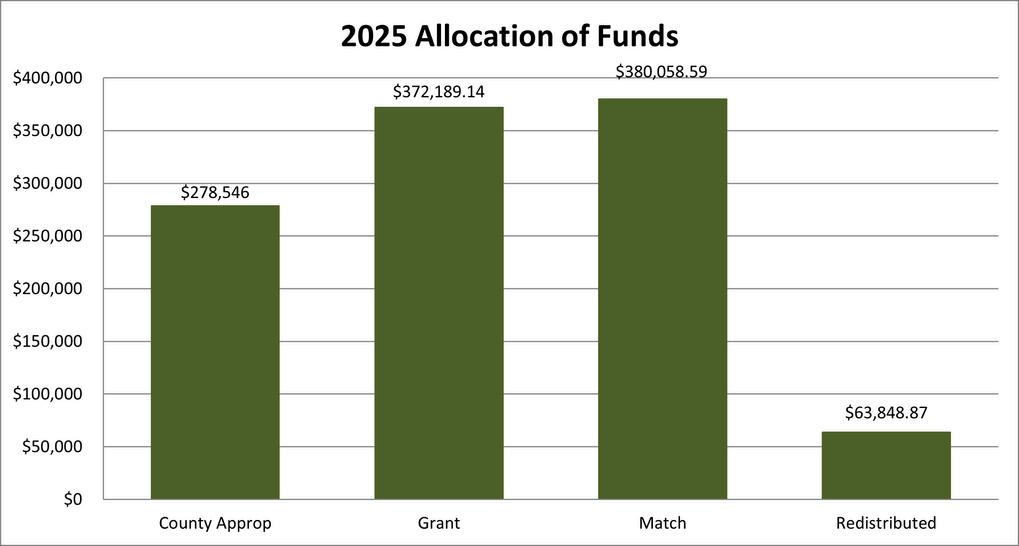
In2025,971.45acresoffarmlandwerepreservedinFranklinCounty,bringingtheCounty’s totalto20,618.59acrespreserved.Additionally,atotalof$1,094,642.59wasallocatedtoward preserving540moreacresoverthenextseveralyears.
Thechartbelowbreaksdownthesourcesoffundingin2025:
2. Support Projects that conserve open space and promote tourism-related activities Franklin County has taken many steps to ensure we are supporting projects that conserve open space and promote tourism. We have done this by partnering with organizations such as Cumberland Valley Rail Trail (CVRT) Council, Wellspan, Keystone Health, Franklin County and Chambersburg Area Development Corporations, and Wilson College to complete a CVRT feasibility study, and offering our support of the construction and opening of the Chambersburg Ampitheatre.
3. Ensure Long-Range Transportation Planning is aligned with planning policies of Character Areas
In 2025, the Planning Department contracted with Larson Design Group as an On Call Consultant and will be working with Larson to develop our 2027 LRTP In the development stages, the county will consider character areas when determining action goals.
1. Promote mixed-use zoning along with design standards within identified growth areas and where new commercial corridors are planned to ensure that uses are at a compatible scale
Currently the Franklin County Planning Department is advocating for municipalities to update their zoning policies to support mixed use where appropriate.
2. Provide model zoning language that helps address non-traditional types of land uses such as ADU, inclusionary zoning, and short-term rentals
Franklin County is sharing toolkits and model ordinances from other counties to give guidance to municipalities on non-traditional land types.
3. Provide direct assistance to municipalities through low or no cost auditing of local land use policies including zoning and SALDO
Audits are being offered on an as requested basis. To date, no requests have been received.
4. Promote the use of LERTA in areas for preferred redevelopment
The county is not aware of any new LERTAs being established since the comp plan. However, some redevelopment has occurred in the last year.
The planning department was made aware of two sites for redevelopment in 2024:
1.21 W Main St Waynesboro- Rick’s Cafe
2.Wayne Ave. and South Fourth Street Chambersburg- Chambersburg Public Works Campus
In 2026, the department hopes to establish improved methods for capturing redevelopment in the county.
5. Host coordination meetings and legislative briefings with municipalities to address needs and concerns of the county
On September 5th, 2025, Franklin County partnered with COG in hosting our planning department’s annual Municipal Summit at The Orchards Restaurant. The department invited FC Housing Authority and GT Environmental Inc. to discuss housing concerns and the county’s Solid Waste Plan. Planning Director, Quentin Clapper, also provided planning updates, and a round table discussion was held regarding fire and EMS concerns facing our county. These yearly summits create an opportunity for the municipalities and the county to discuss needs, updates, and joint successes ultimately establishing collaboration among local government and legislative policy.
6. Offer technical support, such as grant writing or admin support, and assist with RFP development
Technical support is being offered on an as requested basis. In 2025, the county received seven grant research requests.
7. Identify tools to promote development around established communities Promote Zoning Tools as part of land development review
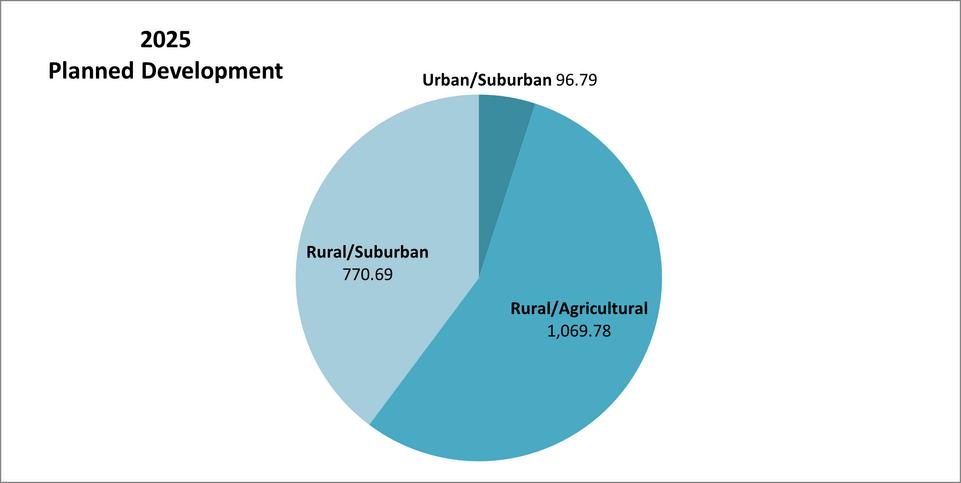
Franklin County received a handful of plans in 2025 which promoted new development surrounding the Urban and Suburban centers. As shown on the pie chart, 96.79 acres of development are in Urban/Suburban centers while 1,840.47 acres of new development are in Rural/Agricultural/Suburban centers. The county aims to encourage future urban/suburban development as we progress through 2026.
8. Advocate for zoning policies that allow for mixed use and higher density housing development within Urban and Suburban Character Areas
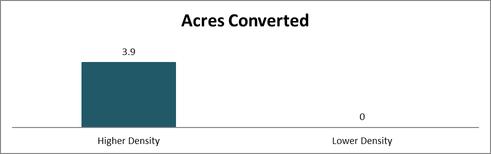
While Franklin County’s goal to encourage and support higher-density development in U/SC/S areas showed limited results in 2025 (see chart below), it is encouraging to note that more acres were converted to higher-density uses than to lower-density uses compared to 2024 The county continues to have open communication with municipalities in working towards this goal in 2026 Ultimately, we still have work to do in planning for higher densities where they are appropriate
1. Develop a municipal and employer supported initiative to work with housing developers to increase housing at strategic locations in Franklin County In 2025 @Home in Franklin County began pulling together stakeholders to develop initiatives and coordinate resources that advocate for affordable and attainable housing
2. Develop an employer-supported initiative to create long-term solutions that address childcare and transportation
Franklin County and LIU-12 held a Child Care roundtable on October 15 , 2025. The meeting consisted of various employer industries who came together to discuss the need for childcare in the workforce and opportunities to improve access to childcare.
3. Encourage replacing site design standards that create barriers to attainable housing such as parking minimums for senior housing, suburban style building setback in urban areas, and low density in developable areas
Franklin County maintains the goal of making home prices and rent more attainable, which will result in a decrease in housing insecurity. We intend to reach this goal by working with townships and advocating for location appropriate design standards during site plan review, zoning amendments and other outreach. The graph on the following page shows the comparison of severe housing cost burden in Pennsylvania as a whole and Franklin County from 2018-2022. While Franklin County is outperforming the state, nearly 9% of households in Franklin County, roughly 5,400 households, are spending over half of their income on housing related costs.
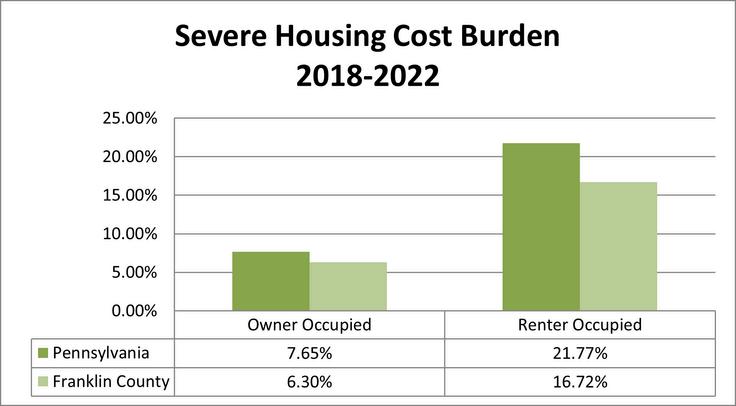
*DataisaggregatedfromTable7(Tenure(2)byHouseholdIncome(5)byHouseholdType(5)byHousingCostBurden (3))ofHUDSCHASTable
4. Provide planning support for municipalities to prepare multi-municipal plans with the goal of balanced distribution of land uses, including housing types
In an attempt to increase housing options throughout the county, Franklin County has worked closely with municipalities, offering support and guidance in preparing multi-municipal plans. Since adoption of the County comprehensive plan, the Planning Dept. has participated in the Mercersburg-Montgomery-Peters joint comprehensive plan which was adopted in 2025. At the end of 2025, FC Planning worked with Letterkenny, Lurgan, and Fannett on distributing a community needs survey to provide action plans for their drafted comprehensive plan.
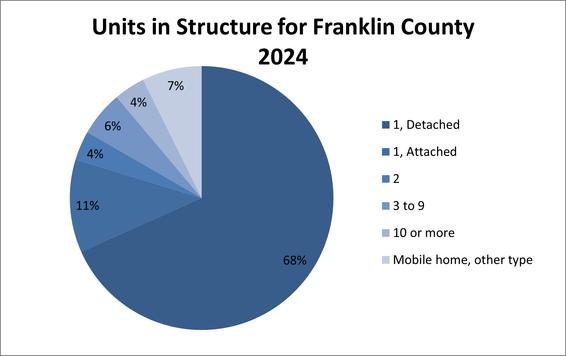
One targeted outcome of this work is to improve the balance and distribution of housing types in the county. The chart displayed below breaks down the total number of homes (66,787) in 2023 by structural type.
1.UpdatetheCounty'sMunicipalSolidWastePlan(SWP)
In2025,thecountyworkedwithGTEnvironmentalandourSolidWasteAdvisoryCommittee indevelopingour2026SWP.Bytheendoftheyear,allchaptershadbeendraftedandactions chosen.FranklinCountyaimstoadopttheplaninsummerof2026.
2.Explorethefeasibilityofhostingrecyclingandwastecollectioneventsonarecurring basis
FranklinCountyiscurrentlyevaluatingopportunitiesforasingletrialHouseholdHazardous Wasteevent.Inrecentyears,DEPhasbegunfundingotherlocalentitiesthatarealso organizingrecyclingopportunitiesinFranklinCounty.
3.ProvidesupporttotheAdam/FranklinBroadbandStudyimplementationgoals FranklinCountyhasmadeourselvesavailabletoaidandassistprogramsandorganizations whointendonpromotingbroadbandexpansionthatalignwiththestudy.InAprilof2024,PA’s BroadbandInfrastructureProgramawarded$4.2milliontoZitoWestHolding,LLCtoincrease broadbandcoverageintheCountyandinSeptemberof2025,PennsylvaniaBroadband DevelopmentAuthority(PBDA)submittedadraftBEADFinalProposal.
4.Regularlypublicizethemappingapplicationtoshareopportunitiesthatthepubliccan utilizeforoutdoorrecreation
FranklinCountyhasaddedrotationalremindersabouttheapplicationonsocialmediato emphasizetheopportunitiesthatareavailableforrecreationinFranklinCounty
5.UpdateOpenSpaceandGreenwaysPlantoprioritizeprojectsofaregionalsignificance Inefforttocoordinaterecreationandpreservationthroughoutthecounty,FranklinCountyis reviewingavailablegrantstoassistwiththecostsofupdatingtheGreenwayPlan.
6.Offersupporttomunicipalitiestodevelopadditionalrecreationopportunities
FranklinCountycontinuestomakeourselvesavailabletoaidandassistmunicipalitieswith lettersofsupportorothertechnicalassistanceasappropriate.
7.PrioritizeimplementationoftheCumberlandValleyRailTrail(CVRT) In2024,thecountypartneredwithCVRTCaswellasotherorganizationssuchasKeystone Health,FCADC,CADC,andWilsonCollegetodevelopaCVRTFeasibilityStudy.TheFranklin CountyMetropolitanPlanningOrganizationhostedtwoopenhousestosolicitpublicinputon theexpansionoftheCumberlandValleyRailTrail.Thestudywaspublishedin2025.
1.UpdatetheCounty'sMunicipalSolidWastePlan(SWP)
In2025,thecountyworkedwithGTEnvironmentalandourSolidWasteAdvisoryCommittee indevelopingour2026SWP.Bytheendoftheyear,allchaptershadbeendraftedandactions chosen.FranklinCountyaimstoadopttheplaninsummerof2026.
2.Explorethefeasibilityofhostingrecyclingandwastecollectioneventsonarecurring basis
FranklinCountyiscurrentlyevaluatingopportunitiesforasingletrialHouseholdHazardous Wasteevent.Inrecentyears,DEPhasbegunfundingotherlocalentitiesthatarealso organizingrecyclingopportunitiesinFranklinCounty.
3.ProvidesupporttotheAdam/FranklinBroadbandStudyimplementationgoals FranklinCountyhasmadeourselvesavailabletoaidandassistprogramsandorganizations whointendonpromotingbroadbandexpansionthatalignwiththestudy.InAprilof2024,PA’s BroadbandInfrastructureProgramawarded$4.2milliontoZitoWestHolding,LLCtoincrease broadbandcoverageintheCountyandinSeptemberof2025,PennsylvaniaBroadband DevelopmentAuthority(PBDA)submittedadraftBEADFinalProposal.
4.Regularlypublicizethemappingapplicationtoshareopportunitiesthatthepubliccan utilizeforoutdoorrecreation
FranklinCountyhasaddedrotationalremindersabouttheapplicationonsocialmediato emphasizetheopportunitiesthatareavailableforrecreationinFranklinCounty
5.UpdateOpenSpaceandGreenwaysPlantoprioritizeprojectsofaregionalsignificance Inefforttocoordinaterecreationandpreservationthroughoutthecounty,FranklinCountyis reviewingavailablegrantstoassistwiththecostsofupdatingtheGreenwayPlan.
6.Offersupporttomunicipalitiestodevelopadditionalrecreationopportunities
FranklinCountycontinuestomakeourselvesavailabletoaidandassistmunicipalitieswith lettersofsupportorothertechnicalassistanceasappropriate.
7.PrioritizeimplementationoftheCumberlandValleyRailTrail(CVRT) In2024,thecountypartneredwithCVRTCaswellasotherorganizationssuchasKeystone Health,FCADC,CADC,andWilsonCollegetodevelopaCVRTFeasibilityStudy.TheFranklin CountyMetropolitanPlanningOrganizationhostedtwoopenhousestosolicitpublicinputon theexpansionoftheCumberlandValleyRailTrail.Thestudywaspublishedin2025.
8.Organizeandtrainaprofessionalworkforcetoberesponsive,efficient,andeffectivein protectingthelivesandpropertyofthecitizensofFranklinCounty FranklinCountyDepartmentofEmergencyService(DES)continuesit’seffortsincreatinga widerbaseofstaffingforESpersonnel,allowingmoreroomforagrowthinpublicsafety throughtrainingandoutreach.FCPublicSafetyTrainingCentercontinuestobeakeyassetin thiseffort,providingaspaceforhands-ontraining,collaboration,andprofessionalgrowth
9.Developandexecutearobustpublicoutreachandtrainingprogramtoinform,educate, andpartnerwithstakeholdersandthepubliconemergencypreparedness In2025,DEShosted12ofthefollowingeventstopromotepublicoutreachandincreasepublic understandingofcountyneeds.
1.ThreeCareerDays
2.FiveCommunityOutreachEvents
3.OneOpenHouse
4.TwoPreparednessDrills
5.OneSeniorFair HumanServices
1.Hostworkforcesummitswitheducationandtrainingproviders,majoremployers,and childcareserviceproviderstostrengthentheconnectionsbetweeneachindustry FranklinCountyandLIU-12’sChildCareroundtableinOctoberbroughttogethermajor employersandchildcareproviderstoconnectandopenupopportunitiesforsupportineach industry.
2.Workwithearlylearningprogramstosupportlocaleffortsthatprovideearlylearning initiativesinthecommunity
AtOctober’sChildCareRoundtable,hostedbythecountyandLIU-12,stakeholderswere presenttotalkthroughtheneedforqualityinitiatives
3.ContinueimplementationoftheFranklinCountyHumanServicesTransportationPlan InFebruaryof2024,FranklinCountypartneredwithRabbittransitinthelaunchingof“Veterans MedicalTransportation”;providingweeklytransportationtoselectVAhospitalsatnocostto veteransinFranklinCounty.
WiththerecentOpioidSettlementawarding$6.5milliontoFranklinCountyoverthenexttwo decades,thecountyplanstoput$275,000towardsrecoveryandtreatmentrelatedsupports. IncludedintheseeffortsisatransportationprogramthroughtheFranklin/FultonDrugand AlcoholProgram
4. Continue to support implementation of the Franklin County Human Services Plan
Franklin County’s 2025 TMCA wrote new and updated existing reinvestment plans to meet health related social needs for individuals with include housing, food access, utilities, medical and behavioral health, transportation, and more.
In addition to this, Franklin County continues to ensure that we are maintaining high standards in our identified strengths, while looking for ways to meet the needs identified in the plan
5. Improve the centralization of information related to local services
Franklin County along with other community organizations have adopted the 'no wrong door' approach to connect people to the services they need. At the County, Human Services Resources and Link Access are resources that people can use that are uncertain of how to access the information or services that they desire. Additionally, the Franklin County GIS Dept. and Human Services Dept. are coordinating to create an improved directory for available services.
Agriculture remains a leading industry in Franklin County, accumulating more than $655 million in cash receipts annually. In 2025, the easements on ten farms were officially purchased, bringing the total preserved land to 170 farms and 20,618.59 acres.
With the continued support of the Franklin County Board of Commissioners, the Agricultural Land Preservation Board advanced its efforts with the selection of five farms in 2025 This will add nearly 540 preserved acres to the program It is anticipated that in the coming year the program will exceed 21,150 acres preserved. In addition to the acres preserved and in progress, there are currently 36 farms on the preservation waiting list that represent roughly 3,730 additional acres of farmland for future preservation.
Pennsylvania leads the nation in farmland preservation with more than 661,000 acres preserved. Within the state, Franklin County ranks 10th in preserved acres.
In 2025, the department also began a project to update the ranking list. All the applicants on the ranking list were contacted to update their application and to provide conservation plans not previously on file and to update any plans that no longer aligned with their current farming practices. A meeting was held with each applicant to review program requirements and ensure their documents were current
Goal 1: Access federal preservation dollars to accelerate the County’s preservation activities.
Goal 2: Work with state, regional and local agencies to promote and enhance agriculture
Goal 3:
Goal 4:
Continue to explore ways to supplement County funding for the agricultural preservation program, enabling the program to take full advantage of the State's match and thus preserve more farms within the County
Support agricultural land preservation by promoting up to date agricultural security areas
Goal 5:
Coordinate with NRCS and continue to encourage easement owners to update their conservation plans in order to help maintain soil and water quality
The Franklin County Metropolitan Planning Organization (FCMPO) accomplished several items in 2025 such as: updating the Unified Planning Work Program (UPWP), Developing guidance for applications to receive Carbon Reduction Program funds, developing the Cumberland Valley Rail Trail Feasibility Study, and adopting new performance measures.
The Franklin County Transportation Improvement Program represents a short-range, four-year work plan of all federally-funded and regionally-significant work projects spanning from FFY 2027 to 2030. As a prerequisite to securing federal funding, the TIP is updated every two years in cooperation with PennDOT and local municipalities and must be consistent with the 2045 Long Range Transportation Plan (LRTP) as well as fiscally constrained. The 2027-2030 TIP programmed approximately $86.3 million in funding for projects, which includes 19 bridge projects, 19.20 miles of resurfacing, 4 safety, intersection, and bike/pedestrian improvements, and continued funding for the Exit 12 Interchange at Guilford Springs Road. Following a period of draft review by the public and PennDOT, the 2027-2030 TIP is anticipated to be approved at the May 21, 2026 FCMPO Policy Board meeting.
To accompany the latest update of the Transportation Improvement Program, a ‘Tipat-a-Glance’ document is being drafted to help provide the public more information about how TIP funds were being allocated in the region. This document consists of informational tables breaking down the TIP project list by category, project phase receiving funding and in which year, and the total funds attributed to each category, as well as informational maps displaying the amount of funds attributed to each municipality and the project locations, and an overall narrative. This is intended to be introduced to the public with the 2027-2030 TIP, and to serve as a framework to break down future TIP updates.
Following the conclusion of Franklin County MPO’s on-call consultant contract with Michael Baker International, a request for proposals was developed and released by MPO and Franklin County Procurement staff on March 24th to secure a two-year contract with the possibility of two 1-year extensions with another qualifying agency. A pre-proposal conference with prospective applicants was held on April 7th to give a breakdown on the process. Following the formal end of the enrollment period on May 7th, responses were evaluated between MPO and Procurement staff over the course of two weeks until a formal recommendation for Larson Design Group (LDG) was issued on June 4th, with the contract being summarily signed and approved by the Board of Commissioners on August 13th.
Work began to prepare for an update to the Franklin County 2045 LRTP. The LRTP represents a long-range, twenty-year ransportation needs and project prioritization
plan that is developed through regional stakeholder and public input and utilized as a roadmap to guide the next two decades of transportation improvements and development. As a prerequisite to secure federal funding, the LRTP is required to be updated every four years. A kickoff meeting between MPO staff, PennDOT, and FHWA was held in late October, and MPO staff has started to coordinate with LDG to develop the scope of the project.
Goal 1: Development of Long Range Transportation Plan.
Goal 2: Adopt the 2027-2030 Transportation Improvement Program.
Goal 3: Begin work on the 2027-2029 Unified Planning Work Program (UPWP).
Goal 4: Develop an informational Dashboard of regionally significant transportation information for public reference
Goal 5: Provide technical assistance and coordination with municipalities and PennDOT to improve the local transportation system.
Franklin County owns 91 bridges and co-owns one bridge with Cumberland County. Housed within Franklin County Property Management is a bridge maintenance crew that performs regular bridge maintenance and works closely with the County engineering consultant to formulate short and long-term bridge improvement plans. Following conclusion of HRG’s 2021-2025 NBIS agreement with Franklin County, the selection process for a new four-year NBIS agreement was coordinated between Franklin County and PennDOT. After receiving several statements of interest and hosting interviews with each qualified firm, HRG was once again selected to serve as Franklin County’s bridge engineering firm for 2026-2030.
A few accomplishments in 2025 include the initiation of engineering on Tallow Hill Road over Conococheague Creek, Shimpstown Road over Licking Creek, and Sylvan Drive over Little Cove Creek, the beginning of the Burnt Mill Road Bridge project being funded through the Historic Metal Truss Capital Rehabilitation Program, and continuation of the West King Street bridge projects over the Falling Spring and Conococheague Creek.
Goal 1: Continue coordinating with PennDOT and the Historic Metal Truss Capital Rehabilitation Program on the initiation of the Burnt Mill Road Bridge project
Goal 2: Continue project development for five bridges
Goal 3: Explore alternative long-term funding solutions to support the Bridge Program needs.
Each year the County receives entitlement funding from the Commonwealth of Pennsylvania through the Department of Community and Economic Development (DCED). The source of the entitlement funding is provided by the federal government, through the Department of Housing and Urban Development’s (HUD) Community Development Block Grant Program (CDBG) The County Commissioners allocate funding to selected and approved projects that meet one of the following three national objectives:
Low-to-Moderate Income persons
Urgent Need Blight
Over the years, the majority of the projects that Franklin County has funded address the first objective, with Low-to-Moderate Income Persons being identified by either the U.S. Census or by conducting income surveys. However, a variety of projects can be completed under this objective. Program funds can be used to ensure affordable housing, provide services and vital infrastructure improvements to the most vulnerable communities, and to create jobs through the expansion and retention of businesses. This program has made a difference in the lives of millions of people and their communities across the Nation. A key part of this program's success is citizen participation, especially those that are low-to-moderate income. Citizens are encouraged to attend local meetings, review proposed activities, and provide feedback to identify how best to use the funds provided
HUD determines the amount of each grant by using a formula that includes community needs, extent of poverty, population, housing overcrowding, age of housing, and population growth lag in relation to other areas. For 2025, Franklin County applied for $358,280 in CDBG funds from HUD through DCED to address various infrastructure, housing, and public service needs throughout the county. The County will retain $64,490.40 to cover administrative staffing costs. The remainder of the funds, $293,789.60, was awarded to the following agencies to benefit Low- to Moderate- Income individuals.
Luminest-Blue Heron Senior Housing Development- $223,789.60
Habitat for Humanity- $70,000
During 2025, the CDBG program made strides toward meeting goals and advancing projects, which include:
Greencastle Borough progress towards projects from FY 2022 and 2023 for ADA curb ramp installations, sidewalk extensions, and flashing walk sign beacons
Regional meetings were held to increase public engagement during the development of the FY 2025 grant application. While there is still room for improvement, this method has resulted in increased participation
Habitat for Humanity housing acquisition project for FY 2022-2023 that will soon result in housing for a Low-to-Moderate Income family
Goal 1: Continue to explore opportunities to utilize CDBG funds on projects other than infrastructure improvements.
Goal 2:
Goal 3:
Complete outreach efforts to other counties that will identify new opportunities for CDBG funds Identifying new strategies will increase the effectiveness of the program
Increase public engagement on project selection and implementation Additionally, increase engagement from other municipalities and small communities within the County
Goal 4: Improve processes and grant documentation
The 2025 Mosquito season was low in mosquito numbers but above average with West Nile Virus positives, especially when compared with the rest of the state. Relentless precipitation in June caused flooding, prompting a population explosion for nuisance species. Most of our adult control work was conducted in June and July in response to the nuisance species and complaints from citizens. By the end of July flood waters had subsided and mosquito populations plummeted. This was a blessing because by end of July pools of mosquitoes testing positive for West Nile Virus was starting to dramatically increase Even though rates of West Nile were high the overall low population of mosquito numbers allowed health concerns to remain low.
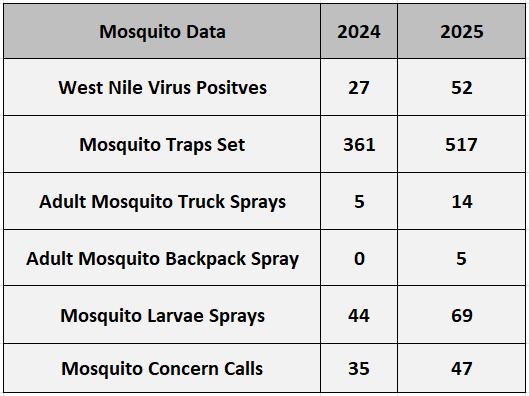
27 Black-legged tick nymphs were collected in 2025 3 out of the 27 came back positive for the bacteria that causes Lyme Disease (11%) This is an outlier compared to the rest of the state that sat around 25%. A total of 50 Black-legged ticks were collected in the fall of 2025. 39 out of the 50 (78%) ticks collected tested positive for the bacteria that causes Lyme Disease. These Lyme levels continue to rise each year and the state’s average has increased to 60% within our adult tick populations.
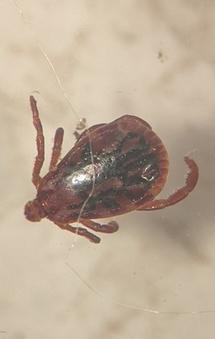
Male American Dog Tick under microscope
Goal 1: Build on the surveillance and control practices in Franklin, Fulton, Bedford, and Huntingdon Counties.
Goal 2: Continue to grow cooperative relationships with officials and stakeholders in each county
Goal 3: Educate a minimum of 1,500 people from the community on ticks and mosquitoes.
Goal 4: Monitor areas prone to floodwaters for mosquitoes. Particularly areas east of Chambersburg.
Goal 5: Contain the spread of LaCrosse Virus to the area it was discovered.
FranklinCountyestablishedtheHousingTrustFundin2002tosupportprogramsand projectsthatincreasetheavailabilityofaffordablehousingtoourcountyresidents.The fundsaregeneratedbyfeesforfilingdeedsandmortgageswiththeFranklinCounty RecorderofDeeds.
RequestsapprovedforfundingthroughtheHousingTrustFundduring2025:
ChambersburgProject-$10,000
Providedfundstoassistwithaweek-longvolunteereventthatperformsnecessary repairstohomes
Goal 1: Improve Coordination with recipients throughout project implementation.
Goal 2: Explore additional opportunities to support affordable housing throughout the County.
Goal 3:
Collaborate with the CDBG Program Administrator and the County Grant Manager to potentially fund housing projects in coordination with other federal grant funding sources
Goal 4: Work with local municipalities to improve the availability of housing in each community within the County.
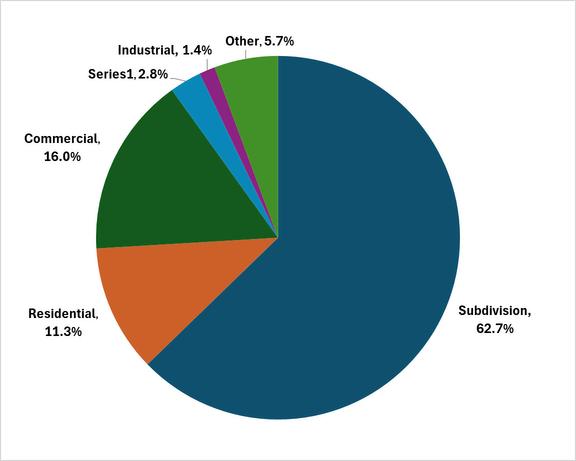
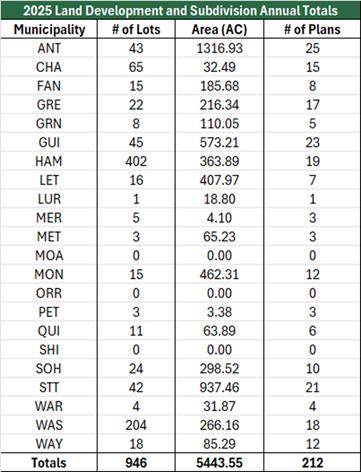
In 2025, the department reviewed 212 new plans. 133 of the plans were for subdivision or lot line adjustment purposes. The remaining plans, 79 in all, for land development represent the planned development of 716 housing units and other assorted minor developments.
The majority of acreage submitted for planned land development occurred in Antrim Township with over 741 acres worth of parcels being planned for development. St. Thomas Township followed behind with roughly 209 acres of planned development. Based on the method used to collect acreages, the areas may not reflect land converted for other uses but count the total parcel acreages that are being developed.
A goal for the Planning Department in 2026 is to continue to refine tools for tracking plan submissions, in order to better guide staff and program activities and community land use trends and needs. This may include digital plan submission.
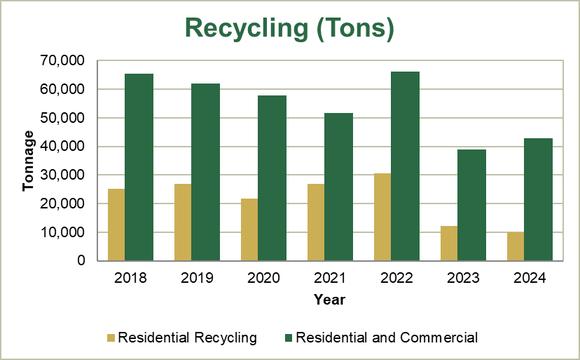
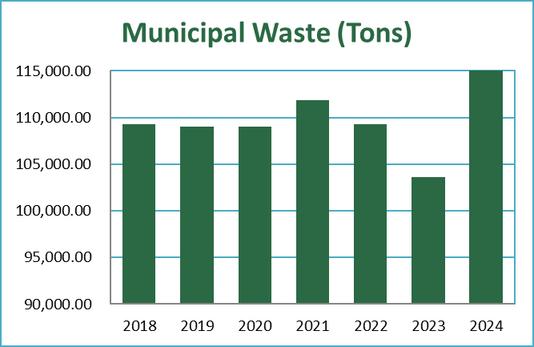
Municipal waste generated by Franklin County residents reduced slightly in 2024 to ~117,425.1 tons. In 2024, 42,866.35 tons of material were recycled for a recycling rate of about 8%. Household hazardous waste (HHW) and glass recycling continue to be the primary solid waste issues within the County. The department is currently exploring the feasibility of hosting recycling events for these types of materials.
In 2024 Reworld partnered with Goodwill to provide electronic waste recycling across 22 PA counties. The programs have greatly improved access for residents to recycle e-waste. In Franklin County, the Goodwill on Wayne Ave in Chambersburg is a part of this program. Reworld has collected a reported 1,269 tons of e-waste statewide in 2025.