


Availability of Medical Plan Benefits Information
(also



(also
Benefits Call Center
Higginbotham Public Sector
833-982-2477
Email: lewisvilleisd@hps.higginbotham.net
Medical
TRS ActiveCare
BCBSTX
866-355-5999
www.bcbstx.com/trsactivecare
TRS Virtual Health
RediMD
855-942-4900
www.rediMD.com/trsactivecare
Registration Code: trsactivecare
Teladoc
855-835-2362
www.member.teladoc.com/ trsactivecare
Pharmacy
Express Scripts by Evernorth
844-367-6108
www.express-scripts.com/trsactivecare
Dental Coverage
Cigna Healthcare
800-244-6224
www.mycigna.com
Group #3346815
Network – Total DPPO
Vision Coverage
EyeMed
866-939-3633
www.eyemed.com
Network – Insight
Health Savings Account (HSA)
EECU
817-882-0800
www.eecu.org
Flexible Spending Accounts (Health Care and Dependent Care Reimbursement)
National Benefit Services (NBS)
855-399-3035
www.nbsbenefits.com
Telehealth with Behavioral Health
Recuro Health
855-673-2876
www.recurohealth.com
Permanent Life
Texas Life
800-283-9233
www.texaslife.com
Life and AD&D
Chubb
888-499-0425
Group #100000044
Disability
New York Life
888-842-4462
www.newyorklife.com Group #SLH100028
COBRA Dental and Vision
National Benefit Services
800-274-0503
www.nbsbenefits.com
Critical Illness
Cigna Healthcare
800-754-3207
www.mycigna.com
Group #CI961740
Hospital Cash
Chubb
888-499-0425
https://mybenefitsconnect.chubb.com Group #100000044
Legal Services
LegalEase
800-248-9000
www.legaleaseplan.com/lisd Group #9000789
Emergency Medical Transportation
MASA MTS
800-423-3226
www.masamts.com
Group #B2BLEWIS
Investment Services
403(b) and 457(b)
TCG Administrators
800-943-9179
www.tcgservices.com
TeleWealth virtual meeting: www.tcgservices.com/telewealth
COBRA TRS ActiveCare Medical bswift
833-682-8972
Who is Eligible
• For medical eligibility, active contributing TRS members or substitute teachers* working 10 or more regularly scheduled hours per week. For all other benefits, employees working 15 or more regularly scheduled hours per week.
When to Enroll
• Within 30 days of your start date
When Coverage Starts
• First day of the month following employment start date
Who is Eligible
• For medical eligibility, active contributing TRS members or substitute teachers* working 10 or more regularly scheduled hours per week. For all other benefits, employees working 15 or more regularly scheduled hours per week.
When to Enroll
• Open Enrollment (OE) or when you have a Qualifying Life Event (QLE)
When Coverage Starts
• OE: Start of the plan year
• QLE: Dependent on QLE details
* Substitute teachers do not receive the district medical premium contribution.
OE: Open Enrollment
QLE: Qualifying Life Event
Who is Eligible
• You can cover eligible dependents under a benefit that offers dependent coverage, provided you participate in the same benefit; dependent children can be covered through the maximum age listed in the chart below.
• If your dependent is disabled, coverage may be able to continue past the maximum age under certain plans. You must provide a physician’s statement confirming your dependent’s disability. Contact the LISD Benefits Department to request a continuation of coverage.
You may only enroll for or make changes to coverage outside of Open Enrollment if you are a new hire or if you have a QLE, such as:


COBRA event, judgment, or decree Becoming eligible for Medicare, Medicaid, or TRICARE Receiving a Qualified Medical Child Support Order
Gain or loss of benefits coverage
Change in employment status affecting benefits
Death of dependent
You must complete a Benefit Change Form and provide requested proof of the QLE to the Benefits Department within 31 days of the event. Go to https://benefits.lisd.net for more information.
Enrolling in benefits is simple through THEbenefitsHUB.
• THEbenefitsHUB system is accessed through the LISD Learning Hub.
• Log in to the LISD Learning Hub (Lhub) through the Staff page, www.lisd.net/staff, then click on the blue “Benefits Hub” icon.
• For step-by-step log in instructions, go to https://benefits.lisd.net . If you have issues with logging in, contact the LISD Benefits Department via email, benefits@lisd.net , or call 469-948-8104
1. System Acknowledgments: Read and click I acknowledge for each acknowledgment. Click Save and Continue at the bottom of the page.
2. Select the Enroll in Benefits tile.
3. Personal Information and Dependents: Review your personal information and verify covered dependents. Contact the Benefits Department with any discrepancies at 469-948-8104 or email benefits@lisd.net
4. Benefits: Read each benefit screen to enroll or waive the product (medical, dental, vision, etc.). You must confirm on each screen that each dependent to be covered is selected in order to be included in the coverage for that particular benefit. Once your elections are made, click Sign and Continue at the bottom of each screen to complete that benefit enrollment. You may use the “back” button during the session to make changes. Once you click Sign and Continue, you are enrolled in the benefit. You may make changes to your elections through the end of the Open Enrollment period.
5. You may be asked to provide Evidence of Insurability (EOI) for certain benefits. This may be done during your enrollment session.
6. Beneficiaries: Step 1 – Add or edit your beneficiaries and click Sign and Continue. Step 2 – Enter the percentage of benefit you would like to designate for each beneficiary. Some designations are mandatory and cannot be changed. (Beneficiaries can be edited at any time throughout the year.) Click Finished
7. Consolidated Enrollment Form: After completing the enrollment walkthrough, the “Consolidated Enrollment Form” page will appear with “Congratulations!” and a green check mark displayed. Review the information carefully for accuracy. Use the “back” button to make changes or log out if you are finished.
8. Making changes: You may log in at anytime to make changes to your benefits during the Open Enrollment period. Remember, as soon as you click Save and Continue you are enrolled in the benefit, whether you finish the walkthrough or not.
Employee benefits can be complicated. The Higginbotham Public Sector benefits team is available to help you with the following:
• Enrollment
• Benefits
• Eligibility
• Claims Call or text 833-982-2477 Monday through Friday from 7:00 a.m. to 6:00 p.m. CT. If you leave a message after 3:00 p.m. CT, your call or text will be returned the next business day. You can also email lewisvilleisd@hps. higginbotham.net
Bilingual representatives are available.
A cafeteria plan enables you to save money by using pretax dollars to pay for eligible group insurance premiums sponsored and offered by your employer. Elections made during annual enrollment become effective on the plan effective date and will remain in effect during the entire plan year.
Changes in benefit elections can occur only if you experience a QLE. You must present proof of the QLE to your Benefits Department within 31 days of the event and complete and sign the Benefit Change Form. Changes must be consistent with the QLE.
Is there an age limit for dependents to be covered under my benefits?
Yes. See the Eligibility page for details.
Where can I find benefits summaries and forms?
To access medical plan Summary of Benefits and Coverage (SBC) documents, plan documents for other coverages, and forms, go to the Benefit Information section at www.mybenefitshub.com/lewisvilleisd. Click on each benefit (e.g., medical, vision, etc.) for details.
How can I find in-network providers?
Go to www.mybenefitshub.com/lewisvilleisd and click on the Provider Search link, where you will see all available plan provider searches.
BCBS provides ID cards if there is a plan change or a new enrollment. New cards usually arrive within four weeks of your effective date. If there are no plan changes, a new card will not be issued.
You may not need or receive an ID card for dental and vision plans. Simply share the carrier name and phone number with your health care provider to have benefits verified.
Call the Higginbotham Public Sector Benefits team at 833-982-2477
Can I cover family members (a spouse and/or dependent) as dependents on my benefits if my spouse and I work for the same employer?
Some benefits may not allow for this type of coverage if you both work for the same employer. Review the benefit plan documents, contact Higginbotham Public Sector, or contact the carrier for eligibility details.
Yes, generally. Married couples may not enroll in both a Health Care Flexible Spending Account (FSA) and a Health Savings Account (HSA) at the same time. If your spouse is covered under a Health Care FSA that reimburses for qualified health care expenses, then you and your spouse are not HSA-eligible – even if you do not use your spouse’s Health Care FSA to reimburse your expenses. However, there are some exceptions to the general limitation for other types of FSAs (e.g., Limited Purpose Health Care FSA; Dependent Care FSA). Contact the FSA and/or HSA administrator before you enroll, or consult your tax advisor for further guidance.
Disclaimer: You acknowledge that you have read the limitations and exclusions that may apply to obtaining spouse and dependent coverage, including limitations and exclusions that may apply to enrollment in FSAs and an HSA as a married couple. You, the enrollee, shall hold harmless, defend, and indemnify Higginbotham Public Sector, LLC from any and all claims, actions, suits, charges, and judgments whatsoever that arise out of your enrollment in spouse and/or dependent coverage, including enrollment in FSAs and an HSA.

Our medical plans protect you and your family from major financial hardship in the event of illness or injury.

All TRS-ActiveCare participants may enroll in one of the following plans:
• TRS-ActiveCare Primary
• TRS-ActiveCare Primary+
• TRS-ActiveCare HD
The TRS-ActiveCare 2 plan is closed to new enrollments, but you may continue in the plan if you are a currently enrolled participant.
Ask your Benefits Administrator for your district’s specific
• $0 preventive services
• One-on-one health coaches
• Weight loss programs and nutrition
• TRS Virtual Health
• Member Rewards is even better. Now you’ll get a check when you use Member Rewards and choose low-cost, highquality doctors and facilities – up to $599* per tax year.
• Airrosti Remote Recover y gives you inhome virtual physical therapy to relieve common aches and pains at no cost.* See the Annual Enrollment Guide for more details.
* Eligibility rules may apply.
You have in-office and virtual benefits:
• TRS-ActiveCare Primary Plan: $30 copay for office visits or $0 with Teladoc
• TRS-ActiveCare Primary+ Plan: $15 copay for office visits or $0 with Teladoc
• TRS-ActiveCare HD Plan: 30% coinsurance after deductible or $42 with Teladoc
• TRS-ActiveCare 2 Plan: $20 copay for office visits or $12 with Teladoc
This plan is closed to new enrollees. Current TRS-ActiveCare 2 participants can stay enrolled.

As part of your TRS medical plan coverage, you also have pharmacy benefits coverage through Express Scripts, our pharmacy benefits manager (PBM). This pharmacy benefits coverage is available ONLY to those enrolled in one of the TRS-ActiveCare medical plans.
Express Scripts helps you understand your pharmacy benefits and makes it convenient and affordable for you and your family to access the medications you need. New enrollees will be issued ID cards effective for the upcoming plan year. If you do not receive a card, or if yours is misplaced, you may download a temporary ID card. You can also contact the Express Scripts TRS-ActiveCare Customer Support team for assistance.
Once your plan year deductible is met, you will pay the applicable copay or coinsurance for each prescription until your out-of-pocket maximum is reached. The Express Scripts website allows you to download a temporary ID card, check medication costs, and explore options for home delivery, specialty medications, and retail pharmacies.
Please note that when utilizing prescription drug resources outside of Express Scripts, your prescription costs may not be applied toward your pharmacy coverage deductible or copays.
Check medication prices, see what pharmacies are in-network, and find out what medications are covered by your plan.

Your medical plan offers $0 preventive care for everyone. Preventive care is the care you receive to help prevent chronic illness or disease. It includes exams, lab work, screenings, immunizations, and counseling to prevent health problems, such as diabetes or heart disease.
Cholesterol screening
Blood pressure screening
Colorectal cancer screening
Lung cancer screening
Hepatitis B screening
Well visits
Bone density screening
Obesity screening
Diabetes type 2 screening
Depression screening
Mammograms
Cervical cancer screening Immunizations
Why should I get preventive care?
Blood tests for iron and cholesterol
Anxiety screening
Growth screening
Hearing screening
Hepatitis B screening
Depression screening
Alcohol, tobacco, and drug use assessments
Tuberculosis screening Immunizations
Having a doctor who knows you and your medical history is a key part of preventive care.
Autism screening
Blood screening
Depression screening
Developmental screening
Hearing screening
Obesity screening and counseling
Hypothyroidism screening
Behavioral assessments
Well visits
Immunizations
Preventive care is the fastest and best way to uncover potential risks and avoid chronic health conditions.
Are all screenings, tests, and procedures covered under preventive care?
No. Your doctor will be able to advise you as to the preventive care you need or should obtain, based on your medical and family history.
Why did I get a bill for preventive care?
Diagnosis codes on the doctor’s bill must meet certain insurance company conditions for them to be processed as preventive and covered at 100%. If you have a medical complaint, or your doctor finds a specific medical issue during your preventive care doctor’s visit, a diagnosis code for that issue or complaint will be on your bill. As a result, the insurance company may process the bill for a specific medical condition, not preventive care. In this case, you must pay the copay or portion of your deductible.
Becoming familiar with your options for medical care can save you time and money.
NON-EMERGENCY CARE
Access to care via phone, online video, or mobile app whether you are at home, work, or traveling; medications can be prescribed
Telehealth
24 hours a day, 7 days a week
Generally, the best place for routine preventive care; established relationship; able to treat based on medical history
Doctor’s Office
Office hours vary
Usually lower out-of-pocket cost than urgent care; when you can’t see your doctor; located in stores and pharmacies
Retail Clinic
Hours vary based on store hours
When you need immediate attention; walk-in basis is usually accepted
Urgent Care
EMERGENCY CARE
Generally includes evening, weekend and holiday hours
Hospital ER
Freestanding ER
Life-threatening or critical conditions; trauma treatment; multiple bills for doctor and facility
24 hours a day, 7 days a week
Services do not include trauma care; can look similar to an urgent care center, but medical bills may be 10 times higher
24 hours a day, 7 days a week
Allergies
Cough/cold/flu
Rash
Stomachache
Infections
Sore and strep throat
Vaccinations
Minor injuries/sprains/strains
Common infections
Minor injuries
Pregnancy tests
Vaccinations
Sprains and strains
Minor broken bones
Small cuts that may require stitches
Minor burns and infections
Chest pain
Difficulty breathing
Severe bleeding
Blurred or sudden loss of vision
Major broken bones
Most major injuries except trauma
Severe pain
2-5 minutes
15-20 minutes
15 minutes
15-30 minutes
4+ hours
Minimal
Note: Examples of symptoms are not inclusive of all health issues. Wait times described are only estimates. This information is not intended as medical advice. If you have questions, please call the phone number on the back of your medical ID card.
Offset your High Deductible Health Plan (HDHP) health care costs, reduce your taxes, and get a long-term tax-advantaged savings account.
A Health Savings Account (HSA) is like a personal savings account that allows you to pay for current or future health care expenses with pretax dollars or save the funds for retirement. The funds can also be used for your dependents, even if they are not covered by the HDHP. An HSA is always yours to keep, even if you change health plans or jobs.
You are eligible to open and contribute to an HSA if you are:
• Enrolled in an HSA-eligible HDHP
• Not covered by another plan that is not a qualified HDHP (e.g., spouse’s health plan)
• Not enrolled in a Health Care Flexible Spending Account
• Not eligible to be claimed as a dependent on someone else’s tax return
• Not enrolled in Medicare, Medicaid, or TRICARE
• Not receiving Veterans Administration benefits
Note: You may have an HSA at the financial institution of your choice, but only accounts opened through EECU are eligible for automatic payroll deductions.
• Use your HSA debit card to pay for qualified expenses.
• Pay out-of-pocket and submit your receipts for reimbursement online or through the app.
You may contribute up to the IRS annual maximum.
1
1
1 If you are age 55 or older, you can contribute an extra $1,000.

Use it Now
Pay for qualified out-ofpocket medical, dental, and vision expenses as they are incurred.
Invest Over Time
Invest and grow your HSA dollars tax-free. You can use the funds to pay for qualified expenses later.

www.eecu.org

Set aside pretax dollars from each paycheck to pay for certain IRS-approved health and dependent care expenses. We offer the following Flexible Spending Accounts (FSAs).
The Health Care FSA covers qualified medical, dental, and vision expenses for you and your eligible dependents. This benefit is funded up-front, so you will have access to your whole annual election on the first day of the plan year. Eligible expenses include:
• Deductibles, copays, and coinsurance
• Prescription drugs
• Braces, glasses, and contacts
• Hearing aids and batteries
If you enrolled in an High Deductible Health Plan and contribute to an HSA, you may not contribute to a Health Care FSA.
Use your FSA debit card (excludes the Dependent Care FSA). OR
Pay out-of-pocket, and submit your receipts for reimbursement.
www.nbsbenefits.com
service@nbsbenefits.com
FSAs are generally considered “use it or lose it” accounts, and unused remaining funds at the end of the plan year may be forfeited. Your employer may offer some flexibility (e.g., more time via a grace period to incur expenses; or a limited amount of funds that can be carried over in to the next plan year). Because options vary by employer, it’s important to review your specific plan details or check with your employer for more information.
Planning the amount of your contributions carefully can help you make the most of your FSA and avoid losing unused funds. You cannot change your contribution election during the plan year. Keep itemized receipts to verify debit card payments.

The Dependent Care FSA helps pay expenses associated with caring for children under age 13 and elder dependents so you or your spouse can work or attend school full-time.
• To be eligible, you (and your spouse, if married) must be gainfully employed, looking for work, a full-time student, or incapable of self-care.
• You can use funds for daycare or babysitter expenses for your children under age 13, but only for the part of the year when the child is under 13.
• Only day camps – not overnight camps – can be considered for reimbursement.
• You can use funds for care of a spouse or dependent of any age who spends at least eight hours a day in your home and is mentally or physically incapable of self-care.
• The dependent care provider cannot be your child under age 19 or anyone claimed as a dependent on your income taxes.
• Dependent Care FSA claims may be submitted as incurred and will be paid as funds become available after monthly payroll contributions are deposited.
You may contribute up to the IRS annual maximum.
$7,500
Visit fsastore.com for an array of FSA-eligible products.

Pay out-of-pocket, and submit your receipts for reimbursement.
Watch and learn more!
Knowing the difference between a Health Savings Account (HSA) and Flexible Spending Account (FSA) can help you choose the best option for you and your family. Each benefit allows you to save taxes because the amount you elect is set aside on a pre-tax basis.
HEALTH SAVINGS ACCOUNT
IRC SEC. 223
• Acts as a personal savings account.
Description
Contribution Source
Account Owner
• Funds can be used to pay for current or future health care expenses with pretax dollars; or funds can be saved for retirement.
• Funds can also be used for your dependents, even if they are not covered by the HDHP.
Employee (You)
Employee (You)
Underlying Insurance Requirement High Deductible Health Plan (HDHP)
Maximum Annual Contribution
Permissible Use of Funds
Year-to-year rollover of account balance?
Individual – $4,400
Family – $8,750
Age 55+ Additional Catch-up – $1,000
• Pay for qualified out-of-pocket medical, dental, and vision expenses.
• If used on nonqualified expenses prior to age 65, subject to income tax plus a 20% penalty.
FLEXIBLE SPENDING ACCOUNT
IRC SEC. 125
• An employer-sponsored plan that lets you set aside pre-tax money from your paycheck to pay for eligible out-of-pocket health care or dependent care expenses.
• Generally, a “use it or lose it” account.1
Employee (You)
Employer
None
Health Care FSA
• $3,400
Dependent Care FSA
• $7,500 (Single parent filing head of household; or married filing jointly)
• $3,750 (Married filing separately)
Health Care FSA - Pay for qualified medical, dental, and vision expenses.
Dependent Care FSA - Pay for qualified dependent care expenses and services.
Yes. Funds roll over and can be used anytime or saved for future use. No. After end of plan year, allows a 75-day grace period to incur new expenses and a 90-day runout period to file claims.1
Does the account earn interest? Yes No Portable?
Yes. It is always yours to keep, even if you change jobs or medical plans.
1 FSAs are generally considered “use it or lose it” accounts, and unused remaining funds at the end of the plan year may be forfeited. Your employer may offer some flexibility (e.g., more time to incur expenses). Check the full plan details for more information.


The products and services listed below are examples of medical expenses eligible for payment from your Health Care FSA or HSA.*
This list is not all-inclusive; additional expenses may qualify, and the items listed are subject to change in accordance with IRS regulations. Please refer to IRS Publication 502 Medical and Dental Expenses at www.irs.gov for complete details.
Abdominal supports
Acupuncture
Ambulance
Anesthetist
Arch supports
Artificial limbs
Blood tests
Braces
Cardiographs
Chiropractor
Crutches
Dental treatment
Dentures
* Excludes Dependent Care FSA.
Dermatologist
Diagnostic fees
Eyeglasses
Gynecologist
Healing services
Hearing aids and batteries
Hospital bills
Insulin treatment
Lab tests
Metabolism tests
Neurologist
Nursing
Obstetrician
Operating room costs
Ophthalmologist/Optician/Optometrist
Orthopedic shoes
Orthopedist
Osteopath
Physician
Postnatal treatments
Prenatal care
Prescription medicines
Psychiatrist
Therapy equipment
Wheelchair X-rays
Our dental plans help you maintain good oral health through affordable options for preventive care, including regular checkups and other dental work.
Two levels of benefits are available with the DPPO plans: in-network and out-of-network. You may see any dental provider for care, but you will pay less and get the highest level of benefits with in-network providers. You could pay more if you use an out-of-network provider.

Our vision plan offers quality care to help preserve your health and eyesight. Regular exams can detect certain medical issues such as diabetes and high cholesterol, in addition to vision and eye problems. The plan will pay the highest level of benefits when you see in-network providers. PLUS providers offer more savings that add value on top of existing benefits. A welcome packet with two ID Cards will be mailed to you.

Life and Accidental Death and Dismemberment (AD&D) insurance are important to your financial security, especially if others depend on you for support.
With Life insurance, your beneficiary(ies) can use the coverage to pay off debts such as credit cards, loans, and bills. AD&D coverage provides specific benefits if an accident causes bodily harm or loss (e.g., the loss of a hand, foot, or eye). If death occurs from an accident, 100% of the AD&D benefit would be paid to your beneficiary(ies).
Eligible employees receive Basic Life and AD&D at no cost. You are automatically covered at $15,000* for each benefit.
*Reduces to $9,750 at age 70.
A beneficiary is the person or entity you elect to receive the death benefits of your Life and AD&D insurance policies. You can name more than one beneficiary, and you can change beneficiaries anytime. If you name more than one beneficiary, you must identify how much each beneficiary will receive (e.g., 50% or 25%).
Watch and learn more!

Life insurance is important to your financial security, especially if others depend on you for support or vice versa.
With Life insurance, you or your beneficiary(ies) can use the coverage to pay off debts such as credit cards, loans, and bills. Life coverage amounts reduce to 65% at age 70.
A beneficiary is the person or entity you elect to receive the death benefits of your Life and AD&D insurance policies. You can name more than one beneficiary, and you can change beneficiaries anytime. If you name more than one beneficiary, you must identify how much each beneficiary will receive (e.g., 50% or 25%).
Portable – keep your supplemental coverage if you leave your current employer
Convertible – convert your group term life insurance benefits to an individual life policy if your coverage ends
Accelerated Death Benefit for Terminal Illness –
50% of Death Benefit not to exceed $500,000
Accelerated Death Benefit for Long Term Care –
4% of Death Benefit per month up to 75% of Death Benefit not to exceed $200,000
Some limitations and exclusions apply, so see the plan documents for details.
If you need more coverage than Basic Life, you may buy Voluntary Life coverage for yourself and your dependent(s). If you do not elect Voluntary Life coverage when first eligible, or if you want to increase your benefit amount at a later date, you may need to show proof of good health. You must elect Voluntary Life coverage for yourself before covering your spouse and/or child(ren).
Employee
Spouse
• Up to 7 times employee annual earnings up to a maximum of $750,000 in $10,000 increments
• New hire Guaranteed Issue $350,000
• Increments of $5,000 up to $250,000 maximum (not to exceed 100% of employee amount)
• Increments of $2,000 up to $10,000
• Live birth to six months – $100
• New hire Guaranteed Issue $50,000 Child(ren)
• Six months to age 26 – $2,000 to $10,000 in $2,000 increments
• New hire Guaranteed Issue $10,000
Accidental Death and Dismemberment (AD&D) insurance is important to your financial security, especially if others depend on you for support or vice versa.
With AD&D insurance, you or your beneficiary(ies) can use the coverage to pay off debts such as credit cards, loans, and bills. AD&D pays a death benefit to the beneficiary should the death occur due to a covered accident and provides specific benefits if an accident causes bodily harm or loss (e.g., the loss of hand, foot, or eye). AD&D coverage amounts reduce to 65% at age 70.
If you need more coverage than Basic AD&D, you may buy Voluntary AD&D coverage for yourself and your dependent(s). If you do not elect Voluntary AD&D coverage when first eligible, or if you want to increase your benefit amount at a later date, you may need to show proof of good health. You must elect Voluntary AD&D coverage for yourself before covering your spouse and/or child(ren).
A beneficiary is the person or entity you elect to receive the death benefits of your Life and AD&D insurance policies. You can name more than one beneficiary, and you can change beneficiaries anytime. If you name more than one beneficiary, you must identify how much each beneficiary will receive (e.g., 50% or 25%).
• Up to 7 times employee annual earnings up to a maximum of $750,000 in $10,000 increments
• New hire Guaranteed Issue $350,000
• Increments of $5,000 up to $250,000 maximum (not to exceed 100% of employee amount)
• New hire Guaranteed Issue $50,000
• Increments of $2,000 up to $10,000
• Live birth to six months – $100
• Six months to age 26 – $2,000 to $10,000 in $2,000 increments • New hire Guaranteed Issue $10,000

Permanent Life insurance is a type life insurance that provides coverage for the insured’s entire lifetime, as long as the premiums are paid. It complements term life insurance, which covers the insured for a specified period of time.
Help protect your family with the PureLife-plus Plan from Texas Life Insurance Company. This permanent universal life insurance plan offers level premiums and a level death benefit to age 121, as long as there is no lapse in premium payments.
• Family Coverage:
» Employee: issue ages 17-70.
» Spouse: issue ages 17-60.
» Children: issue ages 15 days to 26 years.
» Grandchildren: issue ages 15 days to 18 years. Children must reside with the applicant to be eligible for coverage. Employees do not have to participate in order to apply for coverage on eligible dependents.
• Portability: If you change jobs or retire, and continue to pay your premium, your coverage continues with no loss of benefits and no premium increase.
• Accelerated Death Benefit: With the optional Terminal Illness Rider, you may receive an accelerated portion of your death benefit – up to 92% – should you be diagnosed as terminally ill with a life expectancy of 12 months or less.
• Convenient Payment: Your premium can be payrolldeducted.
• Easy to Qualify for Coverage: Just answer three questions with no medical exam required. During the last six months, has the proposed insured:
1. Been actively at work on a full-time basis and performing usual duties?
2. Been absent from work due to illness or medical treatment for more than five consecutive working days?
3. Been disabled or received tests, treatment, or care of any kind in a hospital or nursing home; or received chemotherapy, hormonal therapy for cancer, radiation, dialysis treatment; or received treatment for alcohol or drug abuse?


Educator Disability insurance combines features of short-term and long-term disability into one plan. Disability insurance protects part of your income if you are unable to work due to a covered accident, illness, or pregnancy. We offer Educator Disability insurance for you to purchase and allow you to choose the coverage amount and waiting period that best suits your needs.
Units of $100, minimum amount of $200 Lesser of 70% of your monthly covered earnings or $8,000
1: 14/14 days1 Option 2: 30/30 days1 Option 3: 60/60 days Option 4: 90/90 days
1 Benefit Waiting Period will end on the date in inpatient hospital admission if the date is before the time period specified.
If you die while receiving benefits, New York Life will pay a survivor benefit to your lawful spouse, eligible children, or estate. The plan will pay a single lump sum equal to three months of benefits.

Disability – “Disability” or “Disabled” means that, solely because of a covered injury or sickness, you are unable to perform the material duties of your regular occupation/regular job and you are unable to earn 80% or more of your indexed earnings from working in your regular occupation/regular job. After benefits have been payable for 24 months, you are considered disabled if solely due to your injury or sickness, you are unable to perform the material duties of any occupation for which you are (or may reasonably become) qualified by education, training or experience, and you are unable to earn 60% or more of your indexed earnings. We will require proof of earnings and continued disability.
Covered Earnings – “Covered Earnings” means your wages or salary, not including bonuses, commissions, overtime pay, and other extra compensation.
When Benefits Begin – You must be continuously disabled for your elected benefit waiting period before benefits will be payable for a covered disability.
How Long Benefits Last – Once you qualify for benefits under this plan, you continue to receive them until the end of the benefit or until you no longer qualify for benefits, whichever occurs first. Should you remain disabled, your benefits continue according to one of the following schedules, depending on your age at the time you become disabled and the plan you select.
When Coverage Takes Effect – Your coverage takes effect on the later of the policy’s effective date, the date you become eligible, the date we receive your completed enrollment form if required, or the date you authorize any necessary payroll deductions if applicable. If you’re not actively at work on the date your coverage would otherwise take effect, your coverage will take effect on the date you return to work. If you have to submit proof of good health, your coverage takes effect on the date New York Life agrees, in writing, to cover you.
Effects of Other Income Benefits – This plan is structured to prevent your total benefits and post-disability earnings from equaling or exceeding pre-disability earnings. Therefore, we reduce this plan’s benefits by other income benefits payable to you, your dependents, or a qualified third party on behalf of you or your dependents. Disability benefits may be reduced by amounts received through Social Security disability benefits payable to you, your dependents, or a qualified third party on behalf of you or your dependents. Your disability benefits will not be reduced by any Social Security disability benefits you are not receiving as long as you cooperate fully in efforts to obtain them and agree to repay any overpayment when and if you do receive them. Disability benefits will also be reduced by amounts received through other government programs, sick leave, employer’s sabbatical leave, employer’s assault leave plan, employer-funded retirement benefits, workers’ compensation, franchise/group insurance, auto no-fault, and damages for wage loss. For details, see your outline of coverage, policy certificate, or your employer’s summary plan description. Note: Some of the other income benefits, as defined in the group policy, will not be considered until after disability benefits are payable for 12 months.
Earnings While Disabled – During the first 24 months that benefits are payable, benefits will be reduced if benefits plus income from employment exceeds 100% of pre-disability covered earnings. After that, benefits will be reduced by 50% of earnings from employment.
Limited Benefit Period – Disabilities caused by or contributed to by any one or more of the following conditions are subject to a lifetime limit of 24 months for outpatient treatment: anxiety-disorders, delusional (paranoid) or depressive disorders, eating disorders, mental illness, somatoform disorders (including psychosomatic illnesses) or substance abuse. Benefits are payable during periods of hospital confinement for these conditions for hospitalizations lasting more than 14 consecutive days that occur before the 24-month lifetime outpatient limit is exhausted.
Termination of Disability Benefits – Your benefits will terminate when your disability ceases, when your benefit duration period is exceeded, or on the following events: the date you earn from any occupation more than the percentage of indexed earnings, or the date you fail to cooperate with us in a rehabilitation plan, or transitional work arrangement, or the administration of the claim.
The insurance company will waive the pre-existing condition limitation for the first four weeks of disability even if you have a pre-existing condition. The disability benefits as shown in the schedule of benefits will continue beyond four weeks only if the pre-existing condition limitation does not apply.
Benefits are not payable for medical conditions for which you incurred expenses, took prescription drugs, received medical treatment, care or services (including diagnostic measures), during the three months just prior to the most recent effective date of insurance. Benefits are not payable for any disability resulting from a pre-existing condition unless the disability occurs after you have been insured under this plan for at least 12 months after your most recent effective date of insurance.
The pre-existing condition limitation will apply to any added benefits or increases in benefits.
How do I choose which plan to enroll in during my open enrollment?
1. First, choose your elimination period and plan type (Select or Premium). The elimination period, sometimes referred to as the waiting period, is how long you are disabled and unable to work before your benefit will begin. This will be displayed as two numbers such as 14/14, 30/30, 60/60, or 90/90.
The first number indicates the number of days you must be disabled due to Injury and the second number indicates the number of days you must be disabled due to Sickness.
When choosing your elimination period, ask yourself, “How long can I go without a paycheck?” Based on the answer to this question, choose your elimination period accordingly.
Important Note: Some plans will waive the elimination period if you choose 30/30 or less and you are confined as an inpatient to the hospital for a specific time period. Please review your plan details to see if this feature is available to you.
2. Next, choose your benefit amount. This is the maximum amount of money you would receive from the carrier on a monthly basis once your disability claim is approved by the carrier (based on a percentage of your salary).
When choosing your monthly benefit, ask yourself, “How much money do I need to be able to pay my monthly expenses?” Based on the answer to this question, choose your monthly benefit accordingly.
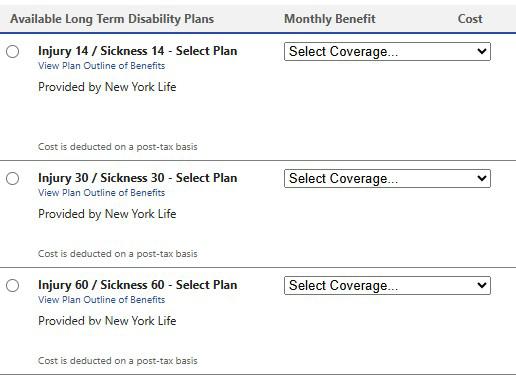
Choose your desired elimination period and plan type.
Choose your Monthly Benefit amount from the drop down box.
The Hospital Cash plan pays if you are confined as an in-patient at a hospital. Unlike traditional insurance which pays a benefit to the hospital or doctor, this plan pays you directly. It is up to you how you want to use the cash benefit. These costs may include meals, travel, childcare or eldercare, deductibles, coinsurance, medication, or time away from work.
Hospital Admission
Hospital Confinement
Intensive Care Unit Admission
Intensive Care Unit Confinement
Newborn Nursery
Observation Unit (Treatment less than 20 hours)
Wellness Benefit
EMPLOYEE MONTHLY CONTRIBUTIONS
$1,000, up to 5 per calendar year
$100 per day up to 30 days
$2,000, up to 5 per calendar year
$200 per day up to 30 days
$500 per day, 2 days maximum for normal or Cesarean section delivery
$500 per day, up to 2 days per calendar year
$50, one per calendar year, per covered member

Critical Illness insurance helps pay the cost of medical or other expenses related to a covered critical illness. The plan provides a lump sum benefit payment to you upon first and second diagnosis of any covered critical illness or cancer. The benefit can help cover expenses such as lost income, out-of-town treatments, special diets, daily living, and household upkeep costs.
What are the Critical Illness coverage costs? Employee contribution rates are based on benefit amount elected, coverage tier, and employee age. See plan document for more details.

Hospital Indemnity
Pays

This voluntary telehealth program gives you 24/7 access to board-certified doctors, licensed counselors, and psychiatrists via your mobile device or computer – from home, the office, or on the go. Whether you need medical care or support navigating stress and life changes, confidential help is at your fingertips. It is a standalone program that is NOT tied to your medical plan coverage.
While telehealth with behavioral health does not replace your primary care physician, counselor, or psychiatrist, it is a convenient and cost-effective option when you need care and:
• Have a non-emergency issue and are considering an after-hours health care clinic, urgent care clinic, or emergency room for treatment
• Are on a business trip, vacation, or away from home
• Are unable to see your primary care physician, counselor, or psychiatrist
For minor conditions such as:
• Sore throat
• Headache
• Stomachache
• Cold/flu
• Allergies
• Fever
• Urinary tract infections
• Behavioral health


Skip the trip to your doctor! Set up your account so you can get on-demand medical care.
MASA Medical Transport Solutions (MASA MTS) helps you prepare for the unexpected with affordable medical emergency air and ground transportation.
If you or your family members need emergency medical transport, your insurance coverage and Medicare may not cover all of the costs. Following your medical crisis, MASA MTS will negotiate with your medical plan provider and cover your remaining balance on your medical transportation bills. If a member has a High Deductible Health Plan, benefits for incurred expenses will be available once plan deductible is met.

Disclaimer: This material is for informational purposes only and does not provide any coverage. The benefits listed, and the descriptions thereof, do not guarantee coverage and do not represent the full terms and conditions applicable for usage and may only be offered in some memberships or policies. Premiums, benefits, and coverage vary depending on the plan selected. For a complete list of benefits, premiums, terms, conditions, and restrictions, please refer to the applicable member services agreement or policy for your state. For additional information and disclosures about MASA plans, visit: https://info.masaglobal.com/disclaimers.
www.masamts.com Group #B2BLEWIS

Legal services benefits include access to legal advice and representation on a wide variety of legal matters from traffic violations to creating a will.
Coverage Highlights
• Access to a national network of attorneys with exceptional experience that are matched to meet your needs.
• Concierge help navigating common individual or family legal issues.
• Home and residential legal issues (buying, selling, disputes, etc.).
• Auto and traffic issues (tickets, serious traffic matters, Lemon Law litigation, etc.).
• Estate planning and wills.
• Financial and consumer issues (debt collection defense,bankruptcy, tax audit, student loan refinancing, etc.).
• Family issues (separation, divorce, guardianship, adoptions, elder law, etc.).
• General issues (civil litigation defense, document review, misdemeanor defense, etc.).


The purpose of the Sick Leave Bank is to provide additional paid sick leave days to members of the Bank in the event of extended illness, surgery, or a disability due to an injury when the member is unable to perform the duties of his/her position. Benefits are for personal illness/injury of the member, and for serious illness, injury, or death of family members (as defined within the bereavement and critical care benefits).
For full plan details, please visit benefits.lisd.net
Eligibility is limited to all full-time employees of the Lewisville Independent School District. Full-time shall be defined as thirty or more hours of duty per week. Eligibility for membership begins on the first official workday for eligible personnel. An employee must be able to earn at least one local personal leave day from the beginning of his/her employment to the end of that SLB year to be eligible for membership. Application for membership must be made during the enrollment period or within thirty-one (31) days of employment or eligibility for membership.
• Existing employees
» Sick Leave Bank enrollment will be conducted during the benefits Open Enrollment period.
• New hires
» New employees will indicate their Sick Leave Bank election through the on-line benefits system.
» New employees that fail to make an election within 31 days of their hire date will not be allowed to join the Sick Leave Bank until the following plan year.
Existing members who have not received awarded SLB days in 2025-2026 are not required to donate a local day for 2026-2027.
The Application for Sick Leave Bank Days must be submitted to the Benefits Department of the Lewisville ISD. If the member is too ill to complete the application, his or her building or area administrator may begin the process on the member’s behalf. The deadline for submitting the application to the Employee Services/Benefits Department is 60 days from the first date of absence pertaining to the SLB request. Each illness or injury must be applied for separately and each must meet the criteria for approval of benefits on its own merits. This may not apply, however in certain circumstances such as recurring absences due to the same illness. See Guidelines for Benefits. The SLB Board will make the final determination of the eligibility of the member’s request for days from the SLB. If all criteria are met, the SLB Board will approve a maximum number of days (up to 25) that the member may withdraw from the Bank. In no circumstance may the member withdraw any days that exceed his or her actual absence for the period covered by the approved application. The SLB Board tries to meet at regular intervals to assure that any decision will be made prior to the cutoff date for payroll determination. If the cutoff date is missed on an individual applicant, the Payroll Department will make corrections on the next payroll check as supplemental pay. You may determine the cutoff date for your position by checking with Payroll or your administrator. The Payroll Department will not be able to issue special checks.
Applicants who wish to discuss their situation may contact:
• The Benefits Department for questions regarding SLB Board meetings
• Payroll Department for questions on pay and leave balances
• SLB Board Members for questions on SLB Board activities and responsibilities
No individual is authorized to make SLB or application decisions.
The sick bank calendar year is from July 1st through June 30th for all staff.
Employees that are on leave of absence at the beginning of the Sick Leave Bank year will not be paid for any days awarded from the Sick Leave Bank until the employee has returned to work for a minimum of 18 days. The employee may apply for and be awarded Sick Leave Bank days for the absences at the beginning of the Sick Leave Bank year, but the employee will not be paid for these days until they have returned to work for a minimum of 18 work days.
For employees who elect to join the SLB, one local personal leave day will automatically be subtracted from the employee’s personal leave balance. It becomes the permanent property of the bank and cannot be returned. Each deposit remains the property of the bank, even in the event of termination, resignation. Unused bank days carry over to the next SLB year. If a member uses any days from the bank during a bank year, the employee will be required to become a member the next bank year whether or not the employee wishes to enroll. One (1) day will be subtracted from the employee’s personal leave balance during the member’s next year of employment. If, as of March 1 the number of unused bank days is equal to or greater than three (3) times the number of current members then employees who continue their membership the following year do not have to donate a local personal day (provided that the employee did not use any days from the bank during the current bank year).
Only bank members in good standing are eligible to withdraw days. Days will be awarded only after the member has exhausted all accumulated state and local leave. The Sick Leave Bank may provide a member with benefits for serious illnesses and injuries. A member may apply for days after ten (10) consecutive days of absence for reasons of personal illness or injury. A member may apply for days for planned absences such as surgery or hospitalization in advance if it is anticipated that the absence will exceed ten (10) days. There is no 10-day waiting period for critical care or bereavement leave. A member may apply for these immediately. The ten (10) consecutive days of absence provision is modified to include school holidays for employees that elect to postpone their medical treatment/ care to a school holiday but who are unable to postpone the medical treatment/care to the summer months. The days during the holiday period that an employee would have been absent had the employee not postponed their medical treatment/care will count toward satisfying the 10-day absent rule. The ten (10) day consecutive absence requirement is waived for employees who have a minimum of 10 absences due to a serious long-term illness/injury but whose absences are not consecutive. Benefit days are retroactive to the first day of eligible absence once all other eligibility criteria are met. No benefit days will be granted unless an actual absence from normal duty occurs. No benefit days will be granted for elective absences, elective surgical or medical procedures, or procedures that could be safely and reasonably postponed to extended school breaks. If the member dies before all approved absences are used, the unused days revert to the bank. There are no survivor benefits under any circumstance.

A 403(b) plan is a U.S. tax-advantaged retirement savings plan available for public education organizations.
A 457(b) plan is a tax-deferred compensation plan provided for employees of certain tax-exempt, governmental organizations or public education institutions.
A 403(b) plan is a special type of employer-sponsored retirement plan designed for eligible public education, religious, and other tax-exempt organizations. Saving with a 403(b) plan gives you the ability to defer a portion of your paycheck and invest funds in a portfolio of your choosing. By participating, you can take advantage of tax savings, reduce your retirement income gap, and get one step closer to achieving financial independence. To establish a 403(b) account, you must first select an investment provider from a list of approved vendors and then elect contributions on a pre-tax or Roth basis.
A Section 457(b) plan is a special type of employersponsored retirement plan that certain governmental employers and other tax-exempt organizations can establish for their employees. Your employer offers the RAMS 457(b) plan as a way to help you save for life beyond your full-time working years. Contributing regularly to a 457(b) can help give you the power and confidence to retire with more in your pocket to cover housing, health care, vacations, bills, and other expenses upon retirement.
Contact TCG to open or change an account anytime during the year.
Contribution maximum limits (can contribute to both plans)
• $24,500
• $8,000 additional catch-up contribution (ages 50-59 and 64+)
• $11,250 additional catch-up contribution (ages 60-63 in 2026)

• $24,500
• $8,000 additional catch-up contribution (ages 50-59 and 64+)
• $11,250 additional catch-up contribution (ages 60-63 in 2026)
Early withdrawal penalty tax 10% None
Investment options
Fixed/Variable interest annuities or mutual funds/ custodial accounts
Managed allocations or self-directed mutual funds
Investment committee/advisor oversight No Yes, managed by TCG Advisors
Funds can be requested upon:
• Age 59
Distribution restrictions
Financial Hardship/ Unforeseeable
Emergency
Distributions
Visit www.tcgservices.com
Visit www.tcgservices.com/telewealth to book a virtual meeting.
Call 800-943-9179
Loans
• Age 55 and/ or leaving an employer
• Disability
• Death
• Financial hardship
Qualified for the following causes:
• Medical care
• Foreclosure/ eviction
• Tuition payment
• Buying a home
• Funeral costs
• Home repair costs
• Disaster relief
Funds can be requested upon:
• Age 59
• Separation from employer
• Disability
• Death
• Unforeseeable emergency
Must be an unforeseen Emergency. The following criteria must be met:
• Medical expenses
• Funeral expenses
• Foreclosure/ eviction
• Certain hurricanes and natural disasters
Permitted; loans from all qualified plans limited to the lesser of 50,000 or 50% of vested account balance.
Actively-at-work – This term refers to being at work as opposed to being on vacation, leave, or away from work for any other reason. Company-wide or position-wide reporting dates (like summer breaks or winter breaks for teachers) do not apply here.
ADL (Activities of Daily Living) – This is a concept related to eligibility for Long Term Care (LTC) benefits. There are six ADLs: bathing, dressing, toileting, transferring, eating, and continence. Most LTC plans require that the covered individual be unable to perform a certain number of these tasks to be eligible for benefits.
Beneficiary – This is who will receive a benefit in the event of the insured’s death. A policy may have more than one beneficiary.
Benefit Duration – This is the maximum period of time in which a claimant can receive benefits.
Benefit Reduction – Some plans may include percentage reductions in benefit amounts when participants reach a certain age.
Cafeteria/Section 125 Plan – This plan provides participants an opportunity to pay for qualified benefits on a pretax basis. Premiums for most medical, dental, vision, FSA, and HSA plans are deducted on a pretax basis, which reduces participants’ taxable income.
Certificate of Benefits (Certificate of Coverage) – The certificate serves as the primary official plan document for participants of group benefits, as they are not enrolled in an individual policy.
COBRA – COBRA allows participants who lose their health benefits the right to continue group health benefits for limited periods of time under certain circumstances including voluntary or involuntary job loss, reduction in the hours worked, transition between jobs, death, divorce, and other life events. Qualified individuals will have to pay the full premium (including any employer contribution applied when employed) up to 102% of the cost to the plan. Coverage is typically available for 18 months but can be extended in certain situations.
Copay – Also known as a copayment, this is the fixed amount you pay for health care services received at the time of service. A copay typically goes toward your deductible.
Coinsurance – After you have met your deductible, this is your share of the cost of a covered health care service, which is calculated as a percent of the allowed amount for the service. For example, your coinsurance is 20% (while the insurer pays the remaining 80%).
Contingent Beneficiary – This is who will receive a benefit in the event of the beneficiary’s (aka the primary beneficiary) death. A policy may have more than one contingent beneficiary.
Contingent Plans – Contingent plans make benefits available to participants only when another specific benefit has been elected. Examples of contingent plans include voluntary life for dependents (contingent on the election of employee voluntary life) and a Health Saving Account (contingent on the election of a High Deductible Health Plan).
Conversion – Conversion is a benefit continuation option that transforms group coverage into individual coverage, separate from the group policy. This typically comes with much higher premiums.
Covered Expenses – These are health care expenses covered under your health plan.
Deductible – This is the amount a participant must cover for health care services before the insurer will share costs and provide coinsurance.
Eligibility Waiting Period – This period is the amount of time new hires must wait before they are eligible for benefits.
Elimination Period – Also known as a waiting period, this is the number of calendar days that participants in a Disability plan must be disabled before they are eligible to receive benefits.
Employer Contribution – The amount of premium or financial contribution an employer provides to participants for medical insurance.
EOB (Explanation of Benefits) – This statement from your insurance carrier explains which procedures and services were provided, how much they cost, what portion of the claim was paid by the plan, and what portion of the claim is your responsibility. It also includes information on how you can appeal the insurer’s decision. These statements are also posted on the carrier’s website for your review.
EOI (Evidence of Insurability)/Statement of Health (SOH) – Some plans require an application or a “proof of good health” type of statement to obtain coverage. This is commonly referred to as EOI (Evidence of Insurability). Such applications or statements must be submitted electronically or by mail to the carrier for approval.
FMLA (Family and Medical Leave Act) – This act ensures employees have job-protected and unpaid leave for qualified medical and family reasons.
FSA (Flexible Spending Account) – An option that allows participants to set aside pretax dollars to pay for qualified expenses (i.e., certain medical care or dependent care expenses) during a specific period (usually a 12-month period). Participants determine how much to contribute to their FSA at the beginning of the plan year. Most funds must be used by the end of the year, depending upon the type of FSA, as there is a limited carryover amount.
Grace Period – As it pertains to FSAs, this is the period immediately following the end of the plan year during which participants can incur new expenses to use their remaining FSA funds.
Guaranteed Issue – Some plans may include Guaranteed Issue coverage to new enrollees without EOI.
HPS (Higginbotham Public Sector) – HPS is the insurance broker that represents your account.
HSA (Health Savings Account) – This is an employeeowned savings account used to pay for eligible health care expenses with pretax dollars. Funds in the account do not have to be used within a specified time period. An HSA must be coupled with qualified High Deductible Health Plan.
In-network – Doctors (e.g., a primary care physician or specialist), hospitals, and other providers that contract with your insurance company provide health care services at discounted rates. These providers are on an outlined list of health care practitioners.
Inpatient – A person who is treated as a registered patient in a hospital or other health care facility.
Medically Necessary – Services or supplies provided by a hospital, health care facility, or physician that meet the following criteria: (1) are appropriate for the symptoms and diagnosis and/or treatment of the condition, illness, disease, or injury; (2) serve to provide diagnosis or direct care and/ or treatment of the condition, illness, disease, or injury; (3) are in accordance with standards of good medical practice; (4) are not primarily serving as convenience; and (5) are considered the most appropriate care available.
Medicare – An insurance program administered by the federal government to provide health coverage to individuals age 65 or older, or who have certain disabilities or illnesses.
Member – You and those covered become members when you enroll in a health plan. This includes eligible employees, their dependents, COBRA beneficiaries, and surviving spouses.
Open Enrollment – Open Enrollment refers to the annual period during which employees may enroll in available benefits or make coverage changes without a Qualifying Life Event.
Out-of-network – Doctors, hospitals, and other providers that are not contracted with your insurance company. If you choose an out-of-network provider, you may be responsible for costs over the amount allowed by your insurance carrier.
Out-of-pocket Expense – Amount that you must pay toward the cost of health care services. This includes deductibles, copayments, and coinsurance.
Out-of-pocket Maximum – Also known as an out-ofpocket limit, this is the most you pay during a policy or benefit period (usually a 12-month period) before your health insurance or plan begins to pay 100% of the allowed amount for covered services.
PCP (Primary Care Physician) – A doctor who is selected to coordinate treatment under your health plan. This generally includes family practice physicians, general practitioners, internists, and pediatricians.
Plan Year – A 12-month period of benefits coverage under a group health plan, which may or may not coincide with a calendar year.
Plan Year Maximum – The maximum amount of benefit available to a participant for each plan year.
Portability – Portability is a continuation option available that allows participants to continue group coverage beyond their employment. Premiums typically remain in line with active participants, but coverage depends on the continuation of the group policy. If the group policy terminates, portability will no longer be available.
Preventive Care – The care you receive to help prevent illness or disease. It also includes counseling to prevent health problems.
Pre-existing Condition – A pre-existing condition is a medical event, treatment, or diagnosis that occurs prior to the effective date of insurance coverage.
Pre-existing Condition Limitation – Some plans may limit benefits due to pre-existing conditions for a set period of time.
Premium – A reference to the cost (usually monthly) of insurance/benefits paid by the employer or employee.
QLE (Qualifying Life Event) – These are events that allow changes to pretax benefits outside of Open Enrollment. Changes must typically be made within 30 or 31 days of the event. Examples of QLEs include marriage, birth, divorce, gain or loss of benefits coverage, and change in employment status affecting benefits.
Run-out Period – Related to FSAs, this is a period immediately following the end of the plan year in which participants can submit claims incurred within the plan year.
THE benefitsHUB – This is the benefits enrollment system used by HPS.
This brochure highlights the main features of the Lewisville ISD employee benefits program. It does not include all plan rules, details, limitations, and exclusions. The terms of your benefit plans are governed by legal documents, including insurance contracts. Should there be an inconsistency between this brochure and the legal plan documents, the plan documents are the final authority. Lewisville ISD reserves the right to change or discontinue its employee benefits plans anytime.