Malaysia Manufacturing Momentum Strong Despite Mining Drag, Growth Outlook Lifted Behind The Scenes: Microsoft: Data Centres More Efficient Than Public Perception Suggests
IN THE HOT SEAT
Precision Motion as the Backbone of Advanced Manufacturing
PUBLISHER’S MESSAGE
As we step into mid-2026, Malaysia’s industrial manufacturing landscape is being reshaped by AI-powered semiconductor demand.
The Electrical & Electronics (E&E) cluster has surged to its strongest performance in 40 months, with output growth hitting 15.3% year-on-year and computer, electronic, and optical products up 17.2%. This strategic shift positions Malaysia as a critical node in the global AI supply chain, driven by the semiconductor upcycle and rising memory demand.
Yet the picture is nuanced. The S&P Global Manufacturing PMI slipped to 49.9 in May 2026, edging back into contraction territory after two months of expansion. Factory hiring has paused amid subdued production demands, export orders have softened for three consecutive months, and rising input costs continue to pressure manufacturers despite improving business confidence. Malaysia’s manufacturing sector is navigating a transition phase— strong long-term AI tailwinds offset by fragile near-term demand.
For automation leaders and industrial manufacturers across Asia, this is a pivotal moment to leverage automation, digitalisation, and smart manufacturing for efficiency gains. We invite you to experience these innovations firsthand at the Johor Industrial Fair 2026. Pre-registration is now OPEN for Southern Malaysia’s largest manufacturing & industrial automation expo, happening 19–21 August 2026 at Austin International Convention Centre (AICC), Johor Bahru. Admission is FREE—pre-register now at www. johorexpo.com to skip the queue and discover the latest in Industry 4.0, robotics, automation, and future-ready industrial talent.
Automate Asia will continue tracking how automation technologies and intelligent systems enable manufacturers to thrive in this evolving landscape. Thank you for being part of our journey. Let’s build the future of Asian manufacturing together.
PUBLISHER
FBI Publications (M) Sdn Bhd (1168942-P)
Unit 9-3, Jalan PJU 5/6, Dataran Sunway, Kota Damansara, 47810 Petaling Jaya, Selangor. Tel: (+603) 6151 9178
PUBLICATIONS MANAGER
Vanny Lim vanny@asiafbi.com
PUBLICATIONS EXECUTIVE
Jocelyn Ong jocelyn@asiafbi.com
PROJECT EXECUTIVE
Ethan Loi ethan@asiafbi.com
MARKETING COMMUNICATIONS
Nur Izyan binti Dzulkifli izyandzul@asiafbi.com
CREATIVE DESIGNER
Muhammad Fadzil design@asiafbi.com
PRINTED BY
MMS PRINT SHOP (M) SDN. BHD. (1246387-v)
NO 43G, Jalan PBS 14/2, Taman Perindustrian Bukit Serdang, 43300 Seri Kembangan, Selangor.
CONTRIBUTORS
• Igus Malaysia Sdn Bhd
• MASSCI
• MEIF
• Prof. Datin Lorela Chia
DISCLAIMER
Despite the constant care and attention that we devote to the structure of this magazine and the information it contains, Automate Asia Magazine cannot guarantee the completeness, accuracy of the data and content of the magazine, nor that it is up to date at all times. Automate Asia Magazine therefore accepts no liability for any direct or indirect damage of any kind whatsoever that arises from, or is in any way related to, the use of the magazine of its accessibility or lack thereof.
The assertionand opinions expressed in articles and announcements on this magazine reflect the views of the author(s) and do not (necessarily) reflect the views of the publisher. Automate Asia Magazine can in no way whatsoever be held responsible for the content of such views nor can it be held liable for any direct or indirect damage that may aris from such views
Automate Asia Magazine cannot guarantee that the information in this magazine is suitable for the purpose for which you consult it. All information, products and services are offered in the condition in which they actually are and without any (implicit)guarantee or warranty in respect of their reliability, suitability for a particular purpose or otherwise.
Automate Asia Magazine neither guarantees nor supports any product of service mentioned in this magazine, or does it warrant any assertions made by the manufactures of such products. In light of this , readers of this magazine are always recommended to obtain independent information and/or to perform independent research before using the information acquired via this magazine.
The information in this magazine is regularly supplemented and/or modified. Automate Asia Magazine reserves the right to make any changes with immediate effect and without providing any notice therefore
ORGANISATION NEWS
08. iCents Wins RM34.5mil Contract to Build Data Centre
09. IQ Group Closes Subsidiary’s Manufacturing Operations
INDUSTRY NEWS
10. Govt Backs Local Chip Designers to Boost ‘Made by Malaysia’ IP
12. Manufacturing Sector Stabilising, Says FMM
14. Johor’s Economic Boost to Reach All Districts, Says MB
16. Malaysia Manufacturing Momentum Strong Despite Mining Drag, Growth Outlook Lifted
18. Penang Port Monitors Middle East Tensions to Safeguard Semiconductor Supply Chain
20. Penang Records RM22.4bil Approved Manufacturing Investments In 2025
INTERNATIONAL NEWS
22. China’s Electronics Manufacturer Learns to Live with Trump Tariffs and Thrive
AUTOMATION & CONTROL
16. China’s Smaller Manufacturers Look to Catch the Automation Wave
ROBOTICS
30. ABB Teams Up with Nvidia to Improve Factory Robot Training
32. Former Google AI Researcher Sets Up AI Robotics Startup in Tokyo
34. Robotic Legs Help Elderly Fire Survivors Climb Home
ARTIFICIAL INTELLIGENCE
36. AI Boom Accelerates China’s Chip Industry Growth as Demand Strains Supply Chain
38. i-City Anchors New Visitor Economy
40. Singapore To Prepare 10,000 Students for Future Shaped by Autonomous ‘Physical AI’
5G
42. Setting New Standard For 5G Connectivity
TECHNOLOGY AND PRODUCT NEWS
44. NZ, M’sian Varsities Team Up On AI, XR Lab
46. igus sets the course for worldwide growth and fast delivery times - with investments in automation and local production
IN THE HOT SEAT
50. Precision Motion as the Backbone of Advanced Manufacturing
MASSCI
56. Execution Intelligence How Physical AI Is Reshaping ASEAN’s Supply Chains
MEIF
62. From Automation Islands to Industrial Capability Why Malaysia’s M&E Sector Must Move Beyond Tools to Systems
SPECIAL INSIGHT
66. Behind The Scenes: Microsoft: Data Centres More Efficient Than Public Perception Suggests
70. How Older Adults Are Using Virtual Reality to Counter Social Isolation
74. The Readiness Gap The Next Industrial Divide
78. Malaysia’s Digital Strategy: Balancing The Technology Choices
iCents Wins RM34.5mil Contract to Build Data Centre
iCents Group Holdings Bhd has bagged a RM34.5 million contract to undertake a subcontract project for one data centre development.
In a statement, iCents Group said its wholly-owned subsidiary VC Engineering Sdn Bhd had accepted a letter of award (LOA) from a local construction company to undertake the project.
The subcontract involves the supply, delivery, installation, testing and commissioning, as well as maintenance of air-conditioning and mechanical ventilation (ACMV) systems for the data centre project.
The project is expected to be completed by February 2027.
iCents managing director Vincent Ong Mum Fei said this reflects the company’s continued involvement in specialised ACMV works for data centre developments.
“We remain committed to delivering the scope of work in accordance with the required specifications, timelines and quality standards,” said Ong.
iCents said it remains focused on strengthening its project execution capabilities and expanding its presence in high-specification industries, including data centre developments.
Following the official launch of Maytech Cleanroom Manufacturing Sdn Bhd in Mantin, Negri Sembilan, the company is also enhancing its cleanroom and data centre-related product manufacturing capabilities to support future growth.
iCents Group Holdings Bhd has bagged a RM34.5 million contract to undertake a subcontract project for one data centre development.
IQ Group Closes Subsidiary’s Manufacturing Operations
Lighting and security manufacturer IQ Group Holdings Bhd has announced the closure of its wholly owned subsidiary IQ Group Sdn Bhd’s (IQM) manufacturing operations on May 5, 2026.
This follows the completion of the final production batch with no further orders thereafter, it said in a filing with Bursa Malaysia.
It said the closure would be in line with the restructuring of manufacturing activities within the framework of IQ Group’s efforts to improve cost efficiency and better utilisation of resources across its operations.
“The closure is expected to be completed by the third quarter of 2026,” it said.
The group said this exercise will not have any material adverse effect on its financial position and is expected to contribute positively to its long-term operational efficiency.
IQ Group said that over the past three financial years, IQM has experienced a substantial reduction in manufacturing volume, largely attributable to a shift in customer sourcing preference towards China in pursuit of perceived cost efficiencies, followed by the implications of United States tariffs.
This has consequently led to a significant reduction in order volumes for products manufactured by IQM, it said.
“For IQM, the final production batch was completed on April 17, 2026, with no further orders thereafter.
“Following a comprehensive review of operational requirements and future order visibility, IQ Group has decided to cease the manufacturing operations of IQM,” it said.
The group said a small team of existing employees will be retained and transitioned to oversee third-party supply and external manufacturer management for products manufactured in Cambodia and Vietnam, while the remaining manufacturing workforce positions deemed redundant will undergo a retrenchment exercise in line with applicable laws and regulations.
It said the closure will not affect the group’s other manufacturing operations in China and its offices in Taiwan, Japan and the United Kingdom, as IQM operations are not a major business for the group, with approximately five per cent of IQ Group’s revenue affected.
“The cessation of the IQM manufacturing operations is expected to result in an estimated one-off closure expenses of approximately RM2.90 million.
“This comprises RM460,000 relating to inventory written-off arising directly from the manufacturing closure; RM130,000 relating to fixed assets written-off based on their current net book value; and an estimated retrenchment compensation package of RM2.31 million,” said IQ Group.
Following the closure, the group also anticipated annual savings of approximately RM1.81 million in subsequent financial years.
Govt Backs Local Chip Designers to Boost ‘Made by Malaysia’ IP
The government has identified and is supporting the establishment of more than six local integrated circuit design firms, a critical step toward owning “Made by Malaysia” technology intellectual property (IP).
The Investment, Trade and Industry Ministry (Miti) said that 13 local companies had been identified as potential candidates for development toward the “10+100 Local Champions” target.
The “10+100 Local Champions” refer to 10 companies aiming for annual revenue exceeding US$1 billion (US$1 = RM3.93) and 100 companies targeting at least RM1 billion in revenue.
The ministry added that the government is also supporting start-ups to encourage local participation in innovation through initiatives such as MyChipStart and SemiconStart, which aim to strengthen the capabilities of local chip designers.
“The government is also developing mechanisms to match local IP owners with industry and investors to accelerate the commercialisation of research and development (R&D) and thereby drive the production of high-impact IP,” it told the Dewan Negara in a written reply posted on the Parliament’s website.
The ministry was responding to Senator Datuk Wu Him Ven’s question regarding the latest achievements of Phase
The government has identified and is supporting the establishment of more than six local integrated circuit design firms, a critical step toward owning “Made by Malaysia” technology intellectual property (IP). – NSTP pic
Three of the National Semiconductor Strategy (NSS) and the breakdown of domestic direct investment (DDI) versus foreign direct investment (FDI) in the semiconductor sector from 2020 to 2026.
MITI said the semiconductor sector was a major contributor to manufacturing investment in Malaysia.
It said that although FDI had traditionally dominated the sector, recent trends showed increasing involvement by local companies in the value chain.
The ministry said semiconductor investment performance from 2020 to 2025 showed dynamic growth since the implementation of the NSS.
“Since the beginning of the NSS, FDI totalled RM56.8 billion, while domestic investment (DI) amounted to RM3.5 billion.
Miti said that the high reliance on FDI underscored the need for the government to strengthen DI to build resilience in the local industry.
“To this end, the government is providing various financing support mechanisms to fortify the country’s semiconductor sector, allocating nearly RM2 billion for 2026.
“In this context, the government has optimised the use of grant schemes to ensure financial resources are used in a more focused and high-impact manner,” it added.
Manufacturing Sector Stabilising, Says FMM
Malaysia’s manufacturing sector showed signs of stabilisation in the second half of 2025 following earlier weakness, the Federation of Malaysian Manufacturers (FMM) said.
President Jacob Lee Chor Kok said the sector is entering a stabilisation phase rather than a broad-based recovery.
“While key indicators are improving, demand remains fragile and cost pressures persist, keeping manufacturers cautious in their outlook,” he said at a briefing on the FMM Business Conditions Survey.
The survey showed the general business activity index rose to 103 from 77 in the first half, signalling improving operating conditions.
Production volume and capacity utilisation also recovered to 102, while capital investment edged up to 103,
pointing to a gradual restoration of operational stability.
Employment remained broadly stable at 98, suggesting firms are maintaining workforce levels amid cautious conditions.
However, the recovery remained uneven, with local and export sales still below the neutral level at 94 and 93, respectively.
Production costs also remained elevated at 146, despite some moderation, continuing to weigh on overall performance.
Overall, key indicators such as business activity, production and capacity utilisation have moved slightly above the neutral threshold, indicating gradual stabilisation. However, demand remains uneven across industries, while elevated cost pressures continue to compress margins.
Looking ahead, manufacturers are entering the first half of 2026 (1H26) with cautious optimism, with recovery expected to strengthen gradually.
The business activity index is projected to rise to 104, reflecting further improvement in operating conditions.
“Manufacturers are seeing better conditions, but lingering demand uncertainty and high costs mean recovery will be measured rather than rapid,” Lee said.
Forward-looking indicators for production and capacity utilisation are expected to remain above neutral levels, signalling moderate expansion.
However, demand conditions remain uncertain, with domestic sales expected to stay subdued and export markets likely to see only modest stabilisation.
Cost pressures are also expected to remain elevated, continuing to weigh on margins and business expansion plans.
Manufacturers expect moderate revenue growth in 1H26, but the profit outlook remains cautious due to persistent cost pressures and uneven demand.
“Profit expectations are more subdued than revenue, underscoring the continued impact of cost pressures on margins.
“About 41 per cent of respondents expect profits to increase, while 26 per cent foresee no change and 33 per cent anticipate declines,” he said.
He added that key challenges in 1H26 will centre on rising costs, intensifying competition and weak demand.
Cost pressures were cited by 56 per cent of respondents, followed by competition at 53 per cent and weak demand at 46 per cent.
Other concerns include difficulty attracting new customers (45 per cent) and changes in global trade policies (43 per cent).
“These responses highlight the combined impact of margin pressure and uncertain market conditions on manufacturers.
“In contrast, issues such as data security, RON95 subsidy rationalisation, financing access and foreign skilled labour were cited by fewer respondents.
“Overall, the sector is stabilising but still facing an uneven recovery, with firms likely to remain cautious in their operating and investment decisions,” he said.
Malaysia’s manufacturing sector showed signs of stabilisation in the second half of 2025 following earlier weakness. NSTP/ROHANIS SHUKRI
Johor’s Economic Boost to Reach All Districts, Says MB
Benefits from Johor’s economic development will be felt across all 10 of the state’s districts through the implementation of the Johor Economic Transformation Plan (JETP), said Menteri Besar Datuk Onn Hafiz Ghazi.
The menteri besar said that although the Johor-Singapore Special Economic Zone (JS-SEZ) is expected to be the main catalyst for Johor’s economic growth, the state government is ensuring development is not concentrated in only a few areas.
He said each district will be developed according to its strengths and potential, ensuring that the gains from economic growth are shared equally.
“JS-SEZ is just the beginning. JETP covers the entire state, involving all 10 districts.
“For example, Muar will be developed through the Maharani Energy Gateway project; Tangkak will focus on tourism; Mersing on fisheries and tourism, while Segamat will emphasise modern agriculture,” he said in a recent interview with Bernama.
Onn Hafiz said the state government is committed to ensuring every district receives development spillover that can raise incomes and create more job opportunities.
The JETP, unveiled on Nov 21, 2025, is the state government’s strategic framework to propel Johor to developed-state status by 2030, aiming to double its gross domestic product (GDP) to RM260 billion.
The holistic development plan covering 10 districts and 16 local authorities also aims to raise GDP per capita beyond RM69,000 and create 200,000 high-skilled job opportunities for young workers.
It was reported that Onn Hafiz stated that the JETP focuses on four main strategic interventions: infrastructure availability, investor-friendly policies, fiscal and nonfiscal incentives, and workforce provision.
The chief minister was quoted as saying that the economic focus in Johor Bahru and Kulai will continue to make those two districts hubs for artificial intelligence (AI) development, high-tech manufacturing, the digital economy, aerospace, and export-oriented services.
Muar will be developed as a tourism centre and a high-value food processing
industry hub, in addition to an industrial energy complex. At the same time, Tangkak will serve as a strategic transit centre and agro-tourism destination and Segamat as a zone for high-value crops and biomass processing.
Meanwhile, Batu Pahat will be strengthened as a processing and manufacturing industrial hub, Pontian as a blue-green energy and aquaculture products hub, and Kota Tinggi as an energy gateway as well as a hub for green chemicals, agriculture, and tourism.
Mersing will be developed as a blue economy and eco-tourism hub, while Kluang will be positioned as a highvalue agro-processing, agricultural, and logistics hub.
Benefits from Johor’s economic development will be felt across all 10 of the state’s districts through the implementation of the Johor Economic Transformation Plan (JETP), said Menteri
Besar Datuk Onn Hafiz Ghazi.- Bernama pic
Malaysia Manufacturing Momentum Strong Despite Mining Drag, Growth Outlook Lifted
Analysts remain optimistic about Malaysia’s industrial production index (IPI), which expanded at a steady 3.1 per cent, although it fell short of the median consensus forecast of 3.5 per cent due to a sharper decline in mining output. REUTERS PIC
Analysts remain optimistic about Malaysia’s industrial production index (IPI), which expanded at a steady 3.1 per cent, although it fell short of the median consensus forecast of 3.5 per cent due to a sharper decline in mining output.
Kenanga Research has upgraded its 2026 manufacturing IPI growth projection following stronger-thanexpected production performance in the first quarter of 2026 (Q1), a momentum expected to continue into the second quarter (Q2).
The firm revised its forecast upward to 4.3 per cent from the earlier estimate of 3.5 per cent.
“This is partly underpinned by accelerating stockpiling activity as manufacturers seek to mitigate raw material shortage risks stemming from Middle East-related supply disruptions.
“Stronger output in the first half of 2026 could partially offset a potential slowdown in the second half should second-round effects from prolonged geopolitical tensions and commodity price volatility intensify.
“Encouragingly, the latest manufacturing purchasing managers’ index (PMI) rose to 51.6 in April, the highest level in four years, pointing to a solid start for Q2,” it said.
Echoing Kenanga Research’s view, Hong Leong Investment Bank Bhd (HLIB) said global manufacturing activity improved in April, supported by stronger output and new orders, although some demand was driven by firms frontloading purchases ahead of potential supply shortages and rising costs.
HLIB said while supply chain risks may continue to weigh on Malaysia’s
commodity-related production, the electrical and electronics sector remains supported by the ongoing global tech upcycle.
Both firms maintained their 2026 gross domestic product growth forecast at 4.5 per cent, although Kenanga Research raised its first-quarter growth estimate to 5.1 per cent from 4.7 per cent, citing stronger manufacturing momentum.
“We expect growth to strengthen in Q2 at 5.3 per cent, supported by inventory accumulation and firmer services activity under Visit Malaysia 2026, which should help offset mining weakness.
“Nonetheless, we expect growth momentum to slow in the second half of 2026 should geopolitical tensions persist, the 2025 base effect weigh, and inventory restocking ease,” Kenanga Research said.
Penang Port Monitors Middle East Tensions to Safeguard Semiconductor Supply Chain
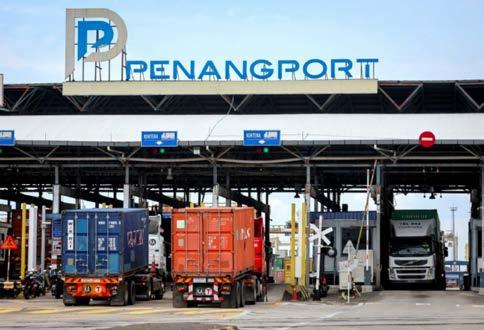
The Penang Port Commission (PPC) is closely monitoring developments in the Middle East to ensure potential disruptions to global shipping do not affect Penang’s semiconductor supply chain and broader logistics network.
PPC chairman Datuk Yeoh Soon Hin said the commission recently met with the North Malaysia Shipping Agents Association (NMSAA) to assess how the ongoing regional conflict could impact international shipping operations and logistics flows linked to Penang.
He said while Penang’s semiconductor ecosystem - which includes packaging, testing, electronics manufacturing services, and automation equipment - has remained resilient, the state must remain vigilant given its heavy reliance on global supply chains.
“Direct disruption to Penang’s semiconductor production base has not been significant thus far.
“However, the conflict presents clear but currently manageable indirect risks, particularly in the form of potential logistics delays, tighter raw material supply, and rising energy costs,” he said in a statement made available to the New Straits Times.
Often dubbed the “Silicon Valley of Malaysia,” Penang is a major hub for the semiconductor and electronics industries.
The sector relies heavily on international supply chains, meaning disruptions to air or sea transport could potentially delay critical components and affect production timelines.
Although the Middle East is not a major semiconductor manufacturing hub, Yeoh said prolonged instability could still affect global supply chains, particularly if tensions escalate around key maritime routes such as the Strait of Hormuz.
“Any disruption in the strategic waterway could force vessels to divert from traditional routes, potentially increasing transit times, freight charges, and insurance costs for shipments connected to Penang, which plays a key role as a global outsourced semiconductor assembly and test (OSAT) hub.
“As such, Penang must remain vigilant and proactively formulate short- and medium-term response strategies to assess and mitigate potential supply chain risks,” he added.
He said escalating tensions in the Middle East have introduced greater uncertainty to global shipping conditions, prompting PPC to work closely with the Transport Ministry, shipping agents, and maritime
stakeholders to ensure supply chain continuity for northern Malaysia.
Discussions with industry players focused on possible route adjustments, longer transit times, and rising freight and insurance costs, with shipping agents sharing real-time operational challenges faced by the industry.
“The conflict has created multiple challenges for global shipping, particularly in relation to the security of key sea lanes,” he said.
He stressed that Penang Port remains operationally stable, with PPC continuing to closely monitor cargo volumes, vessel movements, and equipment turnaround.
“As a key gateway along the east–west shipping route through the Straits of Malacca, Penang Port stands ready to adjust port operations as developments evolve, while maintaining Malaysia’s position as a regional trade and logistics hub,” he said.
Penang Records RM22.4bil Approved Manufacturing Investments In 2025
Penang recorded RM22.4 billion in approved manufacturing investments in 2025, a 29 per cent increase from 2024, reinforcing the state’s position as a key industrial hub despite global economic uncertainties.
Chief Minister Chow Kon Yeow said Penang ranked third among the highest contributors of approved manufacturing investments nationwide, accounting for 17 per cent of Malaysia’s total.
He said these investments involve 232 projects, expected to generate 24,633 new job opportunities.
The chief minister said that the approved manufacturing foreign direct investment (FDI) in 2025 amounted to RM15.2 billion, representing 68 per cent of Penang’s total approved manufacturing investments.
“The state also ranked among the top three recipients of manufacturing FDI in Malaysia, contributing 15 per cent of the nation’s total,” he said in a statement today.
According to him, Singapore, the United States and China were the top three sources of FDI, collectively accounting for 57 per cent of Penang’s total approved manufacturing FDI.
Meanwhile, Chow said the state’s domestic approved manufacturing investments totalled RM7.2 billion, representing 32 per cent of the state’s total investments and more than double the previous year’s figure.
He said investment activities were largely concentrated in the promoted sectors of electrical and electronics (E&E), machinery and equipment (M&E), and chemicals and chemical products, which together accounted for 81 per cent of total approved inflows in 2025.
He said of these, 52 per cent were new projects, while the remainder were expansion projects, highlighting Penang’s dual strength in attracting new investors while enabling existing companies to scale their operations.
“Penang is encouraged by the strong investment performance recorded in 2025. In the face of global economic uncertainties, the state has continued to attract quality investments that further strengthen our role within the global value chain.
“This reflects the enduring confidence of investors in Penang’s industrial ecosystem and long-term growth prospects,” he added.
Chow noted that the state government remains committed to working closely with its partners to ensure Penang continues to provide a conducive and competitive investment environment.
He also expressed appreciation to investors and to the Malaysian Investment Development Authority (MIDA) and InvestPenang for their continued support in facilitating strategic investments that contribute to the state’s sustainable economic growth.
China’s Electronics Manufacturer Learns to Live with Trump Tariffs and Thrive
President Donald Trump’s tariffs sought to hurt Chinese manufacturing, but for one electronics maker, a turbulent 2025 ended with a belief that China is a location that is difficult to replicate — as long as things don’t change too drastically.
Agilian Technology, which makes products mostly for Western brands, saw its US orders — accounting for more than half its revenue — frozen for months and clients demanded it set up production outside China.
Tariffs brought chaos to many Chinese companies but Beijing’s retaliation — export controls on minerals and metals that US firms need and are difficult to source — reduced the levies.
This allowed Agilian, a US$30-milliona-year business, to recover though it has pursued offshoring.
A recovery in China’s manufacturing sector might surprise Trump following the anniversary of his “Liberation Day” tariff rollout, given that he campaigned on using levies to reindustrialise the American economy and project US power.
“The data confirms that Trump’s tariffs indeed haven’t derailed the momentum that we’ve seen in China’s manufacturing sector,” said Nick Marro, principal economist for Asia and lead for global trade at the Economist Intelligence Unit.
China’s trade surplus for the first two months of 2026 rose to US$213.6 billion, official data showed, from US$169.21 billion a year earlier.
Gaussorgues wondered whether Trump would make a breakthrough when he visits China next month. Economists and industry executives expect Trump’s visit to extend a detente between the two rivals.
According to Denis Depoux, the general manager of consultancy Roland Berger, He Yadong, a spokesperson for China’s Ministry of Commerce, said: “China has shown the rare earths (are) a leverage of mass destruction.
“It’s a nuclear weapon of trade.”
Today, Agilian executives view Trump’s tariff policies as guideposts for how to deal with future flare-ups.
In 2024, as Trump was rising in election polls, Agilian’s clients wanted to get ahead of tariffs and asked the firm to ship products to North American warehouses.
Other US importers had similar ideas and storage prices went “crazy”, said Renaud Anjoran, the firm’s vice-president.
Shortly after Trump was re-elected, post-midnight calls from “panicked” clients became frequent. One customer with family in Penang urged Agilian to set up a production base there.
Agilian had set up an entity in India, but most clients pushed back on operating there, worried about slow production and Customs delays.
After Trump was inaugurated, two tariff hikes on China totalling 20 per cent concerned clients, but they stuck around. Then on April 2, tariffs on Chinese exports rose another 34 percentage points. For Agilian customers, “this was a disaster” and many cancelled orders.
China retaliated. Escalations pushed the levies above 100 per cent on both sides before the end of the month. “Things were frozen,” said Anjoran.
The company decided to go with Penang and found a factory to partner with. It was preferred because it was removed from the South China Sea, where military conflicts can’t be ruled out.
Agilian also scouted industrial rental space in Dharwad, India, and even looked at moving production to the US.
By mid-2025, Agilian’s India team found a 4,000-square-metre industrial building and was discussing which products could be made there.
But then a May Washington-Beijing deal removed most of the tariffs imposed on China.
In August, Trump hiked tariffs on India by 50 per cent to force it to stop buying Russian oil.
But Anjoran pressed ahead: “We want to be a multi-country manufacturer. Focus on the long arc of time.” Pre-production runs in Penang also started in the middle of the year.
Through the summer, China’s export controls exposed US dependence on materials processed almost exclusively in China, squeezing autos, defence and other industries.
An October meeting between Trump and Chinese President Xi Jinping brought tariffs down by 10 percentage points. By then, Agilian’s clients had stopped asking about levies and offshoring.
Agilian will keep developing facilities in India and Malaysia “as an insurance policy,” Gaussorgues said.
He hopes to grow revenue 30 per cent in the next three years, though he fears Trump could get in the way again.
“I started in January saying, okay, this might be a good year and then the Iran war started,” he said.
Source: www.thestar.com.my
The Infrastructure Powering the Next Generation of Autonomous Buildings
From self-adjusting blinds to responsive cooling, autonomous buildings are already here. By combining Tata Communications’ Digital Fabric with Johnson Controls’ OpenBlue, this partnership is advancing AI-driven building management.
In a growing number of offices, schools and residential developments, systems are already making real-time adjustments throughout the day. Blinds respond to changing light conditions, airconditioning adapts to occupancy levels and lifts flag maintenance needs when sensors detect early signs of wear.
These are no longer isolated smart features. They represent a fundamental
shift towards autonomous buildings – environments designed to optimise performance with minimal human intervention, supported by artificial intelligence (AI)-driven decision-making and remote oversight.
While the technology to enable this is already in place, infrastructure has often been a limiting factor. Achieving autonomy requires infrastructure capable of processing and securing continuous streams of data reliably. For technology leaders, this goes beyond deploying sensors or dashboards. Connectivity, computing, security and data orchestration must operate as a unified system, built for AI workflows from the outset.
A Partnership Built for This Moment
This vision underpins the partnership between Tata Communications and Johnson Controls. Tata Communications’ Digital Fabric provides the secure digital backbone for global systems, integrating connectivity, edge computing, cloud platforms and embedded security. Johnson Controls’ OpenBlue platform brings building intelligence to life, automating the management of core building systems, including heating, ventilation and air-conditioning (HVAC), fire safety and access control. Together, they bring the infrastructure needed to enable autonomous environments across global portfolios.
“Buildings are becoming smarter and more connected, with adaptive systems designed to deliver sustainability, comfort and operational efficiency,” said Mr Gerald Wong, managing director of Digital Solutions Asia Pacific at Johnson Controls. “Intelligent buildings are only as smart as the infrastructure that supports them. This is where Tata Communications’ Digital Fabric comes in.”
It is a partnership grounded in complementary strengths. Mr Amitabh Sarkar, vice-president and head of Asia Pacific at Tata Communications, added: “Together, we bridge operational technology and enterprise IT – bringing building systems, connectivity and cloud platforms into a single, secure architecture that enables intelligent, connected environments.”
Traditional enterprise environments are typically assembled from multiple vendors, with separate connectivity networks, security frameworks, cloud services and computing platforms. This disjointed approach often leads to operational friction.
“AI-driven systems depend on speed, data fluidity and consistent governance across the digital stack,” said Mr Sarkar. “When infrastructure is fragmented, organisations face integration challenges, limited visibility and slower response times, making it difficult to scale AI applications effectively.”
This becomes particularly important in autonomous buildings, which rely on continuous data flows between sensors, building systems and AI engines. Such demands call for an integrated architecture designed to function as a unified whole.
The benefits of this approach are already evident. According to a study conducted in April 2025, OpenBlue deployments have delivered measurable outcomes over three years – including a 30 per cent reduction in energy spend, 67 per cent lower maintenance costs and up to 155 per cent return on investment.
Real-world implementations further reinforce this impact. In London, occupancy sensors have reduced energy waste by up to 10 per cent by activating systems only when spaces are in use. In Singapore, banks have achieved up to 12
per cent energy reduction across more than 600 sites using real-time occupancy data and autonomous energy reporting.
These outcomes point to a broader shift in priorities. As Mr Wong noted, decarbonisation and efficiency are now central to how organisations manage building performance. “Decarbonisation and energy efficiency continue to be leading trends, with new baselines being set every year, alongside the increasing need for investments to deliver financial returns.”
Mr Amitabh Sarkar, vice-president and head of Asia Pacific at Tata Communications, emphasises the need for infrastructure designed to support AI-driven environments at scale.
Coordinated data flows across systems are key to real-time decision-making at scale.
In highly connected operations, resilience depends not just on connectivity, but on how securely it is managed.
Securing And Scaling Ai-Driven Environments
As buildings become more interconnected, cyber risk increases. Every connected device – from Internet of Things sensors and access control systems to HVAC controllers – expands the potential attack surface.
“Cybersecurity is now a concern across all environments,” said Mr Wong. “We need to provide the highest level of protection across increasingly integrated systems.”
Tata Communications’ Digital Fabric addresses this through a zerotrust architecture embedded at the infrastructure layer, where every device, user and workload must be continuously authenticated. This enables organisations to scale securely while maintaining the data flows needed for automation.
“Trust is no longer perimeter-based; it is dynamic and contextual,” said Mr
Sarkar. “A zero-trust architecture allows enterprises to manage cyber risk effectively while enabling real-time operations.”
At the same time, edge computing plays a critical role. By processing data closer to where it is generated, buildings can respond instantly – optimising energy usage, detecting anomalies or triggering safety protocols without relying on constant cloud connectivity.
“Edge processing enables real-time decisions locally, while cloud orchestration provides centralised oversight,” Mr Sarkar explained. “Together, this creates a resilient architecture that supports performance across distributed locations.”
Edging Towards Autonomy at Scale
This shift towards distributed intelligence is accelerating. A study by Gartner estimates that by 2028, around half of enterprise-managed data will be created and processed outside traditional data
centres or the cloud, while an industry forecast by STL Partners suggests that the global edge computing market could exceed US$424 billion (S$541 billion) by 2030.
For organisations managing buildings across multiple geographies, the implications are clear: Autonomy requires infrastructure that is equally intelligent and adaptive.
As Mr Wong noted, this shift goes beyond technology to how buildings are designed, managed and operated. “With this partnership, we are bringing together building intelligence and connectivity to create smart, autonomous buildings for the future,” he said.
Learn more about how Tata Communications’ Digital Fabric powers secure, scalable and AI-ready enterprise environments.
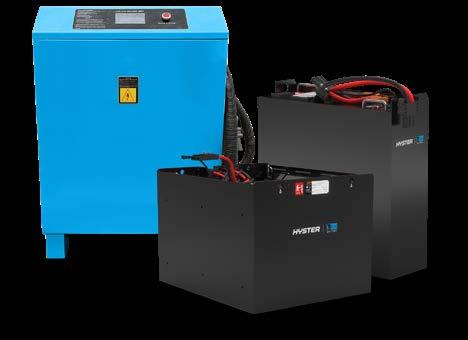
Hyster Unveils Lithium-Ion Power Solutions Designed to Provide Turnkey, Seamless Experience from A Single Source
Unified system addresses compatibility risks and delivers an integrated experience between battery, charger and forklift
Hyster announces lithium-ion batteries and chargers that are purpose-built for Hyster forklifts, providing a unified system that delivers peak performance and efficiency, backed by the one-stop-shop convenience and expertise of Hyster® dealers. The integrated power solutions reduce the risk of software mismatches, faults and charging errors that can be common with third-party power systems, and enable integration with Hyster Tracker™ telemetry to provide near real-time battery data alongside other fleet and equipment information.
Global electric forklift sales data makes it clear that more operations are looking to electrify their materials handling equipment. But while the motive power they depend on might be changing, their expectations for performance and dependability are non-negotiable,” said Ken Schreiber, Senior Product Director,
Electrical Energy Solutions, Hyster. “Over the years, customers have come to trust Hyster dealers and equipment to provide a seamless experience and performance they can count on — and we’re delivering on that promise by helping to ease their electrification journey with these integrated lithium-ion power solutions.”
The batteries and chargers are specifically designed to work with Hyster® lift trucks, with each element validated by the factory to work as a fully integrated ecosystem that delivers the power and durability required in the world’s most demanding operations.
• Battery technology: Lithium iron phosphate (LFP) chemistry offers high energy density, superior temperature tolerance, long lifespan and fast charging, enabling batteries to meet the demands of multi-shift
applications. Modular battery design enables service of individual modules, rather than requiring replacement of entire battery pack.
• Charging infrastructure: Operators can simply plug the charging cable into the easy-access port — no need to open the forklift’s hood or take other steps to charge — and built-in interlock sensors prevent operators from moving the truck while plugged in. The high-speed chargers can be placed anywhere, including hightraffic areas, to encourage opportunity charging that keeps operations moving.
• Lift truck integration: Systemlevel integration enables the battery to communicate with other truck systems, offering a unified view of truck and battery data via Hyster Tracker telemetry, as well as targeted alerts regarding battery status that can enhance lift truck safety and performance, such as low charge or high temperature.
The Hyster dealer network provides complete, end-to-end support for this OEM battery and charging solution, streamlining support for equipment, batteries and charging infrastructure from a single point of contact. This eliminates the service headaches that can come from piecemeal battery, charger and lift truck solutions, including warranty administration and support.
ABB Teams Up with Nvidia to Improve Factory Robot Training
ABB’s robotics business has partnered with Nvidia to narrow the gap between how industrial robots perform in virtual simulations and how they behave on factory floors, the companies said on Monday.
Swiss-based ABB will use Nvidia’s Omniverse libraries of simulated data to make its training environments more realistic by incorporating details such as lighting, shadows, and textures.
ABB Robotics President Marc Segura said: “This will save companies a lot of time and money.”
The logo of ABB is pictured at the Global Industrie exhibition in Villepinte near Paris, France, March 26, 2024. REUTERS/Benoit Tessier
Former Google AI Researcher Sets Up AI Robotics Startup in Tokyo
ASilicon Valley-born AI startup is turning to Japan to prove AI can reshape one of the world’s largest industrial robot supply chains.
Integral AI Inc, a five-year-old company founded by former Google researchers Jad Tarifi and Nima Asgharbeygi, develops AI models geared for automated systems such as robots and self-driving cars. The company has worked with auto parts maker Denso Corp since 2021 to help teach industrial robots new skills by observing demonstrations.
The 15-person startup is holding initial discussions with Toyota Motor Corp, Sony Group Corp, Honda Motor Co, Nissan Motor Co and Mitsui Chemicals Inc to pitch them on how artificial intelligence can advance manufacturing processes. The next step is for a human operator to give a robot a language prompt, like “make a coffee,” and have the robot teach itself how to do so, Tarifi told Bloomberg News.
Japan is home to many of the world’s biggest industrial robot makers including Fanuc Corp and Yaskawa Electric Corp,
while SoftBank Group Corp is buying the robotics unit of ABB Ltd. The country also hosts factory automation providers such as Mitsubishi Electric Corp and Kawasaki Heavy Industries Ltd, with Japanese companies delivering an estimated 29% of the global supply of industrial robots, according to the International Federation of Robotics.
Integral has a role to play because “Japan is strong in robotics, but they’re not strong in AI and compute,” Tarifi said.
The 42-year-old, who started Google’s first generative AI team in 2013, is one of a growing number of AI doctorate holders who see the workings of the brain’s neocortex as key to building AI architecture and algorithms that mimic the way a child learns.
Tarifi’s goal is to create AI models that can distill information with less data and process new information without accidentally deleting prior data – essential for learning. Such models would enable companies to push ahead in physical AI and handle sophisticated tasks such as designing new batteries, discovering
materials and drugs or powering humanoid robots, Tarifi said.
Ultimately, the aim is to help companies teach robots to build new robots. “They might build a cooking robot, they might build a cleaning robot, or they might build a factory robot that builds an iPhone,” he said.
The ability to self-learn could eventually free machines from the need for updates. Existing large language models, such as OpenAI’s ChatGPT and Google’s Gemini, require more human-guided training, which can limit flexibility, efficiency and reliability, according to Tarifi.
Facing life-and-death situations as a child in war-torn Lebanon, Tarifi realised early on that “to actually have meaningful impact with AI, you need to affect the physical world, not just the digital world,” according to a 2024 interview with Nikola Danaylov – author of Conversations with the Future: 21 Visions for the 21st Century – on the Singularity.FM podcast.
Integral, which has raised about US$5.5mil (RM21.6mil) to date, now seeks about US$10mil (RM39.3mil) in a new funding round to scale up its model and ready it for public release. That’s pocket change compared with what big tech companies are spending on AI, but adequate for developing an algorithm, Tarifi said. The company will seek greater scale after the planned launch of Integral’s Genesis model later this year.
“The company’s claims are extremely bold,” Danaylov said in a recent interview. “But when you can’t afford to use or recreate the paradigm, you have no other option but to invent a new one.”
The 15-person startup is holding initial discussions with Toyota Motor Corp, Sony Group Corp, Honda Motor Co, Nissan Motor Co and Mitsui Chemicals Inc to pitch them on how artificial intelligence can advance manufacturing processes. — Photo by Possessed Photography on Unsplash
Robotic Legs Help Elderly Fire Survivors Climb Home
More than four months after a deadly fire engulfed her apartment block in Hong Kong’s northern Tai Po district, Fanny Mok is preparing to go back to retrieve what remains of her belongings.
Mok, 59, is borrowing robotic exoskeleton legs to help her climb to her 13th floor apartment where she lived for the past 30 years, until a blaze in late November torched the complex, killing 168 people and displacing more than 4,000.
“My knees hurt, I don’t have enough strength and I get short of breath,” said Mok, who is temporarily staying in a small hostel room about a 25-minute drive from her former home.
She has been practising climbing stairs using the exoskeleton legs in an apartment building near Wang Fuk Court, where the inferno damaged seven high-rise towers.
Former residents will be allowed to return to their flats for the first time from April 20 to May 4, with each household given a three-hour window to collect their belongings.
Mok is among dozens of fire victims who are borrowing the exoskeleton legs and taking training sessions to learn how to use them.
“There’s a real need. If I were 30, I wouldn’t need it. But at 60, I genuinely do,” she said.
Helped by an NGO called AidVengers Federation, former residents must pass a test before being allowed to operate the exoskeletons, which are made by Hypershell, a Shanghai-based robotics company. The pass rate has been 70%, the NGO said.
Built in the 1980s, Wang Fuk Court was home to 4,600 people, with more than a third of residents aged over 65.
Most of them are now living in temporary accommodation across the city.
The complex’s apartment towers have 31 floors, making the climb difficult for many elderly former residents.
Collecting all their personal items in just a few hours was also difficult, they said.
Betty Ho, 61, who lived on the 15th floor of one of the towers for 35 years, said she hoped to retrieve cash and family photo albums spanning her childhood and adulthood.
“How can you take everything you’ve lived with for decades out in just three hours? It’s basically impossible. Letting go of things is really very difficult.” — Reuters
Aid in motion: Ho trying on a robotic exoskeleton ahead of her first visit home to retrieve belongings, in Hong Kong. — Reuters
AI Boom Accelerates China’s Chip Industry Growth as Demand Strains Supply Chain
China’s chip industry is showing strong growth momentum as a global sprint to build AI infrastructure creates an explosion in demand, sparking higher capital spending and capacity expansion as chipmakers race to keep up, executives said today.
Growth in the industry “is coming faster than expected” this year, Jerry Zhang, China sales head at Swiss semiconductor components firm VAT, told Reuters on the sidelines of Semicon China 2026 in Shanghai, one of the industry’s largest annual gatherings.
As companies race to ramp up production, China’s manufacturing capacity for chips made on mature 22nm to 40nm process nodes - used in cars, smartphones and electronics - is projected to reach 42 per cent of global output by 2028, up from 37 per cent in 2026, SEMI China President Lily Feng said.
Artificial intelligence is also reshaping the broader semiconductor sector, increasing requirements for testing, packaging, and high-speed interconnects, as chips become more complex and performance-intensive.
“AI has significantly increased computing power requirements, and that in turn has raised the requirements for semiconductor testing,” said Terry Feng, China sales director at US chip testing firm Teradyne.
The impact is particularly visible in areas such as optical interconnects - a critical layer linking chips inside data centresfor which China is a major global supplier.
“Our order backlog is already booked out into next year,” said Zhou Limin of Mycronic’s MRSI unit, which makes highprecision equipment used to assemble optical modules, a key component of optical interconnects.
The AI boom has also started to strain the semiconductor supply chain globally, particularly in raw materials and high-end components, as manufacturers struggle to keep up with rising demand.
Given the size and strength of its manufacturing industry, China is better placed than most to respond, according to executives and industry analysts.
“We are very optimistic about the memory (chip) cycle - there will be
large-scale capacity expansion,” said Bai Yu, vice president at Suzhou Origins Materials Technology, which will begin construction of a new production base next month.
The company supplies materials used in manufacturing to top Chinese chipmakers including ChangXin Memory Technologies, Yangtze Memory Technologies and Semiconductor Manufacturing International Corporation.
Participants in the fair also included foreign suppliers, as they remain central in higher-end segments of the chip supply chain even as China’s domestic industry expands.
“There’s still a place for foreign firms because it is a very specialised industry - you have to have the expertise, the materials and the understanding,” said Cameron Johnson, senior partner at Tidal Wave Solutions.
He added that foreign companies often retain an edge in after-sales support and technical services, areas where domestic competitors are still catching up.
China’s chip industry is showing strong growth momentum as a global sprint to build AI infrastructure creates an explosion in demand. - File pic, for illustration purposes
i-City Anchors New Visitor Economy
As Malaysia intensifies its global push ahead of Visit Malaysia 2026, the country’s tourism narrative is undergoing a structural transformation.
Iconic images of island sunsets and heritage streets still define its brand, but a new wave of attractions across Selangor and Kuala Lumpur is reshaping how the nation competes for international attention.
Powered by artificial intelligence (AI), robotics and immersive engineering, these attractions are shifting technology to centre stage — becoming the attraction itself — and increasingly, a driver of capital interest.
At i-City in the capital of Selangor, the AI World Experience Centre — developed in partnership with AgiBot — offers a glimpse into this future.
Currently the largest public showcase of its kind in the country, the centre features over a hundred lifelike humanoid robots capable of real-time interaction. The setting is deliberately accessible; families gather as children wave at machines that wave back, testing the natural communication of AI in a leisure environment.
Deputy Tourism, Arts and Culture
Minister Chiew Choon Man recently noted that these innovative centres are key to creating distinctive travel packages.
The scale of this differentiation is critical as the nation aims for a significant postpandemic surge.
Chiew recently expressed high confidence in these targets, stating, “The momentum we are seeing gives us confidence that the 2026 target of over 40 million arrivals is achievable with continued collaboration across government and industry players.
“Official projections for Visit Malaysia 2026 place the target range between 35.6 million and 47 million visitors, generating between RM147.1 billion and RM329 billion in receipts.
“Yet the strategy goes beyond novelty. For developer I-Berhad, these projects are demand engines embedded within a larger master-planned ecosystem, where robotics-as-a-service and high-tech attractions help stimulate hospitality demand,” he said.
Wyndham Hotels and Resorts Asia Pacific president Ooi Joon Aun said Wyndham i-City was not just about hospitality — it was about showcasing what AI-powered living feels like.
He noted that global pilots have demonstrated the transformative potential of AI and robotics in redefining hospitality, adding that the partnership with i-City allowed for the delivery of “next-generation guest experiences in one of Malaysia’s most innovative destinations”.
Property consultant Sam Goh noted that integrated ecosystems combining attractions, technology and hospitality could reduce cyclical risk for developers while capturing both visitor spending and long-term asset appreciation.
“As experiential travel becomes a driver of destination choice, real estate projects that embed attractions, technology and hospitality elements are increasingly positioned to capture both visitor spending and long-term asset value growth,” he said.
The Wyndham collaboration with i-City also spans to Kuala Lumpur City Centre (KLCC).
At Wyndham Suites KLCC, located minutes from the Petronas Twin Towers, guests can experience WynSnow — an indoor snow environment engineered within a tropical metropolis.
Behind this spectacle lies a sophisticated integration of climate-control systems and sensory design, illustrating how technical infrastructure can be repurposed into an experiential tourism asset.
Wyndham Suites KLCC operates under a hybrid hospitality-residential model, allowing buyers to occupy units, retain them as secondary homes, or participate in a professionally managed hotel rental programme.
Guests at Wyndham Suites KLCC may enjoy seamless access to views of the Petronas Twin Towers.
(From left) AgiBot founder, chairman and chief executive officer Deng Taihua, Deputy Tourism, Arts and Culture Minister Chiew Choon Man and I-Berhad chairman Tan Sri Lim Kim Hong officiating at the launch of i-City’s AI and robotics showcase recently.
Singapore To Prepare 10,000 Students for Future Shaped by Autonomous ‘Physical AI’
Over the next five years, at least 10,000 students in Singapore will be trained to work with “physical AI”, where intelligence is no longer confined to computer screens but embedded directly into robots, drones and autonomous machines.
The initiative, supported by the National Robotics Programme (NRP), will span from primary schools to universities.
Through hackathons and industry projects, students will move beyond basic coding to solve real-world problems.
Robots With “Common Sense”
While traditional robots follow pre-set rules, the next generation of machines will need to sense, decide and act independently, industry players say.
Professor Mohan Rajesh Elara, cofounder of Singapore-based cleaning robot firm LionsBot, said the current limitation of robots is a lack of situational awareness.
“The robots of today are driven by the codes that (a) programmer wrote … definitive rules that enable the robot to complete a task.”
“But a robot of today, if (it’s) doing the job and if a fainted person is on the floor, the robot often will take this person for an obstacle. The idea is, how can we empower robots with common sense to interpret this scenario?” Prof Mohan added.
LionsBot, which has deployed over 5,000 robots in 30 countries, is now integrating this “common sense” into its fleet.
This would enable its robots to “interpret the environment and take actions beyond the rules”, for example, intervening and providing medical attention to a person, he said.
“With this transformation coming, we need talent who go beyond coding AI only in software, only on screen, to users of AI, to youth that are capable of programming (and) developing innovative physical AI systems with robots and intelligent devices.”
The company plans to reach 10,000 students over five years, through industry immersion, classroom learning and hands-on team challenges building robots.
This number is “probably only a fraction of the talent that Singapore will need”, said Prof Mohan.
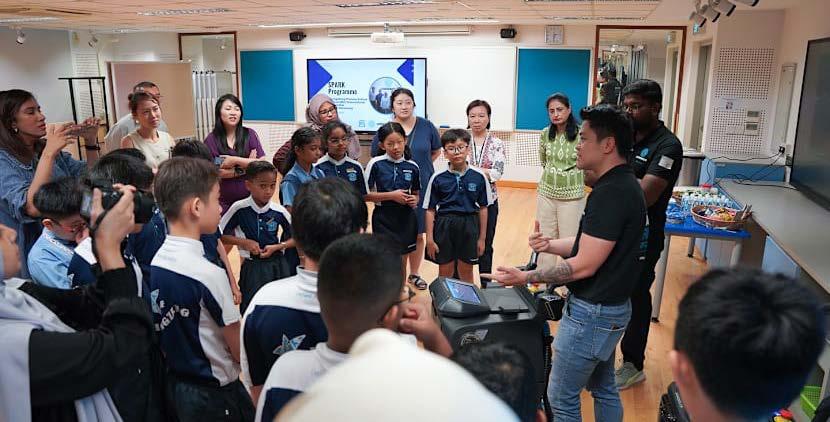
LionsBot aims to immerse 10,000 students in the world of physical AI through hands-on building sessions and classroom learning over the next five years. (Photo: LionsBot International/Facebook)
He added that the programme will begin rolling out in mid-2026, offering students a “first-of-its-kind” look at how physical AI robots are developed, from the initial research and design stages to manufacturing and global deployment.
Public-Private Sector Push
To support this technological leap, the NRP is also pushing for stronger publicprivate partnerships.
Mr Tung Meng Fai, NRP’s executive director, noted that while schools are excellent at teaching academic fundamentals, industry partners bring practical knowledge.
“This is where industry and the schools –public, private – can really work together,” Mr Tung said.
“The talent that we train for the ecosystem not only knows the academic fundamentals, but are also very practical problem solvers, and knowledgeable about the systems.”
Source: www.thestar.com.my
He added that by exposing students to robots early, they become comfortable and familiar with using them, ensuring the technology has a real-world impact once these students enter the workforce.
Preparing For Future Jobs
The rapid evolution of AI has left many students feeling uncertain about their future careers, industry players note.
Mr Mark Yong, CEO of Garuda Robotics, said he sees secondary school students asking “very deep, pointed questions” about what they should study to remain relevant several years down the road.
While core engineering skills are vital, adaptability and the ability to learn proactively are the most important traits for the future, he said.
Mr Yong pointed out that in an AI-driven world, the humanities remain critical.
“You will need somebody to think about the ethics of the AI you’re deploying. You need people who are conversant with the language of design to be able to build interfaces that are pleasant for people to interact with,” he said.
It also hosts projects lasting up to a month for secondary school and junior college students. This has helped address students’ concerns about an uncertain future, Mr Yong noted.
As robots begin to make more autonomous decisions, new specialised roles are emerging.
“There’s going to be AI security engineers, because now robots are going to use common sense, and we need to have guardrails,” Prof Mohan said.
“There’s going to be AI trustworthiness as a big area, and a number of new jobs will be created in that domain.”
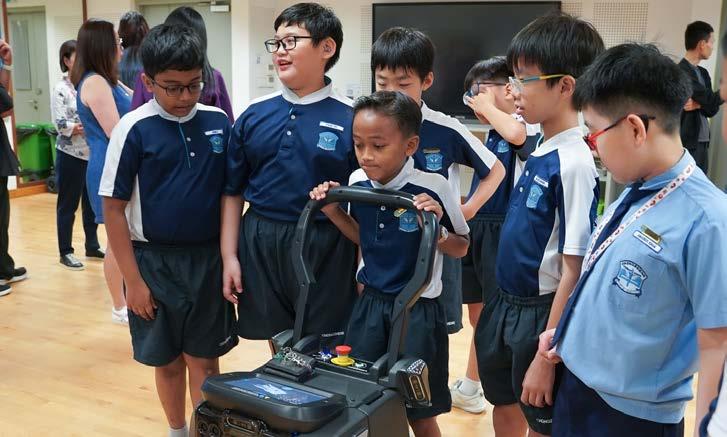
Students learning to operate an autonomous robot. (Photo: LionsBot International/Facebook)
Setting New Standard For 5G Connectivity
UMobile has introduced a suite of 5G services powered by AI-driven 5G standalone network.
The company said that this will give users smarter, more reliable connectivity rather than simply faster speeds.
U Mobile chief consumer business officer Navian Manian said expectations around connectivity have shifted significantly in recent years.
“Consumers today care more about speed and data than ever before, but beyond that, they expect reliability wherever they are — whether at crowded venues such as concerts and football stadiums, transport hubs or while travelling abroad.
The new plans introduce several industry-first features, including Ultra5G Priority Pass, which allows users to activate prioritised network access during periods of congestion such as large events.
They also come with built-in security protection against phishing SMS, fraudulent calls and unsafe websites, addressing growing concerns over cyber threats.
Navian said connectivity today goes beyond basic usage, forming the backbone of travel, work and everyday digital experiences.
“Whether it is reliable connectivity at home, seamless usage while travelling, or protection against scams, consumers want a complete experience — not just a mobile plan,” he added.
Meanwhile, U Mobile chief business officer How Lih Ren said businesses require a different level of network performance as digital operations become increasingly critical.
To address this, U Mobile introduced Ultra5G Reserve, a dedicated network priority feature for enterprises that offers up to four times better performance by prioritising business-critical data.
The enterprise plans also include built-in intelligent security, seamless international connectivity and high-capacity data offerings, alongside additional services such as business fibre, dedicated internet access and Internet of Things (IoT) solutions.
How said the focus is on delivering tangible outcomes rather than just connectivity.
“At the heart of our approach is a simple belief — not all network traffic is equal. Businesses need assurance that their operations will not be disrupted, especially during peak periods,” he said.
“We are moving towards a model centred on business performance, where security is embedded, connectivity is seamless and reliability is prioritised,” he added.
Commenting on the AI-driven 5G standalone network, U Mobile chief technology officer Woon Ooi Yuen said said the service has achieved 80 per cent coverage of populated areas nationwide.
The network has also been recognised as Malaysia’s fastest 5G network and for best 5G availability.
“As we continue to expand, we are laying the groundwork for a digital future that is faster, safer and more resilient,” he said.
From left are U Mobile chief technology officer Woon Ooi Yuen, chief consumer business officer Navin Manian, and chief business officer How Lih Ren.
NZ, M’sian Varsities Team Up On AI, XR Lab
TWO universities have joined hands to boost research and development of artificial intelligence (AI), extended reality (XR) and immersive technologies by setting up a joint satellite laboratory.
Universiti Teknologi Malaysia (UTM) vice-chancellor Prof Dr Mohd Shafry Mohd Rahim said the laboratory, set up in collaboration with New Zealand’s University of Canterbury (UC), aimed to enrich knowledge and explore new areas of learning.
“Our partnership has continued to grow over the years, expanding into new fields such as AI, XR and virtual reality (VR),” he said during the launch at UTM’s campus in Skudai, Johor.
“Through this collaboration, we will undertake several joint research projects.
“This partnership is not one-sided. While UC has a presence here, UTM has also established a laboratory at their campus.”
Both universities were also planning to introduce a joint PhD programme.
The laboratory builds on a memorandum of understanding (MOU) signed in July last year.
The five-year MOU would also focus on developing globally competent graduates and researchers by facilitating joint supervision, mobility programmes and greater exposure to international research ecosystems.
The joint satellite laboratory was expected to accelerate technology transfer and start-up incubation by leveraging shared
international industry networks while positioning UTM as a globally connected research hub in advanced computing and immersive digital innovation.
UC deputy vice-chancellor (research) Prof Lucy Johnston, who was present at the launch, said the long-standing partnership between the two institutions had been shaped by people-to-people connections over the years.
“They brought new perspectives, ideas and friendships that continue to enrich our community today.
“Since then, generations of Malaysian alumni have gone on to make significant contributions across business, education, government and industry.”
She pointed out that the joint satellite laboratory would also serve as a platform to translate research into real-world impact.
“It provides opportunities for students and researchers to gain international experience, engage with emerging technologies and develop skills needed in an increasingly connected world.”
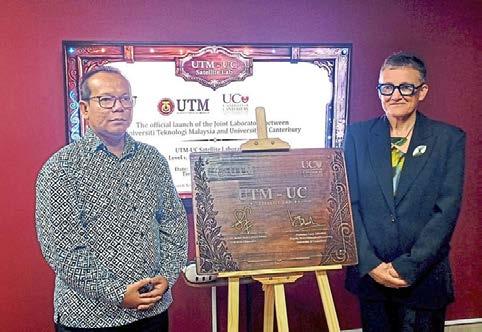
Prof Mohd Shafry and Prof Johnston at the launch of the Universiti Teknologi MalaysiaUniversity of Canterbury joint satellite laboratory in Skudai.
igus sets the course for worldwide growth and fast delivery times - with investments in automation and local production
With global investments totalling €124.4 million, igus strengthens fast supply chains, customer proximity and competitiveness
At a time when global conflicts and economic uncertainty are slowing down many industries, the power to innovate remains essential for growth and competitiveness. With 227 new motion plastics products, igus proves that innovations can emerge precisely when conditions are difficult. To achieve further growth, the company has invested heavily in new infrastructure and automation, leading to even faster delivery times. In addition, igus is expanding its global activities with new and existing subsidiaries to further strengthen customer proximity through local production.
Despite global challenges, igus succeeded in growing its 2025 turnover to €1.155 billion - an increase of 4.4 percent compared to the previous year. The three largest sales markets for igus are China, Germany and the USA, which together account for around 60 percent of sales. igus employs 5,423 people across the globe - 185 more than in 2024, and 2,044 of them in Germany alone. To become independent of the external labour market by 2027, the company has set up its own Training Factory at its headquarters in Cologne at a cost of €600,000. In 2025, igus invested a total of €42.2 million in the innovation centre in Cologne alone and €11.5 million in shareholdings. In
addition, €70.7 million were invested in the global subsidiaries. The funds are used for new land, buildings and modern tools, among other things, all with the aim to supply customers even faster and more reliably in future. “Product quality and price are no longer the only differentiating factors,” says Artur Peplinski, CEO and Spokesman of the Management Board at igus. “Our customers increasingly need suppliers who can deliver quickly and, above all, reliably without having to compromise on product quality.” One lever for more speed is automation. As part of the new “Phase 8” building at the Cologne headquarters, for example, a fully automated small-parts warehouse is being
built, which will shorten the throughput of orders with up to 1,800 storage and retrieval operations per hour. Specially developed automation solutions that relieve employees of routine tasks, such as unloading injection-moulding machines, ensure additional speed in production. The 857 injection-moulding machines in Cologne produce over one billion components a year. In areas such as crimping and soldering, new automation solutions allow for throughput times that are up to 10 to 30 times faster than manual processes.
1,500 square metres of additional test space for more research and innovation
To guarantee high quality at all times, the industry’s largest test laboratory in the world has become even larger and now covers 5,500 square metres. “Adding 1,500 square metres to our test areas in the new building exclusively for our dry-tech products creates the basis for more capacity and new products, such as PTFE-free and bisphenol-free materials,” says Peplinski. “The number of test rigs alone has increased by around 20 percent and with it the number of tests: from the current 11,000 to a total of around 17,000 tests per year.” Part of the investment was also channelled into the development of new online tools that enable design engineers to configure products automatically, and therefore even more easily and quickly, without having to exchange design drawings with the igus sales department.
New subsidiaries and local production for even greater customer proximity
igus still manufactures around 95 percent of its components in Germany. However, the trend towards local production is increasing all over the
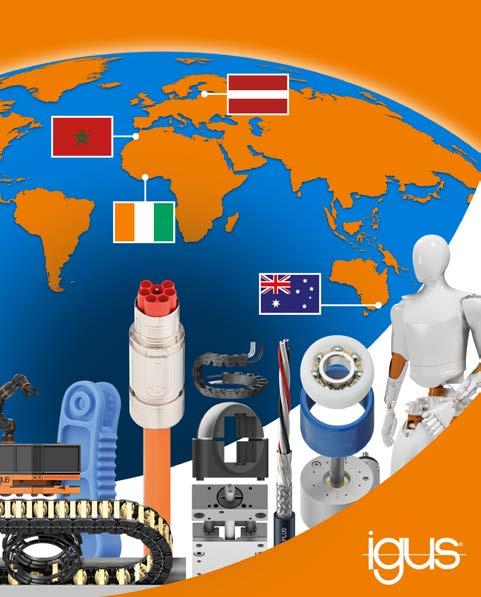
world. Developments such as China first or America first are an expression of this reality. To better understand and meet local challenges and improve its own ecobalance, igus expanded its plants in China, the USA, Poland, Turkey and Japan in 2025. In many places, larger storage and assembly factories have emerged. “By expanding local production capacities in China and the USA alone, we lowered transport weight by around 1.2 million kg in 2025 - a significant contribution to CO₂ reduction,” emphasises Peplinski. The company has also established new subsidiaries in Australia, Morocco, the Ivory Coast and Latvia.
Sustainability remains a central component of the corporate strategy. Since 2025, igus’s production has been climateneutral at its headquarters in Cologne in accordance with Scopes 1 and 2. The company’s own recycling platform chainge is also continuing to grow: 235 tonnes of disused energy chains have been taken back so far. “One important step forward is the new ISO-certified validation, which allows us to demonstrate the CO2 savings of our energy chain recycling to customers in a transparent way,” explains Peplinski.
227 new products allow for further growth
The new products from igus are also intended to ensure international growth and help the company break into new markets. The plastics specialist will be presenting a total of 227 new motion plastics products at Hannover Messe 2026. These include the first drylin C roller guide, 3D printing materials for the food and beverage industry and the e-spin energy supply system, a new cleanroom solution for long travels with ISO Class 1 certification from Fraunhofer IPA. This year, igus will also be presenting new solutions for e-mobility with e-tract AC and DC. igus sees low-cost robotics in particular as a growth driver. “It is our goal to democratise automation,” says Artur Peplinski. “Small and medium-sized companies with limited budgets and little previous experience should also benefit from the benefits automation offers.”
To this end, igus is expanding the RBTX online platform. The aim of igus is to develop the RBTX ecosystem further, turning it into a service hub for complete automation solutions. In future, RBTX will not only bundle components from over 260 wellknown robotics manufacturers, but also connect users with suitable integration partners - quickly, transparently and independently of the manufacturer. Around 100 humanoid robot models from 35 manufacturers are already available today. Peplinski summarises: “We want to show that sustainable growth and technological innovation are possible even in challenging times. With a consistent focus on speed of delivery, local presence and automation solutions, we are setting the course for growth - for us and our customers.”
PRESS CONTACT:
Vijay Kalyarasu
Marketing
igus® Singapore Pte Ltd 84 Genting Lane #06-03 Axxel Innovation Centre Singapore 349584
Tel. 65 6487 1411
E-Mail: vkalyarasu@igus.net
ABOUT IGUS:
igus® SE & Co. KG develops and produces motion plastics. These lubrication-free, high-performance polymers improve technology and reduce costs wherever things move. In energy supplies, highly flexible cables, plain and linear bearings as well as lead screw technology made of tribopolymers, igus is the worldwide market leader. The family-run company based in Cologne, Germany, is represented in 37 countries and employs around 5,400 people across the globe. In 2024, igus generated a turnover of €1,155 billion. Research in the industry’s largest test laboratories constantly yields innovations and more security for users. 245,000 articles are available from stock and the service life can be calculated online. In recent years, the company has expanded by creating internal startups, e.g. for ball bearings, robot drives, 3D printing, the RBTX platform for Lean Robotics and intelligent “smart plastics” for Industry 4.0. Among the most important environmental investments are the “chainge” programme – recycling of used e-chains - and the participation in an enterprise that produces oil from plastic waste.
Precision Motion as the Backbone of Advanced Manufacturing
Kyaw Thu
Akribis Systems was founded in August 2004 by four Singaporean entrepreneurs. What began as a small team has since grown into a global organisation with close to 2,000 employees worldwide. Early members of the leadership team, including Kenny and KT, joined shortly after the company’s inception and have been closely involved in its growth journey. Many employees have remained with the company for over two decades, reflecting a strong internal culture and long-term stability.
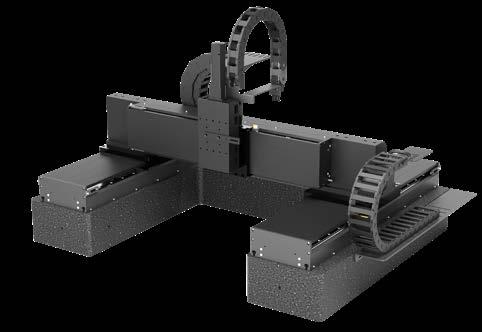
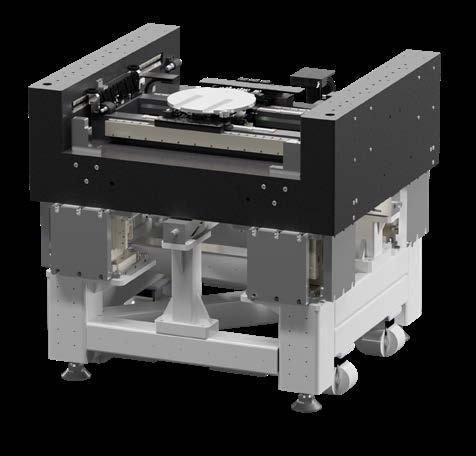
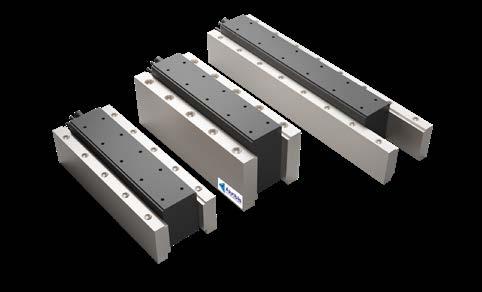
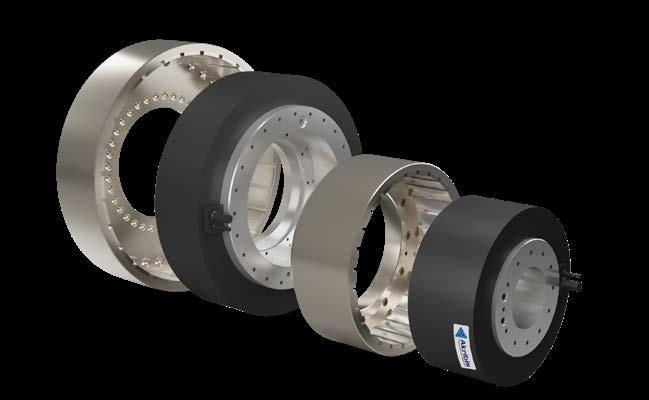
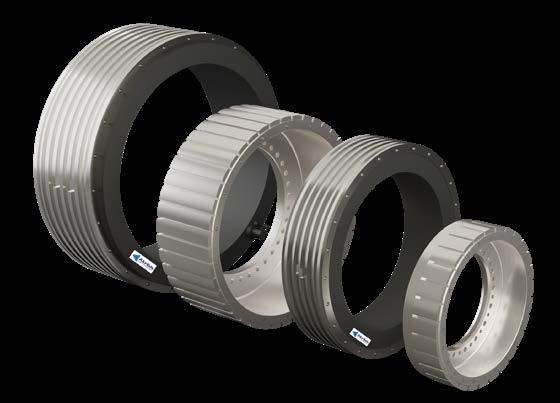
The company initially focused on direct drive technologies, particularly linear motors. Over time, Akribis moved up the value chain, expanding into motion stages and eventually developing complete motion solutions. Today, its portfolio spans iron core linear motors, voice coil
Kenny Tan
motors and rotary direct drive motors, positioning Akribis among providers with one of the most comprehensive motion control offerings in the market.
From Ang Mo Kio to America, Akribis has expanded to major cities across different continents, establishing a strong international presence over the years. A key milestone came in 2010 with its entry into China, where the company quickly built a strong foothold. This move significantly accelerated its growth, and today, thirdparty surveys recognise Akribis as the leading direct drive supplier in China across both linear and rotary motors.
The company has since developed a global footprint, with operations spanning the United States, Europe, Korea, Japan, Malaysia, Israel, and other key markets
worldwide. This international presence enables Akribis to work closely with customers across regions, particularly during the early stages of product development.
Akribis also places strong emphasis on vertical integration. Core processes, including machining aluminium and steel components, motor design, stage assembly and complete system integration, are handled in house. In addition, the company develops its own encoders and motion control systems, allowing for highly customised and optimised solutions tailored to customer requirements. Ultimately, Akribis positions itself not just as a product supplier, but as a solutions provider focused on delivering performance, precision and long-term value.
Assistant Vice President (Sales and Applications)
Akribis Systems Pte Ltd
Vice President (Sales)
Akribis Systems Pte Ltd
1. AKRIBIS is well known for its precision motion and mechatronic systems. How does precision motion technology directly impact manufacturing accuracy and throughput in today’s electronics and semiconductor production environments?
KT: Precision motion can be a very big topic, but if I have to summarise it in two words, it would be direct drive. Direct drive technology allows us to achieve highly accurate positioning without relying on transmission components. Traditionally, the industry has been very used to systems like belt drives, gear systems or screw drives, where rotary motion is translated through multiple mechanical components.
The challenge with those systems is that they introduce mechanical limitations, especially backlash and wear over time. While they serve their purpose, they will always have a certain level of inaccuracy. With direct drive, we eliminate those transmission elements. This means we can position exactly where we want, stop precisely at the required point, and achieve much faster acceleration and response. The dynamic performance is simply not comparable to conventional transmission systems.
In today’s electronics and semiconductor manufacturing, where precision and speed are both critical, this makes a direct impact. You get higher accuracy, better repeatability and ultimately improved throughput. That is why, for us, the answer comes back to direct drive.
2. As electronics manufacturing moves towards higher complexity and tighter tolerances, what are the biggest technical challenges manufacturers face in maintaining precision and consistency on the production line?
KT: From a manufacturer’s perspective, the short answer is actually talent and human capital. As manufacturing moves towards higher complexity and tighter tolerances, the technology challenge is one thing, but having the right people to support it is another. In Singapore especially, we are competing with large multinational companies. These companies have strong branding and deep resources, so attracting and retaining engineering talent can be quite challenging for us.
For a company like Akribis, which is very engineering-driven, the learning curve is steep. It requires commitment, especially for younger engineers who are still building their knowledge. Not everyone is willing to go through that level of dedication today, so retention becomes an ongoing challenge. What we can do on our side is improve how we train and develop people. We try to make the learning
process more structured and engaging, for example by letting them experience both fast-paced, high-impact projects and more gradual learning environments. The idea is to keep them motivated while still building strong technical foundations.
Interestingly, this challenge is not the same everywhere. For example, when we expanded in the US, in Provo, Utah, we were able to hire much faster compared to Singapore. We filled multiple positions within a few months, while similar roles locally are still harder to close. This shows how talent availability can directly impact how manufacturers scale and maintain consistency. On the technical side, maintaining precision and consistency at tighter tolerances really comes down to quality control and process capability.
As a vertically integrated company, we keep our machining capabilities in-house. It is not necessarily the cheapest option, and it does add operational complexity, but it allows us to control quality, meet higher tolerance requirements, and manage lead time more effectively. At the end of the day, achieving high precision is not just about technology. It is about having the right people, the right processes, and the ability to consistently deliver at that level.
3. In high-precision manufacturing, even small deviations can lead to significant losses. In your experience, where do manufacturers most commonly underestimate the importance of motion control, and how does this affect long-term production reliability and yield?
KT: From our experience, there are two common areas where manufacturers tend to underestimate the importance of motion control. The first is the disconnect between mechanical design and control engineering. In high precision systems, both sides need to work very closely together. The mechanical structure directly affects control performance, and the control engineer needs to feedback on what needs to be improved in the design to achieve the required bandwidth and stability. If this collaboration is not strong, you may end up with a system that looks good mechanically but cannot deliver the required precision consistently.
At Akribis, we are fortunate to have strong teams on both sides. We have experienced mechanical engineers, as well as control engineers across different regions including Singapore, Shanghai and Israel, where our firmware and FPGA development is based. Because these teams work closely together, we are able to approach motion control as a complete solution rather than separate components.
Kenny: The second point is how some manufacturers approach sourcing. In many cases, they split the system into different parts and source them separately. For example, they may get one supplier for motors, another for stages, and another for control systems. On paper, each component may meet the specification, but when integrated, they may not work seamlessly together. When issues arise, it often leads to finger pointing between suppliers, and that makes it very difficult to troubleshoot and maintain long term reliability and yield.
This is something we see quite often when customers come back to us after already implementing a system from multiple vendors. In some cases, we can help improve the system by modifying certain components or upgrading materials. But in other cases, a full redesign is needed to achieve the desired performance.
That is why we focus on providing a complete motion control solution. From motors to stages to control systems, everything is developed in house. This allows us to ensure compatibility, respond quickly when issues arise, and ultimately give customers better reliability and yield over the long term. At the end of the day, motion control is not just about individual components. It is about how everything works together as one system.
4. Looking at the applications showcased at APE 2026, which manufacturing processes or equipment areas do you see benefiting the most from advances in precision motion and automation?
Kenny: I was actually looking at some of the applications this morning at APE 2026, and one area that really stood out to me is advanced measurement and calibration systems, especially those using laser interferometry. These systems are used to measure accuracy and repeatability at a very high level, which is critical when you are dealing with precision motion stages.
TGS-XY
In the past, there were not many options available for this kind of highend measurement. But now, we are seeing more companies coming in with better tools and higher capabilities. This is important because as the measurement technology improves, it directly enables us to build more precise systems. We can better understand the performance of our stages, identify even very small deviations, and then further refine our designs. So, in terms of applications, I would say areas that rely heavily on ultra-precision positioning will benefit the most.
This includes semiconductor equipment, advanced inspection systems, and any process where accuracy and repeatability are critical. Ultimately, these advancements give us more confidence to push the limits of precision. With better tools to measure and validate performance, we are able to design systems with even tighter specifications and deliver higher accuracy to our customers.
5. For manufacturers looking to upgrade or future-proof their production lines, what practical considerations should they prioritise when selecting motion control and automation solutions?
KT: From a practical standpoint, manufacturers should first focus on what they are trying to achieve, rather than getting too deep into the technical details of motion control itself. They should be clear on their end goals. What product are they producing, what level of precision is required, and what kind of output or volume they are targeting. Once these requirements are defined clearly, the solution can then be built around it.
back with a complete solution based on our full range of capabilities. This allows them to focus on their core process, while we handle the complexity of motion control design. What gives us confidence is our engineering strength and experience across different industries, from hard disk drive to semiconductor and consumer electronics.
We are able to bring these experiences together and sometimes even crosspollinate ideas across industries to develop better solutions. So, in terms of future-proofing, it is really about choosing a partner who can understand your requirements, scale with your needs, and provide a complete and integrated solution. That makes a big difference compared to managing multiple vendors or piecing together different components on your own.
At Akribis, we position ourselves as a one-stop motion control solution provider. Customers can share their requirements with us, and we will come
Kenny: We started off very small, and as we expanded into other countries and set up regional offices, it opened up a lot more opportunities for us. Being present in different markets allows us to engage with a wider range of applications, many of which you would not typically find in Singapore. That exposure has really helped us broaden our experience and strengthen our capabilities across different industries.
KT: I’m quite confident that we are able to take on the task, and at the same time, we make sure we stay relevant and up to date. We are not afraid of AI. In fact, we embrace it. We are already working on projects that leverage AI to better support our customers. At the end of the day, we are very customer-centric. If we can help our customers solve their challenges, including working closely with research institutions and universities when needed, then we will grow together with them.
With the support of new technologies, along with the experience and knowledge within our team, we are able to deliver solutions with confidence.
AKD-A
6. What advice would you give to the younger generation who are considering a career in the precision engineering and motion control industry?
Kenny: For the younger generation, I would say don’t be afraid to start broad before you specialise. When we first started, we did a bit of everything, from supply chain to purchasing, technical work and even customer consultation. That exposure helped us understand the full picture of the industry. Today, I see that many young people prefer to focus on one specific area very early on. There is nothing wrong with that, but having a broader foundation can really help in the long run.
This industry is not just about technical skills. It is also about understanding applications, working with people, and solving real-world problems. Sometimes, you may discover that what you thought you wanted is not exactly what suits you best, and that is okay. It is part of the learning process.
I recently had a conversation with a young engineer who felt like taking a break and exploring something different, like a more people-facing role. I think that is perfectly fine. What matters is being open to learning and finding where your strengths and interests truly are. So, my advice would be stay curious, be willing to learn beyond your comfort zone, and give yourself time to grow. This industry has a lot to offer, especially if you are open to exploring it.
KT: I would like to add on to what Kenny mentioned, because I think his point is very relevant. Kenny and I are from the same generation, and when we look at the younger generation today, the environment they are growing up in is very different from what we experienced. When we started out, we really began from the ground up. We did everything ourselves, from deliveries to soldering, assembly, and technical work. It was a very hands-on journey.
AER-F
But at the same time, we cannot expect the younger generation to go through exactly the same path. Many of them have grown up in a different environment, with more support and different expectations. That is not necessarily a bad thing, it is just different.
In fact, I would say the challenges they face today are even greater in some ways. In the past, a diploma was already sufficient for many roles. Today, even having a degree or PhD is becoming more common. On top of that, there is the added pressure of new technologies like AI, which makes the landscape even more competitive.
So, I think it has to be a two-way approach. From our side, we need to listen more, understand their perspectives, and be more empathetic to what they want. We may also need to adapt how we guide and develop them. At the same time, I believe confidence is very important. In many Western environments, there is a strong emphasis on encouraging young people and building their confidence. That
is something we can learn from as well, because in today’s environment, if you lack confidence, it is easy to fall behind.
Young people today generally have a clearer idea of what they want, or at least what they think they want. We should give them the space to explore, make some mistakes, and learn from them. Instead of being too quick to penalise, we can guide and coach them, especially in the early stages. Over time, with the right support and exposure, the skills and mindset will come.
my advice to younger generation is to stay hungry for knowledge/ skill sets, be open to suggestions and ideas, develop a skill to evaluate the data from different sources, stay humble yet be confident when necessary.
Kenny: If we look at it from a country perspective, the level of industrialisation and how engineering is perceived can vary quite a lot. In Singapore, for example, engineering used to be more attractive in the earlier days. When we
first started, sectors like automation and semiconductors were quite strong and growing, so there was more interest in engineering as a career. But over time, as the economy evolved, engineering may not be seen as attractive compared to other industries. Because of that, the interest from local students has declined, and it becomes more challenging to attract young talent into this field.
You can see this in terms of participation as well. There are fewer engineering students actively exploring opportunities in the industry. In some cases, we do see foreign talent coming in, for example from China, but many of them may eventually return to their home country. So overall, it becomes a challenge in building a strong and sustainable engineering talent pipeline locally.
ADR-C
DGL XY
From Dashboards to Decision-Makers Agentic AI Control Towers for Disruption Response in ASEAN Supply Chains
By Ir. Ts. Prof. Dr. Chee-Fai Tan
Vice President (Technology), Malaysia Association for Sustainable Supply Chain & Innovation (MASSCI)
Deputy Vice-Chancellor, Kuala Lumpur University of Science & Technology (KLUST)
For much of the last decade, “supply chain control towers” were sold as the pinnacle of maturity: unify data, monitor events, and give leaders end-to-end visibility. That promise delivered real value—especially for organizations operating across multiple ASEAN countries, ports, suppliers, and distribution networks. But the operating reality of 2026 is harsher and faster:
disruption is more frequent, impacts are more nonlinear, and the cost of delay often comes from decision latency, not from a lack of dashboards.
A modern control tower therefore has to evolve from visibility to orchestration— from seeing problems earlier to solving them faster. Industry commentary increasingly describes this shift as moving
The catalyst is agentic AI: goal-driven AI systems that can plan, coordinate multiple steps across multiple systems, and execute workflows with guardrails and human approvals. In practical terms, agentic AI turns a control tower from a “monitoring layer” into a “decision-to-execution layer.”
Why ASEAN needs the nextgeneration control tower
ASEAN supply chains are structurally complex. Even well-run companies operate across:
● multi-tier suppliers with uneven digital maturity,
● cross-border lead times and regulatory variability,
● port and capacity volatility,
● weather-driven disruption risk,
● labour constraints in logistics and manufacturing.
When disruptions occur, the operational pain is rarely “we didn’t know.” The pain is “we knew, but we couldn’t coordinate fast enough across procurement, production, warehouse operations, transport partners, and customer service.”
Recent real-world disruptions underline the point. Freight networks continue to face shifting conditions from weather disruption and carrier capacity adjustments, with port congestion remaining a recurring issue that forces frequent replanning. At a macro level,
conflict-related shipping disruption can rapidly create congestion and rerouting pressures far beyond the original region, stressing transhipment hubs and downstream networks.
This is precisely where agentic AI control towers matter: not as a “single pane of glass,” but as an execution coordinator that reduces time-to-response.
What a control tower is and what it must become
A widely cited definition frames a supply chain control tower as a concept that combines people, process, data, and organization, supported by technology to enable transparency and coordination. IBM similarly describes the traditional control tower as a connected dashboard of data, metrics, and events that helps organizations prioritize and resolve issues in real time.
These definitions are still correct, but incomplete for today’s disruption environment. A “dashboard-only” control tower creates three common failure modes:
1. Too many alerts, too little action
Teams are overwhelmed by events, emails, and exception queues.
2. Siloed decision rights
Procurement sees supplier risk; operations sees production constraints; logistics sees capacity issues—yet no one owns the integrated decision.
3. Slow workflow execution
Even when the right decision is known, executing across ERP/TMS/ WMS and partners takes too long.
The next-generation control tower must therefore add an explicit capability: orchestrated execution. Industry narratives increasingly emphasize control towers evolving from reactive visibility into intelligent orchestration.
What “agentic AI control tower” means in practice
Agentic AI is best understood as “AI that can run a playbook,” not merely “AI that answers questions.”
A helpful way to distinguish it from standard generative AI: agentic AI is suited to objectives that require coordinating multiple steps and multiple systems, making sequential decisions, and completing complex tasks with minimal human oversight.
In a supply chain control tower, that means the system can:
● sense signals (internal + external),
● reason about impact and constraints,
● propose ranked response options,
● execute workflows (with approvals),
● learn from outcomes to improve future decisions.
This is the jump from “visibility layer” to “operating layer.”
The disruption response loop: Sense to Decide to Execute
To make this actionable for ASEAN industry readers, frame the control tower as a disruption response loop:
1) Sense: multi-source risk and operations signals
An agentic control tower continuously ingests signals such as:
The point is not to add more data—it is to create an early-warning fabric that is tied to operational actions.
2) Decide: cross-functional recommendations, not single-team alerts
This is where agentic AI creates a stepchange in value. Instead of sending 20 alerts to 20 people, the tower generates one integrated decision package:
● What is the predicted impact (service level, cost, downtime, revenue exposure)?
● What options exist (reroute, expedite, substitute, reschedule, reallocate inventory)?
● What constraints must be respected (customer commitments, regulatory, cold-chain, labour capacity)?
● What is the recommended option and why?
3) Execute: workflow automation with human approvals
Execution is where most control towers fail today. Agentic AI can trigger and coordinate workflows across systems, while keeping humans in the loop for material-risk decisions.
Human-in-the-loop approaches are now being positioned as the practical balance between autonomy and accountability: agents handle speed and scale; humans handle judgment and governance.
In practice, execution tasks might include:
● creating or modifying purchase orders (ERP),
● issuing schedule changes (APS/MES),
● releasing wave picks or re-slotting (WMS),
● tendering freight or switching modes (TMS),
● notifying customers with revised ETAs (CRM),
● escalating to specific role owners with pre-filled context.
Five high-impact use cases for ASEAN disruption response
Use case 1: Port congestion response orchestration
When port congestion rises, the immediate operational need is rapid replanning: rerouting, reprioritizing, staging inventory differently, and informing customers. Port congestion updates often explicitly note how weather and capacity adjustments shape freight movements, reinforcing why weekly planning cycles are insufficient.
An agentic tower can auto-run reroute playbooks (alternative ports, alternative carriers, inland staging) and generate approval-ready actions.
Use case 2: Supplier delay containment (multi-tier)
Agentic AI can detect early signs of supplier instability (lead time drift, partial shipments, quality excursions) and trigger coordinated actions:
● expedite critical parts,
● activate alternate suppliers for defined SKUs,
● reschedule production to protect customer priorities,
● rebalance inventory across sites.
Use case 3: Weather disruption playbooks
Weather is not new, but the speed of operational adjustment is the difference between resilience and chaos. The tower can automatically:
● model which lanes and nodes are exposed,
● shift inventory positioning,
● activate alternate fulfilment centers,
● revise dispatch waves and customer promises.
Use case 4: Labour shortage and warehouse throughput protection
When labour availability drops, the control tower’s role is not to “report” it; it must protect throughput:
● reprioritize picking and shipping,
● deploy automation capacity intelligently,
● adjust cut-off times and promises,
● coordinate with transport partners.
Use case 5: Conflict-driven shipping shock response
When trade routes are disrupted and vessels reroute, the downstream effects include schedule unreliability, congestion spill overs, and cost surges, often with cascading impacts on perishable or timesensitive cargo.
Agentic towers can execute rapid “service protection” strategies: prioritize critical customers, shift modes selectively, and allocate limited capacity with governance.
The architecture that makes it real
To keep the article grounded for automation professionals, describe the control tower as five layers:
A continuously updated representation of orders, inventory, capacity, and constraints.
3. Agentic reasoning layer
Goal-driven agents that can plan multi-step responses and evaluate trade-offs.
4. Workflow & system execution layer
APIs/RPA to take actions across enterprise systems and partner portals.
5. Governance layer (human-in-theloop)
Approval thresholds, audit trails, policy rules, and safety controls.
This aligns directly with the industry direction: visibility alone is not enough; execution is the competitive advantage and autonomous agents are increasingly discussed as the mechanism.
Governance: the difference between automation and control
ASEAN leaders will adopt agentic control towers faster when governance is explicit. The recommended principle is simple:
● Automate high-frequency, low-risk actions
● Require human approval for highimpact decisions
● Always log rationale, data used, and outcomes
Human-in-the-loop agentic AI is increasingly described as a necessary architectural pattern where agents operate within boundaries defined by oversight, preserving accountability.
Implementation roadmap: move in four steps.
1. Stabilize visibility (but don’t stop there)
Clean event definitions, master data, and exception taxonomy.
2. Codify disruption playbooks
Define what “good response” looks like for the top 10 disruption scenarios.
3. Deploy agentic pilots on one value stream
Example: import-to-plant lanes for critical components, or a key distribution hub.
4. Scale with governance + KPIs
Track decision latency reduction, service recovery time, expedited cost avoidance, and fill-rate resilience.
Closing: the new control tower promise
In ASEAN, disruption will not be solved by better reports. It will be solved by faster, better coordinated execution across functions. Control towers are evolving accordingly, from visibility dashboards into orchestration engines.
Agentic AI is the catalyst because it turns sensing into doing: it runs playbooks, coordinates cross-system actions, and keeps humans in the loop where judgment and accountability matter.
The organizations that win the next decade will not be those that “see disruptions first.” They will be those that resolve disruptions fastest, with disciplined governance, and with control towers that have evolved from dashboards into decision-makers.
About the Author
Ir. Ts. Prof. Dr. Tan Chee Fai is an engineering leader focused on smart manufacturing, digital transformation, industrial AI, and robotics across ASEAN. He works with industry and institutions to design practical technology adoption pathways that improve productivity, resilience, and sustainability, with a strong emphasis on governance and realworld execution.
Recalibrating Industrial Strategy A synthesis from MEIF’s Strategic Industry Roundtable on industrial resilience under volatility
By the Machinery & Engineering Industries Federation (MEIF)
On 17 March, MEIF convened its Strategic Industry Roundtable on the potential implications of disruption in the Strait of Hormuz. While the discussion began with energy routes and geopolitical risk, it quickly surfaced a wider industrial reality.
The roundtable reframed a shipping chokepoint as an industrial stress point, where energy exposure, logistics dependency, contractual risk and production continuity begin to converge.
Manufacturers are now operating in an environment where disruption moves faster, spreads further and affects more layers of operations simultaneously than many businesses were originally structured to manage.
Energy volatility, shipping uncertainty, supplier concentration, logistics disruption and workforce constraints
are no longer isolated operational concerns. They increasingly influence pricing, sourcing decisions, customer commitments, production continuity and investment confidence at the same time.
For machinery and engineering companies, this changes the nature of industrial planning itself.
The industrial systems most optimised for stability may also be the systems most exposed to prolonged volatility.
When Efficiency Meets Exposure
One of the clearest themes emerging from the roundtable was how deeply interconnected industrial systems have become.
A disruption affecting one shipping corridor can alter production schedules across multiple markets. Energy instability
can reshape manufacturing costs within weeks. Delays involving a single supplier can ripple through delivery commitments, project timelines and operational planning across entire customer chains.
For manufacturers, volatility is no longer sitting outside the business environment.
It is entering core operational decisionmaking.
This affects:
● procurement timing
● inventory exposure
● production scheduling
● customer delivery confidence
● supplier dependency
● investment pacing
● operational continuity
The discussion repeatedly returned to a deeper concern.
Many manufacturing systems were designed during decades where efficiency was the dominant industrial logic:
● lean inventories,
● compressed buffers,
● tightly optimised sourcing,
● maximum utilisation,
● faster turnaround.
These capabilities remain important.
At the same time, prolonged disruption exposes how concentrated many industrial dependencies have quietly become.
The discussion repeatedly returned to whether industrial systems designed for maximum efficiency can continue absorbing the scale and frequency of volatility now entering global manufacturing environments.
Force Majeure Is Becoming a Strategic Signal
One of the more revealing moments during the roundtable was the seriousness with which force majeure entered the discussion.
Traditionally, force majeure clauses were treated largely as legal protections for exceptional disruptions.
The conversation now feels different.
Shipping disruptions, geopolitical uncertainty, logistics bottlenecks, energy fluctuations and supplier interruptions are occurring with greater frequency and overlapping consequences across industries.
This changes how businesses think about contractual obligations, delivery commitments and operational accountability.
The discussion suggested something deeper than legal risk management.
When manufacturers begin revisiting force majeure assumptions more actively, it signals that disruption is no longer being treated as an occasional exception.
It is increasingly being treated as part of the operating environment itself.
This is encouraging businesses to reassess:
● sourcing assumptions,
● continuity expectations,
● contractual timelines,
● escalation pathways,
● and operational dependencies that were previously taken for granted during stable conditions.
In practical terms, resilience is moving closer to the centre of operational planning.
Supply Chains Are Becoming Strategic Infrastructure
The roundtable also reinforced how significantly the role of supply chains has evolved.
Supply chains are no longer functioning simply as supporting infrastructure behind manufacturing activity.
They increasingly shape competitiveness directly through:
● logistics continuity
● supplier reliability
● operational visibility
● delivery confidence
● standards alignment
● cross-border coordination
This is particularly relevant for Malaysia’s machinery and engineering sector, where industrial ecosystems remain deeply connected to regional and global production networks.
As global manufacturers reassess concentration risk and operational exposure, continuity itself becomes more commercially valuable.
The discussion suggested that manufacturers are increasingly evaluating not only:
● cost,
● speed,
● and capability,
but also whether ecosystems can sustain reliability when conditions become difficult.
This creates both pressure and opportunity for Malaysian industry.
The pressure comes from rising expectations around resilience, responsiveness and coordination.
The opportunity comes from strengthening Malaysia’s position as a continuity- capable manufacturing ecosystem within ASEAN
Malaysia’s Strategic Positioning
Malaysia remains strongly positioned within regional manufacturing and trade networks.
The country continues to benefit from established industrial capability, strategic logistics positioning and deep participation across electronics, machinery, engineering and advanced manufacturing supply chains.
Yet the next phase of competitiveness may depend less on participation alone, and more on how effectively industry strengthens:
● operational coordination
● supplier capability
● logistics resilience
● industrial visibility
● workforce continuity
● trusted execution across borders
As global supply chains recalibrate around concentration risk and continuity planning, manufacturers are increasingly looking beyond cost competitiveness alone.
Reliability, responsiveness and operational confidence are becoming more important selection criteria within long-term industrial partnerships.
This creates an important opportunity for Malaysia to strengthen its strategic
relevance within a more uncertain manufacturing environment.
Looking Ahead
The roundtable ultimately pointed toward a broader industrial shift.
Manufacturing strategy is entering a period where volatility can no longer be treated as temporary background noise surrounding otherwise stable operating conditions.
It is becoming one of the conditions shaping industrial decision-making itself.
For machinery and engineering companies, resilience can no longer sit separately from operations, transformation or growth planning.
It must increasingly be built into how businesses structure supplier relationships, manage operational dependencies, adopt technology and sustain customer commitments from the outset.
The manufacturers best positioned for the next phase may not necessarily be
those operating with the least friction during stable periods.
They may be the organisations capable of sustaining coordination, continuity and confidence when conditions become harder to predict.
For Malaysia’s machinery and engineering sector, resilience is no longer only a defensive posture.
It is becoming part of industrial strategy itself.
The Machinery & Engineering Industries Federation (MEIF) convenes strategic industry roundtables, dialogues and ecosystem initiatives to support industrial resilience, capability development and manufacturing competitiveness.
For enquiries on future MEIF programmes and strategic engagements, please contact Ms Syifa at syifa@MEIF.org.my.
Behind The Scenes: Microsoft: Data Centres More Efficient Than Public Perception Suggests
Data centres have become one of the most debated pieces of infrastructure in the modern economy. As artificial intelligence (AI) drives a wave of hyperscale investments across Southeast Asia, public concern about water consumption, energy demand and grid pressure has intensified.
Hyperscalers such as Microsoft argue that modern facilities are far more efficient than public perception suggests, and that the industry’s relationship with national grids is more symbiotic than extractive.
Data centre capacity in Southeast Asia is projected to triple from 2025 levels by 2030, driven by a tenfold surge in AI use, according to a KPMG report.
For Microsoft, which operates more than 400 data centres across 70 regions globally, the conversation starts with visibility, or the lack of it.
Alistair Speirs, general manager for Azure Infrastructure at Microsoft, says much of the public concern stems from infrastructure that most people never see.
“During the smartphone revolution, people saw devices evolve every year in their hands. Data centres happen in secure facilities, out of sight. Even IT professionals used to server rooms don’t see how dramatically infrastructure has changed,” he said when met during a media tour of Microsoft’s newly built data centre in Jakarta, Indonesia, in February.
That invisibility, Speirs says, obscures how much the technology has evolved. Microsoft applies a versioning system to its fleet with each new facility built on lessons from the ones before it, adapted for greater efficiency in power and water use, or designed around the next generation of compute innovations. A versioning system means each new data centre is built better, with improvements from the previous data centre designs.
The result, Speirs argues, is infrastructure that bears little resemblance to the server rooms most people picture when they hear the words data centre.
The concern over power use is not unfounded, however, as AI workloads are genuinely more power-intensive than traditional compute.
A Microsoft spokesperson says rising AI adoption is the primary driver.
“AI data centres consume more per unit because AI demand itself is rising rapidly. Adoption is accelerating. GPU workloads and model sizes are growing. So total
(Photo by Microsoft)
consumption rises because demand rises,” the spokesperson says. The key metric, according to the spokesperson, is not total consumption but performance per watt — transactions per second per watt — which improves with each new generation of hardware.
In Malaysia, the grid reality compounds this concern as it still relies largely on fossil fuels, which sit at the heart of public concern that data centres, however efficiently designed, are drawing power from carbon-intensive infrastructure in markets where the renewable transition remains incomplete.
With power becoming a flashpoint, Microsoft’s response is its power purchase agreement model. Rather than the “behind-the-metre” approach favoured by some industry players, which involves contracting directly with power plants and bypassing the grid, Microsoft commits to long-term agreements with utility companies instead.
“If we commit to, say, 200MW over 10 years, utilities can finance new generation capacity. Because we only buy zero-carbon energy, that investment goes into solar, wind, hydro or geothermal,” Speirs says, adding that this model benefits the wider grid rather than simply securing cheap power for Microsoft’s own operations.
As data centres are also softwaredefined, Speirs says they can interact with the grid more flexibly than most industrial consumers.
“With backup systems, we can run on backup when the grid is stressed, or in some cases, send power back to support it,” Speirs explains. This ability to absorb and smooth supply fluctuations is particularly relevant as renewables, variable by nature,
make up a growing share of regional energy mixes. “Rather than simply consuming energy, data centres can help create larger, more stable grids,” he adds.
Backup systems also present their own challenges. The uninterruptible power supply batteries and generators required to sustain operations during grid disruptions — which Speirs says can last up to a week in cases of major national disruption — still run primarily on fossil fuel.
In Indonesia, Microsoft’s generators run on biodiesel at about 40% non-fossil fuel content, meaning the remaining 60% is still fossil-derived. Longer term, Speirs points to hydrogen fuel cells as the most credible path forward as the company has already tested powering entire data centres for 48 hours using the technology. “The science is known, the challenge now is scaling,” he says.
On cooling design, Speirs addresses one of the most persistent public assumptions that data centres must be kept as cold as traditional server rooms.
“It’s not the temperature but the airflow that matters. The cold aisle isn’t especially cold. It’s close to outside ambient temperature. As long as air moves across the servers, they remain cool,” he says.
Water consumption is the other flashpoint, and one where the gap between perception and reality is sharpest. The common assumption is that liquid cooling uses more water than air cooling but Speirs explains that the opposite is true.
Air cooling relies on evaporation to dissipate heat, and that evaporation consumes water continuously. Liquid cooling, by contrast, operates as a closed loop with no evaporation. The same water circulates through the system for up to seven years without needing to be replaced.
As high-powered components such as GPUs, and eventually CPUs, shift to liquid cooling infrastructure, Speirs says overall water consumption across data centres will fall relative to the air-cooled facilities they replace. Rainwater harvesting is also used on site.
A view of Microsoft’s Indonesia Central cloud region during a media tour last February (Photo by Microsoft)
The scale of that consumption is becoming easier to quantify. According to a blog post by OpenAI chief executive Sam Altman, a single ChatGPT prompt uses about 0.34 watt-hours of energy and 0.322ml of water.
A Gemini prompt consumes slightly less — about 0.24 watt-hours and 0.26ml of water — according to a recent Google publication. Individually the figures appear modest, but multiplied across billions of daily queries, they add up quickly.
The International Energy Agency’s April 2025 report forecasts global data centre electricity consumption exceeding 945 terawatt-hours by 2030, which is a sharp rise.
Microsoft has committed to being water positive and carbon negative by 2030. For its data centres specifically, the company targeted net zero by 2025. Microsoft says the cycle has been completed and the verification report is now being finalised.
Microsoft’s Indonesia Central cloud region in Karawang, launched in May 2025 as the company’s first in the
country and backed by a US$1.7 billion investment commitment, shares the same three-availability-zone architecture as the Malaysia West cloud region in Greater Kuala Lumpur, which went live the same month.
For Malaysia, specifically, the opening of Malaysia West introduces dimensions that go beyond efficiency metrics. Local data residency reduces latency and enables mission-critical workloads that government agencies and financial institutions were previously reluctant to place on cloud infrastructure hosted abroad.
“Malaysia West provides local data residency and low latency, which increases comfort for sensitive workloads,” a Microsoft spokesperson says.
On data ownership, the company is clear that customer data belongs to the customer. “We do not use enterprise customer data to train our models,” the spokesperson says.
Early anchor customers include Petroliam Nasional Bhd (PETRONAS), TNG Digital and Sirim Bhd, among
others. A second Malaysian region in Johor is in development, planned to incorporate zero-water evaporation cooling and backup generators running on renewable biofuel.
Microsoft’s investment in Malaysia, US$2.2 billion committed in 2024 over four years, is the largest in its then 32-year history in the country.
It is projected to generate US$10.9 billion in new revenues and more than 37,500 jobs by 2028, including 5,700 skilled IT roles.
On skills, Microsoft says its talent development programmes in Malaysia have reached over one million people, though the company’s AIForMYFuture initiative carries a stated target of training 800,000 Malaysians by end2025. “Infrastructure and workforce must advance together,” a spokesperson says. For small and medium enterprises, Microsoft says the opportunity extends beyond text-based tools into manufacturing optimisation, supply chains, production cycles and robotics.
How Older Adults Are Using Virtual Reality to Counter Social Isolation
On a sunny afternoon, after lunch and bingo, residents at Castle Argyle, a senior living community in the Hollywood Hills, were ready for a trip to the Greek island of Santorini.
“This has been on my bucket list for over 40 years,” said Mary Sue Escamilla, 73, wearing Mediterranean-appropriate flipflops and a sparkly anklet.
The residents settled into their seats and strapped on headsets. Their views panned past whitewashed houses on a volcanic outcropping. Pat Bridges, 79, turned to Escamilla. “Do people actually live there, Mary?” Bridges gripped her armrests, peering toward the cerulean waters of the Aegean Sea.
The residents were participating in a pilot program at Castle Argyle: virtual-reality experiences for older users, designed to be used in senior living communities.
“We specifically look at how we can bring older adults together who have an opportunity to build relationships, but might be missing that kind of relational glue that’s created through sharing personal anecdotes and stories,” said Kyle Rand, co-founder and chief executive of Rendever, the company that makes the headsets.
At Castle Argyle, Tatiana Hernandez, the social services coordinator, adjusted Bridges’ headset over her glasses and reminded the residents to turn to the right
to look at the 15th-century fortress. After the five-minute excursion, she asked the residents about their favourite part.
“Oh, I loved the colour of the ocean,” Escamilla said. “The only question is, Which bikini should I bring?”
Loneliness and isolation have serious ramifications for older adults. Studies have shown that social disconnection can have the same impact on mortality as smoking up to 15 cigarettes a day. This kind of isolation is also associated with a 50% increased risk of developing dementia and a 32% increased risk of stroke.
Pat Bridges watches a Japanese cherry blossom video with a VR headset in the multi purpose library at Castle Argyle in Los Angeles, February 2, 2026. — Morgan Lieberman/The New York Times
With VR programming, companies aim to offer older adults a way to counter social isolation through shared experiences. Some programs are specifically designed as part of physical therapy, particularly for rehabilitation after a stroke.
VR technology is well suited for older users, especially those with limited mobility. Movement inside a VR device mimics how people move naturally: Turn to the left to look left, lean in to see a closeup. And the experiences are designed to be brief – most are less than 10 minutes – which helps with common concerns like nausea and eye strain.
Through the pilot program last fall, which ran at Castle Argyle and two other communities for older adults, Rendever found that over eight weeks of VR experiences most residents reported a decrease in loneliness and an increase in social connection.
“When VR is done well, you get mentally transported to a place,” said Jeremy Bailenson, founding director of the Virtual
Human Interaction Lab at Stanford University. “That can bring you moments of awe and moments of joy, which have incredible value in the moment, and are incredible conversation starters.”
In his research, Bailenson noted the possibility of meaningful effects on mood and socialisation: A few minutes together on a virtual hike or sunset cruise can change a silent dinner to a lively conversation about past travel experiences. He likened it to a recent trip with his octogenarian mother to Italy.
“Part of the benefit of the travel is that when she goes home, she talks about it,” he said.
Eighty miles east of Castle Argyle is the Plymouth Village senior living community, structured more like a miniature suburb.
At the community’s recreation centre, several residents prepared to go on a VR hike at Glacier National Park. Gail McLaughlin, 77, set down her oxygen tank
and parked her walker; Lynda Morgan, 87, took off her trifocals. They strapped on headsets and virtually made their way along a narrow footpath, through fields of spring wildflowers and copses of spruce and pine. As the camera lingered, the women traced a butterfly’s path across the screen.
“Oh, this brings back memories,” said McLaughlin, who used to go backpacking often with her husband in the Pacific Northwest. She told the group about her years living in Seattle, hiking up past the snow line on Mount Rainier. “It was really neat to see icebergs in July, on little mountain lakes,” she said, adding an aside to herself: “I’ve been thinking, I want to pull those photos out.”
Ashley Mancebo, director of community life at Plymouth Village, opened Google Maps inside the Rendever VR view and typed in the address of Morgan’s former home in Angelus Oaks, an unincorporated community surrounded by the San Bernardino National Forest.
“That was my home for 31 years,” Morgan said. She showed her fellow residents around her old life: where her late husband built a rose garden for her, the red schoolhouse that has since closed down, the road to the restaurant that they owned and managed together.
“I was never a hiker, but here I can go on those hikes that my husband loved,” she said.
As she sees it, the VR experiences will be especially valuable once her mobility is more limited. “It’s a comfort to know that it’s available to me when I need more care,” Morgan said.
While VR products are often used in group settings within ageing communities, they’re also found in memory care units, stroke rehabilitation centres and cancer clinics. Chris Brickler, the chief executive of Mynd Immersive, said he started the company in 2016 after witnessing his father-in-law experience Alzheimer’s disease. The company’s programmed headsets have been used in 800 living facilities and outpatient clinics across the
United States. One 10-part series focuses on famous spots along Route 66.
“It allows the brain of someone who did that trip 40 years ago to relive it,” Brickler said. “The technology can really unlock someone’s mood and disposition for the day.”
Last year, the Veterans Affairs Department started offering Mynd Immersive products at VA hospitals. Doctors can prescribe the VR tools for veterans to manage conditions including PTSD, isolation and cognitive decline.
“If we can help people manage their pain, anxiety and depression more effectively at home, that prevents them from needing to go to clinic,” Brickler said.
The cost of programming is generally handled by the care facilities; the residents don’t pay anything for it, and insurance isn’t involved.
One ongoing challenge is reaching more withdrawn older adults. In many senior living communities, there’s a small
group of residents who often participate in activities, whether it’s a memoir club, water aerobics or VR, while other residents stay in their rooms.
“It’s selective,” said Janine Jones, 74, who lives at Castle Argyle. “The same people talk to each other, and others just don’t talk at all.”
Still, for those willing to try it, VR can expand what feels possible.
“It shows you that there are people interested in stuff beyond just living and existing,” Bridges said, chatting with fellow residents over Golden Oreos and cranberry juice after her virtual trip to Santorini. “It’s an escape from reality.”
Founding President, Malaysia Association for Sustainable Supply Chain & Innovation (MASSCI)
Vice President 1, Machinery & Engineering Industries Federation (MEIF)
A strange thing is happening in industrial transformation.
The technology is becoming easier to acquire, while the capacity to use it well is becoming harder to fake.
AI can now enter a business faster than the governance around it. Automation can be installed faster than the discipline needed to sustain it. Data can move faster than the trust required to act on it.
This is where the next industrial divide begins.
It will be shaped by organisations that can carry intelligence, accountability and complexity through their operating systems — and those whose ambition keeps moving faster than their institutional maturity.
When Intelligent Systems Meet Uneven Maturity
Across industries, the visible layers of transformation are accelerating quickly.
Production lines are becoming more connected. Decision environments are becoming increasingly machine-assisted. Supply chains are becoming more data-driven and interconnected. Even mid-sized companies can now access capabilities that were once available only to large enterprises.
Yet organisational maturity is advancing far more unevenly around them.
A factory may install sophisticated automation while maintenance culture remains reactive. A company may deploy AI into workflows where accountability pathways are still unclear. A supply chain may digitise rapidly while interoperability, standards alignment and traceability remain inconsistent across stakeholders.
Technology scales capability. It also scales exposure.
Weak governance becomes more visible. Weak process discipline becomes more consequential. Weak data confidence becomes harder to hide. Weak coordination becomes operationally expensive.
The transformation challenge is no longer confined to whether systems can become more intelligent.
The deeper challenge is whether organisations can become coherent enough to carry that intelligence responsibly.
The Readiness Gap Is an Architecture Gap
Much of the transformation conversation still treats readiness as a preparatory phase.
Training programmes. Awareness workshops. Digital adoption initiatives. AI literacy sessions.
These efforts matter. They build exposure. They reduce hesitation. They create momentum.Yet readiness itself is evolving into something far more structural. The readiness gap is today’s survival problem.
Many SMEs continue framing survivability and long-term capability as competing priorities, when the ability to sustain is exactly what determines survivability.
The readiness gap shows up in daily operations: orders delayed because information sits with one person, production depending on informal workarounds, customer claims unsupported by reliable data, automation installed without operator confidence, rising costs exposing waste that had been tolerated as normal.
These are not abstract transformation issues. They are operational survival issues.
An organisation may have technically advanced systems while still depending operationally on fragmented reporting structures, reactive coordination and
institutional memory trapped inside a few individuals.
This is why some transformation efforts appear highly sophisticated from a distance yet remain fragile underneath.
The dashboard may look intelligent. The operating system beneath it may still be negotiating coherence. Readiness is no longer preparation for transformation. Readiness is becoming industrial infrastructure.
Trust Infrastructure Is Becoming a Competitive Layer
One of the more important industrial shifts taking place today is the movement of trust from a cultural concept into an operational capability.
For decades, industrial competitiveness was strongly associated with cost, speed, technical capability and scale.
“Data visibility is useful. Operational discipline is what makes it valuable.”
Those dimensions still matter deeply. Yet increasingly, value is also being shaped by confidence in the system itself.
Confidence that data is reliable. Confidence that automated decisions remain accountable.
Confidence that suppliers operate within trusted standards.
Confidence that systems can continue functioning coherently under pressure.
This is where trust infrastructure becomes strategically important.
Trust infrastructure is built through:
● traceability
● assurance mechanisms
● governance discipline
● interoperability
● operational transparency
● accountability pathways
● consistency under stress
These are no longer supporting functions sitting quietly behind transformation. They are becoming central to whether transformation can scale at all.
As systems become more intelligent, organisations themselves must become more trustworthy. That may become one of the defining leadership realities of the AI era.
Automation Is Testing More Than Machines
Automation is often discussed through the lens of equipment, software integration and technical capability. The more revealing story sits around the machine layer rather than inside it.
Automation maturity increasingly exposes the maturity of the surrounding ecosystem:
● process discipline
● maintenance culture
● workforce adaptability
● machine-data confidence
● supplier coordination
● escalation maturity
● governance consistency
A connected factory is not automatically a coherent factory.
The smart factory is ultimately a trusted operating system.
“The dashboard may look intelligent. The operating system beneath it may still be negotiating coherence.”
This distinction matters because industrial systems rarely fail in isolation. They fail through accumulated misalignments between technology, people, governance and operational reality.
The next phase of automation will likely place greater strategic value on organisations capable of sustaining alignment as complexity intensifies.
That capability is far harder to install than technology itself.
ASEAN’s Next Industrial Advantage
This conversation carries particular significance for ASEAN.
The region already possesses many important industrial strengths: manufacturing depth, strategic geography, supply chain relevance and growing digital capability.
The next opportunity may depend on something more integrated.
Trusted capability.
Supplier maturity.
Cross-border interoperability.
Standards alignment.
Industrial coordination.
Data confidence.
Workforce adaptability.
Operational resilience.
These are becoming strategic capability layers for the region.
As industries navigate AI acceleration, geopolitical fragmentation, supply chain volatility and rising demands for traceability, trusted industrial systems may become one of ASEAN’s most valuable competitive assets.
Strong supply chains are shaped by more than efficiency. They are shaped by the ability to sustain confidence across complexity. That confidence is becoming commercially valuable. Increasingly, it is becoming geopolitically valuable as well.
The New Measure of Transformation
The next phase of industrial transformation may require a more mature vocabulary altogether.
One less centred on announcement cycles, symbolic modernisation and adoption theatre. And more centred on whether systems can sustain coherence under increasing complexity.
Can organisations maintain accountability while scaling intelligence?
Can governance evolve at the same pace as automation capability?
Can supply chains demonstrate reliability rather than merely claim readiness?
Can leadership sustain clarity as systems become faster, denser and more interconnected?
These questions sit closer to the real frontier of transformation. The organisations that emerge strongest from this next industrial era may not necessarily be recognised by the loudest transformation narratives.
“The smart factory is ultimately a trusted operating system.”
They may instead be recognised by something quieter. Systems that continue holding under pressure. Operations that sustain trust while scaling intelligence.
Leadership structures capable of carrying complexity without fragmentation. Readiness is becoming the architecture that determines whether transformation can hold at all.
works
the intersection of industrial transformation, sustainable supply chains, trusted operating systems and ecosystem development across manufacturing and supply chain environments.
She serves on the National Governing Committee of the Machinery & Equipment Productivity Nexus and chairs its Supply Chain & Ecosystem Development Workgroup. An Associate Fellow of the ASEAN Academy of Engineering & Technology (AAET) and Fellow of the Academy of Engineering and Technology of the Developing World (AETDEW), her work connects industrial capability, cross-border ecosystems and systems-level value creation.
About the Author
Datin Lorela Chia
at
Malaysia’s Digital Strategy: Balancing The Technology Choices
Malaysia has played a central role in global trade for centuries, linking East and West through the Strait of Malacca. Today, that same geographic advantage positions the country to take on a new role where physical trade is complemented by digitalisation to make it a leading digital, AI, and investment hub in Southeast Asia.
As economies digitalise, the foundation of competitiveness is no longer limited to ports and logistics, but also robust digital infrastructure. How goods, services, and capital move across borders rely on connectivity, cloud platforms, and data ecosystems. For Malaysia, the ability to build and sustain a strong digital infrastructure will determine how effectively it can attract investment, support innovation, and scale new industries.
Leveraging the Resilience of a Dual 5G Network
When it comes to digitalisation, 5G connectivity plays a central role. It enables faster, more reliable, and more responsive networks that are required for modern supply chains, industrial automation, and real-time decision-making.
5G supports use cases such as autonomous systems, advanced manufacturing, and mission-critical services, which are essential to economic growth and competitiveness.
5G also supports the expansion of AI, which requires large volumes of data that must be processed and transmitted with minimal delay. It provides the necessary performance to support the
greater AI demand for network capacity and efficiency. This relationship creates a multiplier effect, enabling new business models, improving productivity, and supporting the transition toward highervalue economic activities.
The global technology landscape is also undergoing a structural shift. Two major technology ecosystems are emerging: one aligned with Global standards and platforms, and another driven by Chinabased technologies. These ecosystems differ across infrastructure, cloud services, accountability, and AI development frameworks. For many investment destinations, this creates a strategic dilemma as aligning with only one ecosystem can limit access to ecosystems.
Malaysia’s dual 5G network strategy is therefore a key enabler of this approach. By supporting two distinct network infrastructures, the country reduces reliance on a single technology pathway while strengthening resilience and competition. This model allows Malaysia to align with both Global and China-linked technology ecosystems at the infrastructure level, ensuring interoperability and continuity across different digital environments.
Malaysia’s Dual 5G Network: Gateway to Technology Ecosystems
This has direct implications for foreign investment. In an environment where geopolitical alignment increasingly influences investment decisions, the ability to operate across multiple technology ecosystems provides options. Investors
can deploy capital within their preferred frameworks while still benefiting from Malaysia’s connectivity, market access, and regional positioning. This broadens the pool of potential investors and strengthens Malaysia’s appeal as a longterm investment destination.
This approach also supports domestic innovation and business growth. For Malaysian companies, access to both Global and China-linked technology ecosystems expand opportunities to build, partner, and scale across different markets. It enables businesses to tap into a wider range of technologies, platforms, and supply chains. This reduces dependence on any single ecosystem while encouraging a more diverse and competitive digital economy.
The dual-network approach also enhances national resilience. It reduces exposure to supply chain disruptions, policy shifts, or technological dependencies that may arise from relying on a single ecosystem. At the same time, it strengthens Malaysia’s ability to remain neutral and adaptable in a more fragmented global environment.
Trust and governance remain central to this strategy. As digital systems become more integrated into economic activity, confidence in infrastructure, data security, and regulatory frameworks becomes increasingly important. Investors and enterprises require assurance that networks are secure, policies are transparent, and operations are consistent. Malaysia’s approach, combining infrastructure investment with a balanced technology strategy, supports this requirement and reinforces its credibility as a stable digital economy.
The broader impact extends beyond investment and infrastructure. Digital connectivity and access to multiple technology ecosystems enable the development of new services in areas such as healthcare, education, public services, and urban management. These improvements contribute to productivity, inclusion, and long-term economic resilience.
Taken together, Malaysia’s strategy reflects a shift from adoption to leadership. By combining advanced connectivity, AI
enablement, and a balanced approach to technology ecosystems, the country is positioning itself to capture the next phase of digital growth. Its ability to remain open, connected, and adaptable will be critical in sustaining its role as a regional hub for trade, innovation, and investment.
In an increasingly complex global environment, Malaysia’s strength lies not in choosing one path over another, but in maintaining the flexibility to operate across both Global and China-linked technology ecosystems. This balanced approach builds on its historical role as a connector of markets and positions it to remain relevant in the evolving digital economy.
Article based on research from ABI Research’s “5G Impact Assessment – Malaysia” report.
The above comments and opinions in the article are the author’s own own and do not necessarily represent Automate Asia Magazine’s view
WEBSITE ADVERTISERS
Agensi Pekerjaan Well Growing Sdn Bhd
Anewtech Systems Pte Ltd
Ari-Armaturen Sdn. Bhd.
Automate Asia Magazine
Automation SolutionGO! 2026
Cenergi JLG Sdn Bhd
CIOE 2026
EMAX Indonesia and BMAX 2026
EMAX Malaysia and PMAX Malaysia 2026
EMAX Thailand 2026
Euro Base Technology (JB) Sdn Bhd
International Integrated Circuit Innovation Expo (IICIE 2026)
Isodynamique Systems Sdn. Bhd.
Johor Industrial Fair 2026
Meister Asia Pacific Sdn. Bhd.
Pepperl+Fuchs Pte Ltd
PMAX Philippines and EMAX Philippines 2026
Schaeffler (Malaysia) Sdn Bhd
Siquest Technology Sdn Bhd
SMC Automation (Malaysia) Sdn Bhd
iFact Sdn. Bhd.
Tenton Sdn Bhd
Turck Banner Malaysia Sdn Bhd
Ultracore Malaysia Sdn. Bhd.
Vitrox Technologies Sdn. Bhd.
YGL Intelligent Technology Sdn. Bhd.
INTERNATIONAL SALES OFFICES
MALAYSIA | FBI Publications (M) Sdn Bhd
Unit 9-3, Jalan PJU 5/6, Dataran Sunway, Kota Damansara, 47810
Petaling Jaya, Selangor.
Tel: (+603) 6151 9178
Whatsapp: (+60) 12 433 4851
E-mail: my@asiafbi.com
SINGAPORE | Fireworks Trade Media Pte Ltd (HQ)
1 Scotts Road, #24-10, Shaw Centre Singapore 228208
Sales Hotline: (+65) 6631 8369
Email: sales@asiafbi.com
INDONESIA | PT Fireworks Indonesia
Jl. Suryopranoto No. 11F Kel. Petojo Selatan, Kec. Gambir Jakarta Pusat 10160