Vol. 15. No. 3, Oct-Dec 2026
Certified Sustainable Palm Oil Market Share Signals Potential For 40%
FGVPI Targets RM1bil Profit Before Tax By 2030
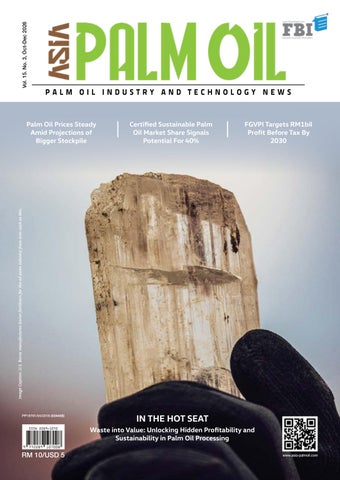
Image Caption: U.S. Borax manufactures boron fertilizers for the oil palm industry from ores such as this.
Palm Oil Prices Steady Amid Projections of Bigger Stockpile
IN THE HOT SEAT Waste into Value: Unlocking Hidden Profitability and Sustainability in Palm Oil Processing
Editor's Message
T
he palm oil industry has always been shaped by change. From shifting global demand and price movements to sustainability requirements and technological advancement, the industry continues to evolve. As we enter the final quarter of 2026, one development stands out: Malaysia’s growing focus on moving beyond commodity exports and creating greater value from palm oil.
As 2026 draws to a close, this edition of Asia Palm Oil Magazine looks at an industry that is gradually redefining itself. The opportunities ahead will come not only from expanding markets, but from finding better ways to produce, process and utilise palm oil. For an industry that has long been one of Malaysia’s economic strengths, the next chapter may well be defined by how successfully it turns that strength into higher value.
India offers a good example of this transition. While it remains one of Malaysia’s most important markets for palm oil, the opportunity today extends beyond crude palm oil. Oleochemicals, specialty fats, food ingredients, personal care products and other downstream applications are becoming increasingly important. For Malaysia, this represents more than an export opportunity. It reflects how the industry can strengthen its global position by competing through innovation, expertise and value creation rather than volume alone. The same thinking must continue across the entire value chain. Higher productivity, replanting, mechanisation and digitalisation remain important, particularly as the industry addresses labour constraints and the need for greater efficiency. At the same time, areas such as biomass utilisation, renewable energy and circular economy solutions are opening new possibilities for what was once considered waste. The question is no longer simply how much palm oil we can produce, but how much more value we can create from what we already have.
Susan Tricia Editor Follow us: : Asia Palm Oil Magazine : Asia Palm Oil Magazine
PUBLISHER FBI Publications (M) Sdn. Bhd.
PUBLICATION MANAGER Vanny Lim vanny@asiafbi.com
PUBLICATION EXECUTIVE Jocelyn Ong jocelyn@asiafbi.com
PROJECT EXECUTIVE Ethan Loi ethan@asiafbi.com
FBI Publications (M) Sdn Bhd (1168942-P) J-3F-1, Encorp Strand Garden Office, No 12, Jalan PJU 5/1, Kota Damansara, 47810 Petaling Jaya, Selangor Tel: +603 6151 9178
PRINTED BY MMS PRINT SHOP (M) SDN. BHD. (1246387-v) NO 43G, Jalan PBS 14/2, Taman Perindustrian Bukit Serdang, 43300 Seri Kembangan, Selangor.
ENDORSED & SUPPORTED BY
MARKETING COMMUNICATION MANAGER Nur Izyan binti Dzulkifli izyandzul@asiafbi.com
CREATIVE DESIGNER Muhammad Fadzil design@asiafbi.com
BOARD OF DIRECTORS Kenny Yong Susan Tricia
OFFICIAL MAGAZINE OF
CONTRIBUTOR U.S. Borax Inc. (Rio Tinto)
U.S. Borax Inc. (Rio Tinto) ASIA PALM OIL MAGAZINE | Oct-Dec 2026
DISCLAIMER The assertions and opinions expressed in articles and announcements on this magazine reflect the views of the author(s) and do not (necessarily) reflect the views of the publisher. Asia Palm Oil Magazine can in no way be held responsible for the content of such views nor can it be held liable for any direct or indirect damage that may arise from such views. The information in this magazine is regularly supplemented and/or modified. Asia Palm Oil Magazine reserves the right to make any changes with immediate effect and without providing any notice thereof
8
11
FGVPI Targets RM1bil Profit Before Tax By 2030
MPOB Names Badrul Hisham as New DirectorGeneral, Ahmad Parveez Leaves After 7 Years
> ORGANIZATION NEWS
> GREEN SOLUTIONS
08 - FGVPI Targets RM1bil Profit Before Tax By 2030 10 - Hap Seng Plantations Favoured on Yield, Growth Potential 11 - MPOB Names Badrul Hisham as New Director-General, Ahmad Parveez Leaves After 7 Years 12 - SD Guthrie Earnings Get Double Boost
30 - Certified Sustainable Palm Oil Market Share Signals Potential For 40% 32 - FGV Expands Trial of B100 Biodiesel in Plantation Operations 34 - Malaysian SMEs Still Face ESG Pressure Despite EU Reporting Change, MBSB Says 37 - Seda Highlights Biomass, RE Opportunity in Palm Oil Sector
> INDUSTRY NEWS 14 - Malaysian Palm Oil Exports Fell in August on Weak Demand from India 16 - Palm Oil Falls on Dalian and Chicago Rivals, Lower Crude Oil 18 - Palm Oil Prices Steady Amid Projections of Bigger Stockpile
14
> INTERNATIONAL NEWS 22 - Gapki Warns of Sharp Production Losses 24 - India’s Edible Oil Imports Hit 10-Month Peak 26 - Indonesia Launches National Commodity Exchange, Challenging Malaysia’s Palm Oil Pricing Dominance ASIA PALM OIL MAGAZINE | Oct-Dec 2026
Malaysian Palm Oil Exports Fell in August on Weak Demand from India
26
54
Malaysia Targets 32pct Installed Renewable Energy Capacity This Year
21,049 Smallholders Benefit from BUDI AgriCommodity Programme in Johor
> PLANTERS CORNER
> IN THE HOT SEAT
38 - Improving yield and fruit quality 42 - Agrobank To Fully Disburse RM200mil Under Oil Palm Smallholder Scheme by October 44 - Lower Palm Oil Yields Loom as Sabah Growers Cut Fertiliser 48 - Monsoon May Ease ‘Super El Niño’ Potential Impact on Palm Oil Output 50 - Non-Uniform Oil Palm Seedlings Prompt MACC Report
52 - Waste into Value: Unlocking Hidden Profitability and Sustainability in Palm Oil Processing
> TECHNOLOGY AND PRODUCT NEWS 56 - MPOB Turns Palm Oil into Water-Saving Cooling Solution for Data Centres
> SPECIAL INSIGHT
37
58 - From Mud to Message: Palm Oil’s Next Harvest 64 - Palm Oil Flourishes from A Minor Curiosity to A Global Backbone 66 - Succession Planning: Replanting Leadership in Oil Palm
United Malacca Set to Benefit from Higher CPO Prices ASIA PALM OIL MAGAZINE | Oct-Dec 2026
8
FGVPI Targets RM1bil Profit Before Tax By 2030 employees, with a focus on increasing annual productivity by 30 per cent. “I want to see a 30 per cent increase in productivity. It may seem difficult, but I have done the calculations on paper and it is achievable.
FGV Palm Industries Sdn Bhd (FGVPI) is targeting RM1 billion in profit before tax by 2030, driven by a strategic shift in its business model and improved operational productivity. NSTP/DANIAL SAAD.
FGV Palm Industries Sdn Bhd (FGVPI) is targeting RM1 billion in profit before tax by 2030, driven by a strategic shift in its business model and improved operational productivity. FGVPI chief executive officer Hamdan Ismail said the company is currently transitioning from its traditional role as a primary processor to a “buy fruit, sell oil” business model, which is expected to begin on Oct 1. He said the strategic roadmap includes progressively increasing its profit-before-tax target to RM400 million in 2027, RM600 million in 2028, RM800 million in 2029, and RM1 billion the following year. “I have calculated this trajectory based on the shift in our business operations. By moving towards direct oil sales, we are positioning FGVPI as a high-value profit-generating entity,” he said in his speech at a ceremony to present non-formal education recognition with the Malaysia Productivity Corporation here today.
“Competent workers will lead to efficient operations. Efficient operations will certainly increase productivity, which in turn will strengthen FGV’s competitiveness,” he said. On operational excellence, Hamdan said FGVPI had maintained an oil extraction rate of more than 21 per cent at all its mills nationwide, with the Chuping Palm Oil Mill recording the highest rate at 24 per cent. Hamdan said FGVPI, as one of the country’s leading palm oil industry players, would also step up efforts to raise its palm kernel re covery rate beyond the five per cent target to increase returns to FELDA settlers. “Although the industry average is low, FGV, as a leading player, must strive to exceed the five per cent target to enable higher fruit prices. “Higher returns to settlers will help keep the economic cycle moving, while contributing to the well-being of millions of FELDA settlers and the wider FELDA community,” he said.
FGVPI is a subsidiary of FGV Holdings Bhd that operates 63 palm oil mills nationwide, making it one of Malaysia’s largest palm oil mill operators, responsible for processing fresh fruit bunches from smallholders and Federal Land Development Authority (FELDA) settler communities. To drive this growth, Hamdan said RM45 million has been allocated for human capital development involving its 5,800 ASIA PALM OIL MAGAZINE | Oct-Dec 2026
Source: www.nst.com.my
10
Hap Seng Plantations Favoured on Yield, Growth Potential The research firm is projecting a more conservative FY26 production growth of 13 per cent. CGS International also highlighted Hap Seng Plantations’ relatively lower cost pressures compared with industry peers, with the company securing its fertiliser requirements for 2026 in April and expecting fertiliser costs to increase by only five to 10 per cent year-on-year, compared with the 15 to 25 per cent rise anticipated for many plantation companies. Hap Seng Plantations Bhd remains a preferred pick among Malaysian plantation stocks, supported by strong fresh fruit bunch (FFB) production growth, attractive dividend yields and an undemanding valuation. – Bernama pic
Hap Seng Plantations Bhd remains a preferred pick among Malaysian plantation stocks, supported by strong fresh fruit bunch (FFB) production growth, attractive dividend yields and an undemanding valuation. CGS International Securities Malaysia Sdn Bhd maintained its “Add” call on the stock with an unchanged target price of RM3.35. It noted that Hap Seng Plantations is trading at below 10 times its projected financial year 2026 (FY26) and FY27 price-toearnings ratio, making it the cheapest stock under its Malaysian plantation coverage. It said the plantation company is also expected to deliver dividend yields of more than six per cent over the next two years. CGS International expects FY26 earnings to be supported by sector-leading FFB production growth and higher year-on-year crude palm oil (CPO) prices.
In addition, Hap Seng Platations may benefit from priority access to fertiliser supplies through its parent company, Hap Seng Consolidated Bhd, which operates a fertiliser trading business, it said. Looking ahead, CGS International said the potential emergence of a strong El Niño weather pattern could weigh on FFB production in FY27 but may also boost palm oil prices. For FY26, the firm forecasts the net profit to almost double to RM206 million from RM112.4 million in FY25 and stabilise to RM201 million in FY27, supported by higher production volumes and stronger palm oil prices. Revenue is projected to increase to RM884.7 million in FY26 from RM702.4 million in FY25, before edging up to RM893.6 million in FY27. The research firm identified stronger-than-expected dividend payouts and a sharp rise in CPO prices driven by El Niño-related supply concerns as potential catalysts for a re-rating of the stock. However, higher production costs and weaker-than-expected sales volumes remain key risks.
According to the firm, management has maintained its FY26 FFB production guidance of between 714,000 and 715,000 tonnes, representing growth of 16 to 17 per cent year-on-year. The company’s FFB output increased seven per cent in the first half of the year, accounting for 42 per cent of CGS International’s full-year forecast. ASIA PALM OIL MAGAZINE | Oct-Dec 2026
Source: www.nst.com.my
11
MPOB Names Badrul Hisham as New Director-General, Ahmad Parveez Leaves After 7 Years
Malaysian Palm Oil Board, Datuk Dr Ahmad Parveez Ghulam Kadir is handing over the reins to Datuk Badrul Hisham Mohd, who takes over as the agency’s new director-general effective Aug 3.
A
fter seven years at the helm of the Malaysian Palm Oil Board (MPOB), Datuk Dr Ahmad Parveez Ghulam Kadir is handing over the reins to Datuk Badrul Hisham Mohd, who takes over as the agency’s new director-general effective Aug 3. Ahmad Parveez’s tenure saw MPOB navigate one of the industry’s most challenging periods, marked by stronger sustainability requirements, global market expansion and increasing scrutiny of Malaysia’s palm oil sector.
He previously held the post of deputy secretary-general at the Ministry of Agriculture and Food Security, and had also served at the Works Ministry as well as the Domestic Trade and Consumer Affairs Ministry, Throughout his public service career, Badrul played an important role in policy development, resource management, organisational transformation and the coordination of various strategic national initiatives. He also served on the boards of several government agencies.
His successor now inherits the task of steering the industry through its next phase of growth and transformation. In a statement, MPOB said Badrul’s appointment is expected to strengthen the board’s position as a global leader in the palm oil industry. “Badrul brings nearly three decades of experience in public administration and diplomacy, having played key roles in policy formulation, the development of the agriculture and plantation sectors, and strategic management across various ministries,” it said.
Badrul said MPOB has reached a stage of maturity that requires a fresh approach to ensure Malaysia’s palm oil industry remains competitive amid an increasingly challenging global landscape. “MPOB will continue to strengthen its role as the lead agency driving the development of the nation’s palm oil industry. “This is by placing greater emphasis on innovation, sustainability, transparency, traceability and more efficient and responsive service delivery in line with the aspirations of the Plantation and Commodities Ministry,” he said.
Prior to his appointment, Badrul served as deputy secretarygeneral (sectoral) at the Economy Ministry since 2025. Source: www.nst.com.my
ASIA PALM OIL MAGAZINE | Oct-Dec 2026
12
SD Guthrie Earnings Get Double Boost S
D Guthrie Bhd is expected to record stronger earnings in the near term, supported by higher fresh fruit bunch (FFB) production, firm crude palm oil (CPO) prices and gains from its land monetisation activities. CIMB Securities Research analyst Ivy Ng Lee Fang said SD Guthrie was expected to see stronger sequential earnings in the third quarter (Q3) of financial year 2026 (FY26), driven mainly by higher FFB production and CPO prices, partly offset by higher fertiliser costs. “We raise our FY26 to FY27 earnings forecasts by three per cent/one per cent, respectively, after increasing our Malaysian CPO price assumptions by RM50/tonne to RM4,450/RM4,550 per tonne, respectively, and lifting our industrial development profit forecasts. “We estimate that every net RM100 per tonne increase in CPO prices would lift net profit by six per cent, while every three per cent decline in FFB yields would reduce net profit by seven per cent,” she said in a note. Ng said SD Guthrie had identified El Niño as an emerging production risk for FY27, particularly in Kalimantan and Papua New Guinea (PNG).
Ng said that the stock appeared fairly valued at relatively demanding FY26 and FY27 price-to-earnings ratios of 23 times and 20 times, respectively, excluding industrial profits. “Key earnings upside could come from stronger-than-expected CPO prices amid tighter supply, although this could be partly offset by weaker FFB yields if El Niño intensifies,” she said. Public Investment Bank (PublicInvest) analyst Chong Hoe Leong raised SD Guthrie’s FY26 to FY28 earnings forecasts by between eight per cent and 20 per cent. “This reflects a higher CPO price assumption of RM4,500 per tonne and an estimated net gain of RM408 million from the recent land sale transaction in Bukit Kerayong, Kuala Selangor,” he said. Separately, Chong said the company has entered into a conditional sale and purchase agreement with Sime Darby Property involving the disposal of freehold land in Kulai, Johor for RM418.5 million, which would rake in a net gain of RM373 million in Q2 FY27. PublicInvest has maintained an “Outperform” call on the stock with a higher target price of RM7.81.
However, she noted that it is too early to gauge the impact. “Downstream bulk and trading should continue to benefit from volatility, although differentiated margins remain under pressure. “We project industrial development net profit at RM1.03bn for FY26F, exceeding SD Guthrie’s RM500 million to RM700 million recurring net profit target for FY26,” she said. Moving forward, CIMB Securities maintained its “Hold” call on the stock. ASIA PALM OIL MAGAZINE | Oct-Dec 2026
SD Guthrie Bhd is expected to record stronger earnings in the near term, supported by higher fresh fruit bunch (FFB) production, firm crude palm oil (CPO) prices and gains from its land monetisation activities. Source: www.nst.com.my
14 INDUSTRY NEWS
Photo by CEphoto, Uwe Aranas
Malaysian Palm Oil Exports Fell in August on Weak Demand from India
M
alaysian palm oil exports likely fell last month on weakerthan-usual festival demand in major buyer India.
“Demand was lower than expected because of the availability of cheaper soy oil,” he said.
Shipments from the world’s second-largest producer were 1.3 million tonnes, according to the median estimate in a Bloomberg survey of eight plantation executives, traders and analysts.
Production likely rose 2% to 1.8 million tonnes, according to the survey.
That’s down 8% from July. Stockpiles swelled about 6% to the highest since January.
Malaysia’s Palm Oil Board is due to release official data for August by Sept 10.
The tropical oil has climbed around 7% in the third quarter and prices are near a two-year high. The potential for the El Niño weather pattern to dent production in the months ahead, and tightening supply as Indonesia diverts more of its palm oil to biofuels are among the drivers. “The rally could be deterring price-sensitive buyers in India,” said Anilkumar Bagani, head of research at Mumbai-based Sunvin Group.
ASIA PALM OIL MAGAZINE | Oct-Dec 2026
El Nino has raised concerns that it could dent palm oil production in the months ahead and tighten supplies.
Source: www.freemalaysiatoday.com
In business as in life, every partnership is built on trust. For over 140 years, we have worked alongside our customers, delivering on our promises and establishing our role as your trusted partner in service.
Increasing productivity. Maximise efficiency. Faster response time.
Partner with Alfa Laval for reliable and sustainable operations. Thailand
Malaysia
Indonesia
www.alfalaval.id
www.alfalaval.th
+60 3 5122 2880
+62 21 7918 2288
+66 2 399 4419
www.alfalaval.my
16 INDUSTRY NEWS
Palm Oil Falls on Dalian and Chicago Rivals, Lower Crude Oil M
alaysian palm oil futures fell for a second straight session on Thursday, tracking weakness in rival oils on the Dalian and Chicago exchanges, while easing crude oil prices also weighed. The benchmark palm oil contract for October delivery on the Bursa Malaysia Derivatives Exchange was down 6 ringgit, or 0.13 per cent, to 4,691 ringgit (US$1,148.63) a metric ton in early trade. Dalian’s most-active soyoil contract fell 0.13 per cent, while its palm oil contract lost 0.26 per cent. Soyoil prices on the Chicago Board of Trade were down 0.29 per cent.
Malaysian palm oil futures fell for a second straight session on Thursday. NSTP/DANIAL SAAD
Palm oil tracks price movements of rival edible oils, as they compete for a share of the global vegetable oils market.
Lower crude oil futures make palm a less attractive option for biodiesel feedstock.
Oil prices fell more than US$1 on Thursday as forecasters lowered global oil demand projections for 2026 because of the disruptions from the US-Israeli war on Iran, though the supply constraints from the conflict provided a floor for the market.
Malaysia has lowered its September crude palm oil reference price to a level that maintains the export duty at 10 per cent, a circular on the Malaysian Palm Oil Board website showed on Wednesday. Brazil’s Supreme Court formed a majority on Wednesday to rule that the soy moratorium agreement, which barred companies from buying soybeans from areas deforested after 2008, is legal, exempting grain traders and processors from paying compensation sought by farmers, who argued the pact constitutes a cartel. The ringgit, palm’s currency of trade, weakened 0.05 per cent against the dollar, making the commodity slightly cheaper for buyers holding foreign currencies. Market News Asian stocks rose on Thursday after US inflation data came in as expected, dampening expectations of further near-term Federal Reserve rate hikes, while oil held near US$80 a barrel as Washington and Tehran remained deadlocked over efforts to end the Gulf war.
ASIA PALM OIL MAGAZINE | Oct-Dec 2026
Source: www.nst.com.my
Playfully easy radar level measurement Compact 80 GHz radar level transmitters for all missions • Easy gameplay: Simple installation – maintenance free • Master all application levels: No matter if liquids, solids or open channel • Durable PVDF housing and antenna, DN40 or DN70, measuring ranges 0...10/15/30 m • OPTICHECK technology built-in for self-diagnosis & verification
Visit microsite: nextlevel.krohne.com
Discover the OPTIWAVE 1500 Series
18 INDUSTRY NEWS
Palm Oil Prices Steady Amid Projections of Bigger Stockpile
C
RUDE palm oil (CPO) prices are holding firm, despite rising Malaysian inventories, as the market looks beyond near-term supply to the risk of tighter conditions in 2027. Strengthening El Niño conditions, Indonesia’s B50 biodiesel mandate and disruptions to competing vegetable oils have prompted analysts to raise their price forecasts. The key commodity has gained more than 15% since the start of the year, while Malaysia’s average CPO price stood at RM4,493 per tonne last month, up 9.3% year on year. For the first seven months of 2026, CPO averaged at RM4,388 per tonne. Some industry players see further upside. SD Guthrie (KL:SDG), one of the world’s largest palm oil producers, said at its results briefing last Tuesday that it expected CPO to trade between RM4,600 and RM5,000 per tonne for the rest of the year, and reach as high as RM5,200 per tonne in the first quarter of 2027 if El Niño conditions develop. “Earlier on, the market was trading on expectations [of the El Niño effects on crops] and, now, the market is seeing some actual signs. Many parties agree that CPO prices will be higher,
ASIA PALM OIL MAGAZINE | Oct-Dec 2026
Palm oil prices steady amid projections of bigger stockpile (Photo by Low Yen Yeing/The Edge)
especially with production potentially being lower going into 2027,” CIMB Securities head of Malaysia research and regional plantation analyst Ivy Ng Lee Fang tells The Edge. “It is not possible to [estimate] what the year-end inventory will look like, as we wouldn’t know the extent of the drought then and its impact on supply. Nevertheless, everyone is bracing for a more severe impact because the Meteorological Department has said the El Niño signs are [worsening],” she says, adding that the weather phenomenon has had a greater impact on Indonesia than Malaysia.
Bracing For a Worsening El Niño According to the Asean Specialised Meteorological Centre, Indonesia’s hotspot activity picked up notably in August 2026, driven by a sharp increase in Kalimantan, where hotspot counts rose 159% month on month (m-o-m) to 3,462, accounting for about 60% of Kalimantan’s year-to-date total of 5,825. Hotspot counts refer to satellite-detected heat anomalies, commonly used as an indicator of possible vegetation or peat fires. “A forest fire was also reported on Aug 3 in East Java province, affecting 550ha, which we believe is indicative of increasingly dry conditions across parts of Indonesia. While current hotspot levels remain well below those recorded during El Niño years, such as in 2015 and 2019, the pace of increase is notable. A prolonged dry spell in Indonesia, in our view, could also elevate haze risk in Malaysia, potentially disrupting harvesting activities,” CGS International said in an Aug 11 note. According to several analysts, channel checks indicate that most Malaysian estates continue to receive sufficient rainfall for now. For context, past El Niño events in 2015 and 2022 indeed led to higher CPO prices as production lagged. During the 2015/16 El Niño period, CPO prices rose about 21.5%, while Malaysia’s CPO output subsequently fell to 17.32 million tonnes in 2016 from 19.96 million tonnes in 2015, Malaysian Palm Oil Board (MPOB) records show.
CIMB has raised its average CPO price forecast for 2026 and 2027 by RM50 per tonne to RM4,450 and RM4,550 respectively, citing geopolitical risks, strengthening El Niño weather conditions and higher Indonesian biodiesel demand. PhillipCapital Research, which is “neutral” on the plantation sector, expects CPO to trade between RM4,400 and RM4,600 in August and September, with its full-year assumption of RM4,350 per tonne for 2026 and RM4,400 for 2027. Nevertheless, it expects Malaysian inventories to remain elevated at between 2.5 million and 2.8 million tonnes over the coming months as the industry moves through its seasonal peak production period. Meanwhile, TA Securities, which is maintaining its 2026 price assumption at RM4,300 per tonne, cautioned in an Aug 12 note that high inventories could cause prices to moderate in the second half of this year, although it did not expect a sharp correction. According to MPOB’s monthly statistics report published on Aug 10, inventories rose 3.3% m-o-m to 2.63 million tonnes in July, the highest in five months and up 24% y-o-y, as production rose 9.4% to 1.79 million tonnes from June. Exports increased 14.5% to 1.39 million tonnes. Even so, several factors have kept CPO prices firm despite the stock build. Demand has remained resilient, while palm oil has become increasingly competitive against rival vegetable oils. India, the world’s largest vegetable oil importer, stepped up purchases in July, with palm oil imports surging 50% m-o-m to about 733,000 tonnes, the highest in five months, as refiners stocked up ahead of the nation’s broad festive season from August to November. “El Niño is forecast to strengthen, with the NOAA (National Oceanic and Atmospheric Administration) estimating an 81% probability of a very strong El Niño during October to December 2026. Stronger El Niño weather conditions could reduce oil palm yields and production in Southeast Asia with a time lag, posing greater downside risk to supply from 2027 onwards,” says CIMB’s Ng. The weather phenomenon is expected to bring hotter and drier conditions to Southeast Asia. But the impact on oil palm is unusual in that drought does not necessarily translate immediately into lower production. Stress on palms can affect fruit formation, meaning the largest yield impact can emerge more than a year after the weather event. ASIA PALM OIL MAGAZINE | Oct-Dec 2026
20 INDUSTRY NEWS “The US Department of Agriculture has cut its Indonesian palm oil production forecast for 2026/27 to 47.2 million tonnes amid expectations of drought conditions,” Ng points out. In addition, higher crude oil prices have supported CPO by making palm-based biodiesel more economically attractive, boosting demand from Indonesia. Impact Of Indonesia’s B50 Mandate on Supply Indonesia implemented the B50 biodiesel mandate on July 1, raising palm-based biodiesel content in diesel to 50% from 40%. The rollout was shelved in January over technical and funding concerns, but President Prabowo Subianto revived the plan in March amid heightened concerns about energy security. B50 is significant because it increases Indonesia’s domestic palm oil demand, potentially reducing exportable supply.
Notably, an Aug 7 Reuters report said palm oil harvesting in parts of Borneo and Sumatra was being disrupted by sharply higher diesel costs and fuel shortages, causing some smallholders to reduce harvesting and fruit collection. “It is hard to say how big an impact this could be. It could have just a localised effect, affecting only a small group of planters,” says Ng.
Analysts have pointed out that any tightening of exports by Indonesia, the world’s largest producer, could support CPO prices and Malaysian planters’ earnings.
Geopolitics has added another layer to the CPO rally. An escalation in attacks on ships, ports and export infrastructure around the Black Sea has disrupted commodity flows from the region.
“Indonesia’s nationwide B50 biodiesel mandate is expected to consume 16.7 million to 18 million kilolitres of palm biodiesel annually, providing additional support to palm oil demand. However, relatively high Malaysian palm oil inventories and CPO’s price premium over competing vegetable oils could cap near-term price upside,” says CIMB’s Ng.
That matters to palm oil because Russia and Ukraine are dominant suppliers of sunflower oil. Disruptions to sunflower oil exports can push importing countries towards alternatives such as palm and soybean oil, supporting prices across the vegetable oil complex. The same substitution effect was seen after Russia’s initial invasion of Ukraine in 2022.
ASIA PALM OIL MAGAZINE | Oct-Dec 2026
“Sunflower oil exports from Russia and Ukraine fell sharply in late July [following an escalation of tensions between the two countries] and are expected to remain very low in August, after intensified attacks on ports, infrastructure and commercial vessels prompted several major players to suspend operations and export offers. This could support substitution demand for palm oil ahead of India’s festival season from September to November,” CIMB said in its Aug 11 sectoral note. Analysts Favour Upstream Exposure The prospect of firmer CPO prices has kept several research houses positive on plantation stocks, particularly upstream producers with greater earnings sensitivity to the commodity. “Higher CPO assumptions imply 2% to 4% upside risk to FY2027 and FY2028 earnings,” says Ng, reiterating CIMB’s “overweight” call on the sector, with IOI Corp Bhd, Kuala Lumpur Kepong Bhd (KL:KLK) and Hap Seng Plantations Holdings Bhd (KL:HSPLANT) as its top picks. The research house had target prices (TPs) of RM4.54, RM23.66 and RM6.86 respectively for the counters. CGS International has highlighted upstream players such as Ta Ann Holdings Bhd (KL:TAANN) and Hap Seng, which “should record relatively stronger net CPO average selling prices compared with their Indonesian peers”. It has “add” recommendations for the two companies and TPs of RM6.85 and RM3.35 respectively.
non-core asset monetisation. “After a RM160 million gain from the Kulai land sale in 1Q2026, we expect two more deals in FY2026F, keeping SDG on track to reaching its RM500 million to RM700 million target,” it said. Kenanga Research, which is also maintaining its “overweight” call on the sector, points out that despite the recent outperformance of the KL Plantation Index, the sector’s valuations — price-earnings ratio (PER) of 15 times to 16 times and price-to-book value (P/B) of 1.3 times — remain undemanding and are comparable with the average of the past three years, PER of 15 times and P/B of 1.2 times. Like CIMB, Kenanga believes there will be “an upward bias towards firmer earnings” and has ascribed “outperform” calls on IOI Corp (TP: RM4.65), for its sector leading return on equity, contributions from its new venture and strong 4QFY2026 close; KLK (TP: RM25.20), for its sensitivity to CPO prices and stronger push into property; United Malacca Bhd (KL:UMCCA) (TP: RM7), for its maturing estates and attractive ratings and; and TSH Resources Bhd (KL:TSH) (TP: RM1.60), for its upstream CPO price sensitivity and ongoing 40% expansion in new planting. “PPB Group Bhd (KL:PPB) (TP: RM13) appears oversold, with decade-low ratings, considering the group’s strong fast-moving consumer goods position in China, India and Southeast Asia, barring some near-term uncertainties over Wilmar International Ltd’s Indonesian operations,” Kenanga warns.
The research house has also rated SD Guthrie an “add”, with a TP of RM7.40, citing its leverage to higher CPO prices, status as the largest oil palm planter among listed peers and ongoing Source: theedgemalaysia.com
ASIA PALM OIL MAGAZINE | Oct-Dec 2026
22 INTERNATIONAL NEWS
Gapki Warns of Sharp Production Losses T
he Indonesian Palm Oil Producers Association (Gapki) has projected that extreme El Nino could potentially reduce crude palm oil (CPO) output by up to five million tonnes. Gapki chairman Eddy Martono said that the significant impact of a severe El Nino on palm oil production could be felt as early as next year. Meanwhile, the rollout of a mandatory increase in palm-based biodiesel to a 50% blend from 40% is expected to increase domestic CPO absorption and reduce CPO supply for export markets. However, Eddy stressed that ensuring palm oil supply for domestic use remained the top priority. “Supply for domestic use is prioritised, so there will be no problems with domestic demand. What will decline is export volumes,” he said on Tuesday. The association previously estimated that the B50 implementation could lift domestic CPO consumption for biodiesel to between 16.3 million and 17 million tonnes annually.
ASIA PALM OIL MAGAZINE | Oct-Dec 2026
Mandatory increase: A worker loads fresh oil palm fruit bunches at a cooperative plantation in Central Kalimantan. With Indonesia’s biodiesel blend rising to B50, Eddy says securing domestic palm oil supply remains the top priority. — Reuters
Producers expect national CPO output of around 53 million tonnes in 2026, which should leave enough supply to fulfill the higher domestic demand for fuel. Indonesia, the world’s largest producer and exporter of palm oil, is expanding domestic use of the commodity as President Prabowo Subianto pushes to reduce diesel imports and achieve energy self-sufficiency.
Energy and Mineral Resources Minister Bahlil Lahadalia said B50 would boost domestic demand for CPO and provide market certainty while maintaining price stability at the point where farmers sell their produce. But Eddy said that CPO prices remained difficult to predict, as they are affected by various factors, including the B50 rollout, developments in other vegetable oil markets and El Nino. “It’s quite hard to predict an increase in CPO prices due to El Nino and the implementation of B50 biodiesel because CPO prices are also driven by other vegetable oils such as sunflower, soybean, rapeseed and canola oils. If the supply of other vegetable oils increases, it can put pressure on vegetable oil prices, including CPO,” he explained. Earlier this month, the National Development Planning Board (Bappenas) said that El Nino could reduce productivity in several agricultural commodities, such as rice, palm oil and coffee.
The Meteorology, Climatology and Geophysics Agency (BMKG) has forecast El Nino this year to escalate to strong levels and potentially impact strategic sectors, especially in East Nusa Tenggara, West Nusa Tenggara, Java, Bali and South Papua. “Since March 2026, BMKG has predicted that Indonesia will experience a drought coinciding with El Nino, which at that time was of moderate intensity,” said BMKG head Teuku Faisal Fathani on Aug 4. He noted that the World Meteorological Organisation declared El Nino active on June 2, while analysis indicated the phenomenon remained strong from May through July. Teuku explained that El Nino is different from the dry season, as it could exacerbate the dry season by making the conditions drier and prolonging its duration. BMKG expects the effect of El Nino in Indonesia to wane in mid-October during the rainy season, even though global forecasts suggest that it could last until May next year.
Bappenas has set four key clusters to anticipate and manage risks posed by El Nino, including forestry, land and agriculture, energy and water resources, health and aquatic foods. In the forestry, land and agriculture category, El Nino is also predicted to increase the risk of forest and land fires. Source: www.thestar.com.my
ASIA PALM OIL MAGAZINE | Oct-Dec 2026
24 INTERNATIONAL NEWS
India’s Edible Oil Imports Hit 10-Month Peak I
ndia’s edible oil imports climbed to their highest level in 10 months in July as refiners increased purchases of palm oil and soyoil to replenish inventories ahead of the festival season amid tightening domestic supplies, five dealers say.
Soyoil imports rose 32% month-on-month in July to 501,000 tonnes, the highest in seven months, while sunflower oil shipments edged higher by 4% to 253,000 tonnes. India’s edible oil imports surged 34% from June to a 10-month high of 1.49 million tonnes in July, driven by higher imports of all three major edible oils. The figures exclude duty-free shipments arriving via land from neighbouring Nepal, the dealers said. The Solvent Extractors’ Association of India is due to publish July import data by mid-August.
India’s edible oil imports surged 34% from June to a 10-month high of 1.49 million tonnes in July. — Reuters
Higher palm oil and soyoil buying by the world’s biggest importer of vegetable oils could help top producers Indonesia, Malaysia and Argentina in bringing down stocks and support benchmark palm oil and soyoil futures. Palm oil imports jumped 50% from a month ago to 733,000 tonnes in July, the highest in five months, dealers’ average estimates showed. ASIA PALM OIL MAGAZINE | Oct-Dec 2026
Source: www.thestar.com.my
26 INTERNATIONAL NEWS
Indonesia Launches National Commodity Exchange, Challenging Malaysia’s Palm Oil Pricing Dominance
I
ndonesian President Prabowo Subianto has announced the establishment of the Strategic Mineral and Commodity Exchange (BMKS), slated to begin operations on January 1 next year, trading palm oil, nickel, coal, and other major export commodities. The initiative aims to create an independent Indonesian price benchmark, challenging the long-standing global pricing dominance of the Bursa Malaysia Derivatives’ crude palm oil futures contract (FCPO).
The new exchange also carries the mandate of strengthening government oversight of export prices, volumes, and tax collection, complementing the export declaration mechanism operated by Danantara Sumberdaya Indonesia. While BMKS is unlikely to displace the FCPO in the short term, it could still help establish an influential domestic spot price benchmark, enhancing Indonesia’s bargaining leverage in international trade negotiations.
Indonesia produced 51.66 million tonnes of crude palm oil last year, accounting for more than half of global exports, yet international trade continues to rely on Malaysia’s FCPO as the primary pricing and hedging benchmark. Analysts note that Indonesia’s challenge lies in building sufficient market liquidity, data transparency, and international trust; the thinly traded ICDX spot market launched in 2023 has already demonstrated that production dominance alone is insufficient to secure pricing power.
Indonesian President Prabowo Subianto has officially announced the establishment of the Strategic Mineral and Commodity Exchange (BMKS), which will trade palm oil, nickel, tin, coal, coffee, and other major export commodities, with operations targeted to begin on January 1 next year. The initiative aims to establish an independent commodity price benchmark for Indonesia, challenging Malaysia’s long-standing dominance in global palm oil pricing.
ASIA PALM OIL MAGAZINE | Oct-Dec 2026
In his annual budget address to Indonesia’s parliament, he told lawmakers: “We do not merely aspire to be producers of global commodities. We must become the price-setters of global commodities.” The remark cuts to the heart of Indonesia’s long-standing predicament: as the world’s largest producer and exporter of palm oil, the country has never been able to wield pricing power commensurate with its market share. According to market data, Indonesia produced 51.66 million tonnes of crude palm oil last year, accounting for more than half of global exports, while Malaysia, the world’s secondlargest producer, produced just 20.28 million tonnes over the same period. Yet the pricing and hedging benchmark widely used by international traders remains the crude palm oil futures contract (FCPO) traded on the Bursa Malaysia Derivatives (BMD), which posted an average daily trading volume of 80,399 contracts last year—deep liquidity that continues to attract plantation companies, physical commodity traders, international investors, and speculators. Siwage Dharma Negara, a senior fellow at Singapore’s ISEAS – Yusof Ishak Institute, analyzes that Prabowo’s plan has two interrelated objectives: first, to leverage Indonesia’s dominant position in palm oil, nickel, and coal exports to influence international market prices and strengthen bargaining power; and second, to enable the government to more effectively monitor export prices, volumes, tax payments, and potential transfer pricing issues.
He cautions, however, that supply dominance does not automatically translate into benchmark status. Malaysia’s FCPO has been in use for years and has gained broad acceptance in the global palm oil trading market. Liquidity and Trust Are the Biggest Hurdles This is not Indonesia’s first attempt to challenge the existing market order. In 2023, Indonesia launched an exchange-based physical crude palm oil market operated by the Indonesia Commodity and Derivatives Exchange (ICDX), but trading activity remained limited, and it failed to compete with the FCPO in international hedging and price discovery. David Ng, a proprietary trader at Malaysia-based financial derivatives and commodity trading firm IcebergX Sdn Bhd, points out that the FCPO’s most attractive feature is its deep liquidity. “If volume is high, you can get in and out in size,” he said. He notes that futures prices and physical commodity prices are closely linked, with physical cargoes typically priced against the FCPO, giving traders a natural incentive to arbitrage the spread between the two. Both David Ng and Siwage agree that the real challenge for Indonesia is not merely publishing a domestic reference price, but building a market that participants trust enough to actually use. Siwage emphasizes that competitive trading costs, transparent governance, and reliable data are critical. “The
ASIA PALM OIL MAGAZINE | Oct-Dec 2026
28 INTERNATIONAL NEWS
Note: Production and export share figures are from last year; FCPO average daily volume data was published by the Securities Commission Malaysia, citing Bursa Malaysia data.
government can set rules, but it cannot influence individual prices,” he said. If political forces intervene in price-setting, it would undermine the exchange’s credibility. David Ng points to another complicating factor: Indonesia’s oil palm plantations are spread across a far larger and more dispersed geographic area than Malaysia’s, making it more difficult to establish a consistent and reliable data collection mechanism.
arrangements. “Ensuring that contracts adopt an Indonesian domestic price benchmark is extremely difficult,” he said. Unlikely to Displace FCPO in the Short Term, but Still Strategically Valuable BMKS will be supervised by Indonesia’s Financial Services Authority (OJK), which has appointed Henry Rialdi as deputy commissioner responsible for exchange regulation and oversight.
Revenue Oversight and Transfer Pricing Considerations Bhima Yudhistira Adhinegara, executive director of the Jakarta-based Centre of Economic and Law Studies, cautions against viewing BMKS purely as Indonesia’s bid for international pricing power. “Prabowo wants to ensure prices are more transparent so the government can audit transaction data and protect income tax revenue,” he said. He draws a parallel between the initiative and Danantara Sumberdaya Indonesia (DSI), the operational arm of Indonesia’s Danantara sovereign wealth fund. DSI was established in part to oversee exports of crude palm oil, coal, and ferroalloys. Since June 1, exporters have been required to declare transactions through DSI, with further reforms expected to be implemented in January next year. Bhima is skeptical about whether establishing a domestic Indonesian benchmark price can persuade overseas buyers to abandon existing reference benchmarks such as the FCPO. He notes that large export contracts between Indonesia and buyers in China and India have long established their own pricing
ASIA PALM OIL MAGAZINE | Oct-Dec 2026
Siwage notes that even if BMKS cannot replace the FCPO in international contracts in the short term, mandatory trade reporting could still help Indonesia establish a practically useful physical market price benchmark and give the country greater bargaining leverage in commercial negotiations. He believes Indonesia’s status as the world’s largest palm oil supplier alone is sufficient to generate such influence. The following table compares key data for the Indonesian and Malaysian palm oil markets: Overall, Indonesia’s move reflects the frustration of resourcerich developing countries over international commodity pricing mechanisms long dominated by a handful of exchanges. However, as the ICDX precedent shows, a governmentestablished trading platform that fails to attract sufficient market participation and liquidity will struggle to dislodge entrenched benchmarks. Whether BMKS can clear this hurdle will depend on whether its trading cost competitiveness, data transparency, and governance credibility can win the trust of the international market.
Source: finance.biggo.com
Engineering Performance. Powering Sustainability. Wasco AgroTech, a subsidiary of Wasco Greenergy, is a one-stop solutions provider to the global palm oil industry, offering engineering, equipment supply, and lifecycle after-sales services for steam turbine generator systems and palm oil milling equipment. With a robust international network of principals, partners, and service capabilities, the company supports customers with dependable, efficient, and sustainable solutions across the palm oil value chain. Shinko Steam Turbine Single / Multi Stage - Back Pressure Turbine Multi Stage - Full Condensing / Extraction Condensing
Oil Room Equipment and Part Rotary Brush Strainer Automatic Desanding Cyclone Vibro Separator Empty Fruit Bunch Press (2 In 1) Decanter, Purifier, Bowl Disc Screw Press Specialised in Replacement Parts
Kernel Crushing Plant Palm Kernel Oil Machine Palm Kernel Oil Filter
1,300+
units installed
KCP Dust Collecting System KCP Scada / PLC Monitoring System
Biomass Solutions Biomass Pelleting Plant Biomass Fuel Drying System Decanter Cake Drying Plant Biofertiliser Plant Auxiliaries Equipment
Contact us to start your green journey today! +03 5525 7555
watenquiry@wascogreenergy.com
30 GREEN SOLUTIONS
Certified Sustainable Palm Oil Market Share Signals Potential For 40%
I
n 2025, 16.2 million metric tonnes of RSPO Certified Sustainable Palm Oil (CSPO) were sold, representing 20% of the global palm oil supply. Unveiled in the RSPO Impact Report 2026, data shows that as CSPO supply is growing, the potential is even broader. RSPO Member growers now hold a total capacity of 31.4 million metric tonnes of CSPO.
RSPO Membership continues to grow with 6,280 members globally across 103 countries and territories. The most significant membership growth is seen in China, Indonesia and Japan, reflecting expanding market awareness in Asia and large palm oil-consuming countries. Expanding Conservation and Climate Progress
The pipeline for global market transformation is strong, particularly in Latin America where RSPO Members account for nearly 75% of regional output, with 29.3% already RSPO Certified in 2024. Africa has seen a transformative 46.23% surge in supply. The growth trajectory indicates that CSPO supply could reach nearly 40% of global palm oil supply as members continue to certify their plantations against the RSPO Standard. “With our grower members holding the capacity to supply nearly 40% of global demand, we have long moved past the question of whether sustainable palm oil is possible and are actively scaling across global markets. The report shows that sustainable palm oil has measurable and valuable impacts,” said Joseph D’Cruz, CEO, RSPO. ASIA PALM OIL MAGAZINE | Oct-Dec 2026
Beyond market expansion, the report highlights significant progress across environmental protection. RSPO Members conserve and protect 551,637 ha of critical land. While previous Impact data reported only High Conservation Value (HCV) areas, this total now includes High Carbon Stock (HCS) areas and peatlands. Stories from the ground bring to life what biodiversity protection looks like in practice, from species encountered on plantation edges, restored waterways and wildlife corridors. In West Kalimantan, Indonesia, Bumitama Agri Ltd, established a Biodiversity and Community Project, which worked to secure a legal decree to formally protect over 8,300 ha of conservation area. Source: themalaysianreserve.com
RSPO continue to prove that climate commitments can be quantified, verified, and delivered in multiple ways, including peatland rehabilitation and cutting methane emissions through Palm Oil Mill Effluent capture. Cumulatively, 2.98 million tCO2e per year have been avoided in greenhouse gas emissions since 2015, equivalent to taking 694,512 cars off the road.
RSPO invites members, partners, media, and the public to gain a richer understanding of the collective progress towards a more sustainable palm oil sector. • •
Download the RSPO Impact Report 2026 Explore the RSPO Impact website
Empowering workers and smallholders About RSPO: RSPO Certification continues to strengthen social standards across the supply chain. A total of 661,219 workers are directly employed within RSPO Certified operations under systems designed to safeguard their rights and freedom. Independent smallholders generated US$7.9 million through credit sales in 2025. Long-term effectiveness depends on increasing and broadening the global demand for credits to sustain its value and ensure smallholders are meaningfully rewarded for their sustainability efforts. Smallholders continue to be supported through the Smallholder Training Academy and the RSPO Smallholder Support Fund that has benefited 44,796 smallholders since 2013. Enhanced reporting Complementing the new report is an enhanced RSPO Impact website, While the print report provides a concise, high-level overview of RSPO’s yearly progress, the interactive website serves as a comprehensive resource, offering expanded datasets, multiyear trends, additional indicators, and supporting information for stakeholders seeking deeper insights.
The Roundtable on Sustainable Palm Oil (RSPO) is a global partnership to make palm oil sustainable. Formed in 2004, the RSPO is a multi-stakeholder non-profit organisation that unites members from across the palm oil value chain, including oil palm producers, palm oil processors and traders, consumer goods manufacturers, retailers, banks and investors, environmental or nature conservation non-governmental organisations (NGOs), and social or developmental NGOs. As a partnership for progress and positive impact, the RSPO facilitates global change to make the production and consumption of palm oil sustainable. To inspire change, we communicate the environmental and social benefits. To make progress, we catalyse collaboration. To provide assurance, we set the standards of certification. The RSPO is registered as an international association in Zurich, Switzerland, with main offices in Malaysia and Indonesia, and offices in China, Colombia, Netherlands, United Kingdom and the United States. ASIA PALM OIL MAGAZINE | Oct-Dec 2026
32 GREEN SOLUTIONS
FGV Expands Trial of B100 Biodiesel in Plantation Operations
F
GV Holdings Bhd is expanding its biodiesel B100 trial to plantation operations to assess the technical performance and feasibility of 100% local palm oil-based biodiesel in a realworld operating environment. Its chairman, Datuk Abu Huraira Abu Yazid, said the move reflects FGV’s commitment to continuing exploring new potential in palm oil through innovation implemented responsibly and based on evidence. He said Malaysia has the strength as one of the world’s leading producers of palm oil. “In an increasingly challenging global landscape including uncertainty in the supply chain and energy market, this strategic commodity has great potential to continue contributing to the country’s renewable energy agenda and strengthen the competitiveness of the palm oil industry,” he said in a statement on Tuesday. Abu Huraira said the government’s decision to increase the biodiesel blend to B20 also reflected the country’s commitment in strengthening the use of renewable energy based on local sources. “FGV welcomes the aspiration and will continue to play its role through responsible operational assessments to support the development of the country’s biofuel industry,” he said. He said the related efforts were not just about assessing the usability of B100, but also reflected FGV’s commitment to creating added value from palm oil through innovations that support industrial development, strengthen the Federal Land Development Authority (Felda) ecosystem and benefit the settlers. ASIA PALM OIL MAGAZINE | Oct-Dec 2026
It is understood that the six-month trial was carried out at the Tun Abdul Razak Agricultural Research Centre estate, Jerantut involving about 17 assets including tractors, agricultural machinery, electric generators and four-wheel drive vehicles used in the estate’s daily operations. The trial was also carried out in stages with each asset monitored through technical analysis covering fuel consumption, engine performance, operational reliability, maintenance requirements and fuel quality, in addition to all assets undergoing initial inspections to establish a performance baseline. “Plantation operations were chosen because they offer a more challenging operating environment including continuous use of machinery, diverse terrain conditions, high operating temperatures and different workloads depending on the type of asset. “This in turn allows actual operational data to be collected more comprehensively,” he said. The initiative’s launch ceremony was officiated by Prime Minister Datuk Seri Anwar Ibrahim in conjunction with the Settlers’ Day and 70th anniversary of Felda 2026 celebration at Tun Abdul Razak Stadium, Jengka here on Tuesday. FGV said the selection of the Settlers’ Day and 70th anniversary of Felda 2026 celebration as the launch platform reflects the company’s commitment to strengthening the oil palm value chain with the settler community and the supply of fresh fruit bunches from Felda residents forming the basis for the development of various value-added products including biodiesel B100.
Source: theedgemalaysia.com
SHINKO IND. LTD. SHINKO INDUSTRIES VENTURES SDN. BHD. PT. SHINKO INDUSTRIES VENTURES
A Strategic Partner of Shinko Japan Sebagai Mitra Strategis Shinko Jepang
With established opera ons in MALAYSIA and INDONESIA, SIV delivers reliable steam turbine Solu ons across the region.
EFFICIENT POWER High-performance steam turbines drive efficient power generation in modern palm oil mills.
RELIABLE PERFORMANCE • Back-pressure turbine • Condensing turbine • Extraction-condensing turbine
PROVEN SOLUTIONS Our well-trained engineers and technicians support reliable and competitive products, services, and solutions.
Regional Office & Service Centres : Klang(HQ) | Malaysia • Bintulu | Malaysia • Medan | Indonesia enquiry@shinkoventures.com
www.shinkoventures.com
34 GREEN SOLUTIONS
Malaysian SMEs Still Face ESG Pressure Despite EU Reporting Change, MBSB Says
M
alaysian small and medium enterprises may face less direct exposure to the European Union’s corporate sustainability reporting rules following changes to the Corporate Sustainability Reporting Directive (CSRD), but commercial pressure to provide credible environmental, social and supplychain data is unlikely to diminish, according to MBSB. The banking group said the EU’s regulatory changes should not be interpreted as a retreat from sustainability requirements, particularly for Malaysian exporters supplying multinational companies and international markets.
The directive was published in the Official Journal of the European Union on Feb 26, 2026 and entered into force on March 18. MBSB said relevant EU companies covered by the revised thresholds are expected to report for financial years beginning in 2027, while non-EU parent companies falling under Article 40a are expected to make their first mandatory reports for financial year 2028, with reporting due in 2029. Buyers Will Still Demand Sustainability Data
Under Directive (EU) 2026/470, adopted as part of the EU’s Omnibus I package, the turnover threshold applying to certain non-EU parent companies under Article 40a of the Accounting Directive has been raised from €150 million to more than €450 million in net turnover generated in the EU.
For Malaysian companies, however, MBSB said the more important question may not be whether they are directly covered by the CSRD, but whether their customers, financiers and trading partners require sustainability information from them.
The revision is intended to reduce the number of non-EU parent companies directly caught by the reporting requirements.
“The reduction in the number of companies directly captured by the European reporting rules should not be mistaken for a
ASIA PALM OIL MAGAZINE | Oct-Dec 2026
reduction in the market’s expectations,” MBSB Research Chief Economist Abdul Mui’zz Morhalim said. “For Malaysian businesses, the path forward remains clear: buyers and investors increasingly want reliable evidence on emissions, resource use, labour practices and supply chain risks. Companies that build this capability early will be better positioned to compete across markets, not simply comply with one regulation.” Malaysian exporters in electronics, palm oil, rubber and chemical manufacturing are particularly exposed to this trend. Large international customers may continue requesting primary information on carbon emissions, labour conditions, sourcing and product traceability to meet their own sustainability reporting, procurement and due-diligence obligations. This means SMEs that are not themselves legally required to produce comprehensive sustainability reports could nevertheless face substantial data requests as suppliers to larger companies.
Its application begins from Dec 30, 2026 for large and medium operators, putting traceability and supply-chain information firmly on the near-term agenda for affected exporters. The requirements could have implications further down the supply chain as exporters seek more detailed information from producers and suppliers to demonstrate the origin and sustainability credentials of their products. Sustainability Demands Spreading Beyond Europe
EUDR Brings More Immediate Deadline For Malaysia’s palm oil and rubber industries, MBSB said the EU Deforestation Regulation (EUDR) represents an even more immediate consideration. The regulation covers both commodities and requires relevant operators and traders to demonstrate that products entering the EU market are not associated with deforestation or forest degradation.
MBSB stressed that the shift towards greater sustainability disclosure is no longer predominantly a European development. Japan is introducing mandatory sustainability disclosures for progressively larger companies listed on the Tokyo Stock Exchange Prime Market, while South Korea is moving towards mandatory disclosure for large listed companies under its recently finalised roadmap. As a result, Malaysian companies participating in regional and global supply chains could increasingly receive ESGrelated information requests from multiple markets and major customers, rather than only European buyers. For SMEs, MBSB said the strategic question is therefore shifting from simply asking whether they fall under a particular regulation to determining whether they can provide the information customers increasingly expect. Companies should identify their major customers that are exposed to sustainability requirements, map the information likely to be requested and establish systems for gathering primary operational data. This could include electricity and fuel consumption, payroll and labour information, supplier data and product traceability.
ASIA PALM OIL MAGAZINE | Oct-Dec 2026
36 GREEN SOLUTIONS Moving away from broad industry estimates towards verifiable company-level data could also improve commercial competitiveness by enabling businesses to respond more effectively to customer questionnaires, demonstrate measurable progress and identify operational efficiencies that can lower both emissions and costs. Malaysia’s Own Reporting Framework Raises Pressure The transition is also being reinforced domestically. MBSB noted that Malaysia’s National Sustainability Reporting Framework (NSRF) establishes the IFRS Sustainability Disclosure Standards as the country’s baseline for sustainability reporting, with implementation being phased according to company size.
ESG Readiness Becoming A Commercial Issue MBSB said the transition should therefore be viewed not merely as a compliance exercise but as an investment in commercial readiness.
Bursa Malaysia has similarly introduced phased sustainability reporting requirements for listed issuers, while large nonlisted companies are also being incorporated into the reporting ecosystem.
Many SMEs nevertheless face practical constraints, including limited expertise, financial resources and familiarity with green financing.
As larger companies strengthen their disclosure capabilities, they will increasingly depend on suppliers for reliable information to calculate and substantiate their own sustainability metrics.
Companies may also need capital to replace inefficient equipment, improve energy and water management, install renewable-energy systems, digitise data collection or modernise production processes.
For SMEs, this creates indirect reporting pressure even where there is no direct legal obligation to publish a sustainability report.
MBSB said financing and capability-building will need to work together, with suitable funding helping businesses invest in cleaner equipment and processes while advisory and technical support develops their ability to measure and demonstrate the resulting improvements. The bank is also progressing work on a circular economy framework intended to help companies identify opportunities to reduce resource consumption, improve efficiency and develop more resilient business models. Ultimately, MBSB said Europe’s narrowing of the CSRD’s direct scope may provide regulatory relief for some Malaysian companies, but it does not reverse the broader direction of travel. As sustainability requirements expand across Europe and major Asian markets while Malaysia develops its own disclosure framework, businesses capable of measuring their environmental and social impact and producing credible data will be better positioned to retain customers, secure financing and compete in increasingly demanding global supply chains.
ASIA PALM OIL MAGAZINE | Oct-Dec 2026
Source: www.businesstoday.com.my
GREEN SOLUTIONS 37
Seda Highlights Biomass, RE Opportunity in Palm Oil Sector
Deputy Energy Transition and Water Transformation Minister Datuk Seri Abdul Rahman Mohamad. — Bernama
T
he Sustainable Energy Development Authority (Seda) has identified 51.88 megawatts of potential power generation capacity from palm oil mills that can likely be developed in Peninsular Malaysia. Deputy Energy Transition and Water Transformation Minister Datuk Seri Abdul Rahman Mohamad said the ministry, through the Programme Office for Power Electricity Reform Corp, is conducting a comprehensive and phased assessment of the potential development of a nuclear energy programme for longterm electricity generation in Malaysia. “The government wishes to stress that any decision on the construction of a nuclear power plant will only be considered after all related prerequisites have been met and assessments show that the technology is safe, viable, sustainable and beneficial to the country,” he said in the Dewan Rakyat yesterday. He was responding to a question from Rodziah Ismail (PHAmpang) on the findings of studies into the potential of alternative low-carbon energy sources, including nuclear, Source: www.thestar.com.my
biomass, biogas and geothermal, to complement existing renewable energy sources such as solar and hydropower. In response to a supplementary question from Datuk Seri Tuan Ibrahim Tuan Man (PN-Kubang Kerian) on Malaysia’s biogas utilisation capacity, Abdul Rahman said only 1% of the country’s biogas potential has been utilised so far. Meanwhile, Abdul Rahman said Seda Malaysia, in collaboration with the Minerals and Geoscience Department, is also conducting a geothermal resource assessment study in Ulu Slim, Perak. However, based on the findings, exploration drilling would be required to verify the actual capacity and feasibility of developing geothermal resources in the area. “The government will continue efforts to diversify low-carbon alternative energy sources and will not rely on a single source or technology to ensure energy security while maintaining competitive prices.” ASIA PALM OIL MAGAZINE | Oct-Dec 2026
38 PLANTERS CORNER
Improving yield and fruit quality •
Weng Kee Ch’ng Regional Senior Agronomist for U.S. Borax
•
• More than 5M hectares are under oil palm plantation in Malaysia with at least 16M hectares planted in Indonesia. But hectares are not limitless. That’s why you need to optimize your yield of available acreage. Boron for higher yield Oil palm growers seeking high productivity need a fertilizer maintenance diet. Obviously, standard NPK fertilizers are vital. But plants also need micronutrients, including boron (B). Why boron? Micronutrients are limiting factors: Shortages can cause gross deficiency symptoms and low yield. Boron acts as a catalyzer for many plant nutrients. •
•
Nitrogen (N): B supports N metabolism by facilitating protein synthesis, amino acid formation, and biological N fixation—improving N use efficiency. Phosphorus (P): B contributes to membrane integrity and function, facilitating P uptake, transport, and utilization.
Source: Dr. Ramle Moslim ASIA PALM OIL MAGAZINE | Oct-Dec 2026
Potassium (K): B helps maintain cell membrane integrity, enhancing K uptake, transport, and utilization. Magnesium (Mg): B deficiency can restrict root growth and impair nutrient absorption, potentially reducing Mg uptake and affecting photosynthetic activity. Zinc (Zn): B and Zn interact in physiological processes, including enzyme activity, membrane function, and reproductive development.
As you can see, boron is as important as any other nutrient input. Boron also plays a significant role in: • • • • • • • • •
Cell wall formation and structural integrity Cell division and development of new tissue Membrane function and nutrient transport Sugar transport Enzyme activity and metabolic processes Root growth and nutrient uptake Flowering, pollination, and fruit set Fresh fruit bunches (FFB) development Growth of young and spear leaves, and reproductive tissues
Boron plays a critical role in oil palm reproductive development. Research shows that boron deficiency reduces pollen viability, germination, and tube growth, which can negatively affect fertilization, fruit set, bunch formation, and ultimately FFB yield.
Recognizing boron deficiency In oil palm, boron deficiency is often easily recognizable: • • • • •
•
•
Hook leaf: Single or double hooks at leaflet (pinnae) tips, often with transverse corrugations or wrinkling Fasciation: Abnormal flattening and fan-shaped growth of the spear or emerging fronds Failure of leaflet expansion: Leaflets remain shortened, deformed, or fail to unfold normally Leaflet shatter: Leaflets become brittle and fragile, breaking easily under wind or mechanical stress Blind leaf: Incomplete leaflet development, leaving only a tuft of bristle-like structures at the end of the frond Fishbone leaf: Severely reduced leaflet development, resulting in sparse, narrow leaflets and a fishbone-like appearance Spear leaf and growing point damage: Severe boron deficiency can impair the apical meristem, leading to spear leaf distortion, arrested growth, and in extreme cases, death of the growing point
And, most critically for a grower looking to increase yield, fruit set is poor when the plant does not get enough boron:
Unfortunately, by the time visible boron deficiency symptoms appear, damage to growth and reproductive development may already have occurred. Reduced photosynthesis and impaired sugar transport can lead to poorer fruit set, smaller bunches, and lower oil yield. Maintaining adequate boron nutrition is essential for maximizing FFB production and overall profitability. Can boron deficiency be prevented? Avoiding boron deficiency is achievable during your normal fertilizer applications. Just include annual boron maintenance or supplementation. Consult with an agronomist or U.S. Borax specialist to understand your dosage requirements. Recommendations depend on planting materials, soil type, leaf/ foliar analysis, and soil analysis. Soil testing Most plant-available B in oil palm soils is associated with soil organic matter. Sandy, peat, and highly weathered tropical soils are particularly susceptible to boron deficiency due to low retention and increased leaching under high rainfall conditions. Regular soil and leaf analysis can help identify deficiencies before visible symptoms develop, allowing timely corrective action to maintain palm growth, bunch development, and yield: 1.
2.
3.
Hot-water test (HWT): The critical boron HWT level is 0.5-1.0 ppm in most soils for crops that require the most available B. The critical boron level is related to soil pH, organic matter content, and texture. Crops grown in soils that are less than the critical level generally respond to boron. Mehlich-1 (M-1) and Mehlich-3 (M-3) tests: Commonly used to determine available P, K, calcium (Ca), Mg, manganese (Mn), and Zn, mainly in acidic soils. DTPA test: Used mainly for the determination of available Zn and iron (Fe) in alkaline soils.
Tissue sampling Leaf analysis is an essential tool to assess the nutritional status of oil palms and identify boron deficiencies before symptoms become severe. Tissue analysis should be used together with soil testing, field observations, and yield records, as visual symptoms may also be influenced by drought, excessive rainfall, temperature stress, pests, diseases, or other nutrient imbalances.
Source: Dr. Ramle Moslim ASIA PALM OIL MAGAZINE | Oct-Dec 2026
40 PLANTERS CORNER
Most borate fertilizers come from these ores: •
Careful and consistent sampling is critical. Boron concentrations can vary significantly between different palm tissues and leaf ages. For reliable results, always collect samples from the same frond position according to established protocols (typically frond 17 in mature palms) and at a similar physiological stage. To monitor B status over time, conduct leaf sampling at regular intervals, preferably the same time each year. Consistent sampling allows trend tracking and deficiency identification before it impacts growth and yield. Avoid sampling non-standard plant tissues; spear, very young or senescent leaves, as these may not accurately reflect the palm’s overall nutritional status. The diagnostic frond provides the most representative indication of the plant’s current B supply and nutrient balance. Types of borates There are two borate types used as fertilization: 1.
2.
Refined borates where the original source material has gone through a process to remove impurities. Examples include boric acid, disodium octaborate tetrahydrate, borax decahydrate, borax pentahydrate, and anhydrous borax. Mineral or unrefined borates have had no refinement process. Examples include hydroboracite, colemanite, and ulexite.
Borate solubility by type The more soluble a product is, the more B is available to the palm. Boron solubility determines how quickly boron becomes available. Highly soluble products, such as refined borates, provide rapid availability and allow deficiencies to be corrected efficiently. Less soluble borate minerals release B more slowly and may provide longer residual availability under certain soil conditions. Borate solubility depends on the source material and interaction of B with sodium (Na), Ca, and Mg. The more Mg and Ca the less soluble the borate will be. ASIA PALM OIL MAGAZINE | Oct-Dec 2026
• • • •
Hydroboracite (Ca and Mg borate): Practically insoluble in water Colemanite (Ca borate): Low water solubility Ulexite (Ca and Na borate): Partial solubility in water Kernite (Na borate): Water soluble Tincal, also known as borax (Na borate): Water soluble
Why solubility matters Oil palm roots absorb boron from the soil solution primarily as uncharged boric acid (H₃BO₃). Unlike most plant nutrients, which are absorbed as charged ions, B is taken up mainly in this molecular form. H3BO3 moves to the root surface through mass flow with soil water; therefore, adequate soil moisture is essential for boron uptake. After application, all borate fertilizers dissolve and contribute B to the soil solution as H3BO3. Regardless of the fertilizer source, oil palm roots absorb B in this form before it is transported throughout the palm via the xylem. When ulexite is applied to the soil, only 35-46% of the B present will be released within 40 weeks. In contrast, refined products, such as Granubor®, dissolve more readily and provide a predictable supply of plant-available B for oil palm uptake. It can gradually release in the soil within 40 weeks. Selecting a highly soluble boron source helps ensure a more reliable supply of plant-available boron.
Borate fertilizer performance in soil release studies Research shows that not all boron sources are equal in their ability to provide plants with soluble boron throughout the season. In fact, no matter your soil type, Granubor and U.S. Borax’s boric acid outperform ulexite.
Sandy soil 100
80
Boron released (%)
60
40 Ulexite 20 0 Week
Week
Week
Week
Week
Week
Week
Week
Week
Week
Week
Week
Week
Week
Week
Week
Week
Week
55
110
165
220
275
330
385
440
495
550 605
660
715
770
825
880
935
990 1045 1100
1
Σ of precipitation (mm)
2
3
4
5
6
7
8
9
10
11
12
13
14
15
16
17
18
Week
19
Week
20
Clayey soil 100
80
Boron released (%)
60
40 Ulexite 20 0
Σ of precipitation (mm)
Week
Week
Week
Week
Week
Week
Week
Week
Week
Week
Week
90
180
270
360
450
540
630
720
810
900
990 1080 1170 1260 1350 1440 1530 1620 1710 1800
1
2
3
4
5
6
7
8
9
10
11
Week
12
Week
13
Week
14
Week
15
Week
16
Week
17
Week
18
Week
19
Week
20
Source: C. Kappes, 2026. The charts illustrate the release of boron during the soil tests. They do not correlate with the crop cycle. Contact your local U.S. Borax representative for more information.
Boron fertilizer choices U.S. Borax offers several products that work with your schedule: •
•
Fertibor® for direct soil application and Granubor®—a granular borate—either alone or in conjunction with NPK granular blends can be used twice a year starting at six months. Solubor® a soluble borate delivered at seeding or in young palm seedlings.
About U.S. Borax U.S. Borax is a global leader in the supply and science of borates—naturally-occurring minerals containing boron and other elements. We are 1,000 people serving our customers with more than 1,200 delivery locations globally. We supply around 30% of the world’s need for refined borates from our world-class mine in Boron, California, about 100 miles northeast of Los Angeles.
Solubor® can also be mixed with insecticides or fungicides commonly used in nurseries by dividing into three to four applications. A preventative application of B can be applied during the fourth, eighth, and tenth months after germination. For seeding, we recommend doing a spray test on several seeds to find the appropriate fertilizer dosage before application on all nursery plants. ASIA PALM OIL MAGAZINE | Oct-Dec 2026
42 PLANTERS CORNER
Agrobank To Fully Disburse RM200mil Under Oil Palm Smallholder Scheme by October
B
ank Pertanian Malaysia Bhd (Agrobank) aims to fully utilise RM200 million in financing for oil palm smallholders under the TSPKS 2.0 replanting scheme by October this year. Agrobank has so far approved 4,380 applications worth RM190.99 million, group president and group chief executive officer Datuk Tengku Ahmad Badli Shah Raja Hussin said. “We are targeting RM200 million to be fully financed by October this year,” he said after the launch of the Smallholder Oil Palm Replanting Financing Incentive Scheme (TSPKS) 2.0 system today. The system, jointly developed by Agrobank and the Malaysian Palm Oil Board (MPOB), is designed to streamline applications and monitoring under the scheme. It allows MPOB officers to upload information and supporting documents gathered during site visits, including photographs of plantations, for financing assessment. The system was launched by Plantation and Commodities Minister Datuk Seri Dr Noraini Ahmad at the Malaysia Agriculture, Horticulture and Agrotourism Exhibition 2026. The scheme provides funding comprising a 50 per cent grant and 50 per cent financing to eligible independent oil palm smallholders to replant old or less productive trees.
Bank Pertanian Malaysia Bhd (Agrobank) aims to fully utilise RM200 million in financing for oil palm smallholders under the TSPKS 2.0 replanting scheme by October this year. NSTP / FAIZ ANUAR
It is open to smallholders with oil palm holdings of up to 4.047 hectares. Tengku Ahmad Badli said the government could provide additional funding for the scheme next year, subject to Finance Ministry approval. He said the same digital platform could be used should additional funding be approved, allowing applications to be monitored throughout the financing process. “Through this system, if there is additional funding approved in the future, the same application will be used so that the entire financing process can be monitored. “Every application can be monitored end-to-end, from submission until the financing is disbursed,” he said. TSPKS 2.0 builds on the TSPKS 1.0 programme and is implemented through a collaboration between the Plantation and Commodities Ministry, MPOB and Agrobank. The initiative is aimed at helping independent smallholders undertake replanting in a more planned manner while improving productivity, farm resilience and long-term income.
ASIA PALM OIL MAGAZINE | Oct-Dec 2026
Source: www.nst.com.my
44 PLANTERS CORNER
Lower Palm Oil Yields Loom as Sabah Growers Cut Fertiliser
S
ince March, Gino Lo has cut fertiliser use on his 80-acre oil palm plantation by a quarter, knowing the decision could come back to hurt future harvests. The 37-year-old Sandakan smallholder told The Star he had reduced annual application from about 12kg to 9kg per palm on his plantation, which has around 4,400 oil palms. “This will affect the yield. We will have lower yield because of the reduction in fertiliser,” he said. In Kinabatangan, Sahdin Lias, 49, is facing a different problem. He has not deliberately reduced the amount of fertiliser used on his 30-acre plantation, which has about 1,650 palms, but higher prices have left him unable to buy enough at one time to keep to his usual application schedule. Sahdin said the price of one fertiliser product he regularly uses had risen from RM2,100 to RM2,400 per metric tonne. He now buys only one tonne at a time because he can no longer afford to purchase everything he needs in one go, meaning fertiliser cannot always be applied when originally planned. He has not deliberately reduced the amount of fertiliser used on his 30-acre plantation, which has about 1,650 palms, but higher prices have left him unable to buy enough at one time to keep to his usual application schedule. ASIA PALM OIL MAGAZINE | Oct-Dec 2026
Sahdin said the price of one fertiliser product he regularly uses had risen from RM2,100 to RM2,400 per metric tonne. He now buys only one tonne at a time because he can no longer afford to purchase everything he needs in one go, meaning fertiliser cannot always be applied when originally planned. “There isn’t enough money to buy everything at once anymore. As small farmers, we have no choice,” he said. Malaysian Estate Owners’ Association president Ahmad Zachry Anifah Aman said the first signs of under-fertilisation could appear about nine to 12 months after fertiliser is reduced, initially through lower average bunch weights. The impact could then deepen through bunch abortion the following year and fewer female flowers, which would affect the number of harvestable bunches roughly two years later. “The impact of decisions taken in 2026 may only be seen in 2027 and 2028,” he said. Ahmad Zachry said a substantial fertiliser cut of around 40% could reduce yields by 20% or more over the following 18 to 24 months. Fertiliser accounts for about 30% of an estate’s cost of production, while MEOA members in Sabah have reported freight costs rising by 20% to 30%.
Fertiliser manufacturer Baja Harapan founder Steve Lee told The Star that prolonged under-fertilisation could affect oil palms well beyond one harvest cycle. “If oil palms do not receive the amount of fertiliser they require for one year, the impact can continue for two to three years,” he said. Lee said Sabah fertiliser producers were heavily dependent on imported raw materials, leaving them exposed to global supply disruptions, higher freight costs and swings in commodity prices. Nitrogen-based inputs are sourced from countries including Egypt, while ammonium chloride is imported from Vietnam and China. Although supply had largely stabilised after earlier disruptions, prices remained high.
Oil palm trees at a plantation in Sandakan, where growers are grappling with high fertiliser costs and concerns over lower yields.
“The supply is there now, but the price is still high,” Lee said. East Malaysia Planters Association chairman Datuk Syaheddrul R Joddari said smaller operators and independent growers were especially vulnerable because they lacked the purchasing power of larger plantation groups. Bigger companies, he said, were generally better placed to negotiate long-term supply arrangements and absorb temporary cost increases.
“Reducing fertiliser usage may provide temporary cost savings, but it often leads to lower yields and reduced productivity over subsequent years,” he said. Syaheddrul, who is also Sabah Land Development Board general manager, said relatively firm crude palm oil prices had helped cushion some of the pressure from higher input costs. But if fertiliser costs remain elevated, he said growers would have to place greater emphasis on nutrient-use efficiency, precision agriculture and more sustainable fertiliser management. Ahmad Zachry said Sabah faced another problem in the form of port congestion and shipment delays, which could throw fertiliser schedules off even for estates that intended to maintain full application. In a dry year, he said, a late fertiliser round could be close to wasted, making timing almost as important as quantity. Sabah is Malaysia’s largest crude palm oil-producing state, contributing 4.27 million tonnes, or 22.1% of national output, in 2024. The state had about 1.48 million hectares under oil palm cultivation in 2025, with more than 30,000 smallholders managing over 191,000ha.
Source: www.bernamabiz.com
ASIA PALM OIL MAGAZINE | Oct-Dec 2026
48 PLANTERS CORNER
Monsoon May Ease ‘Super El Niño’ Potential Impact on Palm Oil Output conditions have turned drier since late June, particularly in Sumatra and Kalimantan, while Malaysia has yet to experience critical dryness, although temperatures have been rising. She said in the near term, drier weather can improve harvesting efficiency and the transportation of fresh fruit bunches (FFB) to mills by improving field access and reducing disruptions caused by flooding. “However, the bigger risk comes from prolonged dryness lasting more than three consecutive months. Lower rainfall, higher temperature and declining soil moisture could stress oil palm trees, eventually reducing FFB production and oil yields after a time lag of nine to 12 months.
Malaysian Palm Oil Council (MPOC) chief executive officer, Belvinder Kaur Sron (Credit: MPOC)
T
he upcoming monsoon season in December is expected to help mitigate the potential impact of a Super El Niño weather phenomenon on Malaysia’s palm oil production, said Malaysian Palm Oil Council (MPOC) chief executive officer Belvinder Sron. She said the impact of El Niño on palm oil output is typically felt after a time lag of nine to 12 months. “The previous Super El Nino occurred in 2015, and Malaysia’s palm oil production fell by 13 per cent or 2.6 million tonnes in the following year. In 2026, dry weather conditions developed relatively late in the year compared with 2015. “Therefore, rainfall between September and November will be critical in determining the severity of the dry conditions and the extent of El Nino impact on Malaysia’s palm oil production in 2027,” she told Bernama. Belvinder said the impact of El Nino across Southeast Asia has been uneven in 2026, noting that in Indonesia, weather ASIA PALM OIL MAGAZINE | Oct-Dec 2026
“Lower FFB availability, combined with a stable demand, would lead to a decline of palm oil inventories and tighten overall supply,” she said.
CPO Prices to Remain Bullish On crude palm oil (CPO) prices, she said CPO futures on Bursa Malaysia Derivatives had risen above RM4,900 per tonne by mid-August, while 2027 forward contracts were trading above RM5,000 per tonne, reflecting growing market concerns over the potential impact of El Niño. However, the current bullish momentum in palm oil prices goes beyond El Niño, mainly due to geopolitical tensions which are also providing support to the broader vegetable oil market, said Belvinder. “Disruptions to shipping in the Red Sea and reduced traffic through the Strait of Hormuz have kept crude oil prices elevated above US$80 per barrel. “The timing of these supply concerns, ahead of India’s Diwali restocking season, is providing additional support to the vegetable oil market, including palm oil,” she said.
the three-month transition period to clear the remaining B40 biodiesel stocks ends in September. According to Belvinder, strong domestic biodiesel demand in Indonesia, combined with uncertainty over palm oil production dynamics in 2027, has heightened market concerns over export availability next year. “Against this backdrop, palm oil prices are projected to remain above RM4,600 per tonne in September, with the possibility of remaining above this level through the rest of the year. “Malaysian palm oil production typically peaks in September or October before entering a seasonal downtrend in the fourth quarter,” she added. On Aug 18, Malaysian Meteorological Department directorgeneral, Dr Mohd Hisham Mohd Anip told Bernama that the likelihood of El Niño reaching the ‘very strong’ or ‘Super El Niño’ category between October and December has risen to more than 90 per cent.
Furthermore, she noted that Indonesia’s palm oil demand for B50 biodiesel blending could also strengthen further as Source: www.bernamabiz.com
ASIA PALM OIL MAGAZINE | Oct-Dec 2026
50 PLANTERS CORNER
Non-Uniform Oil Palm Seedlings Prompt MACC Report
T
he supply of poor-quality and non-uniform oil palm seedlings is among concerns raised by Felda Palong 7 settlers in a report lodged with the Malaysian Anti-Corruption Commission (MACC). Pertubuhan Badan Bertindak Generasi Palong (Perbagi) chairman Mohd Syahrizal Md Yusuf said the report also raised concerns over the replanting programme, including the quality and specifications of the seedlings supplied. He said the concerns affected some 450 settlers, with the programme expected to impact their livelihoods for the next 25 years. “We have raised four main issues for scrutiny – procurement, including the quality and specifications of the seedlings, inconsistencies in costs, technical weaknesses and integrity in the procurement process,” he told Berita Harian.
The supply of poor-quality and non-uniform oil palm seedlings is among concerns raised by Felda Palong 7 settlers in a report lodged with the Malaysian Anti-Corruption Commission (MACC).NSTP/ABNOR HAMIZAM ABD MANAP
He said the previous programme involved rubber, which he claimed had failed and affected settlers’ incomes. “If the seedlings are problematic from the beginning, productivity will be affected and settlers will bear the burden. This is not an accusation, but a precautionary measure,” he said.
Syahrizal said some seedlings supplied were small and nonuniform, while others had yet to develop sufficient leaves for proper inspection.
Meanwhile, Negri Sembilan Settlers Association chairman Datuk Zainal Abidin Ahmad urged the authorities to investigate all complaints concerning the replanting programme at Felda Palong 7.
He said the group also wanted the cost of supplying and transporting the seedlings compared with those incurred by other Felda schemes, including Felda Teloi Timur.
“MACC should investigate every complaint received. There must be room for the agency to determine whether the allegations are true or otherwise,” he said.
Technical concerns included inconsistent planting distances, with some seedlings planted too close together, as well as inconsistent terrace construction in hilly areas.
The replanting programme, which began three months ago, involves about 450 of the scheme’s 558 settlers and is nearly 50 per cent complete.
Syahrizal urged MACC to scrutinise the selection and appointment of suppliers, tender documents, pricing, invoices, purchase orders and payment claims to determine whether there were conflicts of interest or price manipulation.
The project involves replacing rubber with oil palm across about 1,800 hectares, requiring some 270,000 seedlings.
He said the group had also lodged a complaint with the Malaysian Palm Oil Board (MPOB), seeking an assessment of the technical aspects of the seedlings and replanting work. “We do not want to suffer losses twice. About 17 years ago, settlers suffered losses following the failure of a previous replanting programme. This time, the replanting involves 450 families for the next 25 years,” he said. ASIA PALM OIL MAGAZINE | Oct-Dec 2026
Work has been temporarily suspended due to hot weather, while Felda reviews the contractor appointed to source the seedlings from outside the scheme. Yesterday, the MACC said it was examining information related to the implementation of the oil palm development and replanting programme at Felda Palong 7 in Wilayah Raja Alias, Bandar Sri Jempol, Negri Sembilan, including concerns over the quality of seedlings supplied and whether they meet the required specifications. Source: www.nst.com.my
MALAY SIA ' S L A R G E ST P A L M O I L T EC H N O L O G Y EXH I BI T I O N!
5th EDITION
2026
CONFERENCE 2026
HALL 4 & 5, KUALA LUMPUR CONVENTION CENTRE (KLCC), MALAYSIA www.asiapalmoil.com
www.worldpalmexpo.com
SCAN TO PRE-REGISTER NOW Do not miss your chance to be part of Malaysia’s Largest Palm Oil Technology Exhibition
HIGHLIGHTS OF THE EVENT
Discover Breakthrough Technologies Transforming the Palm Oil Industry
Palm Oil Tech & Innovations Exhibition
ORGANIZED BY:
ENDORSED BY:
(+6012) 433 4851
Technology Seminars
BADGE AND LANYARD SPONSOR:
(+603) 6151 9178
OFFICIAL MAGAZINE:
info@fireworksmy.com
Panel Discussions
World Palm Conference
SUPPORTING ASSOCIATIONS:
@palmex.malaysia.expo
MEDIA PARTNERS:
@palmexmalaysia
@company/palmexmalaysia
52 IN THE HOT SEAT
Waste into Value: Unlocking Hidden Profitability and Sustainability in Palm Oil Processing
Kamon Pornchaichanakit Managing Director at Flottweg Thailand
1. You have built extensive experience in separation technology and the palm oil industry. Could you tell us about your professional journey and your role as Managing Director of Flottweg Thailand?
operations. Today, Flottweg supports customers in Thailand through a local subsidiary backed by Flottweg’s more than 30 years of application experience in the regional palm oil sector and over 70 years of global separation technology leadership.
• My career has been driven by one goal—helping industries create more value from every process. For more than two decades, I have worked in process technology and water treatment, helping industrial customers optimise operations through advanced separation solutions. Working closely with the palm oil industry has shown me that the greatest opportunities often lie in creating more value from existing processes rather than simply increasing production.
• Building Flottweg Thailand has been about creating strong local capability and long-term customer partnerships. We established a dedicated local sales and service organisation to provide responsive technical support and practical process solutions throughout the lifecycle of our customers’ ASIA PALM OIL MAGAZINE | Oct-Dec 2026
• My role is to help customers make better use of the resources they already have. Today’s challenge is no longer simply increasing production. It is about reducing losses, strengthening plant performance and generating greater value from every tonne processed.
• I believe the future of the industry will be defined by how effectively we turn operational challenges into opportunities. Mills that embrace innovation, continuously optimise their operations and invest with a long-term perspective will be best positioned to succeed in an increasingly competitive market.
2. Climate change and changing agricultural conditions have made fresh fruit bunch supply increasingly unpredictable. How can palm oil mills adapt their operations and cost structures to remain profitable during periods of fluctuating supply?
• When fresh fruit bunch (FFB) supply becomes less predictable, every tonne processed must deliver greater value. Profitability can no longer depend solely on processing higher volumes. Mills should focus on maximising oil recovery and reducing processing losses, allowing them to extract more value from every tonne of FFB, regardless of supply fluctuations.
• Improving process efficiency is the most sustainable way to strengthen cost competitiveness. Rather than relying solely on cost-cutting measures, mills should optimise energy use, water consumption and resource utilisation across the production process. These improvements reduce operating costs while supporting consistent production performance.
and process performance is becoming just as important as expanding production capacity. 3. Many palm oil mills prioritise expanding production capacity, while significant amounts of recoverable oil may still be lost through wastewater and processing inefficiencies. Should mills place greater emphasis on improving extraction efficiency before investing in further capacity?
• Before expanding capacity, mills should first maximise the value of every tonne they already process. Improving oil recovery often delivers faster and more cost-effective returns than increasing throughput, as it extracts more value from the same volume of fresh fruit bunches (FFB).
• Oil lost through wastewater should be viewed as recoverable value, not an unavoidable loss. Recovering residual oil from palm oil mill effluent (POME) not only improves profitability but also reduces the organic load entering downstream wastewater treatment.
• Resilient mills are designed to perform under changing conditions, not ideal ones. Climate variability, including El Niño-related heat and drought, has been shown to reduce oil palm productivity across Southeast Asia. As feedstock quality and availability become more variable, mills need flexible processes that can consistently maintain efficiency under changing operating conditions.
• Better extraction efficiency strengthens both business performance and sustainability. Recovering more oil from the same harvested crop improves resource efficiency, reduces waste and supports more sustainable palm oil production without increasing feedstock demand.
• Capacity expansion should build on an efficient process, • The industry’s future will belong to mills that create more value, not simply process more fruit. As margins tighten and sustainability expectations continue to rise, longterm competitiveness will depend on how efficiently every available resource is utilised. Improving resource recovery
not compensate for an inefficient one. My advice is always to optimise the existing process first. Once recovery and operational efficiency are maximised, further investment in capacity is more likely to deliver sustainable long-term returns.
ASIA PALM OIL MAGAZINE | Oct-Dec 2026
54 IN THE HOT SEAT
4. Even a relatively small improvement in oil recovery can have a significant financial impact. Based on your experience, what level of additional recovery is realistically achievable, and what could this mean for the annual revenue and return on investment of a typical palm oil mill?
• Every mill is different, so the opportunity should be assessed based on actual process performance rather than a standard benchmark. The recovery potential depends on factors such as feedstock quality, existing oil extraction rate (OER), process configuration and where losses occur. That is why we always start by identifying where recoverable oil is leaving the process before estimating the business impact.
• Even small improvements in oil recovery can translate into meaningful financial gains because the raw material has already been processed. Every additional tonne of oil recovered becomes incremental revenue without increasing FFB input. This is why improving recovery often delivers an attractive return compared with investments that rely solely on increasing production capacity.
• In practice, successful recovery projects deliver more than additional oil, they improve the overall economics of the mill. Better separation reduces product losses while improving process stability and making better use of existing assets. The long-term value comes from improving the efficiency of the entire operation, not simply increasing production.
• The best return on investment is measured by sustainable operational improvement, not a single recovery figure. Our objective is to help mills achieve consistent performance ASIA PALM OIL MAGAZINE | Oct-Dec 2026
year after year. When higher recovery is combined with stable operation, lower losses and improved resource utilisation, the financial benefits become both measurable and sustainable. 5. For readers who may not be familiar with separation technology, could you explain how the Flottweg Tricanter® works and why it is able to recover oil that conventional gravity settling systems leave behind?
• The challenge is not separating oil from water; it is recovering the fine oil that conventional systems cannot efficiently capture. In palm oil processing, a portion of the oil remains emulsified or attached to fine solids, making it difficult for gravity settling alone to recover. This is where advanced mechanical separation becomes particularly effective.
• The Tricanter® applies centrifugal force to separate oil, water and solids continuously in a single process. Unlike traditional gravity settling or standard two-phase separation, the Flottweg Tricanter features an adjustable impeller that can be tuned dynamically during operation. This compensates for fluctuating feed-stock qualities to cleanly extract pure oil, a clarified liquid phase, and dry solids simultaneously, enabling finer oil droplets to be recovered more efficiently while maintaining continuous operation.
• By removing more oil before wastewater treatment, mills can reduce product losses, lower the oil content entering downstream treatment and make better use of existing resources.
• Ultimately, the technology should be judged by the value it
• The future of Thailand’s palm oil industry will be shaped
creates for the mill. For mill operators, success is measured by recovering more saleable oil, reducing losses and operating more efficiently. The Tricanter® is designed to help achieve those outcomes consistently, making it a practical investment in both profitability and sustainability.
by how efficiently it converts resources into value. Technology alone is not the answer. The real opportunity lies in combining engineering, operational expertise and continuous improvement to help mills produce more value from existing resources. That is how Thailand can strengthen both industry resilience and long-term competitiveness.
6. How can improved oil recovery and more resourceefficient processing support Thailand’s Bio-CircularGreen Economy Model? Can these improvements also strengthen the international competitiveness of Thailand’s palm oil industry?
7. Looking ahead, what advice would you give palm oil mill owners who are planning their next investment, and what technologies do you believe will have the greatest impact on the palm oil industry over the next five to ten years?
• Thailand’s greatest opportunity is not simply producing more palm oil but creating more value from every tonne processed. That is the principle behind the Bio-CircularGreen (BCG) Economy Model. By recovering more oil, reducing losses and making better use of by-products, mills can increase productivity without expanding cultivation or consuming more raw materials.
• My advice is to invest in technologies that create measurable business value, not simply increase production capacity. The most successful mills will be those that maximise the performance of their existing assets before expanding. Every investment should deliver tangible improvements in productivity, operating costs, product recovery or process reliability.
• Better oil recovery strengthens both business resilience and environmental performance. Every tonne of oil recovered from existing process streams generates additional revenue while reducing waste. This helps mills improve profitability and aligns with growing expectations for more responsible and sustainable production.
• Greater efficiency will also strengthen Thailand’s position in an increasingly competitive global market. Thailand is the world’s third-largest producer of crude palm oil, after Indonesia and Malaysia. As buyers place greater emphasis on operational efficiency and sustainable production, mills that maximise recovery and minimise losses will be better positioned to compete internationally.
• The next generation of palm oil mills will be increasingly data-driven. Digital monitoring, automation and realtime process analytics will enable operators to make faster, better-informed decisions, improve process consistency and respond more effectively to changing operating conditions. These capabilities will become increasingly important as the industry evolves.
• The greatest opportunities will come from making existing operations smarter, not simply bigger. Future investments should prioritise stronger process control, automation, and continuous optimisation to maximize existing asset efficiency. As margins tighten, mills that consistently reduce losses and enhance plant performance will be better positioned to compete.
• Ultimately, the industry’s leaders will not necessarily be the mills that process the most fruit—they will be the ones that create the greatest value from every tonne they process. I believe the future of palm oil will be shaped by continuous innovation, stronger engineering capabilities and smarter operational decisions. Technology will continue to evolve, but the real differentiator will always be how effectively people use it to build more productive, resilient and competitive businesses.
ASIA PALM OIL MAGAZINE | Oct-Dec 2026
56 TECHNOLOGY AND PRODUCT NEWS
MPOB Turns Palm Oil into Water-Saving Cooling Solution for Data Centres “If widely adopted, immersion cooling with Sawit EcoTherm could significantly reduce the water demand of the data centre industry,” she told Bernama. Noor Khairin said Sawit EcoTherm combines locally sourced renewable raw materials with water-free operation, energy efficiency and high-performance cooling, making it a promising solution for next-generation artificial intelligence (AI) and hyperscale data centres.
T
he Malaysian Palm Oil Board (MPOB) has developed Sawit EcoTherm, a palm-based immersion cooling fluid that can significantly reduce water consumption and energy use in data centres while supporting more sustainable digital infrastructure. Dr Noor Khairin Mohd, senior research officer at the process engineering and design unit of MPOB Advanced Oleochemical Technology Division said Sawit EcoTherm transforms data centre cooling from a water-intensive process into a water-free cooling solution, to protect Malaysia’s water resources while boosting digital economy growth. She said data centres traditional water-cooling systems projected to consume a staggering 876 million litres of water daily for Malaysia which is equivalent to the water needs of nearly four million people. “This technology replaces conventional air-and water-based cooling systems. Instead of using cooling towers that consume large amounts of water through evaporation, server components are fully immersed in a non-conductive dielectric fluid that continuously removes heat in a closed-loop system. ASIA PALM OIL MAGAZINE | Oct-Dec 2026
“Sawit EcoTherm stands out because it combines highperformance cooling with sustainability and local resource advantages, using a palm oil-based, non-conductive immersion cooling fluid produced from locally sourced Malaysian palm oil. “AI servers generate three to five times more heat than conventional servers. Therefore, immersion cooling can handle much higher heat loads than conventional air cooling, enabling higher computing density, improved energy efficiency and more reliable operation for next-generation AI infrastructure,” she said.
In terms of sustainability, she said Sawit EcoTherm also supports data centre operators in achieving their environmental, social and governance (ESG) goals by addressing four key sustainability priorities: water conservation, energy efficiency, carbon emissions reduction and environmental protection. “The technology improves energy efficiency by cooling server components directly, eliminating server fans and substantially reducing energy consumption by around 30%-50%, contributing to improved power usage effectiveness (PUE). “It also helps reduce carbon emissions, as lower electricity consumption translates directly into lower indirect (Scope 2) greenhouse gas emissions (GHGs),” she said. Noor Khairin said Sawit EcoTherm is also produced from up to 95% renewable, bio-based palm-derived materials, reducing reliance on petroleum-based cooling fluids which improves overall environmental performance.
According to her, government support will be instrumental in accelerating the adoption of this technology as it requires the right ecosystem leveraging Malaysia’s rapid data centre industry’s growth. She noted that it will require strong collaboration between MPOB, technology providers, data centre developers, server manufacturers and immersion cooling system integrators. “The priority is to build confidence among data centre operators through pilot projects, technical validation and demonstrations of the technology’s performance, reliability and long-term cost benefits. “By combining government support, industrial partnerships, and Malaysia’s strong oleochemical capabilities, Sawit EcoTherm has the potential to position Malaysia as a global leader in sustainable immersion cooling technology for next-generation AI data centres,” she added.
“It is PFAS-free (free from “forever chemicals”), readily biodegradable, and has low ecological toxicity, reducing environmental risks associated with accidental leaks or disposal compared to conventional synthetic cooling fluids,” she noted. (PFAS, which stands for per- and polyfluoroalkyl substances, are highly resistant to breakdown.) Source: themalaysianreserve.com
ASIA PALM OIL MAGAZINE | Oct-Dec 2026
58
From Mud to Message: Palm Oil’s Next Harvest AFTER writing about palm oil from many angles – history, science, policy, leadership, labour, sustainability, tribute and field reality – I am now quietly exploring allegory as another way to explain the sector. Stories can reach places where formal reports may not. That was why I supported the Upin & Ipin palm oil cartoon from the start. Children may first come for the characters, colour and laughter, but along the way they begin to see the crop, the people and the work behind it. And one day, these young viewers become consumers, citizens and decision-makers with a little more understanding planted early.
From there, allegory began to call. Aesop’s fables reminded me that a simple story can carry a lasting lesson. Children can follow it. Adults can smile – and sometimes recognise themselves quietly in the mirror. That is how my imagined world began to take shape. It remains work in progress: the characters are growing, the landscape is widening, and the lessons are still being pruned. Story To Glory All this has reminded me of something larger: communication is not only about being correct. It is about being understood.
My Star journey has also included the “If I Were...” pieces – imagining palm oil through a fruit bunch, loose fruits, a seed, ganoderma, rats, a pollinating weevil, and even bananas.
That may be one of the plantation sector’s greatest opportunities – not merely to produce better or defend better, but to explain better.
These lighter angles made serious subjects friendlier: fruit bunches explained milling, loose fruits explained quality, seeds explained breeding, and weevils explained ecology.
The plantation sector is not short of work, data, audits, standards, certificates, satellite images, reports, yield charts and acronyms.
Palm oil’s next harvest is not only in the field. It is also in understanding. ASIA PALM OIL MAGAZINE | Oct-Dec 2026
In fact, we may have enough acronyms to make a fresh graduate wonder whether he has joined a plantation company or a secret intelligence agency. FFB, OER, CPO, FFA, DOBI, ESG, MSPO, RSPO, GHG, NDPE, EUDR – after a while, even the oil palm may request a glossary and counselling. Yet, for all this information, the sector remains insufficiently understood. That is not only a problem. It is an invitation to turn facts into understanding, understanding into trust, and trust into shared stewardship. For too long, the industry has assumed that good work will explain itself. It does not. Even the ripest fruit bunch must still be harvested, transported and processed before its value is released. Knowledge is the same. Trapped inside technical reports and conference slides, it may be correct, but not yet useful to society. Today, a headline travels faster than a field visit. A slogan outruns a report. A viral photo can shape perception before the estate manager has even finished morning muster. This is why communication is no longer decoration. It is strategic infrastructure. A bridge is not built after the flood. Trust works the same way. It must be built early, maintained often and strengthened before the storm.
When people see only fragments, they form fragmented opinions. The answer is not to complain that the public does not understand. The answer is to help them understand. A report may inform, a certificate may reassure and a chart may impress. But none alone will make people say: “Ah, now I understand why this sector matters.” Understanding does not grow by dumping information on people. It grows when knowledge is made meaningful. This is where the industry must talk better: not louder, not defensively, and not with corporate vocabulary wearing a necktie, but with clear, honest, human conversation.
Facts To Trust
Communication is not transmission. Communication is translation. If the audience does not understand, the message has not arrived.
Many outside the sector do not see plantations as living systems. They see fragments: a headline, campaign, photograph, viral clip, slogan or simplified accusation.
In plantation language, it is like sending fresh fruit bunches to the mill but forgetting the transport. The crop is there. The mill is there. But the flow is broken.
They may not see the estate road before sunrise, the harvester carrying the pole, the mechanic repairing a tractor in the heat, the mill engineers watching sterilisation cycles, or the smallholder worrying about fertiliser prices.
So we must translate technical facts into public meaning: free fatty acids into freshness, ganoderma into biological persistence, mechanisation into terrain and economics, sustainability into trade-offs, and environmental, social and governance into people, land, water, biodiversity and livelihoods.
They may not see the young assistant manager balancing cost, compliance, workers and production while rain, road, labour and machinery hold their own separate meetings.
Plain language is not a lowering of standards. It is a raising of respect.
ASIA PALM OIL MAGAZINE | Oct-Dec 2026
60 Talk To Walk Field visits do this powerfully. When people walk an estate, suspicion may not vanish immediately, but it often softens. Assumptions crack. The plantation becomes a place with people, systems, constraints, humour and humanity. A muddy boot can sometimes explain more than a thick report. Unlike the report, it does not require an executive summary. Humour opens the door. Truth walks in quietly. A good story does not merely lecture. It lingers. And when it lingers, it educates. But storytelling must never become sugar-coating. The plantation sector earns trust not by pretending everything is perfect, but by explaining reality honestly.
The world likes simple narratives. Plantations live in complicated reality. The job is not to hide complexity. The job is to make complexity understandable. Truth To Trust Sustainability is not a sermon. It is a negotiation among people, planet, prosperity and practicality: workers, smallholders, biodiversity, carbon, soil, water, yield, cost, markets, timelines, technology and affordability. When green turns grey, communication must become clearer, not louder. We must avoid both greenwashing and blackwashing. One over-polishes the sector until the floor becomes slippery. The other paints everything dark and calls it truth. Neither helps. Truth is not weakness. It is the beginning of credibility.
Plantations are not simple. Sustainability, labour, smallholder inclusion, mechanisation, replanting, compliance and milling investment are not simple.
Credibility grows when we are brave enough to say: this is what we have achieved, this remains difficult, this is being improved, policy must be realistic, industry must do better, and the public deserves fuller context. That is maturity.
Even harvesting a ripe bunch on hilly terrain after rain is not simple.
The same honesty must also be applied inward. This is where tough love matters.
Anyone who thinks plantation work is simple – including some who judge it from brand offices – should try carrying a harvesting pole for one morning, preferably uphill, with leeches serving as unpaid auditors.
Tough love is not negativity. Backed by knowledge, it is care with courage. It means loving the sector enough to defend it, and enough to improve it.
The sector operates in trade-offs: protecting forests, improving labour practices, supporting smallholders, reducing emissions, mechanising where possible, remaining competitive and feeding markets affordably.
It means pride without blindness, loyalty without defensiveness, and celebration without pretending. In plantation terms, tough love is pruning. No palm enjoys pruning. But without pruning, access suffers, harvesting slows and productivity declines. Pruning is not destruction. It is preparation for better growth. Prune To Tune One area needing pruning is the gap between boardroom language and estate reality. Boardrooms speak of strategy, sustainability, digitalisation and value creation. On the ground, people speak of rain, roads, labour, fertiliser, diesel, breakdowns, loose fruits and whether the workers turned up.
ASIA PALM OIL MAGAZINE | Oct-Dec 2026
Both languages are valid. But if they no longer understand each other, the organisation becomes two estates: one in PowerPoint, the other in mud. Without clear leadership, boundaries and accountability, the road between them soon becomes impassable. A dashboard cannot feel humidity, hear a supervisor short of workers, smell a mill problem before numbers appear, or know the value of one reliable mechanic, honest mandore or field conductor who knows the land. Direction must travel down. Reality must travel up. Wisdom happens in between. Hire To Inspire The future of palm oil will not be secured by acreage alone. It will be secured by talent.
A young assistant manager should not feel sent to the end of civilisation with patchy Internet and a probation letter.
Young people are often described as impatient, distracted, too digital and too questioning.
He or she should feel they have entered a profession – one with history, standards, discipline, hardship, honour and intelligence of both head and hand.
But perhaps they are asking questions we should have answered better. They want more than job descriptions. They want meaning, ethics, respect and a future worth telling families about. We must not merely recruit them. We must induct them into meaning: science, people, food security, sustainability challenges, technology, field dignity and unfinished work. Do not give them propaganda. Give them purpose.
Talent grows from salary, yes. But it also grows from story, mentorship, pathway and pride. If we want good people to enter, stay and lead, we must tell a better story about the work. Not a false story. A better true story. Plant To Grant So how do we begin? Here is a simple communication operating system: PLANT. P for Pause and listen before correcting people. Understand their fear, doubt or assumption. L for Link facts to meaning. Technical facts must travel beyond technical people. A for Anchor every claim in evidence: data, examples and field proof. N for Name the human story: workers, smallholders, families, communities, young planters and the people behind the palm. T for Tell it again, patiently and consistently, because one good message once is not communication.
ASIA PALM OIL MAGAZINE | Oct-Dec 2026
62
Before we ask society to understand plantations, we must first plant understanding.
I look forward to sharing my perspective there on why and how can the plantation sector communicate better – with talk, truth and tough love.
This is not a public relations trick. It is a discipline. The planter has always been operator, organiser, problemsolver, negotiator, weather-watcher, people-manager and occasional amateur psychologist. Now the planter must also become a communicator. Not all planters need newspaper columns. Leave that burden to some of us. Not all need conferences. Not all need to dance on TikTok – and for some of us, that is mercy to the public.
Palm oil’s next harvest is not only in the field. It is also in understanding. We must speak to policymakers, consumers, critics, young people, other stakeholders and ourselves – with responsible pride, honest reform and shared stewardship.
But every planter can explain: to a visitor, student, policymaker, young recruit, family member or curious member of the public.
The sector need not shout. It must speak better: clearly, humanely and honestly, with facts in the pocket, mud on the boots, a pinch of humour in the voice and courage in the spine. For palm and people, soil and sun, the story is not ending. It is being replanted.
Nobody understands the living complexity of plantations better than those who have walked them.
And if we plant understanding well, the next harvest may be trust – the kind that lasts beyond one season.
The planter’s voice is credible because it carries mud. And mud, properly understood, is not dirt. It is evidence. Hall To All This is why the coming International Planters Conference in Kuala Lumpur on July 13-15, organised by the Incorporated Society of Planters, matters.
Joseph Tek Choon Yee has over 30 years’ experience in the plantation industry, with a strong background in oil palm research and development, C-suite leadership and industry advocacy. The views expressed here are the writer’s own.
It will gather more than 1,000 planters and stakeholders across the supply chain and continents under one roof for serious plantation discourse. At their best, conferences are not merely where slides meet airconditioning. They are where experience meets evidence, field reality meets policy language, and old hands and young minds test ideas for the next season. ASIA PALM OIL MAGAZINE | Oct-Dec 2026
Source: www.thestar.com.my
Incorporating :
17
YEARS
M E D A N
2027
Organized By :
13th INDONESIA INTERNATIONAL PALM OIL CONFERENCE 2026
MEDAN – GATEWAY TO INDONESIA’S LARGEST PALM OIL HUB
5-7
Santika Premiere Dyandra Hotel & Convention, Medan - Indonesia
OCTOBER 2027
250+ EXHIBITING BRANDS
INTERNATIONAL CONFERENCE TAILORED TO C-SUITE EXECUTIVES
For More Information :
Time : 10.00 - 17.00
www.palmoilexpo.com
CONNECT WITH 6000+ INDUSTRY BUYERS
(+62-778) 4173 552
TECHNOLOGY SEMINARS
info@fireworksid.com
64
Palm Oil Flourishes from A Minor Curiosity to A Global Backbone
E
very time a housewife in Delhi opens a fresh bottle of cooking oil, or a family in rural China fries noodles for breakfast, they are benefiting from a quiet revolution that began not in the boardrooms of London or the farms of the American Midwest, but in the humid plantations of Malaysia.
neighbour into the world’s largest producer. In fact, it was Malaysia which, through good science, resolved many of the unsavoury narratives about palm oil. Admittedly, many among the competing oils were not thrilled by the sudden entry of palm oil on the world stage.
Before Malaysia’s intervention, the world was on the verge of a fats and oils crisis. Looking at the data and the geopolitics of hunger, palm oil and the Malaysian pioneers who pushed it have literally saved the global food supply from collapse.
Indonesia may now hold the crown of volume, but it stands on Malaysian shoulders. Every breakthrough in palm oil genetics, processing and global logistics was pioneered in Kuala Lumpur and Johor. And when the West launched health scares against saturated fats, it was Malaysian marketing that pivoted, proving the oil’s balance and versatility, turning it into the backbone of the global processed food industry. The world has developed a selective memory. The same European non-governmental organisations that demonised palm oil as the harbinger of deforestation conveniently ignored that switching to sunflower or rapeseed would require four times the land.
Looking at the data and the geopolitics of hunger, palm oil and the Malaysian pioneers who pushed it have literally saved the global food supply from collapse. NSTP FILE PIC
Unlike fragile soybean or sunflower oils, palm oil is prolific. One hectare of oil palm yields six to 10 times more oil than a hectare of soybeans. It is the only crop capable of producing enough volume to satiate the gargantuan appetites of India and China at a price they can afford. The world must thank the Malaysian engine of palm oil expansion. But the fruit did not market itself. It is not far-fetched to suggest that Malaysia single-handedly made palm oil what it is today. Before the 1960s, palm oil was a minor curiosity — an African native crop overshadowed by soy, cottonseed and butter. It was Malaysia that industrialised it. It was Malaysia that invested in the ruthless research and development (R&D) to improve yields, disease resistance and milling efficiency.
Which is the greater ecological crime: using the most efficient crop, or ploughing under the Amazon for soy? Palm oil saved the world from an acute shortage of oils and fats. It lifted millions out of poverty in Malaysia and Indonesia. It provided a stable, affordable commodity that allowed developing nations to feed their citizens without currency crises. Yes, sustainability matters. No one defends the burning of primary rainforest. But the solution is not a boycott. The solution is to double down on Malaysian-style management: high-yield, science-driven, regulated agriculture. The latest development is that the oil palm may also be the crop that will cushion the impact of the global threat of energy insecurity. DR AHMAD IBRAHIM Professor, Tan Sri Omar Centre for STI Policy Studies, UCSI University
It was Malaysian companies that sailed across the straits to Indonesia, planting the seeds that would eventually turn their ASIA PALM OIL MAGAZINE | Oct-Dec 2026
Source: www.nst.com.my
ASIA PALM OIL MAGAZINE | Oct-Dec 2026
66
Succession Planning: Replanting Leadership in Oil Palm
O
il palm understands time better than most industries. Fruit must be harvested at the right moment. Roads must be maintained before rain turns discipline into drama. Palms must be replanted before ageing yields turn a proud block into a quiet liability. Yet when it comes to leadership, many plantation organisations still wait too long. Succession planning in oil palm is not merely a human resource exercise. It is leadership replanting: preparing people who can carry the field book, understand the mill, read the market, engage regulators, reassure investors, speak to workers and smallholders, and steer the business through sustainability and scrutiny.
ASIA PALM OIL MAGAZINE | Oct-Dec 2026
Plantation leadership was once shaped mainly by field command. That instinct remains vital. No dashboard can replace the experienced eye that knows when the field is telling the truth. But today’s leader must also stand where board papers meet muddy boots. The boardroom asks for prudence. Investors ask for confidence. Regulators ask for proof. Workers ask for dignity. Young managers ask whether there is a future worth staying for. The estate asks for decisions before the palms grow old waiting. That is why succession cannot be accidental. A company does not only need one future managing director. It needs estate managers, mill managers, engineers, agronomists, sustainability officers, finance leaders and public affairs voices who understand how soil, factory, market and society are connected.
Too much institutional wisdom sits in too few heads. Some seniors know which block floods first, which mill weakness will return and which contractor can be trusted. Such knowledge is precious. But when it remains personal rather than institutional, the organisation is exposed. Poor succession does not always arrive with a loud crisis. More often, it whispers. It appears in assistants who stop asking questions, young managers who see no pathway, supervisors who obey but no longer think, and technical officers who leave because opportunity is clearer elsewhere. Talent is not lost only to competitors. It is also lost to indecision. Boards must not confuse caution with leadership. Prudence is necessary. But over-applied caution can become inertia wearing a tie. Decisions are deferred. Replanting is slowed. Mechanisation remains a seminar topic. Deputies are named but not empowered. The estate sees all this. It may not read annual reports, but it reads intent. Workers know when leadership exists only in memos. Young managers know when trust is spoken but not given. Field teams know when sustainability is treated as a department rather than a discipline. Credibility is built more in field conditions than in statements.
Succession planning in oil palm is not merely a human resource exercise. NSTP/AIZUDDIN SAAD
Leadership must become translation. It must translate boardroom risk into estate decisions, field realities into boardroom language, regulatory demands into workable systems, and industry frustration into advocacy that is firm, factual and fair. A healthy organisation is one where truth travels upward before damage becomes expensive. Family-owned companies face an additional test. Succession is also family conversation, legacy and quiet tension. The older generation may see land as sacrifice and identity. The younger generation may see it as capital, burden or an asset requiring professional management. Sometimes, continuity means stewardship through competence, not control by bloodline.
ASIA PALM OIL MAGAZINE | Oct-Dec 2026
68
Experience should not be discarded. But if seniors remain too central for too long, succession becomes theatre. The young manager is promoted but still waits for every decision. The board applauds renewal while keeping the old key in the old pocket. That is bonsai leadership: alive, shaped and kept small. The best seniors do not cling. They coach, open doors and allow younger leaders to decide while remaining available when judgement is needed. Their finest legacy is to make the institution stronger after they step aside.
Boards must treat succession as governance, not gossip over lunch. They should review critical roles, readiness and retention risks. Staff pinching cannot be the industry’s main talent strategy; it fills vacancies, but does not grow the sector’s bench. A company that replants palms but not people is only halfprepared for the future. One day, every senior planter must hand over the field book. Every chief executive must leave the boardroom. Every technical guru must pass on knowledge. Every founder must decide whether legacy means control or continuity. The palms will need harvesting. The mills will still need running. The question is whether someone capable will be walking the rounds across the whole value chain. Plantations do not reward comfort. They reward stewardship. And stewardship is never a solo act.
ASIA PALM OIL MAGAZINE | Oct-Dec 2026
Source: www.nst.com.my
ADVERTISERS INDEX
Page
Advertisers
15
Alfa Laval Malaysia Sdn Bhd
www.alfalaval.my
13
Aluminium Company Of Malaysia Bhd. (ALCOM)
alcom.com.my
9
JJ-Lurgi Engineering Sdn Bhd
www.jj-lurgi.com
43
Jyen Herr Enterprise Co., Ltd.
www.trimmer.com.tw
17
Krohne (M) Sdn. Bhd.
nextlevel.krohne.com
46-47
Muar Ban Lee Engineering Sdn Bhd
www.mbl.com
IBC
Myande Group Co. Ltd
www.myandegroup.com
65
PALMEX Jakarta 2027
www.palmex-indo.com
51
PALMEX Malaysia 2026
www.asiapalmoil.com
63
PALMEX Medan 2027
www.palmoilexpo.com
69
PALMEX Thailand 2027
www.thaipalmoil.com
33
Shinko Industries Ventures Sdn. Bhd.
www.shinkoventures.com
25
Sumitomo (SHI) Cyclo Drive Asia Pacific Pte. Ltd.
www.apac.sumitomodrive.com
5
Taner Industrial Technology (M) Sdn Bhd
www.taner.com.my
29
Wasco Agrotech Sdn Bhd
www.wascogreenergy.com
IFC, 3, OBC
YKL Engineering Sdn Bhd
www.yklgroup.com.my
Website
INTERNATIONAL SALES OFFICES
E-mail: my@asiafbi.com
E-mail: thai@asiafbi.com
E-mail: sales@asiafbi.com E-mail: info@fireworksphils.com
E-mail: indo@asiafbi.com
600+
80+
1,600+
130,000㎡