farm forum is online
INSIDE: Get over 2008
p. 20 Canola dominates domestic edible oil market
FarmFORUM www.farmforum.cA
Bayer CropScience supporting Canadian farm families Spring 2009 | $5.00
Canola is
king PLUS:
Lower-cost sprayer alternative >> Technology: Farm those tax-free savings >> Business: Preserving Canada’s tomato heritage >> Production: >> Farm Life: Outwit uncertainty with innovation
THE ONLY GROUP 9
Leaving your protection behind can be a painfuL mistake
It’s best to use the right protective equipment for the job. The same is true for your potatoes. Scala® protects against early blight and is the only Group 9 fungicide on the market. So you get excellent early blight control in a smart rotation management tool. New Scala. Growing potatoes without it is like taking a puck in the groin.
bayercropscience.ca or 1 888-283-6847
Always read and follow label directions. Scala® is a registered trademark of Bayer. Bayer CropScience is a member of CropLife Canada. 9412-0109
FarmFORUM
volume 23 | issue 2 | Spring 2009
contents >> PRINT TECHNOLOGY
BUSINESS
PRODUCTION
FARM LIFE
FarmFORUM www.farmforum.ca Publisher Bayer CropScience Editor Sherry Butt
6
Pull-types offer a lower-cost sprayer alternative But is it the right choice for your farm
8
Farm those tax-free savings
Use your TFSA to build a tax-free nest egg
COVER STORY
10
Canola is King
The rags-to-riches story of the golden girl of edible oilseeds
22 Outwit uncertainty with innovation. Passion and perseverance drive OYF national cowinners to succeed
Contributors Jennifer Barber Chris Fertnig Photography Scott Garvey Joy Gregory Mike Schill Genevieve Simms Clare Stanfield Graphic Design Aaron Mumby Design Farm Forum is published seasonally by Bayer CropScience.
4 Editor’s note: winter’s gone and it’s time to make plans for spring 14 Get over 2008. You’re in a new marketing year: smart farmers look ahead 16 Preserving Canada’s tomato heritage: savour that old-time tomato taste 20 Canola dominates domestic edible oil market: crushing industry expanding
contents >> WEB
Associate Editor Dave Wreford
FarmFORUM.ca
Contact Farm Forum at: Bayer CropScience #100 - 3131 114 Ave. S.E. Calgary, AB T2Z 3X2 T. 1 888-283-6847 F. 1 888-570-9378 E. farmforum@bayercropscience.com www.bayercropscience.ca Contents of this publication are copyrighted and may be reproduced only with written permission of the publisher, Bayer CropScience. The views expressed are not necessarily those of the publisher. Publications Mail Agreement Number 40743517 Registered in Canada Copyright 2009 Website www.farmforum.ca Return undeliverable copies to: Bayer CropScience #100 - 3131 114 Ave. S.E. Calgary, AB T2Z 3X2
Fruits of the prairies Research finds more winter-hardy fruits.
www.farmforum.ca/prairiefruit
Energy content key to meal market growth
Choose an advisor who’s right for you
Finding new buyers for canola meal
Tips to help you decide
www.farmforum.ca/meal
www.farmforum.ca/advisor
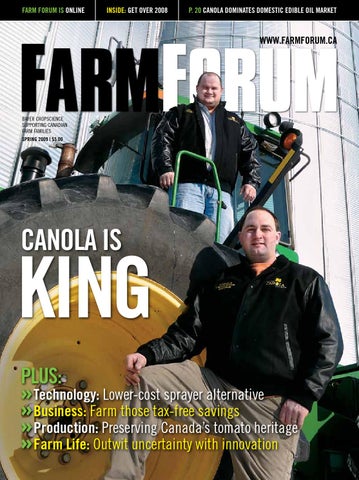
On the cover Mike (front) and Shawn Schill, winners of the Ontario Canola Growers Association’s Canola Challenge yield competition, farm near Arthur, ON. Inside, read the brothers’ top five steps to growing a top canola crop.
Farm Forum.ca | 3
s h o r t ta k e s
There is more on farmforum.ca as you read through this issue of Farm Forum, take the time to explore the additional information for each story that’s available on our website at www. farmforum.ca. For example, if you’re impressed with Mike and Shawn Schill’s achievements with their canola crop in Ontario, the links at the end of our cover story will take you to several websites including the Ontario Canola Growers Association and the Ontario Canola Variety Performance Trials so you can quickly review that province’s canola landscape. If Gary Pike’s comments hit home, why not check out the link to the marketing lesson or see what DePutter publishing has to offer? We present several stories and website links for each topic we cover in Farm Forum, ensuring you have access to more than one point of view. For example, our article on TFSAs offer links to three different financial institutions and our heirloom tomatoes story links you to other tomato growers and places to source seed. We gather and place these links at the end of each story to allow a continued, well rounded look that extends beyond print. Simply visit www.farmforum.ca and follow the links. You can also open the pdf of Farm Forum located on the website and click the links at the bottom of each article. Either way provides you with more information quickly. Thank you for reading Farm Forum and viewing the extra material on the website. By the way, how are we doing with our new format and website? Please let us know at farmforum@bayercropscience.com. FF
4 | Farm Forum | Spring 2009
Editor’s Note Wow! It’s been quite a winter right across the country. Just about every day we either battled bad weather ourselves or heard reports about record amounts of snow, brutal cold, wicked storms or treacherous driving conditions. After all that, I’m sure spring can’t come fast enough for most. The one good thing about a long winter is the amount of time you have to plan for your next crop. In this issue we have some great stories designed to help that process along. Our cover story lays out the ragsto-riches tale of canola, from its introduction 35 years ago to its rise to king of the Canadian edible oils market and primary cash generator for many Canadian growers. Also, the winners of the Ontario Canola Growers Association’s Canola Challenge yield competition share their five tips for growing a top-notch crop of canola. Tax season is just around the corner and it always makes me stop and think about the state of my financial affairs and in particular, of how little savings I have tucked away. In this issue we explain the ins and outs of the new tax free savings account (TFSA) program that came into effect in January. Innovations are also sprouting in the field of sprayer technology. You have all kinds of options today — from hiring custom operators to buying your own high-clearance self-propelled sprayer. But lower-cost pull-type sprayers deserve a second look too. Find out why on page 6. When it comes to marketing, the old adage that “if you fail to plan you plan to fail” rings true. Our business story on page 16 provides tips on how to plan a successful marketing strategy in these turbulent economic times. Also on the topic of success, in this issue’s farm life story the Quebec cowinners of the 2008 national Outstanding Young Farmers’ program award share their secrets. FF
You can’t afford not to have Raxil® fighting for you. It’s the most effective opponent of smut in wheat, barley and oats. It delivers a one-two-punch to both seed and soil-borne Fusarium. And the best of all, it packs an impressive economic punch. For about $3/ac you can expect returns over $20/ac*. How’s that for a knockout?
*Calculations of NET RAXIL BENEFIT is based on CWB PROs as of January 22, 2009, an average yield increase using Raxil Seed Treatment (calculated from 1999 – 2003 Bayer CropScience, Gustafson + Independent trials, 33 replications in both wheat and barley trials taken to yield), and an average input price of $3.00 per acre of Raxil Seed Treatment. www.bayercropscience.ca or 1 888-283-6847 or contact your Bayer CropScience representative. Always read and follow label directions. Raxil® is a registered trademark of Bayer CropScience. Bayer CropScience is a member of CropLife Canada.
Farm Forum.cA | 5 02/09-8750H
Technology
Pull-types offer a lower-cost sprayer alternative By Scott Garvey
Purchase price was the main reason Larry Blaney decided to buy a new suspended-boom pull-type sprayer for the 2008 season. Until then, the Halton, ON grain grower had outsourced his herbicide application work to custom operators. “They did everything they could to accommodate me,” says Blaney. But outsourcing wasn’t the best fit for his operation. He still needed to do small jobs or touch-up work and bringing in custom operators wouldn’t have been profitable for them. The other option — buying his own self-propelled (SP) sprayer — didn’t pencil out, so he opted for a suspended-boom, pull-type model instead. He hasn’t looked back. In fact he’s noticed increased interest among area farmers in these sprayers. “Guys are starting to look back at pulltypes,” he says. The significantly lower cost of pull-types is one reason for this renewed interest, especially by farmers like Blaney, whose operation can’t support the large investment required for a SP model but who want to get away from a reliance on custom operators.
In fact, economics is the driving force 1,600 gallons, some suspended-boom behind pull-type sprayer sales all across pull-types now carry up to 2,400 gallons. the country. The market is price-driven, And the range of options offered by pullsays Ken Avery, a sales associate with type sprayer manufacturers rivals those Watrous New Holland in Watrous, SK. available on high-clearance SP models. But like all equipment, pull-type spray“The difference of $100,000 or more ers have their limitajust isn’t worth it (for tions. They generally some),” he adds. at lower speeds. A new high-clearance A new high-clearance operate And with a tractor out SP sprayer can easSP sprayer can easily front, they can’t keep up ily cost $175,000 US or to SP models on the road more, while pull-type cost US$175,000 or between fields, either. suspended-boom spraymore, while pull-type Suspended-boom ers cost just $35,000 sprayers and tractors just 50,000 US. That’s a big suspended-boom don’t allow for the kind difference. Extra maintesprayers cost just of under-body clearance nance cost for SP models SP high-clearance mais another consideration, US$35,000 - 50,000. chines have. That can while pull-types extend limit their use in mature the use of your farm tractor and eliminate the need to transfer crop stands, which could be critical if fungicide applications are important later in GPS equipment between machines. Today’s suspended-boom pull-type the season. “Purchase price is only part of it,” says sprayers are now available with much larger tank capacities than SP models. Although Matt Hays, CEO of Equipment Technoloa few SP units are available with tanks gies, maker of the Apache high-clearance holding up to sprayer line. A lower-priced machine is a bargain only if it can do the job required of it, he explains. So producers using pull-type sprayers may still have to rely on custom operators for lateseason work. “No two farms are exactly alike,” says Grant Griffith, director of primary producers with
Choosing a wider boom is the best way to cover more acres per hour and still get good coverage. Increasing speed is another option but research shows sprayer efficiency decreases as speed rises. 6 | Farm Forum | SPRING 2009
farmforum.cA
Photo (LEFT) courtesy fast sprayers; (TOP RIGHT) courtesy New Holland North America; (RIGHT) Teejet
the accounting firm Meyers Norris Penny. So there is no black and white formula, he adds, for calculating which type of spray equipment is best. Determining how much capital to tie up in one piece of equipment depends on several factors, which may be of different significance for each producer. According to Griffith, farmers need to ask themselves, “What is the cost to have that sprayer in the shed?” And there are different ways to determine that. Measuring the equipment cost on a per-acre or per-bushel basis is a good place to start. Then you can compare that against the expense of having all your spraying done by a custom operator. However, Griffith points out, you also have to consider the likelihood of getting custom operators exactly when you need them. Spraying too late or too early can significantly reduce the effectiveness of herbicides and other crop protection products. Pull-type sprayers have also piqued the interest of some producers who already have an SP sprayer and want to increase their early-season spraying capacity without the expense of buying a second, similar, unit. “That is one of the things we’ve seen,” says Arnie Josephson of Brandt Industries, a Regina manufacturer of grain handling, spraying and other farm equipment. “Spring is the time when you need the most coverage. Having one of each may be the lowest-cost solution for those expanding their acreage.” For Larry Blaney’s operation, the pulltype is a good fit. It avoids maintaining another engine in a machine, like his combine, which spends most of its time in the shed. And along with the lower maintenance and purchase cost, it meets his needs. “With this sprayer, I’m confident I can do as good a job as anybody,” he says. FF for more information visit us online online articles Manual calibration still a necessity www.farmforum.ca/calibrate Go big or go fast? www.farmforum.ca/bigorfast additional resources AB Gov machinery cost calculator www.farmforum.ca/costcalculator AB Gov field sprayer evaluations www.farmforum.ca/sprayerevaluations Apache sprayers www.farmforum.ca/apachesprayer Meyers Norris Penny www.farmforum.ca/mnp Brandt field sprayers www.farmforum.ca/brandtsprayers Top Air sprayers www.farmforum.ca/topairsprayers
The narrow transport width on New Holland’s SF216 pull-type sprayer provides for safe road travel and convenient storage.
Air-induced nozzles offer versatility Regardless of whether you run a self-propelled sprayer or pull-type, you still have to pick the correct nozzles for the job at hand. And today there are more than a few different types to choose from. In fact, the number of options can be a little overwhelming. Prices range from about $10 each for flat-fans to $30 or more for the newer variable-rate, air-induced types. But do the newer, higher-priced nozzles guarantee better performance? “With the older technology you can still do a decent job,” says Brian Storozynsky of the Agricultural Technology Centre in Lethbridge, AB. Dollar-wise, more expensive nozzles won’t necessarily increase your efficiency, he adds. But equipping a sprayer with the highend offerings may be well worth it in some situations. Variable-rate, air-induced nozzles offer significant benefits for large-acre proTeejet’s AirJet1 ducers and custom operators. “Only in the past air-induced nozzle. three or four years could we use a variable-rate controller to its capacity,” says Storozynsky. That’s because in the past, changing spray settings meant changing nozzles to match, resulting in more time setting up and fewer hours in the field. Conventional nozzles are categorized into six classes, from very fine to extra coarse. And, if you need different spray characteristics to get the job done, that usually requires changing from one class to another. But the air-induced varieties avoid the need for multiple nozzles; they can handle a variety of tasks, eliminating nozzle changes and saving time. That allows one operator to cover more acres each season. Air-induced nozzles come in two types: low and high pressure. Low-pressure designs operate at 40 to 60 psi; high-pressure at 60 to 90. Together, they offer drift reductions of 50 to 90 per cent over conventional flat-fans, and are capable of all-round good performance. High-pressure nozzles can even deliver spray volumes greater than seven gallons per acre. That permits a large droplet size while maintaining excellent crop coverage. FF
Farm Forum.cA | 7
business
farm those tax-free savings Use your TFSA to build a tax-free nest egg
ILLUSTRATIONs BY GENEVIEVE SIMMS
By joy gregory
“There’s a lot more to the Tax Free carried forward; withdrawals are never Savings Account (TFSA) than meets the taxable and do not affect federal proeye.” That’s what farm business ana- grams such as Old Age Security or the Child Tax Credit; and inlyst, Reg Shandro, tells come (interest, dividend producers who dismiss and capital gain) earned in the new TFSA because Financial planning a TFSA is not taxed. they know it won’t help is about more than So why not set up them indulge in that faa TFSA? “Since (farmvourite year-end pastime: chasing down tax ers) tend to define income tax deferral. breaks from a tax control perAnnounced in the spective, they may miss 2008 federal budget and in effect since January 1, 2009, the TFSA the fact that financial planning is about allows Canadians aged 18 and older to more than chasing down tax breaks,” accumulate $5,000 a year in a tax-free explains Shandro. Unfortunately, some farmers have personal savings account, regardless of income. As tax programs go, it’s pretty blinders on when it comes to TFSAs. Instraightforward. Unlike RRSPs, contri- deed, from where Shandro sits, there’s not butions are not deductible from taxable much to dislike about the TFSA. It’s a very income but unused allocations can be useful tax vehicle, he says, so take advan8 | Farm Forum | Spring 2009
tage of it if you can. “Due to potential tax liabilities, the lack of succession planning is a big threat in agriculture today—and the TFSA can help turn that around.”
Saving for succession With Shandro’s help, Lloyd and Wendy Laughlin are taking a tough look at where they want their 10,000-plus acre farm near Youngstown, AB to be in the years ahead. “We don’t really have a succession plan in place yet, but we are in what I would call phase I of passing the farm onto our son,” says Lloyd. To ease succession, they’ve set up a limited company to deal with the farm business and Wendy, who handles the savings side of that equation, has been bucking the agricultural trend and putting money into an RRSP. Now, with
farmforum.cA
$10,000 in TFSA contributions available annually between the two of them, they’ll put extra savings aside too. And savings matter, says Regan Bernhard of Humboldt, SK. A certified financial planner with Investors Group, the former farmer and ag machinery salesman counts several farmers among his clientele. He knows a lot of farmers forego RRSPs because they don’t need an RRSP contribution to reduce income and avoid paying tax. But, says Bernhard, “The reality of not planning is that it’s very short-sighted. A TFSA is a great option even if someone does not need the tax deferral benefit.” While half of the Canadians polled in a Harris/Decima poll last summer expressed interest in opening a TFSA in 2009, Bernhard expects farmers will initially shy away from TFSAs, which make more immediate sense to wage earners. Still, he’s hopeful that will change as selfemployed producers start to work the tax-sheltered accounts into more longterm savings strategies. Farmers who don’t have the cash for a TFSA should talk to a financial advisor and consider borrowing against an operating loan before they dismiss the concept, adds Shandro. “It’s about building a tax-free nest egg,” says Bernhard. When facing high input costs and lower commodity prices, the TFSA can provide some balance by helping farmers put something away for themselves. TFSA flexibility is another selling point, since tax-free withdrawals can be used to cover emergencies and the withdrawn amount can be added to any future year’s contribution. While those planning for retirement can use it to sock away money for their old age, younger farmers may use a TFSA to help them save for shorter-term objectives. “The bottom line is that it’s cash that can be used for anything,” says Bernhard. FF for more information visit us online online articles TFSA: savings and succession www.farmforum.ca/succession TFSAs: just the facts www.farmforum.ca/fastfacts additional resources Bank of Montreal TFSA information www.farmforum.ca/BMOinfo Investors Group TFSA information www.farmforum.ca/investorsgroup Manulife Financial TFSA information www.farmforum.ca/manulifeinfo
Put your TFSA to work Canadian farmers will discover the Tax Free Savings Account (TFSA) is as important as an RRSP when it comes to putting money away for the future, says Stewart Anderson, a professional agrologist and chartered financial analyst with Manulife Securities Investment Services Inc. and Anderson Wealth Management in Winnipeg. “Farm producers are able to manage their income tax quite well. But if your income is low, RRSPs aren’t a big advantage since you don’t get a big tax savings now, and withdrawals are fully taxable in the future,” explains Anderson. “For farmers earning high incomes who have maximized their RRSP contributions, then a TFSA is the next best choice.” While TFSAs won’t likely attract a lot of interest in 2009, Anderson’s sure “they’re going to become a very large component of retirement savings as people get more creative and start to understand how to use these accounts to grow wealth.” Accumulate savings. An annual contribution of up to $5,000 may not seem like much now, but think ahead, says Anderson. If you and your spouse each contribute the maximum, you’ll accumulate $100,000 over the next 10 years. And that’s assuming zero growth. Grow your estate. If you already have money you plan to leave to your adult kids, give up to $5,000 of it to them now if they do not have their own cash for a TFSA investment. “Even over a very short number of years, you’ll be able to shelter a lot of income very quickly,” says Anderson. Aim for gain. It’s easy to think about a TFSA in terms of a cash deposit at a bank. Mutual funds, money market funds, guaranteed investment certificates (GICs), publicly traded securities and government and corporate bonds are also eligible. While growth on investments has been low, that could change quickly, says Anderson. “If you look back at history, you see that after every one of these downturns in equity markets, we’ve had some pretty good growth.” Enjoy the flexibility. The TFSA can be used for short-term savings plans to purhcase items such as vehicles or machinery. Any funds withdrawn can be replaced the following year without any penalties or tax implications. This is an advantage over RRSPs. FF Farm Forum.cA | 9
cover story
5 steps to
top canola crops Compare overall average canola yields with those in the top 10 per cent, and you see a wide gap. Some of the difference can be blamed on uncontrollables like soil type and weather, but crop management plays a big role too. Mike and Shawn Schill know all about that. The brothers farm near Arthur, ON, and in 2008 won the Ontario Canola Growers Association’s Canola Challenge yield competition. They achieved an impressive 3,851 lb./ac. (78 bu./ac.) with InVigor 5030. Here are Mike’s top five tips for squeezing maximum yield from available inputs:
1
Know your farm. Know its crop limitations, from low fertility to weed pressures. Know your heat units and pick an adapted variety. Then plan a good fertilizer and crop protection program. If necessary, get advice from an experienced agronomist: it could be the best money you spend.
2
Seed your crop when the land is ready. If soil temperature is right and the weather is good, it’s time to go, regardless of what the calendar says. Keep checking soil conditions, and plant at an even depth across the entire farm. Monitor the weather regularly and try to work around adverse conditions, even though they are so hard to predict. Do not mud your canola in!
3
Manage your crop intensively. Check its progress at all growth stages. Watch for weed pressure, bad weather, developing insect populations, and any diseases that might show up at any time. If you see problems, or hear of any on neighbouring farms, be ready with cost-effective treatments. This is another good time to check with your agronomist.
4
As harvest approaches, continue watching the crop and ask yourself if it is even across each field. If you spot problem areas, you may want to swath or desiccate early to even the crop out and make it easier to harvest. “We like to spray the crop dead, as we do not like swathing,” says Schill. “This also gives us a clean start for early-planted winter wheat.”
5
When harvest time arrives, be ready to go even if the crop isn’t perfectly dry. “We like to start combining early, before we lose crop to shelling from wind, rain or anything else mother nature throws at us,” says Schill. ”We are not scared to start combining at 15 per cent moisture. Quite often in our area, canola gets too dry and we lose yield.” Combine at a proper speed and try not to overthresh: you don’t want more dockage than necessary. Schill aims for 1 per cent and finds this to be his most profitable dockage. Any less, and too much seed goes out the back of the combine.
“Our overall goal,” he concludes, “is to have the highest yield possible — and get a price to match. We use all marketing tools available to us. If you manage a crop to the best of your ability and make a good profit, what more can you ask?” FF
10 | Farm Forum | spring 2009
“Our overall goal is to have the highest yield possible — and get a price to match”
Mike (standing) and Shawn Schill.
Canola is
King By Clare Stanfield
PHOTO by Chris Fertnig Photography
I
t wasn’t so long ago that canola was called the “Cinderella” crop, a reference to the rags-to-riches story of plain old rapeseed turning into the golden girl of edible oilseeds. Indeed, it wasn’t long ago that canola didn’t exist at all— the first commercial variety, Tower, was introduced just 35 years ago in 1974. “Some farmers said it would never grow and that it was bad for the soil,” recalls Sam Barber. He wasn’t one of them. Barber started farming in the 1960s with his brother, Jim and a neighbour. Today, the two brothers crop about 4,800 acres near Innisfree, AB. “Canola has always been there,” he says. And it has. Canola moved rapidly from its early specialty crop status to become a farm staple. In 1986, roughly a decade after its introduction, farmers from Ontario to B.C. grew nearly 6.5 million acres of the crop. In 2008 harvested acres topped 16 million and produced 12.6 million tonnes. It was a record harvest, beating the previous record set in 2007 by 3.1 million tonnes, and there are some who think 2009 production will be higher still. Why is canola breaking all box-office records? On the surface the answer is plain: better genetics, better agronomic practices, better crop protection products and the fact that canola has always been a decent cash crop. Scratch a little deeper,
though, and you’ll find the attitudes and institutions that are the true underpinning of the industry’s remarkable success.
Growing an industry From the start, the flow of information from farmers to agronomists to researchers has been a continuous loop, each feeding into the other to identify challenges and find solutions, be it disease resistance, earlier maturity, a better understanding of nutrients, harvestability— you name it. The goal has always been to find ways to achieve higher yield and quality. “It’s one of the few commodity groups that really works together,” says Phil Thomas, a senior agri-coach with AgriTrend Agrology in Lacombe, AB. He cites the makeup of the Canola Council of Canada’s Canola Production Issues Team as an example. All grower organizations are represented there, along with a member of the council’s board, researchers, crushers, provincial oilseed specialists and industry representatives. “Sure, some members are competitors, but we all sit down, do some brainstorming, identify weaknesses with the crop and say ‘here’s what we have to do.’” “The grower organizations bring a voice to the industry on the research and marketing sides,” says Jim Bessel, senior Farm Forum.cA | 11
PHOTO COURTESY CANOLA COUNCIL OF CANADA
agronomy specialist with the Canola Council of Canada (CCC). “Cooperation within the entire industry is the underlying factor for the crop’s success.”
Growing a crop
12 | Farm Forum | Spring 2009
per acre, well above the OCGA’s target. The Challenge is about testing the limits of intensive crop management, from variety choice to fertility and pest control to harvest techniques. “With the prices last year and the potential margins, growers are a lot more interested in intensive management,” says Hall. Back in the west, that kind of thinking is music to Phil Thomas’ ears. “We’re not even touching the existing genetic potential of canola,” he says, adding that Canadian canola yields, under irrigation, could consistently reach 100 bushels per acre with the right investment in production. “With today’s technology, we could have a two to three per cent yield gain per year,” he says. To put that in perspective, there has been on average only a one per cent yield gain per year from the rapeseed era to today’s canola. For him, it’s about extracting as much value as you can from existing genetics by both getting back to the basics of good agronomic practice, like seed quality, and pushing the boundaries of new technology and knowledge, like nutrient and soil management. The CCC has a program called Growing Great 2015, a plan to take national production to a sustained level of 15 million tonnes per year. “I think that’s achievable,” says Thomas. “Never mind new genetics. Right now, if we really push it on the agronomic side alone, we can achieve that.” FF farmforum.cA
When canola was introduced, growers put it on summerfallow because broad- contribution to overall canola production. On his farm, Barber deals with clay leaf weed control options were limited to pre-plant, incorporated herbicides, like hills and sandy loam. “No-till has baltrifluralin. Nutrient management was anced that a lot; it’s great for the light still more about the broad NPKS brush soils,” he says. “In the 1990s, we were still strokes than the minutiae of boron, cop- summerfallowing 1,200 to 1,500 acres. I per and zinc, and min-till practices were look back now and think, ‘what a waste of money’. Our revenue grew by leaps not widely accepted. The 1980s saw the first hybrids come and bounds when we went to no-till. We on line. That helped yields significantly, should have started 10 or 20 years before but not consistently, and in-crop weed we did. No-till was 50 per cent of the battle control options were as limited as ever. in getting better yields.” Another factor was It wasn’t until the 1990s improved nutrient manwith the introduction of agement. “In the ‘70s we herbicide tolerant (HT) Our revenue grew were told we were mincanola systems that yield by leaps and ing the soil,” says Bessel. and overall crop manage“We’re not doing that ment took a major leap bounds when we any more. We have inforward. went to no-till creased soil tilth and are “If you go back and now building soil struclook at the trend lines, ture, and canola has led we’ve had a steady yield increase since 1995 when the first HT this because it’s given us options with rohybrids were introduced,” says Thomas. tations, fertility and tillage.” These benefits can be seen not only “You could really see a yield increase, across the west but in Ontario too. That and it was dramatic.” Before 1995, national canola produc- province’s 2008 canola crop was nearly tion averaged around the three to five 50,000 tonnes; not a record but a 19 per million tonne mark, once cracking seven cent yield per acre increase over the premillion in 1994. Liberty Link and Round- vious year. And average yield was an imup Ready systems were both introduced pressive 40 bushels an acre. “In the last three years we’ve conin 1995 and, from then through to 2005, production averaged around six to eight tinued to increase average yields,” says million tonnes, barring a couple of diffi- Brian Hall, canola specialist with the cult years in 2001 and 2002 when they Ontario Ministry of Agriculture, Food dipped well below six million. Since then, and Rural Affairs. He attributes that, in national production has never been be- part, to the outreach work done by the Ontario Canola Growers Association low nine million tonnes. “The yield factor is a big change,” says (OCGA), including its Canola Challenge Sam Barber, who has grown all three HT introduced in 2005. “It originated because we were just systems at one time or another. “I can use them to my advantage: they’re a good kind of stuck at 2,000 pounds per acre,” way to break the herbicide groups and says Jeff Kobe, president of the OCGA I can get some very good yields—we’ve and an agronomist at Sprucedale Aggone as high as 45 bushels per acre with romart in Tara, ON, adding that the OCGA’s goal is to bring Ontario’s averthe InVigors.” While canola genetics were steadily age canola yield to 2,500 lb./ac. (about improving, so was knowledge around the 50 bu./ac.). “We are trying to get guys to push benefits of conservation tillage and more things a bit, and see if they could try precise nutrient management. “We’ve seen dramatic changes in tillage different management techniques to imalone,” says Thomas. The improved mois- prove yields.” The 2008 Challenge winture and soil management that came with ners, Shawn and Mike Schill, certainly conservation tillage have made a huge did, achieving a yield of 3,851 pounds
for more information visit us online online articles What’s happening to biodiesel? www.farmforum.ca/biodiesel Marketing canola? Bone up and don’t follow the herd www.farmforum.ca/marketing additional resources Ontario Canola Growers Association www.farmforum.ca/ONcanola Ontario Canola Variety Performance Trials 2008 www.farmforum.ca/canolatrials Canola Council of Canada www.farmforum.ca/canolacouncil Statistics Canada canola acreage and yield www.farmforum.ca/canolastats Canadian Grain Commission report www.farmforum.ca/canolareport Agri-Trend Agrology Ltd www.farmforum.ca/agritrend
Keep on spraying Converge® XT contains a patented safener so you can apply it from pre-plant surface right up to the three-leaf stage of corn.* Converge XT provides the same excellent season-long control of both grassy and broadleaf weeds that you’ve trusted with Converge and Converge PRO. With a new wider window of application, you can keep on spraying and spraying and spraying.
bayercropscience.ca or 1 888-283-6847
*Converge XT is not registered for use in Canada. It is a violation of the Pest Control Act to use this product in a non-registered application. Always read and follow label directions. Converge® is a registered trademark of Bayer. Bayer CropScience is a member of CropLife Canada. 9232-0109
Farm Forum.cA | 13
business
Get over 2008. You’re in a new marketing year As he looked back to last July when soybeans peaked at $15.91 a bushel, grower Leo Guilbeault was more amused than annoyed. Long before the price spiked, the Ontario Soybean Growers chairman forward contracted about 50 per cent of the 2008 crop planted on his 1,700-acre farm near Windsor, ON. So when that price held for less than an hour, Guilbeault wasn’t concerned about what he’d missed; he was weeks away from harvest and already confident his crop was going to make money. “That price was pretty much double what we were getting in 2006/07 and it would have been nice. But thanks to forward contracts, we’re always in a cash-flow situation.” Guilbeault’s story illustrates why market-savvy farmers can relax when others are sweating dollar signs. And the lesson is simple: when it comes to marketing agricultural commodities in turbulent economic times, smart farmers look ahead, says Gary Pike, CEO of the agricultural consulting firm Pike Management Group (PMG). Markets will remain volatile through 2009, predicts Pike, whose clientele typically farm 5,000-plus acres in western Canada. But market forces will prevail after the next 12 to 24 months, he predicts, since the global supply/demand situation for food commodities remains tight. “As farmers cut back production to hold costs down, I can see no increase in supplies over the next two or three years. Once we erode supplies, demand will push prices back up.” But what can Canadian farmers do in the meantime? For Robert Hall, who farms near Deloraine in southwestern Manitoba, it’s pretty much business as usual. While he admits the 2008 market was fraught with more highs and lows than expected, Hall wasn’t all that frus14 | Farm Forum | SPRING 2009
By Joy Gregory
Gary Pike: markets will remain volatile through 2009.
them optimize returns, echo Pike’s assertion that marketing “starts with what goes in the seed drill.” For Guilbeault, that includes taking advantage of IP premiums for soybeans. For Hall, it means going after malting barley prices. And for both, it means crop decisions based on the old-fashioned agronomics that optimize yield. In Hall’s words, “I pay someone to help me find good markets so I can put my expertise into growing the crop.” FF farmforum.cA
trated when canola prices collapsed in the I don’t think that’s going to change a middle of harvest. bit over the long run,” says Pike. Like Guilbeault, he’d already priced His big tip for 2009? Get over 2008. part of his production at levels that “A lot of guys are going through a grievmet his cash flow needs. “As a farmer, ing process. Now they need to get orI haven’t got time to be ganized for 2009.” That watching the markets and means identifying where in 2008, specifically, those to park your business comA lot of guys are markets collapsed when bine. There are farmers going through a we were at our busiest. I who optimize production can’t think of one farmer and adopt a marketing grieving process. who said, ‘I’m stopping plan based on profitable Now they need the combine and I’m getsales; farmers who optiting into the office so I can mize production but lack a to get organized make sure I get my canola marketing plan, and farmfor 2009 sold before the price drops ers who don’t have a proany lower.’” duction or marketing plan. Call it hope or call it greed, the nasty While most farmers are likely in the midtruth behind the steady rise and dramatic dle category, they should look for ways decline of last year’s ag commodity prices to move into the first group. That means is that few farmers sold crops at the peak. locking in returns on investment instead They were holding out for higher prices. of chasing markets, says Pike. “The guys “There’s an old rule of thumb that says who don’t want to miss the last 50 cents 10 per cent of the crop will be sold within are going to lose.” a dollar of the high and 90 per cent will Guilbeault and Hall, who work with be sold within a dollar of the low and different marketing consultants to help
for more information visit us online online articles Choose an advisor who’s right for you www.farmforum.ca/advisor additional resources Don’t hold out for the price peak www.farmforum.ca/marketinglesson Pike Management Group www.farmforum.ca/agcoach DePutter Publishing www.farmforum.ca/deputter Farms.com Risk Management www.farmforum.ca/riskmanagement Ontario Soybean Growers www.farmforum.ca/ONsoybeangrowers
Photo courtesy pmg
>> Good marketing math makes money As huge market fluctuations complicate decisions on where and how to sell your crops, many farmers turn to industry newsletters or consultants for help in sorting through the many choices. And why not, says Horst Bohner, a soybean specialist with the Ontario Ministry of Agriculture, Food and Rural Affairs. “You can’t be an expert on everything, and farmers need to focus on growing crops.” At Blythe Bray Farms near Woodstock, ON, a full-time farm manager handles the field work. That leaves Valerie Hobbs and her mom, Sharon, more time to plan their sales before, during and after harvest. They like cash markets for their soybeans, edible beans, corn and winter wheat, and work with a futures broker to lock in prices if cash opportunities aren’t there. Typically, they base their choices on data gleaned from a market news and analysis website that puts them in touch with the events that drive markets. It’s about dollars and cents, says Scott Lees of Soderglen Ranches in Airdrie, AB. When Soderglen increased its cattle feeding and grain operation five years ago, the business became more reli-
ant on forward contracts and futures protection. Lees talks to market consultants and brokers on a weekly basis. Keeping close to markets is critical when you have price swings of 10 to 30 per cent, he says. Back in southwestern Ontario, corn, soybean and winter wheat grower John Johnston, says he subscribes to market info services and keeps a good working relationship with elevator contacts because he needs to know his options. With lots of on-farm storage, he figures his marketing season is 18 months long. So he’ll hold crop on-farm but wants some assurance it’ll make him money. Farmers who don’t think they can afford to pay for a quality market information subscription service, or marketing advice specific to their farm, may be adding up the wrong set of numbers if they only focus on the service price, says Robert Hall, a canola farmer from Deloraine, MB. He’s heard farmers dismiss outside help that will cost them $3 an acre. Hall looks at profit. “If I can make an extra 25 cents a bushel on a 30-bushel crop of canola, I’ve got $7.50 in additional profit per acre.” FF
Farm Forum.cA | 15
Production
Savour that old-time tomato taste The story behind heirloom varieties shows how the tomato plant has adapted to prairie conditions By Jennifer Barber
Tomatoes are one of the most talked-about crops among gardeners across the country. Growers like to share stories about their successful — or catastrophic — tomato experiences. So what’s the secret to a successful crop? Some say you’ll find the key by looking at very old (heirloom) tomato varieties. toes on the prairies is that they buy seeds Jim Ternier grows open pollinated to- that weren’t intended for the region,” matoes along with other crops in his two- he says. “While these seeds are easily acre garden on the grounds of St. Peter’s available, they have been mass produced Abbey in Humboldt, SK. The long-time in other areas of the Americas or in grower also owns Prairie Garden Seeds, Europe, and are just not proven in our an online seed catalogue business. He growing conditions.” primarily sells heirloom varieties but also some commercial lines if proven in Canadian gardens. “The rule of thumb with heirloom va- The plant originated in Central and South rieties is that they are more than 50 years America, but the first tomatoes grown in old,” he says. “That rule is flexible, but Canada likely arrived here with Europewhat doesn’t change is the history of the an settlers. There are stories, however, of seed. People have saved these seeds for First Nations people using seeds brought decades and the varieties remain true from Central America. and local.” Initial results were disappointing beTernier explains that tomatoes are cause those early tomato lines weren’t easy to grow when you pick a variety that hardy enough for the Canadian climate. has been bred for the environment you’re “The first true Canadian variety was degrowing them in. “One of the reasons veloped at the Dominion Research StaWorld famous in Yuanyang people haverice hadterraces trouble growing County toma-in Yunnan, tion inChina. Ottawa in the early 1900s,” says
Growing appeal
16 | Farm Forum | Spring 2009
Ternier. “Called Alacrity, it really spearheaded interest in developing breeds for Canadian gardens. Hybrids eventually became more popular with commercial growers because of their uniformity, high yield and ease of transport. Heirloom tomatoes are grown almost entirely by backyard gardeners as their nature makes them unsuitable for large scale commercial production. They tend to be associated with organic growers, and while that is often true, it’s not always the case. “I usually try one or two heirlooms in my own garden every year — just to see how big a tomato I can grow,” says Kevin Twomey, co-owner of T&T Seeds, a mainstream seed retailer and garden supplier just outside Winnipeg, MB. Twomey says heirloom varieties are gaining in popularity, but they aren’t one of his top sellers. “A lot of the interest comes from the
How does your tomato grow?
fact that they are fun to grow,” he says. “One of the heirlooms we sell, Monster, does very well on the prairies and gives a very good tasting tomato. But they don’t produce a lot of fruit and many of our customers want a bigger yield.” He says that pretty much every gardener has a favourite tomato. “Whether you go with an heirloom or a hybrid depends on what you are looking for,” he says. “We carry 30 or more types of tomato and we get new varieties every year. Here, we sell more of the new things than the old things.”
Saving Seeds
An advantage of heirloom tomatoes is that anyone can save seeds for the next growing season. According to Ternier, this helps produce a truly local variety for very specific conditions after only
One reason for growing heirloom tomatoes is simply that they are among the most interesting plants in the garden. Tanya Stefanec is one of those backyard gardeners who says she started her seed business because she had to find a way to support her obsession with the countless different tomatoes she would plant each year. “We have a long history of growing heirloom tomatoes in my family. My grandmother grew them, as did my mother. And once I started, I just became passionate about the incredible differences between one variety and another,” she says. Her Heritage Harvest Seed is a mail order business based in Carman, MB. It specializes in rare and endangered vegetable, flower and herb varieties. Stefanec, a horticulturist, now grows and sells about 160 tomato varieties, with support from backyard growers across the country. She says some heirlooms produce extra-large tomatoes that are bigger than many gourds. One popular variety from her catalogue is the Quebec Meme Beauce which produces a large true red tomato that customers say is one of the best tasting they’ve tried. But it’s not the biggest tomato she sells. That honour belongs to Omar’s Lebanese Tomato that produces a fruit bigger than a slice of bread. Stefanec says size is not the only extraordinary characteristic to be found among heirloom varieties. For example, a German tomato called Reisetomate is one of her most visually unusual. “The only way to describe it is to say it looks like a bunch of fused cherry tomatoes. It’s interesting to look at and fun to eat.” She adds that ornamental tomatoes such as the Silvery Fir Tree are gaining popularity because of their fern-like foliage and early, good sized fruit. “Indian Stripe is also a very popular variety and is known as a black tomato,” she says. “In fact, it is a quite lovely purplish colour with faint green striping.” She says heirloom growers across the prairies are always interested in sharing the more unusual and interesting tomatoes in their gardens, in the hope of keeping some non-traditional varieties alive. FF
a few seasons. “It’s very simple to save your seeds,” he says. “First you need to make sure you have a perfectly ripe tomato — the best looking of the bunch. Then you cut the fruit in half and scoop out as many ripe seeds as possible.” Next step is to let the seed extract ferment for around three days until it is obviously decaying. Then, strain the seeds, wash them well, and place them in a container of water. The poor quality seeds, pulp and skin will float at the top and the rest will sink to the bottom of the container. Then the seeds can be dried and put aside until planting time in the spring. “I am happy that people are becoming more and more interested in growing their own food,” says Ternier. “But for heirlooms, part of the appeal is in their story.” And when he grows those seeds he always keeps that piece of Canadian history in
mind. “By looking back to see what was grown successfully in the past, we can decide if it is worth taking a second look at these rare older tomato varieties.” FF farmforum.cA
©iStockphoto.com/ Funwithfood
From black and white to striped and spotted, heirloom tomatoes have visual appeal
for more information visit us online online articles Fruits of the prairies www.farmforum.ca/prairiefruit Cataloguing history www.farmforum.ca/seedlibrary additional resources Prairie Garden Seeds - tomato family www.farmforum.ca/prairiegardenseeds T&T Seeds online catalogue - tomato seeds www.farmforum.ca/T&TSeeds Seedy Saturdays - buy/swap heirloom seeds www.farmforum.ca/seedysaturdays History/listing of Canadian-bred tomatoes www.farmforum.ca/tomatohistory Heritage Harvest Seeds tomato catalogue www.farmforum.ca/heritageharvestseeds Seeds of Diversity’s Canadian tomato seed inventory www.farmforum.ca/tomatoseedinventory Farm Forum.cA | 17
bayercropscience.ca or 1 888-283-6847 or contact your Bayer CropScience representative. Always read and follow label directions. Velocity™ m3 is a trademark of Bayer. Bayer CropScience is a member of CropLife Canada.
One SOlutiOn. The Crop Science Investigation team tracked the weed killer across the prairies. It wasn’t difficult – New Velocity™ m3 left an easy to follow trail of brilliantly clean wheat fields, only dead grassy and broadleaf weeds remained. Velocity m3 was undeniably the ideal herbicide for wheat growers; with its advanced chemistry, three modes of action and full spectrum weed control it was like nothing they’d ever seen. They couldn’t help but admire its ruthless efficiency. See the evidence for yourself at www.theonesolution.ca
02/09-9019-05A
production
canola dominates domestic edible oil market By scott garvey
Photo caption Record 2008 canola production is meeting strong demand in both domestic and export markets.
In their search for profit, western Canadian farmers have been increasingly looking to canola. In 2008 that translated into an extra half-million seeded acres. The Canola Council of Canada is hoping growers’ love affair with the yellowflowered crop holds. To ensure an adequate supply to meet future demands by the edible oils market, the council has launched its Growing Great 2015 program, which aims to boost annual Canadian production and sales to 15 million tonnes by 2015. “(In 2008) we had record yields on top of record acreages,” says Chris Anderson, the council’s vice president of crop production. With just over 16 million acres seeded in 2008, that means total producWorldstretched famous rice in Yuanyang County tion toterraces 12.6 million tonnes, justin Yunnan, China.shy of that 2015 target. 2.4 million 20 | Farm Forum | spring 2009
Much of that hoped-for increase in pro- Crushing plants operated at 97 per cent duction is expected to feed the expanding capacity last year. Despite these numbers, oilseed crushing industry in Canada. “The domestic crushers processed only about goals for 2015 are split between exports 40 per cent of Canada’s 2008 production. Most canola still heads to and domestic crush,” says the export market. Anderson. “The expectaThe driving force beMuch of that tion is we’ll have 7.5 milhind the move to canola lion tonnes enter our dohoped-for increase as an edible oil is the mestic crush.” in production is health benefits it offers. With nine facilities in saturated fats, crushing canola now, and expected to feed the Itandis low is also seen as a reseveral more expected to expanding oilseed placement for partially come on line within the hydrogenated oils, which next few years, the docrusing industry contain trans-fats. mestic market for canola in Canada And if that were not is growing. By the end of enough, Asian demand November, 2008, Canadian crushers had processed 3.83 million for vegetable oils is rising. It seems you tonnes of raw seed. That figure was up by can’t talk about any commodity market 13 per cent over the same period in 2007. these days without mentioning China,
Photos (LEFT & RIGHT courtesy Bayer CropScience; (TOP RIGHT) ©istockphoto.com/ Sapsiwai
After difficult weather conditions during the 2005 growing season, many Ontario farmers turned their backs on canola. Restoring their faith in the crop hasn’t been easy. “It’s a hard sell,” says Carrie James, general manager of the Ontario Canola Growers Association. Very hot weather downgraded quality of the 2005 crop. As a result, farmers had to settle for lower prices that cut deep into profit margins. That in turn led to a decline in seeded acres from about 50,000 in 2005 to less than 20,000 in 2006. “We increased a lot in 2008, but we were in recovery mode,” adds James. “There are growers that walked away from growing canola,” says Brian Wiley, a producer in Grey County, ON. After a disappointing season in 2005, and lured by the prospect of attractive margins on soybeans, Ontario farmers have since turned much of their attention to that crop. One reason for those attractive margins was the lower input costs associated with soybeans. Sky-high fertilizer prices at the start of the 2008 season put further pres-
it attractive as well,” he adds. That’s another reason canola has become the oilseed of choice for domestic crushers. With superior coldweather properties, canola has excellent potential as the base oil to meet provincial and federal biodiesel content mandates due to come into effect over the next three years. But has this increase in demand for canola oil translated into tangible benefits for growers? “Locally, we’ve always been in a crusher’s area so we have seen that advantage,” says Ed Schaffer, a canola producer at Makwa, SK. Having a local crusher has translated into increased returns. “Money you’d spend on freight, you’d see that in increased price,” says Schaffer. And the local crusher has been offering a price incentive. “There’s probably been a 20 cent premium,” he adds.
With crushers focusing on producing edible oils, seed quality is of primary concern. “They’ll pay more, but in return they demand a good product,” says Schaffer. As additional crushing plants come on line over the next few years, more producers are likely to see price advantages. “The law of supply and demand applies here as well,” says Ruest. “It will give (producers) increased delivery options.” But will the increased demand pressure all farm gate canola prices upward? “I think it will,” says Ruest. FF farmforum.cA
which has seen its annual per capita cooking oil consumption skyrocket from 6 kg to 17 kg in a decade. Although China’s edible oil consumption was flat in 2008, the market is expected to rise by another five per cent over the next five years according to Wang Yinji, general manager of the China Vegetable Oil Co., who presented those numbers in an address to the China International Conference of Seed Crushers last October. These market factors haven’t been lost on North American grain companies like Richardson International, which has a new canola crushing facility under construction at Yorkton, SK. “We wouldn’t be investing if we didn’t think the future was bright (for canola oil),” says Jean-Marc Ruest, vice president of corporate affairs and general counsel. “Its use in the biofuels market make
for more information visit us online online articles Energy content key to meal market growth www.farmforum.ca/meal Expanding crush capacity fuels biodiesel sector www.farmforum.ca/biofuels additional resources The Canola Council of Canada www.farmforum.ca/canolacouncil Richardson Oilseed Processing www.farmforum.ca/richardsonoilseed Canadian Oilseed Producers Association www.farmforum.ca/COPA Ontario Canola Growers Association www.farmforum.ca/OCGA Bunge Canada www.farmforum.ca/bungecanada
sure on canola acreage in Ontario. And earlier this year continued uncertainty over fertilizer prices had many Ontario growers still sitting on the fence with their 2009 seeding plans. Jeff Kobe, president of the Ontario Canola Growers Association, says focusing on yield improvements may be the way to boost canola Marketing options boost Ontario canola acres production in Ontario in the short term. “We’re not going to pick up another 200 or 300 plant. “What’s winning growers back to canola growers,” he says. And with buyers canola is that there are (marketing) options willing to pay premiums for some varieties now,” says Wiley. Prior to Bunge’s reopenof lower-input soybeans, that may be true. ing, the ADM plant in Windsor was the only “There are so many other crops that pro- major buyer in the region. With 2008 seeded acreage near the ducers can grow,” adds Kobe. But one thing that seems to have en- 60,000 mark, clearly a few Ontario growers couraged some previous growers back are seeing opportunities in canola again. to canola is Bunge Canada’s decision to “If the economics are there, farmers will resume crushing the crop at its Hamilton grow it,” says Wiley. FF Farm Forum.cA | 21
fa r m l i f e
They outwit uncertainty with innovation By Jennifer Barber
Passion and perseverance drive these Outstanding Young Farmers to succeed Keeping pace with a constantly changing industry is key to running a successful hog operation. Marco Couture and Lyne Groleau, of St-Rémi de Tingwick, QC, say their love of the land, combined with good products, a meticulous work ethic and a team that’s aware of their challenges have all helped keep their operation thriving. Last November, Lyne and Marco were named 2008 national co-winners of Canada’s Outstanding Young Farmers’ (OYF) program. The couple first met while studying agriculture and maintained their connection to the farm after graduation. Lyne grew up on her family’s swine and dairy farm in St-Rémi de Tingwick, then after she finished school she joined the dairy side of the business. During that period Marco worked as a dairy and crop consultant. In 1992 the opportunity came to make Lyne’s family farm their own. “One day my father came to us and told us that he was putting the farm up for sale,” says Lyne. “We knew right away that we wanted to accept the challenge of making (a living from farming) and building a family at the same time. We did a lot of research and decided that we would take on the hog business.” Their first step was the formation of Porcherie Marigro, a 180-sow farrowto-finish operation. They gained experience selling their stock to local processors and decided they could mitigate some market risk by selling directly to consumers. In 2004, after four years of study into pork production standards, and after carefully examining their market expectations, they built what is now a successful on-farm processing facility called La Jambonnière. “We wanted to remain a small company, so we chose to diversify rather than just get bigger,” says Lyne. They realized a processing facility could help overcome market challenges while sta22 | Farm Forum | SPRING 2009
Lyne with the Jambonnière team: Morin and Stéphanne Palardy France bilizing income and ensuring a quality product for their customers.
the farm gives them a clearer picture of what type of food is found on their plate. It can also clear up misconcepAdvocates for tions about our inagriculture dustry.” To help the community They realized a Many of their understand more about co-op students have processing facility the ins and outs of a hog no practical experioperation, Marco and could help overcome ence with hog opLyne decided to create market challenges while erations when they an open-door policy to begin their 12-week stabalizing income and stint. But by the end, their farm. They actively encourage visitors, offer ensuring they put out they have had their tours to student groups hands on all parts of a quality product for and also hire co-op stuthe process. “They dents every year. learn all the work their customers “We’ve discovered on the farm — feedthat this is a great way of ing, mating, weighing promoting our agriculture,” says Lyne. pigs, care of piglets at birth and even “Visitors to our farm say that listening accounting,” says Lyne. “We had the to people like us speak about pork pro- opportunity to be interns when we duction and explain our processes on were in school, so we can now give
back what we received.” “To grow each of their enterprises, (the 2008) OYF winners began with a priority of maximizing herd productivity, and from there the opportunities are endless,” says Richard Stamp, president of OYF. “(Lyne and Marco) have made the important decision to use their operation to help others understand agriculture — school children and rural visitors alike — an activity that may well be as vital to the future of agriculture as the products they produce.” While Lyne and Marco work closely on all aspects of their business, they split up the work. Lyne manages the production side of the farm and Marco manages the processing facility. “This makes for better management of work,” says Lyne. “However, good communication is essential and we do not hesitate to be there for each other if the need arises.” Since they took over the farm, they’ve made tremendous gains in the number of weaned pigs per sow from 17.9 in 1993 to 27.4 in 2008. They now have two fulltime employees on the livestock end, while the processing facility has 10 employees and five seasonal workers. In addition, the couple’s five daughters, aged 10 to 16, participate in the day-to-day operation of the farm. “Our strength is teamwork, whether in the home, farm or market. Our daughters give us a hand in all areas,” says Lyne. “At the market our customers really like talking with the girls — they have a great deal of knowledge about what we do and how pork can be prepared.” farmforum.cA
PHOTOS COURTESY LYNE GROLEAU AND MARCO COUTURE
A family affair
The couple hope their daughters will follow in their footsteps someday, but say they will respect what their children decide. Whichever career paths they choose, they hope they bring as much satisfaction as their own careers in agriculture.
Looking forward One of the ongoing challenges for Lyne and Marco has been managing waste. The Quebec government imposes tough manure dis-
posal regulations. To address this, Lyne and Marco have manure-spreading agreements with two of their neighbours. Looking to the future, the couple believe the environment will continue to be an important consideration. “We want to be a company that is the envy of all — a dynamic and at the same time, profitable venture,” she says. “We expect to process all the pigs that come from our breeding program, and we want to emphasize product quality.” FF
Lyne, Marco and their girls clockwise from bottom left: Audrey (9), MariePier (16), Cynthia (15), Caroline (15), and Marie-Eve (13)
for more information visit us online additional resources OYF National Winners information www.farmforum.ca/OYFnationalwinners OYF nomination criteria www.farmforum.ca/nominationinfo La Jambonnière www.farmforum.ca/lajambonniere Farm Forum.ca | 23
Light years ahead.
The first new mode of action in cereals in more than 20 years. New Infinity™ represents a giant leap forward in broadleaf weed control. Infinity belongs to an entirely new group of herbicides (Group 27) that provides superior control of the toughest weeds in Western Canada – including Group 2resistant weeds. It is a simple and flexible broad spectrum solution that gives you infinitely better control in wheat, durum and barley.
Explore more at Lightyearsahead.ca bayercropscience.ca or 1 888-283-6847 Always read and follow label directions. InfinityTM is a trademark of Bayer. Bayer CropScience is a member of CropLife Canada.
07/08-6392-03F